







Abstract
Public stigma toward people with prison records hinders re-entry initiatives. Although it is widely discussed in corrections, its measurement has been study specific. Based on existing literature, we develop and test a multidimensional public stigma scale. We examine the factor structure and dimensionality of the scale using a Qualtrics Panel sample of U.S. adults (N = 1,216) and exploratory and confirmatory factor analyses, which show that 17 of the 20 proposed scale items produce a four-factor structure, including danger/distrust, dehumanization, dispositional crime attributions, and social/emotional distance. We assess construct validity by testing the relationship between public stigma and theoretical antecedents and expected support for policy outcomes. Results show that public stigma is positively related to belief in evil and racial resentment and negatively related to personal and vicarious arrest experiences. It is also positively related to support for disenfranchisement and punitive policies and negatively related to support for rehabilitative policies.
Introduction
In his seminal 1963 book, Notes on the Management of Spoiled Identity, Goffman described stigma as a discrediting trait that makes one a reduced, tainted, and discounted individual without full social acceptance. In the context of criminal justice, a key concept is the public’s stigmatizing attitude toward currently or formerly incarcerated people, also known as public stigma (Hirschfield & Piquero, 2010). Public stigma often results in individuals returning from prison bearing “sticky” labels as immoral and criminally deviant (Becker, 1963) and has important implications for postincarceration life. For example, the public’s stigmatizing beliefs may undergird exclusionary social policies limiting housing, education, employment, and other social benefits for people with prison records (The Council of State Governments, 2017). Stigma also has implications for understanding the public’s support for felon disenfranchisement and punitive or rehabilitative criminal justice policies (e.g., Burton, Cullen, Burton, et al., 2020).
Several theoretical perspectives may explain the formation of public stigma. Psychologists hypothesize that belief in evil may lead people to perceive people who have been incarcerated as unreformable evildoers who deserve harsh treatment (Campbell & Vollhardt, 2014; Webster & Saucier, 2013). Criminological and sociological research demonstrates that that racial resentment motivates public stigma (Jackl, 2021; Lehmann et al., 2020), as does political conservatism (Dum et al., 2022; Hirschfield & Piquero, 2010). Conversely, personal or vicarious experiences with the justice system may lead to less stigmatization of individuals with prison experience (Hirschfield & Piquero, 2010; Jackl, 2021).
Despite the practical and theoretical importance of public stigma, existing studies rarely share a common approach to measuring stigma. However, there are at least three benefits to having a general and unified measure of public stigma. First, measuring stigma consistently across different studies can help clarify which predictors are most relevant to shaping public stigma (Denver et al., 2017). Second, by understanding the underlying predictors of public stigma, policymakers can craft targeted policies to improve the reintegration of formerly incarcerated people. Third, a validated survey measure can tie public stigma to a broader literature, including studies that utilize parallel concepts but do not use the term “stigma.”
In this study, we construct a multidimensional scale to measure public stigma. We conceptualize stigma based on a review of existing measures of stigma toward currently or formerly incarcerated people and identify five key dimensions: danger and distrust, social distance, dehumanization, dispositional crime attributions, and negative emotion. We develop a 20-item scale, use data from a Qualtrics Panel (QP) sample to investigate the discriminant and convergent validity of the scale using factor analyses, and assess the construct validity of the scale by examining its relationships to theoretical antecedents and policy support outcomes. The result is a 17-item scale measuring public stigma.
Public Stigma in Existing Criminal Justice Research
To develop a unified public stigma scale, we reviewed literature in a few different lines of research, including attribution style, employers’ decision-making, punitiveness, attitudes toward people who are convicted of sex crimes, and vignette survey research testing public support for specific re-entry policies, as well as research in two papers summarizing prior measures of stigma in criminal justice research (Martin et al., 2020; Rade et al., 2016). To our knowledge, the only study that has explicitly examined public stigma using an index was by Hirschfield and Piquero (2010). They developed their measure based on a 32-item Attitudes Toward Prisoners (ATP) scale created by Melvin et al. (1985) and identified perceived dangerousness, perceived dishonesty, and attitudinal social distance as the main components of public stigma. Accordingly, they used four items to measure public stigma: (1) Most people who have been incarcerated are dangerous, (2) Most people who have been incarcerated are dishonest, (3) I would avoid associating with anyone who has recently been incarcerated, and (4) It would be a big deal if one of my neighbors was incarcerated (Hirschfield & Piquero, 2010, pp. 38–39). 1 The scale has also been used in more recent studies (e.g., Dum et al., 2022; Overton et al., 2021).
Based on the Hirschfield and Piquero (2010) dimensions and a thorough review of stigma-related criminological literature, we identified five related dimensions that may comprise public stigma toward individuals with prison experience: (1) danger and distrust, (2) social distance, (3) dehumanization, (4) dispositional attribution, and (5) negative emotion. Table 1 presents the survey items comprising various scales used to measure stigma and related concepts in the studies identified by our literature search. We organize the scales first by general attitudes toward people in prison and then by items that relate to each specific dimension (within each dimension, we arrange the studies chronologically). For each, we develop a set of items to include as a subscale in our proposed measure of stigma. The result is a 20-item scale.
Overview of Survey Questions Measuring Public Stigma Toward People With Criminal Records
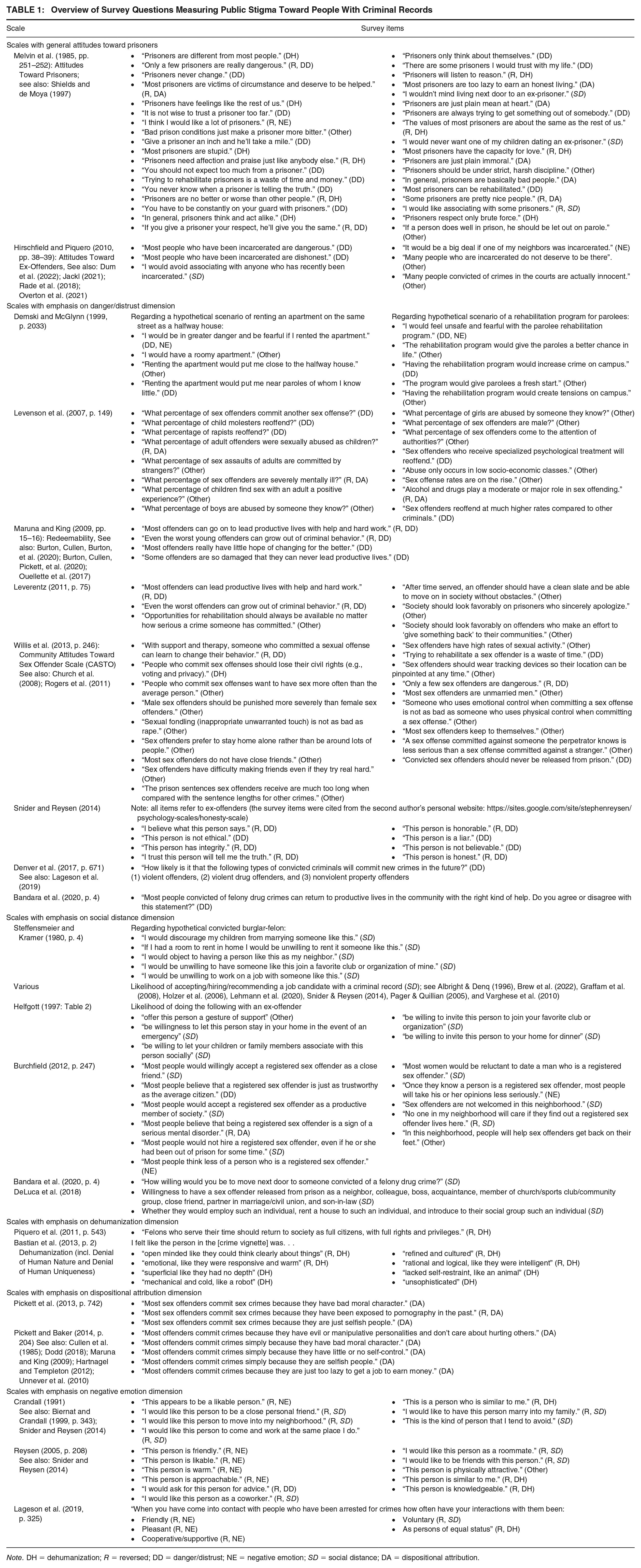
Note. DH = dehumanization; R = reversed; DD = danger/distrust; NE = negative emotion; SD = social distance; DA = dispositional attribution.
Dangerousness and Distrust
The first dimension we propose refers to perceptions of people with criminal records as dangerous and untrustworthy. Hirschfield and Piquero (2010) identified both perceived dangerousness and dishonesty as the key components of public stigma. Although Hirschfield and Piquero distinguish danger and distrust, our review of the literature suggested that trust may reflect concerns about future dangerous behavior (e.g., Melvin et al., 1985; Willis et al., 2013). More generally, concerns about future dangerousness are consistent with the public’s tendency to overestimate the prevalence of violent crime and to stereotype “offenders” as violent and inclined to recidivate (Roberts & Stalans, 1998).
Turning to Table 1, themes of dangerousness and distrust are common in the literature. Survey instruments have asked whether respondents believe people in prison are dangerous, will ever change, or can be trusted (e.g., “You never know when a prisoner is telling the truth”; Melvin et al., 1985). Other research centers on evaluations of whether people with criminal records are honest or dishonest (Snider & Reysen, 2014) or perceived recidivism risks (Lageson et al., 2019). Similarly, research on attitudes toward people convicted of sex crimes examines beliefs that such individuals can change or successfully re-enter society (Willis et al., 2013) and beliefs about recidivism (Levenson et al., 2007). Researchers assessing “redeemability” have likewise focused on dangerousness and trustworthiness by asking whether people with criminal records can lead normal, productive, and law-abiding lives (Burton, Cullen, Burton, et al., 2020; Burton, Cullen, Pickett, et al., 2020).
Overall, themes of dangerousness and distrust center on perceptions of whether people who are incarcerated or formerly incarcerated are dangerous, untrustworthy, likely to reoffend, or unable to rejoin “law abiding” society. We propose four survey items to assess perceptions of dangerousness and distrust: (1a) most people in prison are dangerous, (1b) most people in prison cannot be trusted, (1c) most people in prison could not go on to live normal lives if they were released, and (1d) most people in prison would commit more crimes if they were released.
Social Distance
Social distance is another key component in Hirschfield and Piquero’s (2010) measure of stigma. It may manifest in a range of avoidance behaviors including employers’ aversion to criminal records, neighbors’ unwelcomeness to people who are formerly incarcerated, and families’ rejection of persons who return from prison (The Council of State Governments, 2017). Social distance also taps the behavioral aspect of perception measurement (see Ferraro, 1995).
As Table 1 indicates, prior studies have measured respondents’ social avoidance in different scenarios. Researchers have asked whether members of the public would disqualify job applicants due to their criminal records (Albright & Denq, 1996), avoid people with prison records as co-workers (Reysen, 2005), be willing to live near or make friends with people who are formerly incarcerated, or allow their children to date people with prison records (Melvin et al., 1985). We propose four survey items to measure preferences for social distance: (2a) I would not want to work with a person who had been in prison, (2b) I would not want to live near a person who had been in prison, (2c) I would not want to be friends with a person who had been in prison, and (2d) I would never be willing to date a person who had been in prison.
Dehumanization
Decades ago, Tannenbaum (1938) posited that a criminal label leads the public to view the stigmatized as evil. Becker (1963) described the labeling of criminal stigma as a master status leading to general degradation of the labeled individual. Such evaluations of people with criminal records align with the psychological concept of dehumanization, referring to perceptions of outgroup members as less than human. Measuring dehumanization, Bastian et al. (2013) assessed respondents’ denial of the human nature and human uniqueness of hypothetical defendants in “crime vignettes”. Research suggests the public commonly dehumanizes people with criminal records (Vasiljevic & Viki, 2013).
In criminological work, researchers have asked respondents if “prisoners have feelings like the rest of us” and if “prisoners have the capacity for love” (Melvin et al., 1985, p. 251). Researchers have also asked respondents if they think people with criminal records are similar to them (Reysen, 2005) and perceive people who have been arrested as “persons of equal status” (Lageson et al., 2019). Studying people who are convicted of sex crimes, researchers have asked respondents if they should have access to various human rights (Willis et al., 2013). Drawing primarily on the dehumanization scale of Bastian et al. (2013), we propose four items to assess respondents’ dehumanization of incarcerated people: (3a) People in prison can be emotional, responsive, or warm (reversed); (3b) people in prison are cold and mechanical, like robots; (3c) people in prison lack self-restraint, like animals; and (3d) people in prison are unsophisticated.
Dispositional Attribution
Another theme in public stigma is a belief that currently or formerly incarcerated individuals are simply bad people. Criminological research has examined whether people attribute offending to individual dispositions (i.e., stable or enduring traits that predispose people to commit crimes) or situational influences (i.e., environmental factors that promote people to commit crimes) (Pickett & Baker, 2014; Unnever et al., 2010). Dispositional attributions are particularly stigmatizing in that they represent the view that incarcerated individuals have problematic traits that predispose them to criminality.
Accordingly, research often asks respondents whether they attribute the cause of the crime to personal moral failings, such as people with criminal records being selfish, lazy, and having low self-control (Pickett & Baker, 2014). Likewise, Melvin et al. (1985) asked whether respondents believe “Prisoners are just plain immoral” and “Most prisoners are victims of circumstance and deserve to be helped” (reversed). Pickett et al. (2013) assessed perceptions that people who are convicted of sex crimes are monstrous and incurable, as well as whether people commit crimes because they are “just selfish people.” We propose four survey items to measure the extent to which people make dispositional crime attributions: (4a) most people in prison committed crimes because they have little have little or no self-control, (4b) most people in prison committed crimes simply because they have bad moral character, (4c) most people in prison committed crimes simply because they are selfish people, and (4d) most people in prison committed crimes because they are just too lazy to get a job to earn money.
Negative Emotion
In addition to evaluative assessments, stigma also encompasses emotional responses to stigmatized individuals, including fear (Demski & McGlynn, 1999) and dislike (Crandall, 1991). Various studies have incorporated emotion-related statements. Some focus on feelings of warmth (or a lack thereof) toward people who have been incarcerated. For example, Melvin et al. (1985) asked respondents whether they agreed that they would “like a lot of prisoners” (reversed). Reysen (2005) asked respondents to evaluate the “likeability” of people with criminal records. Demski and McGlynn (1999) asked whether respondents would feel fearful or unsafe living next to a halfway house. We propose four survey items to measure negative emotions: (5a) I would be afraid to be around someone who had been in prison, (5b) I would be upset if a person who had been in prison moved into my neighborhood, (5c) I think I would like a lot of people who are in prison (reversed), and (5d) I feel disgusted by people who are in prison.
Current Study
Our review of the literature on stigmatizing attitudes toward those with prison records suggests five key dimensions of public stigma, including dangerousness and distrust, social distance, dehumanization, dispositional attribution, and negative emotion. Drawing on this literature, we propose a 20-item multidimensional scale measuring public stigma. In what follows, we assess the validity of the proposed scale and demonstrate its utility.
Method
Data
We tested the proposed public stigma scale using a 2021 survey disseminated via Qualtrics Panel (QP). QP uses quota sampling to send out online survey invitations and provides responses from opt-in survey panelists. Potential respondents receive email invitations to participate in surveys in exchange for small payments. Our sample was representative of the US population on gender, race, age, and region. QP panels produce samples that are diverse, as well as representative demographically and politically (Boas et al., 2020) and provide higher-quality data than online crowd-sourcing platforms like MTurk (Zack et al., 2019). Relational inferences derived from online opt-in samples may mirror those from nationally higher-representative samples (Ansolabehere & Schaffner, 2014).
In all, 1,260 respondents started our survey, and 1,216 respondents completed all relevant measures. 2 As we discuss in more detail below, we also split the sample randomly into two subsamples (with 601 and 599 complete responses, respectively) to perform exploratory and confirmatory factor analyses (CFAs). The sample demographics mirror those of the U.S. population. In the full sample, 71% of the respondents are White (compared to 79% nationally), 49% are male (compared to 49% nationally), and 41% have a 4-year college degree or higher education (compared to 32% nationally). For each part of the analysis, item missing data were addressed via list-wise deletion. Descriptive statistics are shown in Table 2. Note that multi-item indices measuring antecedents and policy outcomes (i.e., belief in evil, racial resentment, punitive policy support, and rehabilitative policy support) are provided in full in Supplemental Appendix A (available in the online version of this article).
Descriptive Statistics
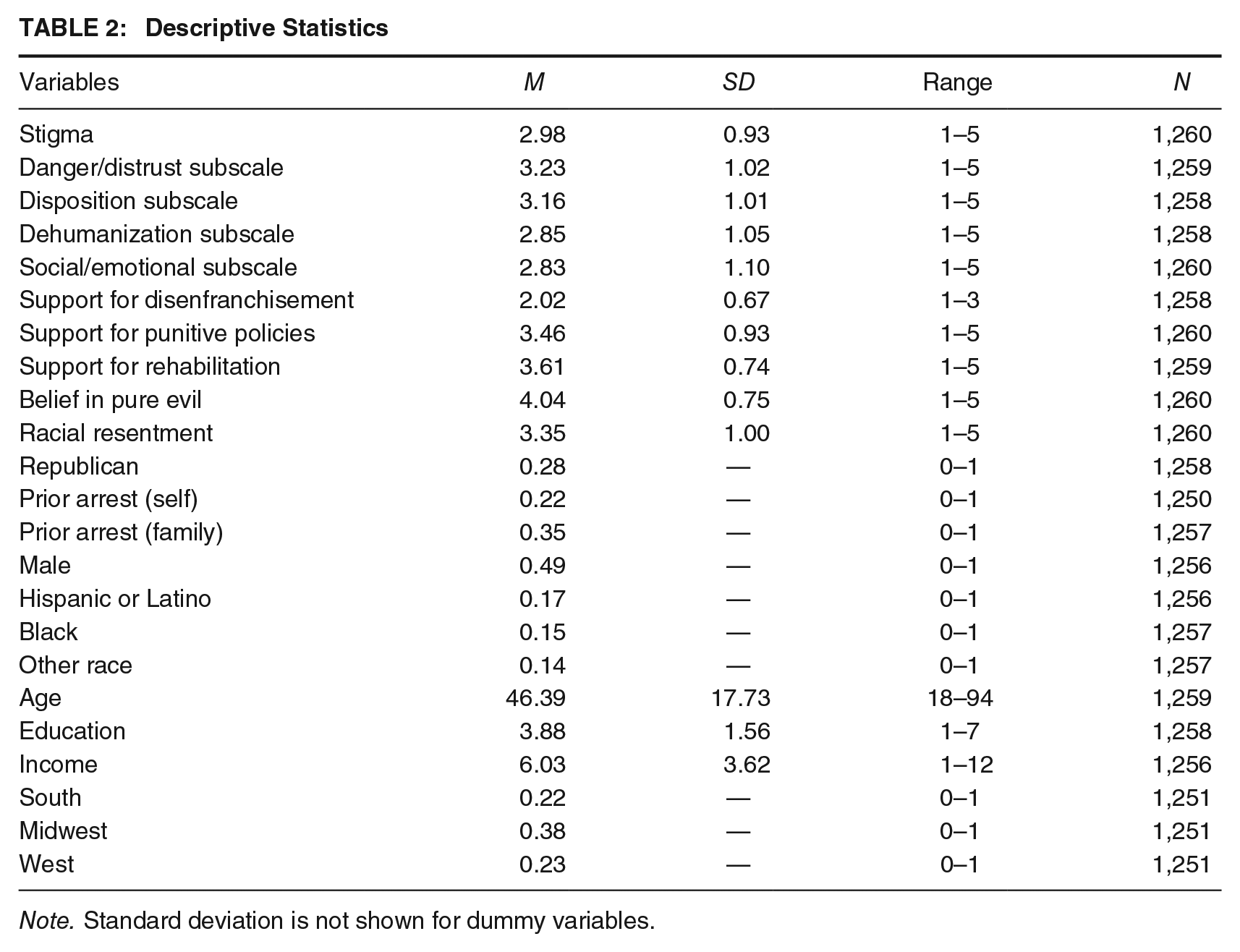
Note. Standard deviation is not shown for dummy variables.
Measures
Stigma
The survey included the 20 items proposed to measure stigma based on five theorized dimensions: dangerousness, dehumanization, dispositional attribution, negative emotions, and social avoidance. For each item, respondents were asked to indicate their agreement on a 5-point scale (1 = Strongly disagree to 5 = Strongly agree).
Antecedents to Stigma
The survey included measures of five theoretical antecedents to stigmatizing attitudes toward people who are current or formerly incarcerated. Belief in pure evil refers to the belief that some people are irredeemably evil and predicts punitive and stigmatizing attitudes toward justice-involved individuals. It is measured using a 5-item index adapted from Campbell and Vollhardt (2014). An example item is “There are people in this world who are evil.” Racial resentment describes the denial of structural and institutional barriers to achievement for individuals of color in the United States and is linked to a host of stigmatizing and punitive attitudes toward justice-involved individuals (e.g., Jackl, 2021). It is measured with the 4-item index used by Enns and Ramirez (2018). An example item is “Irish, Italians, Jewish, and many other minorities overcame prejudice and worked their way up. Blacks should do the same without any special favors.” Political ideology may predict stigmatizing attitudes as well (e.g., Pickett & Baker, 2014). To measure conservatism, we asked respondents to identify their political party affiliation (1 = Republican, 0 = other). We also consider the roles of personal and vicarious arrest experiences, as more contact with justice-involved individuals is associated with less stigma (e.g., Dum et al., 2022). We measure personal arrest experience (1 = prior arrest, 0 = no prior arrest) and family arrest experience (1 = immediate family member with prior arrest, 0 = no immediate family member with prior arrest).
Consequences of Stigma
We measure three expected consequences of stigma, including support for disenfranchisement, punitive policy, and rehabilitation. Support for disenfranchisement by asking respondents which of the following voting rights policies were most appropriate: convicted felons should not lose their right to vote at all (=1), convicted felons should lose their right to vote only until they have completed their sentence (=2), and convicted felons should permanently lose their right to vote (=3) (Burton, Cullen, Burton, et al., 2020). We measure punitive policy support with an index asking respondents to indicate their support for three punitive policies, adapted from Pickett and Baker (2014). An example item is “Making sentences more severe for all crimes.” We measure support for rehabilitation using a 5-item index adapted from Burton, Cullen, Burton, et al. (2020). An example item is “It is important to try to rehabilitate adults who have committed crimes and are now in the correctional system.”
Demographics
Gender is coded Male = 1, female or nonbinary = 0. Race is coded using dummy variables for Black and Other Race (with White excluded as a reference category). Ethnicity is coded 1 = Hispanic or Latino, 0 = not Hispanic or Latino. Education is coded ordinally, from 1 = Less than high school to 7 = Doctorate. Annual household income is also coded ordinally, from 1 = Less than $10,000 to 12 = More than $150,000. Age is calculated from birth year and is coded numerically. Region is coded using dummy variables for residence in the South, Midwest, and West (with residence in the Northeast excluded as a reference category).
Analysis Plan
The analysis proceeds in two parts. First, to assess the convergent and discriminant validity of the scale items, we examine its factor structure and dimensionality. Both exploratory factor analysis (EFA) and CFA are beneficial for scale development (Flora & Flake, 2017). Although EFA is preferred in the early stages of scale development, CFA is preferred as a subsequent step “after the underlying structure has been tentatively established” (Brown, 2015, p. 41). To avoid capitalizing on chance relationships within a single sample (Flora & Flake, 2017), we employ a split-sample approach. In one half of the sample (“Split Sample 1”; after list-wise deletion, N = 601), we conduct EFA using principal axis factoring and use promax (i.e., oblique) rotation (Costello & Osborne, 2005). We then use the remaining half of the sample (“Split Sample 2”; after listwise deletion, N = 599) to conduct a CFA to test whether the factor structure suggested by the EFA is appropriate for the novel items.
The second part of the analysis focuses on construct validity. We examine the extent to which the stigma scale is associated with theoretically relevant antecedents and policy preferences. We estimate an OLS model predicting the full stigma scale from the theoretical antecedents, then estimate the models predicting each of the policy outcomes from the stigma scale. We also present supplemental analyses examining each proposed subscale and whether stigma mediates relationships between theoretical antecedents and policy preferences. All models assessing construct validity use the full sample (N = 1,216).
Results
EFA (Split Sample 1)
The first part of the analysis constitutes EFAs of the proposed items using principal axis factoring with promax rotation. Our preliminary analyses indicated that the two reverse-coded items failed to load on the appropriate factors. Specifically, item (3a) (“People in prison can be emotional, responsive, or warm”) and item (5c) (“I think I would like a lot of people who are in prison”) loaded together on a distinct factor with loadings of .565 and .544, respectively. 3 Neither item had a loading of more than .109 on any other factor. Reversed items loading on a single factor is a common problem in factor analysis and such factors are often not substantively meaningful (e.g., Marsh, 1996). To investigate this finding, we conducted supplemental CFAs as suggested by the literature. However, a model in which the error covariances were correlated for the reversed items (see Brown, 2015) had poor fit (root mean square error of approximation [RMSEA] = .103, Tucker–Lewis Index [TLI] = .878, comparative fit index [CFI] = .857, standardized root mean square residual [SRMR] = .164), while including a “method factor” for the reversed items (see Lindwall et al., 2012) resulted in a model that did not converge. As such, we follow the suggestion by Marsh (1996) to view the reversed items as useful in disrupting inattentive responding but exclude them from the scale and subsequent analyses.
We next conducted an EFA including only the 18 nonreversed items. For the most part, the items appeared to load meaningfully (with factor loadings ranging from .350 to .852) onto four factors corresponding to the danger/distrust, dehumanization, and dispositional attribution factors, as well as a combined factor reflecting both negative emotions and social avoidance. One item (item (1d), factor loading = .337) cross-loaded onto a fifth factor, while a second item (item (1c), factor loading = .387) loaded solely on this fifth factor. We speculate that item (1c) (i.e., “Most people in prison could not go on to live normal lives if they were released”) may have failed to load on the expected factor (danger/distrust) because some respondents viewed formerly incarcerated individuals as unable to “live normal lives” due to stigma, discrimination, or other structural barriers to re-entry. Given this potential interpretation, we also removed item (1c) from the scale and subsequent analyses.
Table 3 presents EFA results using the remaining 17 items. 4 This analysis produces a four-factor structure (note that factor loadings <0.3 are not shown). Here, items (1a), (1b), and (1d) load on a factor corresponding to danger/distrust (with factor loadings ranging from .505 to .813). Items (3b) to (3d) load on a factor corresponding to dehumanization (with factor loadings ranging from 0.494 to 0.585). Items (4a) to (4d) load on a factor corresponding to dispositional crime attributions (with factor loadings ranging from 0.389 to 0.794). Items (2a) to (2d) as well as items (5a) and (5c) load onto a factor corresponding to negative emotions and social avoidance (with factor loadings ranging from 0.518 to 0.853). We interpret this factor as reflecting a preference for emotional and social distance. Not only do negative emotional responses drive preferences for social distance from stigmatized people (Jahnke, 2018), but desire for social interaction may be grounded in emotional reactions to the perceived character or “warmth” of others (e.g., Fiske et al., 2007).
Exploratory Factor Analysis of Stigma Items (N = 601)
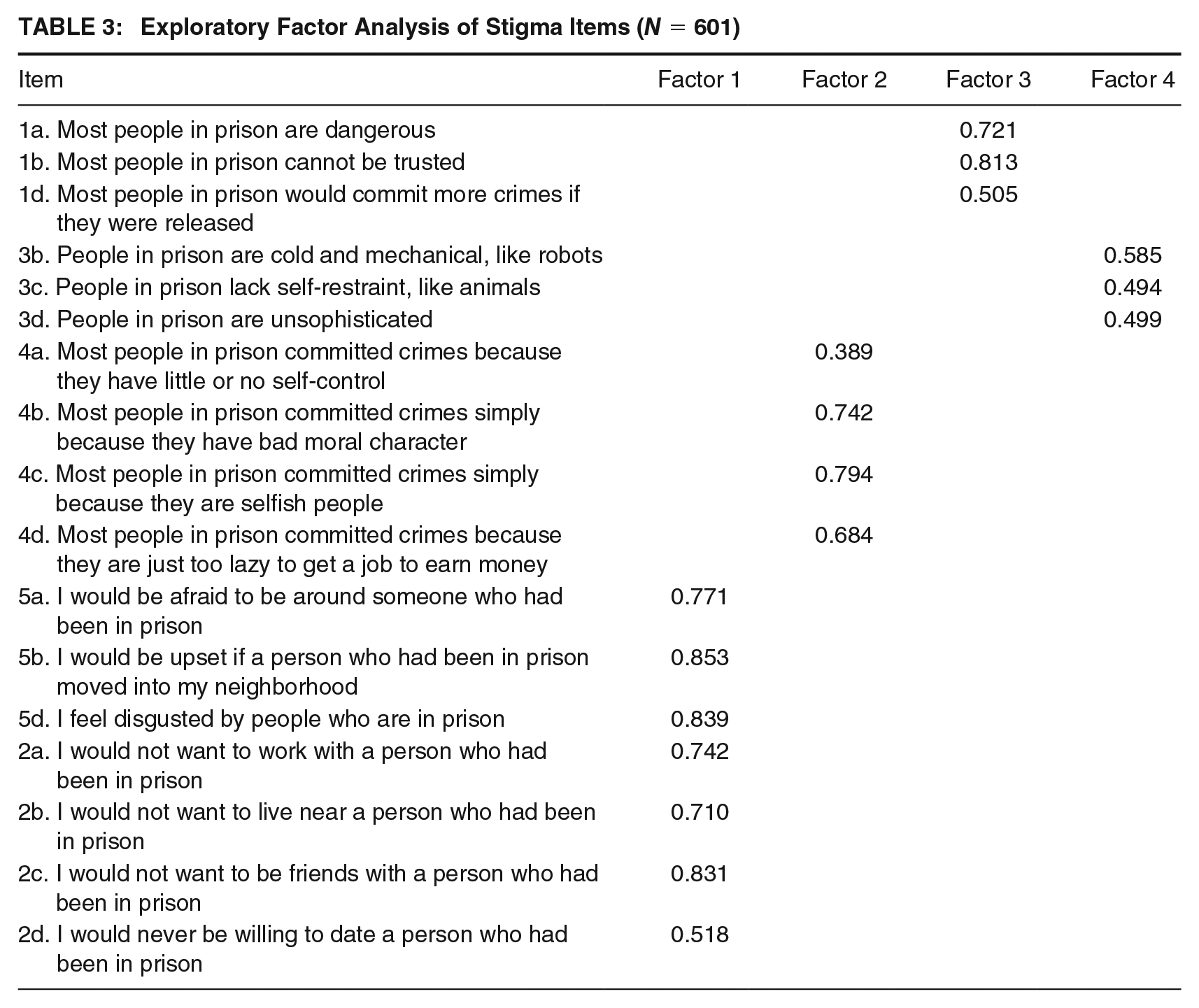
The results also showed variation in factor loadings within each subscale. In the danger/distrust subscale, factor loadings were highest for items directly asking about danger (1a, loading = 0.721) and distrust (1b, loading = 0.813), but lower for the item asking about recidivism (1d, loading = 0.505), perhaps reflecting a distinction between behavioral expectations and perceptions of individual characteristics. In the dispositional attributions subscale, items measuring bad moral character, selfishness, and laziness as explanations for offending (4b–4d) had high factor loadings (ranging from 0.684 to 0.794), while the item measuring low self-control as an explanation (4a) had a lower factor loading (0.389). While bad moral character, selfishness, and laziness are inherently negative dispositional evaluations, it may be that low self-control has fewer negative connotations. In the social/emotional distance subscale, factors loadings were generally high (ranging from 0.710 to 0.853), except for item (2d) (loading = 0.518), which asked whether respondents would ever be willing to date a person who had been in prison. One reason may be the item wording (a strong “never” as opposed to the “would not want” phrasing in the other items). Another reason may be that respondents in relationships may be unwilling to date anyone else, regardless of their stigmatization of people who are formerly incarcerated.
The four subscales identified by the 17-item factor analysis are all strongly correlated, with correlations ranging from 0.628 (dispositional attributions and social/emotional distance) to 0.682 (danger and dispositional attributions). Thus, we interpret the results of the EFA as evidence that the proposed items comprise a multidimensional scale with four dimensions: danger/distrust, dehumanization, dispositional attributions, and social/emotional distance.
CFA (Split Sample 2)
To confirm the factor structure suggested by the previous analyses, we use CFA. We use the results from the EFA conducted in Split Sample 1 to form the basis for our a priori assumptions about the factor structure of the data, and test that factor structure in Split Sample 2 using CFA. Specifically, we assess the model fit for a four-dimensional scale of stigma, in which the four factors suggested by the EFA are entered as correlated latent variables. Each item is specified to load only on the expected factor.
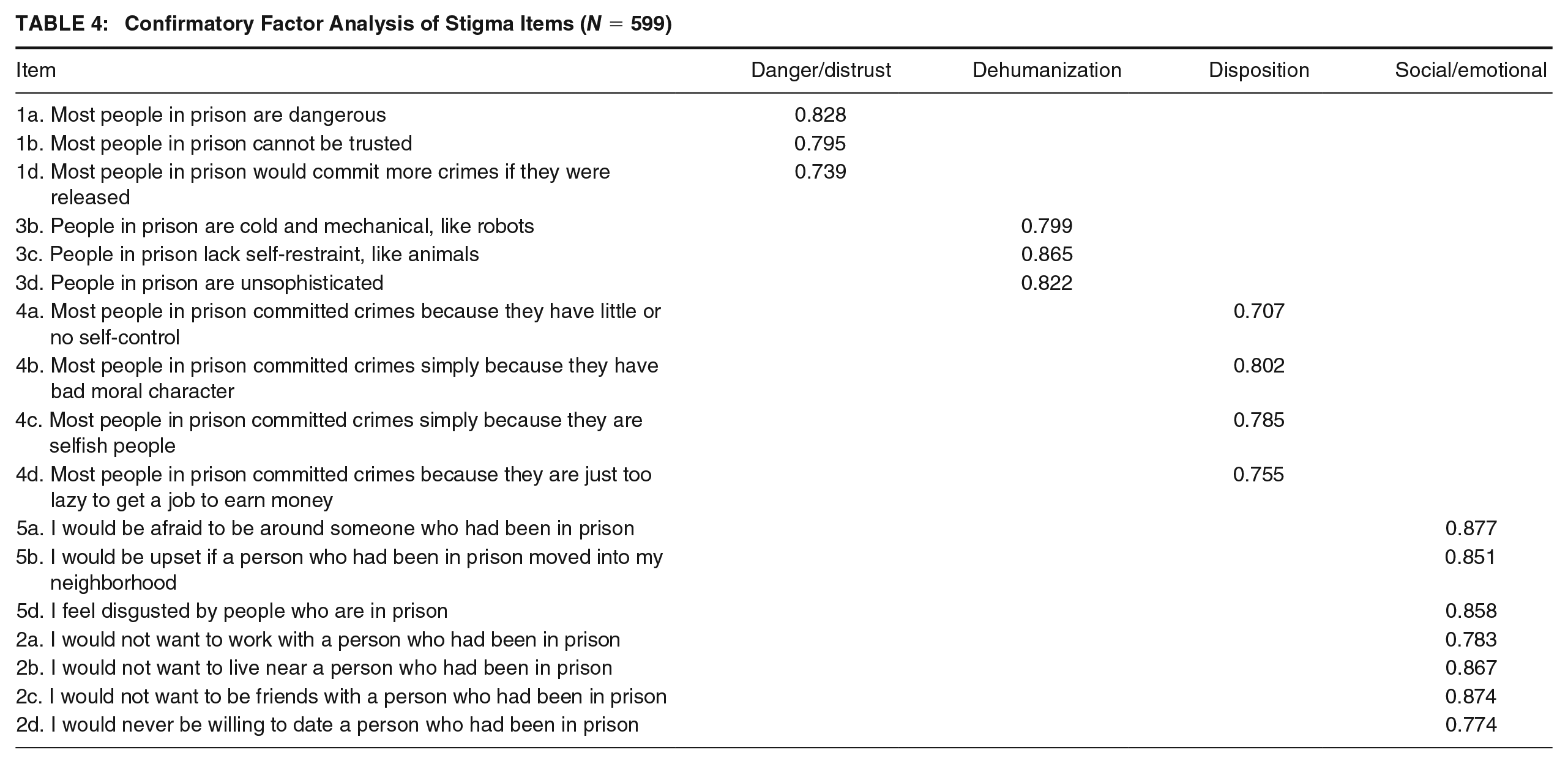
Table 4 presents the results of the CFA (standardized factor loadings are provided). Overall, this analysis supports the four-factor model indicated by the EFA. In Table 4, items (1a), (1b), and (1d) load on a factor corresponding to danger/distrust (with factor loadings ranging from 0.739 to 0.828). Items (3b) to (3d) load on a factor corresponding to dehumanization (with factor loadings ranging from 0.799 to 0.865). Items (4a) and (4d) load on a factor corresponding to dispositional attributions (with factor loadings ranging from 0.707 to 0.802). Items (2a) to (2d) as well as items (5a), (5b), and (5d) load onto a factor corresponding to social/emotional distance (with factor loadings ranging from 0.774 to 0.877). Goodness-of-fit statistics also indicate that this model fits the data well: RMSEA = .060 (90% confidence interval [CI] = [0.053, 0.067], CFI = 0.968, TLI = 0.961, SRMR = 0.032).
Confirmatory Factor Analysis of Stigma Items (N = 599)
Construct Validity (Full Sample)
To test the construct validity of the proposed instrument, we created a multidimensional stigma scale by averaging responses to the 17 items retained in the factor analyses (alpha = 0.954). The average score in the full sample was close to the midpoint of the 5-point scale (in the full sample, M = 2.982, SD = 0.925). Table 5 shows regression models predicting stigma from theoretical antecedents and controls (Model 1), as well as regression models predicting policy outcomes from stigma (Models 2–4). The model predicting the three-point disenfranchisement item is estimated using ordinal logistic regression. The other models use OLS regression.
Regression Models Predicting Stigma and Support for Policies Involving People With Prison Records (N = 1,216)
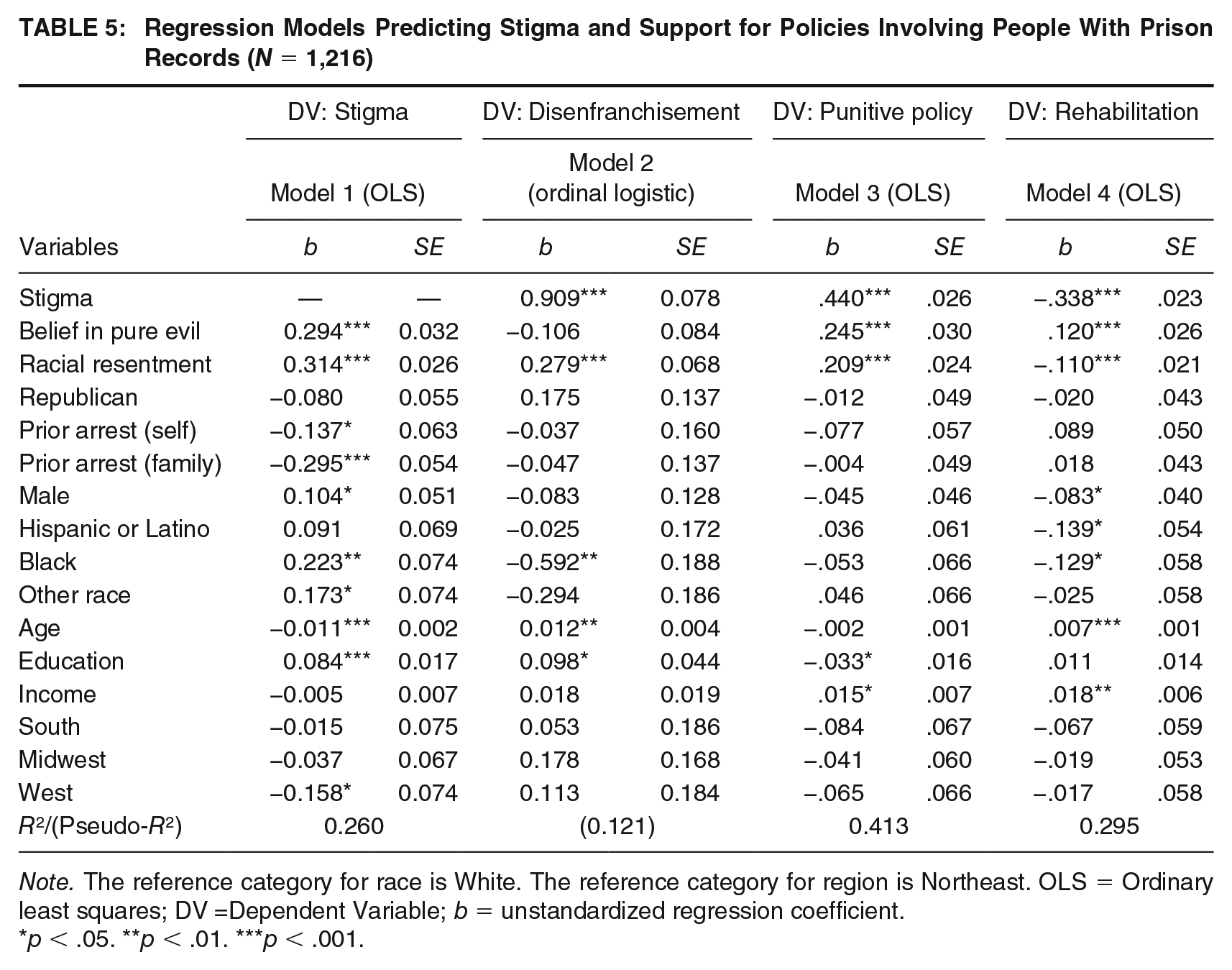
Note. The reference category for race is White. The reference category for region is Northeast. OLS = Ordinary least squares; DV =Dependent Variable; b = unstandardized regression coefficient.
p < .05. **p < .01. ***p < .001.
Beginning with antecedents to stigma, Model 1 indicates that stigma is positively associated with belief in evil (b = 0.294, p < .001) and racial resentment (b = 0.314, p = < .001) and is negatively associated with personal arrest (b = −0.137, p = .031) and family arrest (b = −0.295, p < .001). Although Republican identity is not significantly associated with stigma in the current model, ancillary analysis indicates that it has a positive and significant relationship with stigma (b = .128, p = .029) when belief in evil and racial resentment are excluded. 5
Turning to support for policy outcomes, the next set of models likewise show expected relationships between stigma and policy support outcomes. Stigma was strongly associated with support for disenfranchisement in Model 2 (b = 0.909, p < .001), support for punitive policies in Model 3 (b = 0.440, p < .001), and reduced support for rehabilitative policies in Model 4 (b = −0.338, p < .001). All effects were in the expected directions. Altogether, the results from Table 5 indicate that theoretically relevant antecedents to and outcomes of stigma are largely associated with the proposed stigma scale in expected ways, providing evidence of construct validity.
Supplemental Subscale Analyses
Exploratory subscale analyses further demonstrate the utility of using a multidimensional scale in examining stigma (see Supplemental Appendix B, Tables B1 and B2 [available in the online version of this article]). In Supplemental Table B1, the stigma subscales are generally predicted by similar antecedents to the full scale, including racial resentment and belief in evil (each predictive of all four subscales), as well as family arrest experiences (predictive of all subscales except dehumanization). However, in Supplemental Table B2, differences emerge in the relationship of each dimension with policy preferences: Danger is associated with disenfranchisement and punitive policy, dispositional attributions are associated with punitive policy only, and dehumanization is associated with reduced support for rehabilitation only. Only social/emotional distance is associated with all three policy outcomes.
Supplemental Mediation Analyses
Key theoretical antecedents to stigma, including belief in evil (e.g., Webster & Saucier, 2015), racial resentment (e.g., Enns & Ramirez, 2018), political conservatism (e.g., Pickett & Baker, 2014), and arrest experiences (e.g., Dum et al., 2022) are also established as important predictors of criminal justice policy preferences, suggesting the possibility that public stigma may mediate the effects of these variables on policy support. We test mediation using the KHB program in Stata (see Kohler et al., 2011). Results indicate that the full stigma scale mediates the effects of belief in evil (indirect effect b = 0.268, p = .007), racial resentment (b = 0.285, p = .004), and family arrest experiences (b = −0.269, p = .007) on disenfranchisement; the effects of belief in evil (indirect effect b = 0.129, p = .007), racial resentment (b = 0.138, p = .004), and family arrest experiences (b = −0.130, p = .006) on punitiveness; and the effects of racial resentment (indirect b = −0.106, p = .004), and family arrest experiences (b = 0.100, p = .007) on rehabilitation. For belief in evil there is a suppression effect in predicting rehabilitation (b = −0.099, p =.007). Neither Republicanism nor personal arrest exerted indirect effects on policy support via stigma.
We also considered the extent to which each subscale mediates the effects of antecedent variables. We entered the four subscales as simultaneous mediators, then examined the percent of the indirect effect that is attributable to each subscale. As before, in predicting support for disenfranchisement, belief in evil (indirect effect b = 0.246, p = .017), racial resentment, (b = 0.264, p = .011), and family arrest experiences (b = −0.296, p = .004) are mediated by the stigma subscales. For each variable, social/emotional distance accounts for the largest share of the effect (44% for belief in evil, 52% for racial resentment, and 69% for family arrest experiences). For punitiveness, belief in evil (indirect effect b = 0.152, p = .002), racial resentment (b = 0.159, p = .001), and family arrest experiences (b = −0.119, p = .015) are again mediated by the stigma subscales. For belief in evil and racial resentment, the largest share of the effect is attributable to dispositional crime attributions (41% for belief in evil and 43% for racial resentment), while the largest share of the effect for family arrest experiences is attributable to social/emotional distance (35%). In predicting support for rehabilitation, racial resentment (b = −0.097, p = .010) and family arrest experiences (b = 0.101, p = .007) were again mediated by the stigma subscales, while a suppression effect was observed for belief in evil (b = −0.093, p = .013). The largest share of indirect effects for racial resentment and family arrest experiences were attributable to social/emotional distance (43% for racial resentment; 61% for family arrest). The largest share of the suppression effect for belief in evil was attributable to dehumanization (38%). 6
Discussion
The issue of public stigma toward criminal justice populations has long been an important area of inquiry, yet the measurement of stigma has remained varied and study-specific. To develop a unified stigma measure, we reviewed existing literature. Using a quota-based national online sample, we tested 20 items measuring these domains. Results of EFA and CFA resulted in a 17-item scale with four distinct, but correlated, subscales: danger/distrust, dehumanization, dispositional attributions of blame, and social/emotional distance. Assessments of construct validity using the 17-item stigma scale showed statistically significant links to anticipated theoretical antecedents and policy outcomes.
Altogether, these analyses illustrate the three proposed benefits of having a general, unified measure of public stigma. First, the results clarified which predictors are most useful in shaping public stigma. Belief in both pure evil and racial resentment were significant predictors of the multidimensional stigma measure and each of the four subscales. As such, we demonstrate that denial of structural sources of racial disparity predict public stigma, consistent with work showing racial resentment predicting negative attitudes toward those with prison records (e.g., Lehmann et al., 2020). Likewise, rigid views about the world being a place of good versus evil corresponds with public stigma, adding to prior work on the links between strong dualistic views and opposition to rehabilitation (Webster & Saucier, 2013). Vicarious criminal justice experience predicted less stigmatizing attitudes on the full scale and three of the four subscales. The effect of one’s own prior arrest and political identification were not as consistent. Together, the results suggest that symbolic views shape public stigma more so than personal experiences with the justice system. Insomuch as symbolic views are more ingrained and stable, breaking the link between these views and public stigma may be more effective for gaining support for compassionate criminal justice policies than altering these more fundamental views.
Second, the results linking stigma to policy outcomes also demonstrate the utility of the scale and point to areas of action. The subscale of social/emotional distance significantly related to all three policy outcomes. This behavioral aspect of perception measurement could be addressed through greater awareness of successful examples of re-entry. Personal and family arrest experience reduced belief in the social/emotional subscale of stigma (also danger/distrust subscale), suggesting that interacting with people who are formerly incarcerated lessens the desire to maintain reactionary social distance. The danger/distrust subscale predicted two of the three policy outcomes. Efforts to educate the public on the relatively low danger associated with some people with criminal records should help reduce stigma (e.g., Lageson et al., 2019). Finally, all subscales (except dehumanization) predicted punitiveness. Reducing stigma may help temper punitive policies, but not necessarily expand supportive ones. Factors beyond stigma (e.g., cost savings) may motivate support for compassionate policies for those with prison records.
Third, conceptualizing stigma as multidimensional may be helpful in theoretically linking literature within criminology and to work in other fields. Our study showed that belief in evil—a concept linked to stigma through the literature on dehumanization (i.e., Webster & Saucier, 2013)—was also a powerful predictor of perceived dangerousness, dispositional attributions, and desire for social and emotional distance. Research on welfare policy support suggests that the public prefers to withhold welfare when they view recipients as needing assistance because of personal flaws (e.g., laziness) rather than circumstances (e.g., unlucky; e.g., Petersen, 2012)—which corresponds with dispositional attributions leading to public stigma.
In addition, our unexpected finding regarding the overlap between the anticipated negative emotion and social distance subscales suggests future directions for research. For example, preferences for social distance—which may have direct policy relevance, as in support for Megan’s Laws—may be more closely linked to emotional responses to people who have been incarcerated than to concerns about danger (the ostensible reason for such laws). In removing barriers to re-entry, then, it may be more important for policymakers to address the public’s emotional responses than their beliefs about whether such laws protect public safety.
Although supplemental, the mediation and subscale analyses suggested further avenues for future inquiry. The effects of belief in evil, racial resentment, and family arrest experiences on policy outcomes were mediated by stigma, indicating that stigma may be an important—yet understudied—explanation for variation in policy preferences among people with different psychological orientations and social beliefs. In predicting support for disenfranchisement, social/emotional distance mediated the largest share of all antecedent effects, perhaps reflecting the fact that voting is a direct form of participation in social life (e.g., Burton, Cullen, Pickett, et al., 2020). Dispositional crime attributions and danger/distrust accounted for the largest share of the indirect effects of belief in evil and racial resentment on punitiveness, suggesting that such beliefs lead to preferences for punitive policies through stigma that involves judgments about reoffending (e.g., Denver et al., 2017). In predicting support for rehabilitation, dehumanization had a more prominent role as a mediator, suggesting that support for rehabilitation among those with greater racial resentment and less contact with people who have prison records may be explained by a failure to see people who return from prison as fully human (e.g., Vasiljevic & Viki, 2013). Across all outcomes, the effects for family arrest experiences were best explained by social/emotional distance, perhaps because vicarious arrest experiences necessarily lead to reduction in social distance from justice-involved individuals. However, stigma suppressed the effect of belief in pure evil on preferences for rehabilitative policies, with the largest share attributable to dehumanization. Future research could further explore these effects.
Although our study demonstrates the utility of the multidimensional stigma scale, we acknowledge limitations and the need for future research. First among the areas that should be explored is how to incorporate reverse-coded items. Although the challenge of loading reverse-coded items on the appropriate factors is well-documented (e.g., Marsh, 1996), measures may be improved if they include fully bidirectional scales (Pickett & Baker, 2014). Likewise, we noted that there was variability in the extent to which items loaded on the appropriate factors, and future research will be instrumental in refining the measure further.
Second, there is a need to assess whether the proposed dimensions of public stigma apply similarly to individuals with different types of criminal records. The current scale focuses on stigma regardless of offense type. In general, the content validity of measures related to offending is improved by including multiple offense types (Thornberry & Krohn, 2000), and research suggests that people hold stereotypes of “offenders” as a social group (e.g., Pickett & Baker, 2014). However, it is important to acknowledge that certain items allude to possible specific offenses (e.g., “because they are just too lazy to get a job to earn money” implies instrumental crime), and prior research suggested that stigma may differ among offense types (Cullen et al., 2000). Moreover, the current scale was created to measure attitudes toward individuals with a prison record and its applicability to persons with jail experience is unknown.
Third, replications with other samples and complementary qualitative research are both warranted to improve the understanding of public stigma. Replications with probability-based samples would strengthen findings about the validity of the proposed scale. We also encourage this public opinion work to be supplemented with qualitative research on stigma, especially interviews with policymakers. While public opinion work suggests that general public reactions are consistent with those of actual decision-makers (e.g., Albright & Denq, 1996), qualitative research with policymakers could yield insight into new dimensions to explore regarding stigma.
To implement a more effective and humane criminal justice system, we must better understand and address public stigma toward those who have prison records. While stigma has long been an important concept in criminology, a comprehensive, theoretically based measure of public stigma is overdue. The multidimensional public stigma scale toward individuals with prison records proposed here should facilitate research aimed at understanding the roots of these biased views and possible strategies to gain the public’s backing for reintegrative policy efforts.
Supplemental Material
sj-docx-1-cjb-10.1177_00938548221108932 – Supplemental material for Conceptualizing and Measuring Public Stigma Toward People With Prison Records
Supplemental material, sj-docx-1-cjb-10.1177_00938548221108932 for Conceptualizing and Measuring Public Stigma Toward People With Prison Records by LUZI SHI, JASON R. SILVER and AUDREY HICKERT in Criminal Justice and Behavior
Footnotes
Authors’ Note:
The current study is funded using internal funds from the Bridgewater State University and Rutgers University—Newark. The funding process was noncompetitive.

Supplemental Material
Notes
References
Supplementary Material
Please find the following supplemental material available below.
For Open Access articles published under a Creative Commons License, all supplemental material carries the same license as the article it is associated with.
For non-Open Access articles published, all supplemental material carries a non-exclusive license, and permission requests for re-use of supplemental material or any part of supplemental material shall be sent directly to the copyright owner as specified in the copyright notice associated with the article.
