







Abstract
Recently, the demand for nanocomposites in the form of functionally graded materials (FGM) has increased because of their improved weight-to-stiffness ratios, less delamination effects, and ability to have desired qualities at the right location. Additionally, compared to typical composites, static qualities like strength and elasticity are superior. In this research work, a model for an axially graphene-reinforced functionally graded polymer matrix nanocomposite non-uniform beam is prepared, to obtain the dynamic behavior of the beam in form of its Natural Frequencies. Along the length of the beam, the graphene Nano reinforcement is dispersed in an epoxy polymer matrix as “O” pattern using a function. Material modulus at each location of the beam is modelled using Halpin-Tsai micromechanics theory, the mass density and Poisson’s Ratio of the beam are determined using rule of mixture. The geometry non-uniformity of the beam is modelled using an exponential function. Using MATLAB software code, simulation and parametric analysis of the beam are performed for various slenderness ratios and varied boundary conditions. The non-uniform beam result is obtained after the result for a uniform beam is used to validate it. In result it is analyzed that for the particular geometric and reinforcement configuration of the beam, as the non-uniformity in the beam geometry is increases, the fundamental frequency decreases, and the slenderness ratio has also the same effect on its fundamental frequency.
Introduction
Nanomaterials play an important role in the modern world for building smart structures. Therefore materials functionally graded with Nanomaterials are engineered in such a way that they should be smart enough to meet the functional requirement in the field of medical implants, aerospace, defense, marine, and sports industries. The significance of Graphene nano reinforcement of a very fractional amount in polymer matrix enhances the properties compare to CNT reinforced nanocomposite. 1 Research demonstrates that the introduction of the nanofillers such as graphene oxide (GO) and multi-walled carbon nanotubes (MWCNTs) enhances the mechanical, thermal, and electrical characteristics of the composites. The dispersion of fillers in the matrix, the establishment of conductive networks, and the development of conducting pathways all play a role in improving properties like electrical conductivity, thermal conductivity, interlaminar shear strength, hardness, and elastic modulus. 2 Moreover, the integration of graphene nanoplatelets (GNPs) in polypropylene matrices has exhibited an escalation in the stiffness and durability of glass fiber-reinforced polymer composites, accentuating the efficacy of graphene as a reinforcing agent in the composites. 3 Introduction of GNPs at specific weight ratios results in enhancements in various properties such as tensile strength, flexural strength, impact strength, and modulus of elasticity of the composites. Additionally, the existence of GNPs at lower concentrations has shown a positive influence on the tensile properties of carbon fiber-reinforced epoxy composites, yielding a significant enhancement in tensile strength, with the initial Young’s modulus either maintained or slightly improved. 4
The dynamic characteristic of the Graphene reinforced axial FGM structures also shows better result compare to CNT reinforced polymer matrix FGM structures. 5 Numerical investigation on structural components by the researchers with various reinforcement distribution patterns in polymer matrix for uniform cross-section 6 & porosity distribution patterns for 7 also the structural responses like bending,buckling and vibration are numerically predicted using various elastic (3-D Elastic) and kinematic theories (FSDT, 8 HSDT 9 ).10–12 The parametric studies, illustrate; increasing the magnetic field and length scale parameter (LSP) leads to a reduction in oscillation amplitudes, an increase in the number of periodic cycles of the nanobeams, and a faster rate of damping in the systems. Where the variation in material properties across the thickness of the nanobeams is described using a modified power-law function. Nonlocal strain gradient theory (NSGT) is utilized within the framework of a quasi-3D beam theory, that allows for the consideration of thickness stretching effects. The Kelvin-Voigt viscoelastic constitutive model is incorporated into the model to account for internal damping. 13 Concentrating on the consideration of the precise shape and dimensions of the microstructure of the beam, microstructure-dependent shear deformable beam model is proposed, 14 which establishes a thorough framework for scrutinizing the mechanical deformation of beams with elongated microstructures, providing insights into the impact of microstructural stiffness and dimensions on the behavior of the beam, by supplementing traditional beam theories.
Also the tool finite element method (FEM) commonly used to predict the free vibration behavior of functionally graded (FG) structure reinforced with nanomaterials like Graphene Nanoplates. 15 A novel nonlocal finite element approach 16 is introduced in a recent investigation, that examines the thermo-mechanical vibration of Timoshenko nanobeams with through consideration of various aspects such as volume fraction, scaling parameters, and slenderness ratios; which aims advancing the comprehension of the dynamic characteristics of functionally graded piezoelectric materials and viscoelastic nanobeams under diverse boundary conditions.
Considering extensive body of literature, there has been a considerable attention on the topic free vibration analysis of graphene-reinforced functionally graded polymer matrix nano beams.
The objective of this paper is to contribute to this field by exploring specific aspects related to the axial behaviour of non-uniform beams with an O-pattern graphene reinforcement. This focuses on a novel combination of material properties and geometric variations. The exponential tapered micro beams play a crucial role in various fields, from electronics and optics to biology and materials science. Their unique geometry and mechanical behavior make them versatile tools for innovative engineering applications. Exponential tapered micro beams are essential components in MEMS devices, they serve as resonators, switches, or filters in microfluidics, accelerometers, gyroscopes, and pressure sensors. 17 Tapered micro beams can isolate sensitive components from external vibrations, they find applications in precision instruments, aerospace, and automotive systems. 18 Micro beams can be used for drug delivery, cell manipulation, or tissue engineering, exponential tapers enhance their sensitivity and precision in biological applications. 19 In this article geometric Nonuniformity effect on the non-dimensional natural frequency of the particular O distribution for various end conditions with different slenderness ratios is analyzed.
Materials and method
Model geometry of the beam is changing from one end to another end (Figure 1) by following an exponential function, as: Non-Uniform beam geometry.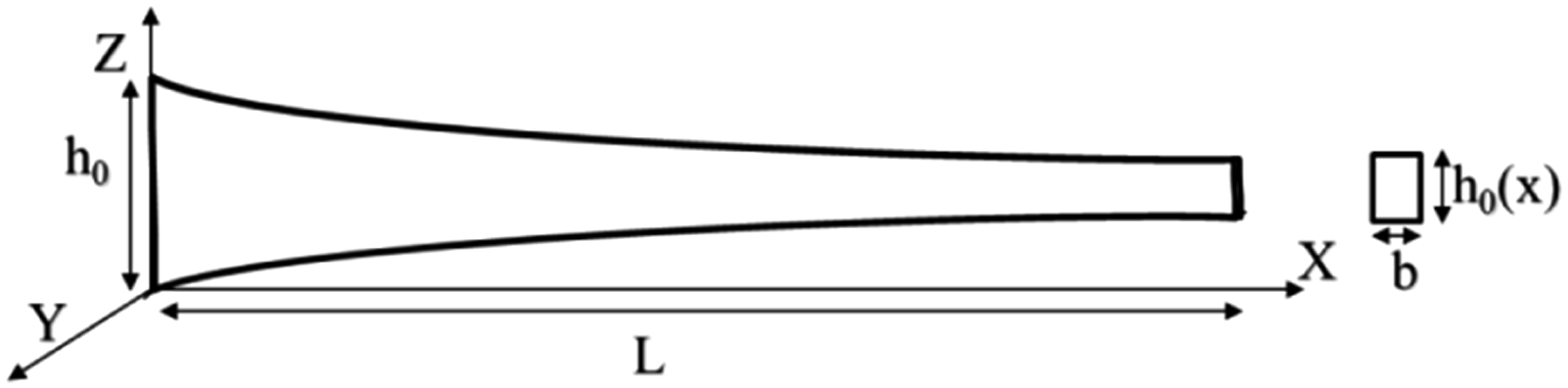
The young’s modulus E(x) any location of the Gr-AFG beam is calculated using an improved Halpin-Tsai micromechanics model.
20
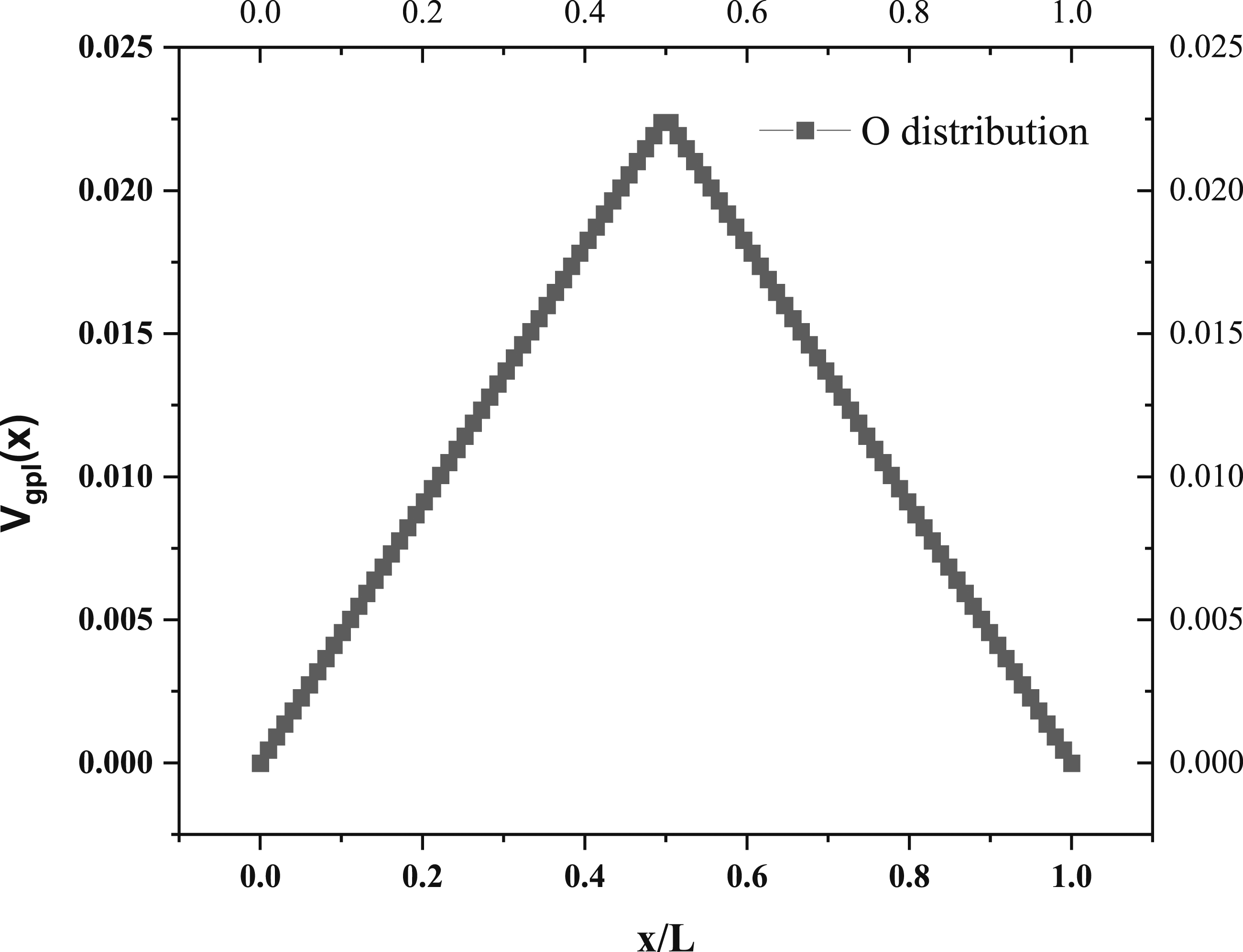
The Graphene platelets are distributed with an O pattern distribution function as (Figure 2.)
O- distribution function. Material properties of GPL and epoxy.
6

The finite element method is used is subdivide the beam model into the number of elements. The stiffness matrix and the consistent mass matrix for an element is obtained from potential energy and kinetic energy equilibrium equations. The stiffness and mass matrix in form of eigen value problem results the natural frequency and the non dimentionalization of the frequency parameter is done for clear representation of a very small change in frequency parameters. The element-wise integration code is applied using Matlab software to solve the model for various parametric alterations. The code is validated for a uniform beam result
3
with an overall error of 0.252% and the results for non-uniform geometry of the nanocomposite beam are simulated, plotted and analysed. The dimensionless natural frequencies (
Results and discussion
The Figure 3 Represents the Fundamental frequency for different geometric exponent, for the slenderness ratios 100,120 and 150. It is noted that for all the slenderness ratios, as the geometric exponent increases the natural frequency decreases. Except clamped- Free condition. Variation of Fundamental frequencies of O- AFG beam at slenderness ratio (A) L/h0 = 100 (B) L/h0 = 120 (C) L/h0 = 150 for different end conditions and geometric exponents.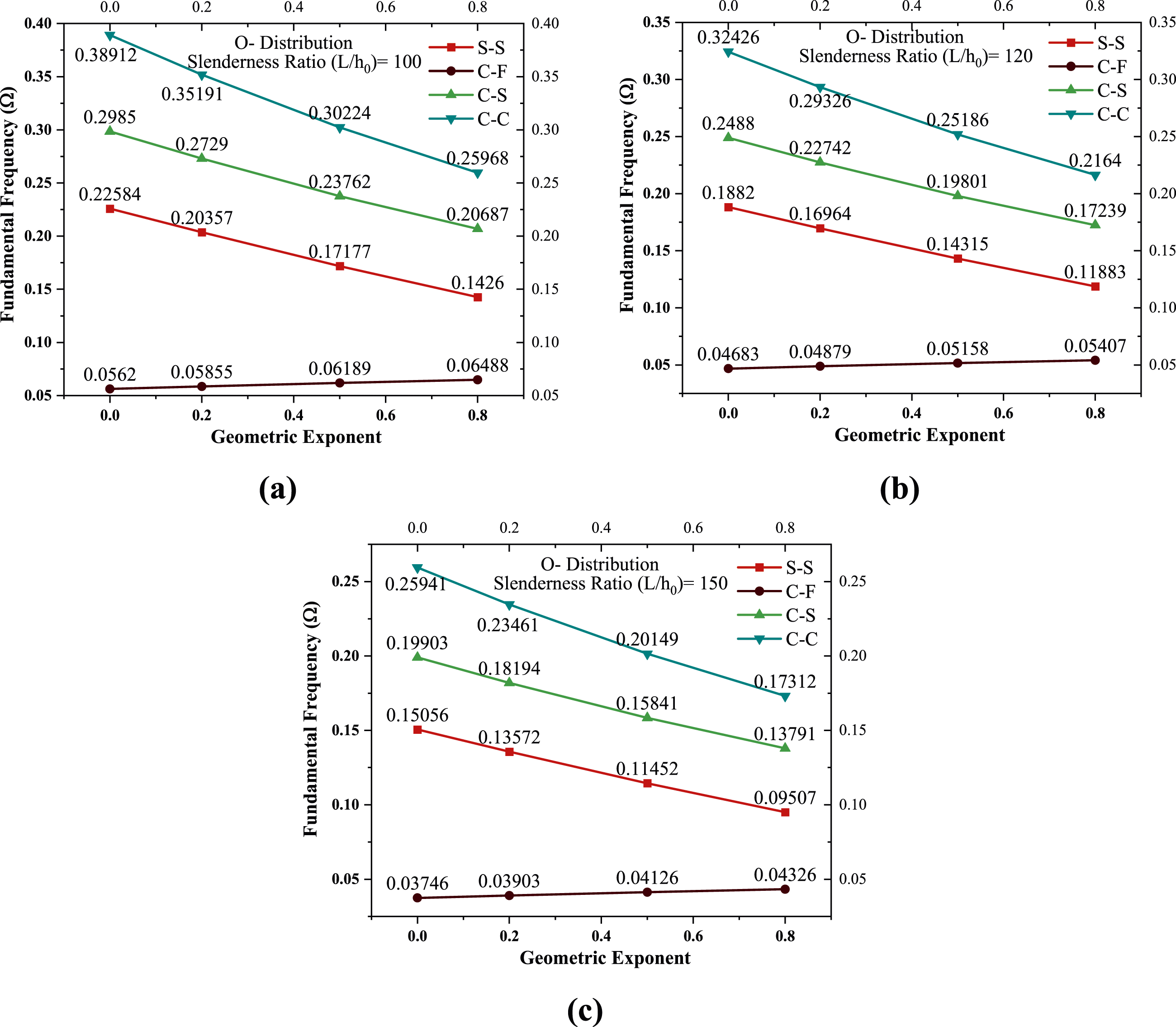
The Figure 3 have three line graph, each graph is only meant to display the result for a particular slenderness ratio that is (a) L/h0 = 100, (b) L/h0 = 120, and (c) L/h0 = 150. Graph shows the relationship between the geometric exponent (on the x-axis) and the fundamental frequency (on the y-axis) for different end conditions at a particular slenderness ratio with changing geometry exponent. The end constraints in each graph are denoted as; S-S (simple support), C-F (clamped-free), C-S (clamped-simple support), and C-C (clamped-clamped).
The observation carried out from the figure that; As the geometric exponent increases, the fundamental natural frequency decreases for all end constraints, except the C-F boundary condition. There exhibit similar trends for all graphs with different slenderness ratios, with slight variations in their slopes.
Overall, these results suggest that higher geometric exponents lead to lower fundamental frequencies across different end constraints, other then cantilever condition. This information could be relevant in fields like materials science or structural engineering.
In this Figure 4(A)-(D), the line graphs plotted from the simulated result obtained for S-S, C-F, C-S, and C-C boundary conditions respectively. The figure interpreats, the effects of slenderness ratios on fundamental frequencies, corresponding to different boundary conditions with varying geometric exponent. The observation made from the analysis is; the fundamental frequency shows a lesser value for the higher values of slenderness ratio at corresponding end conditions, irrespective of geometric exponent. Another important observation carried out is; as the boundary condition changes, the value of fundamental frequency changes considering other parameter same. Here in this figure it can be explained for a particular instance (i.e. for L/h0 = 100 and geometric exponent 0.8), S-S end constraint predicts lower value in graph 4(a), as compare to value in C-S end constraint graph 4(c). Also the lowest value is predicted for C-F in graph 4(b), and highest value is predicted for C-C in graph 4(d). Discussing, the behaviour shows for different boundary can be related to the degree of freedom (DOF) available at each node. Frequency variation for different slenderness ratio at particular end conditions (A) S-S Simple support both end (B) C-F clamped free (C) C-S Clamped Simple supported (D) C-C Clamped Clamped, for various geometric exponent.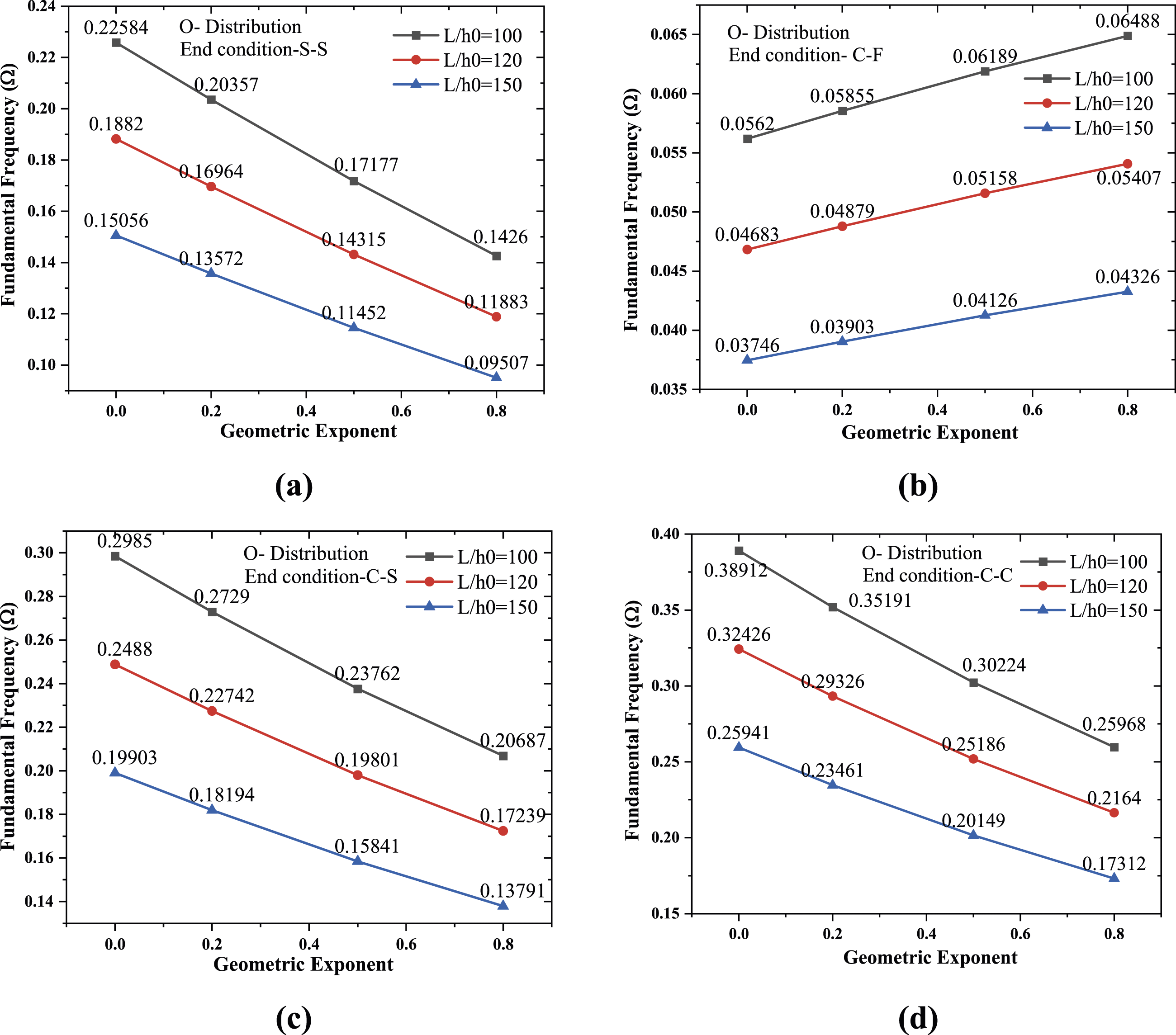
Overall, these figures highlight how factors like length and end conditions impact material reliability over repeated cycles. Engineers and researchers can use this information to make informed decisions in fields related to material fatigue and structural reliability.
The below Figure 5 Depicted the dimensionless natural frequencies for first four modes and for different end condition for various slenderness raio (L/h0 = 100,120 and 150). O- Distribution Non-Uniform Beam at higher modes for (A) S-S (B )C-F (C)) C-S (D) C-C end constraints at slenderness ratio (L/h0 = 100) with varying geometric exponent.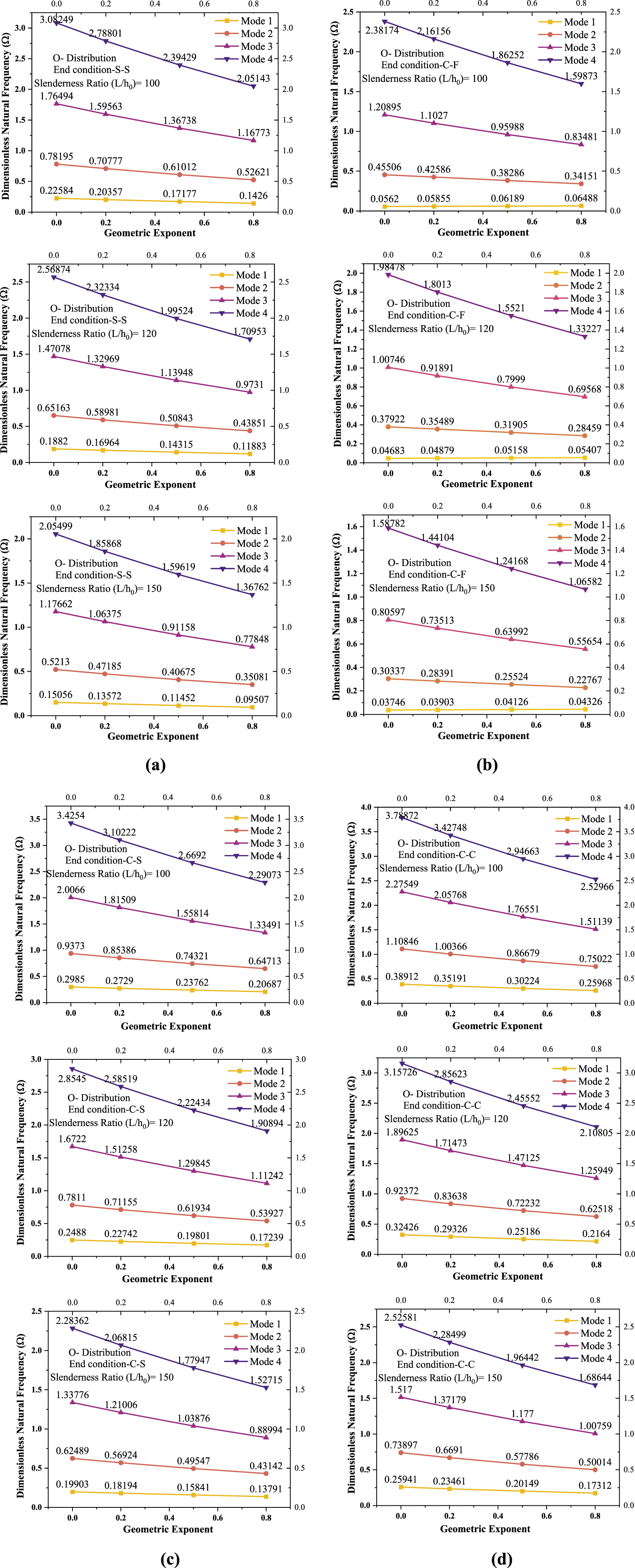
Certainly analyzing and comparing the four graphs, labeled as Figure 5(A)-(D). The figures have three line plots each. The x-axis is labeled “Geometric Exponent,” ranging from 0 to 1. The y-axis represents “Dimensionless Natural Frequency,” and for the specific O-distribution type, the graph (a), contains result parameters for simple-support end condition which includes the slenderness ratio and the vibration modes. similarly for the other three graphs that is (b), (c) and (d) contains result parameters for clamped-free, clamped-simple supported, and clamped-clamped, boundary conditions respectively. The key observation is; Altough the statistical measures for different boundary conditions, along with varing slenderness ratio and geometric parameter, is discussed for fundamental mode of vibration, in Figures 3 and 4; here in Figure 5, the higher modes (labeled as Mode 1, Mode 2, Mode 3, and Mode 4) are observed. It has been represented that for a particular slenderness ratio the rate of change in frequency for higher modes remains same for corresponding boundary conditions and the geometric exponents.
Conclusion
O - distribution graphene reinforced axially functionally graded nanocomposite beam model is simulated and analysed for free vibration behavior study for various end constraints and different slenderness ratios. The conclusions drawn from the above work are; • For O- distribution, the higher mode natural frequencies response are increasing for various slenderness ratios and different end conditions as like fundamental mode frequency. • For a particular slenderness ratio the natural frequency decreases as the geometric exponent increases for ss,cs,cc boundary condition while for cf condition the frequency increases with increasing non-uniformity geometric exponent. • For a given boundary constraint and the geometric exponents the rate of change in frequency for higher modes remains same for a particular slenderness ratio.
Footnotes
Declaration of conflicting interests
The author(s) declared no potential conflicts of interest with respect to the research, authorship, and/or publication of this article.
Funding
The author(s) received no financial support for the research, authorship, and/or publication of this article.
