







Abstract
The process of urbanistic changes in space and time is not a steady one, nor always the same, followed by dissipation and demolition of objects, and the construction of new ones does not necessarily stabilize the process of changes within space. The changes that took place on the former narrow-gauge railroad Belgrade–Obrenovac reflect the changes in historical, cultural, and urban processes as well. The strategic plan of the development of the city and the villages altered, as certain sections of the railroad were being shut down. The observance of a particular infrastructure is, at the same time, the base for monitoring the urban changes through time. Forty years later, the railroad was not the only thing that had ceased to function. Using qualitative and historical methods, this study is an attempt to give answers to multiple questions, some of them being the reasons for the deconstruction of the railroad.
Introduction
After being freed from the Ottomans, Belgrade became the capital of liberated Serbia. 1 The new capital became a cultural, administrative, and trade center at the same time. 2 During the First World War, more than 80 percent of the city was ruined, as well as the suburbs and rural areas surrounding it. It is believed that Belgrade had 110,000 inhabitants after the liberation, according to an informal census. 3 Heavy industry located in the heart of the city, with some factories located in the vicinity of the river Sava, depended fully on the import of industrial supplies from the neighboring developed countries. One of the reasons for the underdeveloped industry was also the underdeveloped transportation system.
In 1931, Belgrade had a population of around 210,000 inhabitants. With a mass expansion of traffic network already well underway, by this time, Belgrade already had three tram lines and a newly opened railroad to Niš, built by King Milan Obrenović in 1884.4,5 The newly formed Kingdom of Yugoslavia put high hopes into the new narrow-gauge railroad, which was supposed to solve traffic issues and improve the connection with new state territories, expanding to the Adriatic Sea. The direction of the railroad was Belgrade–Obrenovac–Lajkovac–Čačak–Užice–Sarajevo–Mostar–Herceg Novi. Although the railroad was of a narrow-gauge type (760 mm), it represented the base for the traffic development over the next forty years. More than 3.5 million passengers were transported along the line, as well as more than 17.5 millions of tons of different commodities. In terms of geography, this railroad connected the wider area of Belgrade with Western Serbia, the central parts of Bosnia and Herzegovina and Montenegro, that is, with Dubrovnik, Herceg Novi, and Bar on the Adriatic coast. 6
The project of the standard gauge railroad Belgrade–Bar (1,435 mm) in the 1960s was supposed to unburden this route; however, it ended up not going through Obrenovac. Belgrade, which was amidst the expansion in the Kingdom then, which had to deal with two main issues. The first one was to relieve the suburban parts of the city from the Sava to the port for the purpose of transporting commodities, and the other one was to connect the rural areas, such as the villages of Obrenovac for the purpose of transporting agricultural products. The other benefit of this railroad was connecting this municipality with Belgrade and further with Pannonian basin. 7 Due to the nonexistence of the bridge over the river Sava at that time, all the transport depended on the bridges in Belgrade. Two biggest river ports at the time were the port in Zabražje (Obrenovac) and the port in Sava Mala (Belgrade).
After the First World War, Belgrade lost more than 60 percent of its inhabitants, leading to migration of people from Southern, Eastern, and Western Serbia. 8 Belgrade had to connect the other parts to stay within the limits of the number of inhabitants.9,10 The former municipality of Obrenovac had twenty-eight settlements spreading from the Sava in the North to the basins of the Tamnava and the Kolubara in the South. The river Kolubara separates this municipality into two almost identical parts. 11
The direction following the basin of the Kolubara, along the right bank of the Sava through Belgrade (Železnik)–Žarkovo–Ostružnica–Umka–Mala Moštanica–Barič–Obrenovac, had been chosen for the railroad route. 12 The reason for choosing this route was in the fact that there already existed an old drive, which was a way of bypassing the landslide-prone area near Duboko, between the settlements of Umka and Ostružnica. Three major social and two economic changes, which took place in the country, influenced the opening, development, and finally the deconstruction of this railroad. 13 The first process that made an impact was the process of the city’s urbanizaton, which further influenced the satellite settlements surrounding it.
The second was the process of deagrarization and depopulation of villages, which meant that people stopped being engaged in agriculture. Finally, the third process was the process of migration on a daily, weekly, and yearly basis between Obrenovac and Belgrade. The economic reform from 1921 to 1931, which was carried out in multiple sections, and the economic reform from 1953 to 1961 influenced the development and later the deconstruction of this railroad.14,15 The process of the railroad changes was followed by the changes in objects, residential units, and the settlements, which changed their look. The change of Belgrade and its then peripheral today’s city parts Železnik and Čukarica was reflected in changes on and around the railroad.
The railroad infrastructure was recycled to construct the streets of the fast-growing residential areas; bulwarks were used as the protection from flooding, and station buildings as the objects for residing or as storages. The tunnel underneath Čukarica today serves for the maintenance of constant temperature suitable for the production of mushrooms; the tunnel between Mala Moštanica and Umka is not in function, and it abounds in crabgrass. All the station buildings with the exception of the ones in Umka and Obrenovac have been demolished. The railway station in Obrenovac has been turned into a bus station, which stands out among all the others in Serbia, by its position and looks.
Historical Stages of Narrow-Gauge Railroad
The construction of this railroad started in February in 1926 and it was put into effect on April 20, 1928. The beginning of the construction started with the companies of the French consortium, and later involved the enterprises from the Kingdom of Yugoslavia. 16 The railroad was connected to Belgrade by a special gauge at Belgrade Sava Station. The first train ceremonially departed the main railway station on September 30, 1928. 17
The main problem of the railroad route was that the trains were often derailed due to the muddy, slippery, and alluvial terrain on which the railroad had been constructed. The construction of the railroad was performed in eight different stages. Within forty years of its existence, the city of Belgrade changed its political and economic system twice. In addition to this, by the time of the railroad deconstruction, the population of Belgrade and Obrenovac rose by five hundred thousand and twenty thousand, respectively. 18
Between 1969 and 2019, there were many changes influencing the landscape changes and the question arose whether the railroad should be reopened. Within the period of fifty years, a new state was established after the collapse of the Socialist Federal Republic of Yugoslavia 1989-1992 and a new trade capitalism was set up, following the example of the European Union countries.19,20
The Maximum Changes of the Narrow-Gauge Railroad through Time
The process of landscape changes and the changes in the objects continued. All the station buildings have been completely demolished, and space itself has been turned into a residential following the year 2000. The only building which kept its original look is the station in Obrenovac.
European and world cities that were devastated in the way Belgrade was are rare, just like the ones that underwent such a rapid process of architectural and urban changes as Belgrade did. 21 These changes encompassed not only Belgrade but also the settlements surrounding it in the radius of 60 km. The settlement of Obrenovac, which is today a city municipality, was within that radius of changes. The former narrow-gauge railroad that connected Belgrade and Obrenovac is certainly a historical archive, witnessing all the changes in space, which occurred before its construction, ninety-one years ago, as well as those happening fifty years after being deconstructed. 22
The Railroad Launch and the First Period of Its Existence
As it has been mentioned before, the railroad was opened in 1928. Not long after its opening, there were certain changes, which led to a discussion about its importance, not only in scientific circles but also among common people (Figure 1).
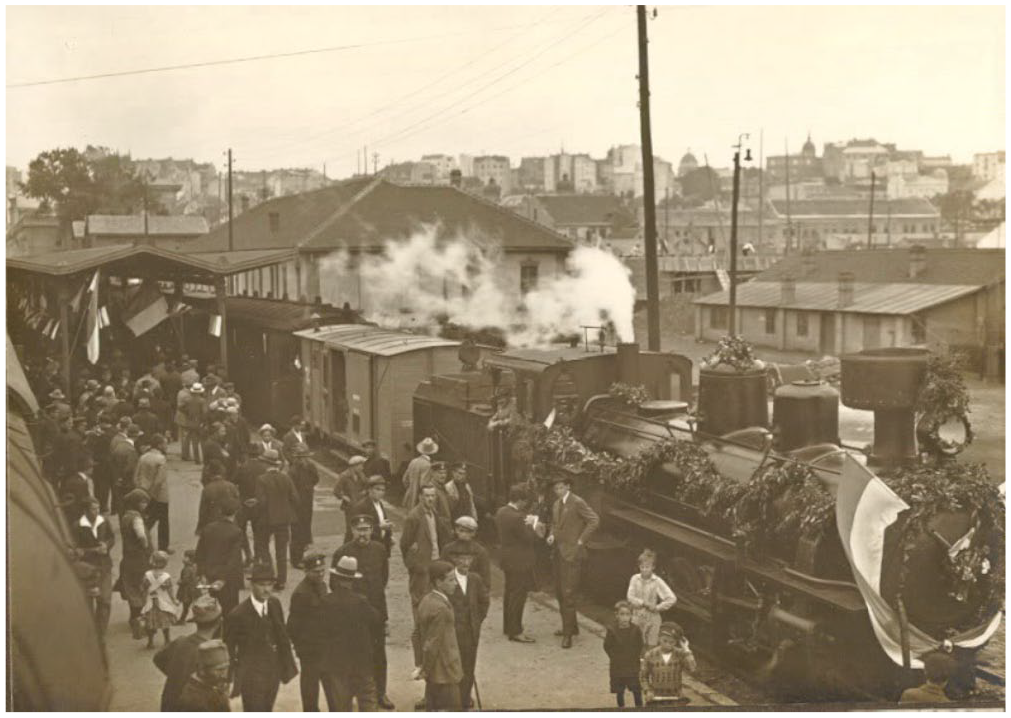
Historical photo of the first train on the narrow-gauge railroad Cukarica–Obrenovac, September 30, 1928.
The shortcomings of the railroad, such as the speed limit to 45 km/h and low carrying capacity, were the ground for questioning its efficiency and usefulness. In December 1928, there were many derailments between the stations of Čukarica and Železnik as well as between Umka and Mala Moštanica. It particularly occurred with freight trains. Then, the minister of the Railways of the Kingdom of Yugoslavia, Lazar Radivojević, was obliged to answer some of the deputies’ questions:
23
It is well known that new railroads suffer from derailment more often than the old ones. The bulwarks at the railroad Belgrade-Obrenovac were constructed during this summer, in the time of big drought. Now, under the influence of rain and the weight of trains, their level drops, which causes the change in the state and position of the upper layers. The consequence of such an occurrence is a derailment of the train wagons. However, these derailments have not been happening as frequently as it was stated by Mr Lazić. He has stated that it occurs on a daily basis. However, since October, the 1st, when the railroad was put into effect, hundreds of trains have crossed it, and only 6 derailments have occurred, without any casualties. Instructions were given to limit the speed on the railroad, and enhance the surveillance and work on the improvement of the railroad.
According to the answer of the minister, we have come to the conclusion that the section along the Sava, from Čukarica up to the tunnel entrance, was risky, due to the alluvial ground and the appearance of clay.
The problems that appeared at the very beginning, and continued to 1933, led to the shortening of the railroad route, by shutting down the stations such as Železnik and Belgrade Sava. Shortly afterwards, all the lines, which were heading directly to Dubrovnik, from the stations between Žarkovo and Obrenovac were, and 20 percent of the lines from Belgrade (Čukarica) to Obrenovac were shortened. 24 The economic world crisis from 1930 to 1934 directly influenced the economy of the Kingdom of Yugoslavia. The increase of discrepancy between unlimited production and limited consumption brought about a great economic crisis by the end of 1929. This crisis influenced the drop in railway traffic by 70 percent, including the section between Belgrade and Obrenovac. By 1934, the stations Belgrade (Sava) and Železnik were shut down, which further influenced the opening and closing of new ones. The first station Žarkovo was at the 10 km distance from Čukarica.
At the exit from the tunnel of Čukarica and the station Proleter, there was Jedek 25 (Figure 2). Železnik Train Station was at the distance of 14.2 km, Ostružnica at the distance of 18.5 km, Umka at 25.2 km. About 31.2 km away from Čukarica, there was the train station of Mala Moštanica. Beside the train station of Mala Moštanica, there was a tunnel that bypassed the landslide and great slopes. It was one of the longest tunnels above the narrow-gauge railroad in the Balkans, 1,615 m long.
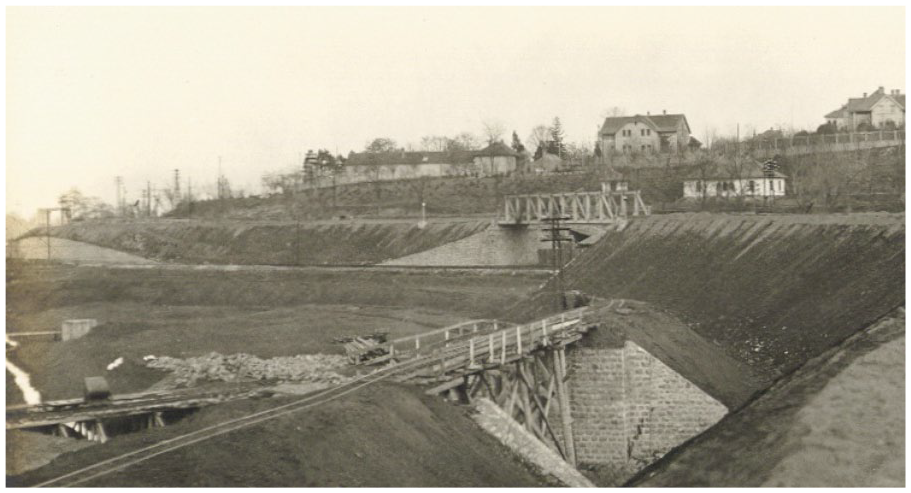
Former bridges near the station of Čukarica.
The train station of Barič was at a distance of 37.6 km. The third gauge of this station was industrial, heading to the factory of Prva Iskra in Barič. The train station Obrenovac was at 41.8 km distance. This station was built in 1908, when the first narrow-gauge railroad in Western Serbia, Zabrežje-Obrenovac, was put into effect. This station was reconstructed and widened in 1928. 26 By the Second World War, this railroad had twenty-three station buildings, two tunnels, five bridges, twenty-six bulwarks, and three ramps (Figure 3).

The narrow-gauge railroad in the old topographic map of Belgrade in the ratio 1:50,000.
The Railroad between 1939 and 1945
The most developed branches of the economy within this period were textile industry, breweries, mills, and sugar industry. 27 In 1939, in line with the world trends, chemical industry developed. The rise of the textile industry in Karaburma started in 1922 and reached its peak at the time of the world economic crisis. This factory could employ around six hundred people. Weifert’s brewery gained a profit of about seven million old Yugoslav dinars, between 1927 and 1939. 28
The Belgrade sugar plant in Čukarica was put out of business at the time of the occupation in the First World War. The state bought out the factory from German shareholders in 1926 and modernized it with new machinery. Since 1929 to 1939, it had the circulating capital of 43.3 million dinars. After 1932, the plant was producing fifteen million tons of sugar annually (Figure 4). A very important role in the Kingdom of Yugoslavia belonged to the wood industry. By 1939, due to the reconstruction of the country, devastated by the war and reconstruction of war struck Europe, this industry held the biggest share in the country’s export. Belgrade had two big sawmills, the sawmill of the Commercial bank, and one in Makiš, on the Sava.
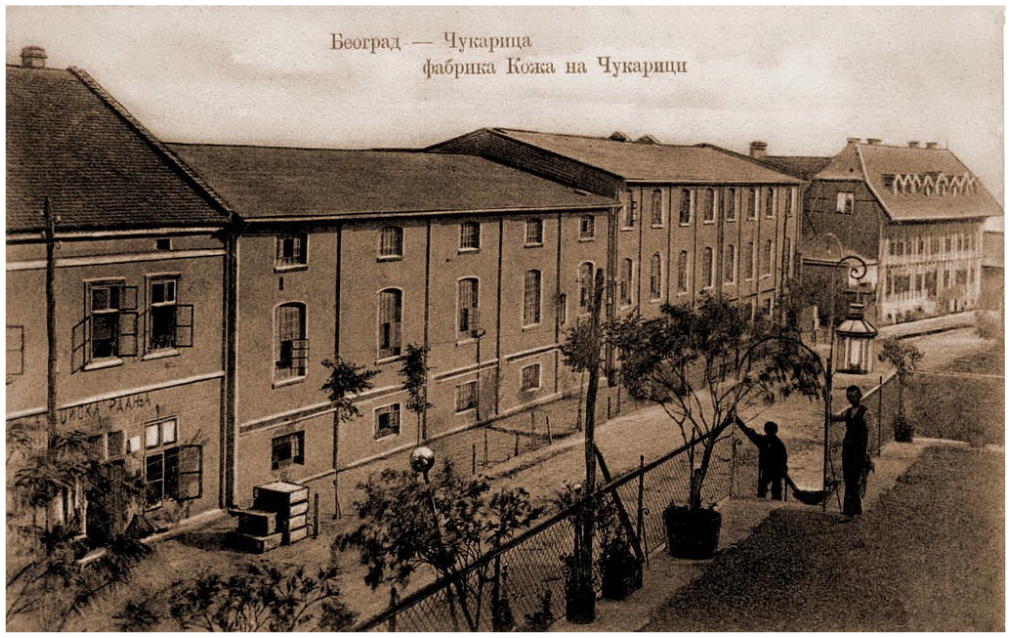
Old factory in Čukarica at the beginning of the twentieth century.
There were about sixty factories of the leather industry in Yugoslavia. The chemical industry had a number of small workshops in Belgrade. Enterprises were founded with a few employees and a low founding capital. Paper industry was not developed enough.
The paper factory Milan Vapa started operating in 1921, occupying the vast land between the former narrow-gauge railroad and the right bank of the Sava, the place of today’s Fair. The annual capacity was around four hundred to five hundred wagons of pure paper. This factory employed three hundred workers and was one of the most modern ones in this part of Europe. The construction industry was located in the central parts of the city and had no significant share in the export. With the development of the river transport on the Sava, the first Serbian shipyard in Čukarica was reconstructed after the First World War and assigned to the Workers’ Union of the Kingdom of Yugoslavia. It was supplied by electricity from the central point in Makiš, and the main factory was located at today’s Ada Ciganlija. This factory had a direct industrial gauge, located at the station Belgrade (Sava), and the one in Čukarica by 1939.
The airline industry had its plants in Rakovica. They were later transferred to Zemun, where the factory Ikarus was founded. What is interesting is that most of the factories had their wagons on the former railroad, whereas two of them, the paper factory and sugar factory, had their own gauges used for the purpose of industry. The paper factory had fifteen train wagons, Weifert’s brewery had eight, and the sugar factory had twenty. More than 90 percent of the passengers had been using the narrow-gauge railroad by 1939. The industry and the economy of the Kingdom of Yugoslavia, especially Belgrade, completely depended on this railroad.29,30
The industry in Obrenovac was not as developed as it was in Belgrade in the period between the end of the First World War and 1939. In the municipality of Obrenovac, a different kind of social processes was taking place. After the war, the process of peasants’ impoverishment continued.
Yet, the population rate in villages continued to grow, which led to further dividing of certain estates. The great world crisis influenced the villages of Obrenovac as well. Those who had their estates by the Sava and Kolubara rivers suffered from flooding. The number of people who owned no land in Obrenovac was approximately 65 percent at the time of the Second World War. The number of peasants indebted by private and state banks was significant. The industry was still underdeveloped and mostly concentrated by the river Sava at Zabrežje. There were few mills and sawmills; Obrenovac was still an agricultural center.
Wheat, cattle, and agricultural products were exported through the port in Zabrežje. In 1921, Obrenovac had about three thousand inhabitants, but the number rose to nine thousand by 1939. Around 80 percent of inhabitants were using the narrow-gauge railroad, whereas the transport of commodity to Belgrade was only around 20 percent since most of it was transferred by ships. Yet, the train station in Obrenovac represented the sinews of the city, by the beginning of the Second World War.31,32 None of the enterprises from Obrenovac had rented train wagon; nevertheless, by the beginning of the war, the railroad was the only connection to Belgrade, and there were six departures from Obrenovac and eight from Belgrade. 33 In the Kingdom of Yugoslavia, Belgrade was an administrative unit, separated from the Banat and named the government of the city of Belgrade. It comprised fourteen suburban municipalities with four hundred thousand inhabitants. At that time, it was named Eastern Paris. 34
It had twenty thousand buildings, 1700 streets, and two hundred forty industrial enterprises. The transport infrastructure consisted of four standard-gauge railroads, one narrow-gauge railroad, five car drives, three river ports in the Sava and the Danube, and two airports in Zemun and Pančevo. On April 12, Belgrade was attacked by fascist Germany, and 2,500 people lost their lives, 70 percent of infrastructure was devastated, and 60 percent of the objects. During the occupation, the Germans tried to establish the normal functioning of the city. On May 16, 1941, the city commander Fester issued a declaration, urging citizens of Belgrade to perform their normal activities:
35
To the People of Serbia As a military commander in Serbia, today, I take over the governing of the country. The one who disobeys my commands, performs sabotage or other criminal acts, will be treated according to the war military law. The one who obeys the rules and performs his obligations has nothing to fear. By doing so, he may be of his own and his country’s assistance. All means of transport in the city and its surroundings are allowed, with the use of necessary documents.
36
In October 1941, the Germans took over two road directions, that is, two railroads, heading to the South and to the West, for the needs of their units. One of the railroads was of a standard-gauge type, from Belgrade to Niš, and the other one was a narrow-gauge railroad from Belgrade (Čukarica) to Dubrovnik. The narrow-gauge railroad was used only for freight trains, although it had two departures for Obrenovac and one to Sarajevo. The departures were changing constantly, due to frequent diversions on this railroad. By the liberation of Belgrade in 1944, more than seven hundred thousand passengers had been transported by this railroad. The Serbs persecuted from the Independent State of Croatia were also transported by this railroad.
After the retreat of the Germans, the railroad was mined, but most of the station buildings were preserved. 37 The landscape particularly changed at Belgrade Station (Čukarica) and Belgrade (Sava). After the Second World War, both stations had one gauge less, implicating a lower capacity of the railroad during the occupation. There are certain records that the German units used this railroad to be transported for the purpose of operations against the People’s Liberation Movement. One of such offensives was for the purpose of destroying the Republic of Užice, and the second one meant the transport of the German units directly to Sarajevo, for the purpose of destroying Partisans. 38
The Railroad after the Second World War (1944-1969)
In October 1944, Belgrade was liberated from the Axis powers. The very next month, the new government organized the cleaning of the debris, vitrescence of buildings, and the recovery of trams, bus, and railway transport. 39 On their retreat from Yugoslavia, the occupant destroyed a number of railways and railway objects. Railway transport was completely stopped.
The most difficult part of the reconstruction in progress was the reconstruction of the bridges above the Danube. The reconstruction of the Danube bridges was finalized in 1946. The railway traffic was set and put into effect a year later. It was estimated that the Germans had managed to destroy almost 60 percent of the railway network during their retreat. In Serbia, more than 400 km of the railroad was completely ruined, along with hundreds of bridges, more than three hundred station buildings, more than ten turntables, weighbridges, and other objects. Since the enemy had been using the narrow-gauge railroad Belgrade (Čukarica) to Obrenovac, the only station building that was destroyed was at Belgrade Stop (Sava).
The railroad was therefore available for transport in 1945. There were two more departures for Sarajevo, one for Dubrovnik, and two more for Obrenovac 40 (Figure 5). The rapid increase in population rate in Belgrade after the Second World War influenced the construction of new railroads and roads. Due to the necessity for international transport, the standard-gauge railroads replaced the narrow-gauge ones. The population of Belgrade consistently rose over the period from 1945 (313,000), 1949 (405,000), 1955 (484,000) to 1961 with approximately 619,000 inhabitants. The population rate rose in Obrenovac as well. In 1945, there were 3,500 inhabitants; in 1955, around 6,700; and by 1961, more than 11,000 inhabitants. 41
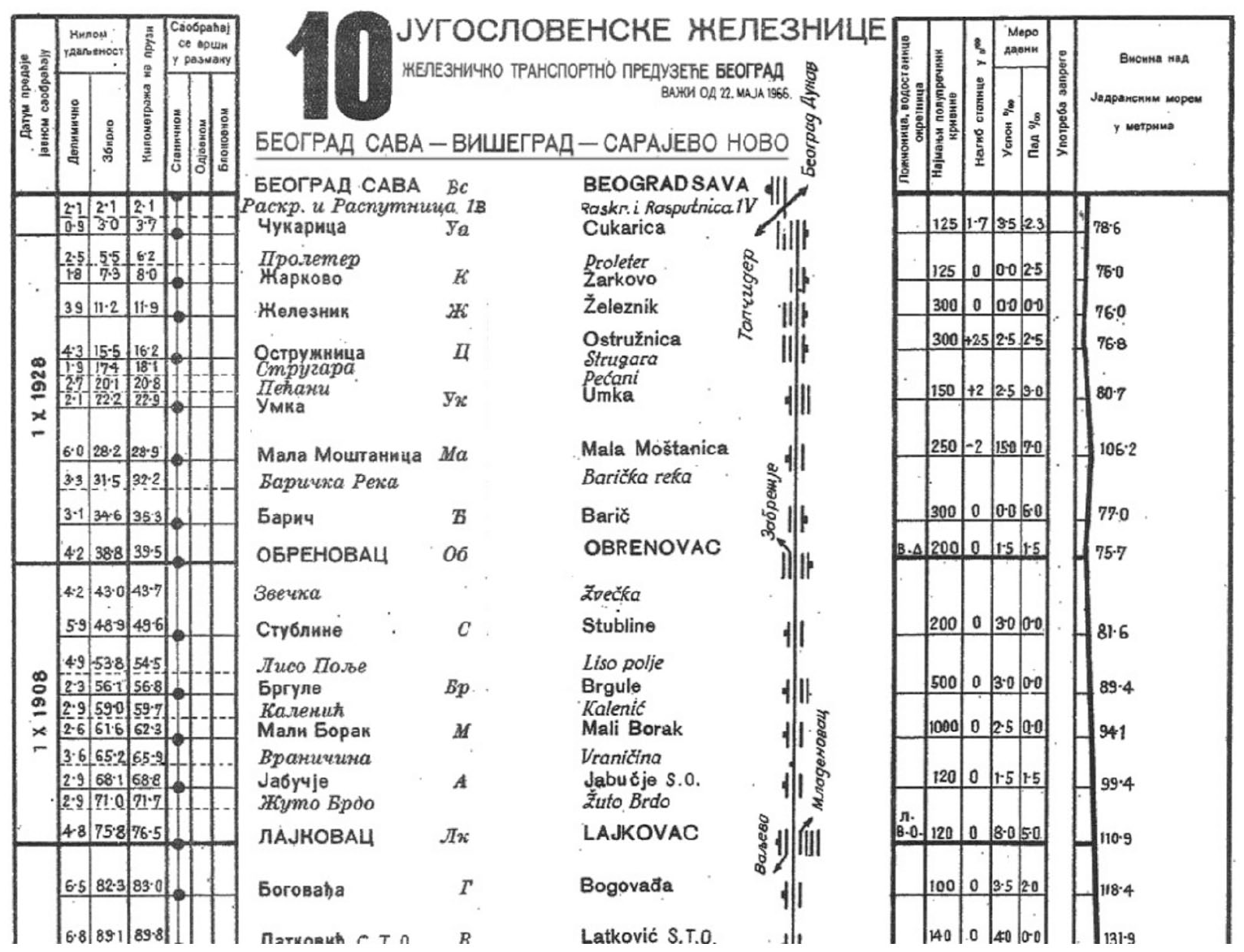
Timetable of the railways Serbia in 1966 with the view of two stations Belgrade (Čukarica)–Obrenovac.
In 1962, Belgrade had 641,000 inhabitants; in 1968, 754,000; and by 1969, around 780,000 inhabitants. Obrenovac had around twelve thousand inhabitants in 1962; in 1968, nineteen thousand; and in 1969, around twenty-three thousand inhabitants. Today, municipality of the city of Belgrade, Obrenovac has become the suburb and the fringe area of the city.
The development of the economy of the city had a direct influence on the completion of urban areas between these two settlements. The rise of the Yugoslav economy in the 1960s brought about the migrations from the interior of the country since people were in search of work in Belgrade. New residential areas were being constructed and new workers’ colonies, such as the complex in Radnicka Street in Čukarica. 42 Železnik, which has functioned as the dormitory of the working class, slowly turned into a residential complex.
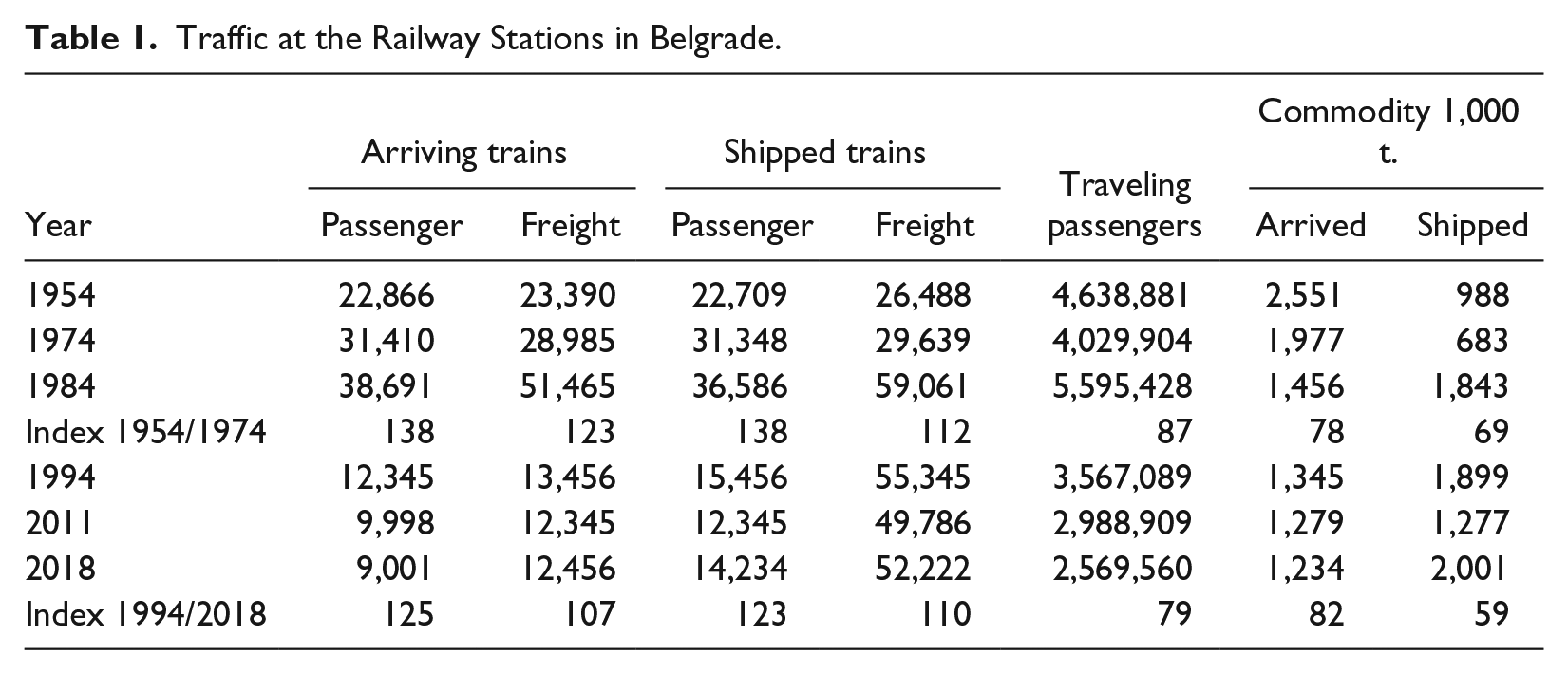
The improvement in the economy was followed by the rise in employment rate on the territory of Belgrade (Table 1). 43 The data from the Table 2 show no record about the employment rate in the railways. The reason might be the fact that the railroad was being reconstructed and reformed. According to the data from the World economic Bank, the road traffic prevailed over the railroad traffic in the 1960s. The worldwide trends were transferred to Yugoslavia, that is, Serbia. 44 The rapid development of the city and its economy contributed to the increase in the transport of commodity. The amount of transport service rose to 40 percent in the period between 1957 and 1960. The dynamics of road traffic development is best shown in the statistics of the number of vehicles registered in the years after the war.
Traffic at the Railway Stations in Belgrade.
The number of Industry Employees in the Socialistic Republic of Yugoslavia.
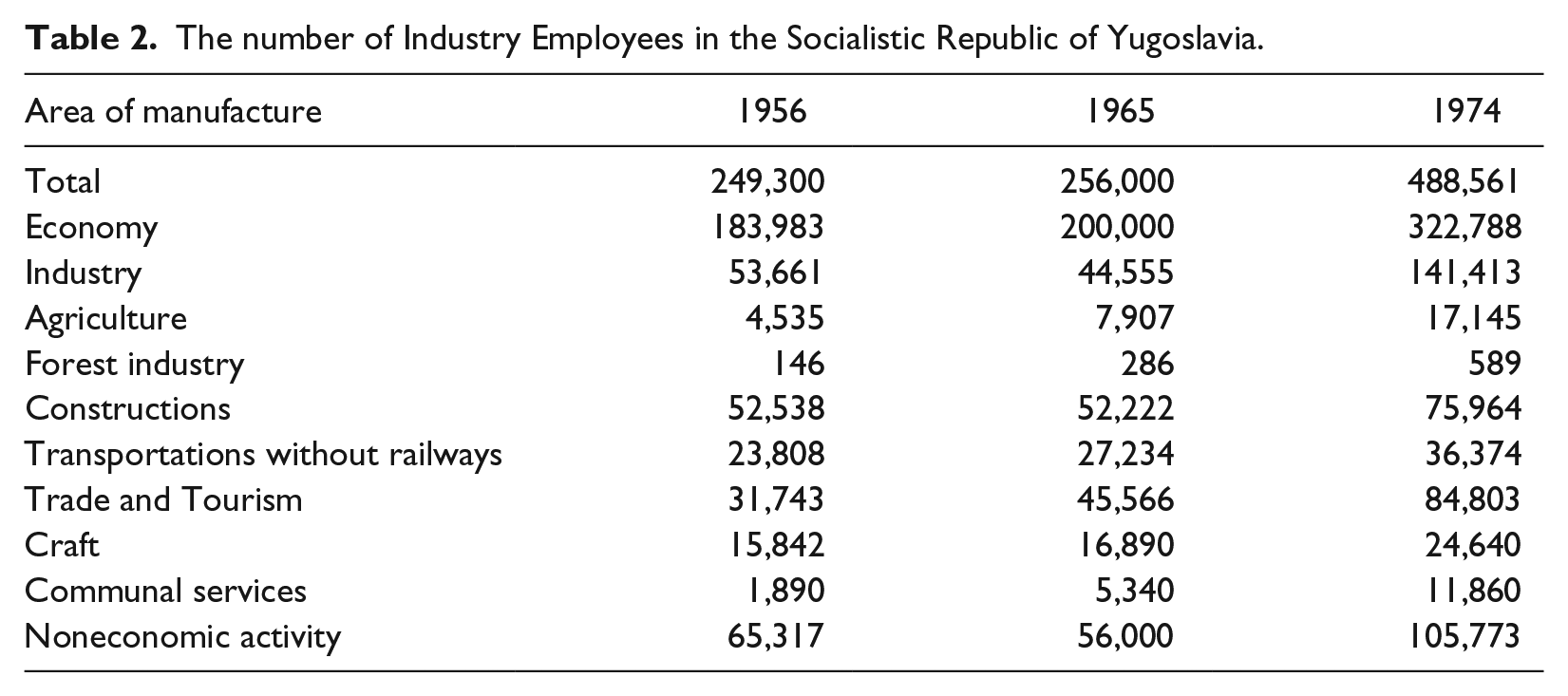
In 1945, there were 720 passenger vehicles and 920 cargo vehicles. In 1954, there was an increase of 14 percent passengers and 21 percent cargo vehicles. By 1965, there was an increase of 23 percent of passenger and 35 percent of cargo vehicles. These historical statistical data show the domination of road traffic over the railroad traffic in the territory of Belgrade. In 1964, the share is the percentage of passengers traveling by rail from Belgrade was 15.5 percent, and 9 percent of the loaded commodity. In 1974, the percentage changed, decreasing to 12.4 percent of passengers and 7.5 percent of the loaded commodity. For more detailed data, see Table 3. 45
Timetable of Trains in the Section of Čukarica to Višegrad via Obrenovac, Čukarica–Obrenovac.
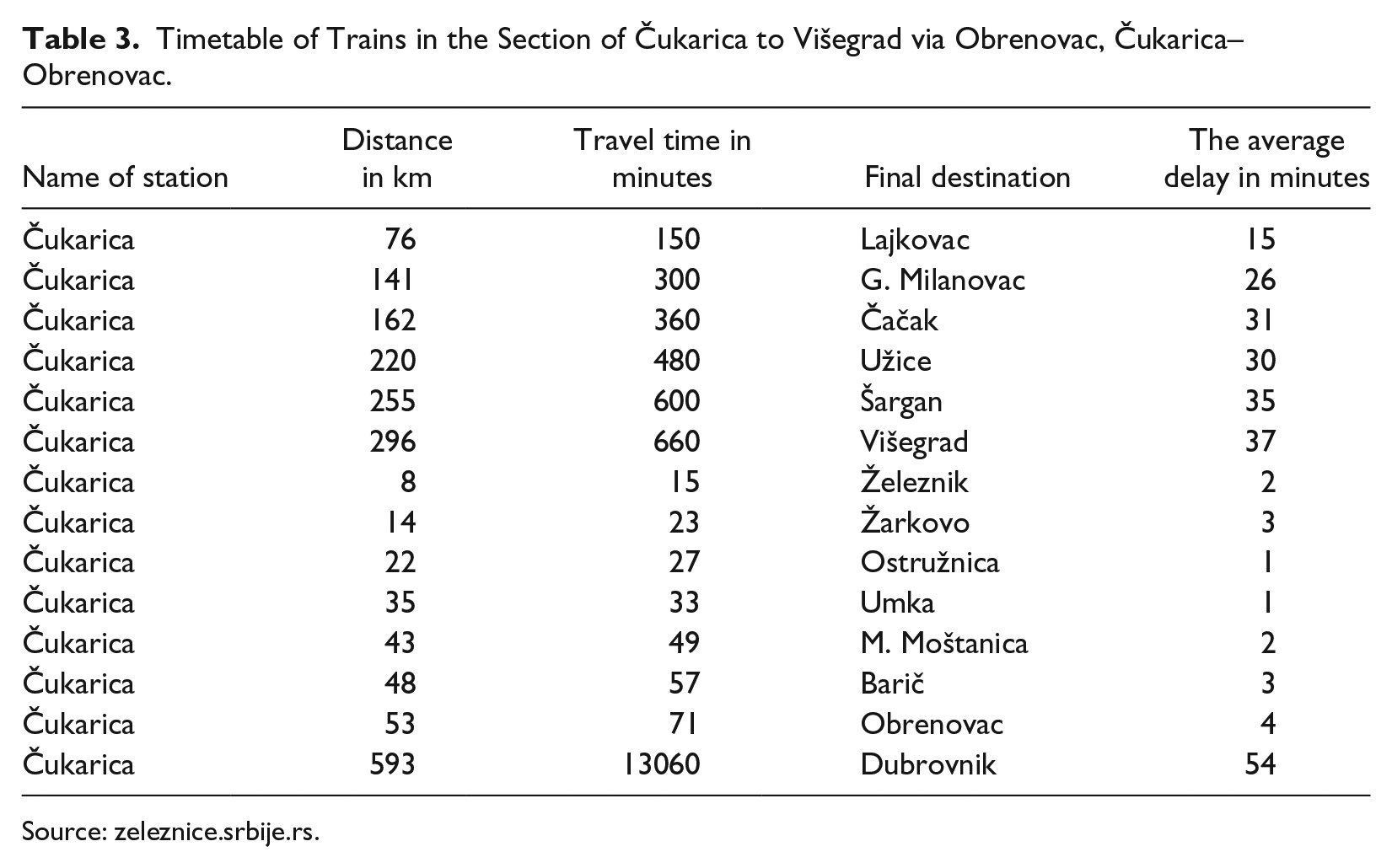
Source: zeleznice.srbije.rs.
The records show that the number of passengers decreased by 608,977 and the number of commodities transported to Belgrade by 574,000 tons, and by 305,000 tons for the commodity sent from Belgrade in the period between 1954 and 1974. The loss of significance of the narrow-gauge railroad was even greater due to the speed limit and the low carrying capacity. The railroad Belgrade (Čukarica)–Obrenovac could not stand the competition in the 1960s, and the pressure which was placed on the area was quite suitable for the further construction of the city. The goal was to wipe out the suburban areas and the illegal construction prevailing in almost all the settlements on the route of the narrow-gauge railroad.
The Railroad Before Its Closing in 1968
As it was previously stated, the railway traffic started losing its significance in the period before the railroad was closed. Since 1965, more than 50 percent of the trains were canceled, mostly those whose departure was by night. Ever since the railroad to Bar was put into the effect, the narrow-gauge railroad has been losing its importance. Due to the construction of new settlements along the route of the railroad, particularly in Čukarica, the opening of the factory Prva Iskra in Barič, and the increase in the population rate in Mala Moštanica and Umka, the railway traffic was becoming more and more difficult in densely populated areas of the city. The frequency of cargo traffic was cut into half.
The delays of trains became more often (Table 3). Station buildings were no longer maintained, with the exception of the one in Obrenovac, which caused their inevitable decay. The objects were being rented for commercial purposes. The life itself which was taking other directions started undermining the very existence of the railroad. Yet, there was not a celebrity who had not taken this route by train, especially toward Dubrovnik and Sarajevo. There were also many foreign journalists and fans of narrow-gauge railroads. One of them was English journalist Ron Fishet, who wrote a short report on his journey on the route Belgrade (Čukarica)–Sarajevo–Dubrovnik: There was a time when the only rail connection between Beograd (Belgrade) and Sarajevo in the former Yugoslavia was a 760 mm narrow gauge line. Later, it was extended to Dubrovnik on the Adriatic coast giving a total length of over 700 kilometres! A narrow-gauge journey from Beograd to Sarajevo took all day, and the journey from Sarajevo to Dubrovnik took another day. Both these lines are now history, although a really spectacular section of the Beograd–Sarajevo line has recently been re-opened as a tourist railway around Mokra Gora near what is now the Serbia–Bosnia Herzegovina border. I was lucky enough to experience the Sarajevo–Dubrovnik line first hand in 1966 but, beforehand, we visited the narrow gauge shed at Beograd; this is 85 class 2-8-2 85 036. 23rd May 1966
Right before the railroad closing, it had been decided to build a highway from Belgrade to Obrenovac, which was not supposed to follow the direction of the Mala Moštanica–Umka tunnel but to go along the north side along the base of the landslide Duboko. The first days of this highway were marked by problems that occurred in the road traffic, which imposed considerations about transferring the highway to the other side of the Sava. Finally, after forty years of its existence, the railroad was closed in May 1968. 46
Spatial and Social Processes Influencing the Closing of the Railroad
During forty years of its existence, the narrow-gauge railroad served as an example of urban and spatial changes. No other area in the old kingdom of Yugoslavia, Socialistic Yugoslavia nor in the contemporary history of Serbia has undergone such rapid and dynamic changes of a developing city. It has neither witnessed such a change in the relationship between the population engaged in agriculture and urban population, nor the disbalance in daily migrations of people from suburban settlements of Belgrade to its center.
The unfinished process of industrialization led to the creation of a large number of nonurban units and rapidly growing parts of the city, which influenced the work of the railroad. This railroad bears witness not only to historical changes but to comprehensive changes in one space through time. Since its opening, according to the needs of the new state and the growing economy, the significance of the railroad grew, which led to the growth of a system within the space, and in the period of the Second World War, it lost its significance, which led to the stagnancy and decline of the system.
After the Second World War, the railroad was again of huge importance, but the other processes started influencing its closing, thus leading to the decrease of the entropy of a system. Upon its closing, the area which it occupied was used for other purposes, and the station objects and the landscape changed according to the needs of a developing city. Only two station buildings were preserved, as well as 300 m of the railroad, including two tunnels (Figure 6; Table 4). The former route is still observable in the suburbs of Obrenovac, and in the settlements of Umka and Mala Moštanica.47,48 Orthogonal streets point out the former route of the railroad. Certain parts of the city have changed to such an extent that most of its inhabitants know nothing about the tunnel being underneath the tram track (Figure 7; Figure 8).
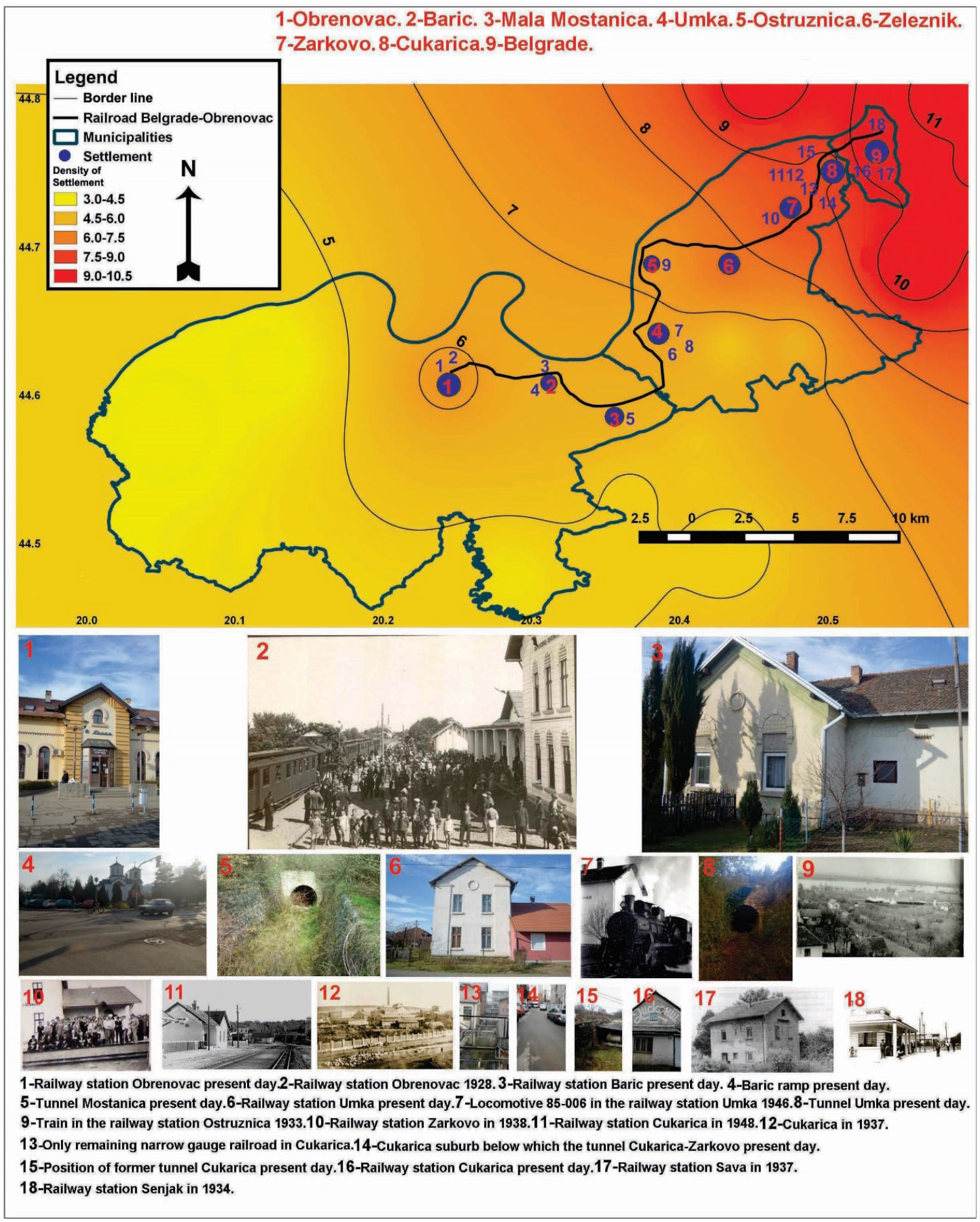
Changes of landscapes near the narrow-gauge railroad route Čukarica–Obrenovac for the period (1928-1968) and (1968-2018).
Railways Stations and Historical Changes.
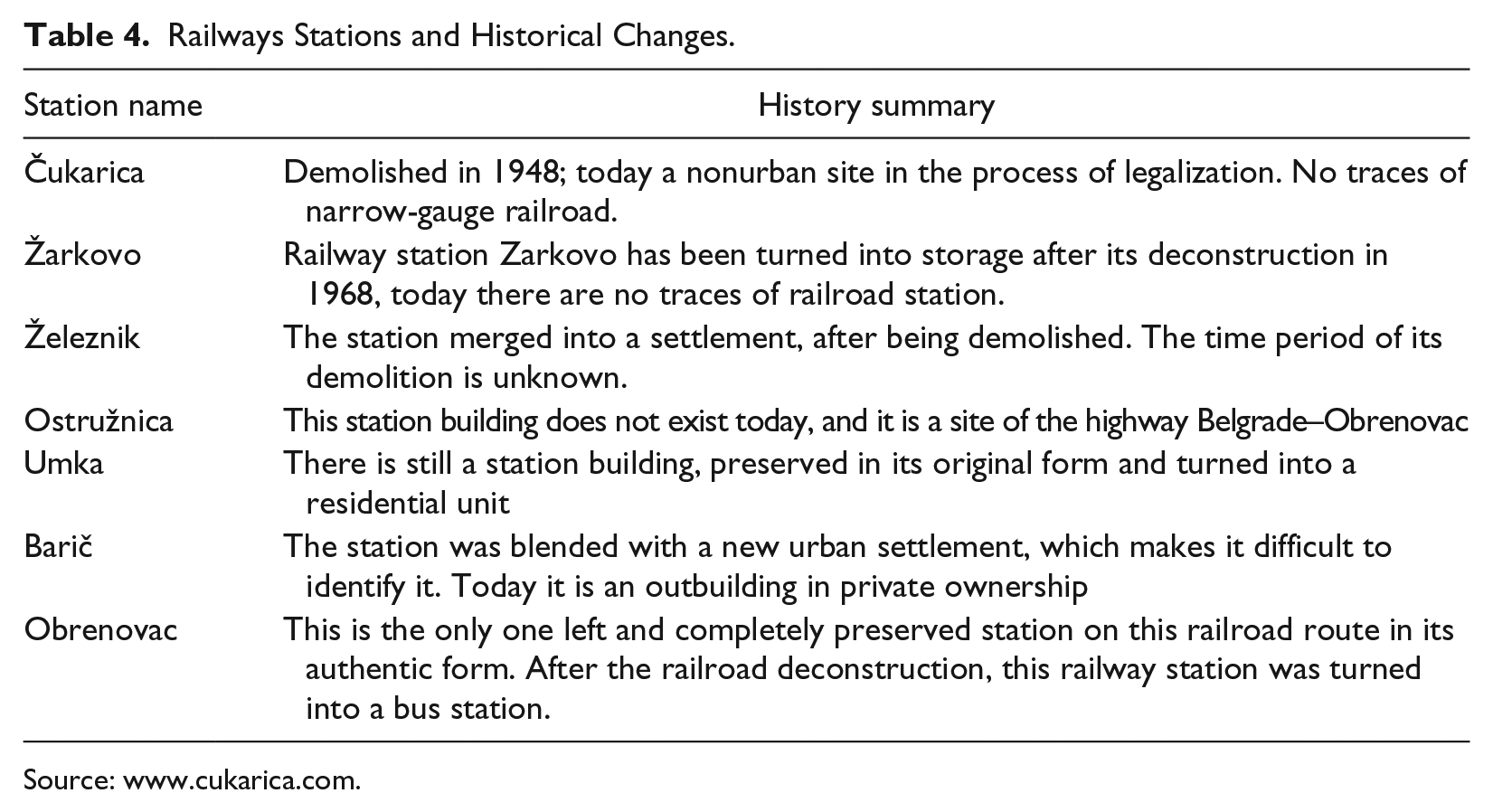
Source: www.cukarica.com.
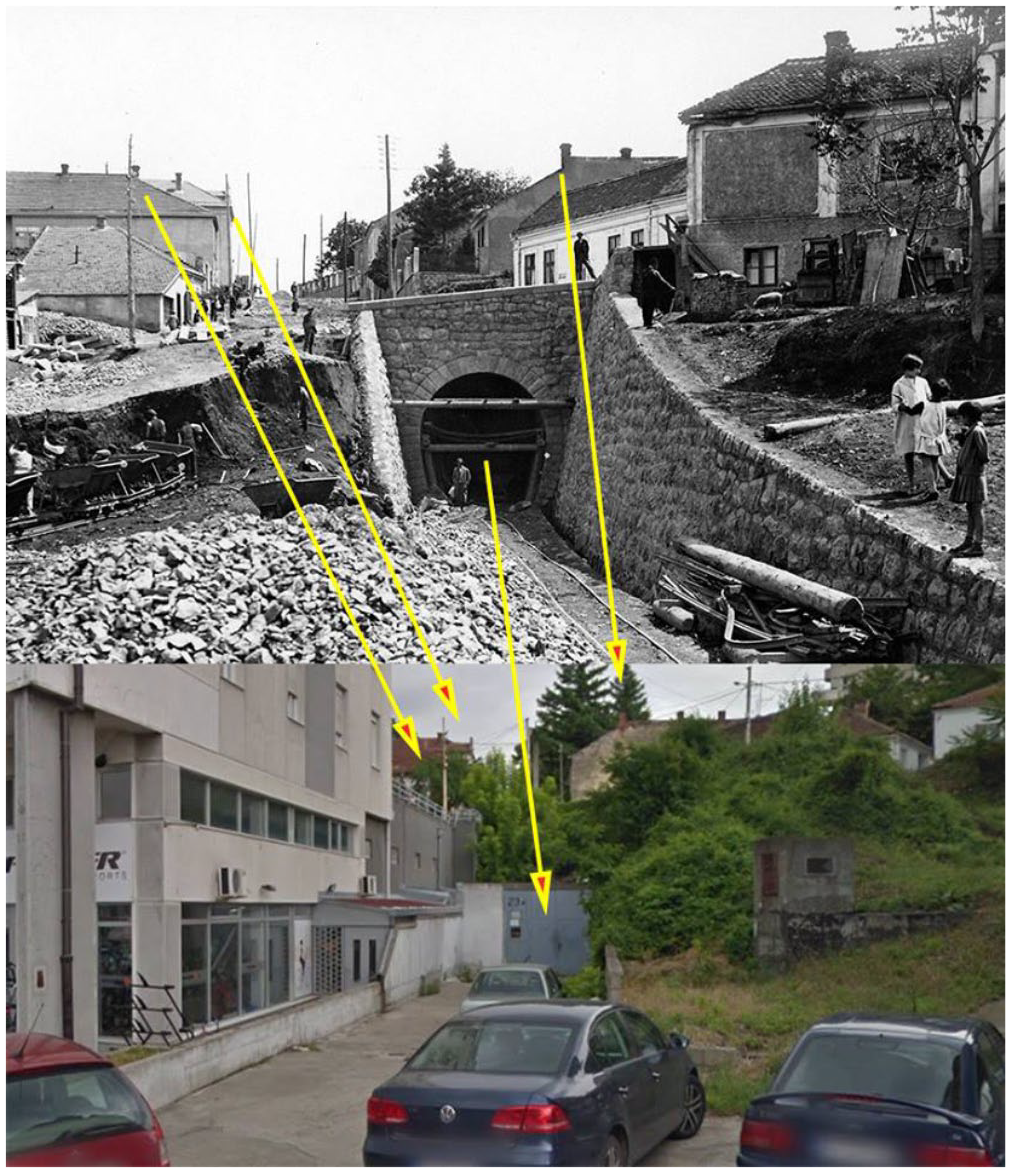
The former tunnel of Čukarica, which has now merged with the urban parts of the city.
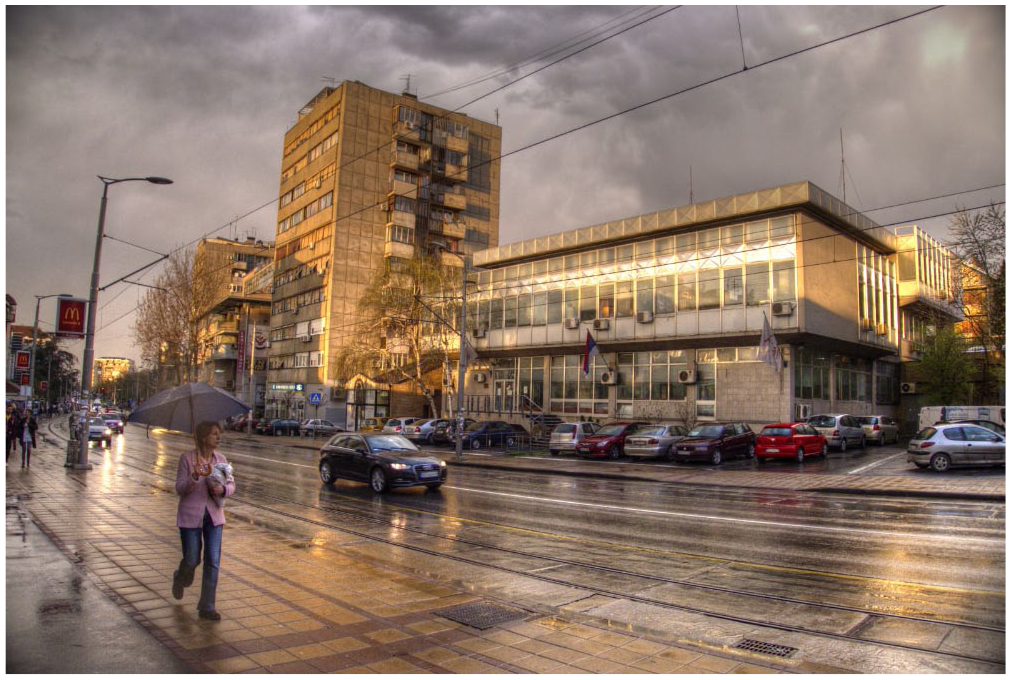
The part of Belgrade called Čukarica today, fifty years after the closing of the narrow-gauge presents a modern urban concept of living.
Most of the settlements in the radius of 40 km toward Obrenovac, which used to be on the route of the railroad, today have new factories, new playgrounds, and other objects with different purposes. If by any chance, the railroad was supposed to be reconstructed or light train included as a means of transport, there would be many problems to be solved, despite the fact that there are hints suggesting the new train would be a great solution for the connection with the central part of Belgrade, and with the new train station in Prokop.
The advantage of a new, ecological train would be in the presence of energy, lessening the degree of pollution, faster connection with the central areas of the city, as well as liberating the parking spots in the center. If one part of the former route passed under the ground, this line could partly be considered an underground railway. 49 Besides the advantages, there are certain disadvantages as well, above all, the land being in private ownership, relatively low speed of the train, and inadequate connectivity with other means of transport.
Besides the advantages, there are certain disadvantages as well, above all, the land being in private ownership, relatively low speed of the train, and inadequate connectivity with other means of transport.
The processes which influenced the railroad after the First World War was industrialization, during the economic crisis since 1929 to 1933, when the railroad started working, and the process of renting, cutting the land into small pieces in the districts of Obrenovac. The Second World War had an even greater impact. After the Second World War, within the first five years of reformation, since 1948 to 1953, the process of industrialization was even more intense, and which included not only Belgrade but also the settlements surrounding it, one of them being Obrenovac. Besides the migrations heading to the central parts of Belgrade, we had an increase of suburbs areas through the time. 50 The railroad and the area surrounding it had no significance for the transport, so it started being observed as an area suitable for the construction of new residential units, made of dormitories for the workers who lived or traveled to Belgrade for work.
Conclusion
The railroads Belgrade (Čukarica)–Obrenovac, which existed within the period between 1928 and 1968, was supposed to connect the suburban parts of the city, as well as newly liberated parts of the Kingdom of Yugoslavia. After the First World War, the growing tendency was to enable direct line from Belgrade to the sea coast. This railroad was connecting it to Dubrovnik, through Uzice and Sarajevo. Once the site of muddy roads and landslides got the characteristics of a well-ordered area with the construction of the railroad, whose purpose also was to contribute to the development of the areas on its route.
The further development of Belgrade was guaranteed by the rise of the economy in the 1930s, as well as the good connectivity of new enterprises with the railroad. The world economic crisis from 1929 to 1933 left its mark on this railroad too, causing some gauges and station objects to be shut down and deserted. Despite all the problems during the Second World War, the railroad was still in function. After the war, Yugoslavia was no longer capitalistic, but a socialist country, and the railroad, still being in its possession, was of great importance.
At the beginning of the 1960s, railway transport marked the global decrease in terms of transported commodity and passengers. The consequences were felt on this narrow-gauge railroad as well. Due to the process of industrialization and the further development of the country, the life standard rose, and more and more people became owners of vehicles. The area between Belgrade and Obrenovac through Čukarica, Železnik, Žarkovo, Ostružnica, Umka, Mala Moštanica, Barič became densely populated, with people building temporary and later permanent objects for living, which influenced the functioning of the railroad. The 1960s were marked by inverse social processes, which had negative effects on people living in the villages.
The process called deagrarization was supposed to solve the problem of workers in factories. The land, previously cut into small parcels, was being deserted. Temporary migrations between Obrenovac and Belgrade became permanent soon enough. The settlements of Čukarica, Železnik, and Žarkovo merged with the city. Parts of the workers’ colonies in Železnik and Žarkovo spread deeply into the area of the railroad. Today, fifty years after its closing, almost nothing of its infrastructure and objects is left, except barely 3 percent. Ninety years since its opening, the majority of people living on its route are completely unaware of its existence.
Yet, the railroad is the witness of changes taking place through time, having an influence on people’s habits as well. It has also shown the relationship between the two settlements within the period of ninety years. It survived two wars, yet failed to stand the pressure imposed by the developing city, migrations, and illegal and unplanned populating. Space itself serves for other purposes now, and the remnants of the railroad show the specific ways of changes that took place during the railroad’s existence and after its closing.
This part of this railroad network may show how space was changed across time and the urban concept of the city of Belgrade. The historical facts of the creation, development, and disappearance of the railroad due to a rapid change inside the space may serve as further observations for the city development.
The potential building of a new railroad which would be in accord with concrete mobility demands, including ecological principles and economic profits would set a fine example for the future in terms of the direction in which urban zones would thrive. Due to a large number of settlements and localities which would be within the proximity of the railroad, the line would have to go underground, so that a lighter train would resemble a subway. The potential construction of this line must consider the ways in which the population within this space would expand over time. The historical research of the former narrow-gauge line may in various ways assist in terms of planning new projects, sustainable development, and the active traffic, which would become ever closer to the city inhabitants.
Footnotes
Declaration of Conflicting Interests
The author(s) declared no potential conflicts of interest with respect to the research, authorship, and/or publication of this article.
Funding
The author(s) received no financial support for the research, authorship, and/or publication of this article.
