







Abstract
The Toronto-based Bureau of Municipal Research published over 800 bulletins and reports on urban issues in Canada between 1914 and 1983. Much has been written about its parent organization, the New York Bureau of Municipal Research. But the history of the Toronto chapter has all but been ignored. This article is a step toward understanding the history of the Toronto Bureau, and its impact on urban policy and local government in the Greater Toronto area. The article proceeds in three parts. First, we tell the story of the Bureau’s genesis, the evolution of its mission and leadership over time, and its eventual demise. Next, we analyze the Bureau’s body of work, identifying two common themes—efficiency and informed citizenship—found across the complete catalog of Bureau documents housed at the City of Toronto Archives. Finally, we examine the Bureau’s tangible achievements, most apparent in areas of municipal finance and administrative reform in the 1910s, 1920s, and 1930s, as well as the Bureau’s enduring legacy, including the lessons its work holds for modern-day urban policy debates in Greater Toronto and elsewhere.
Introduction
The Toronto-based Bureau of Municipal Research, an independent, non-partisan citizens’ organization established in 1914, published over 800 bulletins and reports on urban issues in Canada before closing its doors in 1983. Its mission, encapsulated in its late motto, was to produce “Better Government through Research.” Over eight decades, the Bureau covered nearly every area of urban public policy, from budgeting to housing, welfare to city planning, policing to parks. Yet the origins, evolution, and legacy of the Bureau have never been the subject of dedicated study. Much has been written about its parent organization, the New York Bureau of Municipal Research. 1 But the history of the Toronto chapter has all but been ignored.
This article is a step toward understanding the history of the Toronto Bureau, and its impact on urban policy and local government in the Greater Toronto area—part of a broader project to digitize, catalog, and re-publish the Bureau’s complete library online for public consumption (see http://bomr.ca). This is an important undertaking for several reasons. First, the Toronto Bureau highlights the international reach of the American municipal reform movement in the late nineteenth and early twentieth centuries. Second, in several cases, the Bureau’s research and advocacy helped shape government policy, such as the publication of Toronto’s first comprehensive land use plan. Third, even in cases where the Bureau’s political influence was ambiguous, its research was often ahead of its time. Many of the recommendations made by the Bureau on a variety of topics—from electoral reform to housing to transit—are as relevant today as they were decades, even a century, ago. Fourth, several Bureau employees—including Horace Brittain, Susan Fish, and Anne Golden, to name a few—went on to become prominent figures in the study of urban governance in Canada and the practice of urban policy making in the Toronto region.
The article proceeds in three parts. First, we tell the story of the Bureau’s genesis, the evolution of its mission and leadership over time, and its eventual demise. Next, we analyze the Bureau’s body of work, identifying two common themes—efficiency and informed citizenship—found across the complete catalog of Bureau documents housed at the City of Toronto Archives. Finally, we examine the Bureau’s tangible achievements, most apparent in areas of municipal finance and administrative reform in the 1910s, 1920s, and 1930s, as well as the Bureau’s enduring legacy, and the lessons its work holds for modern-day urban policy debates in Greater Toronto and elsewhere.
The Bureau’s Origin, Evolution, and Demise
The origins of the Bureau of Municipal Research in Toronto can be traced to the emergence of the Canada municipal reform movement at the turn of the twentieth century, fuelled by the American movement which began decades earlier. Although Canadian cities at the time were still quite small by U.S. standards, Canadian reformers nevertheless “looked south” for inspiration from their American counterparts. 2
In November 1912, at the cusp of the so-called Progressive Era, a small group of prominent Toronto businessmen—John Macdonald, a director at the Bank of Toronto, John Firstbrook, a director at The Metropolitan Bank, and John I. Sutcliffe, a chartered accountant—met to discuss ways to improve city government. Patronage was a defining feature of Toronto politics at the time. The City Treasurer, City Clerk, City Engineer, Medical Health Officer, and Deputy Fire Chief had all ostensibly received appointments for delivering votes at election time. 3 This, combined with a booming population, voter apathy, and poor municipal administration created a breeding ground for corruption. The businessmen had had enough. By meeting’s end, Mr. Sutcliffe was selected to undertake a special mission: travel to New York and investigate the work of a civic organization known as the New York Bureau of Municipal Research.
The New York Bureau
The New York Bureau of Municipal Research was established in 1907, a time when the city was dominated by machine politics and neighborhood bosses, and the municipal corporation operated without an annual budget. Motivated by “a blend of altruism and self-interest,” various members of the upper and middle (professional) classes thus organized to expose incompetence and mismanagement within city government. 4 “The Bureau men,” recounts Jane Dahlberg, “were essentially reformers with the idea that a citizen organization could help to improve its government by applying principles of good management to public affairs.” 5
The Bureau’s founders—William Allen, Henry Bruere, and Frederick Cleveland—sought to promote a philosophy of efficient and economical government. The name Bureau of Municipal Research, specifically, conveyed a faith in objective truth and the pursuit of a science of civic government. Public administration could be both better understood and designed based on expert analysis and empirical measurement: “Whether one made shoes or cars, the same administrative principles would adhere; whether one ran a health department of a police department, the same administrative techniques would apply.” 6 Backed by some of New York’s wealthiest philanthropists, including Andrew Carnegie and John D. Rockefeller, the Bureau worked to improve government by recommending new accounting standards, departmental reorganizations, and records management systems.
The Bureau’s first study, How Manhattan Is Governed, documented waste and negligence within the office of Manhattan Borough President John Ahearn, a member of the Tammany Hall Democratic machine, by carefully scrutinizing municipal maintenance records. In many instances, streets, sewers, and public baths that had been officially reported as repaired were still in poor condition. The Bureau’s findings led to a series of official inquiries and public hearings, and eventually, Ahearn’s removal from office—the first time an American elected official was dismissed due to incompetence, rather than dishonesty or corruption. The scandal earned the Bureau considerable notoriety, and similar bureaus were soon opened in over a dozen cities across the United States, including Philadelphia (1908), Cincinnati (1909), Chicago (1910), and Milwaukee (1913). 7
The Toronto Bureau Is Born
Sutcliffe returned from New York inspired. With the support of Alderman S. Morley Wickett, the group invited Henry Bruere, one of the Bureau’s founding directors, to speak at the National Club. According to local reports, Bruere’s address drew “frequent and hearty applause from his hearers.” 8 First and foremost among Bruere’s “suggestions to obtain good city government” was the completion of a comprehensive survey of municipal departments, services, and administrative methods.
A “Committee of One Hundred Citizens” was soon struck to raise funds to conduct the survey under the auspices of a Civic Survey Committee. Members pledged at least $50 toward the endeavor, raising a total of $6,000, or approximately $132,000 in today’s dollars. 9 Naturally, the Committee commissioned staff from the New York Bureau to carry out the study. “The object,” as Frederick Cleveland, another of the New York Bureau’s co-directors, explained, was “to try to find out what the city is trying to do for its citizens, what machinery exists for doing it, how it is doing it, how it fails, and why it fails.” 10
In January 1914, after two months of investigation, the New York staff released their final report on the state of municipal government in Toronto. The report spanned nearly 300 pages, organized into separate analyses of five city departments: treasury, assessment, works, fire, and property. Its general conclusion: Toronto’s “administrative defects are primarily those of methods and not of men.” 11 Simply by improving financial reporting practices, reorganizing the municipal workforce, and employing principles of scientific management, the city could achieve cost savings of approximately five to ten percent. The Toronto Daily Star described the report as “the most important ever submitted on the municipal affairs of this city,” and supported the movement to establish a permanent bureau in Toronto to act as a “centre of general municipal intelligence.” 12
The Toronto Bureau of Municipal Research was incorporated just two weeks later, led by inaugural director Horace L. Brittain, a founding father in the study of local government in Canada. 13 Previously a school teacher and principal in eastern Massachusetts, Brittain was a “Bureau man,” having joined the New York Bureau in 1911, where he conducted local and state-wide surveys of various school systems. 14 Under Brittain’s 33-year tenure, the Bureau published nearly 500 bulletins, papers, letters, and reports.
The Early Years, 1914-1947
The Bureau was originally funded by prominent members of the business establishment, including the Gooderham family of distillers, attracted by its emphasis on professionalism and sound management. This appealed to elites who valued political stability in a period of social and economic change, when high rates of immigration and unionization posed a potential risk to upper- and middle-class interests. The early Bureau thus had little trouble attracting patrons from prestigious private clubs, such as The Toronto Club and the National Club, to serve as trustees, executives, and elected “council” members. 15 But the organization also gave voice to a broader philosophy of civic idealism.
The Toronto Bureau was premised on four founding principles. First is a commitment to scientific inquiry. Scientific methods were expected to produce factual knowledge that would identify the best—that is, most efficient—means of providing public services. 16 Second is civic responsibility. Bureau members believed that public officials, whether elected or appointed, had a responsibility to respect the division between politics and administration. Administrative matters should be led by trained professionals and experts, not politicians. Citizens, in turn, had a responsibility to be aware of and informed about how government works, and to keep governments accountable. 17 Third is publicity. Reform requires political support and public pressure. By publicizing its findings, the Bureau hoped to mobilize citizens, and thus drive change. Last is non-partisanship. The Bureau’s political approach was pragmatic, not personal. As founding chairman John Sutcliffe made clear, “It is a cardinal principle [of all bureaus of municipal research] never to advocate or oppose the election or appointment of any man to any office.” 18 Reports rarely, if ever, included accusations of personal wrongdoing or forms of “muckraking” found in the tabloids.
Over time, the Bureau began to receive donations from other private sources, such as large corporations and business groups, which the Bureau promoted as a demonstration of its political independence and impartiality. Many Bureau reports boasted that the organization’s non-profit status legally barred the Bureau from accepting government subsidies, and prominently stamped this badge of honor on its publications.
19
For example, the back cover of a 1943 bulletin reads, The Bureau of Municipal Research is, and has been from the first, supported by private subscriptions from public-spirited citizens. It has received no governmental or municipal grants, for the reason that its statements of facts, and suggestions as to policy, must not only be independent and unbiased, but must be so considered by the general public. The value of the Bureau to the citizens of Toronto depends on its independence as an agency of constructive criticism and citizen co-operation.
20
Decades later, out of necessity, the Bureau would eventually turn to government for financial assistance. But its public commitment to non-partisanship and impartiality never wavered.
Leadership Transitions, 1947-1973
In late 1947, the Bureau’s first and longest-serving director, Horace Brittain, retired. His successor, Eric Hardy, led the Bureau from 1948-1960. A graduate from the University of Toronto in political science and economics in 1942, Hardy began his career as a director of research in the Wartime Price and Trade Board before moving on to the Ontario Bureau of Statistics and Research. 21 Under Hardy, the Bureau marketed itself as the “only research organization concerned exclusively with improving local government operations and practices throughout Metropolitan Toronto,” an organization “long accepted by public officials and community leaders as a constructive force for civic betterment.” 22
Hardy launched a new “Civic Affairs” publication series, which he framed as open letters to “fellow citizens,” that later evolved into a series of detailed research reports. The Civic Affairs series marked a shift in the Bureau’s strict focus on municipal finance and administrative issues toward social services, such as child care and seniors housing. 23 Hardy’s tenure was also defined by financial challenges. Corporate and individual donations started to decline in the early 1960s, leading to fears that the Bureau might be forced to shut down. 24 Although the organization weathered the storm thanks to a successful membership drive, in retrospect, the end of Hardy’s tenure marked the first cracks in the Bureau’s fiscal foundation.
Following Hardy’s departure, no other director stayed with the Bureau for more than six years. Frank McGilly served a brief term—less than one year—as director in 1961, before moving on to begin his doctorate studies at the University of Pittsburgh. 25 He was succeeded by Michael Goldrick (1961-1964), a 28-year-old Queen’s University graduate in local government, and former executive assistant to the mayor of Ottawa. Goldrick began the Bureau’s gradual shift to a more progressive research agenda. 26 He later became a political science professor at York University and two-term Toronto city councilor.
Simon Miles, a British-born planner and consultant, briefly served as acting director in 1965, before Dominic Delguidice (1966-1969) was hired under the new title of executive director. Trained in public administration at the University of Connecticut, Delguidice spearheaded several comprehensive studies on housing, property development, and regional governance. 27 Delguidice was succeeded by Susan Fish, who was promoted from senior research associate to executive director in 1969 and served until 1973.
Dying Days, 1973-1983
By the end of Susan Fish’s tenure, shrinking revenues and $80,000 in debt obligations had pushed the Bureau to the brink of bankruptcy once again. To balance its books, the Bureau launched a large-scale fundraising campaign, which successfully expanded its membership to include academic institutions (mainly university libraries) and labor groups, such as the Ontario Federation of Labour. But this was not enough to cover the Bureau’s mounting deficits. Reluctantly, the Bureau turned to government for a financial lifeline.
The Bureau’s president, Peter Oliphant, retired in 1972, replaced by Douglas C. Matthews. A well-connected entrepreneur and political fundraiser, Matthews swiftly secured a $25,000 federal grant from the Ministry of State for Urban Affairs, as well as a $40,000 grant and annual $25,000 operations fund from the province—the first of many grants the Bureau received from dozens of government funders over the remaining decade, including the City of Toronto, the Ontario Ministry of Municipal Affairs and Housing, and the Canada Mortgage and Housing Corporation. 28
An organization that once prided itself on financial and political independence had become overwhelmingly dependent on government assistance, and thus vulnerable to shifting political and economic winds. When high inflation and a stagnant economy struck in the late 1970s and early 1980s, many of the Bureau’s government and business partners could no longer sustain past donation levels, and many smaller contributors, including university libraries, chose not to renew their memberships. 29
By the time Mary Lynch took over as executive director in 1980, the organization was in dire straits. Despite the Bureau’s respectable research output, which increased through the late 1970s, continued mismanagement left the organization on shaky financial footing. Budget documents found within the archival collection suggest that Lynch’s predecessor, Charles (Chuck) Bens (1973-1980), resorted to various questionable accounting practices to keep the organization afloat. 30
In a last-ditch effort to save the organization, Lynch initiated a strategic evaluation of the Bureau’s membership and financial structure. The final report, entitled “Future Options for the Bureau” painted a grim picture: “If we continue on our current path, we will eventually cease to exist.” 31 Those who used the information produced by the Bureau—by this time, mainly academics and citizen advocates—were not clients the organization could count on for financial support. Those who made the largest financial donations—businesses and municipalities—saw few direct benefits from their contributions, and provincial and federal government interest ebbed and flowed based on political pressures. In the scramble to simply stay afloat, the Bureau could no longer articulate its value to members and the general public.
A year before its eventual demise, in 1982, the Bureau published a self-assessment of future prospects. Its authors acknowledged that the Bureau “has not had a clear focus for a long time” and was in place where “there is little common agreement on what we do, who we do it for, and whether anyone cares.” 32 Months later, a newly elected provincial government decided not to renew its $25,000 annual grant, leaving the Bureau little choice but to close shop. 33 In a final act of government charity, the Municipality of Metro Toronto agreed to provide the Bureau a closing grant of $35,000 to pay off its creditors and provide severance pay to staff in exchange for the Bureau’s complete library of publications, now housed at the City of Toronto Archives. 34
The Bureau’s Body of Work
What can be learned from the Bureau’s body of work, long buried in the city archives for the past forty years? To answer this question, we digitized and cataloged the Bureau’s complete library and compiled a detailed database of all 831 Bureau publications by series, title, date, subject, and keyword to enable a more systematic analysis of the organization’s impact. Our findings reveal an organization whose research agenda evolved to keep up with the times, while still remaining true to its founding principles.
Formats and Focus Areas
Bureau publications came in at least eight different formats, organized into distinct series: bulletins, white papers, news briefs, radiograms, letters, commentaries, research reports, and annual reports (Figure 1). The focus of each series varied by era. Bulletins were a mainstay of the Bureau’s early work between 1914 and 1922. They were printed as easy-to-read pamphlets and mailed free of charge to city aldermen, municipal department heads, and individuals on the Bureau’s mailing list. Bulletins challenged citizens to call out mismanagement, go to the polls, and become informed citizens.
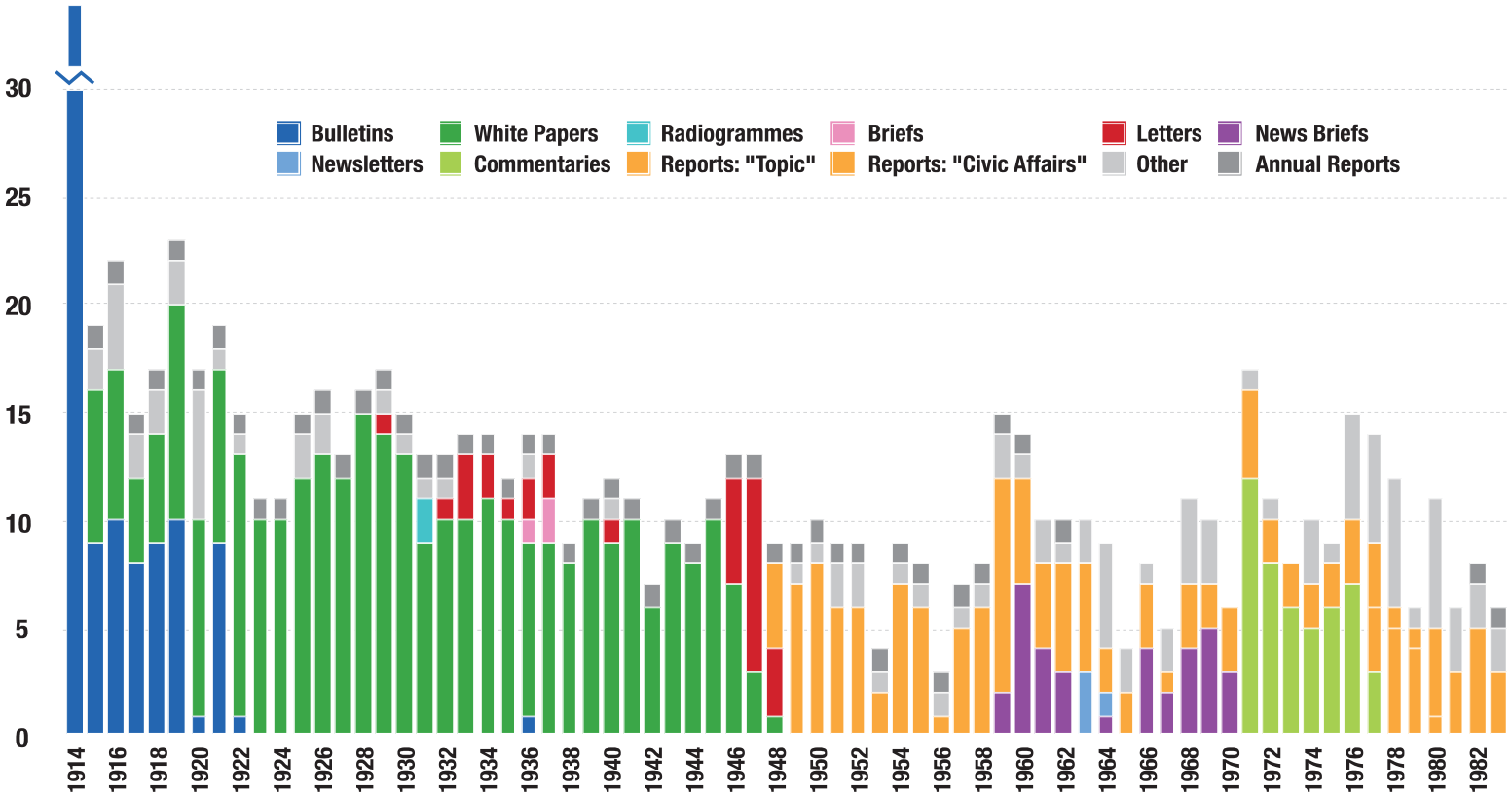
Publications by type/series.
White papers, published between 1915 and 1945, were three-to-five page policy backgrounders written for a general audience. Issues were often presented in the form of “stories” to which the average citizen could relate. The series also included simple educational materials, such as election primers and questions for candidates, a basic explanation of council-manager government, and exquisitely drawn organizational charts depicting all the government actors involved in urban governance. 35
Commentaries presented the Bureau’s editorial position on a wide range of topics and debates from municipal expropriation to multiculturalism. Newsletters, briefs, and letters were intended to either gain publicity for the Bureau’s work, summarize current events pertinent to the Bureau’s research agenda, or critique and raise objections to recent political decisions. Detailed research reports were released under the labels “Civic Affairs” (1943-1983) and “Topic” (1977-1980), and covered a wide range of subjects including low voter turnout, public transit, and various development projects.
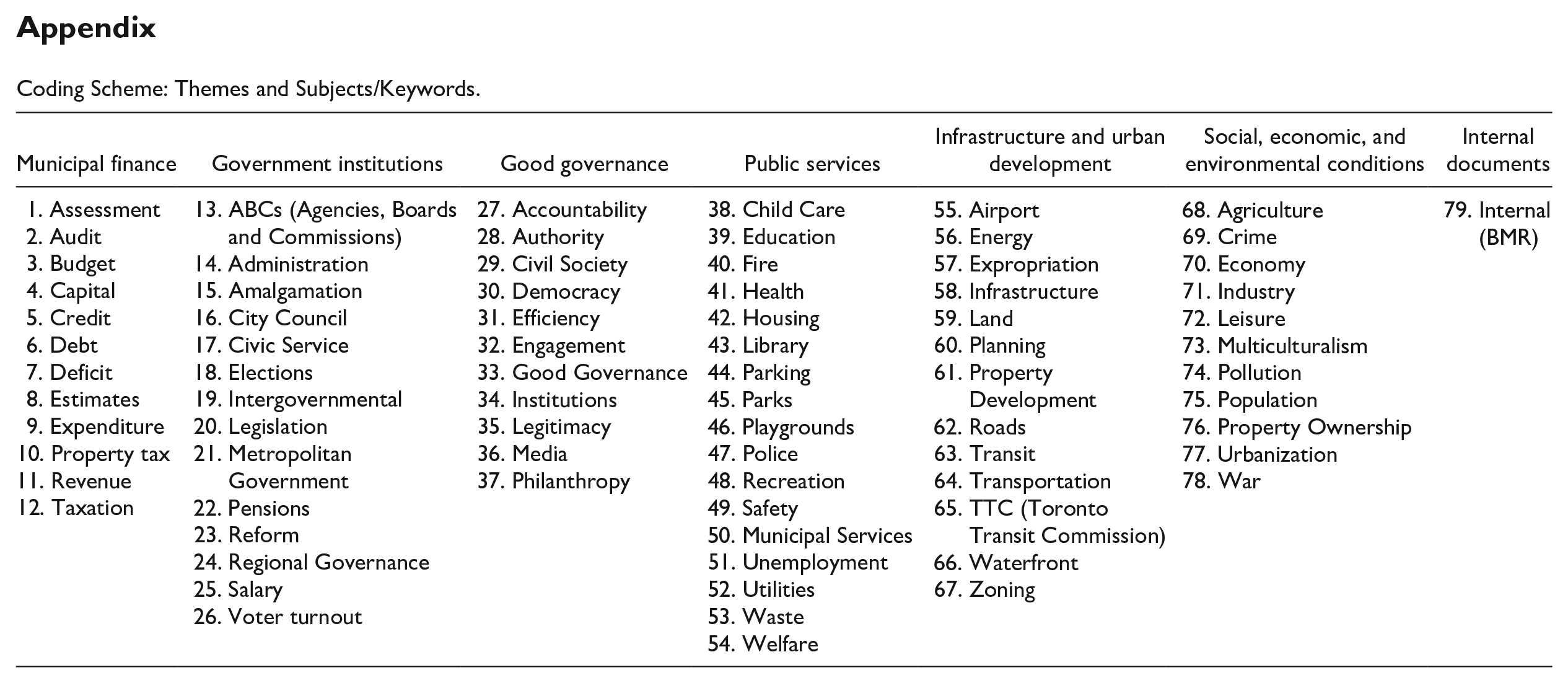
To better understand the focus of the Bureau’s research over time, we developed a categorization scheme (see Appendix). Materials were manually coded using an initial list of 111 tags/keywords, developed iteratively during the data collection process. 36 This list was then cross-checked during quality assurance for simplicity and accuracy, and streamlined into a final list of 79 keywords. In a second round of coding, documents were categorized by primary topic (a single keyword that best defined the material’s general content). We then sorted these keywords into seven general themes and subject areas: (1) finances; (2) government structure and machinery; (3) good governance; (4) municipal services; (5) infrastructure and urban development; (6) social, economic, and environmental conditions; and (7) and Bureau-specific reports (e.g., self-studies).
Figure 2 summarizes the results of the coding process, and illuminates the Bureau’s research focus over time. Of the full list of 831 publications, 236 (28%) deal with municipal finances, such as budgets, debt, taxation, and expenditures, while 217 (26%) examine issues related to the structure and machinery of local government, including the size and configuration of city council, metropolitan government, and elections. Another 142 (17%) discuss the provision of public services, such as police and fire protection, health, housing, and education. Sixty-eight (8%) deal with matters concerning good governance, such as accountability, transparency, and democratic legitimacy. Fifty-six (7%) concern infrastructure and urban development, including transit and transportation, planning, and property development. And eighteen (2%) report on existing economic, social, or environmental conditions, such as economic growth, urbanization, and demographic change.
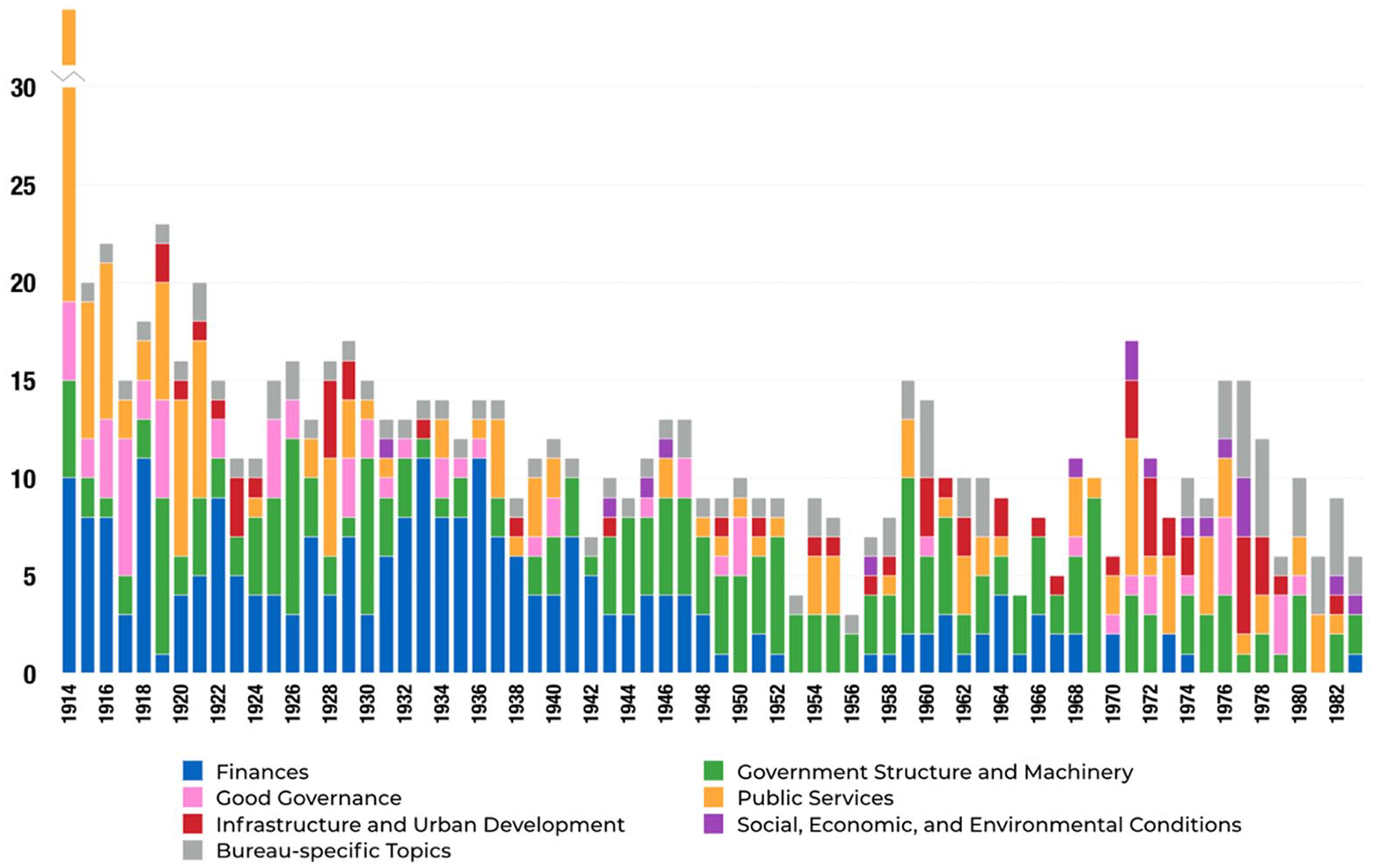
Publications by subject area.
Universal Themes
Two universal motifs emerge across the Bureau’s entire body of work: efficiency and informed citizenship. To the Bureau’s founders, efficiency meant an emphasis on businesslike administration. As one rather blunt Bureau report put it, “public business is business” (original emphasis). 37 Early reformers believed that citizens could not rely solely on philanthropy as a means to improve social conditions. Government could be useful, but not if municipal programs were based on ward politics, rather than need. A “science of civic government” was required to do the job right. 38
Inspired by the writings of Henry Bruere and other “apostles of the ‘efficiency idea,’” the Bureau started out by publishing regular exposés of financial extravagance within city departments, and bulletins and white papers promoting bureaucratic expertise and improved management procedures. 39 For instance, a 1930 white paper asked, “Can the organization of the municipal government of Toronto be improved?” The Bureau’s answer: “Insofar as it is a business, it should be conducted as a business, and, insofar as it is more than a business, the adoption of business principles in administration can do nothing but good.” 40 These principles permeated much of the Toronto Bureau’s work at least until the late 1950s, as the Bureau consistently called for administrative improvements, greater coordination across municipal departments and centralization of core services. 41
After Horace Brittain’s retirement, the Bureau’s language softened—the “science” of government gave way to the expression “best practices”—but its emphasis on sound management carried on for decades. Later reports continued to focus on opportunities for administrative efficiencies and better budgeting, including debt servicing, methods to determine fair taxing schemes, and proper reporting of revenues and expenditures. 42
In later years, the Bureau began producing reports that evaluated policy outcomes, as opposed to outputs. 43 But it never abandoned its traditional focus on quantitative measurement as the bedrock of administrative efficiency. This echoes current-day expectations that government service delivery requires regular performance measurement and value-for-money audits, as well as the dominant discourse within public administration as to the benefits of “evidence-based” decision making.
The second universal theme apparent across all eight decades of Bureau research is the prominence placed on informed citizenship. Since inception, the Bureau worked to defend the public’s right to know how government works, to demand fairness and honesty from municipal officials, and to have access to necessary information to keep governments accountable—a precursor, in many ways, to the contemporary movement toward “open government.” 44
In the early years, the Bureau equated citizenship with public oversight. It called for “effective citizen cooperation” in nearly all its publications, and printed bulletins with stirring mastheads such as “citizen control of the citizen’s business.” The burden of securing good government fell on citizens, as only voters could ensure that tax dollars were spent wisely. Legitimacy, in other words, derived from democratic accountability. The Bureau’s job was thus to enable informed choices and get out the vote. Over several decades, the Bureau published dozens of reports on the causes of voter apathy and ideas for maximizing turnout, as well as a long-running series of letters and research briefs entitled “Questions for Electors.”
Gradually, the Bureau expanded its understanding of citizenship to include community engagement and neighborhood participation in decision making. In the 1950s and 1960s, it began exploring the quality and representativeness of elected officials. 45 In the 1970s, amidst the second urban reform movement, it studied citizen input in city planning at both the neighborhood and regional scale. 46 Citizen-led decision making, in this sense, closely resembled what today we might call local governance, where multiple political actors, both public and private, take part in collective decision making.
Trends and Patterns
While the Bureau’s commitment to the principles of sound administration and civic education remained remarkably consistent, periodic changes in the Bureau’s leadership influenced shifts in research priorities over time.
The majority of the Bureau’s early work on municipal finance and budgeting, for example, highlighted the tax burden on property owners, whereas later reports investigated the potential for new sources of municipal revenue. 47 Similarly, the Bureau regularly published at least one or two documents a year focused on the provision of public services. But what these services entailed changed from era to era, matching changing expectations about the role of local government.
In the 1920s and 1930s, for instance, the Bureau’s research concentrated almost exclusively on police, fire, education, and public health—what might be considered traditional municipal responsibilities. Beginning in the 1950s, and intensifying in the 1970s, the Bureau’s shifted focus to housing, parks, libraries, and child care, in line with the expansion of the welfare state and community-level politics. This indicates that the Bureau exhibited some degree of institutional flexibility. Its founders, one must remember, were by no means interested in expanding municipal public services—only the provision of better, more efficiently delivered services.
Moreover, the Bureau’s methods also evolved. The Bureau’s “scientific” approach to the study of local government and administration diminished with changes in technology, research techniques, and professional norms. Under Horace Brittain’s leadership, the Bureau conducted the majority of its research as city-specific administrative surveys and departmental audits. But as the Bureau’s focus shifted to new policy areas, staff began adopting a more comparative approach. Several reports in the 1950s and 1960s, for instance, included multi-city case studies and jurisdictional scans meant to identify best practices. Later, in the 1970s, the Bureau adopted a more historical, qualitative research methodology. 48
The Bureau’s Legacy
What is the legacy of the Bureau of Municipal Research? Although it is difficult to trace the Bureau’s direct influence on Toronto politics and policy making, we have clues as to how its research, criticism, and advocacy helped shape government policy by examining the Bureau’s annual reports and internal correspondence.
Tangible Achievements
Most of the Bureau’s material accomplishments were most apparent in its earliest years. For example, one of the central recommendations of the New York Bureau’s initial survey of Toronto’s city government, in 1913, was to appoint an executive head of financial administration. 49 Due in part to the Bureau’s badgering, the City appointed its first Commissioner of Finance less than two years later. 50 In 1915, the Bureau called for mandatory balancing of the municipal budget, in a paper entitled “Government by Deficit.” 51 For the next fifteen years, until the Great Depression, the City adopted a strict budget balancing policy, for which the Bureau claimed direct credit. 52 Similarly, in 1916, the Bureau published a white paper calling for the amalgamation of the city’s health services under a single Department of Public Health. 53 The City followed the Bureau’s recommendation almost immediately, merging health services into a single city department in 1917. 54
Over the following two decades, the Bureau’s achievements were less immediate, but nevertheless noteworthy. The Bureau was one of the first organizations, for example, to push for the creation of a city-wide land use plan, in the 1920s, as well as centralize city planning functions and appoint a citizen-led planning commission. 55 It took fifteen years for the Toronto City Planning Board to be established, in 1942, and with it, the publication of Toronto’s first comprehensive Master Plan in 1943. 56
The Bureau was also an early advocate for electoral reform. As early as 1923, the Bureau called for electoral terms longer than one year and a reduction in the size of Toronto city council. 57 It took until 1934 for council to be reduced 25%, to eight representatives, and until 1956 for terms to be extended to two years. 58 The Bureau went on to publish dozens more studies on the subject of elections—on mandatory voting, at-large elections, staggered terms, the use of referenda, the introduction of political parties at the municipal level, and systems of proportional representation—all of which still inform modern-day debates.
Policy Foresight
Over time, either because of changes in leadership or lack of resources, the Bureau focused less on advancing concrete recommendations than illustrating and illuminating the most pressing local policy issues across the Toronto region—research that was often ahead of its time.
For example, the Bureau began studying the “growing pains” of metropolitan centers as early as 1931, twenty years before the creation of Metro Toronto. 59 During this time, it supplied background material and gave presentations on metropolitan government to the Ontario Municipal Board, and participated in more than sixty meetings of the mayor’s Committee on Metropolitan Problems, as well as the premier’s Toronto Area Committee. 60
In the 1950s, as Toronto celebrated the opening of its first subway line, the Bureau warned about impending fiscal shortfalls related to transit expansion, and later raised the prospect that fare revenues alone were insufficient to sustain transit operations, let alone expand service routes, without provincial subsidies—foreshadowing modern-day concerns. 61 The Bureau was also one of the first organizations in Toronto to thoroughly investigate the relationship between transit and urban poverty, anticipating contemporary efforts to improve transit equity and justice. 62
In the late 1960s, during the height of the behavioral revolution in the social sciences, the Bureau published a report entitled “The Development of Urban Indicators,” which in many ways foreshadows the research approach of city indicators projects such as the World Council on City Data. Perhaps not by coincidence, the WWCD’s president and CEO, University of Toronto professor Patricia McCarney, it is interesting to note, worked as a research associate at the Bureau from 1979 to 1981. 63
In the 1970s, the Bureau called attention to the perils of unchecked property development, publishing a comprehensive review of international efforts to control urban growth—more than thirty years before the provincial government established a “greenbelt” to curb sprawl in the Toronto region. 64 The Bureau also published a detailed report on the city’s rental housing market and the crisis of housing affordability. 65 Commissioned by the City of Toronto Housing Department, the study estimated that over 8,000 households lived in either overcrowded or structurally unsound rental units, and up to 30,000 households were living in housing that consumed too much of their income—a figure set to grow without concerted government intervention. Today, after years of disinvestment, that number has jumped to 225,00 households living in unaffordable rental housing, or half of all Toronto households. 66
Through these prescient studies, the Bureau helped launch the careers of several notable names in Toronto’s politics. For example, Susan Schiller (née Fish), the Bureau’s director from 1969 to 1973, went on to become a Toronto city councilor, then a provincial cabinet minister in the governments of Bill Davis and Frank Miller; she now serves on the Ontario Municipal Board. Similarly, Anne Golden, who led the Bureau’s research program in the mid-1970s, became chair of the 1996 Greater Toronto Area Task Force, president of the United Way of Greater Toronto, and most recently, chair of Ryerson University’s City Building Institute, among other distinguished positions.
Conclusion
Some scholars point to the New York Bureau as the birthplace of modern public administration in the United States. 67 Did the Toronto Bureau have a similarly profound impact in Canada? Not nationally. According to founding president John Macdonald, the establishment of the Toronto Bureau was meant to mark “the beginning of an all Canada campaign for civic economy and efficiency.” 68 That never came to pass. Although it inspired the creation of the Citizens’ Research Institute of Canada, in 1919, a companion organization which aimed to expand the Bureau’s mission at all levels of government, there is little evidence that the Institute played an influential role in provincial or federal decision making. 69 It survived only half as long as the Bureau, and similar municipal bureaus never stuck in other Canadian cities. But in Toronto, the Bureau’s impact was real.
As prominent Toronto Star journalist Margaret Daly put it, the Toronto Bureau of Municipal Research kept city government “on its toes,” helping shape government policy and policy discourse for nearly eighty years. 70 Its core ideals of efficiency and informed citizenship are no less relevant today than a century ago, and the issues it investigated no less pressing. Its long-standing interest in measurement and good governance still resonates in today’s world of evidence-based decision making. Its dedication to transparency and accountability still informs professional norms and best practices in municipal administration. And most importantly, its commitment to civic participation and citizen engagement still speaks to the never-ending challenge of local democracy, in Toronto and in cities around the world. The Bureau was sui generis in this respect, an organization without any local contemporaries, past or present.
Footnotes
Appendix
Coding Scheme: Themes and Subjects/Keywords.
| Municipal finance | Government institutions | Good governance | Public services | Infrastructure and urban development | Social, economic, and environmental conditions | Internal documents |
|---|---|---|---|---|---|---|
| 1. Assessment 2. Audit 3. Budget 4. Capital 5. Credit 6. Debt 7. Deficit 8. Estimates 9. Expenditure 10. Property tax 11. Revenue 12. Taxation |
13. ABCs (Agencies, Boards and Commissions) 14. Administration 15. Amalgamation 16. City Council 17. Civic Service 18. Elections 19. Intergovernmental 20. Legislation 21. Metropolitan Government 22. Pensions 23. Reform 24. Regional Governance 25. Salary 26. Voter turnout |
27. Accountability 28. Authority 29. Civil Society 30. Democracy 31. Efficiency 32. Engagement 33. Good Governance 34. Institutions 35. Legitimacy 36. Media 37. Philanthropy |
38. Child Care 39. Education 40. Fire 41. Health 42. Housing 43. Library 44. Parking 45. Parks 46. Playgrounds 47. Police 48. Recreation 49. Safety 50. Municipal Services 51. Unemployment 52. Utilities 53. Waste 54. Welfare |
55. Airport 56. Energy 57. Expropriation 58. Infrastructure 59. Land 60. Planning 61. Property Development 62. Roads 63. Transit 64. Transportation 65. TTC (Toronto Transit Commission) 66. Waterfront 67. Zoning |
68. Agriculture 69. Crime 70. Economy 71. Industry 72. Leisure 73. Multiculturalism 74. Pollution 75. Population 76. Property Ownership 77. Urbanization 78. War |
79. Internal (BMR) |
Declaration of Conflicting Interests
The author(s) declared no potential conflicts of interest with respect to the research, authorship, and/or publication of this article.
Funding
The author(s) received no financial support for the research, authorship, and/or publication of this article.
