







Abstract
This research revisits the widely accepted two-stage framework for understanding Barcelona’s transformation between the late 1970s and early 1990s. According to this view, the first stage focused on small-scale, symbolic projects (such as the Espais Urbans program and early planning efforts), followed by a second stage of large-scale development driven by the 1992 Olympic Games. While acknowledging the heuristic value of this framework, the article argues that large-scale ambitions were already present in Barcelona’s planning agenda from the late 1970s, when democratic planning structures were first established. Drawing on policy documents, testimonies of key political and technical actors, and secondary sources, the study reveals that from as early as 1979 to 1981, the city’s political leadership and planning apparatus conceived a holistic urban strategy grounded in a vision of neighborhood’s public space improvement and international projection. The article emphasizes how political optimism and administrative innovation enabled the mobilization of resources and sustained long-term transformation, even under significant fiscal and political constraints.
Over the past 5 decades, Barcelona has experienced a profound urban transformation that has reshaped not only the city’s physical landscape but also its economic and social features. This has resulted in Barcelona becoming “one of the world’s most admired cities with one of the best images at an international level.” 1 Since the early 1990s, this profound transformation has increasingly attracted the attention of urban scholars. Among the most studied periods are the 1980s and 1990s, when the city was first firmly “placed on the map.”
Early publications from this pivotal time have explored diverse facets of Barcelona's urban development. Scholarly engagement with what, in 1997, Pasqual Maragall, then Mayor of Barcelona, labeled as the “Barcelona Model” has been particularly extensive. These studies and outcome evaluations have varied considerably in their scope and conclusions. While some studies have meticulously examined the advantages and limitations of this model, 2 others have offered a more critical perspective that denounced the “Barcelona Model” as a manipulative endeavor that has ultimately fostered social failures, characterized by increased inequality, displacement, and repression. 3 Additionally, some researchers have even questioned the very existence of a singular “Barcelona Model,” arguing that planning strategies, governance agreements, and networks demonstrably shifted across different phases and neighborhoods over time. 4
Studies that have addressed these 2 decades and the so-called “Barcelona Model” have identified different periods in the transformation of the city. Paying attention to the use of strategic events, Marshall 5 identified three major phases in the city’s planning and policies: (1) a Pre-Olympic period (1979–1988) focusing on small-scale urban interventions; (2) an Olympic-led transformation period (1988–1992) focusing on capitalizing on massive public investment and civic momentum; and (3) a Post-Olympic period (post–1992) driven by strategic planning efforts. McNeill 6 provides a slightly different periodization: (1) the Early Democratic period (1979–1982) characterized by participatory renewal and small-scale design, (2) a period of Urban Realism (1982–1997) under Mayor Pasqual Maragall dominated by the improvements of public space, working-class neighborhood urban upgrading and electoral pragmatism; and (3) an Olympic period (1986–1997) in which mega-events and mega-infrastructure was used to generate global visibility. Analyzing a longer period, Monclús 7 divides the “Barcelona Model” into two phases: (1) the Reconstruction phase (initiated in the early 1980s) with small-scale interventions focused on improving streets and public spaces; and (2) a Strategic Urban Projects phase (1992–2004) stimulated by flagship mega-events including the 1992 Olympics and the later international cultural event, 2004 Forum, in which large-scale infrastructure upgrading in different parts of the city was used to facilitate the rebranding of Barcelona as a global magnet for international tourism and investment.
Despite some differences in the identification of periods, existing scholarship largely converges on the characterization of the late 1970s and early 1980s in Barcelona as a period dominated by ad hoc or incremental small-scale urban interventions without an overarching strategic or comprehensive plan. These studies highlight that while centering their efforts in implementing small scale projects, the newly elected left-wing municipal government prioritized direct collaboration with neighborhood associations and focused on revising or halting large-scale infrastructure projects inherited from the Franco regime that threatened the historic core of downtown neighborhoods.
While acknowledging the importance of this prior scholarship we argue that a detailed examination of testimonies of key political and technical actors, planning and legal documents together with journalistic articles from the pre-Olympic period allows an identification of a holistic approach to comprehensive urban renewal that began at the outset of the democratic transition period. The research illustrates how, from the first democratic local elections, the key political and planning agents driving Barcelona’s urban renewal, despite facing administrative and budgetary constraints, committed to an ambitious comprehensive transformation of the city in which political optimism and administrative reforms played a key role. The following sections provide a detailed examination of these issues and their significant policy implications.
Going Large and Small: International Projection and Local Administrative Reforms
Spain’s democratic transition after the death of General Francisco Franco in 1975 initiated a process that would eventually deeply affect Barcelona’s political and urban development. The transitional period was not a smooth process but was characterized by challenges linked to the drafting and approval of a democratic constitution, the holding of national, regional, and municipal elections, and dealing with an attempted military coup aimed at reversing this process.
The first democratic elections in June 1977 resulted in a victory for the center-right coalition Unión de Centro Democrático (UCD) in Spain. However, in Barcelona and across much of its metropolitan region, the Socialist and Communist parties secured the most votes. The victory of the Partit Socialista de Catalunya (PSC) signaled a shift from the previous historically conservative leadership of the City Council. Since 1979, the PSC continuously held power in Barcelona, either through an outright governing majority or in coalition with the Communists, Catalan Green Party, and/or independents. Narcís Serra, the first democratically elected mayor (1979–1982), was a key figure in the transitional period. A former academic, his administration was supported by a network of progressive civil society actors, including intellectuals, artists, and architects, who collectively envisioned a new democratic and large-scale transformation of the city.
As early as 1979, four programmatic objectives of the Socialist local government included: (a) humanizing the city by shifting the focus from construction projects to providing better services for citizens; (b) democratic reforms of the administration, that included improving performance by reorganizing staff and better financial management; (c) reducing unnecessary bureaucracy and increasing the number of personnel involved in providing direct service to citizens in neighborhoods; and (d) improving professional responsibility and efficiency. 8
Despite this seemingly small-scale pragmatic approach, the inaugural speech on the new mayor revealed an ambitious and optimistic agenda. As Moreno 9 asserts in a detailed analysis of this speech, Mayor Serra highlighted that “[Barcelona had a] role as an economic and political engine of Catalonia and Spain, without losing sight of its role in the Mediterranean.” As part of this internationalization projection, the city joined the two main networks that operated at a global level at the time: the International Union of Local Authorities (IULA) and the World Federation of United Cities (FMCU), hosting in 1980 local representatives from municipalities across the Mediterranean for a meeting to discuss new ideas, challenges, and demands directed at higher-level government institutions. 10
The bid for the 1992 Olympics was a process that started as early as 1980, when Mayor Serra appointed a commission led jointly by an architect and an economist to assess the feasibility of Barcelona hosting the 1992 Games. The mayor tasked the commission with proposing a comprehensive urban transformation plan for the city, that went beyond identifying potential sites for Olympic infrastructure investment. The bid process gained further momentum in 1981, when Mayor Serra informed the King of Spain of his intention to bid for the Games during the King’s visit to Barcelona for the Armed Forces Day parade. Two years later, in November 1983, in the headquarters of the International Olympic Committee in Lausanne (Switzerland), a small delegation from Barcelona officially presented the bid for the XXV Olympic Games in 1992 to the president of the International Olympic Committee Juan Antonio Samaranch. Recalling this event, in an article published in January 1983, Serra wrote: When in 1979 forty-three citizens took charge of the city government, Barcelona was bereft of future projects. First, we set to work on small, urgent urban development actions to revive a city that was feeling disheartened. That “mending” work, however, was not enough. It was necessary to provide the city with a project that, considering its metropolitan character, could act as a catalyst for hopes and collective will: the 1992 Olympic Games.
11
In the same publication, Mayor Pasqual Maragall 12 (terms, 1982–1997) asserted: “The Barcelona metropolis will gain quality of life through the hosting of the Games (. . .). We have 10 years ahead of us. That is why we have already set to work.”
The commission’s final report emphasized continuity with the first Socialist council’s focus on neighborhood improvement, proposing four strategic zones as the foundation for Barcelona’s development after 1992. These areas were Vall d’Hebron, Poblenou (Villa Olímpica), Diagonal, and Montjuïc, 13 see Figure 1.
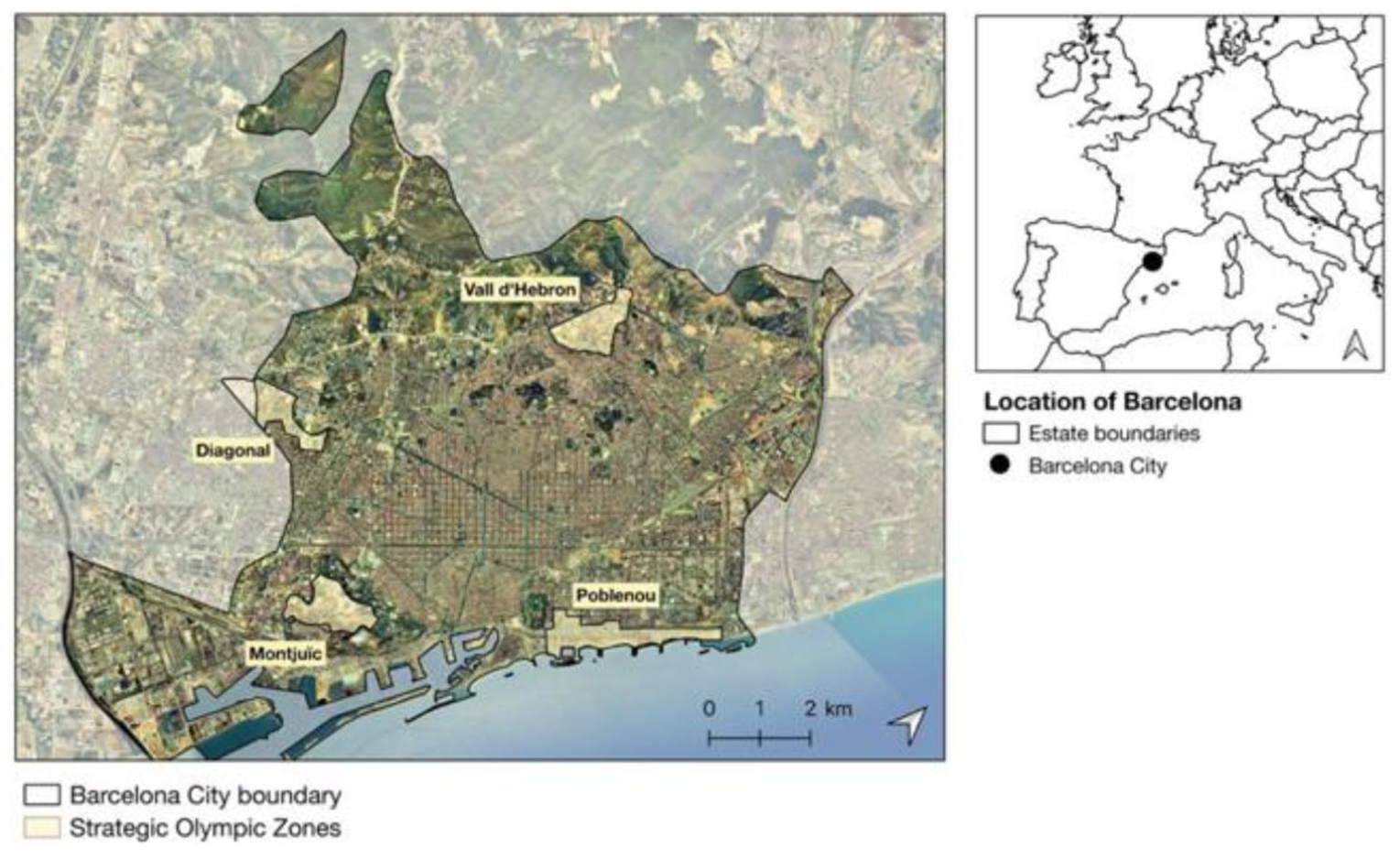
The four strategic Olympic zones. Map created by the authors using zone delimitation from Barcelona ’92: molt més que uns Jocs (Catalan Architects); 1993 orthophoto via QGIS Open ICGC (Institut Cartogràfic i Geològic de Catalunya); Unitats Administratives dataset from Open Data BCN (Ajuntament de Barcelona); and Countries dataset (Eurostat).
Regarding Poblenou, Mayor Maragall proposed the creation of a new maritime district in this industrial area. Historically referred to as the “Catalan Manchester,” 14 Poblenou expanded in the mid-nineteenth century as industrial activities shifted from the city center to its periphery. By the late 1980s, however, the area was characterized by urban decay and industrial obsolescence. Additionally, two ground-level railway lines ran through the area, effectively severing the city from its coastline (Figure 2).
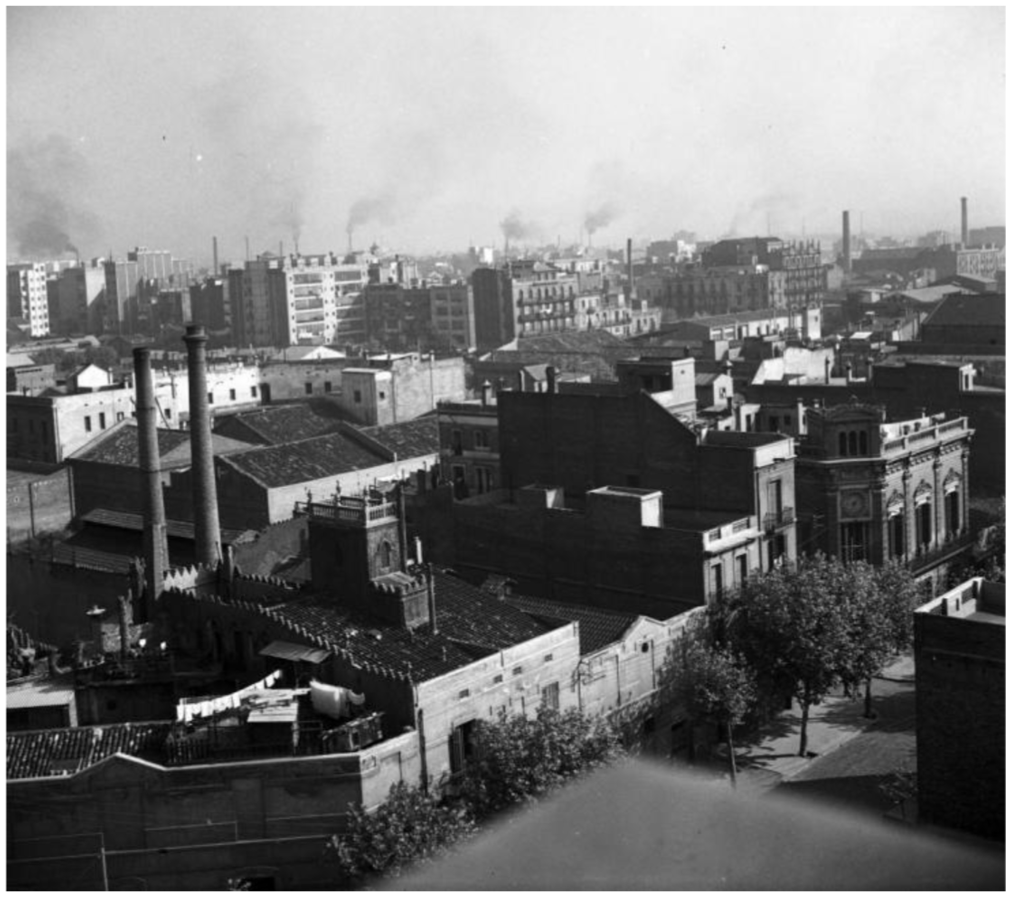
Poblenou mid-20th century. Institut Cartogràfic i Geològic de Catalunya. Open Source https://cartotecadigital.icgc.cat/digital/iiif/cuyas/6959/full/full/0/default.jpg.
The redevelopment of Barcelona’s coastline was among the most ambitious and transformative components of the Olympic urban renewal strategy. The waterfront was revitalized through the creation of new beaches and the construction of 2.5 miles of underground railway tracks. Upon completion, the project produced a newly configured urban district encompassing 50 hectares of parkland, a small recreational marina, a pedestrian promenade linking the beaches to the port, and two 42-story skyscrapers; one housing a hotel and the other an office tower. In addition, the redevelopment delivered 1,854 residential units and 220 commercial establishments. Conceived as an extension of Ildefons Cerdà’s original Eixample plan of 1860, the project sought to integrate the new district seamlessly into Barcelona’s broader urban fabric (Figure 3). 15
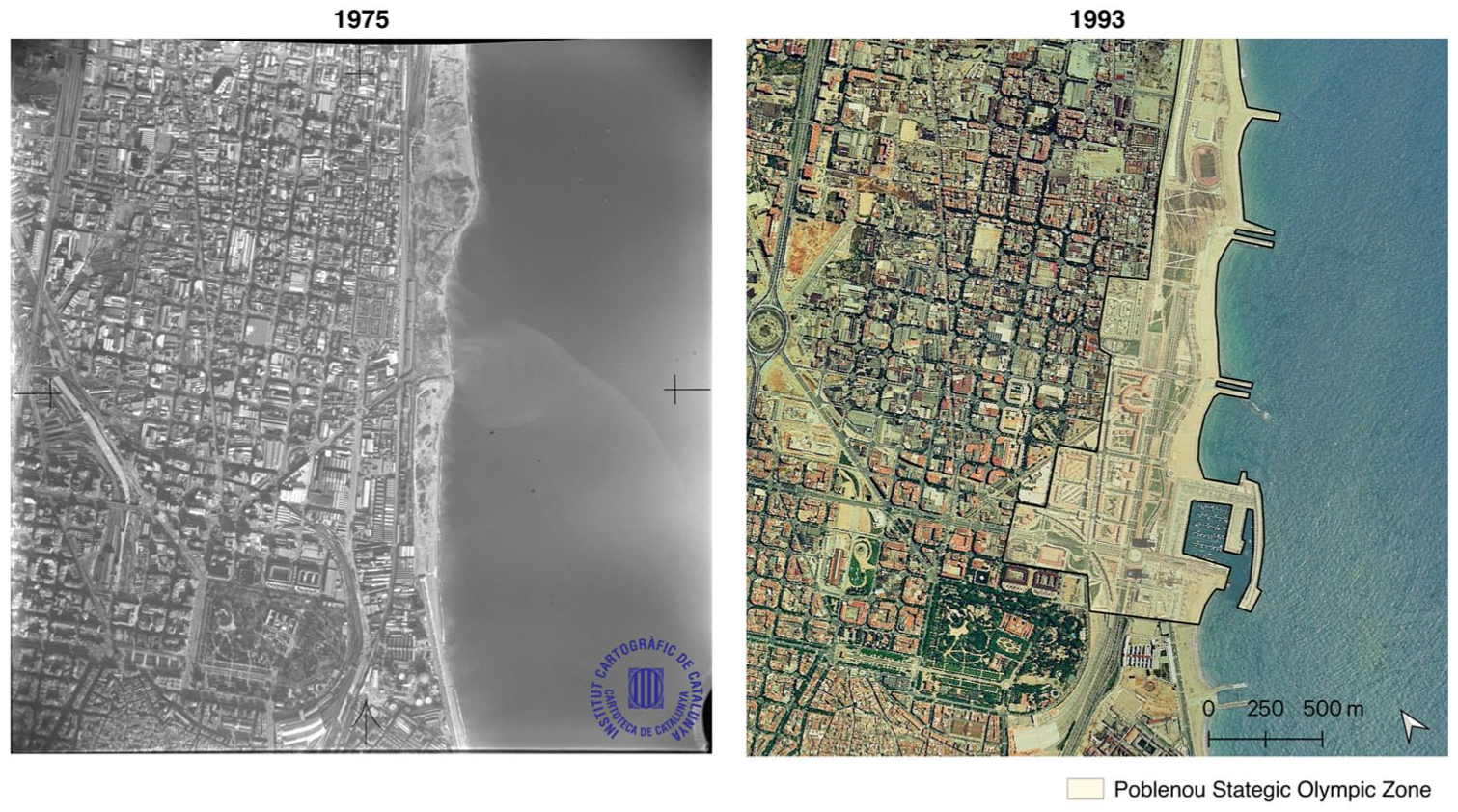
Comparative map of Barcelona’s waterfront pre and post 1992 Olympics. Map created by the authors using zone delimitation from Barcelona ’92: molt més que uns Jocs (Catalan Architects); 1975 aerial photo from ICGC (Institut Cartogràfic i Geològic de Catalunya); and 1993 orthophoto via QGIS Open ICGC (Institut Cartogràfic i Geològic de Catalunya).
Local politicians justified the inclusion of Vall d’Hebron, a working-class neighborhood characterized by inadequate public services and deficient road infrastructure, as a priority area within the city’s 1992 Olympic redevelopment strategy. The project was framed not only to accommodate new sports facilities but also as an opportunity to address long-standing urban inequalities and improve living conditions in one of Barcelona’s most neglected neighborhoods. The neighborhood benefited from the construction of a new sports complex, including tennis courts, as well as 489 new affordable residential units and a ring road that improved mobility by funneling traffic around, and connecting the area to the city. On the other hand, the Diagonal area already featured a high concentration of sports facilities, but these lacked integration into the broader urban fabric. Local planners viewed the hosting of Olympic events in this district as a strategic opportunity to transform this area by constructing new infrastructure, including connecting roads. 16
Additionally, redevelopment projects took place in the Montjuïc hill area. The initial redevelopment of the hill was undertaken to host the 1929 World’s Fair. However, during the Franco regime, the area gradually was neglected and became a marginal space within the city. By 1957, it was home to extensive landfills and approximately 6,090 informal housing units, or barracas, forming several shantytowns across the hill. 17 Starting in the 1960s, a series of relocation programs were implemented, and by the mid-1980s, most residents had been relocated to public housing developments within the Barcelona metropolitan area.
Montjuïc was selected as the main venue for the Olympic sporting events. Central to this redevelopment was the creation of l’Anella Olímpica (the Olympic Ring), whose flagship project was the renovation of the historic stadium originally constructed for the 1929 World’s Fair. At the time of its completion, the stadium, with a capacity of 60,000 spectators, was the second largest in the world. 18 Notably, it was designated to host the People’s Olympiad in 1936, a counter-event to the official Nazi-hosted Olympics in Berlin, but the outbreak of the Spanish Civil War (1936–1939) prevented these games from taking place. The 1985 to 1989 renovation involved expanding spectator capacity to 67,000, by lowering the field of play, effectively deepening the competition area. 19 Beyond the stadium, the redevelopment of L’Anella Olímpica included the construction of two major buildings: the Palau Sant Jordi (Saint George Palace), designed by Arata Isozaki, and the Institut Nacional d’Educació Física de Catalunya (INEFC), designed by Ricardo Bofill. While INEFC functioned as a center for physical education, it also served as the Olympic press center during the Games.
At a public speech in 1986 of Mayor Maragall highlighted why hosting the Games was relevant for Barcelona and the key goals it would advance. He noted: The 1992 Olympic Games are, therefore, today, the best tool to catalyze the economic, urbanistic, and technological development initiatives that Barcelona has planned to project itself forward in time and space. The organization of the 1992 Olympic Games would give Barcelona an extraordinary and decisive push to catch up in the fields of urban planning and communications, especially telecommunications. At the same time, the efforts that have long been underway to promote Barcelona internationally and to transform it into an efficient and attractive metropolis for the establishment of new industrial and high-technology service activities would receive, with the Games, a strong push. Nor can we forget the reactivation that the construction sector would undergo (the building of the Olympic Village in Poblenou, the recovery of the city’s seafront, modernization and construction of sports facilities. . .), as well as that of tourism and commerce (around 300,000 people would visit Barcelona on the occasion of the Games).
20
Apart from this ambitious project, the efforts also focused on enhancing administrative efficiency and strengthening municipal governance. Financial reforms included increasing local taxes and through effective political lobbying, securing additional fiscal support from the central government. 21
One of the key administrative reforms of this period was the decentralization of municipal governance. In 1984, Barcelona’s Socialist municipal government reorganized the city into ten administrative districts, reducing the previous twelve-district structure. This reform was guided by the dual objective of preserving the integrity of historical neighborhoods and established population centers by ensuring that these were not fragmented during the urban revitalization process, while also promoting a more equitable distribution of the city’s population. Each district was endowed with its own town hall, conceived as a direct point of contact between municipal authorities and residents.
Each Municipal Council was chaired by a councilor from the majority governing party in that district. The councils became the driving force behind the Fulls Informatius, a bi-monthly publication that reported on neighborhood affairs and local administrative developments. As Jordi Borja, director of the Decentralization and Citizen Participation Program from 1983 to 1987, later observed, the decentralization process encouraged more coordinated neighborhood initiatives, enhanced responsiveness to local concerns, and strengthened citizen participation, particularly in working-class and peripheral districts. 22 Nonetheless, some critics viewed this early phase of decentralization as largely symbolic. Hernández-Cárdena 23 argues that district-level authority remained limited in practice and that the new administrative boundaries often grouped together neighborhoods with contrasting socio-economic conditions and historical backgrounds, such as the new district of Sants–Montjuïc, that combined two areas with distinctly different demographic profiles (Figure 4).
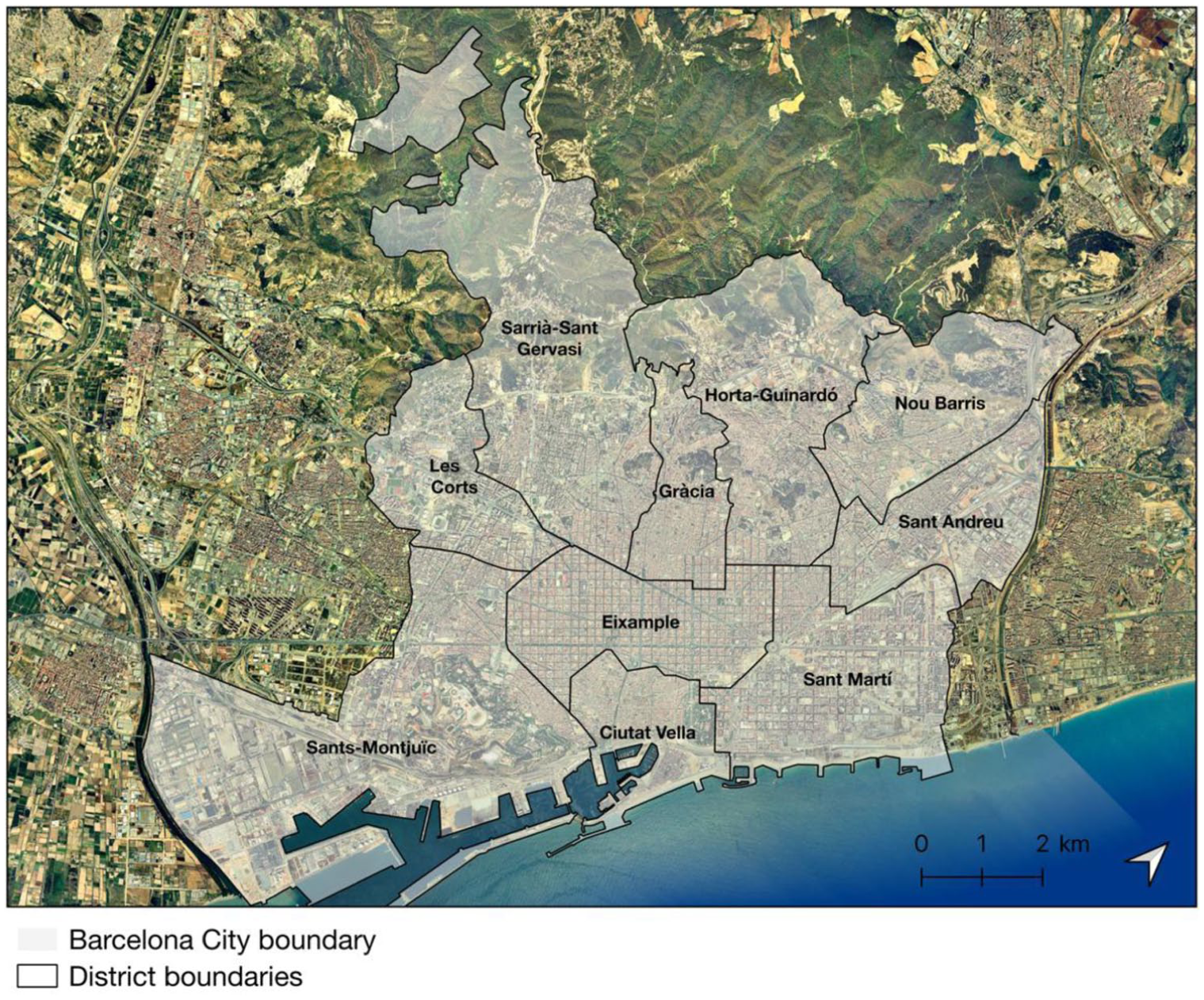
Barcelona’s new ten administrative districts. Map created by the authors using 1993 orthophoto via QGIS Open ICGC (Institut Cartogràfic i Geològic de Catalunya); Unitats Administratives dataset from Open Data BCN (Ajuntament de Barcelona).
In 1982, Pasqual Maragall replaced Narcis Serra as mayor. In his inaugural speech as Mayor, Maragall identified austerity, efficiency, transparency, decentralization, and linkages with the metropolitan area as the main principles for reforming the City Council. But importantly in the context of this article, he simultaneously, also placed special emphasis on the internationalization projection of Barcelona, arguing that: In recent years, the city of Barcelona has raised its international profile. Barcelona, through its leadership among Spanish municipalities, its artistic expressions, and international connections, has reached a higher standing, which must be maintained and strengthened. In this regard, I intend to firmly establish the bonds of partnership with Cologne, Milan, and Boston, cities that connect us to regions toward which, for various reasons, Barcelona is oriented. I also aim to develop the relationships initiated with the British local administration, a model in many respects; to return for a second time to the international capital markets to finance our 1983 investment program; and to sign a collaboration agreement with the City of New York, the University of Barcelona, and New York University.
24
This again highlights that from a very early stage, the main actors in Barcelona’s redevelopment strategy were looking well beyond incremental local redevelopment efforts to make Barcelona a global center of investment and culture.
Planning Tools and Local Political Leadership
In 1980, a year after the first democratic local elections, architect Oriol Bohigas introduced sweeping reforms to the council’s urban planning structure. He assembled a small advisory team that met weekly and streamlined the executive team to include himself, two architects and the council’s legal advisor. He created a Departament de Projectes Urbans (Department of Urban Projects) under his leadership, and simultaneously, created a new agency led by the architect and urban planner, Josep Acebillo, called the Departament d’Urbanisme (Urbanism Department) which assumed control of the existing Departament d’Obres Públiques (Public Works Department). This organizational overhaul served two main purposes. First, it granted Bohigas access to substantial financial resources, as the Public Works Department was one of the council’s best-funded units. Second, it brought public works engineers directly under his supervision, effectively ending the long-standing dominance of the civil engineering department in the urban decision-making processes. 25
The Department of Urban Projects utilized the 1976 Metropolitan General Plan (PGM in Catalan) as a framework for implementing spatially and temporally defined urban projects. 26 The approach “from plan to project” emphasized neighborhood-scale interventions as the key to fostering social cohesion and equitable development across the city. 27
One of the most urgent priorities was the perceived severe lack of open public space, particularly within the urban core (such as the old city and the El Raval neighborhood). In response, the municipal government launched a targeted program to refurbish neighborhood plazas and create new green spaces and rehabilitate established spaces. These planning interventions were designed not only to promote civic life but also to embody a renewed democratic ethos. As Martorell et al. 28 argue, the newly created public spaces were conceived as inclusive and accessible environments that encouraged public gathering and expression. An important parallel initiative in safeguarding Barcelona’s historical identity was the introduction, in 1980, of a preservation code that protected 860 architecturally or historically significant buildings, most of them located in the Old City, which followed a territorial extension of the area originally envisioned in Cerdà’s 1860 plan. 29
In 1981, the Espais Urbans (Urban Spaces) program was launched as a key initiative in Barcelona’s broader strategy to reimagine the city’s public realm. The program combined the physical revitalization of open spaces with the commissioning of contemporary public art, integrating aesthetic, social, and civic objectives within a single urban framework. Spearheaded by architect Oriol Bohigas in collaboration with sculptor Xavier Corberó, art dealer Joseph Helman, and members of Mayor Serra’s administration, the initiative reflected the city’s new commitment to design-led urban renewal and cultural democratization. Esteemed local and international artists, including Eduardo Chillida, Antoni Tàpies, Richard Serra, and Beverly Pepper, were invited to contribute site-specific sculptures, often at substantially reduced fees, signaling a shared investment in the city’s transformation. The Espais Urbans program sought not merely to beautify public areas but to reinvigorate civic life by reclaiming underused or neglected urban spaces as sites of everyday encounter and artistic expression. This effort aligned with Bohigas’s broader vision of linking physical regeneration to the recovery of collective identity in the early years of post-Franco democracy. The initiative culminated in international recognition when, in 1990, it received the Wales Prize in Urban Design from Harvard’s Graduate School of Design. Jury member Henry Cobb 30 commended Barcelona’s approach as a compelling counterexample to the increasingly privatized and impoverished public spaces of U.S. cities. The Espais Urbans program thus exemplified the prevailing ideas of how design and cultural policy could be strategically aligned to produce spaces that were both socially inclusive and globally influential, which was the ethos that came to define Barcelona’s urban renaissance throughout the 1980s and 1990s.
In a letter to Oriol Bohigas, Maragall writes: The small-scale urbanism, the one we (you) defined as “seamstress urbanism,” in retrospect, I see it as a successful attempt to dignify the city by applying a zoomed-in perspective. I remember that one of the first interventions that filled us with joy was the Emili Vendrell square, halfway down Joaquim Costa Street in the Raval, taking advantage of a demolition site. And then the large-scale urbanism, the broad strokes, which could only be understood through a macro lens. It was what first allowed us to imagine, then draw, and finally execute the great Barcelona (not Greater Barcelona), the rediscovered city.
31
In the early 1980s in a parallel effort to the recovery of squares and historically significant buildings across the city, Barcelona engaged in larger-scale urban transformation. In 1982 the architect Solà-Morales’s team, presented the plan for the renewal of the city’s waterfront and the opening of the historic city to the sea. The plan envisaged a multi-tiered waterfront integrating a marina, underground highway, and pedestrian promenade. 32 This was organized within the narrow strip of land about 130 m long between the urban frontage and the waterfront.
Simultaneously, the transformation of the waterfront did not wait for the completion of the new plan; it was already being implemented under the Plans Especials de Reforma Interior (PERI, or Special Plans for Interior Reform), developed in 1981. These plans were ambitious, aiming to deliver targeted interventions grounded in comprehensive socio-economic and spatial analyses. 33 The PERI planning framework was created under the auspices of the 1976 Pla General Metropolità (PGM), with the objective of specifying and carrying out urban transformations that had been only broadly outlined in the general plan.
In this regard, the PERI plans proposed a definitive distribution of land uses, including public spaces, new roadways, housing, and community facilities. They also delineated areas designated for the preservation of existing urban fabric and others identified for renewal. In addition, the plans included a binding phasing schedule detailing the public investment required for each intervention. The implementation process was to begin with the preparation of preliminary studies, which were required to be shared with the social and economic stakeholders of the affected area. Once a sufficient degree of social consensus was achieved, the City Council could proceed with the initial approval of the plan. This preliminary version was then made available for public comment and assessment, potentially resulting in its amendment before final adoption.
Due to the decentralization policies introduced by Barcelona’s socialist municipal government, which reorganized the city into ten administrative districts, the El Raval neighborhood became, in 1984, one of four neighborhoods comprising the new Ciutat Vella (Old City) district. The other neighborhoods were El Gòtic, El Casc Antic, and La Barceloneta. Ciutat Vella represented the historical core of Barcelona, yet each quarter within it had experienced markedly different trajectories of urban and social development. El Gòtic contained the oldest structures in the city. El Casc Antic emerged during the city’s medieval expansion, accompanying the construction of the first city walls. In contrast, La Barceloneta was created in the mid-eighteenth century to house residents displaced from a neighborhood demolished for the construction of the military citadel that followed the War of the Spanish Succession in 1714. El Raval, by contrast, developed in the fourteenth century following King Peter III’s expansion of the city walls. Although older than La Barceloneta, El Raval was, from both urban and social perspectives, the most recently consolidated of the four central neighborhoods, due to its slower pace of urban growth.
The PERI framework thus operated within the dual context of Barcelona’s new democratic planning culture and the municipal government’s decentralization agenda. Together, these policies established mechanisms for neighborhood-level consultation and spatial intervention, setting the stage for the major urban renewal efforts that would soon transform Ciutat Vella (Figure 5).
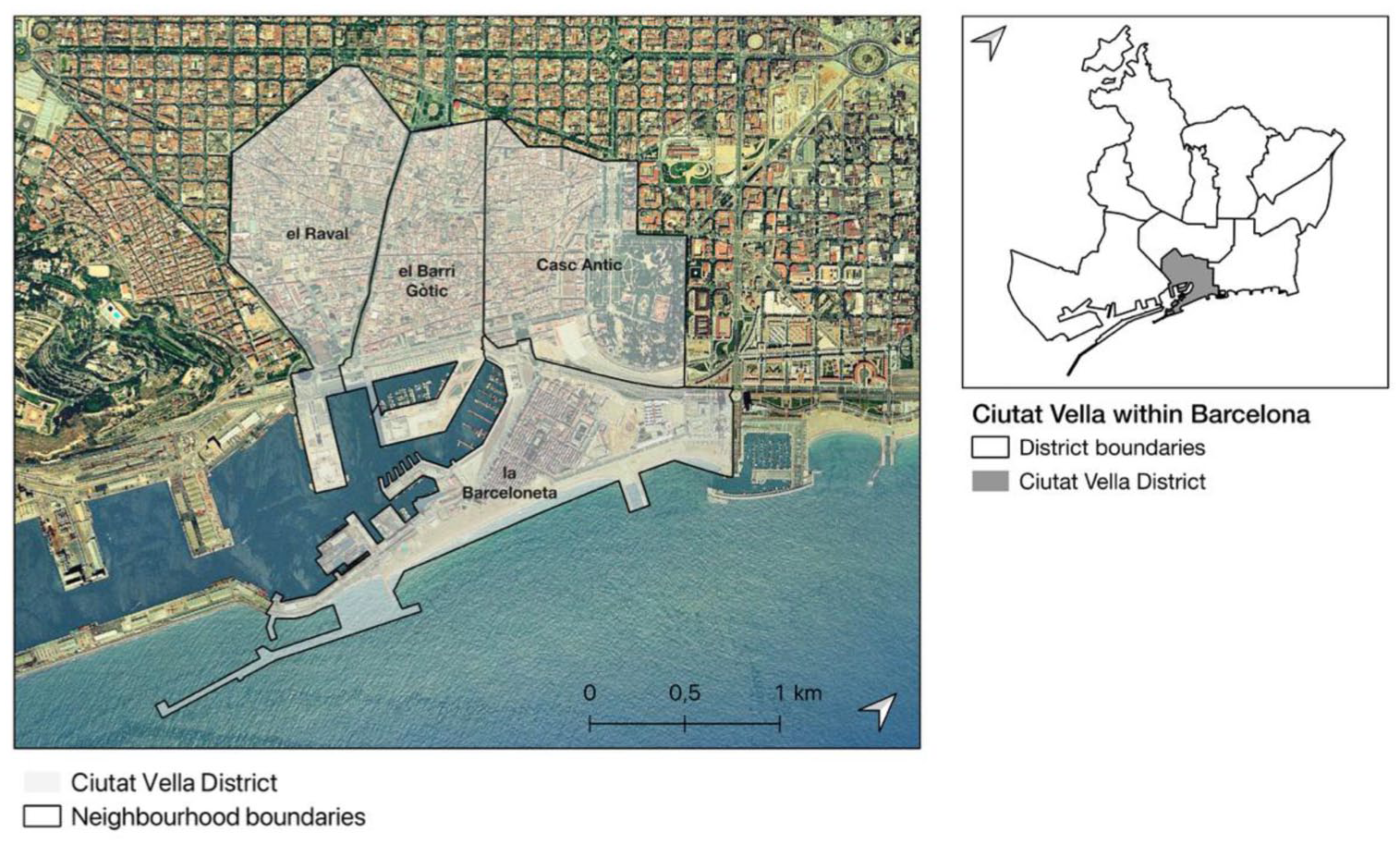
Ciutat Vella (downtown), as per the 1984 consolidation plan. Map created by the authors using 1993 orthophoto via QGIS Open ICGC (Institut Cartogràfic i Geològic de Catalunya); Unitats Administratives dataset from Open Data BCN (Ajuntament de Barcelona). 34
Between 1983 and 1985, the PERI plans were formally approved, establishing the urban planning framework for the four neighborhoods. In many cases, however, the objectives and implementation strategies still required further refinement. To address these needs, additional plans were developed, derived from the comprehensive framework set out in the PERI model (such as the Pla Especial Urbanístic, Pla de Millora Urbana, and Pla de Detall). In this sense, the PERI functioned as both a comprehensive strategic planning instrument and a declaration of political commitment, while the derivative plans marked the transition toward the operational stages of project implementation and management. The PERI for the El Raval neighborhood was publicly presented to residents in March 1982, and the plan for El Casc Antic was introduced later that year, in the autumn.
It is thus clear that from a very early stage in the democratic transition process, the leadership of Barcelona had a strategic vision for the long-term urban revitalization and transformation of the city. To make this optimistic vision of urban renewal a reality Joan Busquets, the director of the Planning Department of the City Council between 1983 and 1989, identifies the crucial role played by the political leadership together with the technical capacity of architects and planners. Regarding the local political leadership, he asserts: (. . .) political leadership in this case was embodied by two mayors: Narcís Serra, from 1979 to 1982, and Pasqual Maragall thereafter, who uniquely materialized and drove this revitalization forward.
35
Ambitious political vision and leadership were essential, as the large-scale transformations embodied in the PERIs were not easy to implement. Reflecting on the conditions of downtown Barcelona at that time, Pere Cabrera 36 architect and executive director of Ciutat Vella’s renewal during the 1980s, highlights the profound urban and social challenges confronting the city center. The area was marked by a drastic demographic decline, the influx of a large, impoverished population, a growing number of elderly residents living alone, a severe deficit of public facilities, and widespread neglect of housing maintenance and renovation. Cabrera observed that “the population [in the area] presents a high degree of aging, cases of marginalization and the total inability to cope with the maintenance of their homes” (p. 16).
Despite the optimism surrounding the technical possibilities offered by the PERIs, the political commitment they represented exceeded what the municipal administration could realistically finance in the early 1980s. In this context, new legislation approved by the Spanish central government in 1983 emerged as a potential source of funding. This law introduced modifications to existing planning regulations and allowed municipalities to apply for financial support from the Spanish government. Under the Àrea de Rehabilitació Integral (ARI, or Integrated Rehabilitation Areas) program, municipalities could request resources if, as stated in the first article of the law, the objective was: (. . .) the improvement or recovery of urban areas or rural areas, their natural conditions, economic and social activities and the living conditions of their residents, through the necessary actions on buildings, open spaces, infrastructures, services and necessary equipment.
37
The first requirement for this designation was the consolidation of the action and investment programs from the approved downtown PERIs. The necessary plans were drafted in mid-1984. It identified multiple causes of urban and housing degradation, emphasizing that previous urban planning was both inadequate and insufficient. It highlighted that there was yet no financial framework to facilitate the preservation and enhancement of buildings of cultural and historical value. Given the nature of the issues identified in the area, the entire Ciutat Vella district -home to more than 100,000 inhabitants and covering a surface area of over 3 km2 was designated for renewal. The creation of a district-wide revitalization program, known as the Integrated Action Plan (PAI), was conceived as an intervention model that required the coordination of urban planning across sectors as diverse as social welfare, cultural promotion, economic development, urban regeneration, housing policy, business regulation, and public safety.
To implement this approach, a Management Commission was established to coordinate actions among the city council, the Catalan government, and organizations representing the various neighborhoods. The ARI Management Commission formally included representatives from La Generalitat (the Catalan government), the city council, the Chamber of Commerce of Barcelona, and the neighborhood associations of the four downtown quarters. The primary objective of the ARI’s Management Commission was to coordinate the redevelopment efforts of all public administrations with responsibilities in urban planning and zoning, social welfare and facilities, economic promotion, infrastructure, private rehabilitation initiatives, and citizen security. 38 Pere Cabrera 39 noted that the commission’s duties also included encouraging the participation of private capital in housing rehabilitation, as well as monitoring and evaluating the overall urban redevelopment process. At the request of the City Council, the Catalan government was the political entity empowered to declare Barcelona’s downtown an ARI, a designation that was formally enacted in 1985.
It is noteworthy to highlight that, at the governance level, the prevailing scholarly consensus maintains that during the early years of the democratic period, relations among different tiers of government, business actors, and community organizations were largely characterized by a strong governance coalition that fostered collaboration and dialogue. 40 Nevertheless, this cooperative framework did not preclude institutional tensions. Frictions emerged between the City Council and the Catalan government. Although the Generalitat ultimately endorsed the establishment of the ARI’s Managing Commission, disagreements between the two administrations delayed its formal constitution until 1987. 41
The organization of the 1992 Olympic Games further exposed both the possibilities and limits of public-private cooperation. Although some urban land in Barcelona is held by public authorities for infrastructure, housing, and community uses, the large portion is privately owned by individuals and companies. The bid to host the Games underscored the public sector’s reliance on private actors—especially real estate developers, hoteliers, construction firms, and investors—to mobilize land, financial resources and technical expertise. 42 However, private sector involvement remained comparatively limited: it accounted for only 32.7% of total Olympic infrastructure investment and was concentrated primarily in the construction of Olympic housing, hotels, and road networks. 43
Urban policy priorities were also shaped by the legacy of neighborhood mobilization. Demands articulated by neighborhood movements significantly influenced the local political agenda, particularly architects and academics who had been active in protest movements during the final phase of the Francoist regime assumed key positions within the municipal administration. These actors played a decisive role in defining and implementing urban projects, placing strong emphasis on improving quality of life and expanding public service provision. 44 However, urban relations with grassroots organizations were not uniformly cooperative. Certain groups mobilized against the Olympic Games or specific urban redevelopment initiatives. In 1987, residents of the Casc Antic launched the campaign “Aquí hi ha gana! Campanya Aliment Solidari” (“There Is Hunger Here! Solidarity Food Campaign”) to denounce the acute physical and social deterioration affecting the historic city center. 45
Strategic Vision of Urban Transformation
In much of the academic literature, Barcelona’s urban transformation during the early democratic period is analyzed as unfolding in two distinct stages. The first stage, beginning in the early 1980s, is characterized by small-scale, neighborhood-oriented, and symbolically charged interventions -such as the Espais Urbans program, the early PERIs, and the initial revitalization of public spaces. These initiatives are often described as efforts to restore dignity, local identity, and democratic expression after decades of authoritarian neglect. The second stage, which emerged in the mid- to late-1980s and culminated in the 1992 Olympic Games, is typically associated with a shift toward comprehensive, large-scale planning, internationalization, and infrastructural modernization.
While this sequential narrative offers analytical clarity, it risks oversimplifying what was, in practice, a far more integrated and ideologically continuous process. As discussed in the preceding sections, large-scale ambitions and strategic planning were present from the very beginning of the democratic era, embedded within institutional reforms and supported by the political and economic leadership of both the municipal and Catalan governments. In this light, the distinction often drawn between the symbolic “seamstress urbanism” of the early 1980s and the macro-urbanism of the Olympic period should not be understood as representing separate phases, but rather as complementary dimensions of a unified project of urban regeneration.
Central to this argument was the reorganization of the city’s planning structure in 1980 under the leadership of Oriol Bohigas. Within the new democratic administration, Bohigas consolidated decision-making authority across the restructured planning departments into a small, ideologically aligned executive team. To strengthen the implementation capacity of urban projects, the Department of Public Works, which received the largest share of public funding, was incorporated into the newly established Department of Urban Projects. This integration combined a shared ideological vision with the fiscal capacity needed to realize it. As several observers have noted, 46 this institutional restructuring fostered technical consistency, political coherence, and resource concentration, thereby enabling the realization of a new urban vision rooted in the 1976 PGM but reinterpreted through a socially and spatially progressive lens.
The institutional reorganization of 1980, led by Oriol Bohigas, provided the structural foundation for implementing Barcelona’s emerging urban vision. Yet equally crucial to this process was the political and social atmosphere that accompanied the city’s early democratic years.
A distinct sense of optimism characterized this initial phase of transformation. As identified in recent analyses of the organization of the Olympics, 47 this collective optimism functioned as both a psychological and political catalyst, mobilizing planners, politicians, and citizens around a shared belief in the city’s potential. The restoration of democratic governance in 1979 generated a widespread sense of hope and civic engagement. Residents and neighborhood associations actively participated in planning processes, contributing to the consensus-building that supported numerous urban interventions. This positive civic energy not only sustained modest early projects but also nurtured the confidence and ambition behind more comprehensive planning efforts.
These actions were guided by a philosophy of “from plan to project,” which combined the technical framework of the 1976 PGM with spatially targeted interventions designed to achieve long-term structural change. 48 Programs such as Espais Urbans (1981) and the early PERIs were not merely symbolic enhancements; they embodied a strategic spatial logic aimed at repairing planning fragmentation, redistributing public investment, and improving everyday urban life as a means of fostering social cohesion and greater equity.
Moreover, the strategic vision of transforming Barcelona into a global city began to materialize during this early period. The transformation of the waterfront, the revitalization of Ciutat Vella, and the articulation of the PERIs for El Raval, La Barceloneta, and other central neighborhoods were initiated between 1981 and 1984, well before the Olympic project was confirmed. The planning process was grounded in detailed socio-economic diagnostics and introduced binding implementation phases, mechanisms for social consultation, and precise land use changes. In particular, the PERIs reflected a strong political and urbanist ambition to reintegrate the deteriorated historical core with the rest of the city.
The 1983 national law on Integrated Rehabilitation Areas (ARIs) provided Barcelona with an opportunity to consolidate its downtown renewal strategy within a new financial and governance framework. In 1985, the ARI of Ciutat Vella brought together local and regional administrations, chambers of commerce, and neighborhood representatives under a shared Integrated Action Plan (PAI). Although this model of coordination was complex and difficult to achieve, it embodied the principle of multi-scalar governance that became foundational for the long-term revitalization of more than 3 km2 of the central urban core. The capacity to prioritize high-impact projects despite limited resources was reinforced by a political culture of optimism and forward thinking, which encouraged collaboration among institutions and civic actors.
Political leadership played a decisive role in operationalizing this process. Both mayors, Narcís Serra and Pasqual Maragall, exemplified a visionary and optimistic form of urbanism. Maragall projected Barcelona onto the international stage through an emphasis on global partnerships, urban diplomacy, and large-scale city-building. In a tribute to Bohigas, Maragall recalled how small-scale projects—such as the first revitalized downtown square—coexisted with grand visions of a “rediscovered city” made possible through “broad strokes” and a macro lens. Bohigas himself emphasized that the continuity of ideological and strategic commitments across Socialist mayors Serra, Maragall, and Clos ensured the coherence and effectiveness of Barcelona’s urban transformation efforts.
In this context, the Olympic Games should not be seen as the beginning of large-scale urbanism, but rather as a political and financial accelerator for a transformation agenda that had already been conceptually, technically, and institutionally established. The Games provided both external validation and internal justification for realizing what had long been imagined, designed, and partially implemented.
Concluding Remarks
The institutional and civic foundations established in Barcelona during the early democratic period not only made large-scale transformation possible but also offer enduring policy lessons for other cities pursuing ambitious and sustainable urban regeneration, particularly in contexts of democratic transition, fiscal constraint, or fragmented governance.
First, Barcelona demonstrates that from the outset, planners and political leaders were able to integrate symbolic and structural interventions within a coherent and comprehensive urban vision. The institutional restructuring of the city’s planning apparatus, such as the creation of the Departament de Projectes Urbans, ensured that technical and fiscal capacity were aligned with political decision-making early in the process. From a policy perspective, this alignment of long-term strategic goals with administrative structures and planning tools, prior to launching major physical transformations, proved essential for the effective implementation of individual projects.
Second, the case illustrates how political optimism, when coupled with technocratic management during a period of democratic renewal, can act as both a psychological and social catalyst for positive urban development. In the 1980s, public confidence in newly democratic institutions fostered a sense of shared purpose that legitimized planning interventions. This experience highlights the importance of recognizing the emotional and symbolic dimensions of urban change, which can sustain public engagement and enhance legitimacy.
Third, small-scale interventions under programs such as Espais Urbans and neighborhood-level improvements were critical in building both technical capacity and public credibility for subsequent large-scale redevelopment efforts. These smaller projects served as testing grounds for new ideas and as visible demonstrations of commitment to underserved communities. The Barcelona experience illustrates that fostering public trust and hope through participatory processes, symbolic projects, and democratic reforms can generate collaboration and maintain the momentum of urban regeneration.
Fourth, despite significant budgetary limitations in the early 1980s, the city was able to develop detailed plans, such as the PERIs, supported by strategic phasing, cost-sharing, and new legal instruments like the ARI program. Strategic austerity was accompanied by a focus on impact, coordination among diverse actors, and the development of institutional capacity for implementation. In this sense, Barcelona shows that resource scarcity need not be an obstacle if cities adopt phased, realistic, and legally grounded planning frameworks.
Fifth, the revitalization of downtown required not only spatial planning but also coordination with social policy, housing policy, economic development strategies, and public safety initiatives. The ARI’s Integrated Action Plan and Management Commission exemplified multi-level governance. Barcelona’s experience thus underscores that successful urban regeneration depends on both horizontal coordination, across city departments, and vertical coordination, across local, regional, and national governments.
Finally, Barcelona’s transformation unfolded over time, sustained by a shared ideological and strategic vision across successive administrations. This continuity proved crucial in overcoming cycles of delay, resistance, or policy reversal. The city’s urban transformation in the 1980s should therefore be understood as a continuous, integrated project that combined technical innovation with an optimistic political vision and leadership. From the outset, small-scale interventions and large-scale strategies were deployed simultaneously, supported by institutional restructuring, the creation of new financial instruments, and a collective belief in the city’s capacity for self-reinvention.
This urban ambition functioned as an enabling force. It created the conditions for cross-sectoral coordination, civic engagement, and calculated risk-taking, even amid fiscal limitations and social challenges. The case demonstrates that transformational urban change is achievable even without vast resources, provided there is a clear and consistent vision, an empowered and technically competent planning structure, leadership grounded in optimism, and effective coordination across political and institutional actors.
Footnotes
Declaration of Conflicting Interests
The authors declared no potential conflicts of interest with respect to the research, authorship, and/or publication of this article.
Funding
The authors disclosed receipt of the following financial support for the research, authorship, and/or publication of this article: This work was supported by the Next Generation EU grant, Faculty Development Research Grants Hofstra College of Liberal Arts and Sciences, Hofstra University, and la Fundación Ramón Areces Grant.

