






Abstract
The account books of the Tong Taisheng 统泰升 grocery store in Ningjin county of northern China in 1800–1850 constitute the most complete and integrated surviving archive of a family business in premodern China. They contain unusually detailed and high-quality statistics on exchange rates, commodity prices, and so on. Utilized once in the 1950s, the archive had been left largely untouched until our recent, almost accidental rediscovery. This article introduces this unique set of materials and traces the personal history of the original owner and donor. The story of this archive encapsulates the history of modern China and how the preservation and interpretation of evidence and records of Chinese economic statistics were profoundly impacted by the development of political ideology in modern and contemporary China. We briefly discuss the historiographical and epistemological implications of our findings for the current Great Divergence debate.
The recent debate over the so-called Great Divergence, spurred by the provocative claim that living standards in eighteenth-century China—at least in the advanced Lower Yangzi Valley region—may have been comparable to those in northwestern Europe as late as the eighteenth century, has promoted a flurry of new research reexamining China’s price and wage history in comparative perspective.
1
The debate, however, has also brought to the fore serious deficiencies in surviving Chinese historical statistics. Reviewing the existing evidence, Allen et al. (2011) point out that the claims of a higher living standard in eighteenth-century China have “relied on indirect comparisons based on scattered output, consumption, or demographic data”; in contrast, our knowledge of real incomes in Europe is broad and deep because since the mid-nineteenth century scholars have been compiling databases of wages and prices for European cities from the late middle ages into the nineteenth century when official statistics begin. (p. 9)
2
The nature of Chinese historical statistics raises a critical question germane to the core of the debate: could the paucity of statistics be a result of poor record keeping in historical China—which itself may be a reflection of the nature of its economy and society— or more a reflection of the poor state of academic scholarship and archival collection in China’s subsequent tumultuous modern history? Can one surmise that the richly endowed Western historical statistics preserved from former times are themselves testimonials to the high level of economic development or even rationality in the West historically? 3
Given the critical importance of historical statistics in the current Great Divergence debate, it is surprising that the historiographical dimension of data issues has so far received little attention. In this article, we illustrate this issue through our unique encounter—during the past seven years of our research—with the merchant account books of Tong Taisheng 统泰升 (referred to as TTS hereafter) and our rediscovery of the original owner or donor. The TTS archive—consisting of over 400 volumes for a single store—contains detailed records of actual market transactions not just in grain but also non-grain commodities and also includes local copper cash/silver exchange rates from a largely unknown North China village township in Ningjin 宁津 county of Shandong province in 1800–1850, a period before China’s forced opening to the West. The original TTS record had been used once by a group of eminent Chinese economic historians in the 1950s but has lain largely incognito since.
This article represents the first of our series of systematic efforts to reconstruct, both thorough statistics and a historical narrative, the history of the TTS archive, the TTS firm, Ningjin county, and the larger North China economy on the eve of the Opium War. The focus of our current work is on the archive itself and the people connected with it from the initial donation, to its preservation, and to its rediscovery. As you will see, the history of the TTS archive and the story of the individuals involved are themselves a miniature history of modern China, of tradition-bound elites and a new generation of modern intellectuals getting caught up and muddling through one and half centuries of ideological and political vicissitudes. It raises some important epistemological questions about the nature of historical evidence and statistical records on Chinese economic history.
The TTS Archive
In a widely used statistical manual for Chinese economic history compiled in 1955 by Yan Zhongping 严中平 and ten other eminent economic historians, two tables (Yan et al., 1955: Tables 30 and 31, on pp. 37–38) and a figure (p. 39) are included that provide a relatively continuous annual series of copper cash/silver exchange rates and two price indices, for agricultural and handicraft goods (in copper cash) respectively, for the period from 1798 to 1850. These three pages of highly condensed statistical series stand out as a glaring anomaly in the dark alley of Chinese historical statistics. Despite the brevity of the explanation in Yan et al., they have not escaped the attention of researchers: the Ningjin series appears frequently in some of the most influential works on China’s premodern monetary sector and often has served as the key (or only) systematic data series for evaluating China’s balance of payments crisis caused by silver outflow, leading eventually to the fateful Opium War of 1842—a watershed event in modern Chinese history (on the use of the Ningjin series, see, for example, Lin, 2006; Chen, 1975; and Vogel, 1987).
Embedded in the footnotes to these two tables are brief explanations of the statistical methodology of constructing the exchange rate series and the number of items included in the construction of these price indices. The authors also indicated that the original data were extracted from a grocery store called Tong Taisheng, located in the town of Daliu 大柳镇 in Ningjin county in the northern part of Zhili province (roughly corresponding to today’s Hebei province). The footnotes mentioned that the original TTS archives were housed mostly in the National Library and a small segment in the library of the Institute of Economics of the Chinese Academy of Social Sciences in Beijing. In 2005, we keyed in—just on the off chance—the TTS merchant account books in the online catalogue of the National Library in Beijing and, to our complete disbelief, the title just popped up on the screen. Eventually, our archival compilation in both the National Library and the library of the Institute of Economics turned up 437 volumes of these account books for the period 1798–1850.
Like all traditional merchant account books, physically the books are light in weight with paper bindings (normally a soft blue cover with red identification strips glued on), approximately 20 cm square, and approximately 3–4 cm thick. They are string-bound and handwritten with a classical brush pen. Pages are not numbered or indexed (although we have seen some later ones with printed ruled pages). The number of pages and records vary in different account books. In the appendix, we present two photos of one of the account books. The first is an image of the cover of an account book. The second is an image of an account page with actual records. Table 1 provides a breakdown of all the volumes by decade.
Extant Volumes of the Tong Taisheng Merchant Account Books, by Decade.
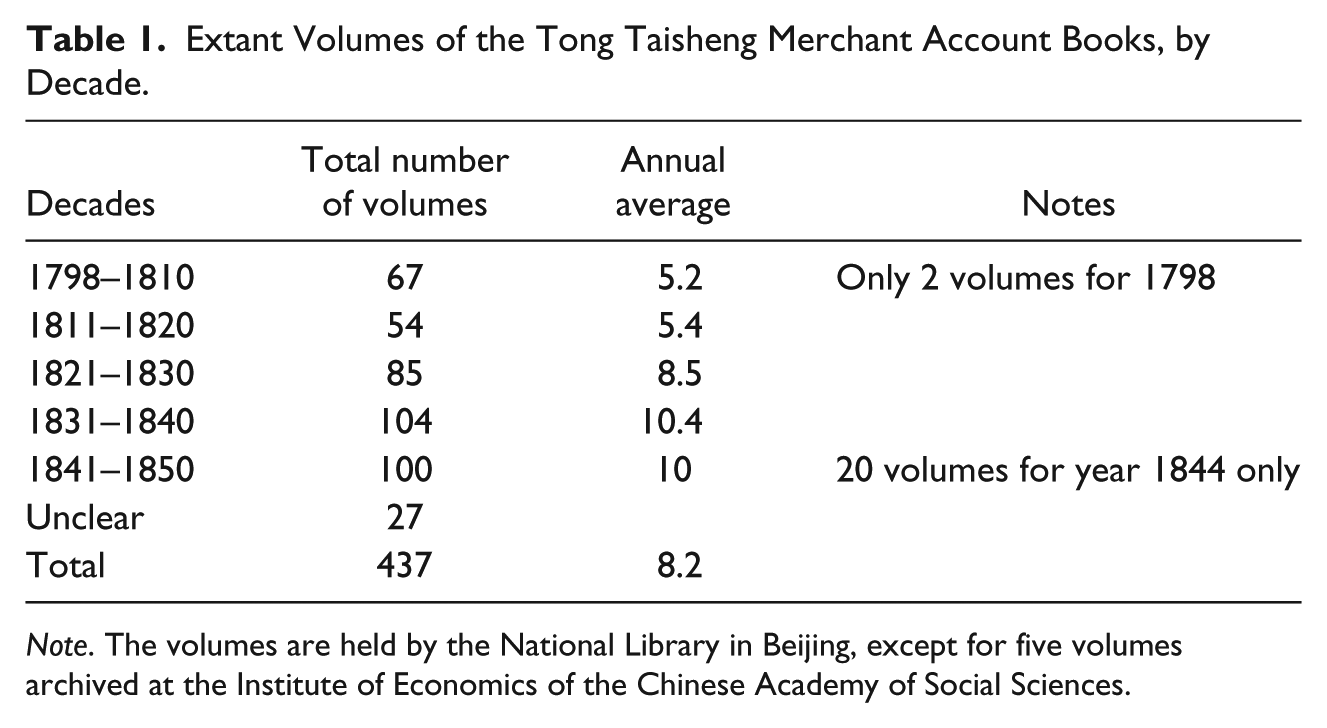
Note. The volumes are held by the National Library in Beijing, except for five volumes archived at the Institute of Economics of the Chinese Academy of Social Sciences.
The account books reveal TTS to be a local retail grocery store selling a large variety of dry goods including rice, iron tools, paper, cloth, rope, pigment, and daily necessities like oil, vinegar sauce, wine, grain, and so on. We can broadly classify the TTS account books into four categories according to their contents and functions. The first is the original account book of the sales counter, mainly journals or day books 流水账 kept by shop assistants to record transactions of cash and goods in copper cash and silver. This occupies a large portion of the TTS account books. The second type is known as a “posted account book” such as the “general trade ledger” 交易总账, which was recorded according to the name of a business firm or a customer, respectively. The third category includes summary account books, such as a strung coins account, profits and dividend account, and so on. The final category includes various miscellaneous account books, which cover temporary dealings and transactions, accounts of loans, land purchases, income from interest on loans, and so on. 4
Both the detail and quality of the data are staggering for a micro-data set for Chinese economic history. As an illustration, using only 17 journals or books of silver accounts, we already have accumulated over 11,000 data points of copper-silver exchange rates with transaction dates and quantities, five or six different types of silver used, loans and interest rates and names of clients, all on a daily basis (see Ma and Yuan, research in progress). There are also detailed prices of about forty or fifty types of commodities with similar degrees of detail. We are confident that careful research based on a systematic exploitation of this rich and high-quality data set could offer new insights into critical debates on Chinese economic history and global history. For example, the relatively complete and integrated nature of the TTS account books allows an in-depth, primary-source-based study of the premodern Chinese accounting system (see Yuan, Macve, and Ma, 2015). The consistent and high-quality time series of copper-silver exchange rates that can be reconstructed from the TTS account books can offer important clues to understanding the traditional Chinese monetary system and the impact of the opium trade and the silver outflow on the Chinese economy during this period. Finally, the systematic information in the volumes and frequencies of transactions—annual, monthly, and daily—can for the first time provide a sound basis for quantifying the landmark study on the traditional Chinese marketing structure by William Skinner (1977). Clearly, the original study by Yan Zhongping et al., a critically important one in its own right, only utilized a tiny fraction of the data sets.
It is notable that economic statistics culled from family business archives—despite their understandable limitations in terms of representation—have some superb qualities unmatched by the more commonly used government or public statistics, which are often subject to either deliberate manipulation (for taxation and other purposes) or bureaucratic negligence. Statistics recorded in private family archives are likely to be more accurate and reflective of actual market conditions, something that is essential for calculating internal profit and revenue. 5 But the significance of the TTS archive goes beyond mere economic statistics. As the complete set of account books was recorded before China’s forced opening to the West in the mid-nineteenth century, the entire TTS archives are in traditional Chinese format with string-bound Chinese paper, handwritten (with an ink brush) in classical Chinese in vertical format. In view of the account book’s traditional numerical codes and indigenous Chinese accounting system, transcription and interpretation require specialized learning and expertise on the part of researchers. 6 On the other hand, the challenge of deciphering these files also affords unusual insights into the internal logic and mechanisms underlying the premodern Chinese market, business organization, the monetary system, accounting methods, and even social customs. 7
Where does this archive come from? Who was the owner of this archive? Why was so little information divulged about this archive? Why was this record preserved in such an exceptionally good and well-ordered condition? How did a pile of archives mentioned in some footnotes in 1955 survive through decades of political turmoil in the Mao era?
The Rediscovery
In April 2008, we visited Ningjin county and the towns of Daliu, Changwan 长湾, and Chaihu 柴胡. Daliu, where the TTS firm was located, was a small market town in Ningjin county, currently a county of Dezhou 德州 city in Shandong province. It was about 240 kilometers south of Beijing, close to the border of Hebei province, east of the historical Grand Canal. With the massive building of rural highway infrastructure during the past two decades, commercial activities in these towns have largely shifted out of the traditional town center, called the “old street” 老街, in Daliu toward a spattering of stores and restaurants along a rural highway, modern, dusty, and homogenous. What has remained alongside the original “old street” are clusters of residences interspersed with a few shops, post offices, and governmental buildings built or rebuilt largely during the Mao era. For the few locals with whom we conversed, the “old street” evoked tales of the 1950s rather than the 1850s. Our visit to the office of the Ningjin county archive turned up nothing on TTS.
We located the Ningjin county gazetteer that dated back to the reigns of the Kangxi (r. 1661–1722) and the Guangxu (r. 1875–1908) emperors. The gazetteer reports Daliu town as holding periodic markets 集场 on every second and seventh day of the month, in addition to a temple festival 庙会 every September (Ningjin xian zhi, 1976: 2.25–27). Yan et al. (1955) noted that TTS had over ten branch stores spread across a couple of nearby market towns such as Changwan and Chaihu, each within about a 10-kilometer radius of Daliu. Based on our estimates from the account books, the annual average volume of transactions at TTS would rank it in the category of a medium-sized business as classified by Xu Tan for the average size of merchant firms in Shandong province during the eighteenth and nineteenth centuries. 8 For anyone familiar with the landmark study on Chinese rural markets by William Skinner (1977), Daliu town and the TTS firm are almost a postcard illustration of the standard market towns across North China during the Qing. They appear among the tens of thousands of mercantile stores and market towns across nineteenth-century China—modest, inconspicuous, and undistinguished.
Just as we thought we had got to the end of the thread on this archive, a completely unrelated browse through a book titled History of Retail Business in Modern Shanghai 上海近代百货商业史 (1988) took us on an entirely unexpected and opportune detour. On page 10 of this book, a footnote (yes, another footnote) mentioned a TTS grocery store located in Daliu, Ningjin county. It cited a newspaper report published in the Central Daily 中央日报 on August 13, 1936, by Wei Zeying 魏泽瀛, which discussed the traditional Chinese accounting system based on the TTS merchant account books. The Wei article cites another article, by Wan Sinian 万斯年, published in Ta Kung Pao 大公报, Supplement (Books) on August 8, 1935. Wan (1935) offers the following critical passage on the source of this archive: While the Peiping [i.e., Beijing] library [today’s National Library of China] had long intended to collect the account book materials, it was prevented from doing so due to its busy engagement in other priorities. Last winter, suddenly the library received a letter from Mr. Rong Mengyuan 荣孟源 from the town of Daliu, Ningjin county. Mr. Rong indicated his willingness to offer his collection of old account books to the library, which we very much welcomed. Mr. Rong noted that these account books had information on the rural economy and commodity prices. He did not ask for any remuneration except for the shipping cost from Ningjin to Peiping. We are of course grateful for such a generous donation. . . . It is reported that the account books arrived in a rather messy condition in two boxes. After a rough compilation by Mr. Zhao Jinghe 赵静和, we arrived at a total of 145 volumes for the Jiaqing reign [1796–1820], and 323 volumes for the Daoguang reign [1821–1850]. The earliest volume dates back to the third year of Jiaqing [1798], and the final volume goes to the thirtieth year of Daoguang [1850], covering a span of more than 50 years. Dating back to more than 130 years ago, these account books are indeed a rare find.
While most descriptions in both Wei (1936) and Wan (1935) match what we have been able to find independently in the extant TTS account books, Wan’s tally of all the volumes adds up to a total of 468, more than the 437 volumes we have been able to locate so far. 9
The key man mentioned above, Rong Mengyuan (1913–1985), as it turned out, was no average donor. In the PRC era, Rong was an eminent historian of modern China and an authority on historical archives of the Qing and Republican period. He was the author of more than 70 journal articles and multiple volumes of works on archival materials of major political events such as the Taiping and Boxer Rebellions as well as the 1911 Revolution. He was also the founding editor of the journal Materials on Modern History 近代史资料, which has been published continuously from 1954. The thread of Rong Mengyuan opened a new horizon for the TTS archive. Based on our subsequent interview with his surviving son, Rong Weimu 荣维木, in Beijing and the discovery of the Rong genealogy last published in 1903 (archived in Nankai University in Tianjin), we can piece together a profile of the Rong lineage in Ningjin county, and the man and the history behind the archive. 10
The Man behind the TTS Archive
The Rong genealogy was last printed in 1903, compiled from the culmination of six previous editions. It traced the lineage back to as many as sixteen generations over a span of 491 years, with editions updated in 1894 (by the sixteenth generation), 1880 (fourteenth generation), 1813 (no indication of generation), 1771 (tenth generation), 1756 (ninth generation), 1745 (eighth generation), 1717 and 1719 (eighth generation). The Rong family first migrated from Zhucheng 诸城 (also in Shandong province) to Daliu in Ningjin county in 1404 during the early Ming dynasty. Starting as farmers, the lineage amassed a certain amount of wealth through diligence and thrift and began to engage in moneylending as well as some charitable activities in the local town by the third generation (possibly during the seventeenth century). By its sixth generation (about the early eighteenth century), the Rongs claimed to have accumulated over 300 mu (48 acres) of land. After some decline in family wealth partly owing to a series of bitter legal disputes over financial matters with another lineage (by the name of Yin), the seventh and eighth generations made a comeback through commerce. 11
Like generations of other successful merchant lineages in traditional China (and perhaps also drawing lessons from their disastrous legal disputes), the Rongs turned to invest in the education of their offspring so that they would be competitive in the civil service examination system, a critical step up the ladder in the Chinese political and social hierarchy. This seemed to pay off as the genealogy reported steady progress, with members attaining the low-level degree of shengyuan and, from the ninth generation on, making successive entries into the ranks of the official examination system. Meanwhile, family wealth and business clearly stabilized with the rise in social and political status secured by these examination achievements. Moving into the nineteenth century—the period recorded in the TTS account books—the wealth of the Rong lineage may have peaked as the twelfth and thirteenth generations added newly purchased land (800 and 300 mu, respectively) to the family’s holdings. The Rongs were clearly the elite of the town, as a member of the thirteenth generation was the trusted person in town who was called upon to mediate and resolve village disputes. The prosperity of the Rongs continued beyond the mid-nineteenth century, the period in which the extant TTS archive ends. 12 As we were informed by Rong Weimu, the Rongs in the early twentieth century allegedly owned nearly half the houses in Daliu. Besides the retail business, they operated a few cottage workshops in flour milling, vinegar processing, and handicraft textiles and also managed some farms mostly using hired labor, both long-term and short-term.
As with other elites in traditional China, the Rongs’ route to wealth and power was secured through generations of mercantile thrift and land acquisition and legitimized through their success in the national civil service examinations. 13 But from the second half of the nineteenth century, following the onset of Western imperialism in China, the world in which the Rong lineage had thrived for generations began to slowly fall apart. Two years after the final 1903 edition of the Rong genealogy was compiled, the civil service examination itself was once and for all abolished by the late Qing constitutional reform. In 1911, two years before Rong Mengyuan was born, the Qing dynasty simply collapsed.
Rong Mengyuan started his education in a traditional private school 私塾 but also enrolled in one of the new-style secondary schools that emerged following the 1905 abolition of the civil service examination. In 1931, Rong went to Beijing to study in a graduate program in Chinese history headed by Lü Zhenyu 吕振羽, a prominent Marxist historian teaching at Zhongguo University. 14 It was in Beijing that the young Rong Mengyuan, a man from a relatively privileged mercantile family background, first encountered Marxist historiography and the Communist ideology. But because of poor health, Rong soon had to prematurely quit the graduate program and return to Ningjin to recuperate. Following Japan’s full-scale invasion of Chinese Manchuria in 1931, Rong joined the protest campaign and shuttled between Ningjin and Beijing. Later on, in 1935, he donated the TTS archive to Academia Sinica.
In 1936, Rong Mengyuan joined the Communist Party and two years later traveled to the Communist Party’s base in Yan’an. There Rong became a teacher in the high school which was later to become Yan’an University. But before too long, Rong Mengyuan landed in political trouble and, in 1941, was stripped of his party membership because of a dispute with the leadership. 15 The founding of the PRC in 1949, however, brought Rong the promise of a new intellectual career as an archival researcher to assist Fan Wenlan 范文澜, then China’s designated official Marxist historian, on his new Marxist textbook version of Chinese history. 16 Given his political mishap, Rong’s intellectual focus on historical archives, which is presumably more factual or “objective” than ideological, seemed like a viable career strategy.
But how did one of China’s most eminent archivists remain completely unassociated with the set of his family account books that he himself had earnestly offered up in the 1930s? Rong Mengyuan died in 1985, leaving no trace or mention of the TTS archive in his own voluminous works on historical archives. Neither was his family, according to Rong Weimu, aware of the TTS archive (or even the Rong genealogy). As probably none of the eleven authors in the Yan statistics volume is alive today, we cannot determine for sure if Yan and his colleagues’ reticence about the Rong origin of the TTS account books was simply due to sheer neglect or something else. 17 We believe, however, some light can be shed on this mystery by looking at the change in the political climate and its effect on scholarship between the 1930s and the 1960s.
The Rise and Fall of an Archive
Although the initial introduction of the Marxist framework of modes of production and stages of social development into Chinese historiography in the early twentieth century was a relatively open and free intellectual endeavor, the framework itself quickly hardened into a political dogma following the founding of the PRC in 1949. 18 The so-called relations of production and universal stages of social development in the Marxist framework of historical materialism turned into an ideology of class warfare that pitted the so-called oppressed against the oppressors, the exploited against the exploiters—with the former represented by the proletariat, the workers and peasants, and the latter by capitalists, the merchants and landlords. As is well known, by classifying people according to “birth origin” (often traced far back into their ancestry), the scheme underpinned massive political persecution such as the Anti-Rightist Campaign in the 1950s and the Cultural Revolution in 1966–1976. 19
Clearly, Rong’s privileged mercantile and landlord “birth origin” would do him no good in this scheme. He and his family were officially labeled as “landlord.”
20
Ironically, as if to extricate himself from his inglorious birth origin, Rong published an article in 1955 attacking the “birth origin” of Hu Shi 胡适, China’s best-known liberal intellectual, who left the Chinese mainland after the CCP’s victory: How much land did Hu Shi’s family own? He himself did not explain, but he did say that every autumn he would follow his grandmother into the field to supervise harvesting by tenants. Hence, his family indeed is that of a landlord. . . . Hu Shi’s family has three stores (as far as I know). . . . Judging from his snobbish attitude of late, mercantile ideas must have had a large influence on him. . . . Hu Shi clearly inherited the tradition of a bureaucratic-landlord-merchant family. (Rong, [1955] 1983: 371)
Only two years later, Rong himself fell victim to the 1957 Anti-Rightist Campaign. An article published in People’s Daily (August 14, 1957) denounced the then-disgraced “rightist” Rong Mengyuan: Rong Mengyuan’s anti-party activities have been consistent throughout. Born in a landlord family, he joined the [Communist] revolutionary cause in 1932, only to betray it at a critical juncture. . . . By concealing his personal counterrevolutionary history, he sneaked back into the party. . . . He continued with his anti-party activities in Yan’an in 1941 . . . only to be expelled. . . . By the end of 1953, the party criticized his factionalist anti-party activities within the Research Institute. . . . But in the end, it was to no avail as Mr. Rong remained an inveterate anti-revolutionary and should be condemned as an imposter in the history profession. (Italics added)
It is striking to see that Rong Mengyuan’s brief respite back at his hometown of Ningjin in 1932–1935, when he was recuperating from illness—and during which he donated the TTS archive to Beijing—was now portrayed as a “betrayal” of the party “at a critical juncture.” It is clear that by then Rong’s one-time strategy of seeking safe haven in the “relative neutrality” of archival material was no longer enough to spare him from the political storm that was engulfing China (People’s Daily, 1957).
Similarly, the political tension between the identity of the owner or producer of statistics and the nature of the statistics was foremost on the minds of Yan Zhongping and his team when compiling their statistics volume published in 1955. Recounting in 1956 their experience of compiling this volume, Yan remarked that: Among our comrades, a minority believed that since foreign-language material was produced by imperialists, it cannot be reliable and should not be accepted as these imperialists were speaking from the stance of aggressors. It should not be used even when no comparable Chinese records existed. This view, however, is narrow-minded. While duly recognizing the aggressive nature of the imperialists, they may still inadvertently divulge their criminal deeds.
21
Yan’s seemingly comic defense of the use of non-Chinese-language sources was actually no laughing matter then. It was a flicker of sanity on the eve of China’s decent into the abyss of the Great Leap Forward when statistics could simply be concocted or fabricated. More importantly, whatever may be the truth, Rong’s anonymity and Yan’s reticence about the “birth origin” of the TTS archive turned out to be a blessing in disguise. While the TTS archive languished in dust for the next three decades, Rong himself—despite being labeled an outright “rightist”—and his family, according to Rong Weimu, managed to lie low and undergo only relatively mild phases of persecution.
From the late 1970s, the arrival of a new era under Deng Xiaoping heralded a gradual but decisive shift away from Maoist radicalism. As part of this reversal, the Deng regime also reined in class warfare and even sought to re-embrace once denigrated and persecuted capitalists, “exploiters,” and “oppressors.” 22 Like countless others, Rong Mengyuan (and Yan Zhongping) reemerged from intellectual exile. Rong reestablished himself as an authority on Chinese historical archives with a prolific publication record in the 1980s. The new era saw a revival of academic interest in traditional China’s indigenous commercial tradition and in the exploration of private merchant business archives, often filled with tales of valuable archives discovered or rescued by sheer accident while others were lost through continued neglect. 23
While generations of scholars are set to benefit from the rediscovery of TTS and other archives, when Rong Mengyuan passed away in 1985, he himself may have harbored no pride or interest in his connection with that pile of family archives he donated five decades earlier. It is curious that throughout the 1980s Rong Mengyuan remained loyal to an ideology of a bygone age and his writings continued to be infused with the stridently leftist rhetoric of identity politics. In his 1983 book, he lamented recent attempts to revamp the reputation of Hu Shi as a scholar by reminding people of Hu Shi’s past as a running dog of imperialism, feudalism, and bureaucratic capitalism (Rong, [1955] 1983: 382–83).
Conclusion
From beneath the small-font footnotes emerges an extraordinary tale of a private merchant archive of an ordinary merchant family in nineteenth-century rural China. The journey of a pile of traditional archival materials through their initial donation to subsequent anonymity and our rediscovery divulges a personal story of individuals surviving through contradictions, ironies, and even betrayals. It is a tale of a nation caught up in a manifest destiny to confront nineteenth- and twentieth-century Western challenges, in the process of which China was turned upside down several times over by the overpowering forces of ideology and politics with China’s historiographical traditions being ruptured, rejoined, and sometimes reinvented.
The story of the TTS archive offers powerful lessons on the nature and quality of historical evidence—quantitative or otherwise—used in debates such as the Great Divergence. It is important to note that the Beijing which Rong Mengyuan encountered in the 1930s saw the high tide of modernization ideology and social engineering based on the tools of statistical and social surveys. 24 In this regard, the discovery, preservation, and utilization of the TTS archive is no accident as the men whose hands had touched the archive—Rong Mengyuan, Wei Zeying, and Yan Zhongping—came of age in a new intellectual era that found new value in a pile of old private merchant archives beyond mere personal and familial nostalgia. Ironically, it was this vision of social engineering pushed to the extreme by the Communist identity politics of the 1950s that sent the origins of this archive back into obscurity. What happened in China during the 1930s and 1950s shapes and reshapes our vision of history and its records before 1850s. Or alternatively, the visions and theories of history interfered with history. Hence, our knowledge of and sources of evidence on the past are shaped as much by how posterity studied the past as by the past itself—assuming there existed such a thing as an “objective” and “abstract” past. The preservation, compilation, utilization, and ultimately the discovery or rediscovery of historical evidence are themselves profoundly dependent on the vicissitudes of our research agenda, ideologies, and paradigms.
Discontinuity and ideological reversals carry real consequences for comparative studies in the current Great Divergence debate. Even in the case of TTS, which has been “rescued” from anonymity, an entire three decades’ worth of potential research scholarship was lost while the TTS account books remained largely unexamined, leaving Chinese economic history with a glaring statistical abyss especially with regard to the current Great Divergence debate. Furthermore, the introduction of new Chinese writing scripts and modern numeral and accounting systems initiated in the early twentieth-century New Cultural Movement and massively enforced through the PRC era rendered materials such as traditional merchant account books far less accessible to average contemporary researchers (apart from the few with specialized training and expertise). 25 All these predispose our reconstruction of the past toward source materials recorded in the more familiar modern or—in the context of former colonies—”European” and colonial framework. These issues are not restricted to modern China alone, but rather are common experiences shared by nations that had experienced abrupt revolutionary transformations—the eighteenth-century French Revolution and the twentieth-century Russian revolution as obvious examples—or the massive implementation of a modernization framework that saw the creation not only of new ideologies but also new writing scripts, such as modern Turkey and Korea. 26 With the surge of the Chinese economic “miracle” during the past three decades and the Chinese economy poised to regain its past global supremacy, the historiographical and epistemological issues behind the quality and nature of evidence on China’s past—quantitative or otherwise—are becoming increasingly pertinent and even urgent.
Footnotes
Appendix
Cover of a Tong Taisheng (TTS) account book (General trader ledger), January 1804.
General trader ledger account from Daoguang 26 (i.e., starting in 1846) (the main store).
Note. For details on reading the account book, see Yuan, Macve, and Ma, 2015.
This page is a good illustration of the “four columns” system (四柱法) in traditional Chinese bookkeeping:
The first column (marked as “A” on the picture) is what is traditionally referred to as the “old column,” jiuguan 旧管, which refers to the credit/debit balance brought forward from the previous account—a polite way of saying money is owed.
The second column, known as xinshou 新收: the entire upper half of the account page records all the money received.
The third column, known as the kaichu 开除: the entire lower half of the page records all the payments made.
The fourth column (marked as “B” on the picture): the ending balance, known as shizai 实在.
Acknowledgements
We are grateful to archival assistance, during different stages of our project, from Cai Jiahong, Gong Guan, Ji Xin, Pan Sheng, Song Wenting, Yan Xun, Yang Qiulin, and Yang Xiaoyan. Our special thanks go to Rong Weimu for an oral interview and to Richard Macve, who offered invaluable suggestions and encouragement at different stages of our project. We have greatly benefitted from comments and discussion with Loren Brandt, Linda Grove, Philip Hoffman, Steve Ivings, Peter Lindert, Peng Kaixiang, Evelyn Rawski, Thomas Rawski, Tirthankar Roy, Osamu Saito, Jan Luiten van Zanden, and Patrick Wallis. Thanks also go to Kathryn Bernhardt and the referees. All errors remain our own.
Declaration of Conflicting Interests
The author(s) declared no potential conflicts of interest with respect to the research, authorship, and/or publication of this article.
Funding
The author(s) disclosed receipt of the following financial support for the research, authorship, and/or publication of this article: The research for this article has been supported by the Global Price and Income Project funded by the National Science Foundation, 2004–2014, headed by Peter Lindert and Philip Hoffman, and by a research grant awarded by the Center for Competitive Advantage in the Global Economy (CAGE), University of Warwick for May 2012–May 2013. In addition, Debin Ma acknowledges support from a Leverhulme Research Fellowship 2013–2014 and Weipeng Yuan from a Chinese Social Sciences Foundation Fellowship (No. 12BZS046).