







Abstract
Hong Kong is not a signatory to the 1951 Convention Relating to the Status of Refugees yet, it has historically attracted refugees from Mainland China and, in the 1970s, from Vietnam. Today, there is a refugee flow from different parts of Southeast Asia. This paper highlights the plight of refugees in an environment where there are no legal frameworks for managing refugees, where there is a deliberate policy of not settling refugees, irrespective of the validity of their claims, and where minimal support is provided for claimants waiting to have their claims assessed. Civic stratification is advanced as a theoretical framework for understanding the status of refugees in Hong Kong and the extent to which resistance is possible within this framework is demonstrated.
Introduction
Loper (2014: 347) pointed out that “the majority of Asian states are not party to the 1951 Convention Relating to the Status of Refugees or the 1967 Protocol Relating to the Status of Refugees – the instruments that constitute the core of the international legal framework governing refugee protection.” This is confirmed by an examination of the current United Nations treaty website for the Convention where countries, such as Singapore, Indonesia, Malaysia, Vietnam, Laos, Myanmar and Thailand remain as neither signatories nor ratifiers of the Convention (United Nations, 2017). Davies (2006) explained this attitude in terms of the “Asian rejection” hypothesis and has argued that the reasons can be found in the Eurocentric nature of the international instruments and the exclusion of Asian nations from the original drafting of the 1951 Convention. While this general explanation may be satisfactory in academic terms, it effectively glosses over contexts and issues that refugees have to confront on a day-to-day basis where there are no legal frameworks to govern local actions. This suggests that the apparent “Asian rejection” of refugees is more than just an historical anti-colonial stance. It creates contexts that are not just structurally inimical to refugees but that also contain the potential for creating social environments that are unwelcoming and uncaring. In this sense, the “Asian rejection” hypothesis is not just a hypothesis but a tool for inhibiting the life chances of individuals claiming protection from harsh and often dangerous conditions in their country of origin.
This paper examines the conditions of one Asian context that has rejected the United Nations Refugee Convention with a focus on Hong Kong. It highlights the conditions of Hong Kong’s refugees from a number of perspectives. First, from the perspective of the local context in which there are no legal frameworks governing the refugee experience and a policy of not settling refugees even if they have valid claims. A part of this context is the provision of minimal support for asylum seekers and torture claimants waiting for their claims to be assessed. Second, the paper draws on a theoretical framework relating to citizenship status to show how Hong Kong’s refugees are accommodated within this framework as well as their agency in resisting their allocated status.
Hong Kong has been chosen as a particular Asian case because it provides a good example of how a local jurisdiction has rejected the international legal framework for refugee protection not just once but twice: prior to 1997 under the British colonial administration; and after 1997, when it could have been covered by that framework because of China’s existing assent to the 1951 Convention. This latter opportunity was taken up by Hong Kong’s sister Special Administrative Region, Macau (Loper, 2010). The intricacies of these processes require some consideration.
Great Britain itself was an early signatory to and ratifier of the 1951 Convention on the Status of Refugees. Yet, Mayblin (2014) has shown that the application of the Convention to colonies was a heated issue at the debates related to the Convention’s development and eventually those states that objected to the so-called “colonial application” clause won the debate. Even though there was a subsequent “territorial application” clause, “the UK extended the Convention only to the Channel Islands and the Isle of Man” (Mayblin, 2014: 433). Thus, from 1951 to 30 June 1997, the Convention was not applied to Hong Kong.
From 1 July 1997, Hong Kong came under Chinese sovereignty. Mushkat (2006: 945) has pointed out that even though the Chinese Central Government had control of defense and foreign affairs matters as they related to Hong Kong, the Hong Kong SAR Government (HKSARG) was “authorized to manage … relevant external affairs” in accordance with the Basic Law, the city’s mini constitution, and this authority extended to international conventions. This has not prevented the Central Government from extending coverage of some international conventions to Hong Kong. (For example, the “1992 UN Framework Convention on Climate Change (UNFCCC) and its 1997 protocol have … been extended to Hong Kong by the Central People’s Government (CPG) in April 2003, after consultations with the HKSAR Government in accordance with BL [Basic Law]” (Mushkat, 2006: 950). The key point here is that the Central Government must consult with the HKSARG before Convention obligations can be transferred. The HKSARG has remained intransigent in rejecting such coverage as evidenced by its response reported to the Committee on Economic, Social and Cultural Rights (CESCR) (Hong Kong Refugee Advice Centre, 2013: 2) “that it does not foresee any necessity to have the Convention and the Protocol extended to its territorial jurisdiction.”
There is an irony in this situation, where an authoritarian Mainland Chinese government shows a greater apparent commitment to human rights than semi-democratic Hong Kong. Yet, this kind of comparison, though illustrative of local attitudes to refugees, is not the main point of the study. Rather, the study aims to move beyond the structural features that characterize the HKSARG’s attitudes to asylum seekers and refugees to demonstrate that the “Asian rejection” hypothesis is not a mere academic construct. Rather, “rejection” remains the guiding force of policies developed to manage people who seek asylum in Hong Kong and such “rejection” impacts directly on the daily lives of asylum seekers waiting to have their claims assessed.
The study draws on various research methods to develop a picture of Hong Kong as a site for refugees: literature and policy review and interviews with relevant local stakeholders, including the representatives of three non-governmental organizations (NGOs) and the head of the recently formed Refugee Union, a group formed by refugees themselves to press government about issues of concern. The interviews were conducted between February and March 2015.
The Hong Kong refugee context and theoretical framework
Hong Kong as a destination for refugees
Hong Kong is currently host to slightly over 10,000 asylum seekers and torture claimants (Justice Centre, 2017). While Hong Kong is not party to the 1951 Refugee Convention, it is bound by seven core international human rights instruments which provide “explicit and implicit guarantees of non-refoulement” or return (Loper, 2010: 405). This is closest to a legal obligation on the part of the HKSARG that is required to screen claimants and prevent the refoulement of individuals to a place where there are substantial grounds for believing that they would be subjected to torture, cruel, inhumane or degrading treatments (Ramsden and Marsh, 2013). Yet, the granting of the right not to be refouled is the only right asylum seekers or torture claimants possess in Hong Kong where they stay with limited security of residency. It should be noted that Hong Kong does not allow even successful refugee claims to settle in the territory. Asylum seekers have no right to work in Hong Kong; they only receive food and accommodation support that is generally regarded as substandard (Shum, 2014; Vision First, 2013). Refugees have been most recently portrayed in the international media as a European “issue” (Papadimoulis, 2016). The case of Hong Kong, however, will illustrate that Asia’s treatment of refugees also needs to come under international scrutiny.
Refugees, asylum seekers and protection claimants – what’s in a name?
According to Article 1(A)2 of the 1951 Convention Relating to the Status of Refugees (1951 Convention) and the 1967 Protocol Relating to the Status of Refugees (1967 Protocol), the term “refugee” refers to any person who: owing to a well-founded fear of being persecuted for reasons of race, religion, nationality, membership in a particular social group or political opinion, is outside the country of his nationality and is unable or, owing to such fear, unwilling to avail himself of the protection of that country …
A related term, asylum seeker, refers to a person claiming refugee status whose eligibility for asylum has yet to be decided (Gibney, 2006: 140–141). As an “unconfirmed refugee,” an asylum seeker awaiting the decision on the determination process is vulnerable and is not entitled to the same range of rights and protection listed above as confirmed refugees.
Although it is sometimes suggested that international conventions provide only very limited protection to “security of residence and work and welfare rights to asylum seekers” (Morris, 2007: 46). Increasingly, however, international human rights instruments are used in courts to challenge unfair policy practices in states (Morris, 2012; Ramsden and Marsh, 2013). Based on the Convention Against Torture and Other Cruel, Inhuman or Degrading Treatment or Punishment (CAT), an asylum seeker can make a ‘torture claim;’ similarly, he or she can also draw a cruel, inhuman or degrading treatment or punishment (CIDTP) claim under the International Covenant on Civil and Political Rights (ICCPR). If substantiated, either of the claims will guarantee the concerned individual the right not be “refouled” by the authority. People who make such claims are often referred as non-refoulement claimants or protection claimants, whereas those who are confirmed as obtaining non-refouled protection can be referred to as non-refouled individuals.
Citizenship and refugees
Citizenship studies have generally ignored the rights of refugees or asylum seekers because as noncitizens, they are not regarded as belonging to the nation-state to which they make their claims. For instance, the classic study by T. H. Marshall is an account of how the historical development of civil, political and social rights forms the basis for “membership” in modern society (Marshall, 1950). Citizenship comes with “entitlements enjoyed by citizens and are upheld by courts within the framework of a sovereign state” (Isin and Turner, 2007: 12). Marshall’s concern was thus with citizenship rights for those who, by birth or legal adoption, belong to a specific nation-state. It has since been heavily criticized as failing to notice the exclusionary nature of such citizenship (Morris, 2012). More recent studies have tried to locate the sources of citizenship away from nation-states. For some, this meant focusing citizenship in global cities (Sassen, 2006; Varsanyi, 2006); for others, the focus has become regions (Kennedy and Brunold, 2016); and for yet others, citizenship is seen to be global rather than local (Alviar-Martin and Baildon, 2016). These are attempts to respond to the increased mobility of people as well as to incorporate “outsiders” such as undocumented workers, irregular migrants or asylum seekers who often have limited rights in the host nations.
More recent studies on the sociology of migrants’ rights look at how the process of institutionalization of citizenship is related to social inequality and how conceptual tools can be developed to understand citizenship from the point of view of those who are excluded from accessing it (Choo, 2016; Morris, 2002). In particular, Lockwood’s (1996) idea of civic stratification has been used to illuminate how a system of stratified rights is contributing to social inequalities “through a variety of exclusions and attendant statuses of partial membership” (Morris, 2002: 23). Lockwood (1996) describes four types of civic stratification – civic exclusion, civic gain, civic deficit and civic expansion. Civic exclusion refers to the formal denial of rights that is often applied to a group with “ascriptive characteristics” (Lockwood, 1996: 537). Civic deficit refers to the process in which the “exercise of rights is derogating” (Lockwood, 1996: 537). The stigmatization and labeling as second class citizens that occur when welfare dependents are claiming their benefits is one such example. Civic gain refers to “the various ways in which legal, formally universal entitlements confer unequal benefits on citizens according to their ability to make use of them” (Lockwood, 1996: 537). An example is when only the very affluent will consider undertaking libel actions even though it is a civil right for all, in theory. Civic expansion is the expanding claims a group is able to make specifically or in general. An example of civic expansion is the gradual extension of permanent residency rights, with concomitant social and family rights, to temporary guest workers in Germany. Morris (2002, 2012) however, suggests that apart from civic expansion, civic contraction is possible as in the case when Britain removed citizenship rights from new Commonwealth citizens.
Refugees/asylum seekers/protection claimants in Hong Kong
Although Hong Kong is not a signatory to the United Nations refugee convention, the United Nations High Commissioner for Refugees (UNHCR) has had a long presence in Hong Kong and has had a sub-office there since 1952 (UNHCR, 2015). Between the 1950s and 1980s, Hong Kong absorbed millions of Mainland Chinese people who fled Communist China, albeit at the time, they were not officially recognized as refugees but merely as “squatters” (Peterson, 2008: 182). Many of these people were absorbed into colonial Hong Kong, and they later opted to be British subjects. From 1975 to the mid-1990s, Hong Kong was the first port of asylum of over 200,000 Vietnamese refugees (Loper, 2010). They were granted temporary protection and allowed to remain in Hong Kong pending resettlement in third countries. The latest wave of refugee surge started in the 2000s – this time the refugees or asylum seekers come mainly from war-torn countries in Africa, such as Somalia, and from South Asian countries, such as Pakistan, Bangladesh and Sri Lanka (Shum, 2014). Unlike previous inflows, the recent arrivals are racially and ethnically diverse and they came to Hong Kong both by air and by boat (Shum, 2014; Vecchio and Beatson, 2014). Excluding irregular migrants, the magnitude of the flow is much more moderate, numbering in the thousands or tens of thousands. As at end of 2016, some 9,981 claims were pending screening by the Immigration Department (Legislative Council, 2017: 2).
Hong Kong, therefore, has had a long history of receiving refugees. The continued presence of the UNHCR means that Hong Kong has long maintained the capacity to screen and resettle refugees, despite its not being party to the 1951 Refugee Convention. As one of the most economically prosperous areas in China, Hong Kong’s established English Common Law system and human rights regime has made it a pull factor for asylum seekers who have entered China to seek refuge (Shum, 2014). Hong Kong’s relatively more liberal visa regime has facilitated convenience of travel for visitors and businessmen (Mathews, 2011). Nationals from approximately 170 countries and territories can enjoy visa-free access to Hong Kong for stays ranging from seven days to six months (Legislative Council, 2006a). The porous borders between Hong Kong and China also enable some nationals from African countries, who would have been denied entry if they applied for a visa to enter Hong Kong, to apply for a tourist visa to enter China allowing them to enter Hong Kong for a week. They can also be smuggled across to Hong Kong by boat if their China tourist visa has expired or if they do not hold legal documents (Shum, 2014; Vecchio, 2015).
Local policy context and refugee perspectives
This section draws on the analysis of current immigration policy documents (that is, those that represent immigration policy developments since 1 July 1997, when Hong Kong returned to Chinese sovereignty), in-depth interviews with NGO groups and the head of the Refugee Union as mentioned previously. The documents spanned the period before and leading up to the research in 2015/2016 and were related to asylum seeker policies across all government bureaus (for example, the Immigration Department, Social Welfare Bureau, Education Bureau and the Security Bureau) as well as relevant Legislative Council proceedings, NGO reports and academic studies.
Because of reluctance by government offices to release up-to-date and detailed information about the protection claimant and refugee population, these methods were the only viable means to map out the situation of the asylum seekers and protection claimants in Hong Kong. Document analysis was supplemented with unstructured interviews involving four key stakeholders from NGOs and refugees themselves. The interviews, conducted in the second quarter of 2015, provided a greater breadth and depth of understanding of the current situation of the group. Their different perspectives about general policies and practices related to refugees were very important in providing information and details for the research (Fontana and Frey, 1994: 365).
Civic exclusion
Despite the continuing inflow of asylum seekers, the HKSARG’s reluctance to be covered by the 1951 Convention on Refugees, either as a British colony or as a Special Administrative Region of China (as discussed earlier), constitutes a clear case of civic exclusion. The decision to remain outside the Convention remains a point of public debate given its previous history of absorbing millions of Mainland Chinese “refugees” fleeing communist China in the 1950s and its response to Vietnamese refugees in the 1970s. There is little evidence to suggest that the HKSARG will change its view about the Convention.
This absence of legal recognition of refugees has resulted in the lack of sufficient conditions to promote the protection and welfare of this group. For example, they cannot work even if they are assessed to be refugees. The only form of assistance that they are eligible to obtain from the HKSARG is a limited in-kind humanitarian assistance package which consists of “temporary accommodation, food, clothing, other basic necessities, appropriate transport allowances and counseling” (Legislative Council, 2015a: 3). There are no cash allowances paid directly to asylum seekers. The government funnels all funds through International Social Services Hong Kong (ISS-HK), which then has the responsibility for meeting the needs of asylum seekers (Legislative Council, 2013: 2). The package is designed to be worth just 63 percent of the amount given to a local individual who is considered to be living in poverty in Hong Kong (Legislative Council, 2014a: 2). For local Hong Kong people, “HKD3,600 is considered the poverty line, HKD7,700 for a couple and HKD11,500 for a family of three” (Vision First, 2013). An official document explains that this level of assistance is intended to prevent refugees and asylum seekers “from becoming destitute, while at the same time, not creating a magnet effect which may have serious implications for the sustainability of our current support systems and for our immigration control” (Legislative Council, 2014b: 1).
This economic argument is often employed to explain the withholding of assistance to refugees, effectively reducing them to a state of impoverishment. In terms of actual refugee recognition rate, Hong Kong’s is very low compared to other countries in East Asia. It was 0.56 percent in 2015 (Carvalho, 2016), compared to 0.6 percent of Japan in 2012 and 6.3 percent of South Korea in 2012 (Loper, 2014). Rather ironically, according to one informant, Hong Kong’s overall prosperity has contributed to the delay in the third country resettlement process: Because countries that resettle refugees from Hong Kong are basically Canada and the US, sometimes some European countries like Sweden, France, Italy, but mostly on specific cases, I think probably they also have quota. They will say Hong Kong is a wealthy country, why should we resettle refugees from there, we should resettle those from Myanmar, Sudan and the like. Refugees from Hong Kong are not a priority (NGO worker A, 2015).
For the asylum seekers, Hong Kong’s reluctant acceptance to conduct screening for non-refoulement claims under international human rights instruments that it signed or ratified indicates indifference and apathy. Although Hong Kong has been party to the CAT since 1992 and it adopted the ICCPR in the Hong Kong Bill of Rights, the government initially outsourced the screening of CAT and CIDTP claimants to the UNHCR and met its obligations by merely accepting the conclusions of the UNHCR. Such passive and unresponsive attitude only changed in 2014 when the government was ordered by the court, after a judicial review, to introduce and operate a separate, but parallel determination process to access torture claimants, alongside the refugee determination process operated by the UNHCR. This two-track system, however, was heavily criticized by NGOs because of lack of transparency and the lack of legal representation and redress for the asylum seekers (Legislative Council, 2006b, 2006c).
It took more judicial reviews in the interim before the government again was directed by the court to implement a Unified Screening Mechanism (USM) in 2014 to assess torture, CIDPT and refugee claims in one single process to recognize the right of refugees and asylum seekers to have legal representatives. Their right to subject screening decisions to judicial review by an independent court is provided and the USM has statutory power to enforce non-refoulement protection. Only with such measures, according to the Court of Final Appeal, will the government meet the “high standards of fairness” that it is obliged to meet when treating asylum seekers and non-refoulement claimants under the CAT and ICCPR (Loper, 2010; Ramsden, 2013).
The 10-year evolution of the screening mechanism for asylum seekers in Hong Kong indicates how human rights instruments can be leveraged to compel a government to accept responsibility for asylum seekers by providing basic non-refoulement protection. It remains inadequate, however, in terms of providing asylum seekers with minimal reception conditions, such as the right to work and other assistance to ensure that their basic needs are met. This last point is particularly poignant and relevant in Hong Kong: the government spent HKD151 million to set up and operate the USM in 2014 and provided HKD76 million for legal services (Legislative Council, 2015b). By comparison, in 2013–2014, the budget for the humanitarian assistance program, which serves the total refugee and asylum seeker population in Hong Kong, was merely HKD203 million (Legislative Council, 2014a). The budget caused an outcry by the Liberal Party, which demonstrated against what they complained as the need to stamp out the flood of “bogus refugees” (Li, 2005). Without ratification or accession to the 1951 Refugee Convention or the enactment of refugee laws, asylum seekers and refugees are vulnerable to victim blaming. They are deprived of protection, their plight as victims of political persecution or wars is not upheld and they are not provided support to promote their well-being.
In effect, by excluding refugees and asylum seekers from local laws and employment, the current practices in Hong Kong are creating an underclass of citizens that is permanently under threat of deportation, constantly living in a state of abject poverty, and with little chance of being properly integrated in the local community.
Hong Kong’s citizenship hierarchy.
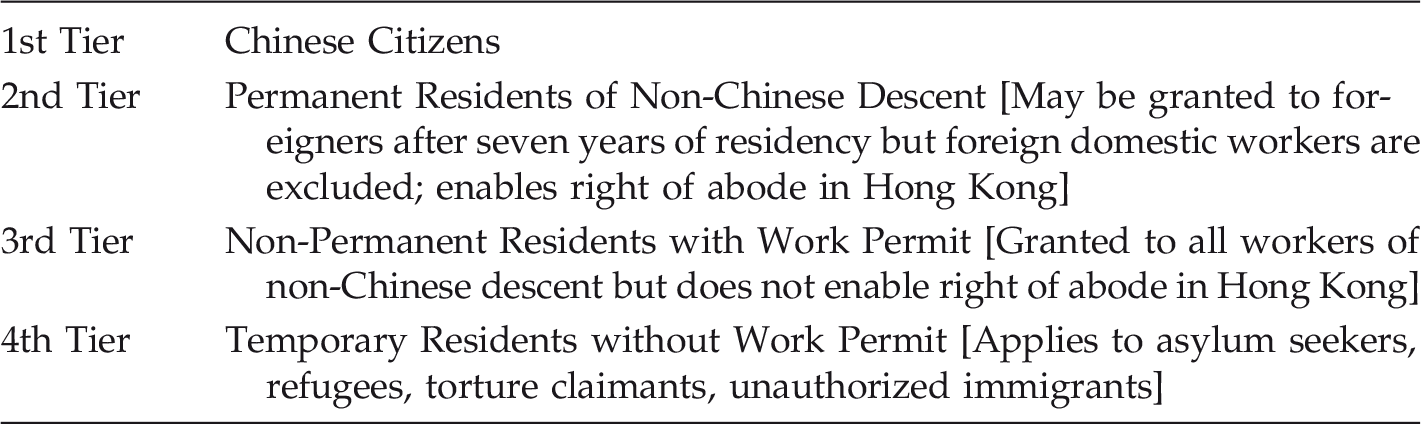
Refugees and asylum seekers who stay in Hong Kong for years also do not qualify to apply for permanent residence. Moreover, they are forbidden from working in Hong Kong and are under threat of deportation if they are found doing so. This puts them in an extremely vulnerable and precarious situation where, on the one hand, their meager entitlement reduces them to impoverishment, while on the other hand, any attempt to work to supplement their income will immediately make them illegal and an easy target for exploitation, threats and harassment. Despite the precariousness of their situation, studies have found that they are actively involved in certain low-end industries, such as the re-cycling and garment industries and trade services, that require a transnational network (Vecchio, 2016). These industries run on an extremely tight margin and survive only “by avoiding government regulations related to minimum wage, safety and overtime conditions, and ensuring more flexibility in working hours and in the dismissal of unnecessary employees” (Vecchio, 2016: 3). One other livelihood option for refugees or asylum seekers is self-employment. They join the growing number of tourist traders from the Indian sub-continent or Africa; thus, they do not compete with locals for jobs. According to Vecchio (2016: 4), asylum seekers “strengthen the business capacity of low-income residents, in turn supporting Hong Kong's well-established ideology of self-reliance.” While refugees and asylum seekers manage to adapt to the local economy and society, in the eyes of the government, they do not have the same rights as nationals, as starkly stated by a government notice to non-refoulement claimants (Immigration Department, 2015: 20): You will not be treated as ordinarily resident in Hong Kong for the purposes of the Ordinance during any period in which you remain in Hong Kong only by virtue of your non-refoulement claim (whether or not your claim is a substantiated claim and whether or not permission has been given to you to take employment … you may still be removed to a specified country that is not your (claimed) Risk State(s).
Civic deficit
A local NGO informant said that about one in five asylum seekers and protection claimants in Hong Kong is a minor. Although children of asylum seekers and refugees are given access to education in Hong Kong, their lack of legal recognition and protection means that their schooling experience is jeopardized by different hurdles imposed by the government. In Hong Kong, the nine-year free and compulsory education begins at the primary level when a child is six years old. In principle, kindergarten schooling is not free. It generally costs at least HKD1,900 to 2,000 per month to obtain a place in kindergarten and parents usually get reimbursement only afterwards under a voucher system. The assistance given by the government to asylum seekers and protection claimants, however, is set at HKD1,600 per month, leaving a shortfall every month for asylum seekers who want to send their children to kindergarten. Furthermore, the reimbursement usually comes in December or January. Between August, the start of the school year, and December, parents have to pay a hefty HKD1,900 or 2,000, a near impossibility for asylum seekers and claimants because the humanitarian assistance package only offers in-kind support; it does not offer any cash money and they are forbidden to work. Parents often resort to selling the little food ration that they receive or find the money by any means to support their children’s schooling. According to NGO workers, some turn to sex work or resort to criminal activities just to be able to send their children to school.
Apart from financial challenges, asylum seekers often have to “beg” for money from the authorities to cover schooling expenses: The second problem is that you got to beg for this money, it is not policy. SFAA is the Student Financial Assistance Agency; it is under the Education Bureau (EDB). The problem is that parents have to go to the EDB, go to the SFAA and beg, and then sometimes they are rejected. They come to us, we write to the Social Welfare Department, we send to Security Bureau. It’s like a hassle, it is not automatic (NGO worker B, 2015).
Civic expansion
The rejection and impoverishment faced by refugees, non-refouled individuals and the protection claimant population came to a head in 2014. Hundreds of refugees united to protest against what they saw as unfair and corrupt practices in the ISS-HK, a Swiss-based organization that is the sole contractor by the Social Welfare Department responsible for distributing in-kind assistance to the group. Refugee groups alleged that the system of subcontracting food rationing to specific food stores invited corruption and abuse. The amount and quality of food rations had been reduced despite an increased budget allocated to the ISS-HK by the Hong Kong government; refugees said that they often received only sub-standard or rotten food (Vecchio and Beatson, 2014).
The protests were not in vein. According to a refugee leader of the group: I spent around seven months sleeping in the streets, later the system started to improve. They started to provide each individual HKD200 for transportation and deposit for renting properties as required by landlords. That was an achievement the union gained during the protest. Now, we have like over 1,000 registered members with a membership card. That’s like one-tenth of the population (Refugee Union Leader, 2015).
Conclusion
The paper has highlighted the process of civic stratification that positions asylum seekers at the very bottom of Hong Kong’s current citizenship hierarchy. Part of the issue is structural since Hong Kong does not have any obligations toward asylum seekers because it is not a state party to the 1951 Convention on the Status of Refugees. This refusal to ratify international legal agreements has resulted in minimal support provided to asylum seekers and refusal to give recognized refugees right of abode in the territory. How will Hong Kong deal with asylum seekers in the future?
Could China, for example, that has acceded to the Refugee Convention, extend it unilaterally to Hong Kong? Given the many tensions between Hong Kong and the Central Government, the Convention may yet be another area of disagreement. It must be noted that when China extended the Convention to Macau in 1999, it was a bilateral decision that included Portugal, Macau’s former colonial ruler. This leads to another issue: is there any indication that the original motivations behind the “Asian rejection” hypothesis have, in any way, been ameliorated and could this influence Hong Kong’s future decision-making?
As pointed out earlier, the majority of Asian countries have yet to ratify the Convention, Moreover, the Asian countries that ratified the Convention – China, Japan, Korea and the Philippines – are not major receivers of refugees. Moon has leveled some trenchant criticism at the Asian mindset when it comes to humanitarianism: Despite the region’s economic achievements and aspirations for global power and influence, most Asian countries are locked in by myopic state-centrism with respect to humanitarianism, as well as backwardness in adopting international standards and laws that promote human rights. They tend to hold a narrow view of sovereignty, deterring them from accepting and implementing such global norms. Moreover, Asia lacks good regional models of constructive refugee policy and capacity-building to host the strangers at the gates. (Moon, 2016)
Given the failure of humanitarianism as a motivation for a more responsive policy to asylum seekers, what is the strength of the economic argument? As pointed out earlier, studies have shown that refugees or asylum seekers have made economic contributions to Hong Kong by taking on jobs that local people refuse to do (Shum, 2014; Vecchio, 2015, 2016). In a population of 7.3 million, over 90 percent of whom are ethnic Chinese, and where the unemployment rate is just over 3 percent, asylum seekers are not likely to affect the ethnic composition of the city or threaten the employment opportunities of the local population. Beyond academic discourse, this argument needs to be placed more centrally before Hong Kong’s business leaders and the HKSARG. Economic arguments can often sway Hong Kong policy-makers so they are well worth considering.
A recent report commissioned by the HKSARG’s Central Policy Unit has recommended that work permits be provided to asylum seekers following similar practices in Switzerland (Kennedy et al., 2016). While the report has not broached the issue of Hong Kong ratifying the 1951 Convention, it has nevertheless made a number of other recommendations related to humanitarian issues, such as housing and schooling and broader issues related to protection claim assessment, human trafficking, border and visa control and the like, that if implemented, could enhance the living conditions of Hong Kong’s asylum seekers. There is no requirement for the HKSARG to implement the report's recommendations but at least the provisions for new directions are now on the table for discussion and review.
Finally, although Hong Kong’s asylum seekers have shown solidarity in the face of such adversity, it is clear that much more needs to be done to recognize the legitimacy of their status, needs and claims. Explanations that try to justify “Asian exceptionalism” are too general and are mere excuses that show the lack of will and self-discipline to make refugee protection an important goal in the region.
Footnotes
Declaration of conflicting interests
The author declared no potential conflicts of interest with respect to the research, authorship, and/or publication of this paper.
Funding
The research reported in this paper was supported by the following research grants: Towards a Refugee Policy for an Inclusive Hong Kong: Enhancing the Status of China's International City funded by the Central Policy Unit of the Hong Kong SAR Government [Project: 2014.A5.010.15B]; and “Neither Immigrants nor Citizens”: Constructing Citizenship Values in a Transnational Context for Hong Kong’s Ethnic Minority Students funded by the Hong Kong Research Grants Council [HKIEd 1840215].