







Abstract
With more jobs requiring educational credentials, highly educated migrants are sought by many governments. This study is drawn from recently collected data between 2018 and 2020 in Hong Kong on highly educated migrants from Mainland China. We explored how entry visa categories, current experience and future expectation of highly educated migrants are related to their intention to stay. The findings suggest that all three aspects of their migration experience are related to their intention to stay. The findings also indicate that immigration policies, in particular visa categories, play a significant role in the intention of highly skilled migrants to stay. Thus, the government should pay attention to the types of visas that are likely to influence the retention of the highly educated in Hong Kong and the number of visas that are issued each year.
Introduction
De Haas et al. (2020) suggested that we may be living in the age of migration. However, some scholars (Parsons et al., 2020) have argued that the current situation can be described more precisely as the era of “high-skilled migration” as many countries, including places in East and Southeast Asia, have devoted considerable effort to specifically attracting highly skilled immigrants through policy incentives (Fong and Shibuya, 2020), in part to maintain their regional competitiveness and in part as a response to the local demand for manpower in aging societies (Walmsley et al., 2017).
While there have been numerous policy studies (Cerna, 2014; Czaika and Parsons, 2017; Facchini and Lodigiani, 2014; Oishi, 2012; Richardson, 2016) aimed at developing better measures to attract, retain and make better use of highly educated foreign talents, migrants’ preference or intention to stay or which policies are effective in retaining them have not been. This missing information is an unfortunate loss. Various policies have been launched to retain highly educated migrants, but they may not yield the desired results. The current study attempts to fill this research gap.
In this study, we explore the case of highly educated immigrants who completed their university education and/or associate degree from Mainland China and are currently residing in Hong Kong. We examine their intention to stay in the city and analyze the factors associated with the decision whether to stay. By focusing on immigrants’ perspective, the study contributes to better understand the factors that shape the decision of highly educated individuals to remain or to move.
Our discussion will contribute to the literature in four ways. First, we identify factors that are crucial to the intention to stay among highly educated migrants. As the group has been deliberately sought and highly valued, their retention is critical to the sustainability of local economic development. The focus of highly educated migrants helps us disentangle how factors related to this group are similar to or different from those that relate to the general migrant population.
Second, we focus on factors related to policy, such as entry visa categories and participation in science, technology, engineering and mathematics (STEM) industries, which are commonly viewed as the engine of economic growth and job creation. This focus is timely as most governments are trying to recruit and retain highly educated migrants, especially those working in STEM-related industries (Lewin and Zhong, 2013).
Third, the study focuses on Hong Kong. Many East Asian countries, such as Singapore and Japan, have adopted policies to attract highly educated migrants (Fong and Shibuya, 2020). In Hong Kong, a major financial center in Asia, the local government has launched a series of admission schemes or programs to recruit foreign talents to develop their careers and settle in the city (Hong Kong Government, 2020). The data collected in Hong Kong helps to facilitate a systematic understanding of the group and their intention to stay in a major city in East Asia, a topic about which we have limited information.
Fourth, most of the highly educated migrants in Hong Kong are from Mainland China (Fong et al., 2018). Under the governing framework of “one country, two systems,” migrants from Mainland China must apply to cross the border just as immigrants apply to settle in another country. Since Mainland Chinese are from the same ethnic group as those in Hong Kong, the study allows us to explore the relationship of the proposed factors without the concern of group difference.
Highly educated migrants from Mainland China in Hong Kong
Following the return of Hong Kong from the British government to China in 1997, Hong Kong has since become a Special Administrative Region (SAR) of China. Under the governing principle of “one country, two systems,” individuals from Mainland China are required to apply for entry to Hong Kong, similar to crossing the border between two separate jurisdictions. Because of geographical proximity and the intimate historical link between Mainland China and Hong Kong, Mainland Chinese have been the major source of migration to Hong Kong (Fong et al., 2018). According to Pong et al. (2014), over 760,000 Mainland Chinese settled in Hong Kong between 1997 and 2012. Between 2016 and 2020, an addition of 301,318 arrived Hong Kong (Lam and Fong, 2022).
Most Mainland migrants come and settle in Hong Kong through three major schemes. First, many arrived in Hong Kong through the One-way Permit (OWP) scheme, which attracted migrants seeking family unification. Between 1997 and 2014, a total of 879,000 migrants from Mainland China arrived in Hong Kong through this scheme. Between 1997 and 2001, migrants arriving through this scheme represented 93 percent of the population growth in Hong Kong. Few of them had high levels of education at the time of arrival. Many had become accustomed to the Hong Kong system and way of life and they preferred to reside in Hong Kong (Fong et al., 2018).
The second major entry point is Mainland students who attended graduate programs in Hong Kong and decided to stay. Initiated in 2008 to attract non-local graduates to stay in Hong Kong, the Immigration Arrangements for Non-local Graduates (IANG) program enabled Mainland students to stay in Hong Kong for employment after graduation (Hong Kong Government, 2020). In 2015, about 10,269 entrants under IANG (more than 90 percent of the total entrants) were from Mainland China (Fong et al., 2018).
The third major entry point is facilitated by Hong Kong’s policies to recruit migrants with high levels of human or financial capital through various schemes or programs. Representative examples include the Capital Investment Entrant Scheme (CIES) launched in 2003, Admission Scheme for Mainland Talents and Professionals (ASMTP) in the same year, Quality Migrant Admission Scheme (QMAS) in 2006 and Technology Talent Admission Scheme (TechTAS) in 2018. By the end of 2019, over 175,000 immigrants were admitted through the above channels with at least 76 percent of them from Mainland China. A considerable number were recruited directly by companies in Hong Kong (Hong Kong Government, 2020).
In recent years, several policy initiatives have been implemented to support the stronger integration of Hong Kong into the Greater Bay Area (GBA) economic zone so that the city can benefit economically. 1 Hong Kong has a role to play in regional economic integration, with a view to developing the GBA into an international innovation and technology hub that would serve other cities in the region (Constitutional and Mainland Affairs Bureau, 2018). Therefore, resources from the government have been pumped into STEM-related industries in Hong Kong to enhance their growth. However, there has been concern that the city’s innovation policies are fragmented and redundant without an overarching direction (Sharif and Chandra, 2022).
Another concern is the lack of locally trained talent in Hong Kong. Given the high land values in Hong Kong, there is concern that a substantial amount of the operating cost is spent on rental of property and facilities (Our Hong Kong Foundation, 2019). An overwhelming percentage of firms with research and development operations are small-scale (Wang, 2018).
Despite government efforts to attract and retain highly educated migrants, many such migrants, even those with high income, have difficulty with Hong Kong’s high living costs, especially for education and housing. According to the recent housing affordability survey report by Demographia (2020), Hong Kong ranked the lowest in affordability among 309 cities in the world. It is to be expected that highly educated migrants will likely leave if they see opportunities elsewhere.
Literature review
In a global labor market, the competition for highly educated migrants is sometimes described as a “battle for talent” (Grigoleit-Richter, 2017). Since they are in demand around the world, highly educated migrants constantly evaluate their own situation to decide whether to stay or move elsewhere to seek better opportunities if needed. Drawing from the literature on migration, we explore how immigration entry visa categories, experience at the destination and future expectation at the destination shape the intention to stay among highly educated migrants in Hong Kong. This approach shows how the past, present and future perspectives on the course of migration shape the intention to stay of highly educated migrants.
Entry visa to Hong Kong
Individual entry visa categories reflect the reason why migrants first enter the destination and any associated social and economic responsibilities, which may have a direct implication for the intention to stay. There are four major categories of entry visa: Study, employment, family reunification and others.
In many countries, highly educated migrants who entered with student visas are more likely to move elsewhere when they complete their education (Baláž and Williams, 2004; Marinelli, 2013; Sabharwal and Varma, 2016). Research by Steiner (2019) about re-migration intention among highly educated migrants found that those who arrived as students were most likely to move elsewhere upon graduation, followed by those who arrived as labor migrants, while those who came as family migrants were more likely to stay.
Upon completing their studies, international students tend to move to other places to seek better opportunities or to fulfill their next goals in life. However, other studies (Borjas, 2002; Mathies and Karhunen, 2021) have suggested that international students are more likely to stay after the completion of their education. During their studies, they gain familiarity with the local society and labor market and they are more ready to translate their educational credentials to the local labor market where there will be reasonable returns (Alberts and Hazen, 2005). In addition, many local governments, including Hong Kong, have implemented policies to retain international students, because their high level of education is seen to benefit the local labor market. Therefore, the literature suggests two possible outcomes for those who enter Hong Kong with student visas:
Highly educated migrants who arrived in Hong Kong as students are more likely to intend to stay.
Highly educated migrants who arrived in Hong Kong as students are less likely to intend to stay.
Migrants who arrived in the city with employment visas are more likely to move away (Colic-Peisker, 2010). As they were recruited from elsewhere to work in Hong Kong, they may have few social ties or attachments to the city. The move to Hong Kong was mainly for economic reasons. Given that their work may be specialized and require long hours, they may have difficulty in finding people outside work with whom to share their work experience or developing social ties with the local community. Therefore, when opportunities arise elsewhere, they often are ready to move without the restriction of any local attachments.
Highly educated migrants who arrived in Hong Kong with employment visas are less likely to intend to stay.
However, we expect that highly educated migrants who arrived as family migrants will be more likely to stay in the host society (Steiner, 2019). Family migrants arrive in Hong Kong with other family members. As migrants are joining families already established in Hong Kong, they most likely are not household heads, which implies that they may not be the decision-makers in their families. Most of them may have arrived when they were young and received most of their education in Hong Kong. Their education credentials are recognized by the local labor market. At the same time, they know the market well and are more attached to the local labor market. These highly educated migrants most likely have stable jobs and income since they are competitive in the labor market and some may have to support other family members financially and socially. Thus, they are less likely to move elsewhere without other family members. Researchers (Khoo and Mak, 2003; Mak, 1997) have observed that some family migrants care for their family members so much that they compromise their own professional development for the interest of their relatives and stay in the host society despite not having optimistic career prospects for themselves. Therefore, we hypothesize that:
Highly educated migrants who arrived in Hong Kong for family reunification are more likely to intend to stay.
Current experience in Hong Kong
Findings from research show that the manner in which migrants are incorporated into the host society upon arrival shapes their intention to stay (Cieslik, 2011; Mak, 1997; Riemsdijk et al., 2016; Tansel and Gungor, 2003) because their early experience directly influence their perception of the receiving context and their life chances there. Most previous studies have explored the ways that migrants’ experience in their work and social life at the destination is related to their intention to stay. Our study focuses on two aspects related to work experience. First, we suggest that for highly educated migrants, income level may be related to the intention to stay. Everyone with higher income, whether highly educated or not, will be less willing to move. It may be difficult for them to find a job elsewhere that provides higher pay. Except for economic motives, they perceive that their talents and abilities are being recognized in their current situation (Kõu and Bailey, 2014; Sapeha, 2017). Therefore, they are more likely to stay.
However, the situation in Hong Kong may be different. As Hong Kong has been known as one of the world’s most expensive cities (Mercer, 2020) in terms of cost of living (including accommodation and daily expenses) and cost of education, migrants may still face the issue of affordability despite high income. They may find it more affordable to stay in other places, even with a lower salary. When opportunities arise elsewhere, they may move.
Highly educated migrants with higher income more likely intend to stay.
The income level of highly educated migrants does not relate to their intention to stay.
Involvement in STEM-related industries is an important factor in the discussion of highly educated migrants. STEM-related industries are commonly considered to be the engine of economic growth and they have experienced drastic growth in recent decades. A study suggests that STEM-related jobs grew about three times more than non-STEM jobs from 2001 to 2011 (Department of Employment and Workplace Relations, Australian Government, 2020; Langdon et al., 2011). In Hong Kong, there is also high demand for workers with experience in related industrial sectors (Legislative Council, 2021).
At the same time, most governments have implemented various policies to retain individuals who work in STEM-related industries (Lewin and Zhong, 2013). The Hong Kong government is no exception. Funding now is available for the development of STEM companies (Innovation and Technology Commission, 2020). However, despite these special initiatives to boost STEM industries, people involved in these industries are pessimistic about the working environment and future development of STEM-related industries (Legislative Council, 2020).
Given the high global demand for workers to fill STEM-related jobs, highly educated migrants may have less intention to stay. We hypothesize that:
Migrants who are working in STEM-related sectors have less intention to stay in Hong Kong.
In addition to economic prospects, the intention of highly educated migrants to stay can be shaped by their social relationships in the local community. Having more close friends in the host society suggests a larger support network and more social embeddedness in the society (Grigoleit-Richter, 2017). Highly educated migrants who developed more close friendships in the host society may have higher intention to stay (Basok, 2000; Tansel and Gungor, 2003). Studies based on data collected in Hong Kong suggested that having local friends can help blur the boundaries between local residents and migrants (Fong and Guo, 2018). In contrast, a community where migrants experience discrimination may influence them to move (Gherghina et al., 2020; Tezcan, 2019). In recent decades, migrants from Mainland China have been feeling that they are discriminated against in Hong Kong as local residents expressed negative sentiments towards these immigrants. Local residents are concerned that their way of life is being affected by the influx of these immigrants (Fong and Guo, 2018). There have been a few cases involving court rulings to settle the dispute (Fong et al., 2018). Given that highly educated migrants are sought after in the global labor market, they will have less intention to stay if they feel that they are not welcome (Sener, 2019).
Migrants who have more close friends in the host society are more likely to intend to stay.
Migrants who experience or perceive incidents of discrimination in the host society are less likely to intend to stay.
Views about future prospects
Future expectation, the extent to which an event or situation is expected to occur, has been considered an important predictor of human behaviors. In recent years, the notion that migrants’ expectation regarding their future prospects may shape their intention to stay in the host society has drawn some research attention from scholars (Koikkalainen and Kyle, 2016). These studies suggest that their future expectation may change migrants’ actual perception and behaviors. However, there has been little empirical research on the relationship.
Higher education is associated with higher levels of cognitive and judgment skills. It is common for most highly educated migrants to form their own views of their current and future situations. Drawing from their understanding of the future situation, highly educated migrants formulate their expectation for career development, which in turn shapes their decision to stay (Ngo and Este, 2006). Highly educated migrants realize that they are competitive in the labor market because of their educational background. Yet, they also know that job opportunities and career development that match their educational background may be more difficult to find (Haley and Taengnoi, 2011). Therefore, they more likely intend to stay if they see future career prospects in their current employment.
Highly educated migrants not only evaluate their careers, but also their future prospects in the host society (Czaika, 2015), as most of them consider their career development prospects in relation to the larger social context. Despite positive prospects for their career development, undesirable developments in the society, ranging from governance to the economy, will affect the intention of highly educated migrants to stay. Therefore, we expect that:
Highly educated migrants who are confident about their future prospects in the host society are more likely to intend to stay.
Highly educated migrants who are confident about the host society’s future prospects are more likely to intend to stay.
Data and methods
Data for this study were collected between December 2018 and May 2020 in an effort to understand adaptation issues facing migrants from Mainland China in Hong Kong. Respondents to the survey were Mainland Chinese immigrants in Hong Kong aged between 18 and 50 who were recruited using the respondent-driven sampling (RDS) method. The data includes only respondents who were born in Mainland China, who lived in Mainland China before age 16 and who worked in three major types of skilled occupations (i.e., managers, professionals and associate professionals) as defined by the Hong Kong occupation classification scheme (Census and Statistics Department, 2017).
For this study on highly educated migrants, we utilized only the data concerning respondents who completed university or college associate degrees. We include those who completed college associate degrees because many of the associate degree programs provide students with skills that prepare them to enter the labor market and opportunities for pursuing further education. However, this group comprises a small percentage of our sample. The total number of all cases included in our analysis accounted for about 98 percent (N = 2,949) of the total sample.
Respondent-driven sampling is a network-based sampling method (Heckathorn, 1997) developed with the aim of sampling hard-to-reach populations. We used this method to recruit respondents for our survey because: (1) Highly educated migrants aged 18–50 accounted for less than 10 percent of Hong Kong’s population (Census and Statistics Department, 2017), (2) workers in Hong Kong tend to have long working hours and are not always available for contact and (3) many people in Hong Kong live in a building with security staff who deny public access to its residents. In view of these difficulties, the RDS method was selected as the best alternative for this study. All interviews were conducted face-to-face in Chinese between February 2019 and February 2020. Due to the outbreak of COVID-19, interviews after March 2020 were conducted online. About 7.5 percent of the sample was collected after March 2020. We made an extra effort to ensure that the quality of the interview would not be affected by the change in the mode of interview. 2
Our data collection commenced with some 40 initial respondents to which we had access. They were carefully chosen to make the sample as heterogeneous as possible. Using the RDS method, each respondent had a limited quota of referral to minimize the dependence between samples (i.e., the situation in which an overwhelming proportion of the sample are referred by a small number of respondents) and at the same time, let each sample seed spread further. Tests were conducted and confirmed that the data reached equilibrium on a few key demographic characteristics. We applied the RDS II weight in our analysis (Volz and Heckathorn, 2008).
To specifically understand migrants’ intention to stay, we asked for their intention to stay in Hong Kong for more than five years to further establish their lives there. We combined the options of “very unlikely,” “unlikely” and “uncertain” in the analysis because our focus is mainly migrants’ intention to stay.
We included three entry visa categories: Family reunion, study and employment. The conditions for family reunification include having a spouse or close family members as permanent residents in Hong Kong. For migrants who came to Hong Kong as students, after graduation, the Immigration Arrangements for Non-local Graduates (IANG) program allows them to search for employment locally. Migrants who came to Hong Kong for employment include those who were admitted through the Admission Scheme for Mainland Talents and Professionals (ASMTP) (started in 2003), Quality Migrant Admission Scheme (QMAS) (launched in 2006), Technology Talent Admission Scheme (TechTAS) (started in 2018) and General Employment Policy (GEP). Migrants who arrived in Hong Kong through these migration schemes either were recruited by companies or applied directly to companies in Hong Kong based on their human capital resources.
The variables to capture migrants’ current experience in Hong Kong include income, whether they are employed in STEM-related industries, number of close friends and experience of discrimination.
Monthly income is a categorical variable that includes below HKD 20,000, HKD 20,000–49,999, HKD 50,000–79,999 and HKD 80,000 or above. In 2019, the average monthly income was about HKD 18,000. However, most respondents with higher education earn more than the average monthly income. Therefore, we include more categories for monthly income of above HKD 20,000.
We asked if migrants were involved in STEM-related industries (i.e., science, technology, engineering or mathematics) because China’s recent GBA initiative heavily emphasizes the development of STEM-related industries and there is a vision of Hong Kong as a hub of innovation and technology (Constitutional and Mainland Affairs Bureau, 2018). Individuals who are involved in these industries may benefit from this development.
The next two variables capture migrants’ current social well-being. We asked the respondents how many of their close friends in Hong Kong are either local-born or arrived in Hong Kong before age 16. The number of close friends in Hong Kong implies their support network locally. A more supportive network can serve as a cushion when migrants face adaptation difficulties. Experience of discrimination will make the respondents feel unwelcome in Hong Kong and may discourage them from staying. We also asked if the respondents had experience of, or perceived, being treated in an unfair manner because of their identity as Mainland Chinese. Categories of responses for perceived discrimination include “never,” “seldom,” “sometimes” and “often.”
We also included variables to indicate how respondents see the future. Specifically, we included information about their confidence in their personal prospects in Hong Kong and the prospects for Hong Kong, in the next 10 years. Categories of responses for both variables include “completely not confident,” “not confident,” “neutral,” “confident” and “complete confident,” respectively.
Additionally, we controlled several variables related to migrants’ demographic characteristics, which include their gender, age, education, marital status, whether they have children and major language skills. Gender is a binary variable consisting of male and female. Age is a continuous variable and can range between 18 and 50. The highest completed education is categorized into four groups: “associate degree,” “bachelor’s degree,” “master’s degree” and “doctorate degree.” Students whose examination marks are not high enough for entering universities usually enroll in an associate degree program that takes two years of full-time study to complete. Many of these programs are offered by universities or subsidiary institutions of universities. Both marital status and whether they have children under 18 are binary variables. Cantonese is the most commonly used language in Hong Kong and hence we asked migrants about their proficiency in speaking it. The categories of response range from 1 to 5, indicating “not fluent at all,” “not fluent,” “fluent,” “fairly fluent” and “very fluent,” respectively.
Linear probability regression, instead of logistic regression, was employed in our analysis, as the dependent variable of our analysis is a binary variable. Recent studies suggest that logistic regression estimates cannot be interpreted in a straightforward manner. Furthermore, they cannot be compared among subgroups because estimates of logistic regression also reflect the degree of unobserved heterogeneity (Mood, 2010).
Results
Descriptive statistics
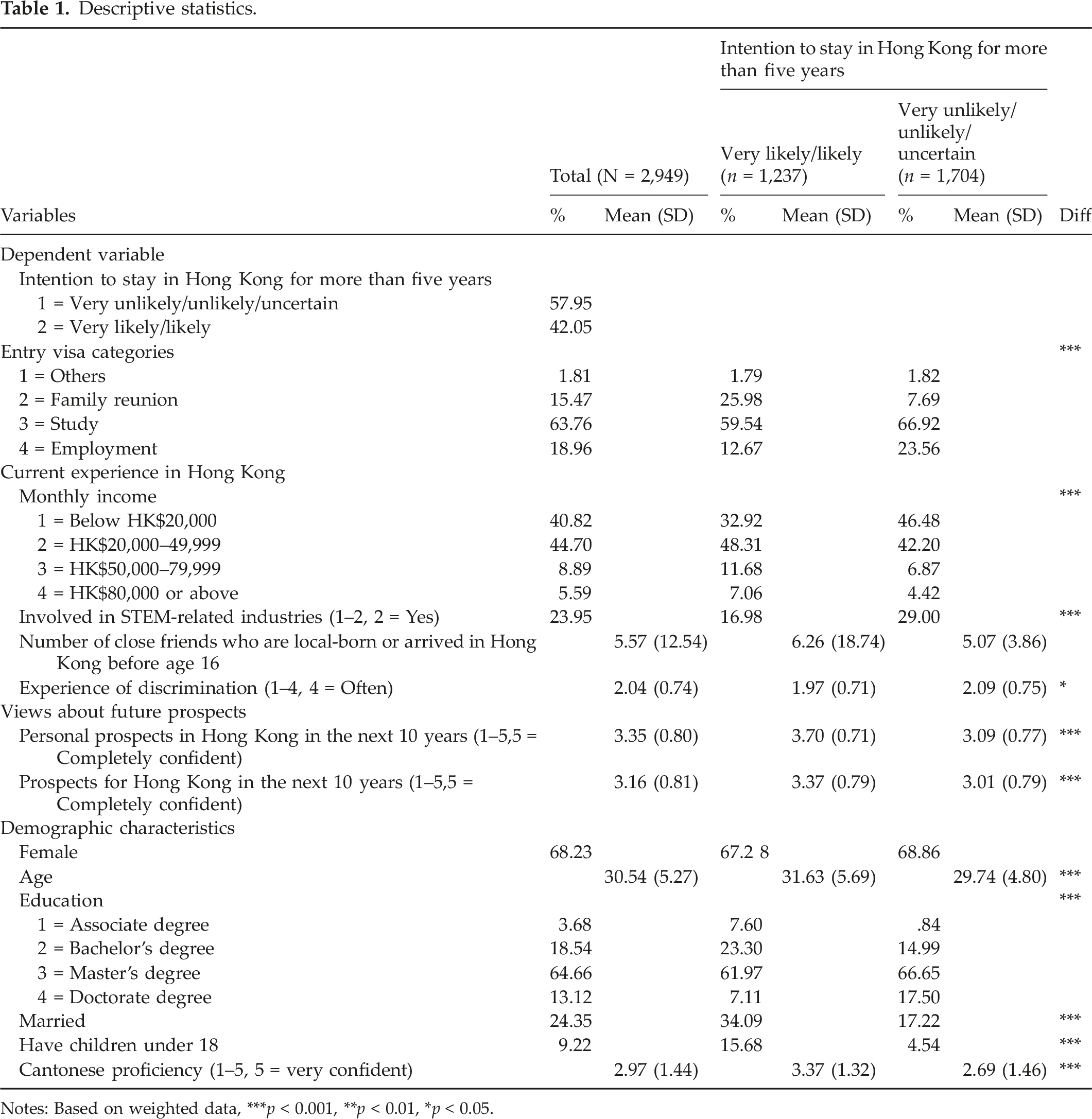
Descriptive statistics.
Notes: Based on weighted data, ***p < 0.001, **p < 0.01, *p < 0.05.
There were only 4,026 (about 0.4 percent) research and development personnel per million people in Hong Kong as at the end of 2018 (Legislative Council, 2021). The percentage for highly educated migrants from the Mainland is much higher, about 24 percent. This group plays an important role in STEM-related industrial sectors.
Highly educated migrants from the Mainland are socially integrated in Hong Kong. On average, they have five close friends who are local-born or arrived in Hong Kong when they were young. In an era of “bowling alone,” in Robert Putnam’s term, they are well connected with local residents. This impression is supported by their report of a relatively low level of perceived discrimination.
Despite their social integration and minor experience of discrimination, the respondents have relatively low confidence of their own prospects in Hong Kong (3.35 out of 5) and their views of Hong Kong (3.16 out of 5). This low confidence may further reinforce their intention not to stay in Hong Kong.
In addition, this group of highly educated migrants from the Mainland includes slightly more who are female and young and many have master’s degrees or above. In other words, they should be very competitive in the local labor market or elsewhere. Given that most of them are single, they are ready to depart from Hong Kong if opportunities arise.
Multivariate analysis
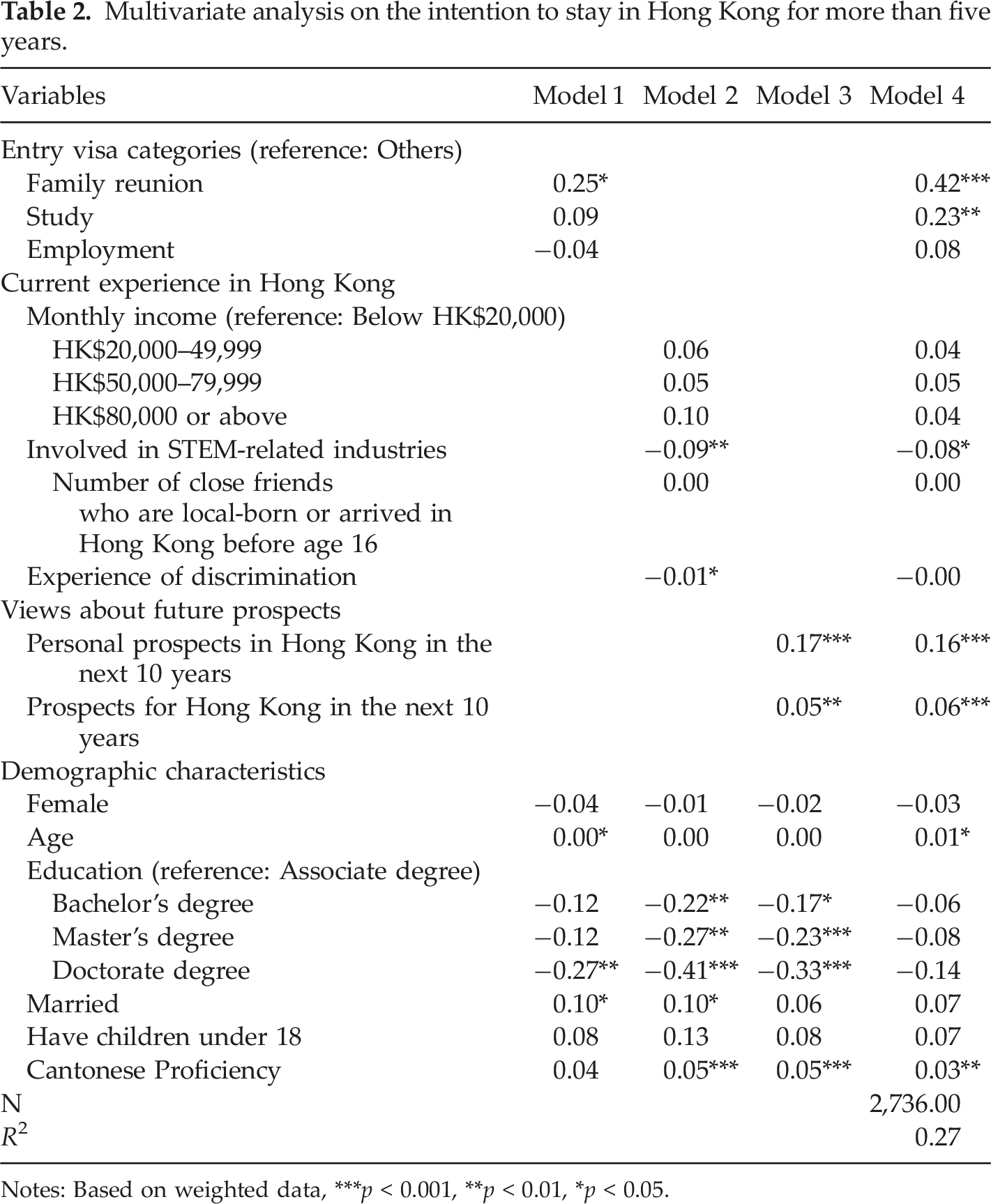
Multivariate analysis on the intention to stay in Hong Kong for more than five years.
Notes: Based on weighted data, ***p < 0.001, **p < 0.01, *p < 0.05.
The findings for all four models are consistent. Therefore, our discussion focuses on the full model. The findings indicate that respondents who entered Hong Kong for family reunion or study have greater intention to stay. The coefficient is 0.42 and 0.23, respectively. They are statistically significant. Those involved in STEM-related industrial sectors are less likely to intend to stay. It is worth mentioning that factors representing integration, i.e., having more close friends and experiencing less discrimination, are not related to their intention to stay. Finally, their future expectations about their own prospects or the city are largely related to their intention to stay. The coefficient is 0.16 and is statistically significant. It appears that highly educated migrants are more concerned about their future economic well-being than their social experience in weighing their decision to stay.
Discussion and conclusion
The findings from the analysis of factors related to the intention to remain in Hong Kong of highly educated migrants suggest that all three aspects of their migration experience—how they enter Hong Kong (entry visa categories), their working and living experiences (current experience) and future expectations—are related to their intention to stay.
The findings have research and policy implications. First, the findings show that the study of the intention to stay of the highly educated migrants, like the study of the general migrant population, should include their entry visa categories, their current experience in various spheres of life (from income attainment to friendship patterns to discrimination experiences), and their future expectation for themselves and the host society. This may be especially true for highly educated migrants because of the stiff competition among destination countries in actively seeking out the highly educated. For their part, the highly educated migrants constantly evaluate the fulfillment of their original purpose in migrating, their current situation and the expectations of future prospects in Hong Kong.
Second, policies play a significant role in shaping the intention of highly skilled migrants to stay. The policies that are likely to exert influence in retaining the highly educated to remain in Hong Kong are those pertaining to the entry visa categories and the number of visas that are issued each year by the government. Also, related to the intention to stay is their involvement in STEM-related industrial sectors, which is also shaped by policies. Though we did not establish the causal relationship of the ways in which policies affect the intention to stay, our study indirectly and consistently shows a possible relationship between the outcomes of policies and the intention to stay. Further reinforcing this argument, the findings also indicate that income is not related to intention to stay.
Finally, we would like to point out that very few of the control demographic or socio-economic variables are significantly related to the intention to stay among highly educated migrants. In other words, the demographic and socio-economic background of the group was not so relevant to their decision-making about staying. This pattern echoes the finding that the intention to stay among highly educated migrants is shaped by their adaptation experience and future expectations rather than by their own demographic and socio-economic background.
Given their involvement in STEM-related industries, access to career- and research-enhancing opportunities may attract highly educated migrants to remain. The government has an important role in play in developing or supporting research institutes that will strengthen research and development capacities as well as incentivize STEM personnel to stay in Hong Kong (Our Hong Kong Foundation, 2019).
It is worth noting that the intention to stay can change over time as there are changes in the experience of these highly educated migrants or in the economic, political and social context of the city. Future research should update the analysis when Hong Kong experiences drastic changes, especially after the social movement in 2019 and the implementation of the National Security Law in 2021. It will be important to conduct a follow-up study of respondents who indicated their intention to stay, to see where they are several years later. Then we can isolate the change in specific factors affecting their stay. In addition, our study does not address gender differences. As studies (Grigoleit-Richter, 2017; Lu et al., 2009) have noted different patterns of adaptation for males and females, there may be differences in the ways that various factors are related to their intention to stay.
Despite the competition to recruit highly educated migrants in Asia, few studies have focused on this particular population in the region. Our study is an initial step to understanding the factors that contribute to the intention of highly educated migrants to stay in the country or area of destination. Further research on the topic may lead to more thoughtful and responsive policies to accommodate their needs in ways that lead to successful retention of the group and their contributions to economic development. For example, in the case of the government of Hong Kong, it should pay attention to the visa categories and the number of granted visas in each category. Furthermore, given rapid changes in the economic and geopolitical context, future research should incorporate these factors in the analysis. In addition, as many other places in the world are competing to attract highly educated migrants, future studies should compare the situation in Hong Kong with that of other possible destinations.
Footnotes
Acknowledgments
The first two authors made equal contributions to this paper.
Declaration of conflicting interests
The author(s) declared no potential conflicts of interest with respect to the research, authorship, and/or publication of this article.
Funding
The author(s) disclosed receipt of the following financial support for the research, authorship, and/or publication of this article: The project is funded by Our Hong Kong Foundation (Social and Economic Integration of Migrants) and China National Science Foundation (Project Number: 72074179).
