This paper considers the problem of decentralized global stabilization via output feedback for a class of uncertain nonlinear systems with unknown output functions, in which the nonlinear terms are interconnected by unmeasurable states and the inputs of each subsystem. First, we design the controller for each nominal subsystem without the perturbing nonlinearities. Then, we apply the homogeneous domination approach to design scaled homogeneous observers and controllers with an appropriate choice of gain to render the nonlinear system globally asymptotically stable. Finally, two simulation examples are shown to illustrate the effectiveness of the proposed scheme.
In this paper, the problem of global stabilization via output feedback is considered for a class of uncertain nonlinear systems described by
where , , are system states, control input and output, respectively, and is a function of unmeasurable states, control inputs and uncertain bounded disturbance . The output function is a function satisfying . The objective of this paper is to find the output feedback observers and controllers of the form
with continuous functions and satisfying , such that the closed-loop system (1)–(2) is globally asymptotically stable.
Large-scale interconnected systems can be found in the real world. Examples of such systems include large-scale power systems, aerospace, decentralized large-scale networks, intelligent transportation and many other practical applications (Yan et al., 2010; Stipanović et al., 2004; Mazo and Tabuada, 2011; Pan, 2009; Feddema et al., 2002). Decentralized control uses local information at the level of each subsystem in the controller implementation for large-scale interconnected systems. Therefore, the decentralized controllers are of much simpler architecture and more practical than the centralized controllers which require sufficiently large communication bandwidth to exchange information between subsystems. The study of decentralized control dates back to the early 1990s (Siljak, 1991). With the development of modern nonlinear control theory, decentralized nonlinear control design has also attracted tremendous interest (see Ye et al., 2006, 2012; Lu et al., 2010; Liu, 2011; Jian and Khorrami, 1997; Jiang, 2000; Ye and Huang, 2003; Xi and Ding, 2007; Kalsi et al., 2010, and the references therein). Ye et al. (2006), Ye et al. (2012), and Lu et al. (2010) formulated the design of the decentralized stabilizing controllers by using the saturation approach. Liu (2011) proposed a new robust decentralized control scheme, based on sliding mode control theory, for a class of uncertain large-scale interconnected systems with matched and unmatched uncertainties. However, most of them require the availability of the states of each subsystems, which cannot be guaranteed in practice. This motivates researchers to develop decentralized dynamic output feedback controllers that incorporate local observers to estimate the states of the subsystems. An important fact about the global output feedback stabilization of nonlinear systems is that the nonlinear terms cannot grow too fast due to the finite escape time phenomenon as demonstrated by Mazenc et al. (1994). Counterexamples are given to indicate that global stabilization of nonlinear systems via output feedback is usually impossible without introducing extra growth conditions on unmeasurable states of the system. Therefore, the recent works of Jian and Khorrami (1997), Jiang (2000), Ye and Huang (2003), Xi and Ding (2007), Kalsi et al. (2010), Krishnamurthy and Khorrami (2010), Polendo and Qian (2007), and Xie et al. (2010) have focused on the decentralized output feedback stabilization for nonlinear systems with different growth conditions. The large-scale nonlinear systems of Jian and Khorrami (1997) and Jiang (2000) were interconnected via their outputs through linearly parameterized nonlinear functions. Ye and Huang (2003) and Xi and Ding (2007) paid more attention to the decentralized output regulation problem for large-scale nonlinear systems with nonlinear exosystem. While in recent work (Kalsi et al., 2010), the local sliding-mode observers were employed for the nonlinear interconnected systems, which consist of linear subsystems coupled by system inputs, and the feedback gain matrices of local controllers were obtained by solving a constrained optimization problem subject to two linear matrix inequalities. However, the above results for nonlinear large-scale systems considered only those interconnected by their outputs or inputs, with limited results for those that considered the interconnection of unmeasurable states. Polendo and Qian (2007) employed the concept of homogeneous domination to cover a larger class of large-scale nonlinear systems while relaxing the linear growth restriction to a polynomial one. Xie et al. (2010) proposed an output feedback controller for a class of large-scale interconnected systems with value bounded uncertainties in the states and inputs. Unfortunately, the output feedback control methods of Siljak (1991), Ye et al. (2006), Ye et al. (2012), Lu et al. (2010), Liu (2011), Jian and Khorrami (1997), Jiang (2000), Ye and Huang (2003), Xi and Ding (2007), Kalsi et al. (2010), Krishnamurthy and Khorrami (2010), Polendo and Qian (2007), and Xie et al. (2010) cannot work for a class of nonlinear systems with unknown output functions interconnected by unmeasurable states, even by their inputs. To solve this problem, we first provide a series of controllers and observers for the nominal systems without using the nonlinear parts. Then, using the homogeneous domination approach (Qian, 2005) with appropriate design parameters, a series of scaled observers and controllers can render the closed-loop systems globally asymptotically stable in two cases: lower-triangular case and upper-triangular case. Moreover, our design scheme can be extended to a general class of more complex large-scale interconnected systems, in which the gains in front of the states and inputs are uncertain constants.
The contributions of this paper are as follows: (i) this paper provides a decentralized controller design scheme via output feedback for system (1) by employing homogeneous domination approach; (ii) the use of homogeneity allows the nonlinear functions of each subsystem to be different from those of other subsystems, thus not requiring unnecessary symmetry in nonlinear interconnections.
Preliminaries
This section contains several useful definitions and lemmas which play important roles in this paper.
Definition 2.1 (Weighted homogeneity (Kawski, 1988)) For fixed coordinates and real numbers :
the dilation is defined by , , with being called the weights of the coordinates, for simplicity, we define the dilation weight ;
a function is said to be homogeneous of degree if there is a real number such that, , , ;
a vector field is said to be homogeneous of degree if there is a real number such that, for , , ;
a homogeneous -norm is defined as , , for a constant ; for simplicity, in this paper, we choose and write for .
Lemma 2.1 (Hermes, 1991) If the trivial solution of the -homogeneous system
is globally strongly stable, there exists a -homogeneous Lyapunov function , which is positive definite and proper, such that
Lemma 2.2 (Rosier, 1992) Let be a continuous vector field on such that the origin is a locally asymptotically stable equilibrium point. Assume that is homogeneous of degree for some . Then, for any and any , there exists a strict Lyapunov function for (3), which is homogeneous of degree and of class . As a direct consequence, the time derivative is homogeneous of degree .
Lemma 2.3 (Bacciotti and Rosier, 2005) Given a dilation weight , suppose that and are homogeneous functions of degree and , respectively. Then is also homogeneous with respect to the same dilation weight . Moreover, the homogeneous degree of is .
Lemma 2.4 (Bacciotti and Rosier, 2005) Suppose that is a homogeneous function of degree with respect to the dilation weight . Then the following hold:
is homogeneous of degree with being the homogeneous weight of there is a constant such that
Moreover, if is positive definite, then
where is a constant.
Lemma 2.5 (Qian and Lin, 2001a) Suppose that and are two positive real numbers. Given any real-valued function , such that
To solve the problem, the following condition is imposed on the unknown output function .
Assumption 2.1 For , there are two known positive constants and , such that
Remark 2.1 The simplest function satisfying (7) is a linear output with an unknown constant if the upper and lower bounds of are known. In addition, some nonlinear output functions with bounded first derivatives, such as , satisfy Assumption 2.1 as well.
Next, we will construct an output feedback stabilizer for the nominal system
where is a function satisfying and . Using the approach of Zhai and Qian (2012), we can design a homogeneous output feedback stabilizer for (8), which is described in the following lemma.
Lemma 2.7 For any constant , there exist constants such that the homogeneous output feedback stabilizer
where and is defined as
renders system (8) globally asymptotically stable.
Proof. The proof is similar to Theorem 2.1 of Zhai and Qian (2012) with some modifications. For the sake of space, the detailed proof is omitted here. ■
Remark 2.2 Most of the existing results on global output feedback control of nonlinear systems are based on the form of , which is a special case of considered in this paper. Fortunately, we can find a method of how to tackle the problem of global output feedback stabilization for nonlinear systems in the presence of unknown function in Zhai and Qian (2012).
Denoting , it is verified that the closed-loop system (8)–(9) can be rewritten
In fact, by choosing the dilation weight
it can be verified that is homogeneous of degree with respect to .
According to Theorem 2 of Hermes (1991) and Lemmas 2.2 and 2.4, there exists a Lyapunov function with homogeneous degree such that
where . Similarly, by Lemmas 2.1 and 2.3, there is a constant such that
Main results
In this section, the homogeneous domination approach will be employed to construct decentralized output feedback controllers for system (1). The results consist of two parts: (i) for the lower-triangular case, we first introduce a scaling gain into a series of observers and controllers established in Lemma 2.7, which are only dependent on the information of its own subsystem. Then, by choosing a large enough gain , the proposed observers and controllers can render the lower-triangular systems globally asymptotically stable; (ii) for upper-triangular case, similar to the lower-triangular case, we introduce a scaling gain into the observer and controller established in Lemma 2.7 for each subsystem. Then, a series of observers and controllers with small enough gain can be obtained to render the upper-triangular systems globally asymptotically stable.
Controller design for lower-triangular systems
First, we introduce a generalized assumption under which it is possible to achieve global stabilization for a class of lower-triangular systems via output feedback.
Assumption 3.1 For , there exist constants and such that
with the constant defined as
and for .
Remark 3.1 In this remark, an explanation is given to show that the relation between two homogeneous degrees is a necessary condition. In order to find a large enough scaling gain to guarantee that the right-hand side of (34) is negative definite, the power of the scaling gain in the right-hand side of (27) is required to be less than 1, that is,
For the case of , it is obvious that (16) holds under the condition . For the case of , a direct calculation yields
Since , then
holds for all . Hence, is a necessary condition to illustrate the system stability.
For simplicity, we assume that with an even integer and an odd integer. Based on this, will be odd in both the denominator and numerator. Note that an equivalent result can be achieved for a real number .
With the help of Lemma 2.7 and Assumption 3.1, we are now ready to use homogeneous domination approach to design global output feedback controllers for system (1).
Theorem 3.1 Under Assumption 3.1, the problem of decentralized global output feedback stabilization for the nonlinear system (1) can be solved by a series of homogeneous output feedback stabilizers.
Proof. The proof is divided into three steps: first, a state transformation is introduced, under which we can obtain a new system; then, we construct a series of observers and controllers with scaling gain ; finally, by choosing appropriate design parameters, the proposed observers and controllers can render the lower-triangular systems globally asymptotically stable.
We introduce the following change of coordinates
with being the scaling gain to be determined later, system (1) can be rewritten as
for .
Next, we construct a series of observers with the scaling gain
where is the gain selected by Lemma 2.7. In addition, we design using the same construction of (9), specifically,
where and . Similar to (11), it can be seen that
Therefore, the closed-loop system (20)–(22) can be written as
By Lemma 2.7, there exist the gains and such that is globally asymptotically stable. According to Lemmas 2.1—2.4, there is a Lyapunov function of degree such that
where is a constant and . With (25) in mind, it can be seen that
Next, under the change of coordinates (19), we deduce from Assumption 3.1 that
The power of the scaling gain on the right-hand side of (27) is
Owing to and , we can obtain
which means that we can find a constant such that
Recall that for , is homogeneous of degree . Then from Lemmas 2.3 and 2.4, it can be deduced that
is homogeneous of degree . With (30) and (31) in mind, by Lemma 2.4, one can find a positive constant such that
where .
Substituting (32) into (26) yields
Let the Lyapunov function be for the whole large-scale system, then it can be seen that the time derivative of is
where and do not depend on . From (34), we can choose a large enough gain such that the right-hand side of (34) is negative definite. Therefore, it can be verified that the scaled homogeneous output feedback stabilizers (21) and (22) render system (1) globally asymptotically stable. ■
Next, we show that Theorem 3.1 can be used to solve the global output feedback stabilization of large-scale lower-triangular systems.
Example 3.1 Consider the stabilization problem of the following uncertain nonlinear systems
where and . By choosing and , we can obtain that and satisfy . Moreover, by Young’s inequality, it can be verified that
from which it is clear that satisfy Assumption 3.1.
Next, by the following change of coordinates
the scaled observers and controllers can be constructed as
with appropriate positive constants and . In the simulation, the unknown parameters are assumed to be , , and . The gains in (38) are chosen as
and the scaling gain is chosen as . If we choose the initial condition as
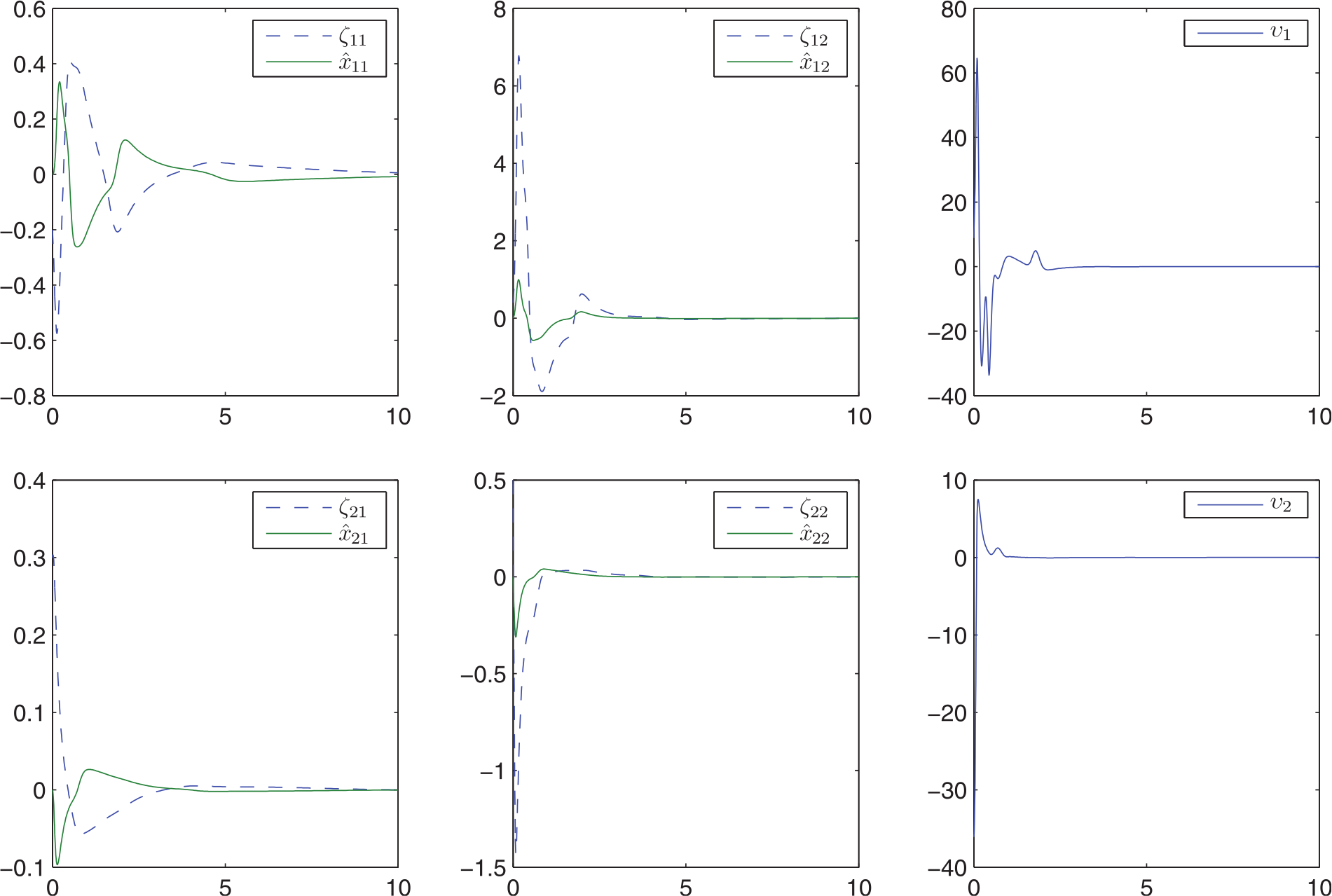
the simulation result is shown in Figure 1, which illustrates that the decentralized system (35) can be globally asymptotically stable by the decentralized output feedback stabilizers (38).
The curves of the states and their estimations for initial condition. .
Controller design for upper-triangular systems
We present a homogeneous growth condition for a class of upper-triangular systems under which it is possible to achieve global stabilization of (1) via output feedback.
Assumption 3.2 For , there exist constants and such that
with the constant defined as (15) and for .
Remark 3.2 In this remark, an explanation is given to show that the relation between two homogeneous degrees is a necessary condition. In order to find a small enough scaling gain to guarantee that the right-hand side of (56) is negative definite, the power of the scaling gain in the right-hand side of (48) is required to be larger than one, that is,
From (40), a direct calculation yields
Since and , explicitly,
holds for all . Hence, is a necessary condition to illustrate the system stability.
With the help of the homogeneous controller and observer established in Lemma 2.7, we are ready to adopt the homogeneous domination approach to globally stabilize system (1) via output feedback.
Theorem 3.2 Under Assumption 3.2, the problem of the decentralized global output feedback stabilization for the nonlinear system (1) can be solved by a series of homogeneous output feedback stabilizers.
Proof. The proof is similar to that of Theorem 3.1 with some modifications. Following the same line, we first introduce the following change of coordinates
with being the scaling gain to be determined later, system (1) can be rewritten as
Similar to the proof of Theorem 3.1, we construct a series of observers and controllers with the scaling gain
where , , , are the same as in Theorem 3.1. Using the same notation (23), the closed-loop system (44) and (45) can be written as
With (25) in mind, it can be seen that
Next, under the change of coordinates (43), we deduce from Assumption 3.2 that
The power of the scaling gain at the first part in the right-hand side of (48) is
Owing to , , and , we can obtain
On the other hand, the power of the scaling gain at the second part in the right-hand side of (48) is
Similar to (50), it can be verified that .
In summary, we can find a constant such that
Recall that for , is homogeneous of degree . Then from Lemmas 2.3, 2.4 and 2.6, it can be deduced that
is homogeneous of degree where , , are positive constants and , . With (52) and (53) in mind, by Lemma 2.4, one can find a positive constant such that
where , .
Substituting (54) into (47) yields
Let the Lyapunov function for the whole large-scale system, then it can be seen that the time derivative of is
where and , do not depend on . From (56), we can choose a small enough gain such that the right-hand side of (56) is negative definite. Therefore, it can be verified that the scaled homogeneous output feedback stabilizers (45) render system (1) globally asymptotically stable. ■
In what follows, we show that Theorem 3.2 can still be extended to deal with a class of more general uncertain systems, in which gains in front of the states and control inputs are uncertain bounded constants.
Corollary 3.1 Under Assumption 3.2, we can find a series of observers and controllers of the form (45) to address the problem of global output feedback stabilization of large-scale nonlinear systems described as
where , are uncertain bounded constants.
Proof. Consider the following transformation of the coordinates
Systems (57) becomes
where the nonlinear terms satisfy Assumption 3.2 with a new positive constant . The rest of proof is the same as that of Theorem 3.2. For the sake of space, the detailed proof is omitted here. ■
Next, we present an example to illustrate the good performance of the output feedback stabilizers for a class of decentralized uncertain upper-triangular nonlinear systems.
Example 3.2 Consider the stabilization problem of the following uncertain nonlinear systems
where and . By choosing and , we can obtain that , , , , and satisfy . By mean-value theory, we have
for a between . Moreover, by Young’s inequality, it can be verified that
with the help of above relations, it is clear that satisfy Assumption 3.2.
Next, by the following change of coordinates
the scaled observers and controllers can be constructed as
with appropriate positive constants and . In the simulation, the unknown parameters are assumed to be , , and . The gains in (64) are chosen as
and the scaling gain is chosen as . If we choose the initial condition as
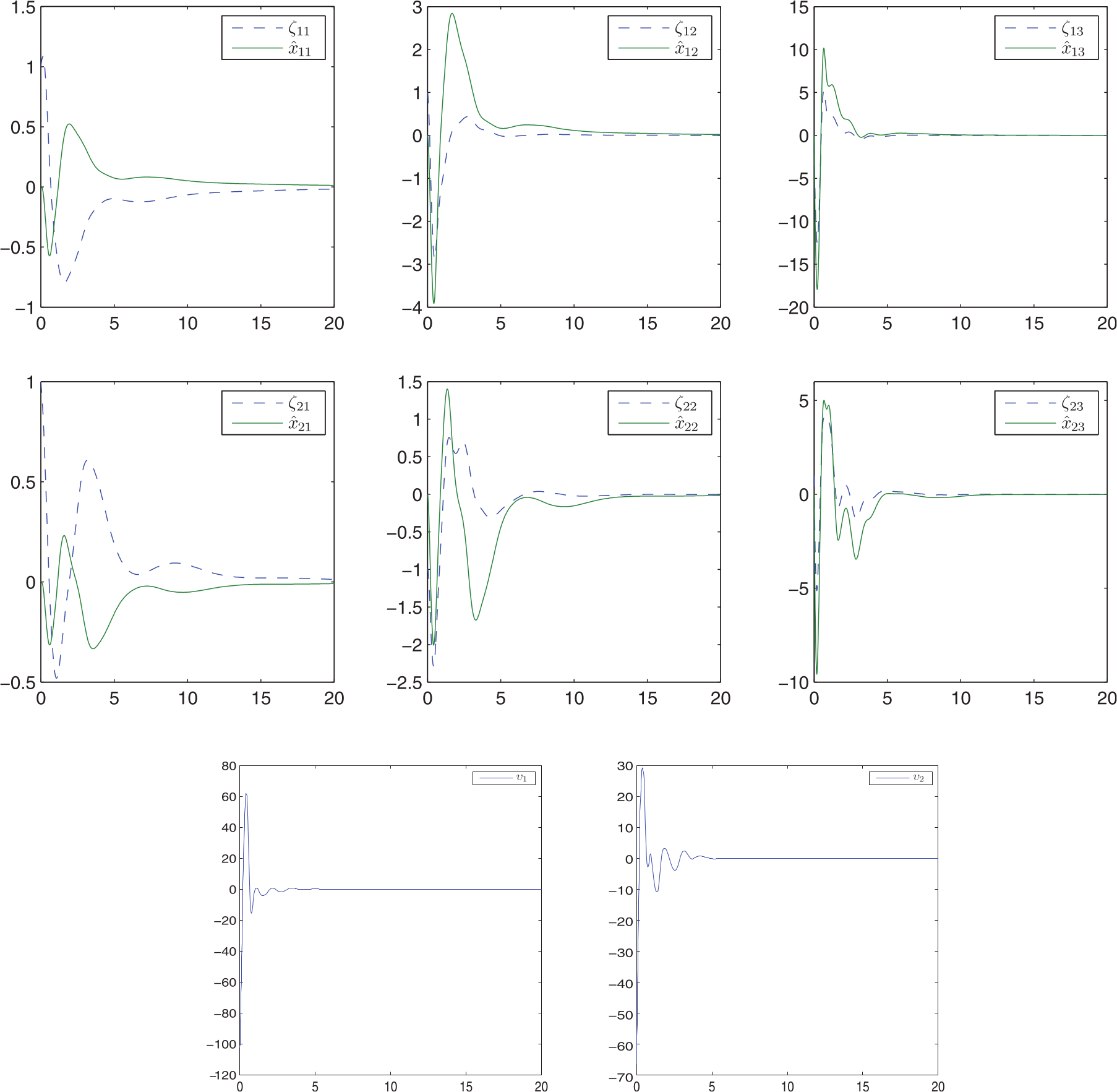
the simulation results are shown in Figure 2, which illustrate that the decentralized system (60) can be globally asymptotically stable by the output feedback stabilizer (64).
The curves of the states and their estimations for initial condition. .
Conclusion
This paper considers the problem of decentralized global stabilization for a class of large-scale nonlinear systems with unknown output functions by output feedback. By using homogeneous domination approach, a series of output feedback stabilizers are designed to render the nonlinear systems globally asymptotically stable with appropriate design parameters. Moreover, under an appropriate transformation of the coordinates, the proposed design scheme can still be extended to a more general class of uncertain nonlinear systems with the uncertain bounded gains in front of the unmeasurable states and the inputs.
Footnotes
Funding
This work was supported in part by the National Natural Science Foundation of China (grant numbers 61104068 and 61273119), Natural Science Foundation of Jiangsu Province (grant number BK2010200), China Postdoctoral Science Foundation (grant number 2012M511176), Research Fund for the Doctoral Program of Higher Education of China (grant numbers 20090092120027 and 20110092110021), Excellent Young Teachers of Southeast University Grant Program.
References
1.
BacciottiARosierL (2005) Liapunov Functions and Stability in Control Theory, 2nd edition. New York: Springer Verlag.
2.
FeddemaJLewisCSchoenwaldD (2002) Decentralized control of cooperative robotic vehicles: theory and application. IEEE Transactions on Robotics and Automation18: 852–864.
JianSKhorramiF (1997) Decentralized adaptive output feedback design for large-scale nonlinear systems. IEEE Transactions on Automatic Control42: 729–735.
5.
JiangZ (2000) Decentralized and adaptive nonlinear tracking of large-scale systems via output feedback. IEEE Transactions on Automatic Control45: 2122–2128.
6.
KalsiKLianJƵakS (2010) Decentralized dynamic output feedback control of nonlinear interconnected systems. IEEE Transactions on Automatic Control55: 1964–1970.
7.
KawskiM (1988) Stability and nilpotent approximations. In Proceedings of the 27th IEEE Conference on Decision and Control, Austin, TX, pp. 1244–1248.
8.
KrishnamurthyPKhorramiF (2010) Decentralized output-feedback control of large-scale interconnected systems via dynamic high-gain scaling. In Efficient Modeling and Control of Large-Scale Systems. New York: Springer, pp. 135–165.
9.
LiuW (2011) Decentralized control design for a class of non-linear large-scale systems with matched and unmatched uncertainties. Transactions of the Institute of Measurement and Control33: 631–644.
10.
LuLLinZBatemanA (2010) Decentralised state feedback design for large-scale linear systems subject to input saturation. IET Control Theory and Applications4: 206–227.
11.
MazencFPralyLDayawansaW (1994) Global stabilization by output feedback: examples and counterexamples. Systems & Control Letters23: 119–125.
12.
MazoMTabuadaP (2011) Decentralized event-triggered control over wireless sensor/actuator networks. IEEE Transactions on Automatic Control56: 2456–2461.
13.
PanY (2009) Decentralized robust control approach for coordinated maneuvering of vehicles in platoons. IEEE Transactions on Intelligent Transportation Systems10: 346–354.
14.
PolendoJQianC (2007) Decentralized output feedback control of interconnected systems with high-order nonlinearities. In: Proceedings of the 2007 American Control Conference, New York City, USA, pp. 11–13.
15.
QianC (2005) A homogeneous domination approach for global output feedback stabilization of a class of nonlinear systems. In: Proceedings of the 2005 American Control Conference, Portland, OR, pp. 4708–4715.
16.
QianCLinW (2001a) A continuous feedback approach to global strong stabilization of nonlinear systems. IEEE Transaction on Automatic Control46: 1061–1079.
17.
QianCLinW (2001b) Non-Lipschitz continuous stabilizers for nonlinear systems with uncontrollable unstable linearization. Systems & Control Letters42: 185–200.
18.
RosierL (1992) Homogeneous Lyapunov function for homogeneous continuous vector fields. Systems & Control Letters19: 467–473.
19.
SiljakD (1991) Decentralized Control of Complex Systems. New York: Academic Press.
20.
StipanovićDInalhanGTeoRTomlinC (2004) Decentralized overlapping control of a formation of unmanned aerial vehicles. Automatica40: 1285–1296.
21.
XiZDingZ (2007) Global decentralised output regulation for a class of large-scale nonlinear systems with nonlinear exosystem. IET Control Theory and Applications1: 1504–1511.
22.
XieYGuiWJiangZHuangC (2010) Decentralized robust H∞ output feedback control for value bounded uncertain large-scale interconnected systems. International Journal of Control, Automation, and Systems8: 16–28.
23.
YanRDongZSahaTMajumderR (2010) A power system nonlinear adaptive decentralized controller design. Automatica46: 330–336.
24.
YeHJiangZGuiWYangC (2012) Decentralized stabilization of large-scale feedforward systems using saturated delayed controls. Automatica48: 89–94.
25.
YeXHuangJ (2003) Decentralized adaptive output regulation for a class of large-scale nonlinear systems. IEEE Transactions on Automatic Control48: 276–281.
26.
YeXHuangJUnbehauenH (2006) Decentralized robust stabilization for large-scale feedforward nonlinear systems. International Journal of Control79: 1505–1511.
27.
ZhaiJQianC (2012) Global control of nonlinear systems with uncertain output function using homogeneous domination approach. International Journal of Robust and Nonlinear Control22: 1543–1561.