






Abstract
In this paper, an adaptive fuzzy-sliding control system is proposed to improve the dynamic performance of a three-phase active power filter (APF). Adaptive fuzzy controllers are employed to approximate both the equivalent control term and the switching control term in the sliding mode controller. An online adaptive tuning algorithm for the consequent parameters in the fuzzy rules is also designed. The switching control becomes continuous and the chattering phenomena can be attenuated. Simulation demonstrated that the proposed control method has an excellent dynamic performance such as small current tracking error, reduced total harmonic distortion (THD), strong robustness in the presence of parameter variation and non-linear load.
Introduction
A variety of non-linear and time-varying electronic devices bring power quality problems to the power system such as low power factor, waveform distortion, surges, phase distortion problems and so on. An active power filter (APF) is useful for power system harmonic suppression and reactive current compensation. The basic principle of APF is to produce compensation current, which is of the same amplitude and opposite phase with the harmonic currents, to eliminate the unexpected harmonic currents. Therefore, it is widely used in many applications to compensate for the harmful harmonic currents produced by non-linear loads on industrial, commercial and residential equipments.
Over the past few years, fuzzy control has been extensively applied because of its model-free approach. Wang (1994) demonstrated that an arbitrary function can be approximated with arbitrary accuracy using a fuzzy system on a compact domain by proposing a universal approximation theorem. Guo and Woo (2004) proposed an adaptive fuzzy-sliding mode controller for a robot manipulator. Yoo and Ham (2000) developed an adaptive controller for a robot manipulator using a fuzzy compensator. Wang et al. (2001) derived an indirect adaptive fuzzy-sliding mode control using a fuzzy switching approach. In this paper, a fuzzy controller will be investigated to approximate non-linear dynamic systems such as an APF, since it is very hard to establish an accurate mathematical model for APF and a classical linear controller cannot achieve an ideal current tracking performance. There are many current tracking control methods, such as single cycle control, hysteresis current control, space vector control, sliding mode control, deadbeat control, repetitive control, predictive control, fuzzy control, adaptive control, iterative learning control and artificial neural network control. Singh et al. (2007) presented a simple fuzzy logic-based robust APF for harmonics minimization under a random load variation. Bhende et al. (2006) developed a TS-fuzzy-controller for load compensation of an APF. Komucugil and Kukrer (2006) proposed a new control strategy for single-phase shunt APFs using a Lyapunov function. Rahmani et al. (2010) introduced an experimental design of a non-linear control technique for three-phase shunt APF. Luo et al. (2009) derived an adaptive fuzzy dividing frequency-control method to minimize the capacity of a hybrid APF with an injection circuit. Kumar and Mahajan (2009) summarized soft computing techniques for the current control of an APF. Chang and Chang (2004) proposed a novel reference compensation current strategy for shunt APF control. Shyu et al. (2008) developed a model reference adaptive control design for a shunt APF system. Matas et al. (2008) showed a feedback linearization approach of a single-phase APF via sliding mode control. Hua et al. (2009) described control analysis of an APF using a Lyapunov candidate. Lu and Xia (2008) applied a simple adaptive fuzzy control into the single-phase APF but the asymptotical Lyapunov stability cannot be guaranteed. Montero et al. (2007) compared different control strategies for shunt APF in three-phase four-wire systems. Valdez et al. (2009) designed an adaptive controller for a shunt APF in the presence of a dynamic load and line impedance. Marconi et al. (2007) developed a robust non-linear controller to compensate for harmonic current for a shunt APF. However, systematic stability analysis and controller design of the adaptive fuzzy controller have not been investigated for APF. Therefore, it is necessary to utilize the adaptive fuzzy control scheme to improve the current tracking and filtering performance. In this paper, a novel adaptive fuzzy control with a fuzzy-sliding term is developed to improve the current tracking performance and guarantee the Lyapunov stability of the close-loop system. The control strategy proposed here has the following advantages:
1) This paper integrates adaptive control, sliding mode control and the non-linear approximation of fuzzy control. Fuzzy controllers are proposed to approximate the equivalent control term and the switching control term in the sliding mode controller. A fuzzy switching part is employed to approximate the sliding mode controller. The sliding controller that is approximated by the fuzzy system is designed to compensate for the approximation error between the fuzzy controller and the optimal fuzzy control law.
2) The proposed adaptive fuzzy-sliding controller for the APF can approximate the non-linear characteristics of the APF model without establishing an accurate mathematical model. Adaptive fuzzy control has a good ability to compensate for the system non-linearities and improve the power dynamic performance, such as current tracking and total harmonic distortion (THD) performance.
3) An adaptive fuzzy control with fuzzy-sliding term is proposed to deal with system non-linearities and a non-linear load in order to improve the current tracking and system robustness compared with a conventional control method. The proposed adaptive fuzzy-sliding mode controller can guarantee the asymptotic stability of the closed-loop system and improve the robustness for external disturbances and model uncertainties. The robust adaptive fuzzy control method has been extended to the control of APF in this paper. This is the successfully application example using adaptive control, fuzzy control and a robust compensator with the APF. Both of these features are the innovative developments of adaptive fuzzy control methods incorporated into conventional control for the APF.
Principle of active power filter
The shunt APF can be considered the most basic structure of APF. This paper mainly studies the most widely used parallel-voltage type of APF. In the practical application, the three-phase is the most widely used shunt APF because of its excellent performance characteristics and simplicity in implementation; therefore the three-phase, three-wire system will be investigated and the dynamics of three-phase APF will be described in this section.
In practical operation, an APF is equivalent to a flow control current source. The whole APF system consists of three sections – the harmonic current detection module, the current tracking control module and the compensation current generating circuit. The harmonic current detection module usually uses instantaneous reactive power theory based on the rapid detection of harmonic current. A three-phase, three-wire APF produces compensation currents with a three bridge-arm circuit. In order to eliminate the harmonic components in the currents from the power supply, the compensation circuit produces compensation currents that have same amplitude and opposite phase with the harmonic currents.
The block diagram of the three-phase, three-wire active power system is given in Figure 1. The principle of the APF is to detect voltage and current of the compensation object, obtain command signal
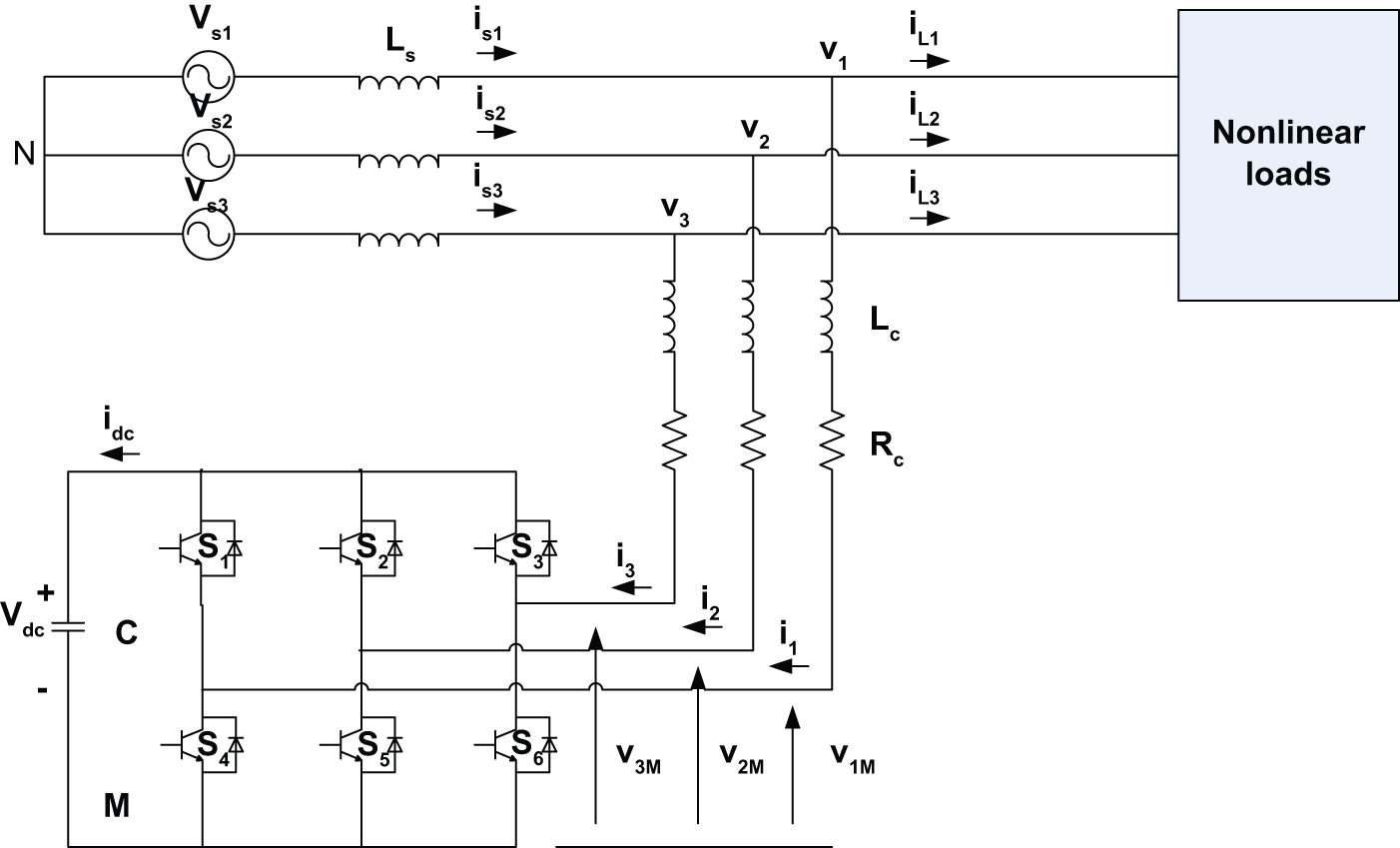
Block diagram for main circuit of active power filter (APF).
The mathematical model of the APF can be described in the following steps. According to circuit theory and Kirchhoff’s theorem, we can obtain following state equations:

The parameters
By summing the three equations in (1), taking into account the absence of the zero-sequence in the three-wire system currents, and assuming that the AC supply voltages are balanced, one obtains:

The switching function

where
Hence, by writing

Adaptive fuzzy control
In this section, an adaptive fuzzy-sliding control is derived and Lyapunov analysis is implemented to guarantee the asymptotic stability of the closed-loop system. An adaptive fuzzy control method based on the sliding-mode control is proposed to approximate the unknown equivalent control and sliding term. First a fuzzy logic system is introduced.
Fuzzy controller
A fuzzy controller is composed of the following four elements: a fuzzifier, some fuzzy IF-THEN rules, a fuzzy inference engine and a defuzzifier. The fuzzy inference engine uses the fuzzy IF-THEN rules to perform a mapping from an input linguistic vector
where

where
From the knowledge of the fuzzy systems, the output of the fuzzy system can be expressed using the centre-average defuzzifier, product inference and singleton fuzzifier.

where
Adaptive fuzzy controller
How to construct adaptive fuzzy-sliding control is derived in next steps. The block diagram of adaptive fuzzy-sliding control system for the APF is shown in Figure 2. Systematic stability analysis is performed in the design of the proposed adaptive fuzzy-sliding control. The detailed design procedure of the adaptive fuzzy-sliding control system can be described in the following steps.
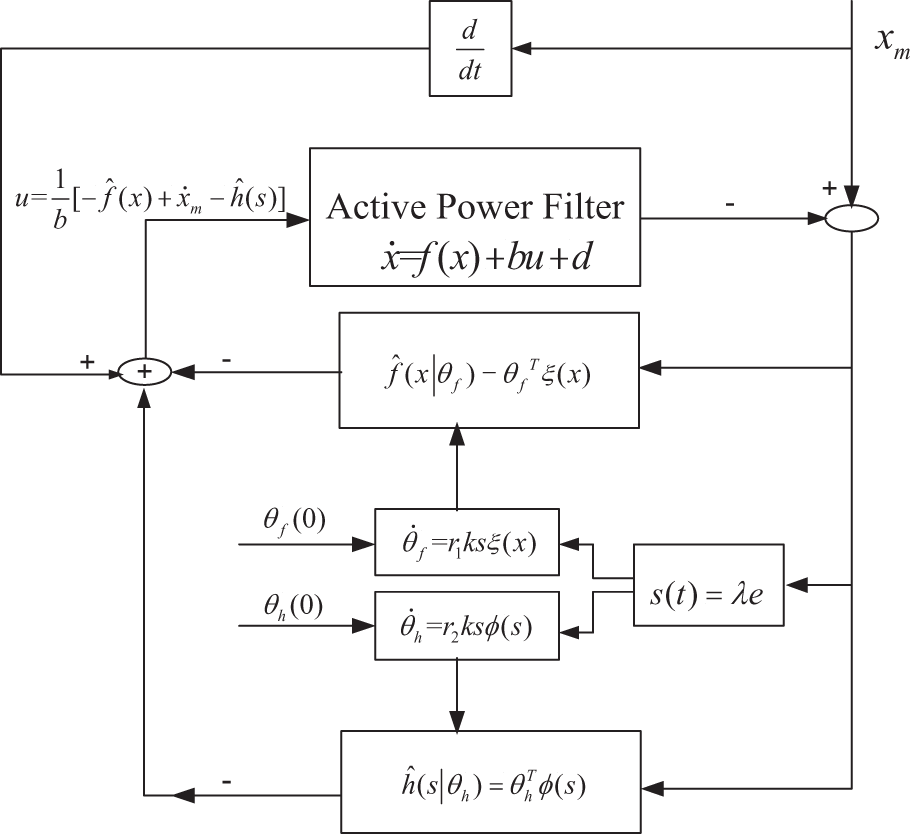
Adaptive fuzzy-sliding control block for active power filter (APF).
We can transform the dynamic model of (4) into the following form:

where

where
We choose the control law as

where
Substituting (9) into (7) yields:

Then
If we choose
If
The fuzzy controller can be expressed as

where


where


where
Define fuzzy approximation error

where

Then the derivative of sliding surface can be derived as

where
Define Lyapunov function candidate:

Then the derivative of

Because

Substituting (12), (13) into (21) yields

Assume the approximation error
Simulation study
The performance of the proposed adaptive fuzzy-sliding control will be testified using the Matlab/Simulink package with SimPower Toolbox. Simulation results are presented to verify the effectiveness of the proposed adaptive fuzzy-sliding control.
We choose six membership functions as

where


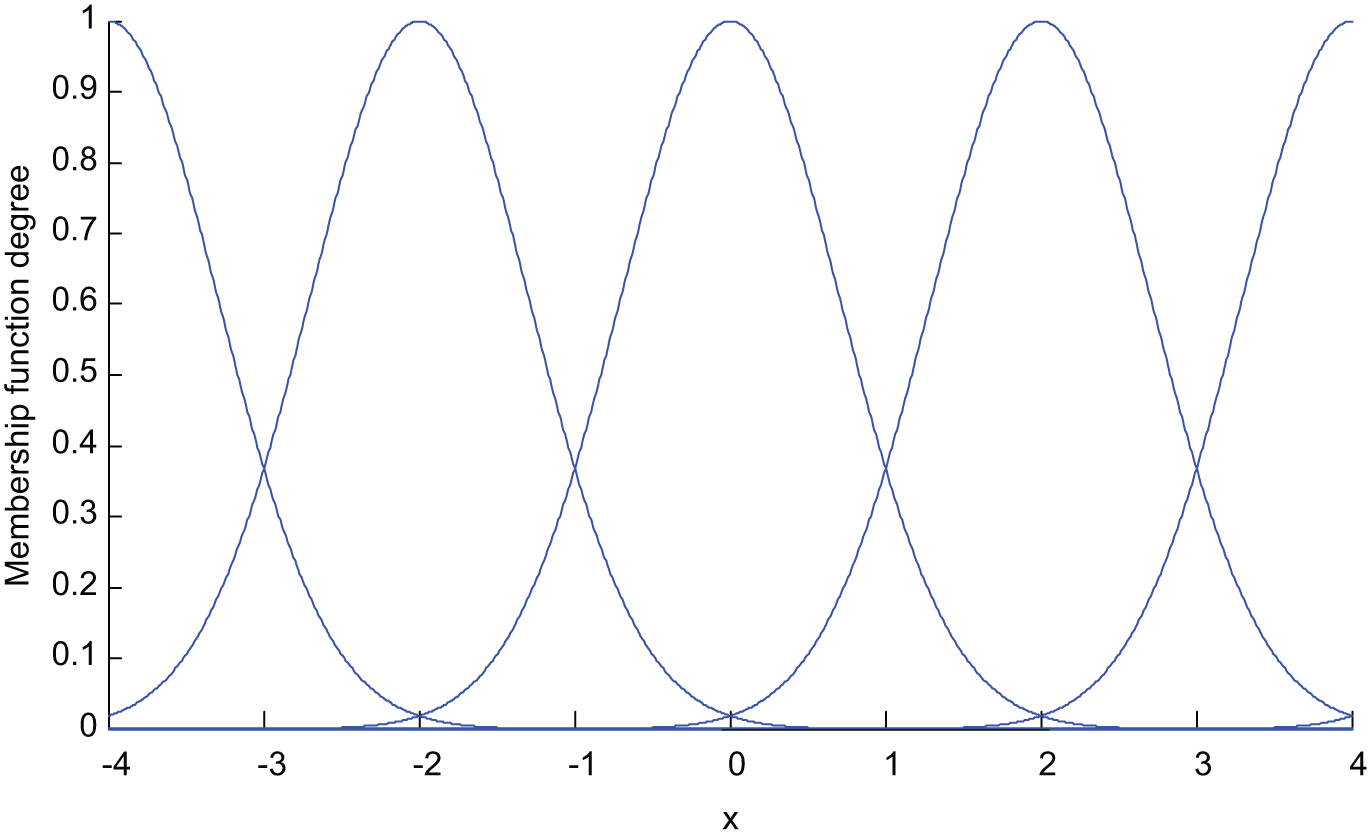
Membership function degree of x.
The initial values of fuzzy parameters are chosen randomly in the interval, and the vector of fuzzy basis functions were constructed by (6).
Sliding function is chosen as

A phase source current before and after APF works is shown in Figure 4. Current harmonic analysis for the first two circles and last two cycles are depicted in Figures 5 and 6. When
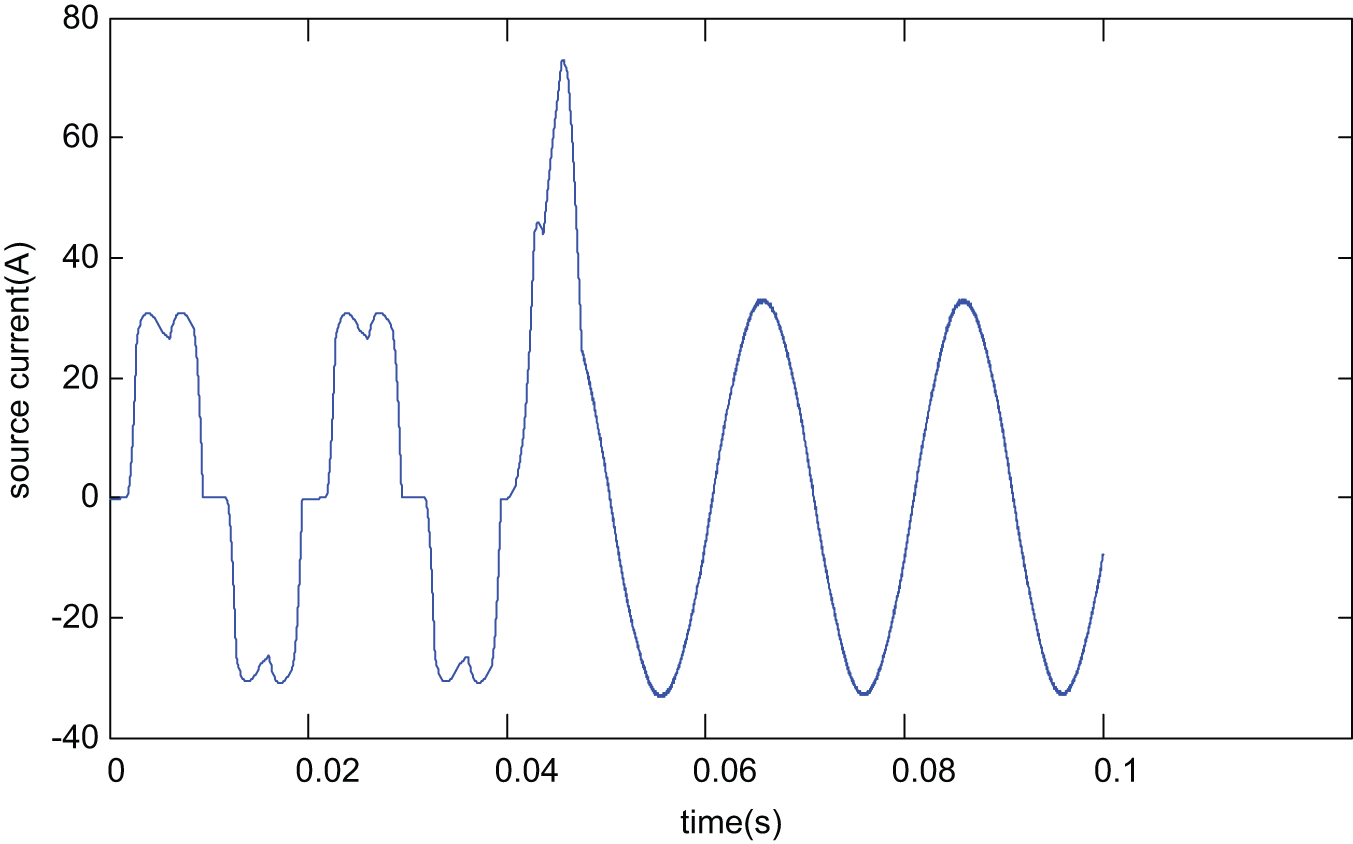
A phase source current.
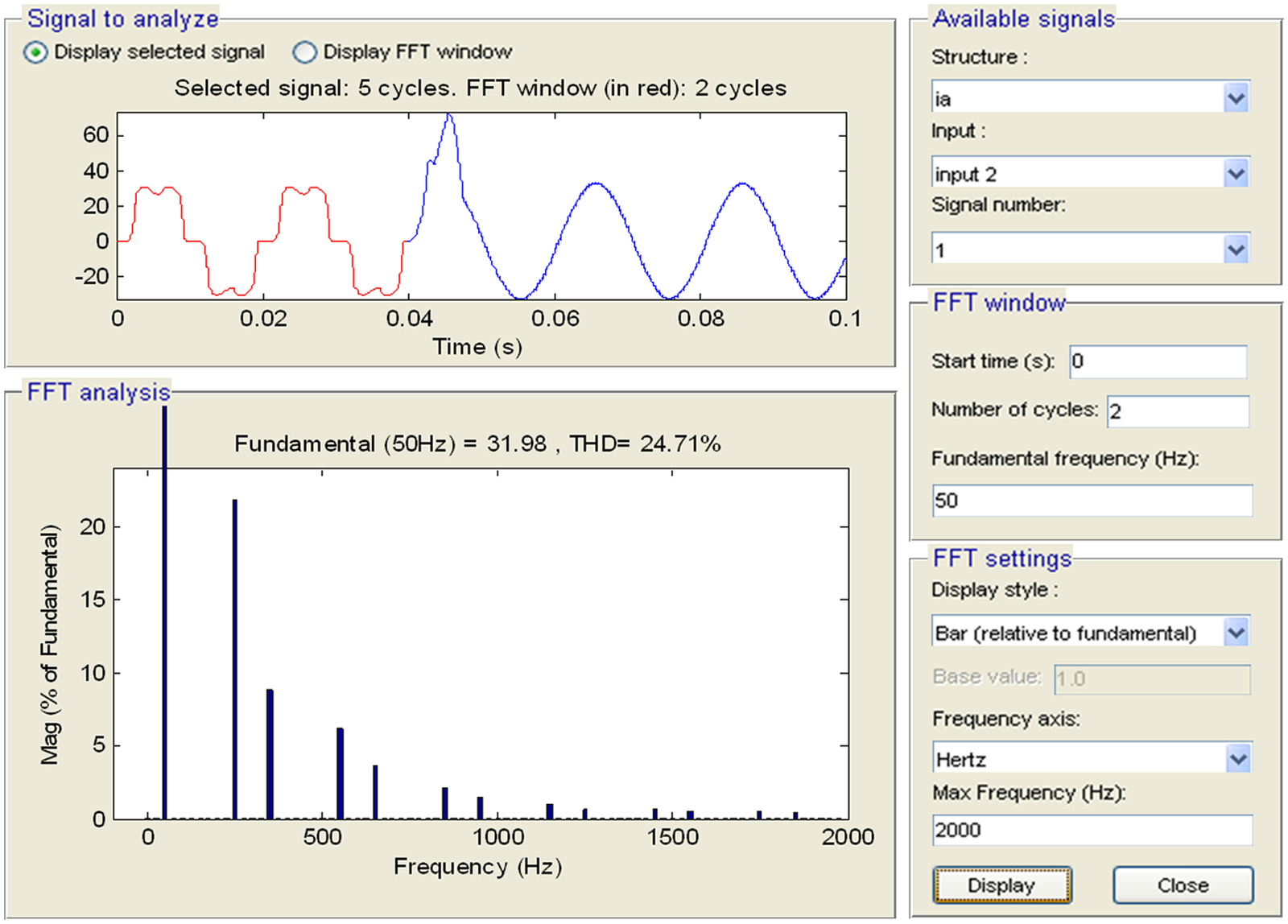
Current harmonic analysis for the first two circles.
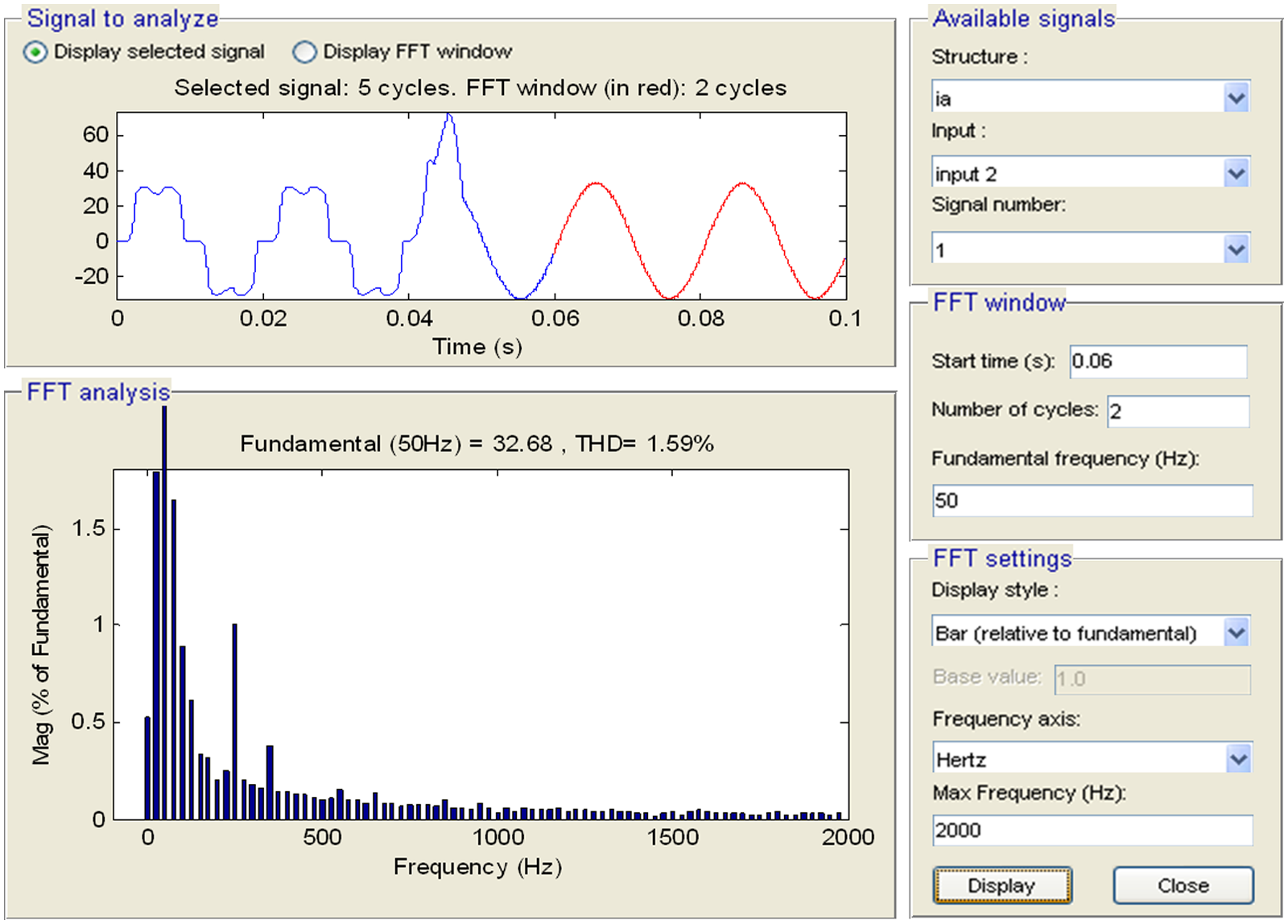
Current harmonic analysis for the last two circles.
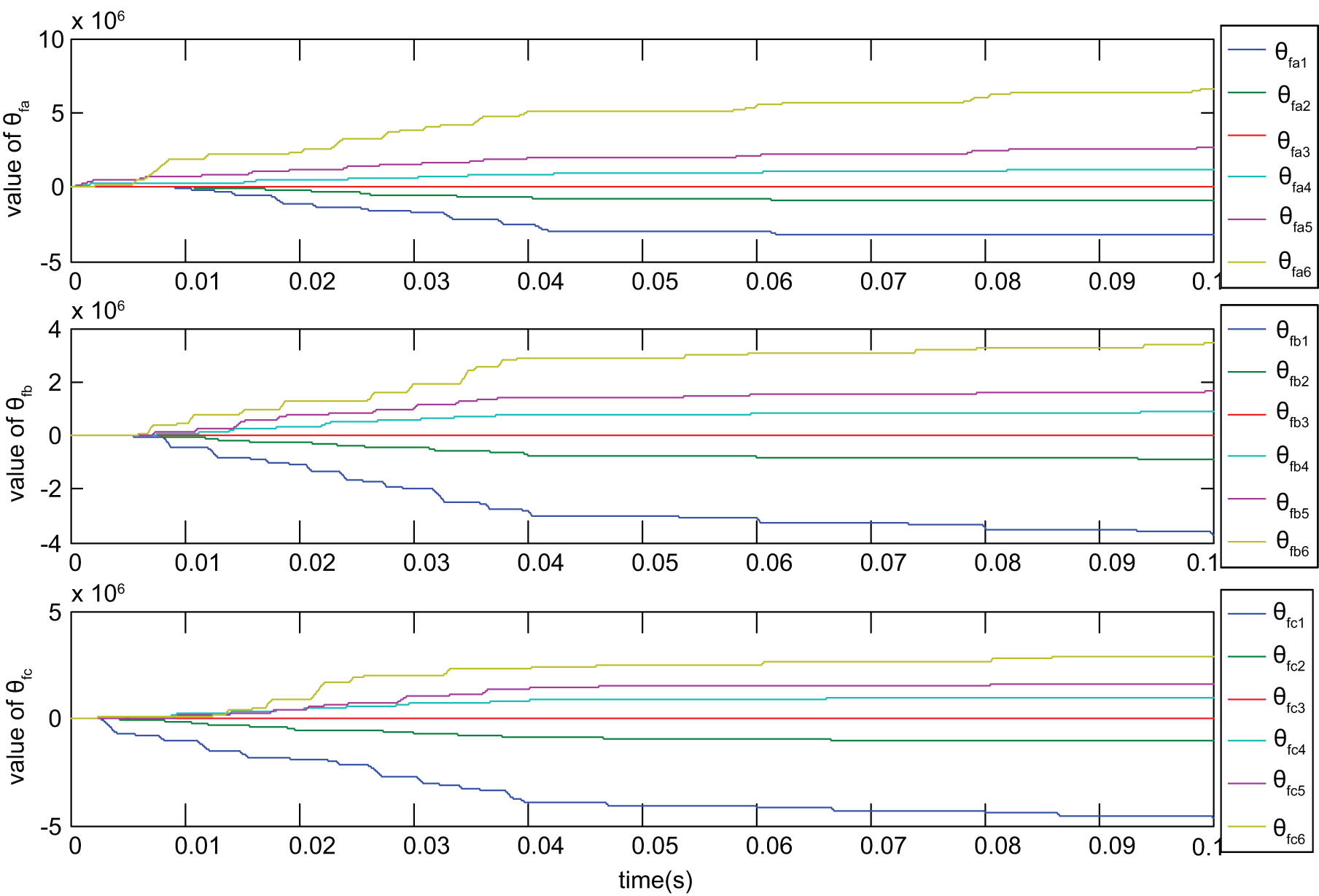
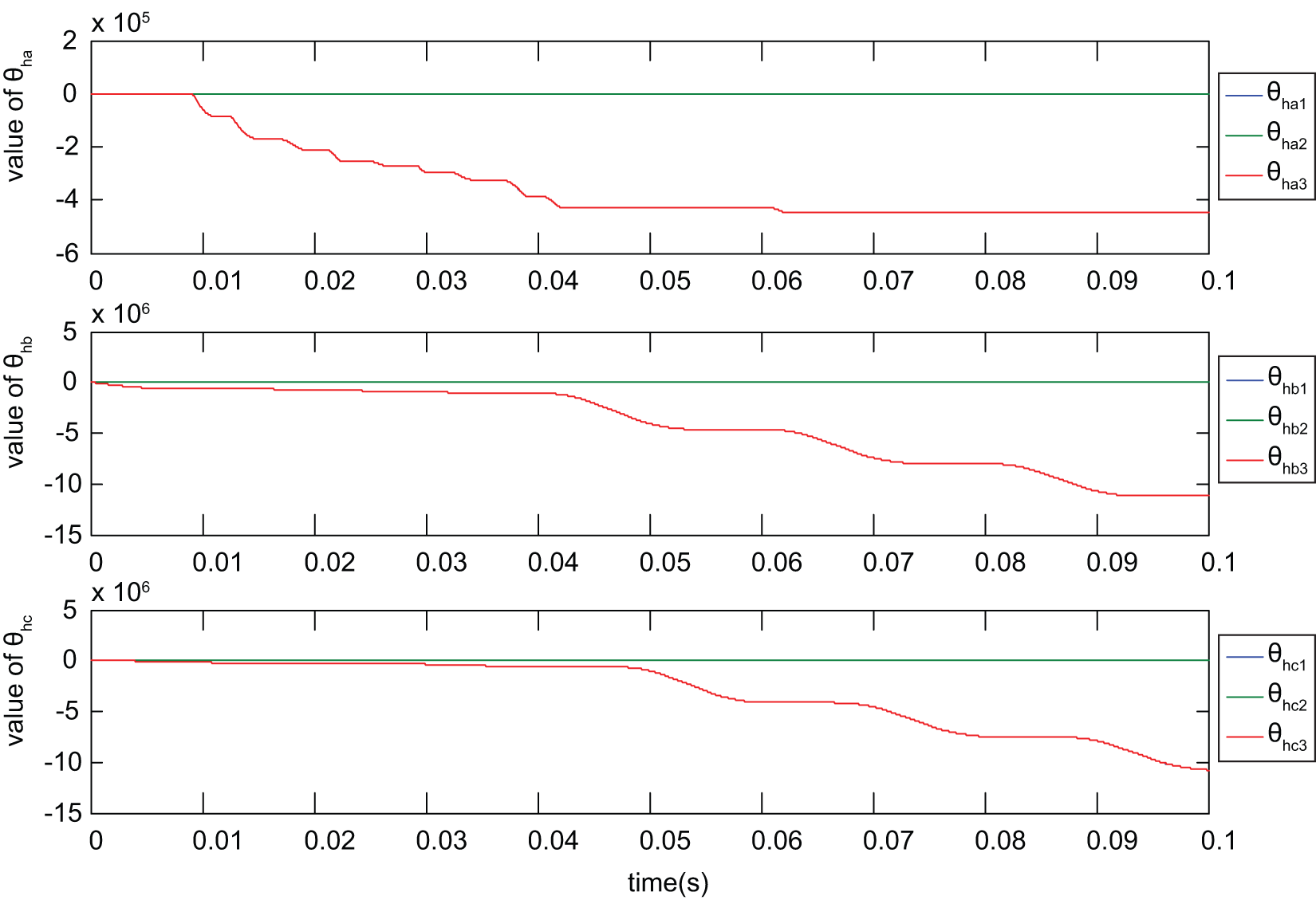
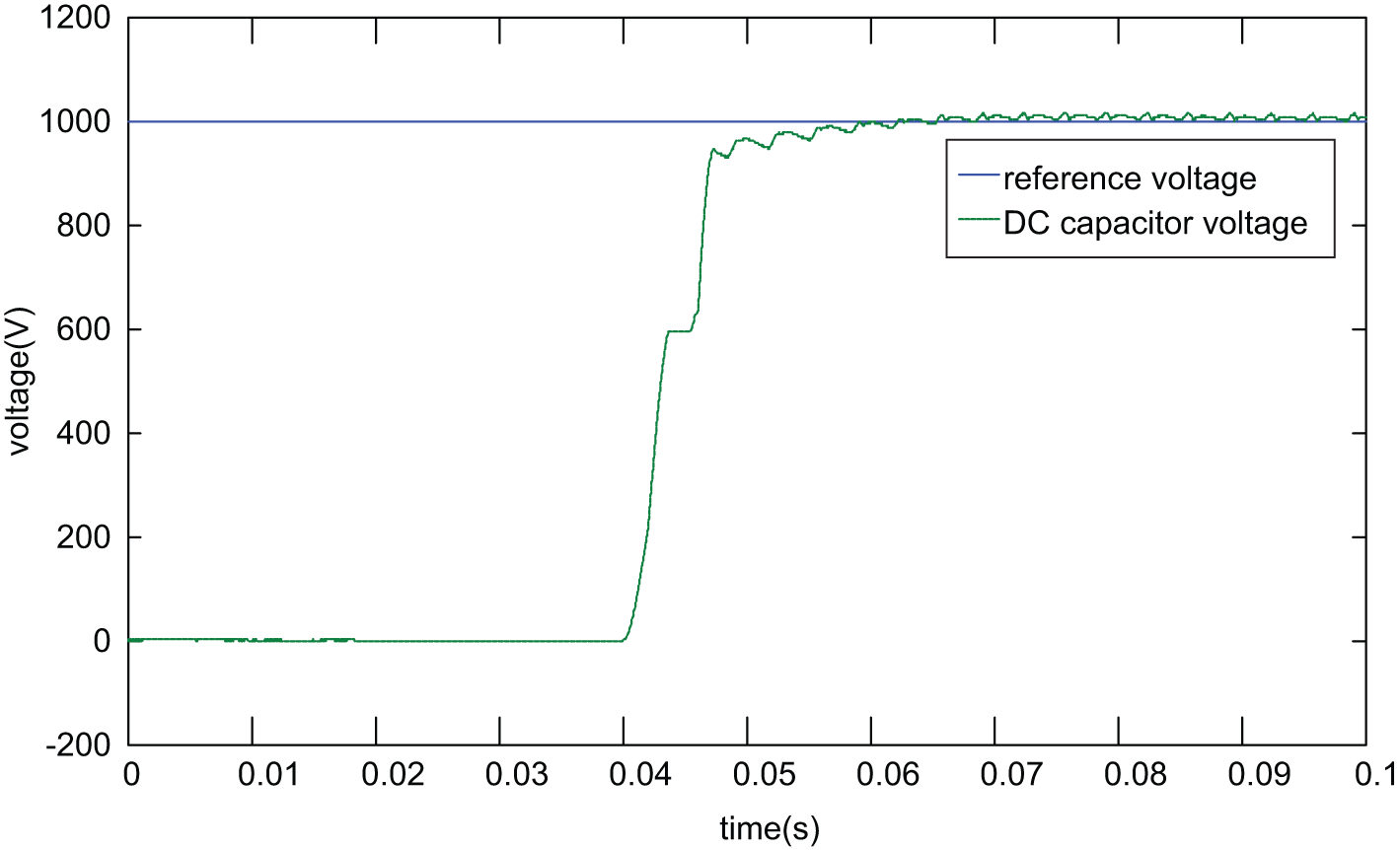
Instruction current and compensation current are drawn in Figure 7, and the compensation current tracking error is depicted in Figure 8. It can be observed that the compensation current can track the instruction current well, which demonstrates that the proposed adaptive fuzzy-sliding control can guarantee asymptotic state tracking. Thus the harmonic current can be effectively compensated and the harmonic distortion of the source current can be reduced. Adaptive parameters of
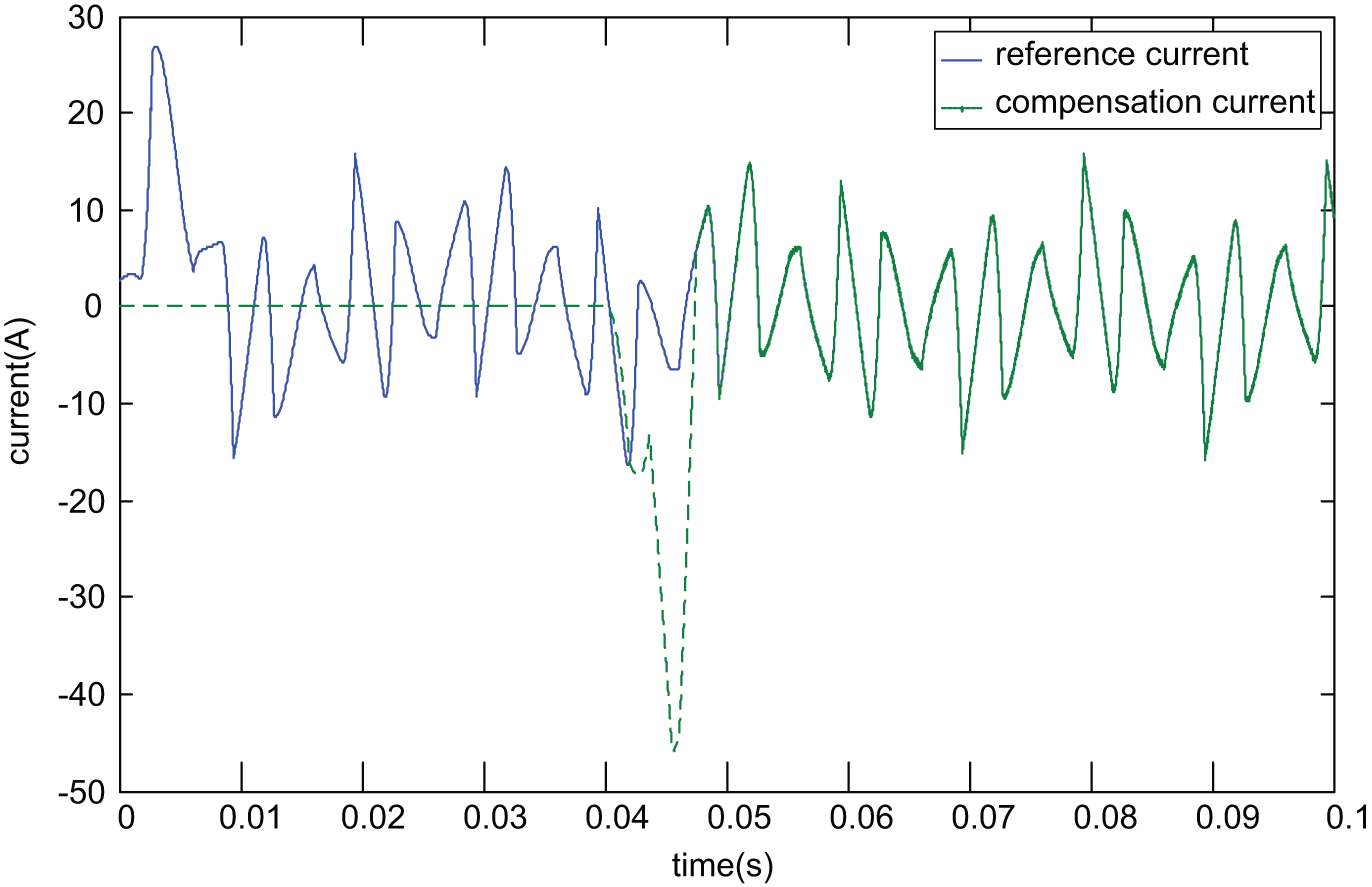
Instructions current and compensation current.
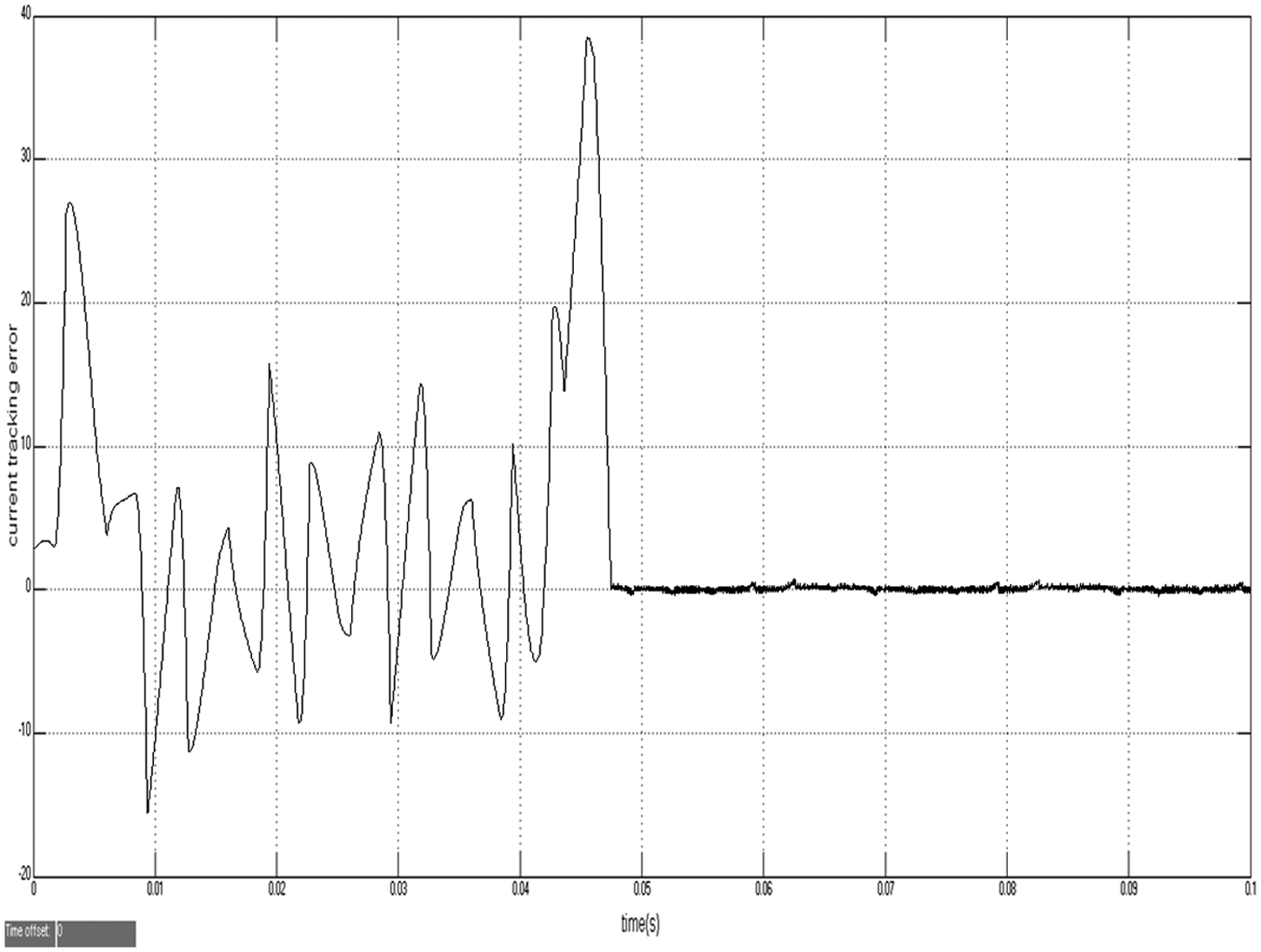
Compensation current tracking error.
Adaptive law
Adaptive law
DC capacitor voltage.
In order to demonstrate that the adaptive fuzzy-sliding control system has strong robustness in the presence of parameter variation, an APF with the parameter variation is testified. As shown in Table 1, the THD is still in the normal range with the parameter variation. It can be concluded that the adaptive fuzzy-sliding control system has good robustness to the parameter uncertainties.
Performance for variation in filter inductance and DC capacitor using adaptive fuzzy sliding control.

THD, total harmonic distortion.
In order to demonstrate that the adaptive fuzzy-sliding control system can achieve better performance than the conventional method, APF using hysteresis control is also testified. It can be seen from Table 2 that the adaptive fuzzy-sliding control system has better robustness compared with the conventional method.
Performance for variation in filter inductance and DC capacitor using hysteresis controller.

THD, total harmonic distortion.
In summary, the current tracking, THD performance and the control performance and robustness to external disturbance can be improved with the proposed adaptive fuzzy-sliding controller.
Conclusion
An improved adaptive fuzzy-sliding control system has been applied to the three-phase APF in this paper. Universal approximation properties of the fuzzy system are employed to approximate the unknown equivalent control and sliding mode control. The parameters of the fuzzy system in both the fuzzy control part of the unknown equivalent control and the fuzzy-sliding mode part can be adaptively updated based on the Lyapunov analysis. The asymptotic stability of the closed-loop system can be guaranteed with the proposed adaptive fuzzy control strategy with a fuzzy switch term. The proposed adaptive fuzzy-sliding controller can make the compensation current follow the instruction current, and effectively eliminate the reactive and harmonic components of the load current. The designed APF control system has superior harmonic suppression performance and yields an improved THD performance. Simulation results demonstrated the excellent dynamic performance, asymptotic stability and strong robustness with the proposed APF control system.
Footnotes
Acknowledgements
The authors thank to the anonymous reviewers for useful comments that improved the quality of the manuscript.
Funding
This work is partially supported by National Science Foundation of China under grant No. 61074056; Scientific Research Foundation of High-Level Innovation and Entrepreneurship Plan of Jiangsu Province and the Graduate Science, Technology and Innovation Project of Hohai University, Changzhou, under grant No. CGB014-05.