This paper is concerned with the analysis of the stability of delayed recurrent neural networks. In contrast to the widely used Lyapunov–Krasovskii functional approach, a new method is developed within the integral quadratic constraints framework. To achieve this, several lemmas are first given to propose integral quadratic separators to characterize the original delayed neural network. With these, the network is then reformulated as a special form of feedback-interconnected system by choosing proper integral quadratic constraints. Finally, new stability criteria are established based on the proposed approach. Numerical examples are given to illustrate the effectiveness of the new approach.
On the other hand, the integral quadratic constraints (IQCs) method offers an effective framework for the stability analysis of feedback-interconnected nonlinear and uncertain systems. Methods such as the robust stability analysis for systems with structured time-varying parameters or uncertainties can be viewed as special cases of the IQC approach (Scherer and Kose, 2008). Further, based on the Kalman–Yakubovich–Popov (KYP) lemma, frequency domain IQC conditions can be formulated as optimization problems which involve LMI constraints (Rantzer, 1996). In contrast to the conventional IQC form in the frequency domain, a novel quadratic separation framework for feedback-connected systems with implicit linear transformation has been proposed by Ariba et al. (2010) and Peaucelle et al. (2007). The merit of this framework lies in its ability to effectively handle time-varying operators. However, the difficulty associated with this framework is to find proper operator and separator . To our knowledge, no stability results have been reported so far based on this framework for the stability analysis of delayed recurrent neural networks. Motivated by the above discussion, this paper will propose some novel techniques based on the IQC framework, and new stability criteria for delayed neural networks will be derived. The main contributions of this paper can be summarized as follows:
Unlike the widely used LKF approach, a new stability analysis method is developed for delayed recurrent neural networks. By constructing several novel IQCs, the original delayed recurrent neural network can be reformulated as a feedback-interconnected system. Then, delay-dependent criteria for constant delays are derived and given in Theorem 1 and Theorem 2.
For recurrent neural networks with time-varying delays, to further reduce the conservativeness of the stability criteria, a novel IQCs-based condition is proposed by partitioning the average varying delays as given in Theorem 3.
Finally, based on Theorem 3, stability conditions for delayed recurrent neural networks with any gradient slope of varying-delay are given in Corollary 1.
The paper is organized as follows. Section 2 gives the preliminaries, including the notation and lemmas which lead to the proposal of a new theorem on the stability of delayed neural networks. The main results on the stability of delayed neural networks are given in Section 3. Numerical simulations are provided in Section 4 to demonstrate the effectiveness of the proposed approach and new stability criteria. Section 5 finally concludes the paper.
Preliminaries
Notation
Throughout this paper, is used to denote the -dimensional identity matrix, and the subscript is dropped when the dimension is evident from the context. and represent the transpose and the conjugate transpose of a matrix respectively. is a full column rank matrix whose columns span the null space of . represents the left inverse of a full column rank matrix . For symmetric matrices and , (or ) implies that matrix is positive definite (or non-negative), denotes the block diagonal matrix, and represents the elements below the main diagonal of a symmetric matrix. Matrices, if not explicitly stated, are assumed to have appropriate dimensions for algebraic operations. denotes the space of -valued, square summable (integrable) functions defined on time interval , and denotes the extension of the space, which consists of functions whose time truncation lies in . Further, introduce the truncation operator , which leaves a function unchanged on the interval and gives the value zero on . For all measurable functions , define the norm ; then this norm corresponds to the inner product for defined as
Stability analysis via IQCs
In this section, stability analysis using the IQC framework is briefly introduced (for details of the IQC framework, please refer to Ariba et al., 2010, and references therein).
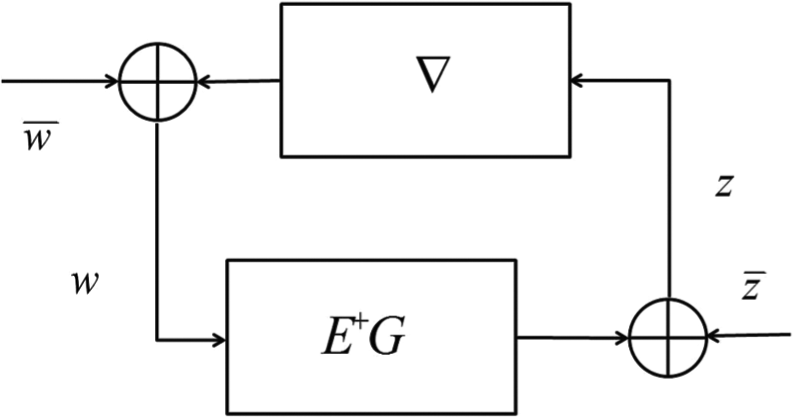
where is the left inverse of real-valued full column rank matrix ; is a real-valued full column rank matrix; are internal variables; are external inputs, and is a linear operator from to . The following lemma proposed by Ariba et al. (2010) ensures the stability of the above feedback-interconnected system.
Lemma 1 (Ariba et al., 2010): The feedback interconnection of and is stable if there exists a symmetric matrix satisfying both conditions
and
Remark 1: In Lemma 1, (5) forms an IQC based on the definitions of different operators and (4) provides the stability conditions for the interconnected system under constraints. It should be noted that only will be considered in the rest of the paper.
To illustrate how the IQC framework is applied to analyse the stability of time-delay systems, a simple example is given below to show the main procedures when Lemma 1 is applied.
Consider the following time-delay system,
where , are constant matrices, and is a constant delay.
To establish the stability conditions in Lemma 1, one needs to transform the original system (6) to the form described in (2) and (3). The key step is to select proper operators and to construct IQCs for each operator. It should be pointed out that the stability results depend on the selected operators. For system (6), we choose integral operator and delay operator . The IQCs for these two operators will be introduced in Lemma 2 and Lemma 3.
Now in (3) is constructed as , and the original system (6) can then be reformulated in the form as described in (2) and (3) with
The next key step is to construct the multiplier in Lemma 1. The multiplier can be constructed as follows.
Denote the sub-multipliers and as
Then, and are combined to produce the multiplier :
Using the construction method proposed in this paper, the multiplier in this particular example has the following form:
Then, to make the system described in (2) and (3) stable, the following inequality should first hold:
that is,
This example has demonstrated that by defining the variables as in (7) and constructing the proper multiplier as in (8), the stability condition (5) in Lemma 1 is then established. Further, by substituting , , and into (4), the stability condition (4) in terms of LMI can also be easily obtained.
Remark 2: This example illustrates the main steps in this IQC-based framework for stability analysis, and the stability condition (4) can be easily obtained by reformulating the original system in the form of (2) and (3). However, different operator selection may lead to results with different levels of conservatism. Therefore, it is necessary to identify a new group of operators and multipliers to reformulate the original system to derive less conservative stability results.
The following IQC lemmas will be used to extend this stability framework to recurrent neural networks with time-varying delays.
Lemma 2 (Ariba and Gouaisbaut, 2009): Define the integral operator . An IQC for the operator is given by the following inequality and for a positive-definite matrix :
where
Lemma 3 (Ariba and Gouaisbaut, 2009): Define operator . An IQC for operator is given by the following inequality , and for a positive-definite matrix :
where
Lemma 4: Define operator . An IQC for operator is given by the following inequality , and for a positive-definite matrix :
where
Stability analysis of delayed neural networks
Consider the following delayed neural networks:
where is the neuron state vector, denotes the neuron activation function, and is the constant external input vector. is a diagonal matrix with . and are the connection weight matrix and the delayed connection weight matrix, respectively.
The time delay is a time-varying continuous function that satisfies
Assume the activation functions are continuous and bounded and satisfy the following inequalities:
where , , are positive constants. Without loss of generality, this assumption describes a wide class of globally Lipschitz-continuous and monotone nondecreasing activation functions. The initial conditions are given as follows:
where is a continuous function vector.
For simplicity, in the stability analysis of system (14), assume is the equilibrium point. By utilizing the coordinate transformation , one can transform the original system (14) into the following form:
where is the state vector of the transformed system, , and with . According to (16), one can obtain that
Therefore, the stability problem of system (14) around equilibrium is transformed into the stability problem of system (17) around the origin.
The purpose of this paper is to establish the stability criteria of system (17) based on a novel IQC-based framework, which is different from most existing LKF-based approaches.
For this purpose, Lemma 1 to Lemma 4 introduced in Section 2 can be used in the stability analysis of general linear delayed systems directly. However, for the delayed neural networks, some special operators need to be developed first.
Considering the relationship between and described in equation (18), the following lemma can be proposed.
Lemma 5: For the neuron activation function satisfying (18), define the following operators:
For the operators , , and for a positive diagonal matrix :
where
According to Lemma 2 to Lemma 5, by combining properly selected operators and , and following the aforementioned multiplier construction method, our main results for the stability analysis of delayed neural networks can be presented as follows.
Theorem 1. The system with is stable if there exist positive-definite matrices and positive diagonal matrices , such that the following inequality holds:
where
Proof. To establish the two stability conditions stated in Lemma 1, we first select the following operators:
Then, we select the multipliers for each IQC:
The overall multiplier is thus given as
where
Denote
With the above selected operators and multipliers, condition (5) in Lemma 1 is thus automatically established as illustrated in the example in Section 2.2. The next step of the proof is to establish the stability condition (4) in Lemma 1. To achieve this, instead of calculating the orthogonal matrix as in equation (4), given that
and
the stability condition (4) will be established if
holds, where
Thus, according to Lemma 1, system (17) with delay is stable. This completes the proof.
Remark 3: Although the LMIs in Theorem 1 are obtained directly from Lemma 1 after choosing a group of IQCs, the proof of Theorem 1 uses an entirely different framework from the traditional LKF approach, and for the first time, this type of IQC-based method is applied to the stability analysis of neural networks with time delays. It should also be noted that the results derived from this IQC-based approach are based on the combination of different operators. To further reduce the conservativeness of Theorem 1 more operators need to be constructed, as shown in Theorem 2.
Theorem 2. The system with delay is stable if there exist positive-definite matrices and positive diagonal matrices , such that the following inequality holds:
where
Remark 4: To obtain less conservative stability results than Theorem 1, two important IQCs with the following operators are further introduced:
The related separators are
Then, by following the same procedure as in the proof of Theorem 1, Theorem 2 can be proved immediately.
Theorem 1 and Theorem 2 only consider the constant delay case; the following theorem gives the stability criteria for neural networks with varying time delays.
Theorem 3. The system with time-varying delay is stable if there exist positive-definite matrices , and positive diagonal matrices , , such that the following inequality holds:
where
Proof. The proof follows the same procedure as for Theorem 1, that is, we select separators for time-varying terms according to the lemmas and rewrite the original systems in the form of (2) and (3).
First, select the following set of operators:
Denoting the left column vectors as , and the right column vectors as , the separator for each IQC can be constructed as
The overall separators matrix is given as
where
Denoting the vector then,
Following the same procedure as in the proof of Theorem 1, the stability condition (27) will be satisfied if
holds. This completes the proof.
Remark 5: It is worth noting that the conservativeness of the obtained criteria can be further reduced to some extent by constructing more delay decomposition operators (, where is the delay partitioning number) or state-augmented techniques. However, this will become more difficult, and lead to a heavier computational burden, for the stability analysis of delayed neural networks than traditional time-delay systems, mainly due to the introduction of the nonlinear activation functions and . Therefore, to balance the computation complexity and conservativeness of the stability conditions, it would be sufficient in many applications if the number of decompositions for the delay were 2 or 3.
Remark 6: Although existing methods reported in the literature are quite useful for the stability analysis of time-varying delay systems, these methods still have some limitations due to the complex nature of the system. The IQC framework enriches the research on this topic as an excellent alternative approach to the traditional LKF-based framework. Further, compared with the traditional LKF approach, the IQC framework can easily integrate the results from the frequency domain analysis, for example for operator , the multiplier
where are two real numbers that can take the values obtained from a frequency domain test (details can be found in Zhang et al., 1999). In this paper, only the conventional selection is used and it is simply for the purpose of demonstrating the IQC-based framework for delayed neural networks.
Finally, based on the result of Theorem 3, if information about the delay slope is unknown, the corresponding stability criterion can be further introduced in Corollary 1 by choosing .
Corollary 1: The system with time-varying delay is stable if there exist positive matrices , and positive diagonal matrices such that the following inequality holds:
where
The other symbol definitions in (29) are the same as in Theorem 3.
Numerical examples
To illustrate the effectiveness of the proposed stability results, two numerical examples are given in this section.
Example 1. Consider the following widely used example:
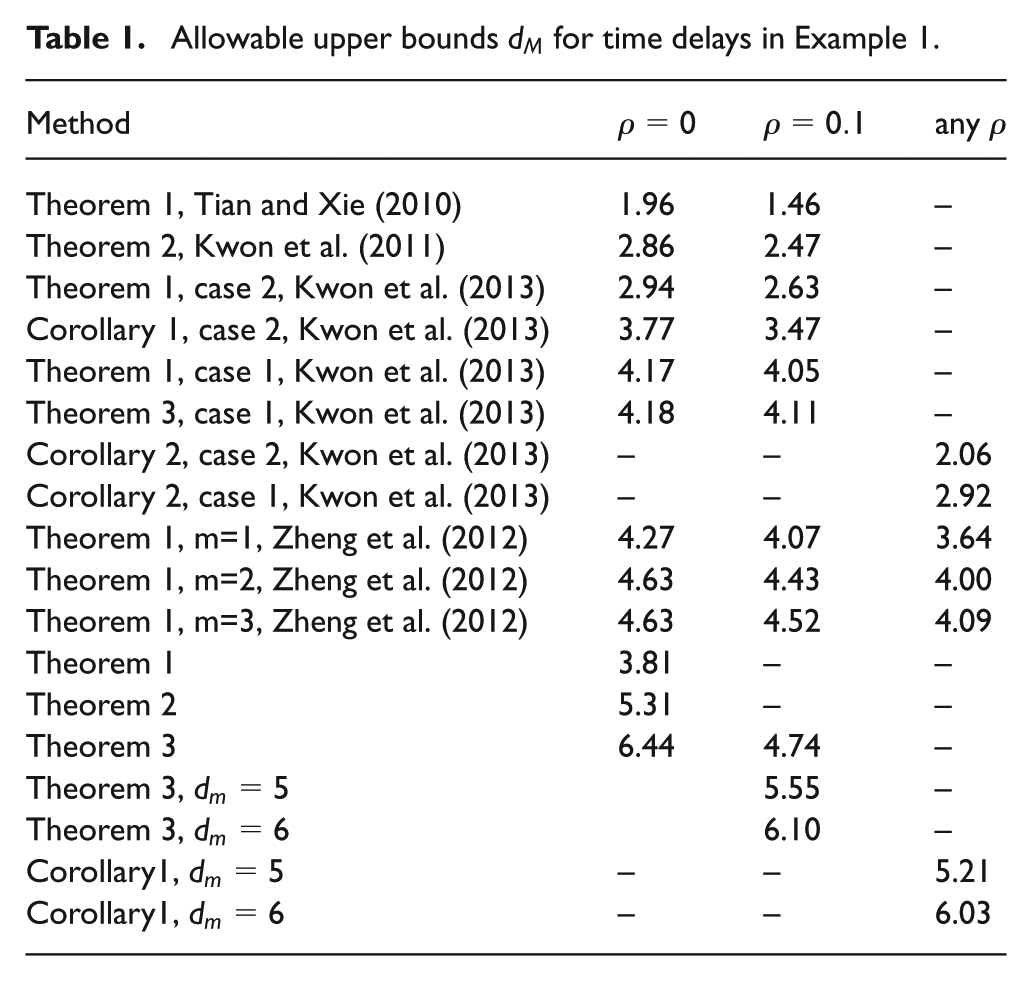
Table 1 shows the corresponding results for the allowable upper bounds including constant and time-varying delays. The theorems in Kwon et al. (2011, 2013), Tian and Xie (2010), and Zheng et al. (2012) are all deduced from the traditional LKF approach. In particular, new techniques such as the augmented LKF method and the partitioning bounding activation function technique have been used in Kwon et al. (2013) and the improved Gu’s discretized LKF approach in Zheng et al. (2012). From Table 1, it can be seen that our proposed IQC-based stability results are less conservative than most of the comparators. As mentioned before, the main purpose of this paper is to deduce the stability criterion for delayed neural networks without using the traditional LKF approach. The simulation results show that the stability criteria obtained by our new approach can produce results comparable to the LKF approach.
Allowable upper bounds for time delays in Example 1.
Example 2. Consider the following widely used neural network with time-varying delays:
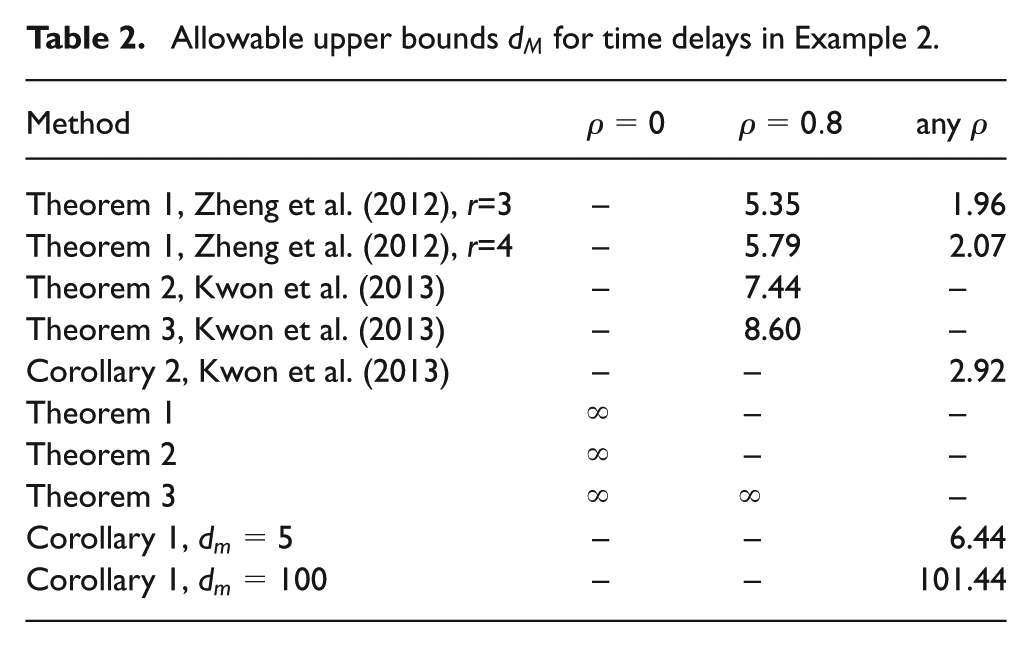
Table 2 is the results obtained by using the theorems proposed in this paper as well as by the methods reported in recently published papers (Kwon et al., 2013; Zheng et al., 2012). Applying Theorem 1 to Theorem 3 given in this paper, when , delay-independent results are obtained. For the time-varying delay case, when , it is still delay-independent using Theorem 3 of this paper, and the results are less conservative than those in Kwon et al. (2013) and Zheng et al. (2012). Since this example is delay-independent for a small delay slope, one may find feasible solutions for any size of delay with a small varying interval. This is evident from the results in Table 2 obtained by Corollary 1 of this paper. It also should be pointed out that further less conservative results can be obtained based on our approach if more IQC terms are constructed.
Allowable upper bounds for time delays in Example 2.
This paper has investigated the stability problem for a wide class of delayed neural networks, and a novel IQC-based framework which is different from the traditional LKF approach has been used. Some new IQC lemmas have been introduced for the time-delay terms and nonlinear activation function terms. According to the newly proposed IQC lemmas, the original system can be formulated as a feedback-interconnected system through implicit linear transformation, and several stability criteria have been subsequently proposed. Two simulation examples have shown the effectiveness of this new approach. Future work will look at developing more effective IQCs for delayed neural networks and further improving the stability criteria for more complex cases based on the IQC framework.
Footnotes
Funding
This work is supported by the National Nature Science Foundation of China (grant number 61074032) and Shanghai Science Technology Commission (grant numbers 10JC1405000 and 11ZR1413100).
References
1.
AribaYGouaisbautF (2009) Input-output framework for robust stability of time-varying delay systems. In: Proceedings of the 48th IEEE conference on decision and control, held jointly with the 2009 28th Chinese control conference, pp. 274–279.
2.
AribaYGouaisbautFJohanssonK (2010) Stability interval for time-varying delay systems. In: 49th IEEE conference on decision and control (CDC), pp. 1017–1022.
3.
ChengTSunHQuZ. (2009) Neural network solution for suboptimal control of non-holonomic chained form system. Transactions of the Institute of Measurement and Control31(6): 475–494.
4.
CheYQWangJZhouSS. (2008) Chaos synchronization of coupled neurons under external electrical stimulation using adaptive H control. Transactions of the Institute of Measurement and Control30(3–4): 225–238.
5.
DuDFeiMJiaT (2013) Modelling and stability analysis of MIMO networked control systems with multi-channel random packet losses. Transactions of the Institute of Measurement and Control35(1): 66–74.
6.
FeiMZhangJHuH. (2006) A novel linear recurrent neural network for multivariable system identification. Transactions of the Institute of Measurement and Control28(3): 229–242.
7.
GopalsamyKHeXZ (1994) Delay-independent stability in bidirectional associative memory networks. IEEE Transactions on Neural Networks5(6): 998–1002.
8.
HsiaoFHXuSDLinCY. (2008) Robustness design of fuzzy control for nonlinear multiple time-delay large-scale systems via neural-network-based approach. IEEE Transactions on Systems, Man and Cybernetics, Part B: Cybernetics38(1): 244–251.
9.
KwonOMParkJH (2009) Improved delay-dependent stability criterion for neural networks with time-varying delays. Physics Letters A373(5): 529–535.
10.
KwonOMKwonJWKimSH (2011) New results on stability criteria for neural networks with time-varying delays. Chinese Physics B20(5): 050505.
11.
KwonOMParkMJLeeSM. (2013) Stability for neural networks with time-varying delays via some new approaches. IEEE Transactions on Neural Networks and Learning Systems24(2): 181–193.
LiTZhengWXLinC (2011) Delay-slope-dependent stability results of recurrent neural networks. IEEE Transactions on Neural Networks22(12): 2138–2143.
14.
ParkPKoJWJeongC (2011) Reciprocally convex approach to stability of systems with time-varying delays. Automatica47(1): 235–238.
15.
PeaucelleDArzelierDHenrionD. (2007) Quadratic separation for feedback connection of an uncertain matrix and an implicit linear transformation. Automatica43(5): 795–804.
16.
Perez-IlzarbeM (2013) New discrete-time recurrent neural network proposal for quadratic optimization with general linear constraints. IEEE Transactions on Neural Networks and Learning Systems24(2): 322–328.
17.
RantzerA (1996) On the Kalman–Yakubovich–Popov lemma. Systems and Control Letters28(1): 7–10.
18.
SchererCWKoseIE (2008) Robustness with dynamic IQCs: An exact state-space characterization of nominal stability with applications to robust estimation. Automatica44(7): 1666–1675.
19.
ShenYWangJ (2012) Robustness analysis of global exponential stability of recurrent neural networks in the presence of time delays and random disturbances. IEEE Transactions on Neural Networks and Learning Systems23(1): 87–96.
20.
SongQCaoJ (2008) Global dissipativity analysis on uncertain neural networks with mixed time-varying delays. Chaos: An Interdisciplinary Journal of Nonlinear Science18(4): 043126.
21.
SunJLiuGChenJ. (2010) Improved delay-range-dependent stability criteria for linear systems with time-varying delays. Automatica46(2): 466–470.
22.
TianJXieX (2010) New asymptotic stability criteria for neural networks with time-varying delay. Physics Letters A374(7): 938–943.
23.
TianJZhongS (2011) Improved delay-dependent stability criterion for neural networks with time-varying delay. Applied Mathematics and Computation217(24): 10,278–10,288.
24.
TianJZhouX (2010) Improved asymptotic stability criteria for neural networks with interval time-varying delay. Expert Systems with Applications37(12): 7521–7525.
25.
TianJLiYZhaoJ. (2012) Delay-dependent stochastic stability criteria for Markovian jumping neural networks with mode-dependent time-varying delays and partially known transition rates. Applied Mathematics and Computation218(9): 5769–5781.
26.
WangYYangCZuoZ (2012) On exponential stability analysis for neural networks with time-varying delays and general activation functions. Communications in Nonlinear Science and Numerical Simulation17(3): 1447–1459.
27.
WuZGLamJSuH. (2012) Stability and dissipativity analysis of static neural networks with time delay. IEEE Transactions on Neural Networks and Learning Systems23(2): 199–210.
28.
YanY (2013) Synchronization of complex dynamical networks under time delays with occurrence probabilities. Transactions of the Institute of Measurement and Control35(4): 437–443.
29.
ZhangHGongDChenB. (2013) Synchronization for coupled neural networks with interval delay: A novel augmented Lyapunov–Krasovskii functional method. IEEE Transactions on Neural Networks and Learning Systems24(1): 58–70.
30.
ZhangHLiuZHuangGB. (2010) Novel weighting-delay-based stability criteria for recurrent neural networks with time-varying delay. IEEE Transactions on Neural Networks21(1): 91–106.
31.
ZhangJKnospeCRTsiotrasP (1999) Toward less conservative stability analysis of time-delay systems. In: Proceedings of the 38th IEEE conference on decision and control, pp. 2017–2022.
32.
ZhangYYueDTianE (2009) New stability criteria of neural networks with interval time-varying delay: A piecewise delay method. Applied Mathematics and Computation208(1): 249–259.
33.
ZhengCDShanQHWangZ (2012) Novel stability criterion for cellular neural networks: An improved Gu’s discretized LKF approach. Journal of the Franklin Institute349(1): 25–41.