






Abstract
The hybrid architecture of a cerebellar model articulation controller (CMAC) and proportional derivative (PD) can effectively reduce the loading error and restrain the surplus torque of electric load simulators. However, due to the over-learning problem of the CMAC, the practical application of the CMAC-PD for electric load simulators is greatly constrained. This paper analyses the over-learning problem of CMAC and proposes a novel learning scheme including control error and an inhibiting over-learning item. An intelligent CMAC-PD controller with novel anti-over-learning scheme is derived by using the gradient descent algorithm. Both simulation and experimental results demonstrate that the proposed CMAC-PD hybrid controller has good robustness, can effectively eliminate disturbances and restrain the over-learning phenomenon of the CMAC.
Keywords
Introduction
The electric load simulator (Figure 1) is an electric torque servo system, which can reproduce the aerodynamic hinge moment of control surfaces during flight testing of unmanned aerial vehicles (UAVs) under laboratory conditions. Nowadays, the brushless torque motor has become the mainstream choice in electric load simulators with the advantages of small volume, low inertia, fast response and low maintenance (Yang and Han, 2014).
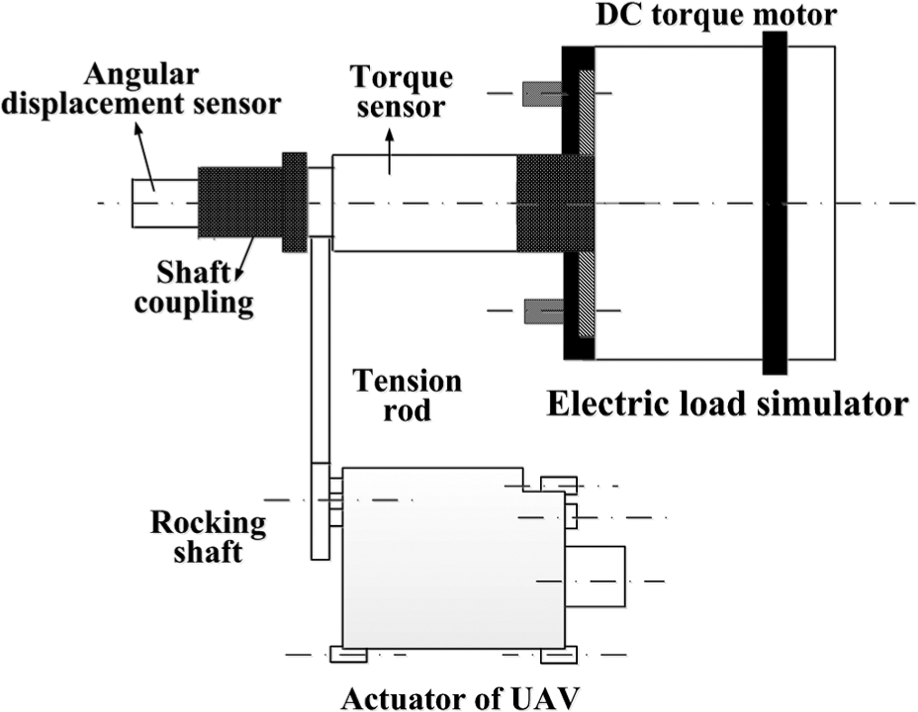
Block diagram of electric load simulator (top view) (Yang and Han, 2014).
As a torque control system, the electric load simulator is a typical passive loading system, which has the surplus torque generated on the shaft by the active motion of actuator when the loading instruction is zero and no compensation or control measures are taken. Conventional control methods include the structure invariance principle (Alberto et al., 2007), synchronous compensator (Wei et al., 2008), adaptive control (Pradhan and Subudhi, 2012) and H ∞ control (Hui et al., 2012), etc., which all need a relatively accurate mathematical model. Considering the intrinsic non-linear factors like friction, mechanical clearance and interference of surplus torque in electric load simulators, a new control strategy is required. Due to the advantages of quick learning, a simple structure, a non-existent local optimum and good real-time performance, the cerebella model articulation controller (CMAC) has found successful applications in control problems, model-free function approximation, robot localization and fault diagnosis (Almeida and Simoes, 2005; Bahuguna et al., 2009; Hsu et al., 2009; Pa et al., 2013; Yu et al., 2008). The most commonly used control architecture is a hybrid controller of CMAC and PD proposed by Miller et al. (1990). The hybrid controller can effectively reduce the loading error and restrain the surplus torque of electric load simulators, but the over-learning of the CMAC will occur due to cumulative errors (Chen and Chang, 1996; Jiang and Lin, 2000) when a CMAC is applied to control systems with a continuously variable signal as the input signal.
Current research is mainly focused on the convergence of the CMAC for function approximation (Lin and Chiang, 1997; Teddy et al., 2007), but our simulation showed that the convergence conditions on the learning rate of the CMAC for function approximation does not apply to the control system. Although the existing literature gave various improvements on CMAC (Cao and Tu, 2012; Cheng, 2011; Teddy et al., 2008), most of them focus on theoretical analysis and simulation. These methods still cannot meet the requirements of practical implementation of a CMAC-PD controller for electric load simulators due to the over-learning problem of the CMAC. The adaptive laws of the CMAC are also used to guarantee the stability of control system (Hsu, 2012; Lin and Li, 2013; Lin and Peng, 2005). However, some system dynamics are simplified and ignored for deriving the adaptive laws and only simulation results were given.
This paper proposes an intelligent CMAC-PD hybrid torque controller with a novel anti-over-learning scheme for electric load simulators. The performance of the proposed intelligent controller is verified by both simulation and experiment. The paper is organized as follows. The next section presents the mathematical model of the electric load simulator. Design of the intelligent CMAC-PD hybrid controller with the novel learning scheme is given and simulation results of a conventional CMAC-PD controller and the improved one are provided. Experimental implementation is shown and finally some conclusions are presented.
Mathematical model of electric load simulator
The simulation model of electric load simulator was presented by Han and Yang (2013) and Yang and Han (2014), and is shown in Figure 2.

Mathematical model of electric load simulator.
The transfer function of electric load simulator is given by
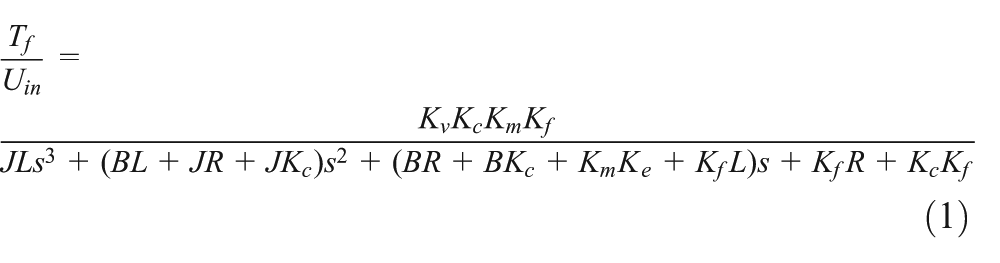
where
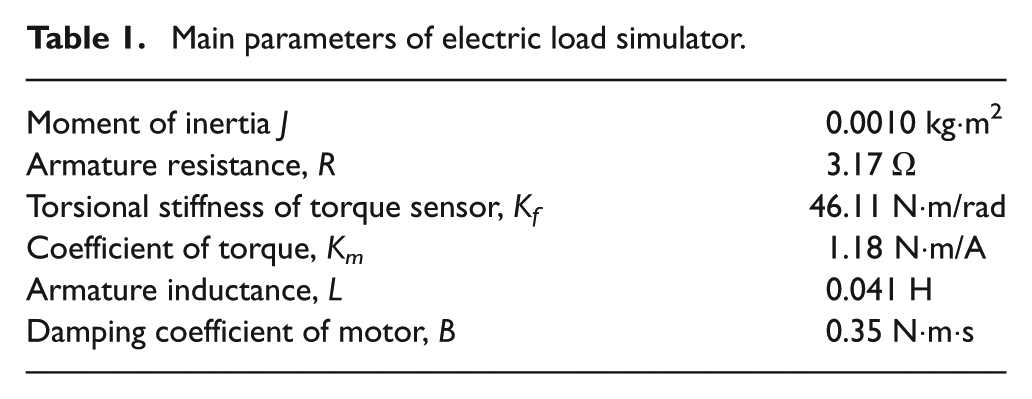
The main parameters are listed in Table 1.
Main parameters of electric load simulator.
The transfer function of electric load simulator can be expressed as

Design of intelligent CMAC-PD hybrid torque controller
Structure of CMAC-PD torque controller
The structure of the CMAC neural network is composed of the input space, associate memory, physical memory and network output (Figure 3). The input state space

The structure of the cerebellar model articulation controller (CMAC) neural network.
The structure of the CMAC-PD torque controller is shown in Figure 4. The CMAC controller and PD controller run in parallel. The CMAC realizes the feed-forward control to guarantee the response speed, tracking effect and reduce the control overshoot; the PD controller is used to improve control performance. With the conduct of the CMAC learning process, the PD output gradually decreases while the CMAC output increases and dominates the control output. The output of the intelligent controller in Figure 4 can be given by

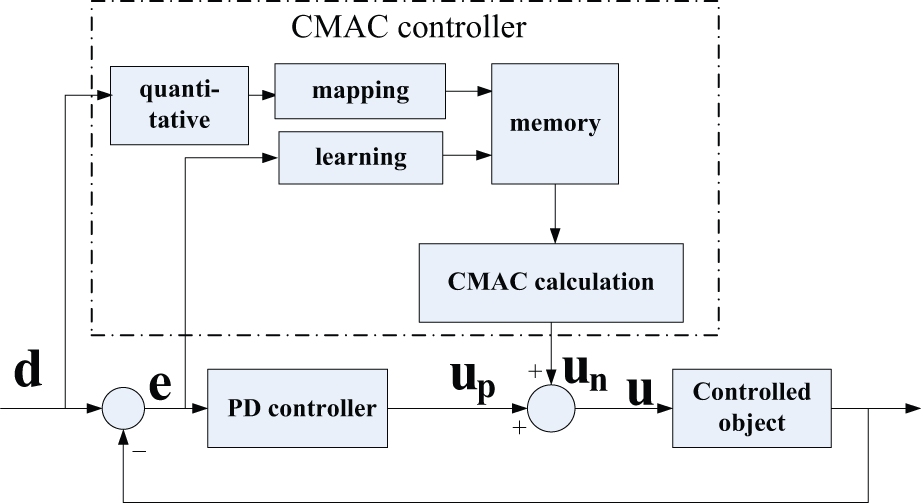
Structure of the cerebellar model articulation controller–proportional derivative (CMAC-PD) hybrid torque controller.
where
Over-learning problem of CMAC
It is commonly considered that the interaction of the CMAC and PD may be the cause for the over-learning of the CMAC. We analyse both the CMAC-PD hybrid controller (Figure 4) and the standalone CMAC controller (Figure 5). The loading instruction follows
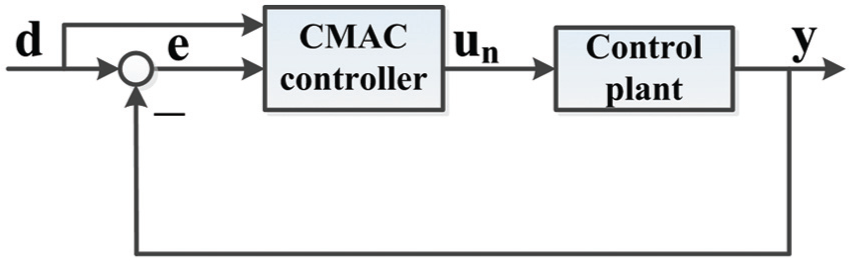
Standalone cerebellar model articulation controller (CMAC) controller.
The design parameters of controller are listed in Table 2. Two weights, No. 30 and No. 50, were randomly selected from the CMAC-PD controller and the standalone CMAC controller.
Design parameters of controller.
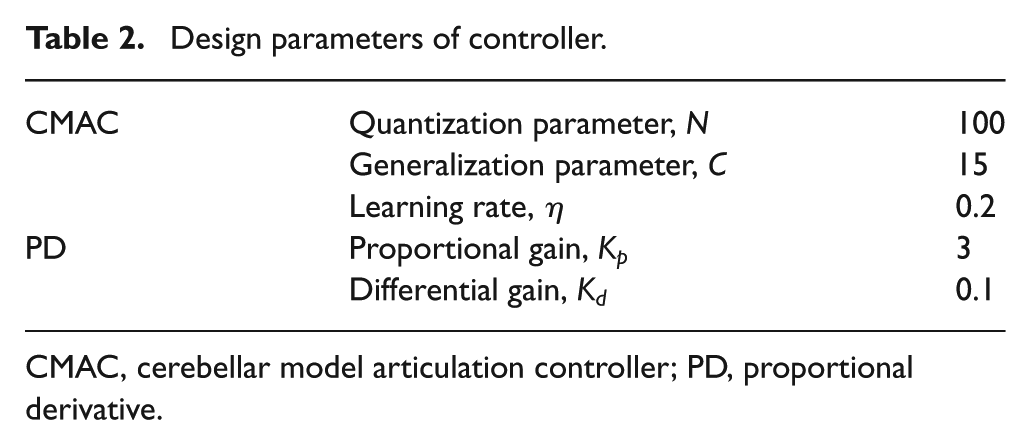
CMAC, cerebellar model articulation controller; PD, proportional derivative.
Figures 6(a) and 7(a) show the variation of the selected weight values respectively. Figures 6(b) and 7(b) depict their control error curves. The absolute values of No. 30 and No. 50 CMAC weights of both the CMAC-PD controller and the standalone CMAC controller rise steadily, which lead to the over-learning of CMAC. They follow the same error trend, despite the fact that CMAC combined with PD can strengthen the system stability and increase the convergence speed to some extent compared with the standalone CMAC, but the over-learning of the CMAC will still be inevitable and lead to system instability with the increasing cumulative errors.
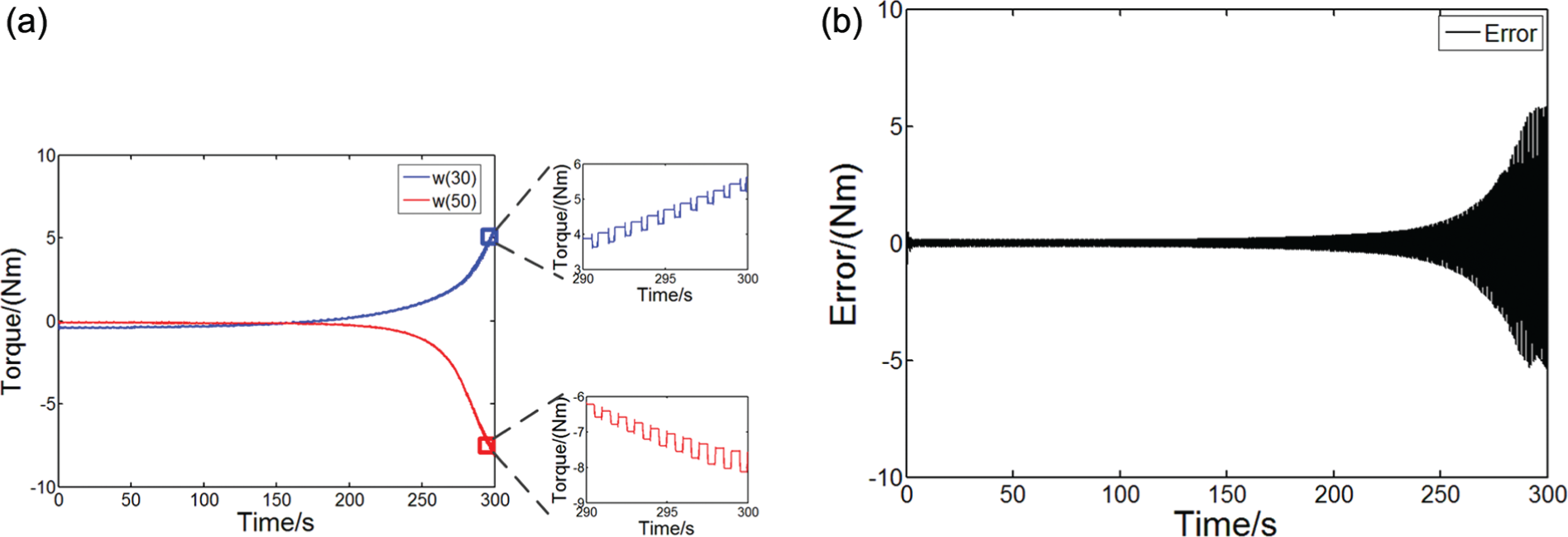
Control results of the cerebellar model articulation controller–proportional derivative (CMAC-PD) controller: (a) variation of No. 30 and No. 50 CMAC weights; (b) control error curve.
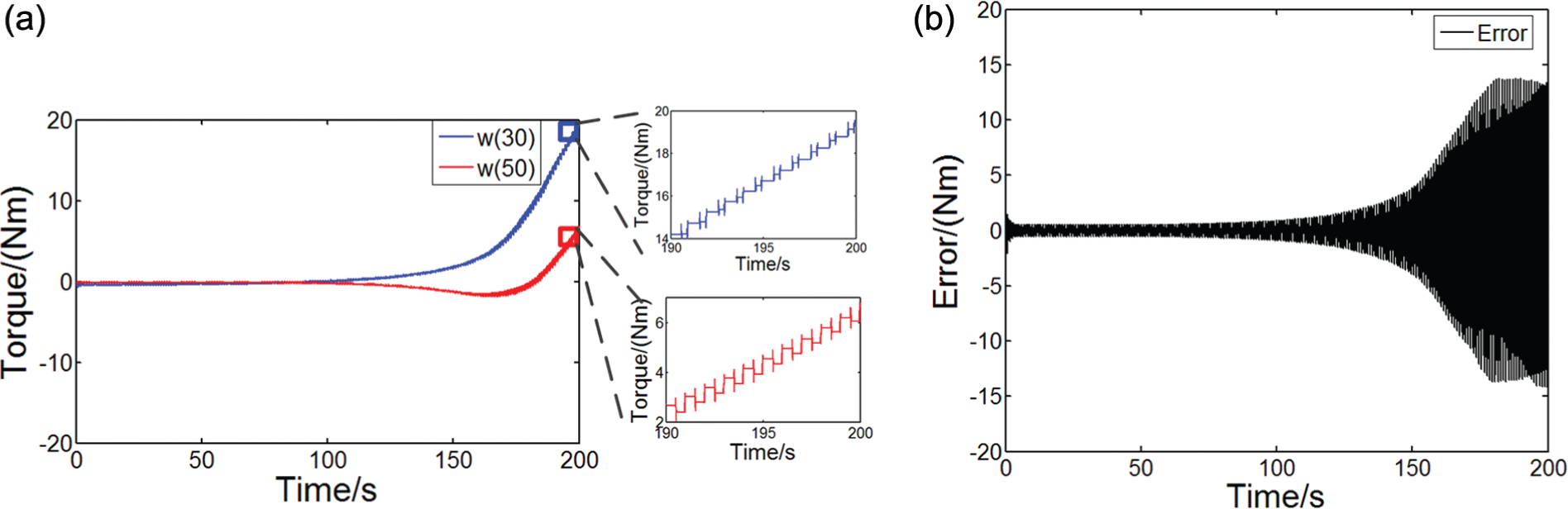
Control results of standalone cerebellar model articulation controller (CMAC) controller: (a) variation of No. 30 and No. 50 CMAC weights; (b) control error curve.
We can conclude that the interaction of the CMAC and PD is not the cause of over-learning and the major cause depends on the CMAC itself. Only the over-learning of the standalone CMAC will be analysed.
The main direct factors affecting the CMAC control are the learning rate and the weight updating method.
Many researchers use the matrix theory and the general convergence principle of iterations for linear equations to analyse the convergence of the CMAC, and obtain the condition on the learning rate

where
However, when a CMAC is applied to an actual control system (Figure 5), the control error is changed to

where y is the output of the control plant, not the CMAC (Figure 5). So the convergence condition of
We use a Lyapunov function to analyse theoretically the convergence of CMAC with the system error in Equation (5).
A Lyapunov function is commonly defined as

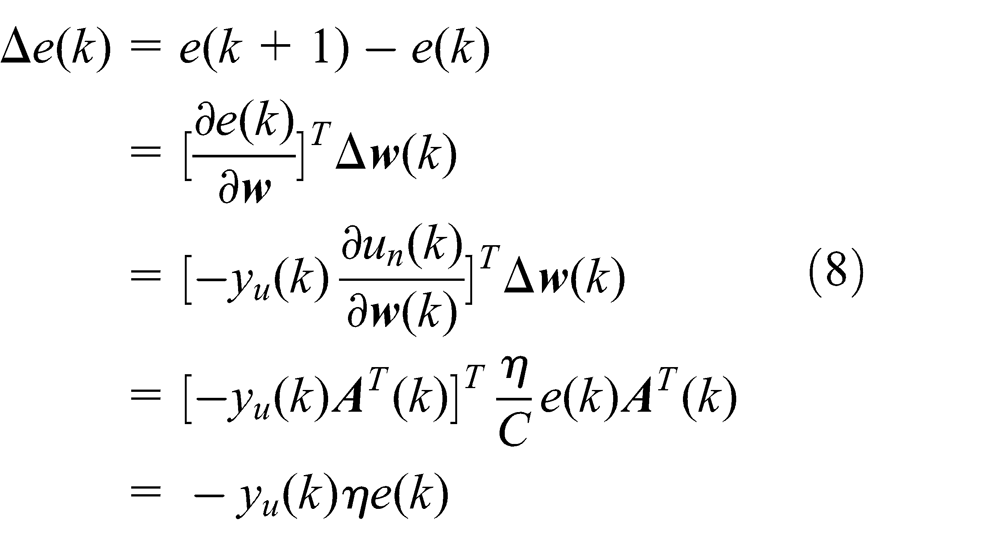
The weights updating formula of conventional CMAC is expressed as

and the error difference can be obtained by
where
Then,
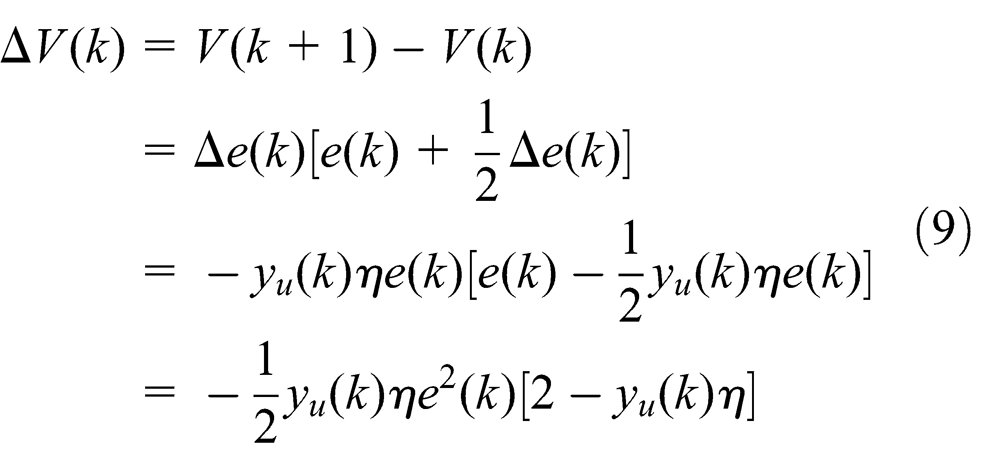
Theoretically, if
A valid Lyapunov candidate function should include the tracking error, the weight estimation error and all other dynamics included in the electric load simulator. As a passive loading control system moved along with the actuator, however, the dynamics in the load simulator is difficult to describe mathematically. As a result, we will improve the weight updating method of the CMAC to resolve the over-learning instead of analysis of the learning rate.
Novel learning scheme of CMAC
We proposed a CMAC-PD torque controller with a fast learning capacity and improved output smoothness for an electric load simulator (Yang and Han, 2014). A novel scalar cost function of the CMAC consisted of an error item and a weight-smoothing item to guarantee a fast learning capacity and improve output smoothness of the CMAC. Although the stability of the CMAC was guaranteed at the same time, the weight updating method of the CMAC updates all weights each sampling time. This means that the improved CMAC is no longer a local neural network. The matrix operation is very time consuming and influences the real-time performance of control.
The learning scheme of the CMAC is derived from the scalar cost function. In order to minimize the system error, limit the output of CMAC and avoid the over-learning a novel scalar cost function is proposed as

where
The second item in Equation (10) can also be interpreted as the difference between input and output energy of the CMAC. If we can keep their balance, then the over-learning problem of CMAC will be restrained. The conventional CMAC, by contrast, has only an error item in the scalar cost function. Its output is not restricted and is easy to diverge due to cumulative errors.
Using the gradient descent algorithm, the novel weights updating formula can be derived as

This novel updating formula can not only avoid the over-learning of the CMAC, but also improve the learning speed. Compared with the updating method in Yang and Han (2014), this improved CMAC is still a local neural network, which can enhance the real-time ability.
Simulation results and analysis
A comparative simulation of the CMAC-PD hybrid controller is performed using a conventional CMAC learning scheme (Equation 7) and novel scheme (Equation 11).
The design parameters of controller are listed in Table 2. Considering the quantization precision and calculation, N=100 can satisfy our requirements. In addition, a large generalization parameter will make the mapping less accurate while a small generalization parameter will lose the generalization ability (Smith, 1998), C=15 makes the activated cells occupy about 13% of the memory space (N+C=115), so that it is available to act as the generalization parameter. The learning rate of the CMAC is between 0 and 2 (Smith, 1998). The parameters of PD are chosen following the control variables method, first the proportional gain Kp then the differential gain Kd .
The loading instruction follows
Tracking performance
Figure 8 shows the tracking error of different controllers. The maximum absolute values of error in each cycle are used, which contains 1/(f·Ts) simulation steps. The maximum absolute value of errors in the first cycle of the CMAC-PD controller using a conventional learning scheme and a novel one are 1.7340 N·m, and 1.1912 N·m, respectively. The error of the conventional CMAC-PD controller can converge to 0.7065 N·m at first, but it diverges quickly. The error of the CMAC-PD controller using the novel learning scheme can converge to 0.6794 N·m. Simulation results show that the novel learning scheme can effectively improve the learning speed and control precision compared with the conventional one.
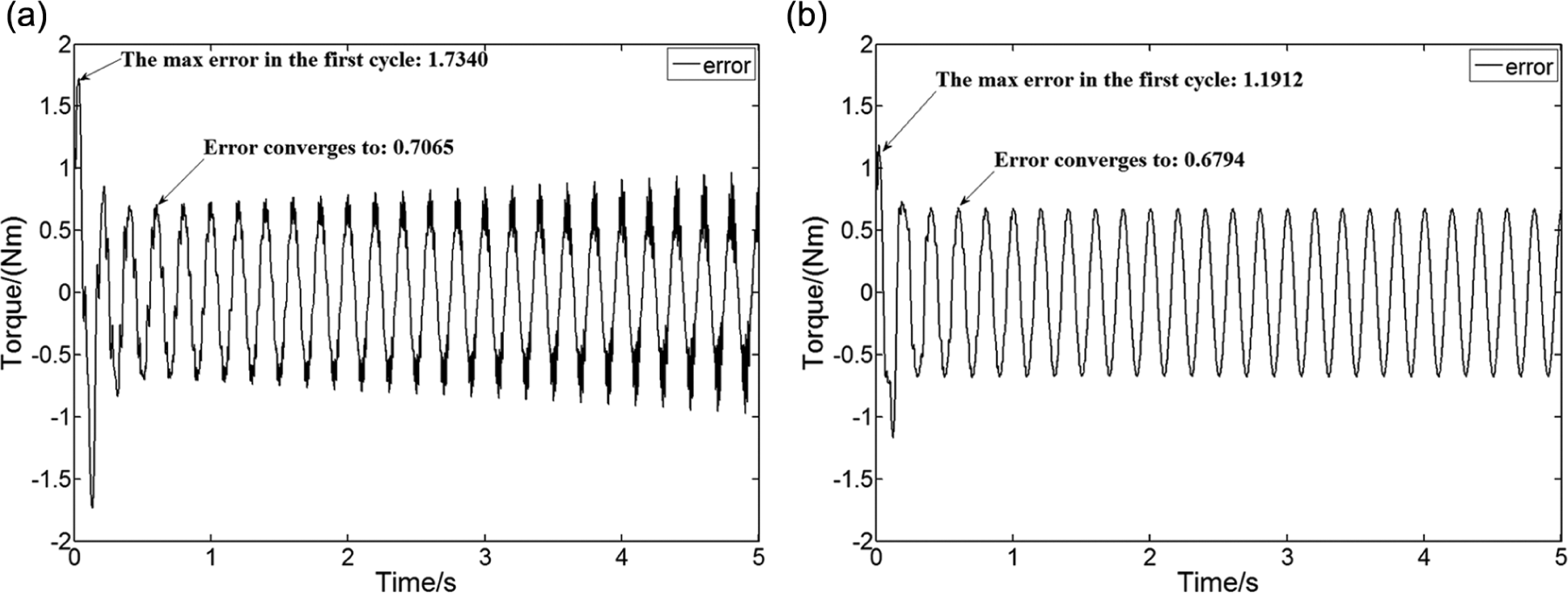
Tracking errors of the cerebellar model articulation controller–proportional derivative (CMAC-PD) controller with different learning schemes: (a) using the conventional learning scheme; (b) using the novel learning scheme.
Inhibiting effect of over-learning
To test the inhibiting over-learning effect of the CMAC-PD controller using the novel CMAC learning scheme, a long period simulation test is taken. The results are shown in Figure 9. The novel learning scheme could make the weights fluctuate in a certain range (Figure 9a). Thus, the error will be convergent (Figure 9b). Then, the novel learning scheme can effectively restrain the over-learning phenomenon.
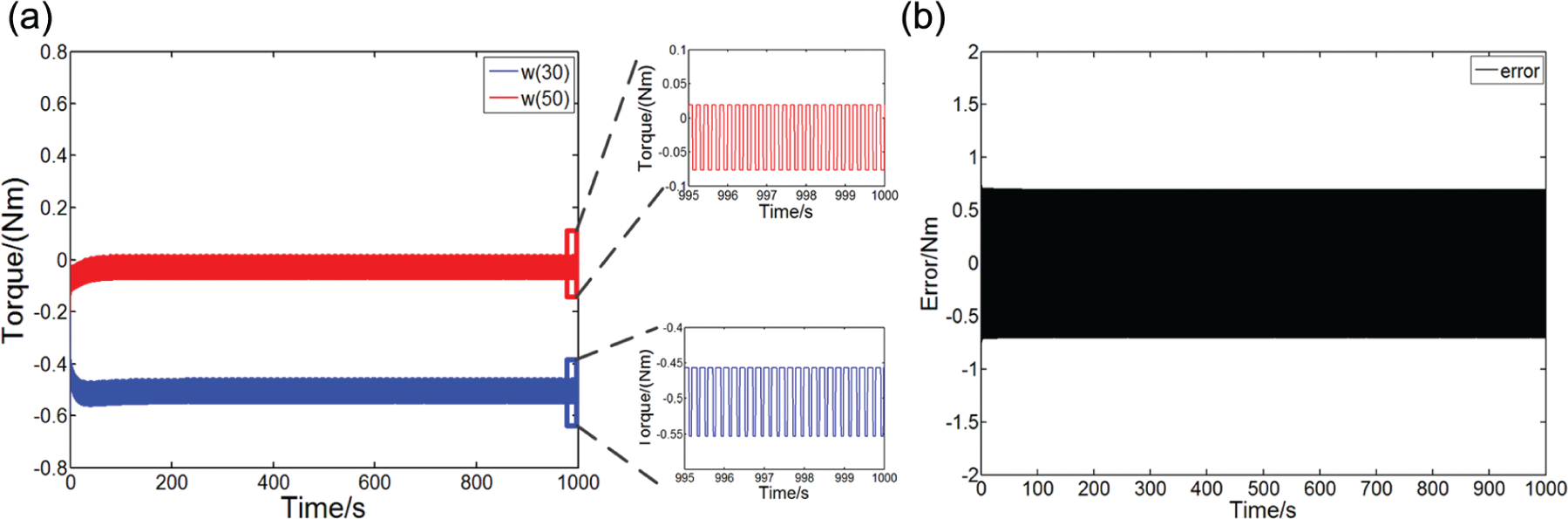
Inhibiting over-learning effect of the novel learning scheme: (a) variation of the cerebellar model articulation controller (CMAC) weights; (b) control error curve.
In conclusion, simulation results have shown that the CMAC-PD controller using the novel learning scheme can not only improve control precision and learning speed but also effectively inhibit the over-learning phenomenon.
Experimental Implementation
The proposed control solution is conducted at a test bed in the laboratory (Figure 10). The test bed mainly consists of a brushless DC torque motor, a processor board DSP F28335, a torque sensor, a motor driver and a control computer. As the core of control, a DSP F28335 processor is very suitable for motor control due to its good performance: core frequency up to 150 MHz, high-performance static CMOS technology, a high-performance 32-Bit CPU and 12-Bit ADC, etc.
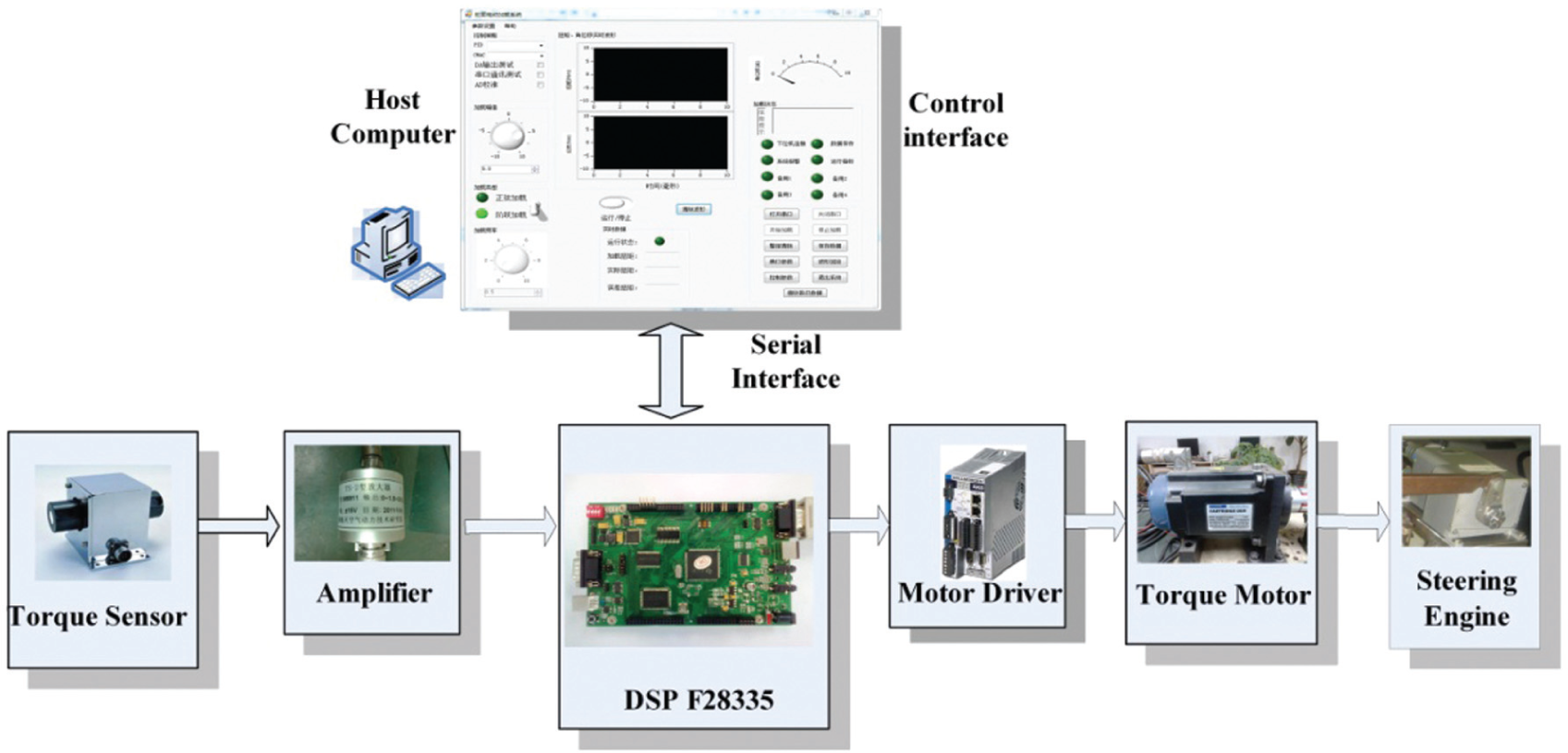
Block diagram of electric load simulator.
The parameters of PD are
The experimental results of the CMAC-PD controller using different learning schemes are shown in Figures 11–13. For the CMAC-PD controller using a conventional learning scheme, the maximum absolute value of error in each cycle converges to 0.57, 0.60, 0.86 and 1.02 N·m at the loading frequency of 0.5, 1.0, 1.5 and 2.0 Hz, and the system diverges at frequencies of 2.5 and 3.0 Hz. For the CMAC-PD using the novel learning scheme, the maximum absolute value of error in each cycle converges to 0.48, 0.54, 0.73, 0.79, 1.05 and 1.07 N·m at a frequency of 0.5, 1.0, 1.5, 2.0, 2.5 and 3.0 Hz, respectively. The tracking accuracy changes with the frequency of the input signals. The experimental results demonstrate that the novel learning scheme can improve learning speed and control precision compared with the conventional one.
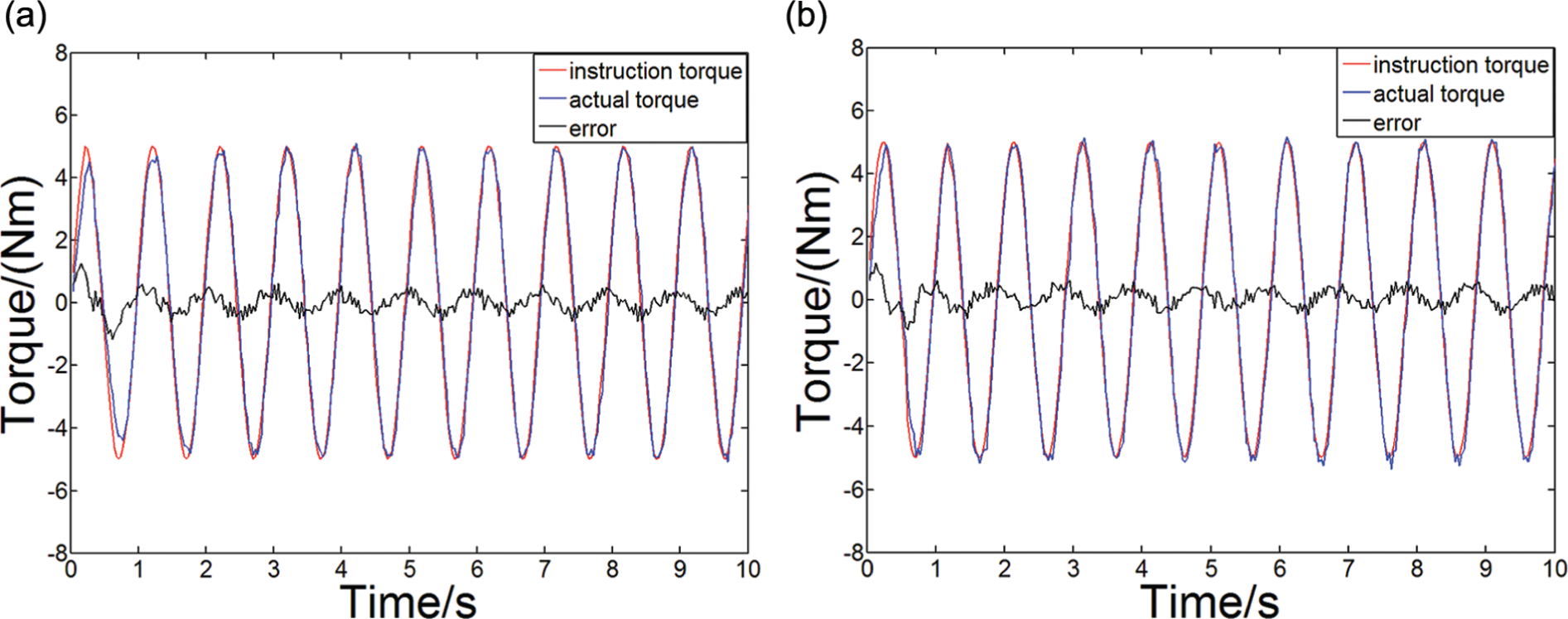
Tracking results of the cerebellar model articulation controller–proportional derivative (CMAC-PD) controller at loading frequency of 1 Hz: (a) using the conventional learning scheme; (b) using the novel learning scheme.
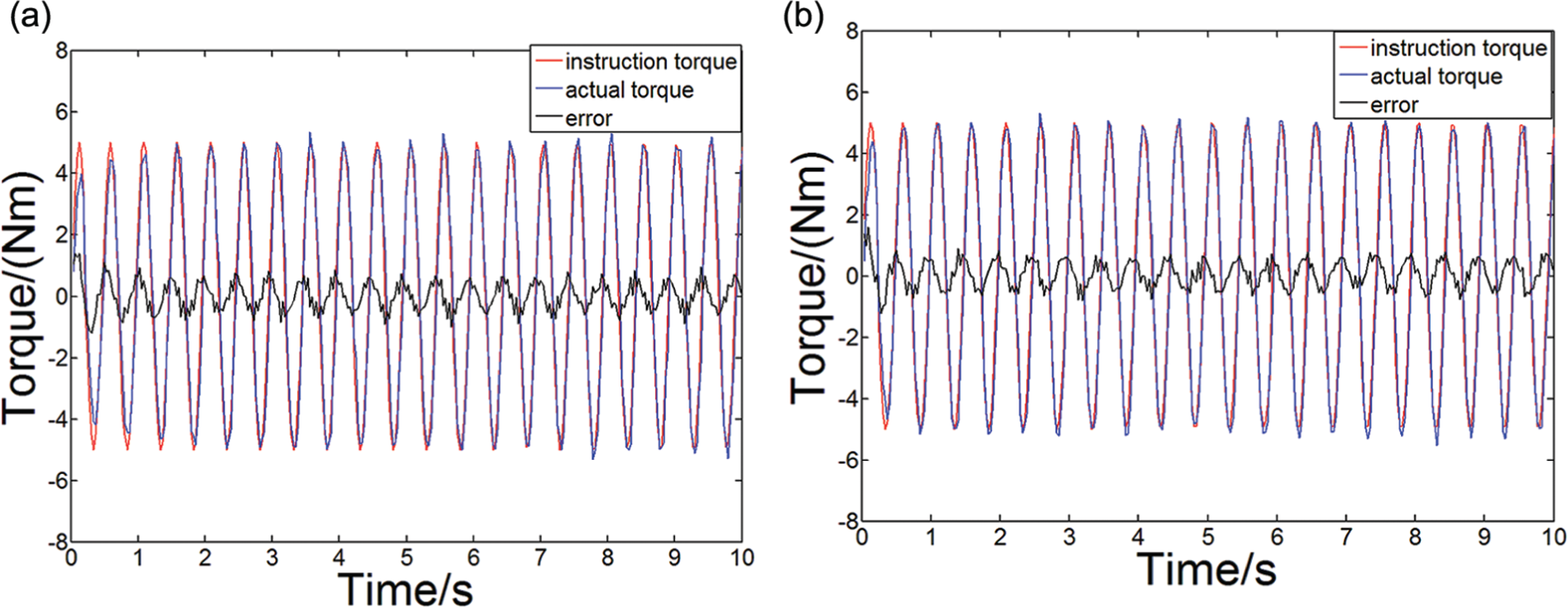
Tracking results of the cerebellar model articulation controller–proportional derivative (CMAC-PD) controller at loading frequency of 2 Hz: (a) using the conventional learning scheme; (b) using the novel learning scheme.
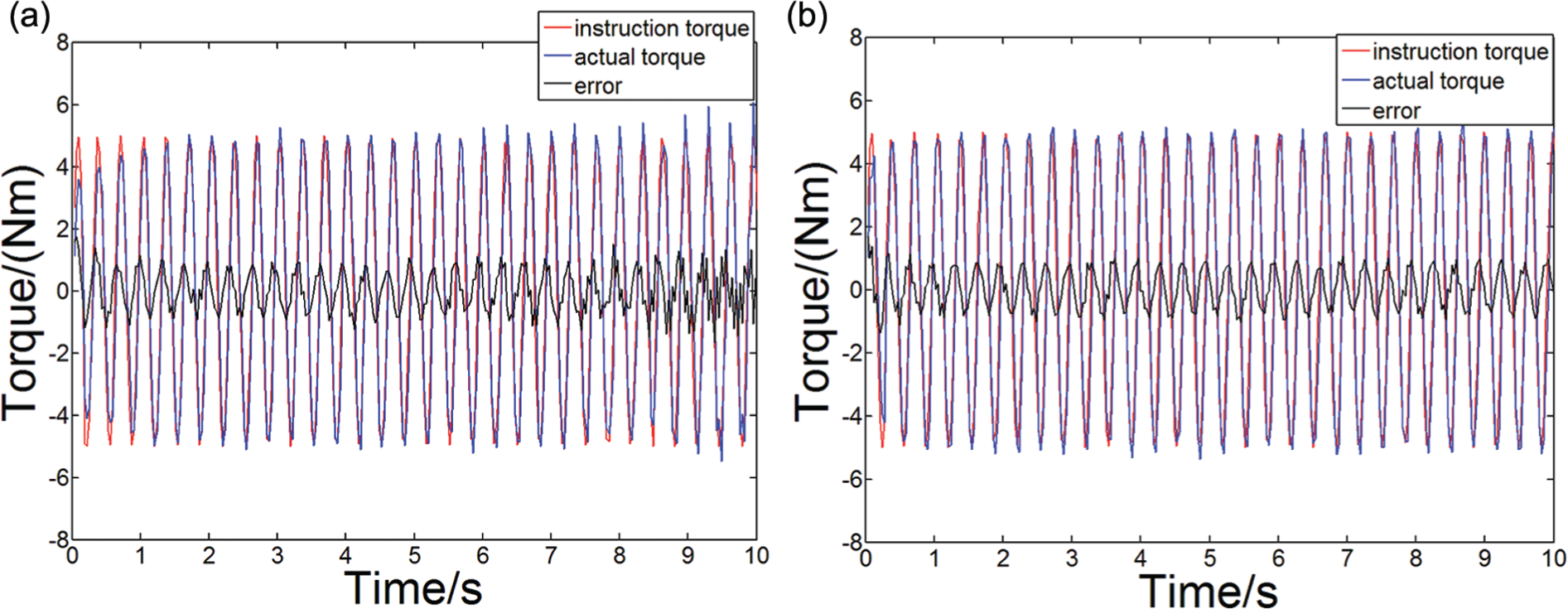
Tracking results of the cerebellar model articulation controller–proportional derivative (CMAC-PD) controller at loading frequency of 2 Hz: (a) using the conventional learning scheme; (b) using the novel learning scheme.
With loading instruction
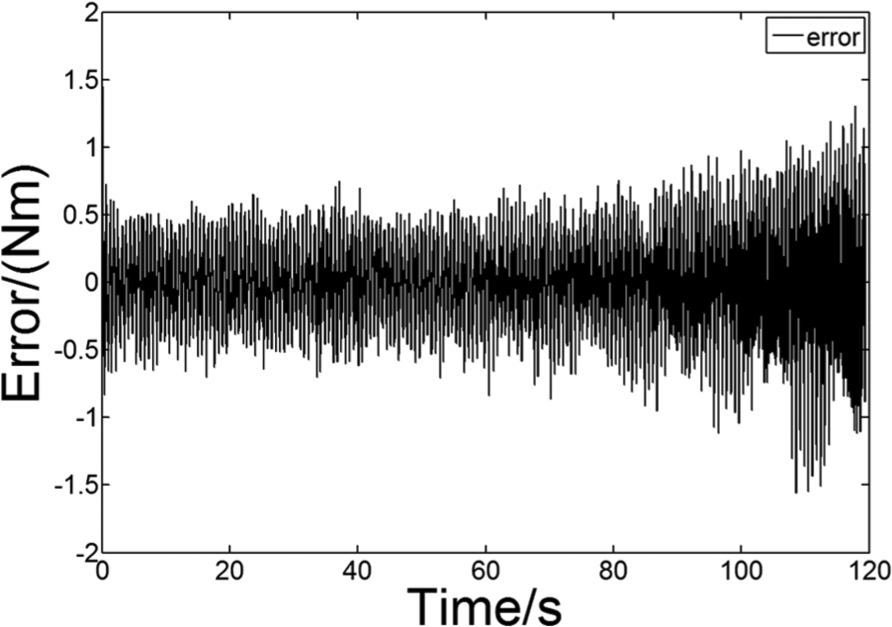
Over-learning phenomenon of the cerebellar model articulation controller–proportional derivative (CMAC-PD) controller using the conventional learning scheme.
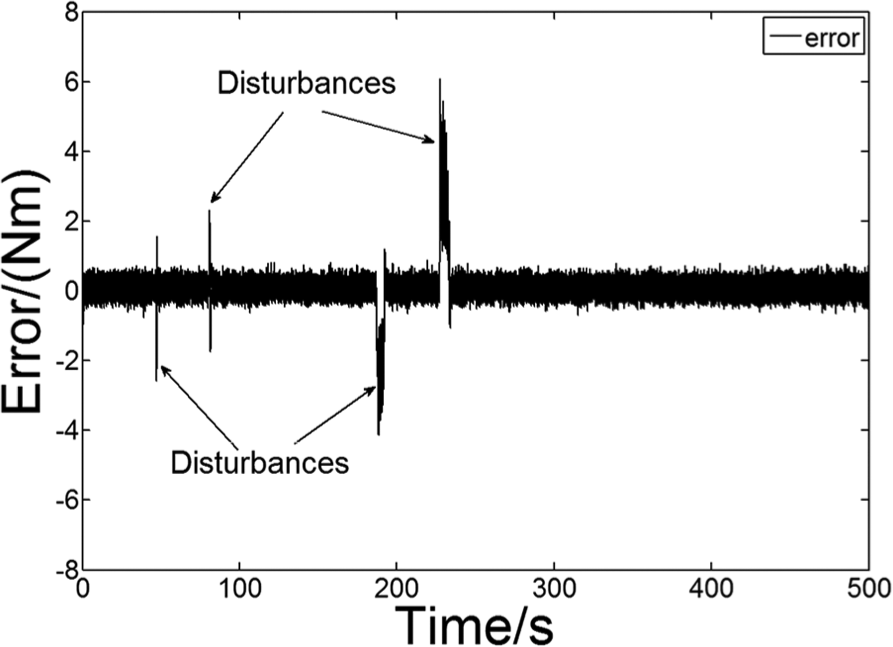
Inhibiting over-learning and disturbances test of the cerebellar model articulation controller–proportional derivative (CMAC-PD) controller using the novel learning scheme.
Conclusions
In this paper, we proposed an intelligent CMAC-PD hybrid torque controller with a novel anti-over-learning scheme for electric load simulators. The novel learning scheme is derived from a new scalar cost function, which contains an error item and an inhibiting over-learning item, by using the gradient descent algorithm.
The simulation and experimental results have shown that the CMAC-PD controller using the novel learning scheme can effectively inhibit over-learning of the CMAC, improve learning speed, eliminate disturbances and ensure control accuracy. The proposed control strategy is also suitable for real-time control of other non-linear systems.
Footnotes
Declaration of conflicting interest
The authors declare that there is no conflict of interest.
Funding
The authors would like to express their gratitude for the financial support by National Natural Science Foundation of China (No. 51277008).