






Abstract
This paper studies the global asymptotic stabilization of a class of upper-triangular systems without a priori knowledge of control directions under the homogeneous domination. The homogeneous domination is used in this paper to design state feedback controllers. The Nussbaum-type gain method is also introduced to complete the design of the controller. The controller is not only used to ensure the global boundedness for all signals of the closed-loop system, but also to guarantee that the system state asymptotically converges to zero. Finally, the simulation results are given to illustrate the effectiveness of the proposed approach.
Introduction
In this paper, a class of upper-triangular systems with unknown control directions is considered and can be represented as
where
In recent years the stability analysis of nonlinear cascade systems has attracted wide attention. Cascade systems are very important nonlinear control systems, and the control design problems in many systems can be converted to cascade control-system design problems. For high-order nonlinear systems the properties of cascade control systems are used to reduce the complexity of the design. Using cascade control design methods, the closed-loop system is transformed into two or more low-order cascaded form subsystems. It is a very effective method for obtaining the stability results of the original system through the stability analysis of the subsystems and the analysis of the interconnections for processing the analysis of the high-order control systems and the synthesis problems. The stability analysis problem needs to seek sufficient conditions to satisfy the stability of the system. Scholars have made much of the analysis stability results of cascade systems in the existing literature. The approach based on the cascade term growth conditions is a very effective way to deal with the stabilization problem of nonlinear cascade systems. (Imura et al., 1992; Panteley and LoriA, 2001).
This method has been widely used in cascade system stability analysis. Another effective method is based on the input-to-state stability (ISS) analysis (Sontag, 1989). ISS means that the bounded input leads to the bounded state. Assuming that the driving subsystem is globally asymptotically stable, if another status of the subsystem on the input to the driving state of the subsystem is stable, then the entire cascade system is globally asymptotically stable (Sontag, 1990).
In the existing literature on nonlinear control systems, many results are related to the lower-triangular systems. Compared with the stabilization control of lower-triangular systems, to the best of our knowledge, there are still few results available for the global stabilization problem of the upper-trangular systems (feedforwards systems).
Among the existing results on the stabilization of upper-triangular systems, the upper-triangular systems with strict feedback form are the main consideration. This system is a special form of the system considered in this paper, that is pi = 1 and gi = 1. For the upper-triangular systems with the strict feedback form, there are two main control methods, the nested saturation control method and the Lyapunov control method. The design ideas of the nested saturation method are given in Teel (1992, 1996). The Lyapunov method is another effective control method. By introducing a class of coordinate transformations and using the Lyapunov method, the stabilization problem of a class of upper-triangular systems is considered in Mazenc (1997) and Mazenc and Praly (1996). By designing the Lyapunov function with cross terms, the stability of a class of upper-triangular systems is analysed in Jankovic et al. (1996). In addition, there is some literature that considers the output feedback control problem of upper-triangular systems (Krishnamurthy and Khorrami, 2008; Qian and Li, 2006). If pi > 1, the global stabilization problem of upper-triangular systems is more challenging. In this case, there exists some literature based on the limitations of pi and fi and some results have been obtained. In the high-order case, the problem of global stabilization for a class of upper-triangular systems which have unbounded or uncontrollable linearizations around the origin is considered in Ding et al. (2011). The global stabilization problem of system (1) satisfying gi = 1 and under the conditions of p1 ≥ p2≥⋯ ≥ pn ≥ 1 is considered in Nussbaum (1983) and Mazenc et al. (1999). By combining the nesting saturation method and the Lyapunov method, the conditions which fi satisfies in Qian and Lin (1999) are weakened in Mazenc (1997) and the results are promoted (Mazenc, 1997); however, the results obtained in Mazenc (1997) and Qian and Lin (1999) require a stronger precondition, that is p1 ≥ p2 ≥ ⋯ ≥ pn ≥ 1.
For the system
satisfying p1 = 3, p2 = 7 and p1 < p2, the methods that Mazenc (1997) and Qian and Lin (1999) proposed are no longer applicable. In this paper, the conditions that the high-order feedforward systems need to satisfy are weakened and we will consider the global stabilization of a class of more wider feedforward systems.
On the other hand, the stabilization problem of feedforward systems is more difficult. Many practical systems can be transformed into feedforward systems. The cart-pendulum system is a typical feedforward system. It can be described as (Mazenc and Praly, 1996)
Therefore, it is necessary to investigate the stabilization problem of feedforward systems.
In the past few decades, the homogeneous system has been a widespread concern (Rosier, 1992). The homogeneous system is the vector fields of the system with homogeneity. One advantage of the homogeneous system is that for the autonomous system, if the system is locally asymptotically stable, the system is globally asymptotically stable (Rosier, 1992; Sepulchre et al., 1997). This means that local asymptotic stability and global asymptotic stability are equivalent. Therefore, the issue of discussing the global stability subsystems can be converted to discussing their local stability problems. The homogeneous domination approach is developed for the global output feedback stabilization of nonlinear systems in Qian (2005). Based on the concept of generalized homogeneity with monotone degree, a new design procedure to explicitly construct global stabilizers for a class of feedforward systems is developed in Zhang et al. (2013). The problem of global stabilization by smooth output feedback for a class of n-dimensional homogeneous systems whose Jacobian linearization is neither controllable nor observable is studied in Yang and Lin (2004); however, the control directions of the systems studied by the aforementioned literatures are known. In this paper, the concept of the homogeneous system is introduced and is combined with adding a power integrator approach to overcome the deficiencies of existing methods. At the same time, the Nussbaum-type gain function is introduced to compensate for the lack of control directions.
Since the early 1980s, scholars have begun to study adaptive control problems with unknown control directions and have achieved considerable results. The initial studies were carried out for linear systems and have proved that even though the high-frequency gain sign is unknown the adaptive control of linear systems is still viable. This groundbreaking work was first proposed in Nussbaum (1983) as the Nussbaum-type gain method and the control problem for a class of first-order linear systems is solved. Subsequently, the Nussbaum-type gain method is used to deal with the adaptive control problem of first-order nonlinear systems, nonlinear disturbances and high-order linear systems; however, because of the impact of interference, most of the existing controllers violently shake. To overcome this disadvantage, a number of results have been achieved in Ryan (1995), Ye (1999) and Ding (1998), and the requirements on the relative degree of the system are relaxed. The algorithm proposed in Ding (1998) and Ye (1999) holds for systems with arbitrary relative degree. In recent years, the control problem with unknown control directions of nonlinear systems has been studied widely. Applying the Nussbaum-type gain method, the strict feedback adaptive control of nonlinear systems with unknown constant parameters is considered in Ye et al. (1998). The decoupled backstepping algorithm is used in Ge and Wang (2002) to study the adaptive control of nonlinear systems with completely unknown control coefficients and strict feedback systems with uncertain parameters. When the uncertain system function satisfies certain conditions, the output problems of a class of time-varying uncertain nonlinear systems with unknown control coefficients is investigated in Ye (1999). The problem of adaptive tracking control is addressed in Zhang et al. (2014) for a class of nonlinear systems with unknown constant parameters and unknown actuator nonlinearity.
As far as we know, there are few pieces of literature which study the high-order feedforward system with unknown control directions. Whether applied to the high-order feedforward systems or to systems with unknown control directions, there is important significance to both theory and practical applications.
In this paper, we consider the global asymptotic stabilization of a class of feedforward systems with unknown control directions. We will combine the homogeneous domination and the Nussbaum-type gain method to design the state feedback controller. First, we consider a linear system with unknown control directions; in order to overcome the difficulties caused by the unknown control directions, the Nussbaum-type gain will be introduced in the design of the stabilization functions and the actual control laws. Then we consider a feedforward system and cascaded nonlinear system. The ISS Lypunov function and the idea of changing the energy function are used to solve the zero-dynamic subsystem issues. Finally, using Barbalat’s Lemma, we prove that the controller can not only ensure that all the closed-loop system signals are globally bounded, but it can also make the system states tend to zero asymptotically. The simulation examples are included to show the effectiveness of the design approach.
Problem formulation and preliminaries
Definition 1. (Qian, 2005)
The weighted homogeneity: for fixed coordinates
A function
A vector field
A homogeneous p-norm is defined as
(∂V)/(∂xi) is still homogeneous of degree τ − ri with ri being the homogeneous weight of xi; and
there is a constant c such that
Moreover, if V(x) is positive definite,
throughout the paper.
where
Design of the state feedback controller
High-order linear systems
In this section, we will present a recursive approach to design the virtual control laws and update laws for system (1). We first consider the following linear system
The time derivative of V1 is
The virtual control law
where
Also, from Lemma 4, the following inequality holds
where we choose γ = 2a/(2a − r1 − τ).
Then equation (10) is converted to
where
Substituting equations (7) and (9) into equation (6) yields
The time derivative of V2 is
where
From Lemma 3, the following inequality holds
Similarly, we obtain
where
Substituting equations (14) and (15) into equation (11) gives
where
and
and where ρ21(x1,x2,η1) > 0, ρ22(x1,x2,η1) > 0 are smooth functions.
Then we have
where
We construct the virtual control law
and define the variable function
From Lemma 3, the first term of equation (21) becomes
Then from equations (20) and (22), we have
where
and the update laws defined by
the following inequality holds
where the Lyapunov function is constructed as
The variable functions are defined by
and
Consider the following Lyapunov function
The design approach is similar to Step 2, and we achieve
Similarly, we obtain
where
Then, the time derivative of Vk is
The proof of Proposition 1 is given in the Appendix.
From Proposition 1, we estimate the last two terms of equation (32) and it is easy to show that
and
where ρk1(·) > 0, ρk2(·) > 0 are smooth functions.
Substituting equations (33) and (34) into equation (32) yields
where
is a smooth function.
Choose the virtual control law
Then equation (35) becomes
where
Similar to Step k, the time derivative of Vn is
The control law un and the ηn are constructed as follows
Then equation (37) is converted to
High-order cascade nonlinear systems
In this section, a class of nonlinear systems with zero-dynamics are considered
where
Consider the following assumptions.
where
where
Under Assumptions 3 and 4, we consider the cascaded nonlinear system (41). In order to deal with the unmeasured states, the energy change function design is applied in the following Lyapunov function
where q: [0,∞) → [1,∞) is a continuous monotonic non-decreasing function.
From Assumption 3, there exists a monotonic non-decreasing function q(·) ≥ 1 satisfying
where
Consider the Lyapunov function
and
It is easy to deduce from Assumption 4 that
Then the following inequality holds
where g = max(k,j), i = 1,…,k, j = 2,…,n, and
Since
If we choose appropriately smooth functions Cn(·) ≥ 0,
Through the procedures to acquire λn(·),
are satisfied, then we have
Then equation (51) becomes
where k = 1,…,n.
Under Assumption 1, the procedure to get
Main results
where
where
The function
where
where
Suppose that there exist 1 ≤ j1 < j2 < ⋯ < jq ≤ n, 1 ≤ q ≤ n such that
where
Clearly, we have
Then equation (59) becomes
where a = max(a1,…,an) > 0,m = 1,2,…,1 ≤ i ≤ q. Since ηk(t),k = 1,…,n,k≠ji,1 ≤ i ≤ q, is bounded and
where
Since
where
Take the limit of the right-hand side of equation (67) as t→tf; hence
Then we prove that z(t),Vk(t),2 ≤ k ≤ n, is bounded on [0,tf). As
is non-negative,
Since
implies by Barbalat’s Lemma that
According to equation (36), the definition of ξk, and the boundedness of ηk, we have
From equation (1),
which implies by Barbalat’s Lemma that
The proof of Theorem 1 is now complete. □
where p > 1, q > 1 are known odd integers and f1(0,0) = 0, a(t), b(t) are uncertain time-varying parameters.
We introduce the following change of coordinates
Then system (73) can be transformed into
According to the design approach in the section on the design of the state feedback controller, a continuous controller can be explicitly designed, making system (73) globally asymptotically stable if the nonlinear function f1 satisfies Assumption 1.
where g1(t) and g2(t) are uncertain time-varying parameters and the gi(t) values on unknown intervals
We choose
According to the design process in the section on the design of the state feedback controller, we can construct the following controller
where
and
The simulation is implemented with the uncertain parameters g1(t) = 1.5 + sin(t), g2(t) = 1.5−sin(t) and the initial conditions x1(0) = 1, x2(0) = −1,η1(0) = 1,η2(0) = 1,z(0) = 2.
The simulation results shown in Figures 1–3 show that the controller we have proposed in this paper is effective. It ensures that all signals of the closed-loop system are globally bounded on [0,∞), and that the system states x1,x2 and the system unmeasurable state z asymptotically converge to zero.
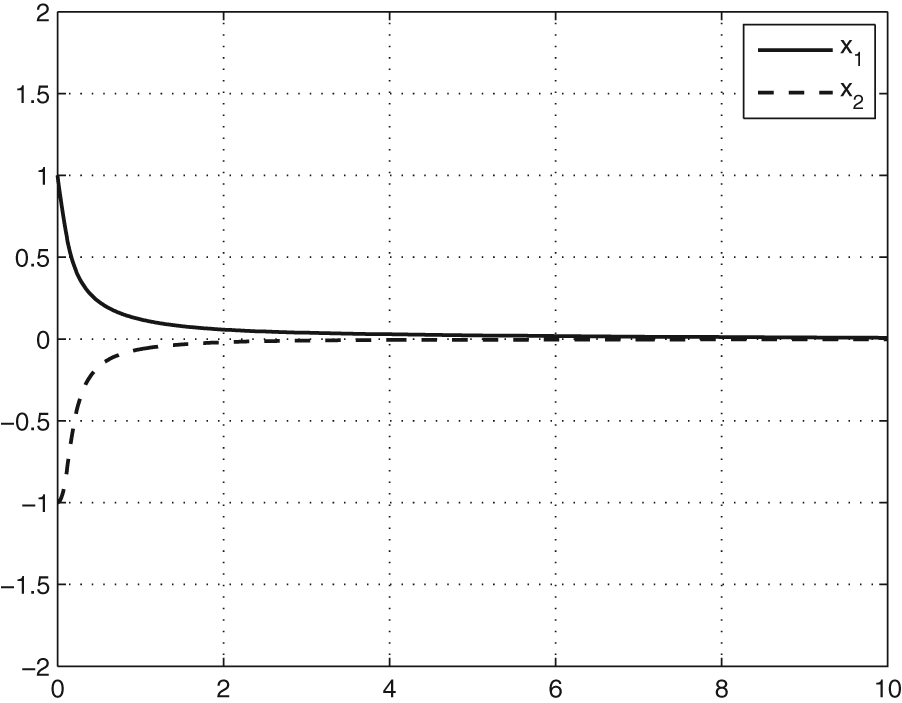
State variables x1,x2.
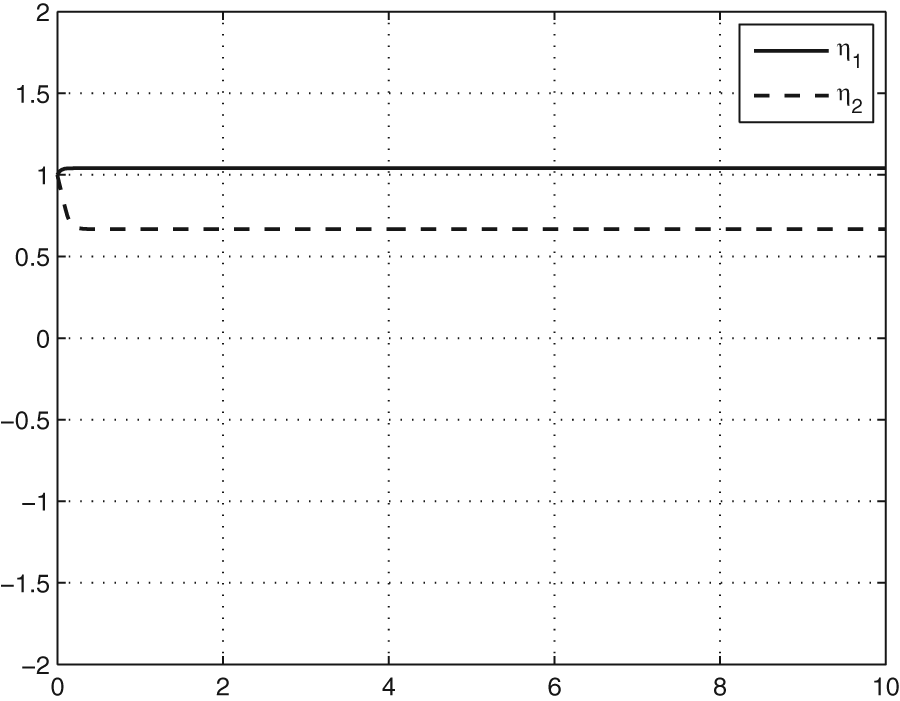
Adaptive parameters η1,η2.
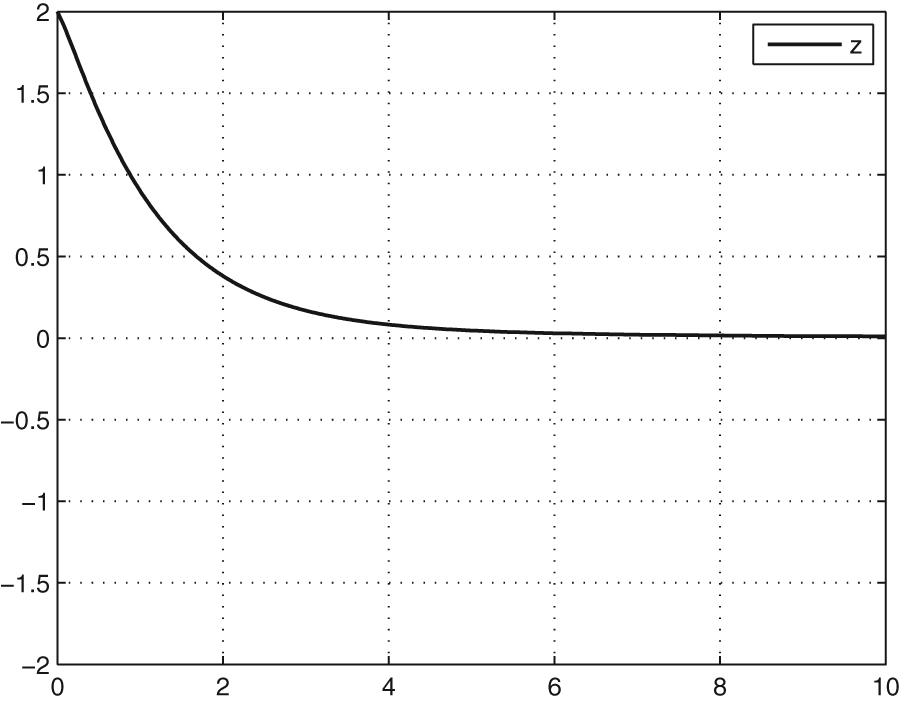
Unmeasurable state z.
Conclusions
A state feedback controller has been proposed for a class of feedforward nonlinear systems with unknown control directions. The homogeneous domination is used to construct the controller and the problem of unknown control directions is solved by incorporating the Nussbaum-type gain into the virtual control laws and the actual control laws. We have proved that under the proposed controller the global boundedness for all signals of the closed-loop system can be achieved and the system state converges to zero, asymptotically. Finally, the simulation examples illustrate the effectiveness of our controller.
Footnotes
Appendix
where α2,1(x1, x2, η1) ≥ 0 is a smooth function.
Suppose that there exists a non-negative function αk−1,l(x1,…,xk−1,η1,…,ηk−2) for l = 1,2,…,k−2 such that
Then we proof that there exists a non-negative smooth function αk,l(x1,…,xk,η1,…,ηk−1) for l = 1,2,…,k, such that
First consider the case when l = 1,2,…,k − 2, so that we obtain
Then consider the case that when l = k − 1, so that equation (80) also holds
Combining equations (81) and (82), we know that, for all l = 1,2,…,k − 1, Proposition 1 always holds.□
Funding
This work was supported by the National Natural Science Foundation of PR China (grant numbers 61374153, 61174038 and 61374087) and the program for Changjiang scholars and innovative research team in Universities (grant number IRT13072).