






Abstract
Based on the homogeneous domination approach and stochastic nonlinear time-delay system stability criterion, this paper investigates the global state-feedback stabilization problem for a class of stochastic high-order upper-triangular nonlinear systems with input time-varying delay. By skilfully choosing an appropriate Lyapunov–Krasoviskii functional and successfully solving several troublesome obstacles in the design and analysis procedure, a delay-independent state-feedback controller is designed to render the closed-loop system globally asymptotically stable in probability. The simulation example is given to verify the effectiveness of the proposed design scheme.
Keywords
Introduction
In this paper, we consider the following stochastic high-order upper-triangular nonlinear systems with input time-varying delay described by
where
When the diffusion term
It is worth mentioning that all the above-mentioned results do not consider the effect of stochastic noise; in fact, stochastic noise and uncertain disturbances often exist in practical applications. Hence, it is necessary and interesting to investigate stabilization problems for stochastic upper-triangular nonlinear systems. Motivated by fruitful deterministic results, the study of stochastic upper-triangular nonlinear systems rapidly became a hot issue in recent years. For the case of system high-order
However, for the asymptotic stabilization of system (1) with general system high-order and input time-varying delay, there have been no relevant results until now. The main purpose of this paper is to deal with the global state-feedback stabilization problem of stochastic high-order upper-triangular nonlinear systems with input time-varying delay (1). To solve this problem, we introduce the homogeneous domination approach and stochastic nonlinear time-delay system stability criterion. By skilfully choosing an appropriate Lyapunov–Krasovskii functional and the low gain scale in the controller, and overcoming several troublesome obstacles in the design and analysis procedure, a delay-independent state-feedback controller is explicitly constructed such that the closed-loop system is globally asymptotically stable in probability. A simulation example is provided to demonstrate the effectiveness of the proposed control scheme.
The paper is organized as follows. The second section provides some mathematical preliminaries. The controller design and stability analysis are given in the third section and the fourth section, respectively. The fifth section gives the simulation example. The sixth section concludes this paper.
Mathematical preliminaries
The following notations, definitions and lemmas are to be used in the paper.
Consider the stochastic time-delay system
with initial data
For any given
where
the dilation
a function
a vector field
a homogeneous p-norm is defined as
then there is a unique solution on
There is a constant c such that
Design of state-feedback controller
This paper aims to design a delay-independent state-feedback controller for system (1) such that the equilibrium at the origin of the closed-loop system is globally asymptotically stable in probability. To achieve this objective, we need the following assumptions for system (1).
Assumptions and a key lemma
where
In this paper, we assume
If
Otherwise, for any
For
In the controller design and stability analysis, the flexible selection of parameter
Before giving the state-feedback controller design procedure, we propose the following key lemma, whose role is to guarantee Lemma 8 and Step 1 in the proof of Theorem 1.
For
When
By (5) and (6),
(ii) For any
From (i) and (ii), we have
State-feedback controller
We first introduce the following coordinate transformation
where
where
Step 1. Introducing
leads to
Step
such that
where
is
where
Next, we prove that
Case I. For
Case II. When
Finally, we prove that inequality (13) holds. From (3), (10)-(12) and (14), it follows that
We focus on the last two terms on the right-hand side of (16).
For
When
Combining (17) and (18), by Lemma 3, we have
where
Using (10) and Lemmas 2–3, one concludes that
where
At step n, choosing
from Lemma 8, it follows that
where
where
from which and Definition 1, one can conclude that
Stability analysis
We illustrate the main result of this paper as follows.
Step 1. We first prove that
Using Lemma 7, one obtains
Since
Step 2. Introduce the following Lyapunov function
where
From
Letting
Step 3. By Lemmas 2–3 and (22), there exists
Using Definition 1, Assumption 1 and (7), and
where
where
where
where
Selecting
In the stability analysis, by adopting the homogeneous domination approach, the effect of input time-varying delay was skilfully dealt with in the inequalities (30) and (32).
Due to the appearance of input time-varying delay, constructing an appropriate Lyapunov–Krasovskii functional (25) to satisfy (34) is not easy to do.
It should be pointed out that the rigorous proof of Theorem 1 is not a trivial task.
A simulation example
Consider the following stochastic upper-triangular nonlinear system with input delay
By
where
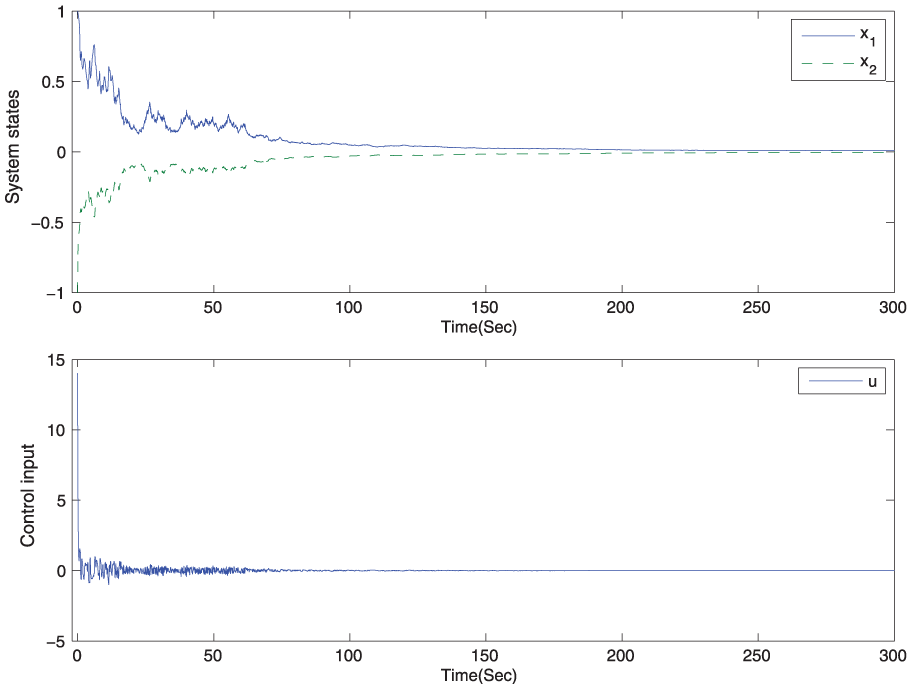
The responses of the closed-loop system (35) and (36).
Conclusion
This paper solves global state-feedback stabilization for a class of stochastic high-order upper-triangular nonlinear systems with input time-varying delay by combining the homogeneous domination approach with a stochastic nonlinear time-delay system stability criterion. The underlying idea of the homogeneous domination approach is that the homogeneous controller is first designed without considering the drift and diffusion terms, and then a low scaling gain N is introduced to the state-feedback controller to overcome the effects of drift and diffusion terms.
There are still some problems to be investigated: One is to consider the data-driven problem of system (1) as discussed in Yin et al. (2015). Another is to solve the fuzzy or neural control for system (1) as discussed in Chang and Yang (2014), Li et al. (2015) and Liu and Tong (2015a, 2015b). The third is to find a practical example for system (1).
Footnotes
Conflict of interest statement
The author(s) declared no potential conflicts of interest with respect to the research, authorship, and/or publication of this article.
Funding
The author(s) disclosed receipt of the following financial support for the research, authorship, and/or publication of this article: This work was supported by the National Natural Science Foundation of China (grant numbers 61403041, 61573172), the Program for Liaoning Excellent Talents in University (grant number LJQ2015001), and the Project Funded by China Postdoctoral Science Foundation (grant number 2015M580435).