This paper addresses the distributed output regulation problem of switched multi-agent systems subject to input saturation. Two types of independent switching signals are considered in this work. Each agent is described by a switched linear system with an average dwell time and input saturation. The interconnection topologies are also switched subject to dwell time. Since not every agent can obtain the information of the exosystem, the distributed feedback controller is designed. An agent-dependent average dwell time method with an adjustable parameter based on algebraic Riccati equations is proposed to solve the output regulation problem. Finally, two examples are provided to illustrate the electiveness of our results.
Switched systems, which are composed of a family of continuous-time or discrete-time subsystems and a rule orchestrating the switching between the subsystems, have drawn considerable attention in the past few years (Liberzon, 2003; Liberzon and Morse, 1999; Sun et al., 2008) due to their wide applications in practical systems. For the study of switched systems, most attention has been paid to stability analysis and control synthesis. The average dwell time method, as one of the most effective approaches, has been recognized as very flexible and useful in the analysis of switched systems (Hespanha and Morse, 1999; Yuan and Wu, 2015). Furthermore, other issues about switched systems including -gain analysis, control, passivity and passication, and fault detection have also been addressed (Lian et al., 2013; Mayo-Maldonado et al., 2014; Wang D et al., 2013; Zhao et al., 2009; Zhao and Hill, 2008).
In recent years, the distributed output regulation problem (to design a distributed regulation algorithm such that the closed-loop agent networks without the disturbance input are asymptotically stable and the error output approaches zero asymptotically) has attracted considerable attention. The output regulation theories of linear and non-linear systems have been applied to cope with the cooperative output regulation for multi-agent systems in Huang (2004), Isidori (1999) and Francis and Wonham (1976). For non-switched multi-agent systems, many results of the coordinate output regulation have been published. By devising a distributed observer, Su and Huang (2012a) solve the coordinate output regulation problem of heterogeneous linear multi-agent systems by a dynamic full information distributed control scheme. Also, a unified observer using output feedback information is proposed and then the output regulation problem is settled by designing an observer-based feedback controller in Meng et al. (2015). Dong and Huang (2014) design a distributed dynamic output feedback control to investigate the cooperative global robust output regulation problem for non-linear agent networks. An internal model based on a distributed control scheme is adopted to translate the output regulation problem to a stabilization problem for multi-agent systems. Further, a robust control law with the help of internal models for agent networks and a stabilizing controller for heterogeneous linear multi-agent systems is designed in Yu and Wang (2013) and Huang and Ye (2014), respectively. Further, Wang and Yang (2015a,2015b) address the cooperative fault-tolerant tracking control problem for a class of multi-agent systems subject to mismatched parameter uncertainties, external disturbances and actuator faults including loss of effectiveness, outage and stuck. In addition, switched multi-agent systems may include two types of switching signals. That is, each agent of such a multi-agent system is a switched linear system and the interconnection topologies describing the information exchange among agents are also switched. In the existing literature, only one type of switching signal is considered. Most results of the output regulation problem for switched multi-agent systems (Hong et al., 2007; Su and Huang, 2012b; Wang X et al., 2013) are considered for the latter one, namely, the switched topologies. However, few results on the output regulation problem of multi-agent systems whose agents are switched systems have appeared. Cervantes-Herrera et al. (2012) consider the output regulation and output consensus for switched multi-agent systems with a special form. The regulated objective is achieved under arbitrary switching by designing a distributed control scheme. Furthermore, the output regulation problem of switched linear multi-agent systems with stabilizable and unstabilizable subsystems is studied in Jia and Zhao (2015). Based on the characteristics of multi-agent systems and switched systems, the authors propose a new method, called an agent-dependent average dwell time method. Since multiple modes depending on various environmental factors are required to describe many practical systems, it is of practical significance for the study of switched multi-agent systems.
It is well known that a system is inherently non-linear in the presence of input saturation, which brings more difficulties in solving the output regulation problem for such a system. For linear systems with saturating actuators, Lin et al. (1996) gives necessary and sufficient conditions for the solvability of the output regulation based on the algebraic Riccati equation. Several approaches for treating the saturation function have appeared, such as the low-gain design methods (Gomes da Silva and Tarbouriech, 2005; Lin, 1996), convex hull method (Hu and Lin, 2001) and anti-windup method (Alamo et al., 2005). Santis and Isidori (2001) extend the result of Lin (1996) and show how the restriction on the set of initial states of the plant can be removed by saturated controllers. The distributed output regulation problem of multi-agent systems subject to input saturation with switched topologies is studied in Wang et al. (2013). For a multi-agent system with a saturation function, if each agent is a switched system and the interconnection topologies of agents are switching, the distributed output regulation problem becomes very difficult. No results about this issue have been reported up to now, which motivates the present study.
This paper investigates the semi-global distributed output regulation problem for switched linear multi-agent systems with input saturation. The contributions of the work are threefold. Firstly, two independent switching signals are considered in this work. That is, each agent of such a multi-agent system is a switched linear system and the interconnection topologies describing the information exchange among agents is also switching. This has not been seen in the existing literature. Secondly, we propose an agent-dependent average dwell time method with an adjustable parameter to solve the output regulation problem. For the switched multi-agent system, an average dwell time of the overall system obviously implies an average dwell time of each agent, while the existence of an average dwell time of each switched agent does not mean the existence of an average dwell time of the overall switched system. Therefore, the proposed agent-dependent average dwell time method that only uses an average dwell time of each individual agent is more general, and the conditions required are much milder. Finally, in addition to the simultaneous consideration of the two switching signals, we also consider input saturation. Due to the saturation, we have to apply the algebraic Riccati equations with an adjustable parameter to obtain controllers satisfying saturation. This adjustable parameter is also used to determine the average dwell time of switched agents. Again, this has not appeared in any results using average dwell time.
The remainder of this paper is organized as follows. In the next section, preliminaries and the problem statement are introduced. The third section gives the main results. Two examples are given in the fourth section. Finally, concluding remarks are given in the fifth section.
Preliminaries and problem statement
In this section, we firstly introduce some preliminary knowledge on graph theory and the notion of average dwell time. Next, the problem being considered is formulated.
Graph theory
Some graph concepts related to the information exchanges among agents are introduced (see Grodsil and Royle (2001) and Ren and Cao (2011) for details). A graph is a pair of , where is the set of vertices and is the set of edges, formed by pairs of vertices. Let be the adjacency matrix of the graph G, in which if there is an edge directed from vertex i to vertex j, and otherwise . The Laplacian matrix of a graph G is denoted by . By , by which we mean that vertex j is a neighbour of vertex i, i.e. vertex i can obtain information from vertex j. The set of neighbours of vertex i in G is denoted by . Let D be a diagonal matrix with . If once , the graph G is undirected graph. A directed path from vertex i to vertex j is a finite ordered sequence of edges with distinct . This denotes that vertex j is reachable in G from vertex i.
N switched linear agents and an exosystem are considered here. The corresponding communicated graph is described by , where and the leader is denoted as vertex 0. In the same way, described the connective weight from vertex i to vertex 0. If the i-th agent can obtain information from the exosystem, , otherwise . Let be a diagonal matrix with . Then, we define the matrix denoted the connection of the overall multi-agent systems in as .
The following lemma about the matrix H is given.
Lemma 1 (Ren and Cao, 2011). H is positive definite if and only if node 0 is globally reachable in .
In this paper, we consider the output regulation problem of agent networks with switching connected topologies. To avoid infinite-switching within a finite time interval, we assume that there exists an infinite sequence of bounded, non-overlapping, contiguous time-intervals , starting at and a constant , called dwell time, such that .
Let be the possible connection topologies satisfying vertex 0 (the exosystem) being globally reachable. is a set of the graphs and is its index set. Thus, we define a switching signal to describe the connection topology changes under the condition of a given dwell time.
Remark 1. It is noted that Laplacian matrix associated with the switching connection graph is time-varying at the switching times . Obviously, is also time-varying. However, according to Lemma 1, is positive definite.
Average dwell time
The classic notion about the average dwell time is stated as follows.
Definition 1 (Hespanha and Morse, 1999). For a switching signal and any , let be the switching numbers of over the interval . If for any given and , we have , then and are called the average dwell time and the chatter bound, respectively. Without loss of generality, as commonly used in the literature, we assume .
Notation: For easy reference of readers, we introduce some notation in this paper. We use to denote the Euclidean infinite-norm for vectors and the induced infinite-norm for matrices. represents the Kronecker product of matrices M and N. denotes the transpose of M, and means matrix M is a positive matrix. and represent the maximum and the minimum eigenvalue of M, respectively. denotes the generalized inverse of M.
Problem statement
In this paper, we study the output regulation problem of switched multi-agent systems subject to input saturation described as follows
where is the state of the i-th agent. is a piecewise constant function of time t, called a switching signal. are the control inputs of i-th agent. are constant matrices. sat is a vector-valued saturation function with
is the exogenous signal representing the reference input to be tracked and (or) the disturbance to be rejected and is assumed to be generated by a so-called exosystem defined by
where is the reference output.
we can define the regulated error output for the i-th agent as follows
Without loss of generality, we can assume that are of full row rank, that is, rank.
If the i-th agent is not connected with exosystem, it cannot get the information of the reference output . Therefore, the reference output and the regulated output cannot be used directly for feedback control of the i-th agent. Then, we define the state coupling variable relationship between the i-th agent and its neighbours as
where is the generalized inverse of C satisfied .
The distributed state feedback controller for the i-th agent is expressed in the form of
The semi-global output regulation problem can be formulated.
Definition 2. Consider multi-agent systems (1), the exosystem (3) and a given compact set . The semi-global output regulation problem under the switching signals and is defined as follows. For any priori given (arbitrary large) bounded set , find, if possible the distributed state feedback controllers (5) and (6) such that:
the closed-loop system without the disturbance input is locally asymptotically stable, with contained in its basin of attraction;
for any initial condition and , the solution of the closed-loop system satisfies
Remark 2: When the agents are non-switched systems, Definition 2 coincides with that of Wang et al. (2013).
The following lemma is needed for controller design to solve the problem.
Lemma 2. (Lin et al., 1996). Assume is stabilizable and A has all its eigenvalues in the closed left half-plane. Then for , there exists a unique positive definite matrix that solve the following algebraic Riccati equation
Moreover, as .
The following assumptions are necessary.
Assumption 1. The eigenvalues of S have non-negative real parts.
Assumption 2. The matrix pairs are stabilizable and have all eigenvalues in the closed left half-plane respectively.
Remark 3. Assumption 1 is a standard assumption in the output regulation literature of the non-switched linear multi-agent systems. Owing to existing input saturation for each agent, the controller is designed based on the solutions of the algebraic Riccati equation (8). Then, Assumption 2 is necessary in this work.
Lemma 3. According to Assumption 2 and Lemma 2, the following algebraic Riccati equations
have the unique positive-definite solutions respectively for all . Furthermore, as .
Proof. The conclusion is obvious and the proof is omitted.
Let , , , . Then, the closed-loop systems of equations (1), (3) and (4) under the controller (5) and (6) can be written as
where
Without saturation function, the closed-loop system (9) becomes
where
Main results
In this section, we give the solvability condition of the semi-global output regulation problem.
Theorem 1. Let Assumptions 1 and 2 hold. Consider the system (1), exosystem (2) and a given compact set . Under any switching signal satisfying the average dwell time
for all and , will be given in equations (20) and (21) respectively. Suppose that the following conditions are satisfied.
The regulation equations
have a common solution matrix , where are defined in (10), and are the gain matrices satisfying equation (13).
There exists a , such that , are bounded for with . Then, the semi-global output regulation problem is solvable via the state feedback controllers (5) and (6) with the gain matrices given by
where are the solutions of equation (8) and , denotes the spectrum of matrices .
Proof. In order to prove the theorem, we firstly need to find a family of state feedback controllers parameterized in for each switched agent. Then, we will show that for a given set , there exists an such that for all , the two conditions of Definition 2 hold under the switching signal and .
Firstly, we will prove that condition 1 of Definition 2 holds. When and the saturation sign is absent, the closed-loop system becomes
According to equation (8), are stable. This is because
According to Remark 1, all the eigenvalues of the matrix have positive real parts. Suppose that is an orthogonal transformation matrix such that is a diagonal matrix with the eigenvalues of along the diagonal.
Setting
we obtain
Then, we define the Lyapunov function
Thus
Obviously, there exist constants such that . Therefore, we have
Since are switched among the solutions of equation (8) under the piecewise constant switching signal , we obtain that there exist constants such that
For example, , where denote the largest and smallest eigenvalues of the positive definite matrices , respectively.
Without loss of generality, let . For any , denote the switching instants by on the interval under the switching signal .
Thus, the closed-loop system without disturbance input is asymptotically stable for any agent-dependent dwell time .
Now, let us consider system (14), i.e. the case of existing input saturation, when , since (Remark 1) and given the asymptotic stability of system (14), there exists an such that for all , we have
Then, it is proved that the system (14) operates in the linear regions of saturation elements for all and . This shows that the equilibrium of equation (14) with is locally asymptotically stable with contained in its basin of attraction.
Next, we will prove condition 2 of Definition 2. Let
Suppose that from time T onwards and without saturation element, we obtain
Consider system (26) subject to saturation. We have
According to condition 2 of Theorem 1, we can derive that belongs to a bounded set independent of . By the stability of equation (14) and , for a constant , there exists a constant such that
Then, from Lemma 2 and condition 2 of Theorem 1, there exists such that
Thus, we obtain
If there exists an input saturation element, it can be seen that the system can operate within the linear region of the saturation elements for all . Since system (25) is asymptotically stable, from equation (23), we obtain . Taking . The proof is complete.
Remark 4. In Cervantes-Herrera et al. (2012), switched agents with non-switched topologies are studied. On the basis of a common Lyapunov function approach, the output regulation problem of switched multi-agent systems is solved under an arbitrary switching rule. However, we do not require a common Lyapunov function and use only multiple Lyapunov functions to propose an agent-dependent average dwell time switching law with an adjustable parameter. In Wang et al. (2013), each agent is not switched. We consider two types of switchings, namely, switched agents and switched topologies.
If each agent consists of only one subsystem, i.e. no switching occurs in each agent, Theorem 1 degenerates into the result in Wang et al. (2013).
Simulation example
In this section we propose two examples to illustrate the effectiveness of our results.
Example 1: We consider the following multi-agent system which has two switched agents as follows
where
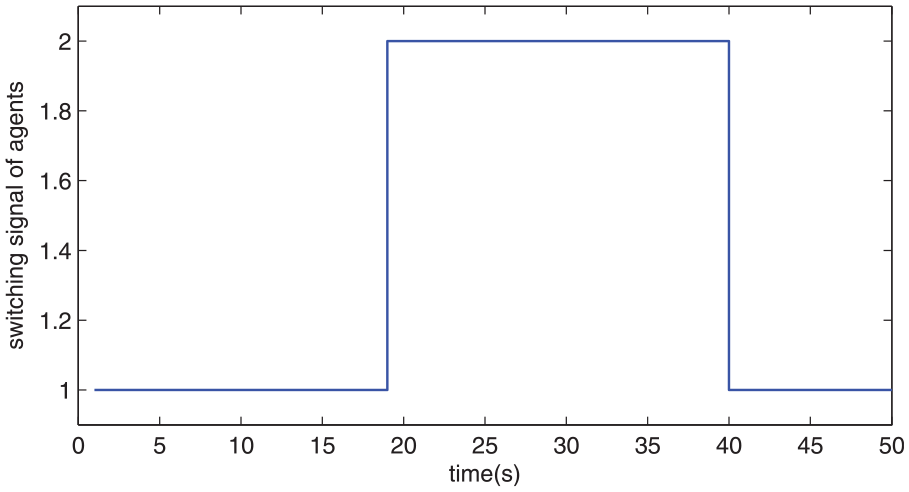
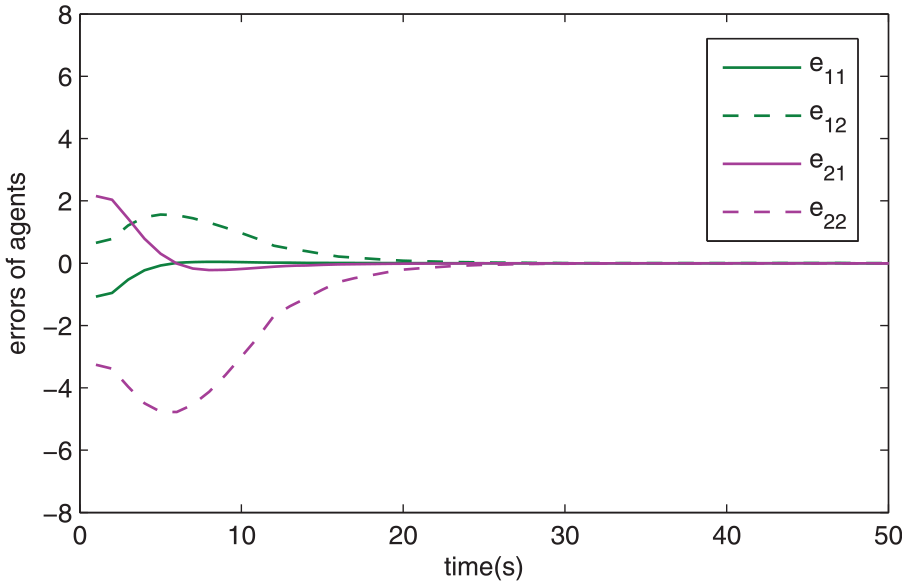
Here the topologies of the multi-agent system with two agents are switching in an alternative order: with switching period s. The matrices and describing the information exchange of the multi-agent systems and the exosystem are given as follows: For the set given by , we take a choice of as 0.1 and obtain the simulation results in Figures 1 and 2 where the agent-dependent average dwell time is as follows: This illustrates the effectiveness of our designed method.
The switching signal of switched agents.
Regulated errors of the four switched agents.
Example 2: To illustrate our control design, we consider another switched multi-agent system with input saturation based on the example in Wang et al. (2013). Here, each agent is a switched linear system
where
Here the topologies of the multi-agent system with four agents are switching in an alternative order: with switching period s. The matrices and describing the information exchange of the multi-agent systems and the exosystem are given as follows
Obviously their eigenvalues are and 1,1,2,2. We take . By solving the regulation equation (12), we obtain , where . For the set given by , we take a choice of is 0.2. For , the solutions of equation (8) are
Then
we have by calculating
Therefore, we obtain the agent-dependent average dwell time as follows
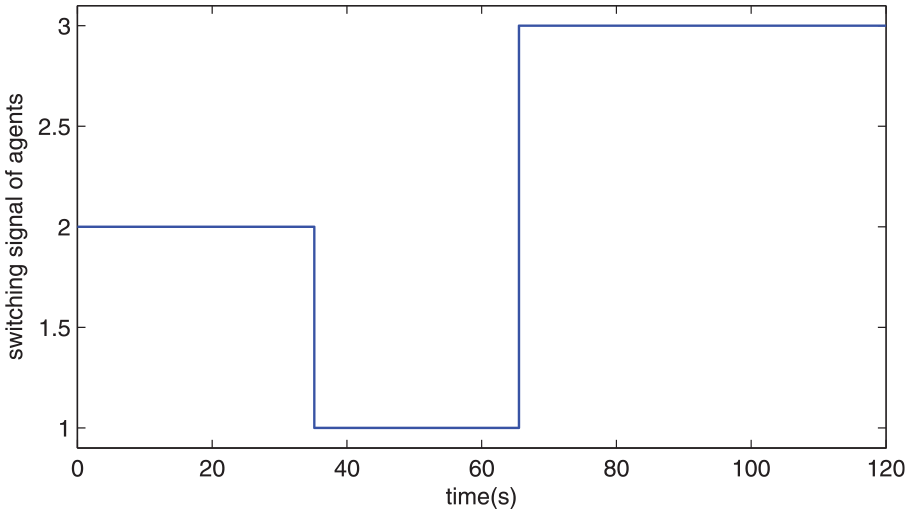
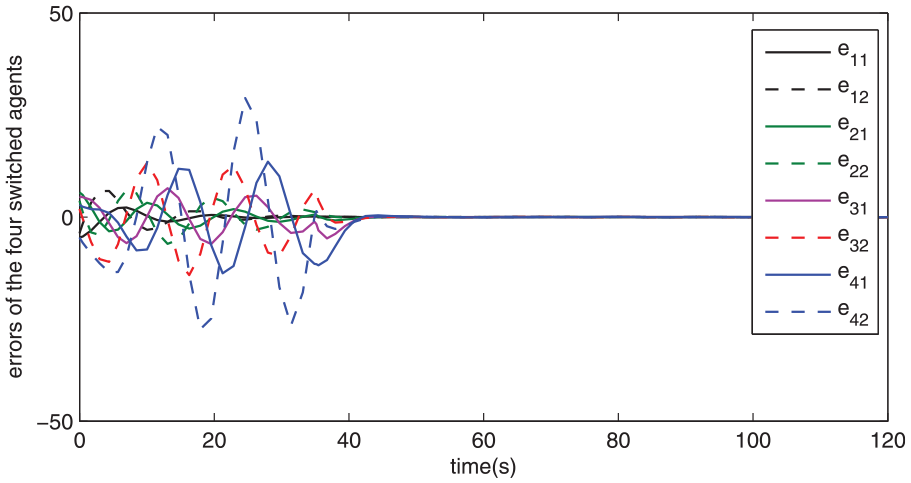
Applying distributed switched dynamic feedback control laws (5) and (6), we obtain the simulation results in Figures 3 and 4.
The switching signal of switched agents.
Regulated errors of the four switched agents.
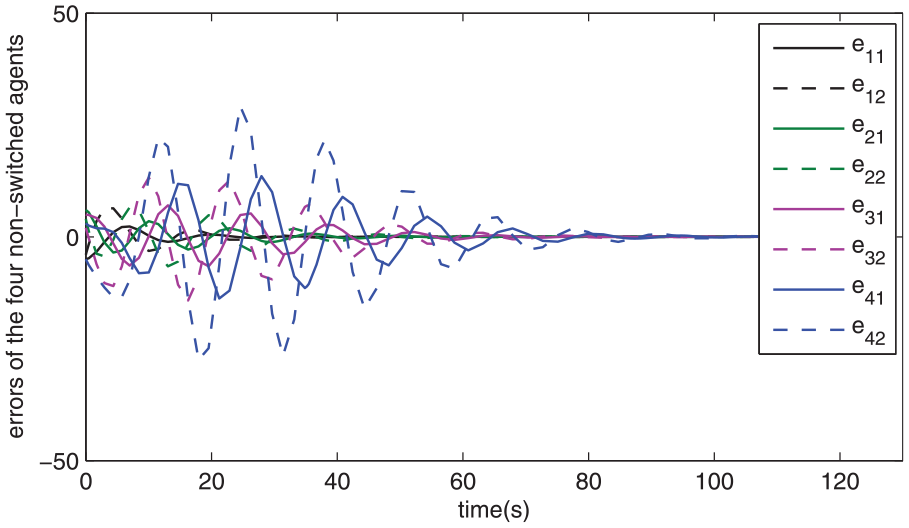
If , each agent is a non-switched linear system. By using the method in Wang et al. (2013), we obtain the simulation results in Figure 5. Also, the time for the regulated errors to approach zero using the method in this paper is shorter, which shows the advantages of our results.
Regulated errors of the four non-switched agents.
Conclusion
In this paper, we have studied the semi-global output regulation problem of switched multi-agent systems with input saturation. Two types of independent switching signals are considered. That is, each agent of such a multi-agent system is a switched linear system and the interconnection topologies describing the information exchange among agents is also switching. Sufficient conditions for the solvability of the problem have been presented. Based on the algebraic Riccati equation, we have proposed the agent-dependent average dwell time method with an adjustable parameter to solve the output regulation problem. Further, the output regulation problem of a switched non-linear agent network will be focussed on in the future.
Footnotes
Conflict of Interest Statement
The Author(s) declare(s) that there is no conflict of interest.
Funding
The author(s) disclosed receipt of the following financial support for the research, authorship, and/or publication of this article: This work was supported by the National Natural Science Foundation of China (grant numbers 61304058 and 61233002), the IAPI Fundamental Research Funds (grant number 2013ZCX03-01) and the General Project of Scientific Research of the Education Department of Liaoning Province (grant number L2015547).
References
1.
AlamoTCepedaALimonD (2005) Improved computation of ellipsoidal invariant sets for saturated control systems. In: Proceedings of the 44th IEEE conference on decision and control and European control conference, Seville, Spain, 15–25 December, pp.6216–6221.
2.
Cervantes-HerreraARuiz-LeonJLopez-LimonCet al. (2012) A distributed control design for the output regulation and output consensus of a class of switched linear multi-agent systems. In: Proceedings of the IEEE 17th conference on emerging technologies and factory automation, Krakow, Poland, 17–21 September, pp.1–7.
3.
DongYHuangJ (2014) Cooperative global output regulation for a class of nonlinear multi-agent systems. IEEE Transactions on Automatic Control59(5): 1348–1354.
4.
FrancisBAWonhamWM (1976) The internal model principle of control theory. Automatica12(5): 457–465.
5.
Gomes da SilvaJMJr.TarbouriechS (2005) Antiwindup design with guaranteed regions of stability: An LMI-based approach. IEEE Transactions on Automatic Control50(1): 106–111.
6.
GrodsilCRoyleG (2001) Algebraic Graph Theory. New York: Springer-Verlag.
7.
HespanhaJPMorseAS (1999) Stability of switched systems with average dwell-time. In: Proceedings of the 38th Conference on decision and control, Phoenix, AZ, USA, 7–10 December, pp.2655–2660.
8.
HongYGaoLChenDet al. (2007) Lyapunov-based approach to multiagent systems with switching jointly connected interconnection. IEEE Transactions on Automatic Control52(5): 943–948.
9.
HuTLinZ (2001) Control systems with actuator saturation: Analysis and design. Boston: Birkhäuser.
10.
HuangJ (2004) Nonlinear Output Regulation Problem: Theory and Applications. Philadelphia, PA: SIAM.
11.
HuangCYeX (2014) Cooperative output regulation of heterogeneous multi-agent systems: An H∞ criterion. IEEE Transactions on Automatic Control59(1): 267–273.
12.
IsidoriA (1999) Nonlinear Control Systems II. New York, NY: Springer-Verlag.
13.
JiaHZhaoJ (2015) Output regulation of switched linear multi-agent systems: An agent-dependent average dwell time method. International Journal of Systems Science. Epub ahead of print 8 January. DOI: 10.1080/00207721.2014.998747.
14.
LianJShiPFengZ (2013) Passivity and passification for a class of uncertain switched stochastic time-delay systems. IEEE Transactions on Cybernetics43(1): 3–13.
15.
LiberzonD (2003) Switching in Systems and Control. Boston MA: Birkhauser.
16.
LiberzonDMorseAS (1999) Basic problems in stability and design of switched system. IEEE Control Systems19(5): 59–70.
17.
LinZStoorvogelAASaberiA (1996) Output regulation for linear systems subject to input saturation. Automatica32(1): 29–47.
18.
Mayo-MaldonadoJCRapisardaPRochaP (2014) Stability of switched linear differential systems. IEEE Transactions on Automatic Control59(8): 2038–2050.
19.
MengZYangTDimarogonasDV (2015) Coordinated output regulation of heterogeneous linear systems under switching topologies. Automatica53: 362–368.
20.
RenWCaoY (2011) Distributed Coordination of Multi-Agent Networks: Emergent Problems, Models, and Issues. London, UK: Springer-Verlag.
21.
SantisRDIsidoriA (2001) On the output regulation for linear systems in the presence of input saturation. IEEE Transactions on Automatic Control46(1): 156–160.
22.
SuYHuangJ (2012a) Cooperative output regulation of linear multi-agent systems. IEEE Transactions Automatic Control57(4): 1062–1066.
23.
SuYHuangJ (2012b) Cooperative output regulation with application to multi-agent consensus under switching network. IEEE Transactions on Systems, Man, and Cybernetics-part B: Cybernetics42(3): 864–875.
24.
SunXMWangWLiuGPet al. (2008) Stability analysis for linear switched systems with time-varying delay. IEEE Transactions on Systems, Man, and Cybernetics-Part B: Cybernetics38(2): 528–533.
25.
WangDShiPWangW (2013) Robust Filtering and Fault Detection of Switched Delay Systems. Berlin and Heidelber: Springer-Verlag.
26.
WangXNiWYangJ (2013) Distributed output regulation of switching multi-agent systems subject to input saturation. IET Control Theory and Applications7(2): 202–209.
27.
WangXYangGH (2015a) Cooperative adaptive fault-tolerant tracking control for a class of multi-agent systems with actuator failures and mismatched parameter uncertainties. IET Control Theory and Applications9(8): 1274–1284.
28.
WangXYangGH (2015b) Distributed reliable H∞ consensus control for a class of multi-agent systems under switching networks: A topology-based average dwell time approach. International Journal of Robust Nonlinear Control. Epub ahead of print 5 November. DOI: 10.1002/rnc.3474.
29.
YuLWangJ (2013) Robust cooperative control for multi-agent systems via distributed output regulation. Systems and Control Letters62(11): 1049–1056.
30.
YuanCWuF (2015) Hybrid control for switched linear systems with average dwell time. IEEE Transactions Automatic Control60(11): 240–245.
31.
ZhaoJHillDJ (2008) On stability, L2-gain and H1 control for switched system. Automatica44(5): 1220–1232.
32.
ZhaoJHillDJLiuT (2009) Synchronization of complex dynamical networks with switching topology: A switched system point of view. Automatica45(11): 2502–2511.