This paper focuses on the tracking control problem of stochastic nonlinear multi-agent systems subjected to input saturation and directed switching topologies. In addition, the external disturbances are also considered to ensure the system robustness. A dynamic event-triggered consensus scheme based on a switching compensator for every follower agent is proposed via output feedback. By the Lyapunov stability analysis, a sufficient condition for switching signal is obtained such that the tracking errors can reach a small compact set of the origin. Moreover, the proposed event-triggered strategy by fully exploiting the dynamic gain can save resources effectively and avoid the Zeno behavior. Finally, simulation studies confirm the effectiveness of the theoretical results.
As an elementary issue of the distributed cooperative control, the consensus problem of leader-following multi-agent systems (MASs) is to design a control protocol for each follower agent to track the leader agent in a distributed way (Li et al., 2018; Ni and Shi, 2020; Shao et al., 2018; Zhang et al., 2017). It is well known that many physical systems are always affected by various random factors, which may cause system performance degradation. Hence, it is essential to investigate the consensus tracking control problem of stochastic multi-agent systems (SMASs) (Li et al., 2020b, 2021; You et al., 2019). In You et al. (2019), the output feedback-based consensus tracking of SMASs is investigated using dynamic gain compensators. In Li et al. (2020b), a filter-based leader-following consensus scheme is developed via dynamic output feedback control. In Li et al. (2021), the full-state consensus problem of feedforward SMASs with uncertain nonlinearities and stochastic disturbances is addressed. However, the studies mentioned above require continuous communication, which may not be feasible due to limited communication resources.
To overcome these disadvantages, event-triggered control (ETC) method has gained increasing attention of researchers (Li et al., 2019; Xia et al., 2020; Yang et al., 2022; Zou et al., 2019a, 2019b). Based on ETC strategy, the consensus tracking for SMASs with high-order dynamics was addressed in Zou et al. (2019a). In Zou et al. (2019b), the consensus problem of SMASs with switching topologies was investigated by applying ETC approach. ETC and self-triggered control schemes coupled with high-gain method were presented for nonlinear SMASs in Li et al. (2019). In Xia et al. (2020), using command-filtered backstepping control and fuzzy control, the finite-time consensus tracking was solved via ETC strategy. In Yang et al. (2022), containment control problem of SMASs was considered via output feedback. For ETC, the Zeno behavior (Yang et al., 2022) is harmful and must be ruled out.
It must be recognized that switching system is ubiquitous in control systems. There have been many valuable studies on control systems with switching feature, such as the works considered in Liu et al. (2018), Yoo (2018), Zhou et al. (2019), Li et al. (2021), Zhuang et al. (2022) and Liu et al. (2022). The tracking control is considered for switched nonlinear systems by adaptive neural backstepping approach in Liu et al. (2018). A distributed consensus protocol for switched MASs was developed in Yoo (2018). In Zhou et al. (2019), output feedback-based weighted output consensus of switched SMASs with external disturbances was realized in switching networks. The consensus of feedforward SMASs with switching signals independent of the average dwell-time (ADT) conditions was studied in Li et al. (2021). In Zhuang et al. (2022), the consensus tracking problem of discrete SMASs under switching topologies via impulsive control was studied, which ensures that the tracking errors of systems reach a bounded neighborhood of the origin. The adaptive tracking control scheme is developed for switched nonlinear systems with the ADT method in Liu et al. (2022). However, the consensus problem of switched nonlinear SMASs is still challenging in theory and practical application.
Input saturation is a common and inevitable problem in practical applications due to some physical limitations. It may reduce system performance and result in instability. Recently, some investigations on SMASs with input saturation via ETC have been done in Ma et al. (2016) and Zhao et al. (2022), to name just a few. In Ma et al. (2016), the mean square consensus problem was investigated for discrete SMASs with sensor saturations via ETC strategy. In Zhao et al. (2022), by applying neural network and backstepping design approach, the consensus tracking issue for SMASs subject to input saturation was addressed.
In this work, we focus on the consensus tracking problem of switched SMASs subject to uncertain nonlinearities, input saturation, and disturbances via output feedback and ETC strategy. Compared with the literatures mentioned above, the main contributions of this work are listed below. (1) The consensus algorithm for SMASs with switching topologies and saturated input is developed via ETC method and output feedback, where the distributed control algorithm for each follower agent is designed based on a switched compensator only depending on local information exchange. Compared with Li et al. (2021), the nonlinear factors such as input saturation and external disturbances are considered in this paper. Similar to Li et al. (2021) and Liu et al. (2022), the ADT is introduced to deal with the switching topologies. (2) In the process of the backstepping design such as in Liu et al. (2018) and Zhao et al. (2022), the derivative of the virtual controllers needs to be calculated repeatedly, which increases the computational complexity, especially, when the virtual controller is not derivable. In Zhao et al. (2022), a first-order filter is introduced to overcome this drawback. In this paper, the main results are based on several linear matrix inequalities, which can avoid complex computation. (3) Different from the time-triggered scheme such as in Li et al. (2021), the ETC approach is applied to the controller design, which reduces the numbers of controller update and exchange of information and then saves energy.
Notations
ℜ, , , , and are the set of real numbers, positive real numbers, real matrix, all non-negative integers, and all functions with continuous partial derivatives, respectively. Denote by and the identity matrix and zero matrix of order , respectively, the -dimensional zero vector and . Denote by and the maximum and minimum eigenvalue of a symmetric matrix, respectively. ∥·∥ is the two-norm of a matrix. ⊗ represents the Kronecker product. means that real matrix is positive (negative)-definite. and are the mathematical expectation and trace of a matrix, respectively. Class function is strictly increasing, and . A class function with is called class function. A class function is a class function about for fixed , and it decreases to 0 as for fixed .
Preliminaries and problem formulation
Stochastic stability
Consider the following switched stochastic system
where is the system state, is the -dimensional standard Wiener process, , and with and are the function matrix and the function vector, respectively, satisfying local Lipschitz condition.
Definition 1. Given any function with , define differential operator as (Wang et al., 2016)
By Ito’s formula, the differential of function is
According to the proof of Theorem 1 in Zhao et al. (2012), it holds that
Definition 2. For switching signal , if the switching numbers in time interval satisfy (Niu et al., 2022)
then the two positive constants and are called the ADT and the chatter bound, respectively.
Lemma 1. For with , two class functions and , and constants and , if (Krstic and Deng, 1998)
and
hold for and , then the system is bounded in probability and the only strong solution of equation (1) satisfies
for .
Graph theory
Let be a switching graph. and are the set of nodes corresponding to followers and edges denoting the directed information flows between two followers, respectively. is the weighted adjacency matrix of , and with is the degree matrix of . The Laplacian matrix of is defined as . If the agent can receive information from the agent, namely, , then , otherwise, . Let be a matrix representing the communication relationship between the leader and followers, in which if the follower can obtain information from the leader, otherwise , and . In addition, the leader agent is labeled by 0.
Problem formulation
Consider the following nonlinear SMASs
where , let , be the full-state vector of the agent and its initial state; and are the controller and the system output, respectively; ; is an -dimensional standard Wiener process; , , and are the uncertain nonlinear dynamic, unknown external disturbance, and uncertain function, respectively. is the saturation control input defined as
If , then . Hence, by introducing a saturation degree function , equation (10) can be expressed as , where
For convenience, system (8) can be rewritten in matrix form as
where
and
Subsequently, several needed assumptions and related lemmas are given.
Assumption 1. There exist known non-negative continuous functions and , such that
and
Assumption 2. The switching graph , , has a directed spanning tree rooted at the leader.
Assumption 3. The external disturbances satisfy with constant , for .
Remark 1. The above three assumptions play a significant role in this paper and have essential difference compared with related works. Assumption 1 means that the system (8) allows large uncertainties in nonlinear function and , can be any continuous function. This generalizes the results of You et al. (2019), Li et al. (2019), and Tan et al. (2021).
Lemma 4. For , , there exist matrices with and , and , such that, for positive constants and , the following inequalities
hold, where is Hurwitz with appropriate and
and are the transpose of matrix and , respectively.
Control objective
Under Assumptions 1–3, design a distributed output feedback control law for each follower agent, such that the tracking error can reach a small bounded set of the origin.
ETC design
Define the local output consensus error of agent as
Since only the output measurement is available, a compensator with a dynamic gain is designed as follows
where with initial state , , and the dynamic gain is designed as
with , , .
Remark 2. From equation (18), we can know that . Thus, is monotonically non-decreasing and bounded by .
Similar to Zhu et al. (2011) to deal with the input saturation, there exist some unknown constants such that , if The unknown lower bound of is estimated by a designed adaptive law
where is a constant, and is the estimation of . Let be estimated error.
An ETC mechanism is developed as follows
and
where represents the measurement error between the input and the intermediate control designed later. Moreover, when , one can obtain for . are the design parameters. is an input updating time instant sequence of agent .
Remark 3. Different from Niu et al. (2022), the ETC scheme proposed in equations (27) and (28) adopts the relative threshold strategy, in which the dynamic parameters and are introduced such that the triggering threshold parameter can be adjusted dynamically.
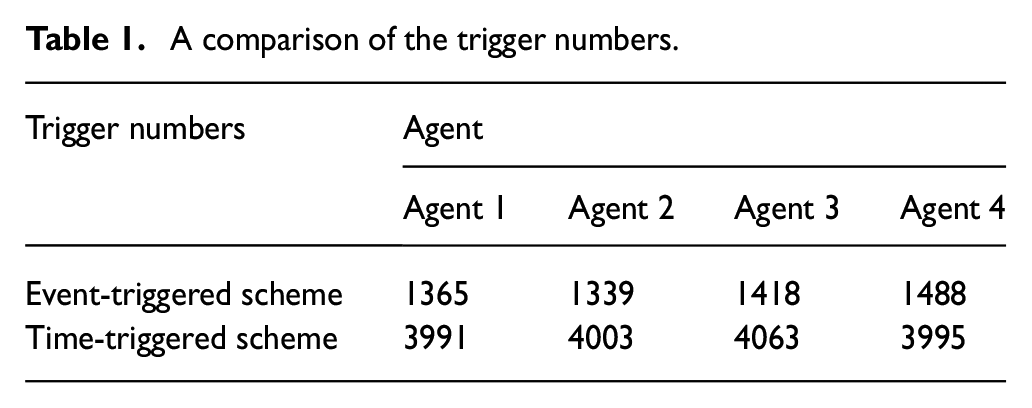
Remark 4. Compared with the time-triggered scheme such as in Li et al. (2021), which needs to update the controller continuously, the event-triggered scheme only updates the controller when the trigger condition (27) is satisfied. In other words, the controller remains constant in the time interval . Therefore, the event-triggered scheme can reduce the numbers of controller update and save energy.
The intermediate control signal is designed as
where are the constants.
For the ETC scheme (26)–(29), one has for , where are the time-varying parameters. Hence
Remark 5. The event-triggered consensus protocols (18), (25), and (26)–(29) are distributed, which only depend on the relative information between itself and its neighbor agents.
Theorem 1. Under Assumptions 1–3 and the control law (26)–(29), if the switching signal satisfies the ADT condition with constants and , then the tracking error of system (8) converging to a small bounded set of the origin can be ensured.
Proof. Construct the Lyapunov function candidate , where are provided in equation (15) and .
Applying the operator to along the trajectory of equation (24) yields that
Based on equations (19), (22), (24), and (64), are bounded, and then are bounded. As a result, all signals of the closed-loop system are bounded if the ADT condition is satisfied.
This completes the proof of Theorem 1.
Theorem 2. Consider SMASs (8) satisfying Assumptions 1–3. Under the proposed control scheme (26)–(29), the Zeno behavior does not occur, that is, .
Proof. Rescaling , and , then by computing the Dini derivative of over the interval , one drives that
From equation (29), is continuous for . Thus, with constant . Noting that , and , one obtains that the lower bound of inter-event time satisfies
that is, the Zeno behavior can be excluded.
Numerical example
An example is given to validate our main results in this section. Consider an SMAS with four followers and a leader. Set matrices , , , the nonlinear term , , and , . One can get that the nonlinear function meets the Assumption 1 with . Let the upper and lower bound of the control input be . Select parameters , , , , , , , , , , , and matrices , , , and . By solving the linear matrix inequalities in equation (15), one can obtain the positive definite matrix solutions
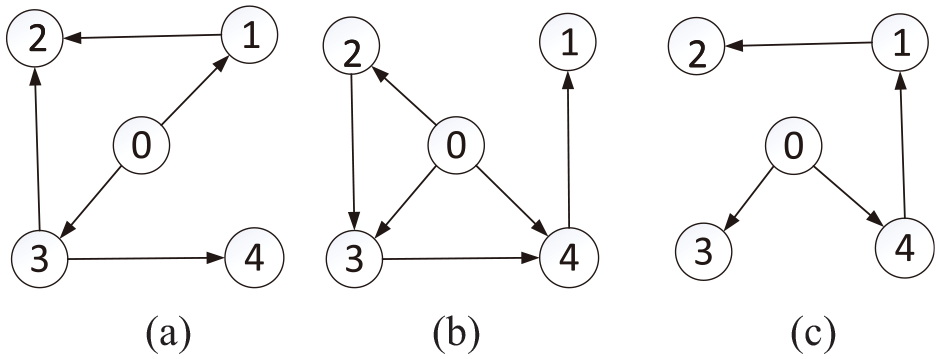
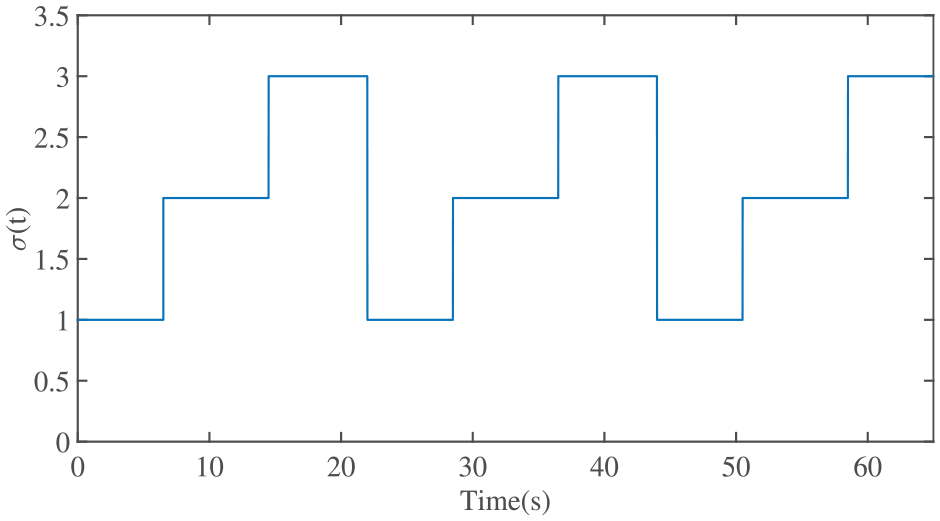
Three switching graphs labeled by (a), (b) and (c) are shown in Figure 1, which switch from (a), (b) to (c) cyclically according to the switching signal. Select the ADT as with . The switching signal is shown in Figure 2.
Switching graphs.
The curve of the switching signal .
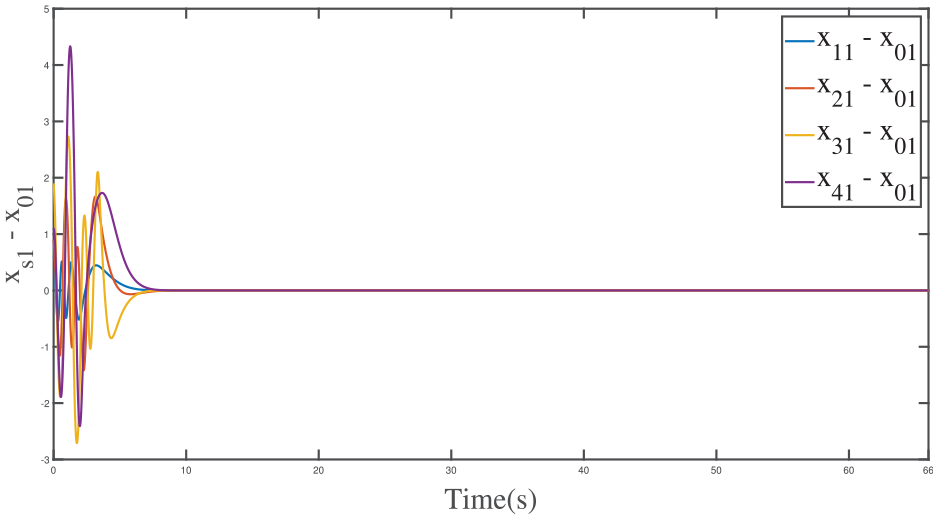
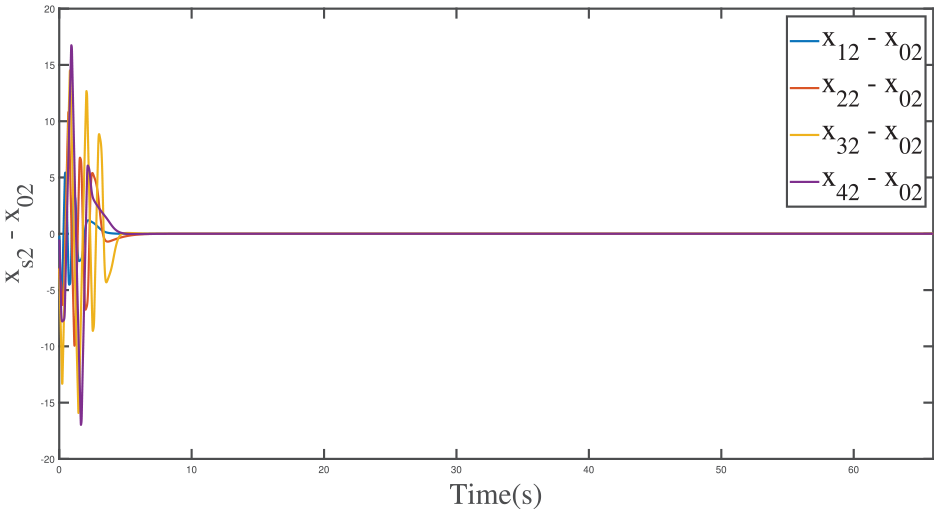
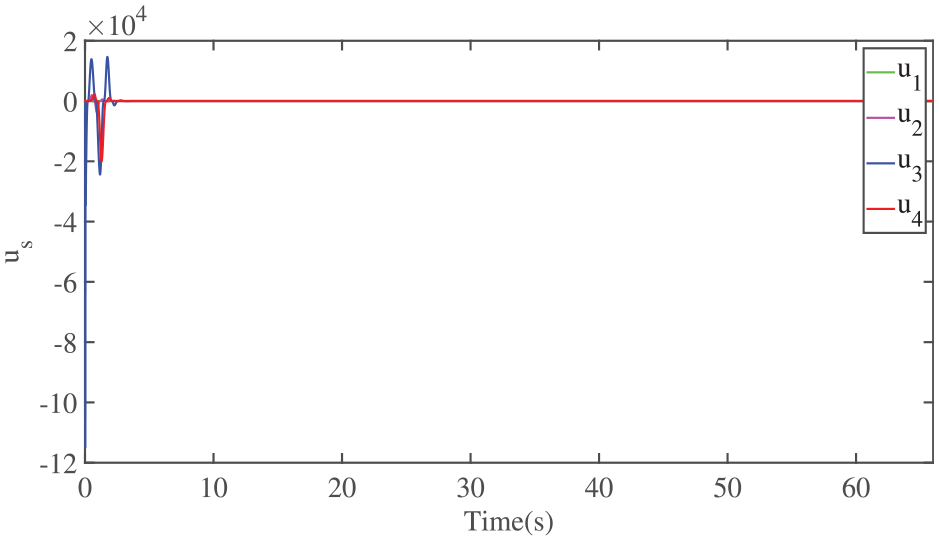
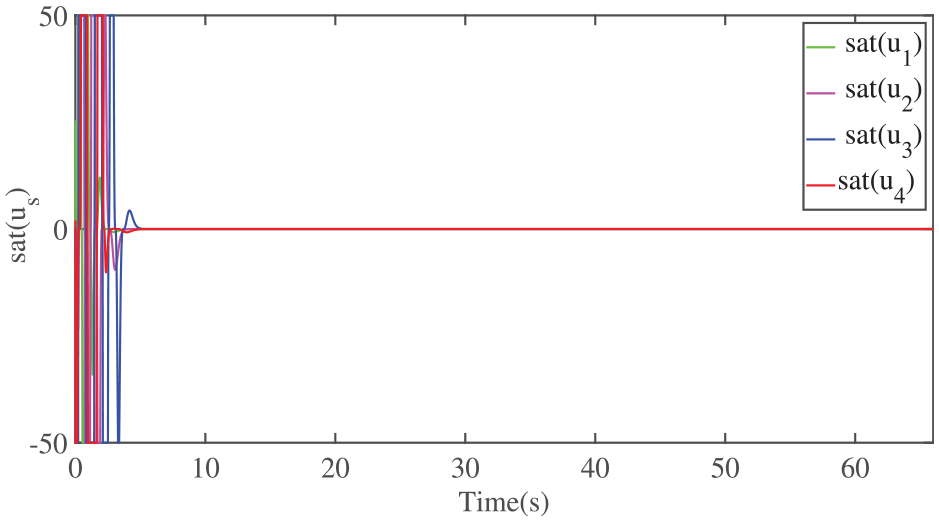
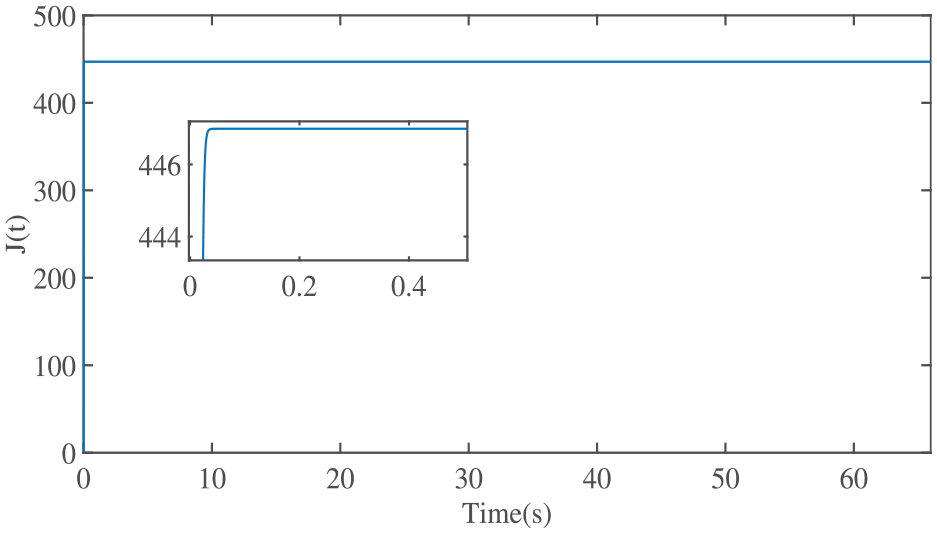
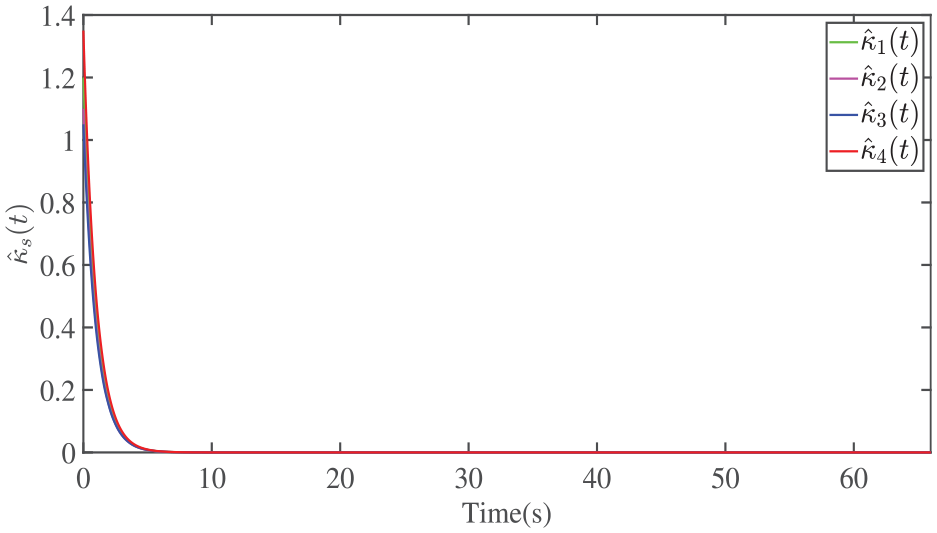
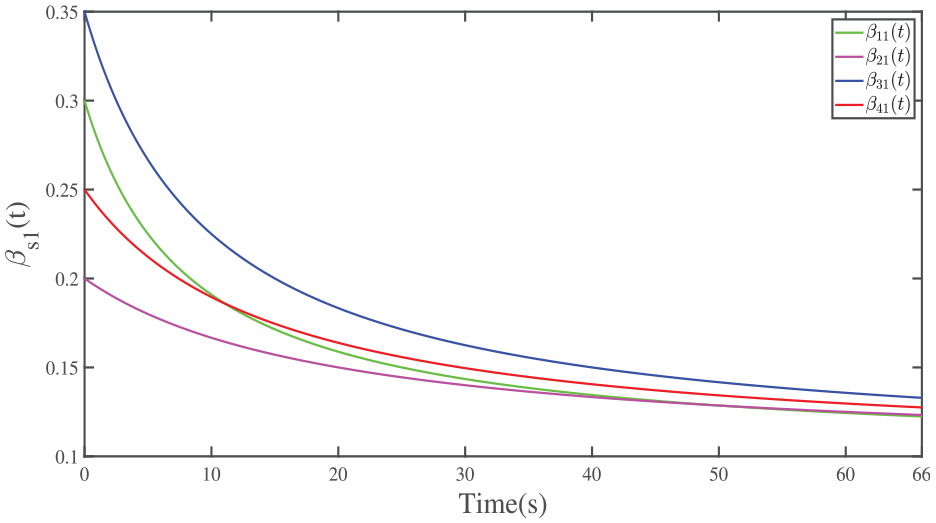
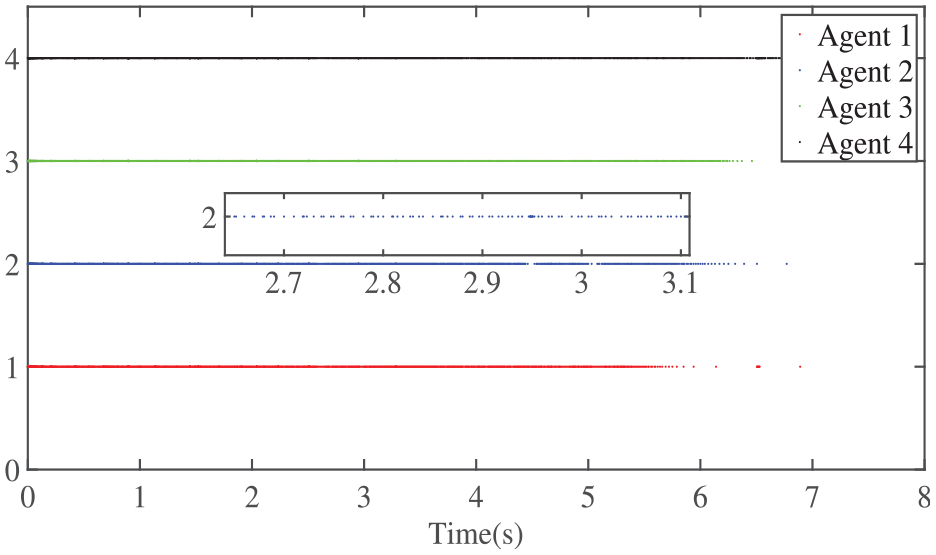
Select the initial values , , , , and . Within 66 seconds simulation time, the simulation results are presented in Figures 3–10. The curves of the tracking errors are shown in Figures 3 and 4. It can be seen from Figures 3 and 4 that a satisfactory tracking effect is achieved. The curves of the control input and the saturated input are depicted in Figures 5 and 6, respectively. It can be watched from Figures 5 and 6 that when the required control input is large, the saturated control input can still work well. The curve of dynamic gain is depicted in Figure 7, which is monotonically increasing and bounded. The curves of the adaptive parameters and the time-varying parameter are shown in Figures 8 and 9, respectively. The details of the triggering time instant are shown in Figure 10. Obviously, the Zeno behavior is ruled out successfully. To explain that the ETC scheme can reduce the numbers of controller update and then save energy, a comparison with time-triggered scheme is given in Table 1. From the Table 1, it can be seen that the trigger numbers of the event-triggered scheme are obviously less than those of the time-triggered one.
The curves of the tracking errors .
The curves of the tracking errors .
The curves of the control input .
The curves of the saturated input .
The curve of dynamic gain .
The curves of the adaptive parameters .
The curves of the parameters .
Triggering time instants of each agent.
A comparison of the trigger numbers.
Trigger numbers
Agent
Agent 1
Agent 2
Agent 3
Agent 4
Event-triggered scheme
1365
1339
1418
1488
Time-triggered scheme
3991
4003
4063
3995
Conclusion
In this paper, the consensus problem is addressed for SMASs with switching topologies via ETC strategy and output feedback. The uncertain nonlinearity, input saturation, and external disturbances are also considered, which makes the system model more general. The proposed controller can remove the adverse effects caused by the considered system complexity factors and save system resources due to the use of the ETC approach. Since the outputs of system are the only available data, the switched compensators play a key role in the design of controllers. By stability analysis, the consensus tracking with a bounded error is ensured, if the gained ADT condition can be satisfied. For future research works, the finite-time stability of above system with disturbance observer is an interesting topic.
Footnotes
Declaration of conflicting interests
The author(s) declared no potential conflicts of interest with respect to the research, authorship, and/or publication of this article.
Funding
The author(s) received no financial support for the research, authorship, and/or publication of this article.
ORCID iD
Wangjiang Li
References
1.
KrsticMDengH (1998) Stabilization of Nonlinear Uncertain Systems. London: Springer-Verlag.
2.
LiKHuaCYouX, et al. (2021) Leader-following consensus control for uncertain feedforward stochastic nonlinear multiagent systems. IEEE Transactions on Neural Networks and Learning Systems. Epub ahead of print 27 August. DOI: 10.1109/TNNLS.2021.3105109.
3.
LiKHuaCCYouX, et al. (2020a) Output feedback-based consensus control for nonlinear time delay multiagent systems. Automatica111: 108669.
4.
LiYLiHDingX, et al. (2018) Leader-follower consensus of multiagent systems with time delays over finite fields. IEEE Transactions on Cybernetics49(8): 3203–3208.
5.
LiYLiuLHuaC, et al. (2019) Event-triggered/self-triggered leader-following control of stochastic nonlinear multiagent systems using high-gain method. IEEE Transactions on Cybernetics51(6): 2969–2978.
6.
LiYParkJHWuL, et al. (2020b) Distributed output-feedback adaptive fuzzy leader-following consensus of stochastic nonlinear interconnected multiagent systems. IEEE Transactions on Systems, Man, and Cybernetics: Systems. Epub ahead of print 29 June. DOI: 10.1109/TSMC.2020.3002331.
7.
LiuYZhuQZhouX, et al. (2022) Adaptive fuzzy tracking of switched nonstrict-feedback nonlinear systems with state constraints based on event-triggered mechanism. ISA Transactions121: 30–39.
8.
LiuZChenBLinC (2018) Output-feedback control design for switched nonlinear systems: Adaptive neural backstepping approach. Information Sciences457: 62–75.
9.
MaLWangZLamHK (2016) Event-triggered mean-square consensus control for time-varying stochastic multi-agent system with sensor saturations. IEEE Transactions on Automatic Control62(7): 3524–3531.
10.
NiJShiP (2020) Adaptive neural network fixed-time leader–follower consensus for multiagent systems with constraints and disturbances. IEEE Transactions on Cybernetics51(4): 1835–1848.
11.
NiuBKongJZhaoX, et al. (2022) Event-triggered adaptive output-feedback control of switched stochastic nonlinear systems with actuator failures: A modified MDADT method. IEEE Transactions on Cybernetics. Epub ahead of print 9 May. DOI: 10.1109/TCYB.2022.3169142.
12.
PolycarpouMMIoannouPA (1993) A robust adaptive nonlinear control design. In: 1993 American control conference, San Francisco, CA, 2–4 June, pp. 1365–1369. New York: IEEE.
13.
ShaoJZhengWXHuangTZ, et al. (2018) On leader-follower consensus with switching topologies: An analysis inspired by pigeon hierarchies. IEEE Transactions on Automatic Control63(10): 3588–3593.
14.
TanLLiCHuangJ, et al. (2021) Output feedback leader-following consensus for nonlinear stochastic multiagent systems: The event-triggered method. Applied Mathematics and Computation395: 125879.
15.
WangFChenBLinC, et al. (2016) Distributed adaptive neural control for stochastic nonlinear multiagent systems. IEEE Transactions on Cybernetics47(7): 1795–1803.
16.
XiaJLiBSuSF, et al. (2020) Finite-time command filtered event-triggered adaptive fuzzy tracking control for stochastic nonlinear systems. IEEE Transactions on Fuzzy Systems29(7): 1815–1825.
17.
YangBLinW (2005) Robust output feedback stabilization of uncertain nonlinear systems with uncontrollable and unobservable linearization. IEEE Transactions on Automatic Control50(5): 619–630.
18.
YangYXiXMiaoS, et al. (2022) Event-triggered output feedback containment control for a class of stochastic nonlinear multi-agent systems. Applied Mathematics and Computation418: 126817.
19.
YooSJ (2018) Distributed consensus tracking of a class of asynchronously switched nonlinear multi-agent systems. Automatica87: 421–427.
20.
YouXHuaCCYuHN, et al. (2019) Leader-following consensus for high-order stochastic multi-agent systems via dynamic output feedback control. Automatica107: 418–424.
21.
ZhangDXuZSrinivasanD, et al. (2017) Leader-follower consensus of multiagent systems with energy constraints: A Markovian system approach. IEEE Transactions on Systems, Man, and Cybernetics: Systems47(7): 1727–1736.
ZhaoYYuHXiaX (2022) Event-triggered adaptive consensus for stochastic multi-agent systems with saturated input and partial state constraints. Information Sciences603: 16–41.
24.
ZhouJWangYZhengX, et al. (2019) Weighted H∞ consensus design for stochastic multi-agent systems subject to external disturbances and ADT switching topologies. Nonlinear Dynamics96(2): 853–868.
25.
ZhuZXiaYFuM (2011) Adaptive sliding mode control for attitude stabilization with actuator saturation. IEEE Transactions on Industrial Electronics58(10): 4898–4907.
26.
ZhuangJPengSWangY (2022) Leader-following consensus of discrete-time stochastic nonlinear multiagent systems under fixed and switching topologies via impulsive control. IEEE Systems Journal16: 6021–6030.
27.
ZouWAhnCKXiangZ (2019a) Event-triggered consensus tracking control of stochastic nonlinear multiagent systems. IEEE Systems Journal13(4): 4051–4059.
28.
ZouWShiPXiangZ, et al. (2019b) Consensus tracking control of switched stochastic nonlinear multiagent systems via event-triggered strategy. IEEE Transactions on Neural Networks and Learning Systems31(3): 1036–1045.