This paper presents adaptive time-delay control (TDC) with a supervising switching technique (SST) for controlling robot manipulators. Two adaptive techniques are used to enhance the TDC. The control gain of TDC is adaptively tuned using a class of Nussbaum functions. With Nussbaum functions, compared with conventional TDC using a constant gain, the proposed control using Nussbaum functions can deal with inertia parameter variations due to the movement of a robot manipulator. The SST is used to deal with discontinuous disturbances. The proposed control is model-free, highly accurate, robust and adaptive.
Motion control of robot manipulators is one of the most challenging tasks for many control engineers. The robot dynamics is highly nonlinear and strongly coupled due to nonlinear terms such as the gravity term, the friction term, the Coriolis and centrifugal terms and the disturbances term. The controllers (such as computed torque control, computed-torque-like control, sliding mode control and adaptive control) based on dynamic models of robots are highly complicated due to the calculation of the nonlinear terms of the robot dynamics equations (Geng et al., 2014; Lewis et al., 1993; Wang et al., 2014). Intelligent control techniques such as fuzzy control and neural networks have been used to obtain the ‘black box’ model of the robot manipulators for realization of model-free control (Cheng, 2015; Er and Gao, 2003; Han and Lee, 2014; Ishiguro et al., 1992; Lin, 2006). The use of intelligent controls, however, introduces another problem: one needs to tune a number of parameters which heavily affect the control performance. Therefore, in terms of simplicity, both model-based techniques and intelligent techniques are inadequate candidates for practical implementation.
The TDE-based controls employ constant gains, and these gains are tuned either by the trial-and-error method or by systematic methods (Jin et al., 2008, 2009, 2011). However, one cannot be sure whether the best tuned gains in a particular situation are also the best for other situations because the posture of a robot arm changes frequently. Moreover, the control system parameters continuously vary because of degradation of the motor, dried lubricating oil, and deformation caused by stress acting on the robot body. Hence, the TDC with constant gains cannot always guarantee high accuracy in trajectory tracking performance for a large number of robotic systems with parameter variations.
This paper presents adaptive time-delay control with a supervising switching technique (ATDC-SST) for controlling robot manipulators. Two adaptive techniques are used to enhance the TDC. First, the control gain of TDC for a robot manipulator is tuned adaptively using a class of Nussbaum functions (Nussbaum, 1983). The Nussbaum technique for the TDC is proposed for a class of single-input-single-output (SISO) systems with simulations using a single-degree-of-freedom (DOF) link (Cho et al., 2014b). We will present a custom-made controller for robot manipulators, which is a multi-input-multi-output (MIMO) system, with experiments using a PUMA-type robot manipulator. In addition, the SST is used to deal with discontinuous nonlinearities such as Coulomb friction. The SST (Cho et al., 2014a) was originally proposed to control and synchronize noise-free chaotic systems. In this paper, the SST is extended to compensate for discontinuous nonlinearities such as the Coulomb friction of the robot manipulator. Moreover, saturation of the SST gains is proposed in this paper to prevent parameter drift for a real robot system affected by noise. Consequently, a model-free robust adaptive controller is proposed for robot manipulators. The proposed ATDC-SST is model-free thanks to the TDE; thus, it is exempt from calculations of complex robot dynamics. The proposed control is adaptive thanks to the Nussbaum technique; thus, auto-tuning of the gain is possible. The proposed control is robust thanks to the concurrent use of TDE and SST; thus, compensation for parameter variations and disturbances is possible.
As a result, the ATDC-SST can deal with changes in the system dynamics more actively. The SST monitors the status of the system dynamics and enhances the switching intensity when the discontinuous disturbances or the fast-changing desired trajectory changes the system dynamics rapidly. Once the state variables of the system dynamics are settled down, the SST reduces the intensity to zero to avoid chattering. The switching gain is updated by an adaptive controller introduced in Huang et al. (2008). The control gain is automatically updated by the Nussbaum technique to improve the control accuracy as the state variables change the inertia matrix during the operation. It is shown that the closed-loop system with the proposed control is semi-globally uniformly ultimately bounded (UUB). The proposed ATDC-SST becomes model-free, highly accurate, robust and adaptive. The effectiveness and feasibility of the ATDC-SST are verified through experiments using a PUMA-type robot manipulator.
The paper is organized as follows. In ‘Preliminaries’, some concepts important to designing the ATDC-SST are introduced. In ‘ATDC-SST’, design of the ATDC-SST for a robot manipulator is presented. In ‘Stability analysis’, a stability analysis is given for the ATDC-SST. In ‘Experiments’, the ATDC-SST is applied to a PUMA-type robot manipulator. Finally, conclusions are presented.
Preliminaries
Definition 1. Nussbaum function (Nussbaum, 1983). A function is called a Nussbaum function if it satisfies
Proposition 1. (Du et al., 2010) An even differentiable function is of Nussbaum gain functions if the following Ryan-type condition holds
Proposition 2. The Nussbaum function satisfies
where .
Proof. It is derived as follows using Property 1 of the Nussbaum function in Du et al. (2010)
▪
Proposition 3. Suppose
where and , and is a constant. Then, the function satisfies Proposition 2.
Proof. It has been proven that if is a Nussbaum function, then is also a Nussbaum function from Properties 2 and 3 in Du et al. (2010). Similarly, it can be shown that satisfies Proposition 2.▪
Remark 1. In general, Nussbaum functions are used to estimate the control direction and gain. However, in many cases, the control direction of a robot arm is specified by vendor datasheets and it is fixed during operation. Hence, we modify the Nussbaum function to estimate the control gain only (Cho et al., 2014b).
ATDC-SST
The dynamics equation of an n-DOF robot manipulator in joint-space coordinates is given by
where represent the position, velocity and acceleration of the joints, respectively; is the symmetric and positive-definite generalized inertia matrix; is the Coriolis matrix; is the gravitational vector; is the friction; and is the control torque.
The control input can be designed by computed torque method
as
where is the desired joint acceleration, , and the sliding surface is . Hence, with the combination of (12) to (15), the TDC for the manipulator (Hsia and Gao, 1990; Youcef-Toumi and Ito, 1988) is given by
If TDE functions perfectly (i.e. ), then the closed-loop error dynamics becomes
and then it follows that
which is a conventional second-order dynamics equation characterized by the derivative gain and the proportional gain .
However, TDE error is inevitable with the constant gain . When the inertia parameter varies rapidly due to the movement of a robot manipulator, and when the effect of discontinuous disturbances (e.g. nonlinear friction such as Coulomb friction and stiction) is dominant, the closed-loop error dynamics is affected by the TDE error as
where .
To reduce the TDE error, two adaptive techniques are used in this paper. First, an adaptive gain , instead of the constant gain , is adopted. A Nussbaum function is used to adaptively adjust the control gain to improve the control accuracy as the state variables change the inertia matrix during the operation. A SST is used to deal with discontinuous disturbances which are the main cause of the TDE error. The switching gain of the SST is adaptively tuned to enhance the switching intensity when the states of the system rapidly change.
The control equation pertaining to the ATDC-SST is as follows
where ; is the sliding surface; and are the slopes of the desired error dynamics given in (17); is a signum function whose ith element is the sign of ; and , and are diagonal matrices whose th element is defined as
where a Nussbaum function.
The intensity of the system dynamics movement, , is given as
It is obvious that when a discontinuous disturbance occurs or the desired trajectory is rapidly changing, the intensity increases in proportion to the state variables. Hence, the enhanced switching gain effectively compensates for the tracking error. On the other hand, once the state variables of the control system are settled, the intensity immediately decreases to zero. Hence, the proposed controller can reduce chattering.
The adaptive algorithms for the TDC gain and the switching gains and are as follows
where is an adaptive gain to estimate the control gain; and are adaptive gains to estimate the switching gain of the soft and the hard nonlinearity, respectively; and are upper bounds to prevent drift of the switching gains; ; ; and
The update rule for the switching gain is due to Huang et al. (2008). The update rule for the switching gain is inspired by Cho et al. (2014a). Both and converge to positive constants in a noise-free ideal simulation environment. However, in practical robotic systems, signal noise is inevitable, and and gradually increase and cause overestimation of parameters. Therefore, to implement the proposed ATDC-SST for real robot systems, we have adopted the saturation techniques of adaptive control, which are widely accepted to prevent parameter drift (Chang, 2009; Li et al., 2011; Xiao et al., 2012; Zhu et al., 2011).
with and . If we let , the proposed control becomes the TDC-SST, as
with and . The TDC (25) is inherently robust to payload variations and other uncertainties, because these effects are automatically estimated and cancelled by the TDE (Hsia et al., 1991). Under very rapid dynamics of friction, the TDC revealed the robustness problem, and it has been shown that the robustness problem comes from the TDE error (Cho et al., 2009). Because the TDE error causes the resulting dynamics to deviate from the desired error dynamics as shown in (19), the tracking error reduction is an outcome of the reduced TDE error. Thus, for the TDE-based controllers, suppressing the TDE error is identical to enhancing robustness and reducing tracking error (Cho et al., 2009; Jin et al., 2008, 2009). The SST, which was originally proposed to control chaotic systems, has been shown to be effective to counteract TDE error (Cho et al., 2014a). In this paper, the SST is extended to compensate for discontinuous nonlinearities of the robot manipulator, and saturation is introduced for the gains of the SST to prevent parameter drift for a real robot system affected by noise. Hence, we can expect that the robustness of the TDC can be enhanced with the modified SST. Moreover, in the proposed control, the Nussbaum function is adaptively updated to improve control accuracy when the inertia matrix changes during the operation.
Consequently, the proposed ATDC-SST for a robot manipulator has the following merits: first, due to the use of the TDE, calculations of the complex robot dynamics are not required. Second, due to the use of the SST, the TDE error is suppressed and robustness of the TDC is improved. Third, due to the use of the Nussbaum technique, the proposed controller can adaptively adjust the control gain to improve control accuracy. The proposed control is model-free, robust, highly accurate and adaptive.
In the proposed control (20), the time delay L is selected to be the sampling time. As is apparent in equation (12), the time delay is used on purpose to eliminate uncertainty, and its magnitude should be selected such that . For this reason, L is required to be sufficiently small, unless it interferes with noise sensitivity. It is reported that when the sensor signal is noisy, adjusting L to be a multiple of the sampling time could be a good solution (Youcef-Toumi and Huang, 1993; Youcef-Toumi and Wu, 1992). However, the analysis on the time delay stated that there is an upper limit of time delay for stability, and a smaller time delay is required for a faster plant (Youcef-Toumi and Huang, 1993; Youcef-Toumi and Wu, 1992). Increasing L causes the closed-loop system to be less sensitive to noise, yet deteriorates stability, robustness and command-following. In most cases in the literature, L is the sampling time which is the smallest achievable time delay in practical digital implementation. We think that in-depth research on systems with multiple time-delay in conjunction with TDE is very challenging and yet an important direction to work in.
Stability analysis
To prove the stability of the closed-loop system involving a Nussbaum function, the following definition from Ge and Jing (2002) is used in the subsequent proof.
Definition 2. The solution of system (9) is semi-globally UUB, if, for any compact set , there exist and such that for all and .
The following theorem shows that the output of the closed-loop system is semi-globally UUB.
Theorem 1. The tracking error of the closed-loop system (9) with (20) and (23) is semi-globally UUB.
Proof. Let us consider a Lyapunov function
where . Then, it follows that
On the other hand, it follows from (9) that
where represents soft nonlinearity and represents hard nonlinearity (Jin et al., 2008)
is a positive-definite control gain that satisfies
for all . Using TDE, we approximate and as
Hence, it follows from (29) that
where and . Substituting the control input given in (20) into the above equation and using (24), we obtain
where . Substituting (35) into (28), we obtain
where c is the smallest eigenvalue of . According to Youcef-Toumi and Ito (1988), if satisfies (32), then and are bounded. Hence, hard nonlinearity is bounded as
On the other hand, because soft nonlinearity satisfies the Lipschitz condition, its bound is given as
Thus, combining (37) and (38), the bound of the TDE error is derived as
Using (23b), (23c) and (39), it follows from (36) that
From (23a) and the definition of the Lyapunov function (27), we obtain
where is the th element of , and
Multiplying on both sides and then integrating over , we obtain
where
Because is bounded and , is also a class of Nussbaum functions.
Suppose that for a given , is unbounded such that
From Proposition 2, it follows from (43) that
which is a contradiction because for all . Similarly, the same condition holds as . Hence, , and must be bounded, and we obtain
▪
where is a positive constant. Hence, the closed-loop system is semi-globally UUB.
Experiments
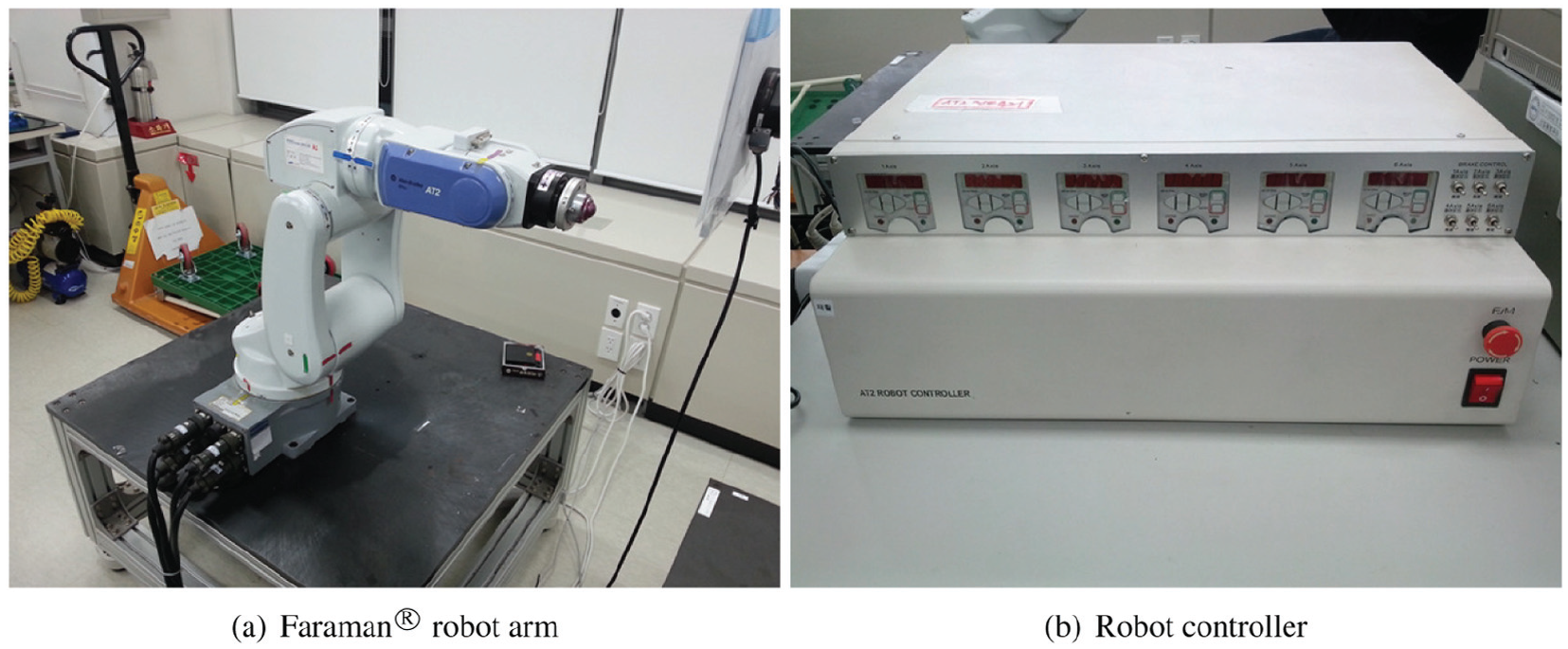
A PUMA-type robot, Faraman AT2® (Samsung Electronics, Figure 1), is used for the experiments. The maximum payload of the robot is 3 kg. The maximum continuous torques are 0.637, 0.637 and 0.319 Nm for joints 1, 2 and 3, respectively. The gear reduction ratio of each joint is 120:1, the encoder resolution of each joint is 8192 pulses/rev, and the final resolution of each robot joint is 0.000366°.
Experimental setup.
Generally, sufficiently small L is crucial for the TDE to function correctly for TDE-based controllers (Jin et al., 2008, 2009, 2011). The smallest achievable L is the sampling period of the controller in digital implementation. An Advantech industrial PC with a multi-functional data acquisition board (Sensoray S626) is used as the control hardware device. The conversion time of the sensory S626 board for analog outputs is 0.6 ms (0.2 ms/channel × 3 channels), and it requires additional computing time for calculations of control equations, memory management and encoder signal processing. For our experimental setup, L is selected to be 1 ms, which is the smallest achievable sampling period.
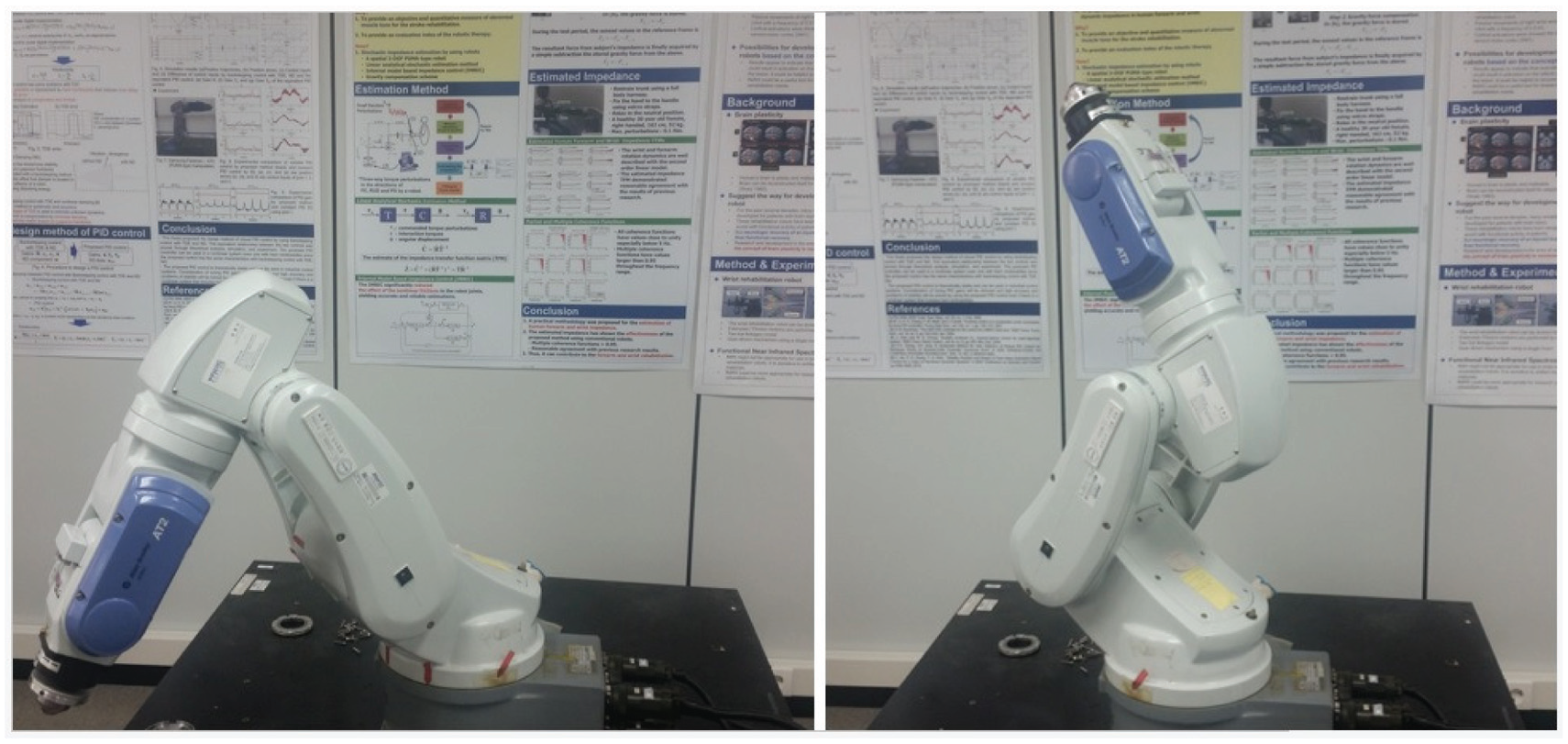
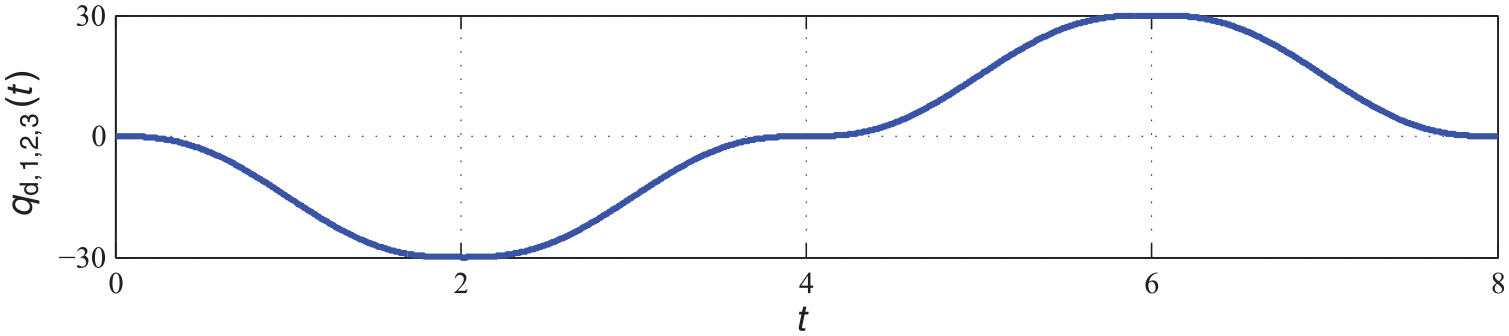
The control objective is to rotate each joint from the initial position () to the first desired position (), and then return to the initial position for ; this process is repeated for the second desired position () for (Figure 2). The desired trajectory is generated using the fifth polynomial method (Figure 3; Craig, 2004).
Postures of the Faraman AT2: the first desired position (left) and the second desired position (right).
Desired joint positions.
The control gains are selected as follows: and (i.e. and ). The adaptive control parameters are selected as ; ; ; ; ; and .
We use one of the well-known Nussbaum functions as follows
For comparison, the experiments are conducted with the TDC (25) and the TDC-SST (26). The switching gains of the SST are estimated by using (23b) and (23c). The parameters were selected to obtain critically damped error dynamics as and . In (25) and (26), the control gain is tuned heuristically. The high-order time-delay term is derived from the encoder as follows
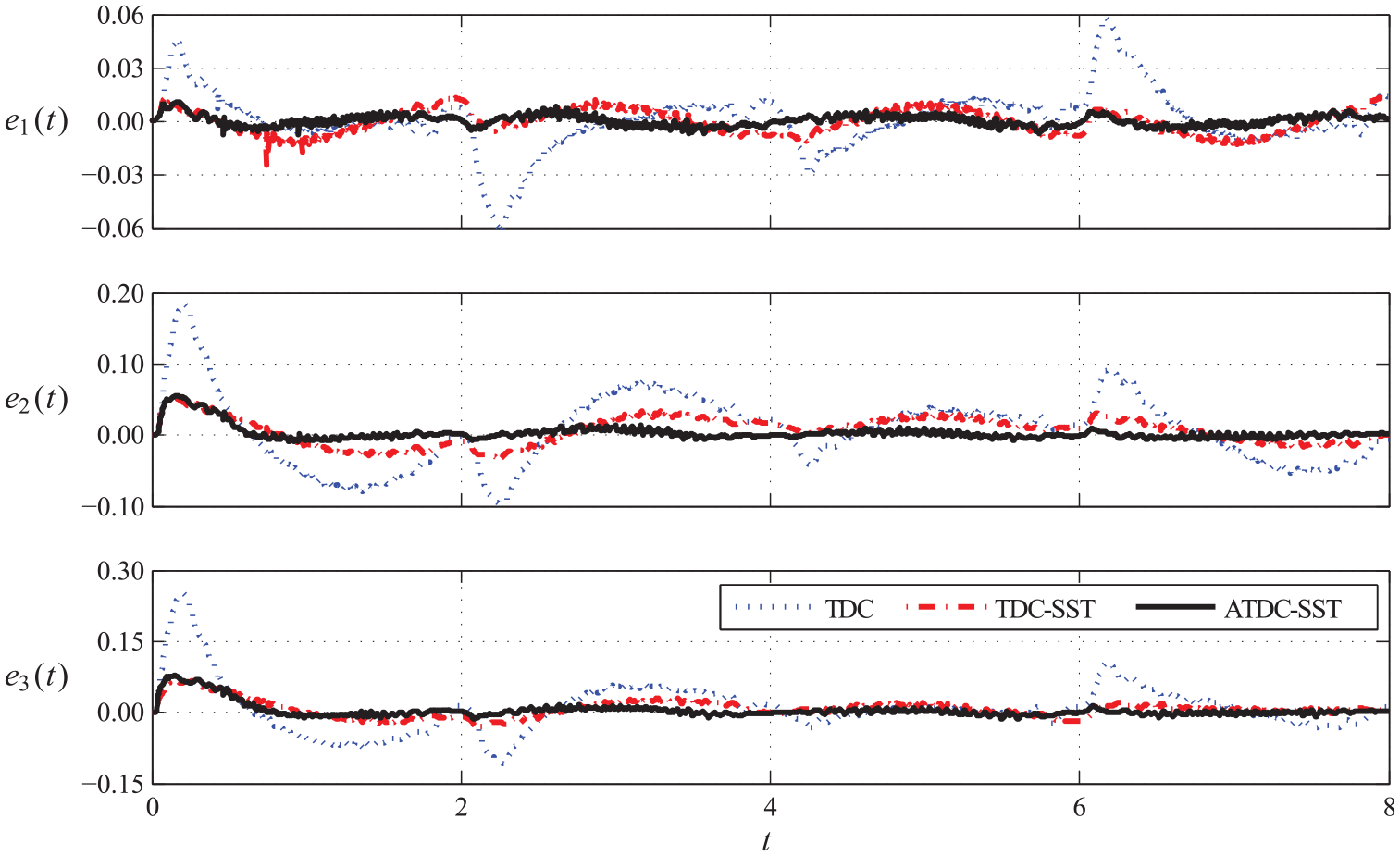
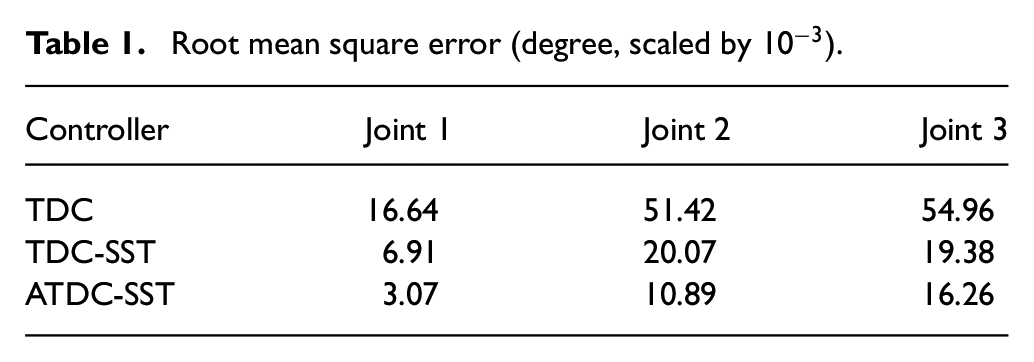
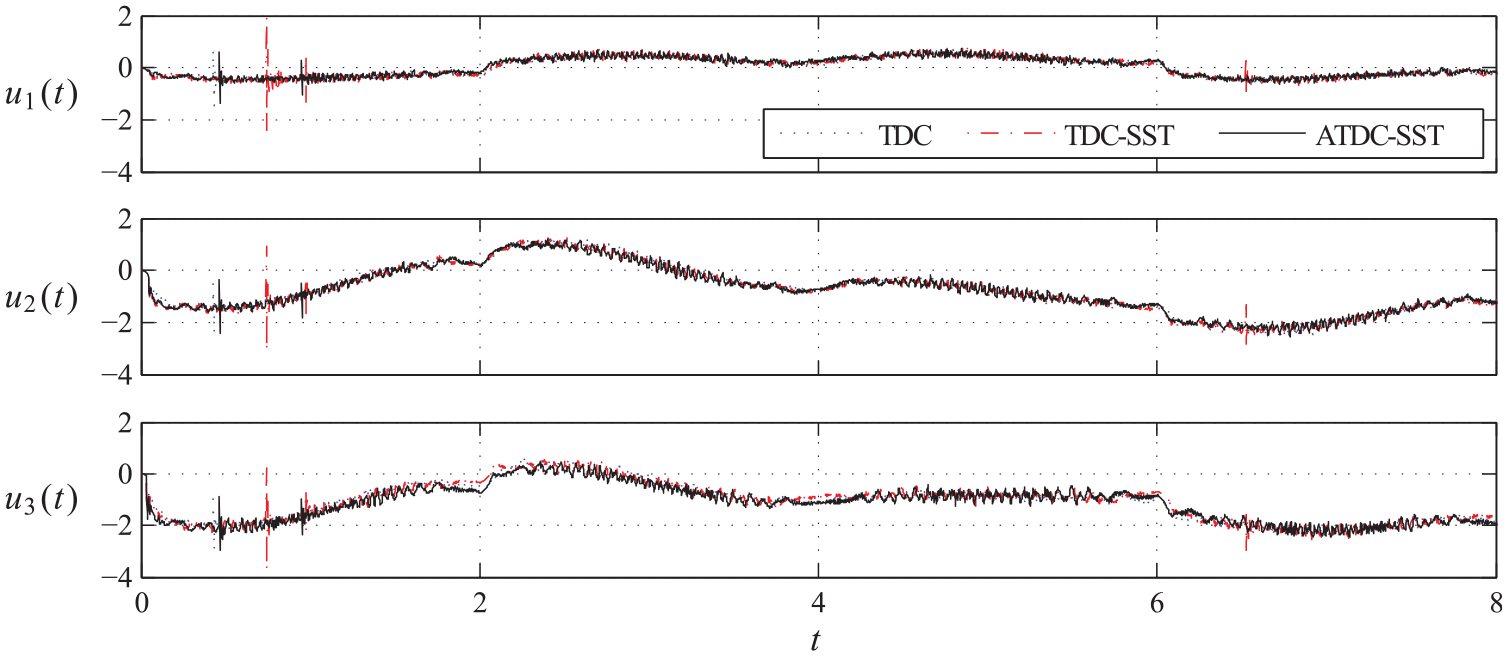
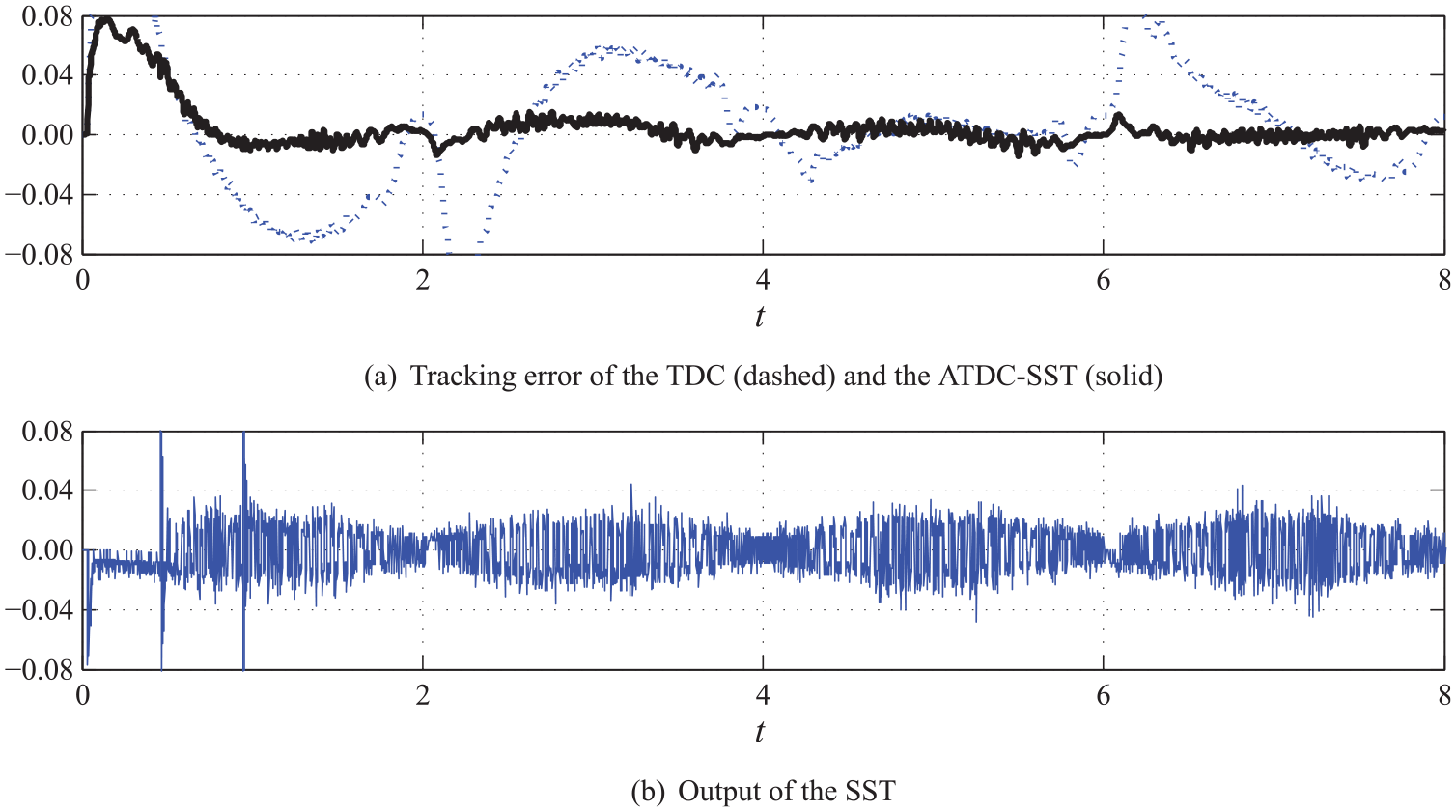
The tracking errors of the joints are shown in Figure 4 and listed Table 1, and the control inputs are shown in Figure 5. The ATDC-SST shows the best tracking performance among the three controllers (i.e. the TDC, the TDC-SST and the ATDC-SST). The TDC can improve robustness by accepting the SST because the switching action can compensate for discontinuous disturbances such as Coulomb friction at velocity reversal. Figure 6 shows that the SST output increases roughly in proportion to the tracking error. Note that the intensity of the SST increases the switching gain when the states of the system rapidly change near , 3, 5 and 7 s, and decreases it when the states of the system change slowly at around , 2, 4, 6 and 8 s. Hence, the SST not only improves the accuracy of the TDC but also reduces chattering when the state variables converge to desired positions.
Joint position errors.
Root mean square error (degree, scaled by ).
Controller
Joint 1
Joint 2
Joint 3
TDC
16.64
51.42
54.96
TDC-SST
6.91
20.07
19.38
ATDC-SST
3.07
10.89
16.26
Control inputs.
The switching amplitude of the SST at the third joint increases proportionally to the error.
By adding the adaptive controller given in (23a) to the TDC-SST, the tracking accuracy of the TDC-SST is improved further because the ATDC-SST can handle the varying system dynamics more effectively than the TDC-SST. Since the inertia matrix changes during the operation, the control accuracy of the TDC (or the TDC-SST) is not uniform. Sometimes the control accuracy is comparable to the ATDC-SST but it cannot be always guaranteed. In contrast, the ATDC-SST adaptively adjusts the control gain using the Nussbaum function as the state variables change the inertia matrix during the operation. Hence, the ATDC-SST can improve the control accuracy of the TDC or the TDC-SST. Consequently, the proposed ATDC-SST provides a highly accurate trajectory tracking solution for control of robot manipulators.
Conclusion
The ATDC-SST is proposed for robot manipulators. Two adaptive control strategies are presented for controlling robot manipulators with the TDC. First, the adaptive technique is used with a class of Nussbaum functions to automatically adjust the control gain of the TDC, . Second, the adaptive technique is used to adjust the gains of the robust SST, and . As a result, the proposed control provides good tracking despite the presence of unknown parameters and nonlinear uncertainties in the system dynamics. Compared with the TDC, which has constant gains, the proposed control can not only deal with a dynamic change in the inertia parameters due to movement of the robot arms, but also deal with disturbances such as friction. The SST increases when the states of the system rapidly change to compensate for errors adaptively, and the SST automatically reduces its switching amplitude when the system states vary slowly. It is shown that a closed-loop system with the proposed controller is semi-globally UUB. The effectiveness and feasibility of the proposed ATDC-SST is verified through experiments. The proposed ATDC-SST is model-free, highly accurate, robust and adaptive.
Footnotes
Conflict of interest
The authors declare that there is no conflict of interest.
Funding
The author(s) disclosed receipt of the following financial support for the research, authorship, and/or publication of this article: This work was supported by the Energy Efficiency & Resources Core Technology Program of the Korea Institute of Energy Technology Evaluation and Planning (KETEP) from the Ministry of Trade, Industry & Energy, Republic of Korea (grant number 20132020102070).
References
1.
ChangY (2009) Adaptive sliding mode control of multi-input nonlinear systems with perturbations to achieve asymptotical stability. IEEE Transactions on Automatic Control54(12): 2863–2869.
2.
ChengW (2015) Neural-fuzzy control of a flexible dynamic tracking and adjusting manipulator. Transactions of the Institute of Measurement and Control37(7): 883–891.
3.
ChoGRChangPHParkSHet al. (2009) Robust tracking under nonlinear friction using time-delay control with internal model. IEEE Transactions on Control Systems Technology17(6): 1406–1414.
4.
ChoSJJinMKucTYet al. (2014a) Control and synchronization of chaos systems using time-delay estimation and supervising switching control. Nonlinear Dynamics75(2): 549–560.
5.
ChoSJJinMKucTYet al. (2014b) Stability guaranteed auto-tuning algorithm of a time-delay controller using a modified Nussbaum function. International Journal of Control87(9): 1926–1935.
6.
CraigJ (2004) Introduction to Robotics: Mechanics and Control. 3rd ed.Upper Saddle River, NJ: Prentice Hall.
7.
DuHGeSSLiuJK (2010) Adaptive neural network output feedback control for a class of non-affine non-linear systems with unmodelled dynamics. IET Control Theory & Applications5(3): 465–477.
8.
ErMJGaoY (2003) Robust adaptive control of robot manipulators using generalized fuzzy neural networks. IEEE Transactions on Industrial Electronics50(3): 620–628.
9.
GengJShengYLiuX (2014) Time-varying nonsingular terminal sliding mode control for robot manipulators. Transactions of the Institute of Measurement and Control36(5): 604–617.
10.
GeSSJingW (2002) Robust adaptive neural control for a class of perturbed strict feedback nonlinear systems. IEEE Transactions on Neural Networks13(6): 1409–1419.
11.
HanSLeeJ (2014) Fuzzy echo state neural networks and funnel dynamic surface control for prescribed performance of a nonlinear dynamic system. IEEE Transactions on Industrial Electronics61(2): 1099–1112.
12.
HsiaT (1989) A new technique for robust control of servo systems. IEEE Transactions on Industrial Electronics36(1): 1–7.
13.
HsiaTGaoL (1990) Robot manipulator control using decentralized linear time-invariant time-delayed joint controllers. In: Proceedings of the 1990 IEEE international conference on robotics and automation, pp.2070–2075.
14.
HsiaTJungS (1995) A simple alternative to neural network control scheme for robot manipulators. IEEE Transactions on Industrial Electronics42(4): 414–416.
15.
HsiaTCLaskyTAGuoZ (1991) Robust independent joint controller design for industrial robot manipulators. IEEE Transactions on Industrial Electronics38(1): 21–25.
16.
HuangYJKuoTCChangSH (2008) Adaptive sliding-mode control for nonlinear systems with uncertain parameters. IEEE Transactions on Systems, Man, and Cybernetics, Part B: Cybernetics38(2): 534–539.
17.
IshiguroAFuruhashiTOkumaSet al. (1992) A neural network compensator for uncertainties of robotics manipulators. IEEE Transactions on Industrial Electronics39(6): 565–570.
18.
JinMJinYChangPHet al. (2011) High-accuracy tracking control of robot manipulators using time delay estimation and terminal sliding mode. International Journal of Advanced Robotic Systems8(4): 65–78.
19.
JinMKangSHChangPH (2008) Robust compliant motion control of robot with nonlinear friction using time-delay estimation. IEEE Transactions on Industrial Electronics55(1): 258–269.
20.
JinMLeeJAhnKK (2015) Continuous nonsingular terminal sliding-mode control of shape memory alloy actuators using time delay estimation. IEEE/ASME Transactions on Mechatronics20(2): 899–909.
21.
JinMLeeJOChangPHet al. (2009) Practical nonsingular terminal sliding-mode control of robot manipulators for high-accuracy tracking control. IEEE Transactions on Industrial Electronics56(9): 3593–3601.
22.
LeeJChangPHJamisolaRS (2014) Relative impedance control for dual-arm robots performing asymmetric bimanual tasks. IEEE Transactions on Industrial Electronics61(7): 3786–3796.
23.
LewisFLAbdallahCTDawsonDM (1993) Control of Robot Manipulators. New York, NY: Macmillan.
24.
LiHBaiYSuZ (2011) Adaptive sliding mode control of electromechanical actuator with improved parameter estimation. In: 2011 eighth Asian control conference (ASCC), pp.608–612.
25.
LinCK (2006) Nonsingular terminal sliding mode control of robot manipulators using fuzzy wavelet networks. IEEE Transactions on Fuzzy Systems14(6): 849–859.
26.
NussbaumRD (1983) Some remarks on a conjecture in parameter adaptive control. Systems & Control Letters3(5): 243–246.
27.
WangXNiuRChenCet al. (2014) H∞ switched adaptive control for a class of robot manipulators. Transactions of the Institute of Measurement and Control36(3): 347–353.
28.
XiaoBHuQZhangY (2012) Adaptive sliding mode fault tolerant attitude tracking control for flexible spacecraft under actuator saturation. IEEE Transactions on Control Systems Technology20(6): 1605–1612.
29.
Youcef-ToumiKHuangSY (1993) Analysis of a time delay control based on convolutions. In: American control conference, pp.2582–2586.
30.
Youcef-ToumiKItoO (1988) A time delay controller for systems with unknown dynamics. In: American control conference, pp.904–913.
31.
Youcef-ToumiKItoO (1990) A time delay controller for systems with unknown dynamics. Journal of Dynamic Systems, Measurement, and Control112(1): 133–142.
32.
Youcef-ToumiKWuST (1992) Robustness and stability analysis of time delay control. In: American control conference, pp.2691–2695.
33.
ZhangTPGeSS (2007) Adaptive neural control of MIMO nonlinear state time-varying delay systems with unknown dead-zones and gain signs. Automatica43(6): 1021–1033.
34.
ZhuZXiaYFuM (2011) Adaptive sliding mode control for attitude stabilization with actuator saturation. IEEE Transactions on Industrial Electronics58(10): 4898–4907.