This paper considers the adaptive state-feedback control problem for a class of high-order non-linear systems with unknown control coefficient and time delays. By applying the neural network approximation method and the Nussbaum function approach, the restrictions on non-linear functions and the conditions on the time-varying control coefficient are largely relaxed. In addition, an adaptive neural network state-feedback controller with only one adaptive parameter is successfully constructed by introducing proper Lyapunov–Krasovskii functionals and using the backstepping technique. The proposed scheme guarantees the closed-loop system to be semi-globally uniformly ultimately bounded. Finally, a simulation example demonstrates the effectiveness of the controller.
In this paper, we consider the following high-order non-linear system
where , , are system measurable states and control input, respectively; are odd integers. System (1) is said to be a high-order non-linear system if there exists at least one , in which are high-order; is an unknown bounded time-varying continuous function called the control coefficient. and are continuous locally Lipschitz functions with and ; denote the unknown time delays.
When , the control problems for system (1) with different structures have received much attention; see Ibrir (2011), Joa et al. (2014), Man and Liu (2016), Mirkin (2010), Zhang and Xu (2015) and the references therein. When , the stabilization problems for system (1) were investigated in Lin (2010), Lin and Qian (2000), Qian and Lin (2002) and Sun and Liu (2007) under restrictive growth conditions. To relax the growth conditions, a novel systematic design method, namely the homogeneous domination approach, was originally developed for non-linear systems in Qian (2005). Subsequently, Qian and Lin (2006) and Polendo and Qian (2007) extended these results to output-feedback stabilization of high-order non-linear systems. However, Polendo and Qian (2007), Qian (2005) and Qian and Lin (2006) did not consider time delays. Since time delays and control coefficients are common in many practical systems that may affect system stability, the design and investigation of non-linear time-delay systems with unknown control coefficients is of great importance. By combining the homogeneous domination approach with appropriate Lyapunov–Krasovskii functionals, Gao and Wu (2015a,b), Zhang et al. (2014) and Zhang and Lin (2014) proposed different control schemes for time-delay systems in the absence of control coefficients. In Gao et al. (2013), the authors explicitly constructed a state-feedback controller for a class of high-order non-linear systems with time delays and unknown control coefficients being bounded by two positive constants. Note that all the mentioned results (Gao et al., 2013; Gao and Wu, 2015a,b; Zhang et al., 2014; Zhang and Lin, 2014) still require the growth conditions with the value range of the degree of homogeneity being either a fixed point or on an interval even when using the homogeneous domination approach. This is somewhat restrictive from a practical and theoretical viewpoint. Therefore, further weakening the growth conditions on system non-linearities becomes an important issue.
To deal with the above problem, a neural network (NN) approximation approach has gradually been considered for its universal approximation capacity of handling unknown non-linearities. As shown in Ge et al. (1999), the radial basis function neural network (RBF NN) can be considered as a two-layer NN in which the hidden layer performs a fixed non-linear transformation with no adjustable parameters to map the input space into an intermediate space; then the output layer combines the outputs of the intermediate layer linearly as the outputs of the whole network. Therefore, they belong to a class of linearly parameterized networks and have good approximation ability. In recent years, RBF NN has obtained fruitful results for one-order non-linear systems (Chen et al., 2009, 2010, 2015; Ge et al., 2003; Ge and Wang, 2002; Hua et al., 2014; Huang et al., 2005; Jiang et al., 2015; Yoo et al., 2009; Zhou et al., 2013). In particular, by defining a parameter which is related to the nodes and weight vectors of NN, a novel RBF NN approximation approach was presented in Zhou et al. (2013) that did not need RBF NN to be known a priori. On the other hand, based on the RBF NN approximation approach and other design techniques, for non-linear systems with an unknown control coefficient, the Nussbaum-type gain function approach proposed by Marteusson (1990) has been proven to be an useful tool in Ge and Wang (2003), Ho et al. (2005), Liu (2007), Wang et al. (2013), Wen and Ren (2011), Yu and Li (2014) and Zhao et al. (2007).
However, for a more general non-linear system (1), the existence of high-orders , time delays and the time-varying unknown control coefficient will result in a much greater difficulty during the control procedure. Stabilizing this kind of system by combining RBF NN with a Nussbaum-type gain function is difficult.
This paper focuses on the adaptive state-feedback control problem for a class of high-order non-linear system with unknown control coefficient and time delays. The main contributions are listed as follows.
The considered time-delay system is more general with an unknown time-varying control coefficient.
An adaptive state-feedback controller is successfully constructed to guarantee the closed-loop system to be semi-globally uniformly ultimately bounded (SGUUB) by applying the Lyapunov–Krasovskii functional and backstepping technique.
The remainder of this paper is organized as follows. The second section begins with preliminaries and problem formulation. The design and analysis of the adaptive state-feedback controller are presented in the third and fourth sections, respectively. In the fifth section, a simulation example is given. The sixth section concludes the paper. Some necessary proof is given in the Appendix.
Preliminaries and problem formulation
Notations: denotes the set of all non-negative real numbers; is the n-dimensional Euclidean space; denotes the family of all the functions with continuous second partial derivations; ∥·∥ denotes the Euclidean norm of a vector or its induced matrix norm. For simplicity, we sometimes denote by X for any variable .
The following definitions and lemmas are to be used throughout the paper.
Definition 1 (Ge et al., 1999). The solution of system (1) is SGUUB, if for any (some compact set containing the origin) and initial conditions , there exist a and a number such that for all .
To deal with the unknown control coefficient , the Nussbaum function approach is employed.
Definition 2 (Nussbaum, 1983). A function is called a Nussbaum-type function if it has the following properties
By Definition 2, it is easy to prove that for a smooth Nussbaum function , is also a smooth Nussbaum function with being an odd number. To the best of our knowledge, there are many functions satisfying the above properties, for example, , and . Throughout this paper, the Nussbaum function is exploited.
Lemma 1 (Ge and Wang, 2003). Let and be smooth functions defined on with , , where and let be an even smooth Nussbaum function, if the following inequality
holds, where , represent some suitable constants, and is a time-varying parameter that takes values in the unknown closed intervals with , then , and must be bounded on .
Lemma 2 (Young’s inequality). For , holds, where , and .
Lemma 3 (Lin and Qian, 2000). Let be real variables, then for any real numbers and continuous function , one has .
Lemma 4 (Qian and Lin, 2002). For real variables , , then , where is a real number.
In the following, RBF NN will be used to handle the unknown non-linear functions. The universal approximation result in Sanner and Slotine (1992) indicates that, if the node number is chosen to be sufficiently large, RBF NN can approximate any continuous function to any desired accuracy over a compact set as
where is the approximation error, and is the known function vector with being RBF NN node number. The basis functions () are chosen as , where is the width of the function; are the centres of the receptive field; is the ideal constant weight vector with the form
where is the value of variable W when the objective function is at a minimum with being the weight vector.
The control objective of this paper is to construct an adaptive state-feedback controller based on the RBF NN approximation approach and the Nussbaum function approach for system (1) such that the closed-loop system is SGUUB. To achieve this control objective, we need the following assumptions.
Assumption 1. The sign of the time-varying control coefficient is unknown and takes a value in an unknown closed interval with .
To facilitate the design process, following coordinate transformation is introduced
where are virtual control laws to be designed. Then, based on the above coordinate transformation, we further give the following assumption.
Assumption 2. For , there exist unknown non-negative functions such that .
Remark 1. Assumption 1 on unknown control coefficient is reasonable. A similar assumption can be seen in Ge and Wang (2003). In comparison to Ho et al. (2005), Assumption 2 is more general because the functions are not assumed to be known.
Design of an adaptive state-feedback controller
Before the backstepping design procedure, we define a novel constant, which is the basis of RBF NN approximation
where are the numbers of RBF NN nodes, are the ideal constant weight vectors. Now, we start the following recursive design process.
Step 1. Choose the first Lyapunov–Krasovskii function candidate as
To proceed further, we give the following estimate. With the use of RBF NN approximation (2), for any given , there exists such that
where and is a defined compact set through which the state trajectories may travel. According to and equation (4), we have
In terms of Lemma 2, Lemma 4 and equation (11), one obtains
where , , , and equations (11) and (12) are used to handle non-linear terms in the absence of time delays, which are the direct application of RBF NN approximation (2).
Hence, at step n, choosing the Lyapunov–Krasovskii functional candidate
one has
where , , , , , and . By constructing the adaptive state-feedback controller as
one yields
where is a design constant and .
Remark 2. Two points are stressed in this remark.
We give the motivation for selecting Lyapunov–Krasovskii functionals (5), (6), (15) and (18). The term is used to handle the adaptive parameter during the RBF NN approximation process. are positive and used to deal with the delay terms. Obviously, these Lyapunov–Krasovskii functionals are positive definite and differentiable. A similar Lyapunov–Krasovskii functional has been frequently used for time-delay systems (Chen et al., 2009; Ge et al., 2003; Huang et al., 2005; Ibrir, 2011; Joa et al., 2014; Mirkin, 2010; Yoo et al., 2009; Zhou et al., 2013).
During the design process, is used as a direct result of RBF NN. On the one hand, from , one has . One the other hand, in terms of and the quality of the exponential function, one obtains . Thus, one can get . Similarly, one can get .
Controller analysis
Now, we state the main result in this paper.
Theorem 1. For system (1) satisfying Assumptions 1 and 2, when the adaptive control laws are chosen as equations (13), (16) and (20), the closed-loop system consisting of equations (1), (3), (13), (16) and (20) can be guaranteed to be SGUUB.
Integrating equation (28) over and then multiplying both sides by , we have
where , are used and .
From Definition 1, equation (29) and Lemma 1, we conclude that , and are SGUUB, hence and are SGUUB. By times backward, it can be obtained that and are SGUUB. In addition, equation (20) indicates is SGUUB. Together with equation (3), one has are SGUUB. This means that all the signals in the closed-loop system (1), (3), (13), (16) and (20) are SGUUB.□
Remark 3. We need to emphasize three points about the design method exploited in this paper.
Compared with Gao et al. (2013), Gao and Wu (2015a,b), Zhang et al. (2014) and Zhang and Lin (2014), in which the homogeneous domination approach was used to somewhat relax the growth conditions, this paper can further weaken or even remove the growth conditions by adopting the RBF NN approximation approach.
The existence of inevitably causes extra difficulty in designing an adaptive NN controller. By introducing the Nussbaum function technique, can be effectively handled under much weaker conditions.
A simulation example
Consider the following high-order non-linear system
where is a time-varying control coefficient, , and are constant time delays.
By following the design procedure in the third section, the adaptive state-feedback controller is chosen as
where , , , are design constants, , , , , , , , are constants that can be chosen.
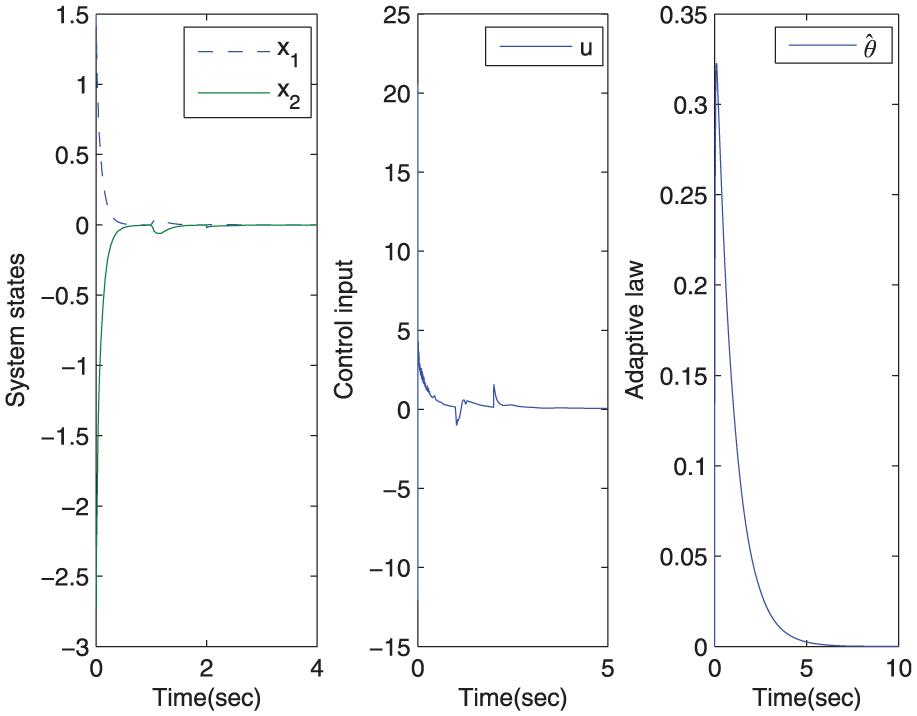
In simulation, we choose . In addition, the design parameters are chosen as , , , , , , , and . The initial states are chosen as , and . Figure 1 illustrates the effectiveness of the control scheme.
The responses of the closed-loop system (30) and (31).
Conclusions
This paper successfully solves the adaptive state-feedback control problem for a more general class of high-order non-linear system with time delays and a time-varying control coefficient. By combining the RBF NN approximation approach with the Nussbaum function, the restrictions on system non-linearities and the unknown control coefficient are greatly relaxed. The introduced RBF NN approximation approach doesn’t need the knowledge of NN nodes and weight vectors to be known a priori, which simplifies the design procedure. Finally, by skilfully constructing Lyapunov–Krasovskii functionals, the proposed control scheme guarantees the closed-loop system to be SGUUB.
There are still three important issues under investigation.
How to solve the state-feedback control problems when delays in system (1) are time-varying.
How to design observers and further address the output-feedback control problems for system (1).
How to generalize system (1) to stochastic cases and address the stabilization problems.
Footnotes
Appendix
Proof of Proposition 1. We prove the proposition by induction. Assume that at step , there exist a series of virtual control laws
for the th Lyapunov function candidate
such that
holds, where is a constant, , , are known functions, and . In the sequel, we will prove that equation (34) still holds for the ith Lyapunov function (15).
To proceed further, an estimate for the sixth term of equation (39) is needed. According to RBF NN approximation (2), for any given , there exists such that
where equation (40) is used to handle non-linear terms in the absence of time delays, and . Combining with equation (4) yields
In terms of Lemmas 2 to 4 and equation (41), one can get
The authors declare that there is no conflict of interest.
Funding
The author(s) disclosed receipt of the following financial support for the research, authorship, and/or publication of this article: This paper is supported by the National Natural Science Foundation of China (grant numbers 61573172, 61305149 and 61403174), 333 High-level Talents Training Program in Jiangsu Province (grant number BRA2015352) and the Program for Fundamental Research of Natural Sciences in the Universities of Jiangsu Province (grant number 15KJB510011).
References
1.
ChenBLiuXPLiuKFet al. (2009) Novel adaptive neural control design for nonlinear MIMO time-delay systems. Automatica45(6): 1554–1560.
2.
ChenWSGeSSWuJet al. (2015) Globally stable adaptive backstepping neural network control for uncertain strict-feedback systems with tracking accuracy known a priori. IEEE Transactions on Neural Networks and Learning Systems26(9): 1842–1854.
3.
ChenWSLiWMiaoQG (2010) Backstepping control for periodically time-varying systems using high-order neural network and Fourier series expansion. ISA Transactions49(3): 283–292.
4.
GaoFZWuYQ (2015a) Further results on global state feedback stabilization of high-order nonlinear systems with time-varying delays. ISA Transactions55: 41-48.
5.
GaoFZWuYQ (2015b) Global stabilisation for a class of more general high-order time-delay nonlinear systems by output feedback. International Journal of Control88(8): 1540–1553.
6.
GaoFZYuanFSWuYQ (2013) Global stabilisation of high-order non-linear systems with time-varying delays. IET Control Theory and Applications7(13): 1737–1744.
7.
GeSSHongFLeeTH (2003) Adaptive neural network control of nonlinear systems with unknown time delays. IEEE Transactions on Automatic Control48(11): 2004–2010.
8.
GeSSHuangCCZhangT (1999) Adaptive neural network control of nonlinear systems by state and output feedback. IEEE Transactions on Systems Man and Cybernetics, Part B: Cybernetics29(6): 818–828.
9.
GeSSWangC (2002) Direct adaptive NN control of a class of nonlinear systems. IEEE Transactions on Neural Network13(1): 214–221.
10.
GeSSWangJ (2003) Robust adaptive tracking for time-varying uncertain nonlinear systems with unknown control coefficients. IEEE Transactions on Automatic Control48(8): 1463–1469.
11.
HoDWCLiJMNiuYG (2005) Adaptive neural control for a class of nonlinearly parametric time-delay systems. IEEE Transactions on Neural Network16(3): 625–635.
12.
HuaCCYuCXGuanXP (2014) Neural network observer-based networked control for a class of nonlinear systems. Neurocomputing133: 103–110.
13.
HuangSNTanKKLeeTH (2005) Further result on a dynamic recurrent neural-network-based adaptive observer for a class of nonlinear systems. Automatica41(12): 2161–2162.
14.
IbrirS (2011) Observer-based control of a class of time-delay nonlinear systems having triangular structure. Automatica47(2): 388–394.
15.
JiangBShenQKShiP (2015) Neural-networked adaptive tracking control for switched nonlinear pure-feedback systems under arbitrary switching. Automatica61: 119–125.
16.
JoaHWChoibHLLimaJT (2014) Observer based output feedback regulation of a class of feedforward nonlinear systems with uncertain input and state delays using adaptive gain. Systems and Control Letters71: 44–53.
LinWQianCJ (2000) Adaptive regulation of high-order lower-triangular systems: Adding a power integrator technique. Systems and Control Letters39(5): 353–364.
19.
LiuYG (2007) Output-feedback adaptive control for a class of nonlinear systems with unknown control directions. Acta Automatica Sinica33(12): 1306–1312.
20.
ManYCLiuYG (2016) Global adaptive stabilisation for nonlinear systems with unknown control directions and input disturbance. International Journal of Control89(5): 1038–1046.
21.
MarteussonB (1990) Remarks on adaptive stabilization of first-order nonlinear systems. Systems and Control Letters14(1): 1–7.
22.
MirkinBGutmanPO (2010) Robust adaptive output-feedback tracking for a class of nonlinear time-delayed plants. IEEE Transactions on Automatic Control55(10): 2418–2424.
23.
NussbaumRD (1983) Some remarks on the conjunctive in parameter adaptive control. Systems and Control Letters3: 243–246.
24.
PolendoJQianCJ (2007) A generalized homogeneous domination approach for global stabilization of inherently nonlinear system via output feedback. International Journal of Robust and Nonlinear Control17(7): 605–629.
25.
QianCJ (2005) A homogeneous domination approach for global output feedback stabilization of a class of nonlinear systems. In: Proceedings of the American control conference, Portland, USA, 8–10 June 2005, pp.4708–4715. IEEE.
26.
QianCJLinW (2002) Practical output tracking of nonlinear systems with uncontrollable unstable linearization. IEEE Transactions on Automatic Control47(1): 21–36.
27.
QianCJLinW (2006) Recursive observer design, homogeneous approximation and nonsmooth output feedback stabilization of nonlinear systems. IEEE Transactions on Automatic Control51(9): 1457–1471.
28.
SannerRMSlotineJJ (1992) Gaussian networks for direct adaptive control. IEEE Transactions on Neural Network3(6): 837–863.
29.
SunZYLiuYG (2007) State-feedback adaptive stabilizing control design for a class of high-order nonlinear systems with unknown control coefficients. Journal of System Science and Complexity20(3): 350–361.
30.
WangTTongSCLiYM (2013) Robust adaptive fuzzy output feedback control for stochastic nonlinear systems with unknown control direction. Neurocomputing106: 31–41.
31.
WenYTRenXM (2011) Neural network-based adaptive control for nonlinear time-varying delays systems with unknown control direction. IEEE Transactions on Neural Network22(10): 1599–1612.
32.
YooSJParkJBChoiYH (2009) Adaptive neural control for a class of strict-feedback nonlinear systems with state time delays. IEEE Transactions on Neural Network20(7): 1209–1215.
33.
YuZXLiSG (2014) Neural-network-based output-feedback adaptive dynamic surface control for a class of stochastic nonlinear time-delay systems with unknown control directions. Neurocomputing129: 540–547.
34.
ZhangNWZhangEBGaoFZ (2014) Global stabilization of high-order time-delay nonlinear systems under a weaker condition. Abstract and Applied Analysis2014: 1–8.
35.
ZhangXLinY (2014) Global stabilization of high-order nonlinear time-delay systems by state feedback. Systems and Control Letters65: 89–95.
36.
ZhangZQXuSY (2015) Observer design for uncertain nonlinear systems with unmodeled dynamics. Automatica51: 80–84.
37.
ZhaoZWHuangSJLuoQ (2007) Adaptive NN control of a class of nonlinear systems with unknown control direction. In: Proceedings of the 26th Chinese control conference, Hunan China, 26–31 July 2007, pp.213–216. IEEE.
38.
ZhouQShiPXuSYet al. (2013) Observer-based adaptive neural network control for nonlinear stochastic systems with time delay. IEEE Transactions on Neural Network and Learning Systems24(1): 71–80.