






Abstract
In this paper we present an extension of three important model reduction techniques: namely, the stability equation, the modified pole clustering and the dominant modes methods for conventional (regular) systems to reduce complexity relating to high dimensionality of mathematical models representing physical, generalized (also called singular) systems. Combining these methods to Genetic Algorithms’ tools and exploiting a special representation base where a full order singular system is deflating into proper and improper subsystems, different natures of stable, optimal low order models are obtained. To show the effectiveness of the proposed algorithms, a numerical example is given, where six approximants are derived from a multi-input multi-output singular system. By the use of two optimal norms, the MOR errors are quantified and permits to conclude to the quality of the proposed reduced order models.
Keywords
Introduction
Developing reduced models that approximate complex systems is necessary because model reduction decreases the simulation time in comparison with the original high order model. It enables real time applications, and produces acceptable accuracy. The genetic algorithms have been widely used in control engineering because of its popularity to provide answers to the limitations of more conventional methods (Hongxing et al., 2005). This tool is essentially exploited to solve the optimization problem (Grefenstette, 2007) in different fields of applications mainly because of their ability to find the optimal solution or to provide a solution close to the global minimum unlike other mathematical method used on the minimization terms. The Genetic Algorithm employs search procedures based on mechanics of natural selection and survival of the fittest (Habib and Prasad, 2008). Our main contribution is to exploit and extend some important tools based on the Model Order Reduction (MOR) of standard (also called conventional/regular) state space systems: namely, the stability equation (Parmar et al., 2007), the modified cluster methods (Kumar and Tiwari, 2012), dominant modes (Rommes and Martins, 2006), combined with Genetic Algorithms’ (GAs) tools and evaluated for stable, linear, continuous-time invariant, multi-input multi-output (MIMO), singular systems (also called generalized state space systems or descriptor systems) model reduction.
The main step is the decomposition of original singular systems on the Weierstrass canonical form (Adamou-Mitiche et al., 2003). Based on Adamou-Mitiche et al. (2007), the optimal low order models are constructed as follows: According to each specified algorithm presented in this work, the reduced order denominators are determined in a specified manner. The reduced order numerators are identified by GA’s tools (Vilbe and Calvez, 1990). Each algorithm gives two low models of different natures: singular when only the singular system proper part model reduction is considered, but the improper part is entirely copied; and nonsingular when the proper and improper parts are subject to model reduction. To effectively estimate the obtained reduced order models, some norms are calculated and different responses are traced.
A brief description of GA’s MOR principal is presented in the second section. The two important MOR-based GA techniques are introduced: namely, the stability equation and the modified pole clustering methods, and the proposed approach is presented. In the third section, after a statement of the problem position of any singular system model reduction scheme, a procedure for constructing a different low order model for singular systems is presented, followed by an illustrative example that allows us to draw some important conclusions.
GA-based MOR
The essence of all GA’s techniques in regular MOR systems is stated as follows. Starting with an original system of full order n, represented by its transfer function
where
where
Stability equation technique and GA-based MOR
The reduced order model is calculated using the step-by-step procedure.
where
with
The coefficients
By rejecting the factors with the largest magnitudes of
where
This step is summarized in Figure 1.

Flow chart of the stability equation technique.
where
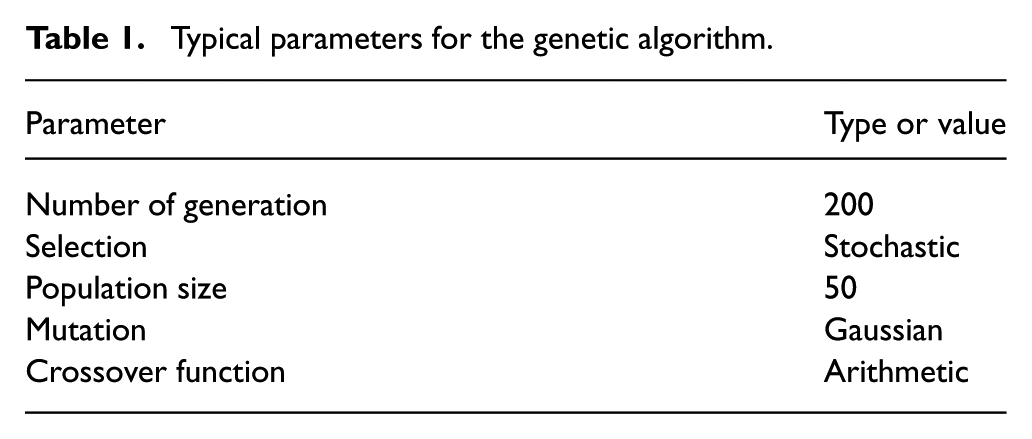
The typical parameters of GA are taken according to Table 1 (Pal et al., 1995).
Typical parameters for the genetic algorithm.
Modified pole clustering technique and GA-based MOR
The reduced order model is calculated using the step-by-step algorithm.
Let the k real poles in the ith cluster be defined as
The centroid cluster
Using the same algorithm separately for real and imaginary parts of the complex conjugate poles, the centroid cluster is obtained as
To achieve that, a procedure is given as below.
Let k the number of the real poles in a cluster be given as
Set
Find the centroid cluster pole as
Set
Find the new centroid cluster from
Is
Take a modified centroid cluster of the rth cluster as
For synthesizing the common denominator polynomial, one of the following cases may occur.
Case 1. If all the new centroid clusters are real, then the reduced model denominator of order r is
Case 2. If all the new centroid clusters are complex conjugate, then the reduced model denominator of order r order reduced model is
where
Case 3. If some centroid clusters are real and some are complex conjugate, then the reduced model denominator of order r order reduced model is
The proposed approach: Dominant modes combined GA
This method is constructed essentially from the idea of retaining the faster modes of the full order system combined to GA’s. Simplicity, accuracy and speed of calculating the reduced order proposed approximant are guaranteed, since it does not require any mathematical skills. As a result, the low order system behaviour fits adequately the original one. The reduced order model is calculated using the step-by-step procedure.
Descriptor model reduction
Problem formulation
Consider a linear continuous-time, (m_inputs, p_outputs) MIMO, stable, singular system, of full order n given by the generalized state space matrices
where
The goal of any singular model reduction approach is to replace the original system of complete order n (21) by a reduced model of order r (22) given by the generalized state space
The system
The algorithm
The proposed MOR algorithm produces two natures of reduced models. The first reduced model
These two reduced models
where
that permit to form the proper nonsingular transfer matrix
Use its continuous equivalent system represented by its transfer function and use the same operations as in Step 3. The proposed method gives a reduced model
where
Simulation comments
A simulation example is presented in this section. For each technique, the order reduction is occurs firstly on the proper part of the two-inputs/two-outputs singular system, and after on the twice parts of the original system. To solve the generalized Sylvester equation use the package SLICOT (Benner et al., 1999). Consider a 16th-order singular system where
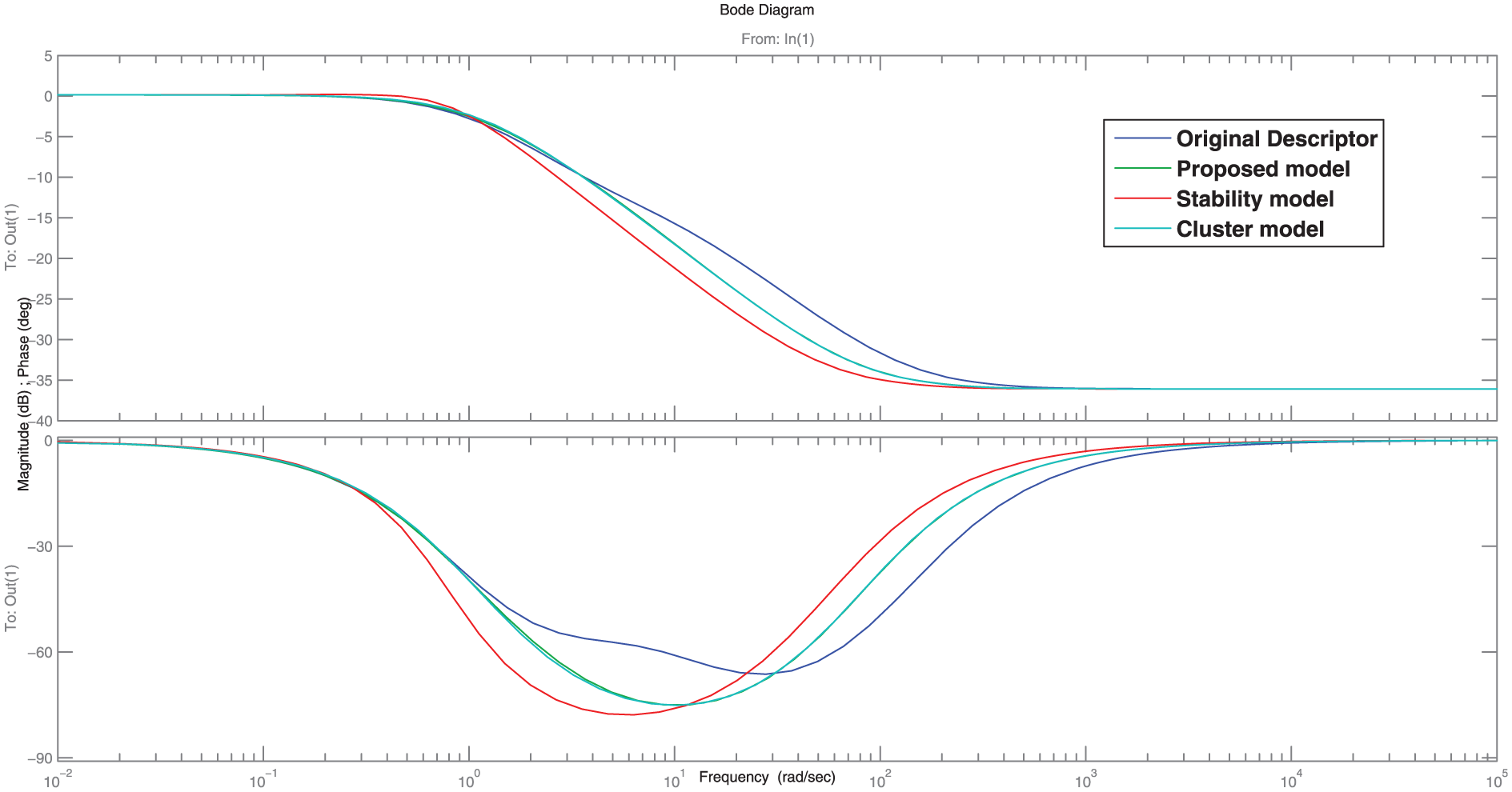
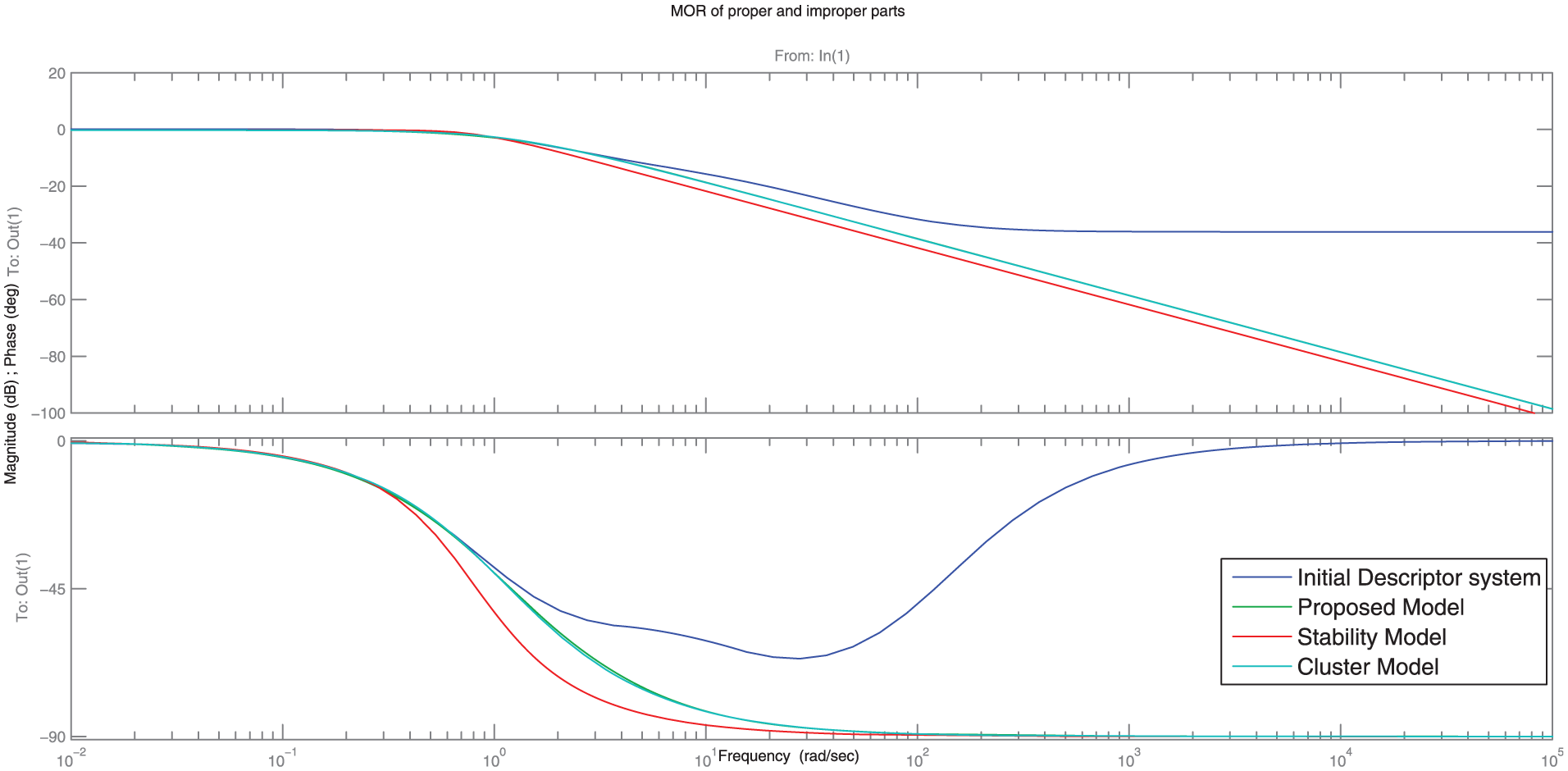
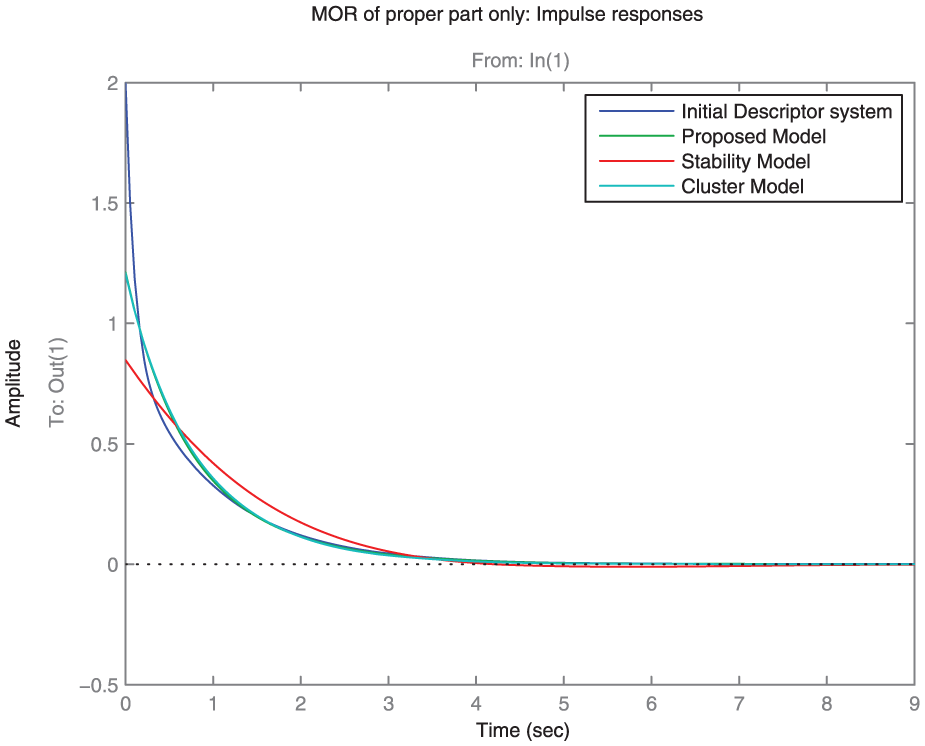


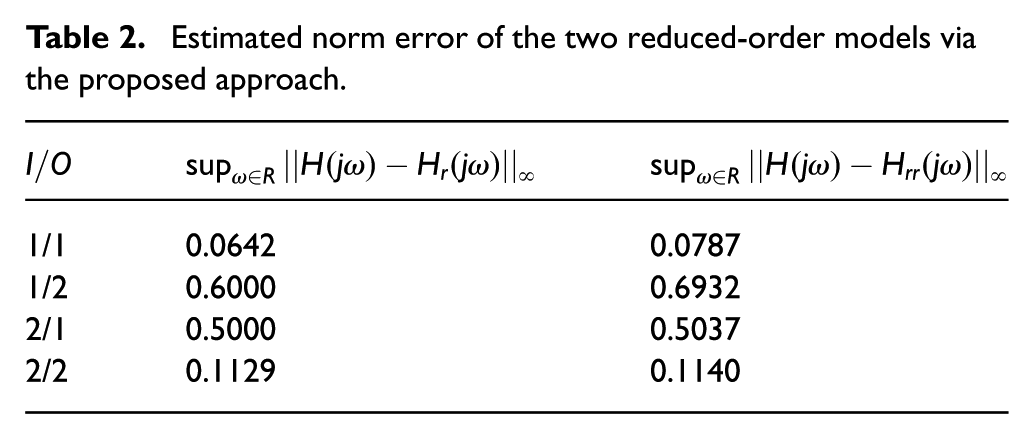
Estimated norm error of the two reduced-order models via the proposed approach.
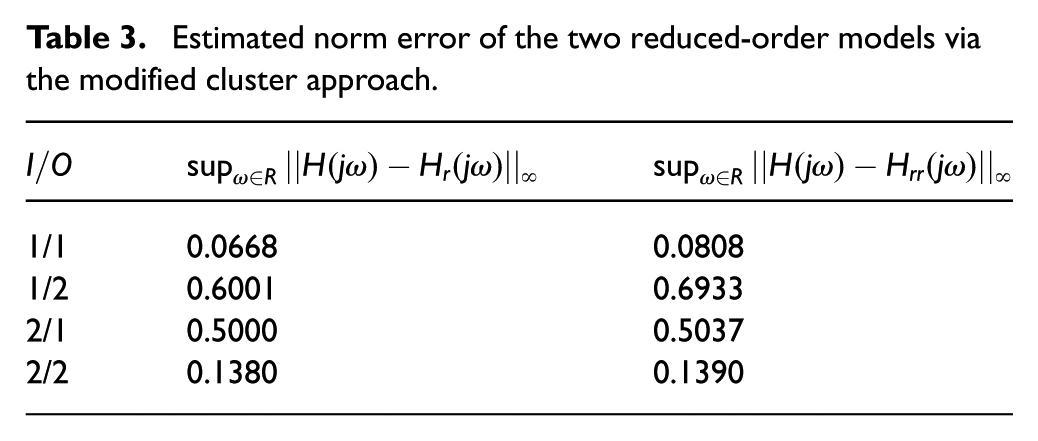
Estimated norm error of the two reduced-order models via the modified cluster approach.
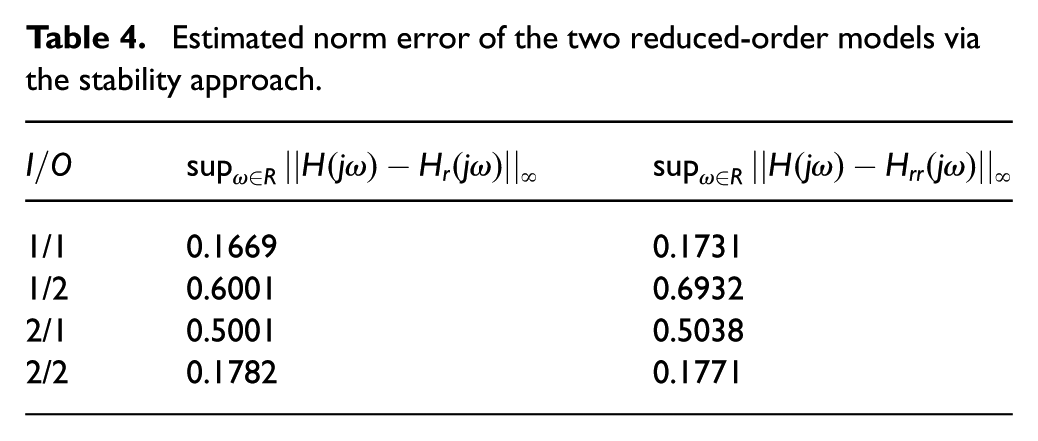
Estimated norm error of the two reduced-order models via the stability approach.
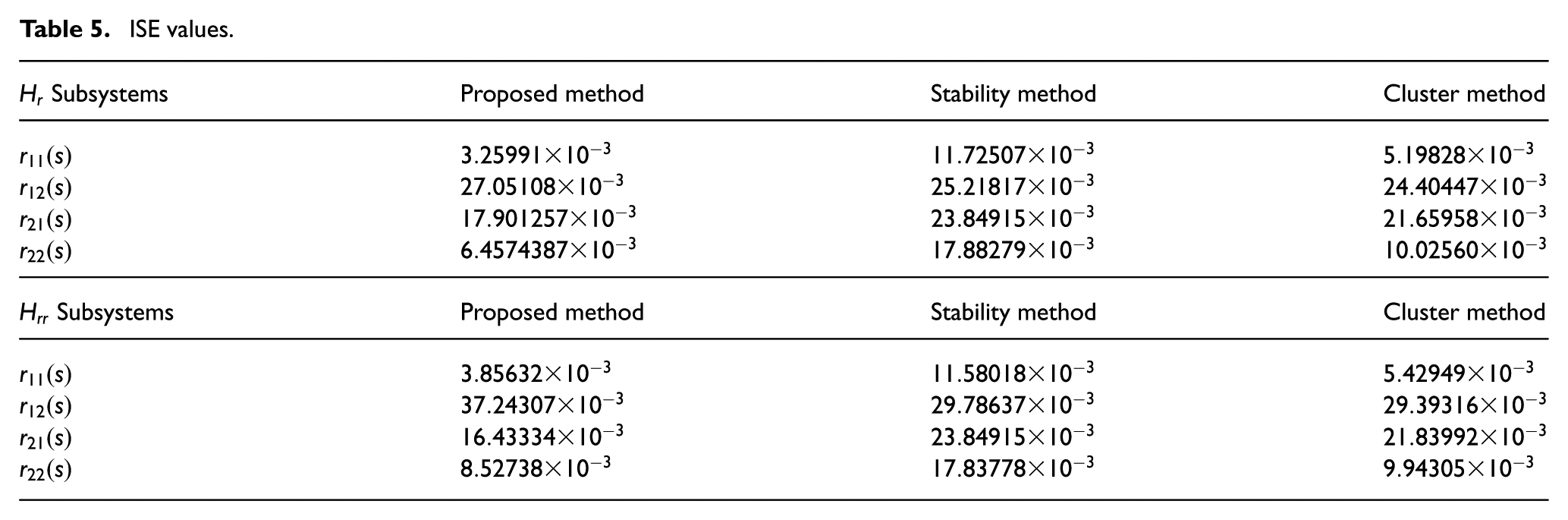
ISE values.
Conclusion
In this paper, based on the canonical forms of Adamou-Mitiche et al. (2003) for a continuous-time, original, singular system of full order n, three MOR techniques are extended to the approximation of singular systems using GA’s tools: namely, the stability equation, the modified cluster method and the proposed approach – dominant mode combined GA. Each approach gives two different approximants: in the first, only the proper part (corresponding to the finite eigenvalues of the pencil
Footnotes
Acknowledgements
The authors are very indebted to the anonymous reviewers for their constructive comments that have helped greatly improve the quality of the paper.
Conflict of Interest Statement
The author(s) declared no potential conflicts of interest with respect to the research, authorship, and/or publication of this article.
Funding
This research received no specific grant from any funding agency in the public, commercial, or not-for-profit sectors.