






Abstract
Fractional calculus increases their applications in system design and analysis problems because of providing more realistic modeling of real systems. Owing to computational complexity of fractional calculus, the computer-aided design and analysis methods are required for engineering applications of fractional order systems. This study presents a numerical method for parametric robust stabilization of fractional order systems by employing single-parameter perturbation. This method implements a fractional order perturbation strategy on the basis of brute-force search technique for system stabilization problems. In order to meet a predefined minimum argument root design specification, the proposed algorithm searches for a desired placement of the minimum argument characteristic root within the first Riemann sheet by performing iterative perturbations of the fractional order. This approach can provide a straightforward numerical solution for robust stabilization problems of fractional order systems by employing an order perturbation scheme. Moreover, a possible utilization of a fractional order derivative operator as a system stabilizer is theoretically discussed. Illustrative examples show the utilization of the proposed stabilization algorithms for computer-aided fractional order system design applications.
Introduction
Fractional order system modeling is increasing importance in the solution of science and engineering problems. It has been reported that fractional order system models can provide a more accurate representation of real systems (Das, 2011). The fields of system science and control engineering have particularly benefitted from trends in the fractional order system modeling over the last decade (Chen et al., 2009; Monje et al., 2010; Petras, 2009).
Stability analysis plays a substantial role in control engineering, and several studies have accordingly addressed robust stability analysis problems of fractional order systems: Stability analysis, according to pole placement in the complex plane, has been discussed for fractional order systems (Matignon, 1996). Petras et al. (2005) presented a stability check procedure for uncertain linear time invariant (LTI) systems with interval fractional orders and coefficients and minimum argument eigenvalue based stability testing of the fractional order LTI interval systems has been shown (Chen et al., 2006). The use of linear matrix inequality (LMI) to stabilization of fractional order LTI systems has also been addressed in numerous studies (Adelipour et al., 2015; Ahn et al., 2007; Lu and Chen, 2009; N’Doye et al., 2013). The fractional order extension of the Lyapunov direct method has also been used to demonstrate the stability of nonlinear and time varying fractional order systems (Aguila-Camachoa et al., 2014). Moreover, well-established parametric, robust stability analysis methods have been applied to fractional order systems in several studies: Robust stability checking based on four Kharitonov’s polynomials has been shown for commensurate order LTI systems (Petras et al., 2004). Utilization of stability boundary locus for stabilization of feedback systems has also been carried out (Hamamci, 2007). The zero exclusion principle has considered for fractional order interval systems (Tan et al., 2009). A numerical method based on edge polynomial sampling from interval box of uncertain parameters has been demonstrated for fractional order interval systems (Senol et al., 2014).
Although several heuristic optimization methods, such as evolutionary methods (Biswas et al., 2009) and particle swarm methods (Zamani et al., 2009), have been proposed for the tuning of fractional order controllers, studies assessing the application of heuristic search methods for robust stabilization of fractional order LTI systems with interval uncertainty are quite rare in the literature. In order to develop a fractional order system design tool for engineering problems, it is very useful to employ straightforward and effective search methods for robust stabilization issues because of the difficulties involved in the development of a common analytical method that can be applied to stability analysis of any fractional order system. In fact, there is a need to develop computer-aided design tools based on numerical analysis techniques to simplify the design and analysis of such order systems for engineers. One of the aims of the present study was to develop a computational framework that enables application of brute-force search methods in the problem of robust stabilization of fractional order LTI systems for control engineering. The brute-force method is a fundamental, reliable search algorithm that tests all possible solutions in a finite solution set in order to find the most appropriate one, and it is very practical method to find out an optimal solution in discrete and finite search spaces (Haynal and Haynal, 2013). Their consistency and effectiveness in finding the best solution from a finite set of options have enabled brute-force based algorithms to be employed for computer-aided design of advanced systems (Amy et al., 2013).
A probabilistic robust stability evaluation scheme based on fractional order perturbation has previously presented for the robust stabilization of fractional order systems (Alagoz et al., 2015), and an analytical solution for robust stabilization and control was recently proposed for first-order uncertain systems by using a fractional order integrator (Hmed et al., 2016). Theoretical demonstration of system stabilization by means of single parameter perturbation promotes the development of single-parameter real-time system stabilization methodologies. However, straightforward numerical schemes or algorithms are required to achieve the online stabilization of complex fractional order systems for practical applications. In this sense, the current study also examines the utilization of closed loop
Consecutive order perturbation enables directional movement of characteristic polynomial roots in the first Riemann sheet, and therefore it takes effect on the root arguments (Alagoz et al., 2015; Petras, 2009), namely, the polar angles of characteristic roots. In the current study, the author proposes a practical fractional order system stabilization scheme based on tuning of the characteristic root arguments for a given minimum root angle specification. A numerical algorithm based on the brute-force search is employed to search for a relevant fractional order perturbation satisfying the design specification. Illustrative stabilization examples are also presented to show application of the proposed method for computer-aided fractional order system design problems.
LMI-based methods for the solution of fractional order system stabilization have been extensively studied. Those types of analytical approaches present an increasing computational complexity depending on the matrix operations when system complexity grows. The matrix structures may need to be reestablished for more complex fractional order systems. Model-depended analytical solutions for stabilization problems of some fundamental forms of fractional order system models have been also proposed, however, the solutions are only valid for these fundamental forms. The proposed stabilization method-based brute-force search provides a straightforward scheme, of which algorithmic complexity does not grows severely when complexity of fractional order system models increase. This can be a key advantage when developing computer-aided system design tools. In addition, the proposed algorithm can achieve a minimum root angle specification to ensure a desired degree of robustness in terms of characteristic root locus.
Methodology
Basic definitions and remarks

The Hurwitz stability regions under
Problem formulation and preliminaries
This section presents a robust stabilization scheme based on the minimum root argument calculation. Fractional order LTI systems are represented by fractional order differential equations in the form of (Caponetto et al., 2010; Xue and Chen, 2014):
By using the property
where denominator polynomial coefficients,
The interval uncertainty bounds of coefficient
In the present study, the fractional order perturbation of the system model is represented by the order deviation
In order to facilitate root locus analysis of fractional order LTI systems,
where,
The stability analyses based on characteristic root placement in the first Riemann sheet have previously been discussed in detail (Alagoz et al., 2015; Matignon, 1996; Petras, 2009; Radwan et al., 2009). These studies showed that, by applying
The current study demonstrates an application of the brute-force search method to find out fractional order perturbation
where,
The expanded degree integer order characteristic polynomials
For a given unstable fractional order interval transfer function, the basic steps of the robust stabilization method based on minimum argument consideration can be summarized as follows:
The fractional order perturbation takes effect on the both root angles and magnitudes, as suggested by Remark 1. Alteration of the fractional order can change root argument of commensurate order models directionally. Alagoz et al. (2015) introduced a probabilistic robust stability index and performed robust stabilization according to the robust stability probability of the system. In the current study, minimum root argument in the first Riemann sheet is utilized for robust stabilization of fractional order interval systems.
The characteristic polynomial of the
By applying
For the robust stabilization of
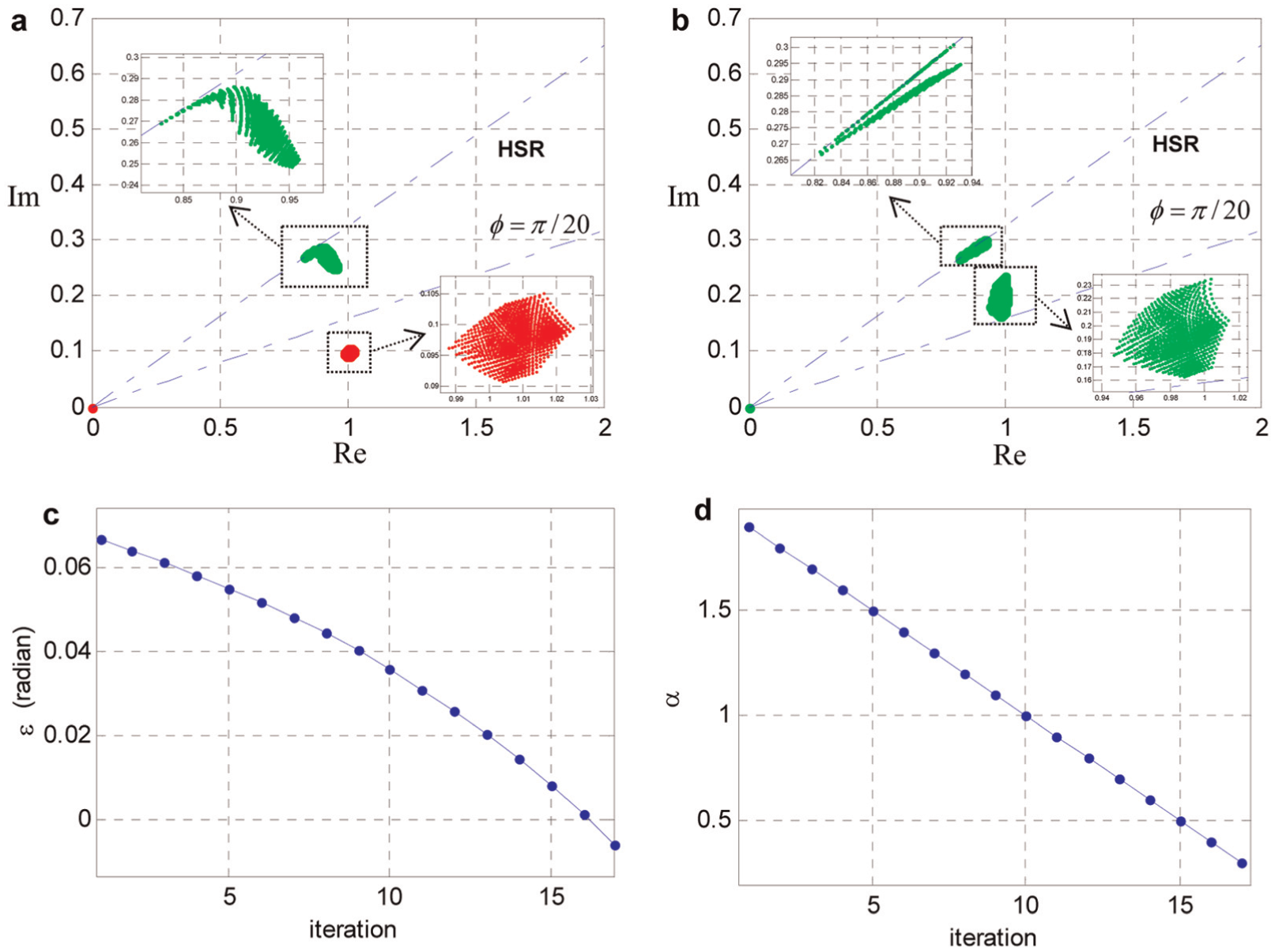
(a) The root set of the unstable system for
In order to validate stabilization of the system model for
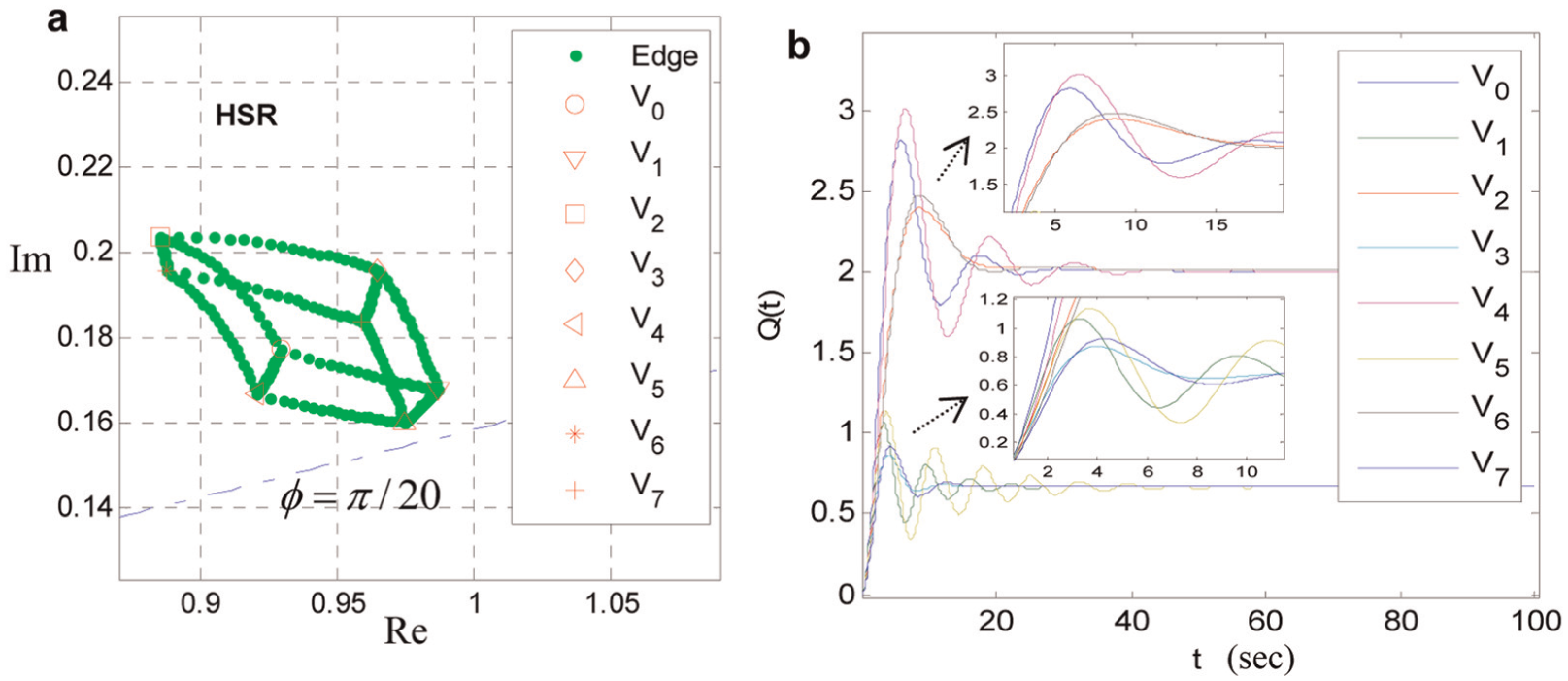
(a) A close-up view of the roots of the vertex and edge polynomials; (b) Step responses of eight vertex polynomials (in seconds).
A possible application: system stabilization by
compensator
This section demonstrates a possible utilization of fractional order derivative in the application of parametric stabilization of nominal systems. In this application,
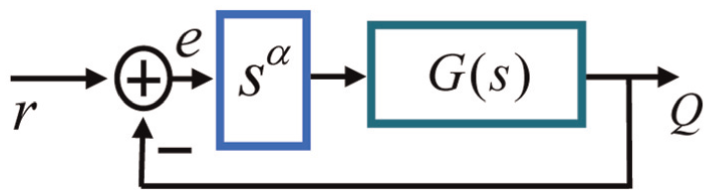
System stabilization via closed loop
In this section, our control objective is to find
The transfer function of the stabilizing system can be written as:
One can assume the plant transfer function in a rational form as
Equation (10) reveals that compensation with fractional order integrator takes effect on the part of characteristic polynomials that is associated with denominator polynomial, and the compensation with fractional order derivative affects the part of characteristic polynomials that is associated with numerator polynomial of
Figure 5 shows an algorithm implementing the brute-force search of
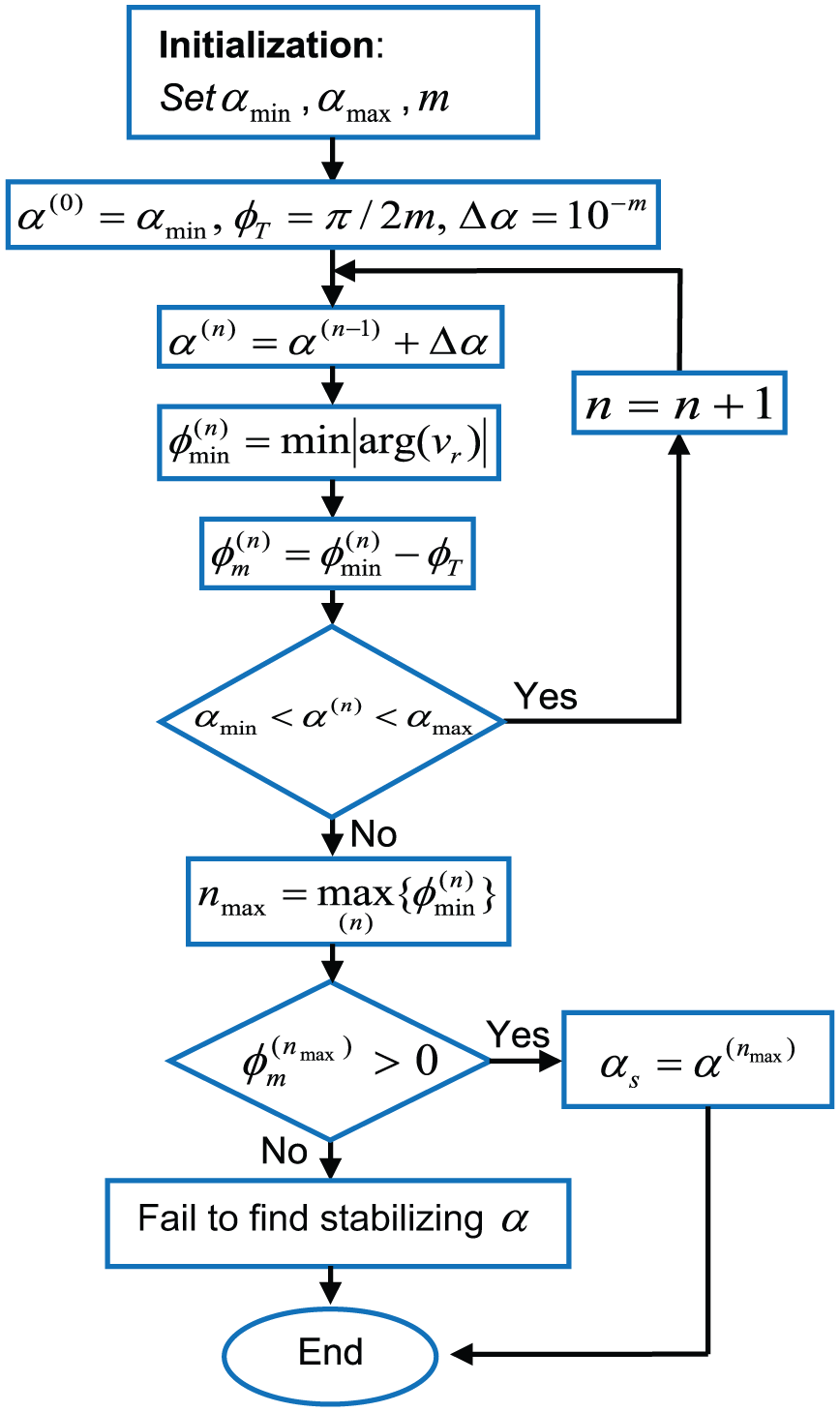
A stabilization algorithm based on the brute-force search of
The system model is stable for the positive angle margin,
If the algorithm does not find a positive angle margin, it fails to stabilize systems in the range
In practice, the closed loop
Our objective is to robust stabilize the system by locating the minimum argument characteristic root of the system far from the stability boundary. The initiation parameters of the algorithm were configured to
Figure 6(a) shows the trace of the minimum argument characteristic root during the brute-force searching. The maximum value of root angle

(a) The root trace of minimum angle root shifting process; (b) The change of minimum argument root angle (in radians) versus
Figures 7(a), (b) and (c) illustrate time responses for the unstable fractional order plant function
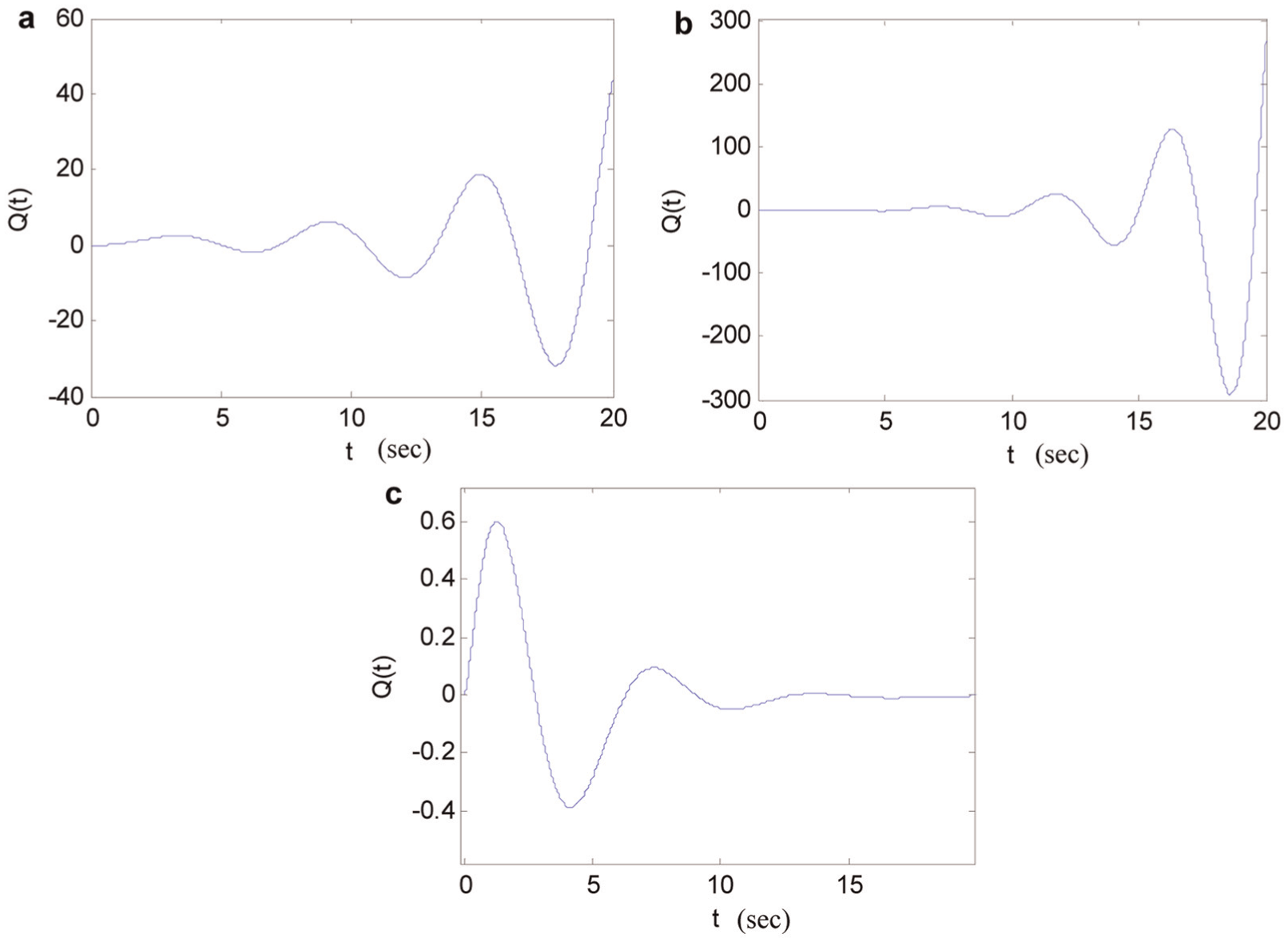
(a) The unstable time response of
Our objective is to improve stability and control of the fractional order PMSM velocity servo system model by using a fractional order integrator and place the minimum argument characteristic root at a relevant distance from the stability boundary to enhance robust stability. The initiation parameters of the algorithm were configured to

(a) The root trace of minimum angle root shifting process; (b) The change of minimum argument root angle (in radians) versus
Figures 9(a), (b) and (c) illustrate time responses for the unstable

(a) The unstable time response of
Conclusions
This paper presented a numerical system stabilization scheme based on relocation of minimum argument characteristic roots. Illustrative examples were given to demonstrate possible applications of the proposed method for the robust stabilization of interval uncertain fractional order system and the closed loop
An increase in the complexity of fractional order system changes the characteristic polynomial. However, this does not lead to a significant modification of the algorithmic structure of the proposed method. This is an advantageous property, particularly, for the development of computer-aided design tools.
Brute-force search provides uniform searching of order perturbation with a desired resolution in a predefined range. Thus, stabilizing range of the order perturbation and the best robust stabilizer can be found for closed loop
Computational cost strongly depends on the search range of order,
This is an encouraging result for the development of real-time system stabilizers including fractional order
The proposed methodology can achieve replacements of system poles by using a root trace technique to meet minimum argument constraints. This is a noteworthy contribution to computer-aided system design. The computational scheme based on brute-force search is easy to implement and it is yet effective to manage stabilization of complex fractional order systems.
Footnotes
Conflict of interest statement
The authors declare that there is no conflict of interest.
Funding
This research received no specific grant from any funding agency in the public, commercial, or not-for-profit sectors.