






Abstract
The process of permanent magnetic drive (PMD) presents high uncertainty under the complex operating conditions. In this paper, a type of Takagi Sugeno Kang (TSK) interval type-2 fuzzy logic systems (IT2 FLSs) under the Karnik-Mendel (KM) structure is designed for data-based PMD torque and revolutions per minute (rpm) forecasting. For designing the antecedent and input measurement of TSK IT2 FLSs, the primary membership functions (MFs) of interval type-2 fuzzy sets (IT2 FSs) are all selected as Gaussian type-2 MFs with uncertain derivation, while the consequent parameters are chosen as type-1 fuzzy numbers. According to matrix transformation, the complicated task of calculating derivatives in the TSK IT2 FLSs under the Karnik-Mendel structure can be managed subtly by some elementary vectors and partitioned matrices. And the parameters of the proposed systems are also tuned by the back propagation (BP) algorithms. Simulation examples based on the data of PMD torque and rpm are used to test the advanced fuzzy logic systems forecasting methods. The effective and feasibility of forecasting by the proposed type-2 systems compared with their type-1 counterparts is illustrated in the light of Monte Carlo simulations, convergence and stability analysis.
Introduction
Forecasting activities have always been an important issue in human’s daily life. Traditional time series forecasting models have been hot researching topic for forecasting. Owing to the low computational costs, these linear models have their advantages. However, the presence of uncertainty and nonlinear in the operation systems may drop the forecasting ability of the linear models. So, it is necessary to develop new method to manage information with uncertainity. With the rapid development of artificial intelligence, advanced nonlinear models have been gradually used for forecasting. These models consist of fuzzy logic systems (FLSs) (Yousef and Javad, 2016) and neural networks (NNs) (Barbounis and Theocharis, 2007). Interval type-2 fuzzy logic systems (IT2 FLSs) can approximate any real continuous function on a compact set to arbitrary accuracy (Méndez and Hernández, 2013). Recent study on load forecasting demonstrates that IT2 FLSs own a better approximation ability than methods such as NNs.
In the past 20 years, researchers have made great progress on transiting type-1 (T1) FLSs (Zhang and Wang, 2015) to IT2 FLSs (Lin and Chen, 2011). Many efforts are dedicated to IT2 FLSs to perfect their theory and deploy them in real applications (Hagras and Wagner, 2012). IT2 FLSs are emerging technology (Mendel, 2001). The process of permanent magnetic drive (PMD) (Barkat et al., 2011), intelligent controllers (Safarinejadian et al., 2015), database systems (Niewiadomski, 2010), medical systems (Lee et al., 2010), and plant monitoring and diagnostics (Flores et al., 2011) are characterized by high uncertainty, nonlinearity and time-varying behavior. Recent studies verify that IT2 FLSs can cope with uncertainties more suitably than their T1 counterparts from both aspects of theory and practice (Wu 2012).
In Mendel (2001), the mathematical derivation formulas of back propagation (BP) algorithms for a Takagi Sugeno Kang (TSK) IT2 FLS under the popular Karnik-Mendel (KM) (Mendel, 2013) structure are not presented in detailed expressions. In Mendel (2004), in order to compute the derivatives in relation with the BP algorithms to tune the antecedent, and consequent of IT2 FLSs, mathematical formulas are offered. However, both the antecedent, and consequent membership functions (MFs) are not chosen as the specific types. In this paper, all the parameters of the TSK IT2 FLSs under the KM structure are tuned by BP algorithms according to huge complicated computations (Chen et al., 2016). The proposed primary MFs of the IT2 FLSs are selected as Gaussian IT2 with uncertain standard deviation. Detailed mathematical formulas correspond to the method tunes all the antecedent, consequent and input measurement MFs parameters. Then the proposed systems are used for forecasting data-based PMD uncertain parameters about torque and rpm. The simulation results show that the proposed IT2 FLSs have the advantage that they can acquire better predictions compared with their T1 counterparts.
In IT2 FLSs, the KM algorithms are the most popular algorithms for the block of type-reduction (TR). Performing the TR of IT2 FLSs under the KM structure can preserve the uncertainties flow in the systems more appropriately. Forecasting studies for Mamdani IT2 FLSs under the KM structure have been presented elsewhere (Chen et al., 2016) with combinations of BP algorithms and KM algorithms. For the case of TSK type FLSs, a generic review of the theory of existing design methods and their applications for TSK IT2 FLSs has been offered in (Zheng et al., 2009).
The aim of this paper is to present BP learning mechanisms for antecedent, consequent and input measurement MF parameters for TSK IT2 A2-C1 non-singleton T2 FLSs under the KM structure. Here, the names of proposed T1 and T2 FLSs will be abbreviated based on the input type: the name TSK S T1 A1-C0 FLSs will be used for TSK singleton T1 fuzzy logic systems with inputs modeled as crisp numbers; and TSK NS T1 A1-C0 FLSs will be used for TSK non-singleton T1 fuzzy logic systems with inputs modeled as T1 fuzzy numbers; and TSK IT2 non-singleton A2-C1 T2 FLSs will be used for TSK interval T2 non-singleton T2 fuzzy logic systems with inputs modeled as T2 fuzzy numbers. In addition, the names of proposed systems will be abbreviated based on the fuzzy types of antecedent and consequent, where the expressions “A” denotes antecedent and “C” denotes consequent. A2-C1 denotes the case of TSK IT2 FLSs when their antecedents are T2 FSs, and their consequents are T1 FSs; A1-C0 denotes the case of TSK T1 FLSs when their antecedents are T1 FSs, and their consequents are crisp numbers. This paper pays more attention on the case of TSK IT2 A2-C1 non-singleton T2 FLSs. The specification “A1-C0” and “A2-C1” can be omitted in the abbreviated names, that is, the TSK S T1 A1-C0 FLSs are called TSK S T1 FLSs; the TSK NS T1 A1-C0 FLSs are called TSK NS T1 FLSs; and the TSK IT2 NS A2-C1 FLSs are called TSK NS IT2 FLSs.
The rest of this paper is organized as follows. Section II gives a brief review of FLSs. Section III designs TSK NS T1 FLSs by BP algorithms and the KM structure’s TSK NS IT2 FLSs (whose antecedent and input measurement MFs are chosen as Gaussian IT2 with uncertain standard deviation) by BP algorithms. Section IV concerns the designed TSK FLSs used to forecast uncertain parameters data of PMD like torque and rpm, and two simulation examples. The conclusion is provided in Section V.
A brief review of FLSs
In general, the five blocks of fuzzifier, rules, inference, type-reducer and defuzzifier (the last two parts form the output processing block) compose an IT2 FLS, while a T1 FLS only contains the block of defuzzifier as the output processing block. The most important block of type-reducer converts a T2 FS to a T1 FS (type-reduced set), then the defuzzifier converts the type-reduced set to a crisp value. The diagram of an IT2 FLS is shown in Figure 1. In addition, Figure 2 shows various elements a T2 FS.
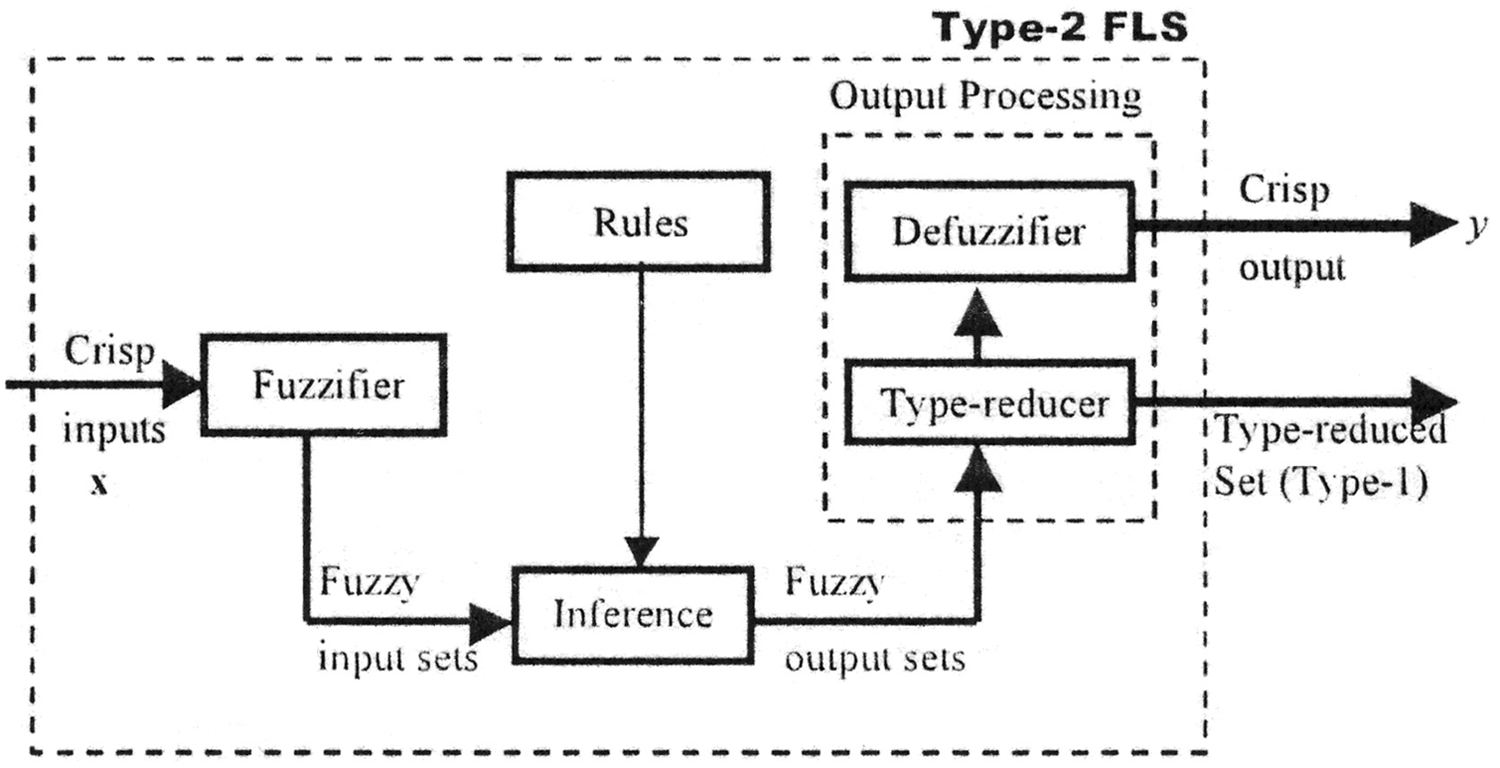
An IT2 FLS (Mendel, 2001).
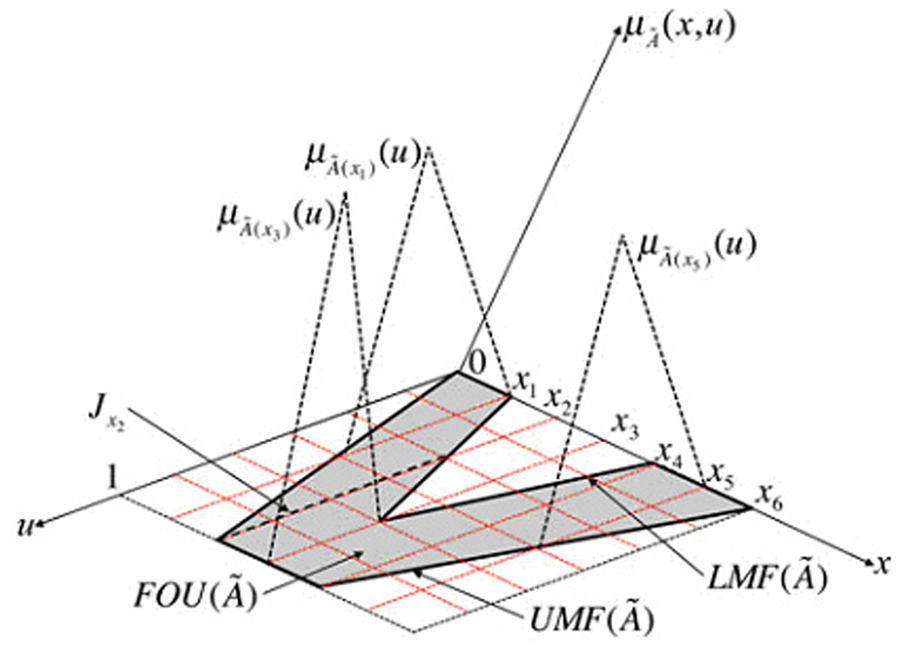
Various elements of a T2 FS (Chen et al., 2016).
A T1 FS

where
A T2 FS

this is to be known as point-valued representation of a T2 FS.
The footprint of uncertainty (FOU) of

where the lower and upper bounding functions (MFs),
An interval type-2 FS (IT2 FS) is a special kind of T2 FS. Because the secondary grades are unified as one, the LMF and UMF can describe an IT2 FS. Gaussian primary MFs of IT2 FSs are often used in T2 society, and Figure 3 shows an example of the FOU of an IT2 FS.
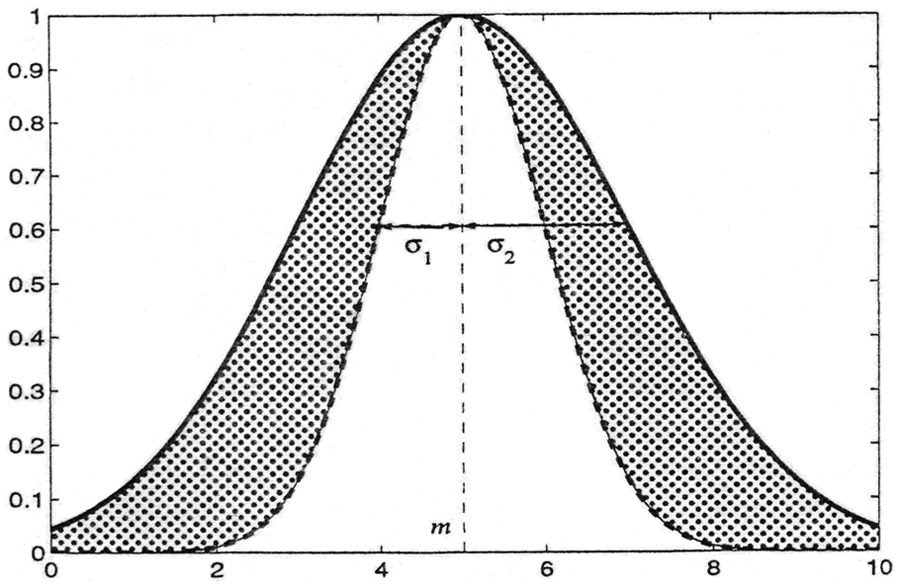
FOU of Gaussian primary MF with uncertain standard deviation (Chen et al., 2016).
Considered from a different point of view, T1 FLSs can be separated into Takagi Sugeno (TS) FLSs and Mamdani T1 FLSs or singleton T1 FLSs and non-singleton T1 FLSs, while IT2 FLSs are composed of TSK IT2 FLSs and Mamdani IT2 FLSs or singleton IT2 FLSs and non-singleton IT2 FLSs. Also, TSK IT2 FLSs are composed of TSK singleton IT2 FLSs (IT2 FLSs), TSK T1 non-singleton T2 FLSs and TSK IT2 non-singleton T2 FLSs (these two are composed of TSK NS IT2 FLSs). TSK S IT2 FLSs employ singleton fuzzifier, and the input measurements are also modeled as crisp numbers. TSK NS IT2 FLSs employ non-singleton fuzzifier, and the input measurements can be treated as T1 or T2 fuzzy numbers. In this paper, we choose the more complicated TSK NS IT2 FLSs, and the input measurements are modeled as T2 fuzzy numbers.
Designing TSK NS IT2 FLSs under the KM structure by the BP algorithms
TSK NS T1 FLSs and TSK NS IT2 FLSs (under the KM structure) are designed to forecast in the section.
Consider a TSK IT2 FLS having

where
Designing TSK NS T1 FLSs
In this section, we use BP algorithms to design TSK NS T1 FLSs (Mendel 2001). Non-singleton fuzzification, height defuzzification and a series of “If-then” fuzzy rules are adopted. Four blocks of T1 FLSs are as follows.

Type-1 non-singleton fuzzifier (Mendel, 2001): Input measurement
is mapped into a fuzzy number
Inference
The output,

where

in which
Gaussian T1 MFs are selected for the antecedent and input measurement MFs. The antecedent MF of T1 FS
TSK NS T1 FLSs optimization
From the given data points, suppose that we obtain a collection of

where
In this paper, we use



Here,
Designing TSK NS IT2 FLSs
Next, we use the BP algorithms to design TSK NS IT2 FLSs under the Karnik-Mendel structure.

Type-2 non-singleton fuzzifier: Measurement
is modeled as a T2 fuzzy number
Inference
In the TSK NS IT2 FLSs, the firing set of the

When IT2 FSs are adopted for the antecedents, input measurements, and IT1FSs are adopted for the consequent sets of TSK T2 fuzzy rules, then


where

where


where


The MF of the input T2 FS
Let
The consequent of rule


Then the output of TSK NS IT2 FLSs is obtained by applying the Extension Principle, where now both

In order to calculate
In the paper, we select both the antecedent and input measurement primary MF as Gaussian type with uncertain standard deviation, respectively, that is,


Then we design the TSK NS IT2 FLSs under the KM structure by the BP algorithms in terms of huge computations. As we all know, it is also very difficult to compute the partial derivatives in TSK NS IT2 FLSs for the two endpoints that are determined by parameters depend on either upper firing strengths or lower firing strengths. In light of matrix transformation, we choose some elementary vectors and partitioned matrices to solve the mission.
The consequents of A2-C1 rules, that is,
Besides,
Then the two endpoints are expressed in both rule-ordered and rule-reordered forms as:

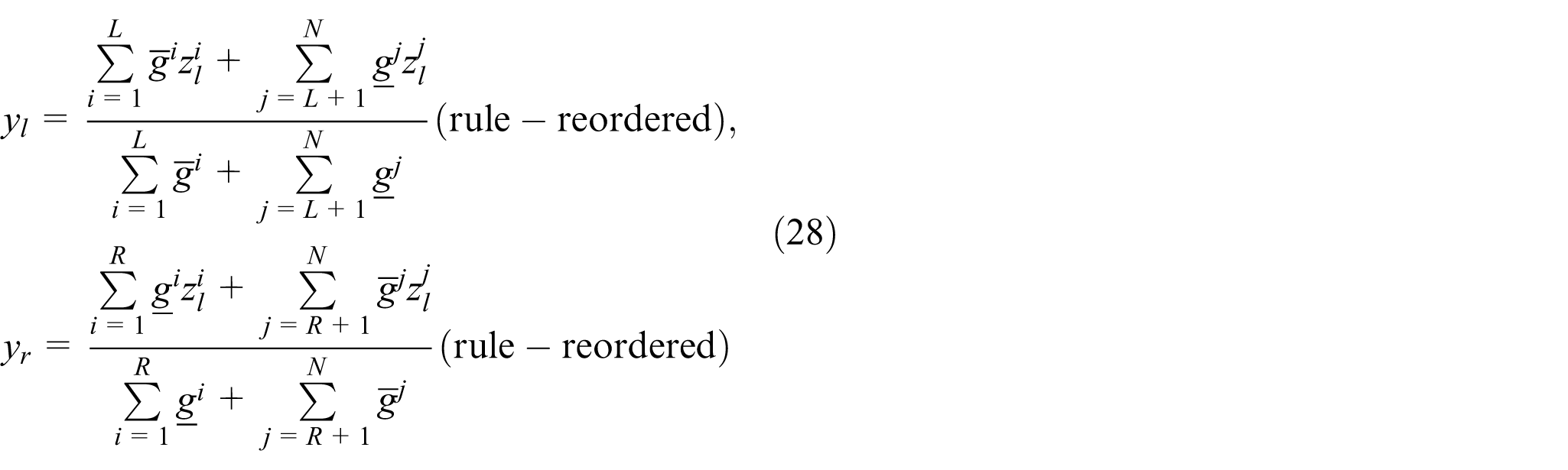
In equations (27) and (28),
In the paper, the rule-ordered firing intervals are expressed as

We use
Re-express
in the rule-ordered form
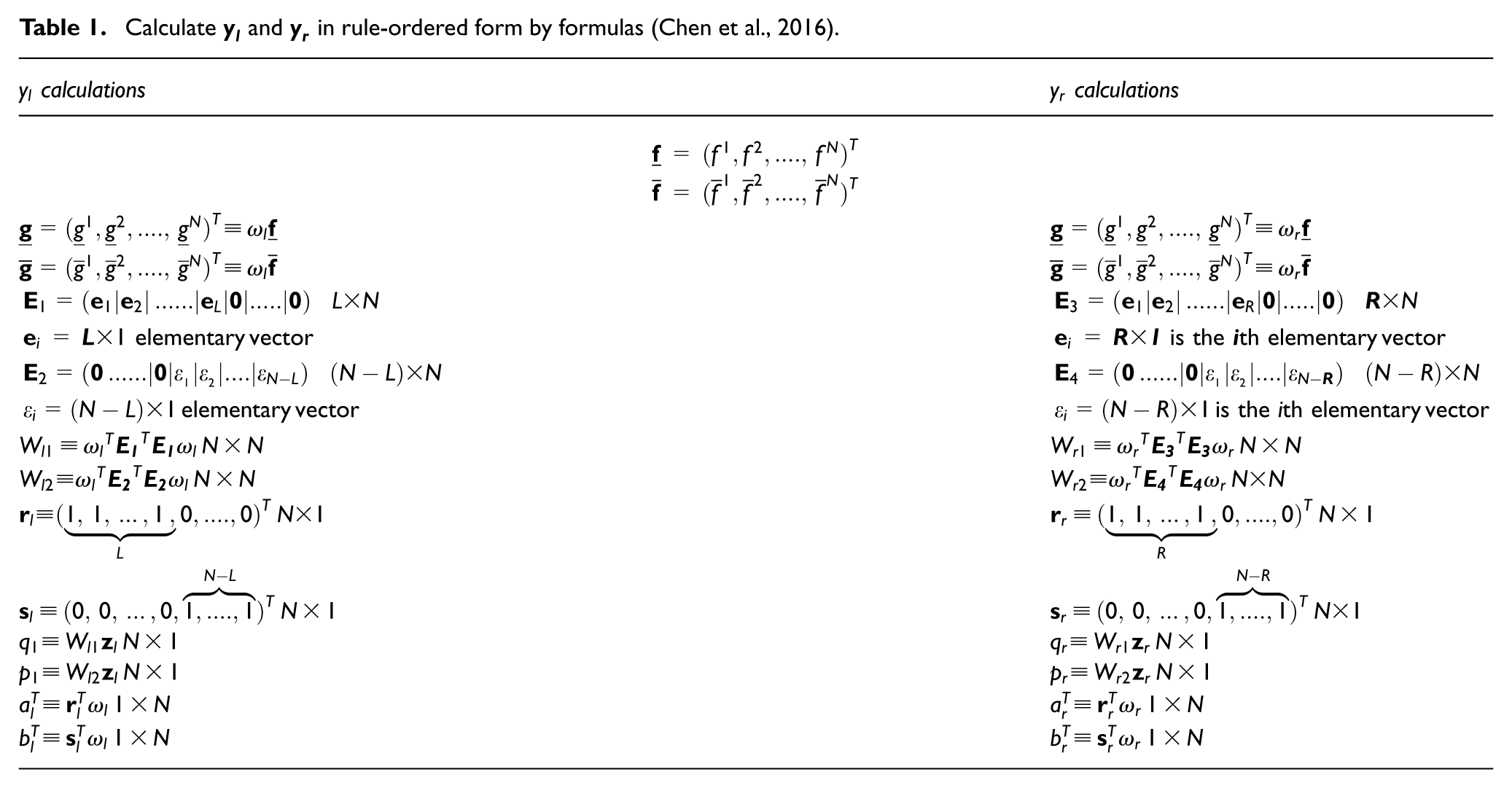
First of all, Table 1 defines and generalizes a collection of vectors and matrices. According to
Calculate
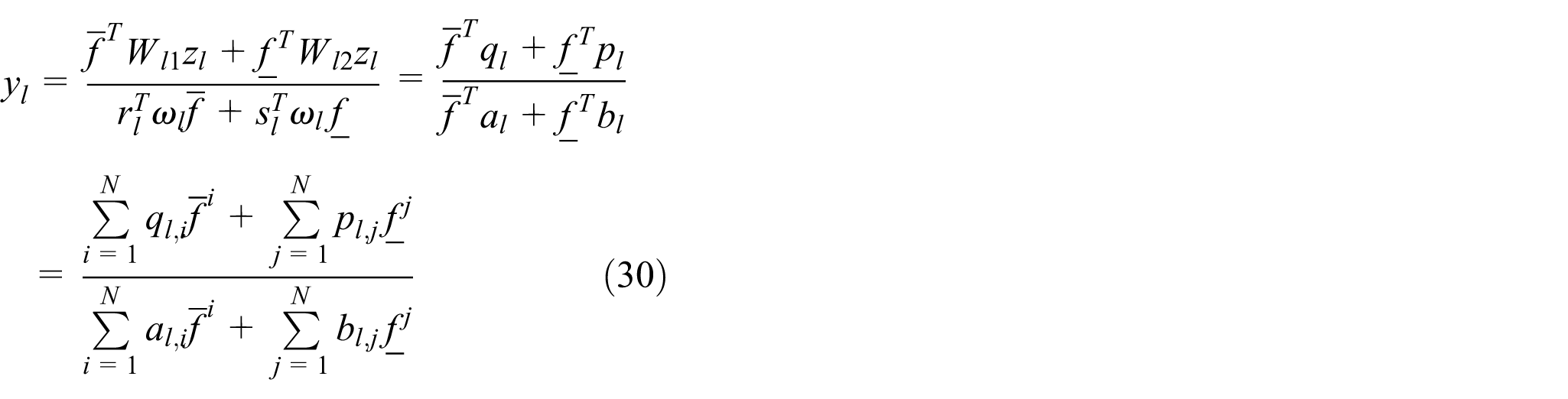
Note that
Re-express
in the rule-ordered form
TSK IT2 NSFLSs parameters optimization
In general, BP algorithms are used to tune the MF parameters of FLS as

where

We first list the following assumptions in order to avoid confusion:
The parameters to be tuned in each rule, each antecedent and consequent are not the same. This means that different rules or MFs own different parameters.
We do not define formulas of antecedent and consequent MFs ahead of schedule.
By means of mathematical formulas, we compute the derivatives that are demanded for completing the BP algorithms.
Computations that are identical to center-of-sets TR of Mamdani IT2 NSFLSs are employed.
Calculate
for antecedent parameters
Here, the subscript

Therefore, we first compute

where




after simple transformation

After substituting (36) and (37) into (34), we get

where

Calculation of
for consequent parameters
Here, we subtly choose
From (33) and (34), it is easy to get that

and

From (19) and (20), we can get that

and


where
Calculate
for input measurement parameters
Consider from (34), (40) and (41)

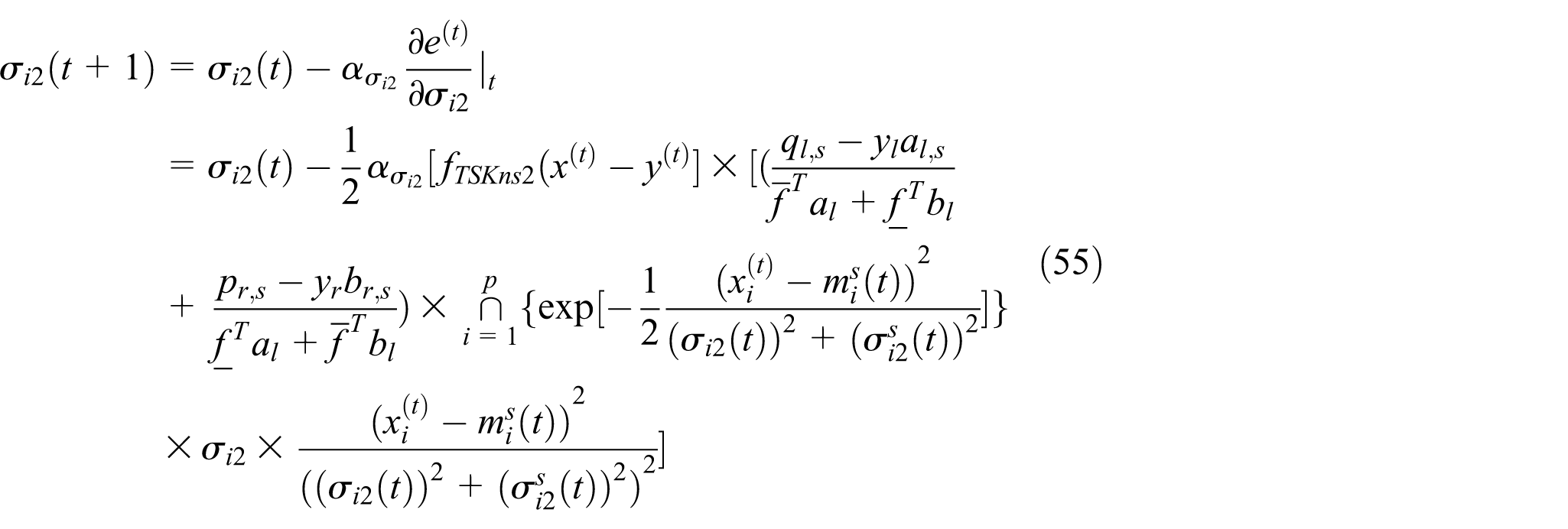
After defining the specific FOUs of MFs, we can derive the general derivative formulas. In the paper, Gaussian IT2 MFs with uncertain standard deviation is selected for the primary MFs of antecedent, consequent and input measurement of TSK NS IT2 FLSs. In the paper, the parameters of all the MFs are tuned by BP algorithms in terms of calculating derivatives in the proposed TSK NS IT2 FLSs under the KM structure.
For the

where
All the parameters




where
The defuzzified output of the TSK NS IT2 FLSs is as
Performance criterions: In order to evaluate the forecast effect of the proposed FLSs, we define two performance indices as Root Mean Square Error (RMSE):
Simulation studies
Data
In the section, the data of torque (Rama and Latha, 2015) and rpm (Kalender, 2015) of PMD under the complex operating conditions are adopted to elaborate the validity of forecasting based on the proposed TSK FLSs. Figure 4 shows the schematic view of PMD. In order to simulate the impact of uncertainty on the performace of FLSs methods, data values used in the simulations emerge comparatively high uncertainty because noise are added. Moreover, the added Gaussian noises are used for simulating nonlinear uncertain load in the situations.
Simulation setup
Firstly, ponder the data of torque of PMD. The PMD torque data is shown in Figure 5(a). As in Figure 5(a), the unit of vertical axis represents the Newton meter (Nm), and the unit of horizontal axis represents 0.001 second (s). All designs are based on 1000 noisy data points:
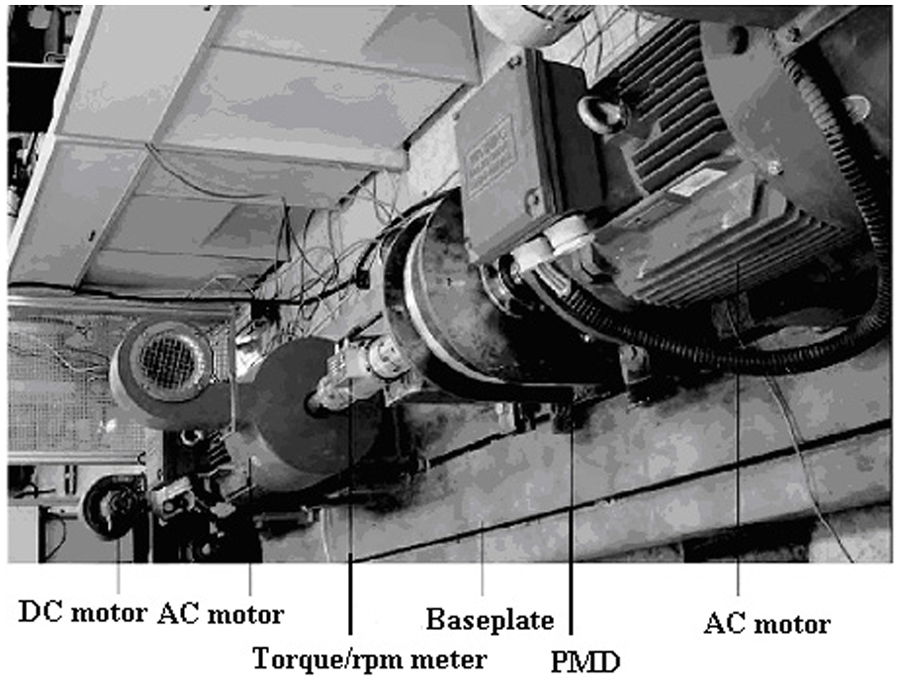
Schematic view of PMD.
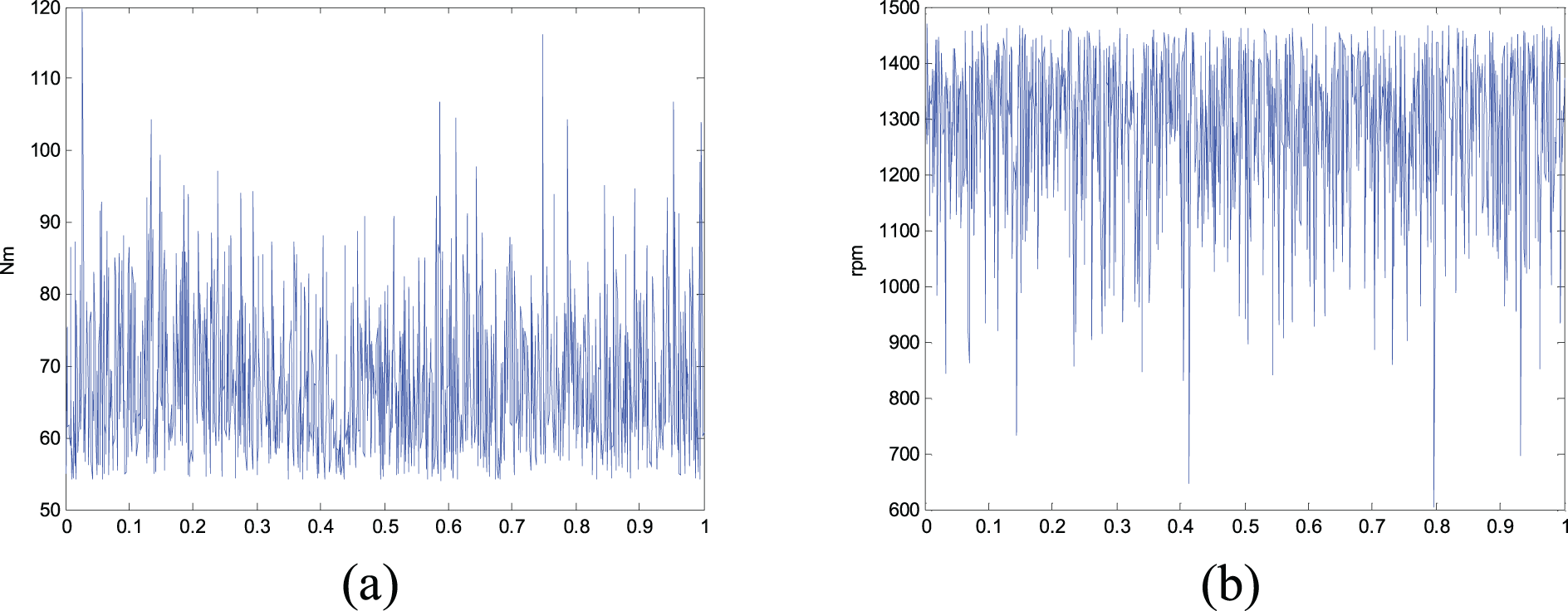
(a) The PMD torque data. (b) The PMD rpm data.
Seen from Figure 5(a), we can find that the data of torque of PMD varies in a relatively large range. In the paper, we try the advanced nonlinear FLSs methods for one-step prediction. The first 504 noisy data are used for training, that is, for designing the of FLSs forecasters. The remaining 496 noisy data are used to test the designs. T1 FLSs and IT2 FLSs under the KM structure forecasters are designed by the BP algorithms. If every four inputs are fed into the FLS forecasters, then one output generates. That is, 500 input-output data pairs generate from
The simulation process for developing TSK FLSs and checking their performances is displayed in Figure 6. We design a one-step predicator, and the mathematical model can be regarded as
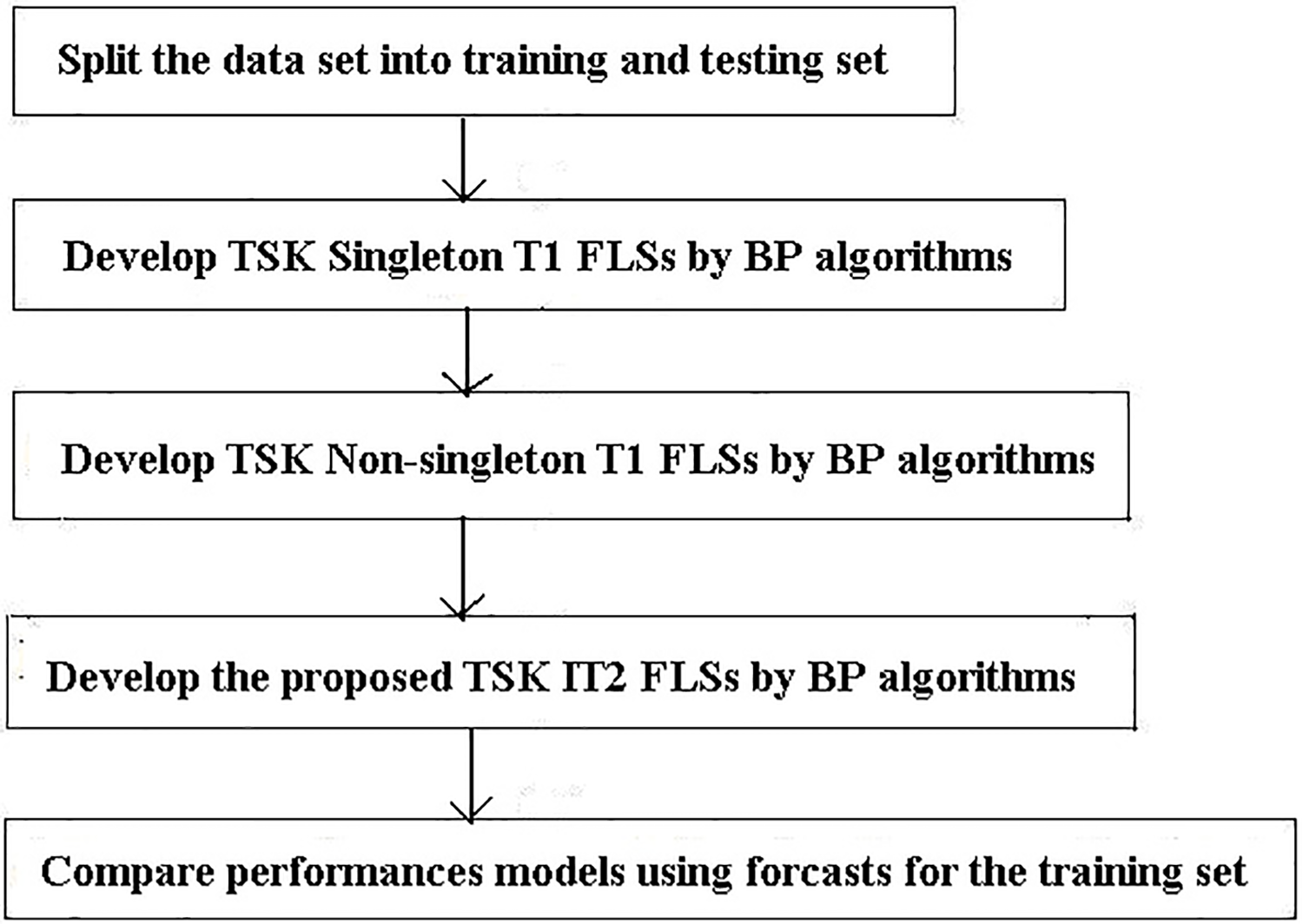
Simulation process for developing TSK FLSs and examining their performances (Chen et al., 2016).
We choose the product t-norm in the simulations. After 30 times of Monte Carlo simulations (in each of the Monte Carlo realization, 50 epochs of BP iteration are performed, and training and testing are executed at the same time), the simulation graphs of forecasting error (RMSE and CEES) iteration (after each iteration, the testing data is used to examine the performances) are depicted as follows.
See from Figures 7–8, we can find that the forecasting performances of the proposed TSK non-singleton IT2 FLSs are superior to their T1 counterparts. Then we consider the data of revolutions per minute (rpm) of PMD. A sampling period of 1 second is employed in the paper. The PMD rpm data is shown in Figure 5(b). As shown in Figure 5(b), the unit of vertical axis represents the revolutions per minute (rpm), and the unit of horizontal axis represents 0.001 second (s). In similar to the case of the torque of PMD, all designs are according to 1000 noisy data points:
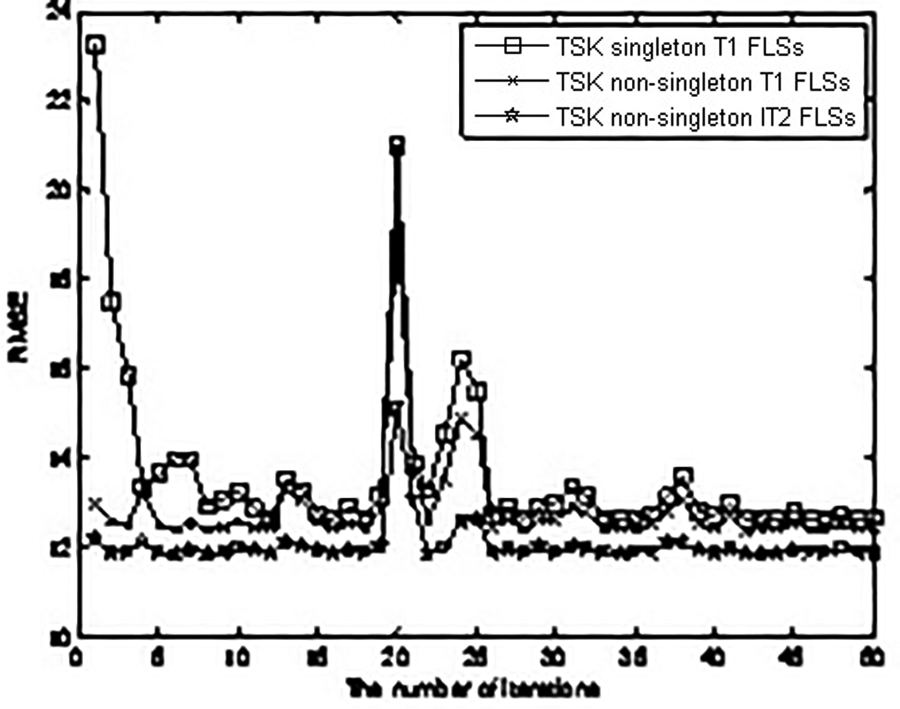
Simulation graphs of RMSE for the torque data of PMD (After 50 epochs of BP iteration, select the 30th Monte Carlo realization).
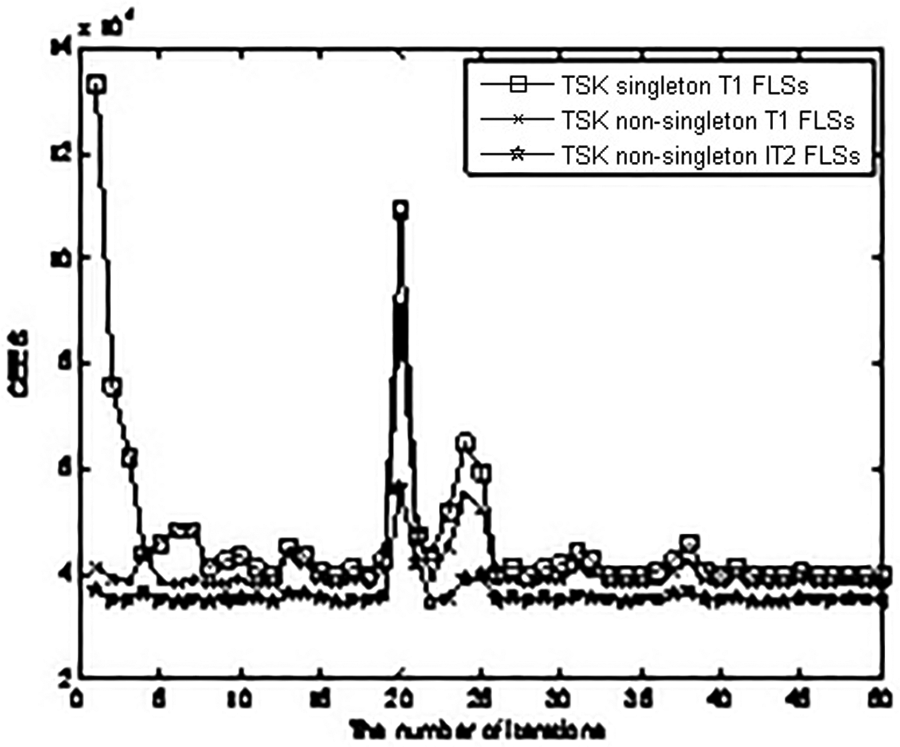
Simulation graphs of CEES for the torque data of PMD (Choose the 30th Monte Carlo simulation, after 50 epochs of BP iteration).
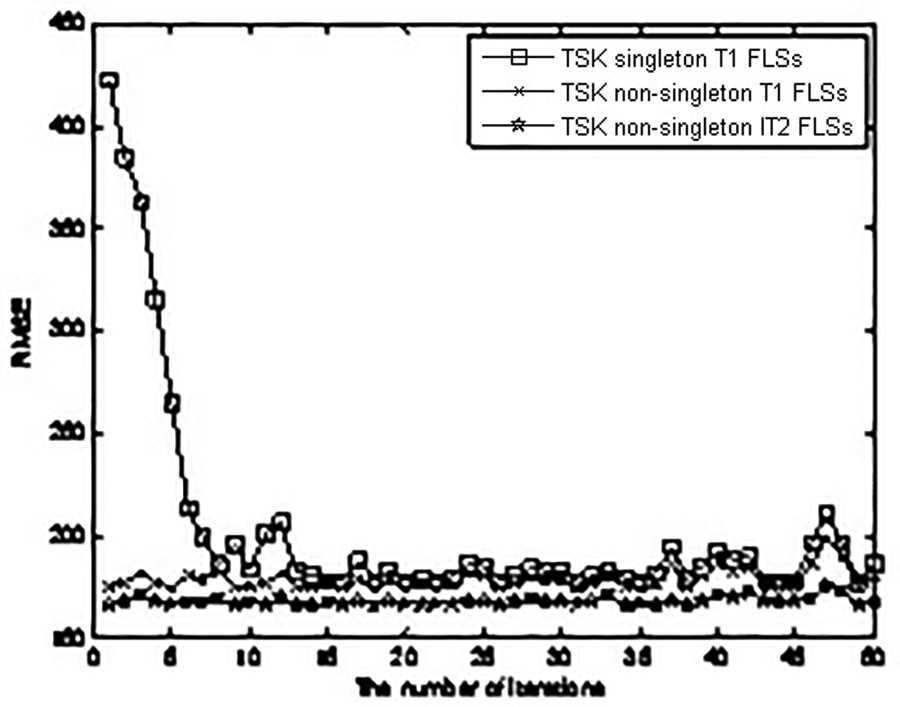
Simulation graphs of RMSE for the rpm data of PMD (After 50 epochs of BP iteration, select the 30th Monte Carlo realization).
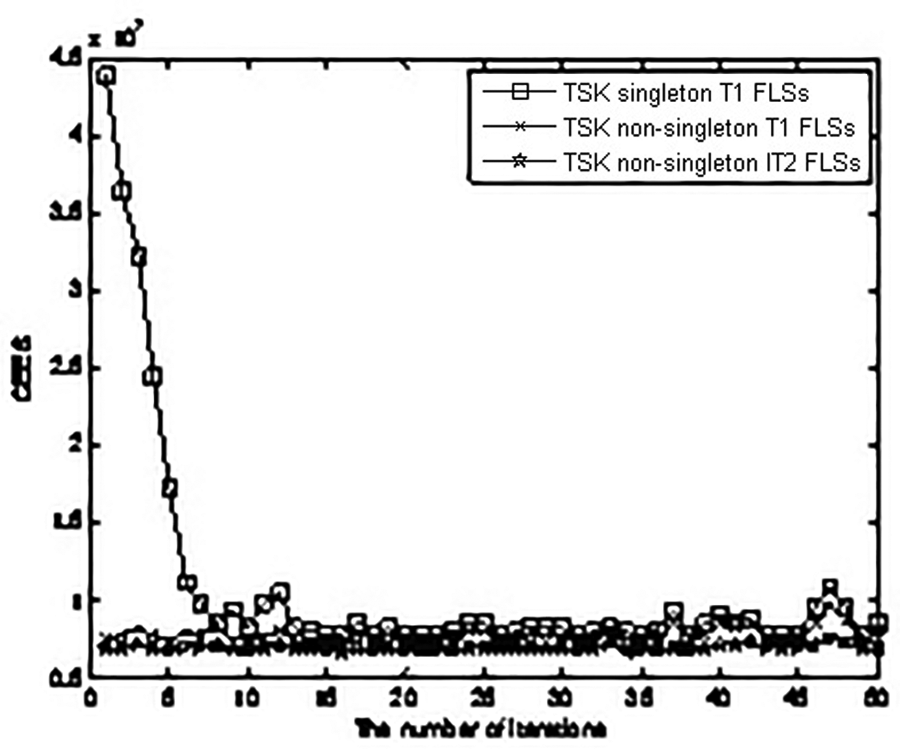
Simulation graphs of CEES for the rpm data of PMD (Choose the 30th Monte Carlo simulation, after 50 epochs of BP iteration).
In order to test the forecasting performance more comprehensively, we choose the Monte simulations in the paper. In the Monte Carlo simulations, the two performance criterions of RMSE and CEES are used for forecasting evaluation. Two types of TSK T1 FLSs are tuned by BP algorithms, while the proposed TSK non-singleton IT2 FLSs under the KM structure are skillfully tuned by BP algorithms according to matrix transformation. In the above three types of TSK FLSs, we select the learning parameter uniformly as
The averages of the above RMSEs and CEESs are displayed in Figures 11 and 12 for each of the 50 epochs.
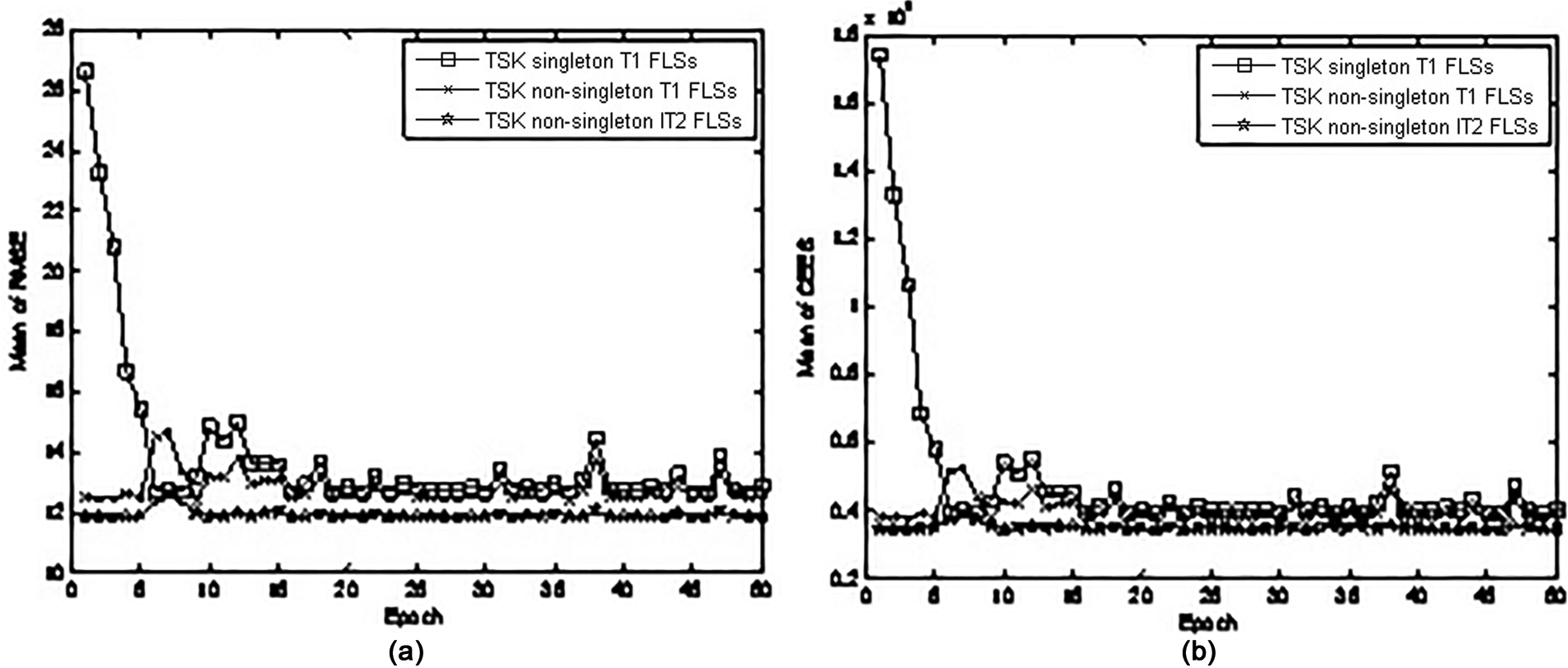
The mean of
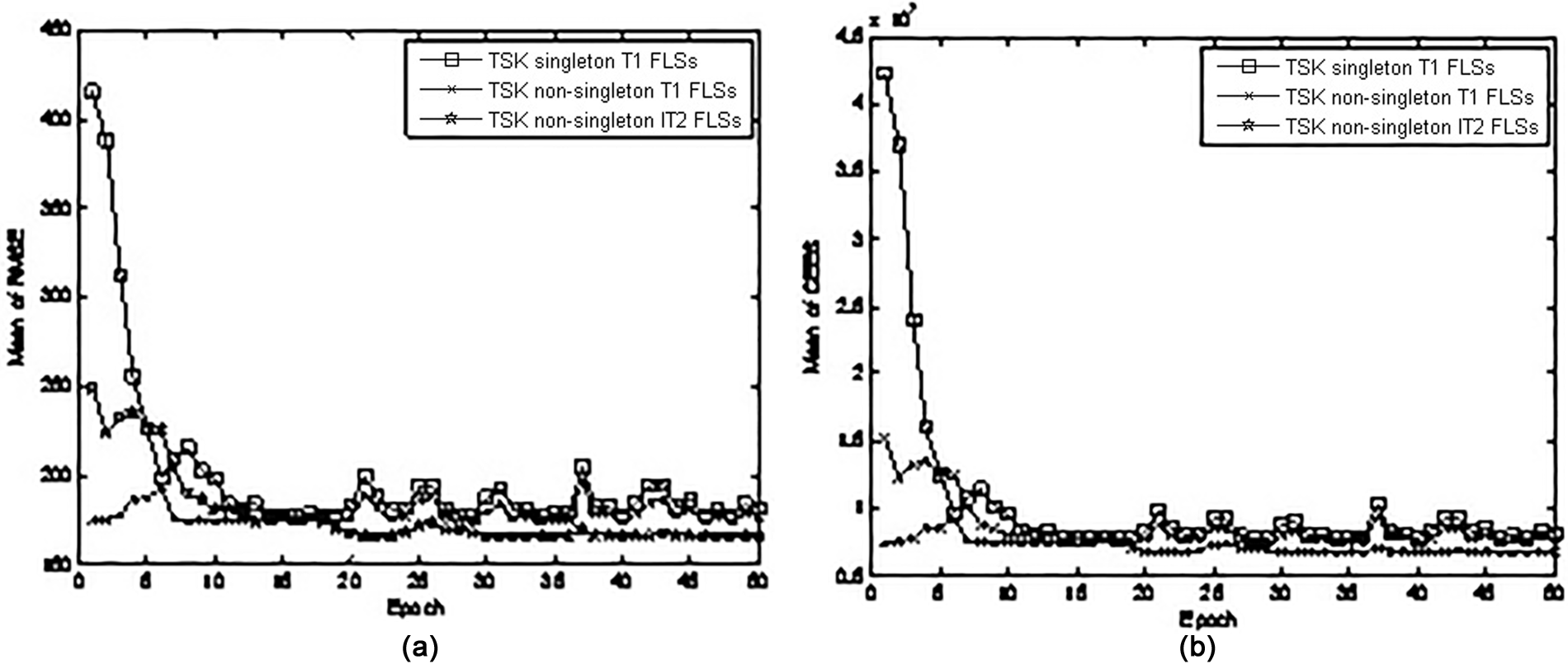
The mean of
Results and discussion
For the case of torque of PMD, we find that
During 50 epochs of iteration, the RMSEs and CEESs graphs of three types of TSK FLSs optimized by BP algorithms all reach relatively stable states at last (although both RMSEs and CEESs have small amplitude of oscillations after a few epochs) (seen from Figures 7 and 8).
The stability of TSK non-singleton IT2 FLSs is the best in three types of TSK FLSs (which has the minimum amplitude of oscillations), and the convergence value of TSK non-singleton IT2 FLSs is the smallest (seen from Figures 7, 8 and 11).
The convergence speed of TSK non-singleton T1 FLSs are faster than TSK singleton T1 FLSs, while the convergence speed of TSK non-singleton IT2 FLSs are faster than TSK non-singleton T1 FLSs (seen from Figures 7 and 8).
For both the averages of the RMSEs and CEESs, we find that TSK non-singleton IT2 FLSs outperform TSK non-singleton T1 FLSs, and TSK non-singleton T1 FLSs almost outperform TSK singleton T1 FLSs (except in a few epoch points) (seen from Figure 11).
For the case of rpm of PMD, we find that:
During 50 epochs of iteration, the RMSEs and CEESs graphs of three types of TSK FLSs optimized by BP algorithms all reach relatively stable states at last (although both RMSEs and CEESs have small amplitude of oscillations after a few epochs) (seen from Figures 9 and 10).
The stability of TSK non-singleton IT2 FLSs is the best in three types of TSK FLSs (which has the minimum amplitude of oscillations), and the convergence value of TSK non-singleton IT2 FLSs is the smallest (seen from Figures 9 and 10).
The convergence speed of TSK non-singleton T1 FLSs are faster than TSK singleton T1 FLSs, while the convergence speed of TSK non-singleton IT2 FLSs are faster than TSK non-singleton T1 FLSs (both TSK non-singleton T1 FLSs and TSK non-singleton IT2 FLSs almost reach their convergences at the first epoch of BP iteration) (seen from Figures 9 and 10).
For both the means of the RMSEs and CEESs, after about 14 epochs of BP iteration, we find that TSK non-singleton IT2 FLSs outperform TSK non-singleton T1 FLSs, and TSK non-singleton T1 FLSs almost outperform TSK singleton T1 FLSs (in the first 14 epochs of BP iteration, TSK non-singleton T1 FLSs may outperform the other two types of TSK FLSs) (seen from Figure 12).
Based on the above convergence and stability analysis, we obtain sufficient evidences demonstrating that the proposed BP optimized TSK non-singleton IT2 FLSs are better choice for developing dependable IT2 FLSs compared with other T1 FLSs. Even though it is quite difficult to tune the parameters of TSK IT2 FLSs under the KM structure by BP algorithms, we could draw a conclusion that IT2 FLSs are more reliable and flexible for coping with uncertainty information than their T1 counterparts. Compared with T1 FLSs, it is applicable to study forecasting by designing and adjusting IT2 FLSs.
Conclusions
In the paper, TSK IT2 FLSs under the KM structure (Chen et al., 2016) are designed and adjusted for forecasting problem on account of torque and rpm data by BP algorithms. In addition, we accomplish the comparative studies with real datasets from PMD. And the high-level FLSs approaches are suitable for the above two cases. Simulation results demonstrate that the proposed TSK IT2 FLSs have approving forecasting performance. Seen from Figures 7–12, we can find that the TSK IT2 FLSs have got better forecasting performance compared with two types of TSK T1 FLSs (Mendel, 2001). However, it is very difficult to design and program the proposed TSK IT2 FLSs under the KM structure by BP algorithms. As is well known, BP algorithms only converge to local extrema and they are not global optimization algorithms. We are probable to select good initial values for the parameters of FLSs, and selecting them brightly can make the algorithm converge much faster.
So much interesting work still lies ahead, including the research of designing and tuning IT2 FLSs parameters based on triangular MFs, trapezoid MFs, bell-shaped MFs, hybrid type MFs and general type-2 (GT2) FLSs optimized by other global search algorithms like quantum particle swarm optimization, genetic algorithms and so on. Future studies will be focused on IT2 or GT2 FLSs design and optimization (Oscar et al., 2016).
Footnotes
Declaration of conflicting interest
The authors declare that there is no conflict of interest.
Funding
The author(s) disclosed receipt of the following financial support for the research, authorship, and/or publication of this article: This paper is partially supported by the Natural Science Foundation of China (No. 61374113) and Fundamental Research Funds for Liaoning’s Universities (No. JL201615410). The authors are very thankful to Professor JM Mendel, who has offered very valuable suggestions.