






Abstract
The control of nonlinear systems has been the subject of extensive research. This interest is mainly due to its potential for real applications. In this paper, we investigated discrete sliding mode control for a class of nonlinear time-delay systems represented by T–S fuzzy models. In most existing fuzzy sliding mode control, a common input matrix is considered for all subsystems. This assumption is very restrictive. Therefore, we proposed a new sliding surface, which takes account of the system state and the control input in order to exclude the restrictive assumption. Furthermore, we have improved the latter sliding mode control scheme, by adding delayed states. Based on formulation of linear matrix inequalities, the parameters of the sliding function are obtained. Therefore, to further reduce the conservatism in the existing results, the Wirtinger-based integral inequality and Jensens inequality are employed. To show the applicability and effectiveness of the proposed controller design methodology, a numerical example is given for illustration.
Keywords
Introduction
The frequent necessity to control complex physical systems encouraged the development of more robust and sophisticated nonlinear control techniques. Fuzzy set theory was introduced in the 1960s by Zadeh (1965). It was then quickly used for a large number of applications in areas as diverse as expert systems, signal processing and classification.
Sugeno and colleagues (Sugeno and Kang, 1988; Sugeno and Tanaka, 1991) developed techniques to refine the structural and parametric identification of T–S fuzzy models. The main interest in Takagi–Sugeno models lies in its special structure, that is, the form of a nonlinear convex sum of linear subsystems. Therefore, many interesting results for linear systems, such as stability analysis (Feng, 2004; Liu et al., 2005), observer synthesis (Tanaka et al., 1998) or H∞ criteria (Zhou et al., 2005) can be extended to T–S fuzzy models.
However, a time delay exists in many actual systems, such as nuclear reactors, chemical engineering, communication networks, and hydraulic system dots (Balachandran et al., 2009; Kuang, 1993). Therefore, the stability and stabilization analysis of time-delay systems has attracted wide attention in academic research over the last few decades (Gu et al., 2003). Generally, these reported stability results can be grouped into two categories; that is, delay-independent (Chen and Lee, 2009; Hong et al., 2005; Oucheriah, 2001) and delay-dependent (Cao et al., 1998; Hua et al., 2005; Xia et al., 2010) cases. The delay-dependent approach is recognized to be less conservative than the delay-independent approach, particularly when the size of the delay is small.
Based on recent progress in linear time-delay systems, many research studies deal with performance analysis and controller synthesis for T–S fuzzy models with time delay (Lien, 2006; Lin et al., 2005; Wu, 2006; Zhou and Li, 2005). For example, Yang et al. (2014) studied stability analysis for discrete T–S fuzzy models with time delay and stochastic perturbation using a new fuzzy Lyapunov function and the delay partitioning technique, which aims to reduce conservatism. According to the literature on this subject, other techniques are proposed, based, for instance, on the Wirtinger-based integral inequality (Seuret et al., 2015), the reciprocally convex approach (Park et al., 2011) and Jensen’s inequality (Gu et al., 2003). These ingredients aim mainly at improving some existing results from the literature.
Moreover, another important requirement for a control system is its robustness. In this work, sliding mode control is adopted for its effective robust behaviour. Sliding mode control has been widely implemented in a variety of practical engineering systems, such as robot manipulators (Baek et al., 2016), aircraft (Rao and Sinha, 2013), electrical motors (Wang et al., 2011) and automotive engines (Corradini and Orlando, 2014). The success of these applications is due to the attractive features of the sliding mode control techniques, such as fast response and good transient performance. In recent years, many papers have reported the problem of sliding mode control for delayed systems, for example, Gao et al. (2014) presented a dynamic sliding mode control for T–S fuzzy continuous time systems with time delays, whereas an integral error-dependent sliding surface design approach is dealt with by Mukherjee et al. (2015). The principle of this technique is to oblige the system to reach and then stay on a given surface (representing a set of static relationships between the variable states). The surface considered is then designated the sliding surface. The implementation of a sliding mode on the system takes place in two steps. First, the surface is designed in such a way that the sliding mode has some desired properties (not necessarily present in the original system); then a discontinuous control law is synthesized to make the surface invariant (at least locally) and attractive. However, during the practical implementation of the traditional (first-order) discrete sliding mode control, a major drawback, known as chattering, takes place. This phenomenon manifests high-frequency switching of the control, and sensibility to the unmatched uncertainties, which can sometimes lead to instability (Kim et al., 2000; Lopez and Nouri, 2006). To overcome these problems, there are various methods to reduce this phenomenon, one of which involves replacing the function ‘sign’ by a continuous approximation in the vicinity of the sliding surface (saturation or sigmoid function) (Edwards and Spurgeon, 1998; Slotine, 1984). In Bartolini et al. (2000), another method, known as a second-order version of sliding mode control, has been proposed.
In this work, the problem of the stabilization of discrete T–S fuzzy systems with interval time-varying delay has been investigated. A new discrete sliding mode control is proposed. It takes account of the delayed state of the considered nonlinear time-delay systems represented by T–S fuzzy models. Furthermore, the discrete Wirtinger-based inequality and the reciprocally convex approach are the main ingredients used to further reduce the conservatism of the existing results.
This paper is organized as follows. The problem description is given. The new discrete sliding mode controller design is then developed. Finally, the advantages of the proposed controller are verified by a numerical simulation example, before conclusions are drawn.
System and problem descriptions
We consider a discrete T–S fuzzy time-delay model with r plant rules described by Ri: if z1k is
where xk∈Rn is the state vector, uk∈Rm is the control input and Ai, Adi and Bi are constant matrices with appropriate dimensions. For practical purposes, we consider τm ≤ τk ≤ τM, where τm and τM are non-negative integers representing the lower and upper delay bounds, respectively. ψl is the initial condition of xk.
with
Then, the discrete-time T–S fuzzy model with time-varying delay in the state is given by
where
To achieve this purpose, the following lemma, which plays an important role in the derivation of stability and stabilization criteria, is necessary.
where
Σ1 = xk − τ1 − xk − τ2
Design of discrete sliding mode control
Design of sliding mode control
Knowledge of weighting functions is important for a linear sliding mode synthesis. A linear sliding surface is chosen as
where Klj ∈ Rm × n, l = 0,…,m, j = 1,…,r, are the parameters to be designed, with τ0 = 0, τ1 = τmin and τm = τmax.
The equivalent control associated with the nominal system of equation (3), denoted ueqk, is defined as the only possible solution to Sk = 0 (or Sk + 1 = 0), that is
where
However, this command cannot constrain the system trajectory to reach the sliding surface. It is therefore necessary to add a variable structure control defined as
with u+ ≠ u−. Ordinarily, the command is expressed as
where σ is a constant.
Stability analysis of sliding mode
Owing to the influence of the sliding surface on system stability and transient performance, the design and analysis of the sliding function become the main issue in sliding mode control.
In this section, the sliding function is designed using a delay-dependent stability approach. A Lyapunov–Krasovskii functional combined with free weighing matrices and Wirtinger-based integral inequality, as previously described (Seuret et al., 2015; Zhang et al., 2015), are used to define a linear matrix inequality condition that guarantees state convergence in sliding mode.
In sliding mode, that is Sk = 0, we obtain ueqk, which is defined by equation (6). Substituting equation (6) into equation (3), the closed-loop system is described as the following autonomous system
where
with
and
Let
Then ηk and xk + 1 are given as
where
and
Construct the following Lyapunov–Krasovskii functional
for equation (9) with
where P, Qi, Ri, i = 1,2 are positive definite matrices to be determined and
Therefore, the increment of V jk , j = 1,…,3 along with the solution of equation (9) is
where
Now, applying Lemma 1, expression J3 can be bounded as
with
φ2 = −(ε1 − ε2)TR3(ε1 − ε2) − 3(ε1 + ε2 − 2ε6)TR3(ε1 + ε2 − 2ε6), whereas for expression J2 we get
with
and for J1, we start by writing it as
where J12 is bounded as
with
and J22 is bounded as
with
Then, by using the reciprocally convex approach (Park et al., 2011) to deal with the time-varying terms in equations (17) and (18) and for any matrix N ∈ R2n × 2n satisfying
we get
with
Hence, re-injecting
where
Thus, it can be seen that Φ0 < 0 is sufficient to ensure that ΔVk < 0. Moreover, applying a Schur complement to equation (22) shows that Φ0 < 0 is equivalent to
where
Note that equation (23) can also be written as
It is straightforward that from equation (24) we get
where
and
with
and
Now, pre- and post-multiplying equations (24) and (19), respectively, with χ4 and
Moreover, let X = P−1,
In the case where the sliding surface does not depend on the delayed states, the sliding surface of equation (5) becomes
The reduced system, which is a special case of equation (9), is defined as
The stability analysis of this particular case can be investigated by using the transformed inequalities
In addition, ηk and xk + 1 are expressed as
where
Then, a Lyapunov functional candidate is defined as
with
where
where
with
and
Simulation example
In this section, a simulation example is used to demonstrate the effectiveness of our proposed theoretical results. Consider the discrete fuzzy time-delay system
with
The initial states of the system are
The behaviour of the closed-loop response of the discrete fuzzy system with state time-varying delay and the comparison results between Theorem 1 and Corollary 1 are shown in Figures 1 to 6. The system state trajectories for the sliding control are illustrated in Figures 1 and 2. Figures 3 and 4 present the control input signal; the resulting sliding surface are shown in Figures 5 and 6.
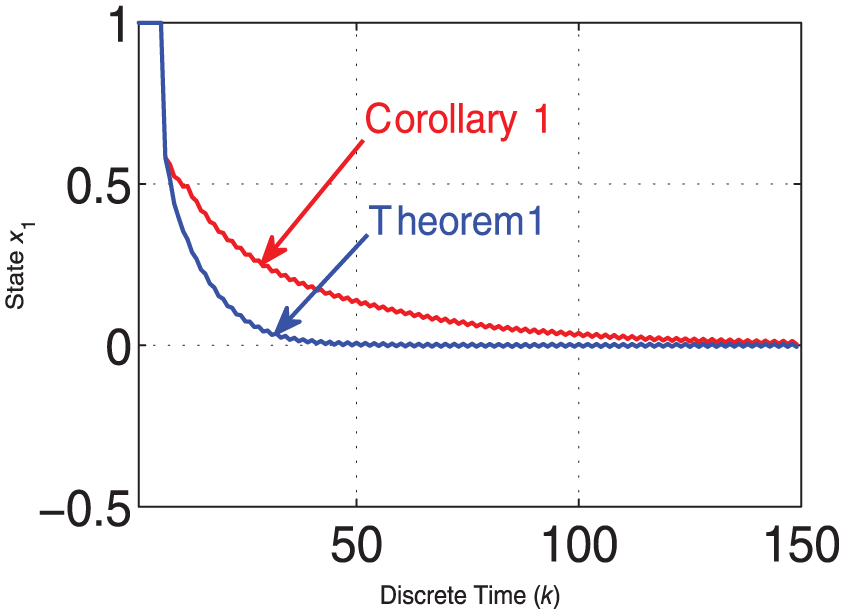
Evolution of the state vector (x1k).
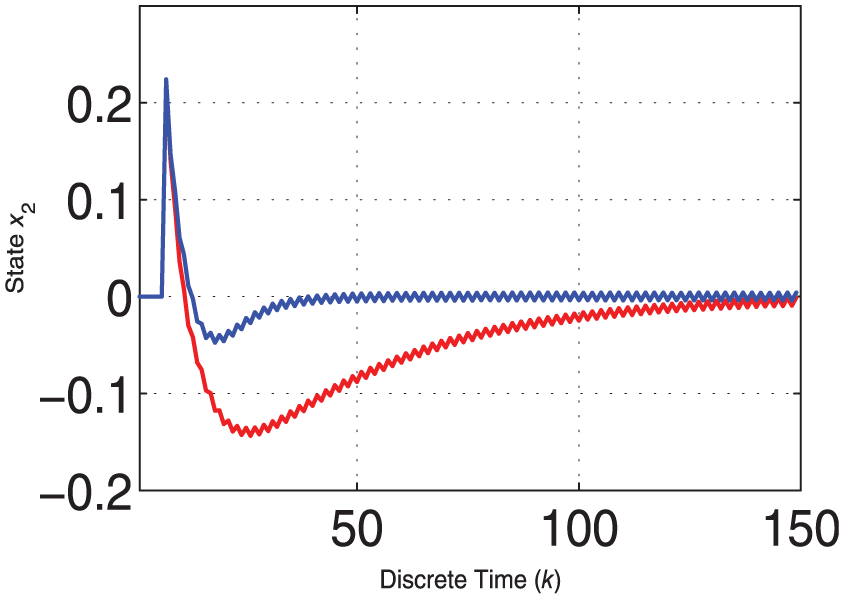
Evolution of the state vector (x2k).
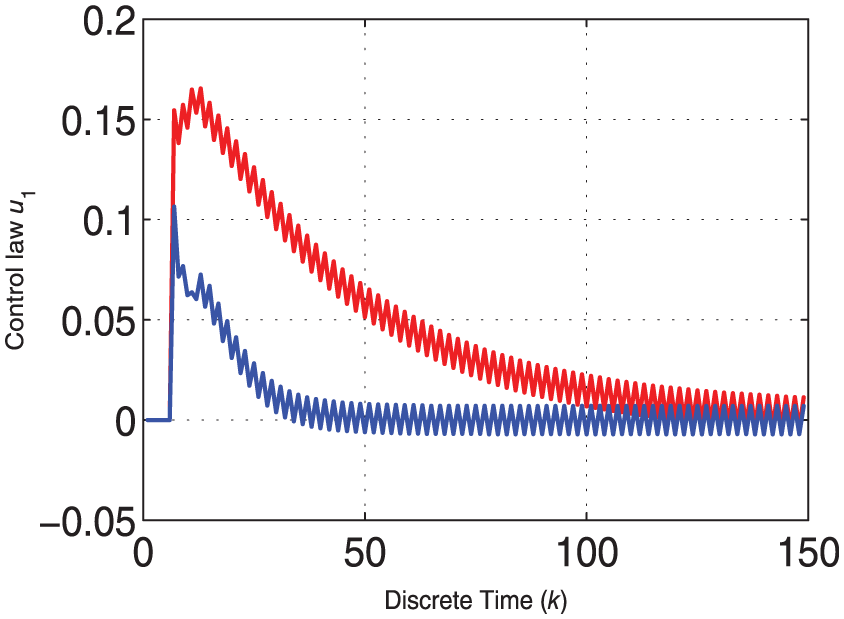
Evolution of the vector input (u1k).
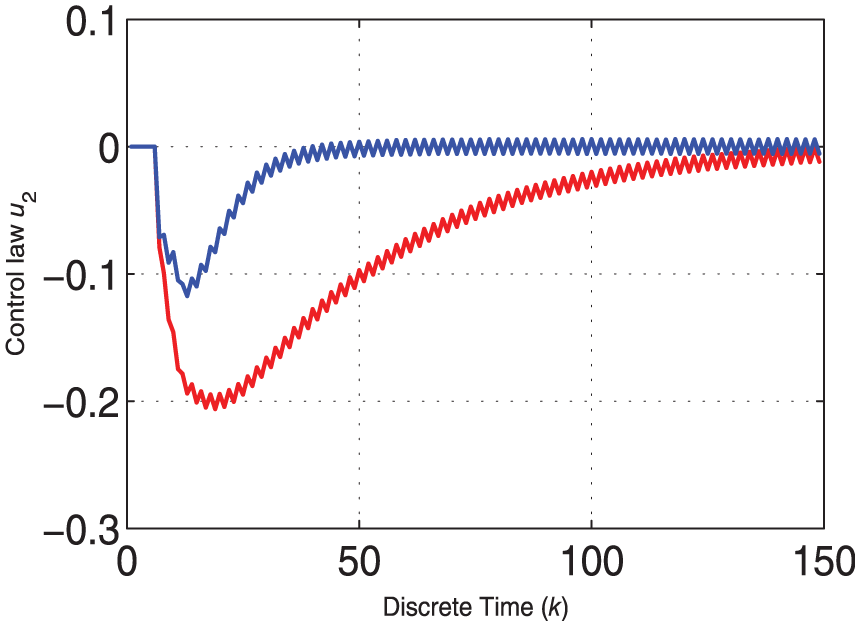
Evolution of the vector input (u2k).
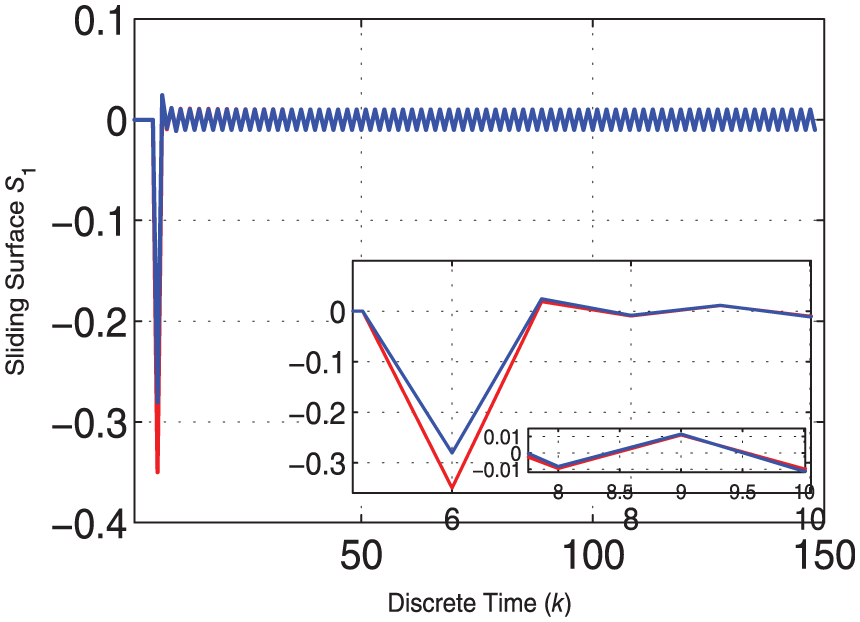
Evolution of the sliding surface (S1k).
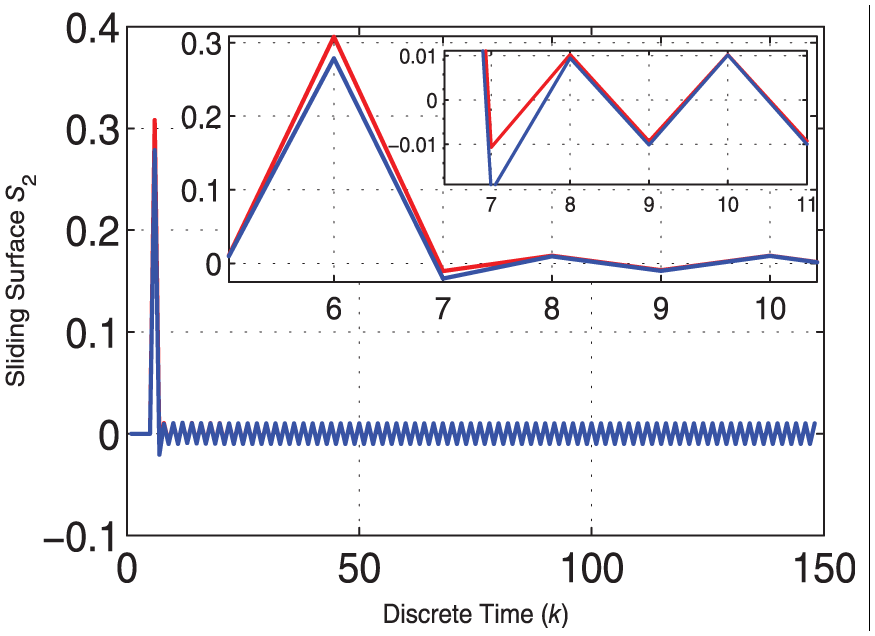
Evolution of the sliding surface (S2k).
Comparisons between system states trajectories for the two algorithms are illustrated in Figures 1 and 2. From these figures, it can be seen that the new sliding mode control, developed by taking into account the state delays and the vector input in the sliding surface, could improve the performance of the closed-loop system. The convergence to the origin is faster than for the classical function (equation (27)).
Conclusion
In this work, a new dynamic sliding surface for a class of discrete Takagi–Sugeno fuzzy systems with time-varying delay is investigated. In terms of linear matrix inequalities and based on the Wirtinger-based integral inequality, a delay-dependent condition for the sliding mode dynamics to be asymptotically stable on the sliding surface is presented. The obtained simulation results show a perfect convergence of the states to the origin (x = 0), in spite of the presence of the unknown state time-varying delay.
Footnotes
Funding
This research received no specific grant from any funding agency in the public, commercial or not-for-profit sectors. The research unit where this work is done, is subordinated to the Ministry of Higher Education and Scientific Research of Tunisia. However, this work is not funded by this Ministry.