






Abstract
Electrohydraulic loading system is a torque servo system with high-accuracy and high-frequency response. In this paper, an adaptive extended state observer-based flatness nonlinear output control is proposed to improve the torque tracking performance of electrohydraulic loading system. This method combines a flatness concept, expected state, adaptive extended state observer and system output to develop a stable control system. Expected input feedforward based on the flatness property is designed to provide model compensation for bandwidth enhancement. An adaptive extended state observer is proposed to estimate the unmeasured states and the unmodeled dynamics. Based on estimated states and disturbances, state feedback control is developed to ensure the stability of closed-loop system, and to improve torque tracking accuracy and system robustness. The stability of the closed-loop system is proved by the Lyapunov stability theory. Extensive experiments were carried out to verify the performance of high-accuracy tracking of the proposed control strategy.
Keywords
Introduction
Owing to the advantages of high power-to-size ratio and large payload capability, electro-hydraulic system has a wide range of applications (Ba et al., 2016; Shiralkar and Kurode, 2016; Wang and Wang, 2013). It has been widely applied in robot manipulators (Dunnigan et al., 1997; Guo et al., 2008; Sirouspour and Salcudean, 2001), active suspensions (Sun et al., 2013), flight motion simulators (Han et al., 2015; Yao et al., 2013), load simulators (Han et al., 2014; Wang et al., 2013), and so forth. Conventional linear control has been commonly used in hydraulic systems owing to their simplicity, clear functionality and ease of implementation (Ishak et al., 2012; Liu and Daley, 2000). However, these methods can only guarantee local stability and it is difficult for them to meet high performance requirements. In some special scenarios, the electro-hydraulic servo system (EHSS) is required to achieve high tracking accuracy and high dynamic response. Some properties for EHSS, like inherent high-order nonlinear characteristics, parameter uncertainties and modeling uncertainties (Shiralkar and Kurode, 2016; Yao et al., 2013), make it relatively hard to develop high-performance closed-loop controllers. Therefore, more advanced control algorithms are really a necessity rather than a luxury (Alleyne and Liu, 1999).
Many advanced nonlinear controllers with strong robustness and self-adaptability have been developed to improve tracking performance for EHSS, such as feedback linearization (Seo et al., 2007; Won et al., 2015b), backstepping control (Kaddissi et al., 2007), passivity-based control (Kim et al., 2012), flatness-based control (Kim et al., 2015), adaptive control (Ahn et al., 2014),
Currently, great attention has been brought into disturbance rejection in controller design. Many algorithms have been proposed (Cheng et al., 2016; Guo and Wen, 2010). In a broad sense, these algorithms can be categorized into two different type of controls, that is, robust control and adaptive control (Yang et al., 2016). Robust control could achieve the best possible robustness probably only by compromising the nominal performance. It is difficult for adaptive control to deal with complex disturbances and uncertainties. It would probably become unstable under some practical applications in the presence of unstructured uncertainty or disturbances. Disturbance/uncertainty estimation and attenuation (DUEA) techniques can alleviate some weakness for robust control and adaptive control described above (Yang et al., 2016). It is able to provide an alternative approach for robust and adaptive control to deal with uncertain systems. In recent years, DUEA techniques have been thoroughly studied and applied into electrohydraulic servo systems (Guo K et al., 2015; Kim et al., 2013; Won et al., 2015(a); Yao et al., 2014).
All aforementioned control strategies need full-state information. That is to say, in addition to the system output, other information including differential output and pressure is also needed in electrohydraulic servo control. For many practical hydraulic systems, output is the only available information owing to cost reduction purpose or structure restriction. Heavy measurement noise of the pressure and velocity measurements may also deteriorate the performance of full-state feedback controllers. Extended state observer (ESO) is one of the DUEA techniques. It can observe system states, and provide real-time estimation of “total disturbances” (Chen et al., 2016). It does not require too much model information and can estimate disturbances. This helped bring ESO into wide applications in a variety of different controllers (Cai et al., 2014; Cui et al., 2015; Guo et al., 2016; Yao et al., 2014). Generally, ESO can be only applied in integral-chain essential linear systems (Li et al., 2012) and cannot be applied into electrohydraulic systems directly. In addition, although ESO has been intensively studied in the literatures, only a few research works on ESO were performed involving uncertain or time-varying parameters.
This paper proposed an adaptive extended state observer. The stability of the observer is demonstrated theoretically. A flatness nonlinear output control is proposed to improve torque tracking performance of electro-hydraulic loading system (EHLS) by synthesizing flatness-based control and adaptive state observer. This way, flatness control can be realized only by measuring the output. Robustness against disturbances is enhanced by disturbance/uncertainty estimation and compensation of adaptive extended state observer. The stability and tracking performance of the closed-loop system are proved based on Lyapunov theory.
The rest of this paper is organized as follows: the description and modelling of the electrohydraulic loading system are derived in the next section. Then, design of the proposed control law for electrohydraulic loading system is demonstrated, and the stability of the overall closed-loop system is derived. Next, experimental validation of the proposed scheme is given. The final section concludes this paper.
System description and dynamic model
The electrohydraulic loading system
Actuator has been widely used as servo driver in various servo control systems. Actuators are often subject to complicated loading conditions in their practical applications. They are usually required to be tested under practical dynamic loads to ensure that they meet the requirements in specific situations. This kind of test should be carried out in a specific load environment, which requires devices and techniques that can help accurately generate the same load condition as practice. The loading simulation technique for actuator test in lab has become more and more important, which can significantly help push actuator’s development, greatly saving experimental expense.
Torque can be generated between two relatively moving objects by friction. Friction may be used to simulate load torque this way, and the EHLS can be then developed. The structure is shown in Figure 1. The basic components in this system are hydraulic cylinders, hydraulic power, servo valve, friction plates, torque sensor, hydraulic swing motor and electric motor. In this system, the left part is the tested actuator system, which is a positioning servo control system; the right part called loading system is a torque servo control system that can generate torque to simulate aerodynamic load acting on the tested actuator. Friction plate A is connected with the shaft of tested actuator through a sliding key. It is able to move along the shaft and rotate together with it. Friction plate B is fixed onto the shaft of motor. It is driven by motor to keep rotating all the time at a constant speed, which would introduce a relative motion between two friction plates. Friction is then produced as both plates are connected with each other. Kinetic friction torque between friction plates can be transferred to the shaft of the tested hydraulic motor to serve as load. Hydraulic cylinders are fixed on the base and parallelly actuated by servo valve to load force on friction plates. The force acting onto friction plates can be adjusted by valve-controlled hydraulic cylinders, to change the loading torque needed. Actual loading torque from torque sensor will be fed back to controller for implementation of torque servo control.

System schematic diagram of electro-hydraulic loading system.
Mathematical model
Friction is very complicated. A simple approach is studied by assuming friction force as a linear function of load. According to torus contact relation between friction plates A and B, friction torque is given by applying infinitesimal calculus.
where
Load force acting on a pair of friction pairs can be expressed by
where K is the load stiffness [N/m], y is the position of hydraulic cylinder [m].
Friction torque is changed with the change of the load force. It can be accurately controlled by adjusting the valve-controlled hydraulic cylinder. The valve-controlled hydraulic cylinder shown in Figure 2 is a crucial element in this system. A basic set of equations describing the dynamic behavior of a valve-controlled hydraulic motor includes the following equations (Merritt, 1967).
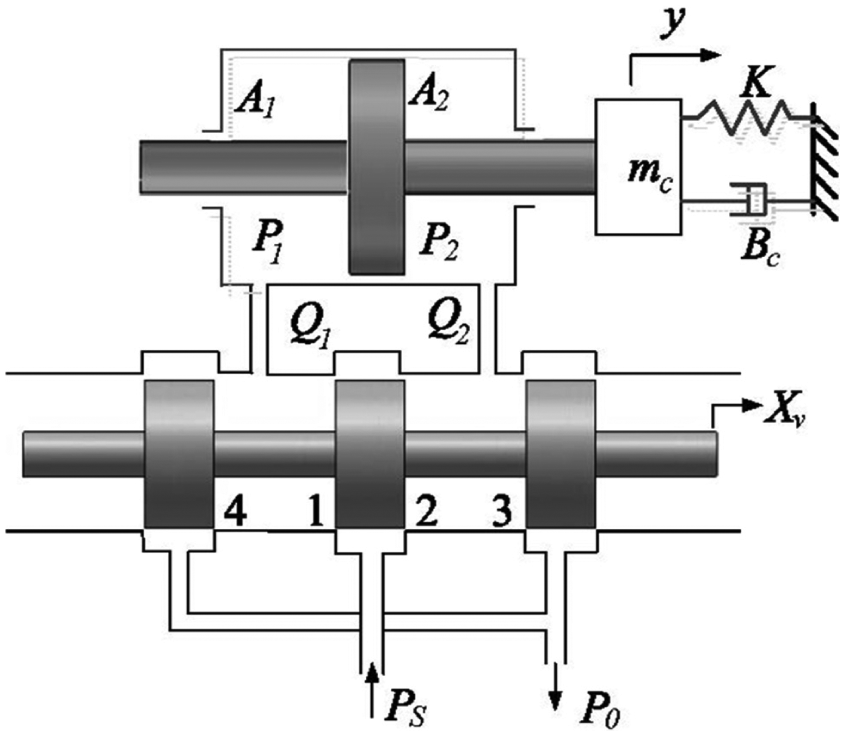
Oil circuit of valve-controlled hydraulic cylinder.
The control flow rate equation of hydraulic valve can be written as
where
By applying the continuity law to each chamber of hydraulic cylinder, the load flow rate continuity equation is given by
where
By applying Newton’s second law, dynamics of the piston can be described by
where m is the equivalent mass of load [kg],
In general, dynamic behavior of electric elements and servo valve are much higher than that of actuator in electro-hydraulic servo system. So, the relationship between input voltage and spool position of servo-valve is given by
Defining state variable as
EHLS is a torque servo system. The output of this system is equal to the state
Flatness-based adaptive nonlinear output controller
Adaptive extended state observer design
For practical implementation purposes, an adaptive extended state observer is designed to estimate the full states.
Define parameters
In order to accomplish the aforementioned design missions, major modeling uncertainty
The extended system model (9) can be then described as
where
To estimate the full states, a nonlinear observer is designed by
with the following parameter adaption law
where
Defining the estimation error as
where
Defining the new variable
where
Based on assumption 1 and definitions of
Choose
There must exist a positive constant
Time derivative for equation (17) is then given as
As
where
By substituting equation (21) into equation (20), the following inequality can be generated
If
where
According to equation (23), equation (24) can be obtained with a comparison lemma.
Flatness-based nonlinear controller design
Considering a nonlinear system
where x is the state and u is the input with the same dimensions as the output y.
If there exists an output
According to the flatness property, the system model could be analyzed by formally calculating the system variables as functions of the flat output and its time derivatives.
System state variables as the flatness functions can be obtained from y,
The control input can be designed based on the flatness property for the asymptotic tracking. According to system (8), the control input can be written by
The goal of this control system is to accurately track desired output torque
System with desired states can be written as
Instead of states in equation (27), the desired control input can be rewritten by using the desired states
Now let the tracking error
The control law is designed by
Defining
where
Defining
Combining equation (33) and equation (34), the time derivative of e can be expressed by
Properly choose gain L so that the matrix
where
Thus,
The actual implementing control law (32) need full states information. However, in this paper only the torque signal is available in the loading system. Using estimated parameter
According to equation (38), the desired control input can be rewritten as
Since the estimated states
Stability analysis of closed-loop stability
Using estimated parameter
where
Combining equation (33) and equation (41), the time derivative of e can be rewritten by
Considering
Choose a Lyapunov function to prove the stability of the closed-loop system
For convenient writing, a set of known constants is defined as
where
Its time derivative along equation (44) is given as
Properly choose gains
Equation (46) can be rearranged as
where
According to equation (48) and stability theory, it is easy to ensure that the closed loop system is stable.
Experimental validation
A test instrument was set up, in order to validate torque tracking performance of the proposed novel loading method. As shown in Figure 3, this test instrument consisted of hydraulic cylinders, servo valves (FF106), a torque sensor (CYB802S,range: 0∼±150N·m, precision: ±0.1%FS ), friction plates, an electric motor, a hydraulic motor, an angle encoder, a PCI1710 card and a PCI1716 card.

Photograph of friction loading device.
Host-client structure was adopted in this friction loading servo control system. The host computer was an ordinary PC. It was used to build the man-machine interface and to process data with LabVIEW. The client computer was an industrial control computer from Advantech Co. Ltd, which was used to run the real-time servo control program. The xPC Target rapid prototype control technology was used in the friction loading servo control system. Simulink control model of system was set up in the host computer. This model was compiled into code for real-time operation through the compile. It was then loaded into the client computer to the control system. Sampling interval could reach 1ms.
The following three controllers were compared in order to validate the developed controller:
AESOBFNOC: Adaptive extended state observer-based flatness nonlinear output controller is proposed in this paper and described above. Control gains are given as follows
ESOBBC: Extended state observer-based backstepping controller was proposed in Guo et al. (2016). The controller was designed based on backstepping approach. In addition, extended state observer was used to estimate not only the unmeasured states but also the modeling uncertainties. Control gains are given as follows:
PID: This is the traditional proportional–integral–derivative controller. Also, its gains tuned carefully via an error-and-try method are
Those three controllers were firstly tested for a sinusoidal torque trajectory

Tracking performance contrast for 1Hz torque command.
Compared with the other two controllers, performance of proposed controller does not stand out when tracking low frequency torque signal. A faster torque trajectory

Tracking performance contrast for 10Hz torque command.

The states estimated by adaptive extended state observer.
Tracking results show that under low frequency of 1Hz, proposed controller, ESOBBC and PID controller demonstrated similar control performances. As the frequency of the desired torque increases higher from 1Hz to 10Hz, the control performances of proposed controller are better than that of ESOBBC and PID. Obviously, the proposed AESOBFNOC and ESOBBC are better than PID controller in terms of both transient and final tracking errors since AESOBFNOC and ESOBBC can employ the system model to achieve accurate model-based compensation. Compared with ESOBBC, AESOBFNOC employed an input feedforward to enhance bandwidth. Adaptive ESO in AESOBFNOC is able to estimate uncertain parameters and compensate them in controllers.
Conclusions
In this paper, an adaptive extended state observer-based flatness nonlinear output control is proposed to improve the torque tracking performance of electrohydraulic loading system. Based on mathematical model of electrohydraulic loading system, flatness-based nonlinear control is designed. Adaptive extended state observer is designed to provide full-state information. Stability of closed-loop system is proved by Lyapunov stability theory. Experimental results demonstrate a good performance for the proposed controller. System dynamic loading performance is greatly improved by the proposed controller. In the future, control gains need to be further optimized. The adaptive scheme may be applied to improve the robustness of system.
Footnotes
Declaration of conflicting interest
The authors declare that there is no conflict of interest.
Funding
This research received no specific grant from any funding agency in the public, commercial, or not-for-profit sectors.