Non-linear disturbance observer-based adaptive composite anti-disturbance control for non-linear systems with dynamic non-harmonic multisource disturbances
Available accessResearch articleFirst published online August, 2018
Non-linear disturbance observer-based adaptive composite anti-disturbance control for non-linear systems with dynamic non-harmonic multisource disturbances
In this paper, an adaptive composite anti-disturbance control structure is constructed for a class of non-linear systems with dynamic non-harmonic multisource disturbances. The key point of this paper is that a kind of non-harmonic disturbance, which has non-linear internal dynamics and complex features, is involved. A non-linear exogenous system is employed to describe the dynamic non-harmonic disturbances and several useful assumptions are introduced. By introducing a non-linear damping term, a novel adaptive non-linear disturbance observer is constructed. Based on the disturbance/uncertainty estimation and attenuation (DUEA) schemes, a composite anti-disturbance control structure is synthesized. Meanwhile, a new sufficient condition is derived and the stability of the closed-loop system is proved. Several illustrative examples are employed to demonstrate the effectiveness of the proposed method.
Disturbances and uncertainties exist more or less in industrial systems and may lead to control performance degradation and even instability of control systems (Chen et al., 2015, 2016; Gao, 2014). To achieve the desired control performance, rejection and attenuation for disturbances and uncertainties have received much attention over the past few years. A great many advanced control methods have been investigated for this issue, such as H∞ control (Lavretsky and Wise, 2013; Wei, 1995), sliding mode control (Feng et al., 2013; Song et al., 2016; Wang, 2016), adaptive control (Gibson et al., 2015; Tao, 2014; Wang and Pan, 2017; Wang et al., 2017) and so on. In particular, the disturbance/uncertainty estimation and attenuation (DUEA) methods, including disturbance observer-based control (DOBC) (Chen et al., 2016; Li et al., 2014) and active disturbance rejection control (ADRC) (Guo, 2016; Jiang et al., 2015), have been studied recently (Chen et al., 2015, 2016). A feedback controller and a disturbance observer are designed independently and then integrated in DUEA methods; as a result, the balance between the nominal performance and robustness may be achieved from their two-degree-of-freedom structure (Chen et al., 2016). Benefiting from these advantages, DUEA methods may be widely used in a variety of practical engineering systems (An et al., 2016; Li and Liu, 2009; Yang et al., 2008).
In practice, disturbances and uncertainties usually derive from multiple sources. However, most of the DUEA results mentioned above are designed for single disturbances (Chen et al., 2015, 2016; Gao, 2014) and are not applicable to multisource disturbances. These multisource disturbances may have different features and should be described by a number of exogenous systems. Meanwhile, the complex characteristics of the multisource disturbances make it difficult to design the controllers. As a solution of the problem, based on DUEA structure, a composite hierarchical anti-disturbance control (CHADC) method has been reported (Guo and Cao, 2014; Sun and Guo, 2014; Wei and Chen, 2014; Wei et al., 2013; Yao and Guo, 2013). Aiming at constant and harmonic disturbances, a linear exogenous system is used for the description and a corresponding robust anti-disturbance controller is constructed. Additionally, for multisource disturbances with unknown frequency and amplitude, a modified composite hierarchical anti-disturbance controller has been investigated (Yang et al., 2016). By using the adaptive internal model principle and the observer backstepping technique, the stability of the closed-loop system is guaranteed.
In spite of these processes, most of the existing DUEA schemes mentioned above have never investigated dynamic non-harmonic disturbances. In recent research, dynamic disturbances are assumed to be harmonic or constant, and are formulated by a linear exogenous system (Guo and Cao, 2014; Li et al., 2016; Sun and Guo, 2014; Wei and Chen, 2014; Wei et al., 2013; Yang et al., 2016; Yao and Guo, 2013; Zong et al., 2016). Without considering the internal dynamics, several studies assume non-linear disturbances as a non-linear function (Sun and Guo, 2014; Wei and Chen, 2014; Wei et al., 2013) or bounded in the norm ||·||2 (Yang et al., 2016; Yao and Guo, 2013). Therefore, it should be concluded that a kind of disturbance with non-linear internal dynamics and non-harmonic features, widely existing in practice, has never been considered. The complexity of the control design arises from the intrinsic complexity and non-linear characteristics of the dynamic non-harmonic disturbances. The existing anti-disturbance control schemes are no longer capable of achieving desired control performance.
Motivated by the aforementioned observations, this paper develops an adaptive composite anti-disturbance control for a class of non-linear systems with dynamic non-harmonic multisource disturbances. First, the dynamic non-harmonic disturbances are described by a non-linear exogenous system under several assumptions, whereas harmonic or constant disturbances are formulated by a linear system. Next, by introducing a non-linear damping term in the disturbance observer, an adaptive non-linear disturbance observer is constructed. Based on the DUEA schemes, an adaptive composite anti-disturbance control structure is finally established. Compared with the existing results, the main contributions of this paper are as follows: 1) to the best of the authors’ knowledge, it is the first time dynamic non-harmonic disturbances in DUEA structures are involved. A non-linear dynamic equation is employed to describe the dynamic non-harmonic disturbances and several useful assumptions are introduced. 2) A novel adaptive disturbance observer is proposed and a new sufficient condition is derived for the closed-loop stability. As a result, the estimation problem and the anti-disturbance control problem for systems with multisource dynamic non-harmonic disturbances are addressed. 3) The system states and the disturbance estimation errors may converge to an arbitrarily small value by choosing the design constants appropriately. Moreover, as an estimation and compensation method, the proposed control structure inherits the advantages of the DUEA schemes, without using conservative control gains.
The structure of the paper is organized as follows: in the next section, the control problem with dynamic non-harmonic multisource disturbances is formulated and some standard assumptions are introduced. The proposed adaptive composite anti-disturbance control structure is given, followed by stability analysis. Simulations are performed to verify the effectiveness of the proposed control approach.
Throughout this paper, the notations are defined as follows: denotes the real -dimensional space, while denotes the space of matrices with real entries. For a given matrix , denotes its transpose. The Euclidean norm is denoted . Meanwhile, stands for -dimensional identity matrix.
Problem formulation
A class of continuous system with multisource disturbances is modelled as:
where is the state vector and is the control input. The disturbances and uncertainties under consideration are from multiple sources: denotes the constant and harmonic noises with partial known information; represents the external non-harmonic disturbance, which is described in Assumption 3. are matrices with proper dimensions. In this paper, we suppose that all of the system states are available.
The following assumptions are necessary:
Assumption 1.The harmonic disturbancemay be formulated by the following exogenous system:
where are known matrices. is the additional disturbance from the perturbations and uncertainties in the exogenous system. It is supposed that is a bounded signal, e.g. .
Assumption 2. is controllable and .
Assumption 3.The non-harmonic disturbancemay be formulated by the following exogenous system:
where are known matrices. is the additional disturbance in the dynamic system of . It is also supposed that is a bounded signal, e.g. . is an unknown non-linear function vector. There exists unknown constants such that
where and are known non-negative functions.
Remark 1. Many practical control systems with multisource disturbances may be formulated in the form of (1), (2) and (3). The constant and harmonic disturbances may be represented by exogenous system (2) and a wide variety of non-harmonic disturbances may be represented by (3).
Remark 2. Assumption 1 presents the linear exogenous system for the constant and harmonic disturbances. Similar assumptions may be found in Sun and Guo (2014), Wei and Chen (2014), Wei et al. (2013), Yang et al. (2016), and Yao and Guo (2013). Guo and Cao (2014), Sun and Guo (2014), Wei and Chen (2014), Wei et al. (2013), Yang et al. (2016), Yao and Guo (2013) did not consider the internal dynamics; several studies assume the non-linear disturbances as a non-linear function (Sun and Guo, 2014; Wei and Chen, 2014; Wei et al., 2013) or bounded in the norm (Yang et al., 2016; Yao and Guo, 2013). Formulating the non-harmonic disturbances as a non-linear exogenous system and introducing the constraints, Assumption 3 makes this paper, to the best of the authors’ knowledge, the first to involve the dynamic non-harmonic disturbances. In contrast to the disturbances in former results, is not harmonic and has a non-linear exogenous system related to the system states, the control inputs and the additional disturbances, making it challenging to design controllers. Lastly, it should be noted that Assumption 2 ensures are in the range space of the control input u so that their effects may be compensated for through the control action.
The design object of this paper is summarized as follows:
Problem 1. Given the system (1) with dynamic non-harmonic multisource disturbances, it is required to design an anti-disturbance control structure to guarantee system stability in the presence of the multisource uncertainties.
The following lemma will be used in our design:
Lemma 1 (Jiang and Praly, 1998). For any and in , and for any positive real number , we have
Adaptive composite anti-disturbance control
Control structure
The proposed adaptive composite anti-disturbance control structure comprises an adaptive non-linear disturbance observer and an anti-disturbance controller. The adaptive non-linear disturbance observer is constructed as
where are the estimations of , respectively. are the gain matrices of the disturbance observer. are the auxiliary vector as the state of the observer. is a non-linear function, defined as:
is an adaptive parameter with an adaptive law given by
where are design constants.
Based on the estimation of the disturbances, the anti-disturbance controller is designed as
Stability analysis
Let , then from (1) and (3)–(6), we may obtain
By combining (1) and (9), the closed-loop system may be derived as
As , the gain may be chosen such that and . Therefore, we may rewrite (11) as
Defining , the composite system yields
where
Define , then .
Theorem 1.Consider system (1) with multisource disturbances (2) and (3) under Assumptions 1–3, if there exist positive-definitesatisfying
then the non-linear disturbance observer given by (6)–(8) and the controller (9) may ensure that the system states and the disturbance estimation errors be uniformly bounded. Furthermore, the system states and the disturbance estimation error may converge to an arbitrarily small value by choosing the design constants appropriately.
Proof. Consider the Lyapunov function candidate
where is a constant value satisfying . and are positive constants that will be explained in the proof. Taking the derivative of with respect to time along (13), we may obtain
From Assumption 3 and (15) we come to
By using , it follows that
According to Lemma 1, we know that for any ,
where . Selecting such that and selecting such that , we may obtain
Substituting (7) and (8) into (21) yields
By using the Lemma 1 again, we obtain
As and , we may obtain
where
By solving (24) we may obtain
It is obvious that for all , and the disturbance estimation errors and the system states are all bounded. Moreover, from (25), it is easy to find that the system states and the disturbance estimation errors may converge to an arbitrarily small value by choosing the design constants appropriately. The proof is therefore complete. □
Simulations
In this section, we will investigate the effectiveness of the proposed control structure against dynamic non-harmonic multisource disturbances. Two cases of non-harmonic disturbances are taken into account. In Case 1, the non-linear exogenous system of the non-harmonic disturbance is assumed to be
The coefficient matrices of are assumed to be . The harmonic disturbances , which may be formulated by (2), have the following coefficient matrices:
The following non-linear system with multi-source disturbances is under consideration
Moreover, we select the additional disturbances as the sine wave signals with upper bound 1. The initial values of the system states and disturbances are taken to be , and . According to Theorem 1, the gain matrices are selected as
The non-linear damping term is selected as
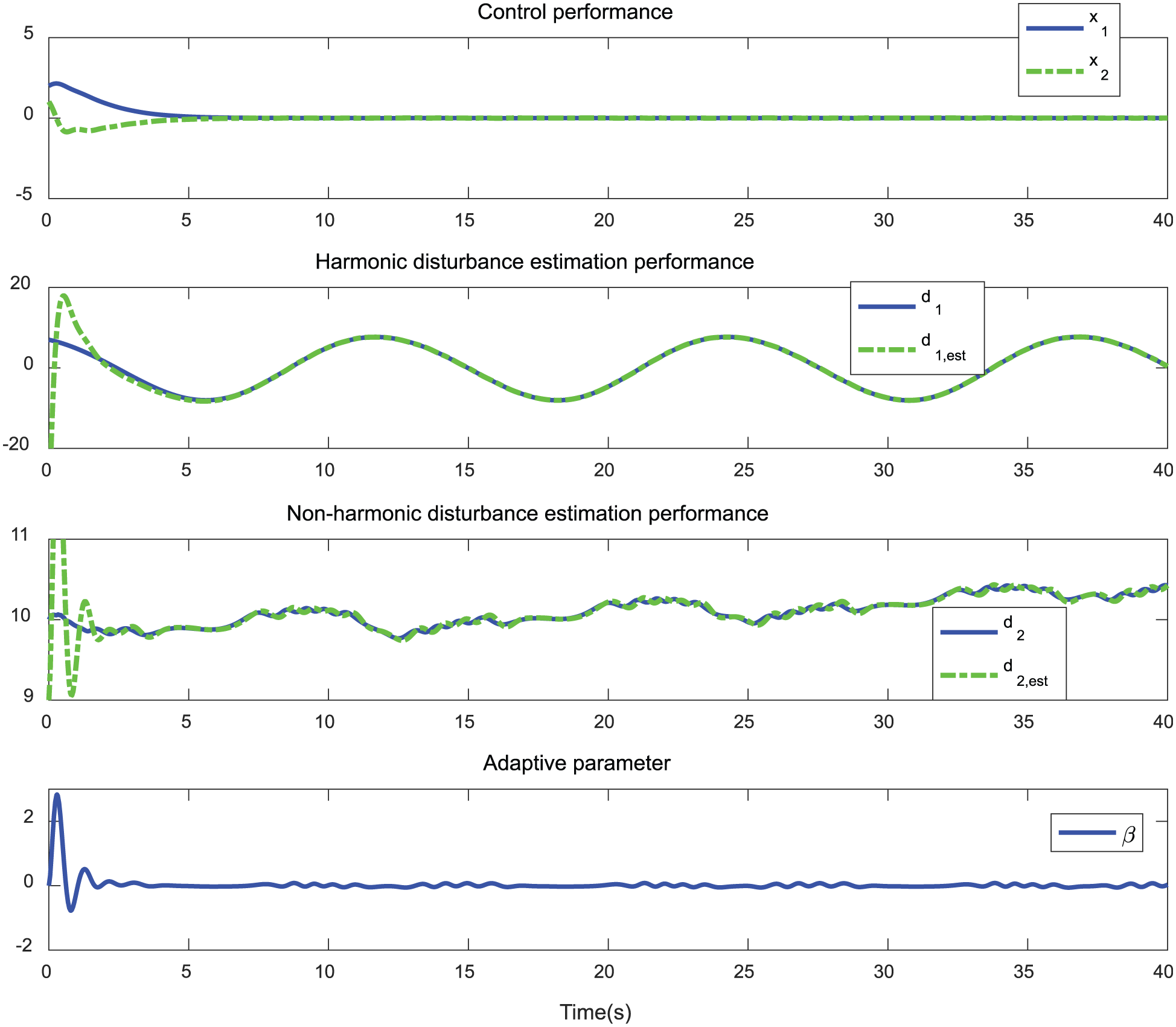
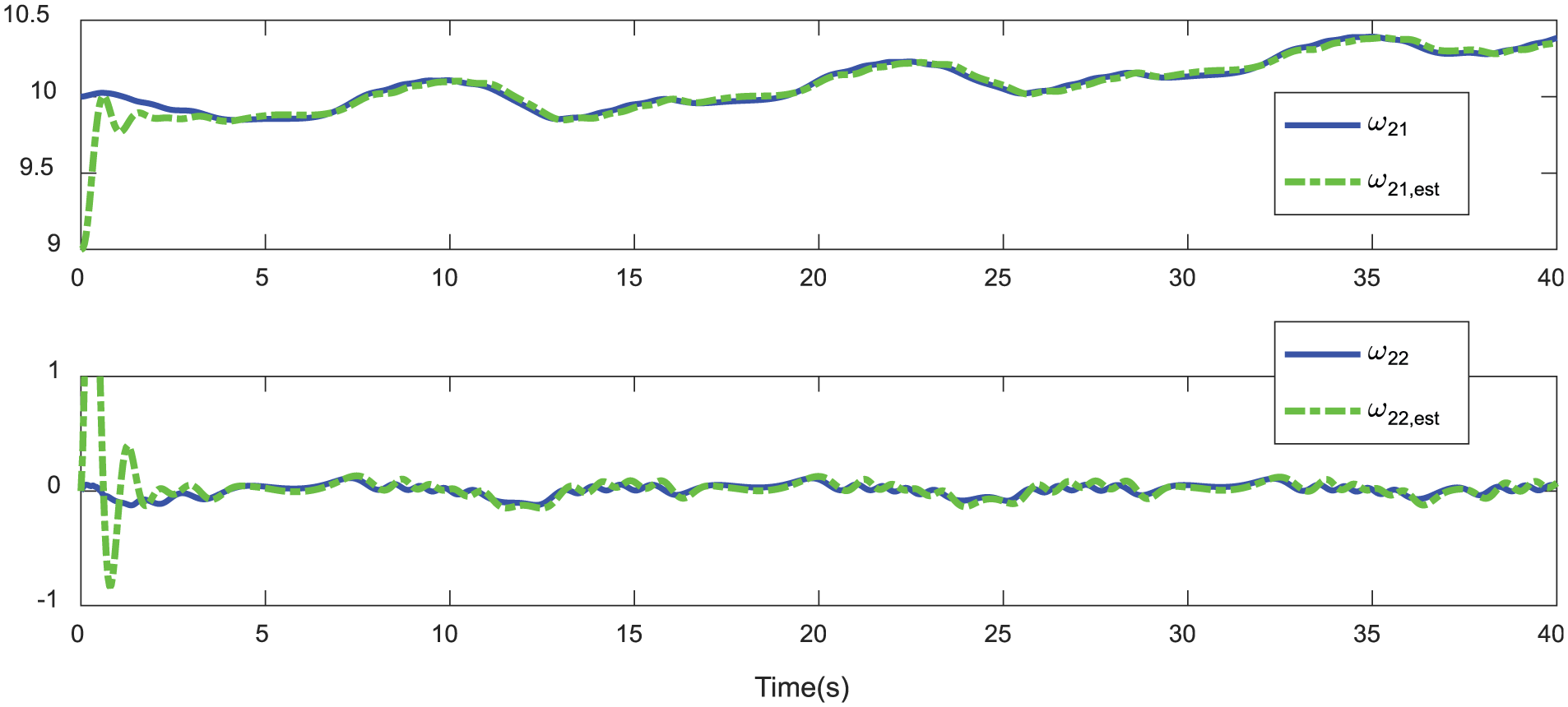
Meanwhile, we choose the following parameters: η = 0.01 and σ = 0.02. The simulation results are given in Figures 1 and 2.
The simulation results of Case 1.
The estimation results of the non-harmonic disturbance in Case 1.
In Case 2, the non-linear exogenous system of the non-harmonic disturbance is taken as
The harmonic disturbances are assumed to have the same coefficient matrices as in Case 1. The non-linear system with multi-source disturbances (28) is still under consideration. The initial conditions and the gain matrices are the same. The non-linear damping term in Case 2 is selected as
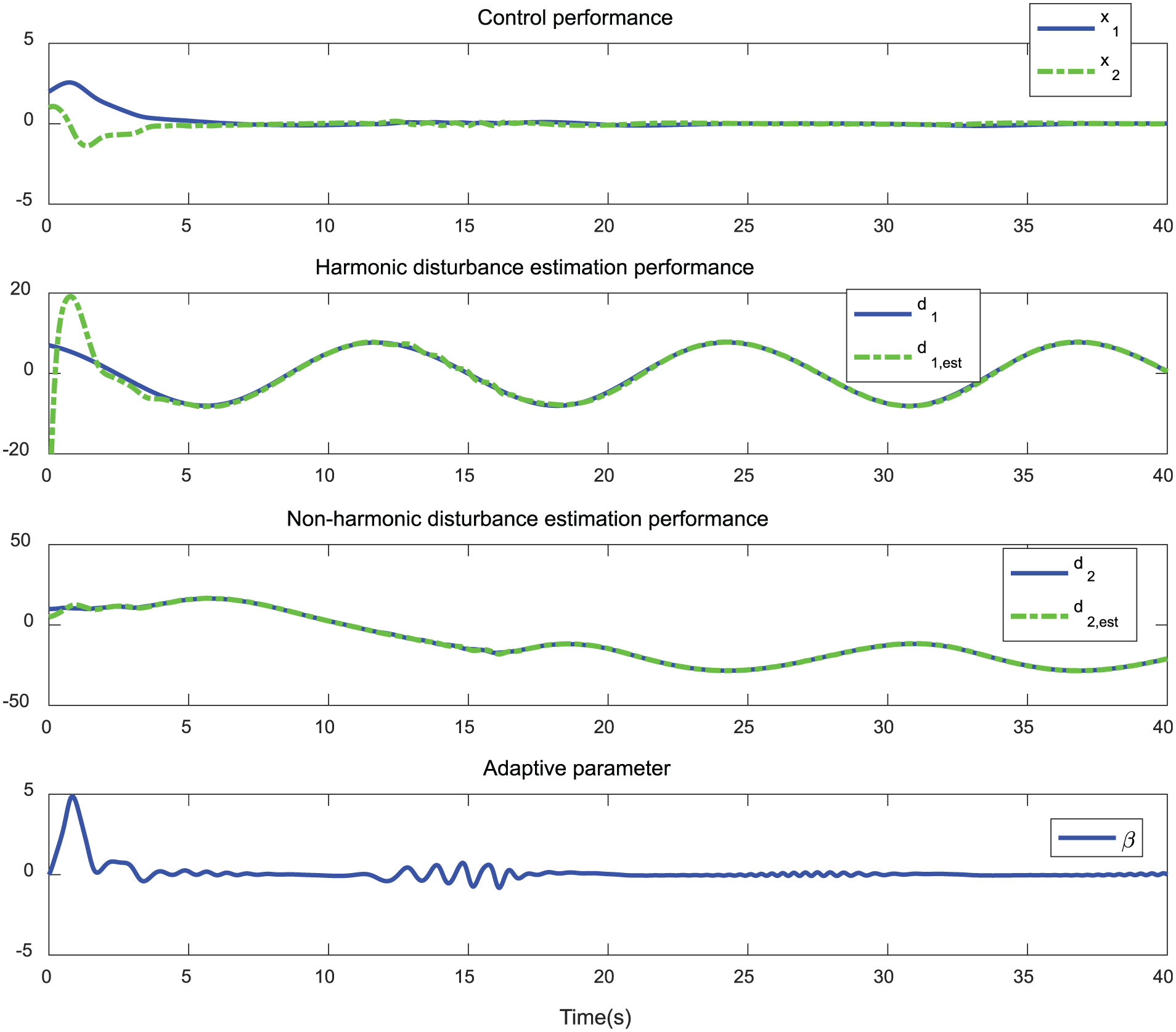
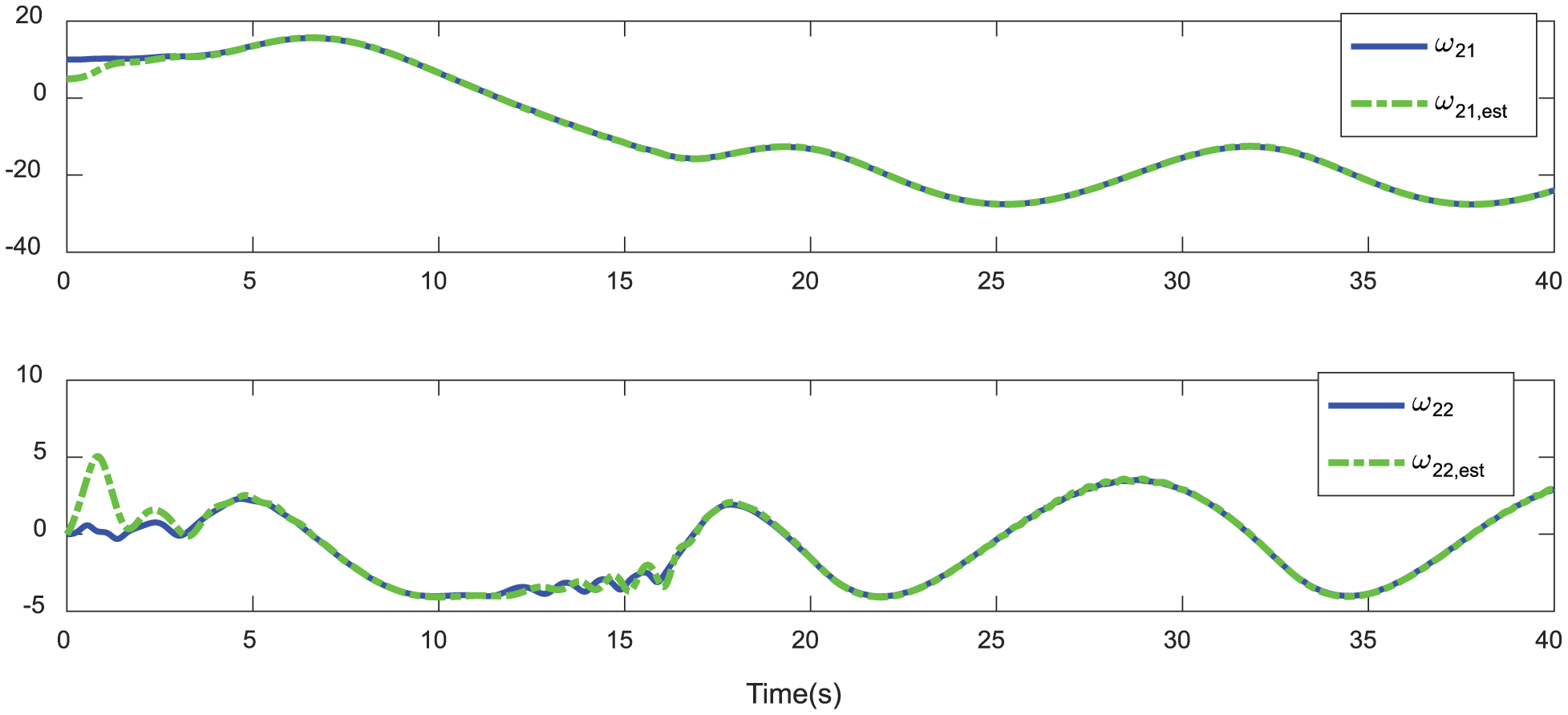
The simulation results are given in Figures 3 and 4.
The simulation results of Case 2.
The estimation results of the non-harmonic disturbance in Case 2.
It may be found that the system states may converge to their desired value in both of the two cases, despite the dynamic non-harmonic multisource disturbances. The disturbance estimation errors are forced to converge to a small value, which may be the main reason for the precise stabilization. The effectiveness of the proposed method is verified. Moreover, from simulation results in the different situations, it may be concluded that the proposed method has robustness to different kinds of dynamic non-harmonic disturbances.
Conclusions
The anti-disturbance control problem for a class of non-linear systems with dynamic non-harmonic multisource disturbances is addressed in this paper. The dynamic non-harmonic disturbances are described by a non-linear exogenous system under several useful assumptions. By using a non-linear damping term, a novel adaptive non-linear disturbance observer is constructed. Based on the DUEA schemes, an adaptive composite anti-disturbance control structure is finally established. Meanwhile, a new sufficient condition is derived and stability of the closed-loop system is proved. Furthermore, the system states and the disturbance estimation error may converge to an arbitrarily small value by choosing the design constants appropriately. The simulation results demonstrate the effectiveness of the proposed method.
Footnotes
Declaration of conflicting interest
The authors declare that there is no conflict of interest.
Funding
This work was supported in part by the National Natural Science Foundation of China under Grants no.11572248.
References
1.
AnHLiuJWangCet al. (2016) Disturbance observer-based anti-windup control for air-breathing hypersonic vehicles. IEEE Transactions on Industrial ElectronicsPP(99): 1. https://doi.org/10.1109/TIE.2016.2516498
2.
ChenW-HOhnishiKGuoL (2015) Advances in disturbance/uncertainty estimation and attenuation [Guest editors’ introduction]. IEEE Transactions on Industrial Electronics62(9): 5758–5762. https://doi.org/10.1109/TIE.2015.2453347
3.
ChenW-HYangJGuoLet al. (2016) Disturbance-observer-based control and related methods – an overview. IEEE Transactions on Industrial Electronics63(2): 1083–1095. https://doi.org/10.1109/TIE.2015.2478397
LiYSunHZongGet al. (2016) Composite anti-disturbance resilient control for Markovian jump nonlinear systems with partly unknown transition probabilities and multiple disturbances. International Journal of Robust and Nonlinear Control18(October2014): 557–569. https://doi.org/10.1002/rnc.3682
14.
LiSLiuZ (2009) Adaptive speed control for permanent-magnet synchronous motor system with variations of load inertia. IEEE Transactions on Industrial Electronics56(8): 3050–3059. https://doi.org/10.1109/TIE.2009.2024655
SunHGuoL (2014) Composite adaptive disturbance observer based control and back-stepping method for nonlinear system with multiple mismatched disturbances. Journal of the Franklin Institute351(2): 1027–1041. https://doi.org/10.1016/j.jfranklin.2013.10.002
WangZ (2016) Adaptive smooth second-order sliding mode control method with application to missile guidance. Transactions of the Institute of Measurement and Control39(6): 848–860. https://doi.org/10.1177/0142331215621616
19.
WangZPanY (2017) Robust adaptive fault tolerant control for a class of nonlinear systems with dynamic uncertainties. Optik – International Journal for Light and Electron Optics131: 941–952. https://doi.org/10.1016/j.ijleo.2016.11.209
20.
WangZYuanJPanYet al. (2017) Adaptive neural control for high order Markovian jump nonlinear systems with unmodeled dynamics and dead zone inputs. Neurocomputing247: 62–72. https://doi.org/10.1016/j.neucom.2017.03.041
21.
WeiK (1995) Nonlinear H/sub ∞/ control and its application to rigid spacecraft. IEEE Transactions on Automatic Control40(7): 1281–1285. https://doi.org/10.1109/9.400476
22.
WeiXChenN (2014) Composite hierarchical anti-disturbance control for nonlinear systems with DOBC and fuzzy control. International Journal of Robust and Nonlinear Control24(2): 362–373. https://doi.org/10.1002/rnc.2891
23.
WeiXChenNLiW (2013) Composite adaptive disturbance observer-based control for a class of nonlinear systems with multisource disturbance. International Journal of Adaptive Control and Signal Processing27(3): 199–208. https://doi.org/10.1002/acs.2290
24.
YangJDingZChenWet al. (2016) Output-based disturbance rejection control for non-linear uncertain systems with unknown frequency disturbances using an observer backstepping approach. IET Control Theory & Applications10(9): 1052–1060. https://doi.org/10.1049/iet-cta.2015.1160
25.
YangZ-JTsubakiharaHKanaeSet al. (2008) A novel robust nonlinear motion controller with disturbance observer. IEEE Transactions on Control Systems Technology16(1): 137–147. https://doi.org/10.1109/TCST.2007.903091
ZongGLiYHouLet al. (2016) Disturbance-observer-based-control and L 2−L ∞ resilient control for Markovian jump non-linear systems with multiple disturbances and its application to single robot arm system. IET Control Theory & Applications10(2): 226–233. https://doi.org/10.1049/iet-cta.2015.0430