This paper is concerned with the problem of observer design for a class of nonlinear systems with time-varying delay and bounded disturbances. For the stabilization problem, attention is focused on the design of a quantized observer that ensures stability of the closed-loop system. For the robust H∞ control problem, a quantized observer is designed such that, in addition to the requirement of the robust stability, a prescribed disturbance attenuation level also needs to be achieved. The nonlinearity is assumed to satisfy the local Lipschitz condition. A more general case is considered, differing from the previous results where the Lipschitz constant is fixed and predetermined. Finally, a numerical example is provided to show the effectiveness of our method.
Time-delay systems can be used to model many practical physical systems, such as chemical engineering systems, distributed networks, the inferred grinding model, manual control, microwave oscillators, neural networks, the population dynamic model, ship stabilization, and systems that are controlled remotely (Chen, 2007; Zhou, 2014). The existence of time delay may cause performance degradation or instability in dynamic systems. As a result, the stability and stabilization problems for time-delay systems have received much attention over the past few decades and many research results have been proposed in the literature that deal with various analysis and design problems (Lin et al., 2007, 2008, 2009; Xu, 2002; Xu and Chen, 2002). The problems of observer-based H∞ control for time-delay Takagi–Sugeno fuzzy systems were addressed in Lin et al. (2007, 2008), where consistent delay-dependent methods have been developed in Lin et al. (2007) and a single-step linear matrix inequality (LMI) method was presented in Lin et al. (2008). Improved schemes for observer-based H∞ control of continuous-time networked control systems with random measurements and time delays were presented in Lin et al. (2009). Much attention has been drawn to delay-dependent stability conditions, which can be less conservative when compared with delay-independent ones especially when the size of the delay is small. Applying the delay decomposition approach, the corresponding delay-dependent stability conditions were proposed in Li et al. (2011) and Balasubramaniam and Nagamani (2012), respectively.
In the past few years, the problem of quantized feedback control has been addressed for more complex systems (Fu and Xie, 2005; Liu and You, 2012; Mera et al., 2014; Tanwani et al., 2016; Zhang et al., 2011). For example, in Fu and Xie (2005), Liu and You (2012) and Zhang et al. (2011), the classical sector bound method was used to study quantized control systems with logarithmic quantizers. It should be noted that the quantization error can be bounded by a sector bound. The static and time-invariant quantizer was considered in Mera et al. (2014), where an estimated region of convergence in the form of an ellipsoid was obtained by using the attractive ellipsoid method. The algorithms for event-triggered sampling and dynamic quantization of input and output measurements of linear systems were developed in Tanwani et al. (2016).
A state observer is usually utilized to reconstruct the states of a dynamic system. The states of a system are not always measurable in many control systems. Hence, the observer-based control is probably well suited in such situation for feedback control. Recently, the problems of observer-based feedback control for systems have been considered by many researchers and a large number of results on these topics have been reported (Abbaszadeh and Marquez, 2009; Chang and Yang, 2014; Fan et al., 2013; Hassan et al., 2016; Lien, 2004, 2007; Naghshtabrizi and Hespanha, 2005). By using the LMI approach, the observer-based control for a class of system was presented in Lien (2004), Lien (2007) and Abbaszadeh and Marquez (2009). An observer-type output feedback control that remotely stabilizes the plant even in the presence of network effects was proposed in Naghshtabrizi and Hespanha (2005). An observer-based actuator fault-tolerant controller was designed in Fan et al. (2013) with explicit consideration of actuator saturation and system disturbances. The problem of observer-based feedback control for linear discrete-time systems was studied in Chang and Yang (2014), where new design conditions for observer-based output feedback controllers were presented in terms of LMI representations. By using the state-dependent Riccati equation approach, a constrained observer-based controller was developed in Hassan et al. (2016). In addition, one should note that the more complicated situation with time-delay has not been dealt with in the mentioned references.
On the other hand, increasing attention has been devoted to the study of observer-based control of time-delay systems (Ghanes et al., 2013; Liu et al., 2012; Lu et al., 2016; Song and He, 2014; Zhang et al., 2016; Zhou, 2014; Zhou et al., 2013). In Song and He (2014), the observer-based finite-time passive control problem for Lipschitz nonlinear systems was investigated. The full-order observers which guaranteed the finite-time bounded and H∞ finite-time stability of a time-delay switched system were designed in Liu et al. (2012). A state observer was designed in Zhang et al. (2016) by applying the combinational measurements. The practical stability of the observer was guaranteed in Ghanes et al. (2013), where the observation error converged to a ball depending on the size of the known upper bound delay of the unknown time-varying function delay and the instantaneous state dynamic variation. The problem of observer-based output feedback control of continuous-time linear systems with multiple delays in both the inputs and the outputs was studied in Zhou et al. (2013), while in Zhou (2014) observer-based output feedback control of discrete-time linear systems with both multiple input and output delays was presented. The authors in Lu et al. (2016) proposed the observer-based sliding mode control problem for non-ideal networked control systems with time delays, data dropouts and signal quantization. However, there is not an intensive literature in the problems of observer-based quantized feedback control for time-delay systems. In particular, the observer-based stabilization problem studied in Liu et al. (2012) involves a linear system with time-varying delay. In the current paper, the nonlinearity is proposed so that the considered system is a nonlinear one. Influenced by Liu et al. (2012), we stabilize a nonlinear time-delay system by a quantized observer. Mathematically speaking, the analysis in this paper becomes much more complicated because of the difficulties arisen from the nonlinearity and the use of delay partitioning approach.
We highlight a few key features.
Sufficient conditions of observer-based quantized control for a class of nonlinear systems with time-varying delay and bounded disturbances are given.
A nonlinear quantized observer is considered.
The delay partitioning approach on how to deal with time-varying delay is developed.
Based on a quantized observer, the memory state feedback controller is designed to guarantee that the resulting closed-loop system is asymptotically stable. Furthermore, the nonlinearity is assumed to satisfy the local Lipschitz condition, and the Lipschitz constant is not assumed to be known. As for the robust H∞ control problem, in addition to the above requirement, a specified disturbance attenuation level is satisfied. The corresponding optimization Lipschitz constant and the disturbance attenuation level can be obtained by applying the multi-objective optimization method.
Notation: Throughout this technical note, the superscript “T” stands for matrix transposition. and denote the n-dimensional Euclidean space and the set of all real matrices, respectively. means that is a real symmetric positive (semi-positive) definite matrix. and represent the identity matrix and zero matrix, respectively. The symbol ★ within a matrix represents the symmetric term of the matrix. The notation ∥·∥ refers to the Euclidean vector norm. denotes a block diagonal matrix with diagonal blocks being the matrix . Finally, we use the symbol to represent . Matrices, if their dimensions are not explicitly stated, are assumed to be compatible for algebraic operations.
Preliminaries and problem formulation
Consider the following continuous nonlinear system with time-varying delay and bounded disturbances
where is the state, is the control input, is the measured output, is the controlled output, is the disturbance input which is time-varying and satisfies . is a nonlinear function and assumed to be differentiable. , , , , , , , and are known real constant matrices with appropriate dimensions. is the time-varying delay of the system that satisfies , , where and are known constant scalars. is the initial condition defined over the interval , which is assumed to be continuous and differentiable.
Throughout this paper, we consider the following static logarithmic quantizer. The signal is quantized by quantizer which is defined as
In this work, the set of quantized levels of is described by
where are the initial quantization values for the th sub-quantizer and is associated with the quantization density. For the logarithmic quantizer, the associate quantizer is defined as follows
where . It follows from Fu and Xie (2005) that, a sector bound expression can be expressed as
where the uncertainty matrix satisfies .
In this paper, the following observer-based control with time-varying delay is proposed to stabilize the system (1) to (3)
where is the estimation of , is the observer output, and are controller gains, and is the observer gain.
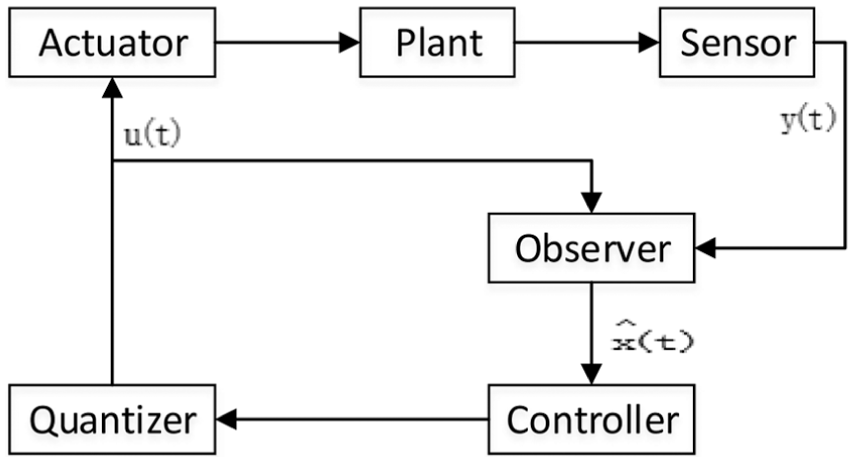
As shown in Figure 1, attention is focused on the design of the gain matrices , and such that all solutions of the closed-loop system converge to the origin. It is observed that the plant’s measured output is sent to the observer through the sensor. Based on the received information of the plant, the observer sends an estimate of the state variable to the controller. Then, the controller’s output is quantized through the quantizer. The signal received in the actuator side and the observer side is . In fact, the observer involves the quantized signal and the measured output . Now, applying (7) with (1) to (3) yields
where the signal is defined as the estimated error of the system. In (7), the control input is quantized. Moreover, a quantized state feedback controller in the form of can be presented as . For simplicity in the following discussion, we denote . Thus, (8) and (9) can be rewritten as
where
The structure of time-delay systems with quantization.
Furthermore, as shown in Abbaszadeh and Marquez (2009), we make the following assumption on the nonlinear function in system (1).
Assumption 1.We assume that the function is locally Lipschitz with respect to in a region containing the origin if and
where is called the Lipschitz constant.
Remark 1.Throughout this paper, it is worth noting that the Lipschitz constant is not fixed. The maximum allowable Lipschitz constant can be determined by solving the convex optimization problem.
Remark 2.Similar to Liu et al. (2012) and Ho and Lu (2003), suppose that the matrix has full row rank. Moreover, the singular value decomposition of matrix is of the form , where and are unitary matrices and is a diagonal matrix with positive diagonal elements.
The problem to be addressed in this paper is to develop techniques of stabilization and robust H∞ control for a class of nonlinear time-delay systems. More specifically, we are concerned with the following two control problems.
Determine a quantized observer-based controller in the form of (7) for the delayed nonlinear system in (1) and (2) (with ) such that the trajectories of the closed-loop system will converge to the origin. Meanwhile, the maximum allowable Lipschitz constant is obtained.
Design an observer in the form of (7) for the delayed nonlinear system in (1) to (3) such that the controlled output satisfies under the zero initial condition. Simultaneously, the corresponding Lipschitz constant is obtained.
Observer-based quantized control
Firstly, the following lemmas are presented, which will play important roles in our further derivation.
Lemma 1.(Xu, 2002) For any positive-definite matrix and vectors , we have
Lemma 2.(Petersen, 1987) Let , and be real matrices of appropriate dimensions with satisfying . Then for any scalar , we have
Lemma 3.(Ho and Lu, 2003) For a given with rank , assume that is a symmetric matrix, then there exists a matrix such that if and only if
where and .
Next, based on the Lemmas let us discuss observer-based quantized control of nonlinear time-delay systems (1) and (2) (with ). The controller gains , and the observer gain could be solved by the following theorem.
Theorem 1.Consider the delay nonlinear system (10) (with ) and let , be given constants and with defined as in (6) be given matrix. If there exist matrices , , , , , , , , , , , , , , , , , and scalars , , , , , such that the following LMI holds
where
with
then the underlying closed-loop system is asymptotically stable. In this case, a suitable observer in the form of (7) is given by , and .
Proof Choose a Lyapunov–Krasovskii functional candidate as follows
where
Taking the time-derivative of with respect to along the trajectory of system (10) (with ) yields
Note that the following equations are true for matrices , and any matrices , , , , , , , with appropriate dimensions
where
Then, it follows from (15) to (17) and (14) that
with
Setting , and using Lemma 1, it follows that
By Lemma 2, it can be seen that
On the other hand, with the support of (20) to (23), it can be deduced that
where
with
Define , , , , , , , , , , , , , . Then, it can be verified that and with . Now, by the techniques developed in Ho and Lu (2003) and applying Lemma 3, it is easy to see that . By setting , we have that with and . By using Schur complement equivalence, is equivalent to
Note that (12) is equivalent to (25) by setting , and by applying Schur complement equivalence again, then pre- and post-multiplying by and its transpose, respectively, which means that (25) holds if (12) is satisfied. Therefore, we have that . This completes the proof.□
The maximum allowable Lipschitz constant can be determined by solving the following convex optimization problem
where , , , , . Then, the maximum allowable Lipschitz constant is .
Remark 3.The convex optimization problem in (26) is a scalarization of a multi-objective optimization with two optimality criteria. Since each of these optimization problems is convex, the scalarized problem is also convex (Boyd and Vandenberghe, 2004).
Observer-based H∞ control
Now, we are able to give the result on the solvability of observer-based H∞ control problem.
Theorem 2.Consider the delay nonlinear system (1) to (3). Given scalars , and a matrix with , then there exists an observer such that the resulting closed-loop system is robustly stable and a prescribed disturbance attenuation level is achieved if there exist matrices , , , , , , , , , , , , , , , , , and scalars , , , , , , , such that the following LMI holds
where
and , , , , , , are given in Theorem 1. Furthermore, a desired observer-based controller is proposed in the form of (7) with parameters given by , and .
Proof First, consider the following time-delay system
where
Then, by using Lemma 1 in Chen (2002), it can be shown that
In fact, it is easy to see that (15) can be re-written as
In this case, a Lyapunov–Krasovskii functional candidate is given in (13). Let . Then, by using (16) and (17), (29) and (30) and following a similar line as in the proof of Theorem 1, it can be verified that
Integrating both sides of this inequality, then we can obtain that , where the zero initial condition is used. This completes the proof.□
Similar to (26), we also have the corresponding optimization problem. According to the condition of Theorem 2, the maximum Lipschitz constant and the minimum disturbance attenuation level can be obtained by utilizing the following multi-objective optimization method.
where , , . Then, the maximum allowable Lipschitz constant is and the minimum disturbance attenuation level is .
Simulation example
In this section, we provide a simulation example to illustrate the effectiveness of the proposed approach. Consider the following continuous nonlinear time-delay system with parameters as
Case 1: Suppose scalars , , and are chosen such that , , and . Solving the convex optimization problem (26) by the standard convex optimization numerical software, we can obtain the maximum allowable delay of and the corresponding maximum allowable Lipschitz constant . Next, scalar is chosen such that . Thus, the controller gains and the observer gain can be inferred
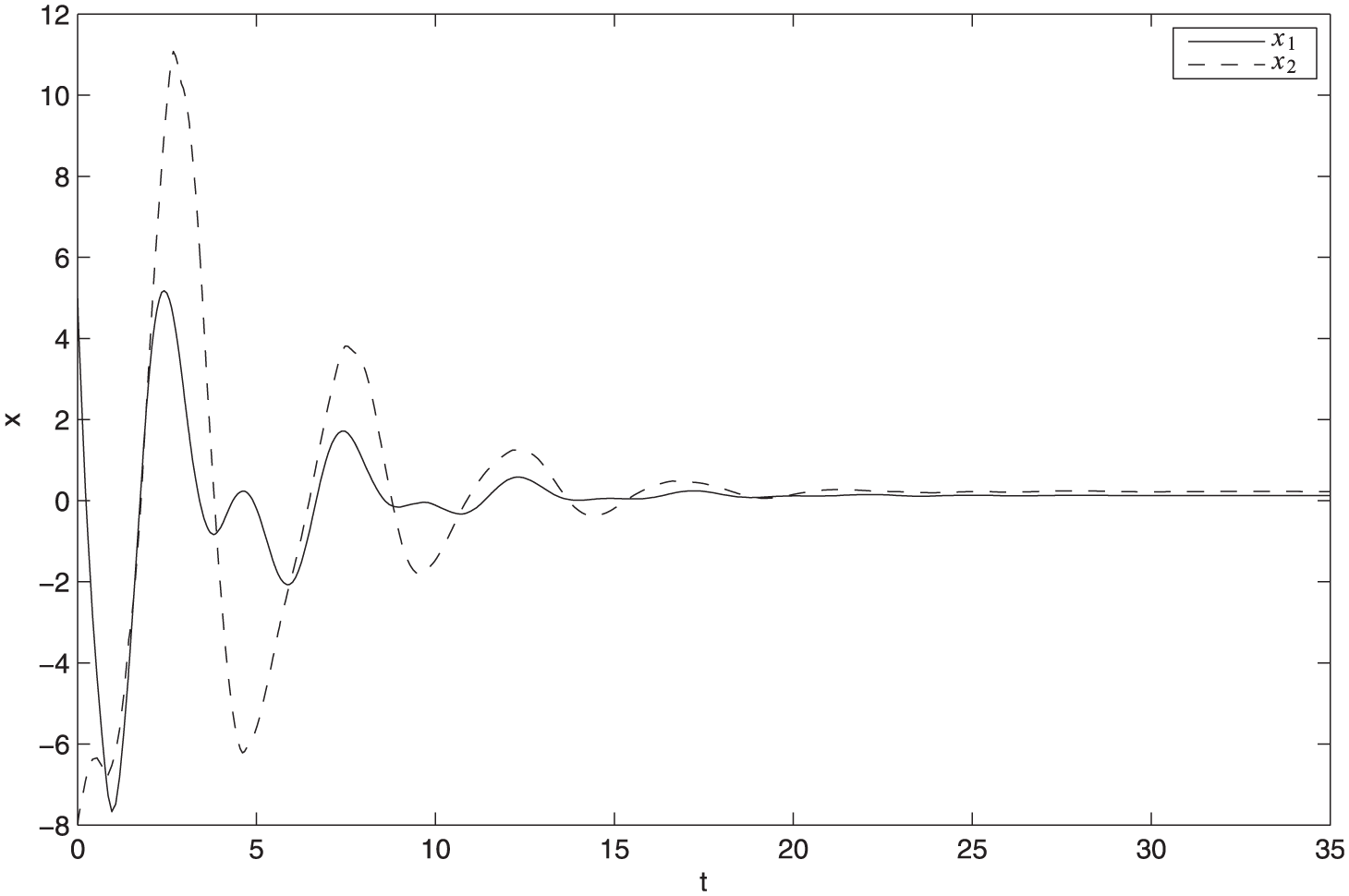
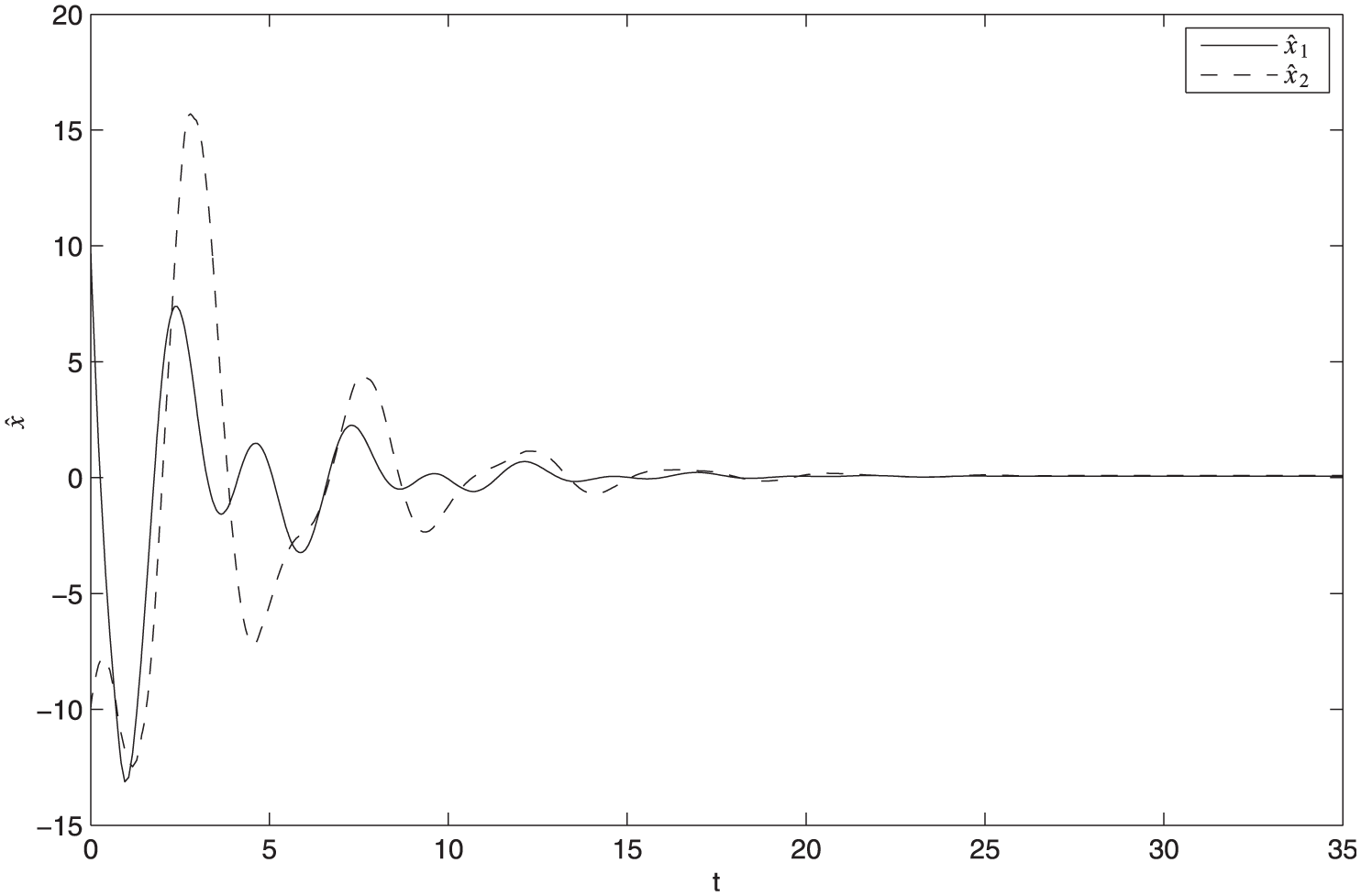
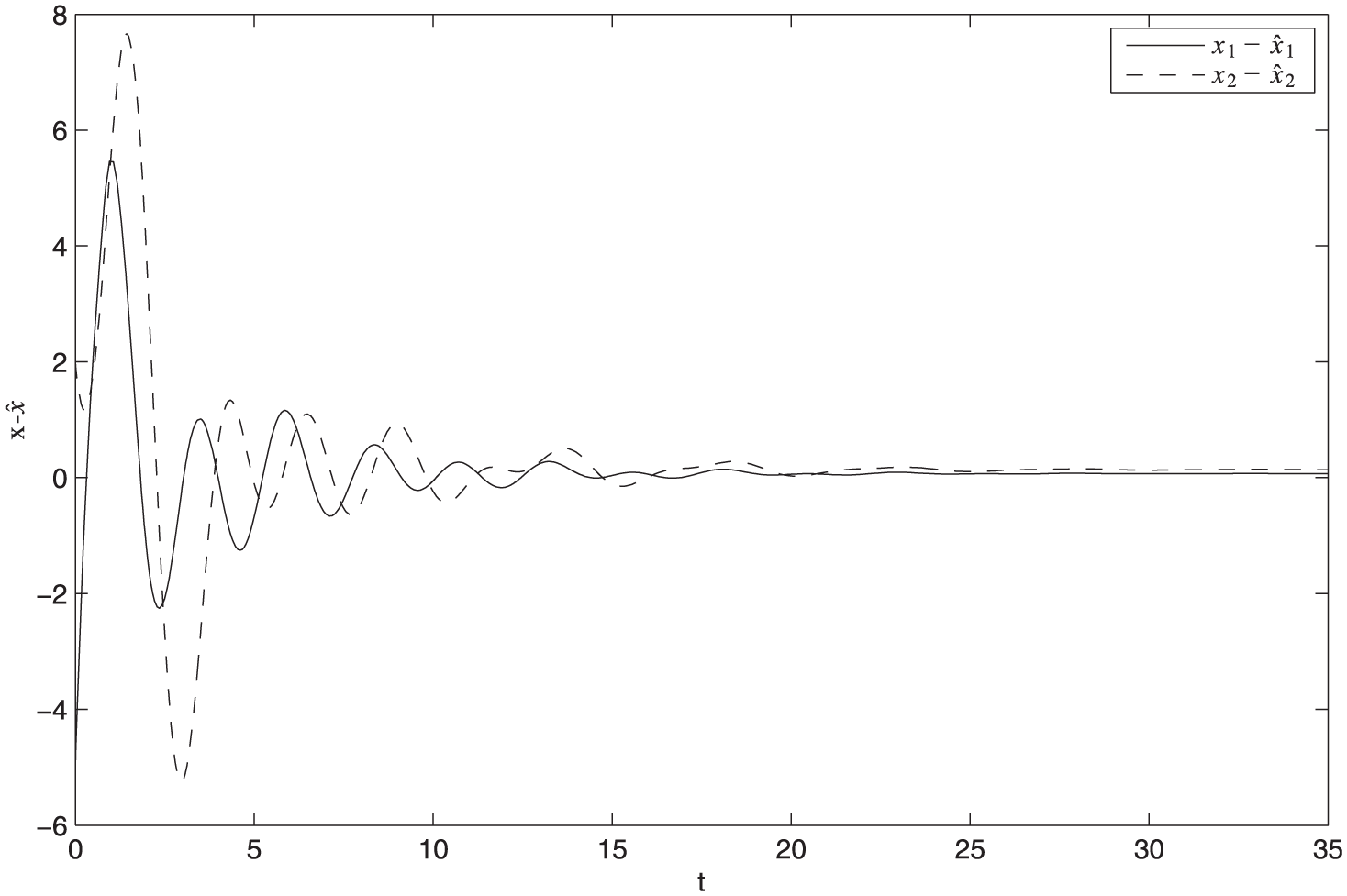
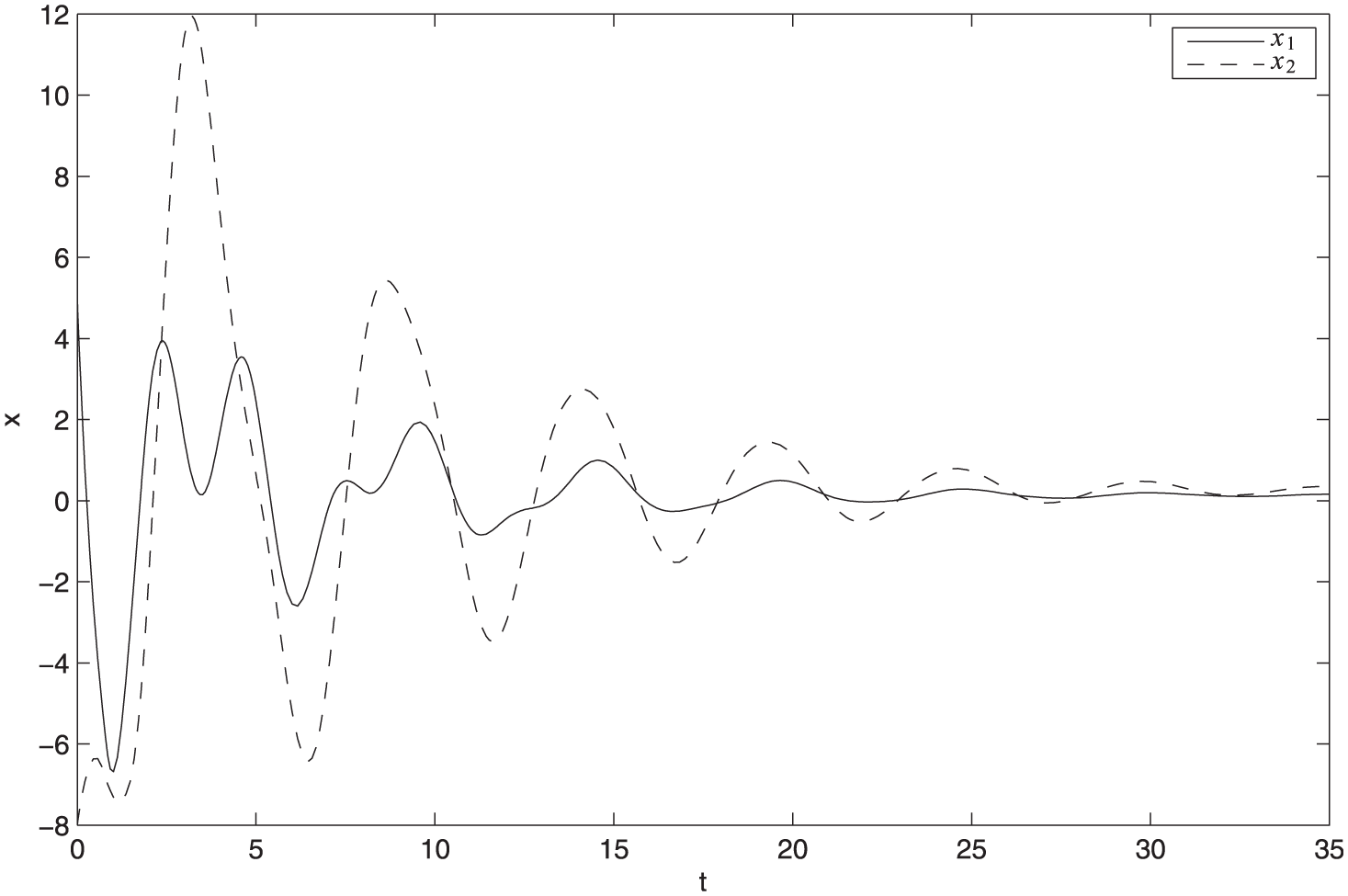
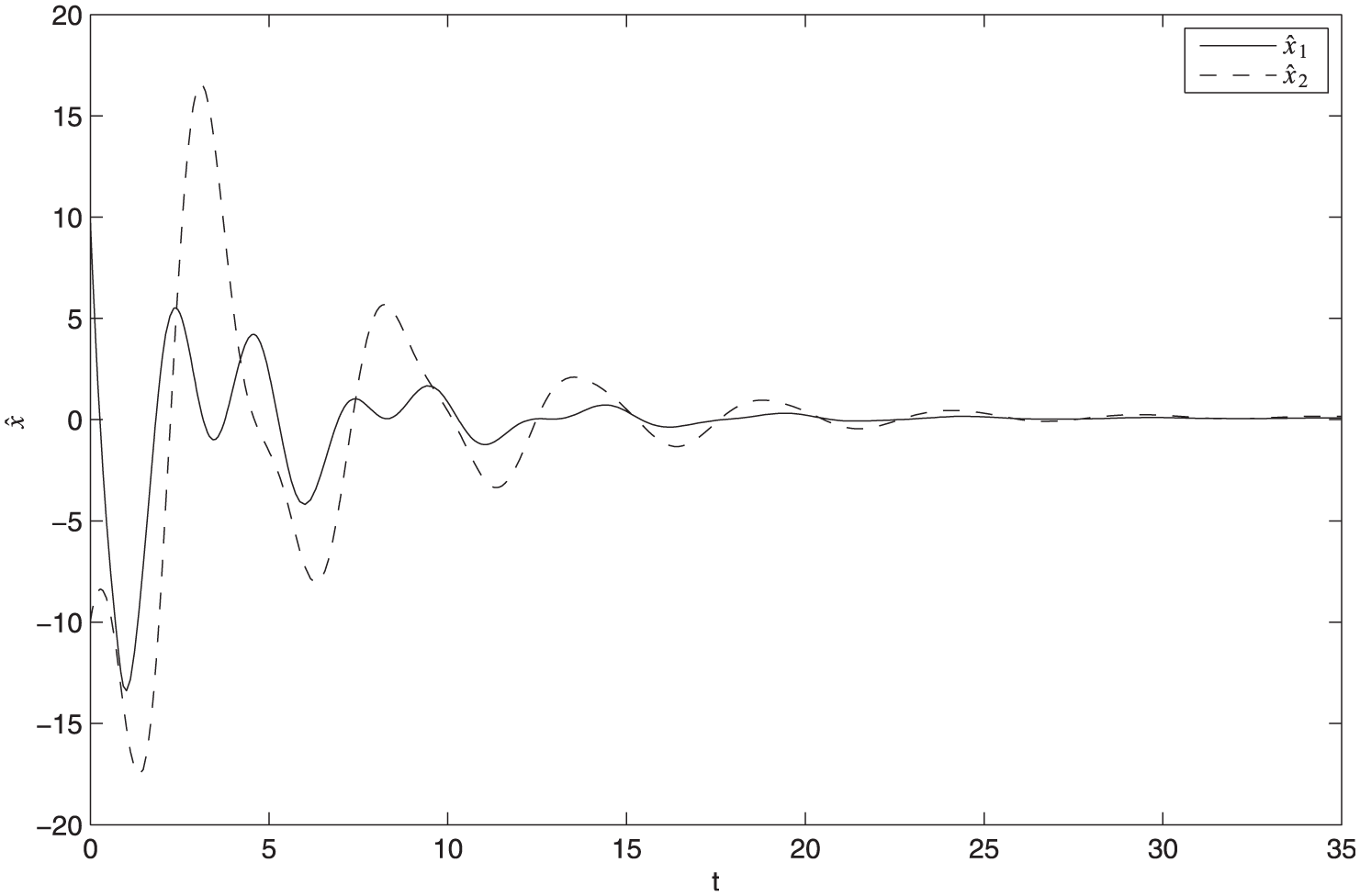
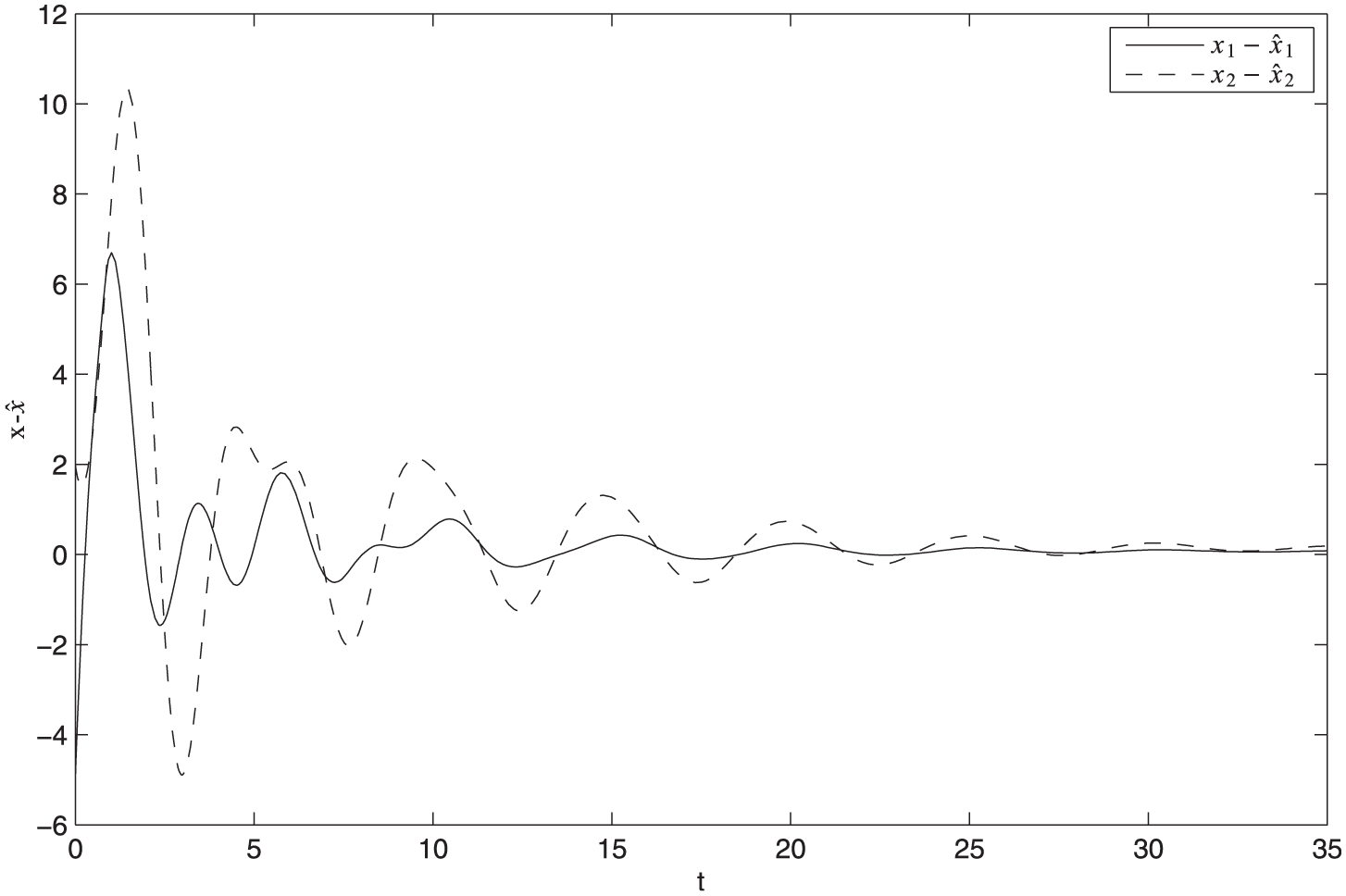
For simulations, we select the time-varying delay The simulation results of the real state response of the closed-loop system (10) (with ) are given in Figure 2, where the initial vector is selected as , the quantizer parameter is selected as and the nonlinear function is assumed to be . The estimated states of the closed-loop system (10) (with ) for initial condition given by are shown in Figure 3. The result in Figure 4 that, with the same initial conditions, the error-state system converges to zero in a finite-time interval.
Real state trajectories ().
Estimated state trajectories ().
Estimation error under the observer ().
Case 2: The purpose of this example is also to solve the observer-based H∞ control problem. Furthermore, scalars , , and are the same as those presented in Case 1. Assume that a bounded disturbance is given by and the time-varying delay is selected as . Then, solving the convex optimization problem (32) with , we can obtain the maximum allowable Lipschitz constant and the minimum disturbance attenuation level is . Also, the corresponding controller gains and the observer gain are obtained
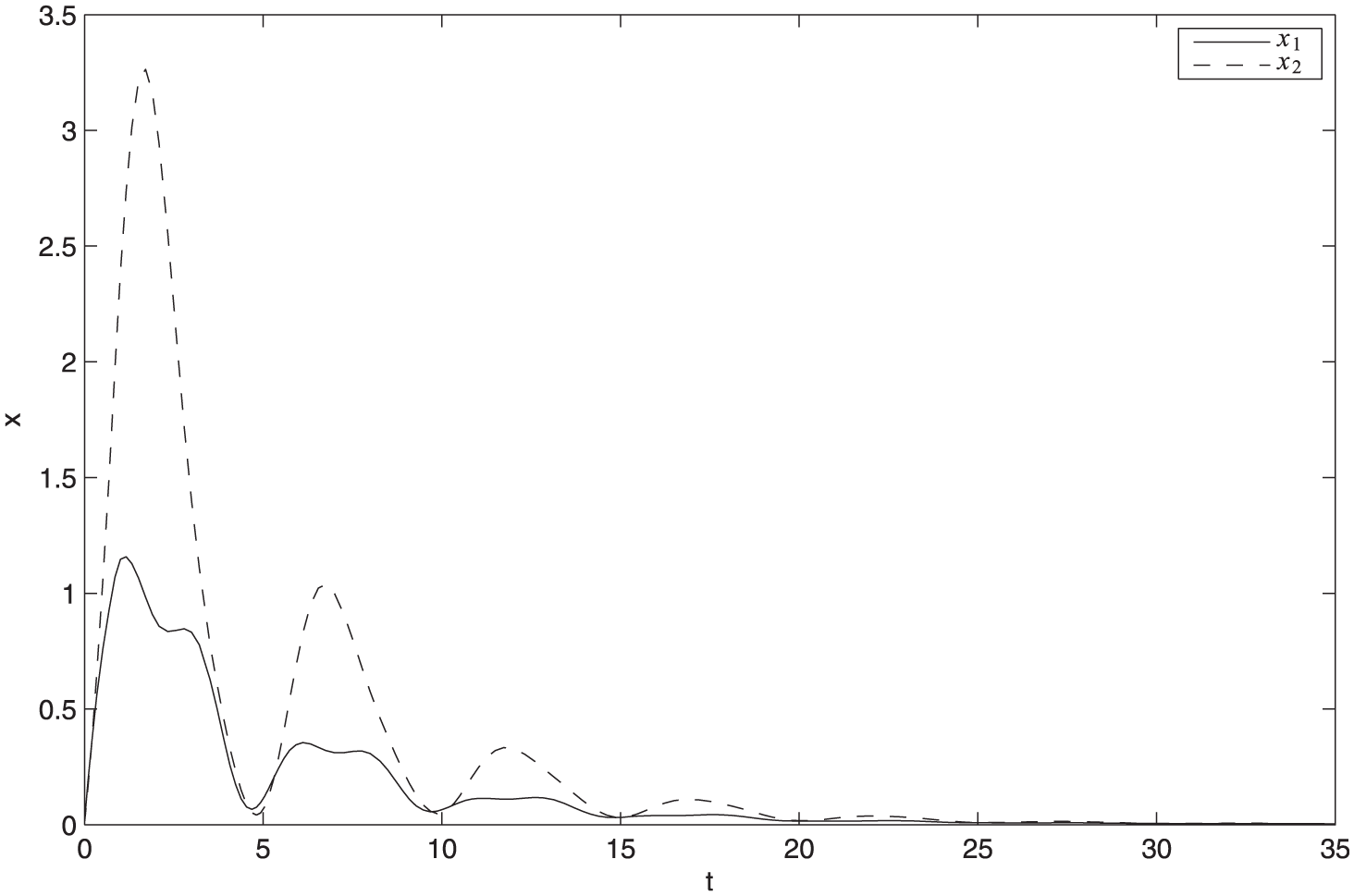
By considering the same initial vectors , , nonlinear function and time-varying delay as in Case 1, the real state trajectories and the estimated states of the closed-loop system (10) (with ) are reported in Figures 5 and 6, respectively. In addition, Figure 7 depicts the estimation errors between the true states and the observed states. Figure 8 shows the real trajectories of the state under the initial condition . Furthermore, by comparing the responses of closed-loop system, it is seen that the convergence rate of responses shown from Figures 2 to 4 is faster than those proposed from Figures 5 to 7. Hence, bounded disturbances have a significant impact on the convergence rate of responses of closed-loop system. As explained above, the bounded disturbance usually leads to a slower convergence rate of response.
Real state trajectories ().
Estimated state trajectories ().
Estimation error under the observer ().
Real state trajectories with ().
Conclusions
The problems of observer design for a class of nonlinear systems with time-varying delay and bounded disturbances have been studied. Sufficient conditions for the solvability of these problems have been obtained in terms of LMIs, and explicit expression of desired a quantized observer-based controller has been given. In addition, the maximum Lipschitz constant and the minimum disturbance attenuation level are obtained by utilizing multi-objective optimization method. Finally, the effectiveness of the proposed method has been illustrated through a simulation example.
Footnotes
Declaration of Conflicting Interests
The author(s) declared no potential conflicts of interest with respect to the research, authorship, and/or publication of this article.
Funding
The author(s) disclosed receipt of the following financial support for the research, authorship, and/or publication of this article: This work was partially supported by the following grants: The Startup Foundation for Introducing Talent of NUIST (S8113107001), Natural Science Fundamental Research Project of Jiangsu Colleges and Universities (15KJB120007), National Natural Science Foundation of P.R. China (61503190, 61573189, 61403207, 41675156), Natural Science Foundation of Jiangsu Province (BK20150927), Outstanding Youth Science Fund Award of Jiangsu Province (BK20140045), Six talents in Jiangsu Province (2015–DZXX–013).
References
1.
AbbaszadehMMarquezH (2009) LMI optimization approach to robust H∞ observer design and static output feedback stabilization for discrete-time nonlinear uncertain systems. International Journal of Robust and Nonlinear Control19(3): 313-340.
2.
BalasubramaniamPNagamaniG (2012) A delay decomposition approach to delay-dependent robust passive control for Takagi-Sugeno fuzzy nonlinear systems. Circuits Systems and Signal Processing31(4): 1319-1341.
3.
BoydSVandenbergheL (2004) Convex Optimization. Cambridge: Cambridge University Press.
4.
ChangXYangG (2014) New results on output feedback H∞ control for linear discrete-time systems. IEEE Transactions on Automatic Control59(5): 1355-1359.
5.
ChenJ (2007) Robust H∞ output dynamic observer-based control of uncertain time-delay systems. Chaos, Solitons and Fractals31(2): 391-403.
6.
FanJZhangYZhengZ (2013) Observer-based reliable stabilization of uncertain linear systems subject to actuator faults, saturation, and bounded system disturbances. ISA Transactions52(6): 730–737.
7.
FuMXieL (2005) The sector bound approach to quantized feedback control. IEEE Transactions on Automatic Control50(11): 1698-1711.
8.
GhanesMDe LeonJBarbotJ (2013) Observer design for nonlinear systems under unknown time-varying delays. IEEE Transactions on Automatic Control58(6): 1529-1534.
9.
HassanMAlrifaiMSolimanHet al. (2016) Observer-based controller for constrained uncertain stochas-tic nonlinear discrete-time systems. International Journal of Robust and Nonlinear Control26(10): 2090-2115.
10.
HoDLuG (2003) Robust stabilization for a class of discrete-time non-linear systems via output feedback: The unified LMI approach. International Journal of Control76(2): 105-115.
11.
LiZLiuHGaoH (2011) A delay partitioning approach to H∞ filtering for continuous time-delay systems. Circuits Systems and Signal Processing30(3): 501-513.
12.
LienC (2004) Robust observer-based control of systems with state perturbations via LMI approach. IEEE Transactions on Automatic Control49(8): 1365-1370.
13.
LienC (2007) H∞ non-fragile observer-based controls of dynamical systems via LMI optimization approach. Chaos, Solitons and Fractals34(2): 428-436.
14.
LinCWangQLeeTet al. (2007) Observer-based H∞ control for fuzzy systems with time delay: Delaydependent design method. IEEE Transactions on Systems, Man, and Cybernetics-Part B: Cybernetics37(4): 1030-1038.
15.
LinCWangQLeeTet al. (2008) Design of observer-based H∞ control for fuzzy time-delay systems. IEEE Transactions on Fuzzy Systems16(2): 534-543.
16.
LinCWangZYangF (2009) Observer-based networked control for continuous-time systems with random sensor delays. Automatica45(2): 578-584.
17.
LiuHShenYZhaoX (2012) Delay-dependent observer-based H∞ finite-time control for switched systems with time-varying delay. Nonlinear Analysis: Hybrid Systems6(3): 885-898.
18.
LiuMYouJ (2012) Observer-based controller design for networked control systems with sensor quantisation and random communication delay. International Journal of Systems Science43(10): 1901-1912.
19.
LuRYangPBaiJet al. (2016) Quantized observer-based sliding mode control for networked control systems via the time-delay approach. Circuits Systems and Signal Processing35(5): 1563-1577.
20.
MeraMCastañosFPoznyakA (2014) Quantised and sampled output feedback for nonlinear systems. International Journal of Control87(12): 2475-2487.
21.
NaghshtabriziPHespanhaJ (2005) Designing an observer-based controller for a network control system. In: Proceedings of the 44th IEEE conference on decision and control, and the European control conference, Seville, Spain, 12–15 December 2005, pp. 848–853. IEEE.
22.
PetersenI (1987) A stabilization algorithm for a class of uncertain linear systems. Systems & Control Letters8(4): 351-357.
23.
SongJHeS (2014) Observer-based finite-time passive control for a class of uncertain time-delayed Lipschitz nonlinear systems. Transactions of the Institute of Measurement and Control36(6): 797-804.
24.
TanwaniAPrieurCFiacchiniM (2016) Observer-based feedback stabilization of linear systems with event-triggered sampling and dynamic quantization. Systems & Control Letters94: 46-56.
25.
XuS (2002) Robust H∞ filtering for a class of discrete-time uncertain nonlinear systems with state delay. IEEE Transactions on Circuits and Systems-I: Fundamental Theory and Applications49(12): 1853-1859.
26.
XuSChenT (2002) Robust H∞ control for uncertain stochastic systems with state delay. IEEE Transactions on Automatic Control47(12): 2089-2094.
27.
ZhangLChenMSuH (2016) Observer-based semi-global consensus of discrete-time multi-agent systems with input saturation. Transactions of the Institute of Measurement and Control38(6): 665-674.
28.
ZhangJLamJXiaY (2011) Observer-based output feedback control for discrete systems with quantised inputs. IETControl Theory and Applications5(3): 478-485.
29.
ZhouB (2014) Observer-based output feedback control of discrete-time linear systems with input and output delays. International Journal of Control87(11): 2252-2272.
30.
ZhouBLiZLinZ (2013) Observer based output feedback control of linear systems with input and output delays. Automatica49(7): 2039-2052.