







Abstract
In many research activities related to the heated environment near the wall or surface, measurement of transient surface temperature and determination of convective heating rate is one of the most important tasks. Since the effective measurement time available for the regime to enumerate is very small, it is essential to use temperature detectors with highly sensitive, precise and instantaneous temperature measurement properties. Thin film gauges with these properties are best suited for such short duration transient surface temperature measurements. This study focuses on the establishment of new calibration technique in convection heat transfer mode. A fabricated calibration set-up is used to supply the heat flux to the thin film gauge, which is in-house built with platinum as sensing element and quartz as an insulating substrate. The heat load applied on the thin film gauge is of impact or step type. The deduction of heat flux value is carried out with recorded transient temperature data. Moreover, the numerical analysis is also carried out to get the heat flux values. The authenticity of the experimental set up and thin film gauge effectiveness is supported by the excellent agreement of the experimental and numerical results.
Introduction
Engineering applications involving heat, stress generation, various type of reactions and physical actions taking place in heated environment near a wall or surfaces requires the knowledge of wall surface temperature histories and heating rate for efficient designing of various systems like gas turbines, aerodynamic vehicle, and so forth. In all these cases, the quantity in motion is basically the heat flux, that is, thermal energy moving through the surface. It is composed of conduction, convection and radiation. The prediction of heat flux measurement becomes important for various engineering system components in terms of material consideration. The methods of heat flux measurement are mainly based on temperature measurements on the surface or in close proximity to the surface. Generally, the temperature detectors employed for the measurement are placed either onto or into the surface. This insertion of temperature detectors caused the physical disruption as well as thermal disruption of the surface. The accuracy of heat flux data estimation depends up on the minimal effect of disruption owing to the presence of temperature detectors. The accuracy and prediction of the heat flux in the convective environment depend upon the temperature detectors surface roughness, continuity at the edges and flow speed as discussed by various researchers (Arts and Camci, 1985; Dul’nev and Pilipenko, 1975; Holmberg et al., 1997; Schultz and Jones, 1973). It has been observed that the available measurement time is very less, of the order of few milliseconds owing to the involvement of transient conditions, which makes the necessity for the use of special gauges with high response time (Arts and Camci, 1985; Childs et al., 1999; Kinnear and Lu, 1998; Taler, 1996).
Earlier research related to the heat transfer measuring systems, in particular, Gardon gauge and thin layered gauges of different designs for steady heat transfer suggest that these designs have limitations in their frequency response (Gardon, 1960; Keltner and Wildin, 1975). Further, it has been claimed that extensive signal processing may enhance the frequency response of these gauges, however, it is not more beneficial (Epstein et al., 1986). As proposed by Vidal (1956) and Taylor (1959), the heat flux measurement from thin film gauges (TFGs) by measuring the time resistance histories has been supported by several researchers (Arts and Camci, 1985; Schultz and Jones, 1973; Taler, 1996). The TFGs are very much suitable for short-duration experimental facilities. In the last few decades, the fast response temperature sensors, specifically the TFGs, have gained popularity for surface temperature measurement and heat flux predictions in convective environment. TFG comprises a layer of thin film of highly conductive metal laid over a substrate having poor non-conductive properties. The thin layer provided on the substrate has a thickness of a very few microns. Usually, highly conductive materials like platinum, nickel, gold, and so forth, have been chosen for thin film, while for substrate Macor, Quartz and so forth are used (Azerou et. al., 2012; Schultz and Jones, 1973; Taler, 1996). It has been reported by several researchers that TFG comes under the category of resistance temperature detectors (RTD) in which detection of temperature changes is evaluated from the variation in thin conductive film resistance (Beck and Wedekind, 1986; Bogdan, 1964; Gatowski et al., 1989; Hall and Hertzberg, 1958; King and Blackie, 1925). A power source unit having the ability to supply the current in the range of milli ampere is required to energize the TFG. Exposing the TFG to the heated environment, a change in surface temperature causes variation in resistance of the temperature sensitive film. The surface temperature value is directly measured from the changes in resistance. Walker and Scott (1998) have stated that the calculation of instant heat flux impinging the thin film can be made with the help of time-dependent surface temperature data from known thermal properties of the substrate material. The deduction of heat flux from time-dependent surface temperature data is made by using the theory of conduction of heat for a semi-infinite body. It is assumed that the substrate surface temperature is the same as that of the film and any temperature changes to the rear end of the substrate owing to instant heat flux is neglected.
Several researchers have discussed that among other available RTDs like thin film calorimeter gauges, coaxial thermocouples and temperature sensitive paints for transient surface temperature measurement, the dominance of TFG is owing to its cost effective and easy fabrication technique, higher sensitivity value, precise measurement ability and instantaneous surface temperature measurement with response time value as low as of few micro seconds (Kinnear and Lu 1998; Taler, 1996). In a recent study, Sahoo and Kumar (2016) conducted an analysis for TFG and other RTDs and has found that TFG is much more suitable for short duration transient conditions.
A number of researchers have explored the development of traditional TFG for various applications with modification and improvement in measurement technique (Holmberg and Diller, 1995; Kumar et al., 2011; Sahoo and Peetala, 2010). The TFG has nowadays gained the promising future in the field of thin film measurement technique for transient temperature measurement and surface heat flux prediction.
Accurate prediction of heat flux using TFG depends upon the understanding of errors, which may arise during surface temperature measurement. Hence, calibration of gauge before being installed into the surface is necessary for accurate prediction of surface heat flux. TFG is subjected to all modes of heat transfer: conduction, convection and radiation, during measurement of heat flux. Calibration practices for gauges involving any one mode of heat transfer or a combination of modes has been reported by numerous researchers (Frankel and Keyhani, 2013; Holmberg and Diller, 1995; Sahoo and Kumar, 2016; Voronkov et al., 1993). In conduction mode, direct heat loads are applied using a heat supplying unit and consequently, the prediction of heat flux through the surface from recorded temperature data is being made using convolute integral of one dimensional equation of heat conduction (Holmberg and Diller, 1995). It has been found that the convection mode of heat flux could be generated with the help of a transonic wind tunnel facility to produce a flow of hot moving air and impinging on the TFG (Beck and Wedekind, 1986; Frankel and Keyhani, 2013). The TFG calibration based on radiation is being achieved by revealing it to a heat lamp (Voronkov et al., 1993). Recently, a developed laser-based technique for calibration purpose of TFG has been proposed by Kumar et al. (2011). This technique is claimed to be the fittest one owing to the absence of sputtering of heat load. This is because the load caused by emitted beams through the laser are of extremely directional in nature, and also have a resemblance of the same heat load property as experienced by the gauges in practical applications.
Various measuring techniques proposed by several researchers are available for heat flux measurement, to or from the surface (Diller and Telionis, 1989; Jones, 1977). Measurement techniques available for transient conditions (convective environment) need more attention, as available heat flux gauges have longer time constant by which they cannot make time resolved measurement in such convective environment. Hager et al. (1989) has claimed that the development of TFG with fast response time have paved the way for detailed measurement in such cases.
In many engineering applications involving heated air flow, it has been observed that the heat transfer analysis related to convective heat transfer mode has got little attention. The present research work is focused on the establishment of calibration setup for heat transfer measurement analysis from TFG in convective heat transfer mode. Experiments were performed on TFG by exposing it to the impact or step heat load for very short duration. These conditions are very much similar to the unsteady flow regime applications where the surface body experiences step heat loads for a very short duration, in the order of milliseconds. Fabricated experimental setup is used to apply sudden step heat load to the platinum-based TFG in convection heat transfer mode. The standard oil bath method is used to calculate the temperature coefficient of resistance (TCR) and sensitivity of the TFG. Further, the recorded surface temperature data have been used to evaluate the heat flux values with the help of one dimensional heat conduction method.
Fabrication and determination of calibration parameters for TFG
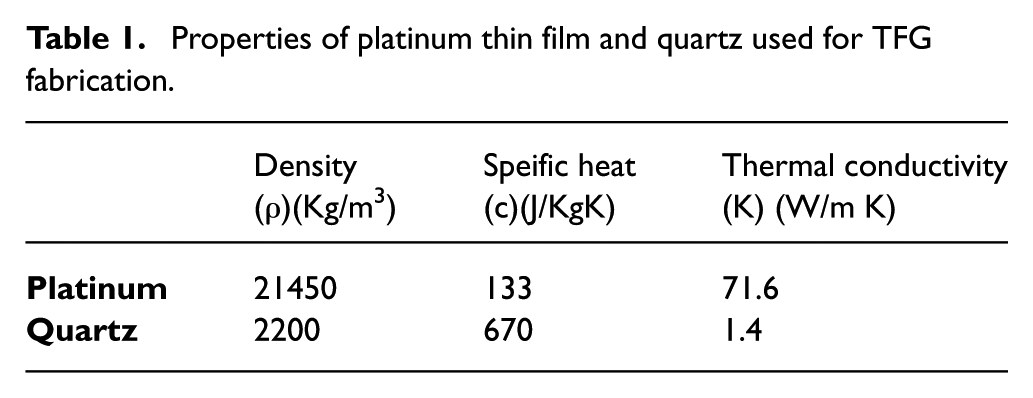
The fabrication of TFG in the present work is carried out by applying a film of highly conductive pure platinum metal on non-conductive substrate surface, as shown in Figure 1. It has been found that quartz has an advantage to withstand in a heated environment up to 1000 °C temperature without showing any significant geometric deformation owing to higher recrystallization temperature (D’Eustachio and Greenwald, 1946). Highly non-conductive thermal and electrical behaviour also support its use as substrate for TFG as claimed by Vidal (1956) and Bogdan (1963). Table 1 represents the properties of platinum film and quartz. The thin film of pure platinum, resistive element, is applied manually on a substrate of quartz material with a brush using bright pure platinum solution (SPI Platinum Paint, West Chester, PA 19381 U.S.A.; Model 4990-AB) and subsequently conditioned. The dimension of the substrate is taken as 0.01 m in length and 0.006 m in diameter. The platinum thin film thickness is taken as 10 µm, which is much smaller in comparison to the substrate dimension. The TFG is kept in a furnace up to the 600 °C for 4 to 5 hours in order to remove the traces of chemical binders present in it and to make it dry completely. All effort is made to make the substrate surface smooth and clean with the help of sand paper and polish. Silver paint, a conductive material, is also applied on the side wall of the substrate in case there is any chance of discontinuity of platinum thin film with the connecting wires. Further, it is dried in the oven and then cooled normally to achieve the proper electric connection. Attempts are made to keep the gauge resistance within the span of 75 to 125 Ω by the successive application of coatings and heating in the furnace several times. All effort is made to minimize the losses incurred by the thickness of the lead wire. The basic principle of TFG is based on RTD. TFG exposure to a heating environment triggered the thin film resistance variation with any small change in temperature values. When heated air impinges on a thin film presented on a substrate surface, it raises the resistance of the temperature sensitive film and produces an observable voltage output signal, which in turn represents the changes in resistance. The relation between the changes in resistance to that of change in temperature is linear, as shown in equation (1). The calibration parameter ‘α’ of TFG is calculated experimentally. It is also referred to as temperature coefficient of resistance (TCR). A constant current source is required to supply a current of the value of 10 mA through TFG, a passive device, in order to energize it. Oil bath calibration technique is one of the standard techniques for static calibration in order to measure the TCR and sensitivity, a comparative parameter for gauges. Sensitivity parameter for gauges basically compares the resistance change corresponding to the change in temperature (Frankel et al., 2008). For static calibration of TFG, the oil bath technique is used. A beaker partially filled with silicon oil is heated with the help of a heater. One empty beaker, smaller in size is placed inside the beaker, comprising the silicon oil in order to get hot air inside the empty beaker. The TFG is suspended and kept just above the bottom surface of the empty beaker, as shown in Figure 2. The indirect heating of TFG is done to protect it from any further damage. The constant current of 10 mA is passed through the TFG with the help of a constant current source (KEITHLEY; Model 2231A-30-3 Triple Channel DC Power Supply). The TFG sample goes through the cyclic heating and cooling with an interval of 5 °C. A Digital Multimeter (KEITHLEY made; Model 2701 Ethernet-Based DMM/Data Acquisition System) is used to record the variation in resistance. The change in temperature during heating as well as cooling is recorded with the help of a digital thermometer whose probe is suspended in the empty beaker containing the TFG sample. From Figures 3a–b, it has been observed that the variation for all TFGs between resistance and temperature is a linear and mean value of sensitivity and TCR comes out to be 0.00044 Ω/K and 0.0021 K−1, respectively.

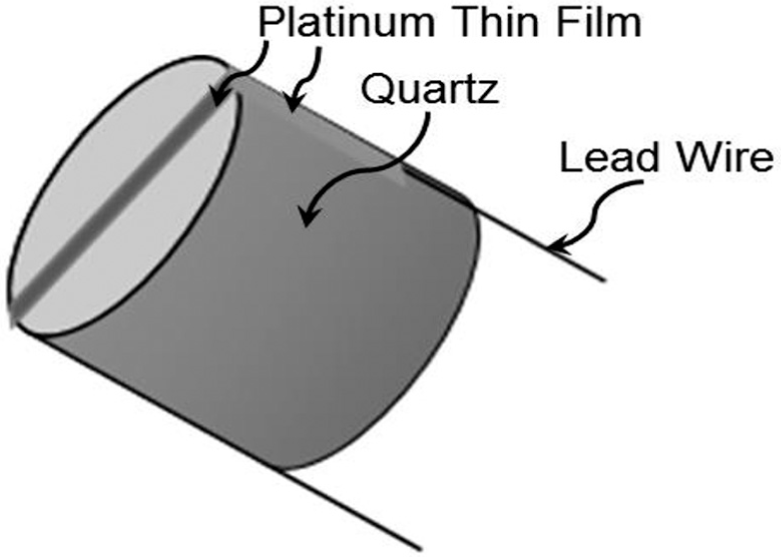
Platinum-based TFG model.
Properties of platinum thin film and quartz used for TFG fabrication.
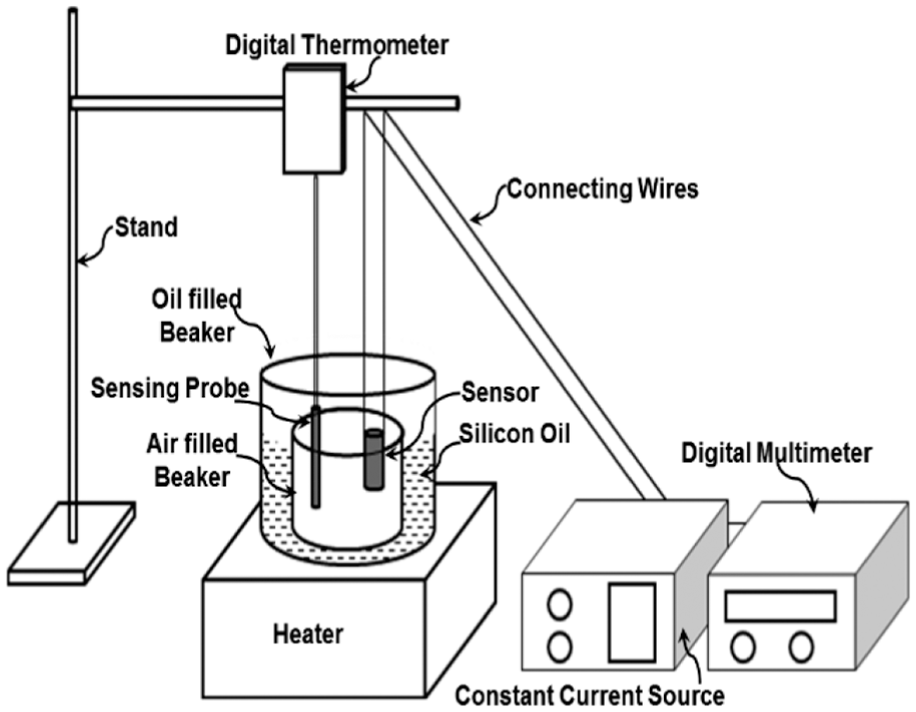
Set up diagram for oil bath static calibration of TFG.
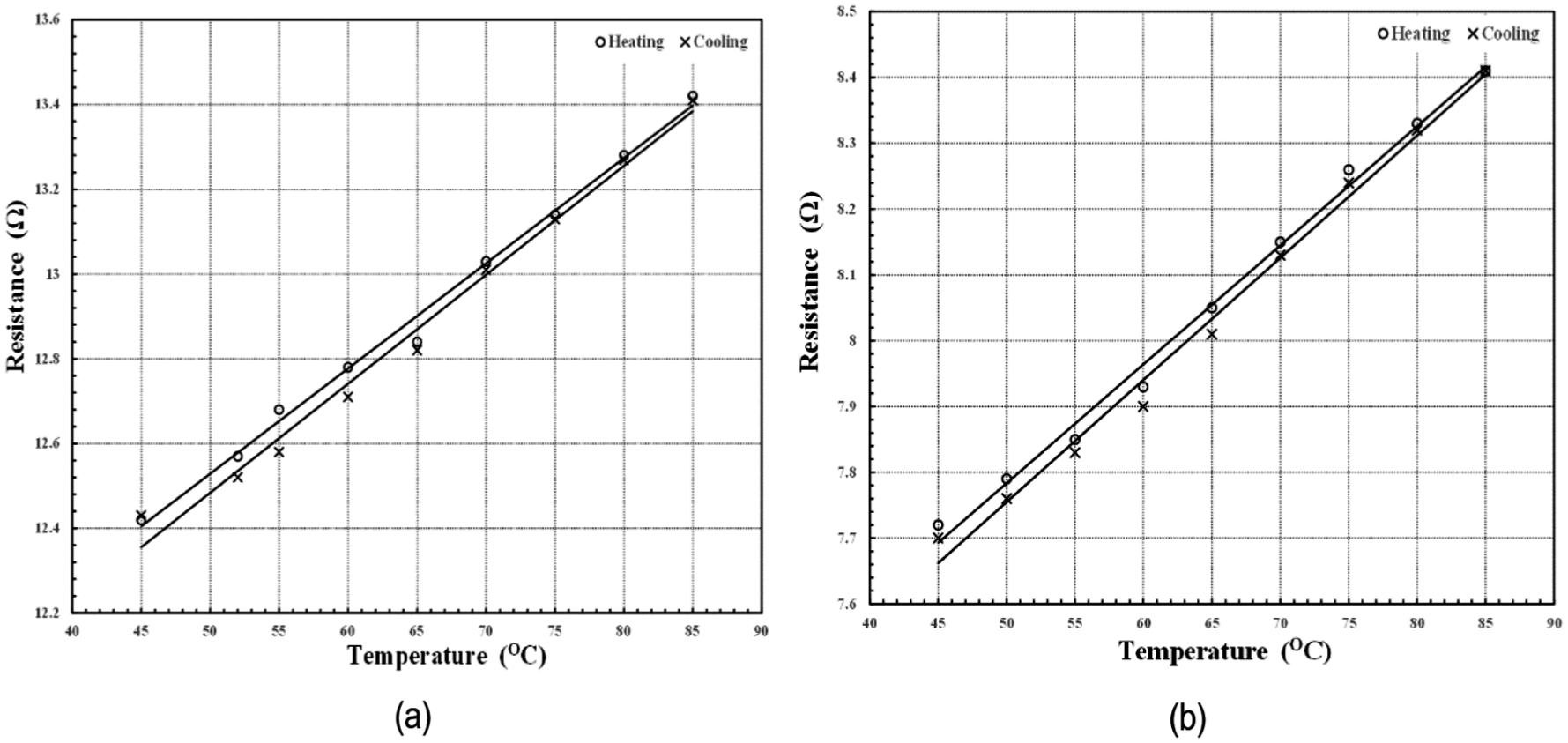
TFG resistance variation with temperature during heating and cooling.
Experimental and numerical analysis
The main objective of the present work is to establish a calibration setup for carrying out experiments on TFG in convective environment. Experiments were performed on TFG by exposing it to the impact or step heat load for a very short duration using a fabricated experimental setup, as shown in Figure 4a and Figure 4b. The experimental set up comprises of a two stage axial fan (VOLTAS make) attached to the duct of 0.52 m diameter and 4 m length, acting as a settling chamber. Heaters are placed in between the axial fan unit and duct to produce the hot air. The axial fan unit is controlled with a controller of Eurotherm company. The velocity and temperature of hot air is measured with the help of hot wire type anemometer of LUTRON made (Model AM-4204HA). Converging and diverging sections of 0.3 m and 1m length, respectively, with a throat diameter of 0.22 m is attached with the duct. The air through the diverging section end is made to pass through a circular plate having a hole of 0.02 m diameter at the centre of plate. The TFG is kept in a hole, which is made inside the stand and kept in front of the jet. The constant current source (KEITHLEY; Model 2231A-30-3 Triple Channel DC Power Supply) is used to pass a current of 10 mA through the TFG in order to energize the TFG. For the purpose to produce the impact heat load effect on the thin film of TFG, strip acting as a shutter is provided in between jet and TFG, which is removed just before the data logger (KEITHLEY made; Model 2701 Ethernet-Based DMM/Data Acquisition System) starts the data recording.
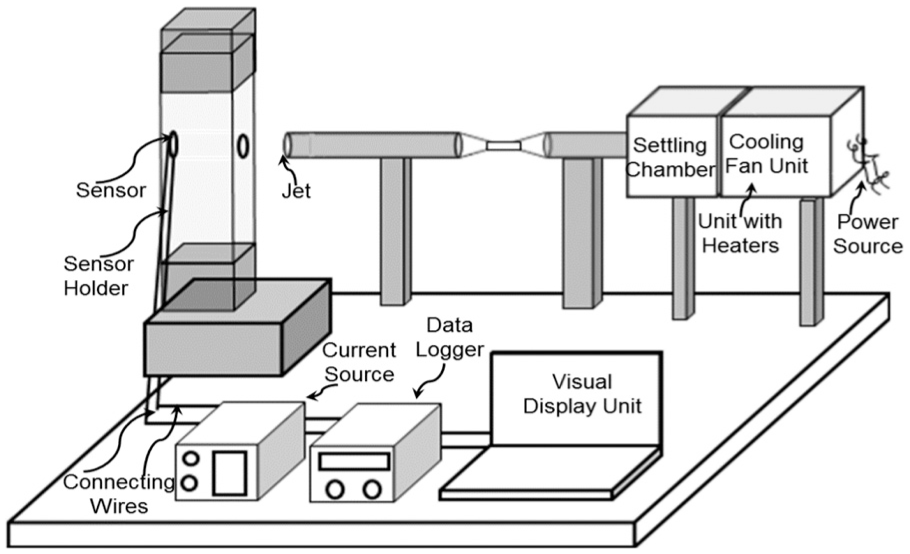
Experimental set up for TFG performance analysis.
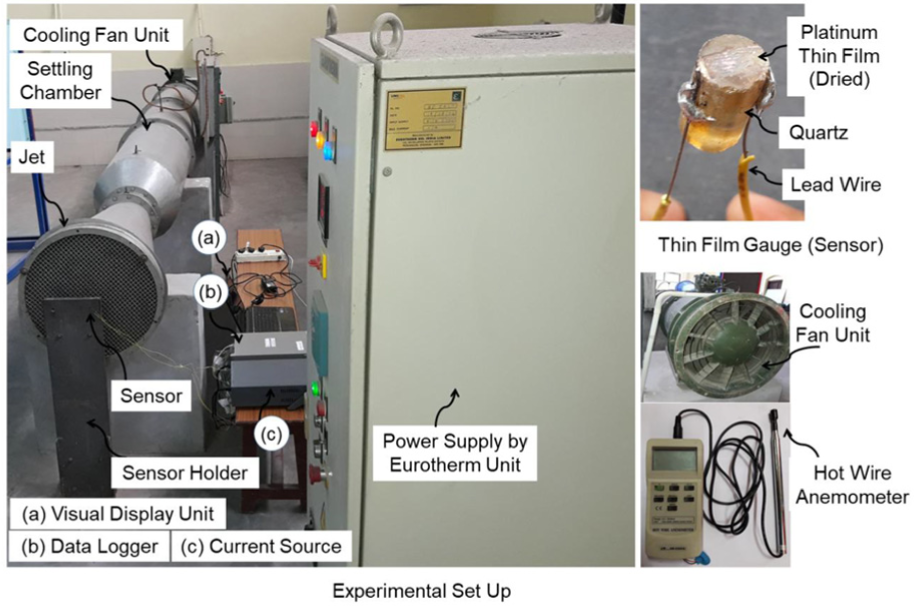
Experimental set up and TFG used for performance analysis purpose.
With the same experimental conditions, numerical analysis has been performed using FLUENT. The surface heat flux recovery from transient temperature data has been made by using one dimensional modeling for both methods. The excellent agreement of the data from both methods for transient temperature and heat flux justify the authenticity of the experimental set up and applicability of the TFG for measurement purpose in convective environment.
Dynamic calibration for TFG
Since measurement of heat flux in convective environment requires the disturbance of flow by the structure of TFG to disturb the quantity it seeks to measure, it is necessary to understand the errors produced by TFG. The errors in heat flux measurement may vary depending on the incident energy nature. Hence calibration of TFG is necessary before being installed into the surface for accurate prediction of surface heat flux (Kumar et al., 2011). In order to measure the heat flux, the TFG is uncovered to the hot air through a jet that finally expanded to the atmosphere at normal atmospheric conditions. The air coming out from the fan is made to pass through a settling chamber as shown in Figure 4a and Figure 4b to achieve the fully developed flow. Axial fan speed is regulated and maintained to get hot air velocity of 2.5 m/s at jet exit. The velocity of hot air is taken at five different locations and then mean value is used for analysis purpose. The hot air from the jet is released and expanded in the normal atmospheric conditions. All efforts have been made to achieve the choked condition through the passage and sonic flow through air jet exit by taking Mach number, a ratio of jet air velocity to the velocity of sound in the surrounding medium, as unity. The jet velocity calculations are made using the isentropic compressible flow relation shown in equation (2) for the conditions mentioned above (Dul’nev and Pilipenko, 1975; Schultz and Jones, 1973). The value of γ and R for air is assumed to be constant for short duration transient tests and their values have been taken as 1.4 and 287 J/kg K, respectively (Sahoo and Kumar, 2016). Computational analysis has been performed to obtain the optimum distance in order to achieve the maximum advantage in terms of stagnation enthalpy and velocity from air jet. It has been carried out for a hollow cylindrical pipe of 20 mm through which highly compressed air exhaust to the atmosphere (Patm=1.01325 bar; Tatm=300K). The inlet conditions for the analysis are estimated by taking M=1, and using an isentropic relations for compressible flow (Anderson, 1990). It has been observed that at a distance of 0.015m the velocity is highest, while in the rest part of pipe the air velocity is uniform. Transient surface temperature histories of TFG is recorded using data logger unit attached to the TFG for a period of 262 ms with time steps of one milli-second. Data has been taken for four different shots between 62–65°C at an increment of 1°C, as shown in Figures 5a–d. It is observed that a rise in temperature is parabolic for an impact load applied for a small duration of 262 ms. The parabolic rise of temperature plots ensures the similar behavior of RTD used for short duration transient measurements (Schultz and Jones, 1973).

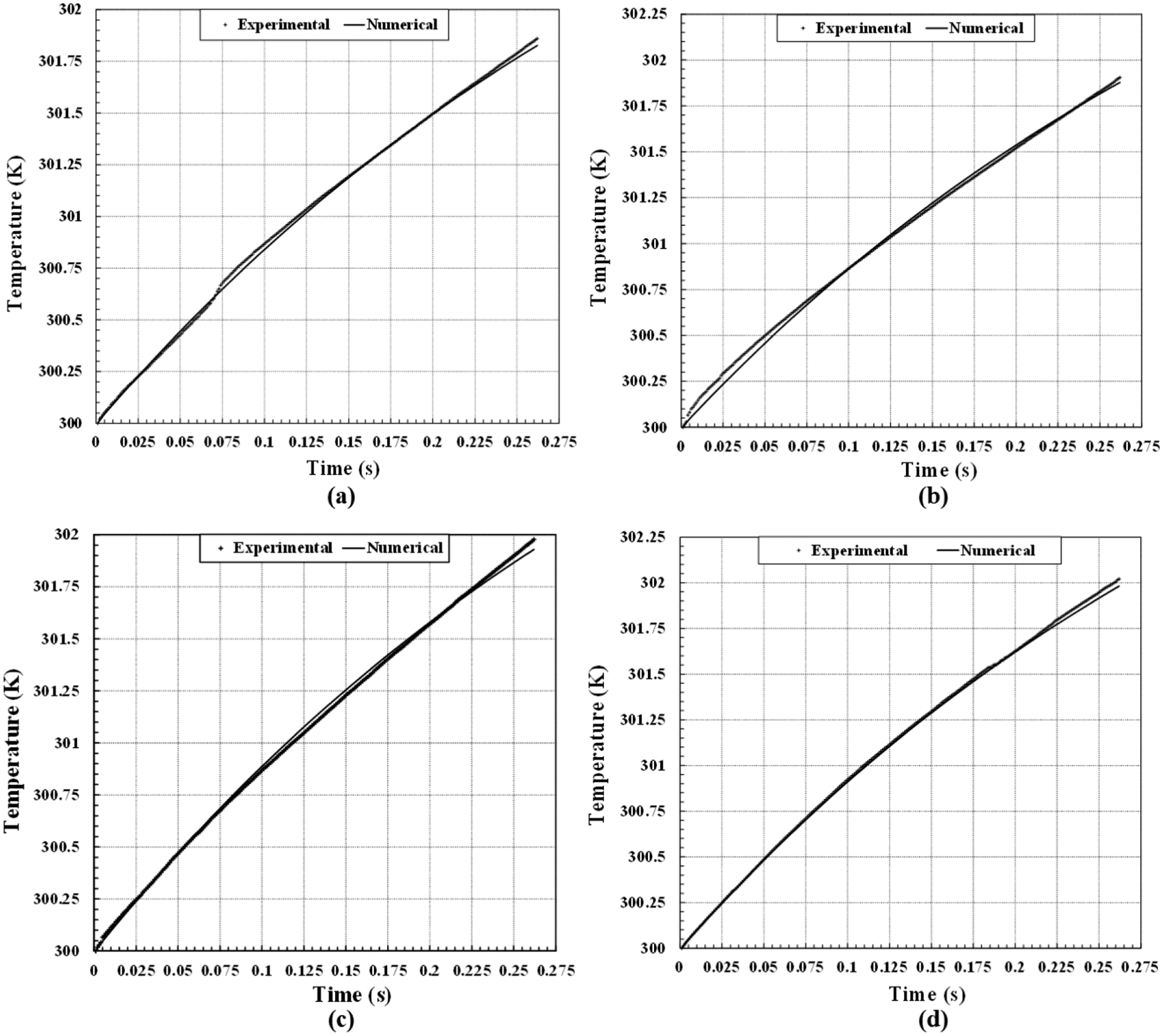
Transient surface temperature data of TFG.
Finite volume simulation for TFG
Numerical analysis using FLUENT is also performed with all conditions chosen for experimental purpose. Figure 6 shows the model used in FLUENT for analysis purpose. The platinum thin film thickness is taken as 10 µm, which is much smaller in comparison to the substrate of 0.01 m length and 0.006 m diameter. The material properties of platinum and quartz shown in Table 1 is used for simulation purpose. For numerical analysis in FLUENT, a suitable mesh convergence study has been carried out. It has been found that the temperature histories converged for the finite element meshes adopted in the present study. The substrate dimension as shown in Figure 6a is selected in such a way so that semi-infinite body condition, a body in which depth of penetration of heat for a given experimental run-times is trivial as compared to the linear dimension of the gauge, is justified (Childs et al., 1999; Kinnear and Lu, 1998). During analysis, the thermal resistance incurred in between the interface of thin film and substrate is neglected owing to trivial thin film thickness as detailed by Collins and Spiegel (1964). Initial temperature value of 27 °C distributed uniformly in the computational domain is considered, while four different temporal values between 62–65 °C at an increment of 1°C is taken for the analysis purpose. Figures 6c–d shows the contour of total temperature variation and velocity variation obtained numerically for a shot in which the maximum temperature of the hot air coming out through jet is 65 °C. From the contour of temperature distribution in Figure 6c, it is observed that the assumptions made for quartz; the isothermal condition at the bottom surface, adiabatic condition at the side walls and no heat flux effect at rear end for the analysis is also justified as these parts are more or less at the same temperature. More than half part of the body of quartz retain the initial temperature condition during the whole simulation scale, which justified the assumption of semi-infinite body for substrate as well. The condition of stagnant enthalpy at a distance of 0.015 m from jet is also justified as shown in Figure 6b, the velocity distribution contour. The experimental and numerical analyses show the similar pattern. It has been found that for all shots, the differences in the experimental and numerical values lies in the acceptable error range of ±2 %.
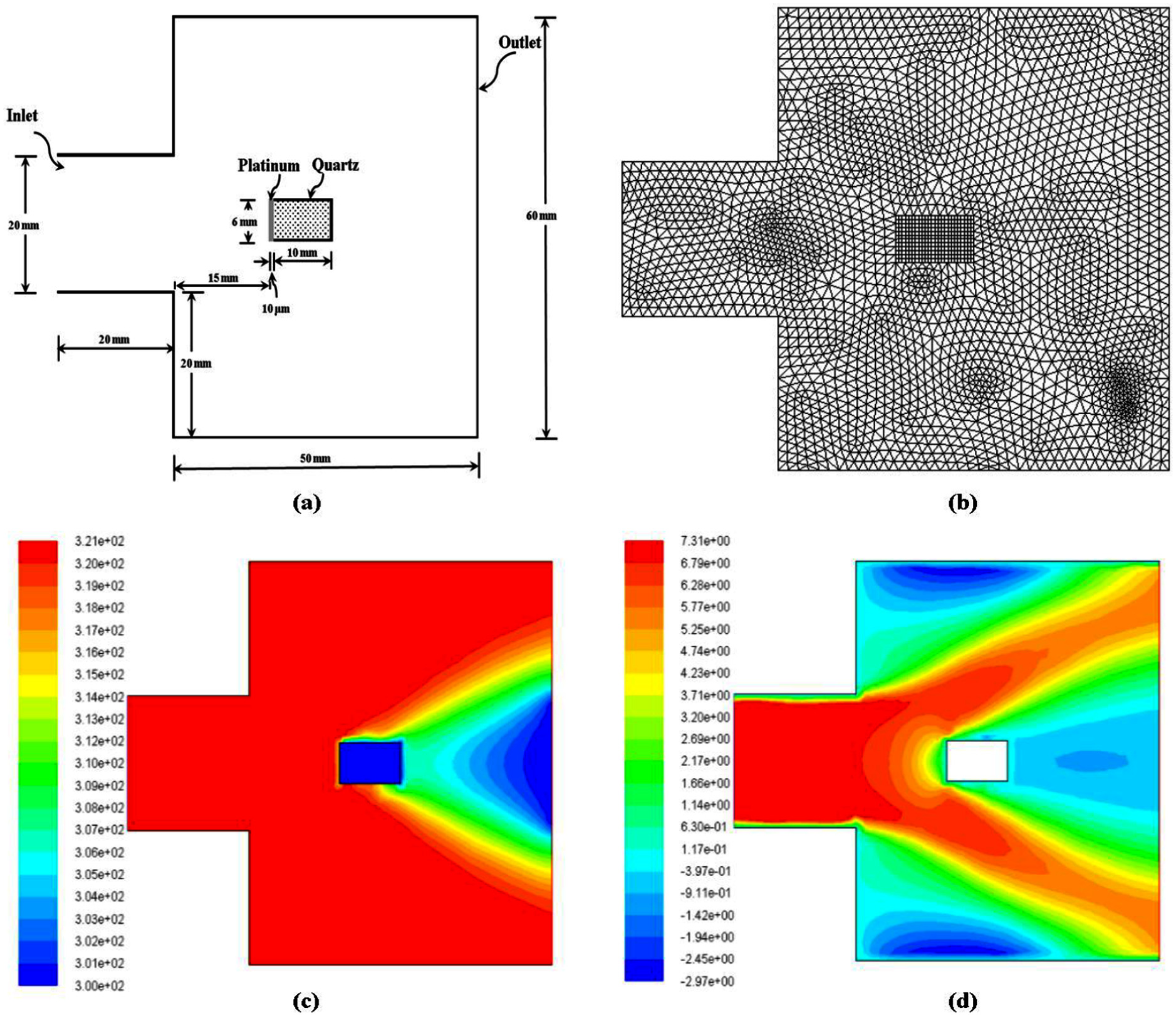
(a) Model used for analysis, (b) Meshing, (c) Contour of temperature distribution, (d) Contour of velocity distribution.
The experimental and numerical results obtained in the present study have been compared and validated with the results of Sahoo and Kumar (2016). It has been observed that Sahoo and Kumar (2016) had made a performance assessment of platinum-based sensor for simple laboratory scale setup comprising of an insulated cylinder to store pressurized hot air. The hot air is made to pass through the jet and impinges on the platinum-based sensor. The calibration test that is carried out in the present study differs in terms of the use of two stage axial fan and settling chamber.
Deduction of surface heat flux
It has been proposed by several researchers that the substrate body dimension of TFG is to be chosen in such a way to consider it as semi-infinite body along with the assumptions that measured surface temperature at stagnation point (point ‘M’ as shown in Figure 7) on thin film is same as that of substrate surface and heat transfer through rear end of the substrate is negligible, while substrate thermal properties throughout the experiment remains constant (Schultz and Jones, 1973; Taler, 1996). In order to predict the heat flux at stagnation point ‘M’, the instantaneous surface temperature data recorded at ‘M’ is fed to the simplified expression of the solution of one dimensional heat conduction problem for semi-infinite body as shown in equation (3) (Sahoo and Kumar, 2016; Sahoo and Peetala, 2010; Schultz and Jones, 1973, Taler, 1996). The quantity within square root outside the bracket in numerator in equation (3) is collectively termed as effective thermal product of the substrate. It has been observed that after

applying the pure platinum thin film on the quartz substrate, there is no significant change in the value of effective thermal product, hence the quantity value may be taken as constant throughout the experiment (Skinner, 1962). A number of existing numerical techniques are available to evaluate the value of heat flux from equation (3). It has been observed that trapezoidal and Simpson rule of approximation methods have limitations owing to the existence of singularity condition at the upper limit, t=τ, while piecewise linear approximation method evades this problem and results obtained through this method are more accurate with less computational time (Cook, 1970; Sahoo and Peetala, 2010). In the present work cubic spline method is used for discretization purpose to deduce the heat flux values from transient temperature histories. Figures 8a–d shows the trend of experimentally and numerically recuperated data of transient heat flux from surface temperature records. The convective heat load mean value for all four shots is obtained as 1.75 kW/m2.
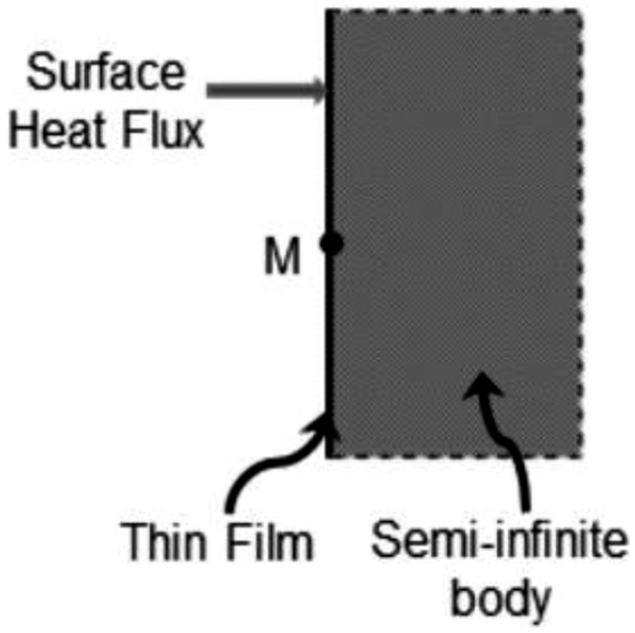
Semi-infinite body consideration for surface heat flux calculation.
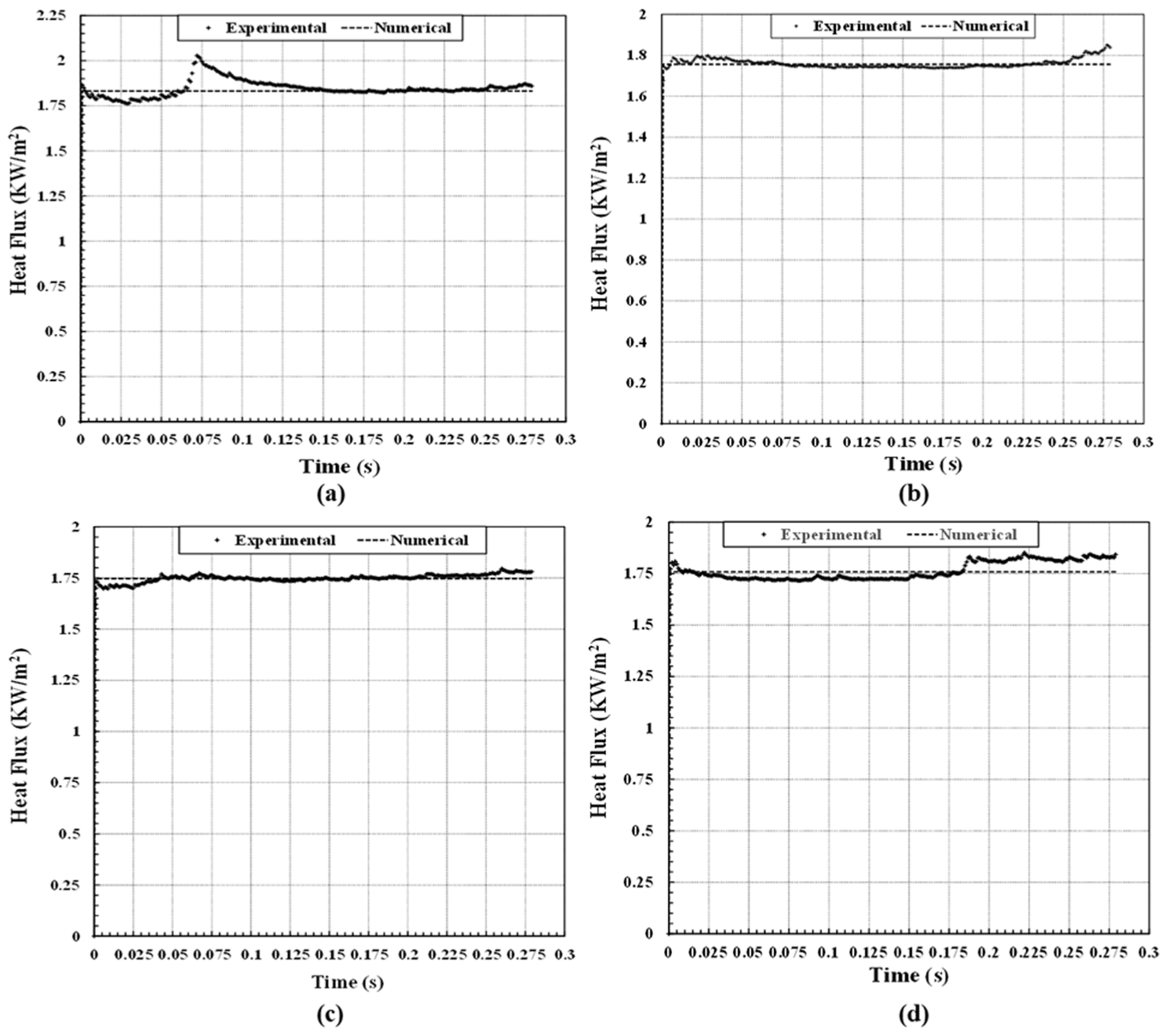
Experimental and numerical data variation of heat flux.
Results and discussion
Present study focused on the performance analysis of TFG having layer of highly conductive pure platinum for calibration set up in convective heat transfer mode. The data pattern for surface heat flux obtained experimentally as well as numerically are very much similar, as show in Figures 8a–d for four different shots. Each experiment has been performed five times and the variation in Figure 8 is shown for the results with maximum value near to the mean value. The differences of maximum and mean value for each case is found to be 0.01%. The mean value of surface heat flux is obtained as 1.75 kW/m2. There is a close agreement in heat flux values for all four diagrams, and from comparison, it is observed that the predicted heat flux values are within the range of ±3%. The assumptions made for semi-infinite thickness for substrate material, quartz, and unidirectional heat transfer behavior is also justified. It is observed that sudden rise in heat flux values in initial stage resembles this nature to the step heat load conditions. It is also observed that after sudden initial rise in heat flux there is very slight variation in the value of heat flux. This sudden rise or step heat load condition owing to maintained convective environment is also one of the reason of the parabolic variation of temperature data in Figures 5a–d, which represent the similar situations in shock tunnel during initial heat load application of step nature type for a very short duration as claimed by Arts and Camci (1985). The quick response of heat flux is also attributed towards the instantaneous changes in the resistance of platinum thin film and confirms its suitability for the conditions involving high flow regime.
Uncertainty analysis
The method of assessing the deviation associated with a measurement is often termed as uncertainty analysis. The accuracy and precision of the measurement is taken into consideration for the estimation of uncertainty related to the measurement. The accuracy expresses how far the measured value is deviated from the standard or known value, while the precision refers to the closeness of two or more measurements to each other. The uncertainty of results is largely expressed as the root-sum-square (RSS) of the accuracy and precision limits as stated by Kline and McClintock (1953). The uncertainty assessment for experimental investigations presents the accuracies related to the instruments and consequently, its effect in the overall
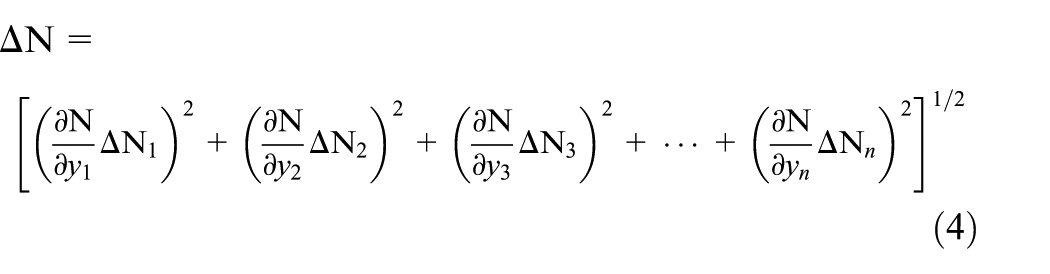
measurements. In the present study, perturbation technique given by Moffat (1988) has been adopted to make the uncertainty analysis for TCR, transient temperature histories and heat flux measurements. The uncertainty in dependent variables has been found using the following approach. If the experimental result,
As per the manufacturer’s specification, the accuracy of thermometer, source meter and data acquisition system is ±0.015°C, ±0.02%, and ±0.015%, respectively. The uncertainty value measured for TCR estimation is found to be ±0.22%, while the overall uncertainty estimated in the calibration experiments for temperature and heat flux signals is calculated as ±0.24% and ±0.28%, respectively. The uncertainty in the measurement can be attributed towards the measurement of output voltage signal using data acquisition system. Lower uncertainty values proves the genuineness of calibration carried out. The experimental uncertainty results obtained in the present study are very much similar to the uncertainty results obtained by Kumar et al. (2011) and Sahoo and Kumar (2016) for platinum-based TFG. In the past two studies, the TFG is exposed to the higher heat flux values in the range of 30-45 kW/m2 and 8-9 kW/m2, respectively as compared with the lower heat flux value of 1.75 kW/m2 applied to the TFG in the present study. However, the hot air flow velocity in the present study is very low as compared with higher flow velocity in the study carried out by Sahoo and Kumar (2016). The TCR value of TFG for the present study is very close to the other two studies.
Conclusions
In the present work, a new calibration technique in convection heat transfer mode has been established. The experiment has been carried out for convective environment, where hot air coming out through a jet impinges on handmade platinum-based TFG. The conductive platinum thin film is applied on a quartz substrate for in-house preparation of TFG. Further static calibration of the TFG has been carried out by using standard oil bath technique to find the value of calibration parameters, TCR and sensitivity. The average value of sensitivity and TCR was found as 0.00044 Ω/K and 0.0021 K−1, respectively. In addition to this, further TFG is subjected to hot air for the application of short duration convective loads of about 262 milli-seconds. Subsequently, the transient temperatures are recorded using data acquisition system. The discretization of transient temperature data has been carried out by cubic spline method and the prediction of transient heat flux is made with the help of convolute integral of one dimensional heat conduction. The average value of heat flux has been found as 1.75 kW/m2. Based on experimental conditions, numerical analysis using FLUENT has been made to get temperature-time variation and heat flux. The process is repeated experimentally as well as numerically for four different shots. It has been observed that the experimental and numerical analysis shows the similar pattern for all shots with the acceptable error difference in the range of ±2 %. The uncertainty analysis for the measurements has been carried out. It has been observed that the uncertainty values obtained for the TCR estimation is ±0.22% and overall uncertainty calculated for temperature and heat flux signals are ±0.24% and ±0.28%, respectively. The cost effective and easy manufacturing technique of the TFG along with platinum thin film ability to maintain its resistive nature for long time makes it as one of the promising gauge for heat flux measurement and temperature-based analysis in engineering application involving convective environment. The problem encountered during the experiment with TFG was that it gives away its resistive property to maintain the linear nature of resistance-temperature variation in harsh experimental flow conditions, which may arise owing to the reduction in adhesiveness of thin film on substrate.
Footnotes
Appendix
Declaration of conflicting interest
The author(s) declared no potential conflicts of interest with respect to the research, authorship, and/or publication of this article.
Funding
The author(s) received no financial support for the research, authorship, and/or publication of this article.