






Abstract
This paper presents a secondary voltage control scheme with a distributed event-triggered mechanism for multiple distributed generators in droop-controlled microgrids. First, considering the issue of limited bandwidth of a communication network in a practical application, two types of distributed event-triggered mechanisms are proposed to reduce the information transmission pressure, while preserving the desired control performance. Then, based on the proposed triggering schemes, distributed secondary controllers are designed for distributed generators. Finally, simulation results demonstrate that by using the control strategy, the voltages of distributed generators are synchronised to their nominal values.
Introduction
Nowadays, to deal with the energy crisis and environmental degradation issues, a growing number of distributed generators (DGs) are integrated into microgrid systems (Che et al., 2015; Cho et al., 2011; Guerrero et al., 2013), which operate in either grid-connected or islanded mode. As in islanded mode, microgrids should maintain frequency and voltage stability autonomously. The regulation of output voltages and frequencies of DGs to their prescribed values in microgrids is called the secondary control problem (Guo et al., 2015; Peng and Zhang, 2016; Yazdanian and Mehrizi-Sani, 2014). Conventional secondary control relies on a microgrid centralized control centre which requires complex communication networks. However, due to the fact that a vast range of DGs are widely dispersed geographically, it calls for reliable communication networks and the centralized control scheme may reduce the reliability and stability of the microgrid systems Bidram et al. (2014); Weng et al. (2016). Compared to a centralized control strategy, distributed control with a sparse communication network is less sensitive to failures and improves the control performance by allowing local controllers to exchange information with their neighbours. During the past decades, some fruitful research on the distributed secondary control of microgrids has been conducted, for instance the work by Bidram et al. (2013b); Li et al. (2016b); Lu et al. (2016); Shafiee et al. (2014); Simpson-Porco et al. (2015), where the implementation of the distributed control requires local information transmission between DGs. Gaeini et al. (2017) pointed out that local controllers should exchange their information over a communication network whose structure is not necessarily the same as the physical power network. In an islanded mode of microgrids, there is no reference bus and also inertia is low. Therefore, the DGs can sense one another via the data receives from the communication network, and thus coordinate their frequency and voltage levels in a distributed manner.
Note that among these results, it is assumed that the information of each DG is continuously transmitted over the communication network. In addition, the traditional periodic sampling control scheme, in which the information is transmitted periodically among DGs, may yield conservative results since the sampling rate is selected for the worst case (Dong et al., 2017; Wen et al., 2016). To save the communication resources between DGs, it is desirable to design effective controllers that can work in event-driven environments and update their values only when needed. Therefore, the unnecessary redundant communication can be mitigated since the information transmitted is executed only when needed (Guo et al., 2014; Wang and Lemmon, 2011; Zhu and Jiang, 2015). The event-triggered idea has also been applied to reduce the traffic in a networked control system in the work by Dimarogonas et al. (2012); Peng et al. (2017); Yue et al. (2013), where an event-triggered condition is proposed to determine the information transmitting time. To avoid the above problems in practical applications, the researchers have endeavoured to solve them in recent years. For instance, for the energy dispatch issues of microgrids in the work by Li et al. (2016a), a distributed consensus-based optimization algorithm is introduced and the corresponding event-triggered optimization scheme is obtained, which could reduce the requirements of data exchange in microgrids. For load frequency control in the work by Peng et al. (2018), an adaptive event-triggering
This paper introduces a distributed event-triggered strategy for secondary controllers of microgrids with multiple DGs. In order to compensate for the voltage deviation caused by the primary control and restore them to their prescribed values, a kind of distributed cooperative control law for DGs is constructed with an event-triggered mechanism. The main contributions of this paper are summarized as follows.
The event-triggered mechanism is introduced in the microgrid secondary controller design. The information transmission instant of each DG is determined by the constructed event-triggered conditions. This method can reduce the number of data packet transmissions, and ease communication pressure.
Both the implementation of the secondary voltage controller and the designed event-triggered mechanism only require the neighbours’ information. This implies that the proposed secondary control strategy with a distributed architecture can avoid the drawbacks of a centralized control scheme as mentioned above.
A modified event-triggered mechanism with guaranteed uniform positive inter-event time intervals is proposed to avoid the potential intensive triggered information transmission among distributed generators, which can reduce the communication burdens further.
This paper is organized as follows: the ‘Problem formulation’ section provides the problem formulation. The secondary voltage control with two types of distributed event-triggered mechanism is presented in the ‘Preliminaries and main results’ section. An experimental validation of the proposed solution in an islanded MG with four DG units is presented in the ‘Simulation results’ section. The ‘Conclusion’ section concludes this paper.
Problem formulation
This section will study a microgrid operating in islanded mode which involves the inverter-interfaced DGs and the loads. As a primary DC source (e.g. wind system, photovoltaic (PV) array, etc.), DGs are connected by voltage source inverters, while the loads are connected through an inductor-capacitor (LC) filter and coupling inductance. To stabilize the output voltage of DGs when the microgrid (MG) switches to islanded mode, the primary control is implemented locally in the internal control loops of DGs by using the notable droop technique, which does not need any communication link. As is well known, the primary control consists of three controllers, e.g. the power, voltage and current controllers, and one can refer to the detailed descriptions of the three controllers in the work by Bidram et al. (2014); Shafiee et al. (2014).
The droop technique is a decentralized strategy, which shares active and reactive power among DGs and maintains the output levels of voltage and frequency within acceptable ranges. At the

where
The magnitude of the DG output voltage

To compensate the voltage deviation caused by the primary control, the secondary controller is applied to tune the voltage amplitude of every DG to their normal values by setting the primary references
Preliminaries and main results
The secondary control of the microgrids is a tracking synchronization problem, where the DG units are interconnected via a communication network (Hong et al., 2006; Li et al., 2015). In the tracking synchronization problem, all agents need to be synchronized with a leader that acts as a command generator. For this purpose, each DG communicates with its neighbours and receives the information of neighbouring DGs. For saving communication resources, an event-triggered mechanism is proposed in the secondary control of microgrids. The details of a distributed secondary coordination control scheme with an event-triggered mechanism for the islanded MG is shown in Figure 1.
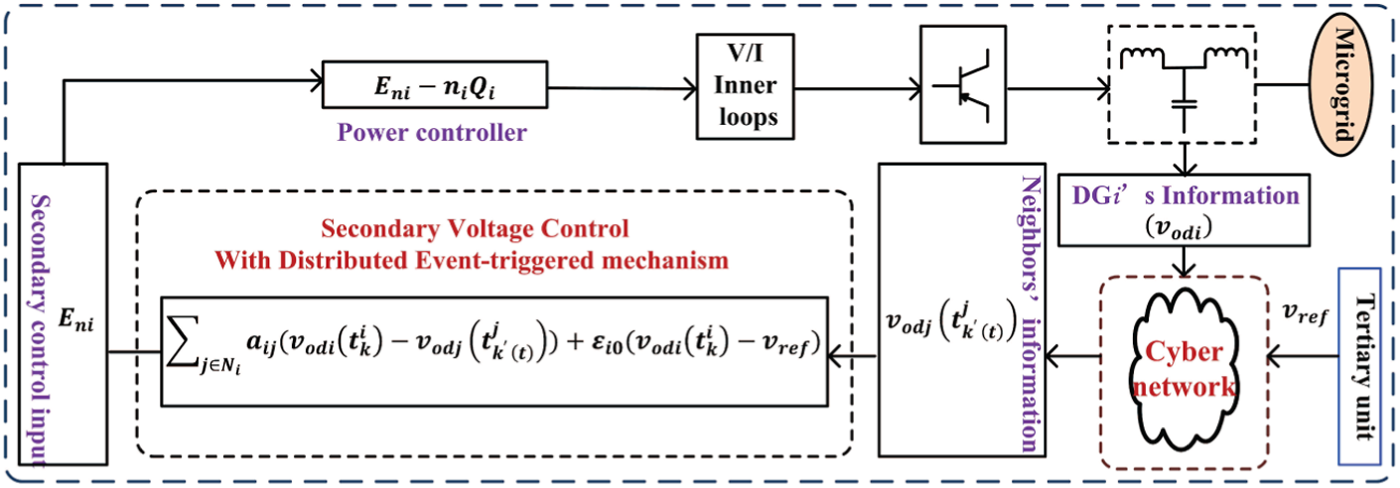
A block diagram of the distributed secondary coordination control scheme.
Preliminaries
An undirected fixed graph
In order to reduce the information transmission pressure, an event-triggered mechanism is introduced in the controller design. Each DG only transmits its own information, such as the output voltage to its neighbours at its triggering instant. This triggering instant is determined by a triggering condition which will be given in the following. Denote the triggering times of the output voltage of the
Secondary voltage control with a distributed event-triggered mechanism
In this section, the secondary voltage control with a distributed event-triggered mechanism is designed such that the voltage magnitudes of DGs

where

where
Before giving the main results, we define

Then, combining the definitions yields

and


where

and

By the property of the Laplacian matrix

where

On the one hand, since the graph

On the other hand, from the triggering condition given by equation (8), it can be derived that

Combining equations (12) to (14) yields

Applying LaSalle’s invariance principle, one can obtain that the solution
Compared to the existing event-triggered schemes, the proposed event-triggered mechanism is derived based on the physical system dynamic equation (3). Besides, the left side of the triggering condition given by equation (8) is computed by the instantaneous measurements.
Theorem 1 implies that the distributed event-triggered controller given by equation (4) is sufficient to achieve the voltage control objective. As mentioned above, an event-triggered scheme has an advantage in mitigating unnecessary redundant communication since the information is broadcasted only when needed. However, this may result in a Zeno behaviour problem (Dimarogonas et al., 2012) since the proposed event-triggered scheme given by equation (8) is continuously monitoring. For this problem, we are seeking the lower bounds of the event time intervals

where

for

which implies equation (16) holds. We analyse two cases here:
From a similar analysis in the work by Li et al. (2015), the event would not necessarily be triggered at
Secondary voltage control with a modified distributed event-triggered mechanism
In this section, we modify the above event-triggered mechanism by incorporating a small positive constant to guarantee the uniform positive lower bounds of event time intervals, thus, avoiding transmission of information too frequently as mentioned in Remark 2. Then, the main result is given below.

where

and

Equation (20) implies that the solution

Define the matrix

Then, according to

Next, the following inequality in set

Equation (24) indicates that

where

where
Simulation results
In order to verify the effectiveness of distributed secondary controllers with event-triggered mechanisms designed in the ‘Preliminaries and main results’ section, some simulations for the microgrid test system of 311 V (per phase root mean square [RMS]), 50 Hz (314 rad/s) have been implemented through MATLAB/Simulink. The test system contains four DGs from Figure 2. The detailed parameters of the system are summarized in Table 1. And a fixed communication network in Figure 3 is considered in this paper. Besides, we select DG1 as the leader in the system. From the communication network, only DG1 can obtain the leader information, and the other DGs only exchange information with its neighbours. In the following, the proposed secondary voltage control method returns the DG voltage amplitudes of the islanded microgrid to their nominal values.
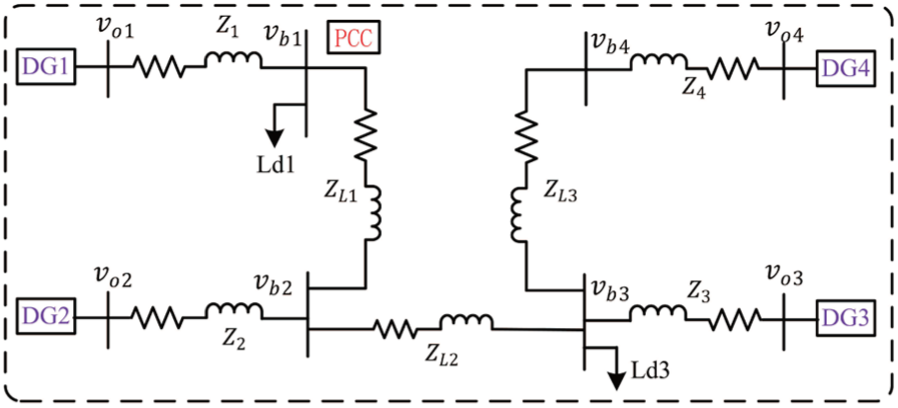
The microgrid test system.
System parameters.

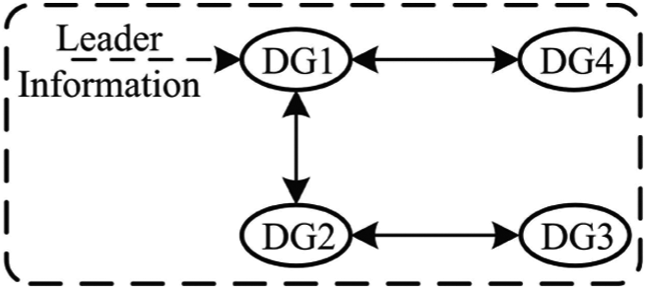
The communication digraph.
This section shows the simulation results under the distributed controllers given by equation (4) with the event-triggered mechanism given by equation (8). The parameters are set as
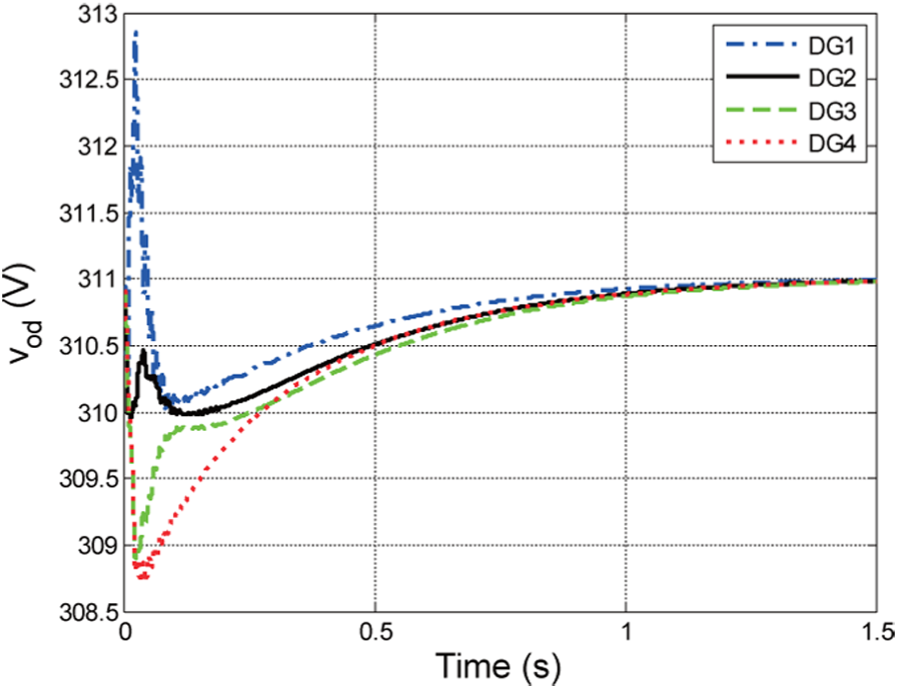
Distributed generator (DG) voltages.
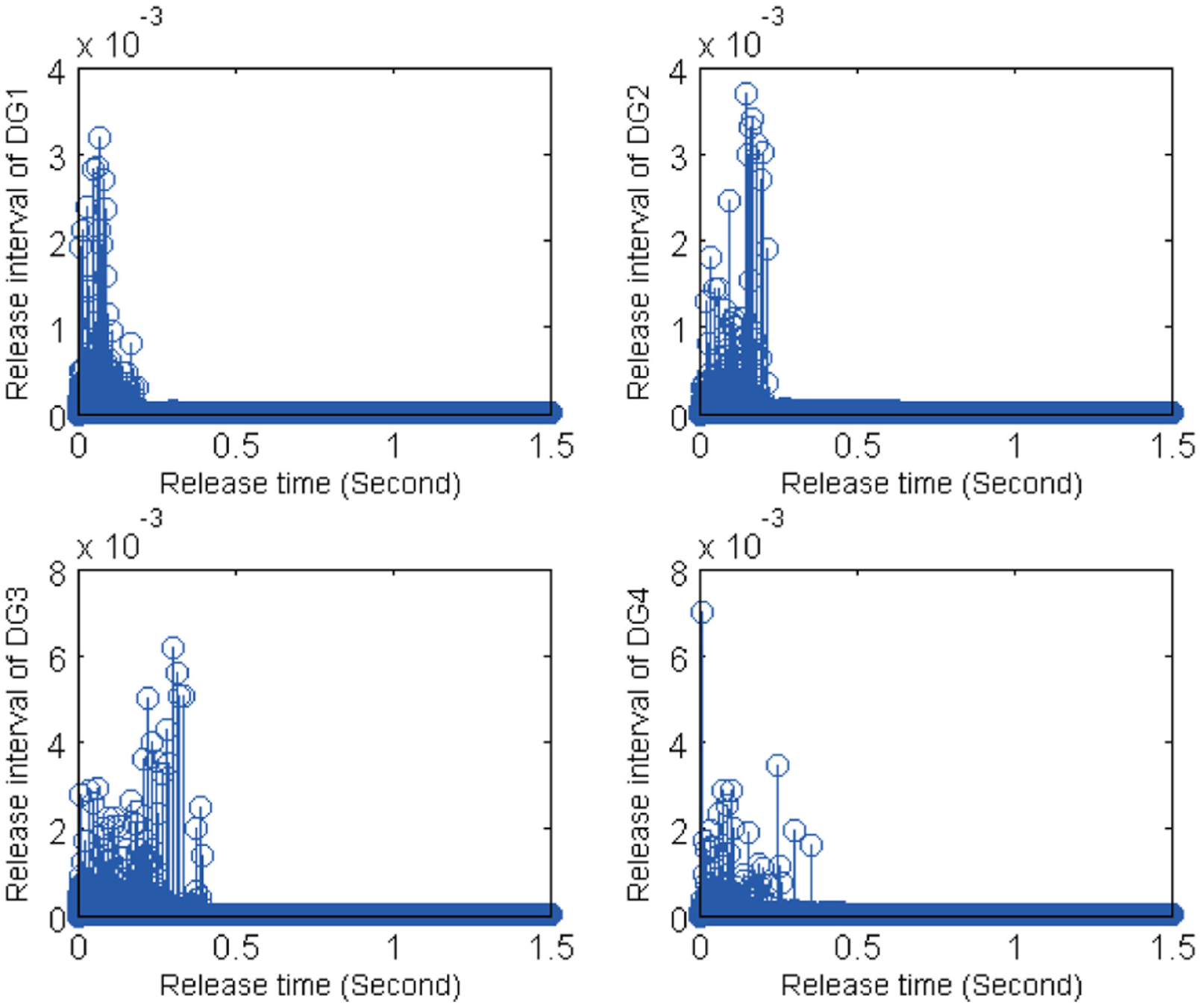
Broadcast periods of the four generators with an event-triggered mechanism.
Then, with the modified event-triggered mechanism given by equation (18), the simulation result is shown in this section. The parameter in equation (18)
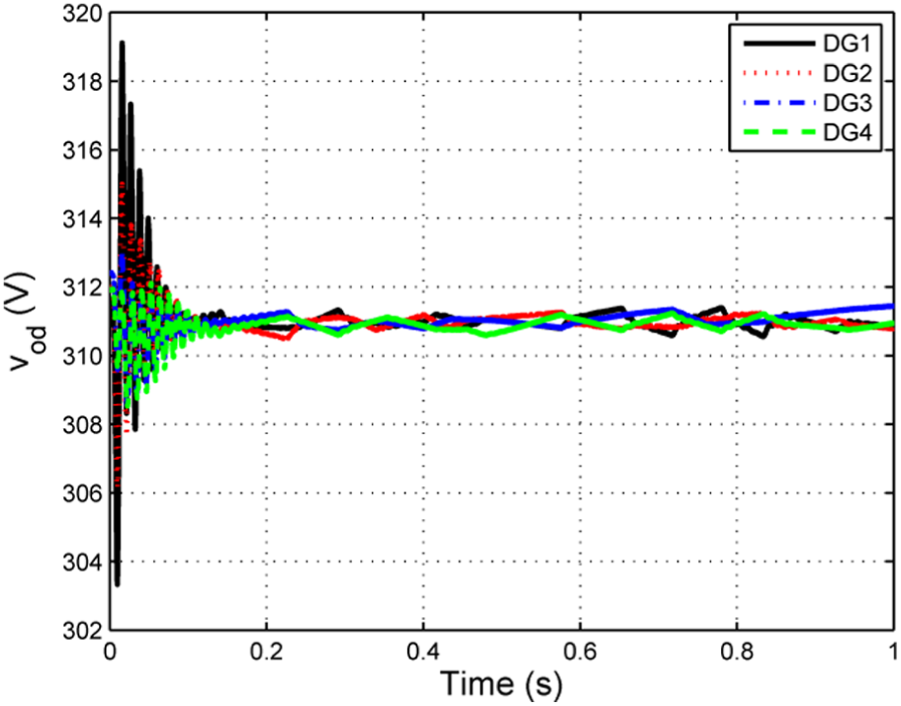
Distributed generator (DG) voltages.
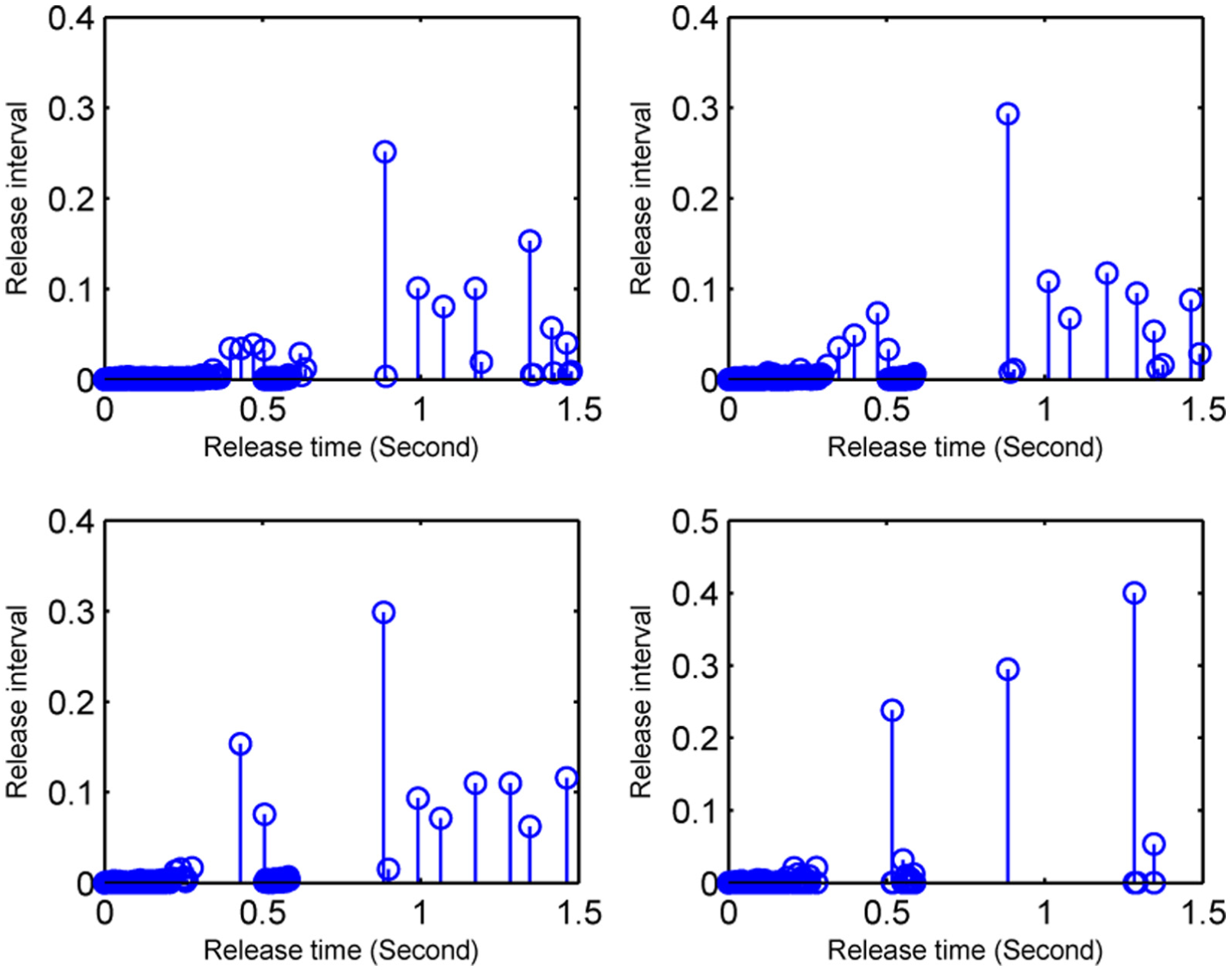
Broadcast periods of the four generators with a modified event-triggered mechanism.
Conclusion
The issue of microgrid secondary control has been investigated in this paper. In order to reduce the information transmission pressure, two types of distributed event-triggered mechanisms are introduced in the controller design. By using the control strategy, the voltages and frequencies of distributed generators are synchronized to their nominal values, which has been demonstrated in the simulation results. Moreover, a non-ideal signal transmission, such as time delay and packet loss, particularly in a practical communication network will be considered in our future works.
Footnotes
Declaration of Conflicting Interests
The author(s) declared no potential conflicts of interest with respect to the research, authorship, and/or publication of this article.
Funding
The author(s) disclosed receipt of the following financial support for the research, authorship, and/or publication of this article: This work was supported by the National Natural Science Foundation of China under (grant number 61533010 and 61503193).