






Abstract
Through the last decade, multi-agent systems have come to the attention of researchers in various fields. Henceforth, these systems have been investigated in various control applications. Microgrids and power systems are intriguing issues to address in agent-based systems. This research proposes a secondary control scheme based on a leader–follower consensus protocol for an islanded microgrid. The scheme aims to regulate the output voltage of distributed generators and to synchronize their frequency in a distributed manner. The control system has been embedded with the physical power system through an event-triggered communication network that determines control protocol for distributed generators. An integral sliding mode method is designed for voltage control to reach a consensus in output voltage among the distributed generators. Furthermore, a pinning-based consensus tracking problem is solved for frequency synchronization. Zeno behavior of the event-triggered mechanism has been excluded. By inducing Lyapunov-based stability analysis, this article suggests a reliable secondary control in the transient operation of isolating a microgrid. The system’s characteristics are further investigated, and results are compared with existing strategies. The proposed method maintains an acceptable voltage regulation and an accurate frequency restoration.
Keywords
Introduction
Microgrids (MGs) offer promising solutions to enhance power infrastructure reliability and address global warming. Distributed generation (DG), such as wind turbines and photovoltaic cells, increases availability in conventional power systems. However, incorporating large amounts of DGs presents challenges like system complexity and the need for advanced control systems (Bevrani et al., 2022). MGs operate in grid-connected or islanded modes, enabling economic dispatch from the main grid or technical maintenance within the MG (Ahmed et al., 2020). Hierarchical structures synchronize voltage and frequency levels of DGs and optimize power flow among Distributed energy resources (DERs) (Zhou et al., 2023). A primary control layer stabilizes voltage and frequency using droop control and current sharing with PI controllers (Olivares et al., 2014). Despite its stability, the primary control layer cannot avoid steady-state deviations, necessitating a secondary control layer for precise tracking of converter-based DERs to nominal voltage and frequency values (Dragičević et al., 2015).
A secondary layer is in charge of reasonable power flow sharing and synchronization of voltage
Centralized approach, where all DGs transmit their data to a Central Computing Unit (CCU) to calculate a control law for all DGs separately (Bhattar and Chaudhari, 2023). One major drawback in the centralized scheme is the high cost of communications. Also, these systems are more prone to failure and system instability with a CCU (Nawaz et al., 2023),
Decentralized approach, where each DG has its local computing unit and communicates with all other DGs to generate control signals for
Distributed approach, where each DG is considered as an agent in a multi-agent system (MAS) and shares information only with a finite set of neighbors in a network defined by a communication graph among DGs (Mesbahi and Egerstedt, 2010). This feature enables systems to lower their susceptibility to temporary local failures. Such attributes of the distributed approach have led to major advances in the recent decade, where modern power systems are in possession of flexible capabilities, for example, plug-and-play (Ning et al., 2020) and robustness to local failures of controllers (Mohiuddin and Qi, 2019).
Regarding practical systems, there are limitations imposed by bandwidth and energy constraints on communication networks in MGs. Therefore, event-triggered (ET) mechanisms can be implemented to reduce unnecessary information exchange among DGs unless a triggering condition has been violated (Shi et al., 2019). Various control methods, including leader–follower consensus protocols (Lai et al., 2020), sliding mode control (SMC) methods (e.g. robust SMC (Prasad, 2023) and terminal SMC (Shotorbani et al., 2017)), and fault-tolerant adaptive schemes (Li et al., 2020), are introduced for synchronizing voltage and frequency in a distributed system. Moreover, optimization techniques such as particle swarm optimization (PSO) (Abdelhadi et al., 2024) and model predictive control (MPC) (Nagasri and Marimuthu, 2023) are investigated for optimal power allocation and frequency regulation.
Enlightened by the discussions as mentioned earlier, a distributed secondary control is designed in this article for islanded AC MGs via an event-based communication network. A second-order integral SMC method, as proposed in the work by Ning et al. (2020), regulates the voltages of inverter-based DGs. Regardless of secondary control methods in the works by Bhattar and Chaudhari (2023) and Guerrero et al. (2012), this paper focuses on the regulation of voltage level of DGs by manipulating the derivatives of DGs’ voltages instead of regulating the voltage level itself. Thus, reactive power sharing is more rational than the conventional droop-based controller. Moreover, frequency restoration of DGs is obtained through a pinning-based control protocol. A communication graph is formed to illustrate the control system interconnections among DGs. Despite the leaderless consensus problem in the work by Dehkordi et al. (2016), in this article, reference values are broadcasted to those DGs with information access to the leader of the graph. Zeno occurrence has also been excluded. The main contributions of this paper are elaborated as follows:
This article investigates the voltage regulation problem to preserve the voltage deviation of DGs within a
The proposed ET mechanism for voltage regulation permits a minority set of DG(s) to update their nominal voltage in droop control at a lower rate than the others. In fact, only the DG which has access to leader’s information is required to modify its control input consistently throughout the isolated mode of the MG. The simulation results show that if the physical system faces load change, the corresponding controllers react proportionally to settle the power-sharing problem for the new load demand. Distinctly, the scheme can be modified to larger MASs with at least two neighboring agents of the leader, as long as the corresponding graph is strongly connected and balanced.
The remainder of this article is organized as follows. The second section represents with preliminaries and problem formulation. In the third section, the primary strategy of the proposed secondary control for MGs is detailed. In the fourth section, the efficacy of the designed controllers is manifested with a four-DG MG through different scenarios through simulations, that is, load change, plug-and-play capability, and communication failure. The last section concludes the article.
Preliminaries and problem formulation
In this section, the required preliminaries, graph theory fundamentals for communication topology, and the problem formulation for the secondary control of MGs are explained.
Notation
Let 1n denote the n-dimensional vector with all entries being 1,
Directed communication
In this paper, a directed graph
Furthermore, the reference values for voltage and frequency can be transmitted by a virtual leader to some of the DGs. Let
State-space model for isolated AC MGs
In an MG, each DG contains a DC voltage source, a voltage source inverter (VSI), an LC filter, and an RL output connecter. The block diagram shown in Figure 1 depicts the control structure for a DG. To maintain the stability of frequency and voltage components in converter-based generators, droop control is introduced as the first control layer. For the
where

Block diagram of a local primary inverter control structure (Guo et al., 2014).
Based on the works by Marwali and Keyhani (2004) (primary controller model), Pogaku et al. (2007) (MG’s complete state-space model, including DGs, line currents, and loads), and Bidram et al. (2013) (feedback linearization method for the output controller of voltage and frequency), the corresponding large-signal model for
where
Problem formulation
Considering the state-space model of an isolated AC MG described in Appendix A, two problems are to be addressed. The first problem is to control output voltage,
The second problem is to synchronize the output frequency,
For the proposed distributed secondary control, the controller design requires each DG to exchange information with its neighbors through a balanced directed communication network. The following assumption establishes the argument of our main results in section “Distributed secondary control of MGs through event-triggered communication network.” In addition, Lemma 1 provides an essential condition for the manifestation of agent-based control in the stability analysis of the MG system.
Distributed secondary control of MGs through ET communication network
In the subsequent section, we introduce a distributed ET SMC approach for voltage regulation. Additionally, we employ a distributed ET controller to restore system frequency. The stability of this proposed scheme is assessed using Lyapunov-based analysis. Furthermore, we validate the practical implementation of the ET mechanism by excluding Zeno behavior.
Distributed second-order integral sliding mode voltage control with ET mechanism
In this subsection, a control law is introduced for the output voltage control problem, that is,
Integral sliding manifold design
For
where
where the surface vector
where
ET sliding mode voltage controller design
In this subsection, the distributed integral sliding mode controller for the closed-loop dynamics of output voltages of all DGs is analyzed based on an ET mechanism. In the distributed ET scheme, let
where
with
where
Taking the Lyapunov function’s derivative concerning
Note that the leader has a constant value and does not possess a dynamic equation. Thus, the stability of the proposed Lyapunov function is obtained as
Accordingly, for
As the output voltage of
where
which the compact form of equation (15) is further deduced as
Event errors are defined as
Stability evaluation
Considering the distributed ET sliding mode voltage controller in equation (9), the sufficient condition of the leader–follower consensus is obtained for the sliding mode dynamics of the output voltage of all DGs. Hence, the following theorem is introduced to ensure the asymptotic stability of the system in equation (15).
where
where
As
where
According to the event function in equation (10), one has
Based on Young’s inequality (Sababheh and Choi, 2016)
According to Barbalat’s lemma (Singh and Khalil, 2005),
Zeno behavior exclusion
Zeno behavior is known as the occurrence of an infinite number of triggering instants in a finite period. In this section, adequate reasoning is provided to exclude such an undesirable phenomenon. To avert Zeno behavior, one must acknowledge that in the triggering sequence
The upper right-hand derivative of the terms
From equation (21), it can be induced that
then we extend inequality (23) to the event-triggering condition in equation (10), which leads to
Consequently, the following inequality is obtained
With a proper selection of
To provide a nominal voltage value in equation (1) that can share the demanded reactive power of the local loads among DGs in the MG, we propose a distributed reactive power controller in the form of
Distributed frequency restoration with ET mechanism
In the following section, we address the frequency restoration problem in secondary control of MGs, that is,
For
Subsequently, we define disagreement auxiliary variable as
To investigate the stability of the proposed controller, we introduce a Lyapunov functional
Before we proceed further, let us introduce the frequency triggering condition as
where
In the discussion mentioned above, equation (30) implies that the proposed distributed ET frequency controller in equation (26) solves the frequency restoration problem in equation (4).
A frequency nominal value is obtained to feed a control signal into all DGs for their frequency restoration to a rated constant and optimal distribution of active power among them. First, let us introduce an active power controller as
Discussion
In this section, a secondary control scheme for AC MGs has been proposed. The control system allows communication among DGs through an ET communication network through interfaced converters of all DGs. To regulate voltage level of DGs, a second-order sliding mode controller was designed, compensating external disturbances with a switching capability of the DSMC’s correction term in equation (9). Then, a nominal voltage value is defined for each DG. Moreover, a distributed frequency controller was suggested in equation (26) to construct the nominal frequency for each DG. We now advance to the next section to validate the results of the proposed method.
Simulation results
In this section, two case studies are conducted on a test system with four DGs (i.e.

(a) Left: Physical coupling of the microgrid with four DGs, right: communication graph among four DGs (Guo et al., 2014). (b) Communication graph among eight DGs.
Parameters for DGs, loads, and lines (Lai et al., 2016).

The ET mechanism constants for the voltage regulation with the second-order integral sliding mode approach are
Performance evaluation: No load change
In this section, the test system’s performance is investigated without any load change. We consider two scenarios, First, a four-DG MG, and second, an MG with eight DGs to evaluate the control system’s performance at a larger scale. Figure 3(a) and (c) shows output voltage and frequency of four-DG MG, and Figure 3(b) and (d) shows output voltage and frequency of eight-DG MG. Voltage regulation and frequency synchronization are achieved at
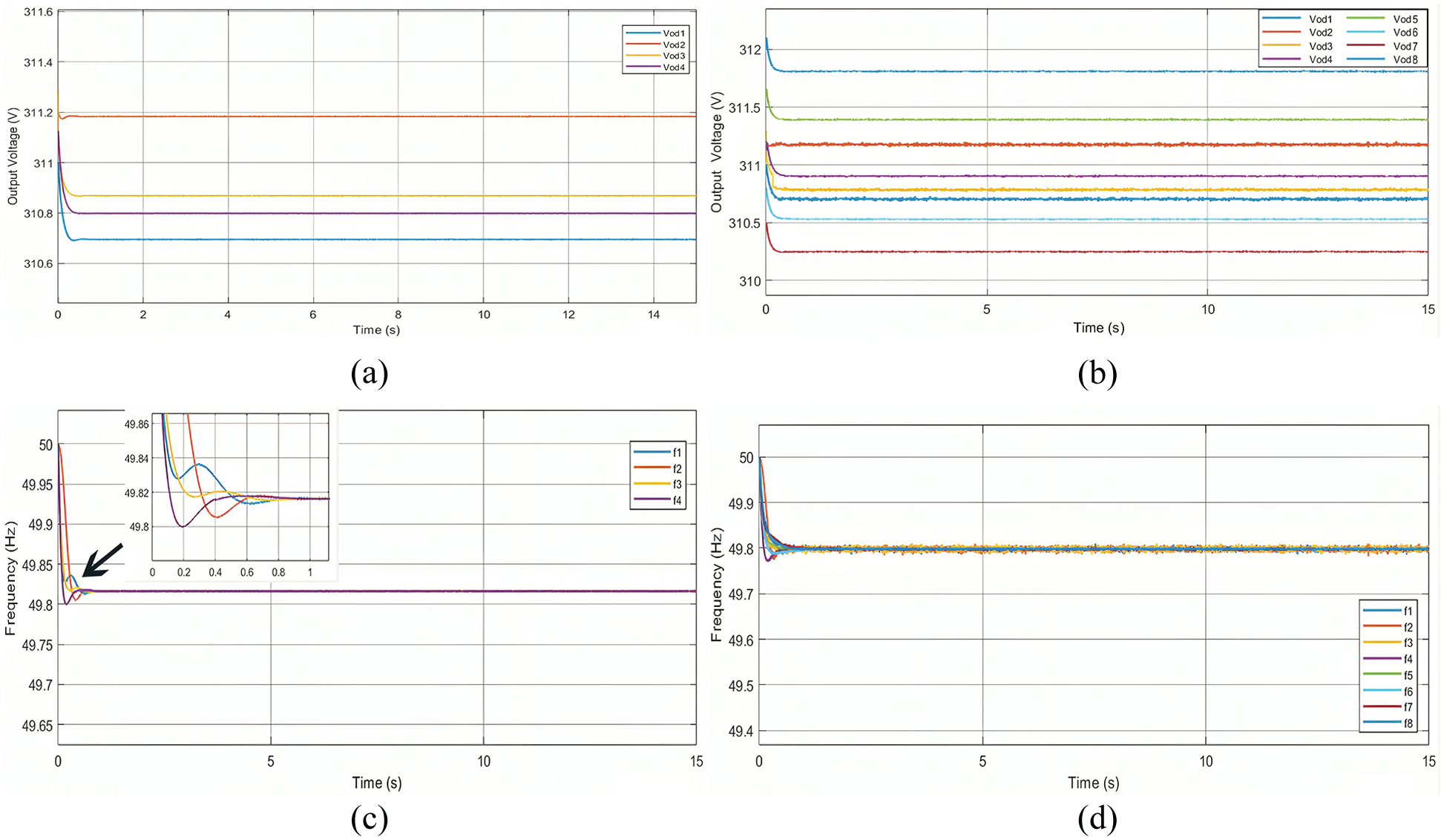
(a) Output voltage without any load change for
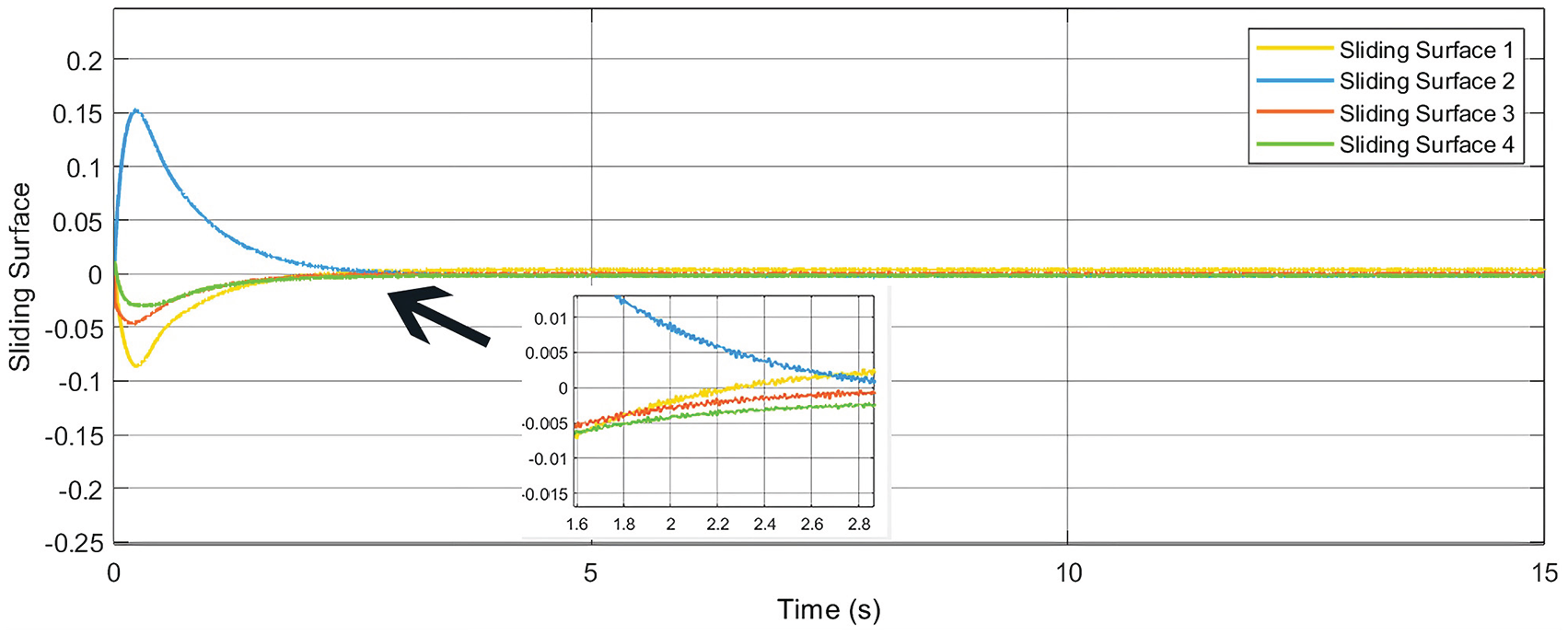
Sliding mode surfaces of DGs without any load changes for
Load change
In this subsection, we will investigate how the proposed method manages to cope with load changes in the grid. For
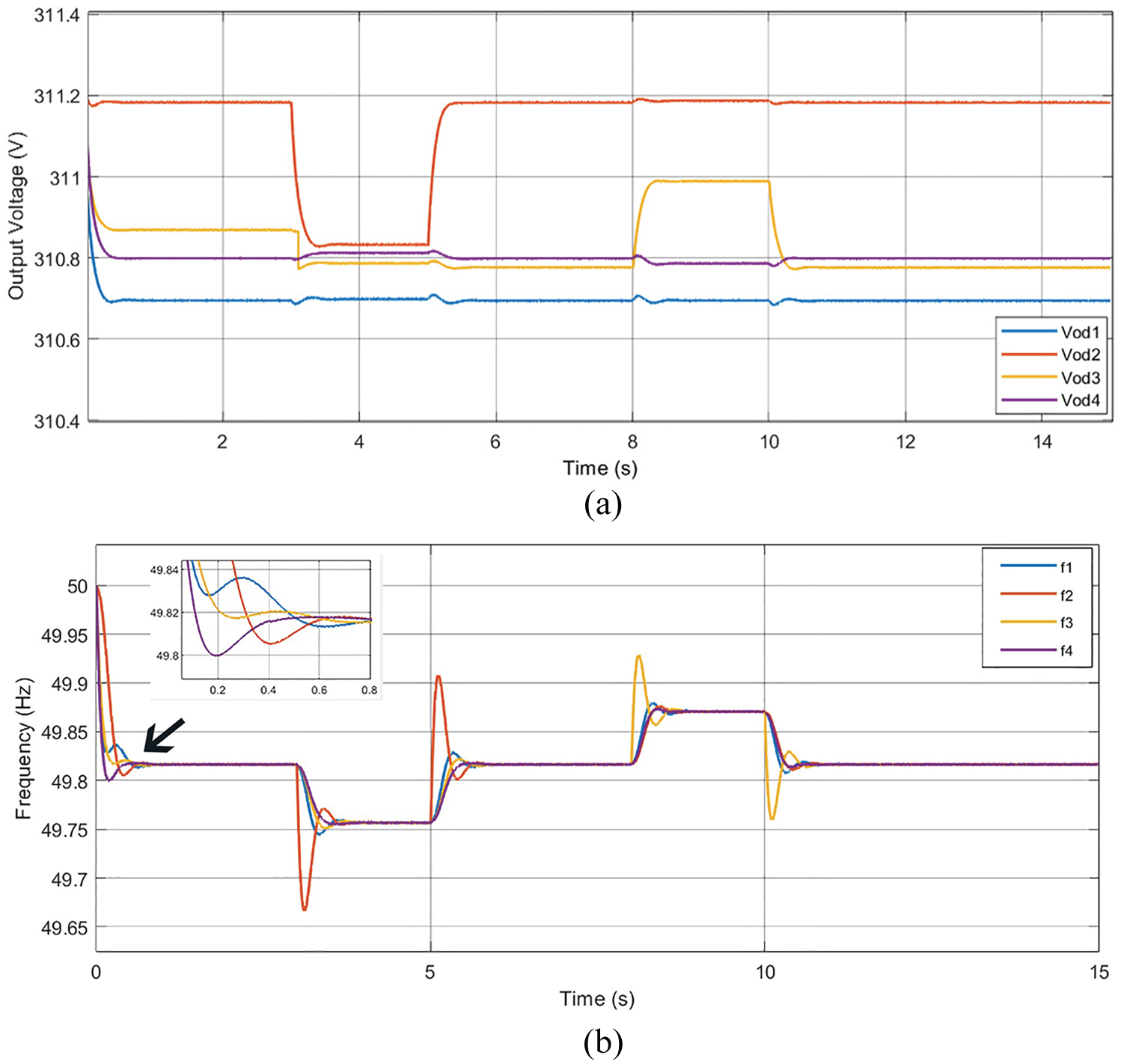
(a) Output voltage and (b) frequency of DGs in the presence of load changes.

Sliding mode surfaces of DGs in the presence of load changes.
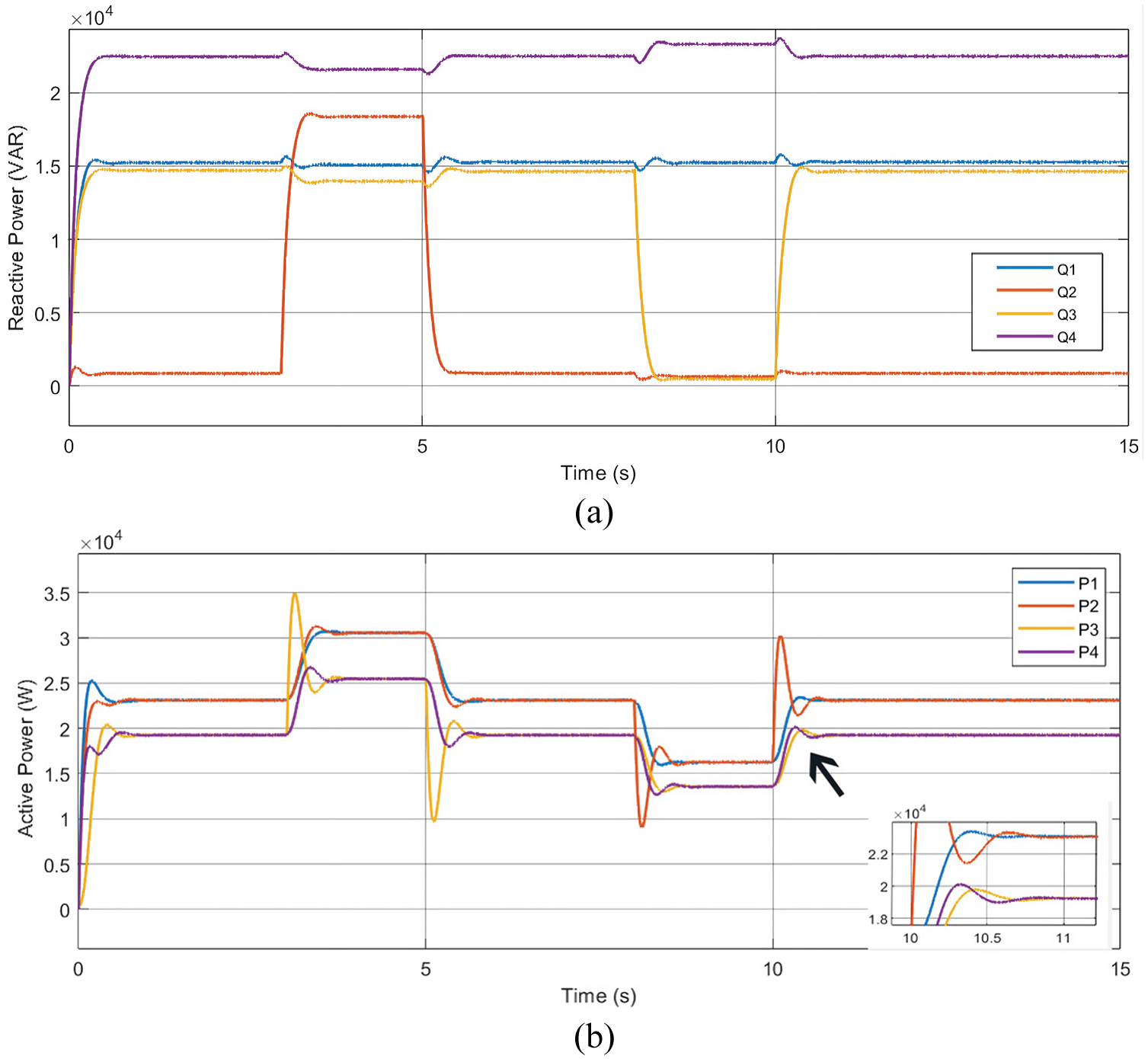
(a) Reactive and (b) active power of DGs in the presence of load changes.

(a) Voltage- and (b) frequency-triggering instants of DGs.
Evaluation of the proposed ET secondary control
In this section, the performance of the proposed method is evaluated with the developed ET secondary control in the work by Wang et al. (2019). Figure 9 depicts (a) the output voltage of DGs with the secondary control and (b) the frequency restoration proposed in the work by Wang et al. (2019). As can be inferred from the voltage response in Figure 9(a), the maximum difference between two separate DGs’ output voltages is over

(a) Output voltage and (b) frequency in the presence of load changes in the work by Wang et al. (2019).
The event conditions are first evaluated, and then compared to existing proposed triggering functions in the literature. The event condition (10) for voltage regulation is designed based on second-order tracking problem, thus DGs are required to update their control input at lower rates. On the other hand, the frequency controllers are excited by the triggering function (29) with first-order tracking dynamics. Influenced by the order reduction in defining the event condition, and the fact that DGs synchronize their frequency output simultaneously, there are more triggering instants in comparison with the voltage controllers.
To evaluate the event-triggering conditions, Figure 10 depicts triggering instants of the proposed ET mechanism with the investigated method in the work by Wang et al. (2019). In this scenario, the simulation is executed through

(a) Proposed voltage-triggering instants. (b) Voltage-triggering instants in the work by Wang et al. (2019). (c) Proposed frequency-triggering instants. (d) Frequency-triggering instants in the work by Wang et al. (2019).
Conclusion
In this article, a distributed secondary control has been investigated for isolated AC MGs regarding direct communication networks among DGs. To reduce communication costs, an event-triggering mechanism is enforced to omit unnecessary information exchange. To regulate the output voltage of converter-based DGs, an ET second-order integral sliding mode controller is proposed to compensate for the droop control’s deficiency in steady-state performance. Furthermore, mean-square synchronization of frequency is developed to construct the frequency controller in the suggested distributed secondary scheme. Note that Zeno behavior of the event-triggering mechanism has been excluded. The evaluation of how the proposed secondary control performs is done through different scenarios to probe the system’s capability of handling load change and communication loss. For different scenarios, it is inferred that the designed voltage controller maintains the voltage level of all DGs within a
Footnotes
Appendix A
In this section, the deduction of
The difference between the angle of the reference frame for
where
The power controller dynamics are stated as
where
According to the fact that the output voltage of each DG is aligned with the
where
The voltage and current controller dynamics of the primary control level are
where
The output LC filter and coupling inductor dynamics are
By combining equations (31) and (35), the state-space model of the AC MG is achieved.
Declaration of conflicting interests
The author(s) declared no potential conflicts of interest with respect to the research, authorship, and/or publication of this article.
