






Abstract
In this paper, adaptive fractional control design is established for uncertain nonlinear fractional order strict feedback form systems with unknown actuator failures. The fractional actuator failure compensation problem is considered in the sense of two actuation shapes, and output matching conditions for these shapes are employed. By means of a fractional backstepping control method, two fractional adaptive state feedback control laws are designed to accomplish output tracking and to guarantee closed-loop stability in the presence of unknown actuator failures and unknown system parameters. A fractional order filter is proposed to avoid the problem of computational explosion of the backstepping design. The stability is proved via fractional order analysis method for the whole closed-loop system. Finally, simulation results for the control of fractional Chua’s circuit and fractional Genesio–Tesi systems demonstrate the effectiveness of the proposed actuator failure compensation method and output tracking property along with fast convergence of unknown parameters estimations.
Keywords
Introduction
In recent decades, fractional order (FO) systems have been extended and their applications have attracted a lot of attention of researchers. Fractional calculus that has been considered as the extension of the integer-order calculus to non-integer order calculus originated for the first time more than three centuries ago (Podlubny, 1999). With the development of physics, the application of differential equations has been extensively studied in the modeling of dynamical systems. This is mostly because of the fact that many physical processes are well characterized by FO differential equations (Jenson and Jeffreys, 1997; Si et al., 2017). For more facts on the applications of fractional calculus, one can refer to Bigdeli (2015), Kumar et al. (2016) and Aghababa (2017) and the references therein. In this regard, FO control systems have been well addressed in the literature and many advanced control methods have been developed, such as robust control (Hmed et al., 2017), sliding mode control (Onder, 2011), backstepping control (Ding et al., 2015; Wang et al., 2016) and so on. In Ding et al. (2015) and Wang et al. (2016), the adaptive stabilization of a class of FO nonlinear systems is investigated without considering the probable actuator failures. A novel adaptive sliding mode control disturbance-observer technique is suggested for the synchronization of fractional-order quadratic chaotic systems with time varying disturbances in Mofid and Mobayen (2017).
Adaptive control method adjusts controller parameters by using system response errors to achieve preferred performance. An adaptive fast terminal sliding mode combined with a global sliding mode control approach is designed to eliminate the reaching phase that improves the performance and robustness of the uncertain non-linear n-order systems in Golestani et al. (2016). Another adaptive global sliding mode control is suggested for performance improvement of disturbed nonlinear systems in Mobayen and Baleanu (2016). The study on adaptive control carries on developing with appearance of fresh interesting topics such as uncertain FO systems in recent years. For example, a sliding mode control strategy is designed for a second-order non-linear system using adaptive fuzzy compensator in Ullah (2016). Another fractional adaptive control scheme (Razmjou et al., 2017) with iterative learning sliding mode is investigated to control linear and nonlinear FO systems. A robust fractional-order adaptive intelligent controller is investigated in Bigdeli and Ziazi (2017) for stabilization of uncertain fractional-order chaotic systems. The intelligent neuro-fuzzy network is employed to estimate unknown dynamics of system.
For reliability and safety causes, actuator failure compensation (AFC) has long been an active topic in the control community (Tao et al., 2004; Wang et al., 2017). Actuator failures have a destructive outcome on the performance of control systems, resulting in unwanted consequences such as instability. Actuator failures are unknown in the sense of failure time moments, failure patterns and failure parameters. For system safety and reliability, the compensation of actuator failures is of both theoretical and practical importance.
The AFC problem has been studied via several different approaches such as multiple-model (Narendra and Balakrishnan, 1997). The main plan of multiple-model, switching and tuning designs is supposing that the controlled plant is one of the plant models in a predefined set. Regarding each plant model, a controller is designed to reach the control objectives. During plant operation, the models in the set run in parallel with the plant, and if one actuator failure occurs, the switching appliance will match the best equal model and switch to the proper controller. In Tan (2013), a novel multiple-model adaptive AFC control scheme is proposed for nonlinear systems inspired from a near-space vehicle control application.
The fault detection and diagnosis (FDD) techniques have also been employed for compensation purpose in systems with actuator failures. Using fault tolerant control methods such as fault identification based on parameter estimation, residual generation and other related techniques have been used (Blanke et al., 2016; Tao et al., 2011).
Robust control schemes (Mobayen and Tchier, 2017), which can handle parameter changes and model uncertainties, have also been utilized to accommodate certain assumed actuator failures by considering them as uncertainties. Consequently, system stability can be guaranteed and a desired closed-loop performance can be preserved in the presence of actuator failures. The robust control-based fault-tolerant approaches employ fixed parameter controllers, which are for the worst-case failures and do not adapt to variations of failure pattern and its values (Cai et al., 2013; Wu and Yang, 2015).
Another type of AFC designs are indirect or direct adaptive control based schemes. An adaptive approach, which is capable of controlling systems with uncertainties caused by failures and disturbances, is an effective scheme for AFC (Tao et al., 2014). Indirect adaptive control designs first estimate the system and failure parameters and then apply control law reconfiguration employing the healthy actuators. Direct adaptive control-based designs do not clearly engage with system and failure parameter estimation, and as an alternative they adaptively update control reconfiguration parameters online. In Yao et al. (2016), a feedback linearization-based adaptive control approach is designed for multivariable nonlinear systems in the presence of uncertain actuators failures. This adaptive controller includes a direct adaptive actuator failure compensator to neutralize the uncertain actuator failure, a nonlinear feedback to linearize the nonlinear dynamics, and a linear feedback to stabilize the linearized system.
The above-mentioned AFC methods and techniques have been used for systems described by integer order differential equations. According to our investigations in control literature, there is not any research and study regarding AFC for FO system. Therefore, we review some significant studies on FDD, and also fault tolerant control in FO systems. In Pisano et al. (2014), a discontinuous FDD observer based on second-order sliding mode techniques has been developed in order to solve certain fault detection and isolation problems for some classes of FO and integer-order uncertain switched dynamics. The aim of Aribi et al. (2014) is to propose diagnosis methods based on FO models and to validate their efficiency to detect faults occurring in thermal systems by using generalized dynamic parity space method and Luenberger diagnosis observer. The FO fault estimation observer based on the continuous frequency distributed equivalent model and indirect Lyapunov approach is proposed for a class of nonlinear FO systems in N’Doye and Laleg-Kirati (2015). The authors in Aribi et al. (2012) develop a fault detection and isolation scheme for FO systems. It is an extension to FO models of a scheme developed for integer order models to design generalized fractional observers scheme. This scheme allows to generate residuals perfectly robust to disturbances and to isolate faults.
In Shen et al. (2013), a method is developed to design FO dynamic output feedback controller for a class of FO systems with actuator faults and polytope-type uncertain parameters. The fault tolerant controllers were designed in Pettinari and Corradini (2014) and Talange and Joshi (2016) for FO systems. The problem of robust fault tolerant control for continuous-time FO systems with interval parameters and sensor faults has been studied in Song and Shen (2013). By constructing sensor fault model and state observer, an observer-based FO output feedback controller is designed.
In all previous researches on FO systems, fault has been considered as a partial loss of effectiveness of system components. These faulty components can be still operational with less efficiency, but the stability and performance of the control system reduces correspondingly. This problem has been widely studied in FO systems in last decade, and various solutions have been proposed to compensate it using different control strategies. However, failure that is a permanent fault or a total loss of effectiveness of system components requires to be studied in FO systems as a new important subject of research. Although, for AFC, actuator redundancy is the key solution, there are significant procedural concerns in the design of such control systems, such as cooperation of multiple actuators and their failure compensation. In addition, actuator failures bring together further and large system uncertainties which can be harmful for the control systems. Consequently, actuator failures not only lead to actuator gain variations, but also cause system uncertainties that need to be dealt with using new adaptive control approaches. Hence, the importance and challenge of failure compensation in control systems motivated us to fill this gap of literature in fractional fault tolerant control systems.
This paper investigates the problem of adaptive AFC for strict feedback form FO nonlinear systems. It is assumed that some parameters of system dynamics and actuator failures are unknown in advance. To deal with the unknown model, the appropriate adaptation laws are presented. Based on the update laws, an adaptive backstepping controller is proposed to stabilize the uncertain system and fulfill the output tracking based on matching designs for two different actuation models in the presence of actuator failures. By using a FO filter, the repeated differentiations of virtual control signal are avoided. The proposed compensation method does not need any information of actuator failures (time, value and pattern of failure). It only uses an adaptive feedback control strategy. The stability of the recommended schemes is mathematically proved. Numerical simulations for the control of fractional Chua’s circuit model and fractional Genesio–Tesi system with augmented actuators authenticate the desired performance of the proposed adaptive AFC approaches.
The main contributions of this research lie in that:
It is the first time that the failure is considered in FO strict feedback form systems.
Fractional adaptive laws are extracted to compensate the unknown actuator failures.
The backstepping controller is designed to ensure the stability and tracking in the presence of actuator failures and unknown system parameters.
A FO filter is proposed to avoid the problem of computational explosion of the backstepping design.
This paper is organized as follows: In Section 2, some definitions and Lemmas of FO systems and the plant model are presented. In Section 3, two different actuation models are introduced for designing procedure of the proposed adaptive AFC schemes. Two adaptive control laws for the uncertain fractional system based on the two actuation models are derived in section 4. Simulation results of designed methods are detailed in Section 5. Finally, conclusions are given in Section 6. Some directions to future works are mentioned in section 7.
Preliminaries and system description
In this section, some basic definitions of fractional calculus and necessary FO stability theorems are presented. Also, the plant model and a basic actuator failure characterization are introduced. It is worth mentioning that there are a different number of FO derivative definitions (Podlubny, 1999), but the definition of fractional integration is unique as follows:
where
where
then there exists a constant
where
Consider the uncertain nonlinear FO strict feedback system
where
The model of actuator failure pattern is considered as
where
With actuator failures, the input vector
where
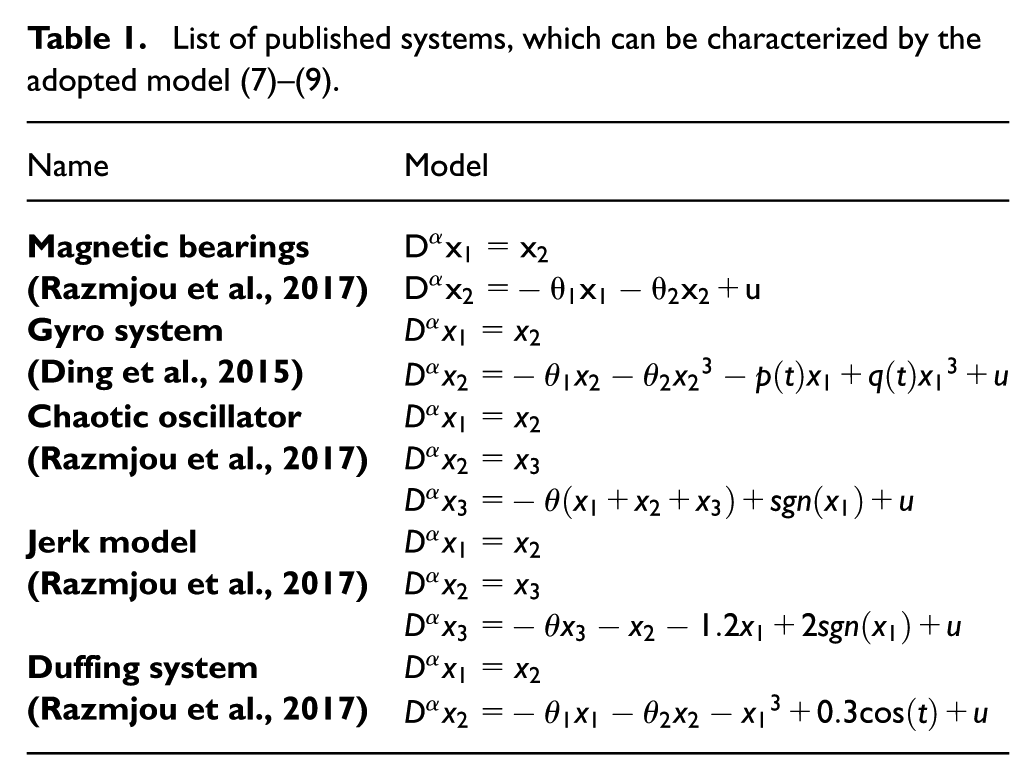
Note that numerous systems belong to the class characterized by (7)–(9). Table 1 shows the systems, including physical systems, which can be described by the model (7)–(9).
List of published systems, which can be characterized by the adopted model (7)–(9).
For issues in fractional AFC such as controller structure, matching, unknown parameters, adaptive laws, stability and output tracking, new solutions are needed, which will be discussed in following sections.
Failure compensation schemes
Two different actuation schemes (Tao et al., 2004) are used for formulating the AFC problems.
First scheme
The first actuation shape which is employed for AFC purpose is
Consider the nominal plant as
where
Based on the Assumption 3 for AFC, when all but one actuator fail, equation (8) with (14) becomes (16) with
To satisfy the output tracking purpose, we adopt the following assumption:
where
A set of output matching conditions is designed for the system (7)–(9) with the actuation scheme (14) with actuator failures, on the basis of the controller structure
where
Second scheme
The second actuation shape which is employed for AFC purpose is
where
Then we rewrite (8) as
In the presence of actuator failures, we have
where
with
Based on Assumption 3 for AFC, when all but one actuator fail, we obtain
To satisfy the output tracking purpose, we adopt the following assumption:
where
A set of output matching conditions is designed for the system (7)–(9) with the actuation scheme (22) with actuator failures, on the basis of the controller structure
where
Main results
Motivated by the developments in Ding et al. (2015) and Wang et al. (2016), the backstepping method is applied to extract the adaptive control laws for the fractional system (7)–(9) with actuator failures on the basis of aforementioned actuation schemes. Such a fractional adaptive AFC control system structure is demonstrated in Figure 1.
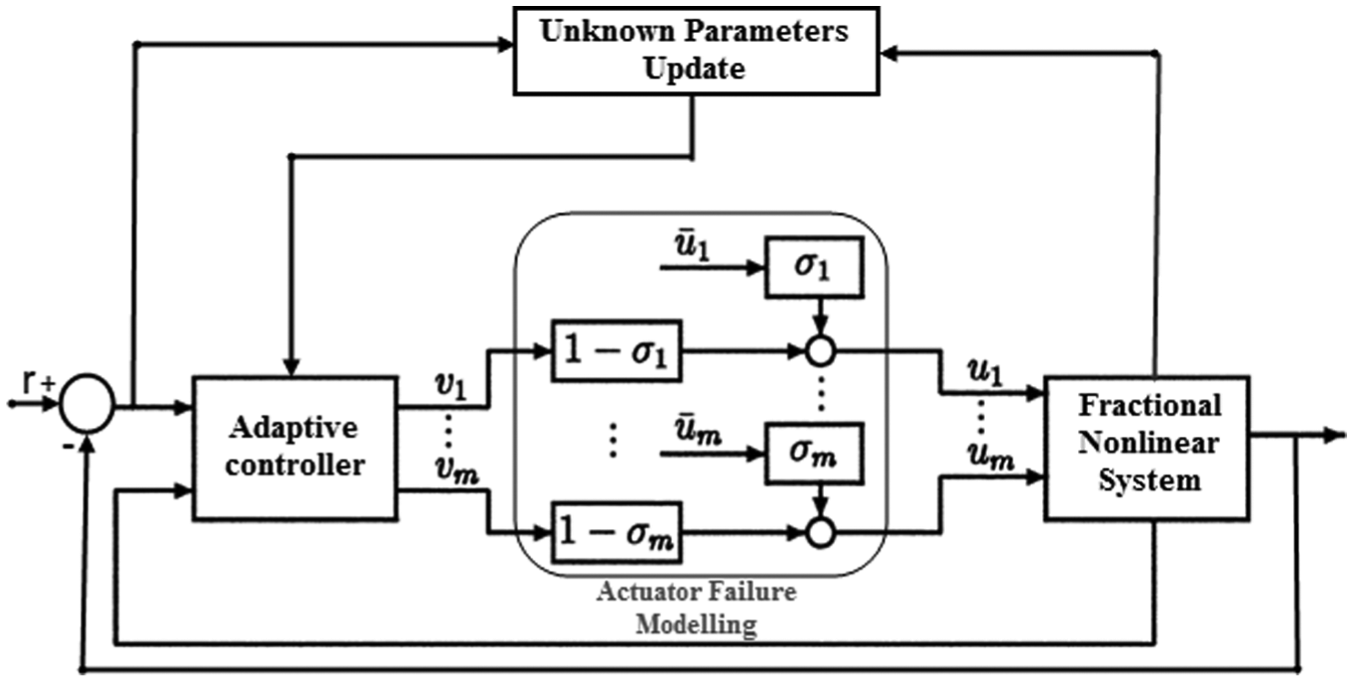
Block diagram of the proposed fractional adaptive AFC.
A FO filter is introduced as
where
With adaptive laws
Where
Step 1: Describing the tracking error
By choosing the first Fractional Lyapunov Function (FLF) candidate as
Selecting
the first term
Step 2: Let
By selecting the second FLF candidate as
Selecting
Step j: Let
By selecting the jth FLF candidate as
Selecting
Step n: First, we rewrite the nth state equation for the actuation scheme (22) and utilizing the subsequent structure for the controller
Presuming to have p actuator failures so
Now we apply the following last step of backstepping technique to the reshaped dynamics according to actuation scheme (22). Introducing
Replacing one control law (36) and adaptive laws (38)–(40), we obtain
By completion of squares, we have
and similarly, one can obtain
Replacing (55)–(57) into (54), we have
where
To ensure that
By considering
with adaptive laws
Numerical simulations
In this section, numerical simulations are presented to investigate the effectiveness of the proposed adaptive AFC design for two examples of uncertain nonlinear FO strict feedback form systems. The predictor-corrector method defined in Aguila-Camacho et al. (2014) with a step time of 0.005 is employed to solve the FO equations in MATLAB.
Example 1
A typical Chua’s circuit and its characteristics may be found in Kebriaei and Yazdanpanah (2010), whose nonlinear equations are given by
where
To obtain the system dynamics form described by (7)–(9), first the normal form of Chua’s circuit equations described by (65)–(67) should be derived. By using the following diffeomorphism transformation
With some mathematical calculations, the system (65)–(67) can be converted to
Based on equations (69)–(71), the following normalized FO model with three augmented actuation parameters
where
Considering the plant (72)–(75) as the first actuation shape given in (14), the adaptive AFC scheme with the controller (60), FO filter (35) and update laws (62)–(64) is applied to ensure the stability and to achieve the output tracking objective, in the presence of the actuator failures
While
with adaptive laws
where
For simulation purposes, the parameters are chosen as
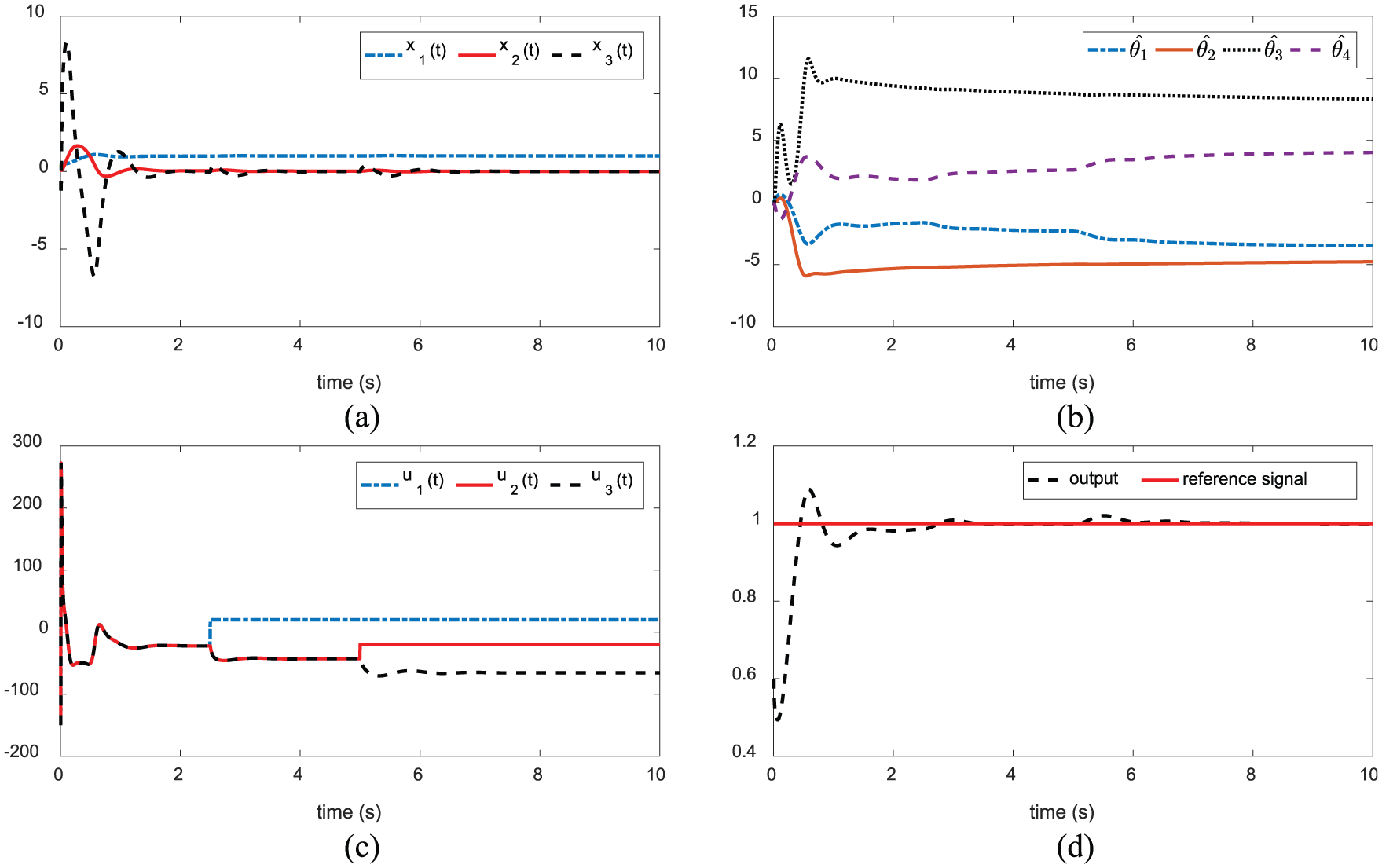
Tracking control results of the fractional Chua’s circuit with actuator failures. (a) System states; (b) Parameter estimates; (c) Control inputs; (d) Output
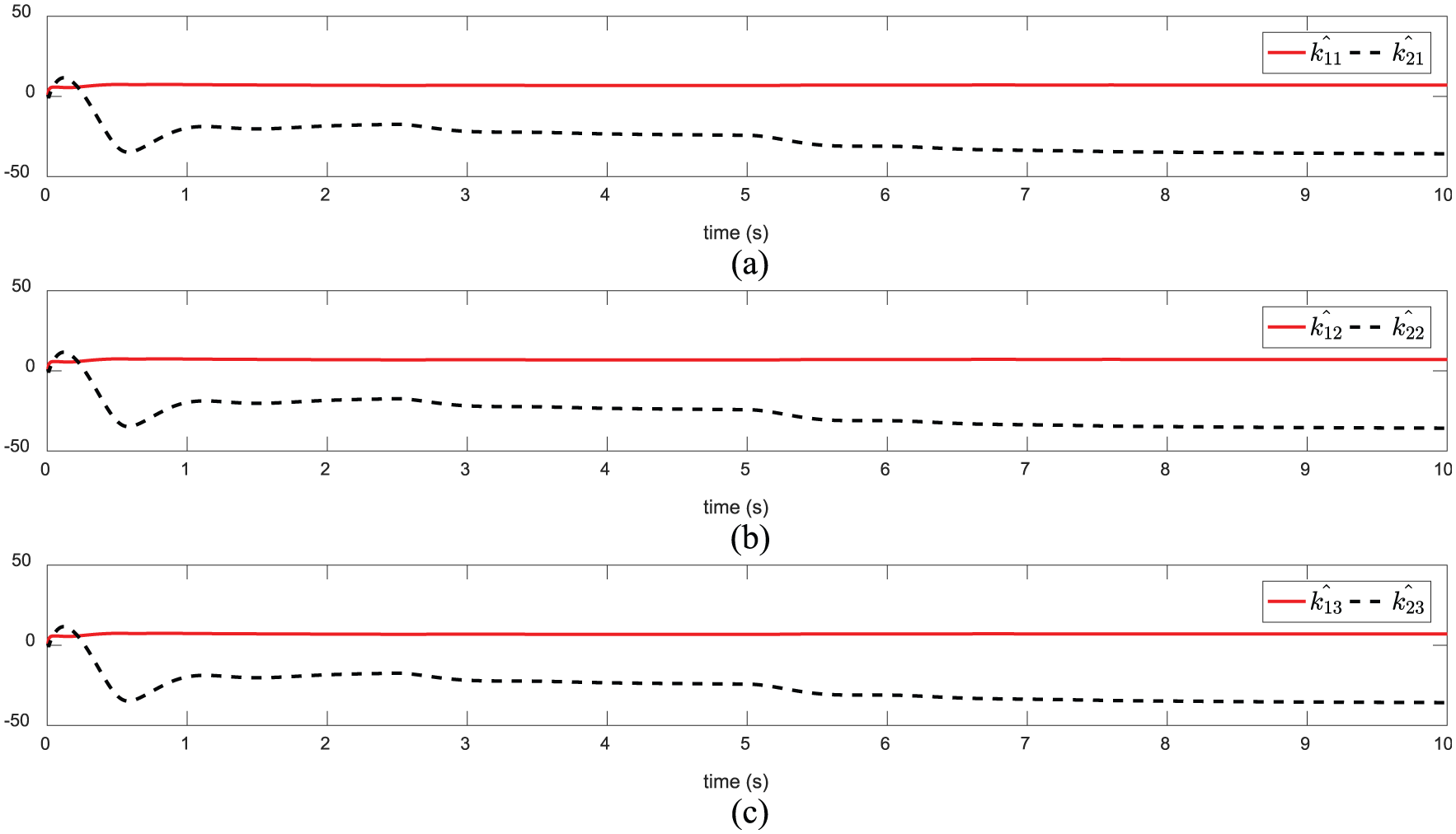
Control parameter estimates of the fractional Chua’s circuit with actuator failures for
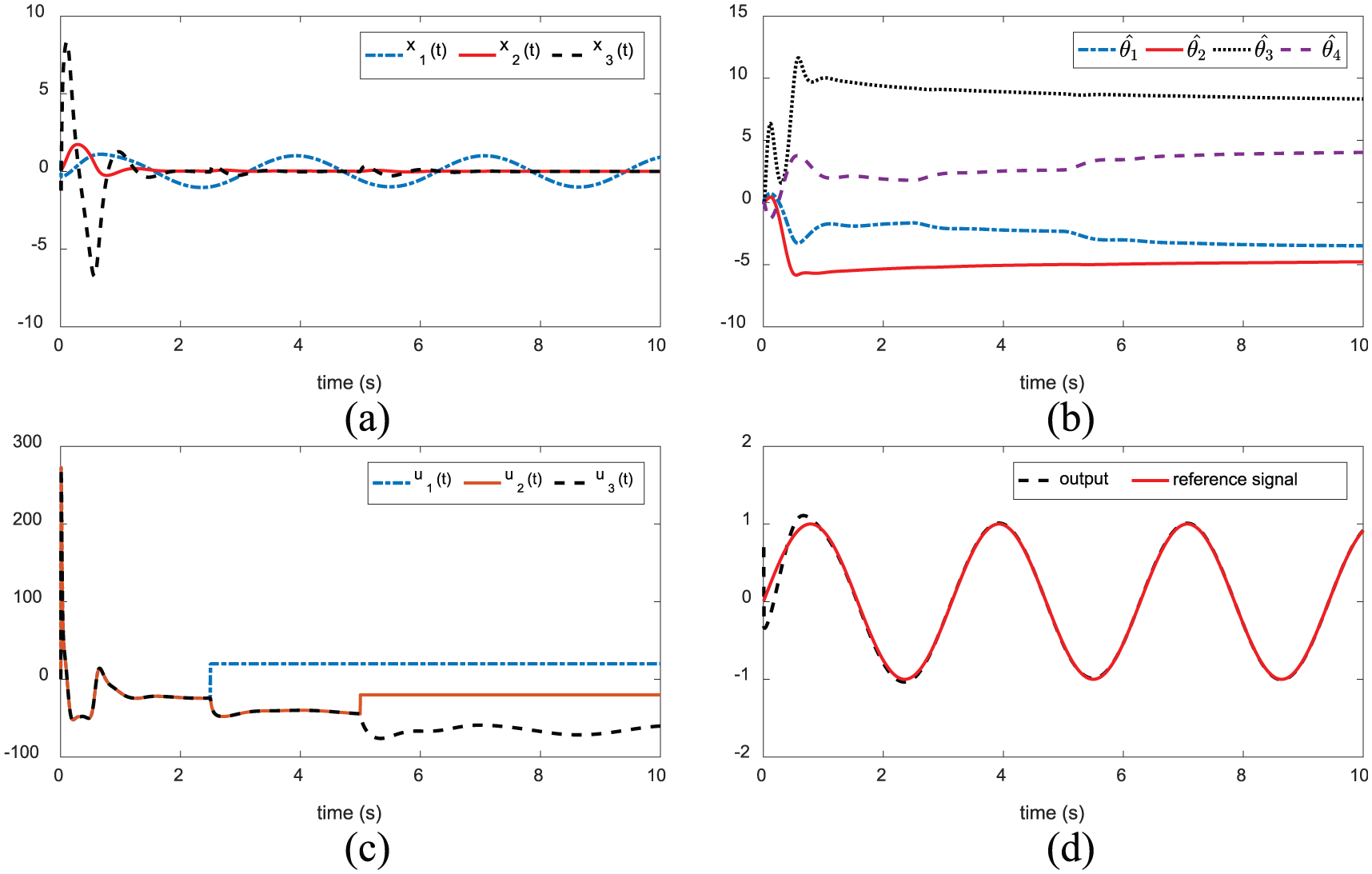
Tracking control results of the fractional Chua’s circuit with actuator failures.(a) System states; (b) Parameter estimates; (c) Control inputs; (d) Output
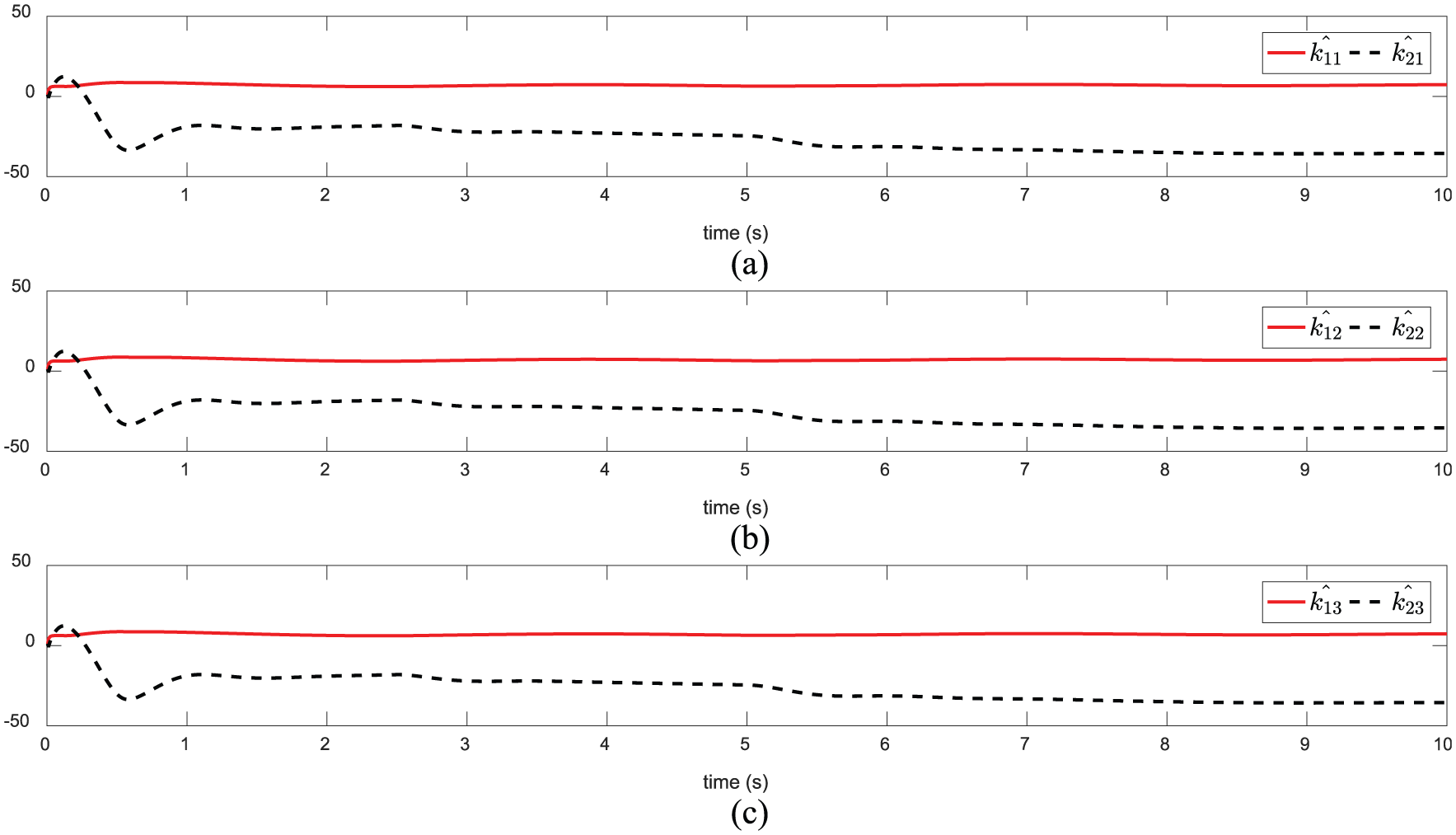
Control parameter estimates of the fractional Chua’s circuit with actuator failures for
Example 2
In this subsection, the compensation scheme is applied to the FO Genesio–Tesi system (Faieghi and Delavari, 2012). According to the searches of the authors, no study has been done before on failure compensation in FO strict feedback form systems. However, to show the efficiency of the proposed AFC method, a study by Aghababa published in 2016 on canonical FO systems using sliding mode controller (Aghababa, 2016) is considered, in which the stability of a healthy Genesio–Tesi system has been obtained successfully. In order to compare our proposed method with Aghababa’s work, it is supposed that a failure detection unit will act in his control system, which will switch to healthy auxiliary actuators in the case of actuator failures occurrence. The performance of sliding mode control approach in the presence of actuator failure is simulated and investigated.
Considering the plant (72)–(75) as the fractional Genesio–Tesi system dynamics, these parameters are changed,
Now, the adaptive fractional AFC scheme (22) with the controller (36), FO filter (35) and update laws (38)–(40) is applied to ensure the stability and to achieve the output tracking objective, in the presence of the actuator failure
while
The first and second steps of controller design are exactly the same as subsection 5.1, so we proceed to step 3.
with adaptive laws
where
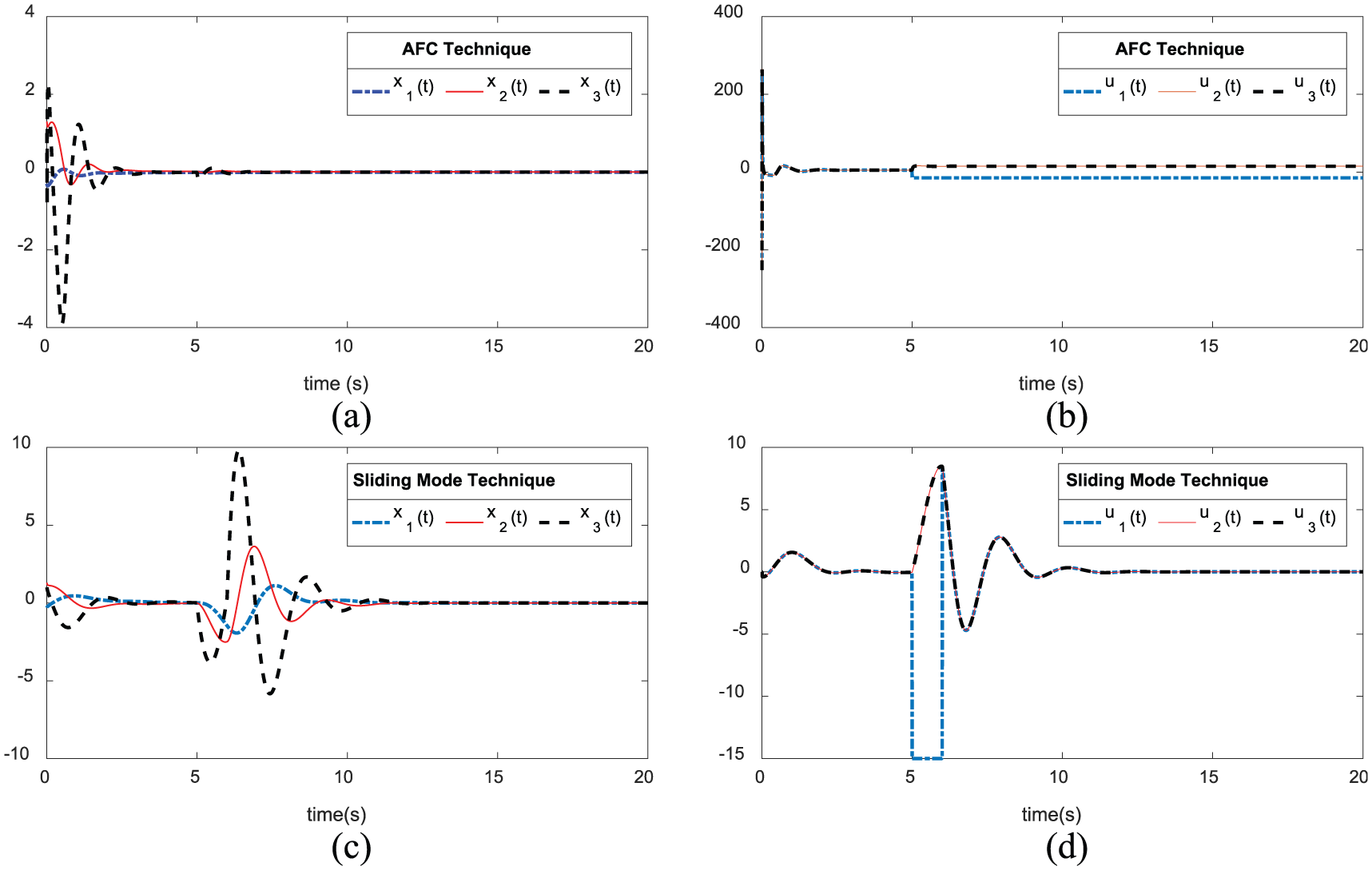
The controlled fractional Genesio–Tesi system; (a) and (b) show the state variables and control signals respectively, derived by AFC technique; (c) and (d) show the state variables and control signals respectively, derived by sliding mode technique.
Conclusions
The problem of adaptive AFC for strict feedback form FO nonlinear systems is studied in this paper. It is assumed that some parameters of system dynamics and actuator failures are unknown in advance. To tackle the unknown parameters, the appropriate adaptation laws are derived. Based on the update laws, an adaptive backstepping controller is proposed to stabilize the uncertain system and fulfill the output tracking based on matching designs for two different actuation models in the presence of unknown actuator failures. The stability of the suggested schemes is mathematically proved. Numerical simulations for the control of fractional Chua circuit and fractional Genesio–Tesi system with augmented actuators, have verified the effectiveness of the proposed adaptive AFC approaches.
Future recommendations
This paper provides opportunities for future studies as following: improvement of adaptive control system performance can be studied, particularly at the moment when actuator fails; the relaxation of the assumption on known signs of control coefficients can be investigated; and the other adaptive or intelligent feedback control strategies such as neural networks-based methods can be employed for handling uncertain actuator or sensor failures.
Footnotes
Declaration of Conflicting Interests
The author(s) declared no potential conflicts of interest with respect to the research, authorship, and/or publication of this article.
Funding
The author(s) received no financial support for the research, authorship, and/or publication of this article.