






Abstract
In this study, a new fuzzy robust backstepping controller with estimation is proposed for the control of a robot manipulator. Backstepping control is preferred because the Lyapunov function that is used in stability analysis and the feedback control law that is used for control purpose are defined systematically during controller design. Fuzzy logic units are designed to update the gains of the backstepping controller. Then, the proposed controller is applied to a robot manipulator that is to track a trajectory in a three-dimensional space while it is subjected to external disturbances and parameter variations. The numerical results demonstrate and verify the successful performance of the proposed controller.
Keywords
Introduction
Nowadays, many mechanical systems that people see around or use in daily life are controlled either by themselves or by computers and microprocessors. Moreover, the diversity and complexity of the systems to be controlled has led to the development of different control approaches. Therefore, in recent decades, especially for the nonlinear systems, there has been a trend towards control methods such as fuzzy logic control, sliding mode control, backstepping control and adaptive control.
Fuzzy logic control is based on the fuzzy set theory presented by Zadeh (1965). In this control method, linguistic control rules are used that are obtained using the knowledge coming from experts and the exact mathematical model of the system is not needed. With the aid of those attractive properties, this method was used in different application areas such as active suspension control (Ning et al., 2017; Taskin et al., 2007), robot manipulator control (Chang et al., 2015; Hacioglu et al., 2008) and process control (Belchior et al., 2012; Yordanova and Jain, 2017).
During recent decades, the backstepping control approach increased its popularity among the researchers. In this method, the Lyapunov function that is used in stability analysis and the feedback control law that is used for control purpose are defined systematically during controller design (Krstic et al., 1995). This control method is applicable to nonlinear systems. With those useful and appealing properties this control method has found application areas such as mobile robot control (Chang et al., 2004; Rudra et al., 2016), antilock brake system control (Wang et al., 2005; Yu et al., 2015), unmanned aerial vehicle control (Mahony and Hamel, 2005; Mohd Basri et al., 2015), and so on. In recent years, controllers that bring together the backstepping and fuzzy logic approaches were also designed. In those controllers, especially in adaptive backstepping designs, the fuzzy logic was used for the estimation of the unknown functions included in the model of the system (Chen et al., 2007; Ho et al., 2008; Li et al., 2017; Liu et al., 2017; Yacef et al., 2016). Chen et al. (2007) considered an output tracking control problem for an uncertain nonlinear MIMO system where the unknown functions in the system are not linearly parameterized and have no prior knowledge of the bounded functions. They have used fuzzy logic to approximate these unknown nonlinear functions. Ho et al. (2008) used Takagi–Sugeno type fuzzy approximators to approximate unknown system nonlinearities where the design procedure is a combination of adaptive backstepping and generalized small gain design techniques. They also tried to solve the singularity problem present in previous fuzzy approximation techniques. Yacef et al. (2016) proposed an adaptive fuzzy backstepping control approach with state observer for a quadrotor unmanned aerial vehicle under wind gust conditions and parametric uncertainties. Fuzzy logic was used to approximate an unknown nonlinear function and a state observer is constructed to estimate the states of quadrotor. Liu et al. (2017) designed an adaptive fuzzy backstepping controller for a class of uncertain fractional-order nonlinear systems with unknown external disturbances. The role of the fuzzy was unknown function approximation. Li et al. (2017) proposed and adaptive fuzzy tracking controller for nonlinear strict-feedback system with input delay and output constraint. Fuzzy logic was employed to identify the unknown nonlinear terms existing in the practical system.
In this study, an anthropomorphic robot manipulator is considered that is aimed to successfully track a specified trajectory in a three-dimensional (3-D) space even in the presence of external disturbances and parameter variations. Since the robots have highly nonlinear dynamics and they are supposed to track the trajectories precisely, the backstepping control method is preferred. The controller is designed in vector-matrix form, which is more suitable for robotic applications. Therefore, a robust backstepping controller with equivalent control estimation is proposed. Additionally, fuzzy logic units are designed that update the control gains of the backstepping controller during operation. With the estimation of equivalent control, the need for the exact mathematical model of the system is significantly reduced, while this is achieved without using fuzzy logic as function approximator, which was the case in other studies in the literature. Additionally, the control gains of the designed robust backstepping controller are tuned online by the designed fuzzy logic units that enhance the performance of the controller. Therefore, the authors believe that with this equivalent control estimation and fuzzy logic control gain adaptation structure, the proposed fuzzy robust backstepping controller with estimation (F-RBCE) differs from the fuzzy backstepping controllers in the literature. The remainder of the paper is organized as follows. First, the robot model is introduced in the next section. Then, the proposed controller is designed and numerical results are presented. Finally, conclusions are given in the last section.
Model of the robot manipulator
In this study, an anthropomorphic robot manipulator is considered, which operates in a 3-D space, as seen in Figure 1. The model has three degrees of freedom due to the three revolute joints, and the rotational motions about those joints are denoted with

Physical model of the anthropomorphic robot manipulator.
Equations of motion for the robot model are obtained using Lagrange equations and they are presented below. Since the equations are highly coupled and include nonlinearities, they are given in a vector-matrix form

Here,
Design of the proposed F-RBCE
In this section, the proposed fuzzy robust backstepping controller with estimation (F-RBCE) is presented. First, the robust backstepping control with estimation (RBCE) is presented and then the methodology of the fuzzy logic control gain adaptation is introduced.
RBCE
The equations of motion of the robot model given in equation (1) can be arranged in a more convenient form for the controller design by using the transformations

where


Here,


Let the candidate Lyapunov function for the system (6) be as

The time derivative of that candidate Lyapunov function is

Consider

Here,

is negative definite. Here,

Then the system (3)–(4) can be given as


Let the augmented Lyapunov function for that system be

Derivative of this Lyapunov function with respect to time is

The feedback control law is selected as

Here,

Therefore, it is deduced that with
In applications, there may be unknown or uncertain parameters in the model of the system. Therefore, a more realizable and robust control law should be used. The equivalent control rule for the nominal system, where there is no external disturbance, can be obtained by ensuring

Then, by estimating the equivalent control, which may possess unknown or uncertain terms, by using a low-pass filter

where

Using a low-pass filter for the estimation of the
Control gain adaptation via fuzzy logic
In this section, the advantages of fuzzy logic and robust backstepping control are combined to obtain a new F-RBCE. Here, the role of the fuzzy logic part is to regulate the control gains

General structure of the designed F-RBCE.
Because of their simple structure, triangular membership functions are widely used in th eliterature (Barua et al., 2014; Chen et al., 1999; Zhao and Bose, 2002) and they are generally sufficient to define membership functions for many variables in different problems. Therefore, triangular membership functions are used for the fuzzification of the input and output variables in this study. For the input membership functions presented in Figure 3, the NB, NS, Z, PS, PB denote negative big, negative small, zero, positive small and positive big, respectively. For the output membership functions the VS, S, M, B, VB denote very small, small, medium, big and very big, respectively. The input membership functions are defined on the closed interval [-1,1] and output membership functions are defined on closed interval [0.01,1]. Input and output scaling factors
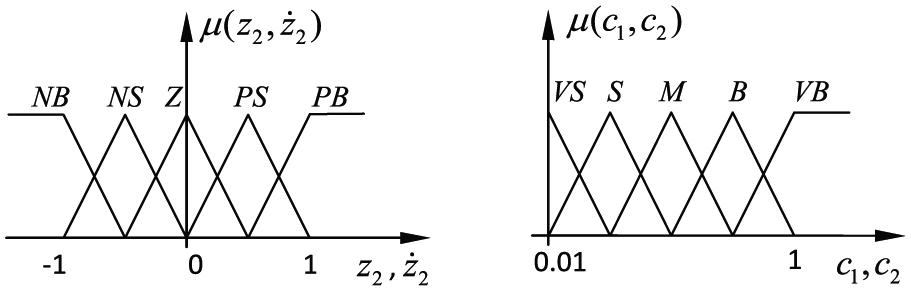
Membership functions for the input and output variables.
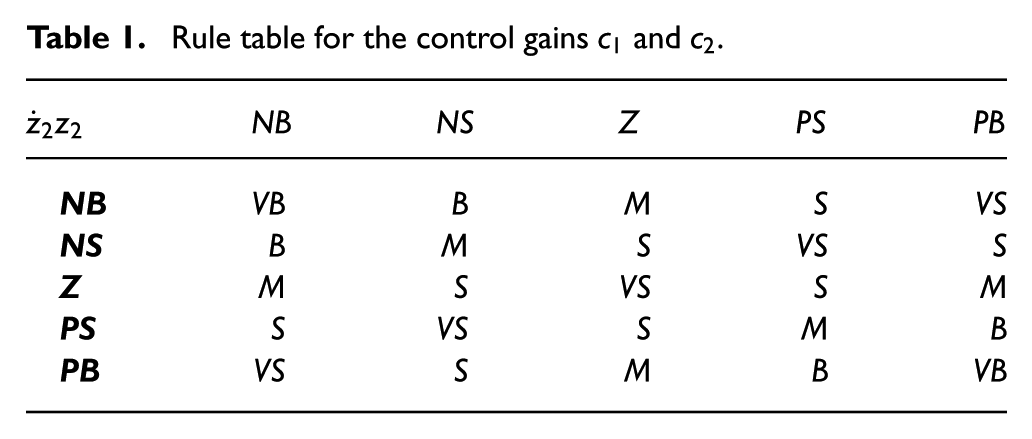
The rules of the fuzzy logic units presented in Table 1 are arranged in such a manner that the error variable
Rule table for the control gains

Rule surface of the fuzzy control gain adaptation units.
Numerical results
In this section, numerical results of the designed controllers are presented. The robot manipulator is supposed to track a helical trajectory in a 3-D space, as depicted in Figure 5. This trajectory is defined as below


Here,

Reference trajectory of the robot arm.
The reference values for the joint angles are obtained by inverse kinematics analysis and they are presented in Figure 6.

References for the joint angles.
In order to test the robustness of the designed controllers in case of external disturbances and parameter variations, the mass of the third link of the robot is suddenly changed during the motion of the robot. This change in mass is not sensed by the controller. Additionally, external disturbance torques are applied to all joints, and those disturbances are also not sensed by the controller. Figure 7 depicts those parameter changes and external disturbances.

Parameter variation and external disturbances applied to the robot manipulator.
In addition to the designed backstepping controllers, for comparison purposes, the Proportional-Integral-Derivative (PID) controller is also applied to the robot and the corresponding results are presented. PID controller is preferred for comparison since it is widely used in industry because of its simple structure (Åström and Murray, 2008). The control law for the PID controller is

Here, the
Figure 8 depicts the time responses for the joint angles and related tracking errors for the joint angles. From this figure, it is seen that the reference joint angles and joint angles for the controllers overlap; thus, it is understood that robot manipulator is successfully tracking the reference joint angles with the use of designed PID, RBCE and F-RBCE controllers. Additionally, it seen from the same figure that the tracking error magnitudes for the F-RBCE are smaller than the ones of the PID and RBCE. The tracking errors also reaches to zero faster with the designed F-RBCE.

Joint angles and tracking errors.
In order to have a realistic simulation, ± 25 Nm limit is imposed on the control torques of the robot to protect the system. The joint torques of the manipulator are presented in Figure 9. From this figure, it is seen that the magnitudes are approximately same for the controllers. It is also seen that for the RBCE there is some chattering on the control signal while F-RBCE control signal is smoother. The variations of the control gains that are calculated by the fuzzy logic units are also presented in Figure 10. It is seen from this figure that the fuzzy logic units update the control gains of the F-RBCE during operation of the robot.

Joint control torques of the designed controllers.

Variations of the control gains of F-RBCE.
To investigate the trajectory tracking performance of the designed controllers more quantitatively, the Root Mean Square (RMS) and maximum (max) values of the tracking errors were also calculated. The RMS value of the tracking error represents the average error value and max value represents the peak error value during the whole time period of the robot motion. Here, the RMS and max values for a collection of values


Figure 11 shows the RMS and max values for tracking errors. It is seen from this figure that by providing smaller RMS and max values for the tracking errors for almost all the joints the RBCE and F-RBCE showed better performance than the PID controller. The figure also depicts the reductions in those values for the RBCE and F-RBCE with respect to PID. The RBCE reduced the RMS values up to 69.9% while the F-RBCE reduced RMS values up to 84.3%. Similarly, with the RBCE the max values are reduced up to 64.3% (only for the third joint tracking error max value is increased via RBCE) and with the F-RBCE the max values are reduced up to 72.5%. Therefore, it is deduced that the F-RBCE showed better trajectory tracking performance than the RBCE and PID.

RMS and max values for tracking errors.
Similarly, in order to compare the performance of the designed controllers in terms of control efforts, the RMS values of the control torques and RMS values of the time derivative of the control torques are also calculated and presented in Figure 12. The variations of the RMS values in cases of RBCE and F-RBCE with respect to the PID controlled cases are also depicted in the figure. It is observed that the control efforts used by the PID, RBCE and F-RBCE are approximately same for all joints since the RMS values for the control torques are very close to each other. Furthermore, if compared with the RBCE, the F-RBCE produced control torques with less chattering for all joints. The PID controller provided the least chattering for the third joint only. Therefore, the proposed F-RBCE with better trajectory tracking performance and smoother control efforts, may be preferred for robot manipulator control applications.

RMS values for joint torques and derivative of joint torques.
Conclusion
A new F-RBCE was designed in this study. The controller used an estimation for the equivalent control part and the control gains of the controller were updated via two fuzzy logic units. Then it was applied to an anthropomorphic robot manipulator that was to track a specified trajectory in a 3-D space. In order to test the robustness of the designed controller, parameter changes and external disturbances were applied to the robot. The numerical results demonstrated that the designed fuzzy backstepping controller performed well in terms of trajectory tracking, even in the presence of parameter variations and external disturbances. Additionally, it was deduced that the designed F-RBCE used less control effort and its control torques were smoother if compared with the designed robust backstepping controller with estimation. Thus, the proposed F-RBCE may be advised for robot manipulator control applications.
Footnotes
Appendix
Declaration of conflicting interests
The author(s) declared no potential conflicts of interest with respect to the research, authorship, and/or publication of this article.
Funding
The author(s) received no financial support for the research, authorship, and/or publication of this article.
