






Abstract
Spacecraft on-orbital services and docking require their autonomous rendezvous control system to have obstacle avoidance capability. Motivated by this, a suboptimal velocity artificial potential function-based control scheme is presented. An ellipsoid model is applied to describe the outer envelopes of the service spacecraft and the obstacles via an eigenvalue algorithm. This has better description precision than the traditional methods. The potential sigmoid function is used to generate repulsive force to avoid obstacles collision. A velocity artificial potential function-based controller is finally developed to ensure that the relative speed of the service spacecraft is reduced to zero before reaching the outer envelops of obstacles. The shaping parameters of the attractive potential function are adaptively optimized. Numerical simulations are performed to demonstrate that the approach can achieve a safe and autonomous rendezvous with fuel cost saved.
Keywords
Introduction
For on-orbital servicing spacecrafts, autonomous rendezvous to target has attracted extensive research interests (Hu et al., 2018, 2019; Gao et al., 2009; Mancini et al., 2020, Yang, 2019). Several projects have been started to investigating safe and autonomous rendezvous problem such as the NASA’s DART program (Timothy, 2003) and the Phoenix mission (Gunn et al., 2015), and so forth. Note that the space environment is getting harsh for future space rendezvous and operations. The problem of safe autonomous rendezvous control with the capability of avoiding obstacles should be addressed (Colin, 1993; Sun, 2019; Sun et al., 2017, 2019; Zappulla, 2018).
The existing autonomous rendezvous controllers can be categorized into two types. The first type mainly focuses on designing controller via the optimal theory (Xing and Pan, 2012). Its core is to change the problem of obstacle avoidance into an optimization issue with constrained conditions (Epenoy, 2011; Martinson, 2013; Tillerson, 2002; Xing and Pan, 2011), and Clark (2015)). Then, the optimal theory is applied to solve this constrained optimization problem. In Breger and Jonathan (2008) and Mueller and Larsson (2008), fuel cost is considered as an important performance index. The integer linear programming algorithm is employed to plan an optimal trajectory for rendezvous on-line. Although some optimization theory is available for autonomous rendezvous control, this problem is still open, because the optimization theory-based solution needs expensive calculation.
The other category of autonomous rendezvous is the analytical control. It is implemented with low complexity. The corresponding control has analytic expression (Clark, 2015). For this category, the artificial potential function-based control (APF) is widely seen (Khatib, 1986; Lopez and McInnes, 1995). It was first applied in Colin (1993) to solve the spacecraft rendezvous control problem. The APF was then extended to achieve satellite formation flying control (Dong et al., 2006) and on-orbital assembly (Badawy and Colin, 2006). In JohnOlcayto and Colin (2007), an APF controller was proposed for docking of the international space station in the V/R-bar directions. In Zhang et al. (2010), a controller for safe corridor rendezvous was presented by integrating APF and the ellipse cissoids. In Su (2012), an APF control design was discussed for electromagnetic satellite formation in the Earth gravity field.
It is worth mentioning that APF is always used to solve the autonomous rendezvous problem by combining with advanced control theories to satisfy different requirements imposed by missions. An adaptive APF control law was proposed to achieve avoidance of static obstacles (Munoz et al., 2010) and to improve precision (Gao and Luo, 2012). In Zhang (2010), a hybrid control method was developed by using APF and the fuzzy control theory for obstacles avoidance. In Lim et al. (2005), applying APF and the sliding mode control to achieve satellite formation mission was discussed. Employing linear quadratic regulator instead of the attractive potential in APF was reported in Mccamish et al. (2010). The convergence rate of the control algorithm for obstacles avoidance was improved. In Palacios et al. (2015), an LQR/APF control law was developed and verified for satellite formation on elliptical orbit.
Although the APF-based approaches are efficient to solve the autonomous rendezvous problem, they are not optimal with respect to fuel consumption and may contain local minima (Zappulla and Richard, 2016). Moreover, the shapes of space objects are required to be spherical. The outer envelope of these objects is considered with less accuracy. If the three-dimensional dimensions of space objects are different, then such simplified method results in redundancy of space description. Motivating by solving these two drawbacks, a new velocity artificial potential function (VAPF) control approach is presented in this paper. It can ensure that the spacecraft’s velocity is reduced to zero before reaching the outer envelope of obstacles. Then, an adaptive version of the VAPF controller is presented by using the optimal control theory. The parameters of the attractive APF are ensured to be optimal by applying an adaptive algorithm to add some degree of optimality. The main contributions of this study are listed as:
In comparison with the existing avoidance controllers applying the spherical shape to describe the outer envelope of spacecrafts and obstacles, the proposed approach applies the ellipsoid to describe the space and the obstacle. An innovative eigenvalue algorithm is derived to calculate the Euler distance between the ellipsoids for the judgment of collision. The description of the space and the obstacles are more accurate. The problem of the redundancy of the obstacle’s description and the decrease of the control accuracy in the conventional methods can be solved.
To the best knowledge of the authors, this paper is the first result of introducing the potential sigmoid function (PSF) as the repulsive force to avoid the obstacles. It has advantages to represent the potential field of arbitrarily shaped obstacles.
The proposed adaptive VAPF control approach can achieve the autonomous spacecraft rendezvous and obstacles avoidance with some optimized properties.
The rest of this paper is organized as follows. The relative dynamics for spacecraft rendezvous is established in Section 2. In Section 3, a new approach to describe the shortest Euler distance of an ellipsoid is presented. In Section 4, a new attractive potential function (APF) is designed by using the potential Sigmoid function. A velocity APF-based controller and an adaptive version are synthesized in Section 5 to achieve the main objectives. In Section 5, numerical simulations are performed to verify the effectiveness and the obstacles avoidance capability of the controller. The paper is ended with some conclusions given in Section 7.
Mathematical model and problem description
The relative dynamics of spacecraft rendezvous
Spacecraft rendezvous usually involves a leader spacecraft in an elliptical planar orbit and a service spacecraft in a desired relative orbit. The service spacecraft is to rendezvous with the leader spacecraft. Let


where
Let


where
Problem formulation
Let
New method to describe the shortest Euler distance
If the relative distance can be estimated accurately, then less orbital maneuvering of the spacecraft is needed. This can improve control and maneuvering efficiency. Therefore, the mathematical model of the shortest Euler distance should be established with the location and the geometry size of the leader/service spacecrafts and the obstacles considered. Motivated by this, an ellipsoid modeling method but not the spherical modeling is presented. For this method, the ellipsoid is adopted to describe the outer envelope of obstacles and the spacecraft. The lengths of the ellipsoid’s three axes are equal to the largest size of the obstacles in the corresponding direction from the center of mass, respectively. Let

where
It is well-known that there is no direct algorithm to compute the distance between two ellipsoids. In this study, an eigenvalue algorithm (Walter et al., 1989) is designed to calculate the shortest Euler distance between two ellipsoids. The algorithm can provide an analytical solution. Moreover, it is characterized by fast calculation and high computational precision in comparison with the iterative method.
Suppose that the distance between the point
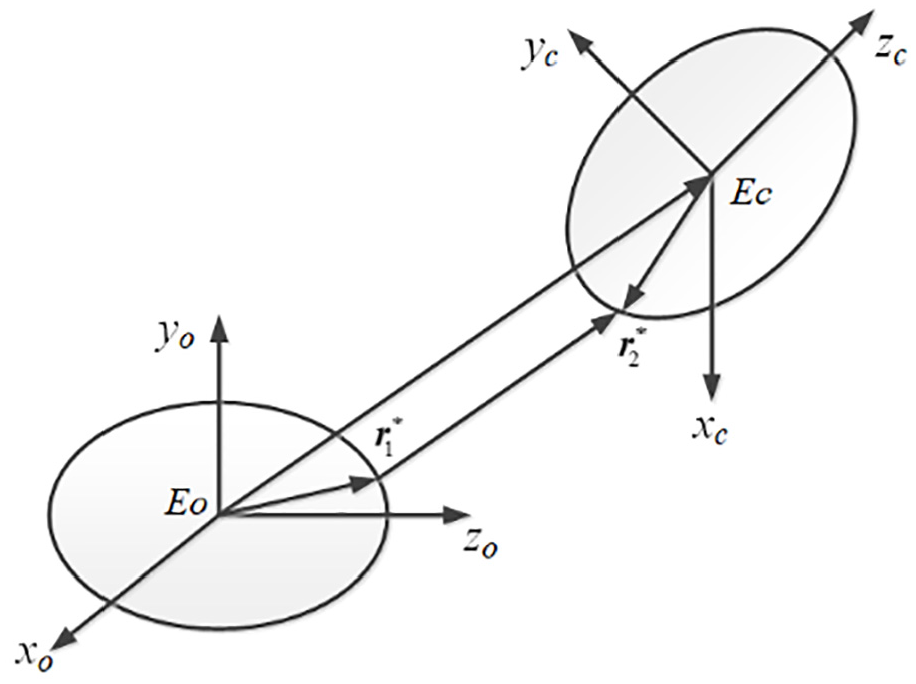
The distance between two ellipsoids.
Firstly, the ellipsoid of the service spacecraft should be converted into a unit sphere by transforming coordinate. Then, the distance calculation in the transformed coordinate changes into obtaining the minimum value of
According to the Lagrange multiplier rule, the coordinate position of the point

where
Define a matrix as

where

Using the same solution to obtaining the position of the point

where

where
Based on (8)-(9), the shortest Euler distance

Development of new VAPF
Because the APF method is a powerful solution to the obstacle’s avoidance problem, the main problem stated in this work will be solved by using APF. More specifically, a novel APF is presented as

where
Attractive potential function design
The attractive potential function

where
Repulsive potential function design
Invoking the ellipsoid described in (5), the relative position of the center of mass between the service spacecraft and the obstacle can be formulated as

where
Unlike the traditional repulsive potential functions, based on the shortest Euler distance, a novel repulsive potential function is designed by using the generalized potential sigmoid function (Munoz, 2011; Ren et al., 2004), which is specified by

where

with the maximum acceleration

To the authors’ best knowledge, this work is the first result of using this generalized potential sigmoid function to the spacecraft rendezvous problem. Due to the application of the generalized potential sigmoid function, the proposed APF (12) including the potentials (13) and (15) has the following advantages in comparison with the traditional APFs:
The developed APF (12) can accurately describe the two-dimensional and the three-dimensional structure of the obstacles. Moreover, the calculation burden is small.
The APF (12) is the first and the higher-order continuous differentiable. It ensures the generated force to be continuous.
The amplitude of the potential field (15) can be modified by adjusting the correlation parameters. It lets the proposed APF be suitable for the whole system.
APF-based control
Using the synthesized APF (12), a VAPF-based controller is first presented in this section. Applying this controller, the control objective of autonomous spacecraft rendezvous is achieved with obstacle avoidance guaranteed. An adaptive VAPF is then presented by introducing the optimal theory to adaptively optimize the shaping parameters of the attractive potential function. Some degree of optimality is ensured.
VAPF-based control
The relative dynamics (1)–(4) is typically a nonlinear system. The Lyapunov theory can be applied to synthesize a controller for avoiding obstacles. To ensure that the service spacecraft does not collide with the obstacles during the rendezvous maneuvering, the velocity of service spacecraft must be reduced to zero before reaching the outer envelope of the obstacles.

where

Moreover,

Then, the system’s velocity is governed to be equal to the negative gradient of the potential function (12). The control objective of autonomous rendezvous with obstacles avoidance capability is achieved.

Differentiating

Inserting (3)and the controller (18) into (22), it leaves

Hence,
To this end, applying the results in Lim et al. (2005) and Cao et al. (2014), it can be proved that
Adaptive VAPF controller design
The design of the AVPF in (18) does not take the performance index into consideration. It can ensure that the system’s velocity converges to
It is known from the above analysis that the prescribed velocity should be preliminarily planned. To accomplish this work, let an optimal performance index be chosen as

where
Applying the relative dynamics (3) and minimizing the performance index (24), it can be obtained that the optimal trajectory is the solution of the following equation

where

Let the optimal velocity be denoted by

where
When planning the optimal velocity
Based on (13), applying the Cholesky factorization, the positive matrix

where

Let the error between

It follows that

where

Additionally, (31) can be rewritten as

with

where

where

Choose a Lyapunov function as

Substituting (35) into (36) yields

Because
It is seen in Theorem 2 that the shaping parameters of the attractive APF are optimized. When the service spacecraft is far from the obstacles, the adaptive
Simulation results
In this section, the effectiveness of the VAPF and SVAPF controllers is numerically validated for a spacecraft rendezvous maneuvering. The relative dynamics (1)–(4) are applied. The orbital parameters of the leader spacecraft are with its inclination 30 degrees, the longitude of ascending node 60 degrees, the semi-major axis 6978 km, the eccentricity 0.05, the argument of the perigee 0 deg/sec, and the standard gravitational parameter 398600
The parameters of the obstacles.

To accomplish the planned rendezvous task, the desired position is determined as

When implementing the developed VAPF and SVAPF in simulation, their control gains are chosen as

With the application of the VAPF and the SVAPF controller to perform the rendezvous maneuver, the resulted rendezvous behavior is shown in Figures 2–3, respectively. No collision between the service spacecraft and any obstacle is observed for both the VAPF and the SVAPF. The objective of obstacle avoidance is achieved by the VAPF and the SVAPF. The desired position is rendezvoused. However, comparing Figure 2 with Figure 2, it is found that these two control laws lead to different rendezvous trajectories. That is because the SVAPF is improved and modified from the VAPF by integrating an optimal strategy and adding an adaptive law. This optimal strategy can update the shaping parameters of the attractive potential function to add some degree of optimality. Hence, the SVAPF ensured a larger safe distance between the service spacecraft and the obstacles than the VAPF. Moreover, the obstacles and the service spacecraft in Figures 2–3 are described by an ellipsoid with their actual sizes and labeled by the blue and green borders, respectively. The ellipsoid is more accurate and suitable to describe the obstacles and the service spacecraft in comparison with the conventional spherical. This is the highlight research in this work, and it can be found in Figures 2–3.
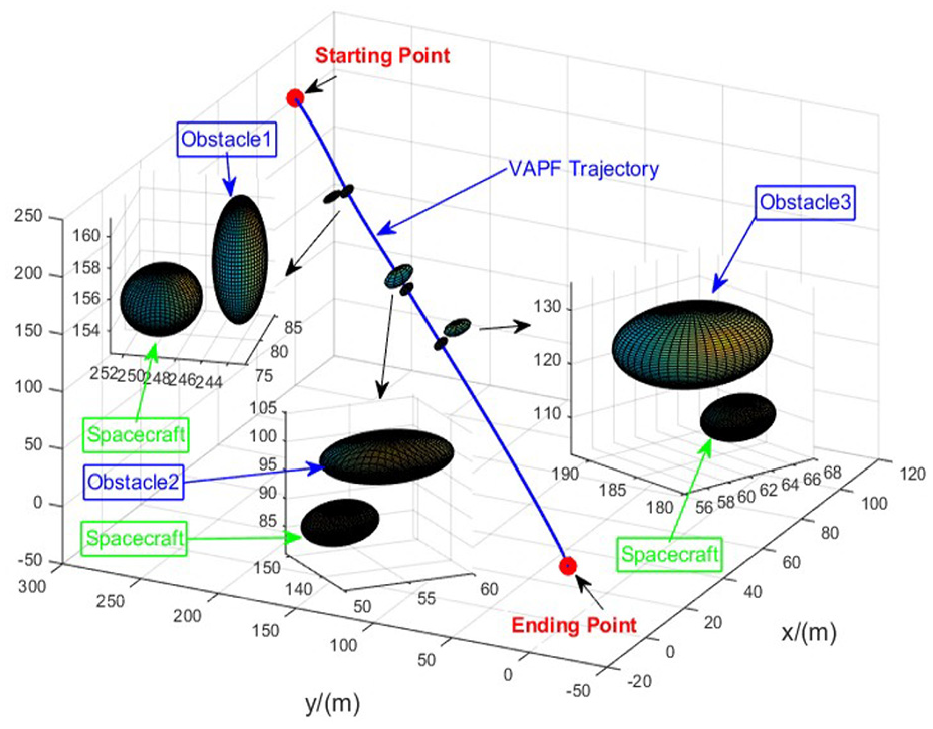
The obstacle avoidance trajectory obtained from the VAPF.
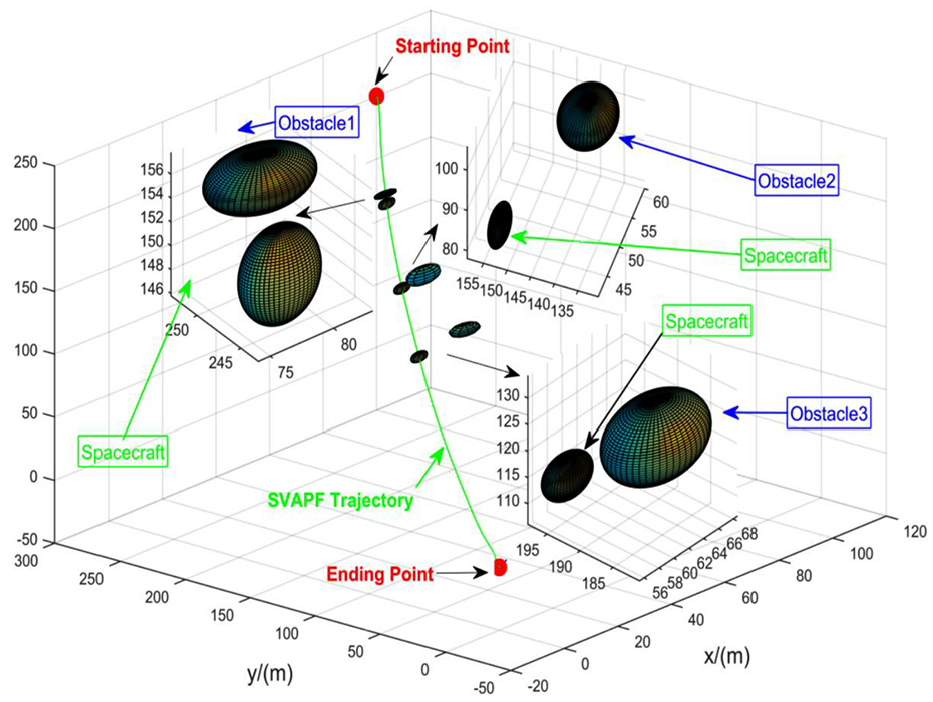
The obstacle avoidance trajectory obtained from the SVAPF.
Figure 4 shows the control input of the VAPF and the SVAPF. It is seen that the control amplitude of the SVAPF is smaller than the VAPF. This is owing to the optimal strategy incorporated in the SVAPF for reducing the fuel cost. Due to this optimal strategy, the shaping parameters of the designed attractive potential function
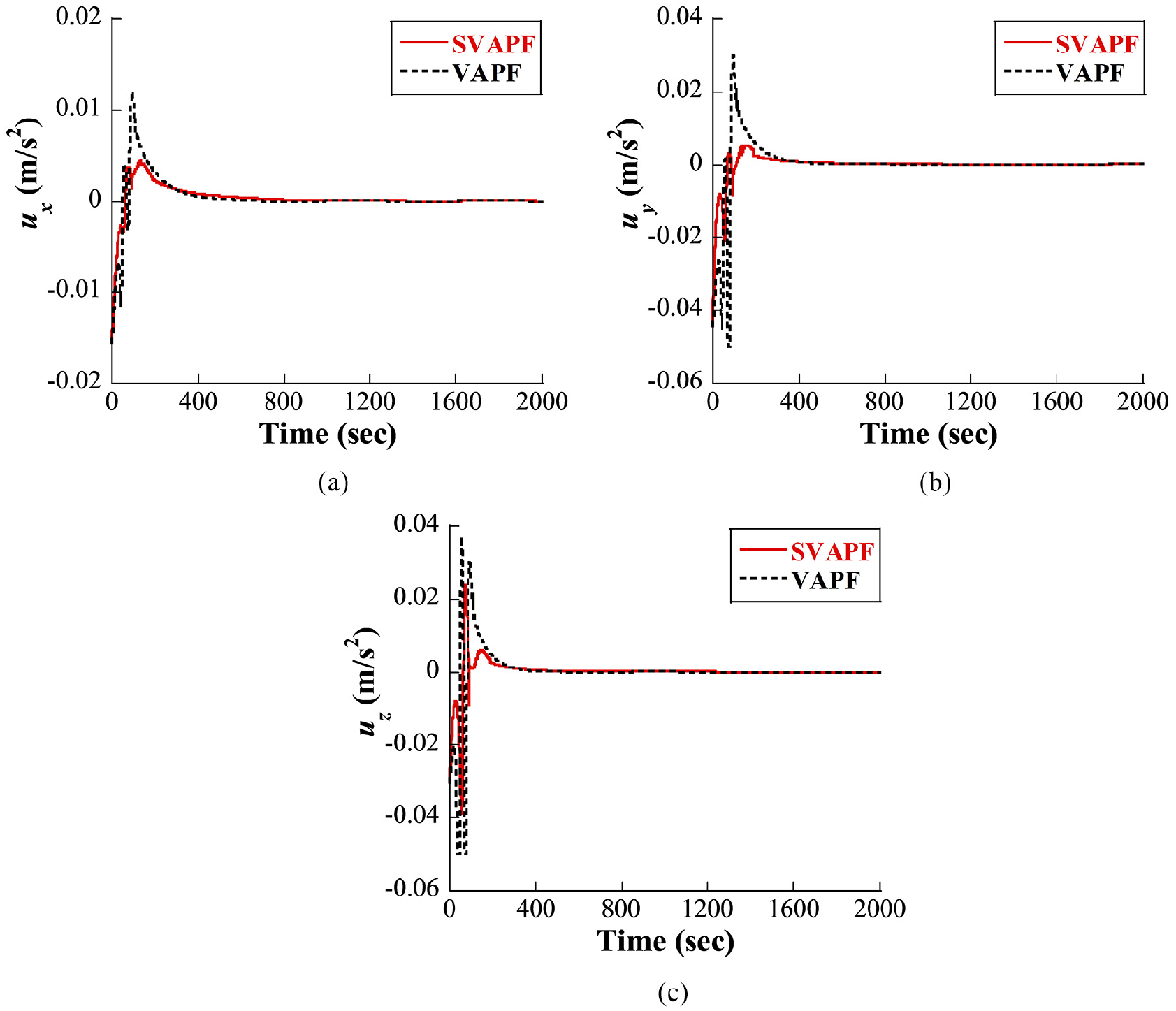
The control input force for the VAPF and the SVAPF.
The position tracking error
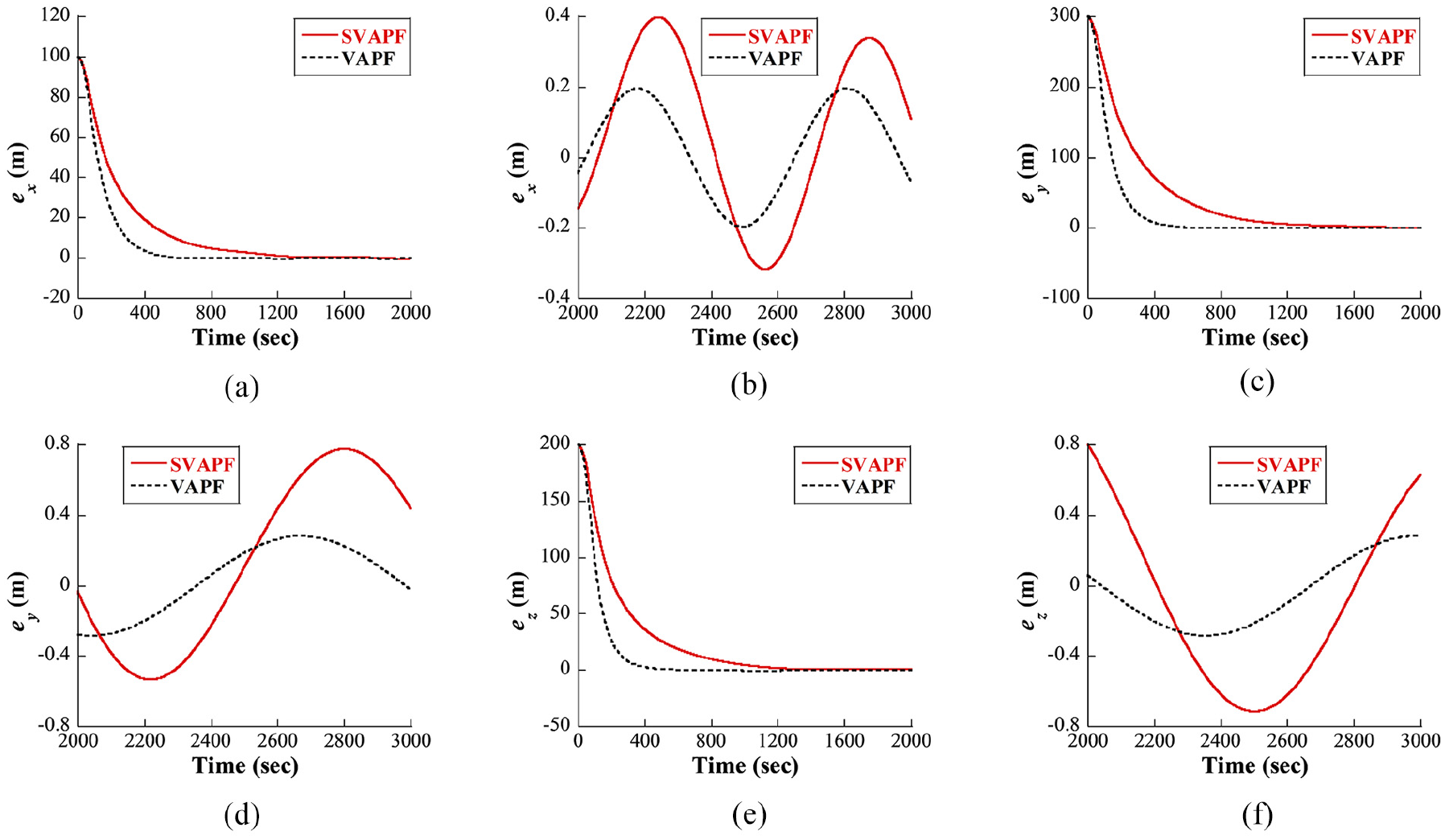
The position tracking from the VAPF and the SVAPF.
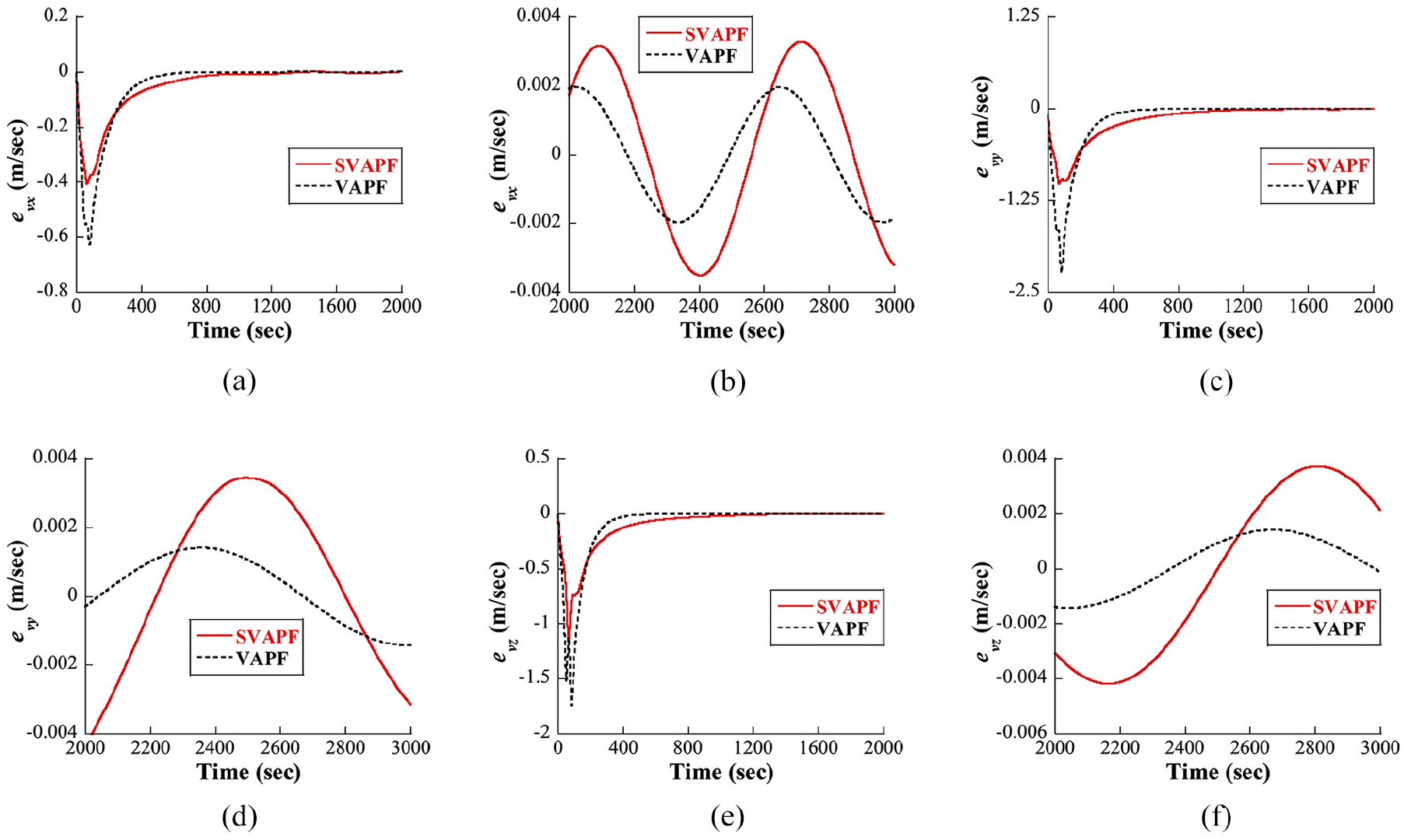
The relative velocity performance from the VAPF and the SVAPF.
It is known that the service spacecraft™ lifecycle and mission-cycle are dependent on fuel consumption. The fuel consumption is an important performance index to evaluate the performance of the controllers. This is also one of the original motivations and the best highlight of this theoretical work. Hence, fuel costs are compared between VAPF and SVAPF. For the comparison, fuel consumption/cost index is mathematically given by (Cao et al. (2014) and Cao and Chen (2015))

Figure 7 shows the fuel cost comparison result of the VAPF control and the SVAPF control. It can be seen that the SVAPF controller can save almost 50% energy than the VAPF control law. The conclusion that the scheme designed to optimize the shaping parameters can add more optimality is hence verified.
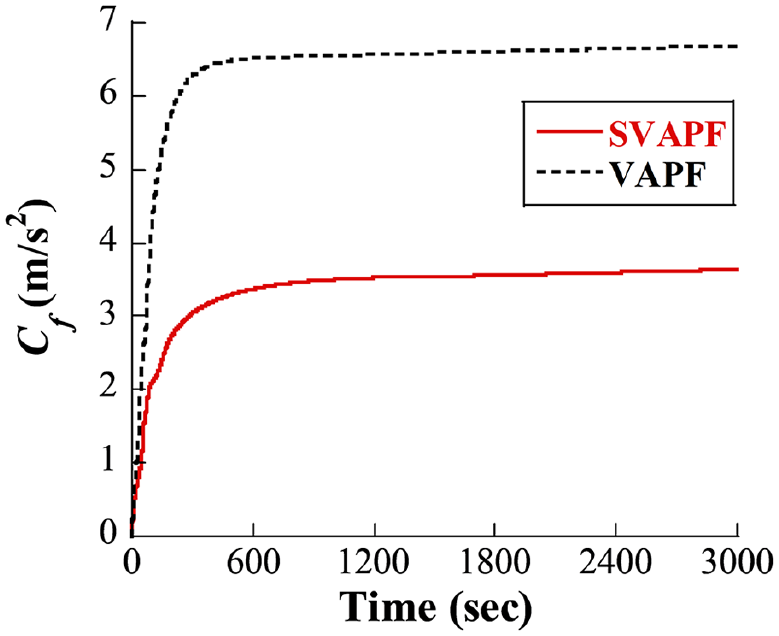
The fuel cost of the VAPF and the SVAPF.
Conclusions
In this work, the spacecraft rendezvous problem in the presence of obstacles was investigated. The ellipsoid was introduced to describe the outer envelopes of the service spacecraft and the obstacles. This ellipsoid description was more accurate and suitable than the conventional spherical method. The potential sigmoid function was used to generate the repulsive force to avoid the obstacles. Based on this, a VAPF-based controller was presented. Moreover, an adaptive version of this controller was developed. Applying the proposed controller, the rendezvous maneuver was successfully performed with great obstacle avoidance capability. The proposed adaptive controller ensured better control performance and some degrees of optimality than the VAPF-based control when evaluating them by using the fuel cost index. It lets the adaptive controller be more suitable for the space mission application.
As one of future work, the obstacles avoidance control problem with fast rate should be conducted for spacecraft rendezvous with actautor constraint. Moreover, formation and cooperative control of spacecrafts in the presence of obstacles should be addressed further. This could be achieved based on the result in Du et al. (2019).
Footnotes
Declaration of conflicting interests
The author(s) declared no potential conflicts of interest with respect to the research, authorship, and/or publication of this article.
Funding
The author(s) received no financial support for the research, authorship, and/or publication of this article.
