This paper designs a predefined-time convergent continuous control algorithm to stabilize a permanent-magnet synchronous motor (PMSM) system. Three cases have been considered: disturbance-free, in presence of a deterministic disturbance satisfying a Lipschitz condition, and in presence of both a stochastic white noise and a deterministic disturbance satisfying a Lipschitz condition. The designed control law is free from the restrictions of exponential control growth and exact initial conditions knowledge. This is the first predefined-time convergent continuous control algorithm applied to stabilizing a PMSM system with both deterministic and stochastic disturbances, which enables one to a priori set the predefined convergence time even in presence of various disturbances of different nature. Numerical simulations are provided for a PMSM system to validate the obtained theoretical results in each of the three considered cases. The simulation results demonstrate that the employed values of the predefined-time convergent control inputs are applicable in practice.
Permanent-magnet synchronous motors (PMSMs) have received increasing attention from industry and household applications due to their characteristics of high power density, high efficiency, high power factor, compact structure, and excellent control performance. The PMSM has been applied in many areas such as aeronautics and astronautics, electric vehicle technology, domestic appliance, fan and pump applications (Kommuri et al., 2016; Kuang et al., 2017; Wang et al., 2020). The PMSM drive plays an important role in motion-control applications. On the other hand, the control performance of the PMSM servo drive is commonly influenced by uncertainties, such as unpredictable plant parameter variations, external load perturbations, or unmodeled dynamics of the controlled plant.
A major challenge for the control community is to design control laws that help to compensate for these uncertainties. The proportional-integral-derivative (PID) controller is conventionally applied to regulate the PMSM systems in industrial applications due to its simplicity, clarity, and functionality (Ang et al., 2005). However, a disadvantage of this controller is its sensitivity to the system uncertainties. An adaptive PI controller with an online tuning rule presents a method to improve the PID performance for PMSM (Hernandez-Guzman and Silva-Ortigoza, 2010).
Recently, many researchers have presented various advanced control strategies to efficiently control the PMSM systems such as linearization control (Zarchi et al., 2010), adaptive control (Ribeiro et al., 2007; Li and Liu, 2009), robust control (Baik et al., 2000; Nian and Deng, 2015; Wu and Zhang, 2018), sliding mode control (Qi et al., 2015; Wang and Wei, 2019; Xu et al., 2017), fixed-time convergent control (Basin et al., 2020), fractional-order control (Xie et al., 2019), fuzzy control (Mani et al., 2018), neural network control (Jon et al., 2017), and predictive control (Shengquan et al., 2020). Much attention has been paid to designing finite-time and fixed-time convergent control laws and estimating their convergence (settling) times. A continuous finite-time convergent algorithm for a second-order system was designed in Levant (1998). This algorithm, called super-twisting, drives a system state and its derivative at the origin in finite-time. The first upper estimates of the convergence times for twisting and super-twisting algorithms, based on the Lyapunov function approach, were obtained in Polyakov and Poznyak (2009a, 2009b). Fixed-time convergent algorithms, where the convergence times are independent of state initial conditions, are studied starting from Andrieu et al. (2008) and Polyakov (2012). Continuous fixed-time convergent scalar and multi-variable control laws are proposed in Basin et al. (2019) for a super-twisting system, whose state and disturbance initial conditions are unknown, and the upper estimates of their convergence times are calculated. A continuous fixed-time convergent control law driving the states of a stochastic super-twisting system at the origin for a fixed-time is designed in Guerra-Avellaneda and Basin (2020). A novel continuous controller ensuring an arbitrary predefined convergence time independent of initial conditions is proposed in Pal et al. (2020) for the -dimensional integrator chain, if no disturbances are present.
It can be observed that in most fixed-time approaches, the settling time cannot be assigned a priori. This drawback is corrected in predefined-time convergent algorithms, where the settling time can be assigned arbitrarily. However, the predefined-time convergent algorithm given in Pal et al. (2020) results in an exponentially growing control magnitude for negative state initial values and requires exact knowledge of state initial conditions in presence of disturbances.
Motivated by the foregoing discussion, this paper focuses on designing novel predefined-time convergent control laws for stabilizing PMSM systems affected by deterministic disturbances and stochastic noises, which are free from the mentioned restrictions of exponential control growth and exact initial conditions knowledge. To the best of our knowledge, this is the first attempt to design a predefined-time convergent control law for a super-twisting system with stochastic noises, although stochastic noises are broadly used for modelling independent unknown disturbances in technical systems. Another motivation point is to demonstrate that the employed values of the predefined-time convergent control inputs are applicable in practical cases of PMSM stabilization.
The contributions of this paper are as follows:
Designing predefined-time convergent continuous control laws driving the states of a super-twisting system to the origin for an a priori assigned time in three cases: disturbance-free, in presence of a deterministic disturbance satisfying a Lipschitz condition, and in presence of both a stochastic white noise and a deterministic disturbance satisfying a Lipschitz condition.
Achieving that the designed predefined-time convergent continuous control laws are free from the restrictions of exponential control growth and exact initial conditions knowledge.
Applying for the first time the developed control algorithm to stabilizing a PMSM system with both deterministic and stochastic disturbances, which enables one to a priori set the predefined convergence time even in presence of various disturbances of different nature.
Validating efficiency of the developed control algorithm for a PMSM system via numerical simulations in each of the considered three cases.
The paper is organized as follows. The mathematical model of the PMSM and the stabilization problem statement are given in Section 2. Sections 3, 4, and 5 present predefined-time convergent continuous control laws for a PMSM in three cases: without disturbances, in presence of deterministic disturbances, and in presence of deterministic disturbances and stochastic noises, respectively. Numerical simulations to validate the obtained theoretical results are given in each section. Section 6 concludes this study.
The standard notation is used: denotes the absolute value of a scalar , denotes the Euclidean norm of a vector , corresponds to a value raised to a power . The function is introduced according to Filippov’s definition (1998).
Problem statement
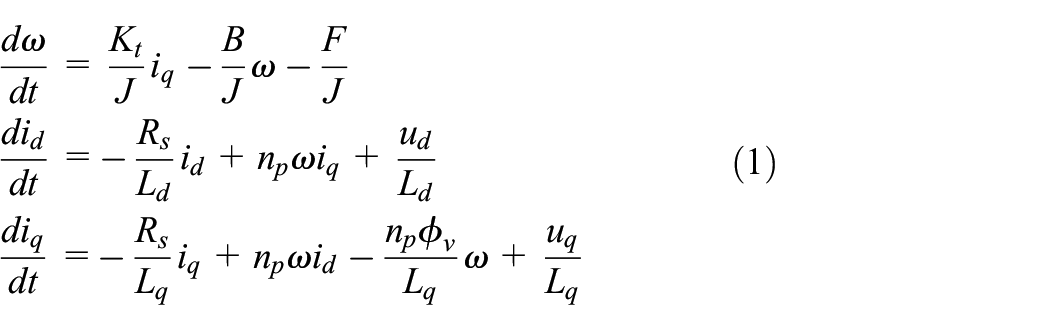
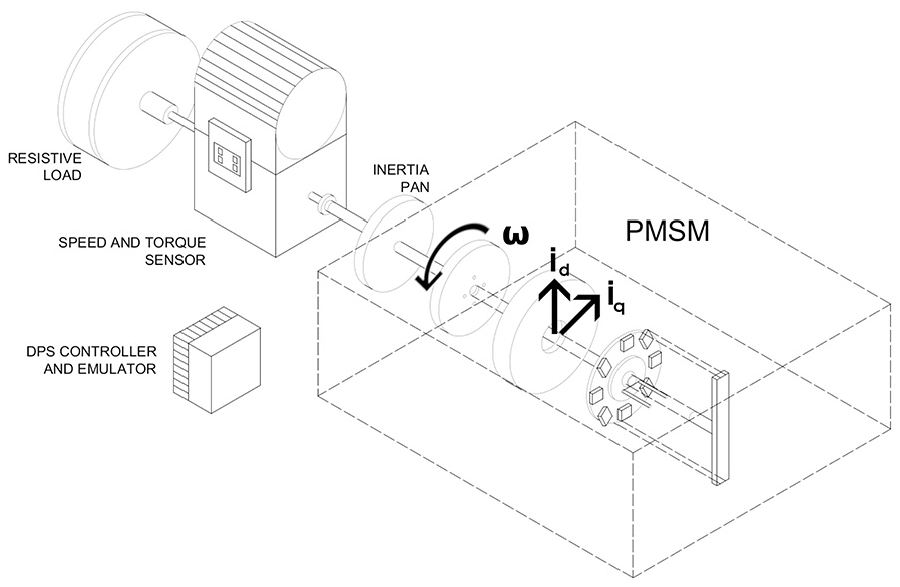
The mathematical model of a PMSM (Figure 1) can be represented by the following equations (Wang et al., 2020)
Here, and are the inductances of axes satisfying , and the stator voltages of axes, and the stator currents of axes, the stator resistance, the rotor velocity, the number of pole pairs, the rotor flux linkage, , the load torque, the moment of inertia, and the viscous friction coefficient.
PMSM electromechanical diagram.
In this paper, the strategy of is adopted (Wang et al., 2020). Then, the first equation in (1) can be rewritten as
where is the control input and is a disturbance.
The control problem is to design a continuous control law driving the states of the resulting closed-loop system at the origin for a predefined time in the sense of the following definitions.
Consider a -dimensional system
where is a state, is a control input, is a deterministic disturbance satisfying the Lipschitz condition
for any , , with a certain constant . is a Wiener process defined on the complete probability space , where is the sample space, is a -field with a filtration , and a probability measure. The condition is satisfied for all .
Consider two cases:
(a). The system (3) reduces to a deterministic system.
Definition 1. (Predefined-time convergence for a deterministic system.) The system (3) is called predefined-time convergent to the origin, if
(1) it is fixed-time convergent to the origin, for any initial state , , there exists a positive constant independent of , such that for all ,
(2) is independent of initial conditions and disturbances and can be arbitrarily chosen in advance, and
(3) , where is the true convergence time.
(b). The system (3) is a stochastic system.
Definition 2. (Predefined-time convergence for a stochastic system.) The system (3) is called predefined-time convergent to the origin in -mean, if
(1) it is fixed time convergent to the origin in -mean, i.e., for any initial state , , there exists a positive constant independent of , such that for all ,
(2) is independent of initial conditions and disturbances and can be arbitrarily chosen in advance, and
(3) , where is the true convergence time.
Predefined-time stabilization without disturbances
Control design
Consider the system (2), where . Then, equation (2) reduces to
where the control law is designed as
Here, is the compensation term and is defined as
where .
Theorem 1. The control law (5) drives the state of the system (4) and its derivative to the origin for an a priori assigned time and stays there afterwards for any . In other words, the closed-loop system (4), (5) is predefined-time convergent to the origin.
Proof. Substituting (5) into (4) yields the equation
or, equivalently
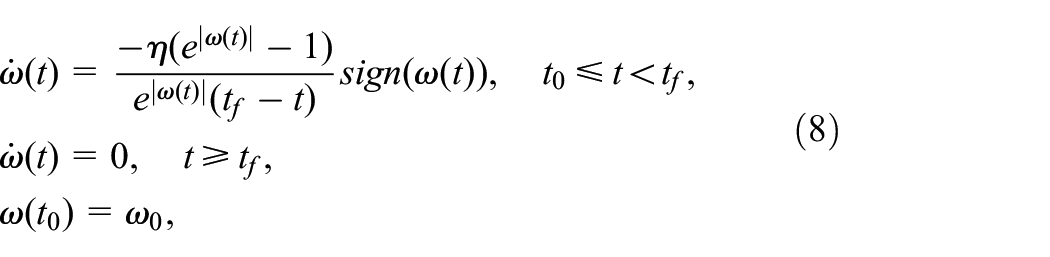
whose solution is given by
where . Hence, is smooth function, equal to zero for all .
The derivative of (9) is given by
It follows from (10) that when for and as well. Thus, is continuous function, equal to zero for all . is also smooth, if . ■
PMSM simulations
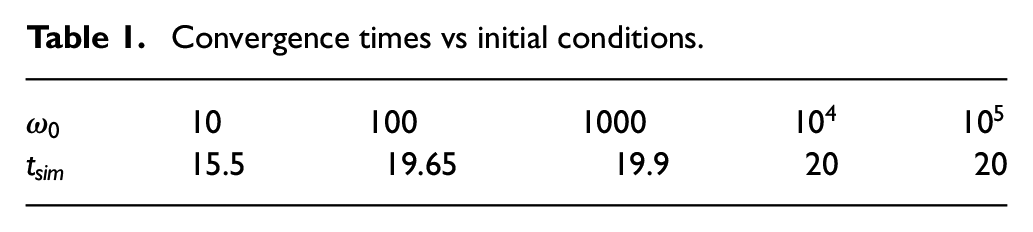
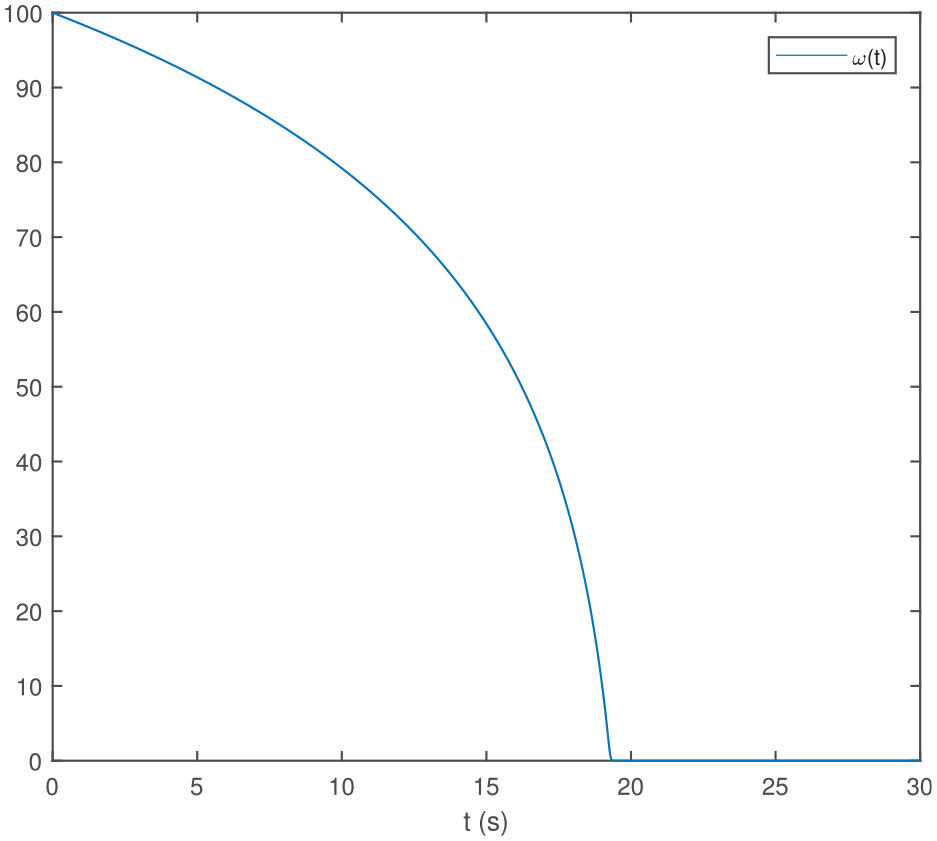
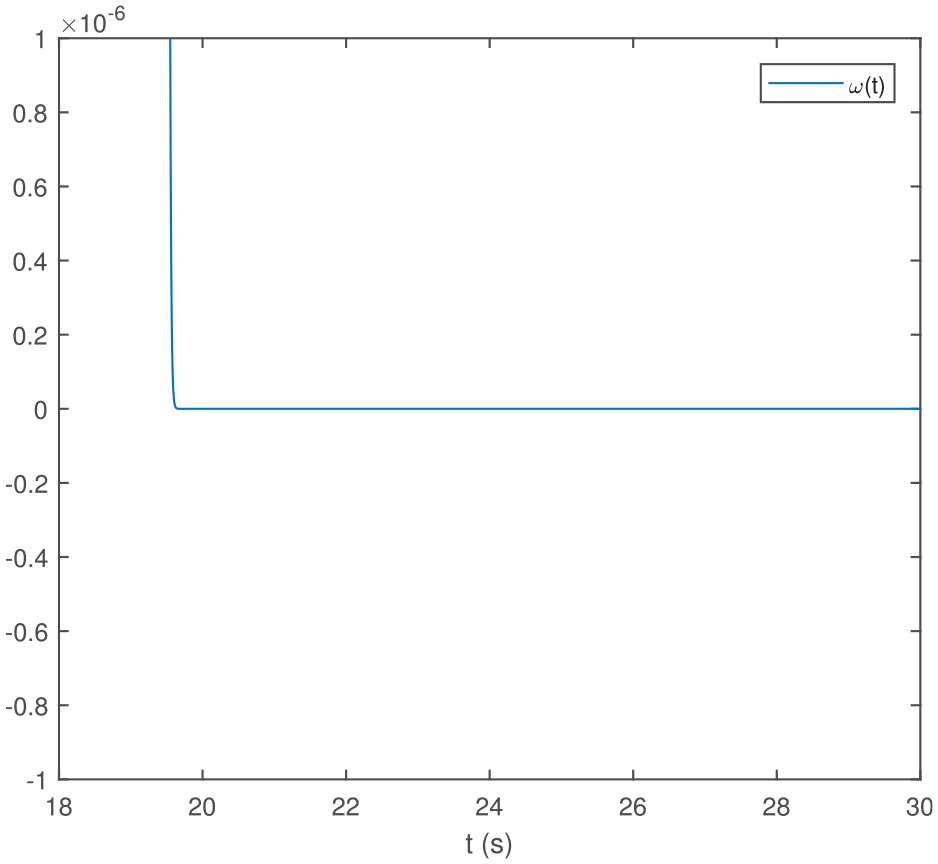
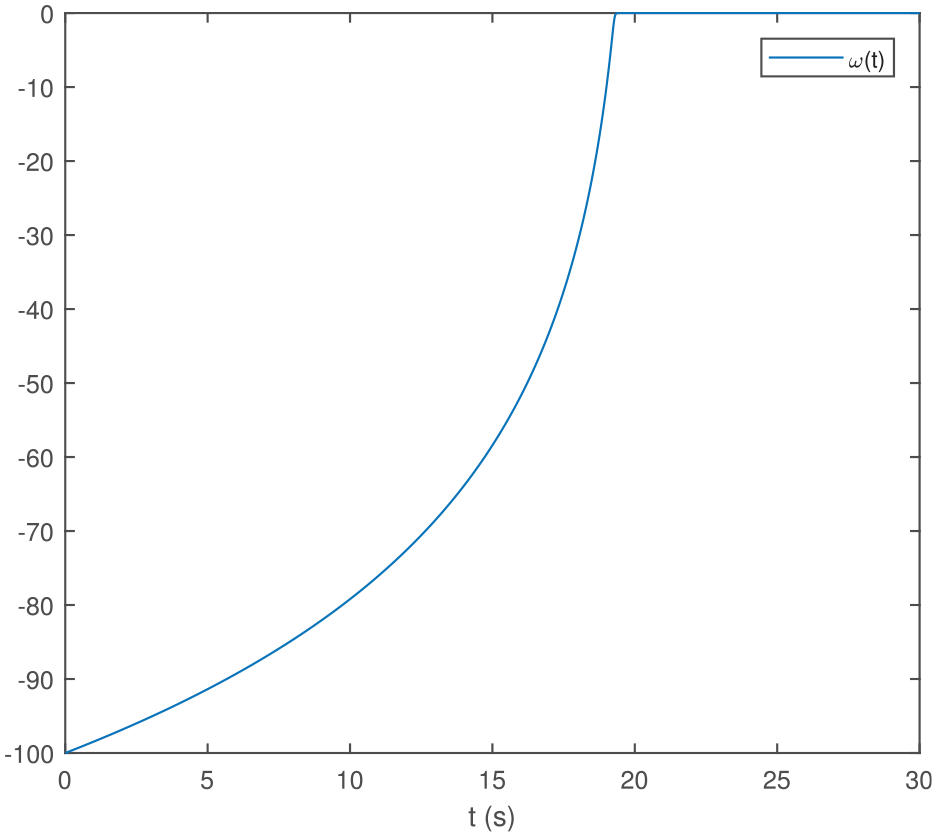
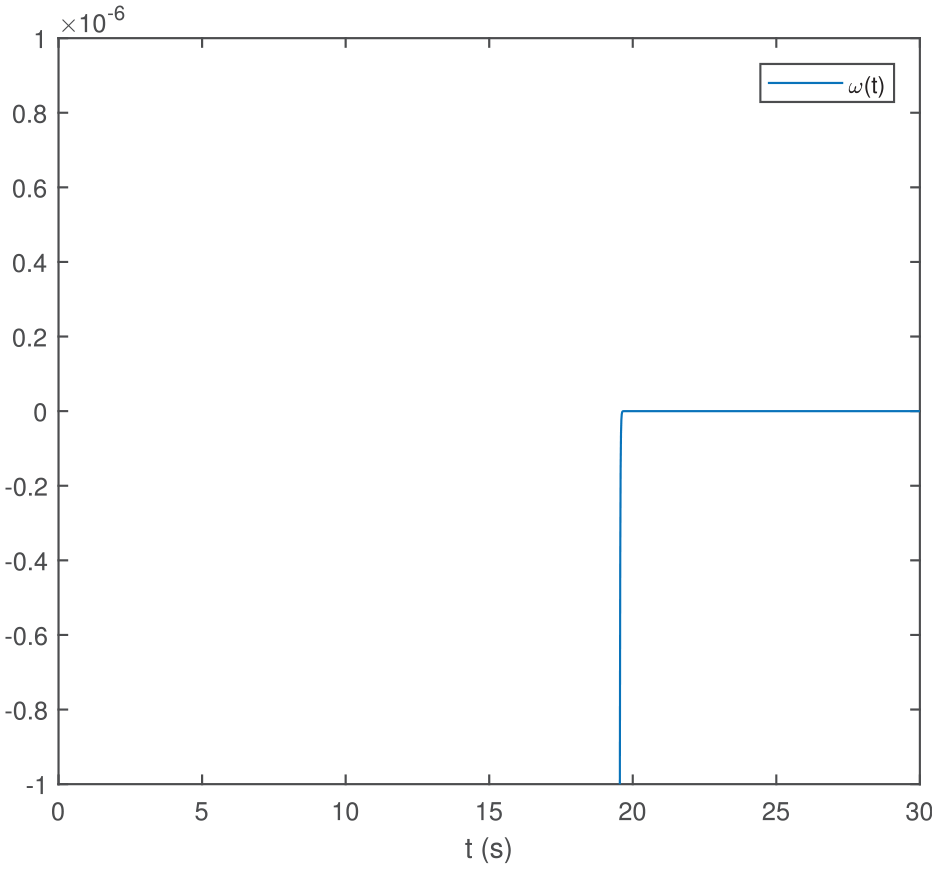
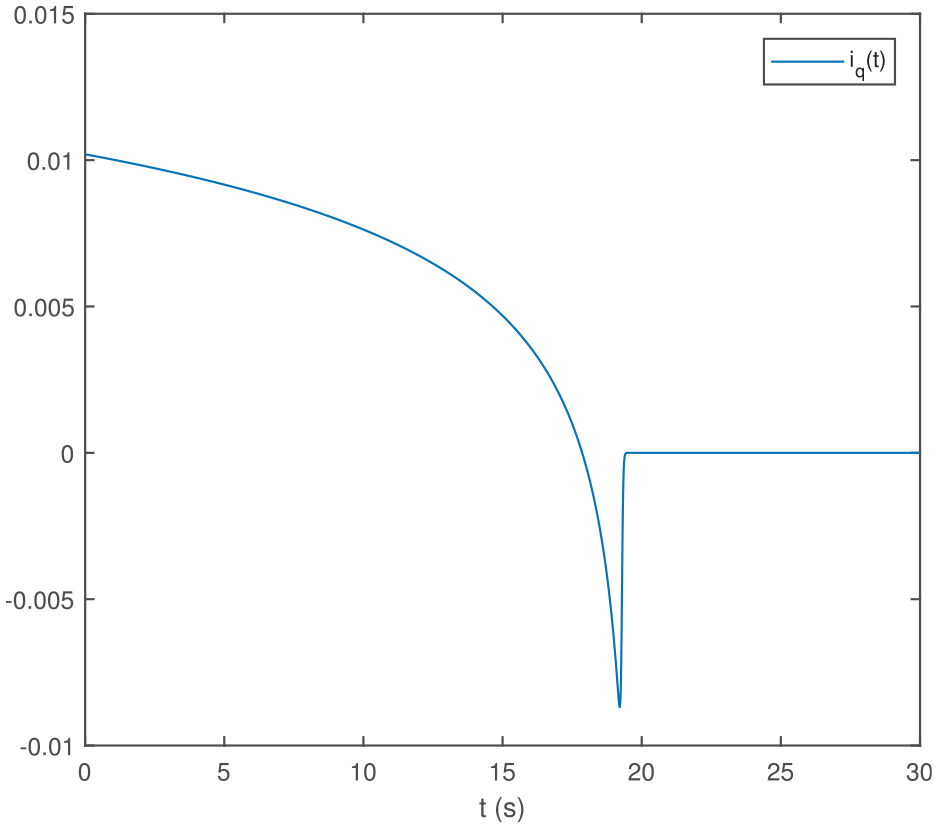
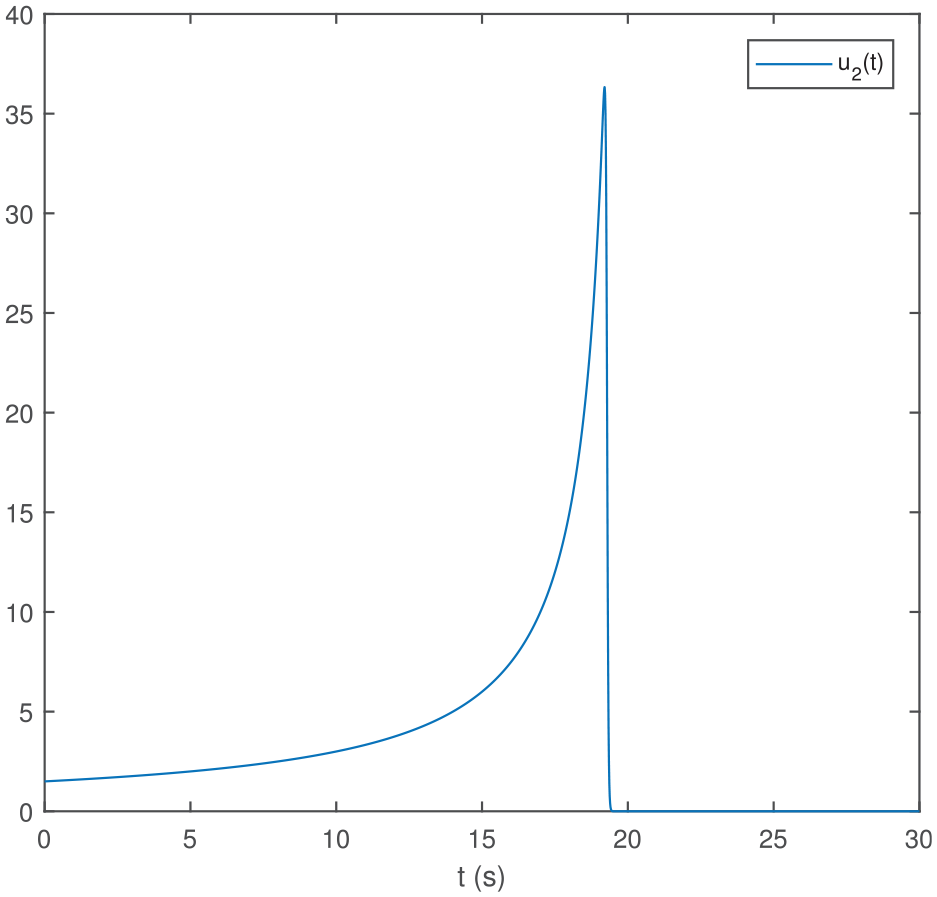
To demonstrate efficiency of the proposed control law, numerical simulations have been performed for the PMSM system (4), (5). The PMSM parameters used in the simulation are assigned as , , , . The control parameters are , . The treated initial conditions and the corresponding settling times obtained by simulation are given in Table 1. Figures 2–5 present the time histories of for initial conditions and , as well as their zoomed time histories, which demonstrate that the system (4) is predefined-time convergent to the origin for the desired time , as stated in Theorem 1. Finally, Figure 6 shows the control input (5) for the initial condition of .
Convergence times vs initial conditions.
10
100
1000
15.5
19.65
19.9
20
20
Time histories of with initial condition .
Time histories of with initial condition (zoomed).
Time histories of with initial condition .
Time histories of with initial condition (zoomed).
Control input (5).
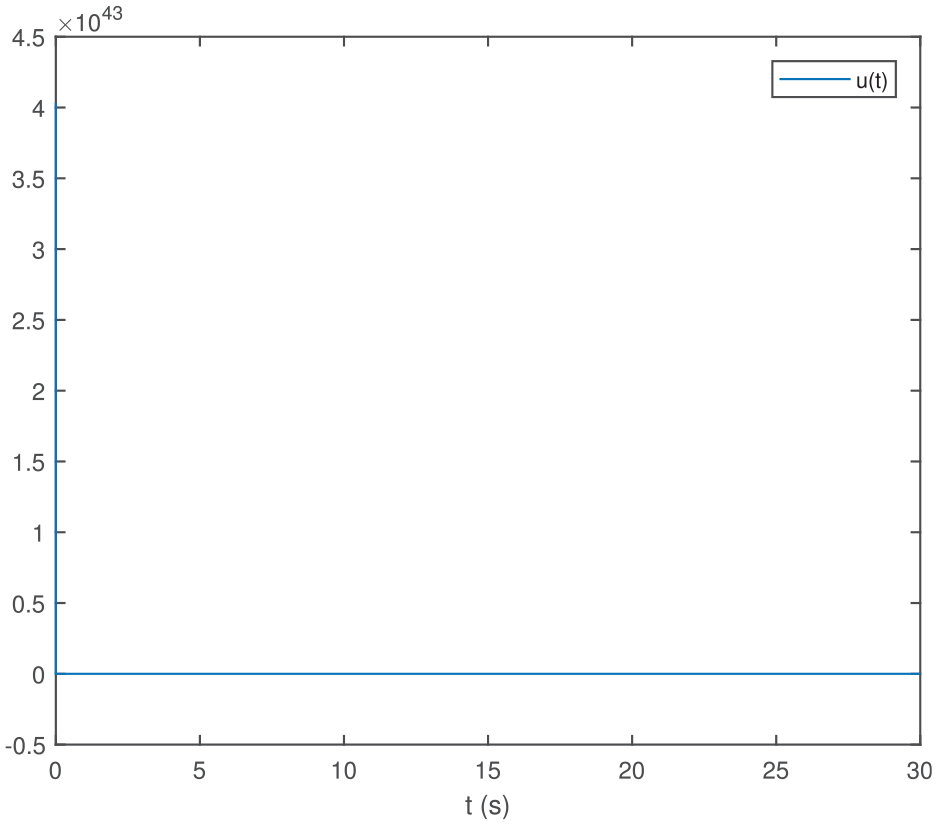
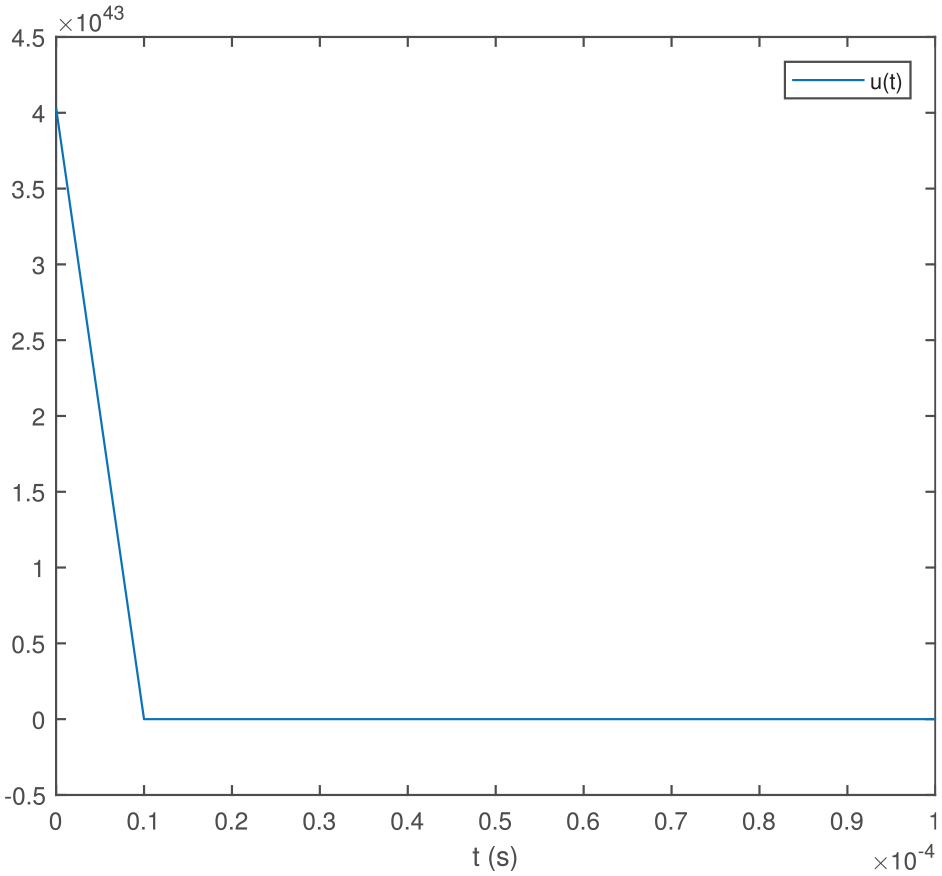
To provide comparisons with the predefined-time control law given in Pal et al. (2020), numerical simulations are conducted for the system (7) with initial condition and the system (1) in Pal et al. (2020) with initial condition . The corresponding graphs of the control inputs are shown in Figures 7–9. The simulation results demonstrate that the control law of Pal et al. (2020) is not realizable in view of its too large magnitude, whereas the control law (6) remains in the range of practically acceptable values.
Note that the control law (6) depends only on the absolute values of the state . Therefore, the state trajectories and control inputs corresponding to positive and negative initial values of the same magnitude are symmetrically mirrored with respect to the time axis, so the exponential growth phenomenon does not take place even for negative state initial values.
Predefined-time stabilization with deterministic disturbances
In this section, two predefined-time convergent control laws are designed for a PMSM system in presence of a deterministic disturbance satisfying the Lipschitz condition with a constant .
Control design
Consider equation (2), where and the control law is designed as
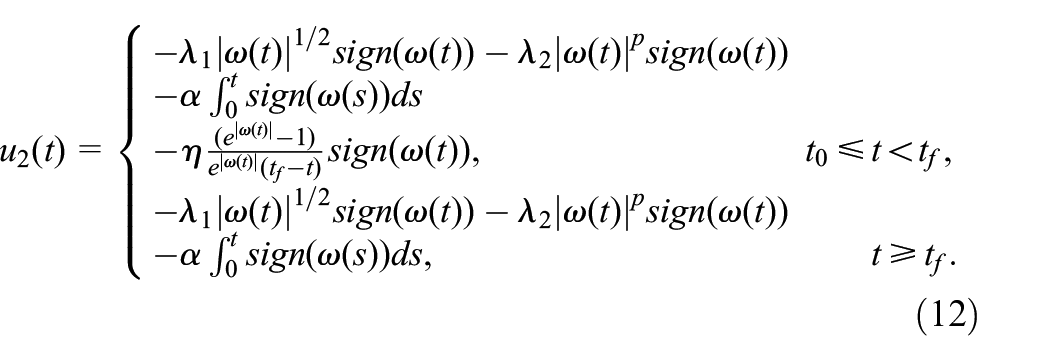
where is defined in Section 3 and is to be assigned. Substituting into (2) yields
where is given by
Here, , , , and . The gain can be selected as or .
Theorem 2. The control law (12) drives the state of the system (4) and its derivative to the origin for an a priori assigned time and stays there afterwards for any . In other words, the closed-loop system (4), (12) is predefined-time convergent to the origin in the presence of a deterministic disturbance satisfying the Lipschitz condition with a constant , if the following conditions hold: , , , , and .
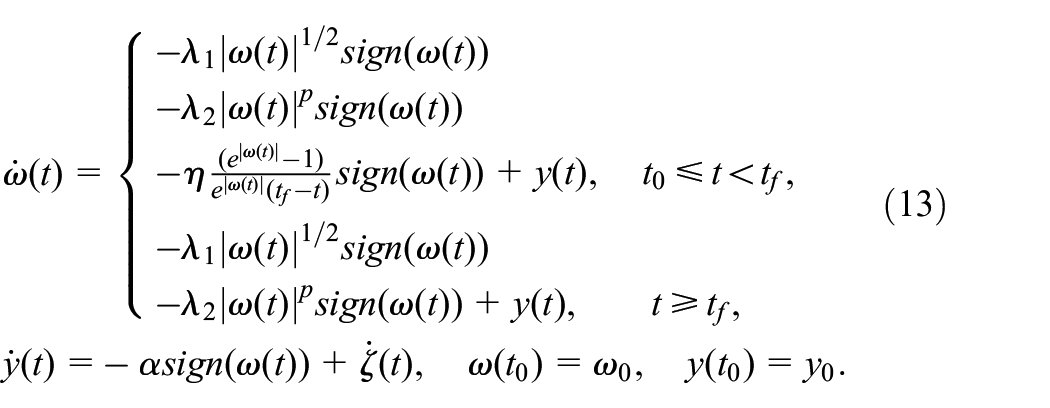
The resulting closed-loop control system can be represented in the conventional super-twisting form
Then, both states and converge to the origin for the predefined time .
Proof: As follows from Theorem 4.5 in Shtessel et al. (2014), the conditions and provide finite-time convergence to the origin of both states of the super-twisting system (13), if , where the term is responsible for finite-time convergence of an undisturbed system and the term is responsible for suppressing the disturbance . Thus, the first and third terms in the control law (12), without the fourth exponential term (6), already yield finite-time convergence of system states (13) to the origin and suppression of the disturbance . As follows from Theorem 1, adding the fourth exponential term (6) in the control law (12), , makes this finite-time convergence predefined for a time no greater than . Finally, as follows from Theorem 1 in Basin et al. (2019), adding the second term in the control law (12), with , yields fixed-time convergence of system states (13) to the origin, if , and suppression of the disturbance . Hence, the combination of all four terms in the control law (12) with makes this fixed-time convergence predefined for a time no greater than and may only increase the convergence rate in comparison to the case . ■.
PMSM simulations
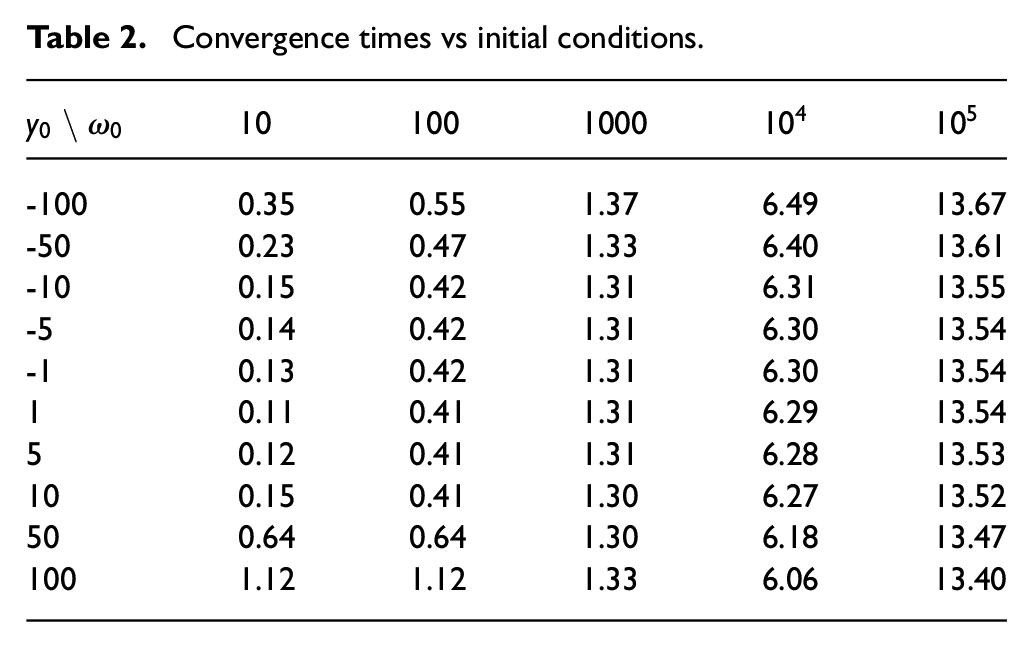
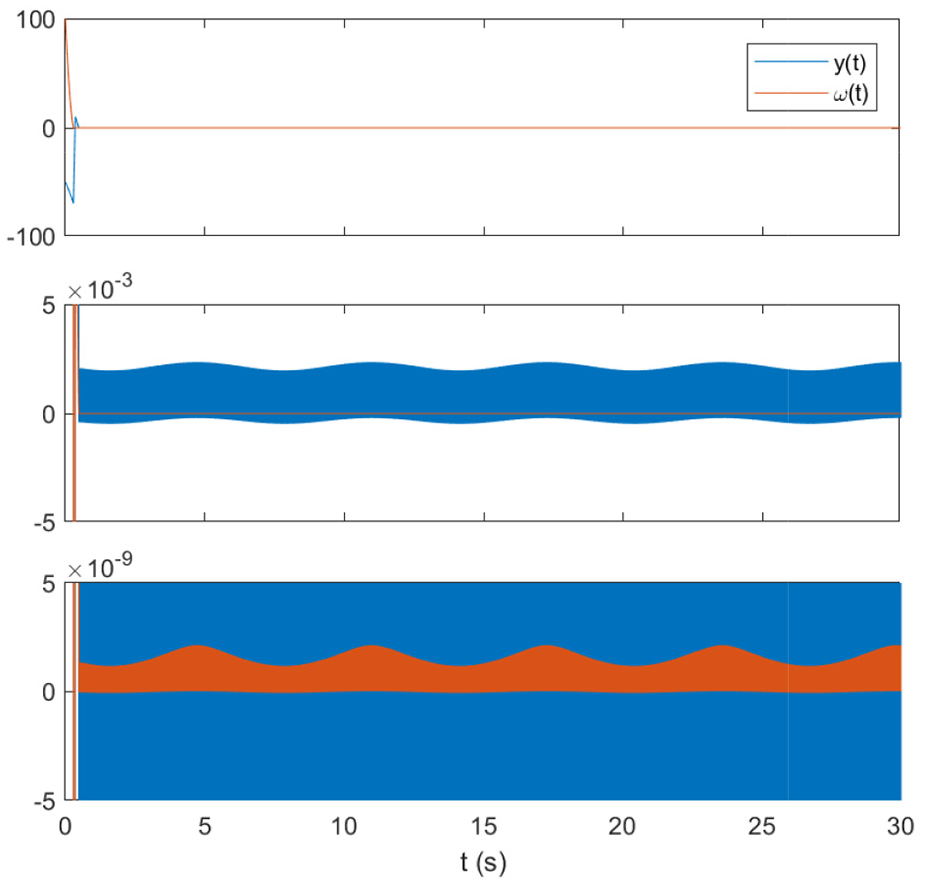
To demonstrate efficiency of the proposed control law, numerical simulations have been performed for the PMSM system (2), (12). First, the case is considered. The PMSM parameters used in the simulation are assigned as , , , . The deterministic disturbance is selected as ; accordingly, the Lipschitz constant is set to . The control parameters are , , , , which are selected to satisfy the conditions of Theorem 2. The treated initial conditions and the corresponding settling times obtained by simulation are given in Table 2. Figures 10 and 11 present the time histories of and for initial conditions , and , , as well as their zoomed time histories, which demonstrate predefined-time convergence of the PMSM states to the origin for the desired time , as stated in Theorem 2. Figure 12 shows the control input (11) for the initial conditions and .
Convergence times vs initial conditions.
\
10
100
1000
−100
0.35
0.55
1.37
6.49
13.67
−50
0.23
0.47
1.33
6.40
13.61
−10
0.15
0.42
1.31
6.31
13.55
−5
0.14
0.42
1.31
6.30
13.54
−1
0.13
0.42
1.31
6.30
13.54
1
0.11
0.41
1.31
6.29
13.54
5
0.12
0.41
1.31
6.28
13.53
10
0.15
0.41
1.30
6.27
13.52
50
0.64
0.64
1.30
6.18
13.47
100
1.12
1.12
1.33
6.06
13.40
Time histories of and when with initial conditions and .
Time histories of and when with initial conditions and .
Control input with and initial conditions and .
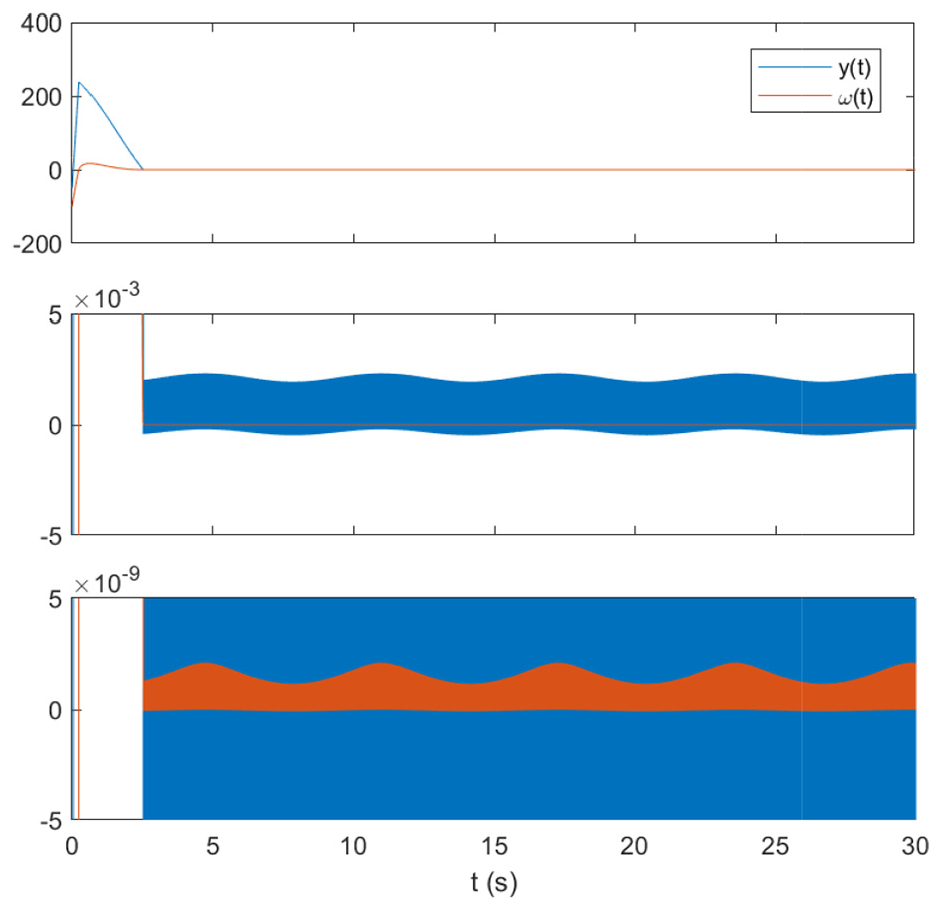
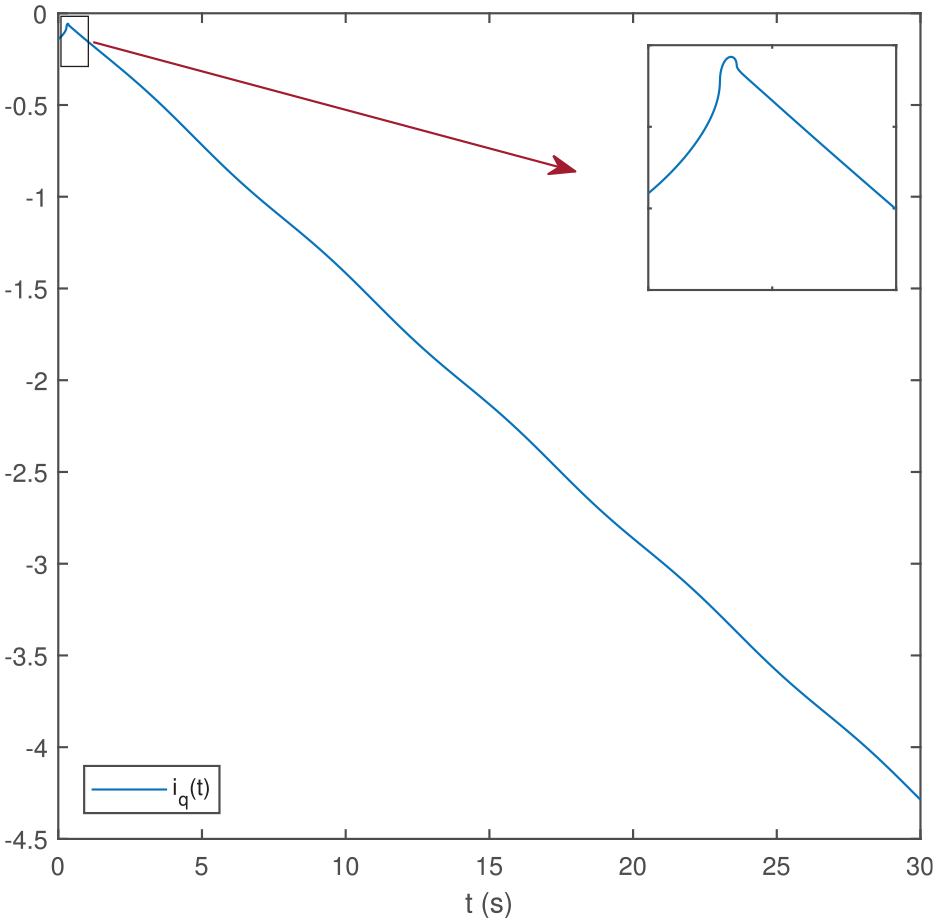
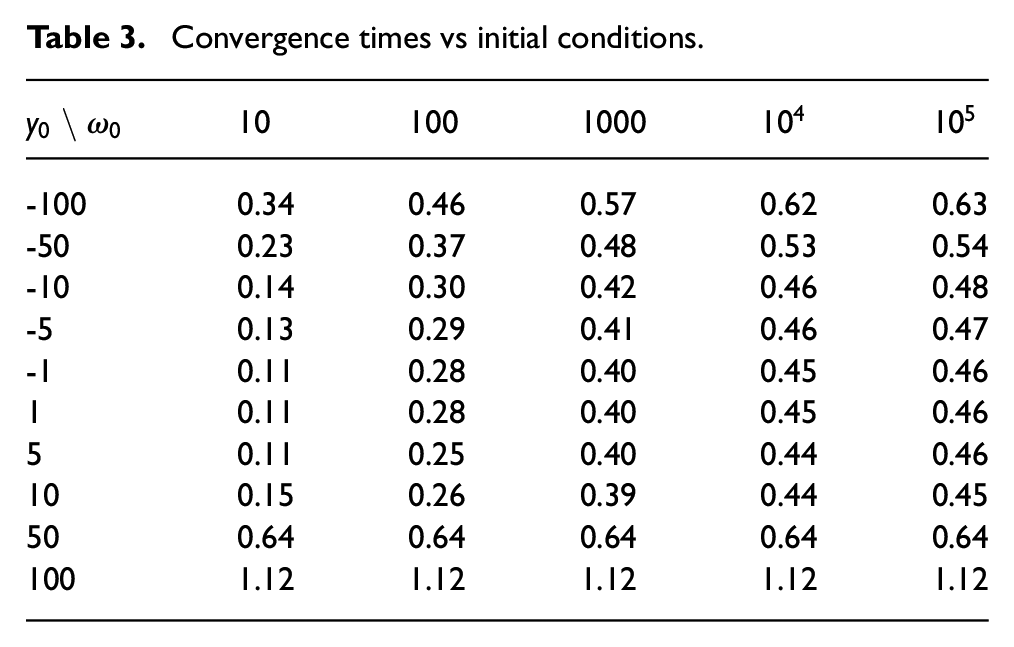
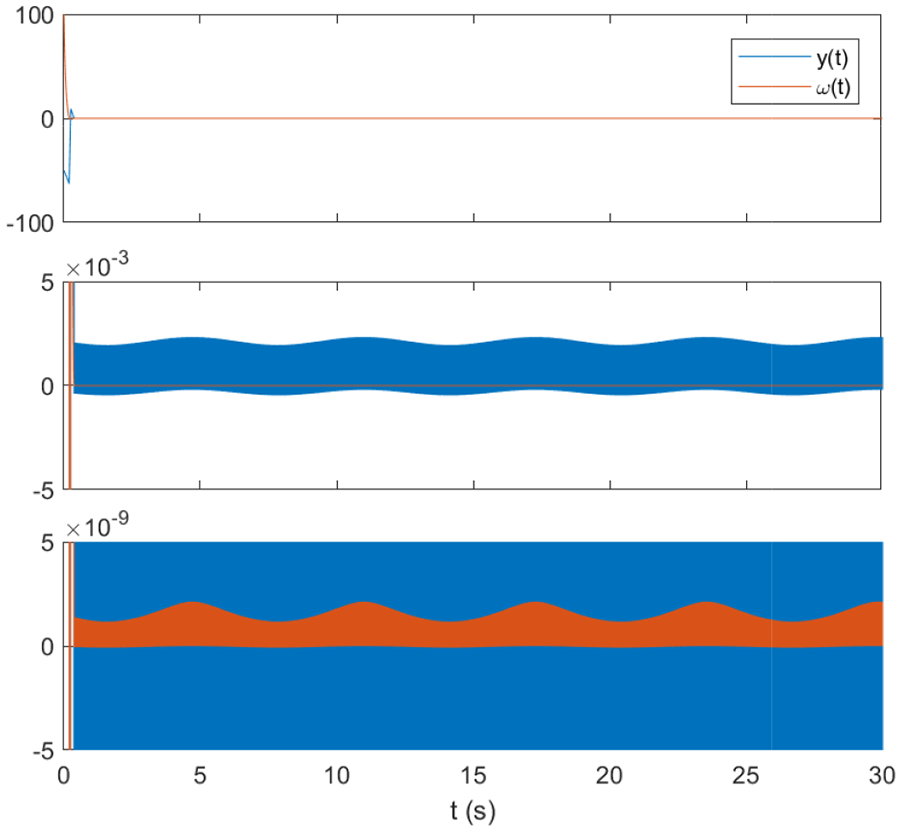
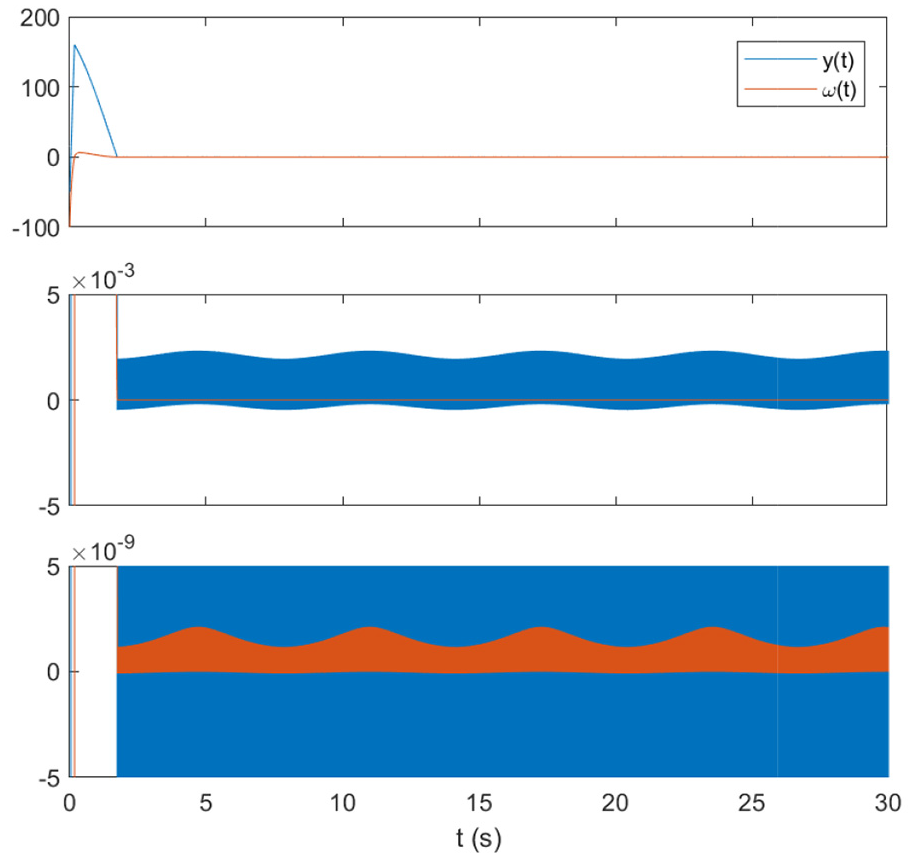
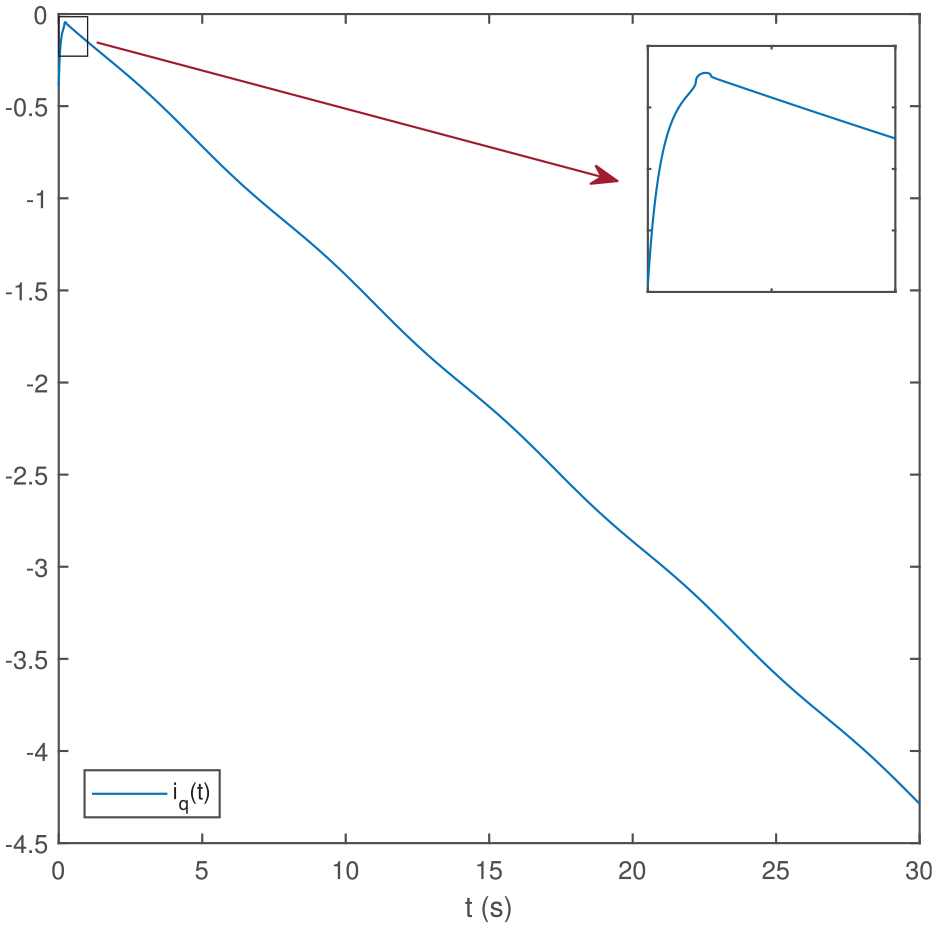
Then, the case is considered, where the values , are selected to satisfy the conditions of Theorem 2 and the other control parameters are the same as in the preceding set of simulations. The treated initial conditions and the corresponding settling times obtained by simulation are given in Table 3. Figures 13 and 14 present the time histories of and for initial conditions , and , , as well as their zoomed time histories, which demonstrate predefined-time convergence of the PMSM states to the origin for the desired time , as stated in Theorem 2. Figure 15 shows the control input (11) for the initial conditions and . Note that in both cases the magnitude of the control input remains less than , which is acceptable in practice. Thus, both control laws provide reliable stabilization of the PMSM states to the origin in presence of a deterministic disturbance within the a priori assigned time of sec. The second control law with yields considerably lesser convergence times for large state initial values, although its magnitude is only slightly higher than that in the first case.
Convergence times vs initial conditions.
\
10
100
1000
−100
0.34
0.46
0.57
0.62
0.63
−50
0.23
0.37
0.48
0.53
0.54
−10
0.14
0.30
0.42
0.46
0.48
−5
0.13
0.29
0.41
0.46
0.47
−1
0.11
0.28
0.40
0.45
0.46
1
0.11
0.28
0.40
0.45
0.46
5
0.11
0.25
0.40
0.44
0.46
10
0.15
0.26
0.39
0.44
0.45
50
0.64
0.64
0.64
0.64
0.64
100
1.12
1.12
1.12
1.12
1.12
Time histories of and with and initial conditions and .
Time histories of and with and initial conditions and .
Control input with and initial conditions and .
Remark 1. The presented simulations were run in MatLab with discretization step 0.001. This discretization is the reason why the state trajectory does not reach zero exactly but forms a limit cycle (chattering) with a certain amplitude. In this case, the finite-time convergence is determined according to the Levant’s test (Shtessel et al., 2014), which establishes that the finite-time convergence takes place if the magnitude of the limit cycle for the state variable of relative degree one with respect to a discontinuous control input is of the same order as the discretization step, the magnitude of the limit cycle for the state variable of relative degree two is of the same order as the discretization step in square, the magnitude of the limit cycle for the state variable of relative degree three is of the same order as the discretization step in cube, and so forth. In the considered case, the state variable of relative degree one, , with respect to a discontinuous control input reaches the limit cycle of the magnitude , which is equal to that of the discretization step, and the state variable of relative degree two, , reaches the limit cycle of the magnitude , which is even less than that of the discretization step in square . Thus, the finite-time convergence of both state variables to zero is established according to the Levant’s test.
Predefined-time stabilization with deterministic disturbances and stochastic noises
Control design
In this section, a predefined-time convergent control law is designed for a PMSM system in presence of a deterministic disturbance satisfying the Lipschitz condition with a constant and a stochastic white noise.
Consider the PMSM system (2) in presence of a deterministic disturbance satisfying the Lipschitz condition and a stochastic white noise
where is a Wiener process defined in .
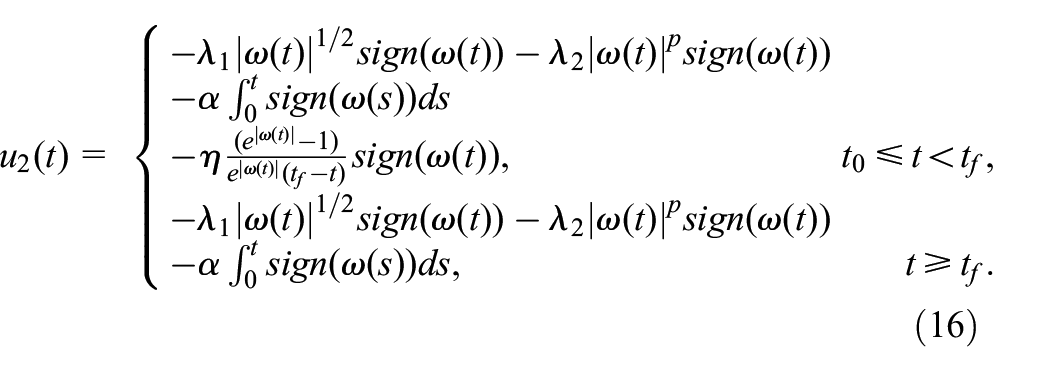
The control law is represented as
where is defined in Section 3 and is to be assigned. Substituting into (2) yields
where is given by
Here, , , , and .
Theorem 3. The control law (15) drives the -th initial moment of the state of the system (14) to the origin for an a priori assigned time and stays there afterwards for any . In other words, the closed-loop system (14), (15) is predefined-time convergent to the origin in -mean in the presence of a deterministic disturbance satisfying the Lipschitz condition with a constant and a stochastic white noise with diffusion , if the following conditions hold: , , , , , , , , and .
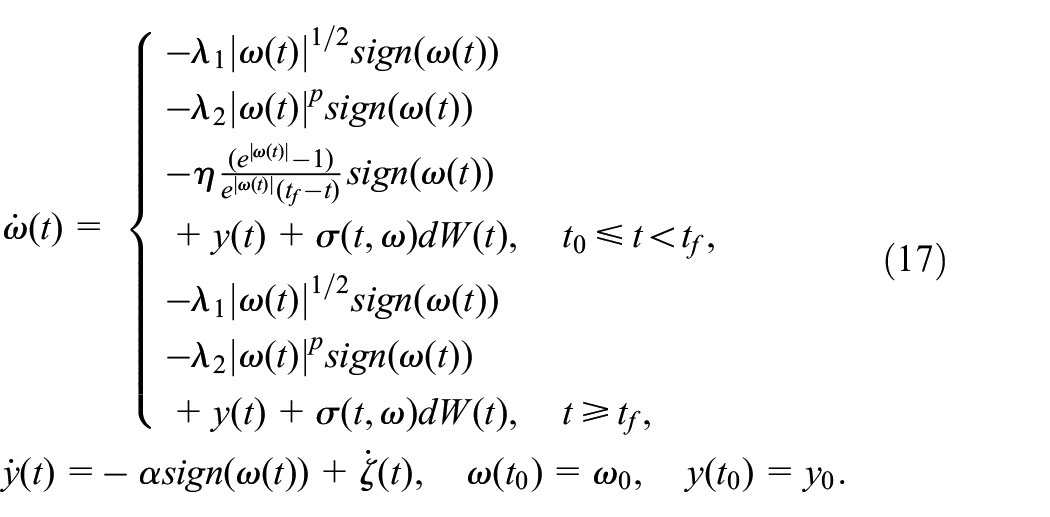
The resulting closed-loop control system can be represented in the conventional super-twisting form
Then, both states and converge to the origin for the predefined-time .
Note that the predefined-time convergence of to zero means that the expectation and the absolute value in power of the centralized difference of values of a stochastic process converge to zero as time tends to an a priori predefined value. Conventionally, the value of is set to 2, which corresponds to the mean-square convergence of a stochastic process to zero.
Proof. As follows from Theorem 2 in Guerra-Avellaneda and Basin (2020), the conditions , and provide fixed-time convergence to the origin in -mean of both states of the stochastic super-twisting system (17), if , where the terms and with are responsible for fixed-time convergence in -mean of an undisturbed system and the term is responsible for suppressing the disturbance . Thus, the first three terms in the control law (16), without the fourth exponential term (6), already yield fixed-time convergence in -mean of system states (17) to the origin and suppression of the disturbance . As follows from Theorem 1 of this paper, adding the fourth exponential term (6) in the control law (16), , makes this fixed-time convergence in -mean predefined for a time no greater than . ■.
PMSM simulations
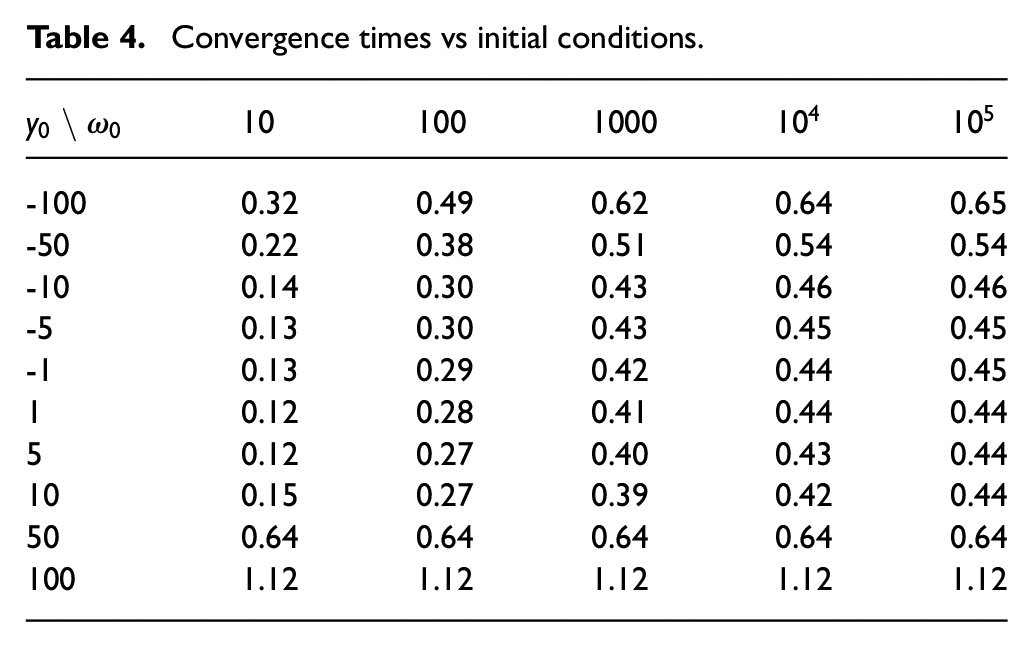
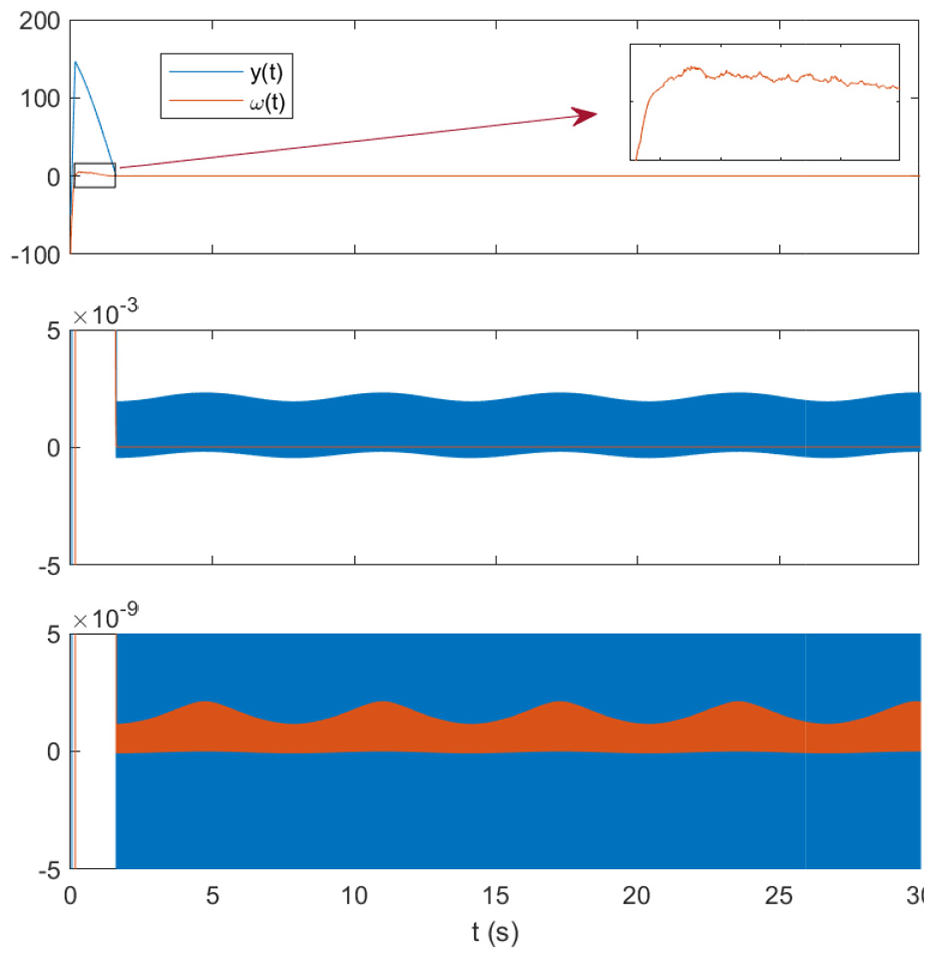
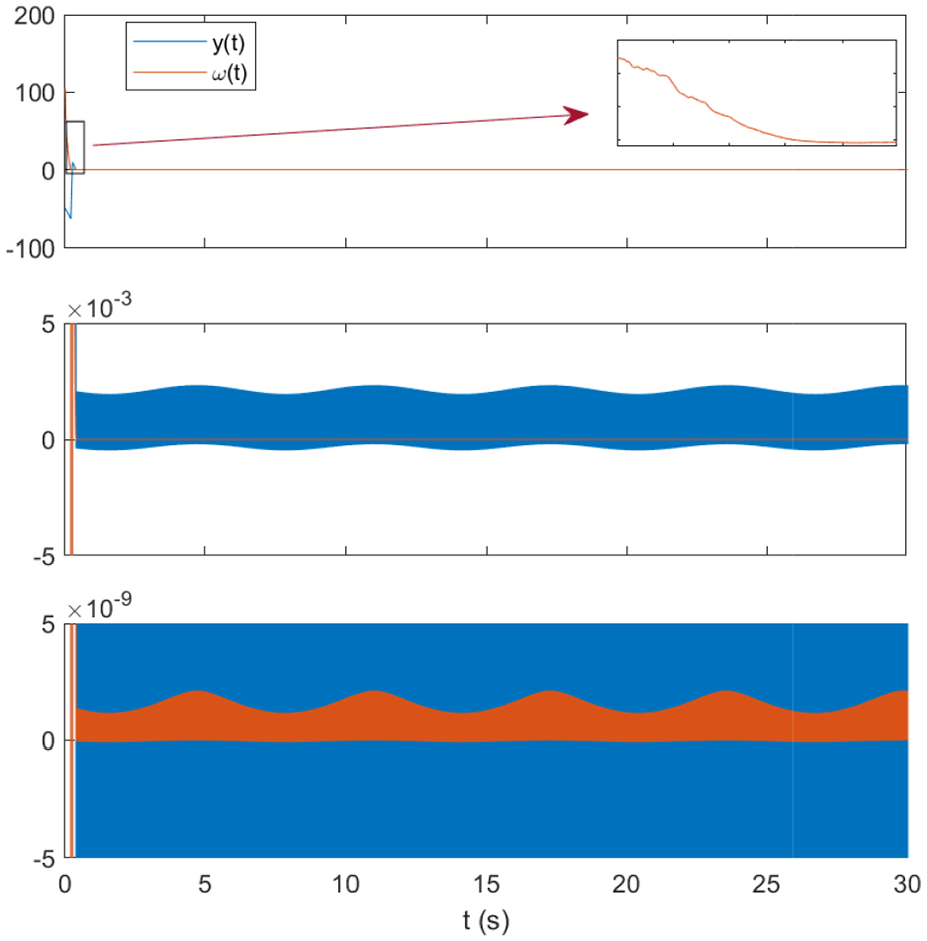
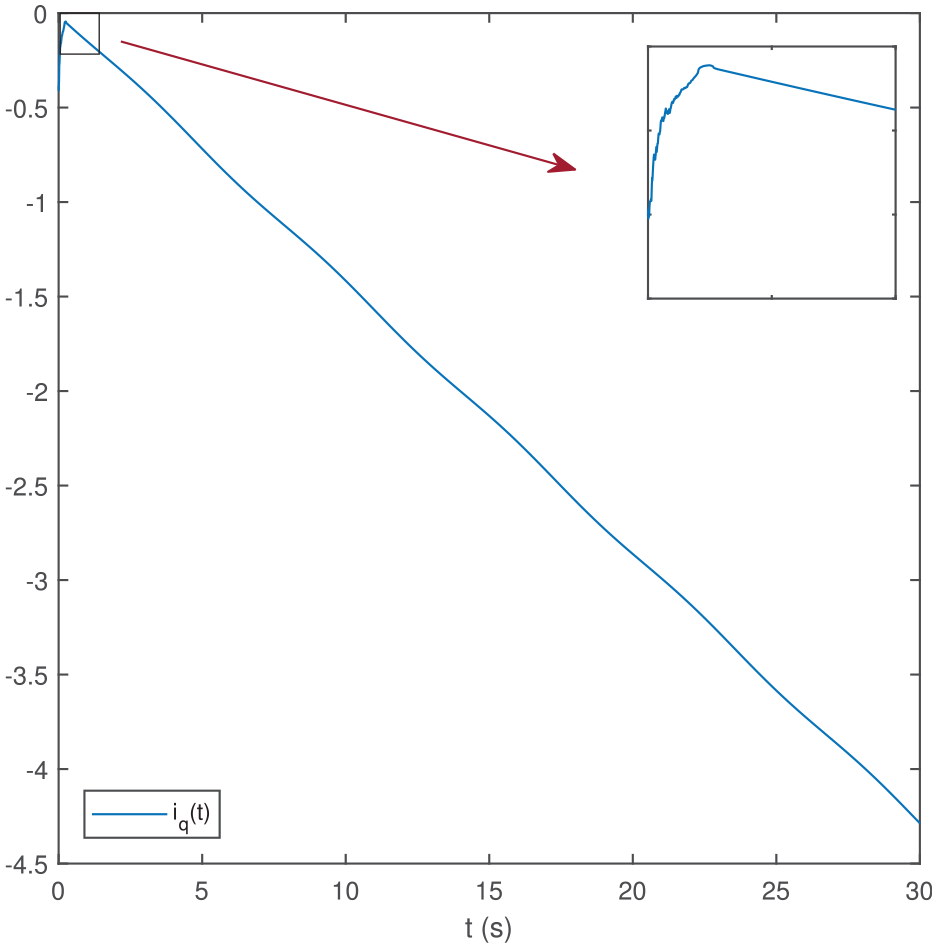
To demonstrate efficiency of the proposed control law, numerical simulations have been performed for the PMSM system (14), (15). The PMSM parameters, deterministic disturbance, Lipschitz constant, and control parameters are the same as in Section 4. The stochastic noise parameter is given by . The stochastic convergence is regarded in mean-square sense, , to satisfy the conditions of Theorem 3. The treated initial conditions and the corresponding settling times obtained by simulation are given in Table 4. Figures 16 and 17 present the time histories of and for initial conditions , and , , as well as their zoomed time histories, which demonstrate predefined-time convergence of the PMSM states to the origin in -mean for the desired time , as stated in Theorem 3. Figure 18 shows the control input (15) for the initial conditions and . The magnitude of the control input also remains less than , which is acceptable in practice. Thus, both control laws provide reliable stabilization of the PMSM states to the origin in presence of a deterministic disturbance and a stochastic noise within the a priori assigned time of sec.
Convergence times vs initial conditions.
\
10
100
1000
−100
0.32
0.49
0.62
0.64
0.65
−50
0.22
0.38
0.51
0.54
0.54
−10
0.14
0.30
0.43
0.46
0.46
−5
0.13
0.30
0.43
0.45
0.45
−1
0.13
0.29
0.42
0.44
0.45
1
0.12
0.28
0.41
0.44
0.44
5
0.12
0.27
0.40
0.43
0.44
10
0.15
0.27
0.39
0.42
0.44
50
0.64
0.64
0.64
0.64
0.64
100
1.12
1.12
1.12
1.12
1.12
Time histories of stochastic and with initial conditions and .
Time histories of stochastic and with initial conditions and .
Stochastic control input with initial conditions and .
Conclusions
This paper has presented a predefined-time convergent continuous control algorithm for a PMSM which is free from the restrictions of exponential control growth and exact initial conditions knowledge. Three cases have been considered:
disturbance-free,
in presence of a deterministic disturbance satisfying a Lipschitz condition, and
in presence of a deterministic disturbance satisfying a Lipschitz condition and a stochastic white noise.
The performance of the developed algorithm is verified with numerical simulations, which demonstrate reliable predefined-time convergence of the PMSM system states to the origin in all three cases. The employed values of the predefined-time convergent control inputs are applicable in practical cases of PMSM stabilization. The ongoing research focuses on designing adaptive predefined-time control algorithms for scalar and multi-variable systems with deterministic disturbances and stochastic white noises.
Footnotes
Declaration of conflicting interests
The author(s) declared no potential conflicts of interest with respect to the research, authorship, and/or publication of this article.
Funding
The author(s) disclosed receipt of the following financial support for the research, authorship, and/or publication of this article: This work is supported by the Mexican National Science and Technology Council (CONACyT) under Grant 250611.
ORCID iD
Michael Basin
References
1.
AndrieuVPralyLAstolfiA (2008) Homogeneous approximation, recursive observer design, and output feedback. SIAM Journal on Control and Optimization47(4): 1814–1850.
2.
AngKHChongGLiY (2005) PID control system analysis, design, and technology. IEEE Transactions on Control Systems Technology13(4): 559–576.
3.
BaikICKimKHYounMJ (2000) Robust nonlinear speed control of PM synchronous motor using boundary layer integral sliding mode control technique. IEEE Transactions on Control Systems Technology8(1): 47–54.
4.
BasinMRodriguez-RamirezPGarza-AlonsoA (2019) Continuous fixed-time convergent super-twisting algorithm in case of unknown state and disturbance initial conditions. Asian Journal of Control21(1): 323–338.
5.
BasinMRodriguez-RamirezPRamos-LopezV (2020) Continuous fixed-time convergent controller for permanent-magnet synchronous motor with unbounded perturbations. Journal of the Franklin Institute357(16): 11900–11913.
6.
FilippovAF (1998) Differential Equations with Discontinous Righthand Sides. Dordrecht: Kluwer.
7.
Guerra-AvellanedaFBasinM (2020) Continuous fixed-time convergent control design for stochastic super-twisting system. Journal of the Franklin Institute357(16): 11793–11806.
8.
Hernandez-GuzmanVMSilva-OrtigozaR (2010) PI control plus electric current loops for PM synchronous motors. IEEE Transactions on Control Systems Technology19(4): 868–873.
9.
JonRWangZLuoCJongM (2017) Adaptive robust speed control based on recurrent Elman neural network for sensorless PMSM servo drives. Neurocomputing227: 131–141.
10.
KommuriSKDefoortMKarimiHRVeluvoluKC (2016) A robust observer-based sensor fault-tolerant control for PMSM in electric vehicles. IEEE Transactions on Industrial Electronics63(12): 7671–7681.
11.
KuangXHongGJinquanXTongZ (2017) Research on a six-phase permanent-magnet synchronous motor system at dual-redundant and fault tolerant modes in aviation application. Chinese Journal of Aeronautics30(4): 1548–1560.
LiSLiuZ (2009) Adaptive speed control for permanent-magnet synchronous motor system with variations of load inertia. IEEE Transactions on Industrial Electronics56(8): 3050–3059.
14.
ManiPRajanRShanmugamLJooYH (2018) Adaptive fractional fuzzy integral sliding mode control for PMSM model. IEEE Transactions on Fuzzy Systems27(8): 1674–1686.
15.
NianXDengZ (2015) Robust synchronization controller design of a two coupling permanent-magnet synchronous motors system. Transactions of the Institute of Measurement and Control37(8): 1026–1038.
16.
PalAKKamalSNagarSK, et al. (2020) Design of controllers with arbitrary convergence time. Automatica112: 108710.
17.
PolyakovA (2012) Nonlinear feedback design for fixed-time stabilization of linear control systems. IEEE Transactions on Automatic Control57(8): 2106–2110.
18.
PolyakovAPoznyakA (2009a) Lyapunov function design for finite-time convergence analysis: “Twisting” controller for second-order sliding mode realization. Automatica45(2): 444–448.
19.
PolyakovAPoznyakA (2009b) Reaching time estimation for “super-twisting” second order sliding mode controller via Lyapunov function designing. IEEE Transactions on Automatic Control54(8): 1951–1955.
20.
QiLBaoSShiH (2015) Permanent-magnet synchronous motor velocity control based on second-order integral sliding mode control algorithm. Transactions of the Institute of Measurement and Control37(7): 875–882.
21.
RibeiroRAraujoAOliveiraAJacobinaC (2007) A high performance permanent-magnet synchronous motor drive by using a robust adaptive control strategy. In: 2007 IEEE Power Electronics Specialists Conference, Orlando, FL, 17–21 June 2007, pp. 2260–2266. Piscataway, NJ: IEEE.
22.
ShengquanLJuanLYongweiT, et al. (2020) Model-based model predictive control for a direct-driven permanent-magnet synchronous generator with internal and external disturbances. Transactions of the Institute of Measurement and Control42(3): 586–597.
23.
ShtesselYEdwardsCFridmanLLevantA (2014) Sliding Mode Control and Observation. Basel: Birkhäuser.
24.
WangAWeiS (2019) Sliding mode control for permanent-magnet synchronous motor drive based on an improved exponential reaching law. IEEE Access7: 146866–146875.
25.
WangGZhangGXuD (2020) Position Sensorless Control Techniques for Permanent Magnet Synchronous Machine Drives. Singapore: Springer.
26.
WuSZhangJ (2018) A robust adaptive control for permanent-magnet synchronous motor subject to parameter uncertainties and input saturations. Journal of Electrical Engineering & Technology13(5): 2125–2133.
27.
XieYTangXSongB, et al. (2019) Model-free tuning strategy of fractional-order PI controller for speed regulation of permanent magnet synchronous motor. Transactions of the Institute of Measurement and Control41(1): 23–35.
28.
XuBShiGJiW, et al. (2017) Design of an adaptive nonsingular terminal sliding model control method for a bearingless permanent-magnet synchronous motor. Transactions of the Institute of Measurement and Control39(12): 1821–1828.
29.
ZarchiHAMarkadehGRASoltaniJ (2010) Direct torque and flux regulation of synchronous reluctance motor drives based on input–output feedback linearization. Energy Conversion and Management51(1): 71–80.