






Abstract
In this paper, the control problem of a class I of underactuated mechanical systems (UMSs) is addressed. The considered class includes nonlinear UMSs with two degrees of freedom and one control input. Firstly, we propose the design of a robust integral of the sign of the error (RISE) control law, adequate for this special class. Based on a change of coordinates, the dynamics is transformed into a strict-feedback (SF) form. A Lyapunov-based technique is then employed to prove the asymptotic stability of the resulting closed-loop system. Numerical simulation results show the robustness and performance of the original RISE toward parametric uncertainties and disturbance rejection. A comparative study with a conventional sliding mode control reveals a significant robustness improvement with the proposed original RISE controller. However, in real-time experiments, the amplification of the measurement noise is a major problem. It has an impact on the behaviour of the motor and reduces the performance of the system. To deal with this issue, we propose to estimate the velocity using the robust Levant differentiator instead of the numerical derivative. Real-time experiments were performed on the testbed of the inertia wheel inverted pendulum to demonstrate the relevance of the proposed observer-based RISE control scheme. The obtained real-time experimental results and the obtained evaluation indices show clearly a better performance of the proposed observer-based RISE approach compared to the sliding mode and the original RISE controllers.
Keywords
Introduction
Control of underactuated mechanical systems (UMSs) has gained over the years a growing attention within the automatic control community (Fantoni and Lozano, 2002). The presence of underactuation in mechanical systems can be due to various reasons (Choukchou-Braham et al., 2014). It may be intentionally specified during the design stage to minimize the weight of the system. Otherwise, it may be unintentional, as a result of the damage of one actuator or more of the system. The underactuation in mechanical systems gives rise to various challenging control issues (Krafes et al., 2018), including:
Many difficulties are often exhibited by such systems, such as their complex dynamics and their nonlinear coupling between actuated and non-actuated coordinates.
Non-integrable and second-order non-holonomic constraints that may exist in the dynamics of UMSs. For instance, the dynamic model of the pendubot is subject to second-order non-integrable differential constraints.
UMSs are often considered as a non-minimum phase, as the internal dynamics of such systems is often unstable. Hence, the application of input–output feedback linearization is not efficient to control such systems (Guemghar, 2005).
One of the control challenges is the lack of feedback linearizability. For instance, the dynamic model of the acrobot (Spong, (1995) and the pendubot (Zhang and Tarn, 2001) systems are not feedback linearizable with a static state feedback. However, only a partial feedback linearization is possible in such cases.
Due to their different structural properties, UMSs are studied in a separate way and there is no general approach to control all variants of them. Some classifications of these systems have been reported in the literature. For instance, in Seto and Baillieul (1994) the authors proposed three representations called tree, isolated vertex and chain, classified using the method of the control flow diagram. It is a graphical representation of the dynamics which represents the interaction forces through the degrees of freedom (DOF). Another classification was proposed in Olfati-Saber (2001), using some structural properties of the system such as kinetic symmetry, interacting inputs, etc. The author proposed three normal representations for two-DOF systems where a backstepping procedure and a forwarding scheme were developed for the feedback form and the feed-forward form, respectively. Besides, a wide range of control techniques have been proposed in the literature, such as partial feedback linearization (Spong and Praly, 1997), passivity-based-control (Donaire et al., 2017; Ortega et al., 2002), adaptive neural network-based control (Ghommam and Chemori, 2017; Moreno-Valenzuela et al., 2017), optimization-based-control (Andary et al., 2009), and observer-based super-twisting control (Hfaiedh et al., 2020a), to name a few.
One particular control approach, mostly used to address the control issue of perturbed UMSs, is the sliding mode control (SMC). It is a robust control strategy characterized by its invariance toward some model uncertainties and external disturbances (Utkin, 2008). Various SMC approaches were proposed in the literature for UMSs. After representation of the system model into a quasi-chained form, a nonlinear robust SMC controller was proposed in Lu et al. (2016) and Sun et al. (2015) to make the system states driven to reach the sliding manifold, and guarantee their convergence to the equilibrium point. In Khalid and Memon (2016), a first-order SMC with a high-gain observer has been proposed for the stabilization of the inertia wheel inverted pendulum (IWIP). In Cheng and Ho (2017) an adaptive sliding mode controller was designed for a class of nonlinear UMSs with matched and mismatched disturbances. Another SMC scheme based on an extended disturbance observer was proposed in Ding et al. (2017) to control a second-order UMS. Thakar et al. (2013) propose a sliding mode approach to control an underactuated system based on the nonlinear model of lateral slosh-container. The main drawback of the first order SMC is the so-called chattering phenomenon. From a practical point of view, this effect is undesirable, since it involves a high control activity generated by the high-frequency of unmodelled dynamics (Slotine and Li, 1991).
To overcome this problem, we are interested in this paper, to redesign another nonlinear robust controller, namely the robust integral of the sign of the error (RISE) controller (Xian et al., 2004). Compared to the SMC, RISE feedback control generates a continuous control law and prevents the chattering phenomenon due to the integral of the discontinuous term in the expression of the control law (Fischer et al., 2014). It has also the advantage to compensate for sufficiently smooth nonlinear disturbances and system uncertainties. Various theoretical extensions of this control scheme have been proposed in the literature, and were applied to a wide range of systems, including autonomous underwater vehicles (Fischer et al., 2014), multi-link flexible manipulators (Jian et al., 2014), parallel robots (Bennehar et al., 2018), hard disc drives (Taktak-Meziou et al., 2014), UMSs (Hfaiedh et al., 2018) and exoskeletons (Sherwani et al., 2020).
The main contributions of the present paper can be summarized as follows:
This work is an extension of the conference paper of Hfaiedh et al. (2018), where a RISE controller was applied to a two-DOF underactuated IWIP. The new findings of this paper include: (a) the proof of the stability analysis of the resulting closed-loop system; (b) new simulations and real-time experimental results; and (c) quantification of the performance through various performance evaluation indices.
The first contribution lies in the redesign of the RISE controller for UMSs. To the best of the authors’ knowledge, no previous work in the literature has dealt with the RISE control to stabilize UMSs whose control design is more difficult than fully-actuated systems. The choice of designing a RISE controller is motivated by the advantage of generating a continuous control law with a guaranteed closed-loop stability based on some trivial properties of the system dynamics. Compared to fully actuated systems, the proposed RISE control could not be straightforwardly applied to UMSs. Referring to the classification of Olfati-Saber (2001), we transform the system into a strict-feedback (SF) form, which decouples the original system into two cascaded nonlinear and linear subsystems. The new control input is included in the actuated subsystem, which is not the case for the unactuated subsystem. Then, new desired trajectories and tracking errors are defined according to the Lyapunov concept of the nonlinear subsystem.
Numerical simulations were conducted to demonstrate the robustness of the proposed RISE controller on the IWIP. Two scenarios have been performed in simulation test: the first one deals with robustness towards parametric uncertainties; and the second one concerns external disturbance rejection. A comparative analysis between the first order sliding mode controller and the proposed original RISE controller is presented and discussed. Moreover, robustness evaluation indices are used to evaluate and compare each controller. This proposed extended version includes a confirmed simulation with a rigorous stability analysis of the resulting closed-loop system.
The second contribution focuses on improving the experimental results of the original RISE controller with a differentiator. It is worth noting that the RISE controller can compensate for uncertainties. This is of a considerable importance for an underactuated mechanical system, since uncertainties are extremely abundant in their dynamics. However, by computing the velocity signal using the numerical derivative of the measured position, an amplification of the measurement noise has been noticed. This noise effect has an impact on the behaviour of the motor, so that it may reduce the system performance. Accordingly, we propose to estimate the angular velocity of the pendulum using a Levant differentiator, to reduce the effect of the measurement noise.
A comparative study between a first-order sliding mode controller, the original RISE controller and the observer-based RISE controller is validated experimentally on the benchmark of the IWIP. Two different scenarios are conducted: in the first one, no additional mass is added to the pendulum body; and in the second, the system is exposed to more challenging external disturbances, compared to the previous work (Hfaiedh et al., 2018), where only punctual disturbances were considered. The disturbances, in the second scenario, consist of an additional mass added to the pendulum body in two successive and close periods. It is an important scenario, as we can evaluate the performance of both the original RISE control and the proposed observer-based RISE control. A comparative analysis is also presented based on various evaluation indices to quantify the performance of the SMC and the original RISE controller with respect to the proposed approach in terms of convergence and energy consumption.
This paper is organized as follows: in the second section, we present a general background on class I of nonlinear UMSs, represented in SF form, and give more details about the application of RISE feedback control; the third section is devoted to an example of application, provided to stabilize a second-order UMS with analytical proof of Lyapunov stability of the resulting closed-loop system; numerical simulation results with different scenarios are presented and discussed in the fourth section; in the fifth section, we present real-time experimental results to show the effectiveness of the proposed control approach combined with the Levant differentiator; and in the sixth section we provide a conclusion and suggestions for future work.
Proposed control solution
Class I of UMSs
Consider an UMS described by Equation (1):
where
where
Due to the lack of actuation in the first part of Equation (2), the system belongs to the class I, otherwise, it belongs to the class II according to the classification of Olfati-Saber (2001). For instance, the translational oscillator with rotational actuator system, the acrobot (Zhao and Yi, 2006) and the IWIP belong to the class I, whereas the cart pole inverted pendulum and the pendubot belong to the class II. The main motivation of this classification is to obtain a general transformation of the system model into other simplified representations which make the control problem more simplified. For instance, the class I can be partially linearized and then transformed into a SF form, leading to a double integrator thanks to the lack of control input in the first part of Equation (2). This linearization method is known as collocated partial feedback linearization (Spong, 1994). In next subsection, we present a brief background on the transformation of class I of UMSs into a SF form.
Definition 1: A nonlinear system presented into a SF form (Krstic et al., 1995) can be described by the following triangular structure as givn by Equations (3) to (6):
where
Background on RISE controller for class I of UMSs
The main motivation behind this subsection is to give a background about the design of the RISE controller using the global change of coordinates which simplifies the control problem by transforming the system into a SF form.
SF linearization
The UMSs of class I with two-DOF and only one control input can be represented into a cascaded nonlinear system in the SF representation if the following assumption is satisfied.
where
where
Proposed RISE control design approach for class I of UMSs
The RISE feedback control was successfully applied to fully actuated systems, and was validated as a promising control technique. The main motivation of this paper is to propose a new redesign of the RISE feedback control for a more complex and challenging system such as the class I of UMSs. The following hypotheses are essential to ensure the design of the proposed nonlinear RISE controller. Consider the dynamics of a nonlinear system described by Equation (15):
where
The expression of the RISE control law requires some auxiliary error signals, denoted by
where the two constant gains
where the two constant gains
State estimation with robust Levant differentiator
The presence of noise in measured signals is inevitable in any real-time experimental application. It certainly affects the performance of the system, especially when computing the first and second time derivatives of those noisy measured signals. To overcome this problem, we propose to use the differentiator of Levant (2003) to provide the derivatives required to implement the RISE controller. The choice of the differentiator is motivated by its high precision and robustness in the presence of noise and parametric uncertainties (Imine et al., 2011). The differentiator of Levant (2003) is described as given by Equations (22) to (26):
If
Application example: IWIP
The design of the proposed RISE controller using a global change of coordinates combined with the Levant differentiator is presented in this section. An application example of this control approach is illustrated on a second-order UMS. A brief description of the system, the control design and the stability analysis are introduced in this section.
Description of the IWIP
The IWIP (see Figure 1) has attracted the attention of many researchers within the control community (Freidovich et al., 2009; Zhang et al., 2016). It was considered a lot as a benchmark to study new nonlinear approaches (Aguilar-Avelar et al., 2017; Andary et al., 2012; Estrada et al., 2012; Gritli et al., 2017; Haddad et al., 2018; Moreno-Valenzuela et al., 2017). It has the flatness property with kinetic symmetry (Olfati-Saber, 2001). The pendulum angle

Schematic view of the system: the first joint
To straighten up the pendulum, the torque
where
where
Summary of the dynamic parameters of the inertia wheel inverted pendulum.

The control design
The dynamic model Equation (28) satisfies Assumption 1, since the inertia matrix is constant. Therefore, the global change of coordinates can be defined as given by Equations (31) to (33):
where
Using the change of coordinates, the system is transformed into a SF form as given by Equations (34) to (36):
With this new SF representation, the control input can act on both actuated and unactuated coordinates. The resulting system is presented as a cascade connection between a linear and a nonlinear subsystem where
Let a valid Lyapunov function be expressed as as given by Equation (39):
Taking the time derivative of the Lyapunov candidate Equation (39), we obtain Equation (40):
we substitute
Based on Lyapunov function Equation (39), we can conclude that the choice of the desired sigmoid function Equation (37) can globally stabilize the nonlinear subsystem Equation (34):
if
if
if
The proposed desired trajectories can now be used for the design of the RISE controller. The control law expressed in Equation (21) depends on the auxiliary errors
where
Using Equations (44) and (21), the control input designed, based on the estimated states, can be expressed by Equations (47) and (48):
Figure 2 illustrates the block diagram of the proposed control approach based on the Levant differentiator.

View of the block diagram of the proposed control approach.
Closed-loop stability analysis
By replacing the expression
where
In our case, the inertia matrix is constant, then
where
After taking the time derivative of the control input, we obtain Equation (53):
By substituting Equation (53) into Equation (51), we obtain the following closed-loop system Equation (54):
Let us now consider an auxiliary function
after we add and subtract the function
where
with the function
where
where
If the control gain
then we obtain Equation (62):
where
provided that the control gain
where
where
and
where
where
After taking the time derivative of Equation (66), we obtain Equation (70):
where
where
We can conclude from Equation (71) that we obtain Equation (72):
with
Numerical simulation results
In this section, we present simulation-based results applied to the IWIP to analyse the performance of the proposed control method without using the Levant differentiator. Two different simulation scenarios are proposed. In the first one, parametric uncertainties are introduced in some physical parameters of the system, whereas in the second one, a sawtooth and sinusoidal disturbing signals are considered.
Scenario 1: Robustness towards parametric uncertainties
In this scenario, we propose to evaluate the robustness of the proposed RISE control by considering an uncertainty term
(a) Integral Square error (ISE) as given by Equation (73):
(b) Integral absolute error (IAE) as given by Equation (74):
where
Summary of the control design parameters.
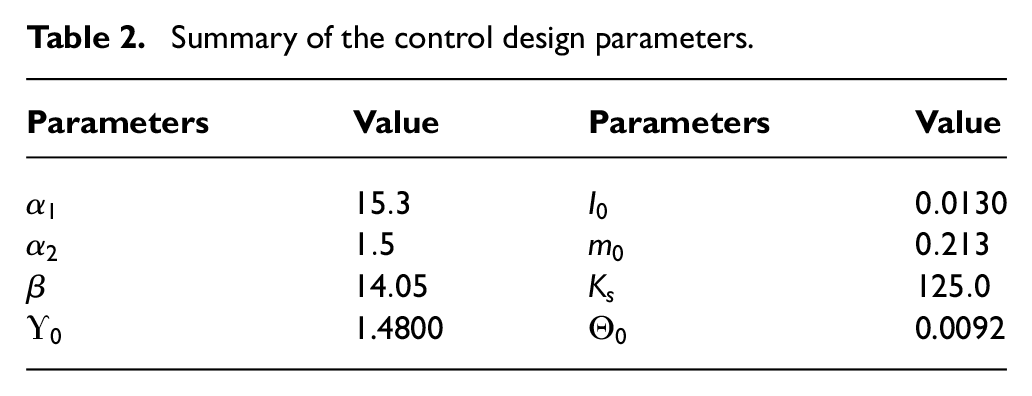
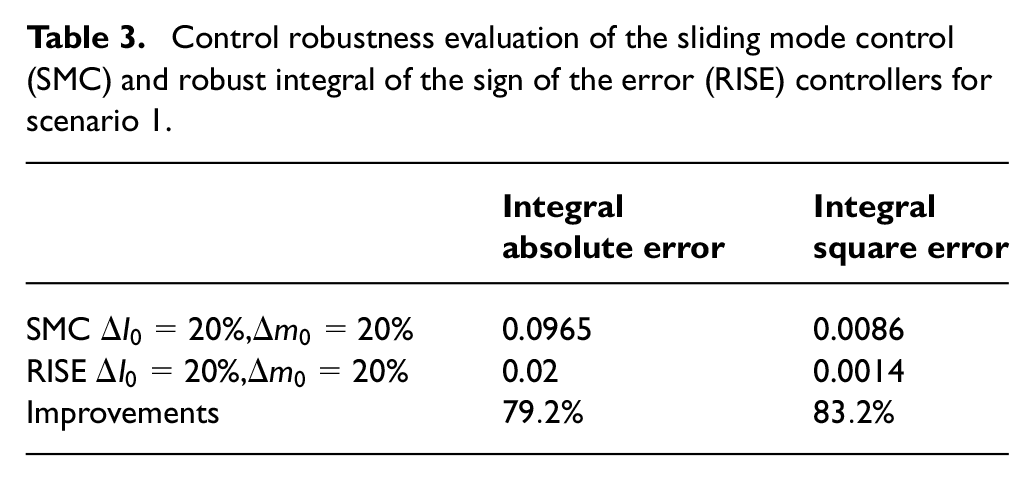
In this subsection the obtained simulation results of the first scenario are presented and discussed. We chose the initial configuration as

Obtained simulation results for scenario 1 – robustness towards parametric uncertainties: (a) pendulum angular position; (b) pendulum angular velocity; (c) velocity of the inertia wheel; (d) control input.
Control robustness evaluation of the sliding mode control (SMC) and robust integral of the sign of the error (RISE) controllers for scenario 1.
Scenario 2: External disturbances rejection
The first considered perturbation is a non-sinusoidal sawtooth disturbing torque equal to [0.3 Nm] applied to the pendulum at time
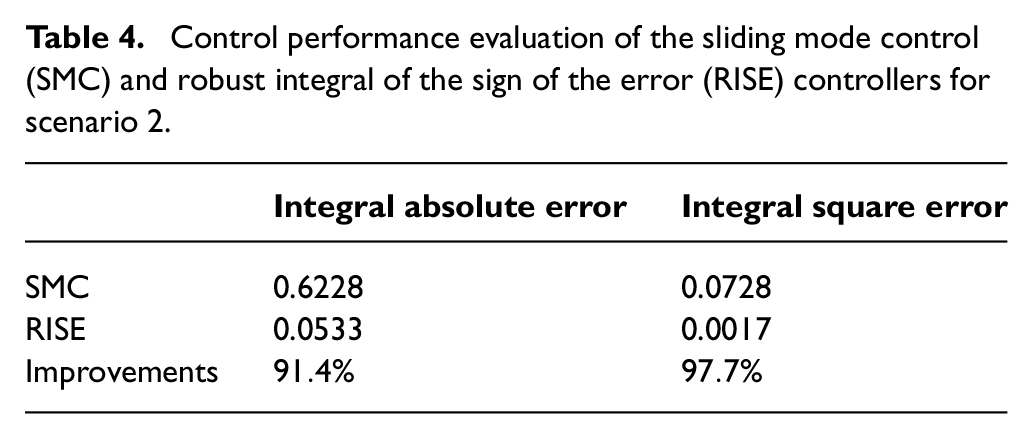
The simulation results of the second scenario are displayed in Figure 4, where we can see the effect of the disturbances in the evolution of the states. The proposed original RISE controller reacts immediately to these disturbances and brings back the states to the desired equilibrium point. The deviation due to the external disturbances is compensated for by the control action. The numerical simulation shows the effectiveness of the proposed control approach compared to the SMC especially when the system is subject to the first non-sinusoidal and periodic disturbance. The performance of the proposed control approach is improved by more than 90% as illustrated in Table 4. In the next section, we discuss the performance of the proposed controller through real-time experiments.

Obtained simulation results for scenario 2: (a) pendulum angular position; (b) pendulum angular velocity; (c) velocity of the inertia wheel; and (d) control input and disturbing signal.
Control performance evaluation of the sliding mode control (SMC) and robust integral of the sign of the error (RISE) controllers for scenario 2.
Real-time experimental results
To validate that the performance of the proposed RISE control approach complied with the Levant differentiator, real-time experiments have been performed on the testbed of the IWIP designed at the Montpellier Laboratory of Computer Science, Robotics, and Microelectronics of the University of Montpellier and the National Center for Scientific Research, France (www.lirmm.fr). The electrical and mechanical components of the experimental testbed are shown in Figure 5, for more details about the experimental platform, the readers can refer to Andary et al. (2009), Touati and Chemori (2013), Haddad et al. (2018) and Hfaiedh et al. (2020b).

View of the inertia wheel inverted pendulum experimental testbed.
The proposed observer-based RISE control, the original RISE and the SMC are compared in nominal case.
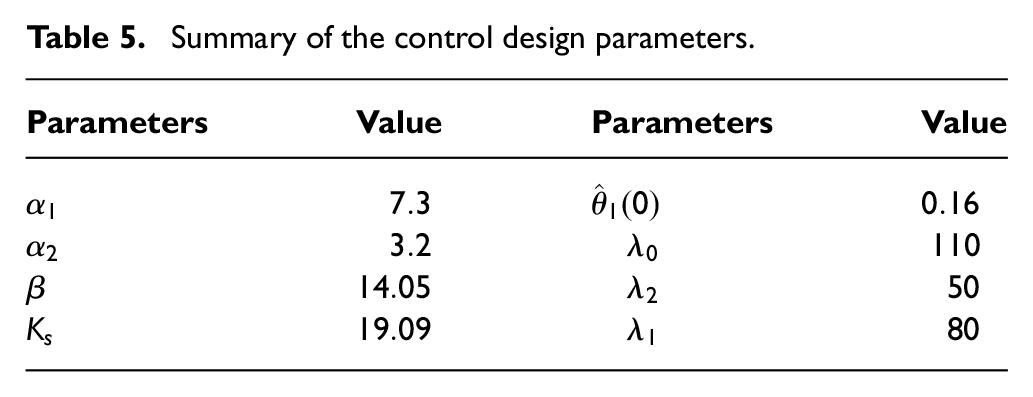
In the second scenario, we consider persistent external disturbances. The control design parameters are summarized in Table 5. In order to analyse the control performance and to highlight the improvement gained by using the Levant differentiator in terms of tracking error, let us consider the following evaluation indices:
The root mean square of the tracking error (RMSE) as given by Equation (75):
where
Summary of the control design parameters.
We consider the following input-torque-based criterion in order to analyse the performance of the system in terms of energy consumption as given by Equation (76):
where
Scenario 1: Nominal case
In this subsection, we present the results of both the SMC, the RISE controller using numerical derivative as well as the obtained results of the proposed extended RISE controller combined with the Levant differentiator. The evolution of the angular position

Obtained experimental results for the first scenario – nominal case: (a) pendulum angular position; (b) pendulum angular velocity; (c) zoomed-in view of pendulum angular position; and (d) zoomed-in view of pendulum angular velocity.
The evolution of the control input for the three controllers and the auxiliary error

Evolution of the control input and the auxiliary error
Although the standard RISE controller ensures a good stabilization of the system, the use of the Levant differentiator leads to an attenuation of noise in the velocity estimation resulting in a smoother control input signal, opposed to the use of a numerical derivative which amplifies any embedded noise in the measurement signals. This noise is due, for instance, to some interferences from other electrical sources, hardware, sensors or environment.
To sum up, the real-time experimental results illustrate clearly that the original RISE and the proposed observer-based RISE approach outperform the SMC in terms of convergence. On the other hand, the Levant differentiator provides a better real-time estimation of the velocity than the numerical derivative.
To compare the effectiveness of the three approaches, we suggest computing the above performance-evaluation indices. The obtained results are summarized in Table 6. The improvements are computed with respect to the SMC approach. Note that, the smallest value of the performance criteria reflects the best performance. This scenario shows clearly that both the proposed observer-based RISE control scheme and the original RISE control one overcome the SMC in terms of convergence and energy consumption. It can be concluded from the obtained results that the RISE controller without differentiator provides satisfactory results. However, the proposed control scheme has the best performance evaluation indices and improvement compared to the standard RISE approach, thanks to the Levant differentiator.
Quantification of the performance through different evaluation criteria for scenario 1.

Scenario 2: Persistent disturbances rejection
The main motivation behind the second scenario is to show the effectiveness of the control approach when the system is under a more complex and more challenging type of disturbances. It consists of two persistent forces generated through an additional mass attached to the pendulum body. The mass was attached during the interval

Illustration of persistent disturbances.

Obtained experimental results for scenario 2 – rejection of persistent perturbations: (a) pendulum angular position; (b) pendulum angular velocity; (c) velocity of the inertia wheel; and (d) control input.
Quantification of the performance through different evaluation criteria for scenario 2.

Conclusion and future work
This paper proposes two robust RISE control approaches for the stabilization of class I of UMSs. For the design of the RISE controller, the model of the system is first transformed into a SF form. With a Lyapunov-based analysis, two new desired trajectories are defined. Then the stability analysis of the resulting closed-loop system and simulation results for different operating conditions were addressed. They attest clearly that the first proposed RISE control approach ensures better stabilization and robustness towards different parametric uncertainties and external disturbances, compared to the SMC approach. However, the limitation of this approach was experimentally noticed through the amplified noise, resulting from the numerical derivative action in the control law. To overcome this problem, a Levant differentiator was proposed and implemented to estimate the system states, including the time derivative of the angular position. Based on the obtained experimental results and further analysis based on some performance-evaluation indices, the combination of Levant differentiator with RISE controller has significantly attenuated the effect of the noise included in the measured signals and improved the performance in terms of tracking error and energy consumption, compared to original RISE and SMC schemes. In future work, various possible perspectives of this work can be investigated. At first, we can combine an adaptation law with the RISE controller to estimate the gains. Furthermore, the automatic optimal tuning of the control design parameters of the controller can also be considered. Finally, further discussions can be investigated about the generalization of this study to the case of other classes of UMSs.
Footnotes
Declaration of conflicting interests
The author(s) declared no potential conflicts of interest with respect to the research, authorship, and/or publication of this article.
Funding
The author(s) received no financial support for the research, authorship, and/or publication of this article.
