This paper studies the cooperative output containment control of the heterogeneous linear discrete-time descriptor multi-agent systems based on the output regulation theory. First, the output containment control problem is transformed into a standard cooperative output regulation problem. Second, since only a portion of the followers can directly obtain the information of the leaders, a new distributed observer is designed for each follower to estimate the combinations of the leaders’ states by using the local state containment errors. Third, two types of distributed control algorithms, as well as the corresponding sufficient conditions, are provided to ensure the achievement of the output containment control. Finally, numerical simulation results illustrate the validity of the proposed method.
Multi-agent systems (MASs) have been used in a variety of practical applications, such as path planning of small- or medium-sized unmanned aerial vehicles (UAVs) (Aggarwal and Kumar, 2020), tracking control of autonomous underwater vehicles (Zhang et al., 2020), and formation control of UAVs (Dong et al., 2015). Their widespread application has aroused the attention and interest in cooperative control problems of MASs, which aims to make all agents achieve a desired cooperative behavior, such as consensus, cooperative tracking, and formation. Containment control problem is a special cooperative tracking problem with multiple leaders, the purpose of which is to design the distributed control algorithms such that the followers could converge into the convex hull formed by the leaders eventually. The theory of containment control has been applied in many fields, such as driverless cars, urban traffic management systems, and robot formation.
In the past few years, many excellent results have been obtained for the containment control problem. In Ji et al. (2008), a hybrid Stop-Go control method was proposed, which can derive the follower-agents to a given target destination. On account of the directed and/or switching communication topology in physical systems, the results in Ji et al. (2008) were generalized to the case of fixed/switching directed communication network, where the Lyapunov method was adopted to the analysis (Cao et al., 2012). In Haghshenas et al. (2015a), the containment control problem was studied for a group of non-identical and nonlinear agents, and the distributed adaptive controllers were designed to achieve the containment motions. Furthermore, one novelty of Haghshenas et al. (2015a) lies in that a new kind of containment error was developed based on matrix. In Wang et al. (2017), the adaptive containment control problem was further addressed under the case that the leaders have nonzero and time-varying inputs. In Zou and Xiang (2019), the event-triggered containment control problem was investigated for a group of second-order nonlinear agents, where the distributed containment protocols were designed based on the non-smooth analysis, and the event-triggered conditions were presented to exclude the Zeno behaviors. In addition, the scenario of unbounded communication delays was considered in Shen and Lam (2016), and the containment convergence was analyzed by transforming the containment problem into the stability problem of an associated error system. Recently, as a real application, a finite-time fault-tolerant containment control protocols were obtained based on the nonsingular faster terminal sliding-mode method, which can derive the states of multiple ocean bottom flying nodes converge to the sliding surface in finite time (Qin et al., 2020).
Output regulation theory can be employed to achieve asymptotic tracking and/or disturbance attenuation of a class of autonomous system (also called exosystem) (Huang, 2004). To date, there have been many results of the cooperative control for MASs under the distributed output regulation framework, such as leaderless output synchronization based on internal model principle in Wieland et al. (2011), output consensus of MASs with structural uncertainties in Li et al. (2015), event-triggered cooperative robust practical output regulation in Liu and Huang (2017), and adaptive cooperative output regulation in Liu and Huang (2018). In recent years, output regulation-based containment control has also become an important issue in MASs (relevant work can be found in Chu et al., 2015; Haghshenas et al., 2015b; Li et al., 2019; Liang et al., 2017; Yuan et al., 2018; Zou and Xiang, 2017; Zuo et al., 2017a, 2017b). In Haghshenas et al. (2015b), the containment control problem for heterogeneous linear MASs was studied by resorting to the containment error presented in Haghshenas et al. (2015a). The similar problem was also considered in Chu et al. (2015) with the adaptive design and the dynamic compensator techniques. Furthermore, Zou and Xiang (2017) proposed the event-triggered containment control protocols. In these works, the containment error was defined based on the neighbor state information and the feedforward-based output regulation method was adopted. Very recently, the output containment control problem and optimal robust output containment problem were investigated for heterogeneous linear MASs in Zuo et al. (2017a, 2017b) using internal model principle, respectively, where the agents may have different dynamics and state dimensions, and the small gain theorem was applied to ensure the global asymptotic stability. In addition, the containment control problem was formulated as several independent stabilization sub-problems in Yuan et al. (2018), and the distributed controller synthesis conditions were eventually obtained by convex optimization. For containment control of discrete-time MASs, Liang et al. (2017) presented a dynamic output feedback containment controller based on a distributed discrete-time compensator and a distributed internal model compensator. Moreover, Li et al. (2019) adopted the power series approach to address the complex regulator equations encountered in nonlinear discrete-time MASs.
Descriptor system is a more natural representation of the real world (Yip and Sincovec, 1981), which has attracted more and more researchers to conduct research deeply on the consensus and cooperative tracking problems of descriptor MASs (Gao et al., 2020; Lu et al., 2019; Yang and Liu, 2012, 2014). The necessary and sufficient consensus conditions for descriptor MASs were provided in Yang and Liu (2012). By introducing the dynamic compensators, the similar consensus problem of descriptor MASs was dealt with in Yang and Liu (2014). The guaranteed-performance consensus of nonlinear descriptor MASs was further considered in Gao et al. (2020). The cooperative optimal preview tracking problem of descriptor MASs was investigated in Lu et al. (2019). In addition, some tracking consensus problems and containment control problems of descriptor MASs can be converted into the cooperative output regulation problems (e.g. Cong et al., 2018; Liang et al., 2020; Ma et al., 2015; Zhang et al., 2020). In particular, the distributed containment control problems of heterogeneous descriptor MASs were addressed based on feedforward control technique and internal model principle in Cong et al. (2018) and Liang et al. (2020), respectively. Furthermore, as a development of Ma et al. (2015) and Cong et al. (2018), Zhang et al. (2020) provided two kinds of distributed containment control strategies: state feedback control and reduced-order normal observer-based output feedback control.
Notice that the works of Cong et al. (2018) and Zhang et al. (2020) concentrated on the continuous-time setting and the state containment control problems. It turns out that the regulator equation and the distributed observer play an important role in designing a distributed dynamic control strategy based on feedforward output regulation approach. We are concerned in this paper with the output containment problem for discrete-time descriptor linear MASs under a directed communication topology. Compared with state containment control of continuous-time heterogeneous singular MASs (Zhang et al., 2020), there exist two challenges for addressing the concerned problem in this paper.
First, output containment control requires more complicated generalized output regulator equation than that for state containment problem. Moreover, the existence and computation of the solution associated with the regulator equation are two important problems in the application of distributed feedforward output regulation theory to output containment control.
Second, when using feedforward output regulation approach to deal with the distributed containment problem, a distributed observer is always needed to asymptotically estimate the convex combination of the leaders’ states. In Zhang et al. (2020), the distributed observer for continuous-time singular MASs exists provided that the observer coupling gain is sufficiently large. We consider its discrete counterpart and deduce the sufficient conditions for achieving asymptotical estimation, which can be found in Remark 3. However, it can be observed that a sufficiently large observer coupling gain is not suitable for discrete-time case. Besides, the modulus of the eigenvalues corresponding to the communication matrix are greater than a certain value, which may limit the chosen of communication weights. Moreover, although previous studies have also done good jobs for designing discrete distributed observer to estimate leaders’ states (e.g. Li et al., 2019; Liang et al., 2017), the results in Li et al. (2019) were only applied for the scenario that the state matrix of the exosystem is neutrally stable, and Liang et al. (2017) required that the spectrum of communication matrix is a subset of the given region, which is similar to the results presented in Remark 3.
Corresponding to the above difficulties and challenges, this paper has two new features:
According to the restricted system equivalent relations, a sufficient condition is given to guarantee the existence of the solution, meanwhile a constructive method is also presented to calculate it.
A new discrete distributed observer is proposed for each follower, with the help of the discrete modified algebraic Riccati equation and two free parameters, it is proved that the above-mentioned limitation subjected to discrete distributed observer can be relaxed.
Notations: and denote the set of real matrices and complex matrices, respectively. denotes the Euclidean norm of a vector . denotes the Kronecker product of matrices and . means a column vector with all the elements equal to . denotes the eigenvalues set of a matrix. represents the real part of . Moreover, let .
Preliminaries and problem formulation
Basic concepts of the graph
In this paper, a directed graph (digraph) is used to model the information interaction among the agents. A digraph is an ordered pair , that is , where represents a vertex set, and means an arc set. An arc from to is denoted by . For , is a neighbor of . If a digraph contains a finite nonempty sequence without the same vertices and arcs, then is called a directed path from to , where . A vertex that exists at least one directed path to other vertices and has no neighbor in a digraph is called the root. A digraph contains a spanning tree if there exists a root in .
For a digraph with vertices, the adjacent matrix is defined as , where if , otherwise . The degree matrix is defined as with and (). The Laplacian matrix is defined as . Here, we assume that all the leaders have no neighbor; therefore, can be divided as follows:
Moreover, the symbols and are used to denote the sets of followers and leaders, respectively. For the digraph , the following assumption is made.
Assumption 1. For each follower in digraph , there exists at least one leader having a directed path to that follower.
Lemma 1. (Cao et al., 2012) Let Assumption 1 hold, then, all the eigenvalues of have positive real parts, each element of is non-negative, and every row sum of is 1.
Basic results of descriptor linear system
Denote a discrete-time descriptor linear system as
where , , and represent the state, control input, and measurable output, respectively. is singular with .
For system (2), the following results are required.
(i) The pair is regular if is not identically zero.
(ii) The pair is causal if .
(iii) The pair is stable if .
(iv) The pair is admissible if it is regular, causal, and stable.
Lemma 2. (Dai, 1989) The system (1) is regular and causal if and only if the following condition holds
Lemma 3. (Dai, 1989) The necessary and sufficient conditions for the R-controllability and R-observability of system (1), respectively, are
Lemma 4. (Gao et al., 2016) Suppose that is regular and causal, and is R-controllable. Then for any given positive definite matrices and , there exists a constant , such that the modified discrete-time generalized algebraic Riccati equation
has at least one positive semi-definite solution for any given .
Remark 1. Under the conditions given by Lemma 4, if the gain matrix is chosen as , then there exists feedback control law such that is admissible.
Problem formulation
The dynamic behavior of each follower is described by the following descriptor state space equation:
where , , , and ; , , and represent the state, control input, and measurable output of th follower, respectively. Here, is assumed to be singular with .
The output signal of each leader (also called exosystems) is generated by the following linear autonomous systems:
where and express the state and the output of th leader, respectively.
Definition 2. A set is convex if , for any and . The convex hull of a finite set of points is defined as
which is the minimal convex set containing all the points in .
Based on convex hull, we give the definition of output containment control of descriptor MASs (4).
Definition 3. For the heterogeneous descriptor MASs (4) and the exosystems (5), find a distributed control algorithm for each follower such that the followers’ outputs converge to the convex hull formed by those of the leaders, or equivalently, the output containment control is achieved.
Since the outputs of the leaders are not available for all the followers, the local containment errors for each follower is defined as
Let
Then, equation (6) can be organized as the following compact form:
It follows from Lemma 1 that is nonsingular under Assumption 1, therefore,
Note that each row sum of is 1, if holds, then the descriptor MASs (4) can achieve the output containment control with respect to the exosystems (5).
In the following, we list some assumptions about descriptor MASs (4) and exosystems (5).
Assumption 2. is regular and causal for any .
Assumption 3. is R-controllable and is R-observable, for any .
Assumption 4. All the eigenvalues of matrix are not located in the unit circle of the complex plane.
Assumption 5. For any , the following rank condition holds
Remark 2. In Assumption 2, the regularity of guarantees the existence of the solution of the system (3). The R-controllability of and R-observability of in Assumption 3 can be utilized to determine the gain matrices of the distributed controllers and distributed observers. Assumptions 4 and 5 are standard in output regulation theory of descriptor systems.
To solve the output containment problem by output regulation theory, as shown in Huang (2004), it is necessary to discuss the sufficient conditions for the generalized output regulator equations and the existence of their solutions. Based on Assumptions 2 and 5, we have the following lemma.
Lemma 5. For matrices , , , and with appropriate dimensions, if Assumptions 2 and 5 hold, the following generalized output regulator equation
exists solutions , .
Proof. If is regular and causal, then according to Dai (1989), there exist non-singular matrices and satisfying
First, using and to perform the elementary transformation for the matrices in rank condition (9) yields
Second, multiplying the second column of by and adding it to the third column gives
Finally, for the right matrices of the above formula, multiplying the second row by and adding it to the third row gets
According to the property that elementary transformation of a matrix does not change the rank, therefore equation (9) is equivalent to
that is
where . Under the above rank condition, if Assumption 4 holds, then it follows from Huang (2004) that the following regulator equation
exists unique solution , . Furthermore, equation (12) can be reorganized as
Obviously, the equation (14) is just the generalized output regulator equation (10). The conclusion of Lemma 5 is proved.
Let , , ,, , , then equation (10) can be organized into the following compact form
Before proceeding further, we also need the following two lemmas.
Lemma 6. (Sinopoli et al., 2004) If is detectable, and are symmetric positive definite, is unstable, then there is a that makes the following modified algebraic Riccati equation
has a positive definite matrix for a given , in which
Lemma 7. If is admissible and asymptotically converges to , then the discrete-time descriptor linear system
is asymptotically convergent.
Proof. If is admissible, then there exist nonsingular matrices and such that
where is Schur (stable) (Dai, 1989). Carry out a linear nonsingular transformation for the system (17), which is equivalent to
where . Expanding them gives
Note that is Schur. Moreover, it is easy to test that (asymptotically) as . Hence, by Lemma 1 of Liu and Huang (2018), the asymptotical stability of equation (18) can be obtained immediately. According to equation (19), satisfies
Since is a constant, the asymptotical stability of will completely depend on , which implies that also converges to zero asymptotically.
From the asymptotical stability of and , as well as
it can be seen that the zero solution of equation (17) is asymptotically stable, then the proof is completed.
Main results
The output containment control can be achieved by two steps: distributed observer design and distributed dynamic controller design.
Distributed observer
When solving the output regulation problem, the state of the exosystem is usually required to be measurable (Huang, 2004). But in the digraph , not every follower can directly obtain all the information of the leaders’ states, which requires the follower to estimate the leaders’ states based on its neighbor information. Assuming that the observer’s state of each follower is , similar to the equation (6), we give the following estimation error of the leaders’ states for each follower:
Denote
then the equation (20) can be rewritten as the following compact form:
Let , since each row sum of is 1, the convex hull can be described by the set and all the elements in each row of the matrix . If the designed observer makes hold, then can realize the estimation of a convex combination . Furthermore, based on , we propose the following distributed observer
where and are free parameter and observer gain to be designed later, respectively. Based on Lemma 6, the following conclusion is obtained.
Lemma 8. Under Assumptions 1 and 2, suppose that the eigenvalues of are written as , where represents the units of imaginary numbers, . Select , if satisfies
and belongs to the set
with
then for any initial states ,
asymptotically. Moreover, and are defined in (16).
Proof. Note that the equation (22) can be expressed as
According to the analysis of the equation (21), if we can prove , then the lemma follows immediately. Hence, we have
Choosing the coordinate transformation as , where is a nonsingular matrix, which makes be similar to , where is the Jordan canonical matrix of . Consequently, we obtain
Note that is an upper triangular matrix; therefore, the stability of the system (28) is determined by the stability of , where are the eigenvalues of matrix . Thereupon, under the conditions given by the theorem, the following only needs to prove that the system
is asymptotically stable.
Note that a matrix has the same eigenvalues as its transpose, so the system (29) has the same asymptotic stability as
With the help of the modified algebraic Riccati equation (16) in Lemma 6, the Lyapunov function candidate can be defined as
It can be easily observed that is positive definite from . Taking the difference of along the trajectory of the systems (30), we have
where is defined in Lemma 6, and represent the maximum and minimum eigenvalues of the matrices and , respectively. Let
Hence, if there exists a domain of such that all of the hold, then we have and thereby .
For a given , observing that , by using the basic properties of quadratic function, if satisfies the inequality (23) and belongs to the set defined in equation (24b), then hold. Furthermore, if belongs to the intersection , then will hold for any . Thereafter, the asymptotic stability of the systems (28) is ensured. Furthermore, by the non-singularity of the matrix , it can be obtained that as . Therefore, the conclusion is proved.
Remark 3. Zhang et al. (2020) considered a distributed observer of the following form:
where denotes the state of the observer, is coupling gain and is feedback gain matrix. The discrete counterpart of (31) is
According to Lemma 6, take , where satisfies the algebraic Riccati equation
with , , and .
Similar to the proof used in Lemma 8, we show that under Assumptions 1 and 2, if
and
then can estimate the convex combination of the leaders’ states asymptotically.
with . That is to say, the distributed observer (32) works under the conditions (35) and (36). However, the inequality (36) shows that the eigenvalues of the communication matrix have a bound. Therefore, if condition (34) does not hold, of the matrix will be readjusted, which further means communication weights among agents are limited. In contrast with the distributed observer (32), we use the detectability of to construct the observer (22), and with the aid of the modified algebraic Riccati equation (16), the parameter is introduced, which adds additional design freedom to relax the limitation for communication weights. This increases the scope of the application of the new observer to a certain extent.
Distributed dynamic controllers
In this subsection, two distributed controllers are proposed based on the distributed observers (22).
First, in the case that can be directly measured, the distributed dynamic state feedback controller is designed as follows
For any proper , is given by
where is the solutions of the generalized output regulator equation (10).
Second, if cannot be measured directly, then the distributed controller (31) will not work. Therefore, it is necessary to design an observer for each follower to estimate asymptotically. Based on the controller (37), the distributed dynamic output feedback controller is designed
Theorem 1. Under Assumptions 1–5, if
(a) , , where is positive semi-definite solution satisfying the generalized algebraic Riccati equation
Here, and are positive definite matrices, , ;
(b) , where is the solution of the generalized output regulator equation (10);
(c) Distributed observer gain is taken as , where is the positive definite solution of the modified algebraic Riccati equation (16);
(d) and are the parameters satisfying inequality (23) and the set (24), respectively, then the distributed dynamic state feedback controllers (37) can make the descriptor MASs (4) achieve the output containment control associated with the exosystems (5).
Proof. Under Assumptions 2 and 5, the generalized output regulator equation (10) holds and exists solution . Based on condition (b), substituting the distributed dynamic state feedback controller (37) into the descriptor MASs (4) gives
Let , then we obtain the following closed-loop system
By performing the coordinate transformation for the system (42), we have
With the equation (15) and , we can also rewrite them as
According to Lemma 4 and Remark 1, if condition (a) holds, then , as well as , is admissible. In addition, it follows from Lemma 8 that asymptotically under conditions (c) and (d). Hence, by Lemma 7, we obtain that converges to zero asymptotically. Note that is a constant matrix, then will also tend to zero asymptotically. This, together with the analysis of equation (8), implies the achievement of the output containment composed of the descriptor MASs (4), the exosystems (5), and the distributed dynamic state feedback controller (37). The proof is completed.
Theorem 2. Under Assumptions 1–5, if
(a) , , where is the positive semi-definite solution satisfying the generalized algebraic Riccati equation (40);
(b) , , where is the positive semi-definite solution satisfying the generalized algebraic Riccati equation
and and are definite matrices;
(c) , where is the solution of the generalized output regulator equation (10);
(d) Distributed observer gain is taken as , where is the positive definite solution of the modified algebraic Riccati equation (16);
(e) and are the parameters satisfying inequality (23) and the set (24), respectively, then the distributed dynamic output feedback controller (39) can make the descriptor MASs (4) achieve the output containment control associated with the exosystems (5).
Proof. Note that the second equation in (39) represents a descriptor state observer, which is designed to estimate . Let
then
By dual principle, if is observable, then is controllable. Hence, under Assumptions 2 and 3, it follows from Lemma 4 that the generalized algebraic Riccati equation (44) exists positive semi-definite solution. With defined in condition (b), is guaranteed to be admissible, which indicates that the descriptor state observer can be utilized to realize the estimation of .
Let . Parallel to the proof of Theorem 1, by combining equations (39) and (4) and doing a series of coordinate transformation, the following closed-loop system can be derived
Let . It can be easily verified that will decay to asymptotically. Similar to the discussion of the system (43), under the given conditions, we can obtain , which means the achievement of the output containment control. The proof is completed.
Remark 4. According to Lemma 3 in Gao et al. (2016), with the help of the formula (11), the solution of the generalized algebraic Riccati equation (40) can be constructed as , where is the positive definite solution of the following reduced-order algebraic Riccati equation
with . Furthermore, for convenience, are taken as 1 in the simulation part.
Remark 5. In Theorems 1 and 2, the feedforward gains depends on the solution of the generalized output regulator equation (10). The proof of Lemma 5 provides a reduced-order method to construct the solution pair . In fact, if the dimensions of the MASs (4) become high or there are more agents in the communication network, then the reduced-order output regulator equation (12) and can be employed to decrease the calculation complexity significantly, where is defined in equation (11). However, if not, there also exists another direct method to solve them. Rewrite the equation (10) as
Using the property of the vectorizing operator in Huang (2004), the formula (48) becomes
with
According to Assumption 5, it is not difficult to verify that have full row rank; therefore, the linear equation (49) has a solution based on the least square algorithm.
Remark 6. In Lemma 8, we can apply the following iterative formula to obtain the solution of the modified algebraic Riccati equation (16)
Moreover, it is better to take the value of from the side close to , where , , is defined in Sinopoli et al. (2004). By substituting the chosen into the equation (50), we also need to check if exceeds the given bound (23) based on the obtained solution . This is very important since it decides whether there exists the set defined in equation (24a) or not.
Numerical simulation
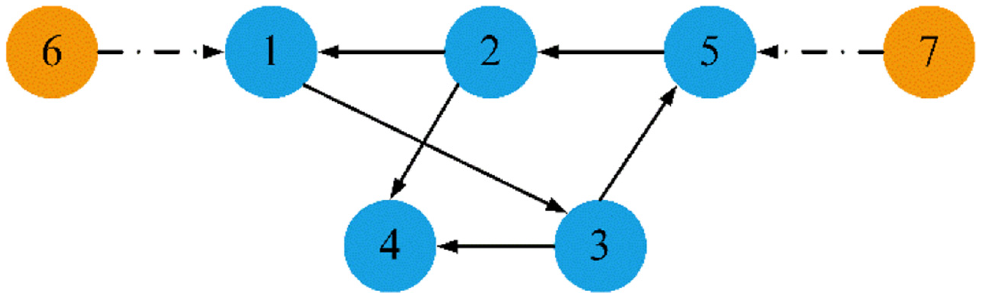
In this section, the validity of the distributed controllers (31) and (33) are demonstrated by the simulation results. Consider MASs with two leaders and five followers; the communication topology associated with these agents is presented in Figure 1.
The communication topology of the MASs.
The Laplacian matrix is described as follows
Correspondingly, according to equation (1), and are obtained
The coefficient matrices of the descriptor MASs (4) and the exosystems (5) are selected as
By Lemmas 2 and 3, it can be verified that the system dynamics of the followers are regular, causal, R-controllable, and R-observable. In addition, the eigenvalues of satisfy Assumption 4 and further calculations show that the rank conditions in Assumption 5 are satisfied. The following is the specific simulation process.
First, selecting and , solving the reduced-order algebraic Riccati equations (41) and using get
Furthermore, based on , , we have
Second, choosing and , where denote the elements in the first row and first column of the matrices . Then, similar to the procedure in the first step, we can obtain as follows
Third, utilizing the method in Remark 5, the solution pairs are computed as
According to the solutions and the feedforward gains are given as
Finally, the eigenvalues of the matrix are 1, according to Remark 6, we have . Choosing , , , and using the iterative scheme (50) yield
The eigenvalues of the matrix are 0.8, 0.3762, , 1.4946. Simple calculation gives that
Therefore, it follows from equation (23) that the chosen is suitable. Based on , the distributed observer gain is obtained as
Furthermore, utilizing , the intersection can be computed as follows:
The admissible initial states of the descriptor MASs (4) and the full dimensional state observers (39) are, respectively, taken as
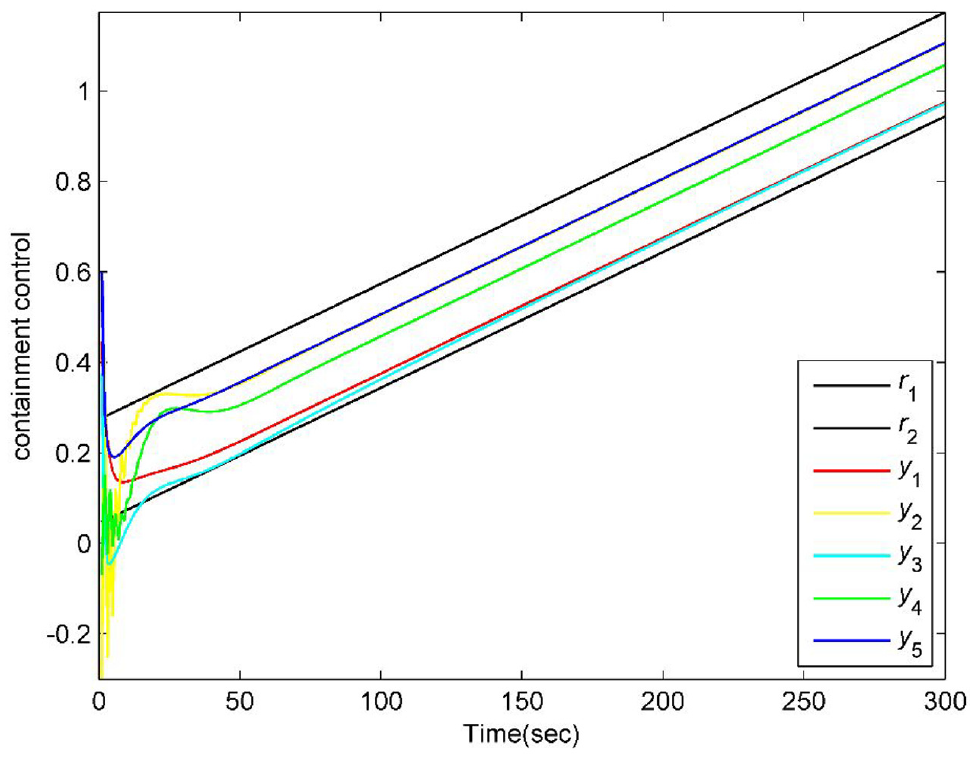
By the simulation method proposed in Liao et al. (2017), the numerical simulation is performed with . Figures 2 and 3 show the output containment behaviors under the distributed dynamic state feedback controller (37) and distributed dynamic output feedback controller (39), respectively.
Output containment trajectories under distributed dynamic state feedback controller (37).
Output containment trajectories under distributed dynamic output feedback controller (39).
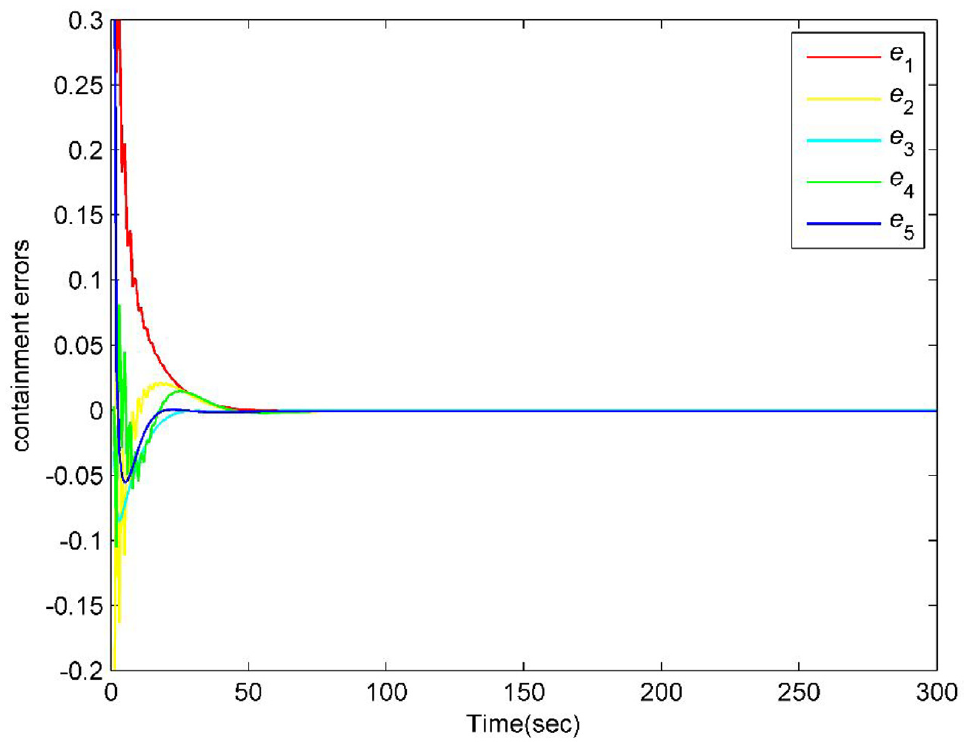
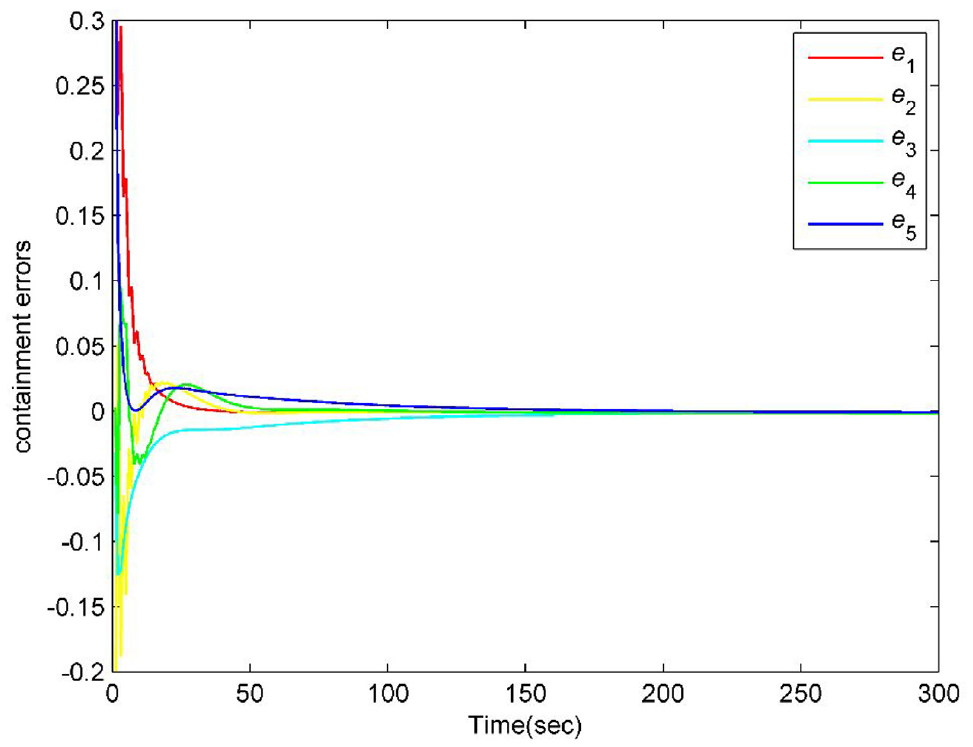
Figures 4 and 5 depict the time evolution of the output containment errors under different distributed dynamic controller. It is straightforward to see that all the output containment errors converge to zero asymptotically, which means that two kinds of distributed dynamic controllers are able to achieve the output containment control.
Output containment errors under distributed dynamic state feedback controller (37).
Output containment errors under distributed dynamic output feedback controller (39).
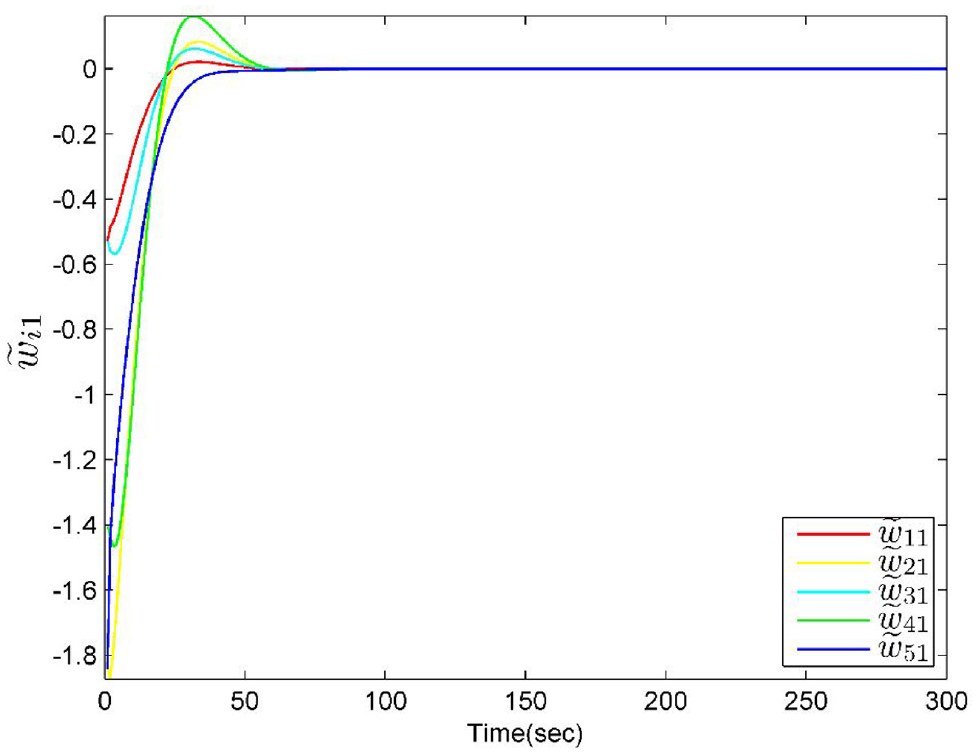
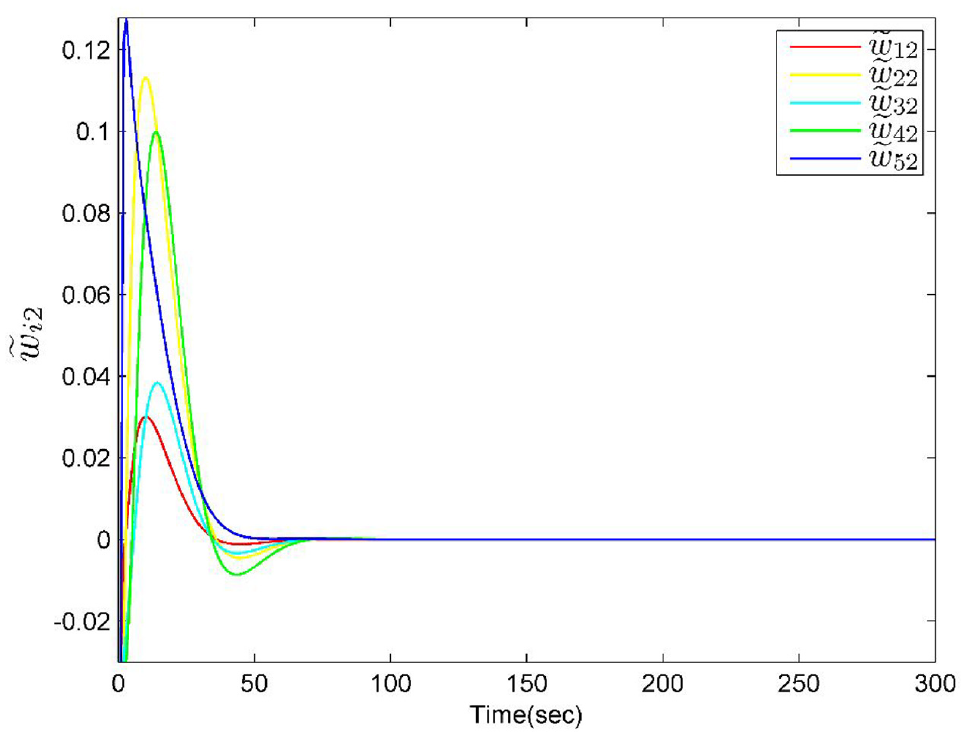
Figures 6 and 7 plot the estimation errors of the distributed observer (22), where and are the components of . With Remark 3, we know that the asymptotical estimation of the distributed observer (32) can be achieved if
and
hold. However, with communication matrix , , , the domain of is empty by calculation, which means the distributed observer (32) cannot work for this occasion. To corroborate the theoretical advantages of the proposed distributed observer, we adjust the communication weights according to , and choose the following new communication matrix
Correspondingly, according to equation (1), and can be obtained as
Estimation errors of the distributed observer (22) under communication matrix .
Estimation errors of the distributed observer (22) under communication matrix .
The eigenvalues of are 1.6000, 0.4408, 1.6647, .
For distributed observer (22), solving the modified algebraic Riccati equation (16) with , , , we have
For distributed observer (32), solving the algebraic Riccati equation (33) with and , then according to Remark 3, we obtain
Comparing the above two sets of results, we can find that:
Choosing such that the condition (23) holds is much easier than adjusting to satisfy the condition (34);
The domain of for the distributed observer (22) is significantly larger than that for the distributed observer (32). To further verify this observation, we repeat the simulation with different and . Tables 1 and 2 compare the domain of for two kinds of distributed observers, which clearly illustrates that the distributed observer (22) is easier to achieve the asymptotical estimation of combination of the leaders’ states.
Region of for distributed observers (22) and (32).
()
()
()
()
Distributed observer (22)
(0.4454, 1.0835)
(0.4462, 1.0833)
(0.4493, 1.0824)
(0.4527, 1.0815)
Distributed observer (32)
(0.8682, 0.9715)
(0.8825, 0.9678)
(0.9370, 0.9533)
empty
Region of for distributed observers (22) and (32).
()
()
()
()
Distributed observer (22)
(0.4505, 1.0821)
(0.4459, 1.0833)
(0.4454, 1.0835)
(0.4453, 1.0835)
Distributed observer (32)
empty
(0.8773, 0.9691)
(0.8677, 0.9717)
(0.8667, 0.9719)
Conclusion
The distributed output containment control problem of linear discrete-time descriptor MASs has been addressed by using the feedforward-based output regulation approach. Through introducing two free parameters, a novel distributed observer has been established for every follower to estimate the convex combination of the leaders’ states asymptotically. On this basis, two distributed dynamic controllers have also been derived to achieve the output containment control. For future research, notice that communication delays and input delays may exist in networked control systems (Chu et al., 2020, 2021a, 2021b; Deng et al., 2020); it would be interesting to extend this result to the discrete descriptor MASs with communication delays and input delays. Moreover, to investigate the problem for discrete descriptor MASs with different dimensions is also a meaningful topic.
Footnotes
Declaration of conflicting interests
The author(s) declared no potential conflicts of interest with respect to the research, authorship, and/or publication of this article.
Funding
The author(s) disclosed receipt of the following financial support for the research, authorship, and/or publication of this article: This work is partially supported by the Fundamental Research Funds for the Central Universities (FRF-TP-18-101A1), the Science-Technology Foundation for Young Scientist of Gansu Province (Grant No.21JR7RA246), the National Natural Science Foundation of China (62003033, 61863026, 61751315), and the Guangdong Basic and Applied Basic Research Foundation (2019A1515111141).
ORCID iDs
Yanrong Lu
Liang Qiao
References
1.
AggarwalSKumarN (2020) Path planning techniques for unmanned aerial vehicles: A review, solutions, and challenges. Computer Communications149: 270–299.
2.
CaoYRenWEgerstedtM (2012) Distributed containment control with multiple stationary or dynamic leaders in fixed and switching directed networks. Automatica48(8): 1586–1597.
3.
ChuHGaoLZhangW (2015) Distributed adaptive containment control of heterogeneous linear multi-agent systems: An output regulation approach. IET Control Theory and Applications10(1): 95–102.
4.
ChuHGaoLYueD, et al. (2020) Consensus of Lipschitz nonlinear multiagent systems with input delay via observer-based truncated prediction feedback. IEEE Transactions on Systems, Man, and Cybernetics: Systems50(10): 3784–3794.
5.
ChuHYueDDouC, et al. (2021a) Consensus of multiagent systems with time-varying input delay and relative state saturation constraints. IEEE Transactions on Systems, Man, and Cybernetics: Systems51(11): 6938–6944.
6.
ChuHYueDDouC, et al. (2021b) Consensus of multiagent systems with time-varying input delay via truncated predictor feedback. IEEE Transactions on Systems, Man, and Cybernetics: Systems51(10): 6062–6073.
7.
CongYFengZSongH, et al. (2018) Containment control of singular heterogeneous multi-agent systems. Journal of the Franklin Institute355(11): 4629–4643.
8.
DaiL (1989) Singular Control Systems. New York: Springer.
9.
DengCErMYangG, et al. (2020) Event-triggered consensus of linear multiagent systems with time-varying communication delays. IEEE Transactions on Cybernetics50(7): 2916–2925.
10.
DongXYuBShiZ, et al. (2015) Time-varying formation control for unmanned aerial vehicles: Theories and applications. IEEE Transactions on Control System Technology23(1): 340–348.
11.
GaoLCuiYChenW, et al. (2016) Leader-following consensus for discrete-time descriptor multi-agent systems with observer-based protocols. Transactions of the Institute of Measurement and Control38(11): 1353–1364.
12.
GaoZZhangHDuanJ, et al. (2020) Guaranteed-performance consensus for descriptor nonlinear multi-agent systems based on distributed nonlinear consensus protocol. Neurocomputing383: 359–367.
13.
HaghshenasHBadamchizadehMBaradaranniaM (2015a) Adaptive containment control of nonlinear multi-agent systems with non-identical agents. International Journal of Control88(8): 1586–1593.
14.
HaghshenasHBadamchizadehMBaradaranniaM (2015b) Containment control of heterogeneous linear multi-agent systems. Automatica54: 210–216.
15.
HuangJ (2004) Nonlinear Output Regulation: Theory and Applications. Philadelphia, PA: SIAM.
16.
JiMFerrari-TrecateGEgerstedtM, et al. (2008) Containment control in mobile networks. IEEE Transactions on Automatic Control53(8): 1972–1975.
17.
LiSFengGLuoX, et al. (2015) Output consensus of heterogeneous linear discrete-time multi-agent systems with structural uncertainties. IEEE Transactions on Cybernetics45(12): 2868–2879.
18.
LiSMaTLuoX, et al. (2019) Robust output regulation for containment control of heterogeneous discrete-time nonlinear multi-agent systems. International Journal of Systems Science50(13): 2459–2472.
19.
LiangHLiHYuZ, et al. (2017) Cooperative robust containment control for general discrete-time multi-agent systems with external disturbance. IET Control Theory and Applications11(12): 1928–1937.
20.
LiangHZhouYZhangH (2020) Containment control for singular multi-agent systems with an internal model compensator. Science China Information Sciences63(12): 229202.
21.
LiaoFXueZWuJ (2017) Design of an optimal preview controller for a class of linear discrete-time descriptor systems. Mathematical Problems in Engineering2017(2017): 1–9.
22.
LiuTHuangJ (2018) Adaptive cooperative output regulation of discrete-time linear multi-agent systems by a distributed feedback control law. IEEE Transactions on Automatic Control63(12): 4383–4390.
23.
LiuWHuangJ (2017) Event-triggered cooperative robust practical output regulation for a class of linear multi-agent systems. Automatica85: 158–164.
24.
LuYLiaoFDengJ, et al. (2019) Cooperative optimal preview tracking for linear descriptor multi-agent systems. Journal of the Franklin Institute356(2): 908–934.
25.
MaQXuSLewisF, et al. (2015) Cooperative output regulation of singular heterogeneous multiagent systems. IEEE Transactions on Cybernetics46(6): 1471–1475.
26.
QinHChenHSunY (2020) Distributed finite-time fault-tolerant containment control for multiple ocean bottom flying nodes. Journal of the Franklin Institute357(16): 11242–11264.
27.
ShenJLamJ (2016) Containment control of multi-agent systems with unbounded communication delays. International Journal of Systems Science47(9): 2048–2057.
28.
SinopoliBSchenatoLFranceschettiM, et al. (2004) Kalman filtering with intermittent observations. IEEE Transactions on Automatic Control49(9): 1453–1464.
29.
WangQFuJWangJ (2017) Fully distributed containment control of high-order multi-agent systems with nonlinear dynamics. Systems & Control Letters99: 33–39.
30.
WielandPSepulchreRAllgowerF (2011) An internal model principle is necessary and sufficient for linear output synchronization. Automatica47(5): 1068–1074.
31.
XuSLamJ (2006) Robust Control and Filtering of Singular Systems. Berlin: Springer.
32.
YangXLiuG (2012) Necessary and sufficient consensus conditions of descriptor multi-agent systems. IEEE Transactions on Circuits and Systems-I: Regular Papers59(11): 2669–2677.
33.
YangXLiuG (2014) Consensus of descriptor multi-agent systems via dynamic compensators. IET Control Theory and Applications8(6): 389–398.
34.
YipESincovecR (1981) Solvability, controllability, and observability of continuous descriptor systems. IEEE Transactions on Automatic Control26(3): 702–707.
35.
YuanCIlbeigiSZengW (2018) output containment control of heterogeneous multi-agent systems via distributed dynamic output feedback. Journal of the Franklin Institute355(12): 5058–5081.
36.
ZhangDN’DoyeIBallalT, et al. (2020) Localization and tracking control using hybrid acoustic-optical communication for autonomous underwater vehicles. IEEE Internet Things Journal7: 1010048–1010060.
37.
ZhangXLiuXFengZ (2020) Distributed containment control of singular heterogeneous multi-agent systems. Journal of the Franklin Institute357(3): 1378–1399.
38.
ZouWXiangZ (2017) Event-triggered distributed containment control of heterogeneous linear multi-agent systems by an output regulation approach. International Journal of Systems Science48(10): 2041–2054.
39.
ZouWXiangZ (2019) Event-triggered containment control of second-order nonlinear multi-agent systems. Journal of the Franklin Institute356(17): 10421–10438.
40.
ZuoSSongYLewisF, et al. (2017a) Output containment control of linear heterogeneous multi-agent systems using internal model principle. IEEE Transactions on Cybernetics47(8): 2099–2109.
41.
ZuoSSongYLewisF, et al. (2017b) Optimal robust output containment of unknown heterogeneous multiagent system using off-policy reinforcement learning. IEEE Transactions on Cybernetics48(11): 3197–3207.