






Abstract
The Sage–Husa filter can estimate states of multitarget from available measurements. To address the imprecise estimations of the conventional Sage–Husa filter, an optimized method and its implementation are put forward in this study. Unlike previous approaches, the beta distribution for unknown detection profile is improved, and the transfer probability is applied to update the implicit probability of detection. With respect to the positive definiteness of the estimated covariance, the Cholesky decomposition is used in both prediction and update of the Sage–Husa filter. Recalling the estimated probability of detection, the track gate strategy in the proposed filtering framework is derived to distinguish clutter-generated and target-generated measurements. On the basis of updated measurements, both the state and the track of multitarget are achieved. Finally, the experiments of multitarget tracking are made to indicate the performance of the proposed Sage–Husa filtering method.
Keywords
Introduction
Multitarget tracking is more significant in the target tracking system. The multitarget-tracking method should have high accuracy (Shan et al., 2014; Xu et al., 2020). Since that the matrix of mean-square error tends to a steady-state value based on the increasing number of measurements, the Kalman filter has been proposed. Although the Kalman filter is used for the multitarget tracking, it is too difficult to construct a perfect model with characteristics of noise in application (Welch and Bishop, 1995). When the target states are maneuvering, it takes the mathematical model a long time to reach a steady state. As a result, the computational efficiency becomes lower (Campbell et al., 2021). Simultaneously, the conventional filter has the tracking errors when tracking maneuvering targets because the associated parameters cannot be adapted to the characteristics of targets (Wang and Liang, 2019). With respect to the unknown noise levels, Du et al. (2018) analyzed the observation that signal and noise concentrated on different frequency ranges and separated signal in frequency domain by predicting target variables.
Aiming at reducing divergence of the Kalman filter, the Sage–Husa filter was put forward to further estimate the current noise. However, the noise variance cannot be accurately obtained owing to time-varying noise, which limits the application of the Sage–Husa filter to a certain extent (Du et al., 2018). To deal with this problem, Luo and Ren (2015) proposed a threshold criterion for the Sage–Husa filter. Liu et al. (2019) presented an enhanced Sage–Husa filter by matching estimation covariance. According to the cubature rule, Li et al. (2014) designed a noise estimator for the Sage–Husa system. Considering the simplicity and convenience of the recursive formula, Yang et al. (2020) presented a novel Sage–Husa estimator to estimate unknown system noise. Lu et al. (2007) realized an adaptive filter by changing the variance of measurement noise. Li et al. (2017) presented an adaptive Sage–Husa filter to reduce measurement error in the estimation of attitude angles. Subsequently, Luo et al. (2020) proposed a modified Sage–Husa filter for the vehicle-driving state. Note that the measurement noise has non-Gaussian heavy-tailed characteristics so that the Sage–Husa filter easily loses the positive definiteness of the estimation covariance in terms of subtractions.
As an important detection profile, the detection probability is unpredictable and even unknown because it varies with the body-frame orientation and surface characteristics of targets. For the target tracking system, the probability is changing due to the influence of passive sensors and environmental characteristics. An and Qi (2021) proposed a multitarget filter based on a single-cluster point process method for the multitarget and parameter estimation. Using the beta function, the unknown detection profile model can be converted into a certain filter that does not need the prior knowledge of detection probability (Da et al., 2021). Thus, Wu et al. (2014) presented a recursion without detection probability, and then computed the closed-form solution. To address the question of the single target tracking with the heavy-tailed process noise, Yun et al. (2021) derived a probabilistic information association filter. With respect to deterioration from the mismatch of the unknown detection probability, Zhang et al. (2019) used the inverse gamma Gaussian-mixture distribution to design a filter. Simultaneously, Artem (2019) proposed a square-root law for the Markov chains with the unknown matrix of the transfer probability. Do and Nguyen (2019) proposed a method for tracking multitarget from the Doppler radar with the unknown detection profile. Regarding the tracking performance of the Sage–Husa filter, the estimation covariance and unknown detection profile should be analyzed: the detection probability has impact on the underestimated cardinality and the estimation covariance has impact on the overestimated cardinality. Usually, it is suitable for the Cholesky decomposition to complete the positive definite matrix so that the filter divergence caused by the non-positive definiteness can be solved. Thus, the beta distribution can be improved based on the transfer probability. Different from the literature above, the optimized Sage–Husa filter and the improved beta distribution are combined for tracking multitarget in this study. In order to enhance the tracking accuracy, two novel algorithms for estimating the detection probability and states of multitarget are put forward. Furthermore, a strategy for distinguishing the different kinds of measurements is explored. The double innovations of this study are presented as follows:
The transfer probability in the beta probability distribution is first derived so that the updated probability of detection cannot be affected during the whole tracking process. The unknown probability of detection is determined using the averaged probability of all targets. The detection probability is regarded as a product of the prior value and the transfer probability so that it can approximate the actual value.
The Cholesky decomposition is used to keep the positive definiteness when updating the estimation covariance. Combined with the track gate, the clutter-generated measurement and target-generated measurement are distinguished. The states of multitarget are estimated based on the updated probability of detection and the updated measurement. Thus, the filter divergence caused by the non-positive definiteness is solved.
The organization of this study is outlined as follows. In “Estimation of detection probability,” the unknown probability of detection is analyzed with the improved beta distribution. In “Optimized Sage–Husa filter combined with track gate,” the optimized Sage–Husa filtering method based on the track gate and its implementation are derived at length. In “Experimental results and discussions,” the experiments are made to verify the tracking performance of the proposed filtering method. In “Conclusion,” the conclusions and the next research plan are drawn in turn.
Estimation of detection probability
Conventional beta distribution
Suppose that α and β are the detection number and the missed detection number for the single target, the detection probability

Note that

At time

where

Similarly,

At time k, the detection probability for the target i is updated as

Note that
Improved estimation of detection probability
With respect to both detection and missed detection at time k, the averaged probability of detection for all targets can be updated as

Proof
At time k, the detection probability can be updated by two effective transfer paths, that is, two solid lines in Figure 1.

Relationship between predicted probability and updated probability.
Note that there are two transfer probabilities from both

where the denominator

Obviously, the factor
Optimized Sage–Husa filter combined with track gate
Model of target state and prediction
At time


where
Using the forgetting factor

where the variance


where

In the conventional Sage–Husa filter, the estimated
Considering the positive definiteness of

where

Obviously, the element
Suppose that the lower triangular matrix is predicted as

Proof
We use the undetermined coefficients

There are the following equations

Then,

Substituting equation (21) into equation (19), we have

where
At time k, suppose that the measurement

With respect to j measurements, the occurring probabilities of the state


According to the total number of all measurements, we have the sum of probabilities

Then, the relationship between

Table 1 presents the prediction process for the multitarget tracking. From the pseudocode, the proposed steps predict the transfer probability
Prediction process.

Update and track gate strategy
Suppose that the innovation


According to the identity of the Gaussian density function, we define the correlation degree

The probability

At time k, the Kalman filtering gain

The estimation covariance

According to the lower triangular matrix

Proof
Substituting equation (18) into equation (33), we have in hand the following form

By defining the undetermined coefficient

We have in hand the following equation

Solving equation (37), there is
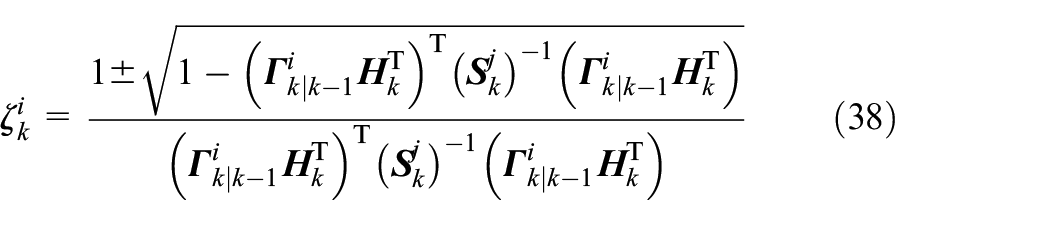
Then, equation (38) can be rewritten as
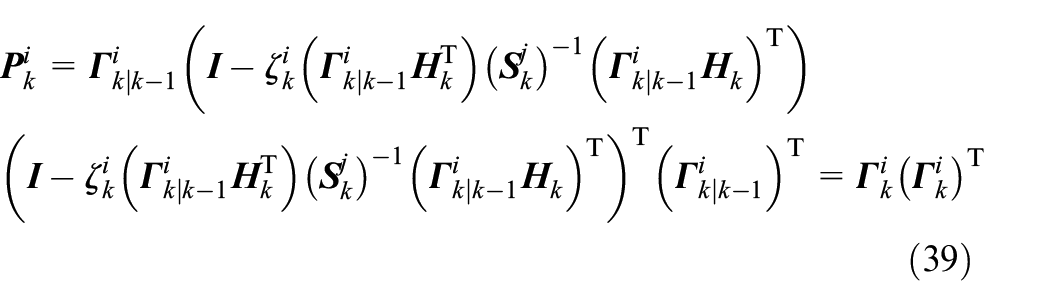
where
Subsequently, we explore the track gate strategy to distinguish current measurements as follows:
1. If the number of available measurements in the predicted gate is not less than 1, according to the relationship between the predicted state

Under the condition of

where
2. If

where
3. If there is no target in the track gate, the number of missed targets increases 1. According to the actual tracking strategy, we consider the target disappears when it cannot be detected within the continuous five periods. As a result, this target is deleted when the total number of missed targets during the continuous periods is more than five.
Given that each updated measurement

Furthermore, we compute the error distance to determine the target track

Under the condition of
Track gate strategy.

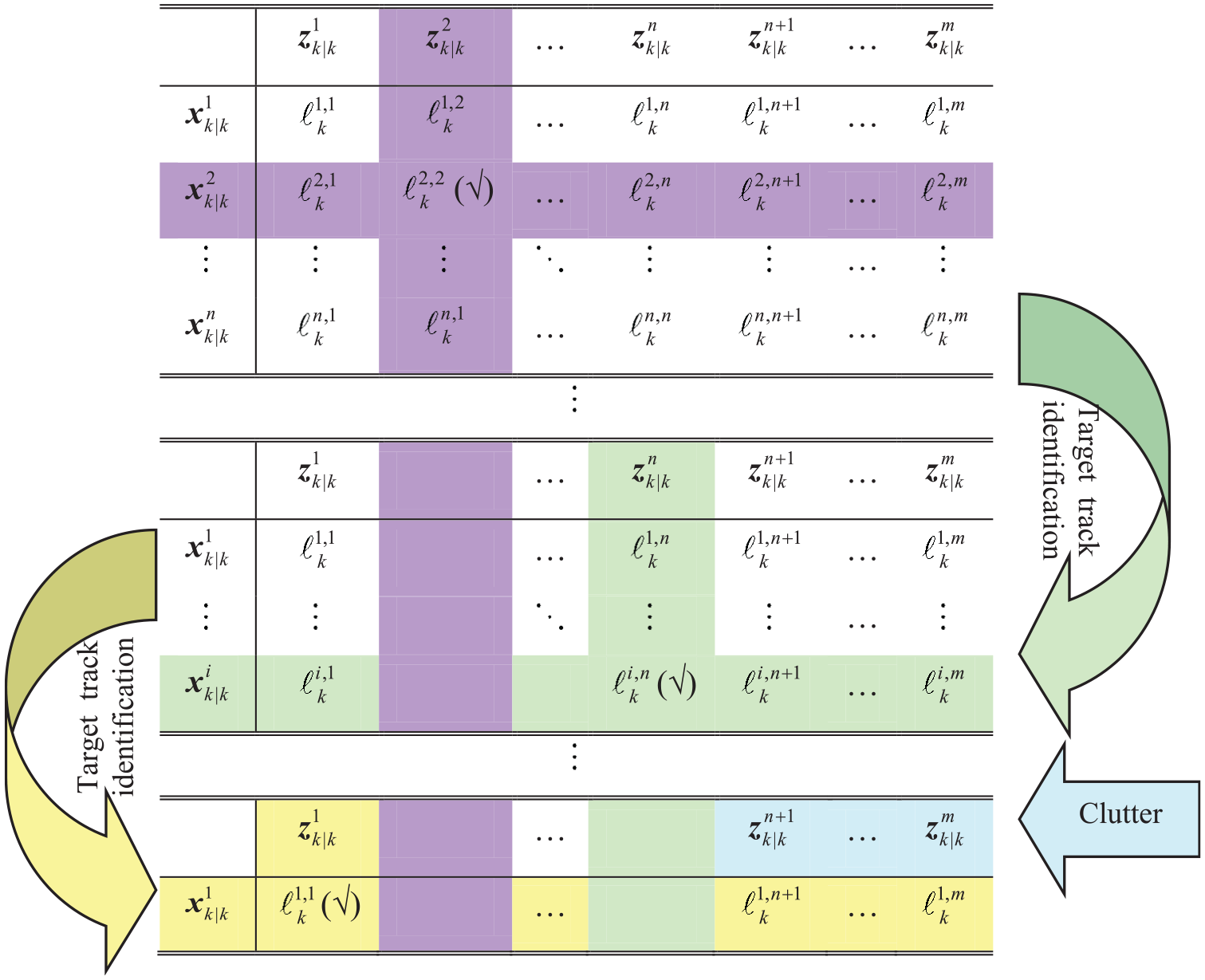
If
Update process.

Experimental results and discussions
The multitarget-tracking experiments are made to analyze the performance of the proposed method. The experimental environment was Intel™ Core™ i5, 8 GB memory and MATLABTM R2018. The surveillance region is a rectangular of
States of multitarget.

Suppose that

where
Figure 2 shows the true tracks of five targets and available measurements in the surveillance region, where the italic number means the target label. Note that most measurements in the x–y coordinates are concentrated around the target tracks, and a few scattered measurements are regarded as the random clutter. Obviously, the clutter reduces the tracking accuracy when it is closed to the true track of target.

Target track and measurements.
Figure 3 indicates the x- and y-coordinates of true tracks, measurements, and estimates of two methods, where the standard method means the conventional Sage–Husa filtering method combined with the conventional beta distribution. Note that the position estimates from the standard method gradually become poor due to the unknown detection probability and the random clutter. The estimated tracks from the standard method tend to drift off the ground truth. Even it has some errors of estimated positions and cannot distinguish clutter-generated measurements. However, the detection performance of the senor affects the estimated positions. By comparison, the proposed method can identify the estimated positions in two coordinates.

Target position estimates in x- and y-coordinates.
Figure 4 demonstrates the estimated cardinality of targets versus time. Note that the standard method cannot exactly evaluate the target cardinality, which underestimates one target on the 2nd, 22nd, and 48th seconds, respectively, and overestimates one target on the 28th seconds. In view of the underestimated cardinality, the standard method has unsatisfactory probability of detection on the 2nd and 48th seconds. When Targets 1 and 5 are close, the method only detects one target on the 22nd seconds. As for the overestimated cardinality, the random clutter around Target 1 on the 28th seconds is considered as the true target. On the contrary, the estimated cardinality of targets using the proposed method during the surveillance time coincides with the ground truth. This reason can be explained that the proposed method uses the updated probability of detection and the track gate to estimate the cardinality simultaneously.

Target cardinality estimates.
The detection probability over time is estimated in Figure 5. The analysis results indicate that the averaged probability from the standard method is 92.263% as well as the standard derivation is 0.024. Note that its fluctuation is relatively stronger and the target cardinality is wrongly estimated. Combined the transfer probability with the improved beta distribution, the detection probability from the proposed method becomes convergent, where the averaged probability of detection is estimated as 93.011% (the actual mean is 93% but unknown) with the standard derivation of 0.015.

Detection probability estimates.
Figure 6 compares the OSPA distance from two methods. Note that the tracking performance of the standard method is worse because it exaggerates the distance error. It has some intensity peaks as a result of the underestimated and overestimated number of targets, where the maximum is 58.001 m. It can be verified that the proposed method achieves the lower error as a direct result of always correcting true cardinality and approaching true position. Obviously, the OSPA distance from the proposed method is not affected by the uncertain situations because the estimation covariance keeps the positive definiteness and the track label plays a major role during the tracking process.

OSPA distance.
Figure 7 compares the averaged OSPA distance under the different clutter rates, where the averaged probability of detection is 93% but unknown. Note that the OSPA distance becomes large when the clutter rate increases. From the change trend, that is, the chain line in this figure, the standard method has rapidly changing distance. It can be explained that the random clutter mainly brings about the overestimated cardinality due to the error of the estimation covariance. By comparison, the proposed method overcomes the flaw so that the estimates of both cardinality and position are more accurate.

Relationship between OSPA distance and
Similarly, Figure 8 shows the averaged OSPA distance under the different probabilities of detection (the mean values are 90, 93, and 96, respectively but unknown), where the clutter rate is 4. Note that the OSPA distance becomes small when the probability increases. The standard method has the maximal OSPA distance because the underestimated cardinality has impact on the distance apart from the error of the estimation covariance. The proposed method estimates the probability of detection to make the OSPA distance small.

Relationship between OSPA distance and PD
Furthermore, Table 5 shows the averaged comparison results under the same scenario above. In this table, we can analyze the tracking performance of the standard method, the reference methods, and the proposed method. In terms of the tracking accuracy, two reference methods improve tracking performance. The investigation shows that the underestimated rate of the reference method (Li et al., 2017) is smaller because it uses the unit upper triangular and diagonal decomposition to reduce the error of estimation covariance. Whereas, the unknown probability of detection still has the negative role for two referenced methods so that the OSPA distance is larger. By comparison, the proposed filter not only has little errors but also estimates and uses probability of detection simultaneously. It indicates the proposed filter enhances the estimation accuracy of both cardinality and state so that there is no cardinality error. Note that the running time of the reference method (Lu et al., 2007) is the smallest by reducing number of the multiplication. Although the Cholesky decomposition, the unit upper triangular, and diagonal decomposition have almost operation time, the proposed method involves calculations of the detection probability and updated measurement. Thus, the required time is larger than that of the referenced methods. As for the overall tracking performance, we can conclude that the proposed method is more acceptable for the multitarget tracking with the unknown detection profile.
Averaged performance.

Overestimated rate = overestimated cardinality in surveillance time/total number of targets in surveillance time; underestimated rate = underestimated cardinality in surveillance time/total number of targets in surveillance time.
Recalling Tables 2 and 3, both the prediction process and the update process are programmed based on the tracking system designed by the Sage–Husa filter. Afterwards, we apply the proposed method with the initial parameters to track targets in the given surveillance region. During a whole period, the states and tracks of multitarget are estimated by transferring the beta parameters and estimation covariance. When the current detection probability is unknown, we cannot obtain the detection probability of the passive sensor at the certain time. However, the proposed method can iteratively use the beta parameters and transfer probability to estimate the detection probability. We randomly extract six scans as shown in Figure 9, where each target is marked by a circle and its label. In the framework of the optimized Sage–Husa filter, the proposed method tracks all actual targets with various states. Moreover, the method effectively identifies the closed targets, such as T11 and T12 in Scans 1, 10, and 20 and T2 and T29 in Scans 10, 20, and 30. Define that the accuracy of the averaged cardinality is a ratio of the number of detected targets to the number of total targets. After statistical analysis, the accuracy of the averaged cardinality of the proposed method can reach the value of 99.2%. Moreover, the averaged detection probability estimated by the proposed method is 95.3% which almost coincides with the reference value 95.0%.

Actual multitarget tracking.
Conclusion
In this study, an optimized Sage–Husa filtering method for multitarget tracking with the unknown detection profile was presented in detail. First, the averaged probability of detection was estimated for the unknown detection profile. Recalling the updated probability of detection, the optimized Sage–Husa filter combined with the track gate was derived. The experiments verified the tracking performance of the proposed method. Based on the promising results, we can come to the following conclusions:
The transfer probability in the space of the probability distribution was proposed based on the improved beta distribution. As is the predicted probability of detection, the updated probability of detection was the product of the prior value and the transfer probability.
The Cholesky decomposition was used in the Sage–Husa filter. During both prediction and update, the estimation covariance can be computed in terms of the positive definiteness. Thus, the filter divergence caused by the non-positive definiteness was solved.
The track gate strategy was proposed to distinguish the clutter-generated measurement and target-generated measurement. In the proposed filtering framework, the states and tracks of multitarget are ultimately estimated using the updated measurements.
The experiment analysis reports the proposed method has good tracking performance. When the targets are moving in the surveillance, the required beta distributions are improved. Then, the detection probability is estimated in the stages of prediction and update. Under the Cholesky decomposition, the estimation covariance of the Sage–Husa filter is computed. We use the updated probability of detection and the track gate to estimate the state of multitarget. Also, the proposed method can track different kinds of targets with passive sensors, such as vehicles and vessels in terms of the actual traffic engineering. Inevitably, the extra time cost has been involved mainly due to the Cholesky decomposition. In the future study, we will reduce the computing time of this method.
Footnotes
Appendix 1
Declaration of conflicting interests
The author(s) declared no potential conflicts of interest with respect to the research, authorship, and/or publication of this article.
Funding
The author(s) disclosed receipt of the following financial support for the research, authorship, and/or publication of this article: This work was supported, in part, by the Natural Science Foundation of Liaoning Province (no. 2020-MS-292), the National Natural Science Foundation of China (no. 51679116), and the Foundation of Liaoning Province Education Department (no. JZL202015402).
