This article investigates the robust observer-based controller design problem for nonlinear parameter-varying systems subject to uncertainty and external disturbances. First, a novel augment vector is constructed, and an corresponding model of the resulting closed-loop system is obtained. Second, by applying the Lyapunov stability theory, a class of state-and-parameter-dependent robust asymptotic stability criteria is established, and the state-and-parameter-dependent sufficient conditions for the design of the robust observer-based controller are then acquired to guarantee the stability of the resulting closed-loop system, which can be effectively solved by sum-of-squares techniques. Different from the previous researches, the proposed control algorithm enables the state-and-parameter-dependent observer and the state-and-parameter-dependent controller design of the nonlinear parameter-varying systems to enjoy the advantage of separate design. The advantage can effectively reduce the computational complexity. Finally, simulation results demonstrate that the proposed robust observer-based controller shows improved performance in presence of uncertainty and external disturbances.
Over the past few decades, the control problems of NTV systems become one of focused research themes and have been proposed for all kinds of NTV systems, for instance, single-input/single-output NTV systems (Yan and Zhang, 2020; Zhang and Yan, 2019), nonlinear parameter-varying (NPV) systems (e.g. Fu et al., 2018, 2019). Among these systems, NPV systems have received extensive attention because the nonlinearity and time-varying feature can be tackled simultaneously by system matrices. In the framework of NPV systems, the stabilization control and the mixed stabilization control were explored in Fu et al. (2019) and Fu et al. (2018), respectively. In Zhu et al. (2020a), a guaranteed cost control method was developed. In Zhu et al. (2020b), based on Lyapunov stability theory, a robust mixed control approach was presented.
It is well known that uncertainties and external disturbances always disturb the stability of the dynamical systems (e.g. Guo et al., 2016; Huang et al., 2019; Ren et al., 2015). Therefore, plenty of control approaches have been developed for dynamical systems subject to uncertainty and external disturbances. Recently, the uncertain nonlinear systems with external disturbances need to be effectively conducted to satisfy the corresponding control performance. The robust controller design problem was studied for uncertain bank-to-turn missiles in Li and Yang (2013). An adaptive control approach was developed for nonlinear system in Chen et al. (2014). In Chen (2004), a disturbance observer strategy was explored by introducing disturbance attenuation technique. Over the past decades, the controller design of nonlinear system with disturbances has been vastly studied, and abundant control strategies were presented for uncertain multiple input–multiple output nonlinear systems in Ginoya et al. (2013), He et al. (2013), and Shao et al. (2015). However, when it comes to the time-varying nature, these available results cannot be effectively extended to NTV systems, particularly NPV systems. This is due to nonlinearity and time-varying features that make the control design more complicated and difficult. Little related studies exist for NTV system with uncertainty, or external disturbance can be investigated (e.g. Chang, 2005 and Zhai et al., 2020).
In addition, state variables are often immeasurable in practical applications, and observer-based control design has been applied (e.g. Wu et al., 2020; Zhou and Zeng, 2017). In Wu et al. (2020), observer-based controller (OBC) of linear system has been obtained, compared with the situation where the observer and controller can be separately designed. The valuable resulting OBC design of the NTV system will be rather challenging. Nevertheless, to the best of the authors’ knowledge, no result has tackled the NPV systems with the simultaneous presence of uncertainty and external disturbances in the observed-based control problem, which motivates this research. Inspired by the observations mentioned earlier, in this paper, the main intention is to establish the uniformly asymptotically stabilization criteria for NPV system with the simultaneous presence of uncertainty and external disturbances by observed-based control. This paper has the following advantages.
A novel framework for OBC of NPV system is obtained, in which the system includes uncertainty and external disturbances simultaneously. This results in difficulty in designing OBC for the resulting systems.
Sum-of-squares (SOS) techniques were employed to solve these state-and-parameter-dependent linear matrix equalities (SAPDLMIs), which is a more common approach and achieves less conservative solutions.
The state-and-parameter-dependent (SAPD) observer and SAPD controller can be separately designed, which effectively reduces the computational complexity.
The remainder of this paper is organized as follows. Some preliminaries and the problem description are given in the “Preliminaries and problem description” section. In the “Robust OBC design” section, the existing conditions of the robust OBC are obtained. The theoretical results are applied to two examples in the “Simulations” section. The “Conclusion” section concludes the paper.
Notations: represents a set of real vectors of dimension and denotes a set of real matrices of dimension . is a set of all real polynomial functions in the vector . and are the zero matrix and identity matrix. , is a set of all SOS polynomials. All vectors and matrices are assumed to have compatible dimensions. ‖·‖ denotes the Euclidean norm.
Lemma 1 (Prajna et al., 2004): For a polynomial symmetric matrix which is nonsingular for all , one has
Lemma 2 (Zhou and Zeng, 2017): If is a bounded and closed subset, , , and are continuous function matrices in . The following statements are equivalent:
Lemma 4 (Xu et al., 2004): Let , , and be real matrices of appropriate dimensions and satisfying . Then, for any positive scalar , one has
Problem description
Consider a class of NPV systems with uncertainty and external disturbances described by
where , , , and represent the state variables, the control input, the measured output, and the controlled output, respectively. is the external disturbances. is the time-varying parameter vector. and are matrices about state variables and time-varying parameter . and are the unknown matrices denoting time-varying uncertainties. , , and are the known matrices in .
Remark 1: From the form of system’s perspective, it is worth pointing out that NPV systems can be reduced to NPV systems (Saeed et al., 2019) and nonlinear systems (Bai et al., 2019). For NPV systems in equation (7), if we remove the state variable in systems’ matrices, the NPV systems can be turned into linear parameter-varying (LPV) systems. Similarly, if we remove the time-varying parameter vector in systems’ matrices, the NPV can became nonlinear systems. This is to say, the NPV systems can take LPV systems and nonlinear systems as special cases. From a modeling standpoint, in many practical dynamic systems, for example, F/A-18 (Anderson and Papachristodoulou, 2013), tilt rotor aircraft (Fu et al., 2019), and turbofan engine (Ling et al., 2021), can be modeled in NPV systems. This phenomena is due to the fact that the time-varying features and the nonlinear characteristics of the dynamical systems are maintained by NPV systems’ matrices.
Assumption 1. For the uncertain NPV systems in equation (7), some/all state variables are unmeasurable.
Assumption 2. For the uncertain NPV systems in equation (7), the uncertainties satisfy
where , , and denote parameter-dependent known matrices. represents an unknown time-varying matrix which satisfies .
For the uncertain NPV systems in equation (7) satisfying Assumption 1 and Assumption 2, we consider a class of SAPD observers of the following form
where denotes the estimated state variables, is the estimated output. The SAPD matrices and are obtained via using instead of in and . denote the SAPD observer gain matrix.
Based on the SAPD observer equation (9), the SAPD controller is given as follows
where is the controller gain matrix in , , and .
First, the uncertain NPV systems of the estimation error can be written as
Furthermore, based on equations (7)–(10), the time derivative of is expressed as
where
Therefore, the corresponding closed-loop system formed by the SAPD observer in equation (9) and the SAPD controller in equation (10) and the uncertain NPV system in equation (7) is given by
where
Remark 2. Note that the SAPD observers in equation (9) depend on the estimated state variables and the time-varying parameter vector; this is because of the NPV systems that the time-varying features and the nonlinear characteristics are maintained in systems’ matrices. Similar to Remark 1, the SAPD observers naturally contain Luenberger observers (Zheng, 2002), nonlinear observers (Tanaka et al., 2012), and LPV observers (Seo et al., 2011) as special cases.
Remark 3. It is worth mentioning that if the commonly augmented vector is used in this paper, it gives us great challenges of designing OBC for NPV systems. The reason is the cross-coupling term, defined by and . Therefore, an exceptional augmented vector is used in the augmented system. It is of great importance to deal with the OBC design problem for NPV systems.
For subsequent derivation, denotes the th row of , denotes the row indices of and whose corresponding row is equivalent to zero, and we define .
For the uncertain NPV systems in equation (7), the control problem of this paper is considered as follows.
Problem 1: For the uncertain NPV systems in equation (7) satisfying Assumptions 1 and 2, our objective is to design an SAPD robust OBC such that the corresponding closed-loop system in equation (12) satisfies the following conditions:
Uniformly asymptotically stable at the zero equilibrium with external disturbances .
The gain from the external disturbances input to is not more than the given positive performance level constant , that is, with initial condition .
Robust OBC design
This section is to develop the robust OBC for uncertain NPV systems with external disturbances. Based on SOS techniques and Lyapunov stability theory, the main results in terms of SAPDLMIs are derived.
Theorem 1: For the uncertain NPV system in equation (7) satisfying Assumptions 1 and 2, given positive-define scalars , , and with , if there exists a symmetric matrix , matrices and , such that
Then Problem 1 is solvable with the SAPD observer in equation (9) and the SAPD controller in equation (10).
Proof: Choose the following Lyapunov functional candidate
Therefore, the close-loop system in equation (12) is uniformly asymptotically stable at the zero equilibrium with external disturbances .
When , , for any , define
then
where ,
Let , by the condition in equation (15) and Schur complement Lemma, we have
which implies the gain from the external disturbances input to is not more than the given positive performance level constant .
As everyone knows, the SAPD condition (15) in Theorem 1 is a bilinear matrix inequality, which presents us with a huge challenge to obtain the OBC. To solve the cross-coupling problem of Theorem 1, the matrix is composed of two symmetric matrices and , that is, . Therefore, some convex results will be obtained by Theorem 2.
Theorem 2: For the uncertain NPV system in equation (7) satisfying Assumption 1 and Assumption 2, supposing , , , and , there exist two symmetric matrix and , such that the following conditions (i) and (ii) are equivalent.
(i) There exist two matrices and , a constant and a symmetric matrix , positive-define scalars ,, and with , such that the SAPD conditions in equations (13)–(15) hold.
(ii) There exist two matrices and , positive-define scalar and , such that the following conditions hold
Furthermore, if the SAPD condition (ii) is satisfied, then Problem 1 is solvable, and the SAPD observer gain matrix and the SAPD controller gain matrix are given by
Proof: (i)⇒(ii)
From condition (15) and , one has
Multiplying both sides of equation (24) by and denoting , then equation (20) holds by Schur complement Lemma.
Similarly, multiplying both sides of equation (24) by , the following inequality holds by Lemma 1
Based on Lemma 4, and denoting , then equation (21) holds by Schur complement Lemma.
(ii)⇒(i)
Letting
according to Lemma 2, there exists a positive constant , the condition (15) holds by Schur complement Lemma and denoting .
The local compact sets of the state and the time-varying parameter vector are not represented specifically. Therefore, the SAPD conditions in Theorem 2 are difficult to solve. In order to obtain the computationally tractable conditions, the local compact sets , , , and are represented as follows
where and are the functions about , , or .
Theorem 3: For the uncertain NPV system in equation (7) satisfying Assumptions 1 and 2, given the compact sets , , , and , positive scalars , ,, and with and , if there exist two symmetric matrices , , two matrices , , and SOS polynomial functions , , , , and , such that
where are column vectors with proper dimensions, then Problem 1 is solved, and the OBC gain matrices can be given by equations (22) and (23).
Proof: Obviously, based on Lemma 3 and Theorem 2, the SAPD conditions (30)–(35) hold.
Remark 4: Now, the robust observer-based asymptotic stability problem has been solved in Theorem 3 for the uncertain NPV systems with external disturbances. Accordingly, the SAPD sufficient conditions, which are in terms of linear matrix equalities, have been obtained. The SOS techniques have been adopted to handle a class of SAPDLMIs. It is worthwhile to note that, the SAPD observer and the SAPD controller can be separately designed by Theorem 3. Therefore, the conservatism of computation complexity has been considerably reduced.
Simulations
Based on the previous research (Zhang et al., 2012), NTV equations, considering the uncertainty and external disturbances, can be modified as follows
where , , ,
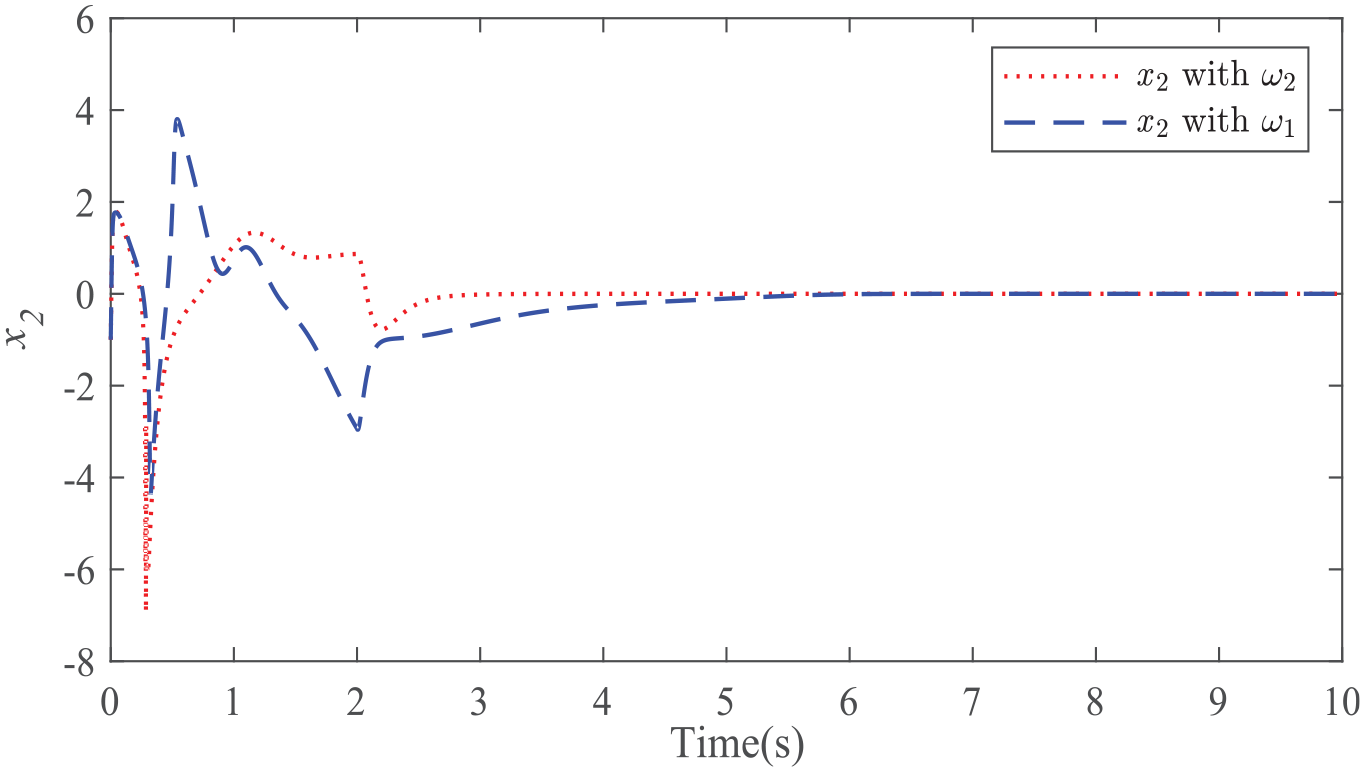
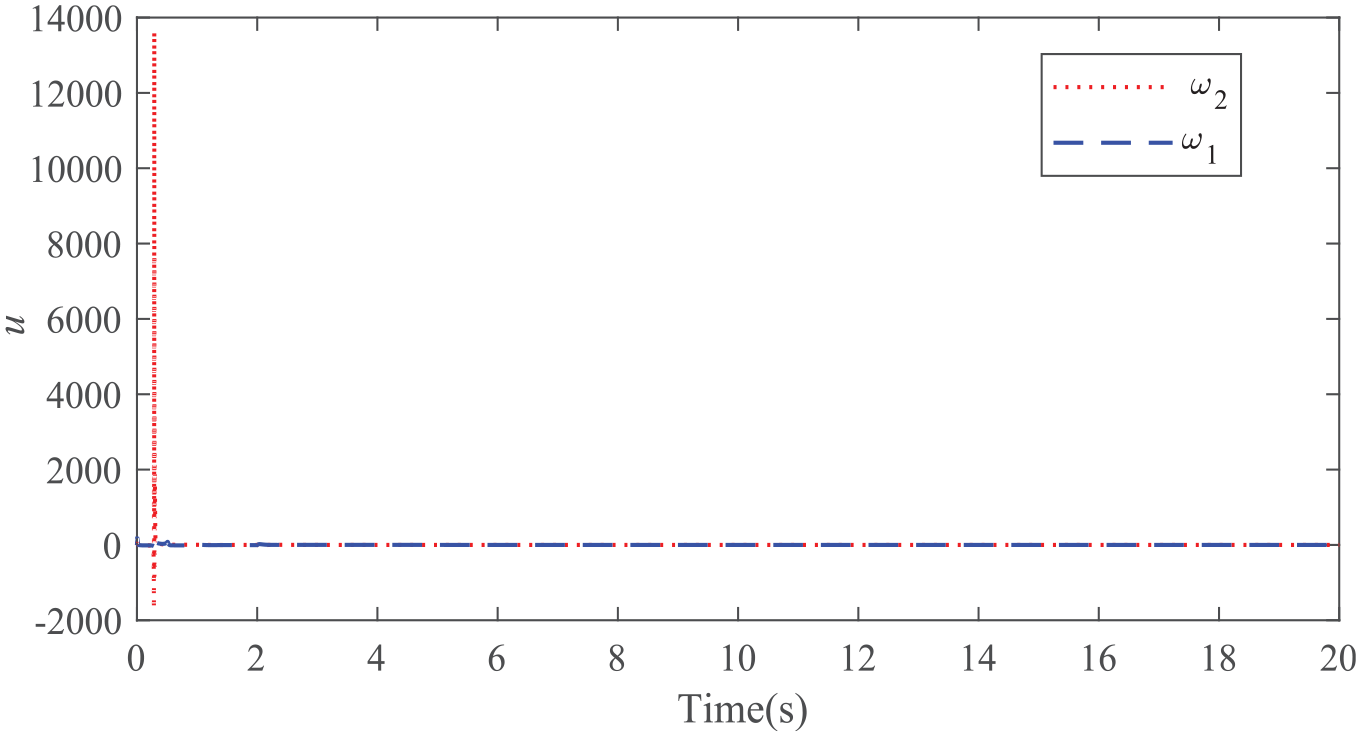
The parameters of simulations are chosen as , . The SOS multipliers , , , and are defined in the degree of two. The polynomial positive scalars and are regarded as SOS free variables. We can get an OBC by Theorem 3. Furthermore, to show the advantage of proposed approach, based on Theorem 3, we also can get a parameter-dependent OBC, but the OBC does not work. In the simulation, the initial state is . The initial estimated state is . And the disturbances are given as follows
The simulation results shown in Figures 1–3 indicate that the proposed OBC ensures satisfactory performance and stability even in the presence of uncertainty and external disturbances.
The behaviors of and .
The behavior of .
The behavior of .
Conclusion
In this article, a novel robust asymptotic stability problem has been defined for NPV systems with uncertainty and external disturbances. Especially, a novel augment vector is established. Based on that, an SAPD robust OBC has been designed to asymptotically stabilize the NPV systems, and the performance is achieved. Based on SOS techniques, these SAPD conditions for the above problem can be effectively solved. Furthermore, the SAPD observer and the SAPD controller can be separately designed, which effectively reduces the computational complexity. In the simulation examples, we have showed that the SAPD robust OBC design approach is less conservative than parameter-dependent ones. Further research works can include the prescribed performance control problem of NPV systems, the analysis, and synthesis problem of NPV systems with time-varying delays.
Footnotes
Declaration of conflicting interests
The author(s) declared no potential conflicts of interest with respect to the research, authorship, and/or publication of this article.
Funding
The author(s) disclosed receipt of the following financial support for the research, authorship, and/or publication of this article: This work is supported by the Zhejiang Provincial Natural Science Foundation of China (Grant No. LQ20F030001), the Guangxi University Young and Middle-aged Teachers Research Basic Ability Improvement Project (Grant No. 2021KY0212), and the Natural Science Foundation of Fujian Province (Grant No. 2020J01284).
ORCID iD
Pingfang Zhu
References
1.
AndersonJPapachristodoulouA (2013) Robust nonlinear stability and performance analysis of an F/A-18 aircraft model using sum of squares programming. International Journal of Robust and Nonlinear Control23(1): 164–176.
2.
BaiHHHuangCQZengJP (2019) Robust nonlinear output-feedback control for flexible spacecraft attitude manoeuvring. Transactions of the Institute of Measurement and Control41(7): 2026–2038.
3.
ChangYC (2005) Intelligent robust control for uncertain nonlinear time-varying systems and its application to robotic systems. IEEE Transactions on Systems, Man, and Cybernetics, Part B (Cybernetics)35(6): 1108–1119.
4.
ChenMChenWHWuQX (2014) Adaptive fuzzy tracking control for a class of uncertain MIMO nonlinear systems using disturbance observer. Science China57(1): 12207–012207.
5.
ChenWH (2004) Disturbance observer based control for nonlinear systems. IEEE/ASME Transactions on Mechatronics9(4): 706–710.
6.
FuRSunHZengJ (2019) Exponential stabilisation of nonlinear parameter-varying systems with applications to conversion flight control of a tilt rotor aircraft. International Journal of Control92(11): 2473–2483.
7.
FuRZengJPDuanZS (2018) mixed stabilization of nonlinear parameter-varying systems. International Journal of Robust and Nonlinear Control28(17): 5232–5246.
8.
GinoyaDShendgePDPhadkeSB (2013) Sliding mode control for mismatched uncertain systems using an extended disturbance observer. IEEE Transactions on Industrial Electronics61(4): 1983–1992.
9.
GuoBWuZZhouH (2016) Active disturbance rejection control approach to output-feedback stabilization of a class of uncertain nonlinear systems subject to stochastic disturbance. IEEE Transactions on Automatic Control61(6): 1613–1618.
10.
HeWZhangSGeSS (2013) Boundary output-feedback stabilization of a Timoshenko beam using disturbance observer. IEEE Transactions on Industrial Electronics60(11): 5186–5194.
11.
HuangJRiSFukudaT, et al. (2019) A disturbance observer based sliding mode control for a class of underactuated robotic system with mismatched uncertainties. IEEE Transactions on Automatic Control64(6): 2480–2487.
12.
Jarvis-WloszekZW (2003) Lyapunov based analysis and controller synthesis for polynomial systems using sum-of-squares optimization. PhD Thesis, University of California, Berkeley, CA.
13.
LiSYangJ (2013) Robust autopilot design for bank-to-turn missiles using disturbance observers. IEEE Transactions on Aerospace and Electronic Systems49(1): 558–579.
14.
LiYTongSLiT (2016) Hybrid fuzzy adaptive output feedback control design for uncertain MIMO nonlinear systems with time-varying delays and input saturation. IEEE Transactions on Fuzzy Systems24(4): 841–853.
15.
LiYLNiuBZongG, et al. (2022) Command filter-based adaptive neural finite-time control for stochastic nonlinear systems with time-varying full-state constraints and asymmetric input saturation. International Journal of Systems Science53: 199–221.
16.
LingYCZhouWXZhuPF, et al. (2021) Modeling of a large envelope system for turbofan engine. Journal of Nanjing University of Aeronautics & Astronautics53(4): 529–536.
17.
LiuYMaLLiuL, et al. (2020) Adaptive neural network learning controller design for a class of nonlinear systems with time-varying state constraints. IEEE Transactions on Neural Networks and Learning Systems31(1): 66–75.
18.
LiuZGLaiGYZhangY, et al. (2014) Adaptive neural control for a class of nonlinear time-varying delay systems with unknown hysteresis. IEEE Transactions on Neural Networks and Learning Systems25(12): 2129–2140.
19.
MazencFNiculescuSBekaikM (2013) Stabilization of time-varying nonlinear systems with distributed input delay by feedback of plant’s state. IEEE Transactions on Automatic Control58(1): 264–269.
20.
PapachristodoulouAAndersonJValmorbidaG, et al. (2016) SOSTOOLS: Sum of squares optimisation toolbox for MATLAB (version 3.01).
21.
PrajnaSPapachristodoulouAWuF (2004) Nonlinear control synthesis by sum of squares optimization: A Lyapunov-based approach. In: The 5th Asian control conference, Melbourne, VIC, Australia, 20–23 July, pp. 157–165. New York: IEEE.
22.
RenBZhongQChenJ (2015) Robust control for a class of nonaffine nonlinear systems based on the uncertainty and disturbance estimator. IEEE Transactions on Industrial Electronics62(9): 5881–5888.
23.
SaeedSKarolosGMatthewF (2019) Reciprocal convex approach to output-feedback control of uncertain LPV systems with fast-varying input delay. International Journal of Robust and Nonlinear Control29(16): 5744–5764.
24.
SeoTOhtakeHTanakaK, et al. (2011) A polynomial observer design for a wider class of polynomial fuzzy systems. In: IEEE international conference on fuzzy systems, Taipei, Taiwan, 27–30 June.
25.
ShaoSChenMYanX (2015) Adaptive sliding mode synchronization for a class of fractional-order chaotic systems with disturbance. Nonlinear Dynamics83(4): 1–12.
26.
TanakaKOhtakeHSeoT, et al. (2012) Polynomial fuzzy observer designs: A sum-of-squares approach. IEEE Transactions on Systems, Man, and Cybernetics42(5): 1330–1342.
27.
WangZHoDHCDongH, et al. (2010) Robust finite-horizon control for a class of stochastic nonlinear time-varying systems subject to sensor and actuator saturations. IEEE Transactions on Automatic Control55(7): 1716–1722.
28.
WuZRenWXiongJ, et al. (2020) Parallel-triggered observer-based output feedback stabilization of linear systems. IFAC-Papers Online53(2): 4428–4433.
29.
XuNZhaoXDZongGD, et al. (2021) Adaptive control design for uncertain switched nonstrict-feedback nonlinear systems to achieve asymptotic tracking performance. Applied Mathematics and Computation408(1): 126344.
30.
XuSYLuJWZhouSS, et al. (2004) Design of observers for a class of discrete-time uncertain nonlinear systems with time delay. Journal of the Franklin Institute341(3): 295–308.
31.
YanHSZhangC (2020) Inverse control of single-input/single-output nonlinear time-varying systems with noise disturbances by multi-dimensional Taylor network. Transactions of the Institute of Measurement and Control42(12): 014233122091534.
32.
ZhaiDXiCDongJ, et al. (2020) Adaptive fuzzy fault-tolerant tracking control of uncertain nonlinear time-varying delay systems. IEEE Transactions on Systems, Man, and Cybernetics: Systems50(5): 1840–1849.
33.
ZhangCYanHS (2019) Identification and adaptive multi-dimensional Taylor network control of single-input single-output non-linear uncertain time-varying systems with noise disturbances. IET Control Theory & Applications13(6): 841–853.
34.
ZhangHYWangHQNiuB, et al. (2021) Sliding-mode surface-based adaptive actor-critic optimal control for switched nonlinear systems with average dwell time. Information Sciences580: 756–774.
35.
ZhangXFFengGSunYH (2012) Finite-time stabilization by state feedback control for a class of time-varying nonlinear systems. Automatica48(3): 499–504.
36.
ZhengDZ (2002) Linear System Theory. Beijing, China: Tsinghua University Press.
37.
ZhouYRZengJP (2017) Observer-based robust stabilization for a class of uncertain polynomial systems. Transactions of the Institute of Measurement and Control39(5): 675–687.
38.
ZhuPFWangJYZengJP (2020a) The guaranteed cost controller for nonlinear systems with time-varying parameters and input saturation. Transactions of the Institute of Measurement and Control42(3): 565–575.
39.
ZhuPFZhouYRZengJP (2020b) Mixed control for nonlinear parameter-varying systems. Control Theory & Applications37(10): 2231–2241.