






Abstract
This paper proposed an adaptive neural network (NN) control method to track the desired trajectory of a bipedal modular reconfigurable robot (MRR), which can solve the gait coordination problem of bipedal MRR. The leg dynamic model and the body dynamic model of bipedal MRR are established based on the Newton–Euler iterative method, and the global dynamic model is subsequently established. Aiming at the gait coordination problem between double support phase (DSP) and single support phase (SSP), the desired trajectory is generated based on the zero-moment point (ZMP) method. The adaptive NN controller is designed to track the generated desired trajectory, which also compensates interconnected dynamic coupling (IDC) effects of the bipedal MRR. The stability of bipedal MRR system is proved by Lyapunov theory. In the end, the effectiveness of the control method is verified by comparative simulation. The simulation results show that the proposed adaptive NN method reduces the position tracking error by
Keywords
Introduction
In the 21st century, with the development of science and technology, the walking robot industry has become a hot issue in social research. In addition, the walking robot has long entered the field of human work and life, replacing humans to complete many special tasks, and playing an important role in the manufacturing and industry (Biswal and Mohanty, 2021; Kar, 2003). Walking robot, also known as walking machine, integrates mechanical design, biological science, sensing technology, and information processing technology. At present, walking robot mainly includes bipedal robot and multi-legged robot (quadruped, hexapod and eight-legged robot, etc.) (Ding and Chen, 2016; Lyashenko, 2022). Among walking robot, bipedal robot has the similar leg structure to human beings; however, the traditional bipedal robot cannot adapt to the new environment and work task because of its poor flexibility. Consequently, it is expected that traditional bipedal robots will ultimately become obsolete.
Compared to traditional robots, modular reconfigurable robots (MRRs) offer superior structural flexibility and adaptability. When performing special tasks, MRR is more adaptable to the environment. The MRR system can be reassembled and disconnected according to the requirements of the mission environment (Pan et al., 2013). The recombination is not only a simple mechanical recombination but also a system recombination. So far, an increasing number of MRRs have been designed (Kotay et al., 1998; Murata et al., 1994). An et al. (2023) proposed a human motion intention estimation method based on a harmonic-driven compliance model, which forms the basis of MRR dynamic model. MRR has been extensively employed in disaster response, space exploration, medical emergency management, and rehabilitation training. Therefore, considering the high flexibility of the MRR system, the bipedal MRR system is proposed, which has high adaptability to the environment.
A growing numberf research teams around the world are working on bipedal robots, and their main research directions are gait coordination, foot force control, foot trajectory planning, and motion control. In order to apply bipedal robot walk stably, many researchers have been exploring and proposing different motion control strategies. Aiming at the gait trajectory of bipedal robot, Vukobratović and Borovac (2004) proposed the zero-moment point (ZMP) stability criterion, and they applied this concept to the bipedal walking robot with dynamic balance, tracking the ideal ZMP curve to achieve steady walking. After reviewing the traditional pattern generation method based on ZMP, Kajita et al. (2003) proposed a bipedal walking path generation method based on ZMP and designed a tracking servo controller. A few years later, in 2007, Kajita et al. (2007) proposed a running model generation and controller based on ZMP. Alcaraz-Jiménez et al. (2013) combined the ZMP stability criterion with step-timing control and applied it to humanoid robots, such as a control system allows robust walking and anti-interference. Ugurlu and Kawamura (2009) proposed a generating online jumping patterns method for single-legged or humanoid robots. Caron et al. (2017) designed a global controller to generate feasible contact motion of bipedal robot. At present, research groups around the world are exploring trajectory generation methods of bipedal robots based on ZMP theory, which has been promoted in the literature (Esfahani and Elahinia, 2020; Ferreira et al., 2012; Su and Zheng, 2007; Wong et al., 2020). For bipedal MRR system, the proposed ZMP method greatly reduces the computation. Even under the contact conditions of complex environment, the stability criterion can ensure the stable walking of the robot. In addition, how to design the controller to make the walking robot move smoothly is also important.
The dynamic model of bipedal MRR system is inherently intricate and characterized by a significant level of uncertainty, making it exceedingly challenging to obtain precise model information. Neural network (NN) control method has strong learning ability, and it is an effective tool for controlling complex nonlinear dynamic systems. The basic idea is using NN approximators to compensate unknown nonlinear dynamic terms (Gomi and Kawato, 1993). In addition, the method based on NN can deal with the control problem of nonlinear system, and the system does not need to be linearized (Zhang et al., 2016). In the 20th century, NN has been used in robot system modeling and control (Ge et al., 1998; Lewis et al., 1998). Nguyen et al. (2020) addressed an important aspect of deep reinforcement learning (DRL) related to situations that require multiple agents to communicate and cooperate to solve complex tasks. In recent years, NN control technology has developed rapidly. Chu et al. (2019) proposed an adaptive global synovial controller based on NN. Zhu et al. (2023) transformed the trajectory tracking control problem into zero-sum game-based optimal control problem based on adaptive dynamic programming (ADP) and NN algorithm. Yu and Feu (2014) solved the issue of robust switching tracking neural control of robotic arm with uncertainties and disturbances. Jiang et al. (2021) proposed a control method for a two-handed robotic system. A paper Nguyen et al. (2022) presented a survey of algorithms used to create deepfakes and, more importantly, methods proposed to detect deepfakes in the literature to date. Zhang et al. (2015b) proposed a scheme for generating circular motion of both arms based on neurodynamics method. Li et al. (2015) proposed a foot force optimization method based on recursive NN for quadruped walking robot. Li and Li (2020) proposed a mobile robot algorithm model based on backpropagation NN and reinforcement learning, and NN controller is used in many robot systems (Cui et al., 2017; He et al., 2016). Nguyen and Reddi (2023) incorporated deep learning into traditional RL, and DRL is highly capable of solving complex, dynamic, and especially high-dimensional cyber defense problems. However, above methods only consider the traditional robot system model, but for MRR system, interconnection dynamic coupling (IDC) effect will affect the system performance. Since traditional NN control method cannot handle IDCs, this paper seeks a novel NN approximation method to solve these problems, which can improve the overall motion performance and control accuracy of the bipedal robot.
The main work of scholars in recent years is listed in Table 1.
Main work in recent years.

The main contributions of this paper are as follows:
Unlike the traditional biped robot dynamic model (Yao et al., 2022), the flexibility of the robot system is not considered. In this paper, a bipedal MRR system is proposed for the first time, which solves the limited motion range problem of traditional robot, and it has broad application prospects because of the flexibility. Considering the IDC effects of bipedal MRR, the NN identifier-based compensation control policy is used to solve the IDC effects.
Different from the traditional ZMP stability criterion (Caron et al., 2017), the ZMP method generates the expected gait path without considering the effect of acceleration, which reduces the computational burden.
A bipedal MRR steady-state walking coordination control method based on adaptive NN is proposed. And for bipedal MRR system with high nonlinear and model uncertainty, an adaptive NN controller is used to approximate the model uncertainty, which ensures the steady-state walking ability of the bipedal MRR system.
Kinematic analysis and gait planning of bipedal MRR
Kinematic analysis of bipedal MRR
The stable walking of bipedal MRR mainly depends on the lower limb walking mechanism. Moreover, the bipedal MRR system has characteristics of complex model structure and more degrees of freedom; therefore, reasonable kinematic analysis is a good basis for bipedal MRR to achieve stable walking.
In this section, a series of analyses and hypotheses are made from the perspective of bionics combined with the way of human leg movement. When people walk, they mainly rely on the coordination of the ankle, knee, and hip joints. And the hip joint can perform three directions of internal and external rotation, forward and forward pitching and abductive convergence. The knee joint can perform forward and forward pitching, and the ankle joint can perform abductive convergence and forward and forward pitching.
This paper only analyzed the forward motion of the bipedal MRR and did not consider the lateral or backward motion, and the bipedal MRR can satisfy the walking motion in the plane area. In conclusion, kinematic analysis is of great significance for gait planning and flexibility control strategy design of bipedal MRR.
Gait design of bipedal MRR
Since the movement mode of bipedal MRR is similar to humans, the two legs move alternately and drive the body to walk forward in the process of movement and carry out periodic movement. When researching the kinematic gait of the robot, only one cycle of MRR is studied. There are two main phases in the walking process of the bipedal MRR: double support phase (DSP) and single support phase (SSP). Considering the symmetry of the machine leg, gait period is defined as the time interval from the support stage of one support leg to the standing stage of the other support leg.
The SSP can also be called the swing phase (SP), where one leg is in a supporting state while the other mechanical leg is in a free-space swinging state and all the force/torque is applied to the supporting leg. The DSP includes weight acceptance phase (WAP) and weight support phase (WSP), when one mechanical leg of the bipedal MRR is in WSP and the other mechanical leg is in WAP or SP.
ZMP stability criterion of bipedal MRR
ZMP is a point on the ground, and the torque of the ground reaction force on the supporting foot of the robot is zero along the two vertical directions in the horizontal plane. In this paper, ZMP method is used to generate the footprint of bipedal MRR, which can plan the contact position between the ground and the plantar. We assume that two soles of the bipedal MRR are composed of two support rectangles (SR), which refers to the minimum support rectangle of the plantar and contact ground travel of the bipedal MRR. In SSP, ZMP should always remain within the rectangular box. In DSP, ZMP may be outside the rectangular box. ZMP is an important basis to judge whether bipedal MRR can contact the ground and maintain stability during walking.
In calculation, assuming that the ground is in complete contact with the sole of bipedal MRR, then the normal force against the ground and foot can be expressed as
where
We can also get
where
where
From equations (1), (3), and (5), we can obtain
From equations (1), (2), and (4), we can obtain
Assuming that there is no influence of external force on the sole of the bipedal MRR, equations (6) and (7) can be redescribed as
If the walking speed of the MRR is slow, the acceleration term in the above equations can be ignored (Shin and Kim, 2015),and the ZMP of the robot during static walking can be written as
As can be seen from the above equations, if acceleration is ignored, the formula for solving ZMP becomes the projection point of the center of mass (COM) on the ground. Therefore, when bipedal MRR walks statically, ZMP coincides with the center of gravity (COG).
Dynamic model of bipedal MRR
Leg dynamic model
Considering that bipedal MRR exists IDC effects
where
The overall dynamic of the leg of the bipedal MRR can be formulated as
Body dynamic model
The body dynamic model of bipedal MRR can be described as
where
Defining
Through the above equation, we can obtain
where
Substituting equation (15) into equation (17), we get
Defining
Combined with equations (19) and (20), the following relationship can be obtained
Through the above formula,
Derivation of the equation (22) with respect to time
Substituting equation (17) into equation (14), we have
Substituting equations (22) and (23) into equation (15), we have
Defining
where
Adaptive NN controller design of bipedal MRR
Problem statement
Because of the special properties of bipedal MRR,
where
The expression of an IDC term is defined as
where
Ignoring the impact of IDC
where
where
From equation (30), we can know
The above equation can be reexpressed as
where
We can define an error function as follows
where
where
Identification and approximation of IDC term
For
where
Considering a bipedal MRR system, the bounded input
From equation (39), we can easily get the following expression
where
where
where
Considering equations (39) and (40), the identification error dynamic equation can be obtained
where
By equations (43) and (44), we can obtain
where the weight update law of equation (46) is given as follows
where
And we have
where
Combined with equations (44), (46), and (48), we can get the following boundary conditions
where
where
where
And we have that
Through the above equations, auxiliary functions
where
Through equations (40)–(42),
where weight
provided
where
Moreover, it satisfies the following relation
where
□
The derivative of equation (57) with respect to time is
By eliminating the common terms
If equation (56) is satisfied, then equation (61) can be written as
where
Let
while
Based on the definition of
Adaptive NN controller
The model-based controller does not have a good control effect for the unmodeled robot system, and this paper uses radial basis function (RBF) NN to approximate the unknown function, which could overcome the above problems.
RBFNN is used to approximate the unknown function in bipedal MRR dynamic, and we define a set
where
where
RBFNN can be used to approximate the function
where
Considering equations (34) and (36), it can be obtained that
In order to effectively solve the issue of approximate error
According to the mean value theorem, it is easy to know that the derivative
Considering Lemma 1, Assumption 2, and Assumption 3, the following equation can be obtained
For the design of the controller, the following auxiliary variables are defined
where
By combining equations (69) and (71) and taking the derivative of
In order to achieve the estimation of
where
The estimated value of system disturbance
Considering equations (71) and (74), the following equation can be obtained
Considering equations (72) and (73), and taking the derivative of equation (75) with respect to time
where
Through the above assumptions and derivations, the following adaptive NN controller is designed based on RBFNN
where
The updating law of adaptive NN can be designed in the following form
where
Taking the derivative of
By combining equations (69) and (77), the following equation can be established
Considering equations (70), (76), and (78), and the following conditions
Then, it can be obtained that
where
We need to choose positive definite matrix
Multiplying by
From the above inequality, we can see that
Simulation results
The simulation is performed under MATLAB software, and the dynamic model of bipedal MRR can be defined as follows
Suppose that input vector is
The system error of the controller is defined as
According to the gradient descent method, the iterative algorithm of weight, node center, and node radial parameters are as follows
where
By gradient descent method, we choose the hidden layer that has three hidden layer nodes, and c is random. Apply the proposed adaptive NN control method, and we select the following parameters:
Assuming that the bipedal MRR moves in a plane, the whole simulation process is carried out in Cartesian space. When bipedal MRR is walking, the two legs move alternately, and the desired trajectory is generated based on ZMP method. As shown in Figure 1, we know that the desired trajectory is COM trajectory. If the bipedal MRR can track the desired trajectory, then it can perform stable walking.

Position tracking of desired trajectory via the proposed adaptive NN control method.
Through the simulation comparison of two control methods, the effectiveness of the proposed method is verified: (1) the traditional trajectory tracking control method based on NN, for example, Chu et al. (2019) and Yu and Feu (2014), and (2) the proposed adaptive NN control method. By comparing the performance of the two control strategies for desired trajectory tracking, the difference between the two methods can be clearly seen.
Position and velocity tracking performance
Since the nonlinear and uncertainty of the bipedal MRR dynamic model affect the tracking performance, we use adaptive NN to approximate the modeling errors and uncertainties. This control method realizes the tracking control of bipedal MRR, and the high-precision trajectory tracking control of robot manipulators is realized. Through the following theoretical verification and simulation comparison experiments, we can intuitively see the superiority of our proposed method, and the tracking error is uniformly bounded.
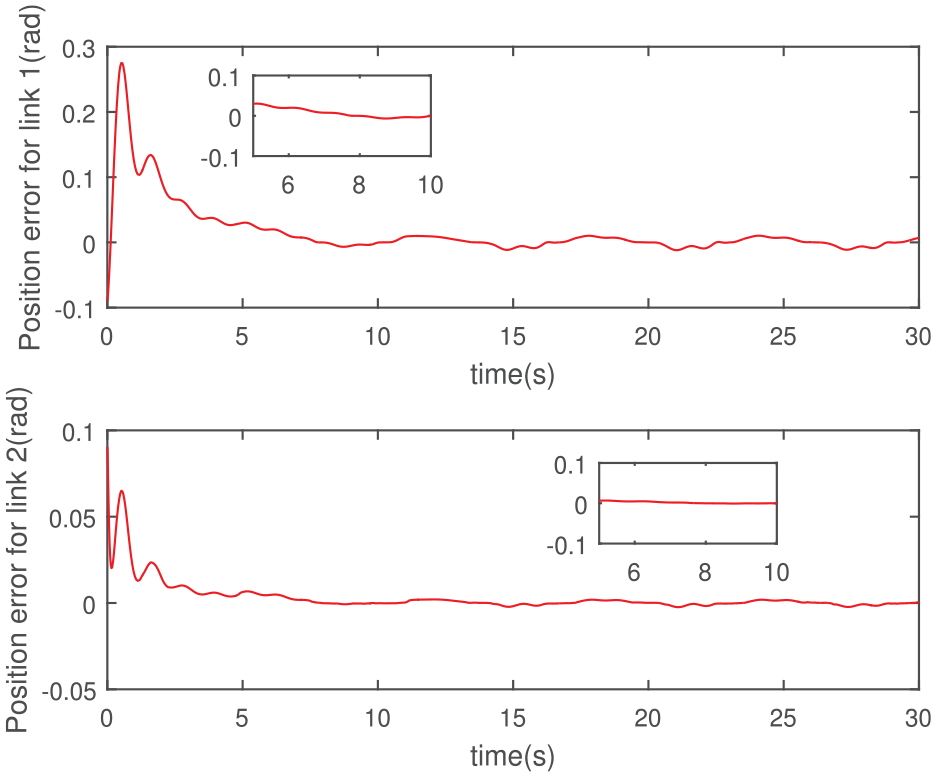
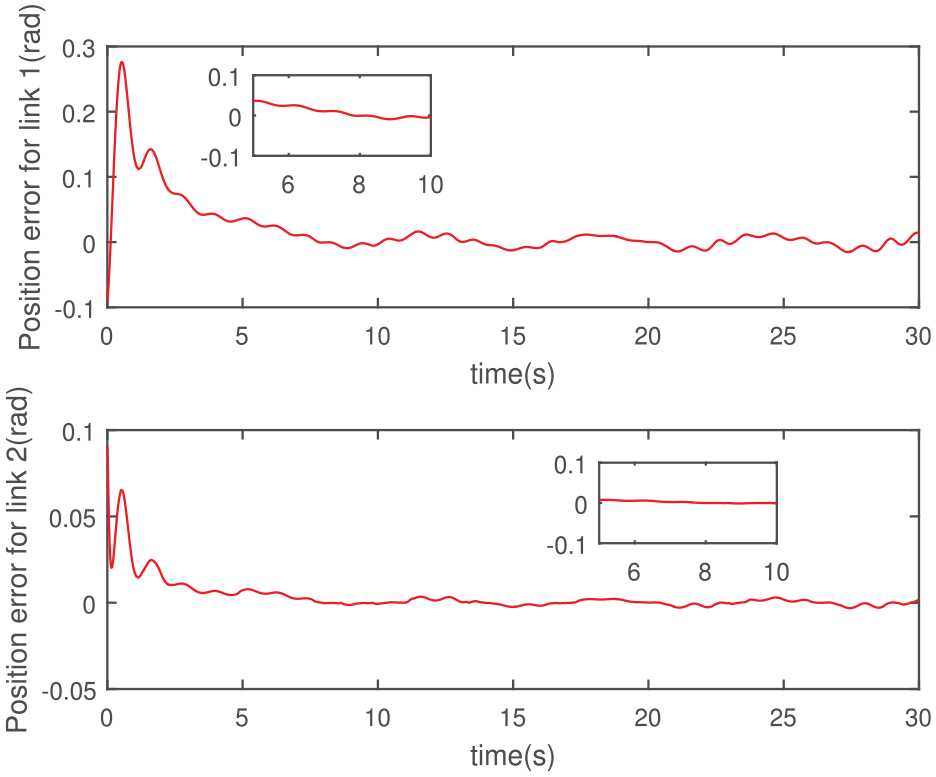
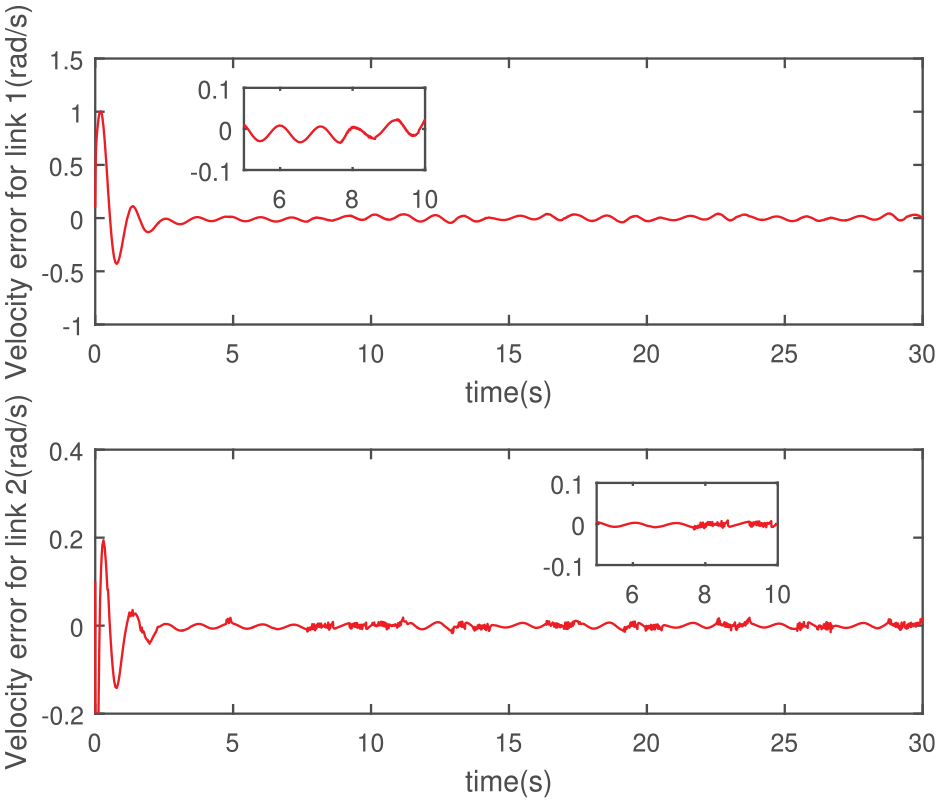
After generating desired trajectory, we introduce an adaptive NN control algorithm to track the desired trajectory. Figure 1 is position tracking of desired trajectory via the proposed adaptive NN control method. When t=2.5 s, actual trajectory gradually tracks the desired trajectory, and the tracking effect is well. In the comparison experiment of tracking error, we add a PID control method. Figures 2–4 show position tracking of desired trajectory in joint space via the proposed adaptive NN control method, traditional trajectory tracking control method based on NN, and tracking control method based on PID. Figures 5–7 show velocity error via the proposed adaptive NN control method, traditional trajectory tracking control method based on NN, and trajectory tracking control method based on PID. Through simulation verification, we can clearly see the effectiveness of our proposed method, and the position tracking error and velocity error remain stable at last.

Position tracking error via the proposed adaptive NN control method.
Position tracking error via the traditional trajectory tracking control method based on NN.
Position tracking error via the trajectory tracking control method based on PID.
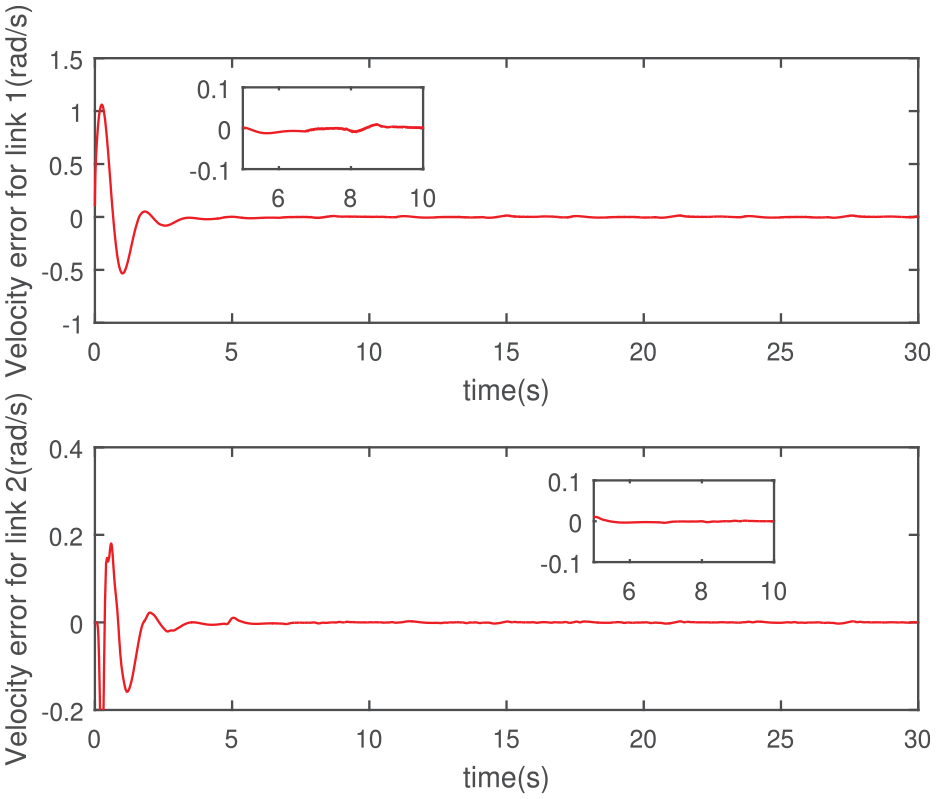
Velocity error via the proposed adaptive NN control method.

Velocity error via the traditional trajectory tracking control method based on NN.
Velocity error via the trajectory tracking control method based on PID.
NN weight curve
The weight of the NN is obtained by training the network, and Figure 10 shows the weight update rate under the proposed adaptive NN control method, which can be obtained using the converged weight.
Control torque
Figures 8 and 9 show the control torque using the proposed adaptive NN control method and the traditional trajectory tracking control method based on NN. According to the results, under the traditional trajectory tracking control method based on NN, the control torque curve shows a strong buffeting effect, which may reduce the accuracy of trajectory tracking, and the control torque is large. In this paper, the instantaneous increase in the control torque is limited to a safe range. As we can see the control torque curve is smooth and the overall control performance is improved.

Control torque via the proposed adaptive NN control method.

Control torque via the traditional trajectory tracking control method based on NN.

Weight update rate under the proposed adaptive NN control method.
Conclusion
Aiming at bipedal MRR system with strong coupling, a trajectory tracking method based on adaptive NN is proposed to solve the gait coordination control issue of bipedal MRR, and the dynamic model of bipedal MRR system is established by Newton–Euler iteration method. In different gait phases, the desired trajectory of the bipedal MRR is generated based on the ZMP. On this basis, an adaptive NN control method is designed to track the desired trajectory, and the IDC effect of bipedal MRR is compensated. The algorithm improves the tracking performance of the robot system. In addition, the stability of the bipedal MRR system is verified using the Lyapunov theory. Finally, simulation results show that the proposed method is effective.
Limitations and future work
At present, a series of research works are only in the initial stage, and more research contents and directions need to be improved and explored, which are mainly reflected in the following aspects:
The desired trajectory of bipedal MRR is generated by ZMP method, which ensures the stability of the robot in the walking process and requires less computation. However, this method is greatly affected by the inertia force of the robot. In the future, ZMP method can be further improved by considering the inertia force of the robot.
Due to the limited conditions, we only consider the contact with the plane in the application scenario. In future applications, we should also consider discussion and research in different complex task contacts to make the whole study more universal.
In future works, more advanced deep learning control methods should also be considered for gait coordination of bipedal MRR.
Footnotes
Declaration of conflicting interests
The author(s) declared no potential conflicts of interest with respect to the research, authorship, and/or publication of this article.
Funding
The author(s) disclosed receipt of the following financial support for the research, authorship, and/or publication of this article: This work was supported by the National Natural Science Foundation of China (Grant no. 62173047), the Scientific Technological Development Plan Project in Jilin Province of China (Grant no. 20230508159RC), and the Science and Technology project of Jilin Provincial Education Department of China during the 13th Five-Year Plan Period (Grant no. JJKH20220689KJ).

Availability of data and materials
Data sharing is not applicable to this article as no datasets were generated or analyzed during the current study.