







Abstract
Failure of self-control is one of the core characteristics of numerous mental health issues. The significance of self-control for mental health is well known, but studies investigating the association between self-control and mental health and the mechanisms underlying this association are quite limited, especially in adolescents. The current cross-sectional study aimed to test the mediating role of resilience in the relationship between self-control and mental health (i.e. psychological well-being and mental health problems) in adolescents. The sample comprised 405 high school students from a state school in one of the major cities of Turkey. Participants’ ages ranged from 13 to 18 years (Mage = 15.94, SD = 1.11), and 34.6% identified as male and 65.4% as female. Findings showed that self-control was positively correlated with psychological well-being and resilience but negatively correlated with mental disorders. Additionally, resilience mediated the association between self-control and mental health disorders as well as the association between self-control and psychological well-being. The study's results are discussed in the context of previous research, and implications for psychologists and mental health professionals working in schools are offered.
Adolescence, commonly known as the teenage years, is a crucial stage of transition from childhood to adulthood (Ogden & Hagen, 2018; Santrock, 2020). Physical, cognitive, social, and psychological systems undergo substantial changes during this time, which is referred to as the reconstruction stage (Ogden & Hagen, 2018). Adolescence is recognized as a period when people are more susceptible to mental health issues. When compared to persons at other stages of life, adolescents have the highest prevalence of mental health issues (Kessler et al., 2005; Ogden & Hagen, 2018). Furthermore, the rising incidence of mental health disorders among teenagers has recently become a source of concern for governments, researchers, and mental health providers (e.g. Aguirre Velasco et al., 2020; Allen & McKenzie, 2015; Bor et al., 2014). These concerns have grown during the pandemic as adolescents face challenges such as lockdowns, school closings, uncertainty, and the difficulty of adapting to the new normal (United Nations Children's Fund [UNICEF], 2021). According to World Health Organization's (WHO, 2022) report, one in seven children and adolescents aged 10 to 19 worldwide suffer from mental health problems, which accounts for 13% of the world's disease burden in this age range. Similarly, 11.3% of Turkish children and teenagers aged 4 to 18 have a mental disorder (Erol & Simsek, 2000). Considering children and adolescents in Turkey comprise about 40% of the population and are under the age of 18 (Munir et al., 2006), it is crucial to address their mental health.
Mental health is defined in a variety of ways. For example, it has been identified as the existence of adaptive functioning and the lack of mental disorders (Arslan & Allen, 2022a; Nishida et al., 2016). According to Keyes (2002; 2005), mental health must be characterized as a state of total emotional, psychological, and well-being rather than only as the lack of psychological disease. The Dual Continua Model of Mental Health, proposed by Tudor (1996), argues that mental health encompasses both mental well-being and ill-being, both of which are connected and form a continuum. Mental illness covers a broad spectrum of issues that people may encounter, from less severe situations like stress, worry, and loneliness to more severe ones like clinically significant depression, psychosis, and addictive behaviors (Glozier, 2002). On the other hand, mental well-being involves the existence of satisfaction via affective, interpersonal, and psychological experiences (Joshanloo, 2016; Keyes, 2002). In this context, this study examines both well-being (PWB) and ill-being (mental health problems) to determine the mental health of adolescents.
Mental health issues in children and teenagers are typically characterized by internalizing (such as distress, anxiety, and related physiological symptoms) and externalizing (such as behavior problems, impulse-control disorders, and antisocial behaviors) behaviors (Achenbach et al., 2016; American Psychiatric Association [APA], 2013; McDermott et al., 2017). Mental health disorders can profoundly influence the development of children and adolescents (Guthold et al., 2023), having a long-lasting effect on their future mental distress and psychopathology in adulthood (Arnow, 2004; Nishida et al., 2016). Adolescents with psychological disorders are more prone to experience physical illness, human rights abuses, social isolation, stigma, discrimination, difficulty in school, and risk-taking behaviors (WHO, 2022). Previous studies showed that mental health issues cause a variety of problems among adolescents, including violence (de Sousa et al., 2021), use of drugs (Colder et al., 2013), academic failure (Ansary & Luthar, 2009), poor reproduction and risky sexual behaviors (Merrill & Liang, 2019), and suicidal behavior (Soto-Sanz et al., 2019). Therefore, identifying protective factors for mental health problems in adolescents is critical for preventing mental health problems and improving healthy life outcomes in adolescents and adulthood (Arslan, 2022; Aguirre Velasco et al., 2020; Guthold et al., 2023). In this regard, the present research attempted to investigate the relationships between self-control, resilience, mental health problems, and PWB among adolescents.
Self-control and mental health
Self-control is prevalently regarded as the capacity to regulate thoughts, feelings, and behaviors in line with long-term goals when faced with momentarily more attractive options (Baumeister et al., 2007; Duckworth et al., 2019). Self-control is required to overcome dominant tendencies that can be long-term self-destructive, unreasonable, or unpleasant (Oaten & Cheng, 2006). People with more self-control are much more adept at managing their lives, controlling their emotions, sticking to their diet, keeping promises, stopping after a few drinks, saving money, persisting in work, keeping secrets, etc. (Tangney et al., 2004). It appears that these characteristics may be linked to better mental health and overall well-being.
Self-control is considered one of the most effective and important adaptations of humans, and it is a desirable trait for societies and individuals (Baumeister & Alquist, 2009; Tangney et al., 2004). Indeed, the benefits of practicing self-control have been evidenced by empirical studies. For example, a greater level of self-control was revealed to be linked to a variety of positive consequences such as well-being, positive affect, greater meaning of life, life satisfaction, high academic performance, and health-promoting behaviors (Duckworth & Seligman, 2005; Hamama & Hamama-Raz, 2021; Kang & You, 2018; Ronen et al., 2016; Şimşir & Dilmaç, 2022). A lack of self-control; however, has been associated with criminality, procrastination, screen addiction, internet addiction, violence, delinquency, overeating, and loneliness (Finkenauer et al., 2005; Gottfredson & Hirschi, 1990; Özdemir et al., 2014; Şimşir Gökalp et al., 2022; Vainik et al., 2019). Accordingly, it would not be surprising that low self-control contributes to mental problems.
The absence of self-control is a prevalent component of many psychological disorders and challenges (Tangney et al., 2004). Recently conducted studies show that low self-control is associated with behavioral and emotional issues (Finkenauer et al., 2005), depression (Özdemir et al., 2014), anxiety (Powers et al., 2020), psychological distress (Li et al., 2019), and internalizing/externalizing problems (Kim et al., 2022; McDermott et al., 2017) among adolescents. Researchers, on the other hand, have proposed that a greater level of self-control buffers adolescents from developing internalizing and externalizing disorders (McDermott et al., 2017; White et al., 2013) as well as reduces their susceptibility to psychosocial disorders (Finkenauer et al., 2005). Hence it is crucial to research the effect of self-control on youths’ mental health to enhance their quality of life.
Mediating role of resilience
Resilience is another protective factor for adolescent mental health (Arslan, 2016; Bomysoad & Francis, 2022; Dray et al., 2017). Despite the fact that there is no agreement on how to define resilience in the theoretical and scientific literature, the most prominent description is the continuation of the adaptation process despite the individual's experiences of considerable adversity (Luthar et al., 2000; Wills & Bantum, 2012). Mesman et al. (2021) also conceptualized resilience as a multisystemic dynamic mechanism for successful adaptation or recovery in the presence of risk or a possible threat. Highly resilient people are more inclined to feel positive even under stress (Tugade & Fredrickson, 2004), think positively, acknowledge their strengths, and find ways to maintain their psychological health instead of concentrating on the negatives (Harrison, 2013). A growing body of research has reported that resilience increases satisfaction with life (Yildirim, 2019), well-being, and psychological health (Asanjarani et al., 2023; Yıldırım & Arslan, 2022), and decreases mental health problems (Arslan, 2016; Bomysoad & Francis, 2022). In summary, resilience serves as a buffer against mental health issues.
The study of resilience in adolescents involves two elements, namely risk factors and protective factors. These two components aid in the process of adaptation (Dias & Cadime, 2017; Olsson et al., 2003). Risk factors are any difficult life experiences, such as unemployment, family dissolution, exposure to emotional distress, disease, violence, conflicts, calamities, or other conditions that potentially enhance the incidence of the start of a problem or sustain the difficulty (Rutter, 1985). Protective factors, on the other hand, are the personality traits or contextual/external circumstances that function as dynamic mechanisms to support children and young people in resisting or balancing the threats with which they are confronted (Bomysoad & Francis, 2022; Olsson et al., 2003; Rutter, 1985). One of the most crucial protective characteristics related to resilience is the capacity for self-control (Artuch-Garde et al., 2017; Dias & Cadime, 2017). Given its importance in mobilizing resources in challenging conditions by controlling temptations and defining goals, self-regulation plays a crucial role in developing resilience (Dias & Cadime, 2017). Dishion and Connell claim (2006) that self-regulation is a resiliency mechanism that diminishes the effect of stressful environments on adolescents’ antisocial behaviors. In this regard, it is conceivable to propose that individuals who exhibit high levels of self-control may be more resilient during times of difficulties and, as a result, better preserve their mental health. Additionally, numerous studies showed that self-control positively predicts resilience (Artuch-Garde et al., 2017; Sagar, 2021; Yang et al., 2019). Experimental research by Morrison and Pidgeon (2017) demonstrated that willpower exercises improve resilience and self-control as well as decrease mental health issues among college students. In light of the findings of the study as a whole, resilience may act as a mediating role in the link between adolescent mental health and self-control.
The present research
Considering prior research findings and theory, this study aimed to investigate the direct and indirect association between self-control and mental health among high school adolescents. Based on this aim, the following hypotheses were made: (a) the presence of self-control could be positively linked to PWB and fewer mental health problems, (b) resilience might play a mediating role in the link between self-control and PWB, and (c) resilience might play a mediating role in the link between self-control and mental health problems. These hypotheses and relationships among variables are presented in Figure 1.
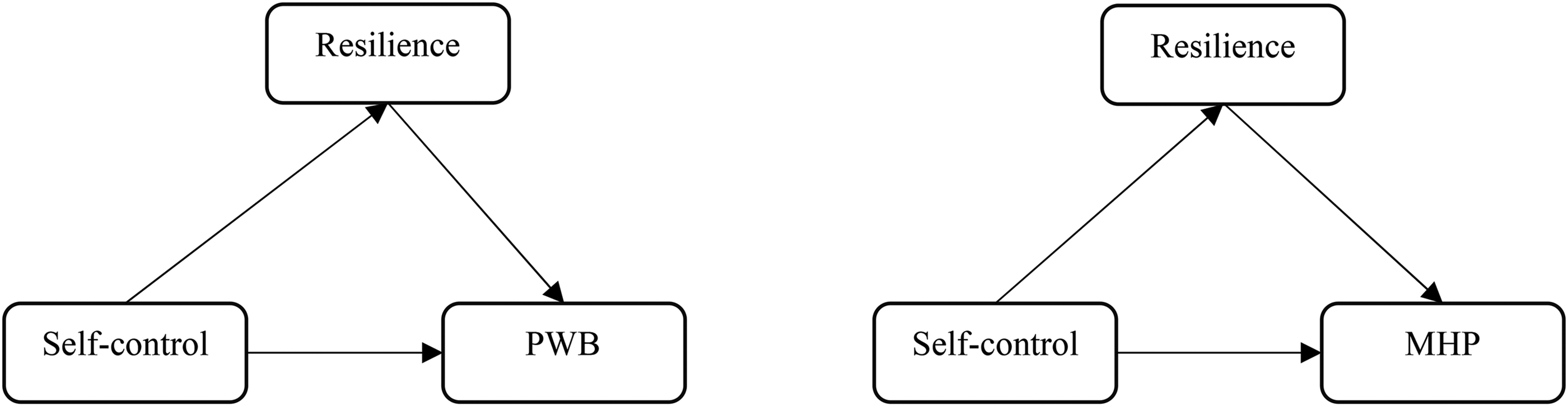
Hypothesized model.
Method
Participants
The initial data for this study were obtained from a cross-sectional questionnaire administered to 491 students from two public high schools in a big Turkish city. However, 86 subjects were removed from the data set since they didn’t complete all the instruments. Thus, the final sample was composed of 405 adolescents across grades 9 (n = 114), 10 (n = 83), 11 (n = 193), and 12 (n = 15), with 34.6% of the students identifying as male and 65.4% as female. In Turkey, the high school consists of grades 9 to 12. The participants’ ages ranged from 13 to 18 years (Mage = 15.94, SD = 1.11).
Procedures
The participants in this study were recruited using the convenience sampling technique. In this technique, participants are selected for the research based on criteria including voluntariness, cost, time, and availability (Etikan et al., 2016). Initially, formal approval from the course instructors and school headmasters was acquired for this research. The objective of the study, its voluntary participation, and privacy safeguards were all communicated to students before the instruments were administered. Paper–pencil questionnaires prepared by the researcher and explained in the scales subsection were distributed to the students who volunteered to participate in the research. Demographic questions and pencil-paper questionnaires in Turkish were completed by all students in their classrooms in ∼30 min.
Instruments
The Personal Information Form (PIF)
To compile demographic information about the participants, the researcher created a PIF in Turkish. The form consists of four short questions. Specifically, gender, age, school, and grade level were requested on this form.
Brief Self-Control Scale (BSCS)
The BSCS is a 13-item self-report instrument created by Tangney et al. (2004) to measure individuals’ self-control abilities. The scale's Turkish version, generated by Nebioglu et al. (2012), was utilized with their consent in this study. The BSCS is composed of two dimensions, including self-discipline and impulsivity (e.g. “I wish I had more self-discipline,” “I often act without thinking through all the alternatives”), and each item is rated on a five-point Likert scale ranging from 1 (strongly disagree) to 5 (strongly agree). The respondent's level of self-control is measured by the total score obtained from the BSCS. Higher scores indicate a greater level of self-control. Additionally, Şimşir Gökalp et al. (2022) replicated the adaptation study of the BSCS with an adolescent sample and came up with a 13-item, one-dimensional structure. The authors reported that the fit indices for the single-factor structure of the scale are acceptable (CMIN / DF = 2.25, CFI = .89, GFI = .92, RMSEA = .07), and factor loadings range from .42 to.72. The scale has high internal reliability (α = .79). Furthermore, the total internal reliability coefficient of the current sample was sufficient (α = .68).
Mental Health Problems Scales
To evaluate adolescents’ mental health problems, the Youth Externalizing Behavior Screener (YEBS) and the Youth Internalizing Behavior Screener (YIBS) were utilized. The total points obtained from these scales were added to calculate the mental health problems score. Furthermore, confirmatory factor analysis (CFA) was conducted to provide validity evidence for the use of a total score based on the YEBS and YIBS. According to CFA results, the two-factor structure of (internalizing and externalizing behavior) has acceptable fit indices (CMIN/DF = 2.96, GFI = .87, CFI = .88, RMSEA = .07) and factor loadings ranging from .31 to .73.
The YEBS is a self-report questionnaire created by Arslan (2019) to assess externalizing behavior issues among children and teenagers. The YEBS comprises 12 items, and three dimensions, namely conduct problems, attention problems, and hyperactivity (e.g. “I often blame others for my mistakes,” “I have difficulty staying focused on the work I’m doing”). Each item is scored using a Likert scale with a range of 1 (almost never) to 4 (nearly always). The authors reported that the fit indices for the three-factor structure of the scale are acceptable (CMIN/DF = 1.87, TLI = .96, CFI = .92, RMSEA = .06) and factor loadings ranging from .64 to .78. The scale has high internal reliability (α range = .72–.83). Furthermore, the total internal reliability coefficient of the current sample is strong (α = .82).
The YIBS is a self-report instrument created by Arslan (2021) to assess young people's depression and anxiety symptoms. The YIBS comprises 10 items and two dimensions including depression and anxiety (e.g. “I have difficulty in focusing,” “I think I am a useless person”). Each item is scored using a Likert scale with a range of 1 (almost never) to 4 (nearly always). The authors reported that the fit indices for the three-factor structure of the scale are acceptable (CMIN/DF = 1.75, TLI = .95, CFI = .97, RMSEA = .06) and factor loadings ranging from .62 to .81. The scale has high internal reliability (α range = .75–.90). Furthermore, the total internal reliability coefficient of the current sample is strong (α = .86).
Child and Youth Resilience Measure (CYRM-12)
The CYRM is a 12-item self-report instrument created by Liebenberg et al. (2012) to measure resiliency in teens and children. The scale's Turkish version, generated by Arslan (2015), was utilized with his consent in this study. The scale has a unidimensional structure (e.g. “My friends stand by me during difficult times,” “I enjoy my caregivers’ cultural and family tradition”), and each item is scored using the Likert scale (1 = does not describe me at all to 5 = describes me a lot). The authors reported that the fit indices for the one-factor structure of the scale are acceptable (CMIN/DF = 2.03, GFI = .94, CFI = .97, RMSEA = .06) and factor loadings ranging from .50 to .78. The scale has high internal reliability (α = .91). Moreover, the internal reliability coefficient of the current sample is high (α = .81).
Psychological Well-Being Scale
The scale is a seven-item self-report instrument created by Diener et al. (2010) to evaluate the PWB of individuals. The scale's Turkish version by Telef (2013) was used with his consent in this study. The scale is unidimensional (e.g. “I lead a purposeful and meaningful life,” “I am optimistic about my future”), and each item is scored on a seven-point Likert scale (1 = strongly disagree to 7 = strongly agree). The authors reported that the fit indices for the one-factor structure of the scale are acceptable (CMIN/DF = 1.58, GFI = .96, CFI = .99, RMSEA = .065), and factor loadings range from .57 to .82. The scale has high internal reliability (α = .80). Additionally, the internal reliability coefficient of the current sample is strong (α = .84).
Data analysis
The study's hypotheses were tested using the mediation analysis method. First, preliminary investigations were performed to check the internal reliability (α) of scales and normality assumptions of variables before evaluating the hypothesized models. Skewness and kurtosis values were used to assess the applicability of the assumption of normality (skewness and kurtosis ≤ |2|; George & Mallery, 2022). The links between self-control, resilience, internalizing problems, externalizing problems, and PWB among high school students were examined using Pearson correlation analysis. Following that, using the Advanced Mediation Models module of the Jamovi software, two separate mediation analyses were carried out to identify if resilience played a mediating role in the associations between self-control and mental health (Gallucci, 2020). First, the mediating effect of resilience in the relationship between self-control and mental health problems was investigated, and then the mediating effect of resilience in the relationship between self-control and PWB was investigated. Additionally, the bootstrap procedure with 5000 resamples was used to identify the study's indirect effects to estimate 95% confidence (Hayes, 2018). The mediation effect is accepted as statistically significant if the indirect effect's bootstrap confidence interval (CI) does not involve zero (Preacher & Hayes, 2008). In other words, the lower and upper limits of the CIs should have the same sign (−, +). The jamovi V2.2 program was used to perform all statistical analyses (The jamovi project, 2021).
Results
Preliminary analyses
The research variables, according to preliminary analyses, had a normal distribution, and skewness and kurtosis scores varied from −.75 to .40 (skewness and kurtosis |2|). Additionally, the results of correlation analyses supported the first research hypothesis by demonstrating a significant and small-to-moderate link between the study variables (see Table 1). Results of correlation analyses indicated that self-control had positive correlations with resilience (r = .48, p < .001) and PWB (r = .34, p < .001); however, it was negatively correlated with externalizing problems (r = −.49, p < .001), internalizing problems (r = −.44, p < .001), and mental health problems (r = −.53, p < .001). Additionally, resilience was positively correlated with PWB (r = .56, p < .001) and negatively correlated with externalizing problems (r = −.31, p < .001), internalizing problems (r = −.50, p < .001), and mental health problems (r = −.47, p < .001). Externalizing problems and internalizing problems also had a positive correlation with each other (r = .54, p < .001), a positive correlation with mental health problems (r = .86; r = .89, p < .001), and a negative association with PEB, respectively (r = −.21; r = −.42, p < .001). Lastly, PWB was negatively correlated with mental health problems (r = −.37, p < .001)
Descriptive statistics and correlational coefficients among the variables.
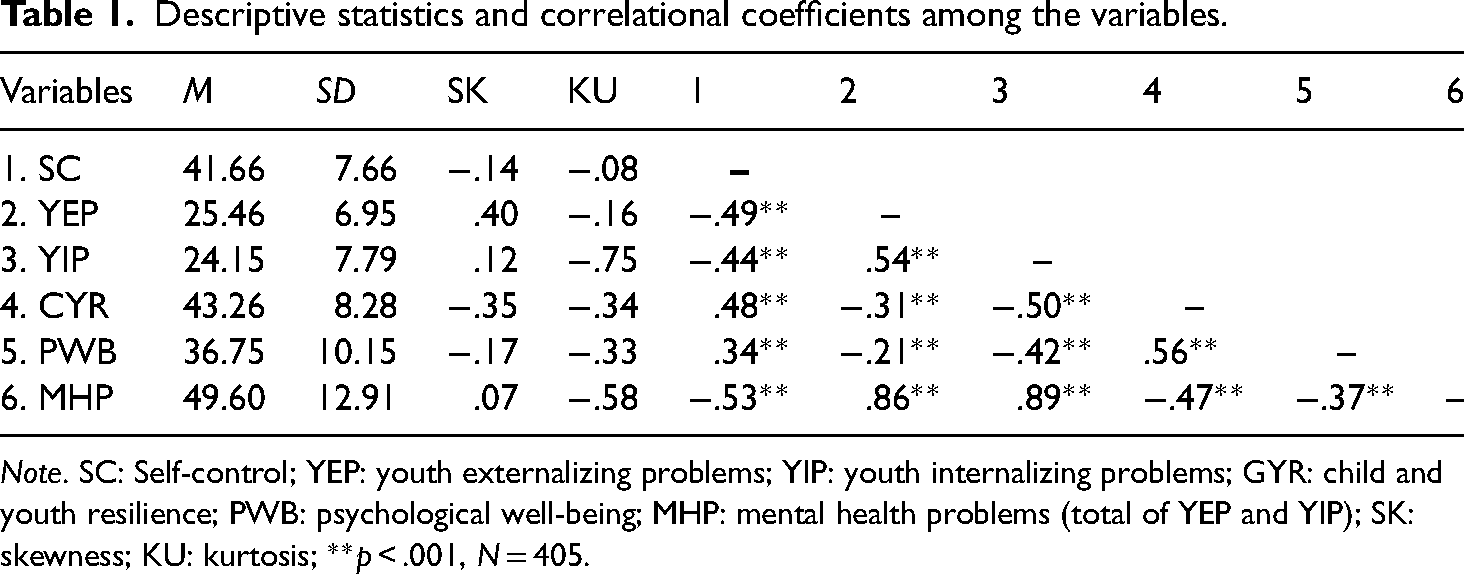
Note. SC: Self-control; YEP: youth externalizing problems; YIP: youth internalizing problems; GYR: child and youth resilience; PWB: psychological well-being; MHP: mental health problems (total of YEP and YIP); SK: skewness; KU: kurtosis; **p < .001, N = 405.
Mediation analyses
Following the preliminary results, a mediation analysis was carried out to examine whether resilience played a mediating role in the relationship between self-control and mental health indicators among adolescents. The analysis's results demonstrated that self-control significantly predicted resilience (β = .52, CI [.42, .62]) and mental health problems (β = −.66, CI [−.80, −.51]). Resilience also significantly predicted mental health problems (β = −.44, CI [−.59, −.30]). The indirect effects of self-control on mental health problems via resilience were significant (β = −.23, CI [−.33, −.15]). The total effect of self-control on mental health problems was significant (β = −.89, CI [−1.02, −.77]). As a result, resilience played a partial mediating role in the relationship between self-control and mental health issues (see Table 2). The total of all variables explained 34% of the variation in mental health issues.
Path estimates and 95% CIs for the mediation model.
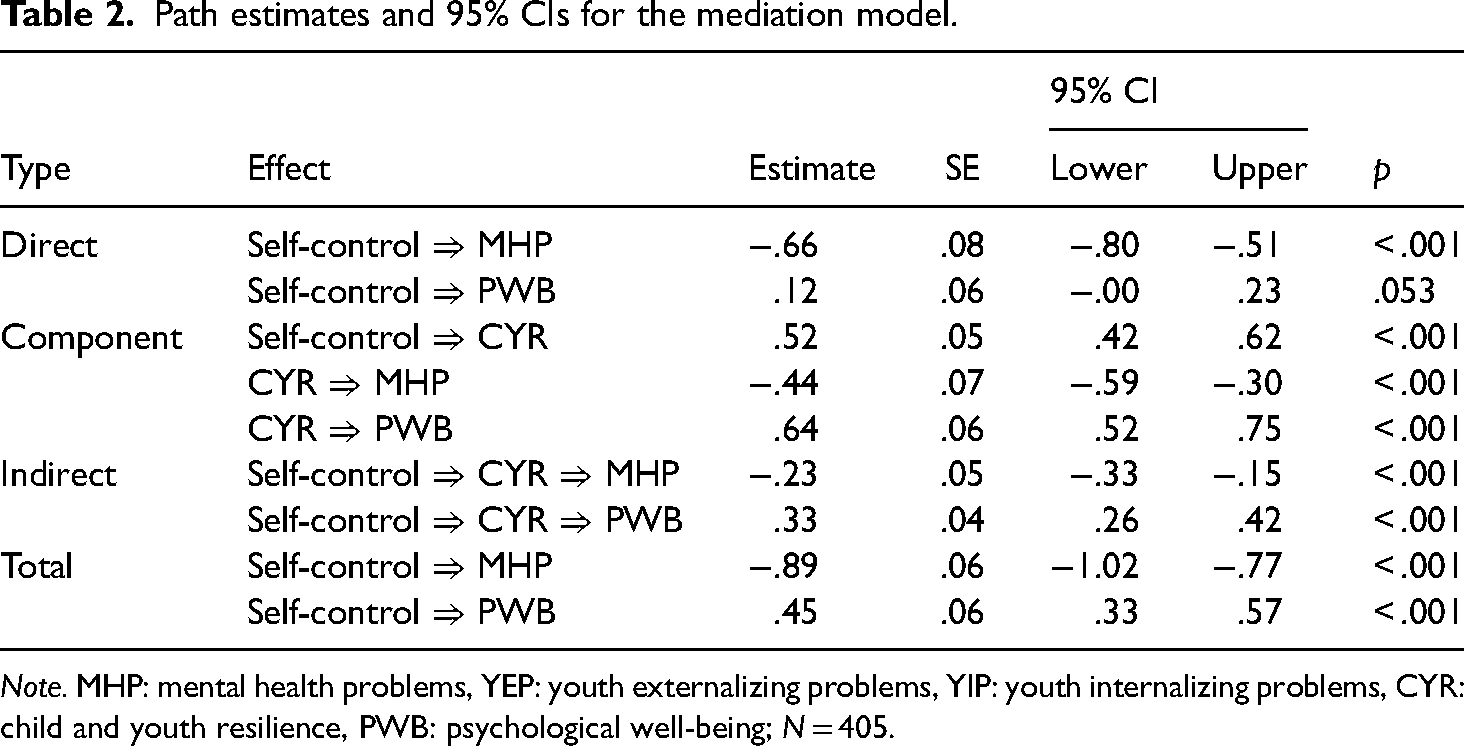
Note. MHP: mental health problems, YEP: youth externalizing problems, YIP: youth internalizing problems, CYR: child and youth resilience, PWB: psychological well-being; N = 405.
Furthermore, the mediating effect of resilience in the link between self-control and PWB was tested. The results demonstrated that self-control significantly predicted resilience (β = .52, CI [.42, .62]). However, the direct effect of self-control on PWB (β = .12, CI [−.00, .23]) was insignificant. Resilience significantly predicted PWB (β = .64, CI [.52, .75]). The indirect effects of self-control on mental health problems via resilience were significant (β = .33, CI [.26, .42]). The total effect of self-control on PWB was significant (β = .45, CI [.33, .57]). As a result, resilience fully mediated the link between self-control and PWB (see Table 2). The total of all variables explained 32% of the variation in PWB.
Discussion
Mental health issues among adolescents have become a major global problem (Allen & McKenzie, 2015). Studies on mental health have therefore increasingly focused on risk and protective factors for the psychological health of high school students (Arslan, 2022; Arslan & Allen, 2022a; Sharma et al., 2020). Yet, only a limited number of them have examined how resilience and self-control affect PWB and mental health problems (e.g. Arslan, 2016; García-Carrión et al., 2019; Hu et al., 2015; Li et al., 2022). In this context, this research investigated the association between self-control and mental health as well as the mediating role of resilience in this association among high school adolescents. As expected, all bivariate correlations were significant, and resilience had a mediating role in the association between self-control and mental health (e.g. mental health problems and PWB). To put it another way, more self-control contributes to an inclination to be more resilient, which is associated with improved mental health.
The results found in this research confirm those from cross-sectional studies investigating the link between adolescent mental health issues and self-control (e.g. Finkenauer et al., 2005; Kim et al., 2022; Li et al., 2019; McDermott et al., 2017). Self-control is crucial for optimal human performance and enables people to succeed in their studies, careers, and relationships (Baumeister & Alquist, 2009; Li et al., 2022; Tangney et al., 2004). These self-control functions are crucial for maintaining mental health, as demonstrated in previous studies. According to Bandura (1989), adolescents with poor self-control may have low self-efficacy in regard to their ability to perform well at work or in school, which is a significant risk factor for symptoms of anxiety and depression. Moreover, deficient self-control may result in behavioral problems including delinquency, conduct disorders, violence, substance use, criminality, and externalizing behaviors (McDermott et al., 2017; Pechorro et al., 2021; Vazsonyi et al., 2017). However, it is worth emphasizing that the association between psychological issues and self-control is reciprocal (Cohen & Lieberman, 2010; Tangney et al., 2004). Negative feelings, for example, might also impair one's self-control capacity (Curci et al., 2013; Duckworth et al., 2013). The study conducted by Duckworth et al. (2013) revealed that stressful life situations raise psychological distress, which adversely impacts adolescents’ ability to control themselves.
Further, the findings of the current research demonstrated that self-control is positively linked to PWB. Similarly, previous research has indicated that self-control is positively correlated with happiness (Cheung et al., 2014), life satisfaction (Hofmann et al., 2013), subjective well-being (Li et al., 2022), PWB (Li et al., 2022), and peace (Şimşir & Dilmaç, 2022). De Ridder and Gillebaart (2017) asserted that self-control contributes to well-being since it facilitates goal achievement and promotes adaptive routines. PWB primarily deals with elements of human development and existential questions in life (Keyes et al., 2002). It also focuses on goal attainment and personal fulfillment (Ryff & Singer, 2008). Likewise, people with greater self-control resist stronger temptations and work toward higher-order objectives (Duckworth & Seligman, 2005). Accordingly, it is not difficult to figure out why people who have strong self-control are also prone to have high levels of PWB.
Additionally, this study's outcomes provided an understanding of the fundamental processes underlying the link between self-control and well-being. The results showed that resilience partially mediated the relationship between self-control and mental health problems. Resilience refers to having relatively few negative psychological symptoms or problem behaviors, despite exposure to adverse circumstances (Wills & Bantum, 2012). Self-control is a crucial asset in building and strengthening resilience in adolescence, as it reduces risk factors for problem behaviors and enhances protective factors (Dias & Cadime, 2017; Luthar et al., 2000; Wills & Bantum, 2012). self-control serves as a resilient factor in mitigating mental health issues. Additionally, resilience has an important role in reducing the harmful effects of unpleasant life experiences (Arslan, 2016; Li et al., 2020) and improving young people's mental health (Arslan, 2016; Dray et al., 2017; Mesman et al., 2021). For instance, a meta-analysis performed by Hu et al. (2015) showed that higher resilience is linked to more favorable signs of mental health such as life satisfaction or a positive affect, and fewer adverse signs of mental health such as depression, anxiety, or negative affect. In their systematic review research, Mesman et al. (2021) similarly demonstrated that resilience is related to a lower incidence of mental health problems.
Finally, the present results broadened the scope of mental health research by revealing that resilience fully mediated the association between self-control and PWB. Self-control ability hinders acting impulsively, facilitates adaptive responses, and increases the flexibility of people's behavior (Baumeister & Alquist, 2009). Flexibility, in turn, contributes to managing stress and well-being (Arslan & Allen, 2022b). According to Artuch-Garde et al. (2017), one of the most crucial protective characteristics in connection to resilience for adolescent mental health is the capacity for self-control. In this context, previous research suggested that resilience positively correlated with self-control (Artuch-Garde et al., 2017; Hu et al., 2021), which is positively related to indicators of well-being including PWB, subjective well-being, and life satisfaction (Andreou et al., 2020; Mak et al., 2021; Yıldırım & Arslan, 2022). In the end, the findings of this investigation showed that resilience is a crucial component in enhancing the influence of self-control on mental health in high school adolescents.
Limitations
The study contains various limitations which need to be taken into account when evaluating its results. First, since the data were gathered cross-sectionally, a cause-and-effect link cannot be examined. Future research may consider collecting longitudinal data to study the cross-lagged pathways between self-control and mental health in an attempt to shed more light on potential causal pathways. Additionally, associations between self-control, resilience, and mental health problems among adolescents might be better understood through longitudinal investigations. Secondly, only quantitative methods were employed in this study. Future studies may combine qualitative and quantitative approaches to provide a more complete description of the links between research variables. Third, all data were obtained using self-report questionnaires, which might have captured social desirability biases (Fischer & Fick, 1993). Future research that takes into account the opinions of other reporters such as parents and teachers may offer more well-rounded measurements. Lastly, there is a lack of heterogeneity among the sample, as participants were selected only from high school students in Turkey. In addition, 65.4% of the sample identified as female. The sample may therefore restrict how far the study's findings can be generalized. More heterogeneous (different cultures, developmental periods, etc.) samples with more representative gender demographics should be included in future investigations.
Recommendations and implications
Notwithstanding such limitations, the study has significant implications for scientists, teachers, school counselors/psychologists, other mental health providers who work in schools, and policymakers. Study findings showed that self-control and resilience are beneficial for the mental health of adolescents. First, these findings may be utilized for the creation of preventive interventions for adolescents enrolled in middle and high schools. For instance, it would be beneficial for researchers to design psycho-education and intervention programs focused on enhancing adolescents’ resilience and self-control. Considering the scarcity of intervention studies for increasing adolescents’ self-control, researchers need to conduct self-control intervention studies to be implemented in school environments (e.g. Oaten & Cheng, 2006). Second, mental health practitioners who are employed in educational institutions (i.e. school psychologists and counselors) should use empirically tested intervention programs to enhance the resilience and self-control of students. They may also include parents and teachers in these programs. Psychologists and other mental health service providers in schools may consider promoting the self-control and resilience of clients during individual or group counseling sessions. Third, teachers may think about using curriculum-based interventions that promote self-control and resilience to improve students’ mental health. These interventions might help adolescents overcome challenging life circumstances and encourage a healthy transition from adulthood. Finally, when formulating national health policies, policymakers might incorporate initiatives to enhance teenagers’ self-control and resilience in preventive efforts.
Conclusion
This study revealed the importance of resilience and self-control in fostering adolescents’ mental health. According to the results of the research, self-control has a positive impact on PWB and an adverse impact on mental health problems in high school adolescents. Additionally, self-control has an indirect association with mental health issues and PWB via resilience. In the end, the study's conclusions have notable implications for psychologists and services for mental health in schools, especially those who struggle with addressing adolescent mental health issues.
Footnotes
Author note

The datasets created during and/or analyzed during the current study are available from the corresponding author upon reasonable request. The Selcuk University, Faculty of Education, Scientific Ethics Evaluation Committee provided ethical approval for this study (Ref: 38-2022).
Declaration of conflicting interests
The author declared no potential conflicts of interest with respect to the research, authorship, and/or publication of this article.
Funding
The author received no financial support for the research, authorship, and/or publication of this article.