







Abstract
Given the important role of a growth mindset in students’ learning processes and outcomes, researchers have increasingly focused on how classroom instruction can cultivate a growth mindset and promote academic progress. This study examined the relationships among perceived classroom goal structures, students’ growth mindset, self-regulated learning strategies, and mathematics performance among 926 Chinese middle school students in Grades 7 and 8. Results indicated that perceived mastery goal structures positively predicted students’ growth mindset and their use of self-regulated learning strategies. A growth mindset was positively associated with self-regulated learning strategies, which in turn were linked to higher mathematics performance. In contrast, perceived performance goal structures were negatively related to mathematics performance. These findings highlight the importance of fostering mastery-oriented classroom environments and supporting students’ growth mindset and self-regulated learning to promote mathematics learning among Chinese middle school students.
Keywords
Introduction
The outstanding mathematics performance of Chinese students in international large-scale assessments (such as Trends in International Mathematics and Science Study and Programme for International Student Assessment) has drawn researchers’ attention to the reasons underlying their success (Guo et al., 2022; Hu et al., 2018). Some researchers have suggested that Chinese students’ high mathematics performance may be partly attributed to their diligence in learning (Leung, 2006). Chinese culture places a high value on education (Leung, 2014) and emphasizes the cultivation of effort and perseverance (Li, 2002). In this sociocultural context, Chinese students may hold a high level of growth mindset (i.e., the belief that one's abilities can be developed through sustained effort; Dweck, 2013). Examining growth mindset in the Chinese educational context may thus provide valuable insights into the mechanisms underlying Chinese students’ mathematics performance.
According to the implicit theories model (Dweck et al., 1995), individuals’ beliefs about the malleability of human attributes can influence their inferences, reactions, and judgments, thereby affecting their academic outcomes. Building on this perspective, students who hold a growth mindset are more likely to engage in proactive learning processes (e.g., self-regulated learning (SRL), Bai & Guo, 2021), which, in turn, benefits their mathematics performance (Roick & Ringeisen, 2018). However, the role of the growth mindset has become increasingly debated in recent years. Some researchers have questioned its effectiveness, with meta-analytic findings showing that the growth mindset was only weakly or non-significantly related to learning goals and academic achievement (e.g., Burnette et al., 2013; Macnamara & Burgoyne, 2023). Despite these ongoing debates, most existing studies have been conducted in Western contexts, and empirical evidence from Chinese educational settings remains limited. Therefore, it is necessary to further examine the hypothesized effects of growth mindset, as proposed by the implicit theories model, among Chinese students.
The ecological system theory (EST; Bronfenbrenner, 1979) posits that individual development is shaped by ongoing interactions between individuals and significant others in their immediate environments. In recent years, researchers have increasingly examined how social contexts convey implicit messages about whether ability is fixed or malleable, which in turn affects students’ mathematics learning processes and performance. Students’ mindset beliefs have been found to be shaped by parenting styles (Ren et al., 2025; Yang & Sun, 2025), peer mindsets (Seo et al., 2025; Sheffler & Cheung, 2020), and teaching practices (Kroeper et al., 2022; Mesler et al., 2021), all of which are also reliable predictors of students’ mathematics performance. In Chinese society, which is deeply rooted in Confucian values such as respect for teachers, teachers occupy a central role in students’ mathematics learning. Students’ mindsets may be especially sensitive to their perceptions of goal structures conveyed during teachers’ instructional practices in the classroom. Therefore, the present study aims to investigate how classroom goal structures shape growth mindsets among Chinese students and how these mindsets, in turn, influence students’ mathematics learning processes and performance.
Classroom goal structures and academic performance
Classroom goal structures refer to the types of achievement goals emphasized through the prevailing instructional practices and policies within a classroom (Ames, 1992). The types of tasks assigned, the grading procedures, the degree of autonomy provided to students, and the ways in which students are grouped in the classroom reflect the classroom goal structures (Kaplan et al., 2002). The goal structures primarily consist of two types: mastery goal structures (i.e., teachers’ emphasis on understanding knowledge and mastering skills; Ames, 1992) and performance goal structures (i.e., teachers’ focus on mistakes, grades, and academic competition; Ames, 1992; Meece et al., 2006).
Previous empirical studies have provided evidence of the associations between classroom goal structures and students’ academic performance. Rolland (2012) conducted a meta-analysis and narrative review, revealing that for sixth-grade students, perceptions of mastery goal structures were positively associated with academic performance, whereas performance goal structures showed a negative association. However, these effects were not significant among students in seventh grade and above. Given the central role of mathematics achievement in shaping later academic success and career trajectories, researchers have increasingly focused on the influence of classroom goal structures specifically in the mathematics domain (Guo & Hu, 2022; Gutman, 2006; Lau & Nie, 2008). For instance, Guo and Hu (2022) investigated fifth- and sixth-grade Chinese Han and Miao students and found that mastery goals positively predicted mathematics performance, while performance goals had no significant relationship.
In the Chinese cultural context, classroom goal structures both embody and transmit cultural values and social expectations that shape students’ learning, while also exhibiting distinctive features. Influenced by Confucianism, Chinese teachers’ discourse and classroom practices often emphasize effort and self-improvement, fostering students’ perceptions of classroom mastery goals (Qian & Lau, 2024; Wang & Rao, 2019). At the same time, the strong exam-oriented culture in China frequently drives teachers to emphasize competition and performance, reinforcing students’ perceptions of classroom performance goals (Wang & Rao, 2019; Watkins, 2010). Moreover, under the influence of collectivist norms, Chinese students tend to form close relationships with their teachers (Yang et al., 2013) and remain highly attuned to their expectations (Chiu et al., 2016), rendering classroom goal structures especially influential on their academic performance.
Classroom goal structures, growth mindset, and academic performance
The growth mindset refers to the belief in the malleability of intelligence, skills, and abilities (Dweck, 2013). Numerous studies have demonstrated that a growth mindset has a positive impact on students’ academic performance (Bostwick et al., 2017, 2020). An increasing number of researchers have shifted their attention to growth mindsets in specific learning domains and found that students’ growth mindset in mathematics—believing that mathematical abilities and skills can be improved through effort—positively influences their mathematics performance (Bostwick et al., 2020; Degol et al., 2018; Huang et al., 2019). For example, Bostwick et al. (2020) found that the mathematics growth mindset of Australian middle school students positively predicted their mathematics performance.
Many researchers have emphasized the importance of fostering a growth mindset in students, given its significant influence on their learning behaviors and outcomes (Haimovitz & Dweck, 2016; Mangels et al., 2006). However, some researchers have questioned the effects of growth mindset on academic achievement (Burnette et al., 2013; Macnamara & Burgoyne, 2023). For instance, Macnamara and Burgoyne (2023) conducted a meta-analysis of 63 studies and showed that a growth mindset was only weakly or non-significantly related to academic achievement. These inconsistent findings may be partly explained by cultural factors. Cultural beliefs have been found to influence not only the endorsement of a growth mindset but also the ways in which mindsets relate to achievement outcomes (Bernardo et al., 2021). In China, Confucian culture places a strong emphasis on effort, viewing it as the primary determinant of academic success (Li, 2006), which provides a cultural foundation for the development of growth mindsets among Chinese students (Bai et al., 2021). Such cultural beliefs may shape the way growth mindset influences Chinese students’ academic achievement. However, most growth mindset research has been conducted in Western contexts, and the effects of growth mindset among Chinese students thus warrant further investigation.
Students’ growth mindset may be influenced by environmental conditions. According to achievement goal theory (Ames & Archer, 1988; Wolters, 2004), classroom goal structures can shape students’ beliefs and attitudes toward learning. Empirical research has explored how these goal structures contribute to the development of students’ growth mindset (Wang & Rao, 2019). For mastery goal structures, if teachers emphasize mastering knowledge and effort in the classroom, students may be more likely to adopt a growth mindset, recognizing that effort leads to success (Wang & Rao, 2019). In contrast, performance goal structures may be detrimental to students’ mindset beliefs. When teachers place strong emphasis on error correction, evaluation, and social comparison, students may interpret academic success as something attainable only by those with innate ability. Longitudinal evidence supports this pattern. For example, Park et al. (2016) found that performance-oriented instructional practices were associated with increases in fixed mindset beliefs among US elementary school students. Similarly, Yu et al. (2025) examined 430 Dutch students over the first 2 years of secondary school and found that perceiving a performance-oriented goal structure was detrimental to maintaining a growth mindset.
Classroom goal structures, SRL, and academic performance
Regarding the student learning process, SRL has attracted much attention from researchers in order to answer the question of how students master their own learning processes (Zimmerman, 2008). In particular, within Chinese society, the virtue model of learning rooted in Confucianism emphasizes social and moral self-cultivation (Li, 2012), encouraging learners to strive through learning to become the most sincere and disciplined person they can be (Tu, 1985). Influenced by this cultural orientation, Chinese students tend to highly value the regulation of their learning, believing that SRL contributes to their academic success (Bempechat et al., 2018). SRL is a dynamic process in which learners consciously initiate and maintain their cognitive, emotional, and behavioral efforts to achieve personal academic goals (Zimmerman & Schunk, 2011). One essential component of this process is the use of appropriate learning strategies. As defined by Zimmerman (1990), SRL strategies encompass the intentional actions learners take to acquire knowledge or skills, reflecting their sense of agency and goal-directedness. Specifically, SRL strategies commonly include organization, elaboration, rehearsal, monitoring, and regulating (Dowson & McInerney, 2004).
Previous studies have consistently highlighted the role of SRL strategies in influencing students’ academic performance (Broadbent, 2017; Cheng et al., 2025; Eshel & Kohavi, 2003; Zhao et al., 2025). For example, Zhao et al. (2025) conducted a meta-analysis examining the relationship between SRL strategies and academic performance in online and blended learning environments, reporting an overall effect size of 0.14. In response to the growing importance of mathematics and the challenges students face in studying it, scholars have increasingly recognized the important role of SRL in mathematics and its impact on students’ mathematics performance (Musso et al., 2019; Roick & Ringeisen, 2018; Sun et al., 2018). For instance, Musso et al. (2019) examined 575 university students and confirmed the significant contribution of SRL strategies to mathematics performance. Despite these valuable insights, the majority of existing research has concentrated on higher education contexts, while studies targeting in primary and secondary education remain limited.
Based on achievement goal theory (Ames & Archer, 1988; Wolters, 2004), the goal structures that students perceive as emphasized in the classroom might influence students’ cognitive engagement and use of learning strategies. Numerous studies have examined how classroom goal structures relate to students’ use of SRL strategies (Fadlelmula et al., 2015; Lyke & Kelaher Young, 2006; Wolters, 2004). When students perceive their teachers as emphasizing mastery goals, they are more likely to engage in SRL strategies (Fadlelmula et al., 2015). However, the effects of classroom performance goal structures remain inconclusive. Some researchers have found that performance goal structures have no significant impact on the use of SRL strategies (Lyke & Kelaher Young, 2006), while others have reported positive effects (Wolters, 2004).
Classroom goal structures, growth mindset, SRL, and academic performance
The classroom context is a primary setting for students’ learning processes. According to EST (Bronfenbrenner, 1979), individual development is shaped by the repeated interaction between students and their teachers in the classroom. Achievement goal theory (Ames & Archer, 1988; Wolters, 2004) proposes that goal structures in classroom teaching practices, which involve the reasons or purposes adopted while engaging in academic work, may influence students’ beliefs, use of learning strategies, and academic achievement. Drawing on these theoretical perspectives, classroom goal structures can shape students’ growth mindset (Wang & Rao, 2019), SRL (Bai & Guo, 2021), and mathematics performance (Guo & Hu, 2022; Lau & Nie, 2008).
Personal mindset beliefs have been regarded as key determinants of SRL (Bai et al., 2021). The implicit theories model (Dweck et al., 1995) suggests that individuals’ beliefs about the malleability of human attributes can shape their use of SRL strategies, thereby influencing their learning outcomes. Building on this, a growing body of evidence supports the link between students’ growth mindset and their use of SRL strategies (Bai & Guo, 2021; Doron et al., 2009; Law, 2009). For instance, Bai and Guo (2021) examined 523 primary school students in Hong Kong and revealed that a growth mindset showed a strong and significant association with students’ use of SRL strategies. Taken together, these findings suggest that classroom goal structures may influence students’ growth mindset, which in turn promotes the use of SRL strategies, ultimately enhancing mathematics performance.
The present study
This study will explore the relationship between mathematics classroom goal structures, students’ growth mindset, SRL strategies, and mathematics performance within the Chinese context. Drawing on existing literature (Bai & Guo, 2021; Guo & Hu, 2022; Wang & Rao, 2019; Wolters, 2004), the implicit theories model (Dweck et al., 1995), EST (Bronfenbrenner, 1979), and achievement goal theory (Ames & Archer, 1988; Wolters, 2004), the study posits that mathematics classroom goal structures are associated with students’ mathematics growth mindset, which, in turn, shows links with their use of mathematics SRL strategies and mathematics performance. Specifically, classroom mastery goal structures are expected to be positively associated with students’ growth mindset and SRL strategy use, which are in turn linked to higher levels of mathematics performance. In contrast, classroom performance goal structures may be negatively related to students’ growth mindset, which could subsequently be associated with lower engagement in SRL strategies and less favorable mathematics outcomes.
Research methods
Participants and procedure
This study surveyed 926 middle school students from six schools in China, including 461 seventh-grade students (49.7%) and 465 eighth-grade students (50.2%). The sample consisted of 460 male students (49.7%), 430 female students (46.4%), and 36 students who did not provide gender information (3.9%). The average age of the participants was 13.52 years (with a standard deviation of 0.679). The present study focused on seventh- and eighth-grade students because this period represents a critical stage in mathematics learning and motivational development. During these years, mathematical content becomes more abstract and cognitively demanding, and many students begin to perceive mathematics as increasingly challenging. Consequently, students’ growth mindset and self-regulated learning strategies become particularly important for sustaining their engagement and performance in mathematics. Additionally, early adolescence is a period in which beliefs and learning habits remain highly malleable, making students especially responsive to the classroom goal structures established by teachers.
After obtaining consent from the schools, teachers, and students, data on students’ mathematics learning were collected with the assistance of local teachers. The questionnaires were administered during regular class periods under the supervision of trained research assistants and classroom teachers. Students were informed that their participation was voluntary and that their responses would remain confidential and would be used only for research purposes.
Measures
All scales used in this study, including the classroom goal structure, growth mindset, and SRL strategies scales, were administered in Chinese. The original English measures were translated into Chinese using a standard translation and back translation procedure. The translations were completed by a mathematics education researcher who was fluent in both Chinese and English, while a graduate student in English who was unfamiliar with the original scales back-translated them into English. Any discrepancies were discussed and resolved by the research team to ensure accuracy. The translated items were reviewed by experts and piloted with students to confirm clarity and cultural appropriateness. CFA results supported the validity of the Chinese versions of the scales.
Mathematics classroom goal structures
This study measured students’ perceptions of the mathematics classroom goal structure using a 5-point Likert scale (hereafter referred to as “classroom goal structure”). The scale was adapted from the Classroom Goal Structure Questionnaire developed by Midgley et al. (2000), with all items revised to specifically refer to mathematics classrooms. The scale comprised two dimensions: mastery goal structure (3 items; e.g., “The math teacher thinks it's acceptable to make mistakes as long as we are learning”; internal consistency α = .73) and performance goal structure (3 items; e.g., “The math teacher tells us which students have the highest exam rankings”; internal consistency α = .69).
Based on the modification indices, two items within the mastery goal structure (“The math teacher wants us to enjoy learning new knowledge” and “The math teacher gives us time to explore and understand new ideas”) showed some overlap, while two items within the performance goal structure (“The math teacher lets us know which students have the highest exam rankings” and “The math teacher wants us to avoid appearing not to understand in class”) were highly correlated. Therefore, the residuals of these pairs of items were allowed to covary. The final CFA indicated a good model fit, χ2(df) = 30.694(6), χ2/df = 5.116; CFI = 0.972; TLI = 0.946; SRMR = 0.035; RMSEA = 0.066, 90% CI [0.049, 0.083].
Mathematics growth mindset
This study used a revised version of Dweck's Implicit Theory Scale (Dweck, 2013; Dweck et al., 1995) to measure students’ growth mindset in mathematics learning (hereafter referred to as “growth mindset”). The scale employed a 5-point Likert format ranging from strongly disagree to strongly agree. The original items assessed beliefs about the malleability of intelligence; in this study, the wording was modified to focus on the malleability of mathematical ability (4 items; e.g., “No matter what my foundation is, I can learn mathematics well through effort”). The internal consistency of the scale was acceptable (α = .77).
Two items in the growth mindset scale (“I can fundamentally improve my math ability” and “No matter what my foundation is, I can learn math well through effort”) showed some overlap; therefore, their residuals were allowed to covary. The CFA indicated an excellent model fit, χ2(1) = 0.97, χ2/df = 0.97, CFI = 1.000, TLI = 1.000, SRMR = 0.004, RMSEA = 0.000, 90% CI [0.000, 0.086].
Mathematics SRL strategies
Based on the Goal Orientation and Learning Strategies Survey (GOALS-S; Dowson & McInerney, 2004), this study used a 5-point Likert scale to assess students’ use of SRL strategies in mathematics. The scale included five cognitive and metacognitive strategies: organization (3 items; e.g., “When learning new mathematics concepts, I link them to what I have learned before”; α = .789), elaboration (3 items; e.g., “When studying mathematics, I try to find the relationships among the things I am learning”; α = .850), rehearsal (3 items; e.g., “I repeatedly memorize the mathematical knowledge I am learning”; α = .845), monitoring (3 items; e.g., “During learning, I check whether I have misunderstood the mathematical content”; α = .849) and regulating (3 items; e.g., “When I encounter confusion in learning mathematics, I adjust my learning strategies”; α = .907).
For each strategy, the mean of its corresponding items was computed. The mean score for each of the five strategies served as observed indicators of the latent construct SRL in the structural equation model (α = .860). The initial CFA showed a poor model fit, χ2(5) = 145.29, χ2/df = 29.06, CFI = 0.932, TLI = 0.864, SRMR = 0.042, RMSEA = 0.174, 90% CI [0.150, 0.199]. Modification indices suggested that monitoring and organization, as well as rehearsal and regulating, were significantly correlated. Therefore, their residuals were allowed to covary. The final CFA model showed a good fit to the data, χ2(3) = 7.34, χ2/df = 2.45, CFI = 0.998, TLI = 0.993, SRMR = 0.008, RMSEA = 0.040, 90% CI [0.000, 0.077].
Mathematics performance
Mathematics performance was collected from the schools in the form of students’ final mathematics exam scores. This is a unified examination in all sample schools to assess students’ mathematics performance. These scores were then standardized within each school and grade level.
Background variables
Students’ gender (Hyde et al., 1990) and parents’ highest educational level (Guo & Cao, 2024) have been found to be associated with students’ mathematics performance. Therefore, these two background variables were collected in the survey: students’ gender (male = 0, female = 1) and parents’ highest educational level (primary school or below = 1, junior high school = 2, senior high school = 3, undergraduate = 4, and postgraduate or above = 5).
Data analysis
In the preliminary analysis phase, descriptive statistics and bivariate correlations were conducted using SPSS 26.0. A series of CFAs were performed to examine the construct validity of the measurement instruments. In the main analysis phase, structural equation modeling (SEM) was employed to test the hypothesized relationships among classroom goal structure, students’ growth mindset, SRL strategies, and mathematics performance using Mplus 8.0.
Model fit was evaluated using multiple indices, including the Comparative Fit Index (CFI), the Tucker–Lewis Index (TLI), the standardized root mean square residual (SRMR), and the root mean square error of approximation (RMSEA). A good model fit was indicated by CFI and TLI > 0.90, SRMR < 0.08, and RMSEA < 0.08 (Byrne, 2001). Bootstrap analysis was conducted to examine the indirect effects of growth mindset and SRL strategies in the association between classroom goal structure and mathematics performance. An indirect effect was considered significant when the 95% bootstrap confidence interval did not include zero (Hayes, 2013).
Research results
Descriptive statistics and correlation analysis
The results of the descriptive statistics and correlation analysis are presented in Table 1. A preliminary exploration of the relationships between the main variables was conducted using bivariate correlation analysis. As shown in Table 1, there was a significant negative correlation between the two types of classroom goal structure (r = −.251, p < .01). The classroom mastery goal structure was positively correlated with students’ growth mindset (r = .308, p < .01) and SRL strategies (r = .325, p < .01). The classroom performance goal structure was negatively correlated with students’ SRL strategies (r = −.095, p < .01). Students’ growth mindset was positively correlated with SRL strategies (r = .550, p < .01). Mathematics performance was positively correlated with classroom mastery goal structure (r = .092, p < .01), students’ growth mindset (r = .162, p < .01), and SRL strategies (r = .187, p < .01), but negatively correlated with classroom performance goal structure (r = −.091, p < .01). Parental education and student gender were related to some key study variables; thus, both variables were controlled in subsequent analyses.
Descriptive statistics and correlation analysis results.

Note: *p < .05, **p < .01.
SEM
According to the research hypothesis, this study used SEM to examine the relationships between classroom goal structures, students’ growth mindset, SRL strategies, and mathematics performance. The results indicated a good fit between the data and the hypothesized model, χ2(df) = 244.834 (112), χ2/df = 2.186; CFI = 0.973; TLI = 0.964; SRMR = 0.029; RMSEA = 0.036, 90% CI [0.030, 0.042]. The standardized path coefficients in the model are displayed in Figure 1. The model explained 22.4% of the variance in growth mindset, 53.4% in SRL strategies, and 6% in mathematics performance. Perceived mastery goal structure was positively correlated with growth mindset (β = .44, p < .001) and SRL strategies (β = .17, p < .001), while perceived performance goal structure was negatively correlated with mathematics performance (β = −.09, p < .05). Growth mindset was positively associated with SRL strategies (β = .63, p < .001), and SRL strategies were positively associated with mathematics performance (β = .14, p < .05).
SEM post-hoc sensitivity power analysis
We conducted a post-hoc sensitivity analysis to evaluate the statistical power of the structural equation model (MacCallum et al., 1996). Given the sample size of N = 926 and model degrees of freedom df = 112, power was assessed using the RMSEA test of close fit (α = .05, 1−β = .80). The results indicated that this sample size provides ∼80% power to distinguish RMSEAH0 = 0.05 from RMSEAH1 ≈ 0.059. The observed model fit was RMSEA = 0.036, which is well below the close-fit benchmark of 0.05, indicating a good model fit and sufficient power to detect meaningful deviations from close fit.
Indirect effect analysis
Bootstrap analysis (resampling 5000 times; Hayes, 2013) confirmed the indirect effects of growth mindset and SRL strategies in the relationship between classroom mastery goals and mathematics performance. Specifically, classroom mastery goals were positively related to students’ mathematics performance through SRL strategies (BC 95% CI [0.004, 0.061]). The study also revealed a sequential indirect association: classroom mastery goals were positively associated with students’ growth mindset, which in turn was positively associated with their use of SRL strategies, ultimately related to better mathematics performance (BC 95% CI [0.006, 0.085]). The direct effect of classroom mastery goals on mathematics performance was not significant (BC 95% CI [−0.133, 0.084]). However, classroom performance goal structure showed only a significant direct effect on mathematics performance (BC 95% CI [−0.182, −0.015]), with no significant indirect associations through growth mindset and SRL strategies.
Discussion
This study found that classroom mastery goal structures were positively associated with students’ growth mindset, which in turn was positively related to mathematics performance. The results were consistent with previous research emphasizing the influence of learning environments in shaping a growth mindset (Dweck, 2008; Wang & Rao, 2019). When students perceive that their math teachers emphasize self-improvement, mastery of knowledge, persistent effort, and learning from mistakes, they may be more likely to believe that math ability can be changed, and with effort, one can excel in math. Early adolescents who hold such a belief tend to have stronger learning goals, more positive beliefs about effort, and are less likely to make ability-based, “helpless” attributions (Blackwell et al., 2007). They are also more likely to see challenges as an opportunity to enhance their skills (Dweck & Leggett, 1988) and to enroll in advanced math courses (Romero et al., 2014), thereby achieving better mathematics performance.
Contrary to our hypothesis, the results showed no significant association between classroom performance goal structures and students’ growth mindset. This suggests that performance-oriented environments may not necessarily undermine growth mindset development in the Chinese context. One possible reason is that different forms of performance-focused practices may function differently in shaping students’ beliefs. For instance, performance-avoidance cues (e.g., emphasizing mistakes or criticizing poor performance) may be associated with fixed-ability beliefs. Prior empirical research has shown that performance-avoidance messages are linked to lower growth in students’ growth mindset (Yu et al., 2025).
In contrast, when teachers praise a student's strong performance (i.e., performance-approach cues) and encourage others to learn from that student, peers may view the high-achieving student as a role model. This aligns with the Confucian principle of learning through emulation, expressed in the saying “jian xian si qi yan” (见贤思齐焉; see the virtuous and strive to emulate them). Such growth-oriented examples may signal that success can be achieved through sustained effort (Gladstone et al., 2024), thereby reinforcing beliefs in the malleability of ability. However, the present study did not distinguish between performance-avoidance and performance-approach goal structures, which may have contributed to the nonsignificant overall association. Future research should adopt more fine-grained measures to examine these goal dimensions separately and clarify their distinct roles in students’ mindset development.
The results of this study suggest that students’ use of SRL strategies was an important link between their perceptions of a mastery-oriented classroom environment and their academic performance. That is, students who perceived a stronger emphasis on mastery of knowledge in the classroom tended to report greater use of SRL strategies, and these strategies were in turn associated with higher mathematics performance. The results were consistent with previous research on the positive influence of classroom mastery goals on the use of SRL strategies (Fadlelmula et al., 2015) and the positive impact of SRL strategies on academic performance (Zhao et al., 2025). A possible reason for this is that the classroom mastery goal structure enhances students’ pursuit of mastery goals (Guo & Hu, 2022). Mastery-oriented students are better able to use SRL strategies (Guo & Leung, 2021; Pintrich, 2000). The impact of such strategies may be particularly salient during early adolescence, a developmental stage marked by enhanced cognitive and metacognitive capacity (Christopoulos et al., 1987). As mathematics content becomes more difficult, junior high school students are especially well-positioned to benefit from elaborative and generative SRL strategies, which can translate into greater gains in mathematics performance (Murayama et al., 2013).
The classroom performance goal structure did not significantly predict students’ use of SRL strategies. The results align with previous findings that classroom performance goals are generally less supportive of SRL development compared to mastery goals (Lyke & Kelaher Young, 2006; Wolters, 2004). One possible explanation is that performance goal structures often emphasize competition, frequent comparisons of grades, and assessment through testing, which may heighten students’ awareness of social comparison and promote extrinsic motivation (Lyke & Kelaher Young, 2006; Meece et al., 2006). As a result, students in such environments may be more inclined to adopt surface-level learning approaches, rather than engaging deeply with the learning process.
This study further illustrates the sequential associations among mathematics classroom mastery goal structure, growth mindset, SRL strategies, and students’ mathematics achievement. Specifically, when students perceive that their teachers value mastery, understanding, and effort in the mathematics classroom, they tend to hold stronger beliefs that with effort, their math ability can significantly improve. Such beliefs are associated with greater use of SRL strategies (e.g., rehearsal, elaboration, organization, monitoring, and regulating), which are in turn linked to higher levels of mathematics achievement. These findings enrich our understanding of how perceived classroom mastery goal structure relates to students’ mathematics learning outcomes. A mastery-oriented classroom climate appears to be related to students’ endorsement of a growth mindset (Wang & Rao, 2019), which aligns with previous evidence showing associations with enhanced self-efficacy (Huang et al., 2019) and a stronger pursuit of mastery goals (Blackwell et al., 2007; Chen & Wong, 2015; Song et al., 2020). In line with prior literature, students who endorse a growth mindset also tend to report greater use of SRL strategies (Bai & Guo, 2021; Guo & Leung, 2021; Wolters, 2004), and these strategies are positively linked to academic progress (Blackwell et al., 2007).
In this study, the classroom performance goal structure was found to have a direct negative correlation with math achievement. When students perceive that their teacher emphasizes achievement, competition, and rankings in the classroom, they are more likely to adopt performance-avoidance goals (Chen et al., 2013; Guo & Hu, 2022) and experience higher math anxiety (Baudoin & Galand, 2017), which negatively affects their math progress. Particularly, as Chinese students enter junior high school, the growing difficulty of mathematics knowledge increases their risk of experiencing repeated setbacks (Sainio et al., 2021). This challenge is compounded by the prevailing exam-driven culture and growing pressure associated with the High School Entrance Examination (Zhongkao). Under these circumstances, an excessive focus on test scores and academic rankings by teachers and schools may heighten students’ mathematics anxiety and fear of failure, thereby hindering their mathematics learning progress.
Limitations and future directions
This study has several limitations. First, this study adopted a cross-sectional design to examine the relationships among classroom goal structures, students’ growth mindset, SRL strategies, and mathematics performance. As noted by Maxwell and Cole (2007), cross-sectional data cannot accurately capture the temporal ordering of variables and may therefore be unable to identify mediation effects. A longitudinal design would enable a more precise examination of the underlying mediating mechanisms among these variables. In addition, although the current model specified a pathway from growth mindset to SRL strategies, it is possible that the relationship is reciprocal. Given the cross-sectional nature of the data, causal direction cannot be determined; therefore, future longitudinal research is needed to clarify potential bidirectional relations between these constructs. Second, the structural equation model explained only a small proportion of the variance in mathematics performance. This is understandable, given that students’ academic achievement is influenced by a wide range of individual, classroom, and contextual factors. Future studies may incorporate factors such as prior achievement, teacher feedback, or parental support for a more comprehensive understanding of students’ mathematics performance. Third, in this study, classroom performance goal structures were not differentiated by type. Performance-approach goals and performance-avoidance goals may have different impacts on students’ growth mindset and mathematics learning. This requires further exploration by future researchers. Fourth, this study employed convenience sampling, and all participants were drawn from Chinese middle schools. Thus, the sample may not fully represent the broader population of Chinese students, nor can the findings be assumed to apply to other cultural or ethnic groups within East Asia. Future research could consider including more representative and culturally diverse samples to better examine the generalizability of the findings. Lastly, all variables were assessed using self-report measures, which may be subject to response bias and may not fully capture students’ actual learning behaviors and beliefs. Future research could incorporate multiple data sources (e.g., classroom observations, interviews, and teacher ratings) to strengthen the validity of the findings.
Conclusions
This study reveals the close relationship between mathematics classroom goal structures, students’ growth mindset, SRL strategies, and mathematics performance. Classroom mastery goals positively predict students’ growth mindset, promote the use of SRL strategies, and are further positively related to their mathematics performance. In contrast, classroom performance goal structures negatively predict students’ mathematics performance. The findings of this study provide certain insights for classroom teaching. The results support the positive role of classroom mastery goal structures in students’ mathematics learning. To foster students’ growth mindset and promote SRL, teachers should focus on knowledge mastery in the classroom, allow students to make mistakes, and emphasize the value and significance of effort. This mastery-oriented learning environment helps students form the belief that with effort, one can learn mathematics well, thereby encouraging them to actively engage in learning and further improve their mathematics performance. The study also highlights the detrimental effects of mathematics classroom performance goal structures on mathematics performance. Teachers should avoid placing excessive emphasis on grades and ranking competition in mathematics classrooms, as this may increase students’ academic stress and hinder their academic progress.
Relationship between mathematics classroom goal structures, growth mindset, self-regulated learning, and mathematics performance. Note: *p < .05, ***p < .001.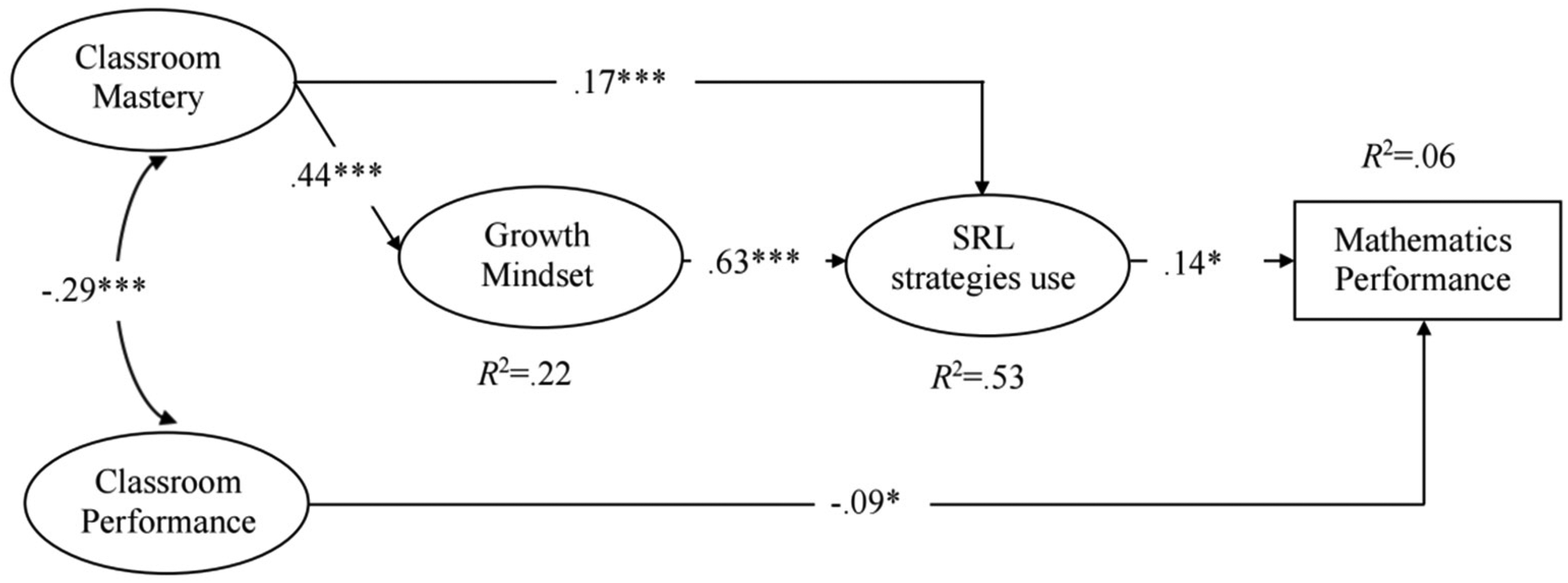
Footnotes
Declaration of conflicting interests
The authors declared no potential conflicts of interest with respect to the research, authorship, and/or publication of this article.
Funding
The authors disclosed receipt of the following financial support for the research, authorship, and/or publication of this article: This work was supported by the Guangdong Provincial Education Science Planning (grant number 2024GXJK689).
