







Abstract
Electric mobility has emerged as a cornerstone of global decarbonization strategies, with its successful deployment critically dependent on the coordinated integration of vehicle powertrain engineering, advanced battery technologies, charging infrastructure, power grid interaction, and intelligent control systems. This paper presents a comprehensive system-level critical assessment of electric mobility, providing an integrated analytical framework that unifies electric vehicle (EV) powertrains, electrochemical energy storage, grid impacts, artificial intelligence (AI), and sustainability considerations. The study systematically examines EV propulsion architectures, charging technologies, and the operational characteristics of contemporary and emerging battery chemistries, including lithium-ion variants ( Nickel–Manganese–Cobalt, Nickel–Cobalt–Aluminum, and Lithium Iron Phosphate), solid-state batteries, and sodium-ion batteries, with particular emphasis on degradation mechanisms, thermal safety, second-life utilization, and recycling pathways. The impacts of large-scale EV charging on power distribution networks are rigorously analyzed through power quality and voltage stability modeling, highlighting harmonic distortion, feeder loading, and voltage deviation challenges associated with high-power fast-charging infrastructure. Advanced mitigation strategies, including active filtering and AI-based grid impact prediction, are discussed to enhance grid resilience. AI is positioned as a core enabling technology throughout the EV ecosystem, with detailed coverage of data-driven and physics-informed approaches for battery health estimation, remaining useful life prediction, range estimation, smart charging control, traffic-aware routing, and charging queue optimization. Furthermore, emerging quantum-inspired optimization and quantum machine learning paradigms are identified as promising tools for addressing high-dimensional uncertainty in routing, charging scheduling, and battery diagnostics. A life-cycle sustainability perspective is incorporated to evaluate the environmental performance of EVs, emphasizing the influence of electricity generation mix, battery manufacturing emissions, material criticality, and recycling efficiency on overall greenhouse gas reduction potential. By synergizing engineering models, AI-driven intelligence, grid interaction analysis, and life-cycle assessment, this work delivers a unified blueprint for accelerating the transition toward sustainable electric mobility. The presented framework offers clear technical guidance for researchers, policymakers, and industry stakeholders seeking to design resilient, intelligent, and environmentally responsible electric transportation systems.
Keywords
Introduction
Around the world, countries have made emissions from transportation as much of a priority to reduce in order to combat climate change as they have carbon from other sectors. The Paris Agreement commits countries to achieving Net Zero emissions by 2050 and policy strategies such as the European Green Deal and India's NEMMP demonstrate that we need to urgently move beyond petrol and diesel vehicles (Elghaish et al., 2024). This transition is in line with UN's Sustainable Development Goals, particularly SDG-7 for affordable and clean energy and SDG-11 for sustainable cities and communities. These include the clean transportation, reduced pollution and improved air quality in cities (Al-Ghafri et al., 2026; IEA, 2023; Kumar et al., 2024a; Nadimuthu et al., 2025; Vishnuram et al., 2025).
Electric cars are one way to help make transportation more sustainable, electric vehicles (EVs) consume energy efficiently and don't emit dangerous gases from their exhaust. Vehicles like this (along with this, and this) can be powered by readily available clean sources such as solar and wind. Electric cars reduce greenhouse gas (GHG) emissions far more than petrol and diesel vehicles, according to multiple life-cycle assessment studies—especially if the electric car owner lives where renewable energy is used. The vehicles are powered by state-of-the-art batteries and smart power systems which enable cities to lower carbon emissions. They also have the potential to return power to the grid, and can be partnered with solar or wind energy charging stations (Babar et al., 2025; Bhandari et al., 2022; Buttler et al., 2018; Chandra et al., 2025; Thirumalai et al., 2025).
Already, electric cars are hitting serious roadblocks all around the world, despite rapid growth. Various issues such as lack of charging stations, slow charging, concerns about getting out of charge after a short distance due to battery capacity and degradation of batteries over time and hefty prices were mentioned for EVs. Important materials including lithium, cobalt and nickel also have supply chain issues (Ahmad et al., 2021; Mariprasath et al., 2024; Tarascon, 2020). Power system stress and higher peak loads stem from the use of too many EVs at once decrease power quality and necessitates sophisticated load balancing methods. Battery production and disposal, studies have found, pose environmental problems in terms of sustainability so we need to find better methods for recycling and reusing batteries (Attia et al., 2022; Miao et al., 2021). The present EV technology development involves a variety of sectors such as power electronics, battery production, temperature control, digital communication, and artificial intelligence (AI) combined with the clean energy generation smart-grid system. Fresh A.I. methods, which can do everything from check a battery's health to predict range and better manage charging, are making electric vehicles more predictable, reliable and sustainable. These techniques are boosting the power density of EVs as a whole. Furthermore, environmental scholarship and Life cycle assessment (LCA) has pointed to the need for clean manufacturing, sustainable materials and battery recycling in order to continue expanding the sustainability lead from EVs. Battery prices are dropping and aggressive government policies are spurring more people to buy EVs around the world. Such growth is occurring very fast in China, Europe and India (Mariprasath et al. 2025; Tie et al., 2013). A detailed quantitative analysis of harmonic distortion, voltage deviation, and power-quality impacts under high EV penetration is presented in Section 4 using system-level modeling and simulation results. Reported studies indicate that high-power fast-charging stations can increase feeder peak loading by 30%–40% and introduce converter-induced harmonics in weak distribution networks
As per recent world data, EVs are being used more quickly and are helping to reduce pollution regarding emissions. International energy and transport reports show that global EV sales surely crossed 14 million units in 2023, making up nearly 18%–20% of all new passenger car sales worldwide. Moreover, this is a big jump from less than 5% in 2020, which clearly shows a fast and steady market change. It is noticed that China, Europe, and the United States together made more than 85% of all electric car sales in the world, and this is only because these places have good government support and proper charging stations. Environmental studies show that EVs produce 50%–70% less GHG emissions than petrol vehicles during their lifetime, and this reduction itself goes further to 80% when renewable energy is used more in electricity grids. As per net-zero scenarios, transport electrification will cut nearly 25% of total CO2 emissions needed by 2050. This shows electric mobility is very important regarding long-term climate goals (Alzoubi et al., 2025; Ehsani et al., 2020; Mahmud et al., 2021)
This complete study of EV technology includes information on the vehicles that are being developed and introduced all around the world. This program discusses the EV motor systems, types of batteries, charging infrastructure, clean energy charging infrastructure drivers vehicle to grid technology AI solutions power quality (PQ) problem and environmental impact. This review is novel in that like no other, it combines technological progress with green measures, power grid repercussions, environmental analysis and government ruling. This work synthesizes technology, the environment, energy and policy connections—which is not the case in some other review articles where there are separate reviews for battery or charging methods. The study offers unambiguous guidance to researchers, policy-makers, and industry towards sustainable electric transportation. It's a collaboration project that brings together the key players in building an awesome electric mobility future.
Fundamentals of EV technologies
Classification of EVs
EVs have different types like battery cars, hybrid cars, plug-in hybrids, fuel cell cars, and heavy vehicles like buses and trucks, but they all work the same way using electric power to move. These groups show only the engineering choices in how complex the drivetrain is, energy density, efficiency, and dependency on infrastructure. Moreover, engineers surely need to balance these different factors while making decisions. Moreover, this balancing process is essential for effective engineering solutions (Mahmud et al., 2021). Battery EVs (BEVs) use electricity from lithium-ion batteries to run the motor, inverter, and braking system, which further puts energy back into the battery itself. As per studies, BEVs get the best drivetrain efficiency of 85%–90% regarding power use since electric systems do not have fuel-burning losses. It is noticed that less power loss in these cars compared to normal vehicles only. As per city requirements, these vehicles work well regarding zero pollution and can charge using renewable energy sources. They need less maintenance as per their simple design. It can be noted that, main problems in electric cars like battery getting weak over time, too much heat when charging fast, and only short driving distance. The other big issue is we need more reliable charging stations everywhere (Lu et al., 2021; Rezvani et al., 2015)
Hybrid electric vehicle (HEVs) use a regular engine and electric motors together with a small battery (Kasri et al., 2024). This combination itself helps the vehicle run further with better efficiency. As per the system design, this battery gets charged by recovering brake energy and regarding engine operations, it charges when the engine load shifts. Moreover, hybrid cars surely have three main designs–series, parallel, and power-split systems. Moreover, each design needs different control methods to manage engine power and energy use. Also, basically, HEVs give better mileage by using smaller engines that work more efficiently, but they are not zero-emission because the petrol engine is still the same main power source. Further, the main engineering problems actually include more complex mechanical and electrical systems, extra weight, and definitely depending on fossil fuels. As per practical implementation, these limitations are creating big challenges regarding the actual use (Sharaf and Orhan 2018)
As per the design, plug-in hybrid electric vehicle (PHEVs) have bigger batteries than HEVs and can be charged from outside power sources using AC charging ports. As per the specifications, these vehicles give electric driving range of 20–80 km and support hybrid working for longer distances. Moreover, the dual engine system itself needs advanced control methods for saving energy, selecting drive modes, and managing heat further. As per vehicle requirements, these control systems must work together regarding overall performance optimization. Moreover, plug-in hybrid cars actually use less fuel and make less pollution when people charge them regularly. The benefits definitely depend on how often you charge the battery and what kind of electricity your area uses. Basically, the dual system makes things more expensive and heavier because it has the same complex design problems. Basically, FCEVs use the same fuel cell system to change hydrogen into electricity, which runs the motor (Wang et al. 2022). They surely give high energy with fast refueling and long-distance travel. Moreover, these benefits work very well for heavy trucks and long journeys. The main parts actually include high-pressure hydrogen tanks, air compression units, humidity control, and heat management systems. These components definitely work together in the engineering design. As per these systems, proper water management is also a key part regarding their working. Further, FCEVs have big problems like not having enough hydrogen filling stations, fuel cells breaking down quickly, and high costs because they use only expensive metals. Basically, these problems make it the same difficult situation for FCEVs to spread in the market widely.
Basically, electric buses and trucks are making city transport run on electricity only, which is the same as reducing air pollution and cutting harmful gases from vehicles. E-buses actually use big battery packs of 200–350 kWh with proper heat control systems. These systems definitely help manage the battery temperature properly. These buses can actually be charged at depots or they definitely use fast pantograph charging methods. The electric trucks and delivery vans need only powerful motors, energy recovery brakes, and fast charging points to handle heavy workloads as per industry needs. The charging setup actually needs megawatt-level power to definitely support daily work operations. Electric buses surely face serious technical challenges including heavy battery weight, overheating problems during quick charging, and reduced travel range with heavy passenger loads (Zhang et al., 2020). Moreover, these buses create power grid overload issues at charging stations, making their widespread use difficult. These technical problems need only proper solutions for good bus operations. Even with these problems, e-buses and e-freight vehicles surely cut down pollution greatly for each vehicle, and moreover, they help cities become more environment friendly. The mathematical model actually includes all main physical processes for electric and hybrid vehicles, like forces, power flows, battery charge levels, and fuel-cell working. It definitely covers the complete system operation. Also, this system helps you predict performance, energy use, and charging needs correctly, which further improves planning itself (Lajunen, 2021; Nykvist et al., 2015; Quak et al., 2023).
The comparison shows that no single EV design can surely meet all needs like efficiency, range, cost, and infrastructure at once. Moreover, this means we need different electrification approaches for different applications. Basically, electric cars are the most efficient and produce zero emissions, making them perfect for city use, but the same vehicles face problems with charging stations, battery life, and driving range. Hybrid and plug-in hybrid EVs provide transitional solutions by extending driving range and reducing fuel consumption further, though the drivetrain system itself becomes more complex and still depends on fossil fuels. Fuel cell EVs surely offer fast refueling and long driving range, making them good options for long trips and heavy transport. Moreover, their wide use faces problems like high costs, lack of hydrogen stations, and material strength issues. As per studies, electric buses and trucks can reduce city pollution and noise a lot, but they need big batteries and proper cooling systems. Regarding charging, these vehicles put heavy load on electricity grid and need strong charging setup. It infers that future electric car systems must balance good performance, daily needs, and infrastructure support only, which shows we need proper vehicle design, smart energy control, and coordinated power grid planning for successful electrification. The comparative characteristics of EBV technologies as mentioned in Table 1. Surely, knowing the exact requirements beforehand helps improve accuracy. Moreover, these requirements are mentioned below:

























Comparative characteristics of EBV technologies.
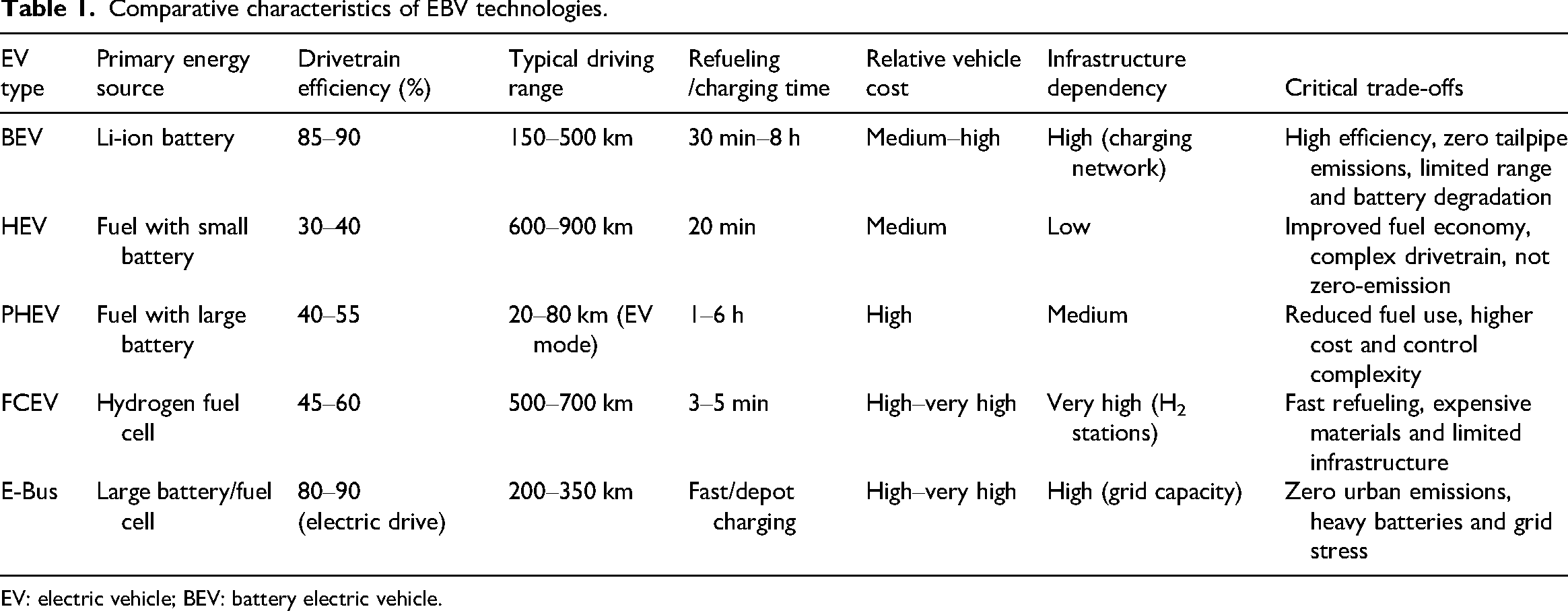
EV: electric vehicle; BEV: battery electric vehicle.
The mathematical equations are used in a computer simulation to study how vehicles move forward, how power flows through the drivetrain, and energy management under the same real-world conditions. Equations (1)–(9) are surely solved together to study how BEVs move, use energy, and travel distance during typical driving patterns. Moreover, this method helps simulate the complete vehicle performance over different driving cycles. These equations actually help us study how hybrid cars split power between fuel and electric systems. They definitely show us how battery charge changes and help measure fuel versus electric energy choices. Equations (16)–(21) actually describe how electrochemical and electrical systems work together in fuel cell vehicles. These equations definitely help estimate hydrogen consumption and system efficiency. For electric buses and trucks, Equations (22)–(25) are further used to simulate charging demand at fleet level and grid power constraints itself. As per these equations, simulation-based system analysis is supported rather than closed-form derivations, which is suitable regarding comparative performance and energy-efficiency evaluation. As per the simulation framework, the physical meaning and functional role regarding each equation are explained below for clarity.
In this simulation framework, Equations (1)–(3) surely describe how vehicles move forward and backward and how traction power flows. Moreover, these equations help us understand the basic motion behavior of vehicles in the longitudinal direction. Equation (1) surely shows how forces work when a vehicle speeds up, where the driving force must beat rolling resistance, air drag, and slope effects. Moreover, this balance decides whether the vehicle can accelerate properly on the road. Also, equation (2) surely converts traction force into mechanical power at the wheels. Moreover, Equation (3) considers drivetrain losses to find the total mechanical power needed. Equation (4) only connects the mechanical power needed to the electrical power taken from battery by including drivetrain efficiency and auxiliary loads. Further, equation (5) actually shows how battery terminal voltage depends on open-circuit voltage and internal resistance. Equation (6) definitely connects voltage and current to find instantaneous battery power output. Further, equation (7) shows how battery state of charge changes with current and nominal capacity itself. Equations (8) and (9) further extend the analysis to energy consumption and range estimation for BEVs in driving cycles. The analysis itself covers how much energy the vehicle uses during actual driving conditions. For hybrid electric cars, Equation (10) shows the total power need that is shared between the petrol engine and electric motor only, while Equation (11) shows the electrical power taken from the battery. Also, equation (12) surely shows the best way to manage hybrid energy by using less fuel while keeping the battery charge close to the target value. Moreover, this approach helps maintain optimal system performance.
Equation (13) actually makes sure the battery charge stays balanced when the plug-in hybrid car uses power or saves power. Equation (14) definitely helps the car run on electric power only as much as possible while keeping the battery safe. Equation (15) surely represents the fuel consumption model for PHEVs based on utility factors. Moreover, this model helps calculate how much fuel these vehicles actually consume. As per the study, equations (16)–(21) show how fuel cell EVs work. These equations explain the basic working principles regarding fuel cell vehicle operations. Equation (16) actually shows how fuel cell voltage equals Nernst potential minus three types of losses–activation, ohmic, and concentration losses. Equation (17) definitely calculates the total power output from the stack. As per equations (18) and (19), hydrogen flow rates are calculated using stack current, and equation (20) finds total hydrogen used in one drive cycle. Equation (21) itself shows how power is shared between the fuel cell and battery. This further represents the power distribution in the system. Equations (22)–(25) surely deal with how heavy-duty electric buses and freight vehicles work. Moreover, these equations address the operation of such heavy vehicles. Equation (22) calculates energy use for each vehicle, as per the depot charging needs. Regarding power demand, Equation (23) adds up total charging power, Equation (24) sets grid limits, and Equation (25) finds total charging cost. As per the study, these formulations show the different working and energy problems regarding commercial EV fleets.
Battery technologies and sustainability
As per current research, battery technologies are being studied regarding their sustainability impact. New battery systems are being developed regarding environmental protection and long-term use. Basically, electrochemical energy storage is the same technology that makes EVs work properly, affecting how far they can go, how well they perform, their cost, and their impact on the environment (Oubelaid et al., 2024). Also, lithium-ion batteries taking over the EV market today, while solid-state and sodium-ion batteries are only now coming up as good options for the future (Kumar et al., 2025a). Basically, battery management systems, safety features, and recycling methods are the same important things needed to make sure batteries work properly and last long (Dunn et al., 2015; Schmuch et al., 2018).
Lithium-Ion battery chemistry
Lithium-ion battery chemistry itself requires further study to understand its basic working principles (Agyekum et al., 2025; Ghazal et al. 2025a, 2025b). The lithium-ion batteries use only specific chemical reactions for storing energy. These batteries surely function by lithium ions moving between the positive and negative electrodes, moreover this ion movement enables the charging and discharging process. As per today's technology, electric cars use lithium-ion batteries that have special cathode materials like layered oxide, olivine, or spinel. Regarding the anodes, these batteries combine with graphite or silicon-graphite materials (Rehman et al., 2024). Basically, the main cathode types are Nickel–Manganese–Cobalt (NMC), Nickel–Cobalt–Aluminum (NCA), and Lithium Iron Phosphate (LFP), and they all have the same trade-offs between energy density, cost, thermal stability, and raw material availability. NMC batteries like NMC622 and NMC811 actually give high energy density of 180–220 Wh/kg. This definitely makes them good for long-distance electric cars. It is observed that more nickel content makes the battery more reactive, and it can only reduce heat stability and cycle life if the process is not handled properly. As per studies, NCA cathodes give same or little better energy storage regarding NMC batteries. Some top car companies surely use these batteries for their fast electric cars. Moreover, these manufacturers choose them specifically for high-performance vehicles. These batteries store energy very well, but they use cobalt and nickel metals which are expensive and create further problems for long-term use itself. LFP batteries surely have lower energy storage capacity at 140–180 Wh/kg, but they are much safer and last longer. Moreover, these batteries do not use cobalt, which makes them better for the environment. As per safety and cost requirements, LFP is a good choice for regular EVs and buses regarding applications where maximum range is not the main concern (Li et al., 2020).
EV batteries are checked by only three things–how much power they can keep, how quickly they get charged, and how many years they will work (Kumar et al., 2025b). These batteries need good efficiency and must further work in different temperatures, making the system itself more reliable. Research shows that batteries actually get weaker because their inner parts break down and get damaged over time. This definitely makes them hold less power and work harder to give energy. These mechanisms are the main reasons why battery performance itself deteriorates further with use. Basically, choosing cathode materials means balancing the same performance needs with how easily we can get resources, toxicity levels, and recycling options for sustainability. Basically, this selection needs careful thinking about the same environmental impact (Zubi et al., 2018).
Solid-State batteries
Solid-state batteries represent the next generation of energy storage technology. These advanced systems offer significant improvements over traditional liquid electrolyte batteries. Solid-state batteries use solid materials like ceramic, sulphide, or polymer instead of liquid electrolyte found in conventional lithium batteries. This change allows these batteries to work with high-voltage cathodes and lithium metal anodes safely. This design aims to improve energy storage capacity and safety while reducing harmful crystal growth. Solid electrolytes provide better heat stability and eliminate leakage problems that liquid electrolytes have. This reduces the risk of dangerous heating in batteries. According to current research, major engineering challenges remain for solid-state batteries, including high resistance between components, mechanical fragility, poor ion movement at room temperature, and difficult manufacturing processes. Scaling solid-state batteries (SSBs) to automotive production levels requires robust solutions for electrode-electrolyte interfaces and stack pressure control. The manufacturing process must be cost-effective to make it practical. Despite these challenges, SSBs are widely considered the most important next technology for high-energy EV applications (Banerjee et al., 2020; Randau et al., 2020)
Sodium-Ion batteries
Lithium-ion battery chemistry itself requires further study to understand its basic working principles. Lithium-ion batteries use only specific chemical reactions for storing energy. These batteries surely function by lithium ions moving between the positive and negative electrodes, moreover this ion movement enables the charging and discharging process. As per today's technology, electric cars use lithium-ion batteries that have special cathode materials like layered oxide, olivine, or spinel. Regarding the anodes, these batteries combine with graphite or silicon-graphite materials. Basically, the main cathode types are NMC, NCA, and LFP, and they all have the same trade-offs between energy density, cost, thermal stability, and raw material availability. NMC batteries like NMC622 and NMC811 actually give high energy density of 180–220 Wh/kg. This definitely makes them good for long-distance electric cars. It is noticed that more nickel content makes the battery more reactive, and it can only reduce heat stability and cycle life if the process is not handled properly. As per studies, NCA cathodes give same or little better energy storage regarding NMC batteries. Some top car companies surely use these batteries for their fast electric cars. Moreover, these manufacturers choose them specifically for high-performance vehicles. These batteries store energy very well, but they use cobalt and nickel metals which are expensive and create further problems for long-term use itself. LFP batteries surely have lower energy storage capacity at 140–180 Wh/kg, but they are much safer and last longer. Moreover, these batteries do not use cobalt, which makes them better for the environment. As per safety and cost requirements, LFP is a good choice for regular EVs and buses regarding applications where maximum range is not the main concern (Slater et al., 2013; Hwang and Myung 2017)
EV batteries are checked by only three things—how much power they can keep, how quickly they get charged, and how many years they will work. These batteries need good efficiency and must further work in different temperatures, making the system itself more reliable. Research shows that batteries actually get weaker because their inner parts break down and get damaged over time. This definitely makes them hold less power and work harder to give energy. These mechanisms are the main reasons why battery performance itself deteriorates further with use. Basically, choosing cathode materials means balancing the same performance needs with how easily we can get resources, toxicity levels, and recycling options for sustainability. Basically, this selection needs careful thinking about the same environmental impact. Sodium-ion batteries offer further advantages in energy storage applications. The technology itself provides a cost-effective alternative to conventional battery systems (Finegan et al., 2015).
Sodium-ion batteries surely operate through the same mechanism as lithium-ion batteries, with sodium replacing lithium as the active ion. Moreover, this substitution maintains the fundamental electrochemical processes while offering potential cost advantages. Sodium-ion batteries are surely gaining popularity because they can work alongside lithium batteries. Moreover, they are perfect for markets where keeping costs low is most important and resources are not easily available. Sodium is surely found in much larger amounts across the world compared to lithium, which makes it easier to get and keeps prices more stable. Moreover, this wide availability reduces the risk of supply problems for making batteries. Moreover, sodium-ion batteries (SIBs) actually use layered oxide or Prussian blue cathodes with hard-carbon anodes in typical designs. These are definitely the main components in standard battery setups. These batteries are having less energy storage than LIBs only, but work better in cold weather and charge faster. Basically, they work well for small EVs, two-wheelers, and storage systems because they use the same amount of fewer rare materials. From an engineering viewpoint, SIBs can surely use most of the existing LIB manufacturing setup. Moreover, researchers are still working to make better electrode materials, electrolytes, and cell designs to meet the car industry needs. Basically, these batteries need to meet the same cycle life and safety requirements that cars demand. As per research, these batteries need less lithium and cobalt, which helps regarding the worldwide use of more electric cars (Feng et al., 2018; Tong et al., 2017; Harper et al., 2019).
Battery safety and thermal runaway
Battery safety and thermal runaway require careful attention, as the battery can become dangerous when it overheats. Battery safety is a fundamental requirement for EV use, as high-energy lithium-ion batteries can experience thermal runaway when damaged, short-circuited, overcharged, or heated externally (Kumar et al., 2025b). Thermal runaway occurs when the battery overheats and reactions begin happening rapidly in succession. This causes the battery to release gas, catch fire, or even explode because the protective layers and electrolyte break down quickly. The engineering solutions include: Cell design uses safer chemistries like LFP, shutdown separators, and flame-retardant electrolytes to improve safety. Module design includes thermal barriers and venting paths for safety. Current interrupt devices are essential components in the pack structure. The battery management system (BMS) controls the entire system by detecting faults, maintaining safe operations, and reducing power during extreme conditions. This system-level approach ensures the battery operates within safe limits at all times. Thermal management systems use liquid cooling, refrigerant-based cooling, and phase-change materials for temperature control. These systems also include active heating features for cold weather conditions. Safety standards like UN 38.3, ISO 26262, and IEC 62660 guide design, testing, and validation procedures. With the increase in EV battery size and fast charging power, robust multi-physics modeling and real-time monitoring are needed for thermal runaway prevention and user safety.
Second-life batteries and recycling
Second-life batteries can be used further in other applications before recycling itself becomes necessary. Batteries can actually be used again after their first job, and proper recycling definitely helps create a system where materials get reused well. Basically, when EV batteries drop to 70%–80% capacity and can't power cars anymore, they still have the same substantial energy left that can be used for storage systems and backup power. This approach actually makes battery materials last longer and definitely cuts down storage costs while reducing environmental harm for each kWh during the complete battery life. Also, second-life use needs strong testing and repair work only to make sure batteries work well in new jobs. The batteries need recycling to get back important materials like lithium, nickel, cobalt, and copper only. This process helps to recover these valuable metals for further use. The recovery itself ensures these metals can be used again. Recycling methods today actually include heat-based, water-based, and direct processes, but they definitely have different energy needs and recovery amounts. Battery makers actually need better designs that can be recycled easily. Standard battery packs are definitely important for proper waste management when batteries finish their life. Surely, producer responsibility policies are necessary for reaching these goals in regulatory frameworks. Moreover, these policies help create proper rules for businesses. Basically, when we reuse and recycle products properly, we complete the same material cycle (Harper et al., 2019; Tong et al., 2017).
In this study, numerical simulations are employed as the primary tool to evaluate energy efficiency, degradation behavior, thermal stability, and long-term performance of battery energy storage systems in EVs. This simulation framework only combines battery aging, heat effects, resistance changes, and energy use models from Equations (26) to (38), which helps us measure how well batteries perform over real working cycles. Similar simulation methods are further used in fossil and alternative energy systems to study energy transport, efficiency, and environmental effects. These methods itself include numerical studies of nanomaterial-enhanced heavy oil flow, risk prediction of gas hydrate formation in deep-water systems, and transition from CO2 storage to hydrogen storage in depleted gas reservoirs. Basically, these studies show that physics-based simulation methods work well and give the same reliable results when used across different areas for checking energy efficiency. Also, this work actually uses proven computer models to study battery systems and definitely shows that simulations can help compare batteries with other energy sources for efficiency and clean energy use (He et al., 2020; Li et al. 2025; Xu et al. 2026).












Equations (26)–(38) surely show the main chemical, heat, and breakdown processes that control how batteries work. Moreover, these processes also decide how long batteries can last. Basically, these mathematical relations describe the same way these key processes work in the battery system. According to Equation (26), the solid electrolyte interphase (SEI) layer actually grows and definitely causes the main aging problem in lithium-ion batteries. The resistance increases due to temperature effects and current flow from side reactions. As per Equation (27), the battery capacity reduces over time regarding both calendar aging and cycle aging effects. The cell actually shows nonlinear behavior through the open-circuit voltage-state of charge (OCV-SOC) relation in Equation (28), and the terminal voltage is definitely modeled using circuit equations (29) and (30) with resistance drops and RC effects. According to Equation (31), battery charge levels are actually controlled using the Coulomb-counting method. This method is definitely needed for managing batteries in real-time. When electrodes crack or interfaces separate, this shows further in the internal resistance growth model of Equation (32) itself. Basically, equation (33) shows the same transport problems that happen when ions move slowly inside electrode materials, which is the same issue we see in sodium-ion and solid-state batteries. Basically, battery heat works the same way as Equation (34) shows heat comes from current and gets cooled by air, while Equation (35) tells when the battery becomes dangerous from too much heat. The battery health is surely measured using Equation (36) during its entire working life. Moreover, this measurement continues throughout the complete operational period. As per Equation (37), the remaining useful life is calculated until the battery reaches end-of-life. Also, equation (38) surely shows the amount of valuable material that can be recovered when the battery reaches its end of life. Moreover, this equation helps determine the exact quantity of useful substances available for extraction. This recycling efficiency is surely a key measure for sustainability. Moreover, it helps determine how well we can reuse materials effectively. These equations give the complete mathematical base for checking battery aging, safety, performance, and circular-economy paths in modern EV systems as per current requirements. The analysis regarding battery life and performance uses these mathematical foundations. Table 2 surely presents a comparative analysis of different batteries. Moreover, this comparison helps in understanding the performance characteristics of various battery types.
Comparative analysis of battery technology.
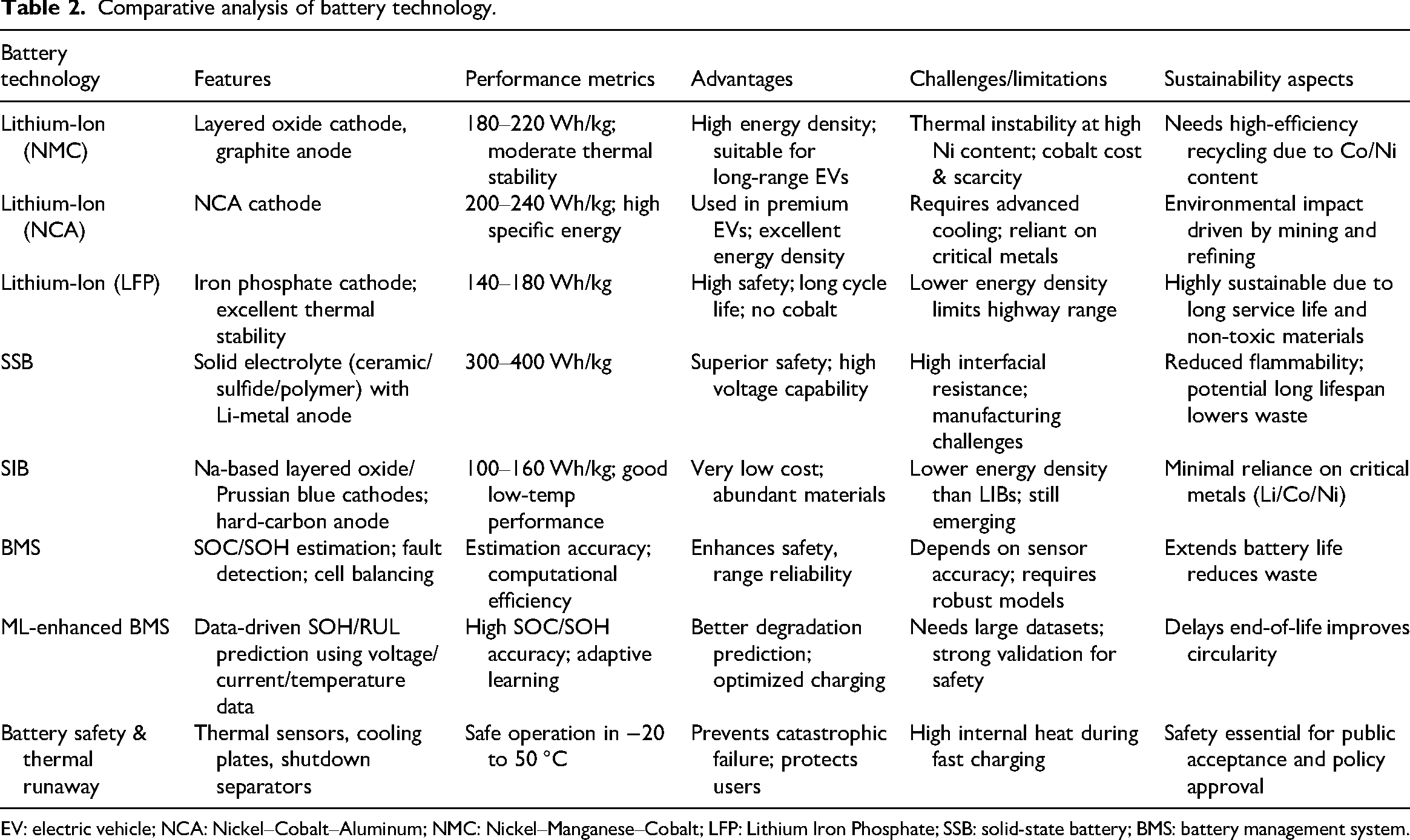
EV: electric vehicle; NCA: Nickel–Cobalt–Aluminum; NMC: Nickel–Manganese–Cobalt; LFP: Lithium Iron Phosphate; SSB: solid-state battery; BMS: battery management system.
It is observed that new battery technologies are helping EVs become better by improving how they store energy, making them safer, lasting longer, and being good for the environment only. Actually, lithium-ion batteries are definitely the main choice for electric cars today because they store more power and have good making methods. Different battery types such as NMC, NCA, and LFP surely provide various advantages in cost, safety, and performance aspects. Moreover, these batteries also differ in terms of material availability for manufacturing purposes. Basically, research shows battery damage happens because of coating growth, cathode breaking, and electrolyte failure, so we need the same strong control systems for batteries. We should actually choose eco-friendly materials to handle these breakdown issues. This will definitely help solve the degradation problems we face. Solid-state batteries provide better safety and energy storage using solid materials instead of liquid ones, but manufacturing issues and interface resistance further restrict their application in vehicles. The technology itself faces production challenges that limit widespread automotive use. The technology is showing promise only, but challenges when making it on a large scale. The sodium-ion batteries as a cheap option for small electric cars and power storage because sodium is easily available everywhere and these batteries can work with the same production lines that make lithium batteries only. Moreover, basically, these batteries need the same improvements in how long they last and how much energy they can store.
Advanced battery management systems are essential for ensuring operational safety and performance optimization through continuous assessment of SOC, state-of-health (SOH), and SOP. Modern BMS systems combine physics models with machine learning to predict battery health and life more accurately in the same real-world conditions. As per accuracy requirements, this combined method gives better results regarding real-world battery performance prediction. As per safety rules, batteries are protected using good materials, better cell making, heat control, and following standards like UN 38.3 and ISO 26262 regarding stopping overheating issues. After car batteries get old, they can actually store power in buildings, and companies can definitely get back useful materials by recycling them properly. Further, this method helps in reusing resources instead of wasting them itself. Basically, these technologies help EV batteries last longer and reduce the same environmental harm throughout their life cycle. The comparative analysis of various battery technology as shown in Table 2.
Figure 1 shows the same engineering choices that decide which battery types work best for EVs. Further, these trade-offs actually help us understand which battery chemistry definitely suits different mobility needs. LFP gets the best overall green score in the multi-criteria plot because it has very good heat safety, long battery life, low resource problems, and cheap materials, though it only shows medium energy storage. Also, LFP batteries keep 90% power after 3500–4000 charge cycles, which further makes them suitable for e-buses and commercial vehicles itself. Moreover, sodium-ion batteries come second in the sustainability ranking because sodium is easily available and the material costs are only very low. As per testing results, these batteries keep 82% power after 4000 cycles, making them good for cheap 2/3-wheelers and short-distance EVs. As per current studies, solid-state batteries give high energy density and better safety but cost more to make and have shorter life cycles. These batteries lose capacity faster than LFP and SIB batteries after many charge cycles, which further reduces their performance itself. The NMC811 and NCA batteries give the highest energy only, but they have the worst scores for being environment-friendly because they use too much nickel and cobalt, cost more money, and get damaged faster. Both types actually reach only 60% capacity after around 3000 cycles, which definitely makes them less practical. These results actually confirm what engineers already know: High-nickel batteries definitely give better range, while LFP and sodium-ion batteries last longer and are better for the environment. These strong options are only making electric cars cheap for all people. The two plots surely show how engineers should balance cost, material importance, wear patterns, and performance when choosing battery technologies for EVs. Moreover, this engineering approach will help in selecting the right batteries for sustainable transportation. As per these factors, better decisions regarding electric mobility development can be made easily.
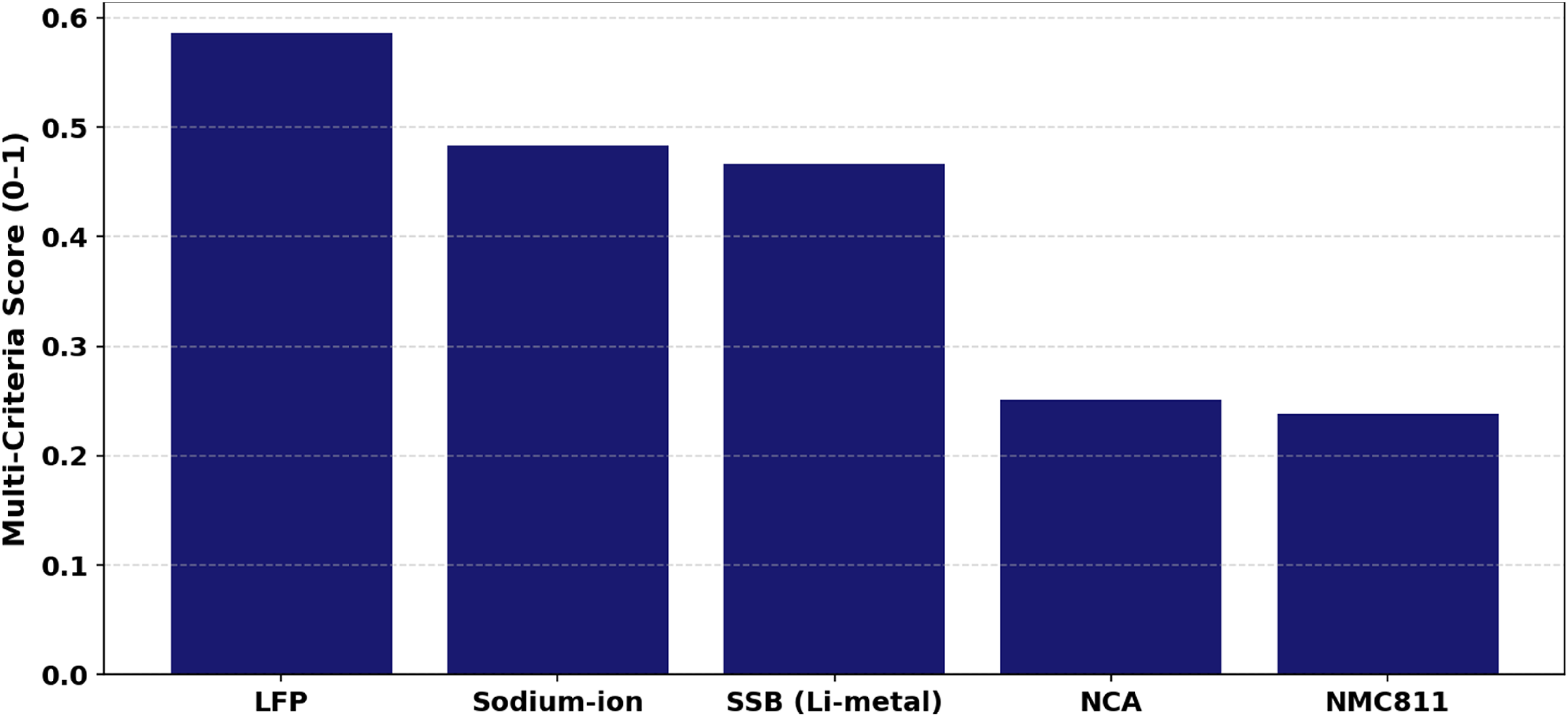
Comparative multi-criteria performance of battery technologies.
A quantitative comparison of battery technologies reveals clear trade-offs between energy density and lifecycle durability, which are central to sustainability-oriented electric mobility design. High-nickel lithium-ion batteries such as NMC and NCA offer gravimetric energy densities in the range of 180–240 Wh/kg, enabling extended driving range and high-performance applications; however, their lifecycle performance is limited by accelerated degradation, with capacity retention typically declining to approximately 60% after around 3000 charge-discharge cycles. In contrast, LFP batteries exhibit lower energy density (140–180 Wh/kg) but demonstrate superior lifecycle durability, maintaining nearly 90% capacity even after 3500–4000 cycles, alongside enhanced thermal stability and reduced reliance on critical materials. Solid-state batteries represent a high-energy-density pathway, with projected values of 300–400 Wh/kg and improved intrinsic safety due to solid electrolytes; nevertheless, current lifecycle performance remains constrained by interfacial resistance, mechanical degradation, and manufacturing challenges, resulting in shorter practical cycle life compared to mature lithium-ion chemistries. Sodium-ion batteries offer a complementary low-cost alternative, achieving energy densities of 100–160 Wh/kg while delivering robust cycle life, with reported capacity retention exceeding 80% after approximately 4000 cycles. Their reliance on abundant sodium resources and reduced use of lithium, cobalt, and nickel enhances lifecycle sustainability despite lower specific energy.
Charging infrastructure and smart grid integration
The rapid growth of electric cars is creating new demands for power supply systems, charging stations, and smart electricity networks (Varshney et al., 2025b). The charging system functions as a power electronic interface that controls how the grid handles loading, power quality, and flexibility services from an engineering perspective. This section discusses charging levels, wireless charging, bidirectional power flow between vehicles and grid, charging with renewable energy, and their effects on the electricity grid with solutions to address problems. Recent research on EV charging reflects a comprehensive evolution from component-level power conditioning toward intelligent, resilient, secure, and sustainable charging ecosystems. Power quality improvement remains a critical foundation, with advanced converter designs and control algorithms effectively reducing harmonics, voltage fluctuations, and charging-induced disturbances, thereby ensuring reliable and grid-compliant battery charging (Kumar et al., 2023; Singh et al., 2025a; Prasada Rao et al., 2024). At the operational level, coordinated charging strategies for EV fleets and community parking infrastructures enable peak-load mitigation, enhanced utilization of renewable energy, and improved system-level efficiency (Chandra et al., 2024), while centralized scheduling frameworks for bidirectional charging in low-voltage microgrids further strengthen grid support and operational flexibility (Panda et al., 2025a). Accurate charging demand forecasting and adaptive control are increasingly supported by data-driven and machine learning approaches, including ensemble learning and K-nearest neighbors, which enhance prediction accuracy under uncertain charging behaviors (Kumar et al., 2024a). Infrastructure planning and grid resilience have also received significant attention, with hybrid metaheuristic-based charging station placement and advanced load management techniques reducing distribution network vulnerability under high EV penetration (Aggarwal et al., 2024; Kumar et al., 2024b, 2024c). From a technological perspective, innovations in misalignment-tolerant wireless charging and fast-charging architectures address user convenience, interoperability, and real-world deployment challenges (Ramakrishnan et al., 2024; Ravindran et al., 2023). The integration of EV charging with renewable energy systems, particularly in solar-powered residential and microgrid environments, highlights the comparative benefits of bidirectional charging in terms of energy efficiency, emission reduction, and grid interaction (Al-Amayreh et al., 2025; Panda et al., 2025a, 2025b). Operational performance of public charging stations is further enhanced through stochastic modeling and queueing-based control strategies that effectively manage congestion and waiting times (Varshney et al., 2025a), while the growing digitalization of charging infrastructure necessitates robust cybersecurity solutions, such as deep learning–based attack detection frameworks, to ensure system reliability and user trust (Tanyıldız et al., 2025). Beyond technical and operational considerations, system-wide perspectives emphasize the role of AI-integrated blockchain frameworks in enabling secure demand response and transparent load balancing (Singh et al., 2024a), as well as the importance of viable business models for scaling EV charging ecosystems sustainably (Sabyasachi et al., 2024). Finally, long-term empirical studies demonstrate that ambient temperature variations and battery aging significantly influence EV charging characteristics, underscoring the need for environment-aware and data-informed charging strategies (Blazek et al., 2023), while comprehensive reviews consolidate these advancements and identify future research directions for fast-charging infrastructure and sustainable e-mobility (Singh et al., 2024d; Ravindran et al., 2023).
Charging levels
Charging levels represent different power settings for charging EVs. Level 1 charging operates using standard home power supply–230 V in India–and provides approximately 1.4 to 3.3 kW charging power. Depending on battery size, Level 1 charging takes 6 to 12 h for mid-size batteries, making it suitable for home overnight charging where power supply is adequate. Level 2 charging uses higher voltage and current, typically 208 to 240 V with 16 to 80 A. This enables power levels ranging from approximately 3.3 to 22 kW. Level 2 infrastructure is commonly found in commercial and public parking areas. It uses power factor correction and high-frequency DC–DC converters in the onboard charger to meet harmonic and efficiency requirements (Wu et al., 2020, 2025). When multiple Level 2 chargers operate together in one area, they create high power demand on local grid systems. Coordinated charging control is necessary to manage this load properly (Singh et al., 2024a).
DC fast charging stations bypass the car's internal charger and connect the battery directly to an external power conversion system. DCFC systems operate at power levels between 50 and 150 kW with DC output voltages from 200 to 500 V. These chargers can achieve 30% to 80% battery charge within 20 to 45 min of charging time. Ultra-fast charging systems provide much higher power from 150 to 350 kW at battery voltages reaching 800 or 1000 V. This results in C-rates of 2C to 4C for standard passenger EV batteries. These high-power systems require three-phase rectifiers with unity power factor control, medium frequency isolation, and advanced thermal management for both charger and battery components. These chargers act as large loads at the power connection point that can cause voltage drops and transformer stress if not managed properly (Birkl et al., 2017; Li et al., 2021b).
Wireless charging systems
Wireless power transfer functions whether the device is stationary or mobile. Wireless charging for EVs primarily uses inductive power transfer method (Ramakrishnan et al., 2024). This IPT system is the main method to charge EVs without using cables. Static wireless charging stations have one coil buried in the ground and another coil mounted under the car, creating a loosely coupled transformer that operates at very high frequencies. Compensation networks such as series-series or series-parallel are designed to achieve maximum power transfer and maintain soft-switching in resonant inverters. Power levels from 3.3 to 11 kW have been demonstrated for static systems that achieve more than 90% efficiency when properly aligned (Gao et al., 2022; Wang et al., 2019). Dynamic wireless charging involves coils placed in road segments, and these coils receive power only when the vehicle moves over them sequentially. This approach increases the complexity of control, communication, and ground insulation design, but it can allow for smaller batteries and lower peak charging requirements if implemented widely. This approach reduces the overall charging demand on the power system. Wireless charging stations create the same power quality issues as conventional electronic chargers when connected to the electricity grid. These stations require additional measures to control electromagnetic fields and maintain them within safe limits (Zhan et al., 2020).
Vehicle-to-Grid, Grid-to-Vehicle, and Vehicle-to-Home
Vehicle-to-grid (V2G), grid-to-vehicle (G2V), and vehicle-to-home (V2H) are systems where EVs can send power back to the grid, draw power from the grid, or supply electricity to homes. Power electronics operate bidirectionally with appropriate control systems. These circuits handle power flow in both forward and reverse directions through the same components. In normal G2V operation, the charger acts as a controlled rectifier that draws active power from the grid. This operation involves drawing electrical energy in a controlled manner. In V2G mode operation, the same hardware functions as a grid-tied inverter that injects active and reactive power back into the distribution system. According to grid requirements, this requires bidirectional AC–DC and DC–DC converters with proper isolation and safety features including anti-islanding, synchronization, and current control. The charger must operate in all four quadrants of the P–Q plane so it can provide services such as reactive power support and voltage control along with active power output (Shao et al., 2022).
V2H is a specific type of V2G where the electric car battery functions as a power storage unit for home use, and it often works together with rooftop solar panels. V2H systems use single-phase inverters that can operate independently during power outages, providing backup power to homes when the main grid fails. When V2G technology is deployed on a large scale, it can assist with frequency regulation, spinning reserve, and peak shaving in the power system. This deployment also brings challenges such as battery degradation costs, communication infrastructure requirements, cybersecurity threats, and managing thousands of EVs collectively (Bimbraw, 2015).
Renewable energy integration and smart charging
Smart charging systems are actually becoming very important when we use renewable energy sources. This definitely helps manage power in a better way. Basically, using solar and wind power for EV charging does the same thing–it cuts down carbon emissions and stops the local electricity grid from getting overloaded (Nadimuthu et al., 2024). There are two main systems–DC-coupled systems where solar panels send power to a shared DC bus that car chargers and batteries use, and AC-coupled systems that connect solar inverters, wind generators, and charging stations at distribution level itself (Singh et al., 2024c). Further, both systems have different ways of managing power flow. As per PV side requirements, MPPT methods like perturb-and-observe or smart approaches are used, while DC–DC converters connect the PV and battery systems. Regarding the interface, these converters handle the connection between solar panels and batteries. These converters surely work as the connecting link between both subsystems in the system design. Moreover, they help the two parts communicate with each other properly. This solar EV charger surely works as a DC-coupled system that can boost power efficiently. Moreover, it uses smart control to divide power between the vehicle battery and local storage. Basically, this design can optimize power allocation for better efficiency, which is the same approach used (Petit et al., 2015; Siebert et al., 2021).
Smart charging actually controls when EVs charge and how fast they charge. It definitely works based on grid conditions, electricity prices, and renewable energy availability. Basically, this helps control how much power is needed and keeps the charging costs the same or lower. From engineering side, it is observed that smart chargers and backend systems that change charging power settings in real time only for power optimization. EV charging actually uses time-based scheduling and valley filling during low demand periods. Fleet charging definitely works through centralized or distributed systems to reduce peak loads (Nagarajan et al., 2025). Basically, these methods help make charging patterns the same and better for different vehicle groups. Wind and solar power surely change during the day, so predictive control and MPC systems help match vehicle charging with clean energy times (Benarbia et al., 2023; Shen et al., 2022). Moreover, this alignment ensures that EVs use renewable energy when it is most available. Basically, these control methods make sure charging happens when renewable energy generation is the same as peak production periods. Moreover, smart charging actually uses computer learning to predict solar power, wind energy, and electric car patterns. This technology definitely helps manage energy better. This approach actually helps balance what users need with keeping the power grid stable. It definitely works well for both sides.
Power quality mitigation using modern controllers
When numerous electronic chargers are deployed in large numbers, they alter how electricity networks operate. The distribution system experiences different electrical characteristics. Due to switching operations, nonlinear converters generate current harmonics that increase THD in both voltage and current measurements (Li et al., 2021a). According to IEEE 519 standards, modern chargers use advanced rectifiers with proper current control, but at high penetration levels, poor filter design can still create power quality problems. When many charging stations operate simultaneously, they can cause voltage problems in weak power networks, excessive loading on transformers, and thermal damage to conductors in severe cases. IEEE 34-bus power quality datasets help model EV charging as dynamic loads and study scenarios with different charging levels, locations, and time patterns. Frequency deviation is a transmission-level problem, but when numerous V2G EVs are aggregated, they can assist with frequency control by adjusting their charging and discharging power (Feng et al., 2022).












Equation (39) defines the downstream real power
Equation (39) defines the downstream real power Pdown (i) at bus i, which is obtained by adding all load and EV charging power from bus i to the feeder end itself. This equation further helps in calculating the total power flow in the distribution system. This amount is actually very important in radial distribution systems because the load downstream definitely affects how much voltage drops. Equation (40) shows how voltage moves from one bus to another bus along the radial feeder, where the voltage at bus i + 1 only goes down based on the load ahead and line resistance value kR. As per Equation (41), the baseline PCC voltage waveform combines fundamental 50 Hz frequency with background harmonic components regarding third and fifth harmonics. This captures the basic distortion present even without EV charging. Further, when we add fast chargers, the power system voltage drops by 4% and gets extra distortion from the 7th and 11th harmonics, which happens only because of the switching circuits in high-power EV charging stations. Basically, the signal RMS value is calculated using Equation (43), and this helps to compare the same voltage levels before and after EV charging. THD actually measures how bad the harmonics are by comparing all the higher harmonics with the main frequency. This definitely shows the total harmonic problem in the system.
To reduce these problems, equation (45) shows the cleaned voltage pattern by keeping only harmonics up to hmax, which works like active filtering with UPQC/STATCOM methods. As per Equation (46), the filtered current waveform is made by removing higher-order harmonics that cause high THD. The input feature vector for predicting grid impact using machine learning is surely defined in Equation (47), which combines the number of fast chargers with the base load. Moreover, this combination provides the necessary data for accurate prediction analysis. Using this input, Equation (48) surely defines the target output, which is the minimum bus voltage Vmin. Moreover, this voltage serves as the main indicator for measuring how much the voltage profile has degraded. Also, the Random Forest model actually predicts Vmin is using Equation (49), where the learned mapping definitely depends on model parameters θ. Moreover, basically, we measure model accuracy using MAE and R2 equations, which are the same methods that show how well the ML model predicts the connection between EV numbers and voltage stability in power systems.
The results show that high-power EV fast-charging stations create the same measurable problems for power distribution networks, especially when many stations are grouped together in urban areas. The voltage profile shows further voltage drop along downstream buses, with the minimum voltage itself dropping from approximately 0.996 p.u. The voltage surely increased from its initial level without EVs to 0.994 per unit. Moreover, this change demonstrates a significant improvement in the system's voltage profile. When 150 kW fast chargers are actually connected, they definitely provide quick charging. The values are actually within legal limits, but the pattern definitely shows more stress on feeders and less voltage stability. Moreover, the effect is stronger at buses that are far away, which shows that only the long feeder lines are getting badly affected by high-power charging loads.
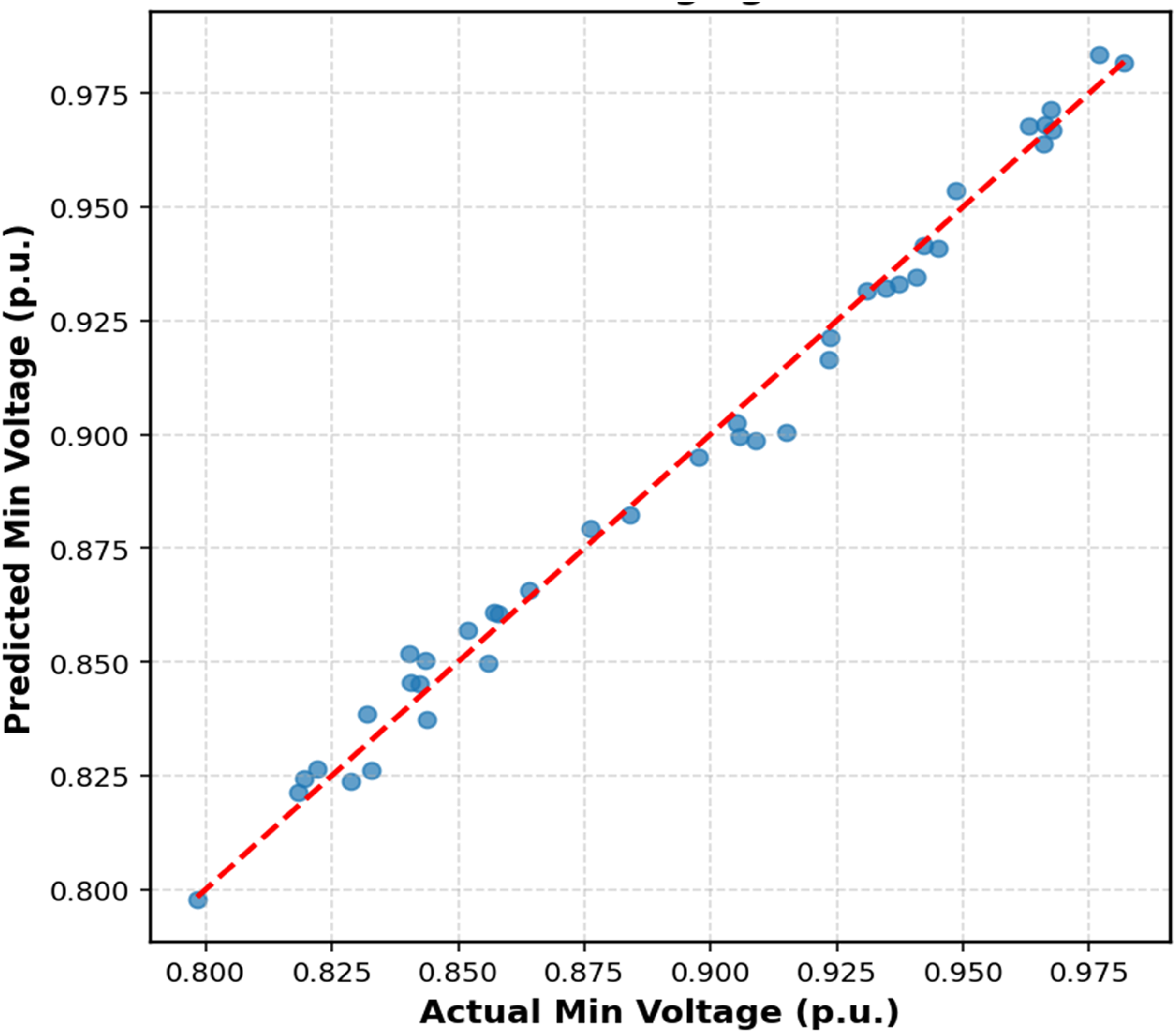
Ml prediction of bus voltage during ev fast charging.
Power quality analysis at the PCC further shows that EV fast charging itself creates harmful effects on the electrical system. The harmonic analysis surely shows that 7th and 11th harmonic components rise during EV charging. Moreover, the third and fifth harmonics that already exist in normal load conditions also increase. It is noticed that the spectrum clearly shows this increase in the harmonic parts only. Moreover, each harmonic amplitude is actually small alone, but when they all add together, they definitely make clear voltage distortion that we can see. Basically, this behavior is the same as how multi-level EV charger rectifiers work when they do switch operations. Basically, this confirms that high-power converters create the same mid-order harmonics when charging conditions change.
The mitigation study further shows that the active filtering method itself works similar to a UPQC/STATCOM device. Moreover, the system reduces high sound waves to make the signal smoother and further cut down distortion itself. The THD reduction in this study surely shows that adding active filtering or grid-support functions to fast-charging systems can improve power quality at PCC. Moreover, these functions can prevent harmonic buildup in weak feeders. Basically, this integration helps keep the same good electrical conditions in the charging setup. It is noted that machine learning analysis only gives us a way to predict how feeders will behave when more EV charging happens. As per the analysis, the Random Forest model gets R2 value near 1, which shows good ability for predicting minimum bus voltage regarding base load and number of chargers. This actually shows that the model can definitely predict voltage values correctly. Actually, this data method works well for grid operators to find voltage problems and plan better charging spots. Grid operators can definitely use this tool to predict issues and make smart decisions for power systems.
The combined results actually confirm that modern distribution systems can definitely handle fast-charging loads effectively. Basically, when you put too many chargers in the same area, it creates voltage problems and harmonic issues, and the same thing can make the electrical feeders age faster if not managed properly. The study shows that active filtering and machine learning methods are good strategies to make power grids stronger, and further research can improve these techniques itself. Moreover, these methods surely help in connecting big EV fast-charging systems safely to the power grid.
AI for EVs and sustainable mobility
AI and machine learning have become very important tools only for making EV systems work better and controlling them properly. AI systems process complex data from batteries, powertrains, chargers, and traffic systems to further improve efficiency. The technology itself analyzes user behavior patterns for better reliability. Basically, this technical method helps make the same systems more sustainable and better for long-term use.
AI for EV energy management
It is observed that AI assists in controlling power systems in EVs to enhance operational efficiency. Energy management in EVs surely involves distributing power optimally between the battery pack and auxiliary loads (Punyavathi et al., 2024). Moreover, this process ensures efficient use of available electrical energy in the vehicle (Chan, 2020). It further includes managing extra energy sources like fuel cells or supercapacitors in some cases itself. Traditional methods actually use rule-based control, ECMS strategies, or model predictive control approaches. These methods definitely follow set patterns to manage system operations. AI methods actually learn difficult patterns straight from data and definitely make these strategies better. Neural networks and fuzzy logic controllers actually help find the best way to split power and torque in hybrid cars. These systems definitely consider battery status, what the driver wants, and road conditions to work properly. Basically, AI models in pure EVs can predict energy consumption using the same inputs like speed, road slope, temperature, air conditioning load, and traffic conditions. These models basically drive eco-driving assistants and real-time energy management systems that adjust the same acceleration patterns and auxiliary loads to minimize total energy use while maintaining driver comfort and performance limits (Chowdhury et al., 2022).
ML models for battery aging prediction
It is noted that smart computer systems only help decide how to divide power between engine and battery in hybrid cars. These systems work properly only when they check battery level, what the driver needs, and road conditions. As per the speed patterns, road slope, outside temperature, AC load, and traffic conditions, AI models can estimate the immediate and short-term energy usage in pure EVs. Regarding energy prediction, these inputs help the system calculate power requirements accurately. As per the analysis, these models give correct predictions regarding energy consumption planning. Basically, these models work in eco-driving helpers and energy systems that adjust the same car acceleration and power use to save total energy while keeping drivers comfortable and maintaining the same good performance. As per current research, ML models are used regarding battery aging prediction. This section surely discusses machine learning methods for studying battery aging processes. Moreover, it examines how these techniques help understand battery deterioration patterns over time. Research findings surely show that battery aging happens because of complex chemical and heat processes that depend on how we use the battery, charging speed, and temperature. Moreover, these processes also depend on time. Also, these factors surely work together to make the battery age faster. Moreover, this combined effect speeds up the overall degradation process. Physics-based models need detailed parameter identification and are computationally expensive itself. Further, these models require significant computational resources. As per historical cycling and field data, ML-based models learn degradation patterns and provide an efficient alternative regarding this process (Chen et al., 2022).
EV range prediction
Researchers use different computational methods like SVM, random forests, and neural networks to predict battery life further. The prediction process itself involves these advanced techniques to determine how long batteries will last. These systems actually work by checking battery information like how it charges, temperature, and voltage changes. They definitely analyze this data to understand battery patterns. Further, these models actually show how much battery power is left, changes in internal resistance, or definitely indicate battery health and remaining life. RNNs and LSTM networks surely capture time-based patterns in cycling data with high accuracy for predicting battery degradation (Renhai et al., 2025). Moreover, these methods show excellent performance in understanding how batteries degrade over time. Basically, this SVM method works the same way for SOH/RUL prediction by linking operational variables like current, temperature, and SOC window to degradation rates for predictive maintenance and warranty optimization. Moreover, accurate range prediction is surely critical for building user confidence, and moreover, it helps in effective energy management at higher levels. Traditional range calculation actually uses average fuel use and current battery level but definitely fails when driving habits change quickly. AI range estimators actually use supervised learning to connect real-time data with predicted variables to estimate energy use on routes. This approach definitely helps make accurate predictions for energy consumption. The system is learning from data to find out how much energy we are using during travel only (Xu et al., 2023). The features actually include past driving habits, speed changes, road angles, traffic flow, weather temperature, AC use, battery condition, and how drivers behave. These data points definitely help understand vehicle performance patterns. Various models such as gradient-boosted decision trees, convolutional and recurrent neural networks, and hybrid physics-informed ML models are surely used to predict Wh/km for the remaining route. Moreover, these different approaches help in accurate energy consumption forecasting. Basically, these models help predict energy usage accurately, and they work the same way for forecasting consumption patterns. As per these predictions and SOC data with usable battery capacity, we get better range estimates regarding battery performance. This approach combines a physics model that calculates vehicle fuel consumption with a machine learning system that further adjusts predictions based on real driving data and environmental conditions itself (Zhang et al., 2023).
Smart charging scheduling using reinforcement learning
Smart charging uses reinforcement learning to decide the same optimal timing for charging EVs (Mohammad et al., 2025). Smart charging helps find the best time to start charging and decides how much power to use further, and when the battery itself should give power back to the grid or buildings. As per user requirements, this process keeps energy costs low and reduces pressure on the electricity grid regarding power consumption. The problem involves steps that happen one after another with uncertain outcomes, so reinforcement learning is surely a strong method to apply. Moreover, this approach can effectively handle such sequential and unpredictable situations. The formulations only define the state by mixing battery charge level, time-based electricity prices, predicted solar and wind power generation, transformer load, and user departure times. These systems use only basic settings to understand what is happening right now. Basically, the system design uses discrete or continuous power settings for charging, and the reward function balances the same three things–electricity cost, battery wear cost, and grid constraints for peak demand and voltage changes. Algorithms like Q-learning, DQN, and DDPG surely help learn the best charging methods by working with computer models. Moreover, these methods find near-perfect policies through repeated practice in simulated environments. Multi-agent RL methods actually coordinate many vehicles at the same time for fleet and parking lot uses. These methods definitely help manage multiple vehicles together in real applications. As per these methods, many vehicles work together in one system regarding their management. DDPG knowledge from hybrid energy systems can surely be used to make a continuous-action RL controller that gives the best charging currents. Moreover, this approach provides optimal control for battery charging operations. Further, this controller itself will work within the feeder loading limits and further meet the power quality requirements (Mujumdar et al., 2024).
The first part is only a physics-based EV range prediction model where vehicle dynamics combined with supervised learning. The basic energy use pattern is actually created by studying how the vehicle moves, including wheel friction, air resistance, road effects, and engine work. This definitely helps understand the vehicle's energy needs over time. Basically, this physics layer uses the same real operating variables like speed, acceleration, temperature, HVAC load, and traffic density to simulate different driving conditions. Further, basically, physics models cannot predict all the behavioral and environmental changes, so a Gradient Boosting model learns from the same difference between what we predicted and what actually happened with energy use. This mixed method actually helps the model keep its real-world meaning while definitely making better predictions, especially when traffic is heavy, drivers are aggressive, or weather conditions are bad (Deng et al., 2021).
The second module surely focuses on predicting how batteries degrade over time using machine learning methods to estimate their health condition. Moreover, this approach helps in accurately determining the remaining useful life of battery systems. This method helps to predict how battery health will only change with time. Researchers are making a special dataset to copy how EV batteries get old over time by only changing things like how much battery is used, charging speed, temperature, and rest periods. This dataset actually helps us understand how batteries definitely work in real field conditions. Basically, this dataset shows the same gradual capacity loss and captures faster degradation when conditions are high-stress. Basically, a Random Forest model learns from these features to understand the same complex patterns that affect battery aging over thousands of charging cycles. The model basically gives accurate predictions for future SOH values, showing it captures the same combined effects from cycling stress, heat exposure, and aging time. Basically, this SOH model is the same important part of the complete energy-management system and helps make better control strategies that think about battery health (Hawkins et al., 2013).
The third component is a smart charging system that uses reinforcement learning to further monitor and optimize how EVs charge itself. The system actually works on a full 24-h charging cycle that checks battery levels, time, electricity rates, and solar power. It definitely manages all these things together to charge properly. It is noted that the action space has different charging power levels only, and the agent can choose from these options. The agent can choose no charging, moderate charging, or full-power charging based on grid conditions and battery status itself. This selection further depends on the current power situation and battery level. The environment updates SOC as per the selected charging power and calculates grid import regarding PV contribution, then it calculates operating costs. The reward system surely punishes three main issues: High electricity bills, too much battery damage, and big differences from the desired battery level at charging completion. Moreover, this structure helps maintain efficient and safe charging operations. This setup gives a strong base for training smart charging systems using only methods like DQN, PPO, or DDPG for more work.
Basically, the range predictor, battery health estimator, and charging system work together to make the same complete energy management system for EVs. Basically, this framework does the same thing—it predicts energy in real-time and monitors battery health for long periods in one system. Basically, it helps make the best charging decisions within the same architecture. As per the hybrid modeling strategy, both physical understanding and data-driven methods are used, which helps the system work well regarding different vehicle, battery, and grid conditions. This combined method actually gives correct battery range prediction and smart battery care with cheap charging costs (Verma et al., 2022). It definitely works well for new electric car systems and smart transport research focused on clean mobility. Equations (52) to (80) only capture all the physical, thermal, degradation, and control working used in the proposed EV energy management model.




























In the proposed physics-informed energy consumption framework, the longitudinal dynamics of the EV are governed by four primary forces: Rolling resistance
The relation in between model prediction of SOH and true SOH is as shown in Figure 3 while the battery aging curve is shown in the Figure 4. SOH values match the ML-predicted SOH values for the synthesized degradation dataset. The comparison illustrates the parity relationship between both values. The points follow the 45° diagonal line closely, showing that measured and predicted values have minimal difference. The Random Forest model captures the degradation behavior caused by changes in depth-of-discharge, C-rate, rest period, temperature, and calendar aging. Moreover, the near-perfect alignment (R2 ≈ 0.99999) further confirms that the model generalizes exceptionally well across the entire SOH range (60%–100%). This behavior confirms that the synthetic physics-guided degradation method is internally consistent and can be learned by the ML framework. Figure 4 shows how the battery ages over 2500 cycles, and displays both the actual curve and the ML-predicted path. The SOH exhibits a two-phase decline: Phase-I (0–700 cycles): Dominated by cycling-induced damage, the SOH steadily decreases with combined influence from DoD, C-rate, and temperature. After 700 cycles, when the battery health drops to around 60%, the degradation stabilizes because the synthetic model hits its lower limit. The predicted curve matches very closely with the true SOH curve, which shows that the ML model can accurately capture both short-term nonlinear degradation and long-term capacity fade. The overlap shows that the proposed degradation mapping method works reliably for large-cycle datasets in EV applications. (Figures 5, 6, and 7)

Relation in between true state-of-health (SOH) and prediction SOH.
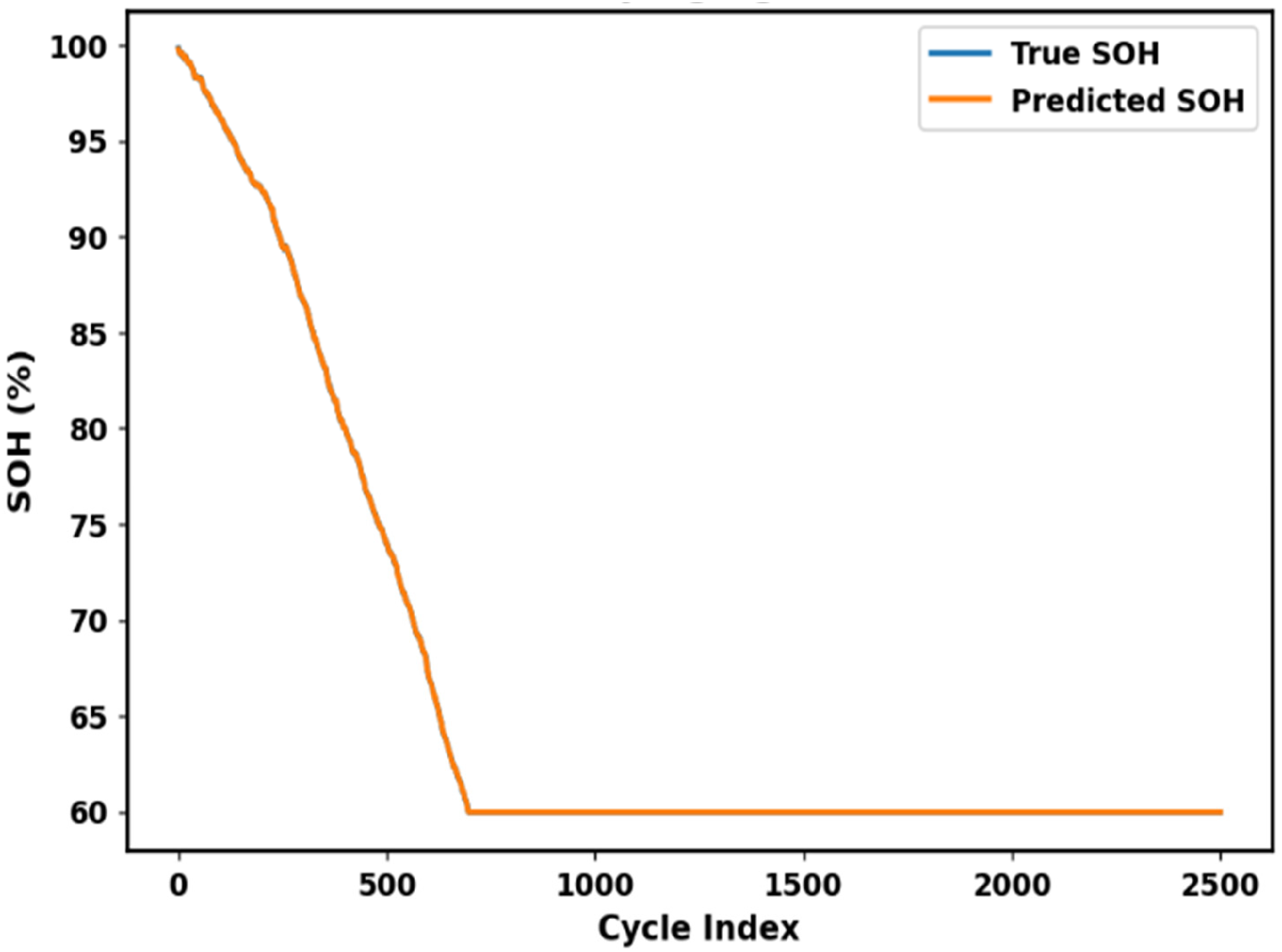
Relation in between EV cycle index and SOH.
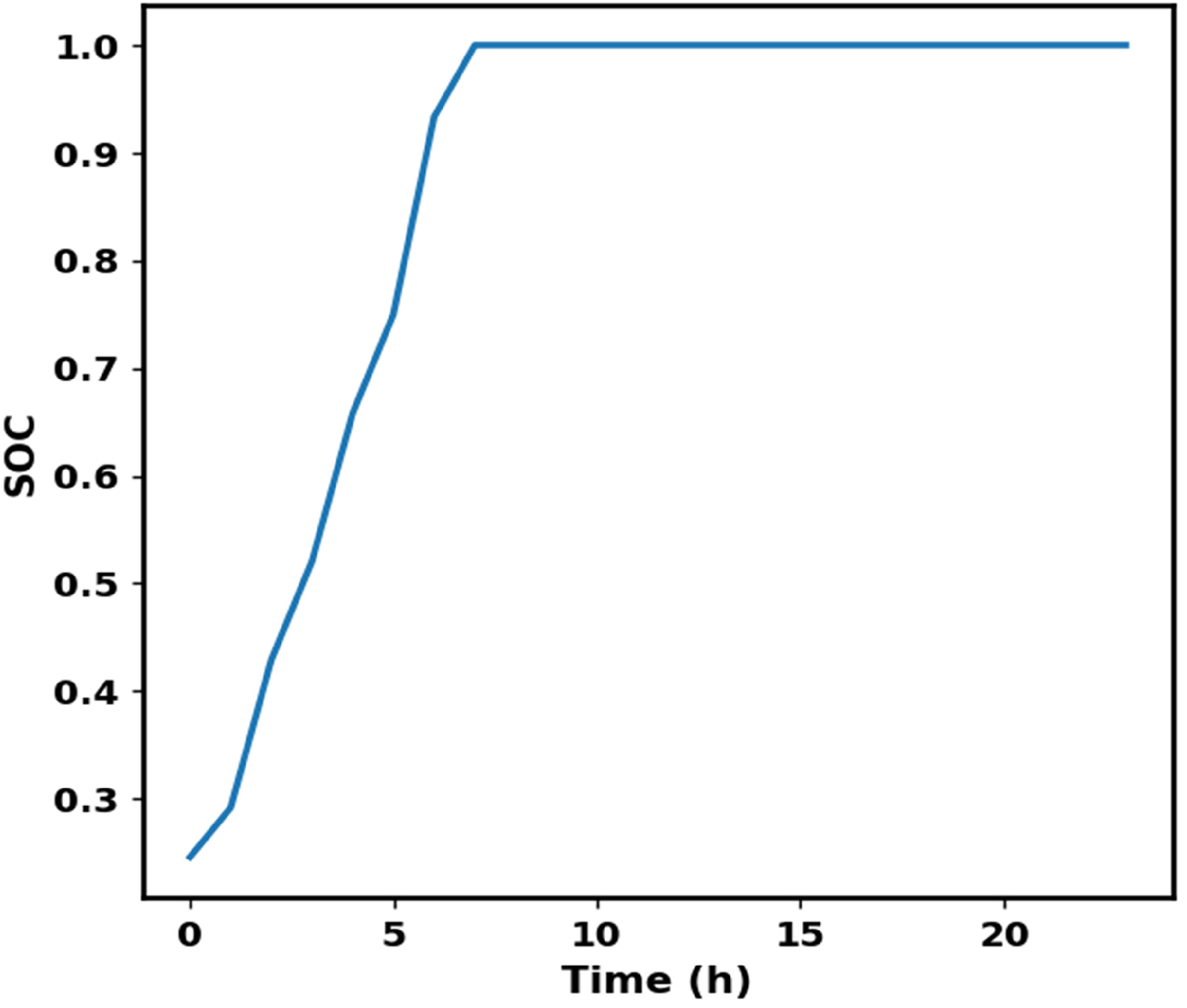
Electric vehicle (EV) state of charge over a time.
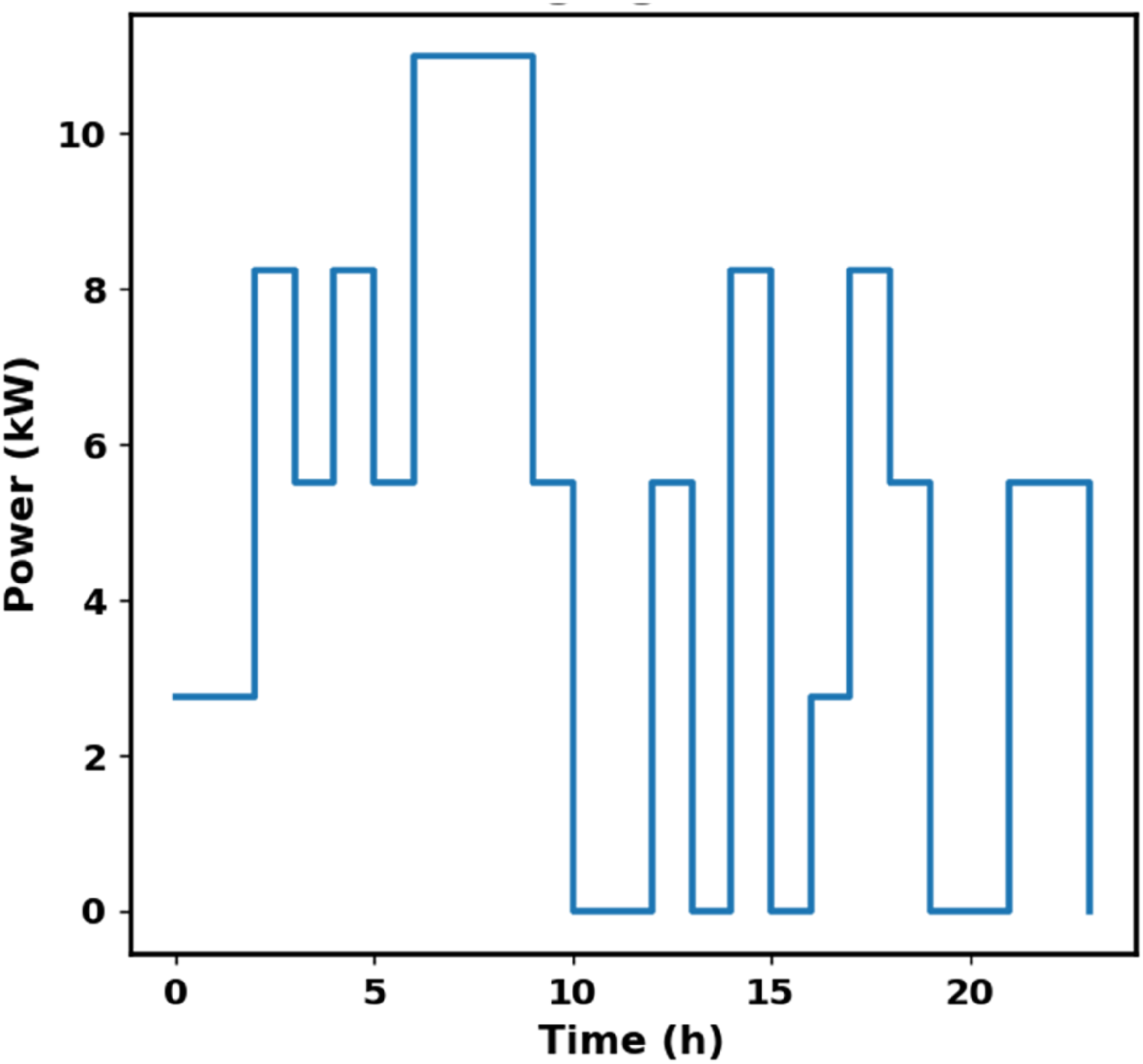
Electric vehicle (EV) charging power over a time.
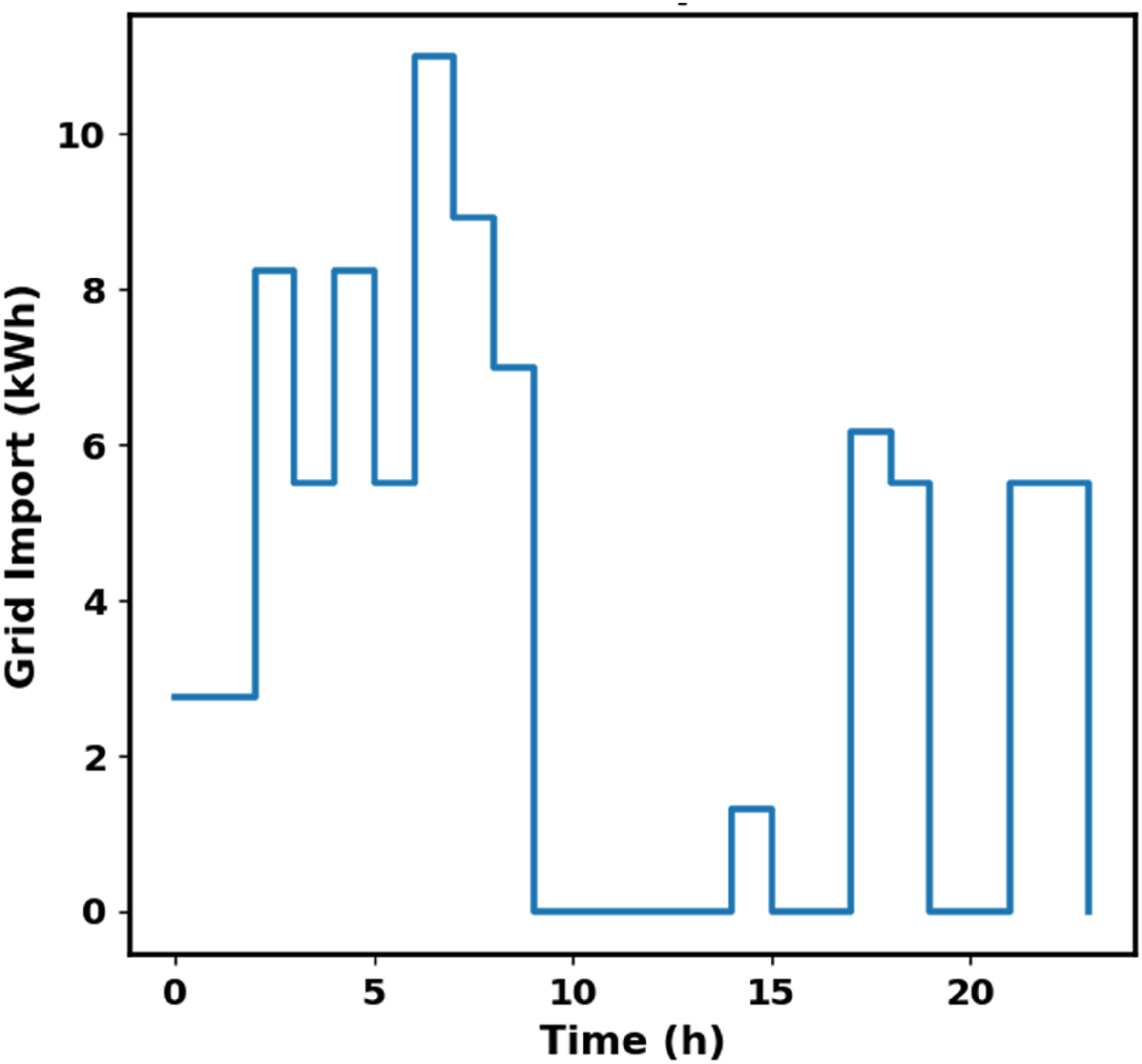
Impact of electric vehicle (EV) on the grid.
Figure 4 shows the SOC path that results from using random policy in the RL smart-charging setup. The SOC increases non-linearly because the agent continuously changes the power levels it selects. The battery charge reaches its maximum level of around 1.0 within the first few hours, and after that it remains at this full level. This behavior confirms that the environment properly applies charging rules, energy storage, and SOC limits. Moreover, it validates the correct implementation of all charging dynamics. This plot shows that the charging state update equation used in the custom RL environment is correct. Figure 5 shows the charging power actions that the random agent took sequentially. The differences between low, medium, and high-power levels show that the action space is working properly, and the agent can explore different power strengths. The zero-power intervals show that the model handles idle charging states correctly. This behavior confirms that the environment's action-to-power mapping works correctly, which is an essential requirement before training a DQN or DDPG agent for optimal charging control.
Figure 6 shows the energy taken from the grid after considering the solar power produced on-site. This calculation accounts for the PV system's contribution to the total energy needs. The variations occur due to the interaction between PV availability and chosen charging power levels. These fluctuations directly show how both factors work together. During daytime, imported power reduces as PV generation meets the charging demand, while nighttime shows higher import levels. Our cost calculation method with the PV system works well in the environment, and this shows that the environment is suitable for optimizing charging costs while keeping peak loads under control. Basically, Figure 5 shows the same charging power actions that the random agent did one after another. The differences between low, medium, and high-power levels show that the action space itself is working properly, and further the agent can explore different power strengths. The zero-power intervals further show that the model itself handles idle charging states correctly. We are seeing that the system's action-to-power mapping is working correctly only, which is needed before training DQN or DDPG agents for best charging control.
Figure 6 shows the energy taken from the grid after considering the solar power produced on-site itself, which further indicates the net energy consumption. This calculation actually shows how much the solar system helps meet the total power needs. It definitely measures the system's contribution to energy requirements. The variations happen due to the interaction between PV availability and selected charging power levels, which further affects the system performance itself. Basically, these changes show the same way both factors work together. During daytime, imported power surely reduces because PV generation meets the charging demand. Moreover, nighttime shows higher import levels. Our cost calculation method with the PV system surely works well in the environment. Moreover, this shows that the environment is suitable for reducing charging costs while controlling peak loads.
Traffic flow, routing, and charging queue optimization
AI actually helps optimize traffic systems and charging stations beyond just individual vehicles (Ali et al., 2025; Arabiat et al., 2024; Khan et al., 2025). It definitely works at the system level to make everything run better. As per routing requirements, shortest path algorithms use energy-aware cost functions regarding road gradient, traffic congestion, and available charging stations. As per historical GPS data and real-time sensor information, ML models predict traffic density and travel times regarding each road segment. These predictions only go into smart routing systems that we are seeing can reduce energy use or total travel time (Dimri et al., 2024). It is noted that waiting in lines becomes important only at charging stations. Arrival rates are random and change with time of day, and further depend on how traffic moves across the network itself. ML-based predictors estimate charger occupancy and waiting times for near future, which further enables EVs to select stations that minimize the total cost itself including driving, waiting and charging. Smart computer methods are actually used to decide which charging spots to give to people and when they can book them. These techniques definitely help balance the power load across many charging stations. When grid models are combined with this approach, it leads to integrated traffic-charging-grid co-optimization, which is further relevant for urban fast-charging corridors and e-bus depots itself (Zheng et al., 2020; da Costa et al., 2025).















The traffic-speed prediction model begins by forming the input feature vector
Figure 8 shows that our TCN-LSTM model itself captures the traffic speed changes over time in real city conditions, and this further demonstrates the model performance. Basically, the model learns the same short-term stop-and-go changes and long-term traffic jam patterns, which are important for reliable mobility prediction. Basically, EVs need accurate speed prediction because traffic speed directly affects the same power requirements and energy consumption. As per this forecasting method, energy management regarding EV operations becomes much better. The testing results show that the model can actually adapt to speed changes very quickly with minimal delay. This definitely makes it suitable for real-time use in eco-routing and energy management systems on actual roads. This further shows the model itself is ready for practical use in vehicles. As per Figure 9, the route structure changes a lot when we use predicted travel speeds regarding normal shortest-distance routing. This shows how speed guessing can change which path we are seeing as best, and only proper prediction helps in selecting the right route. As per the predicted travel times, the algorithm updates road weights regarding traffic conditions to find better routes that avoid heavy traffic areas. Basically, this prediction system helps EVs by reducing delays and avoiding the same unnecessary speed changes during travel. As per the design, it reduces battery usage which is good for these vehicles regarding their power needs. Navigation systems actually work better when they use smart prediction methods instead of only using old traffic data, especially when traffic definitely keeps changing constantly.
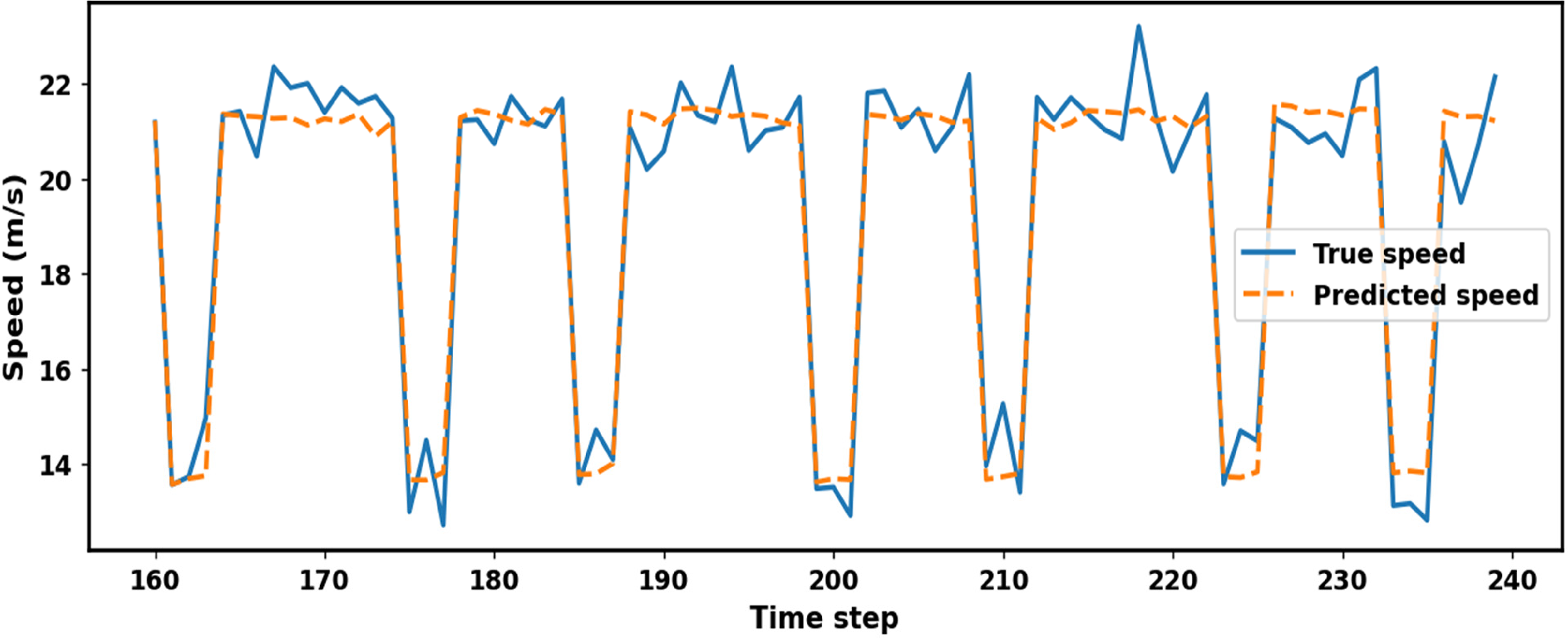
Traffic speed prediction.

Time-optimal route.
Real-time traffic predictions help in route planning, which further reduces energy consumption and makes EV operations more efficient. This approach itself improves the overall performance of EVs. Moreover, when you drive in India's traffic, your car actually uses more energy during frequent stops and speed changes, so you should definitely choose routes with smooth flowing traffic to maintain steady speed and avoid energy loss from braking. As per Figure 10, the best route follows these rules regarding road selection by choosing roads that have higher predicted speeds and lower expected traffic congestion. This integration actually creates a base for a complete system that can predict navigation and definitely accounts for energy use. As per the technology, EV users can drive longer distances and get better reliability regarding their vehicle performance.
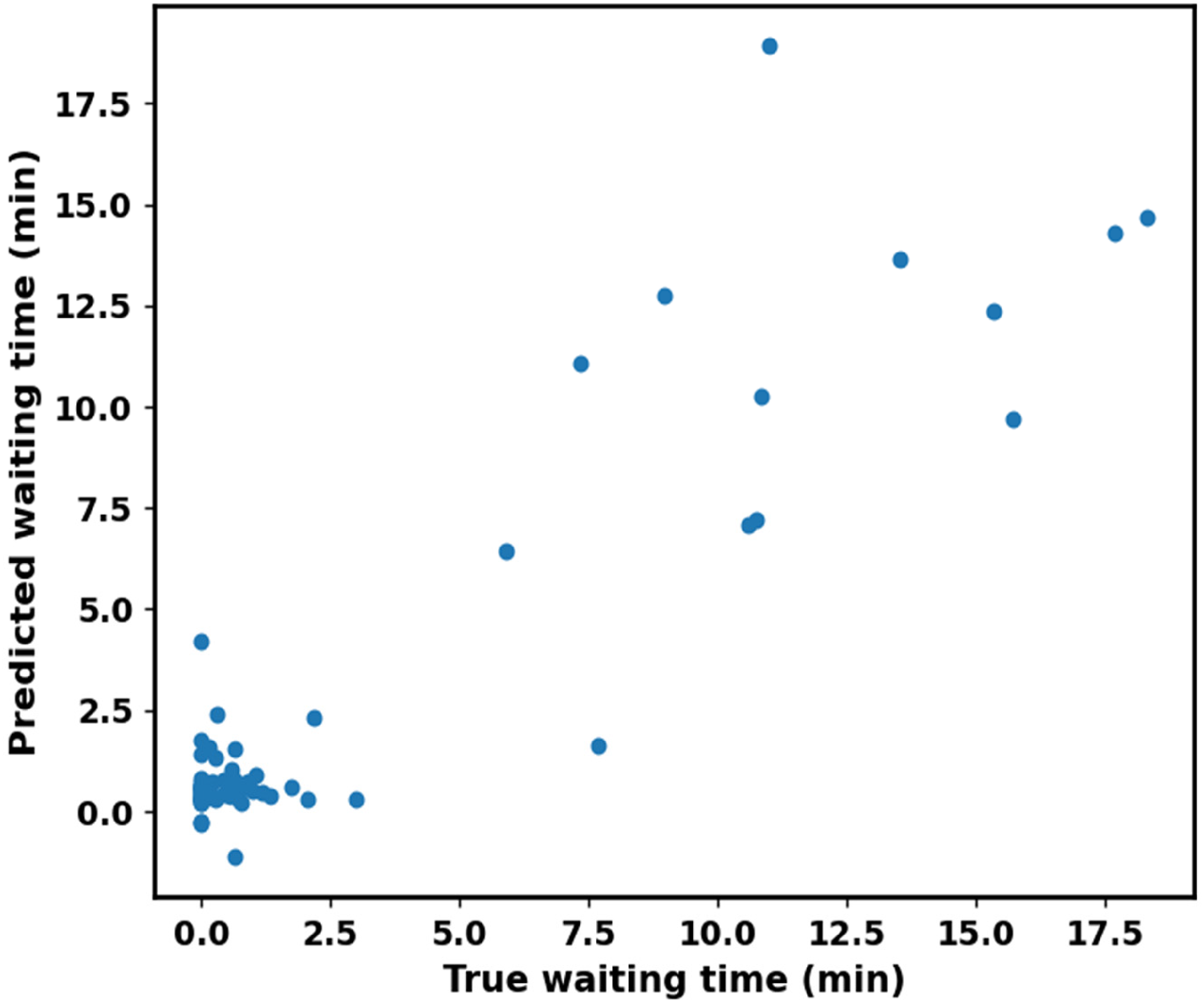
Charging queue waiting prediction.
Figure 11 shows that the XGBoost model itself works well for predicting waiting time at charging stations, and it can be used further for accurate predictions. When the real waiting times and predicted waiting times match closely, it surely shows that the model can find busy periods and when charging stations are full. Moreover, this matching proves the model works well in identifying peak usage times. Correct queue prediction is definitely critical for smooth EV operation because unexpected delays at public charging stations are actually primary factors that cause range anxiety. As per the waiting time predictions, the system can suggest other stations or plan better charging times regarding route efficiency. This further helps maintain consistent trip performance itself. We are seeing that when traffic prediction, smart routing, and charging queue forecasting work together only, they create one integrated system that makes EV travel much more efficient and reliable. The framework actually helps make the complete trip better by checking road traffic and picking good charging stations. This definitely reduces total energy use, travel time, and charging wait time. Basically, these prediction modules work together the same way to make quick decisions that keep changing with network conditions. This system actually works well for big transport networks and can definitely handle many EVs in the future.
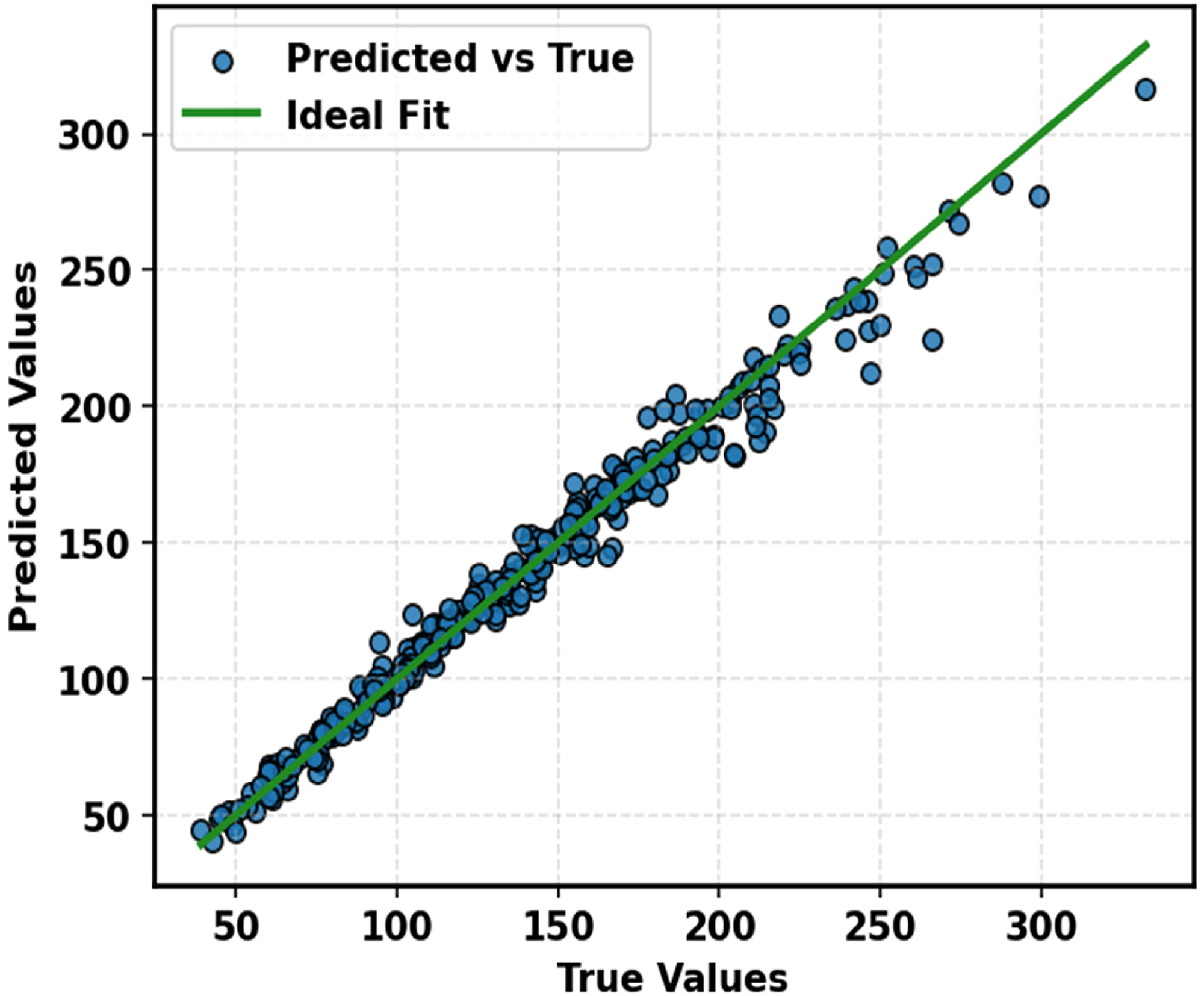
BEV life-cycle GHG.
AI for autonomous and connected electric driving
Basically, self-driving cars in EVs use AI for the same three things–seeing, planning, and controlling the vehicle. As per engineering requirements, the perception layer uses CNN networks, transformers, and sensor fusion methods to read camera, LiDAR, radar, and ultrasonic data regarding environment mapping. We are seeing the prediction system forecasting the paths of nearby cars and people, and then it only computes safe and comfortable routes for our vehicle while following rules like staying in lanes, avoiding crashes, and speed limits (Al-Hindawi & Alhadidi, 2025). Basically, in EVs, the driving range and battery power management are the same thing working together. Eco-driving controllers are surely designed as hierarchical planners that calculate driving paths to reduce energy use. Moreover, these systems ensure that safety and comfort requirements are met during operation. Model predictive control and deep RL are used at the control layer to track planned trajectories and manage longitudinal and lateral dynamics. For connected autonomous EVs, vehicle-to-vehicle and vehicle-to-infrastructure communication adds further optimization opportunities: Platooning to reduce aerodynamic drag, cooperative merging, and coordinated intersection passing. These functions reduce stop-and-go driving, leading to lower energy consumption and smoother charging demand profiles at the system level (Olivetti & Ceder, 2021).
Life cycle assessment of EVs vs. internal combustion engine vehicles
LCA studies consistently show that BEVs have lower total GHG emissions than internal combustion engine vehicles (ICEVs), even when accounting for higher emissions in vehicle and battery manufacturing. Recent meta-analyses report typical life-cycle GHG intensities for BEVs in the range of 180–190 gCO2-eq/km versus 250–26 gCO2-eq/km for ICEVs when powered by average grid mixes, along with lower cumulative energy demand and fossil resource use. However, BEVs tend to score worse in impact categories linked to human toxicity, particulate matter formation, and metal depletion due to the mining and refining of battery materials. When the life cycle is disaggregated, the manufacturing phase—particularly cell and pack production contributes a larger share of total emissions in BEVs than in ICEVs, while the use phase is much lower due to higher drivetrain efficiency and the potential to operate on low-carbon electricity. As power systems decarbonize, multiple scenario studies indicate that the operational benefits dominate and manufacturing-related emissions debt is amortized over the vehicle lifetime, pushing life-cycle GHG reductions for BEVs to 60%–70% or more compared with gasoline cars. End-of-life processes, including the reuse and recycling of traction batteries, can further reduce life-cycle burdens by displacing primary material production, but their net benefit depends strongly on collection rates, recycling efficiencies, and the electricity mix used in recycling facilities.
Material criticality-lithium, cobalt, nickel, and rare earths
The rapid scale-up of EV deployment has made critical raw materials a central sustainability concern. Lithium, nickel, cobalt, manganese, and graphite are key to lithium-ion battery performance and energy density, while rare earth elements such as neodymium, praseodymium, dysprosium, and terbium are essential for high-performance permanent-magnet motors. Demand projections under Net-Zero and 1.5 °C scenarios suggest multi-fold growth in the consumption of these materials by 2040–2050, with EV batteries representing one of the dominant drivers. Supply chains are highly geographically concentrated: Cobalt mining is dominated by the Democratic Republic of Congo, while refining capacity for cobalt, lithium, and rare earths is heavily concentrated in China, creating geopolitical and price-volatility risks. In addition to resource depletion and supply security, extraction and processing raise environmental and social challenges, including water use, tailings management, and community impacts in mining regions. Recent sustainability assessments emphasize the need for diversified sourcing, material substitution (e.g., high-manganese or LFP chemistries to reduce cobalt and nickel dependence), design for recyclability, and rapid expansion of closed-loop recycling to reduce primary material demand while maintaining battery performance (Barman et al., 2023).
Emissions reduction potential of EVs
From a systems perspective, EVs offer substantial potential to reduce well-to-wheel and life-cycle GHG emissions, but the realized benefit depends strongly on regional electricity mixes and vehicle usage patterns. Recent analyses for Europe indicate that BEVs registered in 2023 already emit about 50% fewer GHGs over their lifetime than comparable gasoline cars, with reductions rising to 70–80% under high-renewable electricity scenarios. Global comparative LCA studies covering Europe, the United States, China, and India find that BEVs consistently outperform ICEVs in life-cycle GHG terms, with current reductions typically in the range of 30%–60%, and even higher in regions with cleaner grids. In carbon-intensive systems with a high share of coal, the relative advantage of BEVs is smaller and can be eroded in the short term if battery production is also powered by fossil-heavy electricity, but scenario work shows that grid decarbonization quickly restores BEV benefits. Beyond GHGs, EVs reduce tailpipe emissions of NOx, VOCs, and particulate matter in urban areas, shifting most upstream air-pollution burdens to power plants where emissions are easier to control. Overall, the literature converges on the conclusion that EVs are a necessary—but not sufficient—lever for transport decarbonization, and their full emissions-reduction potential is unlocked only when coupled with cleaner electricity, high vehicle efficiency, and sustainable manufacturing practices (Dunn et al., 2011) (Figures 12, 13).

GHG reduction (ICEV vs BEV).

Material critically index.
Figure 11 shows how the Gradient Boosting model predicts BEV life-cycle GHG emissions. The model itself demonstrates further accuracy in estimating these emission values. The points actually stay very close to the perfect 1:1 line, which definitely shows that predicted and true emission values match well across the complete range of 40–330 gCO2/km. The model surely shows very little spread, especially in the middle range where most data points are found. Moreover, this confirms that the model can strongly learn the complex relationships between grid carbon intensity, battery size, lifetime mileage, and recycling rates. Basically, the model captures almost all the variance with R2 around 0.98, making it the same as perfect for policy analysis and sensitivity studies in EV sustainability research.
Figure 12 shows the GHG savings we are seeing when comparing BEVs with ICEVs using the model predictions only. As per the data analysis, the points stay close to the ideal diagonal line, showing that the model gives accurate estimates regarding both positive and negative GHG benefits across different regions and vehicle types. As per the model results, BEVs show low or negative climate benefits regarding high-carbon electricity grids, but strong advantages with cleaner energy sources. The close grouping around the diagonal line in the positive-benefit area (50–150 gCO2/km savings) shows that the model itself can identify small differences in operational emissions and manufacturing burdens. This further demonstrates the model's accuracy in separating these subtle variations. The model actually shows very strong results with R2 around 0.97, definitely giving reliable insights into how different regional electricity sources affect climate performance comparisons.
Further 13 actually shows how well the Random Forest model can predict the material criticality index for EV production. The model definitely gives accurate results for estimating this index. The scatter plot surely shows a much wider spread around the diagonal line compared to Tasks A and B. Moreover, this happens because material risk assessment is naturally complex and has some random elements in it. As per the analysis, there is a clear positive link showing that the model properly captures how battery size, segment type, recycling rates, and second-life potential together affect overall criticality. The results regarding this combined influence indicate the model works successfully. Further, the model works very well as per the mid-criticality range (0.22–0.35), which is the normal range regarding most modern EV battery types. The R2 value is lower at 0.73 compared to other tasks, but the model itself remains effective for screening high-risk materials that need supply-chain changes. Further, it helps identify configurations requiring enhanced circular-economy strategies. The comparative model statics analysis as shown in the Table 3.
Comparative evaluation of statistics analysis and model performance metrics.
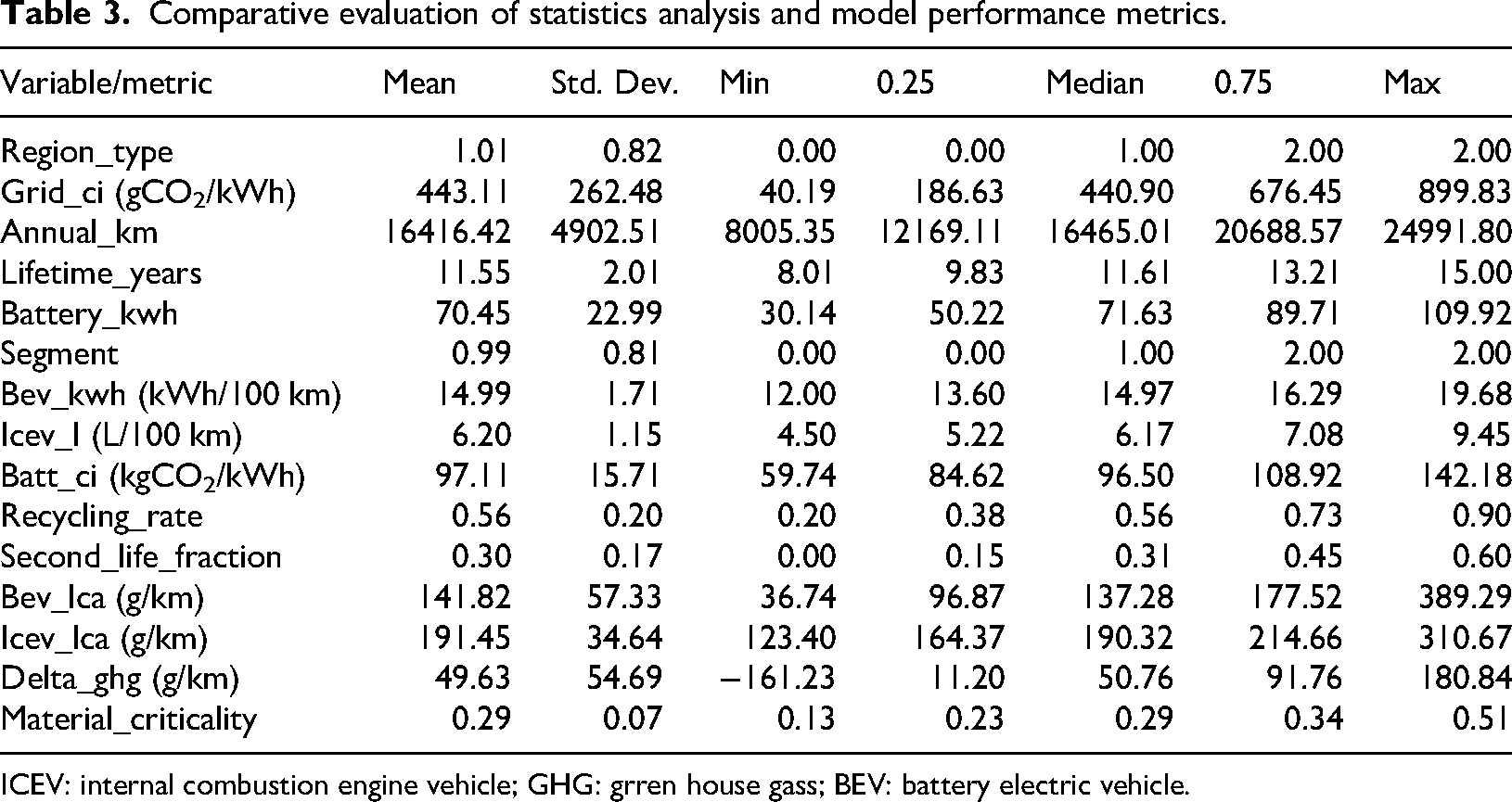
ICEV: internal combustion engine vehicle; GHG: grren house gass; BEV: battery electric vehicle.
We are seeing that the simulated data shows only the main differences in how EVs work, battery design, and regional power system conditions. It infers that electric cars produce different amounts of carbon pollution, ranging from only 36.7 to 389.3 g per kilometer, with an average of 141.8 g per kilometer across 1500 samples. This happens because of battery making, electricity sources, and how people drive their cars. ICEV life-cycle emissions surely show a narrower range (123.4–310.7 gCO2/km; mean 191.4 gCO2/km), which means they are less affected by regional electricity sources. Moreover, these vehicles depend more on fuel efficiency and how much they are driven each year. Electric cars actually reduce carbon emissions by 49.6 gCO2/km compared to petrol cars in most places. However, electric cars with big batteries definitely perform worse than petrol cars in areas where electricity comes from coal power plants. As per the study, key variables regarding grid carbon intensity (average 443 ± 262 gCO2/kWh), battery size (average 70.45 ± 22.99 kWh), electric car energy use (14.99 ± 1.71 kWh/100 km), and recycling rates (0.56 ± 0.20) show wide differences that help create realistic situations for machine learning work. Moreover, basically, the material criticality scores show that cobalt, nickel, lithium, and rare earth elements all face the same geopolitical and supply problems, with values between 0.126 and 0.507.
It is noticed that the machine learning models are showing very good ability to predict the sustainability measures only. Basically, for Task A, the BEV life-cycle GHG model showed excellent results with R2 of 0.9808 and low prediction errors, proving the same model can handle complex relationships between energy use, manufacturing emissions, and recycling effects. Task B itself predicted the GHG benefit of BEVs over ICEVs with strong performance, showing R2 of 0.9684, MAE of 7.12 gCO2/km, and RMSE of 9.51 gCO2/km. This further indicates reliable estimation of emission advantages across different regional and technological contexts. Task C model for material criticality achieved only moderate performance with R2 value of 0.7307, which is expected because supply risk indicators are more random in nature and show weaker connection with basic vehicle parameters. The statistical analysis and model results surely show that the proposed machine-learning framework captures both technology and system factors that affect EV sustainability. Moreover, this framework enables strong assessment across different operational and regional conditions.
EV ecosystem: Socio-Economic, policy, and infrastructure perspective
Global EV policies
EV system only covers the same social, economic, policy, and basic infrastructure parts that work together. Many countries are making policies for EVs to reduce pollution further and promote clean transport itself. EV adoption patterns are surely similar across different countries worldwide. Moreover, these patterns depend mainly on government policies implemented at national and regional levels. As per EU rules, car pollution must be cut by 55% by 2030 and stopped completely by 2035. The regulations regarding vehicle emissions are very strict. This means that petrol and diesel cars will not be sold further after 2035, as the ban itself will stop all such sales. Basically, America's Inflation Reduction Act gives tax benefits to EV buyers and runs the same NEVI program to build fast charging stations across the country. California has made state policies where car companies must sell zero-emission vehicles, and this rule itself will further help reduce pollution. China surely has the most complete EVpolicy system in the world, which includes the NEV credit program and large government subsidies. Moreover, this system also focuses on developing local supply chains for EVs. Further, this approach has made China the largest EV market in the world with the biggest battery production capacity itself. India's policy initiatives such as NEMMP and FAME II scheme surely provide financial assistance to consumers, support manufacturers in reducing EV costs, and develop charging infrastructure. Moreover, these measures are effectively encouraging greater adoption of electric two-wheelers, three-wheelers, and buses across the country. These policy systems definitely show that continuous EV growth actually needs clear long-term rules, focused subsidies, and investment in charging stations and power grid together. Moreover, all these parts must surely work together to get success. This cooperation is needed for achieving good results (Gaines et al., 2020; He et al., 2021).
Economic feasibility
Basically, we check if EVs are economically good by looking at the Total Cost of Ownership, which includes the same costs like buying price, maintenance, energy, and battery replacement. Studies from Europe, America, and Asia actually show that electric cars definitely cost less money over time than petrol cars. They are more efficient, need less repairs, and actually use cheaper energy per kilometer. EVs surely cost more at the beginning because battery production is expensive, but lithium-ion battery prices are dropping quickly due to improved manufacturing techniques. Moreover, current trends show that better production methods are making these batteries more affordable. The price difference between EVs and conventional cars is surely reducing rapidly. Moreover, this gap continues to narrow at a fast pace. As per our findings, different regions affect costs significantly–areas with high fuel prices and low electricity rates achieve cost balance faster, while regions with dirty electricity grids get smaller savings regarding running costs. It is noticed that big vehicle groups like taxis, delivery trucks, and buses are getting good money benefits from electric cars because they run many kilometers every year and save on fuel costs with less repair work only. Further, EVs will surely become economically viable at large scale when battery costs continue to decrease and governments provide supportive policies. Moreover, developing proper recycling markets will maintain steady material supply for sustainable growth (Messagie, 2014; Olivetti et al., 2021; Wulf et al., 2020).
Charging standards
The standardization process itself ensures compatibility across different manufacturers and regions. EV charging technology is surely standardized using regional and international connector systems along with communication protocols. Moreover, this standardization ensures compatibility across different EV models and charging stations. We are seeing the Combined Charging System (CCS) becoming the main standard in Europe and North America, which can handle both AC and DC charging up to several hundred kilowatts only. CCS also supports ISO 15118 communication for smart charging and automatic plug-and-charge features. Further, basically, CHAdeMO from Japan was the same early DC fast-charging system that lets EVs give power back to the grid through V2G technology. China actually uses GB/T standards like GB/T 20234 and GB/T 27930 for EV charging systems. These standards definitely support both AC and DC charging with new versions made for heavy trucks and business vehicles. ISO 15118 actually provides secure communication between EVs and charging stations for contract-based charging and smart coordination. This standard definitely creates the foundation for future large-scale V2G systems. Basically, all these standards need to be the same so that charging works everywhere and we don't have different systems in different places (Ghassemi, 2020; Harper et al., 2019; Hardman, 2019).
Urban planning for E-mobility
It is noticed that putting electric cars in cities needs proper planning for roads, power systems, and only land use together. It is observing city planning studies show charging stations must be placed in the right locations only, looking at how many people need them, how long cars stay parked, and income patterns to make sure everyone can use them fairly. Further, crowded housing areas without own parking spaces need public AC charging only, while business areas and transport hubs benefit from fast-charging setup. Cities are actually making new rules that definitely require builders to install electric car charging systems in new homes and offices to prepare for future needs. Electric bus depots and last-mile logistics centers surely need high-power connection points, transformer upgrades, and local energy storage systems. Moreover, these infrastructure elements are essential to manage peak demand and avoid overloading of electrical feeders. As per urban mobility studies, EV charging must be planned together with public transport, better walking paths, and renewable energy like solar panels over parking areas. This integrated approach regarding transport planning helps create better city mobility systems. Basically, when cities make stricter climate rules, planning for EVs becomes the same as planning for sustainable city design (Lévay et al., 2022; Khalid et al., 2021).
Barriers to large-scale EV adoption
Basically, electric cars in cities need the same proper planning for roads, power supply, and land use together. City planning studies actually show that charging stations must definitely be placed in the right spots by looking at how many people need them, parking time, and income levels. This actually helps make sure everyone can use them fairly. Moreover, crowded housing areas without parking spaces surely need only public AC charging, while business areas and transport hubs benefit from fast-charging setup. Further, cities making new rules where builders must only put electric car charging points in new homes and offices for future use. It is noted that electric bus depots and delivery centers need only strong power connections, better transformers, and local battery storage systems. Basically, these infrastructure parts are the same essential things needed to handle peak demand and stop electrical feeders from getting overloaded. Basically, city studies show that EV charging should be planned with buses and trains, better footpaths, and the same renewable energy like solar panels over parking spaces. As per this combined method regarding transport planning, cities can make better mobility systems. When cities actually make stricter climate rules, planning for EVs definitely becomes the same as planning for sustainable city design.
EVs are surely expanding rapidly, but certain challenges definitely prevent widespread adoption among consumers. Moreover, these barriers continue to limit purchasing decisions across different regions. Research findings surely show that poor charging station availability and uneven distribution across regions remain the main barriers to EV growth. Moreover, this problem affects both developed and developing countries equally. Battery making is actually becoming difficult because getting materials like lithium and cobalt is risky and prices definitely keep changing when electric cars are growing fast. As per the supply problems, we can make only limited batteries in future regarding production capacity. Money differences are actually creating big problems—high starting costs and limited loans definitely make it hard for poor families, small shops, and village communities to use these technologies. We are seeing that when many fast chargers work together in one place, the transformers get too much load and voltage keeps changing, so we need only smart charging systems or better grid equipment to solve this problem. People worry about electric car range, battery life, and safety issues, which further slows down purchasing even though the technology itself is improving. Also, to actually solve these issues, we definitely need improved policies, increased funding for infrastructure, diverse manufacturing methods, and effective communication systems.
Challenges and research gaps
Battery resource scarcity
Basically, EVs have the same big problem everywhere—important materials like lithium and cobalt are not available enough in many places. The shortage of important minerals further limits how many electric cars can be made and used. This problem itself affects the production of EVs worldwide. This problem is actually stopping EV technology from growing worldwide. It definitely affects how fast electric cars can expand globally. Earth studies actually show we have enough global reserves, but the extraction and refining capacity is definitely not adequate to meet projected EV battery demand by 2035. Research actually shows that we definitely won't have enough space for the next few years. Actually, Congo produces more than 70% of all cobalt, and China definitely processes over 60% of lithium globally. This is making big trouble for countries and their supply chains only. Today it is notice that NMC and NCA battery types need these materials in large amounts only, and LFP batteries also require much lithium and graphite even though they use less cobalt and nickel. Basically, researchers need to work more on making eco-friendly batteries like sodium-ion and solid-state types, and the same goes for improving how we recycle battery materials. The battery design needs circular economy ideas from the beginning to reduce dependence on only new minerals.
Charging infrastructure shortage
As per global trends, EV charging infrastructure development is much slower than EV sales growth, which creates regional gaps regarding vehicle numbers and charging availability. It is observed that studies show most countries are having only very few public chargers compared to the suggested 10–15 EVs per charger, and developing nations are facing the same problem due to city growth and power grid issues. Basically, setting up chargers takes long time because of land issues, permit delays, high costs, and the same uncertainty about how much people will actually use fast charging stations. Super-fast DC charging stations are expanding further, but the availability itself is not equal across all cities and highways. Researchers actually need the same prediction models for placing chargers, connecting clean energy centers, and definitely making smart investments based on demand and grid capacity (Panda et al., 2025b).
Power grid stress and stability issues
Power grids face the same severe pressure when electricity demand increases quickly. Basically, when demand increases very fast, it can cause the same system failures and power cuts everywhere. As per system requirements, these stability problems can cause big power cuts if the system cannot handle the extra load properly. It is to notice that wrong load management in grid operations only leads to complete power cuts. As per current observations, EVs are becoming more common and this is increasing power demand changes, especially regarding high-power charging stations that are grouped together at depots, housing areas, or business roads. When EV usage is high, power system risks include transformer overload, voltage reduction, power quality issues, and reverse power flow during V2G operations if not managed properly. Further, the grid itself faces additional stress from these operational challenges. These problems surely occur when EV charging systems fail to function together correctly. Moreover, poor integration between different charging components creates operational difficulties. As per the coordination process, this definitely creates issues regarding the work flow. Big trucks actually need very fast charging that definitely puts huge pressure on the power grid because these charging stations use massive amounts of electricity. Moreover, we are observing that power lines in old city areas were designed for steady electricity use only, and cannot handle such rapid changes in power demand itself. This further creates problems when electricity needs change quickly. Basically, these old systems have the same big issues when the load changes fast. Current research shows gaps in understanding power grid performance when multiple EVs connect, and AI systems can further manage EV charging schedules effectively by itself. Also, basically, we need research on special control devices like UPQC and STATCOM, and the same grid-forming inverters to keep power systems stable when many renewable energy sources and EVs are connected. These devices surely help to keep the power grid stable as per today's requirements. Moreover, they are essential for maintaining proper electricity supply in the system.
Fast-Charging heat generation and battery degradation
Research shows that fast-charging generates heat which damages the same battery cells. Basically, this heat damages the battery and reduces its life the same way excessive temperature affects all electronic components. Moreover, this heat production surely makes the battery damage faster and reduces how long the battery will last. Basically, fast charging heats up batteries and causes the same coating and metal deposit issues that make batteries dangerous. When cells are actually charged above 2–3C rates, they definitely get the same capacity loss and higher internal resistance because current doesn't spread evenly and creates hotspot problems in the same local areas. Due to thermal limits, charging power itself has a maximum limit in practice, even when the charging system can further provide higher currents. Heat problems definitely limit the maximum charging power even when the system can actually provide more current. Actually, this happens even when the system definitely has enough capacity to give more power. As per our findings, the main research gaps are regarding better battery cooling methods like liquid cooling and vapor chambers, thermal runaway studies, and physics-based degradation models. Moreover, we surely require health prediction systems that operate in real-time to minimize battery damage during rapid charging processes.
Limited recycling and second-life technologies
As per predictions, battery waste will increase more after 2030, and the world does not have enough recycling facilities regarding handling this expected waste. Further, current recycling methods consume excessive energy and further recover only limited metals such as Co and Ni effectively, while the process itself remains inefficient for other valuable materials. Current testing shows that direct recycling methods are surely being examined at small scales for their effectiveness. Moreover, these approaches are still under evaluation to understand how well they work. Further, as per current observations, old EV batteries used for storage or small power grids are showing the same technical problems regarding different capacity levels, safety issues, and lack of standard methods to check battery performance. Basically, research gaps are the same issues like automatic battery disassembly, tracking systems, specific recycling methods for different battery types, making batteries easy to break down, and scaling up direct recovery methods to get cathode materials with less processing.
High cost of EVs and economic barriers
EVs cost more than petrol cars because the battery materials are expensive and the manufacturing process is the same complex. Limited production itself makes EVs costly in certain markets, and this further raises the initial purchase price. TCO studies are showing that people can save money over time, but we are seeing that high starting costs only stop poor users and small companies from buying. Economic barriers actually get tougher because battery prices keep changing, and material supplies are definitely not stable. As per current trends, subsidies are helping people purchase these vehicles initially, but regarding long-term success, companies must reduce costs only through large-scale production, cheaper materials, and simple car designs. Further, researchers need to develop cheaper car parts and low-cost batteries, and further create financial models to study how government policies affect EV pricing in different regions. This approach itself will help make EVs more affordable globally.
Lack of standardization and interoperability
Moreover, as per the current situation, not having standard rules regarding this matter surely creates difficulties. Different systems must work together further to achieve better results. This coordination itself ensures proper functioning. As per the current situation, this lack of uniformity makes joining different platforms very difficult. Regarding integration work, it becomes quite challenging when systems are not uniform. This problem surely makes the technology harder to work with other systems. Moreover, it creates additional difficulties in system integration. Moreover, electric cars worldwide are actually facing problems because charging plugs, communication methods, safety standards, and power systems are definitely different and not working together properly. CCS, CHAdeMO, and GB/T charging systems surely operate independently, which makes EV charging more complicated across different countries. Moreover, this separation creates significant compatibility issues between vehicles and chargers. V2G protocols differ across regions, which further creates barriers for widespread implementation itself. Basically, when there's no standard system, it becomes difficult to use the same bidirectional charging technology effectively everywhere. As per current implementation, basic cyber-physical interfaces, ISO 15118 smart charging, and safety standards are not available everywhere. Regarding these technologies, many places still do not have proper setup. As per research findings, we are seeing that all areas are having same gaps only–there are no unified international standards for high-power charging, universal communication systems, safe authentication protocols, and testing methods. These frameworks must surely ensure that chargers and vehicles work together across different world markets. Moreover, this compatibility should be maintained in all global regions.
Cybersecurity challenges in connected EVs
Basically, connected EVs are facing the same serious cyber-security threats that need immediate attention (Akhunzada et al., 2024; Sharma et al., 2025). Moreover, security problems become more difficult when vehicles connect to multiple networks and systems at the same time, and this creates further challenges for the system itself (Ghazal et al. 2025a). We are seeing new electric cars work like smart connected systems only, with wireless updates and intelligent charging features. These vehicles have V2G technology and self-driving sensors for better performance. Also, the technology itself allows further connection with modern digital systems. The connected electric cars are facing the same cyber-attacks where bad people use fake chargers, break into talking systems, send harmful software through car networks, and only change battery information. Charging station attacks surely make the power grid unstable. Moreover, hacked car sensors stop the safety systems in self-driving vehicles from working properly. The research gaps are actually in areas like intrusion detection systems, secure V2G authentication, blockchain charging transactions, and strong BMS communication designs. These areas definitely need more work to solve the problems. As per current requirements, EV operating systems need proper research work regarding security checking. This checking work actually needs proper study to definitely ensure safety. When EVs connect to smart grids, cybersecurity surely becomes a major concern for system safety. Moreover, protecting these connected systems is essential for maintaining reliable operations.
Future trends and research roadmap
Next-Generation Battery Systems
It is notice that solid-state lithium batteries use solid materials instead of liquid ones only, which helps in using lithium metal parts and high-power cathodes as per the design. This technology can reach energy levels above 400 Wh/kg only and it also gives better safety. As per engineering analysis, the main problems are low ionic conductivity in solid electrolytes at room temperature, high resistance between electrolyte and electrodes, mechanical breaking of ceramic layers during cycling, and lithium dendrite growth through solid electrolytes at high current densities. Regarding these issues, they create major challenges for battery performance. These problems actually make solid-state batteries work less well. They definitely reduce how good these batteries can be. Basically, these problems make the battery perform worse, and the solid electrolyte becomes less effective the same way. Future studies will actually focus on creating sulfide/oxide mixed electrolytes with conductivity above 10−3 S cm−1, using coatings and buffer layers to reduce interface issues and stress. Research will definitely develop thin solid electrolyte films that can handle fast charging without thermal problems. Also, sodium-ion batteries surely show good promise only for energy storage applications. Moreover, these batteries are proving effective specifically in this particular field. Further, these systems offer significant advantages compared to traditional lithium-based options itself (Ajagekar et al., 2021; Deb et al., 2022; Neukart et al., 2017; Reiher et al., 2017)
The sodium-ion batteries becoming cheap options instead of Li-ion batteries for electric cars, only for budget vehicles that need to travel short to medium distances (Olivetti et al., 2021). It is noticed that new SIB chemistries are only giving much better performance as per recent studies. Also, sodium-ion batteries with oxide materials and hard-carbon components surely achieve energy levels similar to LFP battery systems. Moreover, these batteries cannot exceed the performance of existing LFP technology. These batteries surely use common sodium instead of rare lithium, making them more practical for widespread use. Moreover, this approach reduces dependency on scarce materials. Studies actually show that SIB EV battery packs definitely cost up to 20% less per kilometer than NMC-based packs for some specific uses. Basically, raw materials are cheaper and supply-chain issues are the same but less in number. Basically, researchers are working to make batteries perform the same in cold weather and last longer during fast charging, while developing sodium-ion battery packs that give the same safety and better heat management for electric cars.
Li-S batteries actually store much more energy at 2600 Wh kg−1 and definitely avoid expensive metals like nickel and cobalt. Further, these batteries are very useful for electric cars that travel long distances and heavy machines itself. Actually, using this technology faces problems like polysulfide shuttle effect, big volume changes in sulfur cathode, poor conductivity, and high electrolyte needs that definitely reduce energy density. Basically, researchers are working on the same battery parts—making better cathode materials with porous carbons and metal compounds, improving separators, creating low-electrolyte designs, and adding protective layers for lithium metal. For EV applications, the roadmap needs to show more than 500 cycles with over 400 Wh/kg at pack level, good abuse tolerance, and compatibility with existing gigafactory processes. Further, the battery pack itself must meet these performance requirements for commercial viability. This method is surely becoming more popular in fresh partnerships between car companies and startups for making Li-S batteries. Moreover, such collaborations are helping to speed up the development process. These partnerships are actually helping to move forward car battery Li-S technology. They definitely make progress faster in this field. The next generation batteries and its significance as mentioned in Table 4.
Next-Generation EV battery technologies.
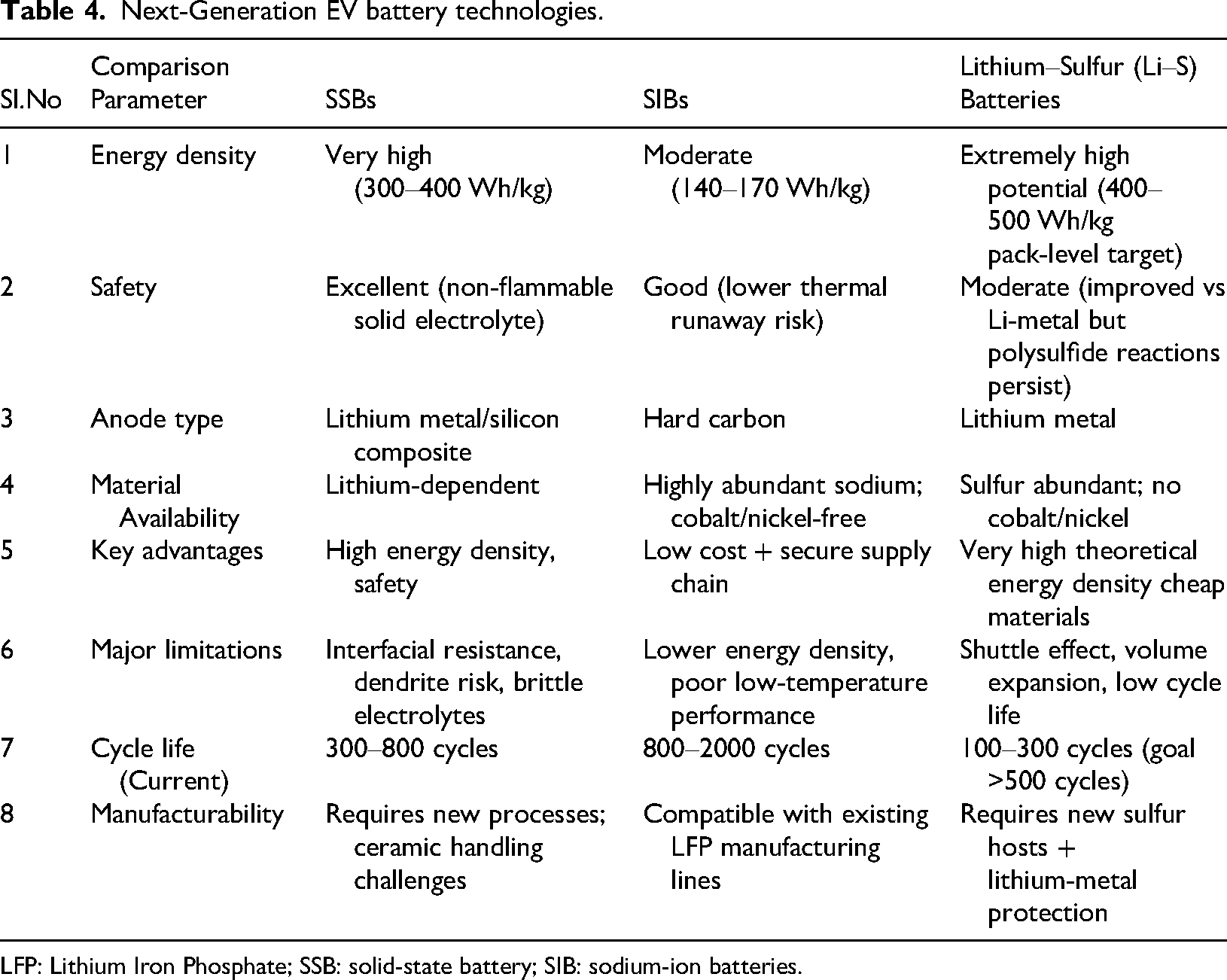
LFP: Lithium Iron Phosphate; SSB: solid-state battery; SIB: sodium-ion batteries.
Quantum computing for EV optimization
Quantum computing and quantum AI can further solve difficult energy and transport problems that regular computers cannot handle by themselves. We are seeing that Ajagekar and You's review shows quantum methods can only make renewable energy systems work faster for planning, control, and finding new materials. Moreover, many power system problems like unit commitment and dispatch can only be written as binary optimization problems. As per research findings, these problems work properly with quantum computers regarding their computational requirements. Battery modeling actually helps scientists discover new materials that definitely make batteries work better. This actually shows that battery technology definitely needs more work and improvement. As per the process, it focuses on finding better battery parts regarding improvement. Basically, scientists work to find new materials that make batteries perform the same way but better. It is observed that researchers can study battery materials with very high accuracy using quantum chemistry methods like VQE and quantum phase estimation, which can handle scales that normal computers only cannot manage. Basically, quantum algorithms give the same better results for surface reactions compared to classical methods. Further, these results itself are more accurate than traditional approaches. We are finding solid battery parts and high-power cathodes faster, which further improves quick charging in EV technology itself. The research plan surely uses hybrid quantum-classical methods where quantum computing calculates electronic structure for battery materials. Moreover, this data feeds into surrogate models for large-scale battery design and BMS parameter setting. Also, quantum subroutines will surely provide accurate material properties that help optimize battery systems. Moreover, these precise calculations definitely improve the overall workflow efficiency. As per traffic conditions and time-based pricing, the problem becomes complex regarding charger availability and grid limitations together. Recent studies have formulated traffic routing and EV charging scheduling problems as Ising Hamiltonians and further solved them using VQE on quantum hardware. The method itself shows competitive or better solutions than classical approaches for small to medium problems. Further, basically, this shows that quantum computing has the same potential in these areas. Recent studies surely show that quantum annealing helps find the best locations for EV charging stations by checking many possible arrangements. Moreover, this method ensures maximum service coverage and grid-friendly operations. We are seeing that future research should only focus on making simple methods for placing EV routes and charging stations across entire cities. Moreover, researchers must actually connect quantum solvers with traffic simulators and definitely build strong quantum schedulers for V2G systems (Chen et al., 2016; Huang et al., 2024; Liu et al., 2022; Zeng et al., 2023).
EV with renewable ecosystems
EVs surely perform more efficiently when combined with renewable energy systems. Moreover, this integration creates a better overall energy solution. As per this combination, cleaner transport solutions are created regarding better mobility options. Further, linking electric cars with clean energy sources is only the main way to cut down carbon pollution in transport and electricity areas. As per recent reviews, solar PV, wind, and storage systems are placed together with charging infrastructure regarding local renewable use, peak reduction, and lower emissions. These systems surely connect solar panels directly to EV charging or combine renewable energy with battery storage and flexible EV charging loads. Moreover, this approach helps in better energy management. The main problems are uneven renewable energy supply, limited local power distribution capacity only, and proper coordination between uncertain power generation and flexible charging systems. EVs working as flexible power loads and storage units that help bring together renewable energy through demand management and V2G services only. It can be noticed that reviews put smart-charging methods into three types–centralized, decentralized, and hierarchical controllers that use optimization and learning to match EV charging with renewable energy and reduce only grid problems and costs. As per future research needs, strong control systems are required for renewable energy and EV microgrids regarding different time periods from seconds to days. Market systems must surely be developed for EV groups that participate in power grid services. Moreover, resilient designs are needed that use EV fleets to provide emergency power during outages. As per your IEEE-34 PQ and ML-based THD prediction work, these directions help regarding high-RES and high-EV feeders with good power quality (Sorrentino et al., 2025; Verma et al., 2024)
Autonomous electric mobility
Surely, self-driving EVs will shape the future of how we travel from one place to another. Moreover, these smart transport systems represent the next big step in mobility technology. This technology is bringing together self-driving cars with clean energy to make cities better and green. It only helps in making urban areas more sustainable. Further, self-driving electric cars with network connectivity will further transform transportation itself and change energy consumption patterns along with charging requirements. System-level studies show that shared autonomous EVs can surely reduce the number of cars people own and the total fleet size. Moreover, these vehicles can maintain the same transport services with fewer cars. The energy use and emissions depend only on how much extra travel happens, how many people share rides, and how they charge the vehicles. As per research, smart electric cars can use eco-driving and group coordination to save energy per kilometer regarding fuel efficiency. When noticed that more total distance traveled, using vehicles more can only reduce the energy savings we get. The car parts are moving toward making EVs that only use less energy and work better. The design actually focusses on making systems work better. This will definitely improve how efficiently things operate. Further, the design surely uses motors inside wheels with improved braking systems that conserve energy. Moreover, this arrangement helps in better energy management during vehicle operation. The system surely controls heat for both vehicle movement and computer operations. Moreover, it manages temperature in both these important areas. We are seeing that electric cars with motors in wheels can save only 15–20% energy in some driving situations compared to normal cars with central motors because they have less mechanical losses and better power control. Recent computer studies on complete EV models show that smart driving systems with strong energy-saving methods can further increase driving range by 20%–25% without major hardware changes itself. As per the detailed MATLAB/Simulink simulations, these results are obtained regarding real-world testing conditions. As per future research needs, self-driving car systems should work with smart energy routing that checks battery damage, heat problems, and power grid issues—this area can use your range prediction patent with AI-based eco-routing regarding better results (Deb et al., 2022).
Digital twins for EV fleet management
As per current trends, digital twins are becoming the main technology regarding EV fleet management only. As per fleet management needs, these systems help companies track and manage their EV fleets in a better way regarding operational efficiency. This make vehicle operations more effective and only help in making them work better. Basically, digital twin technology connects detailed virtual models with real-time data from actual vehicles and is becoming the same important tool for advanced EV fleet management. It is observed that new studies show DT systems for electric cars use a way that brings together battery heat models, drivetrain working, charging links, and talk systems with live data to help with non-stop checking, future care, and making performance better only. This method actually helps in managing vehicles better. It definitely makes vehicle control more effective. The digital twins can check many buses and delivery trucks on different roads with different weights and charging methods only. This helps test vehicles in various conditions. This actually helps fleet operations run definitely better. Basically, operators can check different conditions first, which is the same as testing everything before actually putting it into action. Before actually implementing new timetables, charger placements, and tariff structures, these should definitely be tested first. A 2025 review surely shows that digital twins for EVs help check battery health, study fast charging effects, control heat, and improve depot work. Moreover, these systems work together with IoT, big data, and AI technologies. As per cybersecurity testing needs, DTs allow virtual penetration tests on communication and control systems before real deployment. Regarding system safety, this helps find security problems early without risking actual systems. Basically, this testing method helps find and fix security problems early when developing software, which is the same as catching issues before they become bigger problems. As per research requirements, scientists must develop standard designs for digital twins of EV groups and better methods for handling large data amounts. Regarding system integration, they need to test with power networks and renewable energy plants while connecting these systems with real-time optimization tools. It is notice that special computer programs are used for finding the best places and times to put charging systems, and these programs only use smart learning methods to make better decisions. Also, you can surely combine your ML experience with THD prediction and hydrogen/EV forecasting to build a digital twin system. Moreover, this system will bring together your converter experiments, PQ datasets, and AI models for making fleet-level decisions (Huang et al., 2024; Liu et al., 2022).










The battery state of charge at the next time step depends on the current charge level and charging power, which is further normalized by battery capacity itself and limited to maximum value of 1 as shown in equation (97). The total power taken from the grid is only the base load plus charging power minus the solar panel power, as given in equation (98). The energy we actually import from the grid is calculated by taking only the positive grid power and multiplying it with the time period. The cost is definitely found by multiplying the imported energy with the electricity price at that time. As per the system rules, an extra penalty is charged when grid power goes above the maximum allowed limit as defined in equation (101). Regarding the reward calculation, it is computed as a negative sum of energy cost and overload penalty as shown in equation (102). When the horizon ends, the reward gets adjusted by adding a penalty that is proportional to only the difference between what we want and the actual final state of charge, like in equation (103). Further, it is noticed that the best reinforcement learning policy (Figure 14) only picks the action that gives the highest Q-value for any given state, as mentioned in equation (104). As per equation (105), the highest grid power during operation time is recorded. Regarding PV energy use, it is calculated by adding the smaller value between PV generation and total local demand over time as shown in equation (106). Further, the total cost for the complete operation period is calculated by only adding the energy cost and overload penalties for all time steps, as given in equation (107) (Figure 15).
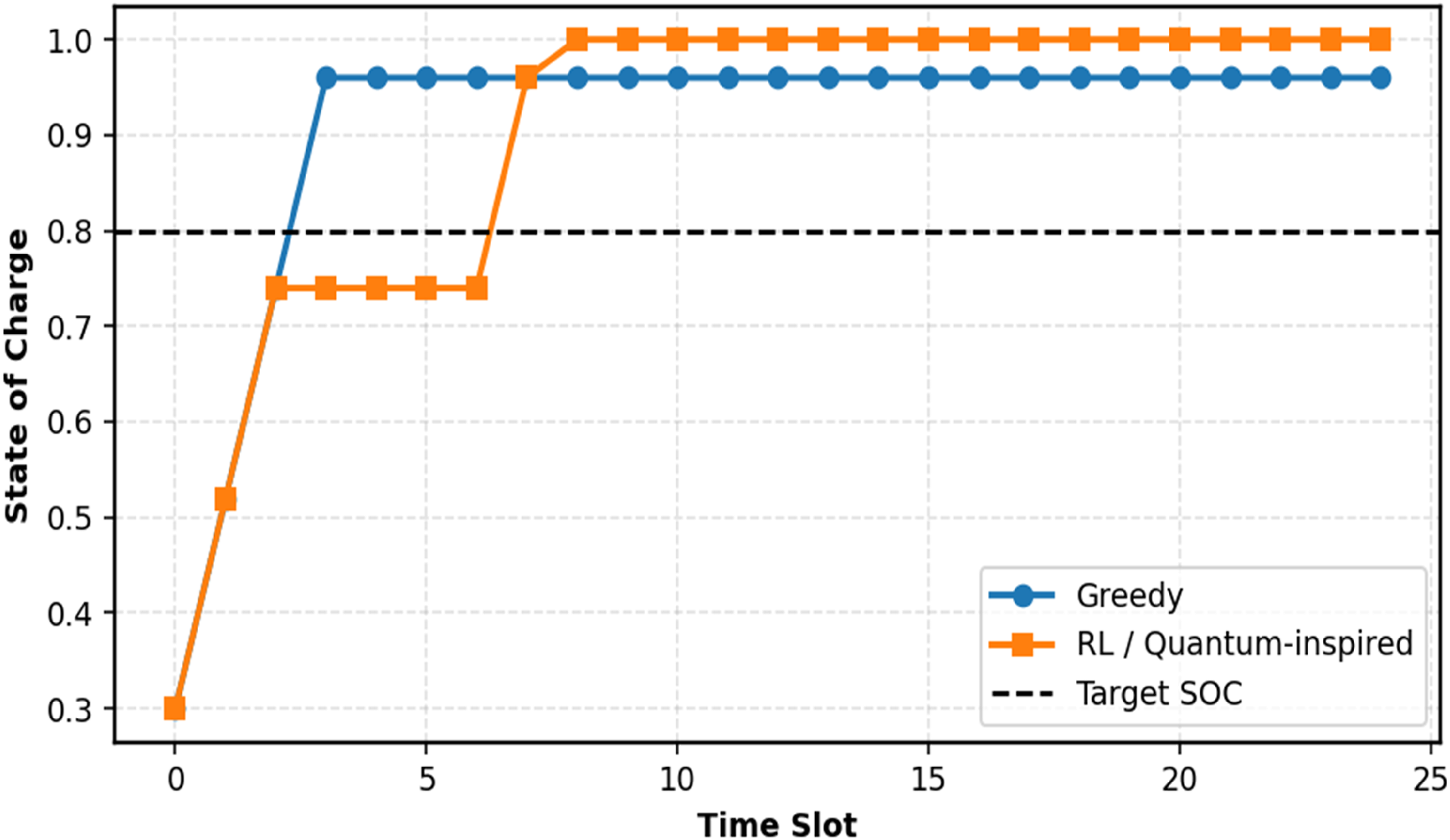
Comparison of greedy and TL/Quantum algorithms for target SOC.
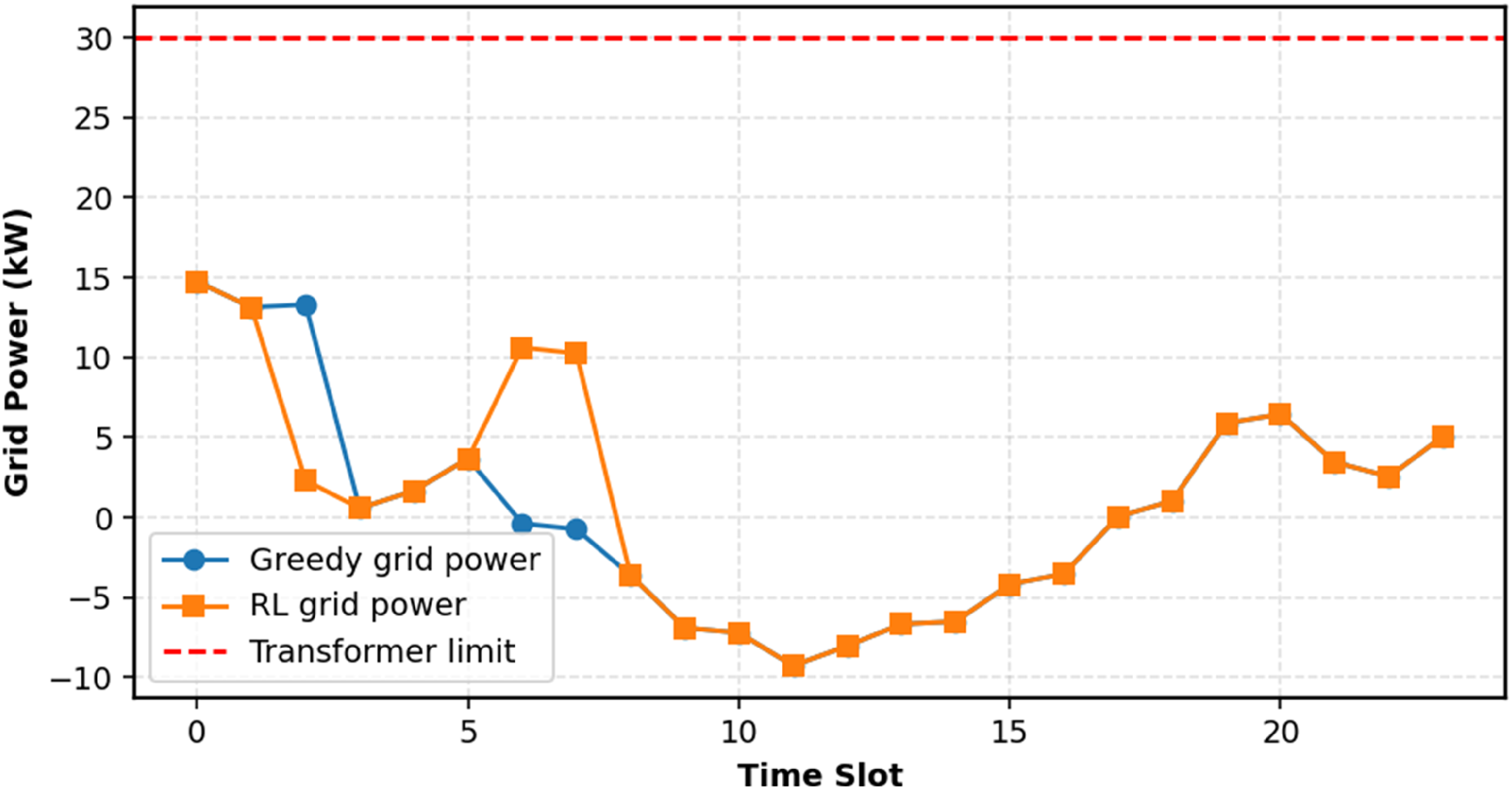
Grid impact of greedy vs. RL Charging Control.
According to the figure itself, further analysis shows the data. Figure 14 actually shows the SOC trajectory comparison for the analysis. The comparison definitely presents the SOC patterns clearly. Also, basically, Figure 15 shows that greedy and RL/quantum-inspired charging methods.
Work in different patterns, but the same comparison is presented. As per observation, these strategies work in completely different ways regarding their operation. The greedy controller surely begins charging immediately and maintains a constant high battery level of approximately 96% throughout the entire period. Moreover, it does not consider electricity prices or solar power availability during its operation. Further, the RL/QUBO method makes the charging pattern itself smarter and further reduces costs. The charging process actually waits when electricity is expensive and definitely charges fast only when solar power and grid conditions are good. It keeps the battery at medium level during high-price times. Both strategies actually reach the needed SOC target of 0.80, but the RL/QUBO method definitely shows smoother changes and better planning when conditions change. Moreover, this behavior surely matches the real-world needs of EV charging, especially when we consider renewable energy availability and changing electricity rates for cost-effective operation. This approach is surely beneficial for both grid stability and economic efficiency.
The performance measures clearly show that these two methods are different from each other. Further, the comparison itself reveals significant variations between both approaches. Further, these results help us understand what we gain and lose with each approach itself. The greedy method surely gives lower charging cost of ₹748.78, but it does not think about system goals and starts charging right away without considering future problems. Moreover, this approach focuses only on immediate benefits and ignores long-term consequences. The RL/QUBO method actually costs more at ₹962.75 total, but it definitely gives a small boost with 0.73% more PV energy use. Further, this method keeps the peak grid power same at 14.74 kW without any increase itself. Basically, the RL/QUBO controller focuses on making the system flexible and improving renewable energy use—the same approach works even when cost reduction is not the main goal. Basically, this behavior is the same as multi-objective energy management studies where we need to balance cost, renewable energy use, and grid support. Further, all these factors itself need careful consideration together. The results show that quantum-inspired optimization can actually be adjusted for different goals like cost, solar power use, and avoiding traffic jams. This method is definitely promising for future EV-grid systems when combined with digital twins or V2G scheduling. In EV, the research direction and corresponding technical focus and purpose as mentioned in Table 5.
Challenges and opportunities in EV.
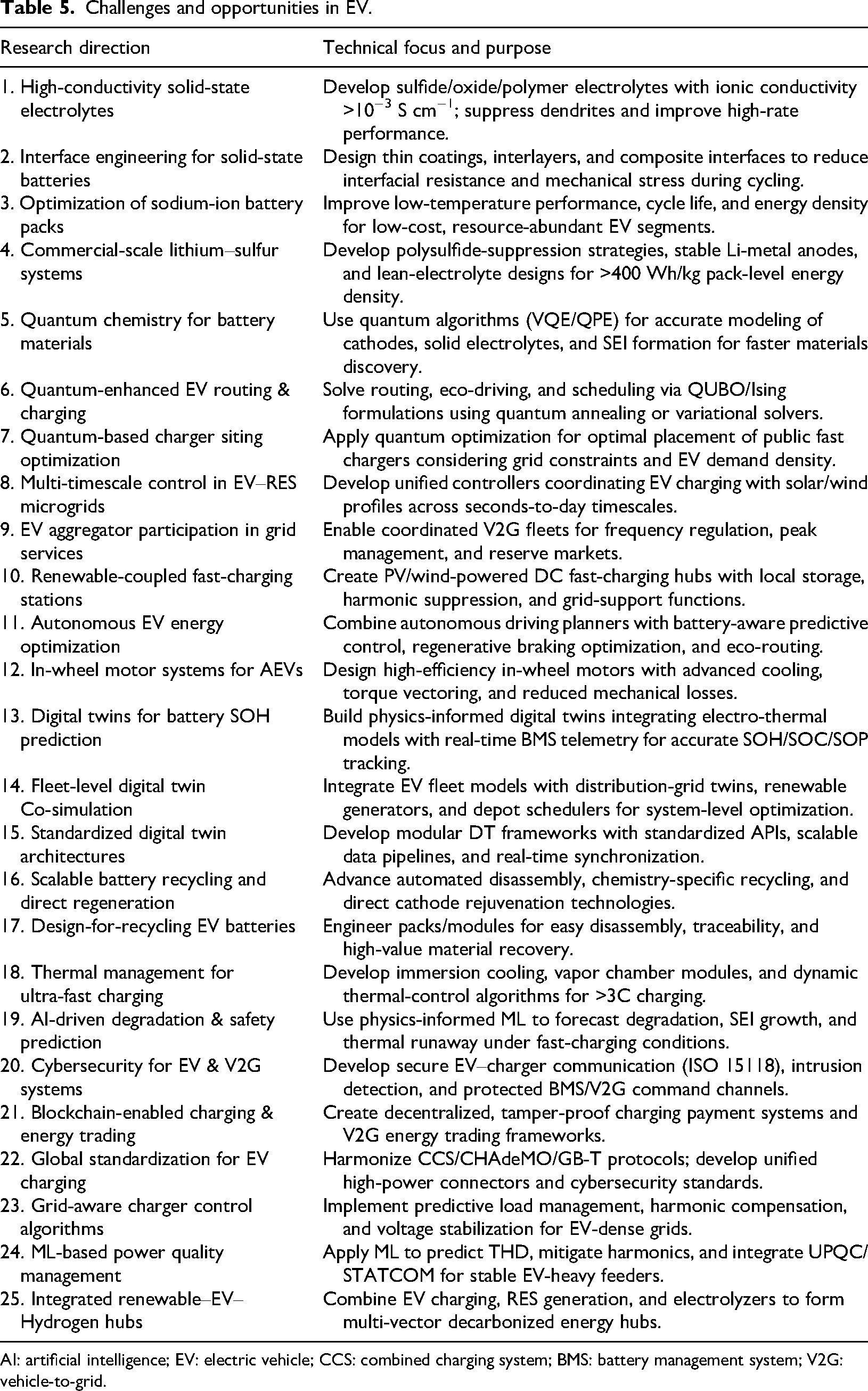
AI: artificial intelligence; EV: electric vehicle; CCS: combined charging system; BMS: battery management system; V2G: vehicle-to-grid.
Conclusion
This study shows that sustainable electric mobility needs more development only in mechanical engineering, battery technology, power systems, data intelligence, and computer frameworks. Also, research findings surely show that EV sustainability depends on battery chemistry, drivetrain efficiency, and grid carbon intensity. Moreover, these three factors together determine how environmentally friendly EVs actually are. For proper environmental assessment, all three factors must surely be considered together. Moreover, these elements work as a complete unit for accurate evaluation. Fast charging and big vehicle fleets are actually putting more pressure on electricity systems. This definitely creates new challenges for power grids across the country. This surely leads to fresh challenges in distributing power, moreover it affects the entire system. AI prediction methods actually show that planned charging can definitely reduce these problems by making peak load lower and making voltage more stable. Actually, the same methods definitely help reduce harmonic distortion issues in power systems.
We are seeing that AI is making electric cars work better and it only helps in planning where to put charging stations properly. Basically, physics models help calculate battery range more accurately, and ML tools do the same for early battery care. As per traffic data analysis, LSTM networks predict patterns for eco-friendly routes, and regarding battery optimization, reinforcement learning helps reduce charging costs and improve performance. Moreover, quantum computing will surely solve complex problems in route planning and battery material discovery much faster than current methods. Moreover, this technology will help researchers find better solutions for transportation and energy storage challenges. These advanced technologies can surely handle complex problems that regular computers find difficult to solve. Moreover, they perform such challenging tasks with much greater efficiency. As per current studies, these systems can handle difficult tasks much better than normal computers. Regarding their performance, they work faster and more efficiently than regular computing systems. These methods can surely improve computer performance and provide faster solutions for transportation systems. Moreover, they help reduce system slowdowns effectively. As per studies, they give better results regarding work with uncertain conditions.
The research shows that electric cars reduce harmful gases the same way when they use clean electricity and recycle batteries properly. Moreover, research actually shows that environmental benefits definitely depend on having good energy systems during the vehicle's complete life. The systems must surely work well throughout the vehicle's entire life cycle. Moreover, efficiency should remain consistent from the beginning to the end of the vehicle's operational period. We surely need strong circular economy policies and better technology improvements to solve current problems like material shortages, battery waste, and recycling issues. Moreover, these steps are necessary to address the growing challenges in our environment. These problems actually need the same good solutions to work properly. They definitely require similar approaches to be effective. Also, new technology trends show that combining engineering methods, AI, and quantum computing itself gives a complete way to build better EV systems for further growth and long-term environmental targets.
Footnotes

Author contributions
Thenkaraimuthu Mariprasath, Kaliappan Esakkiappan: Conceptualization, methodology, software, visualization, investigation, writing—original draft preparation. Shaik M Ali, Muraly Natarajan: Data curation, validation, supervision, resources, writing–review and editing. Basem A Zneid, Oleksandr Rubanenko: Project administration, supervision, resources, writing–review and editing.
Funding
The authors received no financial support for the research, authorship, and/or publication of this article.
Declaration of conflicting interests
The authors declared no potential conflicts of interest with respect to the research, authorship, and/or publication of this article.
Data availability statement
The datasets used and/or analysed during the current study available from the corresponding author on reasonable request.