





Abstract
This paper considers the background of Paul’s generic “slave” metaphor in 1 Cor 9:19–23. Scholars at various times have attempted to identify this slave as a more precise figure from the ancient world. Proposals such as the “enslaved leader” or the “flatterer” have been put forward. This paper agrees with the assumption that Paul has something specific in mind but argues that the various proposals previously offered do not fully encompass Paul’s description of the figure. Instead, it will be argued that what Paul has in view is the ancient actor.
Afrequent metaphor that Paul uses to describe both his ministry and the Christian life in general is that of a slave. One example of this is found in 1 Cor 9:19–23. In this passage, Paul describes himself as a slave who is at the same time, somewhat paradoxically, free. He says that he has intentionally made himself a slave to all so as to win as many as possible. Scholars who examine this passage often assume that Paul is describing a more generic slave, such as the type found in many ancient households. Others, however, have attempted to identify the slave with a specific figure in ancient society. These proposals are illuminating in that they cause us to look more closely at Paul’s metaphor. They make the convincing case that there is more to Paul’s “slave” than meets the eye. However, attempts to identify the figure are either too vague in their interpretation or insufficient in explaining the full behaviour that Paul describes. Overall, they fail to locate Paul’s slave within the cultural context. What these scholars have not considered, however, is the ubiquitous and universally known and understood context of the theatre. In what follows, it will be suggested that when Paul describes himself as a slave in 1 Cor 9:19–23, what he has in mind is an actor.
Literary Context
On two occasions in 1 Corinthians, Paul is compelled to offer a defense of his ministry to the Corinthians. The first of these occasions is found in 1 Cor 3–4, where his style of ministry is called into question and negatively compared with that of Apollos. In response, Paul sets out a series of metaphors to describe not only the nature of his apostleship, but also to show how it comports with the ideals of a minister of Christ (cf. White, 2015, pp. 125–94).
Then in 1 Cor 9, Paul offers a defense of why he did not accept financial support from the Corinthians while he was with them. He argues that, though he has the right as an apostle to demand from them support, he refused to do so, in order to offer the gospel free of charge and thus remove himself from obligation to any one group (cf. Goodrich, 2012, pp. 168–73). He demonstrates this in 1 Cor 9:7–15 with four metaphors all intended to show that no one in the broader society entrusted with a task works for free. In the same way, he says in v. 14, he and others who preach the gospel have the right to earn their living from the gospel. But he refused to use this right (v. 15). The argument is quite straightforward, and the variety of imagery appears to be simply saying the same thing in different ways. What is notable about the metaphors, however, is that, in every case, Paul does not use the proper term to describe the person. Instead, he describes what each does.
In v. 7, he makes clear reference to a soldier. He asks rhetorically: “who serves in the army?” (tis strateuetai) However, he does not use the term “soldier” (stratiōtēs) at any point, only the verbal form describing the action (strateuō). Again, in v. 7, he asks: “who plants a vineyard?” (tis phyteuei ampelōma) But he makes no reference to a vinedresser (oikodespotēs, cf. Matt 20:1; 21:33/ampelourgos, cf. Luke 13:7). Again, he asks: “who shepherds the flock?” (tis poimainei poimnēn) But he does not refer to the shepherd (poimnē). Similarly, in v. 13, he refers to the ambiguous “workers of the holy things” (ta iera ergazomenoi) instead of the more straightforward “priest” (iereus)—or even the performance of the service of the priest (ierateuō).
We see this again in 1 Cor 9:16–18. Here, however, the metaphor becomes more personal. In this passage, Paul unpacks the metaphor in greater detail as it applies to his practice. His point is to show the reason for his refusal of their support—that is, Paul’s ministry is an obligation like that of a household manager. He refers to himself in v. 17 as “one who has been entrusted with a stewardship” (oikonomian pepisteumai), a clear reference to the oikonomos (the slave put in charge of household management) of 1 Cor 4:1 (cf. Garland 2003, p. 426; Collins 1999, p. 348; Fee 2014, p. 464). But as in the previous metaphors, Paul does not us the term oikonomos or even describe his work with the verbal form oikonomeō. Like the oikonomos, Paul, too, has necessity placed on him, only in his case it is to preach (v. 16). Again, like the oikonomos, he does not do it voluntarily, but rather unwillingly (v. 17). Finally, he does it free of charge as it is a duty, not a right (v. 18).
The pattern continues in vv. 24–27. This section more likely points forward to chapter 10, where Paul instructs them to be disciplined in matters of idol meat. The point of the metaphors is to stress the need to be unwavering in one’s ministry. Like an athlete, the minister of Christ must be focussed on the prize of the event; they must adhere to the rules; and they must compete properly until the very last. The principle rounds out what is an emerging image of the minister of Christ. But, once again, we see the same pattern in the use of the metaphors.
In 1 Cor 9:24, Paul talks about “all those who run in the stadium” (oi en stadiō trechontes pantes). Then in v. 25, he refers to those who compete (ho agōnizomenos). Again, without any specific reference to the athlete (athlētēs). He then refers to himself in v. 26 only as one who runs (trechō) and one who boxes (pykteuō). Finally, in v. 27, he says that he “pummels his body and enslaves it” (hypōpiazō mou to sōma kai doulagōgō) so as not to be disqualified for the prize. Concannon (2014, p. 206) has shown that this last phrase has in mind the training regime of the gladiator. But again, we find no terms related to the gladiator himself (e.g., sekoutōr, rētiarios, myrmillōn, thrax, probokatōr, essedarios).
In analyzing these metaphors, two patterns seem to emerge. First, in every case, Paul does not use the proper term to describe the person; rather, he describes the person’s activity. The onus is thus placed on the listener to intuit who he is referring to based on the action (cf. Aristotle, Rhet. 3.2.12; 11.5). Second, Paul selects his metaphors from a wide variety of locations, but in each case, he is describing a well-known figure. Soldiers, shepherds, vinedressers, priests, household managers, and athletes were all easily recognizable and their activities well understood within the society. This fits well with what Quintilian says with regard to the use of simile: “The more remote the source of the simile, the more novelty it produces and the more unexpected it is” (Inst. 8.3.75). But he also cautions: “The main thing to guard against is any obscure or unknown feature in the subject chosen for the simile. What is selected to illustrate something else needs to be clearer than the thing it illustrates” (Inst. 8.3.73). Contrariwise, “It will be quite inappropriate for an orator to … illustrate the obvious by the mysterious” (Inst. 8.3.74; cf. Aristotle, Rhet. 3.2.12). Paul, in other words, seems to be following an established principle of metaphor use. In trying to describe Christian ministry—something apparently misunderstood by the Corinthians—he uses everyday imagery from their society. These images, though not related to the Christian situation, are nevertheless analogous to what he does. Moreover, the imagery employed is so common and well understood, only a description of the action is necessary.
If this analysis is correct, then what we have are two criteria by which to examine 1 Cor 9:19–23. Looking at the first criterion, Paul once again only describes what he did in Corinth. Specifically, he says, “I enslaved myself to all people” (pasin emauton edoulōsa); put another way: “I acted in a slavish manner towards everyone.” Following the pattern of the other metaphors, he does not refer to himself as a slave (doulos), he only describes his actions. But these actions, at basic level, seem to contradict what a slave was. Paul describes himself as one who freely takes on different roles at his own discretion. However, a slave, by definition, is one whose role is assigned by their master. Such a seeming contradiction at least merits enquiry.
Looking at the second criterion, Paul employs the commonplace imagery of the enslaved person—a figure so easily recognized that a title is superfluous. But herein lies the issue: what exactly does Paul have in mind when he refers to the slave? In all of the other examples, Paul refers to an unmistakable character in the society. But a “slave” is far more generic and could refer to a number of different people. On the one hand, Paul might have in mind an actual slave (doulos). This then opens up a variety of other ancient roles that were filled by those with the generic title doulos. On the other hand, he only describes the nature of his behavior—that is, “slavish”. This may imply an actual slave, or it may refer to a free person whose behavior is only deemed to be “slavish”. This ambiguity has led to much disagreement amongst scholars as to who or what Paul has in mind. But if the pattern we have established is correct, then should we be looking for a more precise figure within the culture? It is to this discussion that we will now turn.
Previous Proposals
The difficulty in identifying Paul’s metaphorical slave in 1 Cor 9:19–23 is seen in the variety of interpretations. Some commentators discuss the passage with no or very little suggestion as to the meaning of the metaphor (See, e.g., Collins, 1999, p. 352; Taylor, 2014, p. 218; Lindemann, 2000, p. 211; Zeller, 2010, p. 317; Hering, 1962, p. 82; Grosheide, 1953, p. 212; Johnson, 2004, p. 147; Barrett, 1968, p. 210; Morris, 1985, p. 136; Moffatt, 1945, p. 122; Montague, 2011, p. 159; Plummer and Robertson, 1914, p. 190–91; Klaiber, 2011, p. 144; Merklein, 2000, p. 229). Others tend to focus only on the implication of the metaphor as it pertains to Paul’s behavior. That is, he will act in a slavish manner so as to reach people with the gospel (see, e.g., Horsley, 1998, p. 131; Thiselton, 2000, p. 701; Hays, 1997, p. 153; Gardner, 2018, p. 402; Wolff, 2011, p. 202; Schnabel, 2010, p. 500). Other interpreters see in his description direct reference to Jesus’ statement that any who want to be great must be a servant and whoever wants to be first must become a slave (Matt 20:25–27; Mark 10:43–45; Luke 22:24–27. See, e.g., Kremer, 1997, p. 193; Kistemaker, 1993, p. 305; Taylor, 2014, p. 218; Fee, 2014, p. 470–71; Bruce, 1971, p. 86). Again, others see reference to places in Paul, such as Gal 5:13 (Schreiner, 2018, p. 190), Phil 2:5–8 (Witherington, 1995, p. 212), or his previous discussion in 1 Corinthians of the wisdom of the cross versus the wisdom of this world (Ciampa and Rosner, 2010, p. 422; Conzelmann, 1988, p. 160; Garland, 2003, p. 429). All of these interpretations ring true and fit with Paul’s description of his behavior, but they do not attempt to identify the specific figure to whom Paul refers. It is to the scholars that do make the attempt that we will now turn.
Goodrich sees the oikonomos of 1 Cor 9:16–18 (discussed above) as the controlling metaphor for vv. 19–23. That is, vv. 19–23 extends the analogy introduced in 9:16; the implication being that Paul’s “slave” is in fact the oikonomos. While his insights into vv. 16–18 are insightful and no doubt correct, I think he goes too far in suggesting that the metaphor extends beyond this passage. Goodrich’s main argument is that the term kerdainō (1 Cor 9:19), which generally means to “make profit” or “take advantage”, in this verse takes on a commercial or economic meaning. He argues: “as God’s commercial administrator, the chief objective of his (Paul’s) apostolic administration is to generate a “profit” for his divine principle” (2012, p. 193). This interpretation, however, runs counter to the majority of scholars who see the term as missional. That is, Paul’s objective is to “win” or “gain” converts (see discussion below). More problematic with Goodrich’s argument, however, is the virtual absence of explanation of Paul’s constantly shifting roles or identities (vv. 20–22), which is the primary point of the metaphor. Goodrich (2012, p. 194) only suggests that:
By assuming the lifestyle of Jews, Gentiles, and perhaps other socio-ethnic groups, Paul sought to save more unbelievers than would have been possible had he not adopted such an accommodating approach … in order that he might make even more profits/converts for his master.
But it is not clear from this how a commercial administrator could adopt such a fluid identity. Certainly, no explanation is given by Goodrich to make the connection clearer. As we will see below, a more descriptive analogy can be found when we look elsewhere to the theatre. Finally, Goodrich’s suggestion that 1 Cor 9:19–23 is a continuation of the metaphor in vv. 16–18 runs against the majority of interpreters who identify a new and separate metaphor beginning in v. 19. It is to these proposals that we now turn.
Dale Martin (1990, p. 115) argues that Paul is employing the topos of the “enslaved leader”. This was a practice of Hellenistic demagogues, whereby they aligned themselves with the lower classes and adopted their lifestyle. In doing so, they were able to gain power by seeming to give it up and move down the social scale (Barton, 2001, p. 280–81 and Concannon, 2014, p. 205 both follow Martin). By lowering his social status in the eyes of the Corinthians and taking on the work considered demeaning in higher status circles, Paul is able to win those among the weak. There are two challenges, however, with Martin’s thesis. The first is the suggestion that in “becoming like” his audience, Paul was doing something akin to “moving down the social ladder;” modifying his behavior to suit those lower on the social scale (1990, p. 115). As we will see below, Paul’s “becoming like” his audience was much more thoroughgoing than modifying some behaviors. The second challenge is the familiarity (or lack thereof) that the Corinthians might have had with this figure of the demagogue. Martin (1990, p. 125–26) himself notes this potential difficulty:
Did Paul intend to portray himself as a demagogue or populist? Did he self-consciously choose this model of leadership and reject others? These questions are ultimately unanswerable and ultimately unimportant for this study. If his listeners were familiar with common rhetorical conventions, if they were accustomed to listening to speeches in the amphitheatre, if they listened to Cynic preachers in the markets or at the games, then they likely recognised Paul’s language as familiar fodder. Certainly to educated persons, but probably to many more as well, 1 Cor 9:19–23 represents Paul as a populist leader who aligns himself with persons of lower status.
If we apply our second criterion, that the metaphor refers to a common, easily-recognized figure of ancient life, then Martin’s proposal becomes more difficult to accept.
A similar difficulty could be noted for the suggestion of Glad (2014). He argues that Paul’s slavery metaphor draws on the ancient art of “psychagogy”. Psychagogy, or “soul-direction”, was a pedagogical technique employed by Late Republic Epicureans, whereby a mature person aided in the character formation of a neophyte by shaping his view of himself and the world. This “soul-shaping” touched on the full range of human behaviors, beliefs, and emotions. Like these Epicureans, Paul was a flexible guide who adapted to the status of his “weak” clients. According to Glad, Paul’s challenge in Corinth was less to do with “opponents” and more with a disagreement between himself and the local “wise” about the proper way to develop their “weaker” coreligionists.
A strength of Glad’s thesis is that it identifies Paul’s behavior as adaptability, rather than simply demagoguery (cf. Mitchell, 2001, p. 200). However, his proposal has not been widely accepted. Mark Given, for example, has offered an extensive critique. His primary concern is that Glad consistently interprets Paul’s expression “I became like” as if it merely meant “I associated with”, or “I adapted to the psychological disposition of.” Given argues, however, that this does not do justice to the extent of the adaption that Paul practiced. According to Given, “‘becoming like’ means temporarily assuming a different identity, not merely adapting a little, being versatile, or being liberal enough to associate with those who for varying reasons are ‘other’” (2001, p. 105–6). Mitchell is also critical, noting that Glad reads this particular background onto Paul’s argument more heavily than that text can bear. “It is not clear that Paul employs the variability topos in 1 Cor 9:19–23 per se to provide what Glad himself seeks: a full-scale description of Paul’s psychagogical program of recruitment and guidance” (2001, p. 200). To this critique I would also propose that such an obscure and esoteric figure of Epicurean pedagogy certainly does not fit with the pattern of familiarity established in Paul’s other metaphors.
Looking elsewhere, Ronald Hock (1978, p. 559–60) famously saw Paul’s “slavery” as reference to his manual labor. According to Hock, artisans were typically seen as slavish, and their work brought about a significant loss of status. Likewise for Paul, although his trade enabled him to be free from the support offered by the Corinthians, at the same time, it made him appear slavish. For Paul, however, his tentmaking allowed him to be available to all people, rich and poor. Building on Hock’s work, Lohr (2007, p. 187) proposes that, in becoming a slave, Paul decided to identify with the lowly. That is, to be a hardworking, poor artisan in order to win more to Christ.
Hock’s thesis has not convinced all, however. Still (2006, p. 788), for example, raises a significant objection with regard to the insensitivity of such a strategy.
If Hock is correct in claiming that Paul’s view of work as something slavish would have been “readily understood and shared” by well-heeled Corinthian congregants, then Paul was anything but pastorally adroit in dealing with the church’s (class) divisions. By confirming and even affirming the wise, powerful, and noble in their aristocratic arrogance and upper-class snobbery, Paul would have been shaking the very hands he was seeking to slap in Corinth! Far from puncturing their pride and placing their feet back on spiritual terra firma, by sharing the Corinthian elite’s jaundiced view of work(ers) he would have only widened the chasm he was seeking to bridge.
To this I would also add my own critique of Hock’s thesis. First, if Paul’s slavery was reference to his tentmaking, would he not say something like “I enslaved myself to all and worked with my own hands” as he does in 1 Thess 2:9 or 2 Thess 3:8? Second, Hock argues that Paul’s tentmaking allowed him to be available to all people. But this is not Paul’s language. Paul says that he became these people (kai egenomēn). Working as an artisan might explain how he became like the weak, but it does not explain how he became like a Jew or a Gentile (similarly, Goodrich, 2012, 190). Paul’s language in 1 Cor 9:20–23 (as will be discussed below) seems to mean imitating or adopting and mimicking the behavior of a variety of people groups, not just a single social class. Finally, although Hock’s proposal fits with our first criterion—that Paul only describes the behavior—it does not offer a specific figure.
To my mind, Peter Marshall’s suggestion from 1987 still has the most to offer by way of identifying Paul’s “slave”. He argued that the slave in 1 Cor 9:19 refers to the familiar character of the servile flatterer. “The one who deliberately adapts his conduct to that of others for his own ends” (1987, p. 309). According to Marshall (1987, p. 315–16):
Paul’s enemies have accused him of being a servile flatterer, of having no will of his own. He is all things to all men for his own advantage. He is a counterfeit who is not to be trusted. Rather than respond in kind or deny the accusations, he takes up the language of the invective and the notions of shame in a bold and most provocative manner to describe his work as an apostle.
The strength of Marshall’s thesis over that of Hock and others is that it takes more seriously the nature of Paul’s adaptation to his audience. That is, the flatterer went to great lengths to mimic his audience and become like them. Moreover, unlike Martin and Glad, who see in Paul’s metaphor a topos, rather than a real person, Marshall identifies Paul’s “slave” with a known figure from everyday society. For these reasons, Marshall has moved us in the right direction. However, there are a few issues that make his proposal difficult to accept.
First, Marshall’s argument relies, in large part, on the assumption that Paul is responding to a specific accusation in Corinth. That is, Paul is taking up the charge of “servile behavior” made against him by the Corinthians. It may have been the case that there were murmurings of duplicity amongst some of the Corinthians, but to infer a full-blown charge against him is less convincing. As Willis has argued, 1 Cor 9:19–23 is not defensive in tone. “These ‘confessions’ are too broadly stated and too poorly qualified if Paul was reacting against known accusations of deception … it is unlikely that here they respond to real accusations” (1985, p. 37). Moreover, as I have argued above, each of the metaphors in chapter 9 are deliberately selected by Paul to describe himself and his ministry. It would thus seem logical that the “slave”, too, was something Paul chose to describe himself.
Second, each of the metaphors in chapter 9 refers to a specific and formal category. Put another way, soldiers, shepherds, vinedressers, priests, household managers, and athletes were all occupations in ancient society, and each had specific and well-understood roles and behaviors. A “servile flatterer”, on the other hand, was not a formal category in the same way; rather, it was characterization of a certain type of behavior. If our second criterion is to apply in v. 19, then we are looking for something or someone more formal and recognizable. But who are we looking for? While it is unlikely that Paul has in mind the servile-flatterer, Marshall’s suspicion on this point nevertheless brings us within range of Paul’s possible target: the actor.
In How to Tell a Flatterer, Plutarch describes the flatterer and the actor in the same terms. The flatterer, he says, is someone who “in general plays the part of friend with the gravity of a tragedian and not like a comedian or a buffoon” (50E). A comparison can also be made when Plutarch describes the flatterer as a chameleon (51D; 53A; 53D). In a similar way, Aelian, in his On Animals, describes the chameleon as being “like an actor who puts on another mask or another garment” (2.14). In other words, flatterers and actors were seen as similar kinds of people. Hence, Marshall’s suspicion has put us on the right track. But as I will hope to demonstrate, the particular figure Paul has in mind in 1 Cor 9:19–23 is better understood as the well-known figure of the actor.
In summary, scholars who attempt to identify Paul’s metaphorical slave assume that he has a particular figure in mind. The “slave” is more than a generic house-hold slave; rather, it is figurative language for something precise. Furthermore (with the exception of Goodrich), attempts to identify the specific figure assume somebody that is not in fact a slave but only acts in a slavish way. Martin proposes a (presumably) high status leader whose leadership style is servant-like. Glad proposes an Epicurean teacher whose pedagogical technique was slavish. Hock suggests that Paul’s “slave” is a free manual laborer who is seen by others as a slave. And Marshall proposes a sycophantic free person who is slavish in their nature. Importantly for the present study, these proposals, while insufficient in their descriptions of the whole passage, give us a framework through which to identify Paul’s slave. That is, they allow for the possibility of a specific character who is not a formal slave but either acts or is perceived by others as such. In what follows, it will be argued that the behavior Paul describes in himself appears to reflect what would have been familiar from the theatre.
Status of Actors
Paul says in 1 Cor 9:19 “I have made myself a slave to everyone” (pasin emauton edoulōsa). The key term here is douloō, which simply means “to enslave” or “make one subservient to one’s interests.” We have seen above that in each of Paul’s metaphors, he identifies the person according to their actions. That is, he uses the verbal form of their identity rather than the proper noun. I am arguing in this paper that when Paul refers to his behavior as slavish, he has in mind the actor. This raises the challenge that Paul does not specifically describe an actor. He does not, for example, use the term hypokrinō to describe what he does in 1 Cor 9:19. Instead, he uses the generic douloō. While the previous metaphors are clear, this proposal requires some interpretation. But this is not an insurmountable challenge.
First, as we have just seen, previous scholarship has assumed that the generic douloō refers to something specific and not directly related to the verb. That is, a particular figure from society who only acts in a slavish way. Second, as we will see below, the behavior that Paul goes on to describe in the passage fits best when understood as that of an actor. While it is not as clear to us, for the Corinthians, the way in which Paul describes his actions could easily bring to mind an actor on stage. Third, while the connection of hypokrinō and douloō is, for us, not intuitive, it would likely have been for them. This is because in almost all cases, actors were formal slaves; and even those who were not were described in slavish terms. In other words, the term douloō is not out of place because “slavish” is exactly how people understood both an actor and their actions.
Actors were typically slaves that were part of a troupe owned and managed by a dominus (Boyle, 2006, p. 87; Beacham, 1991, p. 131; see, e.g., Alciphorn, 3.35; Livy, Hist. 5.1.5). The cost of travel and maintenance of the actors meant that the troupe’s size was small, perhaps only four to five core actors with others hired as need arose (Marshall, 2006, p. 99). A troupe would travel from place to place and be hired by a city or a patron to perform for the citizens. Actors might also be kept as part of a wealthy person’s retinue for the purpose of private entertainment. Pliny, for example, writes about a certain Ummidia Quadratilla, who, he says, kept a troupe of pantomime actors that she treated “with an indulgence unsuitable in a lady of her high position” (Ep. 7.24; similarly, Historia Augusta, Verus, 8.11; Dio Cassius, Hist. 59.21.2). Like other types of slaves, actors were able to use the earnings from their acting to purchase their freedom (Pliny, Nat. 37). However, these freedmen actors were still obligated to perform in the same troupe, thus negating any improvement in people’s perception from their freed status (cf. Marshall, 2006, p. 87).
In some cases, a freeborn person would become an actor. But despite their free status, they were nevertheless viewed in slavish terms. In the first place, the very nature of the profession meant that they were forced to eke out a dubious living. They were entirely dependent on patrons and the availability of suitable opportunities for performance (Beacham, 1991, p. 131). Furthermore, despite their formal status as freeborn, their perceived status was always low because of their close and interchangeable association with slaves (Marshall, 2006, p. 87). That is, because actors were organized in a troupe under a manager-owner, even those who were free were not far removed from slave status (Beare, 1964, p. 167). Any actor in a troupe, even a freeborn one, also faced the threat of corporal punishment at the end of a play for things such as bad acting. The fact that they faced such a punishment from those in charge of them suggests that, whatever their legal status, they were not much better off than slaves (Brown, 2002, p. 235).
Atop all this was the general perception people had towards actors. The attitude of the elite was that those who entertained people were nothing more than “slaves for our pleasure” (Historia Augusta, Severus, 37.1). Actors were, from the beginning, socially stigmatized and from the late Republic legally marginalized (Beare, 1964, p. 166–67; Boyle, 2006, p. 17). Those who had appeared on the stage for acting or recitation were, along with pimps and those who had been discharged from the army in disgrace, legally branded with infamia (cf. Justinian, Dig. 3.2.1; 3.2.2.5). According to Roman law, no person who has exercised the profession of actor could sit in the first fourteen rows of the theatre (cf. Quintilian, Inst. 3.6.20; Suetonius, Aug. 43; Dio Cassius, 54.2; Tacitus, Hist. 2.62). Even actors who were Roman citizens were legally classified as infames (Boyle, 2006, p. 18). The profession of acting was also frequently listed amongst other professions of infamy. Disparaging combinations included: “actors, gamblers, pimps” (Cicero, Phil. 8.26), “mimes, jugglers, and drunken flatterers” (Plutarch, Ant. 21.2), “actors and harlots, pantomimists, singers and pimps” (Historia Augusta, Carus, 26.8), “idols, actors, charioteers, and harlots” (Jerome, Epist. 52.6; similarly, Libanius, Or. 45.20). To call someone an actor was also a serious affront. In 69 CE, during the civil war between Otho and Vitellius, the troops of Vitellius abused those of Otho, calling them “actors and dancers”, and men incapable of fighting. This insult only spurred the men of Otho, who begged their commander for permission to attack their abusers (Plutarch, Oth. 6.1). Even the families of actors were tarnished by association with them (cf. Livy, Hist. 24.24.2; Philo, Legat. 203; Cicero, Rep. 4.11; Josephus, Ant. 26.83; Macrobius, Sat. 3.11).
In summary, while Paul does not use the term hypokrinō to describe his ministry, he does use the seemingly synonymous term douloō. For those in his audience, the connection to the actor might not be clear straight away. However, the sort of behavior he is about to describe would very quickly carry their minds the seats of the theatre.
Winning the Audience
Author’s Own Picture
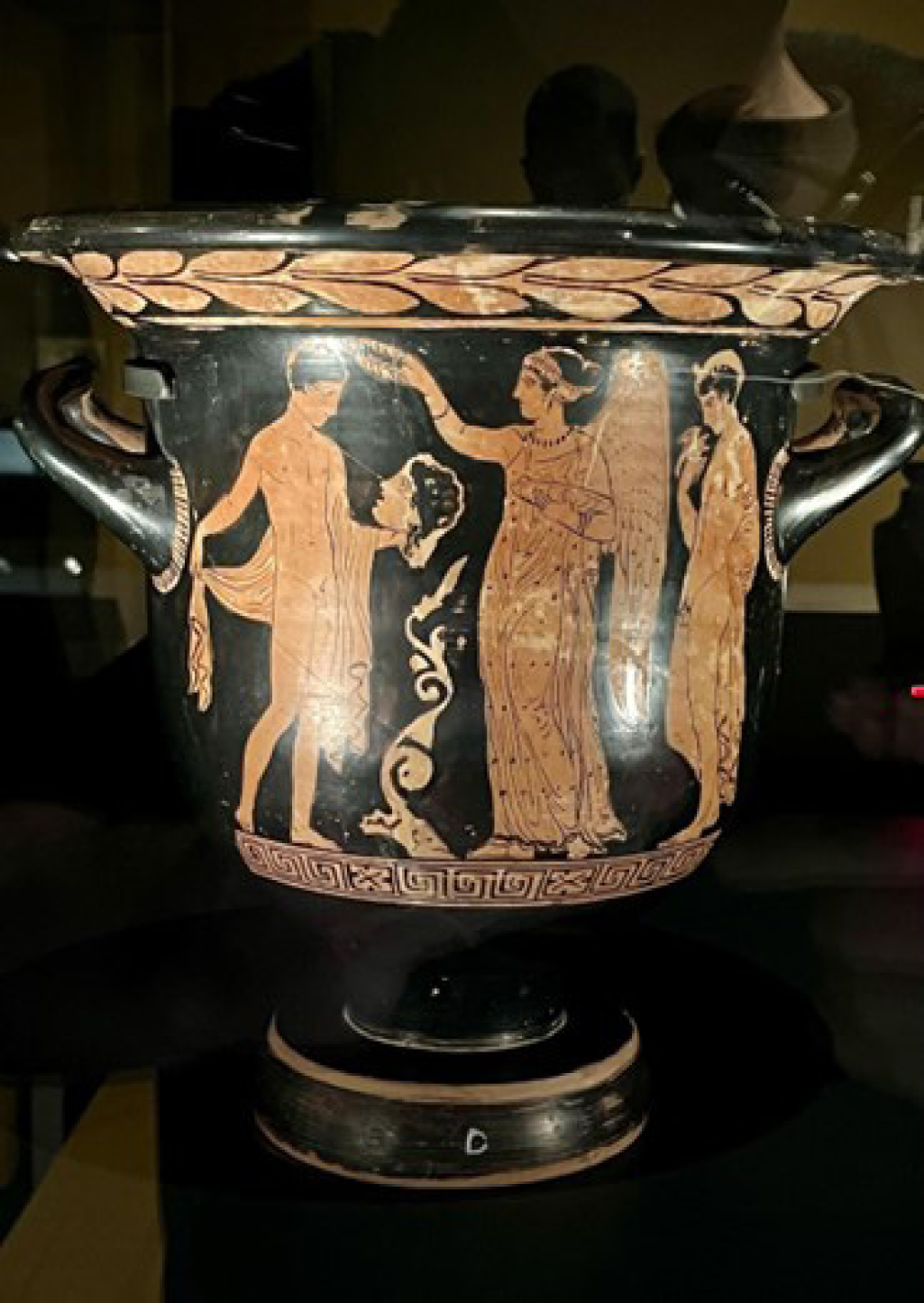
Paul has taken on the role of a slave to “win” (kerdainō) as many as possible. The term kerdainō generally means to “make profit” or “take advantage.” In the context of 1 Cor 9:19, it has the sense of gaining, or winning over a person, and is interchangeable with sōzō in 9:22 (See BDAG, LSJ). Scholars are in general agreement that Paul uses the term in this passage in reference to winning someone to faith in Jesus Christ. Its meaning must be understood in the context of evangelism, reaching others with the gospel message (Daube, 1947; Ciampa and Rosner, 2010, p. 423; Fee, 2014, p. 471; Garland, 2003, p. 429; Barrett, 1968, p. 211; Schnabel, 2010, p. 501). Paul’s purpose in becoming a slave, in other words, is to win over his audience and convince them of the veracity of his message. This is not dissimilar to the objective of an actor.
The very origin of theatre in fifth-century Athens began as a competition. Each year at the City Dionysia, three tragic writers and three or five comic writers would compete against each other within their particular genre (Ley, 2006, p. 8). We see this competition reflected in the image above, wherein Nike crowns a victorious playwright. Like the assembly debates or the courtroom speeches of Athens, the plays were elite verbal performances before popular judges who voted for winners and losers (Wallace, 2006, p. 360). This was also the case in our period. Performances throughout the Roman world were often contests, with prizes being awarded to companies or individual actors (See, e.g., Epictetus, Diatr. 3.4.9–11; Plutarch, Cat. 66.3; Brown, 2002, p. 234).
Winning was thus at the center of the theatre. When an actor was not competing for a prize, they were still competing for the approval of the audience, who, after all, were the ultimate judge of the performance (Boyle, 2006, p. 20). Troupes would therefore compete with other troupes for the greatest portion of an audience and the actors themselves would compete for the audience’s attention (Marshall, 2006, p. 85). Ushers (designatores) were on hand to maintain order, but it was the job of the actors to secure a hearing for the play (Beare, 1964, p. 173). Those backstage would also feel the pressure to compete, as one anonymous stagehand notes: “For it is I who sort out the masks and dress the actors, and I stand in the wings, gripping my fingers, until the theatre breaks into applause” (Alciphron, 4.19.5). Even those who sponsored the theatre did so to win over the audience. A magistrate would hire a troupe to put on a performance in the hope of gaining the crowd’s favour and approval (Marshall, 2006, p. 83; Dio Chrysostom, Or. 66.8). It was thus central to the role of the magistrate to stage performances as a means of winning over a city. In fact, failure to do so could be attributed to a city’s decline (cf. Julian, Mis. 344A; Fronto, Princ. Hist. 18; Dio Cassius, Hist. 47.2).
In such a competitive environment, one in which an audience was the ultimate arbiter of a play’s success, there was immense pressure on the actor to perform well. An audience could turn on an actor for even the tiniest of mistakes (cf. Cicero, Parad. 26; De or. 259). Given the audience’s high expectations, it was an all-too-common fate for an actor to be booed, laughed, or hissed off the stage (cf. Ammianus Marellinus, Hist. 28.32; Macrobius, Sat. 2.15; Lucian, Nigr. 8; Apol. 5; Cicero, Rosc. Com. 11; Dio Chrysostom, Or. 31.119; Dionysius of Halicarnassus, Dem. 53; Theophrastus, Char. 11.3; Phaedrus, Fab. 5.5; Diodorus Siculus, 14.109.2; 15.7.2). The incentive to win the audience’s approval would at times drive an actor to canvas an audience for their favorable judgement (Beare, 1964, p. 167–68; Crates, Test. 1.14). Cicero (Verr. 184) talks about rich habitués of the theatre, who would pay claqueurs to applaud or hiss particular actors. This desire for an audience’s approval is most clearly seen in the appeal of the actors at the end of Plautus’ plays. Casina is a typical example of this:
Now it’s right for you to give the deserving actors the deserved applause with your hands. The man who does so shall always have the prostitute he wants behind his wife’s back. But the man who doesn’t applaud us with his hands clearly, as much as he can, shall always end up with a goat, perfumed with bilgewater, in place of the prostitute. (1010–15)
The goal of every actor, in other words, was to win the audience’s approval. The success of a performance was measured by the ecstasy and applause of the crowd at the end (cf. Plutarch, Quaest. conv. 673C; Xenophon, Oec. 3.9; Dio Chrysosom, Or. 38.39; Aristotle, Probl. 18.4; Philo, Prob. 141; Ebr. 177; Seneca, Ep. 30.12); even to the extent of throwing flowers on the stage (Varro, Ling. 5.178). The mark of a great actor was thus their ability to win over an audience and to incite in them an emotional response. An epitaph of the mime actor Vital-is demonstrates this well:
At sight of me wild frenzy met relief/My entrance changed to laughter poignant grief/None felt the canker of anxiety/Nor worried mid this world’s uncertainty/O’er every fear my presence won success/An hour with me was ever happiness/In tragic rôle my word and act could please. (Dicta Catonis, 5–10)
In summary, the goal of the actor was to win over an audience and with that, to win fame. This, in the end, was the actor’s main prize (cf. Phaedrus, Fab. 5.5–10). In a similar way, Paul’s task was to win over his audience. In a world of competing philosophical ideas and moral principles, he first needed to gain an audience’s attention. Having done so, it was then his task to win them over to his message. While an actor sought confirmation through applause, Paul sought confirmation through conversion. In order to do this, he needed to pull out all the stops. He needed to appeal to his audience not only intellectually and philosophically, but also practically. He needed, in other words, to become like them.
Imitation

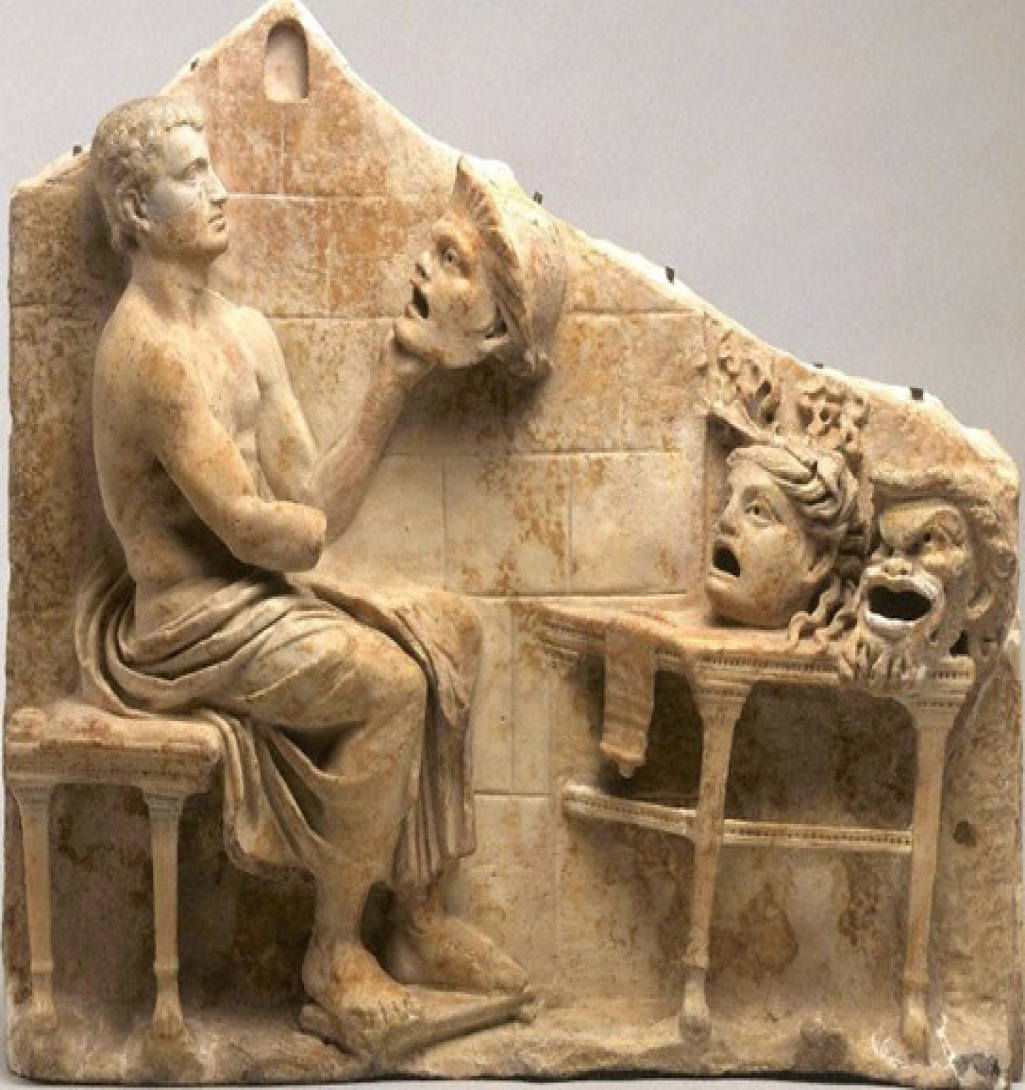
Paul goes on to describe at length the way in which he made his appeal to his various audiences. He became like them (kai egenomēn … hōs). According to Given (2001, p. 106), Paul was not merely adapting a little, being versatile, or being liberal enough to associate with the “other”. Rather, what Paul implies here is temporarily assuming the identity of the person in question. Gooch (1978, p. 105) argues similarly:
Paul here discusses not his dialectical or apologetic method, but his behavior, his personal conduct. He does not say that he adopted the language of those within law or outside it, he does not present himself as agreeing with the basic premises of Jew or the weak. Instead he claims that he has become as one of those he is trying to win: he has adopted, not terminology, but ways of behaving.
This sort of imitation, adopting a different persona, is perfectly in keeping with the craft of the actor.
One of the distinguishing characteristics of the ancient theatre was the mask. We see this in the relief pictured above, where a seated Menander is composing a play. In his hand and placed in front of him are three masks from the New Comedy, each of them stock characters: a youth, a false maiden, and an old man (Green, 1994, p. 95–96). The function of the mask, of course, was to allow the actor to portray a particular stock character. The different characters were distinguished by different hair color or facial features (Beare, 1964, p. 187). They also allowed the audience member, who was often sitting at a great distance from the stage, to identify the character portrayed (cf. Boethius, Eut. 3.15–25). Apart from the mask, a character might also be identified through the actor’s costume, posture, and voice (Marshall, 2006, p. 129; cf. Plutarch, Demet. 18.4). The profession of the character could also be identified by the possession of a cook’s knife, a soldier’s sword, a fisherman’s net, and the like (Beare, 1964, p. 188). But it was the mask that most clearly identified the character to an audience. With its larger-than-life features, it served not only to increase visibility for the audience, but also enabled the character to come to life (Marshall, 2006, p. 155; Green, 1994, p. 95).
A key advantage of the use of masks was that it enabled a small company to represent a considerable number of characters. As we saw above, troupes were by necessity small, perhaps four to five core actors, as each one needed to be paid and the cost of travel would naturally increase with every additional member (Marshall, 2006, p. 99). But the use of masks to represent different characters meant that the same actor could assume up to three or more different roles in the same play (Marshall, 2006, p. 103; cf. Dio Chrysostom, Or. 31.155). An actor playing a murdered character in one scene, for example, could come back to life in a later scene as someone else (Plotinus, Enn. 3.2.15.25). Alternatively, a woman’s part could be played by a man (Marshall, 2006, p. 129). This was essential when we consider that actors were always male (Marshall, 2006, p. 94; cf. Varro, Ling. 10.27). Generally speaking, the mask allowed an actor to represent all kinds of life on stage (Greek Anthology, 7.155). Characters could be literally “put on”, or “taken off”, and transferred from one play to the next (Marshall, 2006, p. 136). In fact, the actor’s ability to adopt different roles was understood as a mark of their talent. As Lada-Richards (2002, p. 408) has argued:
Not only did the Greek theatregoer find nothing incongruous with witnessing the same performer’s multiple metamorphoses, either in one single play or in the context of a trilogy; we could even imagine the Greek audience deriving special pleasure precisely from recognising the same voice behind a plurality of masks and looking forward to appreciating the subtlety and ingenuity of the performative ironies resulting from the playwright’s decision to group his “characters” in such or such a way.
She argues further (2002, p. 410):
It is perfectly conceivable that a Greek protagonist, a candidate for the prestigious acting prize at the City Dionysia … would regard the taxing convention of multiple role-playing as rewarding him with ample scope for a full exhibition of histrionic virtuosity: being called upon to incarnate characters of different social status, age, gender, emotional fibre, intellect and set of values, the performer has the chance not only to display the range, depth and cadence of his voice … but also to demonstrate his enormous flexibility and versatility in the projection of widely divergent points of view and the “realisation” of conflicting moods and passions.
Could it be that Paul’s description of his adaptability was not only an attempt to portray himself as an actor, but an attempt to solicit the Corinthians’ positive approval?
The need to play a variety of roles required a high level of adaptability on the part of an actor. In fact, the adaptability of the actor was so synonymous with the profession that it was used as a metaphor, both positively and negatively, to describe those who changed their behavior. Positively, the philosopher Ariston considered the wise man to be like a good actor, “who, if called upon to take the part of a Thersites or of an Agamemnon, will impersonate them both becomingly” (Diogenes Laertius, 7.2.160). Negatively, the actor changing his mask was a popular trope used to refer to those who were deceptive, changing their character on a whim (Ammianus Marcellinus, Hist. 29.23; Jerome, Epist. 43.2; Philo, Legat. 111; Plutarch, Demetr. 41.4; Cicero, De or. 3.214; Lucian, Nigr. 24). The actor, in other words, was characterized by and famous for his ability to adopt a variety of personas represented in different kinds of masks.
There were, however, limitations around the types of characters a particular actor could portray. Different actors were better suited to either comedy or tragedy and would therefore stay within their specialty genre (cf. Cicero, De or. 109; Gellius, Att. 5; Quintilian, Inst. 11.3.179). The choice of an actor for a role was made by the playwright, who would select them according to their suitability (cf. Plotinus, Enn. 3.2.17.20–25; Cicero, Fin. 3.25). Again, this was so commonplace that it became a metaphor. Lucian speaks of the anger he feels at those who are not in love with philosophy but merely imitate the philosopher by adopting their beard, walk, and garb. It is the same, he says, “if a soft and womanish tragic actor should act the part of Achilles or Theseus” (Pisc. 31; similarly, Ennius, Test. 35; Inst. 11.3.112; Plotinus, Enn. 3.2.17.45–50; Quintilian, Inst. 11.3.112; Dionysius of Halicarnassus, Comp. 20; Lucian, Pisc. 33). Most famously, Augustus, on his death bed, called in his friends and asked them whether they thought he had played the comedy of life fitly. He then said to them: “Since well I’ve played my part, all clap your hands and from the stage dismiss me with applause” (Suetonius, Aug. 99.1).
Apart from being a suitable fit for the role, the actor was also expected to portray the character as the playwright determined. Particular scenes in a play would give a certain level of freedom for the actor to improvise (Demetrius, Eloc. 194). Actors were also expected to bring to a performance their own passion, character, and reputation (cf. Plutarch, Mor. 813D; Plotinus, Enn. 3.2.17.30–35). But when it came down to it, the actor could only follow the instructions and not go beyond the authority of the playwright (cf. Plotinus, Enn. 3.2.18.10–15; Plutarch, Mor. 404F; Lyc. 842A). Again, this became a metaphor for life. Epictetus (Ench. 17) sees the role of god as that of the playwright:
Remember that you are an actor in a play, the character of which is determined by the Playwright: if He wishes the play to be short, it is short; if long, it is long; if He wishes you to play the part of a beggar, remember to act even this role adroitly; and so if your role be that of a cripple, an official, or a layman. For this is your business, to play admirably the role assigned you; but the selection of that role is Another’s [a reverent designation for God].
Over all of this, the task of the actor was imitation. An actor had to embody the character to the extent that they could be mistaken for being the person (cf. Suetonius, Vesp. 19.2; Diodorus Siculus, 31.25.2; Pliny, Nat. 7.55). Looking again at our mime actor Vitalis:
Cheering in myriad ways hearts ill at ease: Through change in look, mien, voice I so could run/That many seemed to use the lips of one./The man whose double on the stage I seemed/Shrank, as my looks his very own he deemed./How oft a woman whom my gestures played/Saw herself, blushed, and held her peace dismayed!/So parts which I made live by mimicry/Dark death hath hurried to the grave with me./To you who with compassion read this stone/I utter my request in saddened tone:/Say sadly: “Glad, Vitalis, did you live:/Such gladness may the Gods and fates thee give”! (Dicta Catonis 11–25)
The actor, in other words, was characterized by his ability to adopt different personas—often in the same play. His actions, the quality of his imitation, his costume, and especially his mask allowed him to become like the character he was portraying. Overall, adaptability was so synonymous with the actor that it became a metaphor—both positively and negatively—to describe a person who assumed different identities or roles in life. It would not be a stretch, therefore, to suggest that the figure of the actor is what lays behind Paul’s description of his adaptability to different audiences.
Conclusion
At first glance, Paul’s description of himself as “slave” is broad and ambiguous—particularly in contrast to the metaphors around it. Previous scholarship has assumed that he had a particular person in mind but attempts to identify this person have failed to explain every point of the behavior that Paul outlines. However, when we consider the metaphor and attendant behavior alongside the actor, the similarities are remarkable. And if what I have argued is correct, it provides a useful background for interpreting the passage.
First, it could be that amongst the murmuring in Corinth was a suggestion that Paul was more like an actor than an apostle. The whole of chapter 9 is dealing with their misconceptions and offence over his refusal to take their support—and all of this is grounded in a misunderstanding of the role of the apostle. As we saw above, it was common to refer to a duplicitous person as an actor. It is not a stretch, then, to imagine in this negative environment passing jabs of “Paul the hypocrite”—after all, labelling a Pharisee “hypocrite” was certainly not unprecedented.
Second, it provides the most complete framework for understanding the different aspects of the passage. The extent to which he embodied the various roles (Jew, Greek, etc) and what that meant in real terms is an ongoing debate and beyond the purview of this paper. But the practice of enslaving himself, the need to win over an audience, and the adaptability necessary to perform his ministry all bear striking resemblance to the art of an actor.
Third, it provides a recognizable figure to complete the set of metaphors in 1 Corinthians 9. Like a soldier, shepherd, vinedresser, or priest, Paul is entitled to receive support. Like an oikonomos, Paul has necessity placed on him to preach, and this free of charge—it is a duty, not a right. Like an athlete, he must abide by the rules of the contest and persevere until the end in order to win the crown. And along the way, he must adapt himself to his particular audience, much like an actor on stage.