







Abstract
The present research examines the emotional and behavioral consequences of collective action participation. It demonstrates that “positive” and “negative” emotions can be experienced simultaneously as a result of collective action participation, yet it is important to distinguish outgroup-directed from self-directed emotions. Results of two experiments (N = 71 and N = 101) that manipulated participation in collective action illustrate that whereas collective action participants experience more outgroup-directed anger and contempt, they feel more self-directed positive affect. Furthermore, collective action participation predicted willingness to engage in moderate and radical collective actions in the future. These relations were mediated by outgroup-directed, but not by self-directed, emotions, suggesting that outgroup-directed rather than self-directed emotions play a crucial role in the maintenance of protest behavior. Theoretical and practical implications of these findings are discussed.
Keywords
How do people feel after they have participated in collective protest? Does protest make them feel happy and satisfied or does it inflame their anger and hate? Several models have been developed to predict engagement in collective action (e.g., Stürmer & Simon, 2004; Van Zomeren, Postmes, & Spears, 2008; Van Zomeren, Spears, Fischer, & Leach, 2004; Wright, 2001), but outcomes of collective action participation have remained relatively underresearched (Louis, 2009; Wright, 2009). For instance, researchers have examined the role of emotions (such as anger) in predicting collective action (e.g., Leonard, Moons, Mackie & Smith, 2011; Van Zomeren et al., 2004) but have neglected the role of emotions as a result of collective action participation, at least in experimental research (for qualitative approaches, see Drury, Cocking, Beale, Hanson & Rapley, 2005; Drury & Reicher, 2005). We posit not only that emotions predict collective action participation but that collective action participation also feeds back into the strength and valence of emotions, which in turn motivate engagement in future actions.
Based on previous research, different predictions concerning the impact of collective action participation on emotions are possible. On one hand, it can be argued that collective action participation increases “positive” emotions, such as joy and happiness, because activism is positively related to psychological well-being (Boehnke & Wong, 2011; Klar & Kasser, 2009). In contrast, research on social identity processes in collective action suggests that collective action participation heightens the salience of one’s social identity, the perception of group-based injustice, and corresponding emotions (e.g., Drury & Reicher, 1999; Reicher, 1996; Reicher, Spears, & Postmes, 1995; Stott & Reicher, 1998). Therefore, it can be argued that collective action increases “negative” or conflict-related emotions, such as feelings of anger and contempt. In the present research, we integrate both perspectives by distinguishing the targets of different emotions. Specifically, we differentiate between self-directed and outgroup-directed emotions. Thus, the purpose of the present research is to examine the strength and valence of self-directed and outgroup-directed emotions as a result of collective action participation. Moreover, it has been demonstrated that activists who engaged in collective action in the past are more likely to engage in collective action in the future (e.g., Stürmer & Simon, 2004). To extend this work further, the present research also aims to investigate to what extent self-directed versus outgroup-directed emotions explain the relation between past action and future participation intentions.
Emotional Consequences of Collective Action Participation
We predict that collective action participation evokes “positive” as well as “negative” emotions simultaneously. There are several theoretical approaches that predict an increase of positive emotions after collective action participation: In particular, researchers from sociology and political science have argued that political activism can be perceived as motivating “in and of itself” (Klar & Kasser, 2009, p. 756; Meier & Stutzer, 2008). Such intrinsically motivated behavior can satisfy important psychological needs (e.g., Ryan & Deci, 2001) and should therefore be accompanied by positive emotional experiences. Indeed, some recent research has demonstrated that indicators of activism are positively related to psychological well-being (Boehnke & Wong, 2011; Klar & Kasser, 2009), suggesting that self-identified activists feel better than nonactivists. Moreover, based on sociometer theory, it can be argued that collective action participation satisfies the basic human need to belong (e.g., Leary, 2006). Research has confirmed that the quest for belonging and the formation and maintenance of social bonds are important motivators of why individuals join movements (e.g., Cable, 1992). By acting on behalf of one’s own group, individuals can feel socially included and might therefore experience positive emotions. Furthermore, Tropp and Brown (2004) demonstrated that “what benefits the group can also benefit the individual” by showing that the motivation for individual enhancement was a significant predictor for women’s willingness to participate in collective action. In this research, individual enhancement referred to the anticipation of an increase in one’s self-esteem and feelings of being important when getting involved in women’s issues. Thus, individuals seem to anticipate that they can personally benefit from collective action participation, which is likely to be connected with the experience of positive emotions following past engagement in collective action. Finally, research on social identity processes leads to a similar prediction: When individuals categorize themselves as group members, they evaluate those group members (including themselves) particularly positive who represent the group values and interests best (e.g., Hogg, Hardie, & Reynolds, 1995; Turner, Hogg, Oakes, Reicher, & Wetherell, 1987). Thus, it is likely that individuals evaluate themselves more positively when they do something good for their ingroup by participating in collective action to promote the group’s interests (Tajfel & Turner, 1979).
Although the described findings are consistent with our view that collective action participation might increase positive self-directed emotions, these studies are unable to provide evidence for the causal order of the relevant variables. To our knowledge, there is only one experimental study that tried to demonstrate the causal effect of activist activity on individuals’ well-being (Klar & Kasser, 2009, Study 3). In this study participants were asked to report their well-being either before or after completing a survey about the improvement of a cafeteria. The survey contained arguments for improving ethical-political aspects of food in the cafeteria, and participants were asked to rate the importance of the arguments and were informed that their answers would be sent to the college’s food services department. Contrary to expectations, results did not indicate any difference in well-being between the two experimental conditions (Klar & Kasser, 2009). We argue that this lack of effect likely resulted as a consequence of the operationalization of activism: Rating arguments is a weak operationalization of activism and a rather passive task (compared to, for instance, generating and publicly presenting one’s own arguments) that does not really operationalize collective action on behalf of a group. In sum, based on the theoretical arguments and related research findings summarized above, we test the idea that collective action has positive consequences for the self and evokes positive self-directed emotions. We further examine whether these positive emotions are likely to drive future participation in collective action.
Contrasting the research on positive outcomes of activism, it has also been demonstrated that collective action participation can intensify conflicts in a framework of struggle for justice and power (McLeod, 1999; Páez, Basabe, Ubillos, & González-Castro, 2007). Many examples illustrate the dynamic nature of collective protests that start with a peaceful demonstration and end in violent action (e.g., Drury & Reicher, 2005, 2009). The elaborated social identity model of crowd behavior (e.g., Drury & Reicher, 1999, 2000; Reicher, 1996; Stott & Reicher, 1998) explains this dynamic as an intergroup phenomenon by analyzing the emergence and escalation of crowd conflict over time: If their social identity and the identity of a relevant outgroup become salient, individuals direct their behavior according to ingroup norms. Therefore, collective action participation can be perceived as the royal road to express one’s social identity and to fight collectively against the outgroup responsible for the injustice (Drury & Reicher, 2005, 2009). If the outgroup is powerful (e.g., the police, the government) and acts illegitimately in terms of ingroup understandings, this will unify members of the ingroup and evoke more extreme behaviors among them. This can radicalize collective protests, sharpen the perception of injustice, and heat up “negative” emotions (Drury & Reicher, 1999; Reicher, 1996; Reicher et al., 1995).
The Present Research
The present research aims to provide a greater understanding of the emotional consequences of collective action participation using an experimental approach. Specifically, we bring together the literature on activism and psychological well-being with the predictions made by research on social identity processes in collective action by differentiating between self-directed emotions (e.g., feeling satisfied with or good about oneself) and outgroup-directed emotions (e.g., feeling angry at an outgroup; e.g., Mackie, Devos, & Smith, 2000; Smith, 1993; Smith, Seger, & Mackie, 2007). Distinguishing these two types of emotions enables a more precise prediction of why emotions of different valence (“positive” emotions such as joy and “negative” emotions such as anger) can be experienced simultaneously as a result of collective action participation. Specifically, we predict that collective action participants experience more outgroup-directed anger, though they feel increased self-directed positive affect.
The Role of Emotions in the Maintenance of Protest
The second aim of the present research is to understand the role of emotions in the maintenance of protest behavior. Therefore, we also examine whether the emotions elicited by collective action participation do, in turn, predict the willingness to engage in future actions. This research question is important to understand how long-term political activism works and why individuals often take part in collective action for extended periods. We argue that emotional consequences of collective action participation are crucial in predicting the maintenance of political protest. In line with this idea, Drury et al. (2005) demonstrated that a perception of “atmosphere and energy” during the protest was related to participants’ further involvement in collective action. Moreover, based on the finding that collective action participation can be predicted by a motivation for self-enhancement (Tropp & Brown, 2004) and is associated with psychological well-being (Klar & Kasser, 2009) and happiness (Boehnke & Wong, 2011), it is reasonable to assume that activists continue to engage in actions because they anticipate positive emotions. Similarly, it is possible that activists are motivated to continue their actions because of a heightened salience of group-based disadvantage and corresponding negative outgroup-directed emotions. In the present research, we examine the relative importance of self- versus outgroup-directed emotions as possible motivators for future action intentions.
In Study 1, we examined whether collective action participation increases the willingness to participate in future collective action and investigated to what extent this is due to increases in self-directed positive affect or increased outgroup-directed anger (and therefore the intention to further engage against group-based injustice). Moreover, current research is increasingly interested in predictors of radical collective action. A recent theoretical extension of the collective action literature (Tausch et al., 2011) suggests that moderate and radical collective actions are predicted by qualitatively different emotions. In Study 1, we specifically assessed collective actions that were fairly moderate and generally adhered to societal norms (Wright, Taylor, & Moghaddam, 1990). However, these moderate actions can be distinguished from radical collective actions, which are often illegal and violate societal norms (e.g., arson attacks; Wright et al., 1990). Tausch et al. (2011) demonstrated that whereas outgroup-directed anger predicted moderate (but not radical) collective actions, feelings of contempt predicted radical (but not moderate) collective actions. These effects can be explained in terms of the different social functions of anger and contempt (Fischer & Roseman, 2007). Anger is felt in relationships in which reconciliation is desired. Therefore, activists need to stick to social norms to articulate their concerns. In contrast, contempt is felt in relationships that lack reconciliatory intentions and entail a psychological distancing from the object of contempt (Fischer & Roseman, 2007). Therefore, activists who feel contempt toward an opponent do not feel a need to follow social norms when protesting against that target.
In Study 2, we included measures of radical collective action and feelings of contempt. We predicted that collective action participation against tuition fees increases the willingness to engage in moderate collective action against the fees in the future because respondents feel increased outgroup-directed anger. Second, we predicted that participants who engaged in actions against tuition fees would be more interested in engaging in radical actions against tuition fees in the future because collective action participation can intensify the conflict between students and the government. As a response to a heightened salience that the ingroup is treated unfairly, some students might respond not only with increased outgroup-directed anger but also with feelings of contempt against the government. Therefore, the relation between past participation and the intention for radical future action against tuition fees should be mediated by outgroup-directed contempt.
Finally, previous research has illustrated that beyond group-level emotions, social identification, particularly politicized identification (Simon & Klandermans, 2001), as well as group efficacy (Van Zomeren et al., 2004) predict collective action intentions. Thus, it is likely that these variables also play a role in the relation between past and future actions, such that participation leads to increased willingness to participate in actions in the future because it increases identification and perceived efficacy. We therefore examined the effects of self-directed and outgroup-directed emotions while controlling for these variables to illustrate their effects over and above other established predictors of collective action.
The Study Context
We tested our hypotheses in the context of the student protests against tuition fees in the federal state of Hessen, Germany. These protests have been ongoing since 2006, when the conservative state government of Hessen introduced tuition fees. Although the fees were abolished in 2008 after the conservative government lost power to the center-left, their reintroduction is possible since the conservative party regained power in 2009. At the time of data collection (spring-summer 2010), the conservative party had just enforced a hiring freeze and other financial cuts for the university but had not yet reintroduced the fees.
In the present research, we heightened the salience of a possible reintroduction of tuition fees by the government and provided participants with the opportunity to engage in collective action against the “pro-tuition fees” government. Afterward, we measured participants’ self-directed and outgroup-directed emotions. In Study 1, we compared self-directed and outgroup-directed emotions and intentions for future collective action among participants who engaged in collective action with those in a no-action control condition. In Study 2, we included four further control conditions to exclude potential alternative explanations and added a broader range of negative outgroup-directed emotions and action tendencies.
Study 1
Method
Participants
Participants in this web-based experiment were students who participated for course credit (N = 71). Participants’ ages ranged from 19 to 30 years (M = 21.30 years, SD = 2.55). Most (92%) self-identified as German; 66% were female. Three participants were excluded because they reported to be in favor of the reintroduction of tuition fees. Seventy-seven percent of those approached participated in the study.
Design and procedure
The study had a 2 (collective action participation: yes, no) × 2 (order of emotion measurements) between-participants design. It was presented as a project of students who were allegedly writing their empirical thesis on the topic of tuition fees and wanted to connect their study with a protest against tuition fees. After completing a number of demographic variables, participants read a text about the current hiring freeze at universities in Hessen enacted by the government. Students were informed that the hiring freeze increases the likelihood of the reintroduction of tuition fees. This information served to heighten the salience of a potential reintroduction of fees by the government. Respondents were asked whether they had heard of the hiring freeze, whether they thought that the hiring freeze makes the reintroduction of tuition fees more likely, and about their general attitudes toward tuition fees. Then, they were randomly assigned to one of four experimental conditions: Half of the participants were directly forwarded to the dependent measures, and the other half participated in collective action against the government. Those in the collective action condition were told that a large-scale campaign against the government in Hessen was currently being conducted to prevent the reintroduction of tuition fees. They were informed that the aim was to collect as many arguments as possible against tuition fees and to send them directly to the government. Participants were asked to read and complete the following protest note: “I, student at the University of Marburg, relentlessly condemn a reintroduction of tuition fees by the government in Hessen and strongly oppose to the government. I protest against tuition fees, because . . .” At this point, students were requested to list as many arguments as possible against tuition fees and reminded that all arguments would be sent to the government.
Afterward, all participants completed the dependent measures. They completed a measure of self-directed and outgroup-directed emotions, followed by the control variables identification with students, identification with the protest movement against the introduction of tuition fees (as a measure of politicized identity), and perceived group efficacy. They then answered a measure about their future collective action intentions. Finally, they were thanked and debriefed.
Measures
Unless otherwise indicated, all items were answered on a 7-point rating scale (0 = disagree strongly to 6 = agree strongly). The order of self-directed versus outgroup-directed emotion scales was randomly counterbalanced: Half of the participants completed the self-directed emotions measure before the outgroup-directed emotions measure, whereas the other half completed the outgroup-directed emotions measure before the self-directed emotions measure. Items were given in a mixed but identical order for all participants.
Outgroup-directed anger
To measure outgroup-directed anger, participants were asked to indicate their current feelings as a student toward the government in Hessen using three items “As a student, I feel anger towards/I am mad at/ I am in rage towards the government in Hessen” (α = .92).
Self-directed positive affect
To assess self-directed positive affect, individuals were instructed to describe their current feelings as an individual (“I feel good/happy/satisfied/glad/proud/pleased/gratified”; α = .90). This measure was introduced as follows: “In the following, please concentrate on yourself as an individual and think about everything that makes you unique as a person and differentiates you from other people. Please describe your current feelings as an individual.”
Collective action intentions
Respondents were asked to indicate how likely it would be that they take part in the following actions in case of a planned reintroduction of tuition fees (0 = very unlikely, 6 = very likely): participate in discussion meetings, participate in plenary meetings, write flyers, sign the complaint against unconstitutionality of tuition fees, take part in street theatre, and demonstrations. We averaged these six items to yield a composite of likelihood of engaging in collective action (α = .83).
Control variables
Student identification was measured using three items, e.g., “Being a student reflects an important part of my personality” (α = .90). Identification with the protest movement against the introduction of tuition fees (“politicized identity”) was measured using the same three items, addressing the protest movement (α = .92). Group efficacy was measured by three items (e.g., “I think that students can stop the introduction of tuition fees”; α = .92).
Results
Self-directed positive affect and outgroup-directed anger were not significantly correlated (r = .15, p = .20).
Effects on self-directed and outgroup-directed emotions
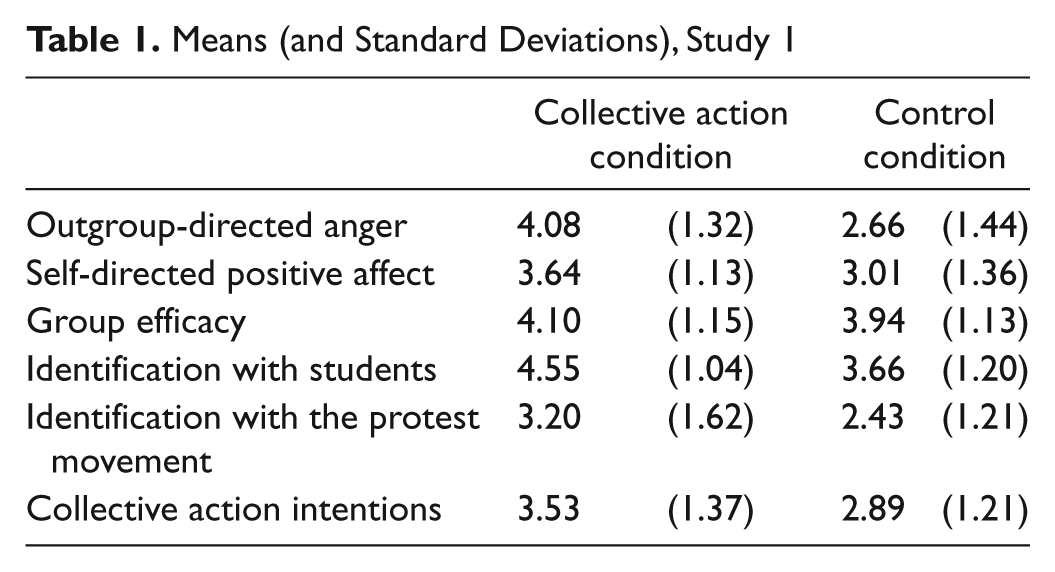
To evaluate whether collective action participation affected self-directed positive affect and outgroup-directed anger, we conducted two 2 (collective action: yes, no) × 2(order of emotions) ANOVAs. As expected, the first analysis with self-directed positive affect as the dependent variable yielded that participants who engaged in collective action felt more self-directed positive affect, F(1, 71) = 6.05, p = .02, η2 = .08, compared to the control condition (see Table 1). No other effects were significant, Fs < 1. The same analysis with outgroup-directed anger as the dependent variable revealed that, as predicted, participants who engaged in collective action felt more outgroup-directed anger, F(1, 71) = 18.20, p < .001, η2 = .21, compared to those assigned to the control condition (see Table 1). No other effects were significant, Fs < 1.
Means (and Standard Deviations), Study 1
Effects on future collective action intentions and mediation by emotions
Next, we tested our hypothesis that participation in collective action increases intentions to engage in collective action in the future. The same ANOVA yielded a main effect of collective action, F(1, 67) = 4.60, p = .04, η2 = .07, indicating that, in line with our prediction, participants who engaged in collective action had a greater intention to participate in collective action in the future, compared to those in the control condition (see Table 1). No other effects were significant, Fs < 1.
Finally, we analyzed whether the relation between participation in collective action and the intention to engage in future collective action was mediated by increased outgroup-directed anger and increased self-directed positive affect. We did this while controlling for identification with students, identification with the protest movement, and group efficacy. Collective action participation was dummy coded (1 = collective action condition, 0 = control condition) and predicted both outgroup-directed anger (B = 1.41, SE = .33, p < .001) and self-directed positive affect (B = .62, SE = .30, p = .04). However, only outgroup-directed anger (B = .20, SE = .08, p = .02) predicted the intention to engage in future action, whereas self-directed positive affect did not (B = .03, SE = .09, p = .73). In line with full mediation, the total effect of participation in collective action regarding the intention to engage in collective action in the future (B = .64, SE = .31, p = .04) was reduced to nonsignificance when the potential mediators were included (B = –.23, SE = .24, p = .34). The total indirect effect was significant (B = .86, SE = .27, p = .002). To examine the specific indirect effects, we tested a multiple mediation model using bootstrapping (as recommended by Preacher & Hayes, 2008; Shrout & Bolger, 2002). The bootstrap estimates are based on 5,000 bootstrap samples, using the SPSS version of the Preacher and Hayes (2008) macro. As expected, outgroup-directed anger significantly mediated the relation between participation in collective action and future collective action intentions, because the 95% confidence interval did not include zero, 95% CI [.05, .71]. However, self-directed positive affect did not prove to be a significant mediator, 95% CI [–.12, .18]. Of the three control variables, only identification with the protest movement proved to be a significant mediator, 95% CI [.10, .93].
Discussion
Study 1 provided support for our hypotheses that collective action participation increases self-directed positive affect as well as outgroup-directed negative affect. Consistent with previous research, this study also provided evidence that individuals who have participated in collective action become more willing to engage in collective actions in the future. Extending previous research, we further demonstrated that this relation was mediated by outgroup-directed anger but not by self-directed positive affect. Thus, we provided evidence that outgroup-related emotions are more important in the process of maintaining political activism compared to self-directed emotions. Furthermore, identification with the protest movement proved to be a significant mediator. This is in line with previous research, illustrating that particularly the politicized identity (compared to identification with a broader group) predicts collective action participation (Simon & Klandermans, 2001; Stürmer & Simon, 2004).
However, there are some limitations to this study and several reasons to replicate and extend these findings. This primarily concerns the construct validity of our operationalization of collective action participation. First, it is possible that our results were not generated by engaging in collective action but by dealing with the topic of tuition fees. More precisely, it is possible that just thinking about tuition fees already caused increased feelings of outgroup-directed anger. Therefore, in Study 2 we used a control group that did not engage in collective action but only dealt with the topic of tuition fees. Second, it is likely that engagement in any type of collective action is associated with a boost in self-directed positive affect because individuals do something good for their ingroup. Outgroup-directed negative affect should, however, be target specific such that negative emotions toward the government only increase after collective action directed at the government. Therefore, in Study 2 we added a control group to test whether engagement in any type of collective action leads to changes in emotions. Finally, although generating arguments that would be allegedly sent to the government in the name of students represents collective action participation, it is not particularly confrontational. Therefore, in Study 2 we used a different type of collective action that would allow participants to get more involved and to act in a more confrontational manner.
Study 2
Study 2 aimed to corroborate the findings of Study 1 and to exclude potential alternative explanations. First, we selected a type of collective action that offered participants the opportunity to get more involved. Specifically, participants were asked to read an unfriendly protest note against the government as loudly as possible and to blow into a whistle as long and loudly as possible while being recorded. This audio-message would allegedly be sent to the government.
Four control conditions were added to this experimental condition. Students in the first control condition read about protests in the past against the government. We hypothesized that simply reading about protest would not affect outgroup-directed emotions to the same extent as collective action participation. Students in the second control condition engaged in collective action directed at another target group. We hypothesized that engagement in protest against another target group would not increase participants’ intentions to engage in future action against the government. Similarly, outgroup-directed emotions that target the government should not be affected by participating in this alternative protest, whereas self-directed emotions would be equally affected in both collective action conditions as a consequence of doing something good for the ingroup. Students in the third control condition read about past protests against an alternative target group. Finally, a fourth baseline control group was added. As in Study 1, students assigned to this baseline control group completed the dependent measures directly, without any experimental manipulation.
In sum, we predicted that, compared to the four control groups, only collective action against the government heats up government-directed emotions. Second, we hypothesized that, irrespective of the target group, collective action participation increases self-directed positive affect, because by engaging in protest, individuals do something positive for their ingroup and represent group interests (e.g., Drury et al., 2005; Hogg et al., 1995; Klar & Kasser, 2009; Leary, 2006; Turner et al., 1987).
Finally, we included measures of contempt and willingness to participate in radical collective action in the future. We tested our prediction that whereas the relation between past participation and the intention for moderate future action should be mediated by outgroup-directed anger, the relation between past participation and the intention for radical future action should be mediated by outgroup-directed contempt (Tausch et al., 2011).
Method
Participants
Participants were students at the University of Marburg (N = 101). Participation was voluntary. Participants’ ages ranged from 19 to 31 years (M = 22.94 years, SD = 1.31). Most (92%) self-identified as German; 69% were female. Students studied diverse subjects (42% social science, 12% medicine, 5% economics, 5% education, 18% were studying for a degree in teaching). Approximately every second person approached (55%) agreed to participate.
Procedure
We used the same cover story as in Study 1. Research assistants approached students in public areas and asked whether they could spend 10 min participating in their research project. If participants agreed, the experimenter explained that the study is about attitudes and protest: One part would be about attitudes toward nature protection because there would be a waste transfer station in a neighboring city, polluting the local river. A second part would be about the social cuts and hiring freeze enacted by the government in Hessen and the participants’ attitudes toward tuition fees. First, participants were asked to indicate their overall attitudes concerning nature protection and tuition fees to exclude proponents of tuition fees before the experimental manipulation. Only opponents of tuition fees were allowed to participate in the experiment. Thus, we avoided selective dropouts of proponents of tuition fees in the condition in which they were asked to protest against the government. Three proponents were directly thanked and debriefed. Next, the experimenter randomly assigned participants to one of five conditions by blindly picking one of five texts.
In the first condition (collective action against the government), participants were informed that they could participate in a protest against the government in Hessen. The experimenter explained that they would collect 1,000 voices and whistles of Marburg’s students to send to the government of Hessen as a cumulative audio-message in the name of students. They were handed a brief text and were asked to read this text loudly into a recorder and then to blow into a whistle as loudly and for as long as possible so that “the ears of the members of the government would fly off.” Before they started they were asked if they were willing to participate, and afterward they could select one of the whistles. 1 The text said:
We, students of the University of Marburg resist the planned social cuts of the government and demand an immediate stop of the cost-cutting program!! Please prick up your ears: In the name of the students of the University of Marburg, I will now show you what I think about your social cuts.
Then, they were asked to blow into the whistle. In the second condition (reading about past collective action against the government), students read a short text to themselves that informed them about an alleged campaign against the government that took place some time ago. This was exactly the same campaign as described in the first condition. Participants indicated whether they had heard about this campaign. The third condition (collective action against pollution) was identical to the first condition and included reading and blowing a whistle; however, the collective action was directed at the city council of a neighboring city that manages a waste transfer station. Before blowing the whistle, participants read the following text into the recorder:
We, citizens of Marburg resist the pollution of the river “Lahn” through the waste transfer station in your city and demand an immediate stop of the pollution!! Please prick up your ears: In the name of Marburg’s citizens, I will now show you what I think about your pollution.
The fourth condition (reading about past collective action against pollution) was identical to the second condition except that participants read about past collective action against pollution as described in the third condition. In the fifth condition (baseline control), participants only completed the dependent measures.
After the experimental manipulation, all participants completed the same dependent measures as used in Study 1, as well as a measure of contempt toward the government and a measure of radical collective action tendencies. Finally, they were thanked and debriefed. Their voices were immediately deleted from the recorder.
Measures
Because we did not find any order effects of outgroup-directed versus self-directed emotions in Study 1, we decided to ask all participants for their outgroup-directed emotions first. We used the same measures of outgroup-directed anger (α = .79), self-directed positive affect (α = .82), identification with students (α = .72), identification with the protest movement (α = .85), and group efficacy (α = .88) as in Study 1. Following Mackie et al. (2000), outgroup-directed contempt was assessed using three items “As a student, I feel contempt/disgust towards/I hate the government of Hessen” (α = .89).
Collective action intentions
Respondents were asked to indicate how likely it would be that they participate in 11 actions in case of a reintroduction of tuition fees (1 = very unlikely, 7 = very likely). Principal axis factor analysis yielded a two-factor solution, demonstrating that moderate actions (all actions already used in Study1) were clearly separable from radical actions (throwing stones or bottles, arson attacks on university buildings, arson attacks on private property of the people held responsible, attacks on police, attacks on persons held responsible; eigenvalues = 3.50, 2.44, 1.13, .92, . . .). Therefore, we averaged the items measuring moderate collective action (α = .76) and those measuring radical collective action (α = .81).
Results
Outgroup-directed anger and contempt were correlated (r = .52, p < .001), but neither correlated with self-directed positive affect (r = .12, p = .25 and r = .11, p = .30, respectively).
Effects on self-directed positive affect
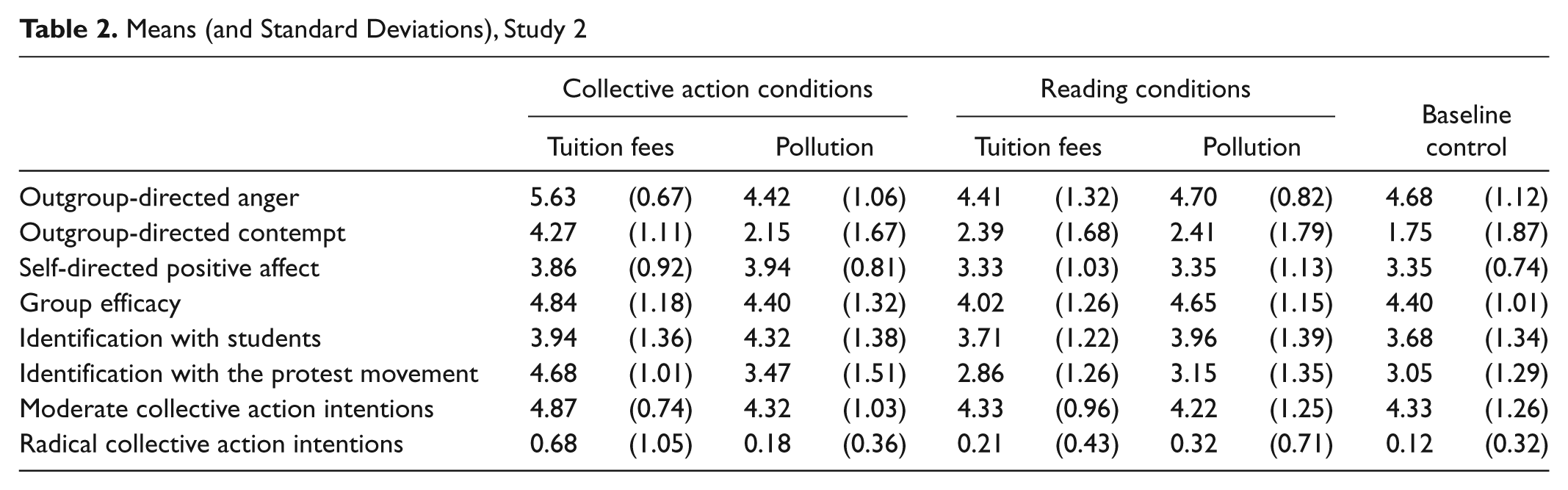
To test the hypothesis that self-directed positive affect increases as a consequence of engagement in collective action, independent of the target group, but that reading about collective action does not affect self-directed positive affect, we calculated two planned contrasts. Specifically, we compared the two collective action conditions with the baseline control condition (1,0,1,0,–2) and the two reading conditions with the baseline control condition (0,1,0,1,–2). As expected, the first contrast was significant, F(1, 96) = 4.64, p = .03, η2 = .05, supporting the hypothesis that, independent of the target, people who participated in collective action would feel more self-directed positive affect compared to those assigned to the baseline control condition (see Table 2). The second contrast was not significant, F(1, 96) = .002, p = .96, η2 = .00, indicating that those who just read about collective action did not differ from the control condition in self-directed positive affect (see Table 2). Two further exploratory post hoc tests (Tukey) tested whether the two collective action conditions and the two reading conditions differed in terms of self-directed affect. Both tests were not significant, ps = 1.
Means (and Standard Deviations), Study 2
Effects on outgroup-directed anger and contempt
To test the hypothesis that outgroup-directed anger and contempt against the government increased as a consequence of participation in collective action directed against the government, we contrasted the experimental group collective action against tuition fees with all four control conditions (–4,1,1,1,1). Six further post hoc tests (Tukey) examined the hypothesis that respondents in the four control conditions did not differ from each other in terms of outgroup-directed emotions. As expected, participants in the experimental condition collective action against tuition fees experienced more outgroup-directed anger, F(1, 96) = 16.63, p < .001, η2 = .15, and more outgroup-directed contempt, F(1, 96) = 27.21, p < .001, η2 = .22, compared to respondents in the four control conditions (see Table 2). Furthermore, also in line with predictions, both outgroup-directed emotions did not differ between the four control conditions, all ps > .71 (see Table 2).
Effects on future collective action intentions and mediation by emotions
Next, we tested whether participation in collective action increased the intention to engage in moderate and radical collective action against tuition fees in the future. The same contrasts as above were used to test our specific hypothesis that only collective action against tuition fees should increase participants’ intentions to engage in future action against tuition fees. In line with predictions, participants in the experimental condition collective action against tuition fees reported stronger intentions to engage in moderate collective action, F(1, 96) = 4.94, p = .03, η2 = .05, as well as in radical collective action, F(1, 96) = 9.21, p = .003, η2 = .09, compared to those assigned to the control conditions (see Table 2). In addition, as expected, post hoc tests revealed that there were no differences between the four control conditions in terms of participant’s intentions to engage in moderate or radical collective action in the future, all ps >.86 (see Table 2).
Finally, we examined whether the impact of participation in collective action against tuition fees on intention to engage in moderate and radical collective action in the future was mediated by increased outgroup-directed anger and contempt, and increased self-directed positive affect. As in Study 1, this analysis controlled for student and politicized identification and group efficacy. The experimental factor was recoded into a dummy variable (1 = collective action against tuition fees, 0 = all other conditions) and predicted outgroup-directed anger (B = 1.01, SE = .24, p < .001) and outgroup-directed contempt (B = 2.07, SE = .40, p < .001) but did not predict self-directed positive affect (B = .35, SE = .23, p = .14).
The first regression predicted the intention to engage in moderate collective action in the future. Outgroup-directed anger predicted the intention to engage in moderate future action (B = .22, SE = .10, p = .03), whereas outgroup-directed contempt and self-directed positive affect did not (B = .003, SE = .06, p = .96 and B = –.05, SE = .10, p = .59, respectively). In line with predictions, the total effect of collective action participation against the government on the intention to engage in moderate collective action in the future (B = .59, SE = .25, p = .02) was reduced to nonsignificance when the potential mediators were included (B = –.15, SE = .27, p = .59). The total indirect effect was significant (B = .74, SE = .20, p < .001), suggesting an overall mediation effect. As in Study 1, to examine the specific indirect effects, we tested a multiple mediation model using bootstrapping. Replicating findings from Study 1, outgroup-directed anger significantly mediated the relation between participation in collective action against tuition fees and the intention to engage in moderate actions, 95% CI [.03, .48]. Neither outgroup-directed contempt nor self-directed positive affect was a significant mediator, 95% CI [–.27, .28] and [–.07, .05], respectively. Regarding the three control variables, only identification with the protest movement proved to be a significant mediator, 95% CI [.14, .72].
The second regression predicted the intention to engage in radical collective action in the future. Outgroup-directed contempt predicted the intention to engage in radical future action (B = .14, SE = .04, p < .001), whereas outgroup-directed anger and self-directed positive affect did not (B = –.03, SE = .06, p = .70 and B = .01, SE = .06, p = .94, respectively). The total effect of collective action participation against the government on the intention to participate in radical actions (B = .47, SE = .16, p = .01) was also reduced to nonsignificance when the potential mediators were included (B = .11, SE = .18, p = .53). Moreover, the total indirect effect was significant (B = .36, SE = .12, p = .003). The bootstrapping procedure revealed that only outgroup-directed contempt mediated the relation between participation in collective action against tuition fees and radical future collective action intentions, 95% CI [.14, .49]. All other indirect effects were not significant, 95% CI [–.19, .09] and 95% CI [–.05, .08] for outgroup-directed anger and self-directed positive affect, respectively.
Discussion
Study 2 corroborated findings of Study 1 and excluded a number of alternative explanations. Importantly, outgroup-directed anger and contempt increased only as a consequence of participation in collective action against the government, underlining the target specificity of outgroup-directed negative emotions resulting from collective action participation. Neither reading about past protests opposing the government nor engaging in an alternative type of protest (against pollution) affected outgroup-directed emotions in relation to the government. Second, as predicted, collective action participation in general lead to increased self-directed positive affect. Thus, irrespective of the target of protest, individuals felt more satisfied when they acted on behalf of their ingroup, be it “students” or “citizens of Marburg.”
Third, we replicated the finding that collective action participation against the government increased the intention to engage in moderate protest in the future and that this effect was due to increased outgroup-directed anger. More intriguing, however, is the finding that collective action participation can also increase the intention to engage in radical collective action and that this is mediated by increased feelings of contempt toward the government. These differential effects of outgroup-directed anger and contempt on willingness to engage in either moderate or radical collective action are consistent with recent findings by Tausch et al. (2011). Finally, replicating results of Study 1, self-directed emotions did not mediate the relation between collective action participation and willingness to engage in future action.
General Discussion
This research extends the literature on the relation between emotions and collective action in several important ways. First, it provides two separate empirical tests illustrating that collective action participation affects the emotional experience of activists. To our knowledge, this is the first direct experimental evidence demonstrating the emotional consequences of collective action. Second, this research advances theory on emotions as outcomes of collective action by distinguishing outgroup-directed from self-directed emotions and thereby providing an answer why “positive” and “negative” emotions can be experienced simultaneously as a result of collective action participation. Finally, by experimentally examining the predictive power of the emotions evoked by collective action participation regarding the willingness to engage in moderate and radical collective action in the future, this research contributes to the understanding of the dynamic relation between collective action participation and emotions. Moreover, it addresses a crucial question regarding the relative importance of different types of emotion for the maintenance of political protest behavior.
Emotional Consequences of Collective Action Participation
To provide a greater understanding of the emotional consequences of collective action participation, we brought together the literature on activism and psychological well-being (e.g., Klar & Kasser, 2009; Meier & Stutzer, 2008) with the predictions made by work on social identity processes in collective action (e.g., Drury & Reicher, 1999, 2005, 2009; Reicher, 1996; Reicher et al., 1995; Tajfel & Turner, 1979) and distinguished between self-directed and outgroup-directed emotions as consequences of collective action participation.
To our knowledge, emotional consequences of collective action participation directed at different targets have not been examined in previous experimental research. Thus, the current work extends past research on the relation between emotions and collective action participation by distinguishing different types of emotions and by examining the impact of these emotions on future collective action. Referring to self-directed emotions, we demonstrated that collective action participation increased positive affect such as joy and satisfaction. Thus, our results are consistent with research illustrating that activism is positively correlated with individual’s well-being (Klar & Kasser, 2009), that activists anticipate personal benefits from collective action participation (Tropp & Brown, 2004), and that collective action participation can evoke a positive emotional climate by emphasizing positive feelings (Páez et al., 2007; Rimé, 2007). This is also in line with research in the context of confronting discrimination that demonstrated that confronters experience personal satisfaction from defending their group (Shelton, Richeson, Salvatore, & Hill, 2006).
However, we also demonstrate that collective action participation against the government inflamed student’s outgroup-directed anger and contempt. This finding supports predictions based on a social identity theory approach to collective action by showing that engaging in collective action heightens not only participants’ politicized identity but also corresponding emotions by increasing “negative” emotions directed at the outgroup. Thus, this research contributes to our understanding of the relation between collective action participation, social identity processes, and the experience of self-directed versus outgroup-directed emotions.
The Dynamic Relation Between Collective Action Participation and Emotions
The present research further illustrates the dynamic relation between emotions and collective action and provides a first answer regarding the relative importance of outgroup-directed versus self-directed emotions in this process: Although both outgroup-directed and self-directed emotions were affected by collective action participation, only outgroup-directed emotions predicted future action intentions. Specifically, results of Study 2 showed that increased outgroup-directed anger, which was evoked by collective action participation, enhanced participant’s willingness to engage in moderate but not radical collective action in the future. Feelings of outgroup-directed contempt, on the other hand, which were evoked by collective action participation, enhanced participants’ willingness to engage in radical but not in moderate collective action in the future. These findings are in line with the recent conceptualization of anger and contempt as serving different social functions (Fischer & Roseman, 2007; Tausch et al., 2011). Anger is felt in relationships where reconciliation and an improvement of the relationship are desired. Thus, anger tends to result in actions that conform to social norms, because actions outside the norms of the system would jeopardize the reconciliation process. In contrast, contempt is felt in relationships that lack reconciliation intentions and often develops on top of anger (Fischer & Roseman, 2007). Therefore, in line with our results, individuals are less compelled to adhere to social norms when acting against the target toward which they feel contempt (see also Tausch et al., in press).
In sum, we have demonstrated that outgroup-directed, but not self-directed, emotions evoked by collective action participation have implications for intentions to engage in future action. Therefore, our research contributes to understanding why political protest is often persistent and provides insights into the roles of emotional consequences of collective action participation in motivating future protest participation. By showing that outgroup-directed anger and contempt are more important than self-directed positive affect in predicting future action, the current work supports the argument that people engage in collective action to improve the conditions of their group (e.g., Wright et al., 1990). That is, collective action participation heightens the perception that the ingroup is treated unfairly, which produces corresponding “negative” outgroup-directed emotions and increases the intention to engage in actions against this type of injustice in the future. Therefore, the current research qualifies recent approaches in which researchers focused on egoistic motivations for collective action participation such as collective action participation as a means for reducing negative aversive tensions (Stürmer & Simon, 2009). Although our work is consistent with the idea that activists anticipate individual enhancement after collective action participation (Tropp & Brown, 2004) and feel good after collective action participation, we demonstrated that outgroup-directed emotions rather than individual enhancement (i.e., self-directed positive affect) are the driving force in long-term political protest.
Limitations and Future Research
Although our findings clearly demonstrate that outgroup-directed emotions are more important than self-directed emotions in terms of explaining the maintenance of long-term protest, we believe that this effect might be moderated by individual-difference variables such as group identification and self-esteem. Both variables may dictate how the individual experiences collective action participation and how these experiences relate to future action. It is conceivable that self-directed positive affect mediates the relation between past and future action for those who are less identified with the disadvantaged group and for individuals with low self-esteem, because these people may engage in protest for different reasons than people high in identification and self-esteem. Compared to activists highly identified with the protest movement, less identified activists do not engage in collective action because they feel outgroup-directed anger but because of pragmatic and strategic reasons (e.g., Van Zomeren et al., 2008). Therefore, the experience of outgroup-directed anger should be less important for activists low in group identification. Instead, the experience of personal benefits (i.e., self-directed positive affect) might energize participation in future actions. Furthermore, the experience of self-directed positive affect (instead of outgroup-directed anger) might be crucial for individuals with low self-esteem as a motivator to engage in future action. These qualifications would be consistent with research illustrating that activists who are members of an organization have different motives to engage in collective action than activists who are not organized (Hornsey et al., 2006). Therefore, one interesting avenue for future work would be an investigation of the moderating role of group identification and self-esteem: Both variables might have differential implications for the predictive power of outgroup-directed and self-directed emotions on future action intentions. To test these hypotheses, future research needs to measure these variables before the experimental manipulation.
Furthermore, it is important to note that the nature of emotions depends on the outcome of collective action. In our research, participants did not know whether their protest would be successful. However, it has been shown that success versus failure of collective action affects activists (e.g., Drury & Reicher, 2005). For instance, activists who were asked to describe empowering collective action experiences reported positive feelings, whereas they reported feelings of discouragement, fear, and disappointment when they were asked to describe disempowering collective action experiences (Drury et al., 2005). Similarly, Maitner, Mackie and Smith (2006) demonstrated that outgroup-directed anger depends on the success of the protest: If the ingroup’s protest resulted in an apology by outgroup members, outgroup-directed anger was reduced. However, if the ingroup’s protest was not successful—that is, if it did not lead to an apology by the outgroup—outgroup-directed anger increased. Thus, future research is needed to examine changes in self-directed and outgroup-directed emotional reactions depending on success and failure of a protest. Moreover, it would be interesting to investigate the emotions experienced by individuals who participated in radical collective action. Engagement in radical compared to moderate collective action should have a different psychological impact on activists. For instance, it has been demonstrated that activists who engaged in radical collective action on students’ behalf disidentified with students when the mismatch of their actions with student norms became apparent (Becker, Tausch, Spears, & Christ, 2011). Engagement in moderate collective action, on the other hand, did not affect student’s identification with the broader ingroup. Thus, given that engagement in radical action is more risky than participation in moderate action, it is likely to also result in qualitatively different emotions, such as in increased levels of anxiety and fear, but also in intensive feelings of pride and exhilaration.
Finally, although we instructed our participants to focus on themselves as individuals when measuring positive emotions, it could be argued that we did not measure self-directed but rather ingroup-directed emotions in our studies. We are confident that the positive emotions measured in our studies were not ingroup directed as they were not correlated with identification with the protest movement against tuition fees (p > .15). Moreover, ingroup-directed emotions would be likely to mediate the relation between past and future action. Yet, we did not find evidence that the positive emotions mediated this relation. Future research is necessary to examine the impact of collective action participation on ingroup-directed emotions. Moreover, recent research suggests that individuals can also feel action-directed emotions. For example, it has been demonstrated that if ingroup aggression directed at an outgroup elicited feelings of satisfaction (satisfied, pleased, content), ingroup members are more likely to support future ingroup aggression (Maitner, Mackie, & Smith, 2007). Thus, future research could extend the present work by examining effects of collective action participation not only on self-directed and outgroup-directed emotions but also on ingroup-directed and action-directed emotions.
Footnotes
The authors thank Stephanie Laux, Marcus Raser, Lena Rupp and Martin Vogel for their help with data collection. This research was conducted while Julia Becker was Associated Postdoctoral Fellow of the DFG Research Training Group “Group-Focused Enmity” (GRK 884) at the University of Marburg and Nicole Tausch was British Academy Postdoctoral Fellow at Cardiff University.
The author(s) declared no potential conflicts of interest with respect to the research, authorship, and/or publication of this article.
The author(s) received no financial support for the research, authorship, and/or publication of this article.