







Abstract
Threatening a man’s manhood—but not a woman’s womanhood—elicits aggression. In two studies, we found evidence that this aggression is related to the social pressure men experience to “be a man.” In Study 1a, we conducted an exploratory factor analysis to isolate participants’ (N = 195; Mage = 19.92) differential motivations for conforming to gender norms. Study 1b then showed that pressure to be masculine moderates the relationship between gender identity threat and aggressive cognition for men. In Study 2a, we conducted a confirmatory factor analysis to validate the aforementioned scales with an age-diverse sample of men (N = 391; Mage = 33.16, range = 18–56 years). Study 2b replicated Study 1b, most notably with younger men. In all, these findings reveal one pathway—the pressure men experience to be stereotypically masculine—that elicits aggressive cognition when under threat in a U.S. context.
Male aggression presents challenges for societies across the world, in domains ranging from public safety to relationship formation (Black, 2018; Black et al., 2011; Good & Sanchez, 2010; Pan et al., 2019). According to the theory of precarious manhood, one primary source of male aggression—in cultures where being aggressive is part of men’s cultural script—is a direct threat to a man’s manhood (for a review, see Vandello & Bosson, 2013). For example, men but not women exhibit aggression in response to receiving gender identity threatening feedback, suggesting that manhood is a uniquely threatenable social status related to aggression in certain cultural contexts (Vandello et al., 2008).
However, we know not all men in these contexts respond aggressively to gender threat, yet moderators for what incites aggression following threat have been difficult to pinpoint (Bosson & Vandello, 2013). In other words, what causes some men’s manhood to be more threatenable than others? Borrowing from motivational theory, we introduce one predictor of male aggression—social pressure to conform to masculine norms—that has previously been associated with men’s low self-esteem (Good & Sanchez, 2010). We hypothesize that this extrinsic pressure to “be a man” is antecedent to a fragile sense of masculinity, which in turn elicits men’s aggression in manhood-threatening contexts like in the United States.
Men’s Motivation to Conform to Masculine Norms in the United States
From a young age, masculine norms are continuously conveyed to boys and men in the United States by peers, family, and the media (Bhana, 2009; Robertson et al., 2011; Way et al., 2014). These norms demand that boys and men be physically tough and aggressive to maintain their status in the gender hierarchy (Bosson & Vandello, 2011). Boys and men who fail to conform may be sanctioned and become the victims of aggression themselves (Pauletti et al., 2014).
Consequently, men in these cultural contexts are motivated to fulfill masculine norms for different reasons (Good & Sanchez, 2010). While some men conform to masculine norms because masculine behavior is intrinsically motivated, other men conform as a result of social pressure. Self-determination theory (SDT) states that people’s motivation lies on a spectrum from being autonomous (self-derived) to being pressured by others (Deci & Ryan, 1987). When autonomously motivated, people experience positive outcomes like increased self-esteem; yet when motivated by social pressure, people experience negative outcomes across a variety of domains. Relevant to this research, pressure to fulfill challenging roles—such as being a skilled driver or the child of a controlling parent—can invoke aggression when these identities are challenged (Neighbors et al., 2002; Soenens et al., 2008).
In the context of gender specifically, conforming to gender norms for autonomous reasons is linked with high self-esteem, while conforming to gender norms for pressured reasons is linked with low self-esteem (Good & Sanchez, 2010). Applied to masculine behavior, SDT would predict that men who autonomously fulfill masculine norms would have more secure and stable masculine identities. On the contrary, men who fulfill masculine norms out of social pressure are hypothesized to have insecure or fragile masculinities—which may invoke aggression in manhood threatening contexts. Research with adolescents has demonstrated a link between gender pressure and aggression (e.g., Pauletti et al., 2014), yet, adult research spanning gender role conflict (O’Neil, 2015) and gender role stress (Eisler & Skidmore, 1987) has not linked any moderators to men’s aggression in threatening contexts. Therefore, we employ SDT to test whether men’s differential motivation—particularly social pressure to be masculine—affects their aggression in manhood-threatening contexts.
Manhood Threat and Aggression
Men socialized in the United States respond to gender identity threats with heightened aggressive cognition and behavior, while women do not (Bosson & Vandello, 2011). These findings suggest that manhood in the United States represents a precarious social status that, when threatened, elicits aggression to fulfill cultural scripts of manhood and regain threatened status. For example, one set of studies demonstrated that, following manhood threat, men chose to partake in an (aggressive) boxing activity over a (nonaggressive) puzzle activity, and threatened men who chose to strike a boxing bag did so with greater force than masculinity-affirmed men (Bosson et al., 2009). Relatedly, threatening a man’s gender identity has been associated with increased verbal sexual harassment toward a female experimenter, an example of a non-physical form of male aggression (Maass et al., 2003). Collectively, these findings reinforce a state of precarious manhood across cognitive, behavioral, and sociopolitical aggression. However, moderators as to what predicts individual men’s aggressive responding are still unknown. Thus, we test whether the aforementioned social pressure predicts aggressive cognition in this precarious manhood threat paradigm.
Pressured Motivation and Precarious Manhood Across the Lifespan
To date, the majority of precarious manhood and aggression research has focused on college-aged men (Vandello & Bosson, 2013). As people age, their identities change and their beliefs often become more fixed (Roberts et al., 2006; Van Hiel & Brebels, 2011). Moreover, older generations tend to hold to more socially conservative beliefs than younger generations (Pew Research Center, 2018), suggesting that age may also affect men’s responses to manhood threat. Thus, one hypothesis about the role of age in responses to manhood threats is that older men—with greater fixedness around gender roles—would become more aggressive in response to negative gender feedback.
However, research on identity development in young men shows that younger men’s masculine identities are more “in flux” than those of other men; indeed, younger men tend to be more insecure in their identities than older men (Singer et al., 2007; Walker & Richardson, 1998). This may be because younger men’s masculine identities are more often driven by social pressures (e.g., from work, romance, family) as they seek to establish themselves as “adult” men (e.g., as leaders at work and in their own new families). Consequently, younger men might be more threat sensitive because they are relatively insecure (Baumeister et al., 1996; Ferriday et al., 2011). In the present research, we hypothesized that younger men would be more sensitive to masculine social pressures and subsequent threats—compared with older men, who are more solidified in their male identities—which would lead to younger men’s increased aggressive cognition.
The Present Studies
Across two studies, we sought to extend precarious manhood research by considering men’s motivation for engaging in masculine behavior. We hypothesized that U.S. men whose masculinity is pressured would be the mostly likely to feel aggressive in a masculinity threatening context. To test this, we first validated one scale to capture people’s differential motivations for conforming to gender norms (Studies 1a and 2a). Second, we tested how these motivations affect the relationship between threat and aggression (Study 1b). Finally, we explored how men’s age affects their pressure and threat sensitivity (i.e., aggressive cognition; Study 2b).
Studies 1a and 1b
In Studies 1a and 1b, we assessed how U.S. male and female college students’ motivation for engaging in gender normative behaviors affects aggressive cognition. Study 1a employed an exploratory factor analysis (EFA) to demonstrate the discriminative validity of two scales—autonomous and pressured motivations—from other common gender identity measures. Study 1b tested the predictive validity of these motivational measures on aggressive cognition. Studies 1a and 1b are the same study with the same data (but different analyses). Those data are available at: https://mfr.osf.io/render?url=https://osf.io/b85ew/?action=download%26mode=render.
Studies 1a and 1b Method
Participants and design
U.S.-born undergraduates (N = 200) received course credit, payment ($5), or a prize (cookies) for their participation. To determine this sample size, we conducted two a-priori power analysis using G*Power (Faul et al., 2007). First, to test the 2 (participant gender: male, female) × 2 (gender threat: threat, control) ANOVA, G*Power suggested a sample size of 210 for a medium effect size (f = .25) and .95 power. Second, to test the three-way interaction of gender, threat, and pressure in a linear multiple regression, G*Power suggested a smaller sample size of 153 for a model including seven predictors (three main effects, three 2-way interactions, and one 3-way interaction) with a small to medium effect size (f 2 = .12) and .95 power. We collected a final sample of N = 200. Five participants were excluded for nonsensically completing every stem in the word task. Final analyses included 195 participants (70 men, 125 women; Mage = 19.92, SD = 1.84; 36.9% White, 31.8% Asian, 17.4 % Black, 7.2% Hispanic/Latino, 0.5% American Indian, 6.2% no response). For the moderation analyses only, two participants were excluded because they did not complete the gender identity scale measures.
Procedure
The procedure was adapted from Vandello et al. (2008) for use on Qualtrics. Participants read instructions that led them to believe that they were about to partake in a brief, two-part study on “Memory and Personality.” First, participants were told to recall events from their childhood to measure how thinking about the past can influence a person’s personality. In actuality, all participants completed one open-ended question about their experiences with traditional gender ideals by answering the following prompt: “Think about when you were growing up. What did it mean to ‘be a man’ [‘be a woman’] to the people you grew up around?”
Next, participants completed three gender identity measures in a randomized order (see Study 1 Materials and Measures), which allowed us to use an exploratory factor analysis to evaluate the extent to which each scale represented a unique construct of gender identity (see Study 1a Results and Discussion).
Participants then completed a randomly ordered, 35-item “Gender-Identity-Self (GIS) Inventory” presumably measuring knowledge about their assigned topic. In reality, every participant received the same quiz that included stereotypically masculine questions (e.g., sports, auto mechanics, home repair) and stereotypically feminine questions (e.g., cooking, child care, fashion; adapted from Vandello et al., 2008). Items ranged from moderately difficult to very difficult so that the following false feedback would be believable. After the GIS, participants received bogus feedback about their performance, including their score compared with other men and women. Half received gender-affirming (control) feedback noting that they scored like the average person of their gender (i.e., a 3.84 on a scale from −4 to 4), and half received gender-denying (threat) feedback noting that they scored much lower than the average person of their gender (i.e., a −1.93 on a scale from −4 to 4). Their score was shown with a graph anchored with “Maximum Female Score” and “Maximum Male Score” at each end with an arrow pointing to “Your GIS Score” (Figure 1).
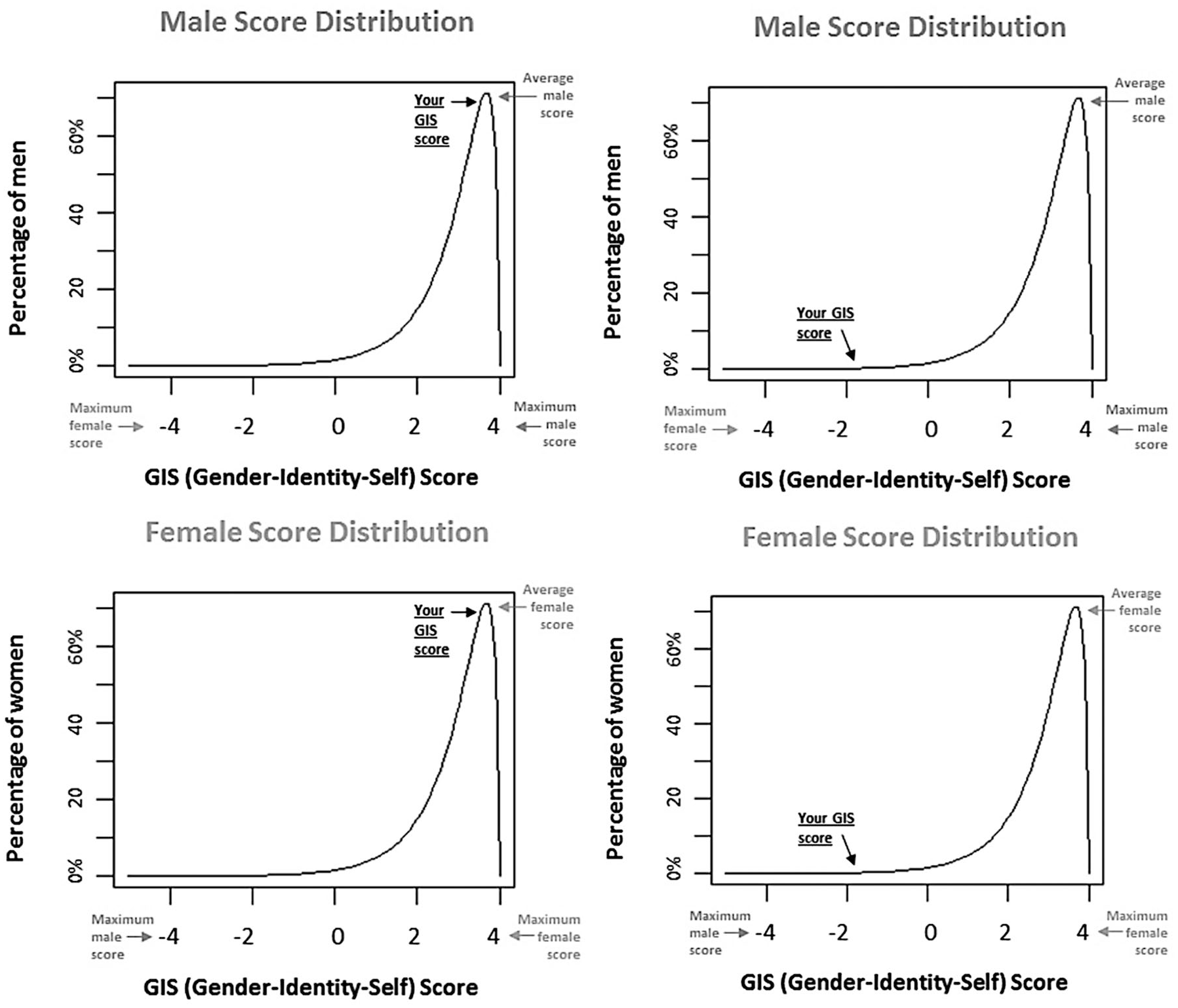
Male participants (top) and female participants (bottom) received either gender-affirming (control; left) or gender-affirming (threat; right) feedback, including the graphs pictured here. In the original images, all phrases including the word “male” (e.g., “Average male score”) were blue, and all phrases including the word “female” were pink.
After receiving their feedback, participants answered the following question to assess their shame: “May we display your score with your name or initials to future classes of students, as well as on the scoreboard in our lab?” Finally, participants proceeded to the aggressive cognition word-completion task (see Materials and Measures below) and were debriefed.
Materials and measures
Motivation for gendered behavior
To capture our gender identity constructs of interest, participants answered nine items intended to measure their autonomous and pressured motivation for gendered behavior, on a 1 (strongly disagree) to 7 (strongly agree) scale (Good & Sanchez, 2010). Examples include the following: “It is important to me to behave like the man [woman] I described” (autonomous motivation) and “I act like the man [woman] I described because I want people to like me” (pressured motivation). See Table 1 for the full set of items.
Factor Loadings for Men-Only Based on the Principal Axis Method With a Varimax Rotation for 15 Items From the Investment in Gender Norms (IN) and Private Regard (PR) Scales, as well as the Pressured Motivation (PM) and Autonomous Motivation (AM) Subscales (N = 68).
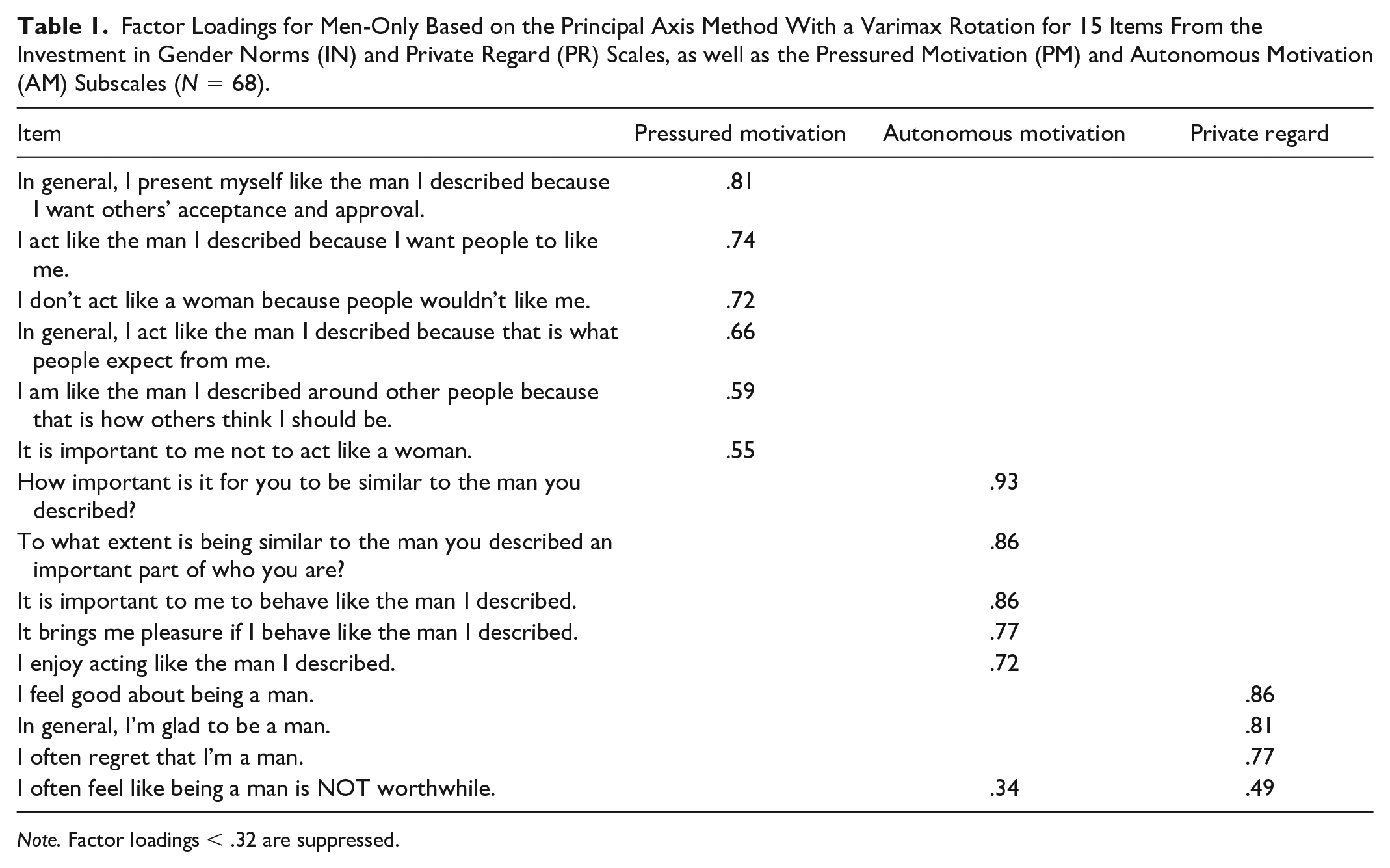
Note. Factor loadings < .32 are suppressed.
Investment in gender norms
Participants also rated their investment in gender norms on a scale of 1 (not at all) to 9 (a great deal) (Good & Sanchez, 2010). Items included the following: “How important is it for you to be similar to the ideal man [woman]?” and “To what extent is being similar to the ideal man [woman] an important part of who you are?”
Private regard
Finally, since past research shows that threatened self-esteem (which we call “private regard”) can predict threat, participants rated their gendered self-esteem using the four-item Collective Self-Esteem Scale–Gender Version on a scale of 1 (strongly disagree) to 7 (strongly agree; Baumeister et al., 1996). Items included the following: “In general, I’m glad to be a woman [man],” “I often regret that I’m a woman [man]” (reversed), “Overall, I often feel like being woman [man] is not worthwhile” (reversed), and “I feel good about being a woman [man].”
Aggressive cognition task
Our dependent variable was aggressive cognition, measured by the percentage of word fragments completed with stimulus words (a proportion of possible words). Past research has demonstrated that this word-completion task is a valid measure of aggressive thoughts and feelings. Vandello et al. (2008) adapted this task from Anderson et al. (2003) and found that only physical aggression was activated in response to threat for men. Thus, we included only those word stems. Participants thus could complete eight word fragments in either aggressive or neutral ways: GU__ (gun), KI__ __ (kill or kick), __IGHT (fight), BLO__ __ (blood), B__T__LE (battle), __ __RDER (murder), __UNCH (punch), and STA__ (stab).
Study 1a Results and Discussion
The goal of Study 1a was to develop scales to represent the constructs underlying people’s motivation for conforming to gender norms. To demonstrate the discriminative validity of our new subscales (autonomous and pressured motivation), items from all three gender scales (motivation for gendered behavior, investment in gender norms, private regard) were altogether subjected to exploratory factor analysis (EFA). We hypothesized the emergence of four constructs, with the motivation scale separating into autonomous and pressured motivation subscales.
EFA was preferred to principal components analysis (PCA) because we sought to verify the existence of two underlying motivational constructs (autonomous motivation and pressured motivation) instead of consolidating factors (Jain & Shandliya, 2013). The principal axis method (PAM) was then used to extract underlying constructs (de Winter & Dodou, 2012) and was followed by a varimax (orthogonal) rotation (Worthington & Whittaker, 2006). Although we conceptualize autonomous and pressured gender motivation to be related—such that they might often be correlated—we also see them as unique, such that one person could be highly motivated in both or neither, or be high in one but low in the other. Thus, we used an orthogonal rotation to maximize the statistical distinction between the constructs to observe how they uniquely relate to our DV. We used the Kaiser criterion and (Kaiser, 1960) and Cattell’s scree test (D’agostino & Russell, 2005) to retain factors, and an item was said to load onto a given factor if its factor loading is greater than or equal to 0.60 within small samples and/or does not cross-load > .32 on more than one factor (Worthington & Whittaker, 2006). Tables 1 and 2 show that all items loaded only onto their respective factors and did not cross-load, with the exception of two items that still loaded relatively exclusively.
Factor Loadings for Women-Only Based on the Principal Axis Method With a Varimax Rotation for 15 Items From the Investment in Gender Norms (IN) and Private Regard (PR) Scales, as well as the Pressured Motivation (PM) and Autonomous Motivation (AM) subscales (N = 125).
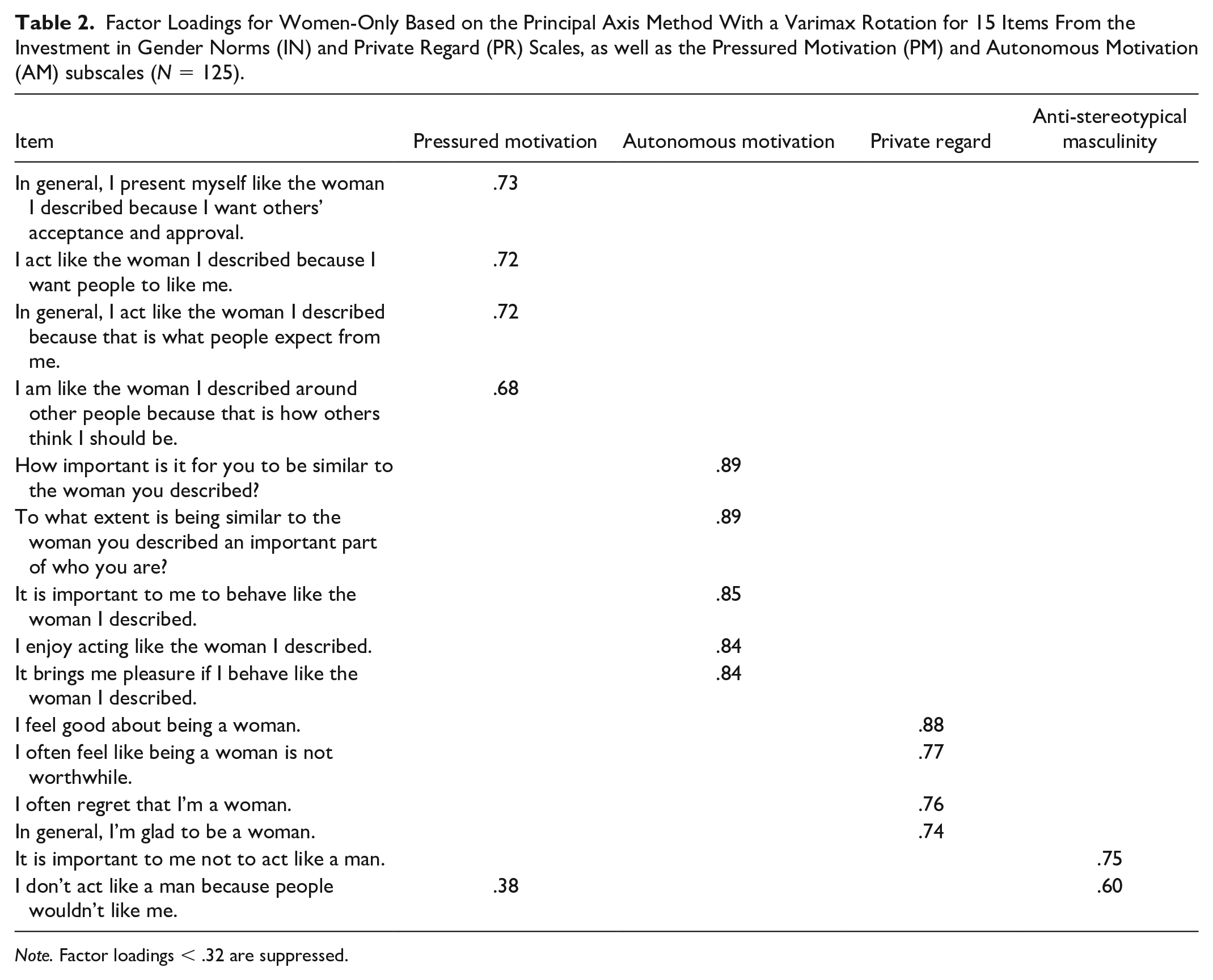
Note. Factor loadings < .32 are suppressed.
We conducted three EFAs, one of which was planned (all participants), and two of which were unplanned (men-only, women-only). First, regarding the EFA including all participants (N = 185), four factors emerged. Confirming our hypotheses, pressured motivation for gendered behavior represented its own unique construct. Private regard for gendered behavior also resulted in its expected loading pattern. Contrary to our hypothesis, the two items previously comprising investment in masculine norms loaded with the autonomous motivation items, which may suggest that autonomous motivation and investment in norms are not conceptually independent. Finally, a fourth, unexpected factor emerged. The items, “I don’t act like a man [woman] because people wouldn’t like me,” and “It is important to me not to act like a man [woman],” loaded onto their own factor. In looking at these items, we reasoned that the fourth factor represented a male “anti-stereotypical femininity” norm that is supported by previous research (Thompson & Bennett, 2015). We decided, then, to run separate EFAs for men-only and women-only, and we expected that the anti-stereotypical femininity factor would emerge from the men-only EFA (n = 68) but not the women-only EFA (n = 125). Of note, these EFAs are underpowered because they were originally unplanned, but to validate the Study 1 findings, we included in Study 2 a confirmatory factor analysis (CFA) which replicates these results. Thus, we feel confident that pressure is a unique construct in men’s gender psychology, as well as a meaningful predictor of aggressive cognition following threat for younger men (per Studies 1b and 2b).
Regarding the separate men-only and women-only EFAs, we found the opposite of our expectations to be true: an “anti” factor emerged in the women-only EFA but not in the men-only EFA. While an “anti-stereotypical masculinity” emerged for women, an “anti-stereotypical femininity” factor did not emerge for men. Tables 1 and 2 show the separate factor analyses for male and female participants, respectively.
As shown in Table 1, the men-only factor analysis produced three factors that reflected our expectations. First, pressured motivation for gendered behavior again represented its own unique construct and also included the item, “It is important for me to not act like a woman,” (as expected). Next, private regard again resulted in its expected loading pattern. Finally, as in the all participant EFA, the two items previously comprising investment in masculine norms loaded with the autonomous motivation items. However, the fourth “anti” factor did not emerge, suggesting that acting in counter (female) stereotypical ways is not a unique factor but rather a subcomponent of men’s pressured motivation to act in line with masculine norms.
Table 2 shows the four-factor model that emerged for female participants. The existence of an “anti-stereotypical masculinity” factor may suggest that there is a unique construct underlying our participants’ femininity that is associated with not being like a stereotypical man, separate from the pressure women feel be normatively feminine. Although outside of the scope of this article, one might suspect that since women were primed to think about traditional notions of masculinity, that an anti-masculinity factor represents a feminist desire to distance oneself from notions of hegemonic masculinity. A central part of a modern woman’s identity, then, may be that she is not like the men with whom, for example, movements like #MeToo have been associated (Veissière, 2018). Alternatively, women might think that exhibiting masculine qualities (e.g., assertiveness) could cause them to be labeled as such undesirable characteristics like “bossy” (Yedidia & Bickel, 2001). Future work, then, might explore the emergence of this anti-stereotypical masculinity factor in women.
For Study 1b—where we examined the relationship between participant gender, gender identity, threat, and aggressive cognition—we used the men-only loadings to create three new variables (pressured motivation, autonomous motivation, and private regard). We used the three-factor model for three reasons. First, we were unsure as to why an anti-stereotypical masculinity factor emerged for female participants only. Second, we reasoned that forcing an “anti-stereotypical femininity” score upon male participants would create a false dimension of gender identity that does not exist for men in our sample. Finally, we felt it necessary to include the “anti” items within the construct of pressured motivation. Pressured motivation, in line with previously mentioned work, includes the pressure that people feel to not be like the opposite gender (see Study 2a Results for further statistical support).
Study 1b Results and Discussion
First, each participant’s scores for pressured motivation, autonomous motivation, and private regard were created using regression scoring. Regression scoring uses the least squares regression approach to identify the location (i.e., score) of each individual on each factor and assigns that score to each participant (DiStefano et al., 2009). This method—as opposed to a simple weighted sum method—factors in the correlation between the factors and the observed variables (via item loadings), as well as among the observed variables and the oblique factors. These scores were then entered into separate ANOVA models with gender and threat to predict aggressive cognition, and then into regression models for the three-way interactions, described below. Before testing these interactions, we first analyzed basic means in t-tests and bivariate correlations. As seen in Table 3, men demonstrated marginally more pressured motivation to conform to gender norms than women (p = .088), as well as more aggressive cognition than women (p < .001). Moreover, pressured motivation and autonomous motivation were correlated, as were pressured motivation and aggressive cognition (Table 4).
Means, Standard Deviations, and Differences of All Continuous Variables by Gender.
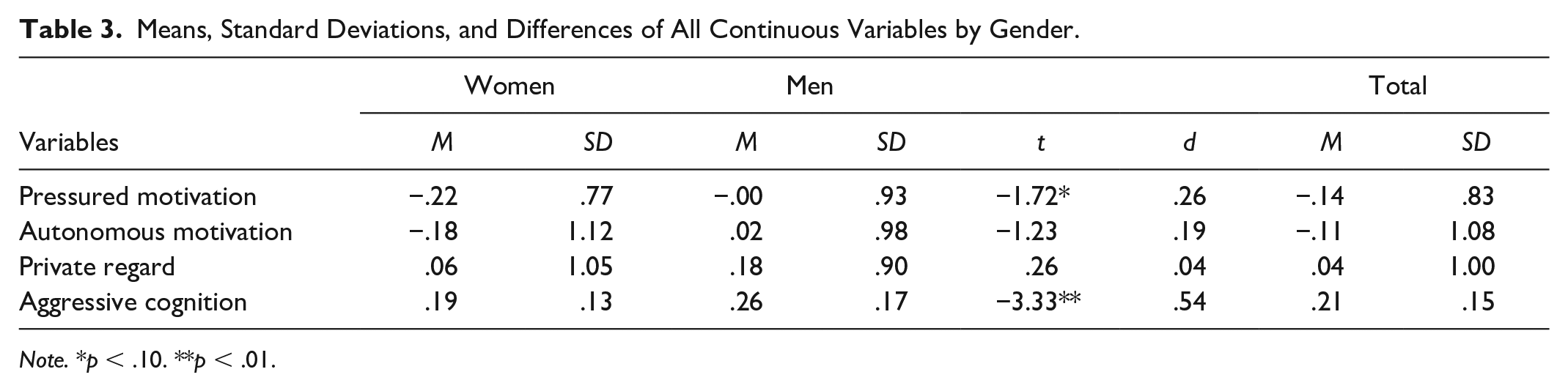
Note. *p < .10. **p < .01.
Zero-Order Correlations Among All Variables.
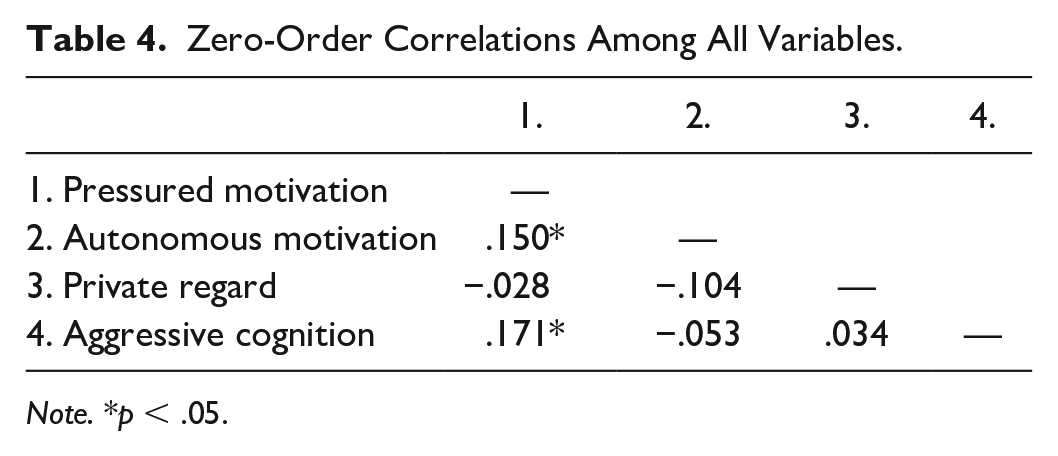
Note. *p < .05.
Participant gender and threat
Replicating past work (Vandello et al., 2008), the 2 (participant gender) × 2 (gender threat) ANOVA was significant, F(1, 191) = 7.51, p < .001, partial η2 = .105. The interaction between participant gender (male, female) and gender threat (threat, no threat) was also significant, F(1, 191) = 8.21, p = .005, partial η2 = .041, such that threatened men (M = .311, 95% CI = [.264, .358]) exhibited more physically aggressive cognition than nonthreatened men (M = .212, 95% CI = [.162, .262]), threatened women (M = .172, 95% CI = [.134, 209]), and nonthreatened women (M = .197, 95% CI = [.162, .232]). Note that there were no statistical differences between nonthreatened men, threatened women, and nonthreatened women. There was also a main effect of participant gender, F(1, 191) = 12.71, p < .001, partial η2 = .062, and a nonsignificant but trending main effect of gender threat, F(1, 191) = 2.87, p = .09, partial η2 = .015, such that men (M = .261, 95% CI = [.227, .296]) and threatened people (M = .241, 95% CI = [.211, .271]) displayed more aggressive cognition than women (M = .184, 95% CI = [.159, .210]) and nonthreatened people (M = .205, 95% CI = [.174, .235]), respectively. However, these main effects were qualified by the aforementioned interaction.
Pressured motivation, participant gender, and threat
To investigate the hypothesis that the threat–aggression relationship is moderated by gender social pressure, we tested a three-way interaction including (1) participant gender, (2) gender threat, and (3) pressured motivation. We also tested the same regression model exchanging pressured motivation for autonomous motivation and private regard. The inclusion of pressured motivation produced the only significant moderation model, explaining 16% of the variance in aggressive cognition, adjusted total R2 = .16, F(7, 185) = 5.10, p < .001. The highest order interaction was marginally significant (β = .09, p = .07). In sum, the inclusion of pressured motivation—neither autonomous motivation nor private regard (ps > .10)—uniquely predicted men’s aggressive cognition following threat.
Confirming our hypothesis, regression results revealed a significant interaction between threat and pressured motivation for men, F(1, 185) = 5.60, p = .02, but not women, F(1, 185) = .00, p =.95. Pressured motivation also moderated the relationship between threat and aggression for threatened men (β = .10, p < .001), but not nonthreatened men (β = .01, p = .78). Altogether, gender identity threat predicted men’s (not women’s) aggressive cognition but only to the extent that men reported experiencing pressure to conform to norms of manhood (Figure 2). Therefore, manhood may not be precarious in its entirety. Instead, these data suggest that manhood may only be fragile (i.e., threat and aggression invoking) when motivated by social pressure.
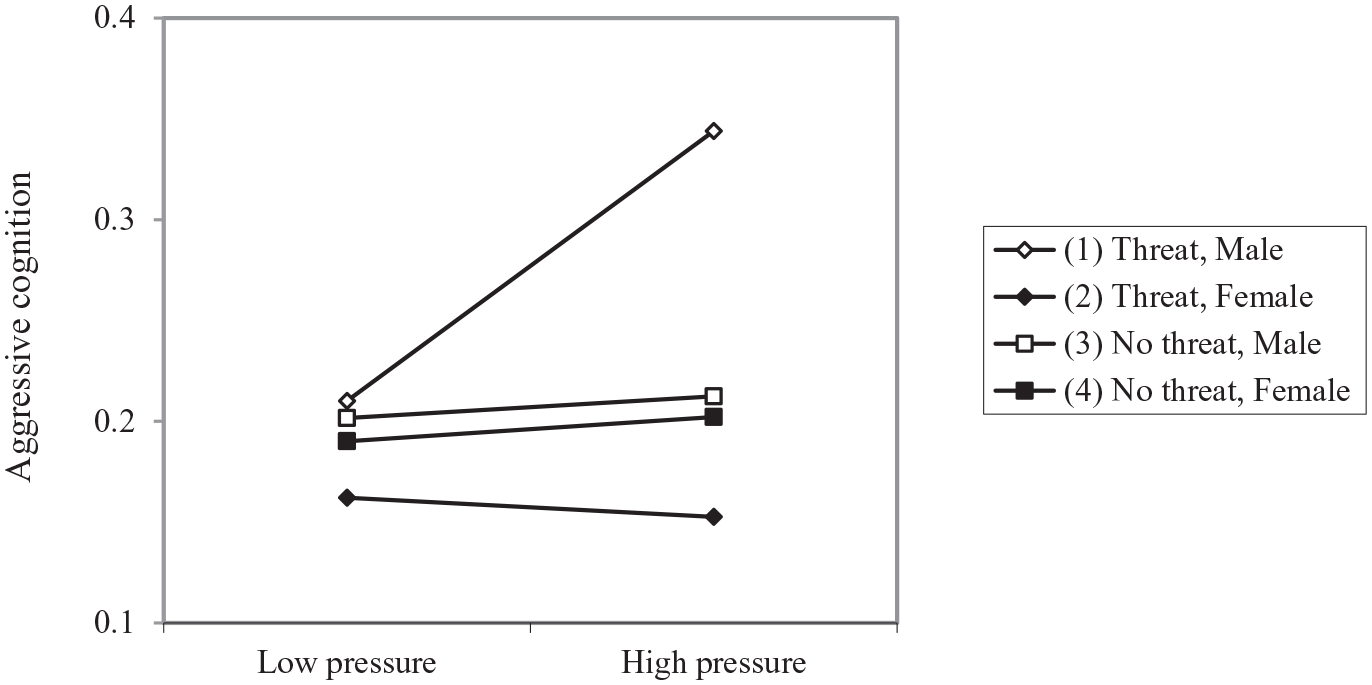
Men who felt a relatively high amount of pressured motivation exhibited the most aggressive cognition following gender identity threat, compared with all women and those men who felt a relatively low amount of pressured motivation.
Shame
A binary logistic regression was performed to explore the effects of gender and threat on the likelihood that participants would share their score as a measurement of shame. The logistic regression model was significant, χ2(4) = 5.165, p = .023, Nagelkerke’s R2 = .036, correctly classifying 66.2% of cases. Those who were threatened were half as likely (.50 times) to share their feedback publicly than participants who were not threatened (p = .024). Surprisingly, participant gender did not affect sharing nor did the interaction between participant gender and threat (all ps > .05).
Thus, male and female participants were less likely to share their feedback if it was gender threatening. Given their aggressive response to the gender threat, we expected this non-sharing behavior from men. However, as in past work, our gender threat did not activate aggression in women. Thus, we expected women might be indifferent concerning sharing their non-feminine feedback (Vandello & Bosson, 2013). However, women were just as likely as men to hide gender atypical feedback. Thus, women appear to also feel a sense of shame for receiving gender atypical feedback, which suggests there may be some other feminine-stereotype outcome (in line with cultural scripts for women) that would arise for pressured women in a womanhood-threatening context. Future research, then, might consider exploring how the social pressure to be stereotypically feminine elicits culturally salient stereotypes for women in certain contexts where those feminine norms are highly valued.
Responses from gender ideals prompt
We also analyzed participants’ responses to the gender prompt regarding their definitions of admired, ideal men and women who they grew up around, to provide an estimation of the extent to which participants were conforming to restrictive versus progressive gender ideals (see scales in Tables 1 and 2). Results showed that, for men, 100% of responses provided were what our two raters (male, female undergraduates) coded as containing traditional ideas of manhood (kappa = .97, p <.0.01). For example, one male participant wrote, “In today’s society, to be a man means that you are tough and resilient. You’re expected not to cry when something happens, but rather, take charge and do something about making it better.” However, only 82% of female responses included traditional or restrictive aspects of womanhood. For example, a traditional female response was, “It meant to be nurturing and caring. While strength was also required, it was more emotional than physical,” while a more progressive response was, “To be a woman is to balance work ambitions with life and family goals, such as watching your kids grow up.” It is worth noting, though, that despite this non-uniformity in women’s responses, progressive definitions of womanhood were often qualified with traditional features, which corroborates existing theorizing on the increasing work–family conflict experienced by women compared with men in recent years (Poms et al., 2016).
In sum, Studies 1a and 1b validated a new measure of motivation for engaging in gendered normative behavior—whether autonomous or pressured. Specific to men, we showed that pressured motivation predicts men’s aggressive cognition in manhood-threatening contexts. These results confirmed past research that manhood threat activates aggression for men but newly shows that this may only be true (or truest) for those men whose masculinity is motivated primarily by social pressure to conform to masculine norms. Next, Studies 2a and 2b aimed to replicate these findings in a more age-diverse sample of men, as well as to test the hypothesis that manhood is precarious in the extent to which it is based on external evaluations, a characteristic most likely to apply to the masculine identities of younger men.
Studies 2a and 2b
Studies 2a and 2b followed the same protocol as Studies 1a and 1b, with two goals. First, we sought to validate the gender motivation constructs derived from Study 1a using CFA in a male-only, age-diverse sample of men. Second, using the factor scores from the CFA, we tested how a man’s age may affect his response to manhood threat, social pressure to conform to masculine behavior, and aggressive cognition. As with Study 1, Studies 2a and 2b are the same study with the same data (but different analyses). Those data are available at: https://mfr.osf.io/render?url=https://osf.io/2wn7a/?direct%26mode=render%26action=download%26mode=render.
Studies 2a and 2b Method
Participants and design
Men born and residing in the United States (N = 400) were recruited via Amazon’s Mechanical Turk Concierge services ($10 per participant). This sample size was determined by guidelines for testing structural equation models such as CFA, where 400 is the ideal sample size (Lei & Wu, 2007). Nine participants were excluded on the same a priori criteria as Study 1, for providing bogus responses to the open-ended items or word stems. Thus, 391 male participants were randomly assigned to either a threat or no threat condition (Mage = 33.16, SD = 6.91, age range = 18–56 years; 73.1% White, 8.4% Asian, 7.7% Black, 6.6% Hispanic/Latino, 2.8% biracial, 0.5% other, n = 2 no response).
Procedure
The procedure was the same as in Studies 1a and 1b, where participants answered a gender prompt, completed gender identity measures, took the GIS, received feedback, and completed the cognitive aggression DV. The only difference is that participants in Study 2 did not answer a shame question; there was no equivalent scenario we could create to gauge similar participant shame within the online MTurk platform.
Materials and measures
All materials and measures were the same as Study 1.
Study 2a Results and Discussion
Confirmatory factor analysis
A CFA model with the three latent constructs derived in Study 1 (private regard, autonomous motivation, and pressured motivation) was estimated using Mplus software (Muthen & Muthen, 2017) to validate our Study 1a (undergraduate sample) findings. Skewness of the indicators was less than 3 (0.04 to 2.45), suggesting nonnormality of data was not a concern (Kline, 2015). Accordingly, maximum likelihood estimation was used. We first set each item to load onto one factor according to the model specified by the EFA in Study 1a (Table 1). This initial model fit the data somewhat adequately, χ2(87) = 451.48, p < .001, CFI = .931, TLI = .916, RMSEA = .104 (90% CI = [.094, .113]), SRMR = .076 (see Schreiber et al., 2006, for a summary of CFA fit indicies standards). These results are presented in Table 5, Hypothesized (three-factor) model.
Fit Statistics for All Measurement Models Tested.
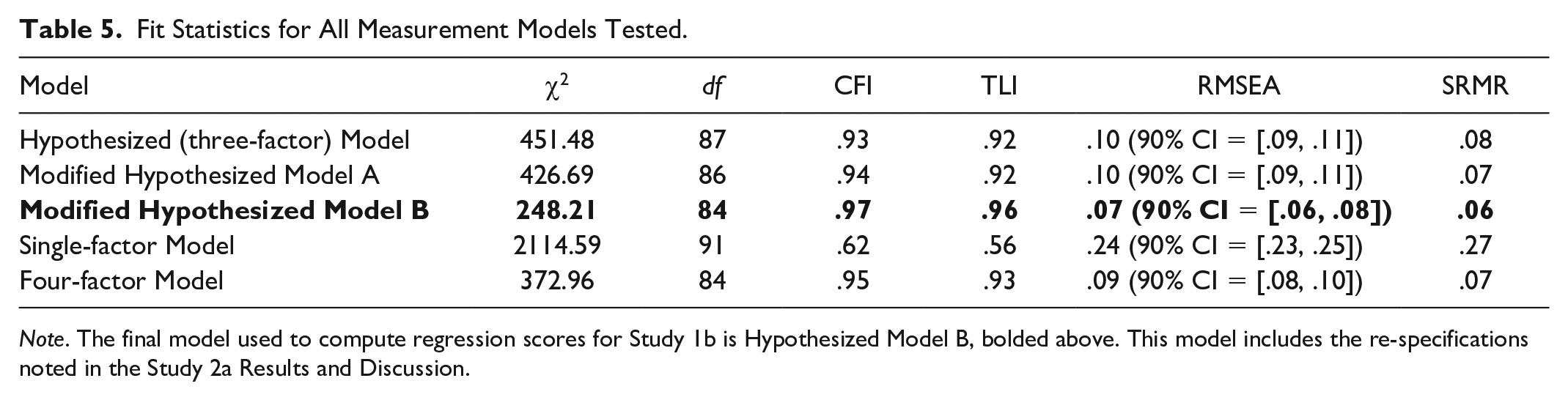
Note. The final model used to compute regression scores for Study 1b is Hypothesized Model B, bolded above. This model includes the re-specifications noted in the Study 2a Results and Discussion.
Model re-specification
Modification indices (MIs) provided by Mplus revealed three re-specifications that improved model fit to acceptable standards, all of which were theoretically sound. First, an MI of 41.65 revealed that one item (“It is important to me not to act like a woman”) should also load onto the autonomous motivation construct. An MI of 41.65 indicates that if this parameter were to be freely estimated, the overall χ2 statistic could decrease by approximately that amount (Byrne, 2013). In Study 1a, the EFA grouped this item with pressured motivation items (instead of its hypothesized autonomous subscale), but the model fit notably improved by allowing this item to load onto both autonomous and pressured motivation subscales. Indeed, the addition of this cross-loading improved model fit to adequate (but still not acceptable) standards, χ2(87) = 426.69, p < .001, CFI = .935, TLI = .921, RMSEA = .101 (90% CI = [.091, .110]), SRMR = .066 (Table 5, Modified Hypothesized Model A).
An additional review of the MIs revealed two additional MIs that stood out from the rest (MI = 93.95 and 83.29). Both of these MIs represented residual covariances, with the larger of the two being a covariance between the only two items having to do with not being a woman (“It is important to me NOT to act like a woman,” and “I don’t act like a woman because people wouldn’t like me”). The other covariance was between the two items of the hypothesized Investment in Gender Norms scale (“How important is it for you to be similar to the man you described?” and “To what extent is being similar to the man you described an important part of who you are?”). As described by Byrne (2013), these covariances represent “systematic rather than random measurement error in item responses” caused by “a high degree of overlap in item content . . . when an item, although worded differently, essentially asks the same question” (p. 106). Accordingly, after re-specifying our model to account for this redundancy, our model fit improved to exceed acceptable standards, χ2(87) = 248.21, p < .001, CFI = .969, TLI = .961, RMSEA = .071 (90% CI = [.061, .081]), SRMR = .060 (Table 5, Modified Hypothesized Model B).
For our final model’s loadings, all R2s were moderate to high (>.3) and all items loaded strongly onto their respective factors (<.8), with the exception of three items. The three items that loaded relatively low and had R2s of less than .3 were the only negatively worded items. In SEM, reverse-worded items have been shown to contaminate data and load poorly onto their respective factors for none other than their reversed wording (Woods, 2006). Thus, despite their poorer fit, we decided to retain them in our scales because we believe that they provide unique insight on their respective constructs. We reasoned that eliminating them solely to improve model fit was not worth sacrificing their additional conceptual value in understanding how private regard, autonomous motivation, and pressured motivation may affect male aggression.
Model comparison
Finally, we tested two alternate models, being a one-factor (a single gender identity factor) and a four-factor (women-only) model (Table 2). Fit statistics are presented in Table 5 and show that the modified hypothesized three-factor model fits the data best. We believe that the present CFA provides substantial discriminatory validity toward the existence of unique motivational aspects of men’s gender identity. Moreover, taken together with the results from Study 1a, pressured motivation and autonomous motivation seem to represent distinct components of gender identity, possibly also useful in understanding other adverse outcomes—beyond aggression—associated with gender identity threat.
Study 2b Results and Discussion
We used regression scoring in Mplus from the modified Hypothesized Model B to create three gender identity scores for each participant, and Table 6 shows the correlations among these variables. These three scores are used in the following analyses.
Zero-Order Correlations Among All Variables.
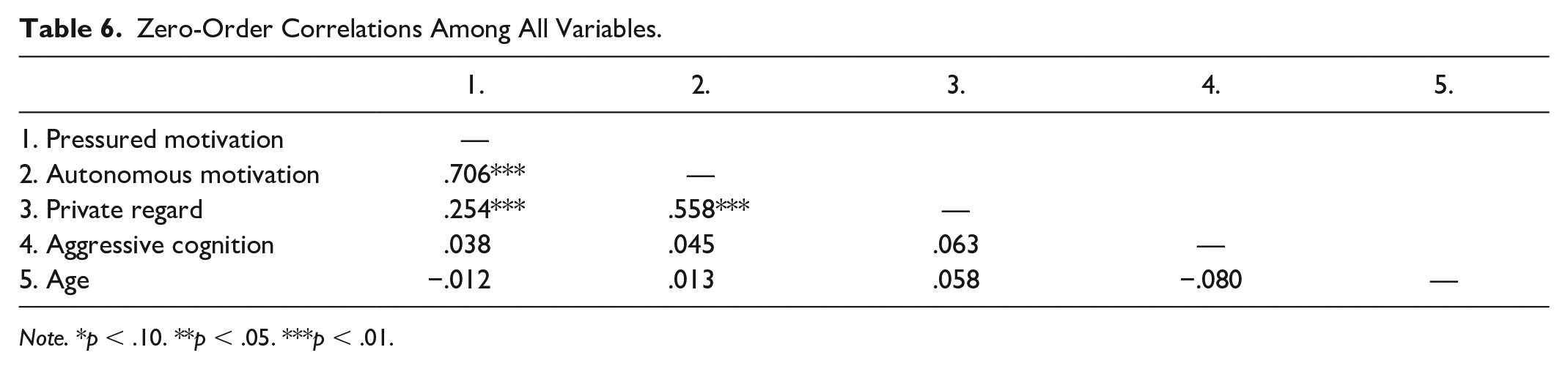
Note. *p < .10. **p < .05. ***p < .01.
Main effect of threat
In Study 1b, we showed that men exhibited physically aggressive cognition following gender-threatening feedback, while women showed no elevated aggression. Study 2b tested men-only, and we expected that we might find a main effect of threat on aggression. Although a one-way ANOVA did not reveal this main effect, F(1, 389) = 0.534, p = .465, this result is still consistent with our overall hypothesis that primarily young men would demonstrate aggression activated by the interaction between threat and pressured motivation.
Pressured motivation and threat
We again tested the interaction between threat and pressured motivation. The overall model was nonsignificant and only explained 1.2% of the variance in aggressive cognition, adjusted total R2 = .012, F(3, 387) = 1.59, p = .192. The test of the highest order two-way interaction, however, was marginally significant, F(1, 387) = 3.68, p = .056, and pressured motivation marginally predicted aggressive cognition only under threat (β = .034, p = .056). Although marginal, taken together with our main effect findings, these results suggest that the inclusion of pressured motivation with manhood threat more accurately predicts male aggression than threat alone.
Age, pressure motivation, and threat
We hypothesized that participant age would attenuate the relationship between pressured motivation and threat on aggressive cognition. Thus, we tested a model including age, pressured motivation, and threat on aggression. Supporting our theory of unstable, externally motivated identity, we predicted that young men (compared to older men) would exhibit aggression in response to threat as a function of their pressured motivation.
We thus tested a three-way interaction including threat condition, pressured motivation, and participant age and tested the hypothesized model exchanging pressured motivation for autonomous motivation and private regard. Pressured motivation produced a significant three-way interaction with threat condition and age (β = −.01, p = .017), with the overall model explaining 4% of the variance in aggressive cognition, adjusted total R2 = .040, F(7, 382) = 2.29, p = .027. Moreover, only men’s pressured motivation, not autonomous motivation nor private regard, interacted with participant age to predict aggressive cognition (all ps > .10).
Specifically, using percentile values created by PROCESS v3.3, two-way interactions between threat and pressured motivation occurred for men in the 16th age percentile (= 26 years), F(1, 382) = 8.98, p = .003 and marginally at the 50th age percentile (= 33 years), F(1, 382) = 3.50, p =.062. For those men in the oldest group—the 84th percentile (= 40 years)—threat and pressured motivation did not predict aggressive cognition (p =.695). The significant effect is represented in Figure 3 as Line 2 (Threat, Younger men). Thus, as in Study 1, the pressure to conform to masculine norms significantly and positively predicted aggressive cognition following threat for men at younger ages.
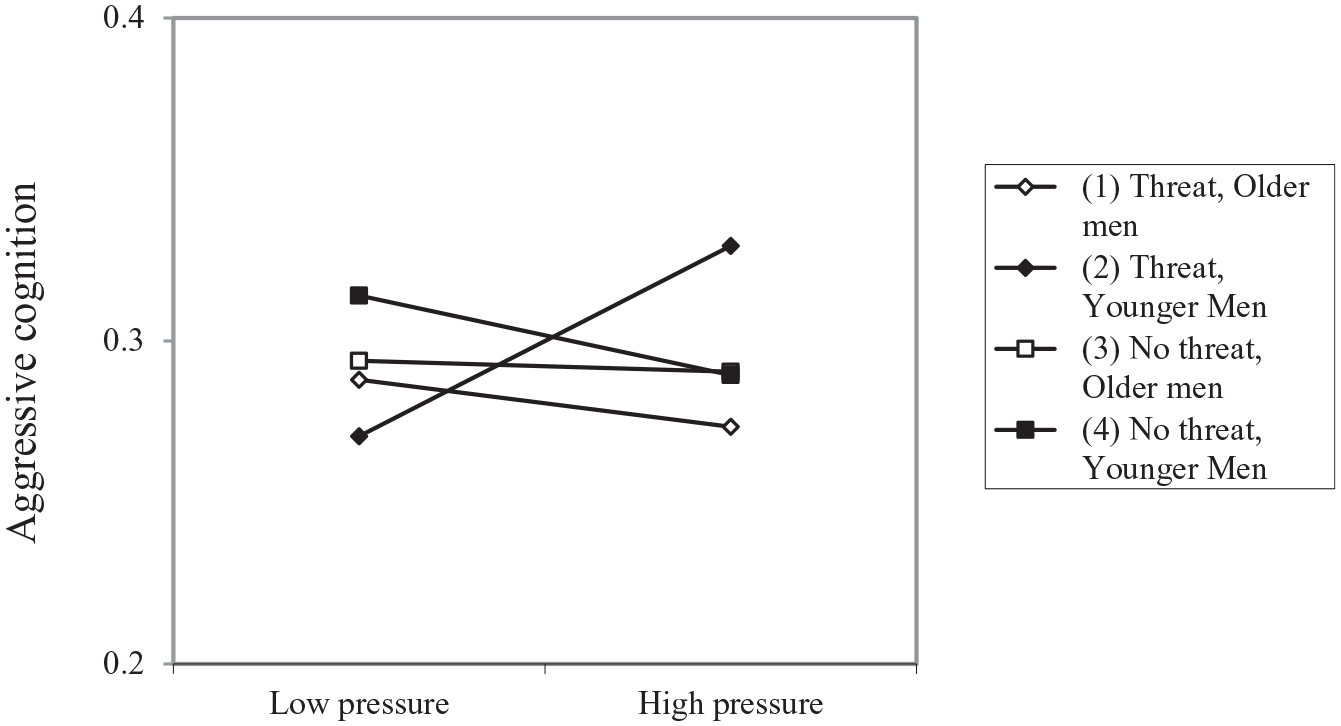
Younger men exhibited aggressive cognition as a function of pressured motivation—where younger men who experienced a relatively high amount of pressured motivation exhibited the most aggressive cognition following gender identity threat—compared with older men and nonthreatened younger men.
Responses from masculinity ideals prompt
As in Study 1b, 100% of men provided what our raters (same raters) coded as a traditional or restrictive idea of manhood (kappa = 0.91, p <.0.01). Example responses from this larger, male-only dataset include definitions like “[To be a man meant] To never cry. To never show emotion. To bring physical harm to anyone who crossed you or your family. To stand up for what you believe in” and stories like “I was playing baseball and was hit by a pitch. My coach, who was a jerk, kept screaming at me to ‘be a man’ about it and to walk to first base. Basically, he was insinuating that I wasn’t tough.” We also asked for the age at which men first remembered hearing or learning about notions of what it meant to be a man: the mean age was 10.75 years (SD = 2.97). Although this age-recollection data were collected exploratorily with no specific hypotheses, future developmental research might consider using this finding to begin to trace the developmental pathways of masculine social pressure that is antecedent to aggressive threat responding in younger adult men.
In summary, our linear regression model including threat, pressured motivation, and age predicted aggressive cognition for our more age-diverse male sample. Older men were less aggressive than younger men and reported less experienced pressure to conform to masculine norms. Although it is possible that memories of gender pressure may be more easily accessible for younger versus older men, these findings more accurately align with our fragile masculine identity theory, where in younger years men’s gendered behavior are more socially pressured, less stable (more fragile), and thus more likely evoke aggression in threatening contexts.
General Discussion
Past research has shown that men, but not women, respond aggressively to gender-related identity threats in the United States, but the individual differences predicting men’s aggressive responding are less known (Bosson & Vandello, 2013). Across two studies, we showed that individual differences in the social pressure men experience to “be a man” predicts aggressive cognition following manhood threat, particularly for younger men. To our knowledge, this is the first research to identify moderators (i.e., social pressure, age) between masculine identity threat and aggressive cognition in adult U.S. men, providing needed evidence as to why, when, and for whom threats to one’s manhood invoke aggressive cognition.
Study 1a introduced scales measuring U.S. college-aged men and women’s autonomous versus pressured motivation for conforming to gender norms. EFA revealed that two unique subscales differentially represented people’s autonomous versus pressured motivation for stereotypical gender conforming behavior, unique from their private regard and investment in gender norms. In addition to showing that men experience more pressure to be gender normative than women, Study 1b then showed that this pressure exclusively predicted men’s disproportionate aggressive cognition following manhood threat.
Study 2a sought to validate the autonomous and pressured motivation scales derived in Study 1a. We sampled an age-diverse group of U.S. men (age 18–56) for generalizability purposes and used the robust CFA approach to confirm and respecify the model for greater accuracy. Study 2b then replicated Study 1b’s finding that men’s social pressure predicted their aggression following manhood threat. This effect was attenuated by age, providing further evidence for the hypothesis that at younger ages, men’s masculine identities are more likely to be based on the external evaluations of others—that is, fragile—versus being more intrinsically motivated and stable in one’s later years.
Taken together, we believe that our findings add to the growing body of literature concerned with the development of social identity, as well as the origins of adverse behaviors related to male identity. Specifically, we showed that the pressure to be masculine according to U.S. masculinity norms—particularly among younger men—may cause an adverse masculine identity state that elicits aggressive cognition in manhood-threatening contexts. More optimistically, it does now appear that threatened manhood does not inevitably lead to aggression: even under threat, men who experienced no or low social pressure to be stereotypically masculine showed no heightened aggression (Figures 1 and 2).
Under what circumstances, then, does manhood threat invoke aggression? Our data suggest that men’s perceptions of how pressuring their social environments are affects their threat responses and subsequent aggressive cognition. Our pressured motivation subscale items (Table 1) tap into perceived normative demands of one’s environment (i.e., “how others think I should be”), and we showed that men’s aggression is unrelated to their autonomous motivation (i.e., “how I think I should be”), private gender regard, and their explicit investment in masculine norms. However, it is worth noting that these findings were situated in the U.S. cultural context where our research was conducted. The United States’ individualist, often “honor”-based culture (e.g., rural, Southern areas; Cohen et al., 1996) is believed to be in itself a culture that constantly conveys the importance of, and simultaneously challenges, men’s masculinity. In this sense, we conceptualize men’s aggression as a norm-consistent masculine response in the U.S. cultural context for men whose masculinity is based on others’ external evaluations. However, in cultures where the restrictive masculine norms are different, we might find that pressured men seek to reassert their manhood in different ways, besides being aggressive. Future research should test our framework in cultures with different masculine norms to show how pressured men respond cognitively and behaviorally to reassert their manhood. Moreover, it is worth noting based on our findings that in cultures where there are flat (i.e., non-hierarchal) or less macho (i.e., gender-equal) gender norms, we might predict that, generally, men would feel less pressure, and thus be (on the whole) less likely to be threat sensitive.
Regarding the development of our gender motivation scale, we should also note that some men, or people in general, may not conform to gender norms. For example, for the item, “I act like the man I described because I want people to like me,” we would expect that someone who does not conform (or who resists conformity) would rate this item on the low end (toward 1: Strongly Disagree), suggesting that they were not pressured or did not conform. For the scope of these studies, we were interested in pressure’s role in men’s aggression (i.e., high values on the pressure scale), and we believe that if people did not feel pressure (or challenged it), they would have received low gender pressure scores. However, future research should explore those men who do not conform and how this is non-conformity is related to men’s self-concepts. For example, a related body of research exists on “resistance to masculine norms” (Way et al., 2014). This important construct predicts positive outcomes for adolescent boys, yet it is different from the pressure construct we were assessing in this study. Resistance to masculine norms captures boys’ explicit efforts to challenge masculine norms—showing that resistance oftentimes yields positive results for boys—yet it does not account for how pressure relates to this resistance. We would predict that boys who resist masculine norms (or who do not conform at all) would demonstrate less aggression in a threatening context, but it might also be the case that boys who challenge masculine norms do so because they have experienced high pressure. Future research should explore this relationship between pressure, not conforming to masculine norms, and challenging masculine norms, particularly as a means of understanding how to foster healthy gender identity development in the presence of restrictive gendered expectations.
From our findings, we also hope to offer the broader insight that pressuring or restrictive social environments may adversely affect people’s self-concept and interpersonal behavior. In the context of gender, pressuring environments demand that men publicly demonstrate their masculine behaviors, or risk potentially dangerous social punishment (Bosson & Vandello, 2011; Connell, 1987; Mosher & Tomkins, 1988; Murnen et al., 2002; Vandello & Cohen, 2003). These environments, in turn, drive younger men’s public gender identities to be motivated by the expectations of others, rather than intrinsically based. Masculine identities that are motivated by the expectations of others are unstable, threatenable, and aggression invoking—what we consider to be fragile masculinity. Conversely, masculine identities that are more intrinsically motivated (i.e., those men reporting low social pressure to be stereotypically masculine), as in a person’s older years, are hypothetically more stable and thus less threatenable and aggression invoking.
Limitations
As with any new experimental work, there are important limitations to consider. Although our data suggest that one’s social environment is a strong factor for predicting aggressive responses, future work should intentionally examine social contextual variables (e.g., urbanicity, religiosity) that might affect individual levels of pressure. For example, regarding urbanicity, past research has shown that on average, rural areas of the United States have more restrictive notions of masculinity than urban areas (Abelson, 2016; Silva, 2017). We believe that these stricter masculine norms may cause more pressure that would translate into there being a higher likelihood of precarious manhood in rural areas of the United States. Recent correlational research supports this hypothesis (DiMuccio & Knowles, 2020), but future research should measure whether norms in rural areas of the United States on average have more restrictive masculine norms, and directly test whether these norms cause aggressive responding to gender threats using an experimental paradigm. Relatedly, future research might also consider ways to manipulate social contextual variables as a way to tap into pressured motivation. For instance, recent work has shifted people’s perceptions of what is normative to change people’s attitudes and behaviors to achieve more desirable social outcomes (Paluck, 2009; Paluck & Paluck, 2009; Tankard & Paluck, 2016).
Similarly, researchers might consider shifting masculine norms by, for instance, presenting models of successful men who challenge stereotypical masculine norms, hypothetically lessening the pressure men experience to conform to stereotypical norms and related negative outcomes (e.g., Ramasubramanian, 2011). Moreover, as discussed, other research has shown that some people already actively challenge masculine norms, and that this process is linked with positive outcomes (Way et al., 2014). This research, which took place with adolescent boys, showed that the boys who spoke of challenging masculine norms had healthier friendships and better socioemotional outcomes.
Also, our study of aggression was limited in its use of cognitive measures in that we did not measure actual aggressive behavior. Past research has demonstrated that the word-completion task we used is related to aggressive thoughts, feelings, and possibly behavior (Anderson et al., 2003; Carnagey & Anderson, 2005; Vandello et al., 2013). However, future work should run a similar study with a behavioral dependent measure to determine the boundary effects (e.g., social context, testosterone, level of perceived threat) that may separate men’s aggressive cognition from their actual behavior. Likewise, future research might measure other known predictors of aggressive cognition and behavior such as basal testosterone to isolate the unique role of social pressure in predicting men’s aggression, particularly as it relates to actual behavior (e.g., Caswell et al., 2014).
Regarding our participant sample, although our results largely analyze men (due to our focus on precarious manhood and men’s aggression), our results do stress the need for research to consider what types of gender pressure may also negatively affect women. For example, we mentioned above the role that work–life conflict may have in the pressures women experience pertaining to being the ideal woman. Moreover, our participant sample was predominantly white and from the United States. Past work highlights that masculinity norms differ by and within racial and cultural groups, thus stressing the need to replicate these models with racially or (inter)nationally diverse samples. For example, work with Black men and adolescents suggests that masculinity norms differ within cultures, even in the United States, and that masculinity norms may be even more variable outside of the United States (Ferber, 2007; Ocampo, 2012; Wilkins, 2012). Thus, by studying gender norms in other cultures—and how each conceptualizes and socializes gender norms and roles—this research would paint a broader picture of how social pressures stemming from multiple identities (including one’s masculine or gender identity) may affect diverse others’ psychological functioning and interpersonal behavior (Gaither, 2018).
Finally, aggression is also only one of many adverse outcomes associated specifically with masculinity. For example, within the last 15 years, researchers have identified a growing “boy crisis” referring to boys’ and men’s disproportionate violence, academic failure, and “epidemic of loneliness,” among other problems (see Way, 2014). Future work should consider how the social pressure identified here may be related to other negative, male-specific outcomes, particularly instances of political aggression that endanger marginalized and underrepresented groups (DiMuccio & Knowles, 2020).
Conclusion
Prior to this research, manhood was often described as a uniformly threatenable social status in the United States—a product of men’s common experience with omnipresent societal norms. However, our data suggest that environments may differ in the extent to which they pressure masculine norms, and, concurrently, the extent to which men’s masculine identities are pressured, fragile, and threatenable. Our data align with past research showing that threatened manhood does lead to aggression (Bosson & Vandello, 2011), but we provide nuance to this phenomenon, showing that men’s threat responding is related the individual pressure each man experiences to be masculine. In demonstrating a link between social pressure, threat, and aggression in certain contexts, we have uncovered one pathway by which social environments may inadvertently harm certain boys’ and men’s gender identity development, potentially also to the detriment of those around them.
Supplemental Material
sj-docx-1-psp-10.1177_0146167220984298 – Supplemental material for “Be a Man”: The Role of Social Pressure in Eliciting Men’s Aggressive Cognition
Supplemental material, sj-docx-1-psp-10.1177_0146167220984298 for “Be a Man”: The Role of Social Pressure in Eliciting Men’s Aggressive Cognition by Adam Stanaland and Sarah Gaither in Personality and Social Psychology Bulletin
Footnotes
Declaration of Conflicting Interests
The author(s) declared no potential conflicts of interest with respect to the research, authorship, and/or publication of this article.
Funding
The author(s) disclosed receipt of the following financial support for the research, authorship, and/or publication of this article: This work was funded by the Charles Lafitte Foundation Program in Psychological Research at Duke University. The authors would also like to thank Anna Gasman-Pines for feedback on drafts of this manuscript, as well as the reviewers for their feedback.

Supplemental Material
Supplemental material is available online with this article.
References
Supplementary Material
Please find the following supplemental material available below.
For Open Access articles published under a Creative Commons License, all supplemental material carries the same license as the article it is associated with.
For non-Open Access articles published, all supplemental material carries a non-exclusive license, and permission requests for re-use of supplemental material or any part of supplemental material shall be sent directly to the copyright owner as specified in the copyright notice associated with the article.
