







Abstract
How do the specific characteristics of a departing star influence the effects of the star’s turnover on a firm’s innovation processes? Proposing a contingency model of key employee turnover, we argue and demonstrate that the individual characteristics of a star scientist who exits a firm determine the effects of the star’s turnover for the organization. Based on a longitudinal study of star scientist turnover in the biotechnology industry (1972-2003), we show that while star turnover disrupts existing innovation routines and thus decreases exploitation, this “shock” creates opportunities for the firm to search beyond existing knowledge boundaries, thereby increasing exploration. However, these effects are moderated by the departing star’s innovative and collaborative involvement within the firm. Specifically, the results indicate that a departing star’s innovative involvement strengthens the negative effects and weakens the positive effects of the star’s turnover on exploitation and exploration in the firm, respectively. On the other hand, a departing star’s collaborative involvement within a firm strengthens the negative effect of the star’s exit on exploitation but increases the positive effect of star turnover on exploration, thereby fostering opportunities for technological renewal. We suggest therefore that the prognosis for firms losing stars may vary, and may not always be dire. Our findings indicate that the short-term and long-term value of human capital is contingent on the social mechanisms surrounding its utilization. Thus, we offer a redirection for research and extend the resource-based view and human capital theory by introducing a resource dependence perspective into this theoretical context.
Keywords
To sustain their competitive advantage, firms must develop effective innovation routines to explore new opportunities and exploit “old certainties” (March, 1991: 71). A firm’s human capital plays a critical role in the selection, retention, and renewal of such innovation routines (Nelson & Winter, 1982). In technology-rich firms, referred to as “precarious monopolies,” highly prolific individuals (i.e., star scientists) have significantly more influence in defining innovation routines than their more average-performing peers (Zucker, Darby, & Brewer, 1998). As a substantial portion of a firm’s R&D capabilities and human, intellectual, and organizational capital is embodied in and dependent on these star employees (Groysberg & Lee, 2009; Paruchuri, 2010), who are free to quit at will (Coff, 1997; Somaya, Williamson, & Lorinkova, 2008), the departure of such rare and valuable human resources may significantly affect firms’ exploration and exploitation routines (Nyberg & Ployhart, 2013).
Notwithstanding the potential implications that the departure of star scientists may have for innovation in the losing firm, the growing body of research on employees’ outward mobility has focused on the rate and degree of general (i.e., nonstar) turnover (Park & Shaw, 2013), with little attention devoted to the status of leavers (Hausknecht & Holwerda, 2013). The thin body of research dealing with turnover of star or high-status employees has focused on the negative performance implications of such departures for organizations (Aime, Johnson, Ridge, & Hill, 2010; Kwon & Rupp, 2013). Yet performance as a metric for assessing a firm’s competitive advantage is problematic because there are other key determinants of a firm’s competitive advantage that this metric fails to capture. This is especially true in technology sectors, where innovation is a key driver of a firm’s long-term success (Silverman, 1999). Hence, to fully evaluate the impact of star employees’ turnover on a firm’s ability to sustain its long-term competitive advantage, we must investigate the effects that star turnover has on the firm’s exploration and exploitation routines (Dalton & Tudor, 1979; Staw, 1980)—an examination we pursue in this article.
Another area in need of research and theoretical attention is the examination of how specific characteristics of a departing star influence the extent and nature of the effects of the star’s turnover on a firm’s innovation processes. Specifically, whereas the literature on employee recruitment (i.e., inward mobility) demonstrates the importance of examining hired employee characteristics in predicting postrecruitment outcomes (e.g., Rao & Drazin, 2002; Song, Almeida, & Wu, 2003), related research on outward mobility in general (Hancock, Allen, Bosco, McDaniel, & Pierce, 2013; Park & Shaw, 2013) and star mobility in particular has commonly focused on firm-level characteristics as moderators of the relationship between employee turnover and performance (Phillips, 2002). For example, Aime et al. (2010) showed that, in the context of a key employee’s departure, rivals’ experience with the losing firm’s key routines enhances the negative effect of this turnover on the losing firm’s performance, while Kwon and Rupp (2013) showed that the negative effect of high performer turnover is strongest in firms that make few investments in human capital and in firms with strong reputations. While these observations are important and interesting, missing is an investigation of how the effects of star employees’ turnover vary based on the characteristics of the departing star.
In an effort to rectify these important omissions, we proceed with a twofold purpose. First, we seek to advance and extend the emerging literature on star employee turnover by examining the effect of star departure on two key innovation outcomes for the organization: exploration and exploitation. Drawing on resource dependence and power theories (Pfeffer, 1981; Pfeffer & Salancik, 1978), we suggest that the disruption of workflow that occurs when a star scientist leaves a firm is related to two countervailing processes. On one hand, a star’s exit causes an upheaval in a firm’s existing routines and core objectives, thereby disturbing the innovation activities that center on and exploit existing knowledge in the organization. On the other hand, commitment to the status quo declines, and openness to new knowledge and routines increases, thereby increasing the organization’s exploratory activities. From this perspective, we suggest that star turnover can be a boon in that it may shock firms into converting the threat of loss into an opportunity for technological renewal (Virany, Tushman, & Romanelli, 1992).
Second, we offer a contingency model that highlights two unexplored individual characteristics that may moderate the effects of star turnover: the degrees of the departing star’s innovative and collaborative involvement in a firm. Stars who are highly involved in a firm’s innovation activities are in a position to demand and control tangible and intangible resources, which enables them to promote their own research programs, limiting the potential for other scientists to explore different research opportunities (Zucker, Darby, & Torero, 2002). Hence, when such stars depart, the disruption to ongoing research is magnified, leading to a greater reduction in both the exploitation of existing knowledge and the exploration of new technologies.
Collaborative involvement refers to the wealth and frequency of collaboration between stars and their colleagues. Stars who collaborate frequently and broadly enhance their colleagues’ embeddedness in and commitment to existing courses of action, yet at the same time provide the social support required for colleagues to take risks and explore new initiatives (Edmondson, 1999; Tzabbar, McMahon, & Vestal, in press). Accordingly, we expect that departing stars’ collaborative involvement will strengthen the positive effect of a star’s exit on exploration and mitigate the negative effect of a star’s exit on exploitation.
Given that not all types of knowledge that underlie innovation are equally susceptible to loss, and not all innovation activities are equally vulnerable to disarray, we argue that the prognosis for firms losing star scientists may vary. Indeed, in some cases, the results may actually not be all that dire. We test our hypotheses using data from dedicated U.S. biotechnology firms between 1973 and 2003. Our analyses yield results that generally support our hypotheses. Specifically, we show that the departure of a star who is highly involved in a firm’s innovation activities undermines the abilities of other scientists both to exploit existing knowledge and to explore new opportunities relative to the departure of stars who are less involved in a firm’s innovation activities. On the other hand, a departing star’s collaborative involvement with colleagues strengthens the positive effect of the star’s departure on exploration. Counter to our expectation, however, we find that a departing star’s collaborative involvement strengthens the negative effect of the star’s exit on exploitation. By integrating human capital theory with resource dependence and power theories, we provide a theoretical and empirical meeting ground for economists, organizational theorists, and strategic human resource management scholars in identifying the roles that both the employment and turnover of high-status individuals play in shaping incumbent scientists’ abilities to effectively exploit existing knowledge and explore beyond existing technological boundaries.
Theoretical Background
Innovation in organizations is governed by collections of routines and search strategies. Routines are generally viewed as patterns of activities that are repeatedly invoked to ensure the reliability and accountability of a firm’s actions (Nelson & Winter, 1982). Reliability and accountability require developing processes that are reproducible or stable over time. This requirement leads organizations to search for novel ideas within existing technological boundaries (i.e., exploitation) or seek new knowledge beyond existing technological boundaries (i.e., exploration; March, 1991; Silverman, 1999).
A basic premise of the knowledge-based view is that a firm’s abilities to effectively exploit existing knowledge and explore new knowledge depend on its employees’ expertise and skills (Kogut & Zander, 1992). Because exploratory tasks involve search in novel domains, effective exploration requires that employees have tacit knowledge acquired through learning by doing (Von Hippel, 1988). On the other hand, much of the knowledge involved in exploitation tasks is likely to be explicit in nature, because the focal actor or unit already possesses much of the required expertise and hence is likely to understand the problem, possible solutions, and the causal mechanisms among the parameters involved in the task (Hansen, 1999). Whereas exploitation requires the ability to search locally for new knowledge to generate incremental extensions from a firm’s existing technological trajectories (March, 1991), exploration is likely to require innovative vision and more unique tacit capabilities in forging connections and making discoveries using novel knowledge in unfamiliar domains.
As holders of high levels of both tacit and explicit knowledge, stars play central roles in both the exploitation and exploration activities pursued in organizations. Star employees have been defined as individuals who demonstrate disproportionately high levels of productivity (Groysberg, Lee, & Nanda, 2008; Oldroyd & Morris, 2012). In scientific settings in particular, the variance in scientists’ performance tends to create social hierarchies based on skills and expertise (Tzabbar, 2009; Zucker et al., 1998), such that star scientists’ expert and referent power (French & Raven, 1959) enable them to assume central roles in a firm’s innovation activities and control key organizational resources (Furukawa & Goto, 2006). The power of star scientists is reinforced by the scarcity, complexity, and tacitness of their knowledge, as well as environmental uncertainty, making their superior abilities even more valuable and difficult to replace following their departure (Zucker et al., 1998).
With established research programs and proven performance, exploitation of knowledge in a star’s research areas offers a promising path to steady success—a key goal of exploitation initiatives. Stars’ external connections and access to tangible and intangible resources also enable them to identify and lead future exploratory research programs (Hess & Rothaermel, 2011). As exploration is an inherently risky and unpredictable endeavor, firms rely on stars’ expertise to reduce the uncertainty associated with such initiatives (Zucker et al., 1998).
Given their unique internal and external positions, star employees are also considered the primary carriers and transmitters of knowledge and routines in an organization (March, 1991). Viewing individuals in general and star employees in particular as repositories of know-how, know-whom, and know-why suggests the possibility that, in addition to knowledge being accumulated, knowledge may also be removed, rearranged, or replaced through star employee turnover (Higgins, 2005). This view supports the notion that since substantial portions of a firm’s R&D capabilities are embodied in its star employees (Winter, 1987), a star’s departure represents the migration of critical knowledge that may have significant effects on both exploration and exploitation in the firm.
The Dual Effects of a Star’s Departure on Exploitation and Exploration
In the context of exploitation, success is determined by the smooth and efficient functioning of established routines, implemented in processes of local search within familiar knowledge domains. Exploitation is defined as the search behavior of any firm or entity in the neighborhood of existing expertise or knowledge (Nelson & Winter, 1982). Through exploitation, organizations initiate new R&D projects that share technological content with the outcomes of their prior searches. We argue that the departure of star scientists may disrupt work routines and thus hurt a firm’s exploitative activities for several reasons.
First, star scientists accumulate both technical and organizational knowledge over time and are thus the engine of knowledge creation within the firm. Their knowledge is viewed not as a “public good” whose use by one person does not deprive others of its use, but rather as a “private good” that is held in the minds of the star employees who have discretion over whether and how to employ this knowledge in the firm (Grant, 1996; Kogut & Zander, 1992). Therefore, a star’s departure is likely to affect organizational memory by depleting organizational skill banks, the core of a firm’s proprietary knowledge (Zucker & Darby, 2001).
Second, stars’ disproportionate expertise and control over key organizational resources provide them with ample opportunity to advance their own research agendas (Zucker & Darby, 2001). From a human capital perspective, the development of expertise requires significant time and resources (Hitt, Bierman, Shimizu, & Kochhar, 2001), such that stars are inclined to leverage the deep knowledge they invested significant time to acquire and build over the course of their careers. Indeed, exploitation offers both individuals and organizations greater certainty and more consistent success than does exploratory search (Cyert & March, 1963), and individuals with significant prior successes (e.g., stars) have the greatest ability and motivation to explore in the area of their own previous work. The departure of a star from an organization thus may cause an especially significant disruption to innovation, leading firms to neglect the activities necessary to produce basic output, redirecting energy and resources away from existing work routines targeted toward smooth operations and the utilization of existing knowledge (Shaw, Duffy, Johnson, & Lockhart, 2005).
Third, the departure of key organizational players severely alters the fabric of the social structure of an organization that is so crucial for the smooth operation of organizational routines (Shaw et al., 2005). Indeed, firms tend to invest substantial resources and direct the efforts of other scientists in the organization to support star-led research agendas, thereby increasing other employees’ reliance on stars for direction and support (Brass, 1984). This reliance on stars’ guidance is likely to place stars in central positions as role models and informal leaders in the organization’s internal work and social networks (Burke, Fournier, & Prasad, 2007), thereby further increasing their colleagues’ dependence on them. Supporting this expectation, Dess and Shaw (2001) argue that the social capital lost following turnover is significant, especially in settings where communication and resource leveraging are at a premium, such as in knowledge-based organizations. Accordingly, we expect a firm’s ability and propensity to exploit existing knowledge to decrease following a star’s departure.
Hypothesis 1a: Star scientist turnover decreases a firm’s technological exploitation.
On the other hand, the disruption associated with a star’s departure may provide the motivation and opportunities necessary for a firm to pursue greater levels of exploration. In particular, the exit of a star causes shake-ups in a firm’s knowledge stocks, power structure, resource distributions, and current innovation routines, leading to a shift in focus within the firm with regard to innovation.
As stars typically champion research advancing their own research agendas, they limit the opportunities of others to advance their own research (Zucker & Darby, 2001) and increase their colleagues’ reliance on them for direction and support (Brass, 1984). When a star leaves, fewer (if any) individuals in the organization are likely to voice such strong support for continuing research along trajectories associated with the star’s expertise, thereby opening the possibility for research in new technological domains.
Furthermore, stars’ departures may alter the bases of power in a firm’s scientific team (Pfeffer, 1981). When key individuals leave, new strategies and solutions gain ascendancy (Staw, 1980). By altering the power distribution within the organization, turnover becomes a major force for overcoming organizational inertia and resistance to change (Tushman & Romanelli, 1985). The need to fill the scientific and empirical void left by a departing star scientist creates opportunities for new organizational members to develop and incorporate new competencies, skills, resources, and perspectives into existing problems, thus serving as the basis for experimentation (Song et al., 2003).
Related to this, just as inward mobility introduces new ideas, skills, and routines to a firm (Jain, 2010; Song et al., 2003), star turnover, or outward mobility, is likely to increase openness to new knowledge and routines even among a firm’s existing employees. Specifically, the disruption of routines following the departure of star scientists is likely to reduce social integration (Shaw et al., 2005) and commitment to path-dependent knowledge development practices, and increase openness to new knowledge or solutions not previously considered in a firm (Staw, 1980)—all further supporting exploratory search. Accordingly, we expect,
Hypothesis 1b: Star scientist turnover increases a firm’s technological exploration.
The Moderating Role of the Characteristics of Departing Stars
While the exit of star scientists can disrupt organizational routines and motivate renewal, the effects of stars’ departure from an organization may vary depending on their degree of innovative involvement and the nature of their collaborative ties with their peers (Azoulay, Zivin, & Wang, 2010; Oettl, 2012). Indeed, stars’ contributions to innovation can take different forms. While all stars are productive, some maintain greater involvement, and thus play more critical roles in their firms’ innovation activities than others. Furthermore, while some stars choose to work independently in their research endeavors, others contribute to their firm’s innovation through frequent collaboration with colleagues (Azoulay et al., 2010; Oettl, 2012). Drawing on resource dependence theory, we argue that the degree of a star’s innovative involvement in a firm’s research and the extent of a star’s collaborative involvement with colleagues may affect the extent to which the remaining scientists in a firm are motivated and able to lead innovation processes following the star’s departure.
Departing star’s degree of innovative involvement
While innovation is often a joint effort involving multiple individuals, the leadership of research initiatives is often assumed by an expert with skills and experience in a relevant domain (Zucker et al., 1998). Particularly in ambiguous and uncertain settings, such as R&D labs, organizations are more likely to rely and be dependent on the experience and knowledge of individuals with proven records of success (Zucker et al., 1998).
When star scientists are deeply involved in a firm’s research, they are likely to occupy a leadership role in the firm’s knowledge and workflow, such that other scientists in the firm rely heavily on them. Furthermore, playing such a critical role in a firm’s research signifies a star’s ability to initiate and lead innovation, and thus to shape the firm’s technological direction and research program (Tzabbar, 2009). Due to individuals’ cognitive limitations (March & Simon, 1958), an interest in sustaining their unique positions within the firm (Pfeffer, 1981), and preferences for predictability in performance (Audia & Goncalo, 2007), stars are likely to prefer that a firm continues to focus on research activities and technological niches that require their expertise, and thus are likely to prefer exploiting their own research agendas.
Thus, over time, a firm is likely to become increasingly dependent on a highly involved star’s expertise and guidance for the organization’s knowledge development activities and research program—or what the firm “knows how to do.” Specifically, a firm’s innovation routines, knowledge development efforts, and tangible and intangible resources become increasingly reliant on star inventors with high innovative involvement. Furthermore, when innovation centers on a star’s tacit and explicit knowledge, other scientists are more likely to perform roles that support the star’s research agenda (Huckman & Pisano, 2006).
Given this dependence, the departure of such stars threatens knowledge depletion and a disruption of the firm’s routines that is more devastating than would occur with the departure of a scientist with less involvement in the firm’s work (Hausknecht & Holwerda, 2013). On the other hand, when a star is not heavily involved in a firm’s innovation activities, it is more likely that the firm’s research program is led and supported by the knowledge of other scientists in the organization as well. In this case, a firm is likely to be better equipped to compensate for any knowledge depletion or disruption in routines caused by the star’s exit and thus to continue exploitation along its current technological trajectories. Accordingly, we argue that the disruptive impact of a star’s departure on exploitation is likely to depend on the degree of the star’s innovative involvement in the firm:
Hypothesis 2a: A departing star scientist’s degree of innovative involvement moderates the negative effect of star scientist turnover on a firm’s technological exploitation, such that this relationship becomes stronger as innovative involvement increases.
When a departing star is less critical to a firm’s innovation activities, other scientists are likely to be less dependent on the star’s guidance and enjoy more opportunities to lead research, such that the firm’s research program reflects the pursuit of innovation activities associated with other scientists. As a result, should the star leave, the firm is likely to be better able and more motivated to replace its focus on the star’s knowledge domains with innovation in other areas. Consequently, when multiple scientists possess the knowledge and skills necessary to explore research trajectories independent of the star’s expertise, the relative depletion of organizational knowledge following the star’s exit is more limited. Furthermore, when more employees in an organization can lead the firm’s knowledge creation efforts, the firm becomes better able to adapt to changes in the external market (Tzabbar, 2009) and less vulnerable to losses in the face of turnover (Hatch & Dyer, 2004; Ployhart & Moliterno, 2011).
In contrast, because the research agenda of a star with high innovative involvement tends to dominate the innovation activities pursued throughout an organization, other scientists in the firm are less likely to have the time or resources to pursue research aligned with their own interests (Zucker et al., 1998). As a result, following a heavily involved star’s departure, a firm’s remaining workforce is likely to lack the requisite capabilities and research agendas to replace the firm’s previous focus on star-led research, thereby limiting the firm’s abilities to effectively pursue exploration in new knowledge domains. Accordingly, we expect,
Hypothesis 2b: A departing star scientist’s degree of innovative involvement moderates the positive effect of star scientist turnover on a firm’s technological exploration, such that this relationship becomes weaker as innovative involvement increases.
Departing star’s collaborative involvement
The strength of a star’s collaborative involvement with his or her colleagues influences the extent to which the knowledge the star contributes to an organization’s work remains wholly in the star’s possession versus becomes embedded in his or her social ties with others in the firm. This difference, in turn, is likely to determine the degree of impact the star’s departure has on a firm’s innovation processes for several reasons.
First, strong collaboration fosters a better understanding of what the collective is trying to achieve, how to achieve it, and what assets each member brings to the collective task (Weick & Roberts, 1993). By facilitating the development of common ground and a shared language (Srikanth & Puranam, 2011), repeated collaboration enables individuals to understand, recognize the value of, and absorb one another’s knowledge more effectively (Harrison, Mohammed, McGrath, & Florey, 2003). Specifically, through increased collaboration, a star’s colleagues can absorb the star’s tacit and explicit knowledge, which in turn enables the star’s knowledge to be aggregated to the firm level (Kogut & Zander, 1992). When individual knowledge is aggregated to a higher level, the firm in general and incumbent scientists in particular are less dependent on a particular individual, as other scientists understand how to utilize existing knowledge and fill in the gaps that arise with the star’s absence (Kogut & Zander, 1992).
Second, when a star has strong collaborative ties with other scientists in a firm, the star’s colleagues are more likely to be familiar with and committed to the research agenda of the departing star, providing these remaining employees the ability and desire to continue to build on and exploit the star’s knowledge following the star’s departure.
On the other hand, when a star does not have strong collaborative involvement with colleagues, other scientists in the firm are likely to have had less direct exposure to the star’s expertise and thus may be less likely to recognize the value of, understand, and be committed to the star’s research agenda. Furthermore, this lack of involvement limits the ability of remaining scientists to mitigate the disruption in the firm’s innovation routines associated with the star’s departure. Thus, the exit of stars with weak collaborative involvement in their firms is likely to have greater negative effects on a firm’s exploitation activities, because the star’s colleagues lack the motivation and abilities to continue the firm’s innovation efforts in the star’s research domain.
Accordingly, we expect that in contexts characterized by frequent collaboration between a star and his or her colleagues, the firm will be better able to maintain its previous innovation routines and continue with research in the same knowledge domains following the star’s exit, reducing the extent to which the star’s departure disrupts the firm’s current research program.
Hypothesis 3a: A departing star scientist’s collaborative involvement moderates the negative effect of star scientist turnover on a firm’s technological exploitation, such that this relationship becomes weaker as collaborative involvement increases.
The extent of a departing star’s collaborative involvement with colleagues is also likely to affect a firm’s pursuit of exploration following the star’s exit, because exploration requires remaining scientists to have the capabilities and tacit understanding of how to lead and navigate the firm’s innovation processes into new areas. In particular, repeated collaborative exchanges increase the opportunities for the transfer and follow-up needed for the effective exchange of tacit knowledge (Szulanski, 2000). The more individuals collaborate, the more time and effort they are willing to invest on behalf of one another, including effort in the form of sharing and integrating tacit knowledge (Hansen, 1999) and support in resolving challenges related to knowledge transfer (Szulanski, 2000). Frequent collaboration is likely to buttress a star’s belief that his or her colleagues’ behavior is rooted in fairness, making the star confident that colleagues will not take advantage of any shared knowledge or newly learned capabilities in ways that undermine the star’s power in the firm (Granovetter, 1982).
Colleagues who are given opportunities to learn the unique tacit knowledge held by a star are more likely to engage in effective exploration following the star’s exit than when such learning opportunities are not available during the star’s employment in the firm. Furthermore, when a star’s collaborative involvement is high, the star is likely to be more willing to relinquish opportunities to lead innovation (albeit likely within the star’s research program) to colleagues while still continuing to serve in an advisory role and share requisite tacit knowledge to ensure the success of colleagues’ research initiatives.
Accordingly, we expect that when a departing star has high collaborative involvement within a firm, due to direct, interpersonal learning opportunities with the star, other scientists will be better equipped to effectively forge new research trajectories in different knowledge domains following the star’s exit. In contrast, when a departing star has weaker collaborative involvement, remaining scientists in the firm are less likely to have the abilities required for effective exploration in new areas, so their innovation efforts are likely to be constrained to research in domains already familiar to the firm.
Hypothesis 3b: A departing star scientist’s collaborative involvement moderates the positive effect of star scientist turnover on a firm’s technological exploration, such that this relationship becomes stronger as collaborative involvement increases.
Data and Method
Research Setting
We examine how and under what conditions the effects of star employees’ turnover on a firm’s exploitation and exploration vary. To do so, we obtained data from a population of small, dedicated, and independent U.S. biotechnology firms founded between 1973 (the year of the Cohen-Boyer breakthrough involving recombinant DNA, often called the birth of modern biotechnology) and 2003. Biotechnology exemplifies a knowledge-intensive setting (Powell, Koput, & Smith-Doerr, 1996) in which the knowledge underlying patents can represent existing or new areas of research (Tzabbar, 2009). Most knowledge that leads to scientific discoveries is embedded in inventors, so the departure of a scientist can influence a firm’s knowledge-building activities (Huber, 1991). Given these characteristics, this research setting is an appropriate, interesting, and important context in which to test our hypotheses.
We identified firms using BioScan, the most comprehensive historical list of U.S. biotechnology firms, and cross-checked this information with the U.S. Companies Database (Bioworld), compiled by the North Carolina Biotechnology Center (Stuart, Hoang, & Hybels, 1999). We excluded all firms that were founded before 1973 or that were not independent entities, meaning we discounted subsidiaries. We identified 456 dedicated U.S. biotechnology firms, out of which 197 employed star scientists.
We then used two data sources to collect information about patents granted to the sample firms. Our primary source, the National Bureau of Economic Research (NBER) patent database, covers patents granted from 1963 through 1999. Using patent information, we generated a list of all inventors named in the 9,100 patents issued to the firms in our sample, which totaled 7,482 scientists. To create the complete patenting history for each scientist, we searched through the NBER database again to identify all patents that bore the scientist’s name and were assigned to any organization. Using this technique, we were able to derive the complete patenting history of each scientist, as well as an employment history, complete to the extent that each scientist patented at each organization by which he or she was employed.
Star employees and star firms
Star employees are highly productive individuals who have superior visibility in the external market relative to average colleagues in an industry (Groysberg et al., 2008; Oldroyd & Morris, 2012). While the precise operationalization of stars in the literature varies (Azoulay et al., 2010; Groysberg & Lee, 2009), we followed previous research in the biotechnology industry by identifying stars based on the quantity and impact of their cumulative research (Rothaermel & Hess, 2007; Zucker & Darby, 2001). Specifically, to identify star scientists, we used the following formula,

where InvPatit represents the number of patents for which scientist i applied by year t, which we divided by IndTenureit, which refers to scientist i’s tenure in the industry as represented by the number of years since scientist i’s first patent application. ForwardCiteijt represents the number of citations patent j of scientist i has received by year t. YearSincePatGrantijt represents the years since patent j was granted by the U.S. Patent and Trademark Office (USPTO). We then multiplied our calculations by the average forward citations of scientist i’s patents received by year t. The product, InvPerformance, thus accounts for both inventor productivity and impact, while normalizing for inventor industry tenure and for patent age. We then created a yearly panel, where we compared each inventor’s score at time t with the average score of all other inventors in our sample. We updated this score annually.
These data showed a skewed (i.e., bimodal) distribution of inventor performance, supporting previous observations that in knowledge-based industries a small number of exceptionally productive individuals (i.e., stars) account for substantial portions of a firm’s output (Groysberg et al., 2008). 1 Thus, based on theoretical and empirical support of categorical differences between star and nonstar scientists and because highly skewed variables violate the assumption of multiple regression and can distort relationships and significance tests, we followed prior work and distinguished between star and nonstar employees by dichotomizing this variable. A scientist whose innovation performance score was at least one standard deviation above the industry average was defined as a star scientist. Given that we updated scientists’ scores annually, we allowed for nonstar scientists to become star scientists over time. 2 We identified 629 star scientists during the study period (i.e., fewer than 7% of the scientists in our sample), who were employed by 197 firms in our sample. On this basis, we operationalized star firm as a dummy variable, where 1 indicated that a firm employed at least one star scientist. These firms and their patenting represent the units of analysis in this study.
Dependent Variables
The two outcomes of interest in this study are degree of post-turnover technological exploration and exploitation. We used patent data to measure exploration and exploitation activities following turnover because they are one of the few sources that give us a detailed and consistent chronology of problems and solutions.
Consistent with Sorensen and Stuart’s (2000) measure, we assessed exploitation using the ratio of a firm’s citations to its own patents in the 3 years following turnover over all citations made by the firm i during this period.

For a robustness check, and to provide a deeper examination of remaining scientists’ search behavior following star turnover that is independent of the star’s innovative activity in firm i, we distinguished between self-citations to prior patents where the departing star was a coinventor and self-citations to prior patents where the star was not a coinventor. Self-citationi represents citations to firm i’s previous patents, j represents departing scientist j’s patents in firm i prior to the departure.

Following an approach used by many other researchers (e.g., Ahuja & Katila, 2001), we operationalized exploration as the ratio of the number of patent applications in unfamiliar technological classes in the 3 years following star turnover over the number of total patent class applications during this time period.

In this formula, application to unfamiliar patent classi represents firm i’s patent applications to technology classes not represented in the firm’s previous patent applications.
To establish a baseline that eliminates the chance that the post-turnover changes observed are a result of productivity lost due to the star’s departure, we developed corresponding control variables that account for preturnover exploitation and exploration as we describe in the control variable section.
Independent Variable
Star turnover
The independent variable is a dummy variable set to 1 in a given year if a star scientist departed from a firm in the previous 3 years. To identify star scientist turnover, we used patent data to locate instances in which individual (i.e., star) i filed a patent for firm x and then subsequently filed a patent for firm y. We interpreted this sequence as indicating that individual i departed from firm x and moved to firm y. This procedure ensures that our observation of turnover events represents the mobility of stars from one firm to another, rather than of stars leaving a firm to retire. Overall, we observed 94 star turnover events.
Although our operationalization of stars is consistent with our theory and with the traditional conceptualization of stars in this literature (i.e., older, productive, and well-recognized individuals), to ensure that our results are not driven by observations of the turnover of stars who are close to retirement, we eliminated from our analysis departures of scientists with over 45 years of industry tenure (i.e., operationalized as years since they first applied for a patent). This results in a total observation of 90 turnover events, involving 32 firms, which serve as the base of our analysis.
In the very rare cases of more than one star scientist leaving firm j within the same 3-year window, we set the departing star characteristics (i.e., moderating variables) to the maximum value among the departing stars. In addition, we controlled for the number of stars leaving in the same 3-year window. Finally, we provide a sensitivity analysis eliminating these instances from our analyses, and, as shown, the results remain essentially the same.
Moderating Variables
To test Hypotheses 2 and 3, we used measures of the departing stars’ collaborative and innovative involvement. Note that we measured these interactions only in the subsample of firms that experienced star turnover.
Departing star’s collaborative involvement
We defined star collaborative involvement as the wealth of links between stars and their colleagues. We examined the degree of a star’s collaborative involvement as a function of both the breadth and frequency with which a star scientist coinvents with colleagues (Uzzi, 1996). Using our coinventing patent data, we computed collaborative involvement as coinvention frequency between a star and his or her colleagues in firm s,

where zijs (э {0,1,2,3,4}) is the frequency with which star scientist i coinvents with team members j; and Ns is the number of members in firm s. The degree of star collaborative involvement varies from 0 (no coinvention) to 1. We employed a 3-year rolling window to account for changes in the size of a scientific team over time. In cases where a firm experienced more than one star scientist departure in a 3-year window, we computed star collaborative involvement as the maximum degree of collaborative involvement by a star scientist departing in this window, as the collaborative involvement of this departing star is likely to have the strongest postdeparture impact. As is common in the literature dealing with CEO turnover, we kept this measure constant for the 3 years following a star turnover event.
Departing star’s innovative involvement
We calculated the degree of a star’s innovative involvement as the ratio of patents for which a star applied

Once again, in cases in which a firm experienced more than one star scientist departure in a 3-year window, we used the innovative involvement value of the departing star with the greatest innovative involvement, as the involvement of this individual is likely have the strongest postdeparture impact.
Controls
Firm age is the natural logarithm of the years since the firm was incorporated. When firms patented prior to their incorporation, we adjusted the date of incorporation to the date of the firm’s first patent application. Firm size is the natural logarithm of the number of employees in a firm, as reported in BioScan. Public firms may be better able to fund research initiatives than private firms (Baum & Oliver, 1991), so we included a public firm control, equal to 1 if firm y is publicly traded and 0 if it is not. Raising venture capital can enable the firm to support more research projects, so we used the dollar sum raised to compute the value of this control. Specifically, to deal with skewness we used the natural logarithm of the sum raised.
Technological diversity has a strong effect on a firm’s knowledge-building behavior (Tzabbar, 2009), so we controlled for its effect by using a Blau index. Using the three-digit technology domain assigned to the firm’s patents by the USPTO, we measured the Blau index for technological diversity as 1 minus the sum of the squares of the proportion of a firm’s innovation activities across j technology domains for a given year.
As past behavior can influence future behavior, we controlled for the degree of both prior exploration and exploitation. The latter was operationalized through distinguishing between self-citations of patents where the departing star was a coinventor and patents where he or she was not, as many of the self-citations could be driven by star inventor’s citation to his or her own patents in firm i. As presented below, Self-citationi represents citations to firm i’s previous patents, and j represents departing scientist j’s patents in firm i prior to departure.

We also controlled for the degree of prior exploration, operationalized as the number of applications to unfamiliar patent classi, which represents firm i’s patent applications to technology classes not represented in the firm’s past patents, and j represents departing scientist j’s patents in firm i prior to departure.

Correcting for Endogeneity
The decision by a star scientist to depart from a firm and the decision within a firm to change innovative directions may in some cases be related. This possibility of endogeneity invites alternative explanations for our expectations. To correct for endogeneity, we employed a two-stage Heckman selection procedure (Heckman, 1979). As Hamilton and Nickerson (2003) recommended, in the first stage we generated an inverse Mills ratio to estimate the probability of star scientist turnover.
As changes in leadership, personnel, and R&D partners have been previously associated with change in organizational routines and technological direction, we included these variables in the first stage model. Specifically, CEO turnover may lead to the introduction of a new research agenda that disrupts organizational routines, so using BioScan reports about key personnel, hiring announcements in LexisNexis, and firm contacts (Shen & Cannella, 2002), we coded this variable according to whether a firm appointed someone who was not previously part of the firm’s top management team as its new CEO. Following prior research (Shen & Cannella, 2002), we used a 3-year lagged measure of CEO turnover to allow sufficient time for new CEOs to influence human and social capital. The recruitment of star inventors can also suggest that a new research agenda may receive ascendency within a firm. Using patent data we have identified instances where a focal firm hired a star inventor from a different firm. We also included scientist recruitment, accounting for the number of inventors hired in the previous 3 years. Finally R&D alliances with new partners have also been associated with firm technological change (Tzabbar, Aharonson, & Amburgey, 2013), so using reports in LexisNexis, BioScan, and Knowledge Express, we identified announcements of new R&D alliances and included this in the first-stage model, accounting for the natural logarithm of a firm’s prior R&D alliances. Table A1 in the appendix lists the maximum estimates of the first-stage selection model.
Research Design and Analysis
We constructed a firm-year panel observation window for all firms in our sample. We used a least squares dummy variable model with a generalized least squares estimation that featured dummy variables for each firm and each year, instead of a common intercept for all observations.
To test Hypotheses 1a and 1b, we compared firms that experienced a star scientist’s turnover and those that did not, including all 197 firms in our sample. Assessment of Hypotheses 2 and 3, which consider the conditions under which the effects of star turnover varies, required us to examine only the subsample of star firms that experienced star turnover at some point in the study period.
Since it is possible that there are inherent and observable differences between firms which experienced star turnover and those which did not, we employed a fixed-effects model to account for these initial differences. A Hausman test also indicated significant (p < .01) systematic differences in the coefficients of the random effects versus fixed-effects models, suggesting that the fixed-effects models were more appropriate. To identify potential model estimation issues, we estimated the models by adding key independent variables one at a time and checked for any instability in the coefficients or standard errors. No significant variance in the estimates emerged, suggesting that multicollinearity did not introduce material modeling problems.
Descriptive Statistics
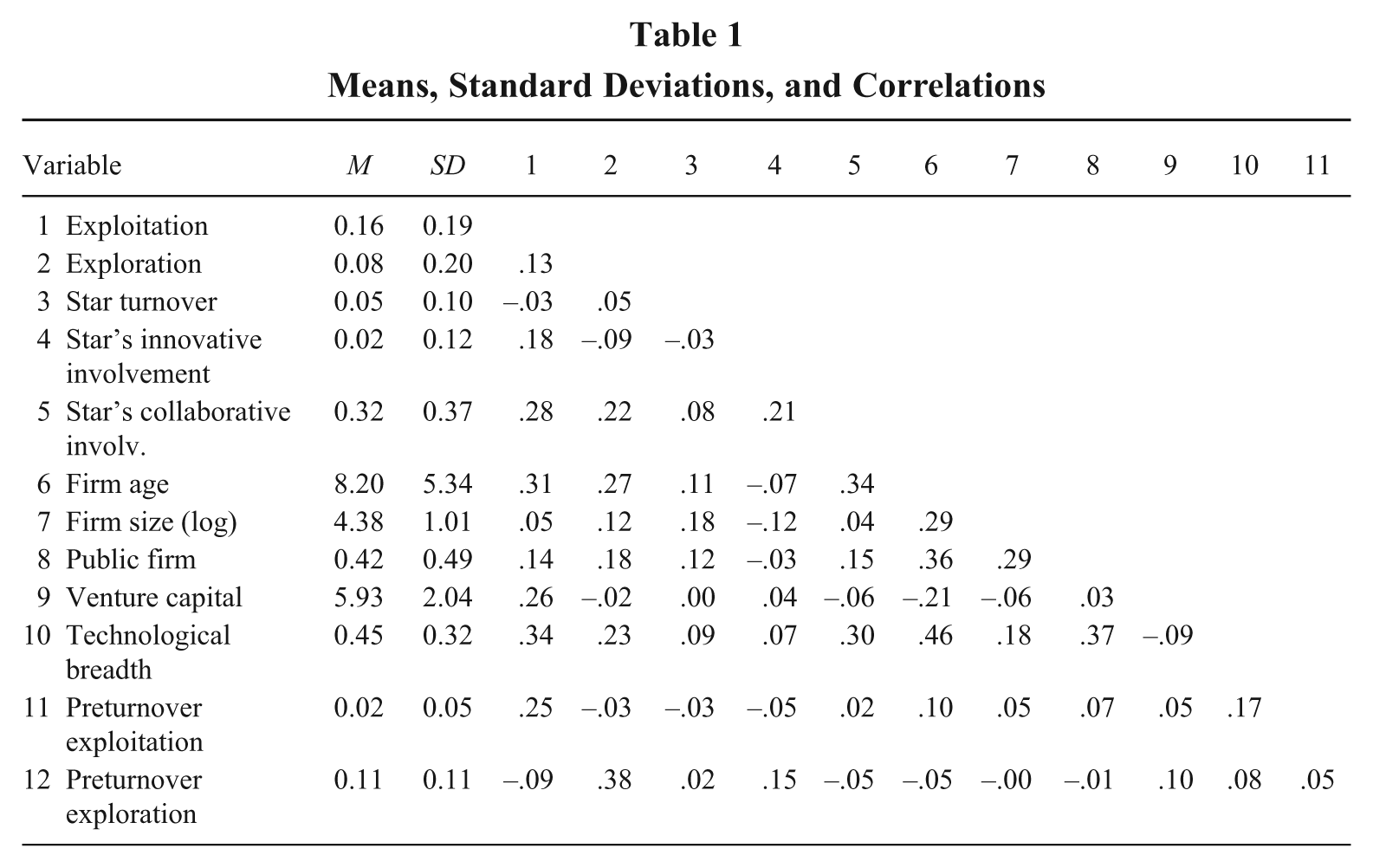
In Table 1, we present the means, standard deviations, and correlations among the independent and control variables. Variance inflation factors (VIFs) derived from an ordinary least squares regression and the modest correlations between the independent variables suggested that multicollinearity problems were unlikely (highest VIF = 4.8, well below the benchmark of 10). In addition to mean-centering the interaction terms to reduce multicollinearity, we estimated and tested the significance of groups of variables, compared against a series model, and examined the coefficients’ standard errors for inflation to ensure that multicollinearity was not causing less precise parameter estimates.
Means, Standard Deviations, and Correlations
Assessment of Endogeneity
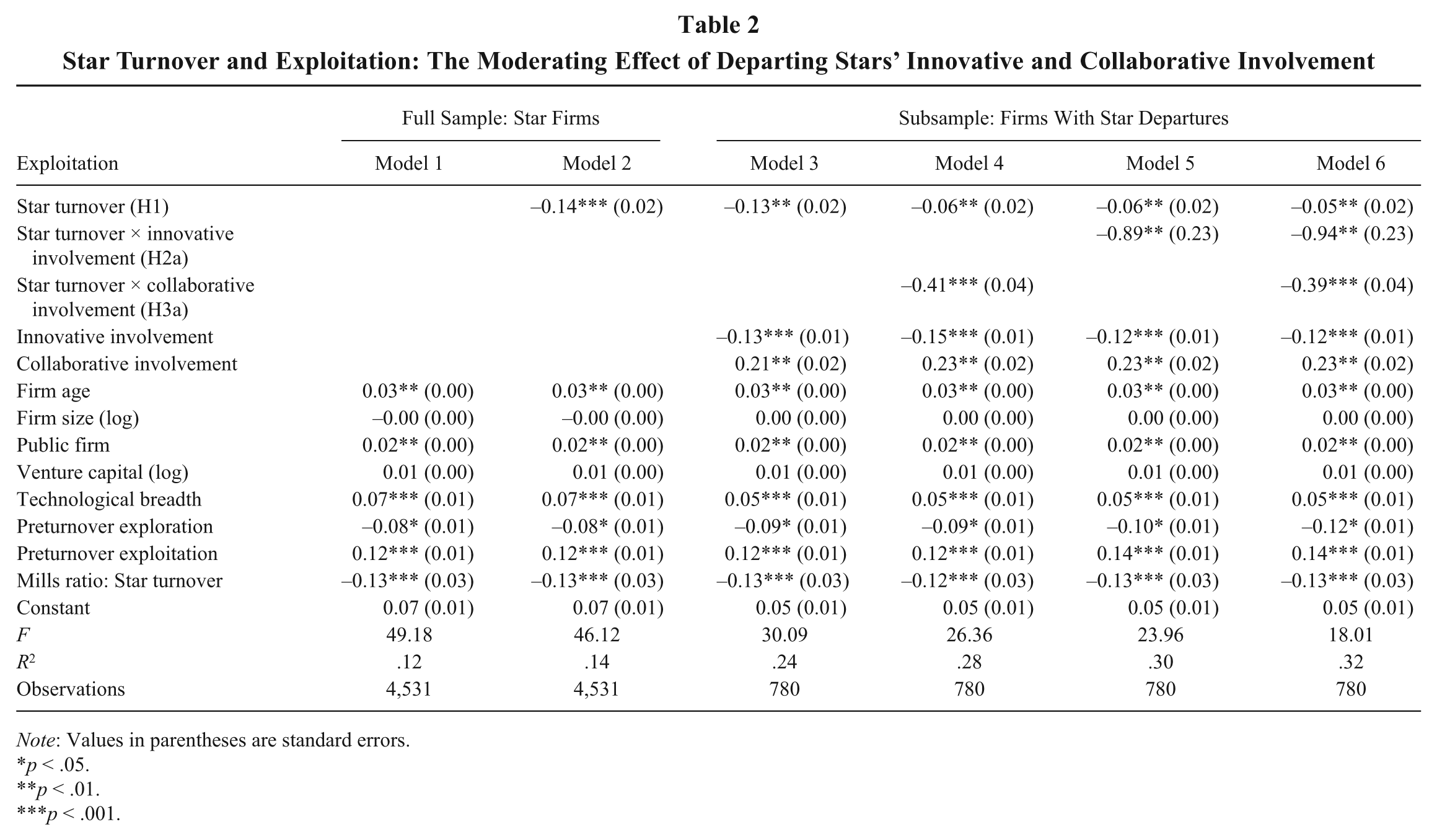
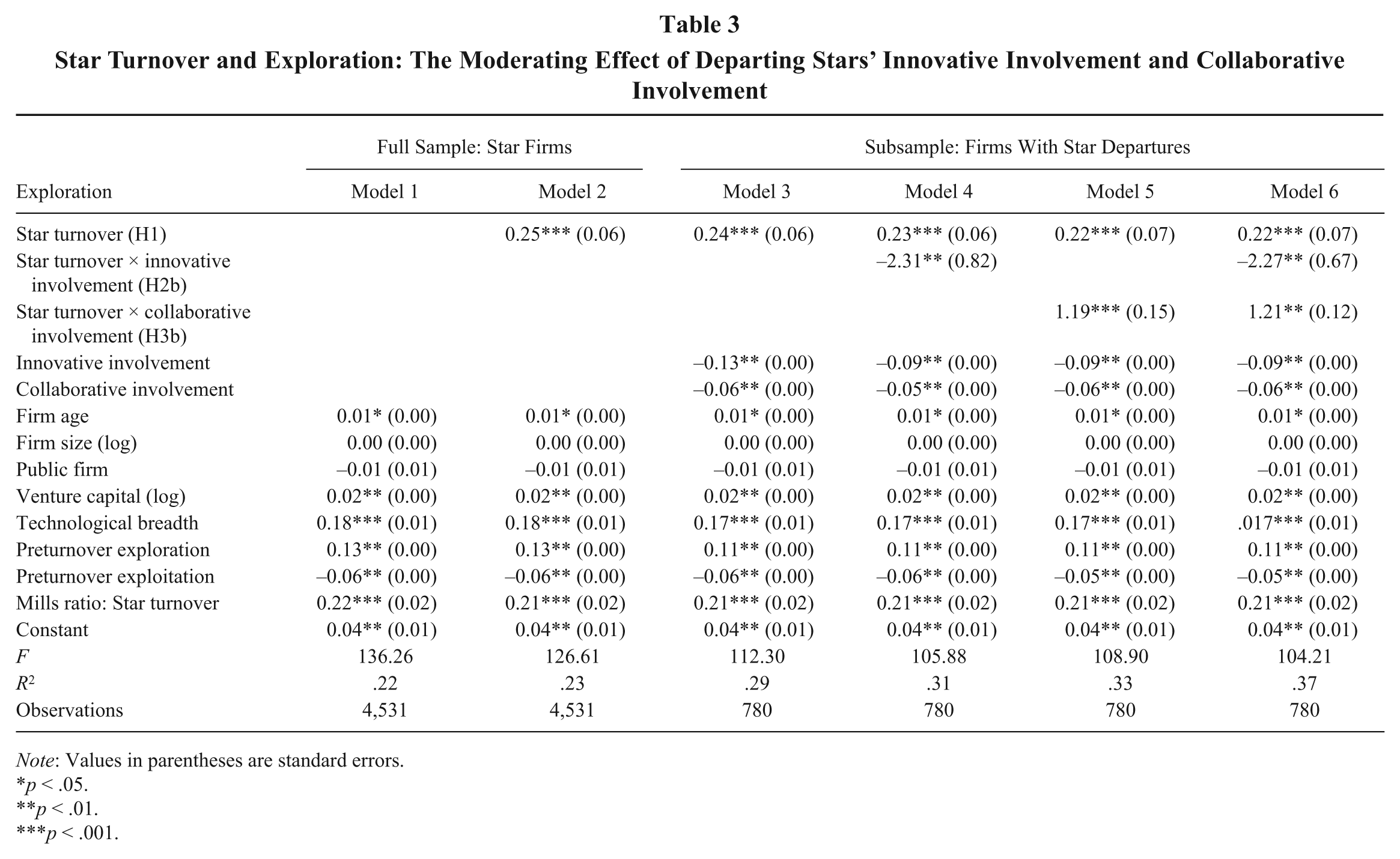
As mentioned, we employed a Heckman analysis to examine alternative explanations for our results that might suggest that the decision in a firm to change technological directions (i.e., explore) is highly correlated with star turnover. Table A1 provides estimated results of the first-stage model, in which CEO turnover, star scientist recruitment, scientist recruitment, and new R&D alliances were the independent variables explaining the likelihood of star turnover. In all models in Tables 2 and 3, the inverse ratio is significant, which indicates that unobserved firm-level factors that were previously related to firm change increase the likelihood of star turnover. These results add credence to the theoretical and empirical model and results.
Star Turnover and Exploitation: The Moderating Effect of Departing Stars’ Innovative and Collaborative Involvement
Note: Values in parentheses are standard errors.
p < .05.
p < .01.
p < .001.
Star Turnover and Exploration: The Moderating Effect of Departing Stars’ Innovative Involvement and Collaborative Involvement
Note: Values in parentheses are standard errors.
p < .05.
p < .01.
p < .001.
Results
Star Turnover and Technological Exploitation
The baseline Model 1 in Table 2 summarizes the effects of the control variables and confirms that exploitation is positively related to a firm’s age, a firm’s status as a public firm, a firm having a broad technological base, and the degree of preturnover exploitation. The degree of preturnover exploration is negatively related to exploitation. We tested Hypothesis 1a with Model 2. As expected, after accounting for a firm’s preturnover levels of exploitation by nonstar inventors, the turnover of star scientists relates negatively and significantly (β = −0.14, p < .01) to exploitation. On average, exploitation in a firm in a period when a star scientist departed is 14% lower than in firms that did not experience a star scientist’s departure. The results support Hypothesis 1a, suggesting that a star scientist’s departure disrupts existing knowledge development routines and thus reduces exploitation.
To determine whether this effect varied based on the degree of a departing star scientist’s innovative and collaborative involvement, we next focused our analyses on the subsample of firms that experienced star turnover in our study period. In Model 3, we added the relevant moderating variables. To test H2a and H3a, we added the interaction terms, one at a time, in Models 4 to 6. Model 6 represents our fully specified model. As indicated in Models 3 to 6, the interaction between star turnover and a departing star’s innovative involvement has a significant negative effect on post-turnover exploitation, consistent with Hypothesis 2a (β = −0.94, p < .01). Counter to our expectation (Hypothesis 3a), the results in Model 6 show that the interaction between star turnover and departing star collaborative involvement has a negative and significant effect on exploitation (β = −0.39, p < .01). To further evaluate the joint effect of a star’s departure and his or her innovative and collaborative involvement on post-turnover exploitation in a firm, we plotted the results comparing a firm’s exploitation at different levels of star turnover and the departing star’s innovative and collaborative involvement (Figures 1 and 2, respectively). As Figure 1 shows, we found strong support for our prediction that, as the innovative involvement of a departing star increases, the negative effect of star turnover on exploitation becomes stronger. Interestingly, Figure 1 also reveals that when a departing star is not heavily involved in the firm’s innovation activities, exploitation slightly increases following the star’s exit. This finding suggests that the turnover of stars who are less productive and less involved in a firm’s innovation activities is not as disruptive to innovation routines (and thus to exploitation) as is the departure of more heavily involved star inventors.
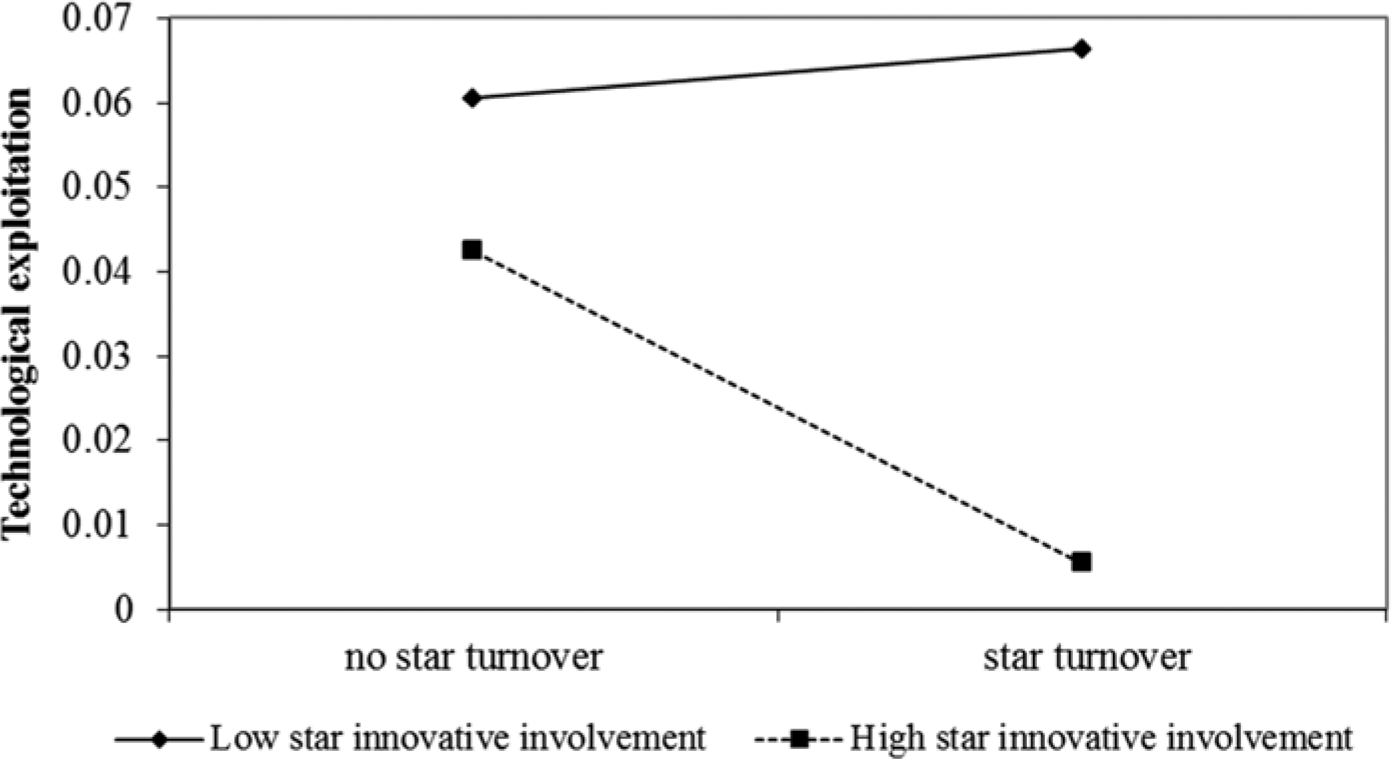
The Joint Effect of Star Turnover and Departing Stars’ Innovative Involvement on Technological Exploitation
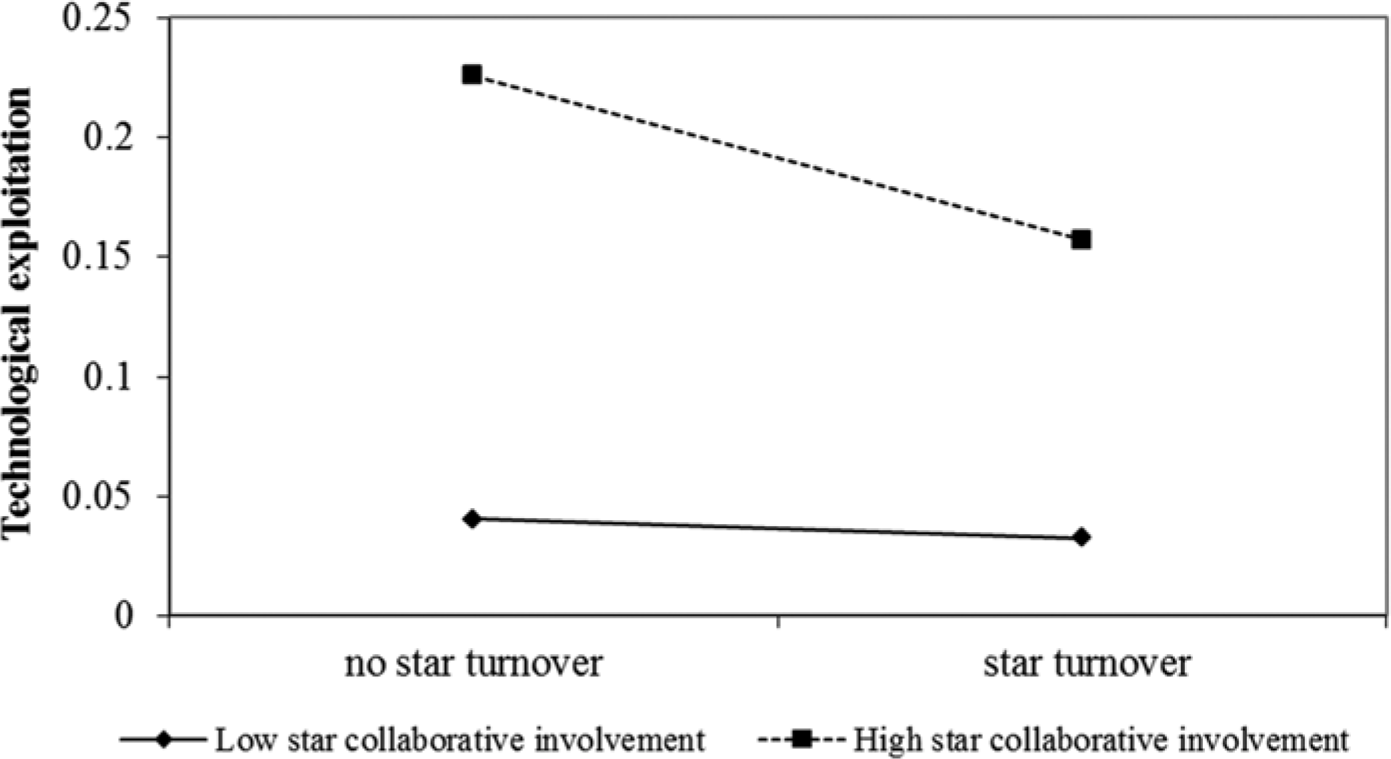
The Joint Effect of Star Turnover and Departing Stars’ Collaborative Involvement on Technological Exploitation
Counter to our expectations, the collaborative involvement of departing stars also significantly enhanced the negative effect of stars’ departure on exploitation (β = −0.39, p < .01). Graphical evaluation of the interaction term, however, provides partial support for our prediction in Hypothesis 3a that departing stars’ collaborative involvement weakens the negative effect of turnover on exploitation. In particular, as the left-hand side of Figure 2 illustrates, firms employing highly collaborative stars engage in higher levels of exploitation than do firms employing less collaborative stars. While the decrease in exploitation following star turnover is greater in firms whose departing stars have higher collaborative involvement (reflected on the right-hand side of Figure 2), exploitation in these firms is still significantly higher than in firms losing less collaborative stars following star turnover. Thus, we conclude that our results reflect partial support for Hypothesis 3a. 3
Star Turnover and Technological Exploration
The baseline Model 1 in Table 3 summarizes the effects of the control variables and confirms that exploration is positively related to a firm’s age, venture capital investment, and the degree of preturnover exploration. The degree of preturnover exploitation is negatively related to exploration. We tested Hypothesis 1b with Model 2. As expected, star scientist turnover relates positively and significantly (β = 0.22, p < .01) to exploration. On average, exploration in firms with a star scientist departure is 22% higher than in firms that did not experience star scientist turnover. This result supports Hypothesis 1b, suggesting that a star’s departure opens up opportunities for new learning and thus for exploratory search.
To determine whether this effect varied according to a departing star’s innovative and collaborative involvement, we next focused our analyses on the subsample of firms that experienced star turnover. In Model 3 we added the moderators, and in Models 4 to 6 we added the interaction terms, one at a time. Model 6 represents our fully specified model. Consistent with Hypothesis 2b, a departing star’s innovative involvement significantly reduces the positive effect of a star’s departure on exploration (β = −2.27, p < .01). In contrast, a departing star’s collaborative involvement significantly enhances the positive effect of a star’s departure on exploration (β = 1.21, p < .01), indicating support for Hypothesis 3b.
To further evaluate the joint effect of star turnover and a departing star’s innovative and collaborative involvement, we plotted the results comparing a firm’s exploration at different levels of star turnover and the departing star’s innovative and collaborative involvement (Figures 3 and 4, respectively). As Figure 3 shows, we found strong support for our prediction that, as a departing star’s innovative involvement increases, the positive effect of star turnover on exploration becomes weaker. This finding suggests that when highly involved stars leave a firm, remaining scientists are less able to explore new knowledge outside the firm’s existing expertise than when less involved stars depart. With the results depicted in Figure 1, we can conclude that the departure of a star who is heavily involved in a firm’s innovation activities undermines colleagues’ abilities to both exploit existing knowledge and explore new opportunities.
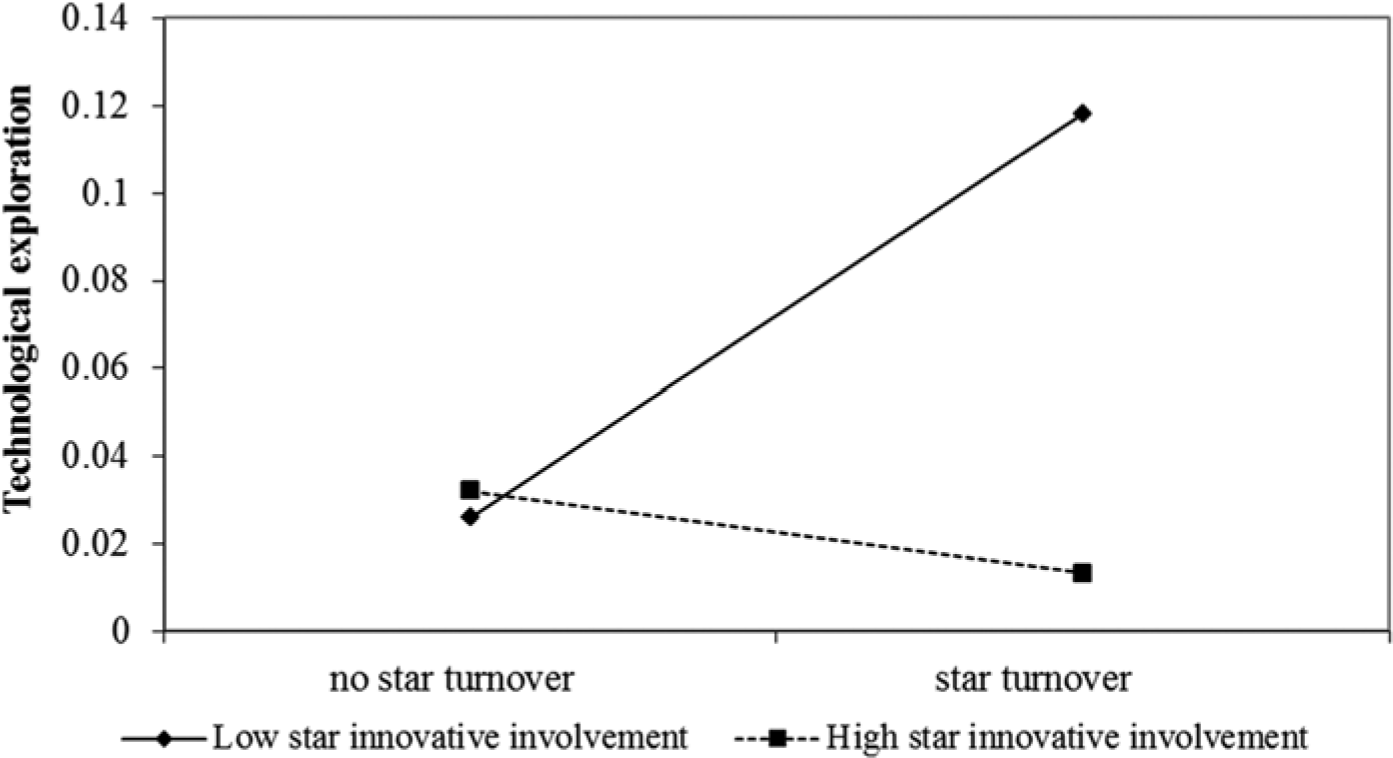
The Joint Effect of Star Turnover and Departing Stars’ Innovative Involvement on Technological Exploration
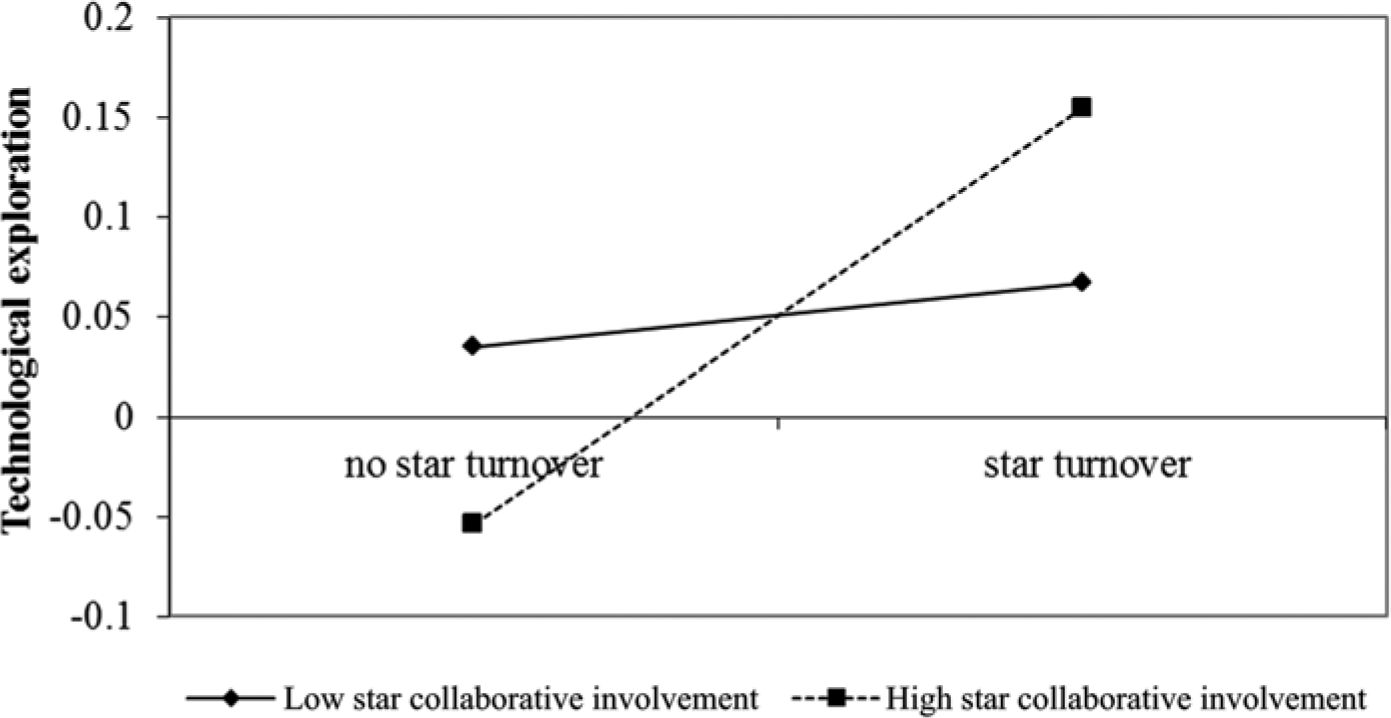
The Joint Effect of Star Turnover and Departing Stars’ Collaborative Involvement on Technological Exploration
As Figure 4 demonstrates, exploration increases at high levels of star turnover. This effect is stronger when the departing star’s collaborative involvement is high. Interestingly, as the left-hand side of Figure 4 illustrates, firms with less collaborative stars are more likely to explore new knowledge than are firms with more collaborative stars during the period of the star’s employment. This finding suggests that the opportunity to learn and explore new knowledge is greatest following the departure of stars with strong, rather than weak, collaborative involvement with their colleagues.
Sensitivity Analysis and Robustness Check
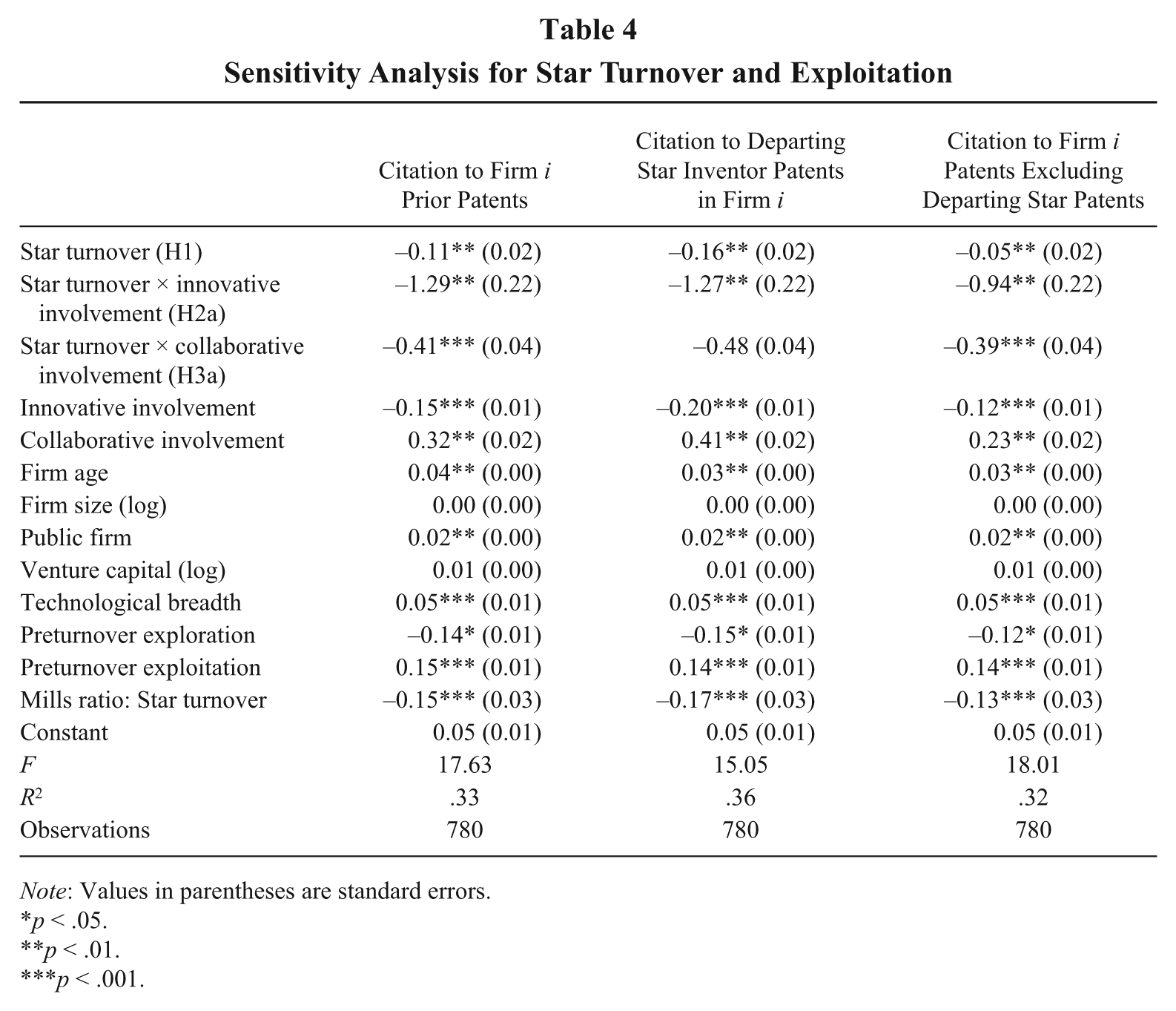
Our theory suggests that the disruption of innovation routines following star turnover decreases a firm’s exploitation of prior research. Since it is possible that our observations are driven by the removal of the departing star’s citations to his or her own prior research in firm i from the firm’s patenting activities following the star’s exit, we excluded citations to star research from our measure. To further examine what might drive these changes in a firm’s exploitative behavior, in Table 4 we present the results of a sensitivity analysis comparing three self-citation categories: (a) citation to all firm i patents, (b) citation to a departing star’s patents filed during the star’s employment at firm i, and (c) citation to firm i patents excluding citation to departing star’s patents while at i (i.e., our measure). As shown in Table 4, the negative effect of star turnover on exploitation is strongest in scenario b, where we assess exploitation as citation to the star’s own patents, and the weakest in scenario c, when citations to patents of the departing star inventor are excluded from the exploitation measure. We can conclude, hence, that star inventors’ tendency to explore within the boundaries of their existing research domains drives firm exploitation. The results provide further strong support for our theory suggesting that a star’s departure also disrupts exploitation of research areas in which the star was not involved.
Sensitivity Analysis for Star Turnover and Exploitation
Note: Values in parentheses are standard errors.
p < .05.
p < .01.
p < .001.
Consistent with prior research, we identified star inventors as individuals who (a) are highly productive and (b) have superior visibility in the external market. Despite our attempt to normalize for scientist tenure and for patent age in the classification process, our criteria for classifying stars may bias our identification of stars toward productive scientists who are older, have greater industry tenure, and thus have had greater opportunities to establish a professional reputation. To deal with this bias and for sensitivity analysis we offer supplemental analyses in which we relaxed our requirement for external recognition (i.e., patent citations) and relied only on productivity (normalizing for scientists’ tenure in the industry) in assessing performance to classify stars. Specifically, we used the following formula:
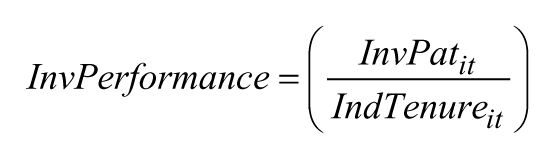
This resulted in identifying 18 more stars and 5 more turnover events totaling 95 events involving 37 firms. We present the results of analyses conducted using this star classification scheme in Tables A2 and A3 in the appendix. As shown, while the coefficients are slightly higher, they are consistent with the results reported above, thus providing additional credence to our findings.
Our data also show that, while rare, there were eight turnover instances where more than one star scientist departed in the same 3-year time period. As indicated, in these cases we used the maximum value of departing star characteristics (i.e., from the stars departing in a particular period) in relevant interaction terms. In an unreported analysis we examined our predicted relationships using the mean values of innovative and collaborative involvement of departing stars in these situations, which produced no significant change to our reported results. 4 To further eliminate the possibility that these turnover events biased our results, we conducted additional tests in which we eliminated these turnover events and the firms associated with these departures from our analyses. As shown in Tables A4 and A5 in the appendix, the results remain essentially the same, providing further credence to our theory and findings.
Discussion
This study was motivated by a critical gap in the extant literature: How and under what conditions are firms’ innovation processes likely to be most affected by the departure of a star inventor, and how do the characteristics of the departing star shape the consequences of his turnover? In examining this question we considered the unexplored idea that while the departure of star scientists may reduce exploitation, it may increase exploration in the losing firm. Furthermore, we investigated whether all star turnover events are equally disruptive. We argued and demonstrated that while star turnover disrupts innovation routines and thus reduces a firm’s tendency to conduct research in areas with which it is familiar, it simultaneously increases a firm’s propensity to conduct research beyond its existing technological boundaries. Hence, the internal shock created by star turnover provides firms with an opportunity to research beyond their existing knowledge boundaries. Furthermore, these effects are moderated by the departing star’s innovative and collaborative involvement in an organization. The results indicate that the former magnifies the negative effects of a star’s departure on exploitation and dampens the positive effect of a star’s exit on exploration. On the other hand, the departure of a star who frequently collaborates with a wide range of colleagues within the firm more negatively affects exploitation and more positively affects exploration than does the departure of other stars. As exploration is critical to ensuring a firm’s long-term viability, we suggest that our findings hint at a silver lining to the cloud sometimes associated with star or key employee turnover.
This study advances our understanding of scientist turnover in several ways. First, whereas the majority of prior research has focused on the impact of star turnover on firm performance, we examined the effect of turnover on firms’ innovation outcomes. Relating star turnover to innovation is critical because a firm’s innovation processes affect both short- and long-term performance and competitive advantage, which are not effectively captured by measures providing a mere snapshot of a firm’s financial performance. Most important, we argue and demonstrate that star scientists’ departure is related to two countervailing innovation processes. On one hand, there is an upheaval in a firm’s existing routines and core objectives, which hinders the activities geared toward exploiting existing knowledge in an organization (Ton & Huckman, 2008). On the other hand, commitment to the status quo declines, and openness to new knowledge and routines increases, thereby increasing an organization’s exploratory activities.
Second, while the majority of extant research has focused on consequences associated with the rate and degree of turnover, we add to the thin but emerging stream of research showing that the departure of high-status individuals has unique consequences for organizations (Aime et al., 2010; Phillips, 2002). By focusing on how specific characteristics of departing stars influence the effects of their turnover on innovation in organizations, we build on an emerging research stream that suggests that considering relevant attributes of who leaves an organization is critical in determining the likely consequences of turnover (e.g., Dokko & Rosenkopf, 2010; Hausknecht & Holwerda, 2013; Nyberg & Ployhart, 2013) and that the departure of high-performing (Kwon & Rupp, 2013) and “key” (Aime et al., 2010) employees may have significant implications for firm performance. In particular, we redirect this emerging literature by arguing and demonstrating that the effect of star turnover also depends on the leavers’ innovative and collaborative involvement in a firm. In doing so, we maintain that not all departures of star employees are detrimental and that the prognosis for firms losing stars may vary, and in some cases may actually not be all that dire.
Contributions to Theory and Practice
Our arguments and findings have theoretical implications both within and beyond turnover research. For instance, by marrying the knowledge-based view and resource-based view with a resource dependence perspective, we identify the specific circumstances under which a firm’s overreliance on rare and valuable human capital may in fact be detrimental to its chances for long-term viability and success (Coff & Kryscynski, 2011). Specifically, while a star’s broad involvement in a firm’s innovative initiatives provides an obvious mechanism for a firm’s maximum utilization of the star’s capabilities in the short term, such high innovative involvement of a star simultaneously funnels resources to the star’s research and away from innovative activities of other scientists, increases a firm’s dependence on the star, and exposes the firm to disarray when the star departs (Coff, 1999). In particular, this scenario leaves remaining employees in the firm lacking a clear research agenda as well as the routines and capabilities needed to forge ahead in either existing or new technological trajectories.
Continued viability of a firm’s exploratory and exploitative routines can be ensured, on the other hand, in research environments in which star inventors are encouraged to collaborate broadly with their peers. Indeed, while a star’s collaborative involvement with other scientists ensures a broad familiarity with innovation routines which focus on exploitation of the star’s expertise during a star’s employment, collaboration between a star and his colleagues also provides the motivation and opportunities necessary for the star to share the tacit knowledge required for colleagues to explore new technological domains following the star’s departure. In this way, the employment of a collaborative star may benefit both the short- and long-term success of an organization by maximizing the utilization and leveraging of a star’s expertise for short-term gains while minimizing the firm’s long-term dependence on the star as an individual by facilitating the sharing of the star’s key resource (i.e., knowledge) with other scientists in the organization.
With these insights we help to reposition research rooted in the resource-based view, which focuses on value creation associated with general properties of human capital. Specifically, whereas the extant resource-based view literature focuses on the individual characteristics of a firm’s resources to account for performance differences across firms (Barney, 1991), we highlight the social mechanisms shaped by departing star inventors that enhance or limit the innovative abilities of the scientists who remain in an organization after the departure of key inventors.
In reference to the importance of maintaining balance between exploration and exploitation (March, 1991), our arguments and findings illuminate how the employment and departure of star scientists affects the fine line between a firm’s need for stability and consistency, which increase innovative output, and its need to introduce changes in its routines, which improve long-term viability. While changes in organizational routines may be costly and hazardous (Amburgey, Kelly, & Barnett, 1993), there is growing evidence that firms need to explore new opportunities that extend beyond their current technological trajectories to survive (March, 1991). Thus, our finding that there may be a benefit to the disruptive turnover of star scientists contributes to the ongoing discussion concerning factors affecting the critical balance of exploration and exploitation within the firm (March, 1991; Sorensen & Stuart, 2000).
From an empirical standpoint, examining turnover in the context of a knowledge-based industry enables us to expand the research on turnover that has heretofore focused on professional service industries—where value lost is reflected in outcomes coproduced between the client and the service provider and in the social and cultural components of human capital (e.g., Broschak, 2004; Somaya et al., 2008). Unlike in service industries, the departure of scientists in R&D-intensive industries also represents a loss of technological or scientific capital, enabling us to take an expanded perspective on the removal of relevant human capital resources with employee departure. Our study further expands on studies set in knowledge-based industries investigating interfirm knowledge flows from the perspective of the hiring firm (e.g., Agarwal, Ganco, & Ziedonis, 2009; Almeida & Kogut, 1999; Corredoira & Rosenkopf, 2010; Oettl & Agrawal, 2008) by examining the removal and loss of core knowledge from the perspective of the losing firm. In this context, we build on emerging literatures suggesting that turnover should be viewed not solely as representing a threat to organizations, but also as an opportunity for renewal (Corredoira & Rosenkopf, 2010).
The methodological and analytical approach of this study surmounts some limitations of prior research, particularly in dealing with endogeneity bias. As shown, turnover may be correlated with unobservable factors associated with change in innovation routines, so failure to control for these correlations may yield upward biases in the estimation of the effects of turnover. Considering the limitations of cross-sectional designs and the results of our first-stage model analysis, researchers should continue to incorporate dynamic approaches to study turnover to avoid potential biases. From a practical standpoint, our findings point to the need for firms to exercise discretion in structuring resources, the division of labor, and other human capital around key employees. In particular, we suggest that firms should be wary of fostering research agendas that leverage a star’s expertise to maximize short-term gains but simultaneously dampen the firm’s resilience to the star’s departure, thus threatening the firm’s long-term viability. On the other hand, research programs characterized by high collaborative involvement of a star enable a firm to leverage a star’s knowledge in the present while simultaneously building the firm’s capacity for future renewal. Given that research environments vary in the level and longevity of performance benefits they provide and in their implications for the leveraging and development of human capital, a single approach may not be optimal for all firms. Rather, we suggest that firms manage their key human capital (e.g., stars) based on the knowledge, skills, and abilities of their other employees and according to their short-term versus long-term performance needs.
Limitations and Future Research
Like any study, this work has several limitations that affect interpretations of its results. First, our results might reflect factors specific to the biotechnology industry. Replication and elaboration of this research in other settings would be useful. In addition, relying on patent data allows us to identify a turnover event only when an inventor is granted a patent for each of his or her employers. However, our focus on the departure of star scientists who are highly prolific reduces the probability of individuals in our sample moving and not patenting with each firm (Zucker et al., 1998). Finally, we employ a traditional conceptualization of stars, which biases our findings toward the effects of older, productive, well-recognized scientists whose performance and reputation reflect accumulated successes over ample time in the industry. This approach inherently limits our ability to assess how the turnover of “rising stars,” who exhibit exceptional performance but have not yet accumulated a sufficient performance record to satisfy our “star” classification criteria, or “fading stars,” whose reduction in current innovative output either eliminates them from their once-current star status or makes it impossible for us to detect their departure to another organization (i.e., because they failed to patent at the latter employer) affects firms’ innovative processes and thus their exploration and exploitation outcomes. We thus suggest that future research examine expanded (or multicategorical) classifications of stars to capture how these other “types” of stars affect the dynamics in firms’ research environments both during and following their tenure in an organization.
Conclusions
Limitations notwithstanding, we believe that our findings cast a new light on the existing literature on changes in innovation routines following turnover. Our findings regarding turnover demonstrate how stars’ characteristics can affect relationships between turnover and innovation, but also how they affect a firm’s ability to change its innovation routines over time. Studying how star characteristics constrain or promote change in routines constitutes an important step in extending our knowledge about the ways in which dependence on and departure of key employees affect preservation, deterioration, and renewal of organizations’ innovative capabilities.
Footnotes
Appendix
Acknowledgements
We are indebted to Russ Coff and two anonymous reviewers for their contribution to the development of this article. An earlier version of the article won the Best Paper award in the Technology Innovation Management Division at the 2013 Academy of Management annual meeting.