







Abstract
Perceived overqualification (POQ) has traditionally been seen as an undesirable employment situation associated with negative outcomes. However, recent research suggests that POQ may have positive implications for both employees and organizations. Despite the growing literature on this topic, scholars have offered numerous explanatory mechanisms for linking POQ with its work outcomes, and inconsistent findings have been reported, highlighting the need for a comprehensive understanding of why, where, and for whom POQ is beneficial or detrimental. In the present study, we developed an integrative theoretical framework that depicts the consequences, mechanisms, and moderators of POQ. We then conducted a meta-analytical review of the POQ literature, analyzing 704 effect sizes from 251 independent samples (N = 87,229). By organizing the dominant mechanisms in POQ research within a unified framework of work motivation, we elucidate the distinct pathways by which POQ induces differential work consequences. We further consider the role of key cultural, economic, sociodemographic, and methodological characteristics as boundary conditions. Overall, our findings provide support for our predictions and provide novel insights into the work-related consequences of POQ. Theoretical and practical implications of our findings are thoroughly discussed.
Perceived overqualification (POQ) reflects an employment condition in which employees believe they possess skills, education, and experience that exceed what is needed or required in their job (Johnson & Johnson, 1996; Maynard, Joseph, & Maynard, 2006). Often viewed as an undesirable experience that can impede work motivation (Erdogan & Bauer, 2021), POQ is a common phenomenon in the workplace. Indeed, estimates suggest that up to a third of the global workforce may consider themselves overqualified for their job (Ipsos, 2011; PwC, 2023; Urquhart, 2022). Consequently, organizational scholars have devoted considerable attention to understanding the work-related implications of POQ (see Erdogan & Bauer, 2021, for a review). While much of this research has concentrated on the negative consequences of POQ (e.g., Erdogan & Bauer, 2009; Feldman, Leana, & Bolino, 2002; Fine & Nevo, 2008), recent work has begun to uncover its positive effects as well (e.g., Duan, Xia, Xu, & Wu, 2022; Ma, Chen, & Jiang, 2022; Van Dijk, Shantz, & Alfes, 2020; Zhang, Law, & Lin, 2016).
However, despite its widespread occurrence and the growing acknowledgment that POQ does not invariably lead to negative outcomes, the field lacks a comprehensive understanding of why, where, and for whom POQ is beneficial or detrimental. This limitation is significant given the vast number of explanatory variables proposed to link POQ to work outcomes and the inconsistent results in the extant literature (e.g., Hu, Erdogan, Bauer, Jiang, Liu, & Li, 2015; Ma, Lin, & Wei, 2020; Ma, Shang, Zhao, Zhong, & Cha, 2023; Wu, Tian, Luksyte, & Spitzmueller, 2017). For instance, findings on the relationships between POQ and various job performance indicators are decidedly mixed (Harari, Manapragada, & Viswesvaran, 2017; McKee-Ryan & Harvey, 2011), with evidence of positive (e.g., Fine & Nevo, 2008), negative (e.g., Bolino & Feldman, 2000), and null relationships (e.g., Erdogan & Bauer, 2009) in prior empirical studies. These inconsistencies in the literature necessitate a more robust theoretical integration and informative research evidence to understand the work-related consequences of POQ.
While a recent review (Erdogan & Bauer, 2021) and two meta-analyses (Harari et al., 2017; Yang & Li, 2021) have sought to clarify the relationships between POQ and its outcomes, these efforts remain limited in important ways. Erdogan and Bauer proposed an intriguing framework to understand the differential consequences of POQ (i.e., motivation vs. capability), but their review was conceptual, leaving the distinct pathways through which POQ affects work outcomes largely unverified. Furthermore, while there exists meta-analytic evidence of the relationships between POQ and work outcomes, these studies either provided little to no explanation for mechanisms (Harari et al., 2017) or focused on particular subsets of mediators (e.g., negative emotions and positive self-evaluation; Yang & Li, 2021) and thus stopped short of conducting a comprehensive investigation of the dominant mechanisms linking POQ to work outcomes. This oversight is significant, as one of the primary criticisms of the POQ literature is the piecemeal fashion in examining mediators, with scholars explicitly calling for “careful integration and joint inclusion in empirical studies” (Erdogan & Bauer, 2021: 274). Despite these reviews, the literature still lacks a robust theoretical framework to understand the differential effects of POQ.
In the present study, we advance the POQ literature by developing an integrative, theory-driven, meta-analytic model—one that assesses the distinct motivational mechanisms through which POQ influences outcomes as well as the cultural, economic, sociodemographic, and methodological characteristics that further shape these relationships. Prior research linking POQ to work outcomes has evolved around two lenses: one views POQ as a demotivator (i.e., a deficiency in one’s job) and another views POQ as a capability (i.e., a possession of superior skills). As a demotivator, POQ is likely to be experienced negatively and provide employees with little justification to engage productively at work (e.g., Bolino & Feldman, 2000; Erdogan & Bauer, 2009; Fine & Nevo, 2008). As a capability, POQ may be experienced positively and provide employees with the sense that they have the know-how to influence the work environment in productive ways (e.g., Lin, Law, & Zhou, 2017; Van Dijk et al., 2020; Zhang et al., 2016). As these divergent lines of research suggest, POQ is likely to generate distinct and potentially competing motivational states. What is sorely needed is a unifying framework that can accommodate these two lenses while shedding light on their specific motivational mechanisms and distinct predictions at a more granular level.
To examine such possibilities, we borrow from Parker, Bindl, and Strauss’s (2010) model of work motivation to understand the mechanisms through which POQ impacts outcomes. According to this theoretical framework, employee work behavior and outcomes are a product of three motivational states: “reason-to” states, which focus on whether employees have sufficient justification to behave productively; “energized-to” states, which focus on the affective states that influence whether employees will behave productively; and “can-do” states, which focus on whether employees possess the necessary capabilities to behave productively (Hu, Jimmieson, & White, 2022; Schaubroeck, Shen, & Chong, 2017). In line with the prevalent view of POQ as inadequate employment status, we propose that POQ interpreted as a deficiency in one’s job inhibits employees’ reason-to and energized-to motivational states. Conversely, in line with the emerging perspective of POQ as possessing surplus skills, we propose that POQ interpreted as capability facilitates employees’ can-do motivational states. We then link these motivational states to key work outcomes that have been examined in the POQ literature (see Figure 1)—namely, in-role performance, extra-role performance, counterproductive work behavior, and workplace well-being.
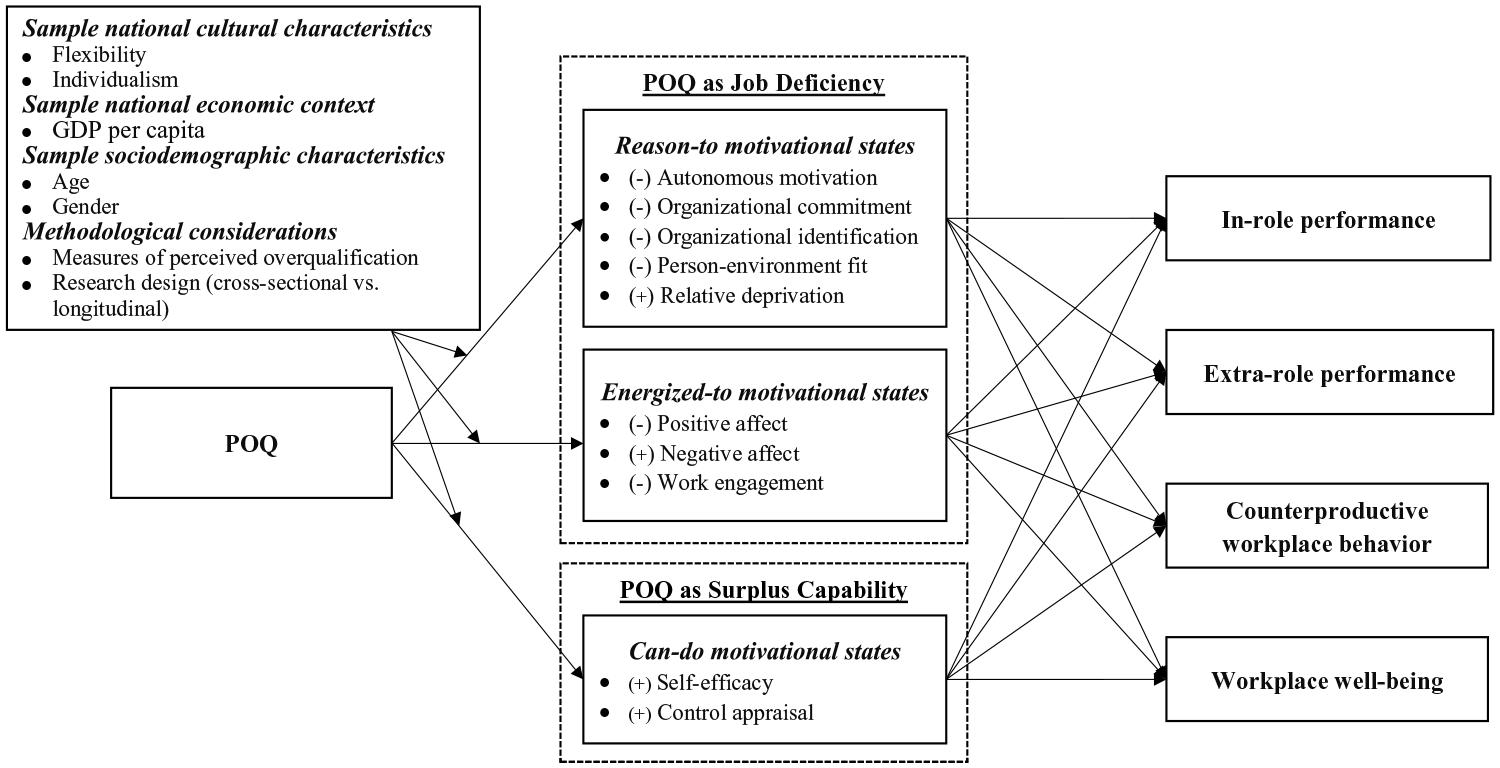
Theoretical Model of POQ, Motivational States, Work Outcomes, and Moderators
In addition, our integrated meta-analytical review provides a more holistic and nuanced view of the POQ literature by taking into account cultural, economic, and sociodemographic factors that shape the positive and negative consequences of POQ. Prior research suggests that cultural variations exist in reactions to perceptions of overqualification (Erdogan & Bauer, 2021; Luksyte, Bauer, Debus, Erdogan, &Wu, 2022). Despite recent review work on the topic, significant gaps in our knowledge persist. Notably, prior meta-analytical studies (Harari et al., 2017; Yang & Li, 2021) have focused on limited cultural factors that have been subject to criticism due to their perceived outdated nature and questioned validity (Minkov, 2018; Oyserman, Coon, & Kemmelmeier, 2002). We leverage the revised Minkov-Hofstede model of national culture to draw a systematic picture of how cultural dimensions (i.e., flexibility and individualism) shape employees’ appraisals of and reactions toward POQ (Minkov et al., 2017, 2018). Flexibility and individualism are theoretically relevant cultural dimensions for understanding when POQ will be interpreted as job deficiency or surplus capability, as these dimensions play a significant role in shaping individuals’ sense of self-importance, how they are likely to interpret and react to setbacks, and the overall importance they are likely to attach to their personal interests and needs (Minkov & Kaasa, 2022). Moreover, and in line with prior POQ scholarship that has recognized the broader economic environment as having the potential to shape how employees interpret and react to their POQ (Erdogan, Bauer, Peiro, &Truxillo, 2011), we investigate the moderating role of national gross domestic product (GDP) per capita. In doing so, we provide the first comprehensive examination of how the broader economic context (i.e., GDP per capita) influences the relationship between POQ and its work outcomes. Finally, while gender and age have been examined as potential correlates of POQ (Harari et al., 2017), how they affect the work motivation and outcomes of those employees who view themselves as overqualified remains unexamined. We aim to shed light on the question of for whom POQ is more likely to be a benefit or a detriment by exploring the moderating effect of such sociodemographic variables in our meta-analytical investigation.
Lastly, we enrich the POQ literature by examining several key methodological moderators. While previous studies have acknowledged the potential influence of methodological factors (Feldman, 1996; Yang & Li, 2021), they have yet to examine how these factors impact the effect size of POQ on its consequences. Research has noted that certain study designs, such as cross-sectional studies, may inflate effect sizes (Liu & Wang, 2012), and the choice of measurement, such as scales used, can systematically influence bivariate relationships (Sverke, Hellgren, & Näswall, 2002). We aim to shed light on future POQ research by examining the impact several key methodological characteristics—variation in (a) the scales used to measure POQ and (b) study designs (cross-sectional vs. longitudinal, single-source vs. multiple-source)—have on the relationships between POQ and its outcomes.
Our study makes three important contributions to the literature. First, while prior studies have examined both positive and negative workplace outcomes of POQ (e.g., Lee, Erdogan, Tian, Willis, & Cao, 2021), the literature lacks a comprehensive theoretical framework to understand the countervailing mechanisms that underpin the relationship between POQ and work outcomes. By building on Parker et al.’s (2010) work motivation model to understand POQ, we provide much-needed clarity as to why POQ may concurrently lead to positive and negative work-related consequences. Second, our investigation into the cultural, economic, and sociodemographic characteristics that shape the relationship between POQ and its outcomes offers critical insights as to where and for whom POQ may be experienced as more detrimental or beneficial. In doing so, we address calls for a more contextual understanding of overqualification (Erdogan et al., 2011; Hu et al., 2015). Finally, our examination of methodological moderators provides a nuanced understanding of the complex effects of POQ documented in the literature. Thereby, we not only respond to calls for greater methodological rigor in overqualification research (Liu & Wang, 2012; McKee-Ryan & Harvey, 2011) but also provide a methodological roadmap for future research in this area.
Theoretical Background And Hypotheses
An Integrative Framework of POQ and Its Consequences
The prevailing view in the existing literature is that POQ 1 is a negative experience (Erdogan & Bauer, 2021), typically involving perceptions of deficiency (Erdogan et al., 2011; Erdogan, Tomás, Valls, & Gracia, 2018) and misalignment with one’s job or organization (Luksyte & Spitzmueller, 2016; Maynard et al., 2006). Research from this viewpoint has identified several explanatory mechanisms linking POQ to adverse work outcomes, including perceptions about one’s lack of fit within the work environment (e.g., Luksyte et al., 2022), lack of internal interests and values about work (e.g., Simon, Bauer, Erdogan, & Shepherd, 2019), perceptions of relative deprivation (e.g., Lee et al., 2021), and strong negative affective states (e.g., Liu, Luksyte, Zhou, Shi, & Wang, 2015). However, a contrasting perspective has emerged in recent years, focusing on the surplus skills and qualifications that can accompany POQ (Erdogan & Bauer, 2021). This viewpoint acknowledges the additional capabilities employees who view themselves overqualified can leverage to manage their job demands and perform at high levels (e.g., Deng, Guan, Wu, Erdogan, Bauer, & Yao, 2018). Studies adopting this perspective have identified positive self-assessments, such as self-efficacy (Zhang et al., 2016), as the primary mechanisms linking POQ to beneficial work outcomes. Importantly, the interpretation of POQ (whether as job deficiency or surplus capability) that is most salient in employees’ minds can significantly impact their performance, work behavior, and workplace well-being.
Given these divergent perspectives, scholars have noted that current explanations for why POQ leads to disparate outcomes are limited by the fragmented approach in which explanatory mechanisms have typically been investigated in prior literature (Erdogan & Bauer, 2021). This is particularly noteworthy given the abundance of mediators that have been proposed as potential explanations for the negative consequences of POQ. We concur with Erdogan and Bauer (2021: 274) that, “the examination of mediators would benefit from taking a theory-based approach.” To this end, we draw from existing theory and research on work motivation (Hu et al., 2022; Parker et al., 2010) to provide a comprehensive, theory-driven framework for understanding why POQ leads to positive or negative consequences.
Grounded in traditional theories of motivation (e.g., Eccles et al., 1983; Vroom, 1964), Parker et al. (2010) introduced a theoretical model to explain the dominant underlying motivational states that influence employee behavior. Though it was initially developed to understand proactive behavior, the model has since been applied more broadly to explain a broad array of situations and work outcomes (e.g., Bharanitharan, Chen, Bahmannia, & Lowe, 2019; Hu et al., 2022; Pan & Lin, 2015; Schaubroeck et al., 2017). The first motivational pathway, labeled “reason-to” motivation, reflects the presence of a compelling reason or justification for action and involves questions such as “Why should I do this?” and “Is there value in doing this?” It includes employees’ autonomous motivation and internalized states such as identity and commitment. The second motivational pathway, labeled “energized-to” motivation, reflects the affective states that influence action and involves questions such as “Do I feel like doing this?”, though the influence of certain affective states may be below the level of conscious awareness. It includes employees’ affective states at work. The third motivational pathway, labeled “can-do” motivation, reflects employees’ beliefs regarding their capabilities for action and involves questions such as “Can I do this?” and “Is it feasible for me to do this?” It includes employees’ perceptions about their self-efficacy and control appraisals. These motivational states can play distinct roles and jointly affect employee work outcomes (Cai, Parker, Chen, & Lam, 2019).
We believe Parker et al.’s (2010) model of work motivation provides a compelling framework to examine the divergent consequences of POQ. As illustrated in Figure 1, we systematically organize the dominant mechanisms through which POQ relates to work outcomes according to three distinct explanations. For the reason-to pathway, POQ is perceived as a deficiency that inhibits employees from forming adequate rationales and justifications toward their work. Variables in this category include employees’ cognitive evaluations (i.e., person-environment fit and relative deprivation) and internalized psychological states (i.e., organizational commitment, organizational identification, and autonomous motivation). For the energized-to pathway, POQ is perceived as a deficiency that triggers aversive affective reactions at work that produce deleterious work outcomes. Variables in this category include employees’ affective reactions (i.e., positive affect, negative affect, and work engagement). For the can-do pathway, POQ is perceived as a capability that highlights employees’ beliefs that they possess the talents and resources to perform well and engage positively at work. Variables in this category include employees’ beliefs regarding competence (i.e., self-efficacy) and feasibility (i.e., control appraisal).
We focus on two broad categories of work outcomes in our meta-analytical review. The first is job performance, which includes the following: (a) in-role performance (also termed “task performance”), referring to activities at work that accomplish job duties and responsibilities (Motowidlo, 2003); (b) extra-role performance, involving discretionary actions that contribute to organizational effectiveness (Katz & Kahn, 1978); and (c) counterproductive work behaviors, encompassing voluntary behaviors that hinder an organization’s effectiveness and/or its members (Robinson & Bennett, 1997). This cluster of outcomes offers a comprehensive understanding of employees’ performance at work (Rotundo & Sackett, 2002) and has been widely examined in organizational research (e.g., Colquitt, Scott, & Lepine, 2007; Colquitt et al., 2013; Diehl, Richter, & Sarnecki, 2016; Martin, Guillaume, Thomas, Lee, & Epitropaki, 2016).
The second category is employee workplace well-being, which we conceptualize as job-related satisfaction and mental and physical health in the workplace 2 (Danna & Griffin, 1999). Existing research suggests that POQ is largely detrimental to employee well-being (e.g., Erdogan et al., 2018; Harari et al., 2017; McKee-Ryan & Harvey, 2011). However, this may be because studies examining the relationship between POQ and well-being have predominantly viewed POQ as a deficiency (i.e., Erdogan et al., 2018) while overlooking the potential positive impact of POQ on employee well-being. With our proposed framework, we provide a more balanced view of the relationship between POQ and its outcomes, including well-being. In the following section, we develop a series of predictions regarding the effects of POQ on each pathway as well as its distal impact on the aforementioned outcomes.
POQ as Job Deficiency: Impacts on Reason-to and Energized-to States and Outcomes
By and large, people often assume that their job should align with their qualifications (Hu et al., 2015; Vaisey, 2006). For instance, it is generally accepted that those with higher education levels should have jobs with superior social status, better pay and benefits, and promising career prospects (Rose, 2005). The perception of overqualification suggests that employees feel that there is a deficiency in their job, such that their skills and qualifications are not fully utilized or valued in their current roles (Erdogan et al., 2011). We contend that, when interpreted as deficiency, POQ negatively impacts both employees’ rational justifications for their work (i.e., reason-to motivation) and their affective reactions to it (i.e., energized-to motivation), ultimately hindering their work performance and well-being.
Jobs that fail to fully utilize employees’ potential provide little reason or incentive for them to work hard or integrate into the work environment (Liu & Wang, 2012). Existing research suggests that overqualified employees may blame their organization for not providing suitable conditions to showcase their talents, leading employees to psychologically distance themselves from and become less attached to the organization (Fan, He, Dai, Jing, & Shang, 2023; Liu et al., 2015). Overqualified employees are less likely to develop a sense of ownership of the organization or a willingness to work toward collective goals (Ma et al., 2023; Wu, Weisman, Sung, Erdogan, & Bauer, 2022). Consistently, research has found POQ to predict a range of psychological states that reflect a lack of interest in or internalized justification toward their work, including reduced organizational commitment (Bolino & Feldman, 2000; Maynard et al., 2006) and identification (Zhao, Zhao, Zeng, & Bai, 2021), perceptions of lack of fit (Luksyte, Spitzmueller, & Maynard, 2011) and deprivation (Erdogan et al., 2018), and reduced autonomous motivation (Chambel, Carvalho, Lopes, & Cesário, 2021).
In addition to POQ’s effects on employees’ cognitive justifications and internalized psychological states, perceiving underutilization in one’s job may also trigger aversive affective reactions that impede employees’ willingness or ability to fully engage in their work. For example, overqualified employees may feel mistreated by their organization because they believe that the organization should provide opportunities and resources that align with their qualifications (Liu & Wang, 2012; Liu et al., 2015). They may develop feelings of anger and resentment toward their organization over their underutilization (Liu et al., 2015); experience painful social comparisons with their peers (Li, Liao, & Han, 2022); or feel frustrated, anxious, or bored at work (Andel, Pindek, & Arvan, 2022; Zhang, Yan, Wang, Qu, & Qian, 2022). Consistent with this view, research has found POQ to trigger a range of negative emotional states (Yu, Yang, Wang, Sun, & Hu, 2021) as well as a reduction in positive affect states (Allan, Rolniak, & Bouchard, 2020) and general work engagement (Dumani, 2015). Taken together, we hypothesize the following:
Hypothesis 1a: POQ is negatively related to reason-to motivational states.
Hypothesis 1b: POQ is negatively related to energized-to motivational states.
We further consider the potential for POQ to harm employee job performance and workplace well-being by way of its negative impact on their motivational states. Research has long established that motivational processes, which involve individuals’ cognitive evaluations and internalized states as well as their affective experiences, can significantly influence work outcomes (Kanfer, Frese, & Johnson, 2017). For employees who perceive themselves as overqualified, reduced reason-to and energized-to motivational states can make them less willing to engage and persist in effortful acts such as accomplishing tasks (e.g., Hu et al., 2015) and can even affect their health and psychological well-being (Erdogan et al., 2018). Accordingly, we propose that POQ negatively impacts employee work outcomes through two distinct motivational pathways.
First, POQ has a negative impact on employee work outcomes through reason-to motivational states. Decades of organizational research have emphasized the important role that employees’ cognitive rationales and justifications toward their work play in shaping their work outcomes (Kanfer et al., 2017). For instance, employees’ perceptions regarding how well their skills and abilities align with the organization’s needs (Greguras & Diefendorff, 2009), their psychological attachment to and embeddedness in the work environment (Meyer, Paunonen, Gellatly, Goffin, & Jackson, 1989), or their beliefs regarding how they compare to others both inside and outside of work (Zoogah, 2010) all stand to influence the amount of effort employees will devote to behaving productively and achieving positive work outcomes (Kanfer et al., 2017; Parker et al., 2010). Consistent with these arguments, employees who perceive they are overqualified may struggle to justify exerting sufficient effort toward their work, which can negatively influence their work outcomes. For example, research has found that through its effects on key psychological states, such as perceptions of person-environment fit, relative deprivation, and perceived autonomy, POQ can impact a range of work outcomes including performance and well-being (e.g., Hu et al., 2015; Luksyte et al., 2022; Simon et al., 2019).
Second, POQ negatively impacts employee work outcomes through energized-to motivational states. It is well understood in research that experiencing negative affective states, or failing to experience positive states and become engaged at work, can have profound consequences on employees’ well-being and their tendency to perform productively at work. Indeed, as with the emergence of negative cognitive appraisals, the experience of aversive affective reactions can impair individuals’ self-regulatory functioning (Lerner & Tiedens, 2006; Tiedens, 2001) and detract from the amount of effort employees put into their work (Kaplan, Bradley, Luchman, & Haynes, 2009); these are key processes that can thwart employees’ positive work behavior and well-being (e.g., Koopman, Lanaj, & Scott, 2016; Lian, Brown, Ferris, Liang, Keeping, & Morrison, 2014). Consistent with these arguments, research has found that POQ can produce negative emotional reactions that can ultimately harm their work outcomes (Peng, Yu, Peng, Zhang, & Xue, 2023). For example, through its effects on employees’ affective states, such as anger and envy, POQ is likely to lead to a range of detrimental outcomes, including reduced performance and increased CWBs (Li et al., 2022; Liu et al., 2015; Peng et al., 2023).
Taken together, we propose that POQ will impede employees’ reason-to and energized-to states, which ultimately detracts from their work performance and overall well-being. We therefore hypothesize the following:
Hypothesis 2a: POQ has a negative indirect effect on employee (a) in-role performance, (b) extra-role performance, and (c) workplace well-being and a positive indirect effect on (d) counterproductive workplace behavior via reason-to motivational states.
Hypothesis 2b: POQ has a negative indirect effect on employee (a) in-role performance, (b) extra-role performance, and (c) workplace well-being and a positive indirect effect on (d) counterproductive workplace behavior via energized-to motivational states.
POQ as Surplus Capability: Impacts on Can-Do States and Outcomes
While POQ may be seen as job deficiency and, therefore, lead to detrimental effects on employee outcomes, a growing body of literature suggests that POQ can also yield beneficial consequences in the workplace (e.g., Lee et al., 2021; Lin et al., 2017; Zhang et al., 2016). This view highlights the positive self-assessments overqualified employees may form regarding their surplus skills and qualifications (Erdogan & Bauer, 2021; Lee et al., 2021). Such positive self-assessments can shape overqualified employees’ beliefs about their ability to successfully manage job demands and complete their tasks (Van Dijk et al., 2020; Zhang et al., 2016). Accordingly, we posit that when interpreted as capability, POQ facilitates employees’ beliefs in their abilities and control over their work (i.e., can-do motivational states), ultimately facilitating positive work outcomes.
Although viewing oneself as overqualified for the job might provide little reason or energy for employees to engage productively in their work, it is likely to instill in them the understanding that they are certainly capable of performing at a high level. Prior research, for instance, has found a positive relationship between POQ and role-breadth self-efficacy (Zhang et al., 2016), as well as task mastery (Lee et al., 2021). In line with this prior work and research on work motivation (Parker et al., 2010), we focus on two sets of psychological states that reflect employees’ can-do assessments and beliefs about their competence in relation to their work. These are beliefs about their ability to execute behavior required to successfully finish work tasks (i.e., self-efficacy) and beliefs that their behavior will result in desired outcomes (i.e., control appraisal). We therefore hypothesize the following:
Hypothesis 3: POQ is positively related to can-do motivational states.
Through its impact on employees’ can-do states, POQ should have a beneficial impact on work outcomes. A wide range of studies have suggested that individuals’ belief in their ability is a critical factor for achieving high levels of job performance and work-related well-being (Judge & Bono, 2001; Nielsen, Nielsen, Ogbonnaya, Känsälä, Saari, & Isaksson, 2017; Wood & Bandura, 1989). Indeed, a belief that one can succeed and achieve desirable outcomes can prompt individuals to set more challenging goals at work (Locke & Latham, 1990) and persistently pursue more effective and efficient behavioral strategies (Lent, Brown, & Larkin, 1987). For overqualified employees, the emergence of such can-do states may enhance their tendency to utilize their surplus knowledge or abilities to carry out job-related activities more effectively (Erdogan & Bauer, 2021).
In particular, prior research suggests that a heightened belief about their abilities may increase overqualified employees’ task-related efforts (Erdogan & Bauer, 2009) and provide them with the additional bandwidth to put forth effort beyond their required in-role duties (Deng et al., 2018). Because they possess skills and expertise that exceed what is needed in their job, overqualified employees may also sense that they have more control over the environment (Lin et al., 2017; Zhang, Wang, Qian, & Parker, 2021), which can allow them to deploy effective coping strategies to anticipate and overcome performance shortfalls (Carver & Scheier, 2001; Zimmerman, 2000). A strong sense of control may also help overqualified employees refrain from engaging in counterproductive behavior. Prior research, for instance, suggests that without effective ways to cope with work demands, employees may lash out in ways harmful to individual and organizational performance (Krischer, Penney, & Hunter, 2010). Moreover, a series of studies have found that merely feeling in control over one’s own behavior can provide individuals with the necessary willpower to avoid maladaptive behavior (e.g., Chow, Hui, & Lau, 2015; Job, Dweck, & Walton, 2010), including CWBs (e.g., Debusscher, Hofmans, & De Fruyt, 2016). Furthermore, a heightened level of perceived competence and control implies that employees hold positive self-views (Deng et al., 2018), which should be beneficial to their overall well-being at work (Nielsen et al., 2017).
Taken together, we propose that POQ will activate employees’ can-do states, thereby exerting a beneficial impact on their work performance and overall well-being. We, therefore, hypothesize the following:
Hypothesis 4: POQ has a positive indirect effect on employee (a) in-role performance, (b) extra-role performance, and (c) workplace well-being and a negative indirect effect on (d) counterproductive workplace behavior via can-do motivational states.
Moderators of POQ and Its Consequences
As described previously, POQ can be interpreted as job deficiency or surplus capability, which can differentially influence work outcomes. As a result, it is important to further understand where and for whom such disparate consequences occur. In the present research, we focus on cultural characteristics (i.e., cultural flexibility and individualism), the economic environment (GDP per capita), and sociodemographic characteristics (i.e., age and gender). Notably, we go beyond prior studies by leveraging an advanced culture framework—that is, the Minkov-Hofstede two-dimensional cultural model—to comprehensively examine the cross-cultural differences that may shape the relationship between POQ and its outcomes (Minkov & Kaasa, 2022; Minkov et al., 2017, 2018). In addition, we provide one of the first comprehensive examinations of how the broader economic context (i.e., GDP per capita) influences the relationships between POQ and work outcomes. Finally, our investigation into the role of gender and age goes beyond their mere relationships with POQ itself, focusing instead on how such sociodemographic variables shape overqualified employees’ motivational states and subsequent work outcomes.
Cultural Characteristics
Culture refers to the pattern of values and beliefs shared among members of a collective that distinguish them from other groups (Hofstede, 2001). Typically aligned with national boundaries, culture serves as an operating system by which members interpret their experiences and consider appropriate actions (Erez & Earley, 1993). Specifically, culture determines which aspects of the environment individuals are inclined to focus on, the ways they process information, and the comparisons they make, which can have profound implications for how they respond to surrounding stimuli (Oyserman, 2017; Wang, Huang, Yang, & Huang, 2022). Unsurprisingly, cultural characteristics have emerged as important contingencies in POQ research (Erdogan & Bauer, 2021). While a few studies have provided some insight into the role certain cultural dimensions play in how individuals perceive their overqualification (e.g., Harari et al., 2017; Yang & Li, 2021), the overqualification literature is largely “culture blind” (Erdogan & Bauer, 2021: 275). Going beyond prior evidence, we employ the more advanced two-dimensional Minkov-Hofstede model to systematically capture cultural differences in employees’ reactions to their POQ—namely, flexibility and individualism (Minkov & Kaasa, 2022; Minkov et al., 2017, 2018). These two cultural dimensions are theoretically relevant to our focus on understanding when POQ is interpreted as a deficiency in one’s job or surplus in one’s capabilities, because both collectively shape individuals’ sense of self-regard and the relative priority they assign to self-improvement and satisfaction of their personal needs and desires (Minkov & Kaasa, 2022).
Flexibility
Flexibility refers to cultures “favoring a modest self-regard, duality, and adaptability” (Minkov et al., 2018: 320). In societies high in the flexibility cultural dimension, the human self is viewed as deficient or lacking in some way, which makes modest self-regard and beliefs in continuous self-improvement of high importance (Minkov & Kaasa, 2021, 2022; Minkov et al., 2018). Because individuals within flexible cultures tend to have relatively humble and malleable self-views, they are more likely to focus on long-term goals rather than satisfy immediate urges (Minkov & Kaasa, 2021) and less likely to anchor their sense of self to personal achievements (Minkov & Kaasa, 2022). Given its role in shaping individuals’ sense of self-importance and willingness to adapt to the environment, we propose that a flexible cultural orientation may influence how employees appraise and react to their POQ.
We predict that, within flexible cultures, employees who perceive themselves as overqualified should be less likely to lack reason-to or energized-to motivational states and more likely to develop can-do motivational states relative to overqualified employees from less flexible cultures. First, because employees within flexible cultures are likely to view the self as “deficient by default and in need of improvement” (Minkov & Kaasa, 2022: 5), they should be less likely to interpret a surplus of skills or qualifications as evidence of a deficiency in their job. Rather, the presence of such surplus capabilities is likely to be interpreted as a pathway to continuous self-improvement. For example, since flexible cultures encourage and expect people to delay immediate gratification and pursue long-term goals (Minkov & Kaasa, 2021; Minkov et al., 2018), overqualified employees from flexible cultures may be more likely to view their surplus capabilities as investments in their future development. In addition, the need to be adaptive and modify one’s behavior to the demands of the context (Minkov et al., 2018) may encourage overqualified employees in flexible cultures to interpret their surplus capabilities as useful resources to successfully cope with current or future challenges.
Overall, we expect that the cultural dimension of flexibility should weaken the potential for POQ to impair employees’ justifications and affective reactions toward their work while strengthening their beliefs of having the capabilities needed to engage positively at work. We thus hypothesize the following:
Hypothesis 5a: Flexibility weakens the negative relationship between POQ and reason-to motivational states, such that this relationship is less negative in cultures with high flexibility.
Hypothesis 5b: Flexibility weakens the negative relationship between POQ and energized-to motivational states, such that this relationship is less negative in cultures with high flexibility.
Hypothesis 5c: Flexibility strengthens the positive relationship between POQ and can-do motivational states, such that this relationship is more positive in cultures with high flexibility.
Individualism
Individualism refers to cultures that believe personal rights and interests exist independently from and are prioritized over group affiliation (Minkov & Kaasa, 2021; Minkov et al., 2017). In individualistic societies, people are more likely to think and act in accordance with their own desires and rules rather than consider themselves as a part of a broader collective (Minkov et al., 2017). Furthermore, individualistic cultures value assertiveness and self-sufficiency (Minkov & Kaasa, 2021; Minkov et al., 2017). In general, individualism encourages people to focus on and protect their personal rights and interests rather than collective pursuits (Minkov et al., 2017). Given its role in shaping how people consider their interests and desires over that of the broader collective, we propose that an individualistic orientation may shape how employees appraise and react to their POQ.
We predict that, within individualistic (in contrast to collectivistic) cultures, overqualified employees should be more likely to experience diminished reason-to and energized-to motivational states and also more likely to develop can-do motivational states. On the one hand, people from individualistic societies tend to prioritize personal goals and desires, believing that they deserve to have these needs met (Hofstede, 2001; Minkov et al., 2017). Consequently, they are more likely to be sensitive to information that signals their current situation is deficient or lacking in some way. Therefore, within individualistic cultures, individuals who perceive themselves as overqualified are more likely to feel deprived of a job that better utilizes talents, thereby amplifying the negative impact of their POQ on their reason-to and energized-to states. On the other hand, individualistic cultures emphasize independence and self-reliance when pursuing goals or interests (Minkov et al., 2017). Research indicates that people within individualistic (compared to collectivistic) cultures feel more competent and in control of their lives and work surroundings (Tafarodi & Swann, 1996; Tafarodi & Walters, 1999). Thus, within individualistic cultures, perceiving oneself as overqualified can serve as an important cue that one possesses high capability and can exert influence over their environment.
Overall, we expect that the cultural dimension of individualism should strengthen the potential for POQ to impair employees’ justifications and affective reactions toward their work while also strengthening their beliefs in themselves to contribute positively to work outcomes. We thus hypothesize the following:
Hypothesis 6a: Individualism strengthens the negative relationship between POQ and reason-to motivational states such that this relationship is more negative in cultures with high individualism.
Hypothesis 6b: Individualism strengthens the negative relationship between POQ and energized-to motivational states such that this relationship is more negative in cultures with high individualism.
Hypothesis 6c: Individualism strengthens the positive relationship between POQ and can-do motivational states such that this relationship is more positive in cultures with high individualism.
Economic Context
In addition to national culture, we also consider the broader economic environment as another important contextual factor shaping employee reactions to their POQ. Previous research indicates that employees subjectively assess their work situations (including perceptions of their overqualification) by considering not only their current circumstances but also how they compare to the broader context in which they are situated (Li et al., 2022). Consistent with this view, recent work shows that economic conditions, in particular, may have a significant influence on how individuals view and evaluate their jobs (e.g., Bianchi, Martin, & Li, 2023; Sirola & Pitesa, 2017). Within the POQ literature, scholars have long speculated that “the economic environment and perceived opportunities should play a significant role in how employees perceive their overqualification” (Erdogan et al., 2011: 226). Accordingly, we further consider how the economic environment across countries, as estimated by national GDP per capita, shapes employees’ reactions to their POQ.
We expect that, within countries with higher (vs. lower) GDP per capita, employees’ POQ should be more negatively associated with their reason-to and energized-to motivational states and less positively associated with their can-do motivational states. GDP per capita serves as an important indicator of the standard of living and economic opportunity within a country, with higher levels of GDP per capita generally signaling greater labor market mobility (Arin, Huang, Minniti, Nandialath, & Reich, 2015; Wennekers, Van Stel, Carree, & Thurik, 2010). We predict that for overqualified employees, higher (vs. lower) levels of GDP per capita should signal the presence of alternative job opportunities that may be more suitable for their qualifications (Feldman & Maynard, 2011). As a result, they are more likely to interpret their current job as deficient, leading to a further reduction in their reason-to and energized-to motivational states. Additionally, in the presence of a favorable economic context, the deficiency in one’s current job becomes more apparent, potentially diverting overqualified employees’ attention away from considering the positive implications of their POQ (i.e., that they possess surplus capabilities enabling them to perform their job more effectively). Consequently, we also expect the positive relationship between employees’ POQ and can-do motivational states to be weaker under conditions of higher (vs. lower) GDP per capita. We thus hypothesize the following:
Hypothesis 7a: National GDP per capita strengthens the negative relationship between POQ and reason-to motivational states such that this relationship is more negative in countries with high GDP per capita.
Hypothesis 7b: National GDP per capita strengthens the negative relationship between POQ and energized-to motivational states such that this relationship is more negative in countries with high GDP per capita.
Hypothesis 7c: National GDP per capita weakens the positive relationship between POQ and can-do motivational states such that this relationship is less positive in countries with high GDP per capita.
Sociodemographic Characteristics
Apart from the influence of cultural and economic characteristics, a growing body of research has implied that the impact of POQ may vary across sociodemographic groups, such as age and gender (e.g., Feldman, 1996; Harari et al., 2017; Peiró, Sora, & Caballer, 2012). As prior work has tended to focus on the mere relationship between these groups and POQ, it would be insightful to systematically examine the role these sociodemographic characteristics play in shaping the motivational states following POQ. As such, we aim to explore the moderating roles of these demographics, as they may represent an important source of variance that explains the relative strength or even directions of the relationships between POQ and employee reactions.
Age
There are competing theoretical explanations regarding how age affects people’s views and responses towards POQ. On the one hand, lifespan theories suggest that people develop different values and motivations as they move through different life stages (Hess, Rosenberg, & Waters, 2001). Specifically, younger individuals tend to prioritize growth and actively seek opportunities for achievement and learning within their job (Hackman & Oldham, 1975; Hess et al., 2001; Lyubykh, Turner, Hershcovis, & Deng, 2022). Consequently, younger workers may be more inclined to psychologically accept temporary overqualification, focusing less on the deficiency of their job and instead viewing their surplus qualifications as valuable resources for knowledge acquisition and personal growth within the organization (i.e., more likely to focus on their capabilities).
On the other hand, socioemotional selectivity theory (Carstensen, 1992) suggests that younger adults typically prioritize knowledge acquisition goals while older individuals tend to prioritize emotional regulation goals. Older employees are more likely to value happiness and meaning in life (Carstensen, 1992). Thus, older employees may pay more attention to positive information, experience more positive emotions, and hold more positive job attitudes (Isaacowitz, Wadlinger, Goren, & Wilson, 2006; Levine & Bluck, 1997; Mather & Knight, 2005). In light of this perspective, older workers may interpret POQ more positively (i.e., as possessing surplus capability) and be less likely to dwell on the negative side (i.e., as job deficiency). Research also suggests that older workers tend to perceive themselves as less qualified overall (Liu & Wang, 2012). Given these competing theoretical explanations, we investigate the moderating role of age as an exploratory research question.
Gender
Similar to age, there are alternative theoretical explanations for the role gender plays in shaping employees’ reactions to POQ. Social role theory posits that men and women have distinct social roles and expectations (Eagly & Johannesen-Schmidt, 2001; Eagly & Johnson, 1990). Specifically, men are expected to be agentic (e.g., aggressive, controlling, and assertive) while women are often expected to be communal (e.g., nice, sympathetic, and considerable). Owing to these gender role stereotypes, women may be more likely to implicitly accept lower-status roles (e.g., taking lower job positions) compared to men (Koch, D’Mello, & Sackett, 2015; Wang, Van Iddekinge, Zhang, & Bishoff, 2019). In line with these expectations, women might have lower expectations of their own achievements (Maccoby & Jacklin, 1974) and thus be more tolerant of the situation of overqualification for various reasons, such as work-family balance considerations (Feldman, 1996). Therefore, compared with men, women might be less inclined to interpret their POQ as deficiency, resulting in less negative reason-to and energized-to motivational states and more likely to focus on their capabilities, leading to more positive can-do motivational states.
Alternatively, self-regulation theories suggest that gender differences exist in self-regulatory reactions (Nolen-Hoeksema & Corte, 2004). For instance, women tend to report feeling less control over important life events and more susceptible to negative emotional stimuli (Nolen-Hoeksema & Corte, 2004). As self-regulation processes influence resource allocation (DeShon, Brown, & Greenis, 1996; Niessen & Jimmieson, 2016), women may allocate more attentional resources to the negative side of POQ (i.e., perceiving it as a deficiency) while investing fewer attentional resources when considering the positive side of POQ (i.e., seeing it as a capability). Given such mixed theoretical predictions, we investigate the interaction between POQ and gender on employee motivational states as an exploratory research question.
Research Question: Does the relationship between POQ and three motivational states (i.e., reason-to, energized-to, and can-do motivational states) vary across employee’s (a) age and (b) gender?
Post Hoc Analysis for Methodological Moderators
Methodological issues have been recognized as an important, yet largely ignored, aspect in POQ research (Feldman, 1996; Liu & Wang, 2012; McKee-Ryan & Harvey, 2011). Investigating whether the existing findings in the POQ literature vary due to methodological issues is an essential undertaking to advance the field. Indeed, researchers have emphasized the need for improved methodological rigor in POQ research (McKee-Ryan & Harvey, 2011). Therefore, employing a targeted post hoc approach (Hollenbeck & Wright, 2017), we further examine potential variations that might arise from methodological moderators, specifically the measures used to assess POQ and the study design employed.
Measures of POQ
The most commonly used measures of POQ are the 9-item scale developed by Maynard et al. (2006) and the 4-item scale from Johnson and Johnson (1996, 1997). Other measures have also been used in multiple studies (e.g., Dong, Zheng, & Wang, 2020; Mckee-Ryan, Virick, Prussia, Harvey, & Lilly, 2009). Since the scales used have systematic influences on the effect sizes between POQ and its consequences (Katsikeas et al., 2023; Sverke et al., 2002) and we have no theoretical reasons to ascertain which measure(s) may have stronger impact(s), we explore whether these measures impact the relationships between POQ and its consequences, and if so, how.
Study Design (Cross-Sectional vs. Longitudinal and Single-Source vs. Multiple-Source)
Methodologists have long acknowledged that, due to potential common method variance (CMV), the magnitude of effect sizes and even the direction of an effect between two variables can be influenced by study design (Podsakoff, Podsakoff, Williams, Huang, & Yang, 2024). Despite issues of CMV having been on scholars’ radar for quite some time (Podsakoff, MacKenzie, Lee, & Podsakoff, 2003; Podsakoff, MacKenzie, & Podsakoff, 2012), numerous studies on POQ have relied on cross-sectional designs or single-source data. Fortunately, several studies have used longitudinal designs (e.g., Lin et al., 2017) or multisource performance measures (e.g., Zhang et al., 2016). Differences in study design might help explain the mixed findings between POQ and job performance. To examine whether the research findings on POQ vary with different study designs, we test the moderating effects of study design on the effects of POQ and its consequences.
Methods
We tested our hypothesized mechanisms and boundary conditions using meta-analytic techniques. As prior empirical research has explored diverse mechanisms between POQ and multiple indicators of employee work outcomes (see Erdogan & Bauer, 2021, for a review), we utilized meta-analytic techniques—including meta-analytic structural equation modeling (MASEM) and full information MASEM (FIMASEM)—as powerful tools to integrate these alternative mechanisms and outcomes and illuminate a comprehensive picture of POQ’s effects (Viswesvaran & Ones, 1995; Yu, Downes, Carter, & O’Boyle, 2016). In addition, as previous studies on POQ have been conducted in different countries with diverse samples and study designs (Erdogan & Bauer, 2021), meta-analysis is also useful to systematically examine the moderating roles of cultural, economic, sociodemographic, and methodological characteristics at the sample level (Schmidt & Hunter, 2015).
Literature Search and Inclusion Criteria
We took several steps to systematically identify eligible studies for this meta-analysis. First, we searched online databases—including Web of Science, Google Scholar, EBSCO Host Web, and ProQuest Dissertations & Theses Global—for relevant articles. We used search terms relevant to our focal variable, POQ. These search terms included “perceived overqualification,” “overqualification,” “overqualified,” “overqualified employee,” “subjective underemployment, 3 ” “perceived underemployment,” “overeducation,” and “skill underutilization.” Second, we searched for articles published in top-tier journals of management and applied psychology, including Journal of Applied Psychology, Academy of Management Journal, Administrative Science Quarterly, Journal of Management, Personnel Psychology, Organizational Behavior and Human Decision Processes, Journal of Personality and Social Psychology, Organization Science, Journal of Organizational Behavior, Leadership Quarterly, Human Resource Management, Journal of Vocational Behavior, Journal of Occupational and Organizational Psychology, and Management and Organization Review. Third, we included articles about POQ from the reference lists of prior review articles (i.e., Erdogan & Bauer, 2021; Harari et al., 2017; Liu & Wang, 2012; Mckee-Ryan & Harvey, 2011; Yang & Li, 2021). Finally, we solicited conference articles from the annual meetings of the Academy of Management and the Society for Industrial and Organizational Psychology for unpublished manuscripts. We completed the literature search on January 31, 2024, and identified 1,033 articles in total. 4
Next, we established several criteria to determine whether to include each of the identified articles and studies reported. First, the included articles must be empirical and quantitative research. Therefore, nonempirical pieces such as review articles or conceptual articles were not included (e.g., Erdogan & Bauer, 2021; Liu & Wang, 2012). Second, to be included in our meta-analysis, a study must examine the relationship between POQ and at least one mediating or outcome variable. Third, included studies must report correlations and sample size. This inclusion rule ensured that we had sufficient information to calculate meta-analytic effect sizes (Schmidt & Hunter, 2015). In addition, if a research article involved more than one sample (e.g., two studies with nonoverlapping samples), we coded them separately. However, if we deem that the same sample was used repeatedly (e.g., Duan et al., 2022; Xia, Xu, &Wu, 2019), we only included the more recent version to avoid repetitive inclusion of the same sample and biased estimation of parameters (Lyubykh et al., 2022). In sum, we included 251 independent samples from 226 articles, with a total sample size of 87,229 employees. Among these 251 independent samples, 85.25% are from published academic journals (219 samples), 10.36% are from doctoral or master dissertations (26 samples), and 2.39% are from unpublished conference papers (6 samples). Additionally, for samples that offered no information about the country background (16 samples) or included participants from several countries (14 samples), the cultural orientation dimensions were not coded. Furthermore, 61 samples provided no information about age composition, and 17 samples did not provide information regarding gender composition. These samples were included in the analyses of the main effects but not in the analyses of respective moderating effects. We depict the literature search and inclusion processes with a flowchart in Figure 2 and provide the full list of studies included in our meta-analyses in online supplementary materials.
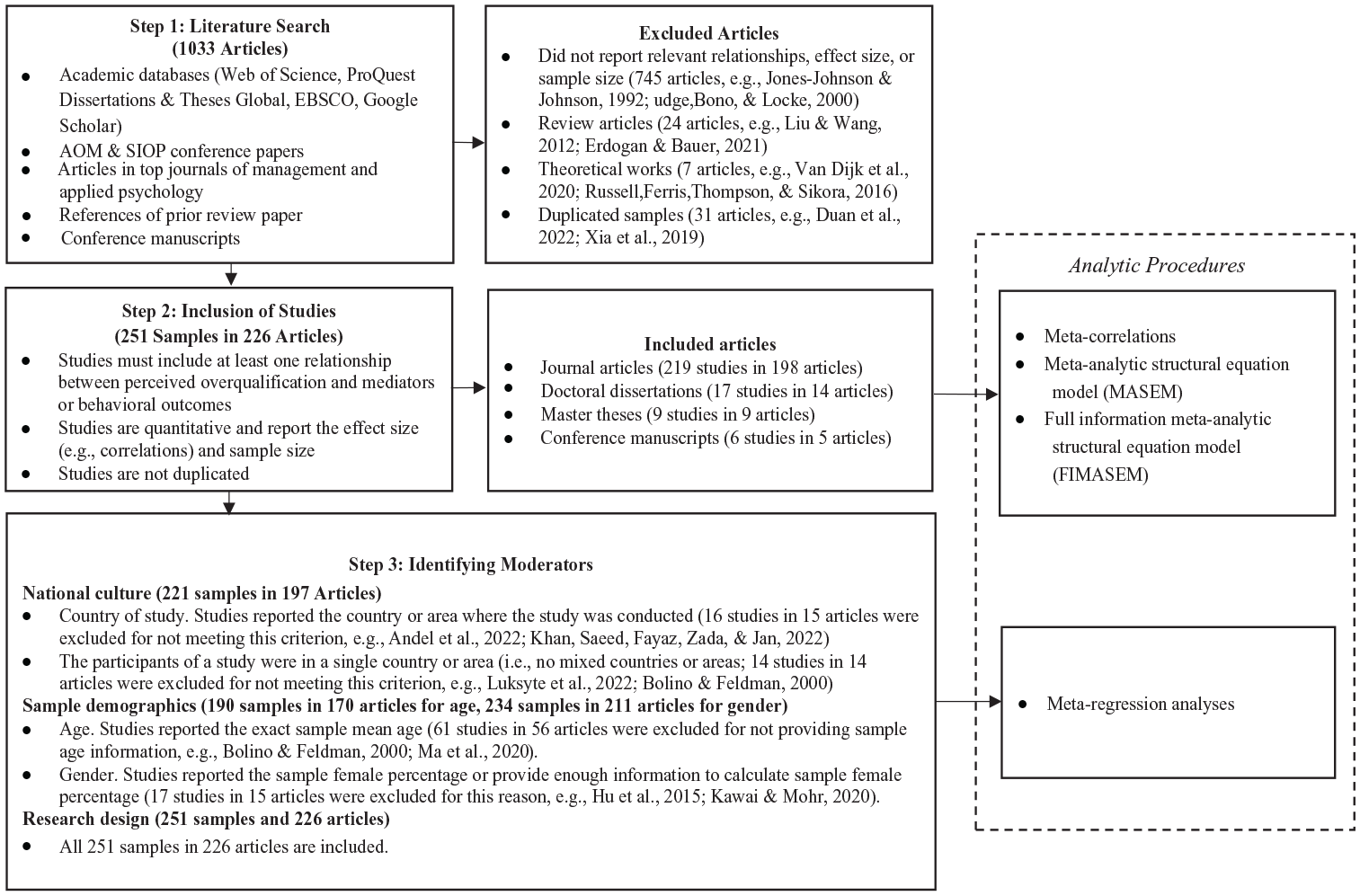
A Flowchart of the Literature Search, Inclusion, and Meta-Analytic Procedures
Coding Procedures
We followed the meta-analytic coding procedures recommended by Lipsey and Wilson (2001). Specifically, our author team first created a coding sheet, including study information (e.g., authors, year of publication, journal names/conference paper/dissertation), variables measured, correlation coefficients, reliability coefficients (i.e., Cronbach’s alphas), sample size, the country where the study was conducted, the cultural value scores and GDP per capita of the country where the sample was collected (described in detail later), sample mean age, sample gender composition, measures of POQ, and study designs (i.e., cross-sectional vs. longitudinal, single source vs. multiple sources). Second, two authors and a trained research assistant (a graduate student majoring in management) coded all selected studies. Each study was coded by two coders (i.e., an author and the trained research assistant) independently to ensure coding reliability. Of the 19,712 cells, 18,859 were coded identically across two coders (agreement rate = 95.67%). The remaining discrepancies were resolved by the whole author team via discussions until the agreement reached 100%. Third, the author team discussed and integrated variables with similar measures into aggregated categories based on the conceptualization of and the items used for each measure (see online supplementary material for details). This is a valid approach to testing higher-level constructs in a meta-analysis (Schmidt & Hunter, 2015) and has been widely used in prior research (e.g., Chung, Zhan, Noe, & Jiang, 2022; Crawford, LePine, & Rich, 2010; Jiang, Lepak, Hu, & Baer, 2012). We explicate the definitions and measures of our focal variables in the following sections.
POQ
Given its aforementioned definition, we included the measures of POQ that are most frequently used throughout the literature (e.g., perceived/subjective overqualification, perceived/subjective underemployment).
Motivational States
Reason-to motivational states
We coded a variable as reason-to motivational states if its measures reflect the presence of a rationale or justification for putting forth effort at work or staying in one’s organization (Parker et al., 2010). Based on this criterion, we coded relevant variables and measures into five constructs under reason-to motivation. Specifically, autonomous motivation reflects internal interest in and values about one’s work (Bono & Judge, 2003; Ryan & Deci, 2000). Organizational commitment reflects the psychological attachment to one’s organization (Meyer, Allen, & Smith, 1993; Reichers, 1985). Organizational identification reflects a perceived oneness with one’s organization and the experience of the organization’s achievements and setbacks as personal ones (Mael & Ashforth, 1992). Perceived person-environment reflects an employee’s perception of the compatibility between themselves and the environment (e.g., the job or the organization; Edwards & Cooper, 1990; van Vianen, 2018). Relative deprivation reflects one’s perception of being comparatively disadvantaged or deprived of something in relation to some standard (Zoogah, 2010). All five of these constructs reflect the theoretical core of reason-to motivation in capturing the subjective value or valence of one’s current job or the overall organization (Parker et al., 2010).
Energized-to motivational states
We coded a variable as energized-to motivational states if its measures reflect work-related affective states (Parker et al., 2010). In particular, we classified relevant variables and measures into work-related negative affect, positive affect, and work engagement. Negative affect captures the “subjective distress and unpleasurable engagement that subsumes a variety of aversive mood states” (Watson, Clark, & Tellegen, 1988: 1063). Positive affect denotes “the extent to which a person feels enthusiastic, active and alert” (Watson et al., 1988: 1063). We also coded measures of work engagement as energized-to motivation as they represent “a positive, fulfilling, affective-motivational state” characterized by vigor, dedication, and absorption (Bakker, Schaufeli, Leiter, & Taris, 2008: 187).
Can-do motivational states
We coded a variable as can-do motivational states if its measures reflect employees’ beliefs regarding their own capabilities and sense of control at work (Parker et al., 2010). Specifically, we operationalized can-do motivation as self-efficacy and control appraisals. In the work domain, self-efficacy reflects the belief in one’s own ability to perform certain tasks (Frese & Fay, 2001). Control appraisal reflects one’s control expectations and beliefs about one’s ability to impact outcomes (Frese & Fay, 2001).
Work outcomes
As outlined previously, our meta-analytic investigation focuses on job performance and workplace well-being as consequences. As for job performance, following prior meta-analytical studies (e.g., Colquitt et al., 2007; Lee, Berry, & Gonzalez-Mulé, 2019; Martin, Guillaume, et al., 2016), we captured three key performance components: in-role performance, extra-role performance, and counterproductive work behavior (Rotundo & Sackett, 2002). We coded an identified variable as in-role performance if its measures reflect work activities aimed at accomplishing job duties and responsibilities (Motowidlo, 2003). We coded a variable as extra-role performance if its measures reflect discretionary behaviors that increase organizational effectiveness (Katz & Kahn, 1978). We coded a variable as counterproductive work behavior if its measures reflect voluntary behaviors that violate significant organizational or societal norms and hurt organizational effectiveness and/or the members of the organization (Robinson & Bennett, 1997). As for workplace well-being, we followed Danna and Griffin’s (1999) categories and identified variables that capture job-related satisfaction and mental and physical health in the workplace as indicators.
Moderators
Cultural characteristics
We used national boundaries to capture the differences in cultural context in the studies included, given the substantial evidence of cultural differences across countries (e.g., Minkov & Hofstede, 2012; Minkov et al., 2017). Specifically, for each of the cultural dimensions in each sample (i.e., flexibility and individualism), we used the continuous, country-level cultural scores from prior research (Minkov et al., 2017, 2018).
Economic context
We coded national GDP per capita using the data from the World Bank (https://www.worldbank.org/en/home). Following prior meta-analyses (e.g., Curran & Hill, 2019; Twenge, Konrath, Foster, Keith Campbell, & Bushman, 2008), we coded national GDP per capita in the estimated year of data collection, which is two years before article publication.
Demographic characteristics
Following prior studies (e.g., Byron, 2005; Robbins, Ford, & Tetrick, 2012), we coded the sample mean age (in years) and the percentage of females in the sample.
Methodological considerations
We coded methodological moderators as categorical variables. Specifically, we categorized the measures of POQ into three types: (a) Maynard et al.’s (2006) scale, (b) Johnson and Johnson’s (1996, 1997) scale, and (c) other measures of POQ. For study design, we coded a study as cross-sectional if all variables were measured at the same time and as longitudinal if at least one focal variable was measured at a different time. We coded a study as single source if all variables were from the same source (e.g., all self-reported) and as multiple source if at least one variable was from a different source (e.g., supervisor-rated or objective data).
Meta-Analytic Procedures
Following Schmidt and Hunter’s (2015) psychometric approach, we conducted the meta-analysis based on the random effect model. First, we calculated the sample-weighted mean correlation for each relationship (r). Second, we corrected measurement errors and estimated the true score correlations (ρ) by utilizing the reliability coefficients (Schmidt & Hunter, 2015). For variables for which there was no information on reliability coefficients available, we calculated the sample size weighted average reliability from other studies (Chung et al., 2022; see Table 1 for the reliabilities of our measures). Third, we computed the 95% confidence intervals (CIs) around the true score correlations. A 95% CI that excludes zero indicates a significant relationship. Moreover, we also calculated the 80% credibility intervals (CVs), which provides information about the distribution of effect size.
Weighted Mean Reliabilities of Focal Variables
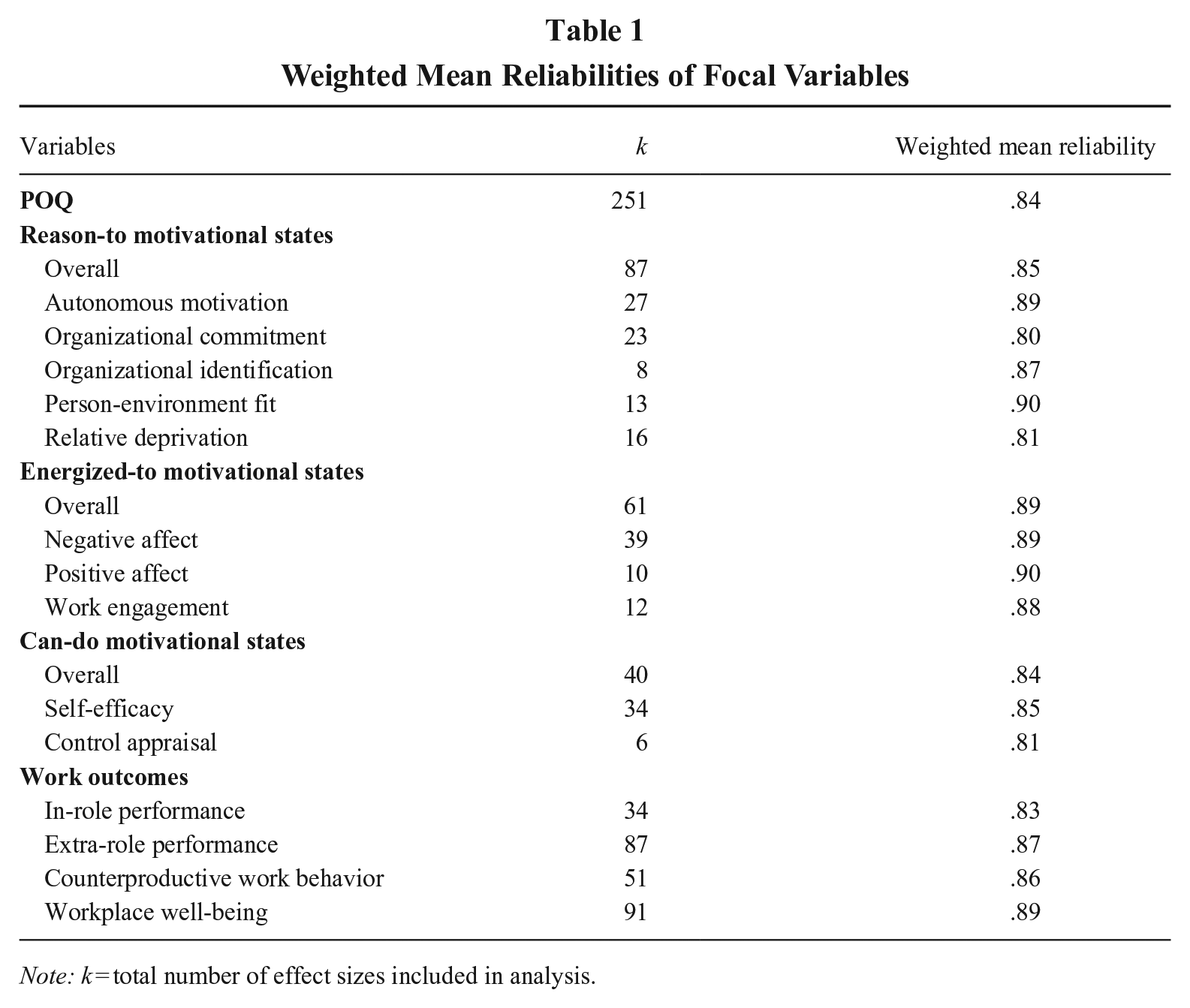
Note: k = total number of effect sizes included in analysis.
To verify the existence of potential moderators, we first calculated the percentage of the variance of observed correlations attributable to sampling error and measurement error (%Var). A percentage lower than 75% indicates the potential existence of moderators (Schmidt & Hunter, 2015). To examine moderating effects, we used a random-effect meta-regression procedure for analyses (Field & Gillett, 2010). For categorical moderators, we further conducted subgroup analysis to detect the effect size differences among groups (Schmidt & Hunter, 2015).
Next, we used MASEM (Viswesvaran & Ones, 1995) to test the mediation effects. We conducted the analyses in Mplus 8.5 (Muthén & Muthén, 1998-2017), building an 8 × 8 meta-analytic correlation matrix based on the estimation of true score correlations. In addition to the mediation paths shown in Figure 2, we also controlled for the direct effects of POQ on the four work outcome variables. We allowed the three mediators and four outcomes to freely covary, respectively. We calculated the harmonic mean of the sample sizes for MASEM, following the suggestions of Viswesvaran and Ones (1995). We then conducted Monte Carlo simulation procedures with 20,000 repetitions and calculated the 95% CIs using the online R tool (http://www.quantpsy.org/medmc/medmc.htm; Selig & Preacher, 2008) to test the indirect effects.
In addition to MASEM, we also conducted supplemental analyses using FIMASEM (Yu et al., 2016) as a robustness check. Yu et al. noted that the traditional MASEM assumes homogeneity of effect sizes, which may be inconsistent with the heterogeneity assumption of the random effect model, and proposed FIMASEM as an alternative. Specifically, the FIMASEM model bootstrapped the effect sizes (ρ) and their heterogeneity (SDρ) and estimated the structural equation model for each bootstrapped matrix. This procedure results in a distribution for each path coefficient. The 80% credibility interval (CVβ) is then calculated for each path coefficient based on its distribution. This 80% CVβ represents the range within which 80% of the population parameters fall. We also calculated the percentage of effect sizes above or below zero in the population. We conducted the FIMASEM with 5,000 bootstrap iterations using the online web-based application developed by Yu et al. (https://mgmt.shinyapps.io/masem/).
Results
Meta-Analytic Correlations
The Effects of POQ
We first examined the relationships between POQ and three types of motivational states. The results of meta-analytic correlations (see Table 2) show that POQ is negatively related to reason-to motivational states (ρ = −.30, 95% CI = [−.35, −.26]), supporting Hypothesis 1a. Specifically, POQ is negatively related to autonomous motivation (ρ = −.27, 95% CI = [−.35, −.19]), organizational commitment (ρ = −.39, 95% CI = [−.45, −.32]), organizational identification (ρ = −.13, 95% CI = [−.22, −.04]), and person-environment fit (ρ = −.25, 95% CI = [−.38, −.13]) and positively related to relative deprivation (ρ = .40, 95% CI = [.31, .48]). We also found that POQ is negatively related to energized-to motivational states (ρ = −.25, 95% CI = [−.30, −.19]), supporting Hypothesis 1b. Specifically, POQ has a significant positive relationship with negative affect (ρ = .29, 95% CI = [.23, .35]) and negative relationship with work engagement (ρ = −.19, 95% CI = [−.29, −.09]) but is not significantly related to positive affect (ρ = −.13, 95% CI = [−.27, .01]). Further, POQ is positively related to can-do motivational states (ρ = .15, 95% CI = [.07, .23]), supporting Hypothesis 3. Specifically, POQ is positively related to both self-efficacy (ρ = .15, 95% CI = [.06, .25]) and control appraisal (ρ = .15, 95% CI = [.09, .20]).
Meta-Analytic Correlations Between POQ, Motivational States, and Work Outcomes
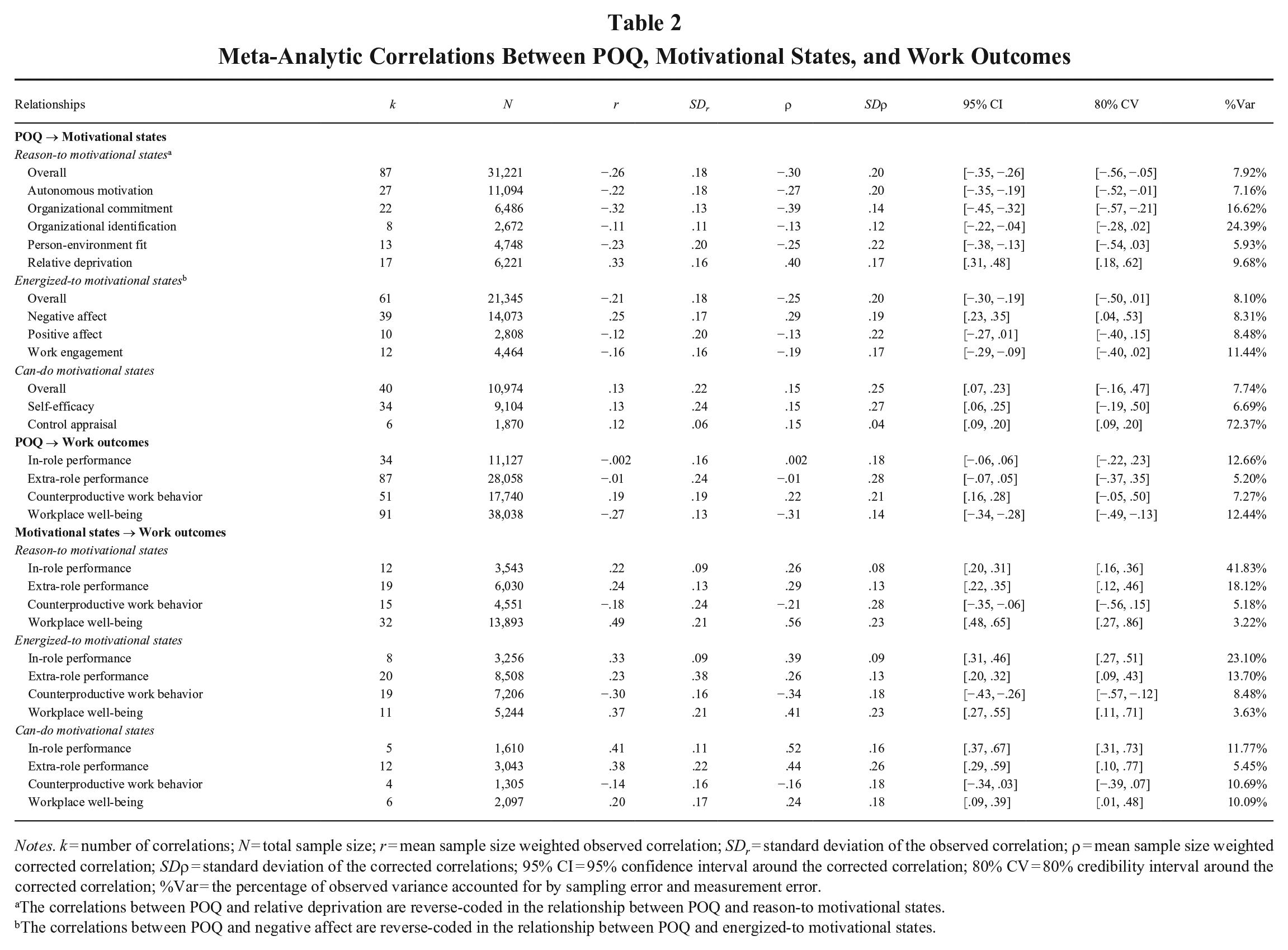
Notes. k = number of correlations; N = total sample size; r = mean sample size weighted observed correlation; SDr = standard deviation of the observed correlation; ρ = mean sample size weighted corrected correlation; SDρ = standard deviation of the corrected correlations; 95% CI = 95% confidence interval around the corrected correlation; 80% CV = 80% credibility interval around the corrected correlation; %Var = the percentage of observed variance accounted for by sampling error and measurement error.
The correlations between POQ and relative deprivation are reverse-coded in the relationship between POQ and reason-to motivational states.
The correlations between POQ and negative affect are reverse-coded in the relationship between POQ and energized-to motivational states.
In addition, consistent with prior mixed findings on the relationship between employees’ POQ and their behavioral outcomes (Erdogan & Bauer, 2021), our meta-analytical results showed that the relationship between POQ and in-role performance (ρ = .002, 95% CI = [−.06, .06]) and the relationship between POQ and extra-role performance (ρ = −.01, 95% CI = [−.07, .05]) are both nonsignificant. However, our results showed that the relationship between POQ and counterproductive work behavior is significantly positive (ρ = .22, 95% CI = [.16, .28]) and the relationship between POQ and workplace well-being is significantly negative (ρ = −.31, 95% CI = [−.34, −.28]). Next, we move to test the countervailing mechanisms between POQ and employees’ work outcomes.
Meta-Analytic Structural Equation Model
To test the mediation effects, we used MASEM (Viswesvaran & Ones, 1995) to build a model that simultaneously included POQ, the three motivational mechanisms, and the four work outcomes. The correlation matrix for the model is shown in Table 3. The estimated path coefficients are depicted in Figure 3 and Table 4. All path coefficients are significant in expected directions, except the relationship between reason-to motivational states and counterproductive work behavior (β = −.01, p = .52) . We then conducted Monte Carlo simulation procedures with 20,000 repetitions (Selig & Preacher, 2008) to test the indirect effects. The results showed that reason-to motivational states mediate the relationship between POQ and (a) in-role performance (indirect effect = −.02, 95% CI = [−.02, −.01]), (b) extra-role performance (indirect effect = −.05, 95% CI = [−.06, −.04]), and (c) workplace well-being (indirect effect = −.13, 95% CI = [−.14, −.11]) but not (d) counterproductive work behavior (indirect effect = .003, 95% CI = [−.01, .01]), thus partly supporting Hypothesis 2a.
Correlation Matrix of POQ, Motivational States, and Work Outcomes
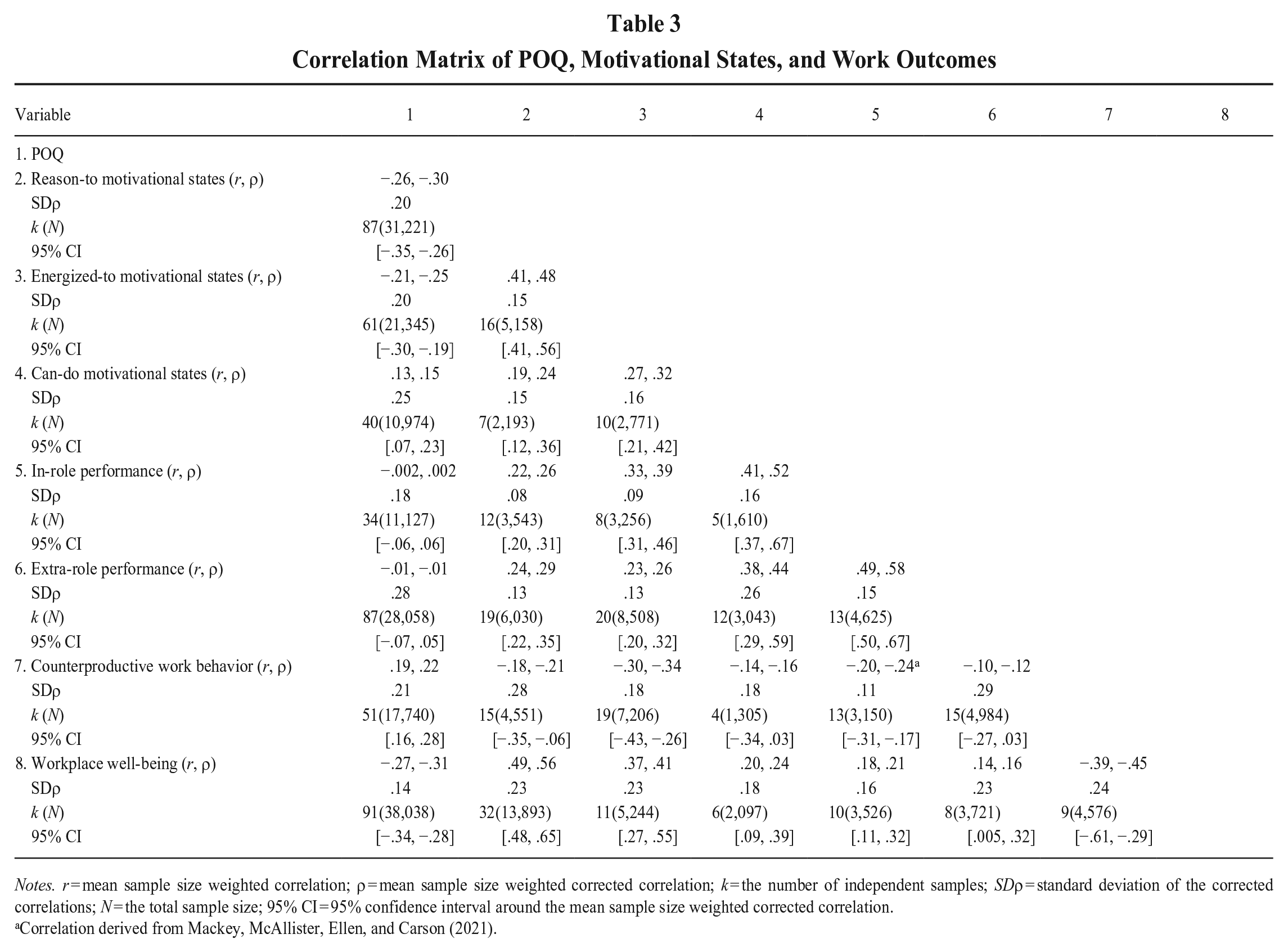
Notes. r = mean sample size weighted correlation; ρ = mean sample size weighted corrected correlation; k = the number of independent samples; SDρ = standard deviation of the corrected correlations; N = the total sample size; 95% CI = 95% confidence interval around the mean sample size weighted corrected correlation.
Correlation derived from Mackey, McAllister, Ellen, and Carson (2021).
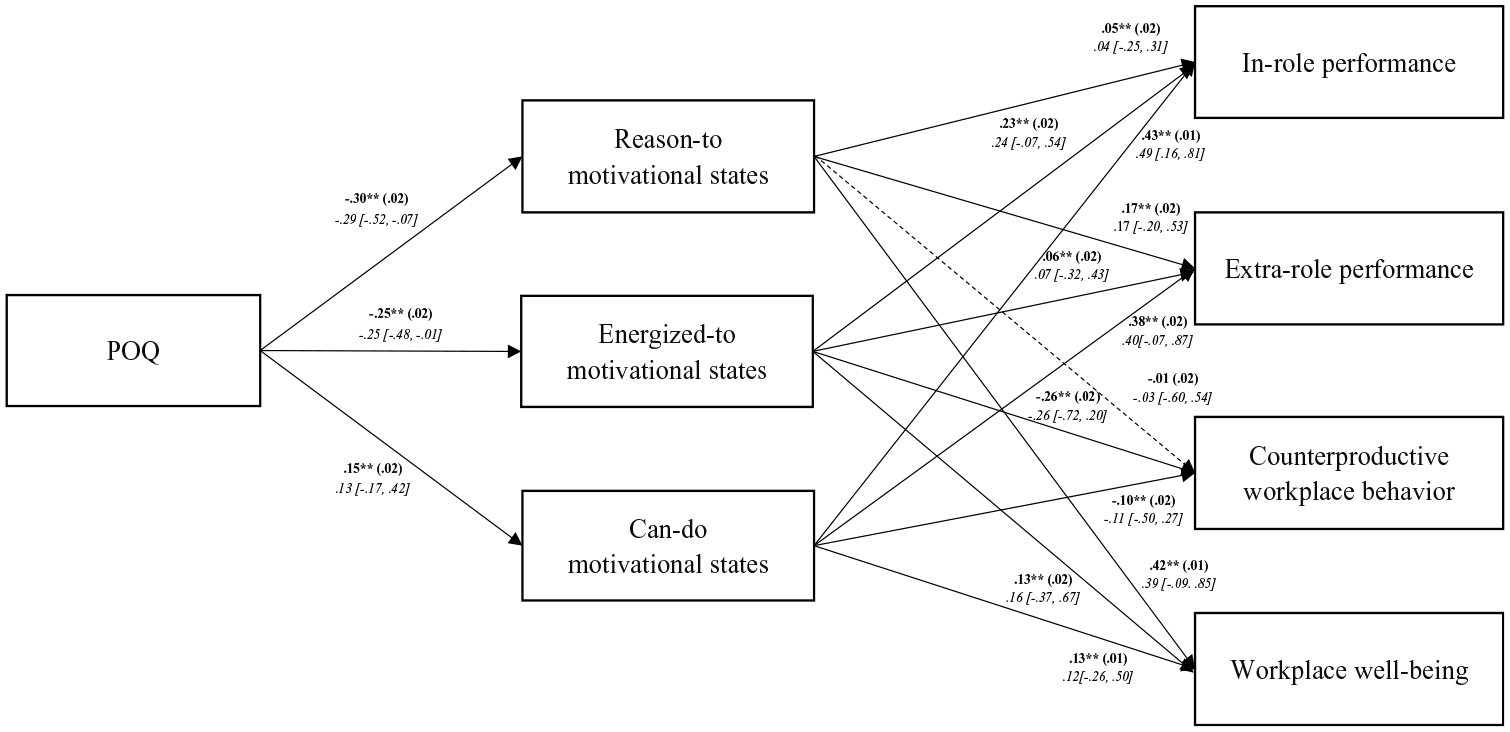
MASEM and FIMASEM Results for the Relationships Between POQ, Motivational States, and Work Outcomes
Results of MASEM and FIMASEM
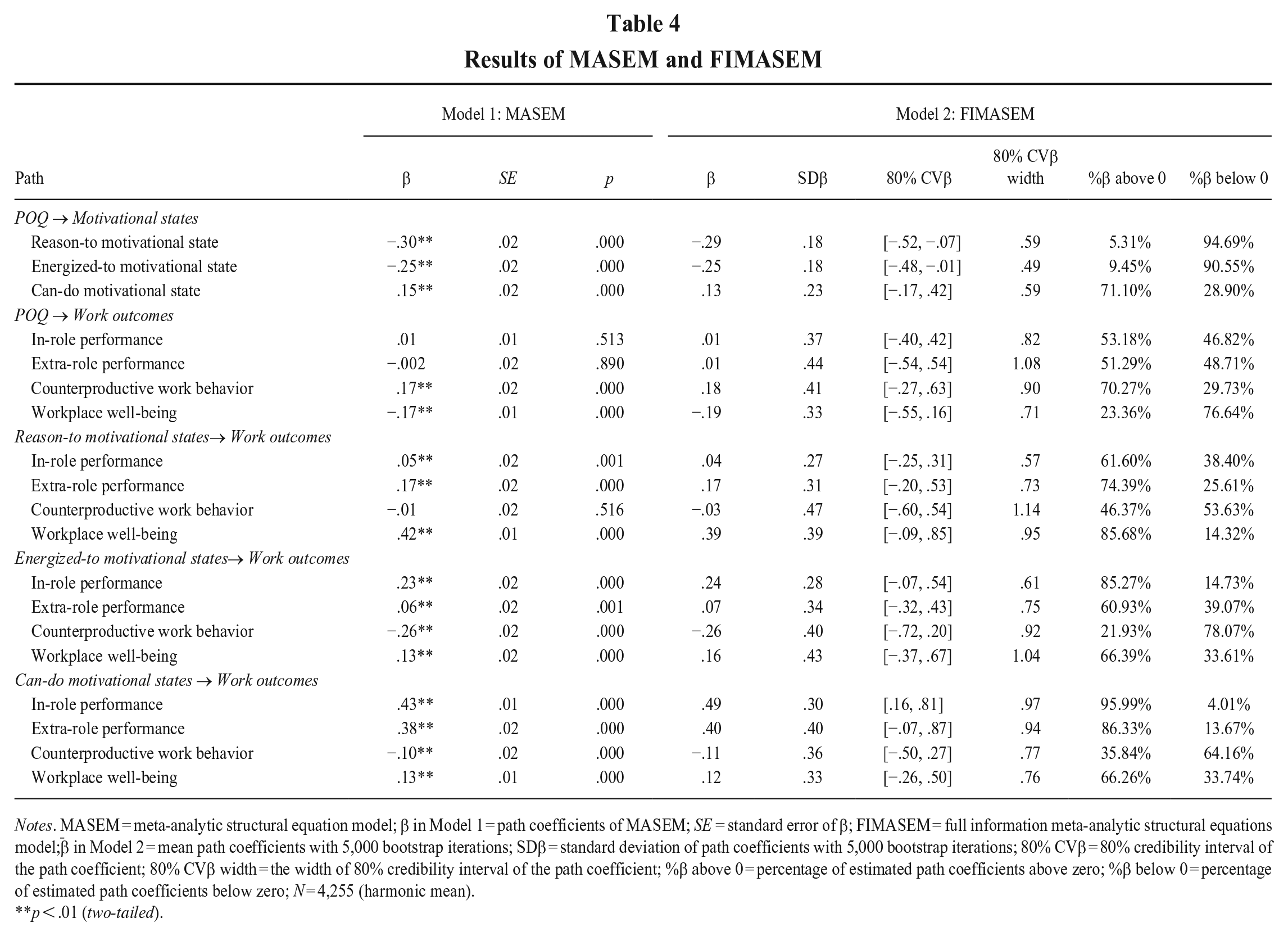
Notes. MASEM = meta-analytic structural equation model; β in Model 1 = path coefficients of MASEM; SE = standard error of β; FIMASEM = full information meta-analytic structural equations model;‾β in Model 2 = mean path coefficients with 5,000 bootstrap iterations; SDβ = standard deviation of path coefficients with 5,000 bootstrap iterations; 80% CVβ = 80% credibility interval of the path coefficient; 80% CVβ width = the width of 80% credibility interval of the path coefficient; %β above 0 = percentage of estimated path coefficients above zero; %β below 0 = percentage of estimated path coefficients below zero; N = 4,255 (harmonic mean).
p < .01 (two-tailed).
Our results also showed that energized-to motivational states mediate the negative relationships between POQ and (a) in-role performance (indirect effect = −.06, 95% CI = [−.07, −.05]), (b) extra-role performance (indirect effect = −.02, 95% CI = [−.02, −.01]), (c) workplace well-being (indirect effect = −.03, 95% CI = [−.04, −.02]) and the positive relationship between POQ and (d) counterproductive work behavior (indirect effect = .07, 95% CI = [.05, .08]), supporting Hypothesis 2b. We further found that can-do motivational states mediate the positive indirect relationship between POQ and (a) in-role performance (indirect effect = .06, 95% CI = [.05, .08]), (b) extra-role performance (indirect effect = .06, 95% CI = [.05, .07]), (c) workplace well-being (indirect effect = .02, 95% CI = [.01, .03]) and the negative indirect relationship between POQ and (d) counterproductive work behavior (indirect effect = −.02, 95% CI = [−.02, −.01]), supporting Hypothesis 4.
Full Information Meta-Analytic Structural Equation Model
As a robustness check, we also tested our model using FIMASEM (Yu et al., 2016). The results are shown in Figure 2 and Table 3. The FIMASEM model does not focus on p values but provides an estimation of the range and distribution of the path coefficients (Yu et al., 2016). The findings show that mean path coefficients for all proposed relationships are directionally consistent with the estimated path coefficients in MASEM. Further, the width of 80% credibility intervals of the relationship between POQ and motivational states are over .18 (i.e., .59, .49, and .59, respectively), suggesting moderate to high heterogeneity among those relationships (Yu et al., 2016), which implies potential moderators. Taken together, the results of FIMASEM provided additional support for our hypotheses.
Moderation Effects
Regarding the relationships between POQ and the three motivation mechanisms, the percentage of variance attributable to sampling and measurement error was far smaller than the threshold of 75% (7.92% for reason-to motivational states, 8.10% for energized-to motivational states, and 7.74% for can-do motivational states), indicating the existence of potential moderators of these relationships (see Table 4). Therefore, we moved on to test the moderating effects (see Table 5 for detailed results).
The Moderation Effects between POQ and Motivational States
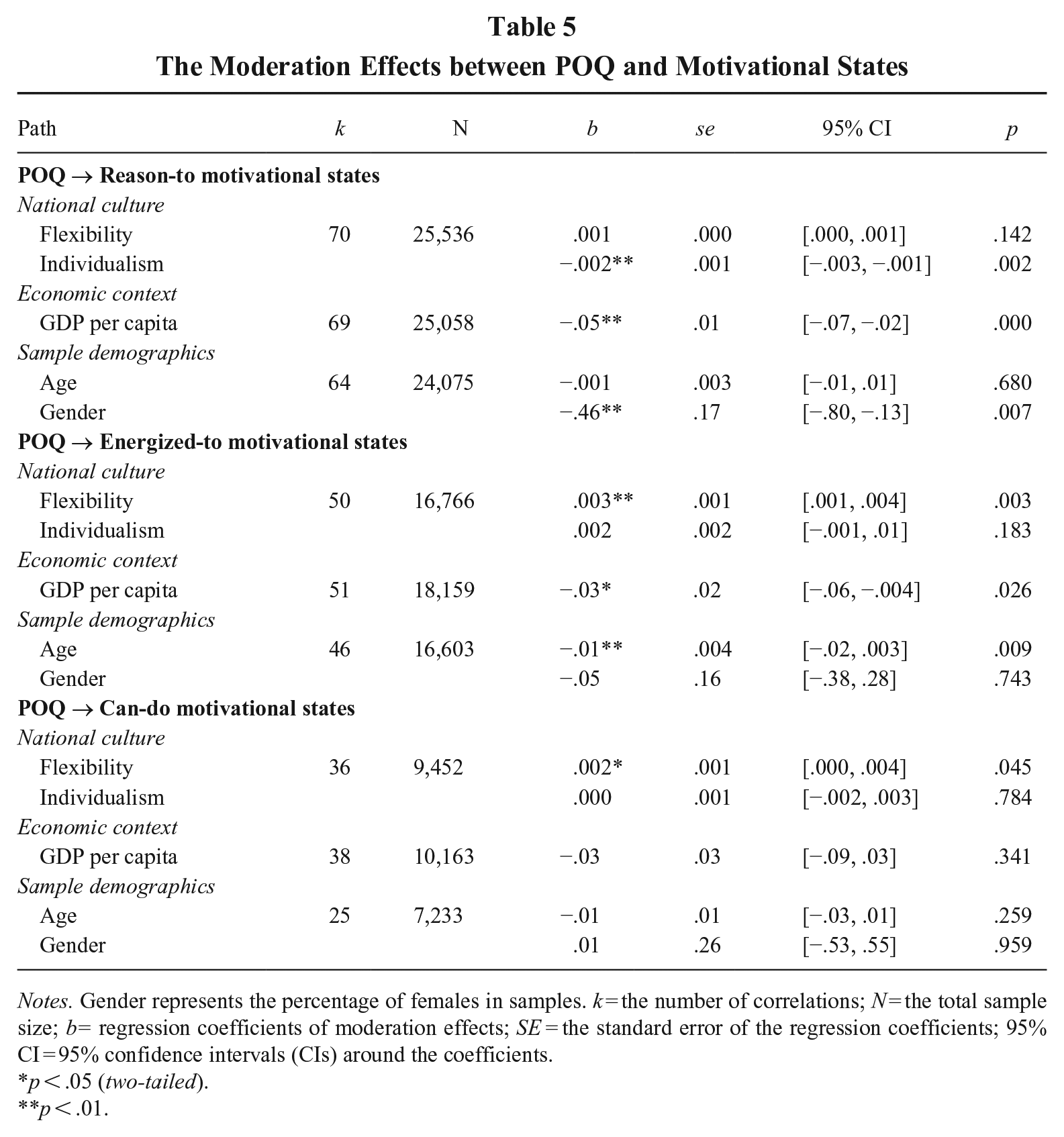
Notes. Gender represents the percentage of females in samples. k = the number of correlations; N = the total sample size; b= regression coefficients of moderation effects; SE = the standard error of the regression coefficients; 95% CI = 95% confidence intervals (CIs) around the coefficients.
p < .05 (two-tailed).
p < .01.
Cultural and Economic Characteristics
Flexibility
We found that the negative relationship between POQ and energized-to motivational states is weaker in high-flexibility cultures and stronger in low-flexibility cultures (b = .003, SE = .001, 95% CI = [.001, .004], p = .003). Additionally, the positive relationship between POQ and can-do motivational states is stronger in high-flexibility cultures and weaker in low-flexibility cultures (b = .002, SE = .001, 95% CI = [.000, .004], p = .045). However, the relationship between POQ and reason-to motivational states shows no significant differences across high- or low-flexibility cultures (b = .001, SE = .000, 95% CI = [.000, .001], p = .142). Therefore, the results supported Hypotheses 5b and 5c but not 5a.
Individualism
The relationship between POQ and reason-to motivational states is more negative in high-individualism cultures than in low-individualism cultures (b = −.002, SE = .001, 95% CI = [−.003, −.001], p = .002). However, we found no significant difference in high-versus-low individualism cultures for the relationship between POQ and energized-to motivational states (b = .002, SE = .002, 95% CI = [−.001, .01], p = .183) and can-do motivational states (b = .000, SE = .001, 95% CI = [−.002, .003], p = .784). Therefore, Hypothesis 6a was supported but Hypotheses 6b–6c were not supported.
National GDP per capita
We found that POQ has a stronger negative relationship with reason-to motivation (b = −.05, SE = .01, 95% CI = [−.07, −.02], p = .000) in higher GDP per capita conditions. Similarly, as GDP per capita increased, the relationship between POQ and energized-to motivation became significantly more negative (b = −.03, SE = .02, 95% CI = [−.06, −.004], p = .026). However, national GDP per capita does not moderate the relationship between POQ and can-do motivation (b = −.03, SE = .03, 95% CI = [−.09, .03], p = .341). Therefore, Hypotheses 7a–7b were supported but Hypothesis 7c was not supported.
Sociodemographic Characteristics
Age
We found that POQ has a stronger negative relationship with energized-to motivational states as the employee’s age increases (b = −.01, SE = .004, 95% CI = [−.02, −.003], p = .009), suggesting that energized-to motivation is more likely to deteriorate for older employees when they feel themselves overqualified. However, the results showed that age did not significantly moderate the relationship between POQ and reason-to motivational states (b = −.001, SE = .003, 95% CI = [−.01, .01], p = .680) or the relationship between POQ and can-do motivational states (b = −.01, SE = .01, 95% CI = [−.03, .01], p = .259).
Gender
We found that the negative relationship between POQ and reason-to motivational state is stronger for samples with a larger proportion of female representatives (b = −.46, SE = .17, 95% CI = [−.80, −.13], p = .007), suggesting that female employees might have less reason-to motivation when overqualified. However, the results showed that gender does not significantly moderate the relationship between POQ and energized-to motivational states (b = −.05, SE = .16, 95% CI = [−.38, .28], p = .743) or the relationship between POQ and can-do motivational states (b = .01, SE = .26, 95% CI = [−.53, .55], p = .959).
Methodological Considerations
Measures of POQ
We coded measures of POQ into three categories: Maynard et al. (2006), Johnson and Johnson (1996, 1997), and others. Because other measures include different scales, we focus on the former two measures as they are the most commonly used. Interestingly, the results showed that the measure of POQ significantly moderated the relationship between POQ and reason-to motivational states (χ2(1) = 3.71, p = .054). Subgroup analysis showed that the relationship between POQ and reason-to motivational states is more negative for studies using Maynard et al.’s scale (ρ = −.33, SDρ = .19, 95% CI = [−.39, −.27], k = 43) than studies using Johnson and Johnson’s measure (ρ = −.16, SDρ = .20, 95% CI = [−.27, −.05], k = 14). However, we did not find a moderating effect of measure difference on the relationship between POQ and energize to motivation (χ2(1) = .006, p = .939) or can-do motivational states (χ2(1) = 2.83, p = .093).
Study design (cross-sectional vs. longitudinal)
The results showed that the relationship between POQ and reason-to motivation is significantly moderated by study design (cross-sectional versus longitudinal designs) (χ2(1) = 13.59, p = .000). Subgroup analysis showed that the relationship between POQ and reason-to motivational states is more negative for studies using cross-sectional designs (ρ = −.37, SDρ = .17, 95% CI = [−.42, −.32], k =47) than studies using longitudinal designs (ρ = −.20, SDρ = .20, 95% CI = [−.27, −.14], k = 42). However, we did not find a significant moderating effect of research design (cross-sectional vs. longitudinal) on the relationship between POQ and energized-to motivational states (χ2(1) = 1.13, p = .288) and can-do motivational states (χ2(1) = 1.27, p = .260).
Study design (single source vs. multiple source)
As there were different sources (e.g., self-report, supervisor-report) for our focal outcome variables (in-role performance, extra-role performance, counterproductive work behavior, and workplace well-being) in the literature of POQ, we explored whether research design (single source vs. multiple source) may impact the effects of POQ on these outcomes. We found that the relationship between POQ and extra-role performance is significantly moderated by single source versus multiple source (χ2(1) = 3.73, p = .054). Subgroup analysis showed that the relationship between POQ and extra-role performance is more positive (ρ = .04, SDρ = .21, 95% CI = [−.02, .10], k = 45) for studies using single-source data and more negative for studies using multi-source data (ρ = −.06, SDρ = .33, 95% CI = [−.16, .04], k = 42). However, our results did not show any significant moderation effect of research design (single source vs. multiple source) on the relationships between POQ and our other focal outcome variables (in-role performance, counterproductive work behavior, and workplace well-being; p = .373, .942, & .078, respectively, for the Chi-square test).
General Discussion
The present study set out to develop and test a comprehensive, theory-driven meta-analytic model focused on understanding why, where, and for whom POQ is beneficial or detrimental. Specifically, we reviewed and synthesized the state-of-the-art literature on POQ and, drawing on the model of work motivation (Parker et al., 2010), theorized the distinct motivational mechanisms that differentially link POQ to a range of work outcomes. The results of our meta-analytical review demonstrated that, on the one hand, POQ negatively impacts employees’ cognitive rationales and justifications toward their work (reason-to motivational states) as well as their affective reactions toward it (energized-to motivational states), which ultimately impedes their work performance and workplace well-being. On the other hand, we also found that POQ enhances employees’ confidence in and control over their work (can-do motivational states), which ultimately promotes positive work outcomes. The present theoretical framework allows us to integrate contrasting perspectives in the literature and explain the mixed findings regarding the relationships between POQ and employees’ work outcomes, including in-role performance, extra-role performance, counterproductive workplace behavior, and workplace well-being.
We further examined the moderating roles of cultural, economic, and sociodemographic characteristics on the relationships between POQ and its consequences. The results support the moderating effects of cultural characteristics (i.e., flexibility and individualism), the economic environment (i.e., national GDP per capita), and sociodemographic characteristics (i.e., age and gender) on some of our theoretical pathways. We also found significant moderating effects of methodological characteristics (measures of POQ, cross-sectional vs. longitudinal design, and single-source vs. multiple-source data) on some of our pathways. These findings carry valuable theoretical and practical implications while also suggesting promising directions for future research.
Theoretical Implications
A Comprehensive and Unified Framework of POQ
Our work enhances the understanding of why POQ leads to differential work outcomes. POQ is a reality for many employees in today’s global workforce, one that can, for better or worse, exert a substantial impact on work outcomes. Research has attempted to understand the consequences of POQ from either a motivation-based lens (i.e., POQ as a deficiency in one’s job; e.g., Erdogan et al., 2018; Fine & Nevo, 2008; Hu et al., 2015) or a capability-based lens (POQ as a source of positive self-assessments; e.g., Erdogan, Karaeminogullari, Bauer, & Ellis, 2020; Lin et al., 2017; Zhang et al., 2016). Within each of these approaches, scholars have proposed a variety of theoretical explanations and have offered a surfeit of underlying mechanisms that could potentially account for why POQ leads to either beneficial or detrimental outcomes. While this body of work has been undoubtedly important, the current state of POQ research has nonetheless faced criticism for lacking a comprehensive framework to synthesize the diverse and, at times, competing mechanisms proposed (Erdogan & Bauer, 2021).
Borrowing from Parker et al.’s (2010) work motivation model, we address this limitation in the literature by presenting a comprehensive and unified theoretical framework that elucidates why POQ can have both beneficial and detrimental effects while reconciling inconsistent findings in POQ research. By using meta-analytical techniques, we have found that POQ leads to negative work outcomes by thwarting employees’ reason-to and energized-to motivational states yet leads to positive work outcomes by enhancing employees’ can-do motivational states. In doing so, we go beyond recent reviews (Harari et al., 2017; Yang & Li, 2021) and address the recent calls in POQ research (Erdogan & Bauer, 2021) for a more holistic and comprehensive approach to examining the predominant mechanisms investigated in POQ research. Furthermore, we extend Parker et al.’s (2010) work motivation model and answer the call to examine the distinct explanatory effects of its key motivational states (Cai et al., 2019) by applying the model to the context of POQ and demonstrating the differential impact such perceptions have on employees’ reason-to, energized-to, and can-do states. Taken together, our integrated model depicts a more complete and balanced understanding of both the dark and bright sides of POQ.
Cultural and Economic Context of POQ
Our findings also contribute to the advancement of POQ research by providing a more comprehensive and up-to-date understanding of the influence of national cultural and economic factors on the differential outcomes of POQ. To date, the few studies that examined the role of culture in the relationship between POQ and its outcomes (e.g., Jahantab, Vidyarthi, Anand, & Erdogan, 2023; Luksyte et al., 2022; Wu et al., 2022) have often focused on individual’s cultural values, thus limiting their ability to capture cross-culture variations at the national level. While prior meta-analyses have attempted to investigate the role of national culture in shaping POQ’s outcomes (Harari et al., 2017; Yang & Li, 2021), these reviews are constrained by their fragmented approach to examining cultural values and their use of potentially outdated and questionably valid cultural dimensions (Minkov et al., 2017).
The current meta-analytical review addresses these limitations and provides a systematic picture of how culture shapes employees’ appraisals of and reactions toward their POQ by employing the advanced Minkov-Hofstede two-dimensional cultural model (Minkov et al., 2017, 2018). Through using this cultural model, we have revealed intriguing patterns in the relationships between POQ and employees’ motivational states. Specifically, our results show that, within highly flexible cultures (i.e., cultures characterized by modest self-regard and adaptability), the negative relationship between POQ and energized-to motivational states is weaker whereas the positive relationship between POQ and can-do motivational states is stronger compared to less flexible cultures (i.e., monumentalists). Additionally, we have identified that the cultural dimension of individualism amplifies the negative relationship between POQ and reason-to motivational states. These findings underscore the significant role played by cultural characteristics in shaping how employees view and react to their POQ.
In addition to national culture, we also considered how the economic environment across countries, as approximated by national GDP per capita, influences employees’ responses to their POQ. Scholars have long suggested that macroeconomic forces make a difference in the implications of POQ (Erdogan et al., 2011; Liu & Wang, 2012; Wilkins & Wooden, 2011). However, to the best of our knowledge, our study provides the first systematic examination of the role played by the macroeconomic environment in shaping employees’ views and reactions to POQ. Once again, intriguing patterns emerged in our investigation of the moderating role of national GDP per capita in the relationships between POQ and employees’ motivational states. Our findings demonstrated that in countries with a higher GDP per capita, POQ is associated with diminished reason-to and energized-to motivational states. This implies that employees are more likely to view their POQ as undesirable in a stronger economic environment. This could be because individuals are less likely to attribute their overqualification to external factors (e.g., lack of opportunities) and may consequently experience a heightened sense of deprivation or unfairness in such contexts. In combination, these findings regarding the moderating role of cultural and economic factors shed light on the varied effect sizes observed in the relationships between POQ and its outcomes across national boundaries.
Sociodemographic Context of POQ
We also contribute to the understanding of POQ by exploring the moderating effects of sociodemographic characteristics on the relationship between POQ and its outcomes. While previous studies have considered sociodemographic variables, they primarily viewed them as antecedents of employees’ overqualification perception (e.g., Harari et al., 2017; Liu & Wang, 2012) or used them as control variables (e.g., Lin et al., 2017; Ma et al., 2020). In our research, we expand upon this work by illuminating how key sociodemographic characteristics—namely, gender and age—shape employees’ reactions to their POQ.
Regarding gender, our results show that reason-to motivational states are more likely to deteriorate for overqualified females compared to males, indicating that female employees may encounter greater challenges in reconciling the negative feelings associated with overqualification. One possible explanation for these findings is that persistent gender inequality in society, which often extends to the workplace, may make females feel less in control of their situation (Ross & Wright, 1998), more sensitized to negative stimuli they encounter in the workplace (Nolen-Hoeksema & Corte, 2004), and therefore more likely to focus on POQ as a deficiency in their job as opposed to a resource they can leverage. With respect to age, though prior meta-analytical evidence has shown no association between age and POQ (Harari et al., 2017), our research reveals that age does moderate the relationship between POQ and energized-to motivational states. Specifically, we found that the relationship between POQ and energized-to motivational states is more negative for older workers compared to younger workers. This suggests that older employees experience more undesirable affective reactions toward their POQ. One possible explanation is that younger overqualified workers, with a longer future time perspective, may possess a greater belief that their undesirable employment situation will improve in the future (Sabino, Basilio, Lopes, Chambel, Dias, & Cesário, 2022), resulting in fewer negative affective states at work.
Methodological Context of POQ
Regarding methodological moderators, our findings reveal that the relationships between POQ and its consequences vary depending on the specific measure of POQ utilized. Specifically, we found that studies using Maynard et al.’s (2006) 9-item scale, as opposed to Johnson and Johnson’s (1996, 1997) 4-item scale, exhibit a more negative relationship between POQ and reason-to motivational states. One possible explanation for these findings is that the Maynard et al. (2006) scale may accentuate the sense of deficiency in employees’ situations. Compared with the Johnson & Johnson (1996, 1997) scale, the Maynard et al. (2006) scale includes items that not only capture employees’ perception of surplus qualifications in comparison to their job requirements but also in comparison with others, specifically those considered “beneath” them. The inclusion of this additional negative social comparison within the Maynard et al. (2006) scale may heighten employees’ perception of inadequacy within their current job. These results emphasize the importance of carefully considering alternative measures of POQ when studying its workplace consequences, as the choice of measurement scale used could subtly influence how employees interpret their POQ. Therefore, researchers and practitioners should be mindful of the scale used in assessing POQ to ensure a comprehensive understanding of its impact.
We also discovered that the relationships between POQ and its consequences tend to inflate depending on the study design employed. Specifically, we found that the association between POQ and reason-to motivational states is more negative in studies using cross-sectional designs compared to longitudinal designs. These results emphasize the importance of future research in carefully considering and addressing CMV when investigating the influence of POQ (Podsakoff et al., 2024). In sum, our findings provide a nuanced understanding of the boundary conditions that shape the effects of POQ and address the call to address methodological issues in POQ research (Feldman, 1996; Liu & Wang, 2012; McKee-Ryan & Harvey, 2011).
Practical Implications
This study also holds significant implications for practitioners. First, our research indicates that POQ has both positive and negative implications for employee work outcomes. Managers need to recognize that overqualification is not solely negative. On the one hand, managers have good reason to be concerned about their overqualified employees, as such perceptions could lead to undesirable motivational and behavioral outcomes, such as more negative affect and counterproductive work behavior. On the other hand, managers should also acknowledge that overqualified employees can bring additional benefits to their organization and make valuable contributions to their work by leveraging their surplus skills and qualifications (Wu et al., 2022). By highlighting the competing motivational mechanisms that determine which outcomes of POQ are likely to manifest, we provide managers with valuable insights for personnel selection and human resources practices.
Further, our research reveals that in certain cultural contexts (i.e., characterized by high flexibility or low individualism), the negative effects of POQ through reason-to and energized-to motivational states are likely to be alleviated, while the positive effect of POQ via can-do motivational states are more likely to emerge. This suggests that cultural background acts as an important boundary condition shaping the implications of POQ. Practitioners can use these findings to gain a better understanding of the advantages and disadvantages of overqualified employees in a global setting. In addition, while managers may hardly have control over the national culture where their overqualified employees are situated, they can apply the lessons learned to their organization’s culture to mitigate the harm from POQ and maximize its potential benefits. Managers might consider adjusting their human resources practices to help sensitize overqualified employees to their underlying competence and provide them with a sense of control over their work. For example, managers can offer overqualified employees more developmental opportunities, help them craft alternative career plans, and design their work to allow for greater task autonomy and impact on others, which may help those employees interpret their situation in a more positive light. These practices may help maximize the potential benefits of overqualified employees while minimizing potential negative consequences associated with POQ.
Limitations and Future Research
We acknowledge the limitations of this research, which also highlights opportunities for future research. First, as with other meta-analytic studies, the present study runs the potential risk of “mixing apples with oranges” concerning grouping similar variables together to form higher-order constructs (Cortina, 2003; Oh, 2020). However, we have taken ways to cautiously address this issue by providing clear definitions for all variables included in our model and systematically examining whether the measures in our samples align with these definitions (details can be found in the online supplementary material). We are confident that our theoretical framework and findings can serve as a sound roadmap for future studies.
Second, although we aimed to test a series of key moderators in our meta-analytical investigation, we were limited in moderators we could include due to the lack of empirical studies on certain factors. As a result, there exist compelling moderators that could enhance our understanding of how organizations can effectively manage overqualified employees that we were unable to examine in this study. For instance, certain leadership behaviors may bring about the more positive side of POQ (Wu et al., 2022). In addition, scholars have suggested that overqualified employees’ attributions regarding the reasons for their overqualification may significantly impact their reactions (Liu & Wang, 2012; Lin et al., 2017). Employees who attribute their overqualification to external factors such as a competitive labor market might be more likely to accept their underemployed status and view their surplus qualifications as valuable resources that can help them be recognized as “rising stars” within the organization. By contrast, if employees attribute their POQ as a result of injustice, such as unfair selection or promotion procedures, they may react more negatively. In addition, overqualified employees with different stable characteristics, such as personality traits, are likely to react differently (e.g., justice sensitivity, Liu et al., 2015; proactive personality, Wu & Chi, 2020). We encourage future studies to delve deeper into how organizational policies, human resources management tools, leadership behaviors, and the individual characteristics of overqualified employees influence their motivational states and work outcomes.
Third, while we operationalized the cultural dimensions of flexibility and individualism at the national level, it is worth noting that these dimensions have also been studied within different contexts and levels of analysis, including the firm, team, and individual levels. Therefore, we encourage future studies to take a multilevel perspective (Kozlowski & Klein, 2000) and investigate how organizational culture or climate (Lumpkin, Brigham, & Moss, 2010), team climates (Bell, 2007), and individual values (Strauss, Griffin, & Parker, 2012) impact overqualified employees’ motivational states and work outcomes.
Fourth, while our study contributes to the understanding of how sociodemographic characteristics shape employees’ reactions to their POQ, further research is necessary to comprehend the complex role that sociodemographic factors play in these relationships (Feldman, 1996; McKee-Ryan & Harvey, 2011). On the one hand, research has observed that POQ and employee affective reactions undergo changes during the socialization process (Simon et al., 2019). Therefore, other demographic characteristics such as job tenure, organizational tenure, and team tenure may also influence the consequences of POQ. On the other hand, although we empirically tested how age and gender moderate the effects of POQ on its consequences, we did not explore potential theoretical mechanisms where competing explanations may coexist. We encourage future studies to delve into these mechanisms, such as exploring mediated moderation effects (e.g., Wang, Burlacu, Truxillo, James, & Yao, 2015), to gain a better understanding of how sociodemographic characteristics interact with POQ to influence employees’ reactions.
Fifth, consistent with prior research, our study focused on employees’ perception of overqualification as compared to objective overqualification. However, it is important to acknowledge that employees who perceive themselves as possessing higher qualifications than required may not necessarily possess surplus capabilities (Erdogan & Bauer, 2021). Prior research has shown only a weak-to-moderate correlation between POQ and objective overqualification, ranging from .16 to .54 (Arvan, Pindek, Andel, & Spector, 2019; Harari et al., 2017; Lin et al., 2017). Moreover, feelings of overqualification can be influenced by various factors, such as personality traits, interpersonal interactions, and job characteristics (Bolino & Feldman, 2000; Erdogan & Bauer, 2021; Harari et al., 2017). For example, individuals high in trait narcissism, characterized by an inflated sense of self-importance, often perceive themselves in an overly positive manner (Martin, Côté, & Woodruff, 2016). Such individuals may hold exaggerated views of their own knowledge, skills, and abilities, leading them to believe that they possess excessive qualifications beyond the job requirements (Cui, 2023; Harari et al., 2017). As our meta-analysis primarily focuses on the consequences of POQ, we encourage future studies to explore these antecedents to enrich the existing literature.
Conclusion
This meta-analytical review provides a comprehensive examination of how perceived overqualification (POQ) influences employees’ work outcomes. Our findings reveal a nuanced picture, demonstrating both the negative and positive effects of POQ on employees’ work motivation and outcomes. Specifically, we found that POQ can diminish employees’ reason-to and energized-to motivational states, resulting in negative work outcomes. However, POQ can also enhance employees’ can-do motivational states, resulting in positive outcomes. These contrasting mechanisms jointly shed light on the previously mixed findings regarding the impacts of POQ on employees’ job performance, including in-role performance, extra-role performance, counterproductive work behavior, as well as workplace well-being. Further, this meta-analysis reveals that cultural characteristics (national flexibility and individualism), economic context (national GDP per capita), sociodemographic factors (age and gender), and methodological considerations (measurement of POQ, research design) all play a role in moderating these effects. In summary, this meta-analytical review provides a comprehensive framework for understanding the positive and negative consequences of POQ, as well as their boundary conditions.
Footnotes
Acknowledgements
We sincerely thank Michael Harris Bond, Seunghoo Chung, and Lei Huang for their insightful comments and helpful suggestions on earlier versions of our manuscript.
Funding
This article was supported by research grants from the National Natural Science Foundation of China (72022022 and 72332009) and the Research Grants Council of the Hong Kong Special Administrative Region, China (PolyU 21502219).
