







Abstract
While prior research has examined individuals’ preference to work for socially responsible employers, little is known about how firms actively leverage their CSR reputation in recruiting talent. Drawing on the resource-based view (RBV), we conceptualize CSR reputation as a strategic resource that provides firms with a competitive edge in the labor market. To leverage this strategic resource, firms set higher skill requirements and advertise their CSR activities in job postings, which allows them to more effectively target and recruit talent. Using a large sample of online job posting data, we first provide empirical evidence confirming that CSR reputation is positively associated with higher skill requirements in terms of education, experience, and social and cognitive skills, as well as greater promotion of CSR activities in job postings. Using employee resume data, we further show that these two recruitment strategies mediate the positive effect of CSR reputation on actual recruitment outcomes, measured by the actual skills of new hires and job position filling rates. Overall, our findings support the notion that firms can rely on their reputation of being socially responsible as a valuable resource for recruiting high-quality human capital.
Keywords
Proponents of the “doing well by doing good” perspective propose that by engaging in corporate social responsibility (CSR) activities, firms potentially stand to gain competitive advantages (Aguinis & Glavas, 2012). This perspective on CSR focuses on the prosocial aspects of such activities, such as ethical, philanthropical, and environmental areas of responsibility, and differentiates between voluntary corporate behavior and mere compliance. According to the resource-based view (RBV) framework, this type of CSR commitment can help cultivate a positive reputation or image, which can be regarded as a valuable, rare, and inimitable resource capable of bolstering a firm’s competitive advantage (e.g., Branco & Rodrigues, 2006; Barney, 1991; Helfat, Kaul, Ketchen, Barney, Chatain, & Singh, 2023; McWilliams & Siegel, 2011). In turn, prior research has examined how firms can convert this resource into competitive advantages. For example, firms can leverage good CSR performance when competing with foreign rivals (Flammer, 2015a), securing government contracts (Flammer, 2018), and addressing market and government failures (Cuervo-Cazurra, Purkayastha, & Ramaswamy, 2023).
Despite these insights, researchers have yet to explicate how firms proactively leverage their CSR resource in one important market—the labor market—to gain a competitive advantage. To fill this gap, we examine whether and how firms with a high CSR reputation employ two specific recruiting strategies—raising skill requirements and advertising their CSR initiatives in job postings—to enhance their actual recruitment outcomes.
We propose that firms can leverage their CSR reputation as a strategic resource to attract and recruit high-quality employees. Talent has long been recognized as a source of prosperity and competitive advantage, especially in today’s knowledge-based economy (e.g., Batish, Gordon, Kepler, Larcker, Tayan, & Yu, 2021; Huselid, Jackson, & Schuler, 1997; Koch & McGrath, 1996). As talent is both scarce and valuable (Ghaly, Anh Dang, & Stathopoulos, 2017; Hatch & Dyer, 2004; Shapiro, 1986), firms may strenuously compete to attract and retain high-quality employees. Prior research suggests that high-skilled or high-quality workers are particularly responsive to socially responsible employers due to their own prosocial tendencies and desire for meaningful work (Bode, Singh, & Rogan, 2015; Carnahan, Agarwal, & Campbell, 2012). This alignment can foster a stronger person–organization fit between high-skilled employees and firms with a strong CSR reputation (O’Reilly, Chatman, & Caldwell, 1991), reinforcing the value of CSR as a strategic resource in the labor market. Recognizing the benefits of this relationship, firms with a high CSR reputation may seek to increase their skill requirements so as to target higher-quality talent and advertise their CSR initiatives in job postings as a signal to job candidates. These two recruiting strategies can effectively enhance firms’ actual recruiting outcomes by directly targeting and attracting skilled employees. Our conceptual model is illustrated in Figure 1.
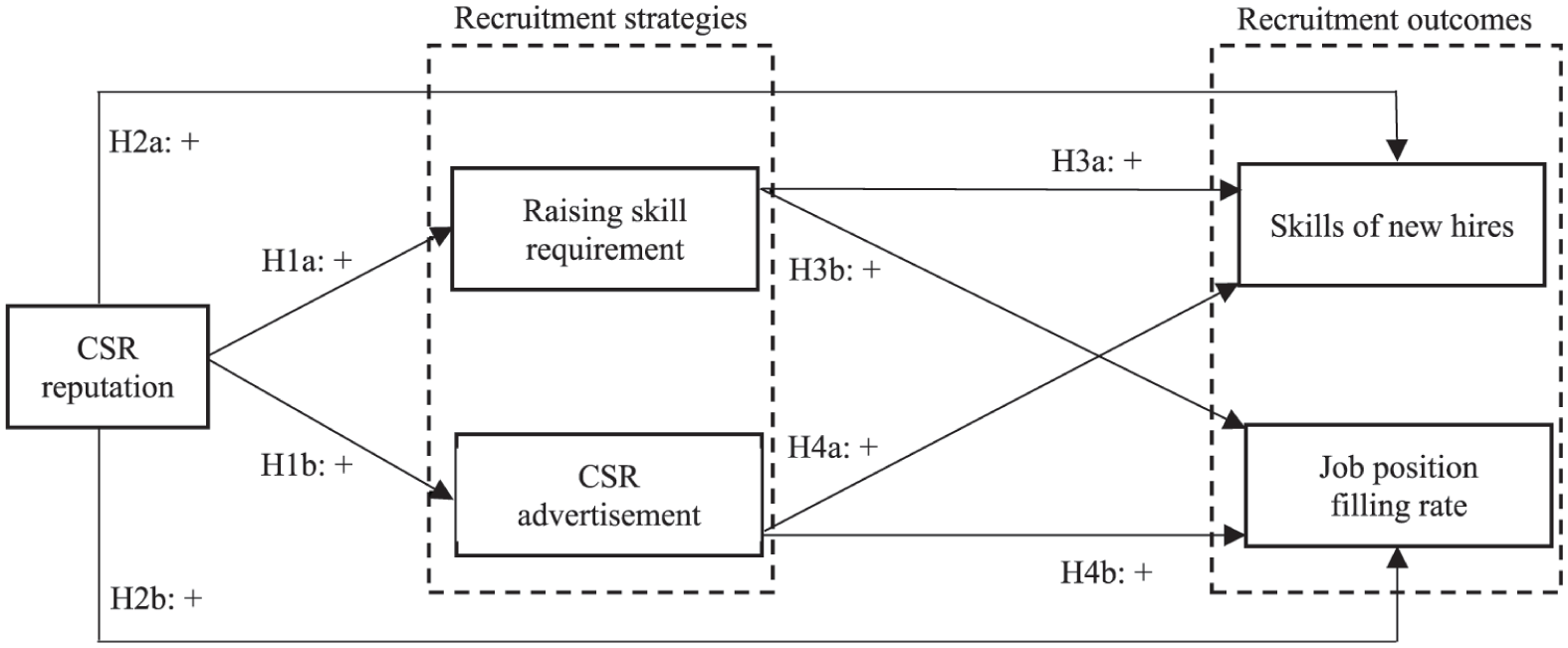
Conceptual Model
To test our model, we obtain a large dataset of online job postings from Lightcast (formerly Burning Glass) and employee resume data from Economic Modeling Specialists International (EMSI) and Revelio. The rich job posting data provide information that reflects firms’ recruitment strategies (Huang, Pacelli, Shi, & Zou, 2024). Employee resume data capture firms’ actual recruitment outcomes and can be used to test the effectiveness of their recruitment strategies. To address endogeneity concerns—specifically, the possibility that omitted factors might simultaneously influence both CSR reputation and firms’ recruitment strategies and outcomes—we adopt an instrumental variable (IV) approach. We identify two IVs: the Democratic-leaning political ideology of the firm’s headquarters location and the CSR performance of industry peers. The selection of these variables is grounded in prior CSR-related studies (e.g., Albuquerque, Koskinen, & Zhang, 2019; Cheng, Ioannou, & Serafeim, 2014; Deng, Kang, & Low, 2013; Dimson, Karakaş, & Li, 2015; Hubbard, Christensen, & Graffin, 2017).
Our results reveal a positive relationship between firms’ CSR reputation and their requirements for education, experience, and social and cognitive skills in job postings, even after controlling for average salaries, a comprehensive set of firm characteristics, and firm fixed effects. Additionally, we observe that firms with a high CSR reputation are more likely to promote their CSR activities in job postings. Moreover, we demonstrate that CSR reputation is associated with better actual recruitment outcomes, as measured by the actual skills of new hires and the job position filling rate. Finally, these two recruitment strategies—raising skill requirements and advertising CSR activities in job postings—mediate the relationship between a firm’s CSR reputation and its actual recruitment outcomes.
This research contributes to the literature in several ways. First, it advances the CSR literature by drawing on the RBV to theorize CSR reputation as a strategic resource for talent recruitment and by empirically examining how firms leverage this resource in the labor market. While prior studies have conceptualized CSR as a resource that fosters strong stakeholder relationships and sustainable competitive advantages across various markets, how firms proactively utilize this resource in the labor market remains understudied. In today’s knowledge-based economy, corporate success increasingly depends on a firm’s ability to attract, retain, and develop talent (e.g., Batish et al., 2021; Huselid et al., 1997; Koch & McGrath, 1996). Given the importance of talent for firm growth, our study seeks to shed light on how firms actively leverage their CSR reputation to gain an edge in the labor market by examining two specific recruitment strategies—raising skill requirements and promoting CSR initiatives in job postings.
Relatedly, our study complements prior literature on the CSR–employee relationship (e.g., Burbano, 2016; Carnahan, Kryscynski, & Olson, 2017; Greening & Turban, 2000; Jones, Willness, & Madey, 2014). Previous research has primarily focused on the employee perspective when exploring high-CSR firms’ advantage in recruiting and retaining talent, but paid little attention to how this advantage can be realized from the firm’s perspective (Breaugh, 2008). By examining this issue from the firm side, our study bridges a crucial gap in the overall understanding of the CSR–employee relationship.
Second, using rich datasets of job postings and employee resumes, we provide comprehensive evidence for the strategic significance of CSR reputation in the labor market. Through job posting data, we can directly observe firms’ recruitment strategies and identify the effect of CSR reputation on those strategies. The employee resume data allow us to examine how CSR reputation and recruitment strategies shape the actual skills of new hires and the efficiency of firms’ recruitment processes (Ham, Hann, Wang, & Yang, 2024). Such rich empirical evidence regarding firms’ recruitment strategies and actual recruitment outcomes advances our understanding of how firms harness the benefits of their CSR reputation from the labor market. This large-sample empirical evidence also represents a contribution to the CSR–employee literature, which has often been based on field and experimental studies.
Lastly, we contribute to the RBV literature. The RBV has gained widespread acceptance as a framework for explaining the sources of competitive advantage and guiding managers in identifying these sources (Helfat et al., 2023). Our research aligns with studies that examine CSR engagement through the lens of the RBV (e.g., Branco & Rodrigues, 2006; Kim, Kim, & Qian, 2018) and provides evidence that firm managers recognize CSR reputation as a source of competitive advantage in the labor market. Unlike most of these studies, however, our work directly examines firms’ proactive actions of leveraging CSR reputation as a strategic resource.
Theory and Hypotheses
CSR Reputation and Recruitment Strategies
Under the RBV framework, a firm is conceptualized as a “pool of resources.” Performance differentials between firms are primarily explained by how firms possess and effectively leverage their strategic resources that are valuable, rare, inimitable, and non-substitutable (Barney, 1991). Firms deploy these resources to execute strategic activities and achieve competitive advantages (Helfat et al., 2023).
Although the early literature often viewed CSR as a cost to shareholders (Friedman, 1970), a growing body of research now suggests that stakeholders—including customers, investors, and suppliers—often react positively to firms’ socially responsible activities (e.g., Cheng et al., 2014; Deng et al., 2013; Jones, 1995; Qian, Crilly, Wang, & Wang, 2021). For example, recent research consistently demonstrates that investors react positively to favorable CSR news (e.g., Dhaliwal, Li, Tsang, & Yang, 2011; Dimson et al., 2015; Flammer, 2013, 2015b). Moreover, consumers prefer to purchase from firms that have a strong CSR reputation, resulting in increased customer loyalty and greater pricing power for those firms (e.g., Bjørner, Hansen, & Russell, 2004; Elfenbein & McManus, 2010). Relatedly, Lev, Petrovits, and Radhakrishnan (2010) find that corporate charitable contributions can enhance revenue growth, particularly for firms whose sales performance is highly sensitive to consumer perceptions.
Consequently, scholars have increasingly conceptualized a strong CSR reputation as a valuable resource. Such a reputation is accumulated over time through sustained, long-term investments and consistent stakeholder interactions, and rooted in stakeholders’ collective evaluations of a firm’s social and ethical conduct. Thus, the cultivation of a positive CSR reputation is a time-consuming, costly, and socially complex endeavor (Roberts & Dowling, 2002), difficult to imitate or substitute, establishing its status as a unique firm strategic resource (McWilliams & Siegel, 2011).
Prior studies provide ample evidence that supports the role of CSR reputation as a resource in fostering competitive advantage (Branco & Rodrigues, 2006; Porter & Kramer, 2011). For example, Flammer (2015a) finds that U.S. firms increase their CSR engagement in an effort to differentiate themselves from their foreign rivals, thereby driving sales growth. Barnett (2007) and Barnett and Salomon (2012) suggest that while CSR engagement is a strategic resource, a firm’s ability to extract value from it depends on its stakeholder influence capacity. Cuervo-Cazurra et al. (2023) suggest that firms in emerging economies engage in CSR initiatives to address market and government failures, particularly through the social dimension of CSR—that is, they focus on building capabilities to mitigate the absence of public goods and services. Collectively, this body of research suggests that firms leverage CSR activities to gain a competitive advantage in both their product markets and the public domain.
We posit that firms also view CSR reputation as a strategic resource that can generate competitive advantages in the labor market. In today’s economy, there is increased awareness that CSR influences the public’s willingness to work for a company. In fact, a study by Cone Communications (2016) confirmed that millennials, who now represent the largest cohort in the workplace, place a higher priority on CSR than previous generations and are increasingly inclined to favor socially responsible employers. Through interactions with both current employees and job candidates, firms can observe a growing preference in the labor market for employers with a strong CSR reputation. Prior research suggests that job seekers value the CSR reputation of prospective employers because they anticipate feeling a higher sense of pride when working for such employers—a factor that offers firms with a high CSR reputation a distinct advantage in the recruitment process. Highly skilled job applicants, in particular, are drawn to employers with a strong CSR reputation due to the alignment of their values with the CSR concept (Bode et al., 2015).
Prior studies have also conceptualized skilled employees as critically important resources, particularly when those employees possess advanced, firm-relevant skills that can enhance organizational capabilities (e.g., Barney & Wright, 1998; Kim & Makadok, 2023; Meyer, 1991). In today’s knowledge-driven environment, the demand for high-skill labor has been accelerating. In addition, previous research has documented the challenges in not only recruiting skilled employees, but also retaining them due to their high mobility. Skilled labor is a scarce resource, and individuals with valuable skills and expertise can easily move between firms (Ghaly et al., 2017; Hatch & Dyer, 2004; Shapiro, 1986). Firms’ competitive advantages, however, cannot be sustained if skilled employees freely depart and join other organizations.
The RBV underscores not only the importance of possessing strategic resources, but also the need to deploy them effectively to acquire complementary resources for firms to achieve lasting success (Sirmon, Hitt, & Ireland, 2007). High-skill human capital represents a complementary strategic resource that can enhance the productivity and value of existing firm resources, including CSR reputation (Crook, Todd, Combs, Woehr, & Ketchen, 2011). In turn, high skill requirements function as a selective recruitment tool, enabling firms to screen for superior human capital without substantially constraining the job applicant supply. The bundling of CSR reputation with high-quality human capital can then reinforce resource complementarities within the firm that are difficult for competitors to replicate.
Theoretically, firms with a strong CSR reputation can reap recruitment benefits by either offering lower salaries or raising skill requirements in job postings to target skilled employees. We argue that the latter strategy is more feasible, especially in today’s labor market, given the fierce competition for top-tier talent. Another reason that firms may not adopt the strategy of offering lower salaries in their job postings is that firms tend to keep their salary information secret in the workplace (e.g., Cullen, 2024; Cullen & Perez-Truglia, 2023) and therefore tend not to disclose such information in the job postings.
Of course, increasing skill requirements in job postings may also increase the likelihood of not filling these job vacancies, especially for firms that do not have a well-recognized brand name among job applicants. However, given that a strong CSR reputation serves a brand function when recruiting employees, firms with higher CSR reputation are capable of setting higher skill requirements in their job postings to efficiently target and attract top talent. Therefore, we hypothesize that:
Hypothesis 1a (H1a): Firms with a better CSR reputation are associated with higher skill requirements for prospective employees in their job postings.
Recruiting is inevitably a two-way matching process between firms and job seekers. So, for firms to effectively leverage their CSR reputation to attract job seekers, a critical premise is that these potential job candidates are knowledgeable about the firm’s CSR activities. While job seekers may come across CSR information through various channels such as media and word-of-mouth (e.g., McWilliams & Siegel, 2011), it is not guaranteed that all applicants will receive the desired amount or type of information or interpret it as the firm intended (Sen, Bhattacharya, & Korschun, 2006). Therefore, to fully capitalize on their CSR reputation in the recruitment process, firms may seek to promote their CSR activities in job postings.
CSR information in job postings serves as a signal of a firm’s CSR commitments (Godfrey, Merrill, & Hansen, 2009; Spence, 1973; Yu, Cuypers, & Wang, 2025). Signaling theory posits that job seekers who often have limited or imperfect information about potential employers rely on signals from these employers to infer their attributes (e.g., Connelly, Certo, Ireland, & Reutzel, 2011; Rynes & Miller, 1983). Firms can highlight their CSR activities in job postings to provide a representative snapshot of their CSR commitments. Job seekers, in turn, interpret these cues as reflections of the firm’s broader organizational character.
By integrating these signals into their job postings, firms ensure that CSR information reaches job seekers when they are actively seeking employment opportunities (Cober, Brown, Keeping, & Levy, 2004). This practice aligns well with the strategy of raising skill requirements to precisely target more highly skilled employees: It enhances the firm’s attractiveness and brand recognition through the explicit display of its values and socially responsible practices to potential applicants. As a result, the effect of firms’ CSR reputation is enhanced, facilitating more informed decision-making by job seekers and ultimately improving firms’ talent recruitment.
However, advertising CSR activities in job postings involves trade-offs. First, because space in a job posting is limited, highlighting CSR initiatives creates an opportunity cost; firms must sacrifice the promotion of other organizational attributes or benefits in the posting. Consequently, firms must decide which information to prioritize. If a firm believes that job seekers are already aware of its CSR performance through external channels, it may instead use the job posting to highlight some other unique attributes that are less visible elsewhere. Second, the benefits of including CSR information may not apply equally to all firms. If a firm with a poor CSR reputation integrates such information into its job postings, job seekers may perceive it as deceptive advertising. Job seekers often verify a firm’s CSR claims through third-party sources; if these claims do not align with the firm’s actual performance, job seekers may suspect greenwashing or other self-interested motives (Willness & Jones, 2013). Such a discrepancy can damage the firm’s reputation among job seekers.
Overall, whether firms with a strong CSR reputation choose to signal their CSR performance in job postings entails a cost–benefit trade-off. However, prior studies show that most job seekers prefer that their potential employers engage in CSR activities (e.g., Jones, Willness, & Heller, 2016). Thus, we argue that, on average, it is beneficial for firms with a strong CSR reputation to communicate information about their CSR activities directly to their job applicants. This leads to our next hypothesis:
Hypothesis 1b (H1b): Firms with a better CSR reputation are associated with more CSR advertisement in their job postings.
Recruitment Outcomes
Management studies have long argued that job seekers view firms with a strong CSR reputation as more attractive employment options (Aiman-Smith, Bauer, & Cable, 2001; Backhaus, Stone, & Heiner, 2002; Jones et al., 2014). According to social identity theory (Ashforth & Mael, 1989; Dutton, Dukerich, & Harquail, 1994; Tajfel & Turner, 1979, 1985), individuals derive part of their identity from the groups with which they are associated. In particular, employees identify more strongly with prestigious and reputable employers, as being associated with such organizations enhances their self-concept and pride (Carmeli, Gilat, & Waldman, 2007; Evans & Davis, 2011; Turban & Greening, 1997). A firm’s actions on social and environmental issues can be particularly influential in improving its reputation and, consequently, can boost prospective employees’ anticipated pride and self-concept when working for such a firm. In turn, that expected personal benefit increases the firm’s attractiveness to job applicants (De Roeck & Delobbe, 2012; Dutton & Dukerich, 1991).
Furthermore, CSR activities can foster a sense of purpose or meaningfulness at work by promoting a more positive, prosocial culture (Carnahan et al., 2017). This enhanced sense of meaningfulness further increases prospective employees’ desire to join the firm, as they anticipate deriving greater utility and satisfaction from their employment there (e.g., Henderson & Van den Steen, 2015; Rodrigo & Arenas, 2008). As a result, high-CSR firms can even offer lower salaries and still attract high-quality employees (e.g., Burbano, 2016; Chen, Pesch, & Wang, 2020; Stewart, Volpone, Avery, & McKay, 2011).
Given job seekers’ preference for firms pursuing CSR initiatives (Greening & Turban, 2000), a firm with a strong CSR reputation could attract a deep and broad pool of job seekers in the labor market, enhancing its likelihood of successfully recruiting candidates with higher skills. Following a similar logic, a firm’s CSR reputation could also improve its recruitment efficiency. A high-CSR firm can also attract a larger pool of better-qualified candidates, which increases its chance of filling its positions (Ployhart, 2006). Furthermore, the recruitment process can be accelerated by job seekers’ desire to identify with high-CSR employers. When job seekers receive offers from high-CSR firms, they may view the opportunity with greater interest and accept the offer more promptly (Chapman, Uggerslev, Carroll, Piasentin, & Jones, 2005). We therefore expect that high-CSR firms will not only secure higher-skilled talent but also complete the hiring process more efficiently. Thus, we hypothesize that:
Hypothesis 2 (H2): Firms with a better CSR reputation are associated with (a) higher skill levels among their new hires and (b) a higher job position filling rate.
The extant literature suggests that firms develop strategies based on their available resources, strategically allocate their resources, and achieve favorable performance through effective implementation of their resource-related strategies (Peteraf & Bergen, 2003; Sirmon et al., 2007). This suggests that strategies can mediate the relationship between a firm’s resources and its performance (Barney, 1991; Grimm, Lee, & Smith, 2006). We expect that the two recruitment strategies—raising skill requirements for job candidates and advertising their CSR activities in their job postings—can help firms translate their CSR reputation into improved recruitment outcomes. Accordingly, we expect that these two recruitment strategies will mediate the effect of a firm’s CSR reputation on recruitment outcomes.
By raising skill requirements in their job postings, firms ensure that only qualified, high-skill candidates apply and enter the interview process. This strategy helps narrow the applicant pool to a smaller group of high-skill candidates who have the specific qualifications needed, resulting in a more effective and efficient recruitment process (Ployhart, 2006). In contrast, low skill requirements are often associated with a high influx of applicants who engage in indiscriminate application behavior, diluting the overall applicant quality. By raising the skill requirements in their job postings, firms deter unqualified job seekers from applying, while encouraging high-skill job seekers to view the position as prestigious and worth their time. Thus, by including higher skill requirements in their job postings, firms can reduce their screening costs and increase the efficiency of their recruitment process (Collins & Han, 2004).
In addition, raising skill requirements reduces the range of skills considered, which in turn clarifies expectations and reduces uncertainty for both the firm (demand side) and the job seekers (supply side). Moreover, high skill requirements often send a signal to the job seekers that the firm’s workforce is populated with their high-caliber peers and that the organization maintains a high-performance culture. High-skill job seekers are drawn to such firms because they are driven to collaborate with equally skilled colleagues and achieve excellence (Chapman et al., 2005). As a result, this approach not only ensures that firms attract highly skilled applicants, but also improves the efficiency of the recruitment process by limiting the number of candidates and the range of skill levels under consideration and better targeting high-skill applicants. Given the preceding arguments, we hypothesize that:
Hypothesis 3 (H3): Firms’ skill requirements for prospective employees in their job postings mediate the positive relationship between firms’ CSR reputation and (a) the skills of new hires and (b) the job position filling rate.
Meanwhile, advertising CSR activities in job postings signals the firm’s CSR performance and broader organizational character (Godfrey et al., 2009; Spence, 1973; Yu et al., 2025). CSR advertisement allows firms to increase job applicants’ knowledge about their CSR reputation, enhancing their branding and attractiveness to high-skill candidates who value and respond more positively to CSR information. Consequently, advertising CSR activities helps attract high-skill job seekers, which increases the firm’s likelihood of finding the desired candidates.
In addition, high-skill job seekers often have the luxury of choosing between multiple offers. Beyond salary, they tend to prioritize the qualities that allow them to feel proud of their affiliation (Burbano, 2016; Cable & Judge, 1996). CSR advertisement can differentiate firms from their competitors and send the signal that high-skill job candidates seek. When highly skilled job seekers are more keenly aware of a firm’s CSR efforts, they are more likely to pursue and accept job offers from that firm (e.g., Bauer & Aiman-Smith, 1996). This leads to a more effective and efficient recruitment process, manifested as the desirable skills among new hires and a more rapid job position filling rate. Based on these arguments, we hypothesize that:
Hypothesis 4 (H4): Firms’ CSR advertisement in their job postings mediates the positive relationship between firms’ CSR reputation and (a) the skills of new hires and (b) the job position filling rate.
Data and Methods
Sample and Data
We use data from several major databases to construct our key variables, including skill requirements, CSR advertisement in job postings, actual skills of new hires, job position filling rate, and CSR reputation.
To test H1a and H1b, which relate to skill requirements and CSR advertisement, respectively, we obtain a dataset of online job postings from Lightcast, an employment analytics and labor market information firm. This database provides comprehensive coverage of all firms for which Lightcast can find online job postings; its sources include firms’ websites, professional recruiting service companies, and any websites that carry job posting information, including roughly 40,000 online job boards. Lightcast collects job postings, parses and deduplicates them into a systematically organized, machine-readable form, and creates labor market analytic products. Its algorithms continually scrape a near-universe of online job postings and collect detailed information corresponding to each unique job posting (Hershbein & Kahn, 2018).
We take several steps to screen the data and generate the sample used in our analysis. We first use the link table provided by Lightcast to merge with Compustat-covered firms in the job posting dataset during the period of 2011 to 2021. This process results in 50,864 firm-year observations, covering 34.2 million job postings from 7,272 U.S. public firms, which is comparable to the datasets used in prior studies focusing on public firms (e.g., Campello, Gao, & Xu, 2024; Dehaan, Li, & Zhou, 2023; Deming & Kahn, 2018; Gutiérrez, Lourie, Nekrasov, & Shevlin, 2020). To minimize measurement error, we require a minimum of 10 job postings for each firm year. After dropping observations with missing values for the control variables, our sample consists of 16,881 firm-year observations. Subsequently, 5,211 observations are dropped due to missing values for the two IVs. Our final sample used for testing H1a and H1b consists of 11,670 firm-year observations from 1,925 distinct public firms. Panel A of Table 1 reports the detailed sample selection procedure.
Sample Selection and Descriptive Statistics
Panel A: Sample Selection
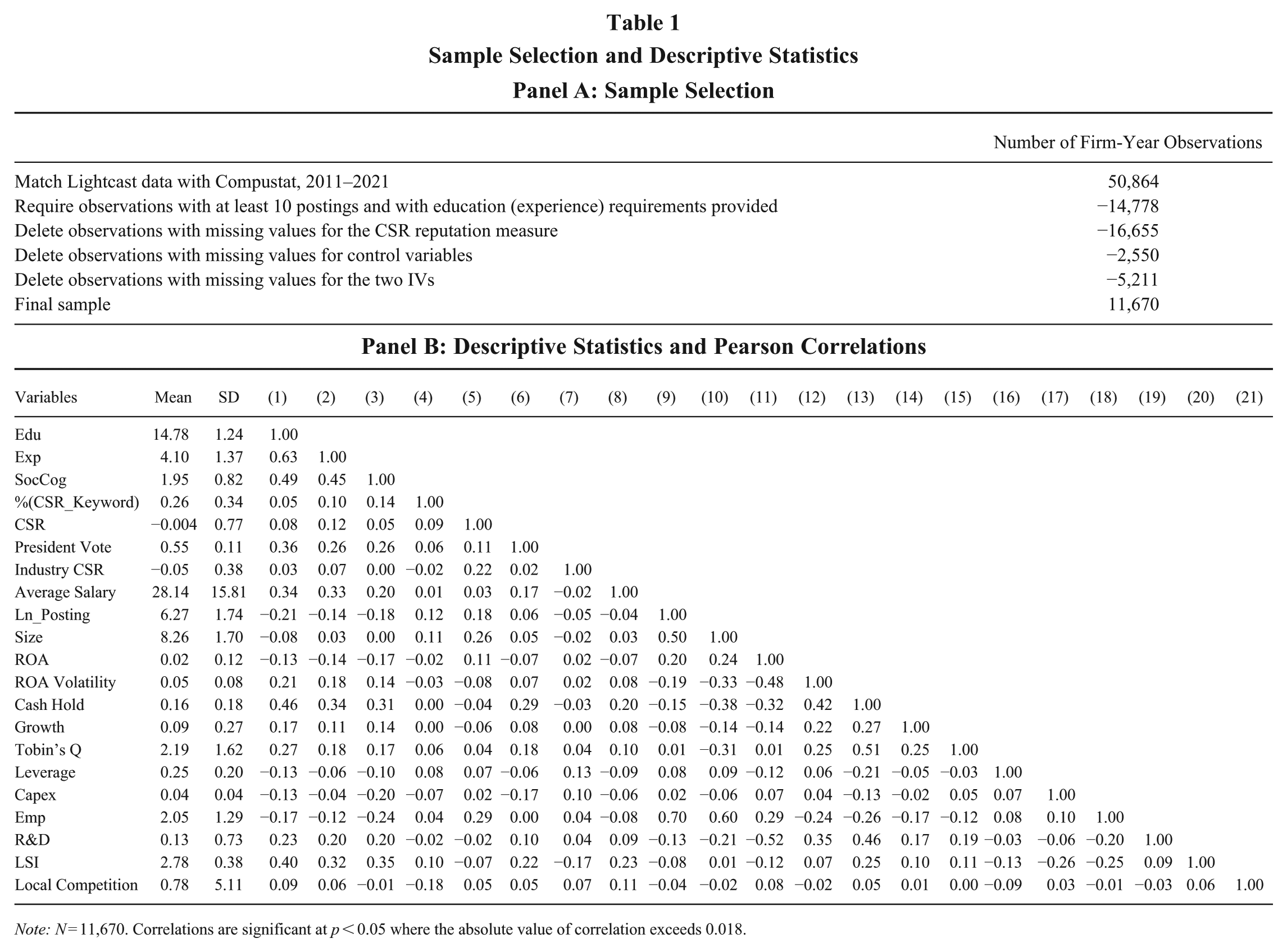
Note: N = 11,670. Correlations are significant at p < 0.05 where the absolute value of correlation exceeds 0.018.
To test H2a, we obtain employee resume data from EMSI to measure new hires’ actual skills. EMSI collects data on individuals’ resumes from a professional networking site and covers approximately 3.5 million resumes. Its granular employment data include job title, start and end dates of employment, firm name, and North American Industry Classification System (NAICS) code. The EMSI data comprise employees’ self-reported education backgrounds, work experience, and skill sets based on their resumes. We merge the EMSI and Compustat databases by firm names to identify employees who currently or formerly worked at our sample firms. Our final sample for testing H2a comprises 7,599 firm-year observations from 1,326 distinct public firms from 2011 to 2021.
To test H2b, we obtain information on employee inflows from the Revelio Lab Individual Worker Profile data, which we then merge with the job posting data from Lightcast to measure the filling rate for firms’ job postings. Revelio Labs provides individual-level position data, including current and historical positions. Our final sample for testing H2b comprises 10,398 firm-year observations from 1,664 distinct public firms for 2011 to 2021. To test H3a, H3b, H4a, and H4b, we use the same data as when testing H2a and H2b.
Our key measure of CSR reputation is a composite CSR index combining ratings from three leading and most widely used sources: Refinitiv’s ASSET4 ESG database, MSCI ESG Ratings, and RepRisk (Christensen, Serafeim, & Sikochi, 2022; De Villiers, Jia, & Li, 2022; Dinner, Kushwaha, & Steenkamp, 2019; Eccles & Stroehle, 2018; Lys, Naughton, & Wang, 2015; Wang & Li, 2019; Zhou & Wang, 2020).
Independent Variable
Firms’ CSR Reputation
To construct the composite score of CSR reputation, we focus on the environmental and social categories of the CSR ratings from the three databases, as corporate governance is typically regarded as a distinct construct from the other two ESG pillars (Gao, Lisic, & Zhang, 2014; Kim, Park, & Wier, 2012). We exclude the labor-related category score because it speaks directly to employees’ personal benefits. Specifically, for the ASSET4 rating, we take the average of the annual environmental and social category scores, which are based on six underlying categories: resource use, emissions, innovation, human rights, community, and product responsibility. For the MSCI rating, we first calculate the annual firm-level rating by averaging its monthly ratings. As MSCI discloses detailed weights for each rating category, we calculate the final MSCI rating as the weighted average of the environmental and social category scores, covering climate change, natural capital, pollution and waste, environmental opportunities, product liability, stakeholder opposition, and social opportunities. To construct the annual RepRisk measure, we aggregate the monthly ratings at the firm-year level, excluding components related exclusively to governance events. We then invert the aggregated score because higher values of the RepRisk Index (RRI) indicate greater CSR concerns or reputational risk.
Finally, we construct the firm-year-level composite index, CSR, by first standardizing the three firm-year scores from the three databases and then averaging them. Specifically, the ASSET4, MSCI, and RepRisk ratings are each standardized into a scale-free measure with a mean of 0 and a standard deviation of 1, then averaged into a firm-level composite score. The higher the composite CSR score, the better a firm’s CSR reputation is.
Using a composite CSR index in our research offers the following benefits. First, the literature has highlighted substantial disagreement among ESG ratings for the same firm across different providers (Chatterji, Durand, Levine, & Touboul, 2016); thus, a single rating may be less reliable than a composite score. Second, combining ratings from different providers allows for a more comprehensive assessment of firms’ CSR reputation by capturing more refined aspects. For example, MSCI emphasizes environmental opportunities, while RepRisk captures exposed stakeholder controversies and reputational risk. Third, a composite CSR reputation measure better fits our research context, as job candidates are likely to draw on different sources to assess a firm’s CSR reputation. Lastly, using a combined measure improves within-firm variation in CSR reputation over time because an individual rating agency may not always update its ratings promptly to reflect a firm’s CSR practices. By integrating ratings from multiple providers, our composite index provides a comprehensive, continuous, and timely assessment of firms’ evolving CSR reputations. 1
Dependent Variables
Firms’ Recruitment Strategies
Skill requirements in job postings
The Lightcast database contains rich labor market demand information, including the job posting date, job title, Standard Occupational Classification (SOC) code, industry, firm, location, and other details. The codified skills include stated education and experience requirements, as well as thousands of specific skills standardized from the open text in each job posting. Beginning with a set of predefined skills, Lightcast uses machine-learning algorithms to identify keywords and phrases and organize them into a taxonomy of unique skill requirements, ranging from general to job-specific (Deming & Kahn, 2018). These data allow us to explore skill requirements in firm-level recruiting. Prior research has shown that the skill requirements mentioned in job postings provide a reasonable representation of the skills obtained from firms’ labor market (e.g., Campello et al., 2024; Deming & Kahn, 2018), supporting the representativeness of the job posting skill information.
Consistent with prior research, we classify skill requirements along three dimensions: education, experience, and social and cognitive skills (e.g., Deming & Kahn, 2018; Deming & Noray, 2020; Hershbein & Kahn, 2018). Workers with higher education tend to possess higher skills and be more sophisticated. Work experience is an essential aspect of worker skills that is accumulated through prior employment (Quińones, Ford, & Teachout, 1995). Social and cognitive skills are essential in a wide range of professional jobs (Deming & Kahn, 2018). Notably, the widespread application of information technology in recent decades has escalated the importance of social and cognitive skills in today’s workplace. As computers replace humans in many routine noninteractive tasks, they will complement workers who are performing more complex and abstract tasks in flexible and team-based settings, which have a high demand for social and cognitive skills (e.g., Autor, 2014; Autor, Levy, & Murnane, 2003; Deming, 2017). Confirming this trend, Deming and Noray (2020) found that social and cognitive skill requirements in job postings increased significantly between 2007 and 2019. Meanwhile, Deming and Kahn (2018) observed substantial systematic variation across firms in their demand for social and cognitive skills.
To measure education and work experience, we directly extract the relevant information from the Lightcast data fields. We measure the education requirement (Edu) at the firm-year level as the average number of years of schooling (e.g., 12 for a high school diploma, 14 for an associate degree, and 16 for a bachelor’s degree) across job postings that specify education requirements for each firm in a given year. The work experience (Exp) requirement is measured at the firm-year level as the average number of years of required prior work experience across job postings that specify experience requirements for each firm in a given year. 2
To measure the social and cognitive skill requirements, we search the text of skill requirements provided by the Lightcast data to identify keywords related to social and cognitive skills. We follow the keyword lists provided by Deming and Noray (2020) to identify these skills. A social skill requirement contains at least one of the following phrases or fragments: “communication,” “collaboration,” “negotiation,” “team,” “persuasion,” “listening,” or “presentation.” A cognitive skill requirement contains at least one of the following phrases or fragments: “research,” “analysis,” “decision,” “solving,” “math,” “statistic,” or “thinking.” Consistent with prior studies (Deming, 2017; Deming & Kahn, 2018; Ham, Hann, Rabier, & Wang, 2025; Law & Shen, 2025), the firm-year level skill requirement, SocCog, is measured as the average number of social and cognitive skill keywords across all job postings for each firm in a given year.
CSR advertisement in job postings
To capture firms’ CSR advertisement in job postings, we use the query list of environmental-and-social–related issues developed by Li, Mai, Wong, Yang, and Zhang (2024) to search the text of job postings for CSR-related keywords. 3 We select CSR-related queries in the categories of community, diversity, environment, human rights, and product. The list of keywords and queries is shown in Table OA1 in the Online Appendix. We apply these queries at the sentence level. For example, a query using “communit* & involvement” implies that a posting contains relevant discussions of CSR issues regarding community if the description text includes both words starting with “communit” (such as “community” and “communities”) and “involvement.” 4 This approach allows us to precisely identify sentences that are pertinent to specific aspects of CSR.
We apply these queries to search the job description text for all firms’ postings in our sample. %(CSR_Keyword), calculated as the percentage of job postings containing at least one CSR keyword in a firm-year, is used to capture firms’ CSR advertisement in job postings. The results remain consistent, however, if we use an alternative measure of CSR advertisement in job postings: #(CSR_Keyword), defined as the natural logarithm of the number of job postings containing CSR keywords for a firm in a given year. Table OA2 in the Online Appendix reports the robustness results.
Recruitment Outcomes
Skills of new hires
We measure the skillsets and qualifications of newly hired employees by using the resume data provided by EMSI. The EMSI resume data provide an individual’s detailed employment history. EMSI does not provide historical skill information, however, so the skill information present in its resumes reflects only an individual’s skills at their latest job position. As a result, skill measures can be obtained only from an individual’s most recent employment.
Using these data, we construct firm-year level skill measures for firms’ newly hired employees in the following year. Specifically, we consider employees in their first year with a new employer to be “newly hired.” For each firm-year, we calculate the average education, experience, and social and cognitive skills for all newly hired employees identified for a firm in the following year. Edu of New Hires is the average years of education across all new hires. For each new employee, we measure years of education as the individual’s highest level of education achieved at the start of each position. Exp of New Hires is the average work experience (in years) among new hires. For each new employee, we measure years of experience as the number of years an individual had worked in the same industry (four-digit NAICS code) as of the first year of each job position. SocCog of New Hires is the average number of social and cognitive skill keywords in the newly hired employee’s resume. To gauge an individual’s social and cognitive skills, we use the same keyword lists for constructing the job-posting–based skill requirement measures.
Job position filling rate
The job position filling rate (Filling Rate) is measured as the ratio of the number of employee inflows to a firm in the following year to the total number of job postings created by the firm within the current year. The filling rate ranges from 0 to 1. For firm-years in which the number of newly hired employees exceeds the number of job postings, we set the filling rate to 1. A higher filling rate indicates that a firm could more successfully fill its job vacancies and is suggestive of greater hiring efficiency.
Control Variables
We include a large set of control variables as determinants of skill requirements and CSR advertisement in job postings. Specifically, because higher salaries naturally attract high-quality job candidates, we control for the average salary (Average Salary), defined as the average hourly minimum salary based on firms’ postings that include salary information. We restrict the sample to firm-years with at least one job posting that provided salary information to calculate the average salary value.
We follow prior studies by controlling for a large set of firm characteristics that may affect a firm’s hiring decisions (e.g., Brown & Matsa, 2016; Chodorow-Reich, 2014). We control for firm size (Size), measured as the natural logarithm of total assets, because large firms have more resources to recruit high-quality employees. We also control for return on assets (ROA), standard deviation of annual ROA in the past five-year window (ROA Volatility), cash holding (Cash Hold), sales growth (Growth), firm value (Tobin’s Q), and the ratio of long-term debt to total assets (Leverage) to capture a firm’s financial health and growth potential, which could have a direct effect on the attractiveness of its job positions (e.g., Brown & Matsa, 2016; Caggese, Cuñat, & Metzger, 2019). We include firms’ R&D intensity, measured as R&D expenditures over total assets (R&D), because firms that engage in more R&D activities are likely to have a higher demand for high-skilled employees. Firms’ investment cycle may directly affect their hiring decisions, so we control for firms’ capital expenditures relative to total assets (Capex), the natural logarithm of the number of current employees (Emp), and the natural logarithm of the total number of job postings each year (Ln_Posting).
In addition, firms’ reliance on skilled labor varies, which influences how they set skill requirements in their job postings. Therefore, we control for LSI, a firm-level index measuring the extent of a firm’s reliance on skilled labor (Ghaly et al., 2017). At the same time, labor market competition constrains firms’ ability to set high skill requirements when the supply of talent is less than the demand. To control for Local Competition, we calculate a firm’s abnormal job postings at the Metropolitan Statistical Area (MSA) and industry (two-digit SIC codes) level as the difference between the number of job postings by the firm and the average number of postings by other firms in the corresponding MSA-industry. We then construct a weighted average firm-year measure (in thousands) based on the proportion of the firm’s job postings in that MSA-industry relative to its total job postings.
Research Design
To test whether firms’ CSR reputation is positively related to the recruitment strategies and outcomes hypothesized earlier, we estimate a two-stage least squares (2SLS) using an IV approach with firm fixed effects. In this analysis, the dependent variables include the skill requirement measures (Edu, Exp, and SocCog), the CSR advertisement measure (%(CSR_Keyword)), the actual skills of new hires (Edu of New Hires, Exp of New Hires, and SocCog of New Hires), and the job position filling rate (Filling Rate). The key independent variable is the firm’s CSR reputation (CSR) in year t − 1, along with a set of control variables also measured in year t − 1. We expect a positive coefficient for CSR.
Studying the effect of CSR reputation is subject to the typical endogeneity concern caused by omitted correlated variables. For example, firms with more financial resources can build their CSR reputation and, at the same time, attract high-quality job candidates. We include firm fixed effects to account for unobserved time-invariant firm-level confounding factors to address the endogeneity concern. We also control for year fixed effects to control for macro-level temporal variations in labor market conditions. Standard errors are clustered at the firm level. To further address the endogeneity concern, we identify two IVs for a firm’s CSR reputation based on our survey of the literature (e.g., Albuquerque et al., 2019; Cahan, Chen, Chen, & Nguyen, 2015; Cook, Romi, Sánchez, & Sánchez, 2019; Deng et al., 2013; Hubbard et al., 2017).
The first IV, President Vote, is the average value of the proportion of votes received by the Democratic candidate in the presidential election in the county and the state where the firm is headquartered. The presidential voting data came from David Leip’s Atlas of U.S. Presidential Elections (Leip, 2024). Democratic-leaning voters tend to care more about CSR issues such as environmental protection, antidiscrimination and affirmative action policies, employee protection, and helping the poor and disadvantaged in the community (e.g., Di Giuli & Kostovetsky, 2014). Influenced by the local political environment, firms headquartered in Democratic-leaning locations tend to allocate more resources to CSR and, therefore, have better CSR performance (Di Giuli & Kostovetsky, 2014; Rubin, 2008).
The second IV, Industry CSR, measures the average CSR performance of industry peers (e.g., Attig, El Ghoul, Guedhami, & Suh, 2013; Awaysheh, Heron, Perry, & Wilson, 2020; Benlemlih & Bitar, 2018; Bhandari & Javakhadze, 2017; Cheng et al., 2014; Shan, Fu, & Zheng, 2017). A firm’s CSR performance may be influenced by the overall CSR performance of its industry, as firms within the same industry tend to face similar stakeholder expectations and institutional environments. Prior research suggests that industry characteristics play a significant role in shaping CSR behavior (Ioannou & Serafeim, 2012), and firms often align their CSR strategies with prevailing industry standards in an effort to maintain their legitimacy. Therefore, firms operating in industries with generally high levels of CSR reputation are more likely to engage in CSR and achieve better CSR performance.
Theoretically, these two IVs are relevant to firms’ CSR engagement but would not directly influence firms’ recruitment strategies, so they meet the exclusion criteria. For the IV of local Democratic-leaning political environment, it is unlikely that firm managers would increase skill requirements for their job candidates or promote CSR activities in job postings for reasons other than recruitment. The primary values of the Democratic party tend to emphasize inclusion, diversity, and environmental concerns (Doherty, 2017), and these values are unlikely to directly lead firms in Democratic-leaning locations to impose higher skill requirements for job applicants. 5 For the IV of Industry CSR, there is also no ex-ante expectation that industry-level CSR performance will influence firms’ strategic decisions in setting the skill requirements in job postings through channels other than their own CSR performance. Both of these IVs have been widely used in prior CSR studies in management, economics, and finance areas (e.g., Albuquerque et al., 2019; Cahan et al., 2015; Cook et al., 2019; Deng et al., 2013; Hubbard et al., 2017).
Results
Descriptive Statistics and Correlations
Table 1, Panel B reports the descriptive statistics and the Pearson correlations. On average, our sample firms require their employees to have 14.78 years of education and 4.10 years of work experience, and they include 1.95 social or cognitive skill–related keywords per job posting. On average, 26% of firm-year job postings contain at least one CSR keyword. The CSR reputation has a mean value of −0.004. Moreover, the %(CSR_Keyword) variable, which represents the extent of a firm’s CSR advertisement in job postings, is positively related to all three skill requirement measures, indicating that the two recruitment strategies of interest here—raising skill requirements and CSR advertisement—are likely to be adopted together.
CSR Reputation and Skill Requirements in Job Postings
Table 2 reports the empirical results of testing H1a. Models 1–4 report the results from the 2SLS regressions and controlling for firm fixed effects. Model 1 reports the first-stage results of regressing a firm’s overall CSR reputation on the two IVs. The coefficients of both IVs are positive, with Industry CSR being very significant (β = 0.21, p = 0.000) and President Vote being marginally significant (β = 0.47, p = 0.091). When we calculate the Kleibergen–Paap F-statistic, we find that the F value is greater than 10 (F = 17.98), indicating that the issue of weak instruments is not a concern. The Durbin–Wu–Hausman test rejects the null hypothesis of no endogeneity for all three skill requirements: Edu (F = 6.80, p = 0.009), Exp (F = 7.05, p = 0.008), and SocCog (F = 5.32, p = 0.021), supporting our use of IVs. The Hansen J-statistic for the overidentifying test fails to reject the validity of the overidentifying restrictions (Edu (χ2 = 0.63, p = 0.428), Exp (χ2 = 1.90, p = 0.168), and SocCog (χ2 = 0.001, p = 0.979)). Overall, these assessments support the validity of our IVs.
The Effect of CSR Reputation on Skill Requirements in Job Postings
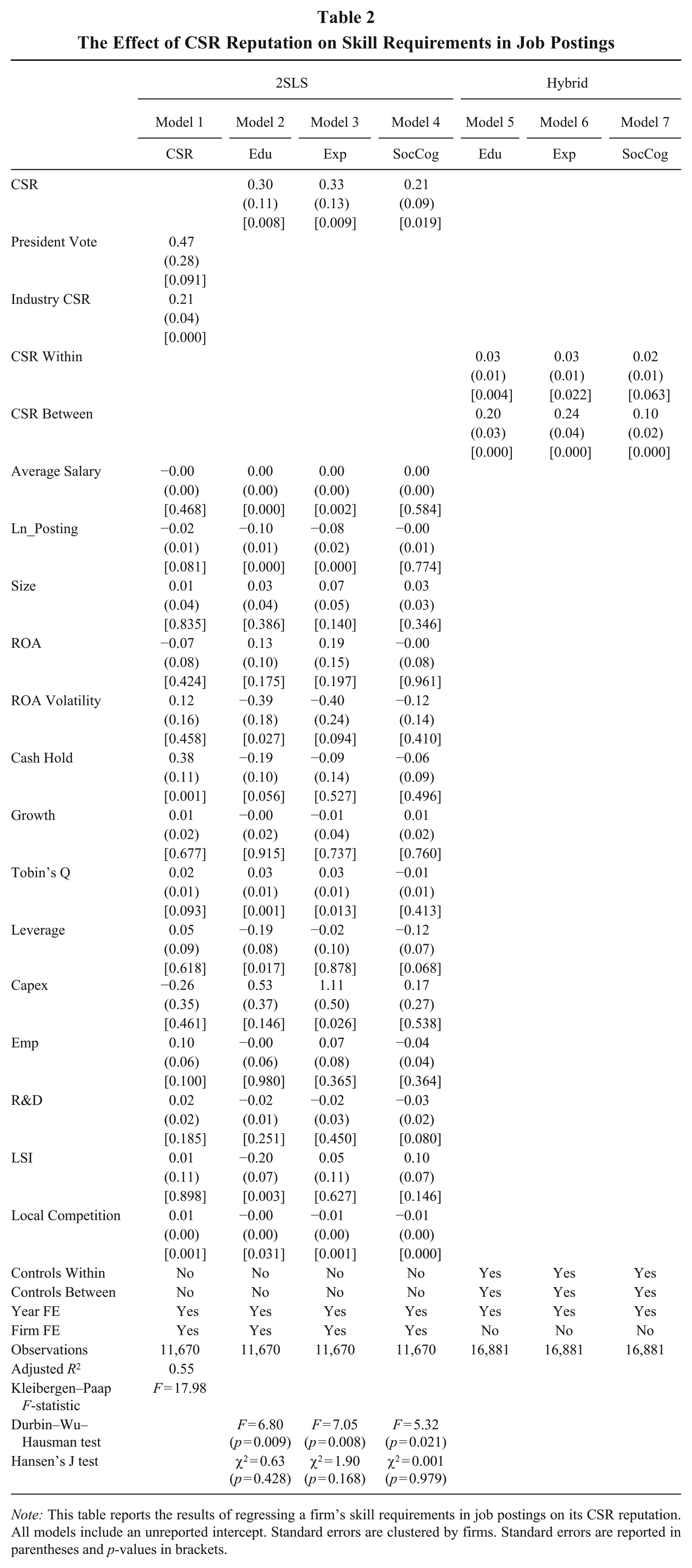
Note: This table reports the results of regressing a firm’s skill requirements in job postings on its CSR reputation. All models include an unreported intercept. Standard errors are clustered by firms. Standard errors are reported in parentheses and p-values in brackets.
The dependent variables in Models 2–4 are education requirement (Edu), experience requirement (Exp), and social and cognitive skill requirement (SocCog), respectively. Across all models, the coefficients of CSR are positive and statistically significant: Edu (β = 0.30, p = 0.008), Exp (β = 0.33, p = 0.009), and SocCog (β = 0.21, p = 0.019). Because we control for firm fixed effects, these findings indicate that as firms’ CSR reputations improve, their skill requirements for prospective employees increase.
In Models 5–7, we estimate a hybrid model to disentangle within- and between-firm effects (Certo, Withers, & Semadeni, 2017). Specifically, we decompose each independent variable into two components: (1) a group-mean–centered component, representing within-firm variations (e.g., CSR Within), and (2) a firm group mean component, representing between-firm variations (e.g., CSR Between). The coefficients of CSR Within are positive and statistically significant for Edu (β = 0.03, p = 0.004) and Exp (β = 0.03, p = 0.022), and marginally significant for SocCog (β = 0.02, p = 0.063). The within-firm effects indicate that improvements in a firm’s CSR reputation are associated with higher skill requirements within the same firm. In terms of the economic magnitude, when the value of CSR Within increases by one standard deviation, the average education, experience, and social and cognitive skill requirements in the job postings increase by 1.9%, 1.7%, and 1.9% of a standard deviation, respectively.
The coefficients of CSR Between are also positive and statistically significant across all three skill requirements: Edu (β = 0.20, p = 0.000), Exp (β = 0.24, p = 0.000), and SocCog (β = 0.10, p = 0.000). In terms of the economic magnitude, when the value of CSR Between increases by one standard deviation, the average education, experience, and social and cognitive skill requirements in the job postings increase by 12.4%, 13.5%, and 9.4% of a standard deviation, respectively, suggesting that the between-firm effects are very significant. In other words, firms with better CSR reputations compared to their peers are likely to set significantly higher skill requirements in their job postings.
Because the between-firm variations in CSR reputation suffer from strong endogeneity concerns, we primarily draw our inferences based on the 2SLS results and within-firm effects, the latter of which are equivalent to the results from the OLS regressions with firm fixed effects. From a practical standpoint, our findings from this analysis inform employers that firms with a strong CSR reputation use it as leverage in the recruiting sphere, by raising the skill requirements so that they can more effectively target top talent. Firms with a high CSR reputation that have not done so may benefit from adopting a similar strategy to exploit their competitive advantage in the labor market. In contrast, firms with weaker CSR reputations appear to be at a disadvantage when hiring and cannot demand high skill levels in their job candidates.
In regard to the control variables, average salary (Average Salary) is positively associated with skill requirements. Firms with lower volatility in ROA (ROA Volatility), greater firm value (Tobin’s Q), and lower leverage (Leverage) tend to include higher skill requirements in their job postings. Moreover, firms’ total number of job postings (Ln_Posting) is associated with lower skill requirements.
To further mitigate endogeneity concerns, we conduct a placebo test using “frequent travel” requirements in job postings as the dependent variable. Travel requirements are tied to the nature of the job rather than to personal skills. In addition, employees’ willingness to accommodate such requirements strongly reflects their family situations and personal preferences. Therefore, travel requirements should not be affected by the employer’s CSR reputation. The results of this analysis are presented in Table OA3 in the Online Appendix. Consistent with our expectation, we do not find a significant association between firms’ CSR reputation and the travel requirements in their job postings, which provides further support for the causal inferences from the main analysis.
CSR Reputation and CSR Advertisement in Job Postings
Table 3 reports the results of examining firms’ CSR advertisement in job postings (the first-stage results are available upon request). In Model 1, we estimate the 2SLS regression for %(CSR_Keyword) using the two IVs and controlling for the same set of control variables and firm- and year-fixed effects. We find a positive association between firms’ CSR reputation and CSR advertisement in job postings (β = 0.11, p = 0.025), indicating that firms with a high CSR reputation actively advertise their CSR activities in their job postings.
The Effect of CSR Reputation on CSR Advertisement in Job Postings
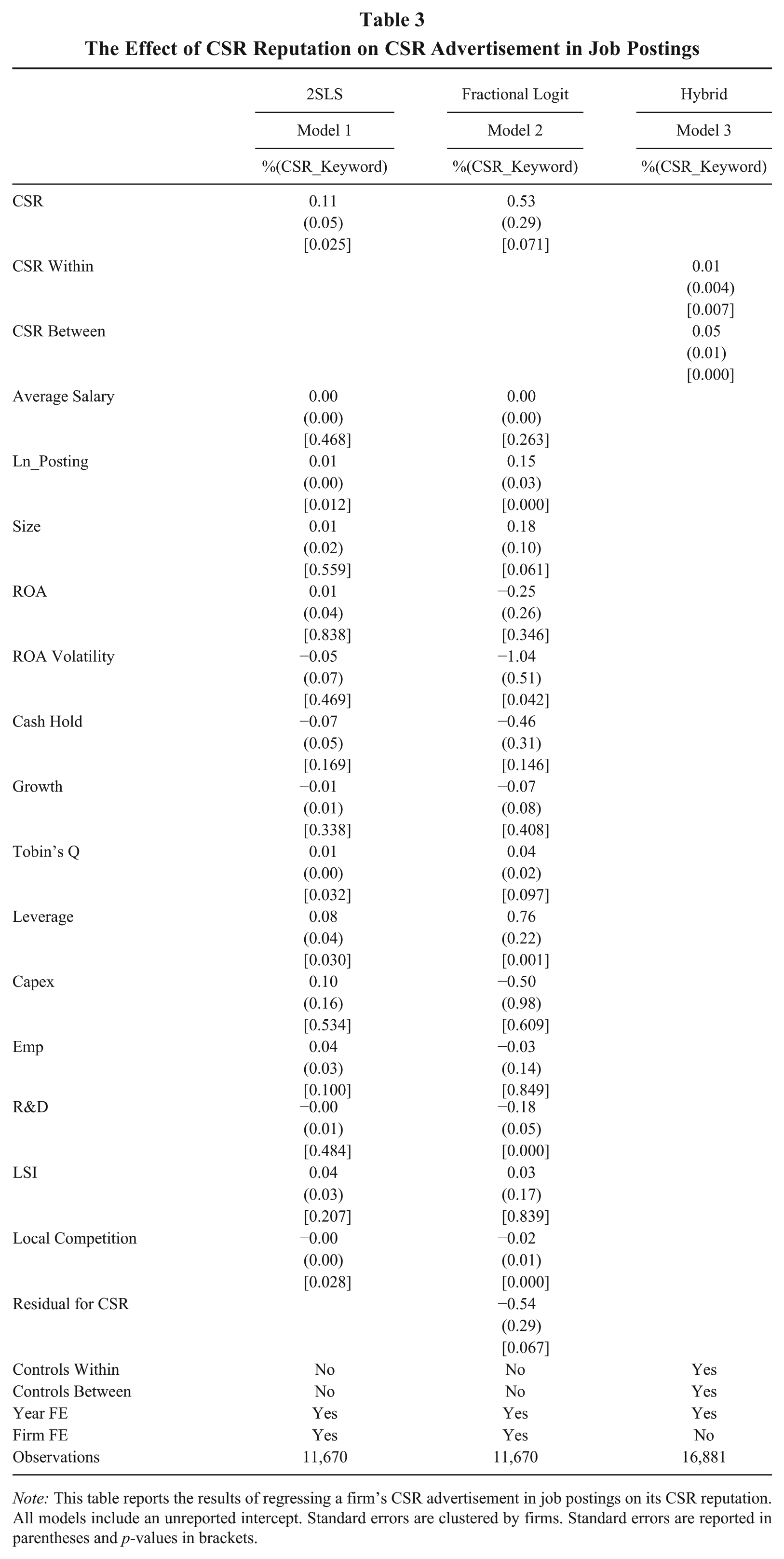
Note: This table reports the results of regressing a firm’s CSR advertisement in job postings on its CSR reputation. All models include an unreported intercept. Standard errors are clustered by firms. Standard errors are reported in parentheses and p-values in brackets.
As %(CSR_Keyword) is defined as a ratio, we also employ a fractional logit model, which can properly handle bounded outcomes, combined with a control function approach to address endogeneity. To combine the fractional logit model with the control function approach, we first regress CSR on the IVs and controls. We take the residuals as the Residual for CSR, which we then include as controls in the second-stage fractional logit regression. The result reported in Model 2 remains similar under this specification.
To disentangle the within- and between-firm effects, we again estimate a hybrid model. Model 3 reports the results. The coefficients on CSR Within and CSR Between are positive and statistically significant (β = 0.01, p = 0.007; β = 0.05, p = 0.000). An increase of one standard deviation in CSR Within and CSR Between leads to a 2.3% and 11.3% standard deviation increase in %(CSR_Keyword), respectively. Overall, this evidence supports H1b, implying that employers with a stronger CSR reputation are also more likely to advertise their CSR commitment in job postings.
This finding provides employers with valuable insights into another strategy utilized by organizations with strong CSR reputations for talent recruitment. It has implications for both firms with strong CSR reputations and those without such reputations, suggesting that they should tailor their recruitment approaches accordingly.
CSR Reputation and Recruitment Outcomes
Table 4 reports the results of testing H2a. We include the same set of control variables in this test. Models 1–3 present the results from the 2SLS regressions with firm fixed effects. We find that firms’ CSR reputation is positively and significantly associated with Edu of New Hires (β = 0.86, p = 0.039) and SocCog of New Hires (β = 0.67, p = 0.035), and marginally significantly associated with Exp of New Hires (β = 1.50, p = 0.060). These results provide some support for H2a, which posits that socially responsible firms have an advantage in recruiting high-quality employees.
The Effect of CSR Reputation on Skills of New Hires
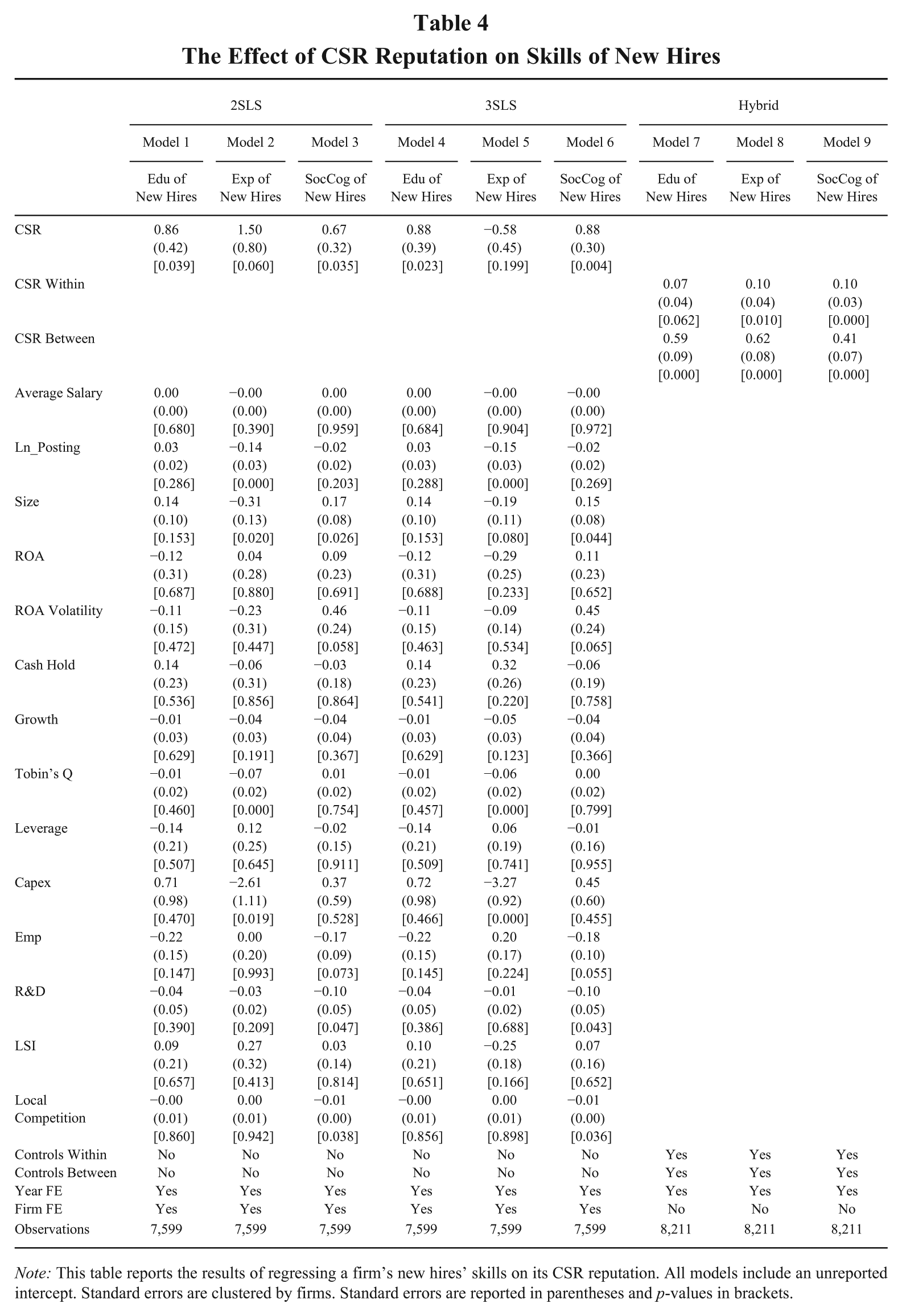
Note: This table reports the results of regressing a firm’s new hires’ skills on its CSR reputation. All models include an unreported intercept. Standard errors are clustered by firms. Standard errors are reported in parentheses and p-values in brackets.
Given that the three actual skills (Edu of New Hires, Exp of New Hires, and SocCog of New Hires) are positively correlated, we also conduct a three-stage least squares (3SLS) estimation. This analytic method combines instrumental variable techniques with seemingly unrelated regression (SUR) to improve estimation efficiency by accounting for cross-equation error correlations. The results for Models 4–6 are consistent with the main results, except for the coefficient of CSR on Exp of New Hires, which is not statistically significant under 3SLS. Models 7–9 present the results from the hybrid model, which have a similar pattern and consistently show that both the within-firm and between-firm effects are largely significant (the within-firm effect for Edu of New Hires is only marginally significant).
Table 5 reports the results of testing H2b. Model 1 reports the results of the 2SLS model with firm fixed effects. The estimated coefficient on CSR is positive and significant (β = 0.02, p = 0.049). The results in Models 2 and 3 are similar when we conduct fractional logit and hybrid regressions respectively. These results support H2b, which posits that firms with a stronger CSR reputation can fill their job vacancies more efficiently.
The Effect of CSR Reputation on Job Position Filling Rate
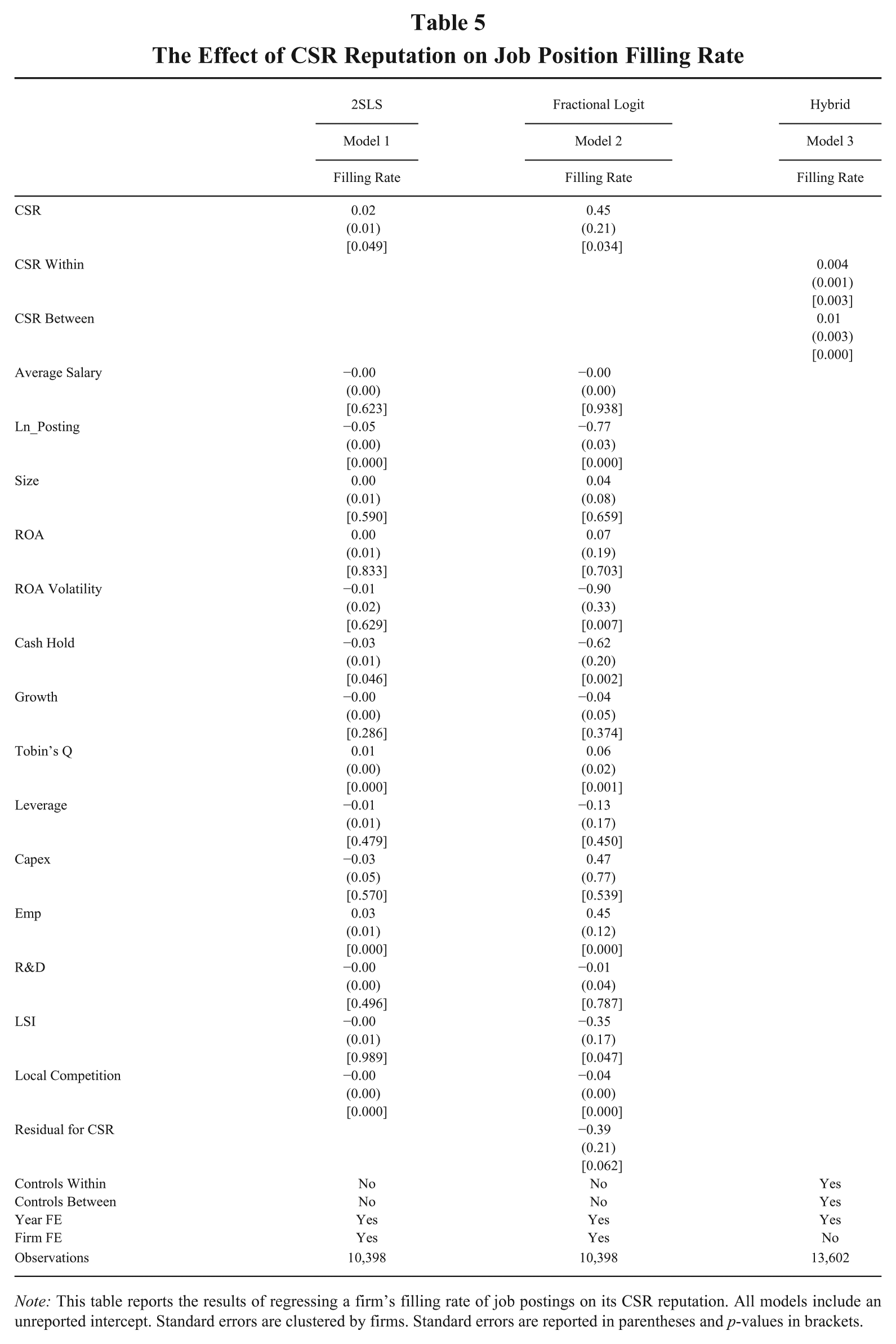
Note: This table reports the results of regressing a firm’s filling rate of job postings on its CSR reputation. All models include an unreported intercept. Standard errors are clustered by firms. Standard errors are reported in parentheses and p-values in brackets.
Overall, the results reported in Tables 4 and 5 to a large extent suggest that CSR reputation can translate into more effective and efficient recruitment outcomes. Given the importance of talent recruitment, our findings inform employers that having better CSR reputation can help the firm achieve favorable recruitment outcomes. Thus, when firms are evaluating the costs and benefits of CSR investments, it is worthwhile to account for the labor market benefits of CSR investment. For organizations lacking a strong CSR reputation, our findings highlight the need to address this disadvantage if they are to successfully compete for top talent in the job market.
The Mediation Effect of Recruitment Strategies
To test H3a, H3b, H4a, and H4b, we next perform a path analysis to test whether raising skill requirements and advertising CSR activities in job postings are the paths/mechanisms through which CSR reputation affects recruitment outcomes—namely, the skills possessed by new hires and the job position filling rate. We use the conditional mixed process (CMP) method to address potential endogeneity in the mediation framework. In addition, we integrate the IV strategy consistently to examine whether the positive effect of CSR reputation on the skills of new hires and the job position filling rate is mediated by the two recruiting strategies. We use bootstrapping with 10,000 replications to correct the confidence intervals of the mediation effects. 6 For the three skill measures of new hires—Edu of New Hires, Exp of New Hires, and SocCog of New Hires—we use their corresponding skill requirements and firms’ CSR advertisement in job postings as mediation variables. For the job position filling rate, we include all three measures of skill requirements and CSR advertisement in job postings as mediation variables.
Table 6 presents the results of the path analysis. It reports the total effect of CSR reputation on recruiting outcomes, the mediation effects of the two recruitment strategies (the indirect effect of CSR reputation on the actual recruitment outcomes through the two strategies), and the rest of the effects that CSR reputation has on the actual recruitment outcomes. The total effect of CSR reputation is positive for all three measures of the actual skills of new hires and the job position filling rate, which is consistent with the results reported in Tables 4 and 5.
Path Analysis on the Recruitment Outcomes Through Skill Requirements and CSR Advertisement
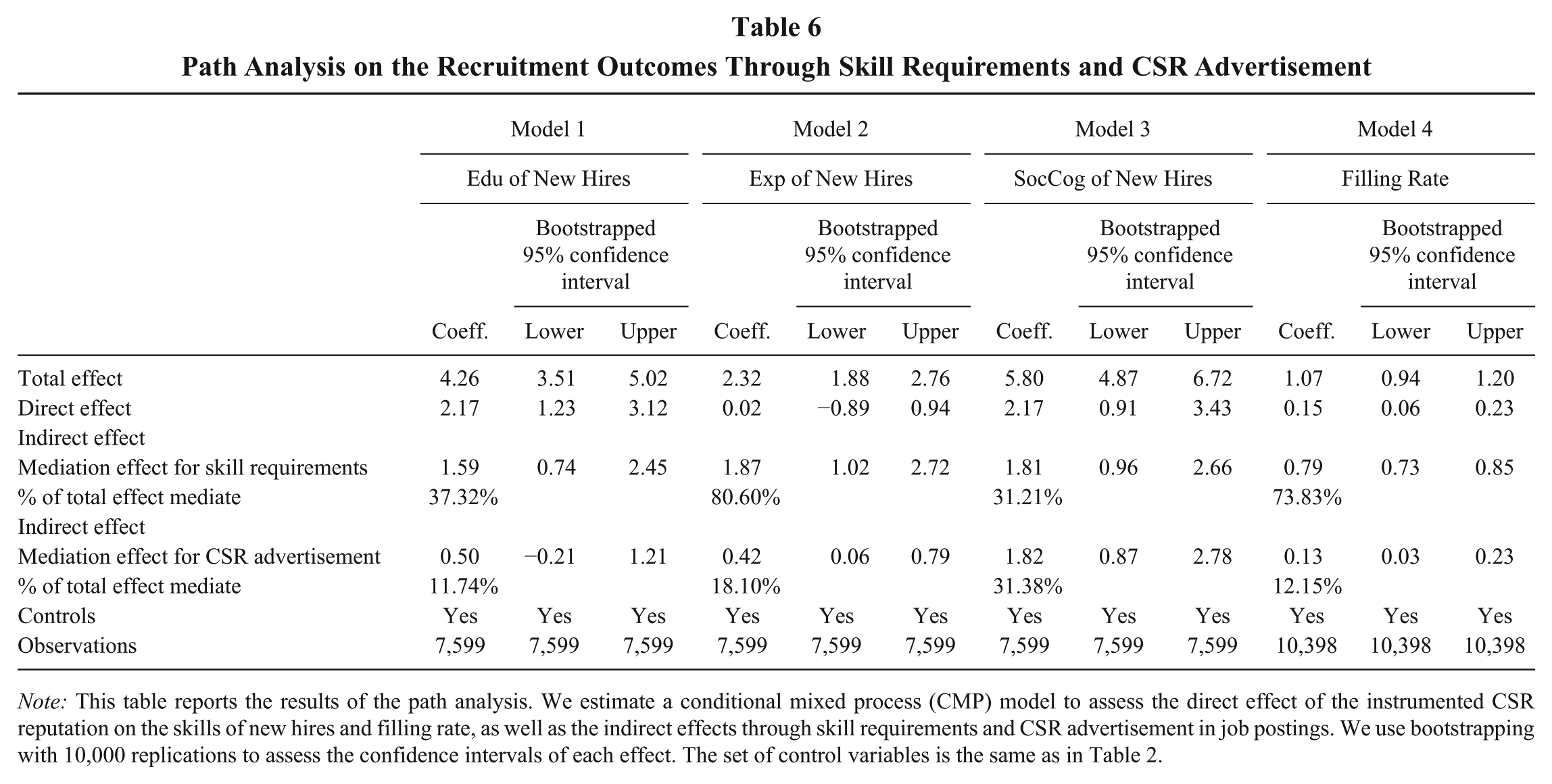
Note: This table reports the results of the path analysis. We estimate a conditional mixed process (CMP) model to assess the direct effect of the instrumented CSR reputation on the skills of new hires and filling rate, as well as the indirect effects through skill requirements and CSR advertisement in job postings. We use bootstrapping with 10,000 replications to assess the confidence intervals of each effect. The set of control variables is the same as in Table 2.
Next, we discuss the mediation effect for each of the dependent variables in Models 1–4. Model 1 reports the results for Edu of New Hires as the dependent variable. The indirect effect of CSR reputation on Edu of New Hires through skill requirement Edu is positive (β = 1.59) and accounts for 37.32% of the total effect of CSR reputation (1.59/4.26). The bootstrapped 95% confidence interval for the coefficient of the indirect effect does not include zero, providing support for our hypothesized mediation effect. The indirect effect of CSR reputation on Edu of New Hires through CSR advertisement in job postings is positive (β = 0.50) and accounts for 11.74% of the total effect of CSR reputation (0.50/4.26). The 95% bootstrapped confidence interval falls between −0.21 and 1.21, which includes zero, indicating that the mediation effect is not significant. Advertising CSR information in job postings may not be an effective strategy for recruiting more well-educated employees possibly because applicants with higher levels of education are more capable of gathering and integrating information from multiple sources, making them less reliant on CSR information in job postings.
Model 2 reports the results for Exp of New Hires as the dependent variable. The indirect effect through skill requirement Exp is positive (β = 1.87) and accounts for 80.60% of the total effect of CSR reputation (1.87/2.32). The indirect effect through CSR advertisement in job postings is positive (β = 0.42) and accounts for 18.10% of the total effect of CSR reputation (0.42/2.32). The bootstrapped 95% confidence intervals for both indirect effect coefficients do not include zero, supporting the proposed mediation effect.
Model 3 reports the results for SocCog of New Hires as the dependent variable. The indirect effect through skill requirement is positive (β = 1.81) and accounts for 31.21% of the total effect (1.81/5.80). The indirect effect through CSR advertisement in job postings is positive (β = 1.82) and accounts for 31.38% of the total effect (1.82/5.80). The bootstrapped 95% confidence intervals for both indirect effect coefficients do not include zero as well, supporting the mediation effect. Overall, the results in Models 1–3 provide support for H3a and partial support for H4a.
Model 4 reports the results for Filling Rate as the dependent variable. The total indirect effect through the three skill requirements is positive (β = 0.79) and accounts for 73.83% of the total effect (0.79/1.07). The indirect effect through CSR advertisement in job postings is also positive (β = 0.13) and accounts for 12.15% of the total effect (0.13/1.07). Given that the bootstrapped 95% confidence intervals for both indirect effects do not include zero, these results provide statistical support for the hypothesized mediation (H3b and H4b).
In summary, we find support for H3a, H3b, and H4b, but only partial support for H4a. Raising the skill requirements in job postings can help translate the firm’s CSR reputation into high-skill new hires and an increased job position filling rate. Meanwhile, CSR advertisement in job postings helps convert CSR reputation into two practical benefits—more experienced and socially and cognitively skilled new hires and a more efficient filling rate—but not lead to new hires with higher levels of education.
These findings have important practical implications. While firms can observe competitors’ recruitment strategies, they lack insights into the effectiveness of those approaches. Our findings inform them whether raising skill requirements and advertising CSR commitment in job postings are effective ways for companies to turn their CSR reputations into tangible recruitment benefits.
Robustness Tests
We perform two robustness tests of the main results reported in Tables 2 and 3, using both alternative samples and alternative research designs.
First, we recognize that employees from different occupations vary in terms of their skill sets and preferences for firms’ CSR performance. For example, technology-intensive occupations are likely to have higher skill requirements. Occupations related to management and administrative support likely require strong social skills (Deming & Noray, 2020). Thus, an alternative explanation for our main result could be that firms with a better CSR reputation include business occupations that have higher skill requirements for their employees or pay more attention to CSR activities.
To mitigate this concern, we rerun our 2SLS models with firm-year-occupation–level data and also control for occupation-fixed effects. We use the two-digit level of the Standard Occupational Classification (SOC) code to construct the firm-year-occupation–level sample. Accordingly, all of the dependent variables are reconstructed at the firm-year-occupation level. We still require at least 10 job postings for each firm-year-occupation. We obtain some consistent results, which are reported in Table OA4 in the Online Appendix.
Second, we examine whether different types of CSR reputation—specifically, environmental and social dimensions—affect the skill requirements in job postings and CSR advertisement. The results are reported in Table OA5 in the Online Appendix. Our results suggest that socially related CSR reputation is more positively associated with the skill requirements and CSR advertisement in job postings, consistent with the idea that such social initiatives may be more attractive to applicants. This effect is likely due to the perception of better employee-related conditions, such as diversity, within firms that undertake such initiatives.
Discussion and Conclusion
This study investigates how firms leverage their CSR reputation as a strategic resource to harness recruitment benefits from the labor market. Drawing on the RBV, we conceptualize CSR reputation as a valuable resource that enhances firms’ attractiveness to job seekers. We argue that a strong CSR reputation enables firms to adopt two recruitment strategies: (1) setting higher skill requirements for prospective employees and (2) actively advertising their own CSR activities in job postings. We further examine whether these two strategies translate a firm’s CSR reputation into recruitment outcomes and find some supporting evidence. That is, these two strategies could mediate the relationship between a firm’s CSR reputation and its actual recruitment outcomes, measured by the actual skill levels of new hires and the job position filling rate. An exception is the relationship between CSR advertisement and the education levels of new hires hypothesized in H4a, which is not supported.
Prior research has extensively explored the impact of CSR reputation on the preferences of current and prospective employees, showing that individuals are more likely to be attracted to socially responsible firms (e.g., Evans & Davis, 2011; Greening & Turban, 2000; Turban & Greening, 1997). Job seekers often perceive such firms as more ethical and desirable employers and anticipate higher pride and satisfaction when working there, even to the extent of accepting lower wages or fewer benefits to join them (Burbano, 2016; Frank & Smith, 2016). Additionally, employees at socially responsible firms exhibit higher levels of organizational commitment and lower turnover rates (Bode et al., 2015). These findings collectively support the well-established preference among job seekers for employers with a strong CSR reputation.
Despite this robust body of evidence, the existing literature has largely assumed that a firm’s strong CSR reputation will automatically translate into favorable recruitment outcomes, without examining the specific strategies or processes that firms employ to leverage their CSR reputation in recruitment (Aguinis & Glavas, 2012; Wang, Tong, Takeuchi, & George, 2016). This oversight has left a significant gap in the literature, as it fails to explain how firms actively convert their CSR reputation into tangible recruitment advantages. Our study addresses this gap by conceptualizing CSR reputation as a strategic resource that firms can leverage to adopt more selective recruitment strategies to target top talent. Talent itself is a rare and valuable resource that can enhance a firm’s competitive advantage. Meanwhile, CSR reputation and human capital are complementary strategic resources, given skilled employees’ strong preference for firms demonstrating a strong CSR commitment. Therefore, firms have incentives to deploy their CSR reputation to effectively target and attract talent, reinforcing the complementarities and synergies between these two strategic resources.
Our findings contribute to the debate in the broader CSR research regarding the economic returns of CSR investments and their effects on firm value (e.g., Edmans, 2012; Kitzmueller & Shimshack, 2012; Margolis, Elfenbein, & Walsh, 2009; Margolis & Walsh, 2003; Peloza & Shang, 2011; Servaes & Tamayo, 2013). Shareholders, for instance, may view CSR initiatives with skepticism, perceiving them as potential hindrances to competitiveness due to the uncertainty surrounding their financial benefits. Our findings suggest that CSR investments are actually aligned with market competitiveness, such as through improving recruitment outcomes. Indeed, CSR reputation as a strategic resource can help firms attract and accumulate a key complementary resource in today’s business environment—namely, high-quality employees.
This finding is critical because CSR investments are sustainable only when they contribute to firm competitiveness and resourcefulness. Notably, large firms often allocate substantial resources to CSR activities; for example, Fortune Global firms spend approximately $20 billion annually on such initiatives (Meier & Cassar, 2018). Despite this significant investment, the mechanisms through which CSR reputation translates into competitiveness and firm value in the labor market remain underexplored (Margolis et al., 2009). By highlighting how firms can actively exploit the labor market benefits of CSR engagement, our research provides a tangible and practical approach through which CSR reputation can enhance firm value.
In addition, by examining the firm’s perspective, we contribute to a more complete understanding of the CSR–employee relationship. We also provide actionable insights for practitioners in human resources, talent acquisition, and strategic management, by clarifying how firms can operationalize their CSR reputation to secure competitive recruitment advantages. First, recruiters can use CSR reputation not merely as a general branding signal, but as a strategic lever to signal the firm’s value proposition to high-skilled job seekers. More specifically, tailoring job requirements and CSR messaging in recruitment materials can attract potential employees whose preferences align with the firm’s values. By raising skill requirements, firms can better match aspirational candidates to the roles where they might be most effective, potentially reducing search and mismatch costs and improving longer-term retention. Moreover, selectively advertising CSR achievements in job postings, when aligned with broader recruitment strategy and organizational practices, can enhance knowledge among prospective applicants about the firm’s social commitments, thereby reinforcing employer attractiveness. Together, these insights suggest clear actions that recruiters can take to integrate their firm’s CSR reputation into its recruitment strategies, thereby helping firms not only differentiate themselves in a tight labor market but also attract employees who value CSR. Such strategic use of CSR reputation can foster a competitive advantage in human capital accumulation, a critical component of long-term firm performance and value creation. Overall, our theoretical contributions can be translated into specific, implementable steps for practice, highlighting what managers can do, in which contexts, and what gains they might expect from adopting these approaches (Simsek, Li, & Huang, 2021).
Our study focuses on two specific strategies that firms could use to leverage their CSR reputation in the labor market—raising skill requirements and advertising CSR activities in job postings. However, we do not claim that these two strategies are the only means through which firms can capitalize on their CSR reputation in the labor market. We call for future studies to investigate other potential recruitment strategies to leverage CSR reputation as well as firms’ choices of different strategies. In two additional analyses included in the Online Appendix (Tables OA6 and OA7), we explore the relationship between these two strategies. First, we focus on a group of firms with a high CSR reputation (with above-median CSR ratings in the year), and find some evidence suggesting that those with better visibility (larger size and more media coverage) are less likely to advertise their CSR activities but tend to raise the skill requirements in their job postings. Then, for the same group of firms with a high CSR reputation, we also find some evidence indicating that those that have a low reliance on skilled labor but operate in a local environment where local firms typically disclose their CSR initiatives in their job postings are more likely to advertise their CSR activities without simultaneously increasing the skill requirements for job applicants. Second, we find that employing these two strategies together can sometimes further improve recruitment outcomes, suggesting that these two strategies have complementary effects, at least to a certain degree. Overall, the relationship between different recruitment strategies depends on the cost–benefit trade-offs under specific scenarios. We also call for further investigations of firms’ specific choices in the future.
Supplemental Material
sj-docx-1-jom-10.1177_01492063261448457 – Supplemental material for Leveraging the Reputation of Being Socially Responsible: Evidence from Firms’ Online Job Postings
Supplemental material, sj-docx-1-jom-10.1177_01492063261448457 for Leveraging the Reputation of Being Socially Responsible: Evidence from Firms’ Online Job Postings by Qiang (John) Li, Bingyi Qin, Wenfeng Wang and Zheng Wang in Journal of Management
Footnotes
Acknowledgements
We would like to thank Action Editor Hermann Ndofor and two anonymous reviewers for their guidance and constructive feedback in the development of this manuscript. We also thank Heli Wang and Wei Shi for their helpful suggestions on earlier versions of this article. We acknowledge the helpful comments we received at the 84th Academy of Management Annual Conference and from the seminar participants at CEIBS, HKUST (Guangzhou), and the University of Hong Kong. This research was supported in part by a research fund from CEIBS (AG25CSR) and by the Scientific Foundation for Youth Scholars of Shenzhen University. Wenfeng Wang gratefully acknowledges the research support provided by the Southern University of Science and Technology. All authors contributed equally.
Supplemental material for this article is available with the manuscript on the JOM website.

Notes
References
Supplementary Material
Please find the following supplemental material available below.
For Open Access articles published under a Creative Commons License, all supplemental material carries the same license as the article it is associated with.
For non-Open Access articles published, all supplemental material carries a non-exclusive license, and permission requests for re-use of supplemental material or any part of supplemental material shall be sent directly to the copyright owner as specified in the copyright notice associated with the article.
