







Abstract
This paper examines how CEOs’ cultural imprints shape women’s representation in corporate leadership and how social movements can alter these effects. Building on imprinting theory, we argue that transformative social movements, such as the #MeToo movement, can create secondary sensitive periods during which deeply ingrained imprints are revisited and reinterpreted. Using a difference-in-differences design in the U.S. information and communications technology sector, we find that, before #MeToo, firms led by CEOs from male-dominant cultures employed fewer women in senior management. After the movement’s emergence, however, these CEOs increased women’s representation more strongly than their peers from more gender-egalitarian cultures. The effect persisted through 2024, was concentrated in male-typed roles, and was strongest among younger CEOs, consistent with intrinsic rather than purely extrinsic motives. Complementary analyses of employees’ career trajectories, employee reviews, and CEO speech suggest that these changes reflect shifts in promotion dynamics, organizational culture, and CEOs’ emphasis on integrity and respect. Together, the findings show that social movements can prompt lasting behavioral change among leaders whose cultural imprints are most directly challenged.
Cultural values and norms influence the roles deemed appropriate for women and men (Eagly & Karau, 2002). These roles, in turn, affect women’s representation and advancement in organizations. Countries characterized by more gender-egalitarian cultures tend to exhibit higher female labor force participation and greater representation of women in management, whereas more male-dominant cultures often correspond to wider gender gaps (Alesina, Giuliano, & Nunn, 2013). However, culture is not confined by geography; it moves with people. When individuals migrate, they carry home-country norms and values into new environments (Fernández & Fogli, 2009). These cultural imprints can continue to shape how they interpret roles, relationships, and appropriate behavior long after relocation. This possibility is especially consequential when migrants occupy powerful organizational positions. When they become CEOs, their cultural imprints may shape how gender roles are understood and enacted within their firms, with consequences for organizational norms and women’s advancement. But do CEOs’ cultural imprints indeed persist, and when, if ever, do they change?
Two major theoretical perspectives illuminate how CEOs’ cultural imprints could shape organizational gender equality. The first perspective posits that culture exerts a persistent influence: Deeply ingrained values and norms remain robust over time, continuing to guide decision-making and everyday practices even in vastly different environments (Alesina et al., 2013). For CEOs, this implies that gender norms from one’s upbringing continue to influence leadership styles and human resource decisions later on (Duchin, Simutin, & Sosyura, 2021). The second perspective suggests that cultural imprints are more malleable, proposing that immersion in new social settings gradually weakens initial orientations as individuals learn and internalize local norms (Blau, 2015). This is evident in immigrants’ cultural assimilation, even though the process often takes multiple generations (Abramitzky, Boustan, & Eriksson, 2020).
Building on imprinting theory (Marquis & Tilcsik, 2013), we introduce a third possibility: that the effects of cultural imprints can change swiftly in response to transformative social movements that are “advocating for new norms and behaviors” (Levy & Mattsson, 2021: 1). These movements can constitute secondary sensitive periods in which cultural imprints are reactivated, reframed, or weakened. When such movements challenge entrenched practices, they can expose tensions between the norms they promote and those embedded in CEOs’ cultural imprints (cf. Swidler, 1986). By heightening public scrutiny, they increase the reputational costs of inaction, motivating CEOs to revise practices in line with changing stakeholder expectations. Beyond extrinsic pressure, they can also provoke reflection, prompting intrinsically motivated efforts to realign behavior with evolving societal norms.
The #MeToo movement provides an ideal empirical context to examine this idea. Emerging in late 2017 as a global campaign against sexual harassment, it represents one of the most salient social movements in recent history (Luo & Zhang, 2022). By exposing pervasive patterns of sexual harassment and its determinants, #MeToo dramatically increased the visibility and costs of gender inequality (Borelli-Kjaer, Moehl Schack, & Nielsson, 2021). As such, it not only challenged entrenched workplace norms but also made gender representation in leadership a focal point of stakeholder scrutiny and moral debate (Billings, Klein, & Shi, 2022). We theorize that CEOs from male-dominant cultural backgrounds—those most imprinted with traditional gender norms—were also those most compelled to revise their practices, whether because of extrinsic pressure to mitigate stakeholder risk or intrinsic moral reflection.
We examined this proposition by analyzing women’s representation among senior managers in the U.S. information and communications technology (ICT) sector, a setting where CEOs from diverse cultural backgrounds are common and women’s underrepresentation makes issues raised by #MeToo especially salient. We find evidence consistent with cultural imprinting: Before #MeToo, CEOs from male-dominant cultures employed significantly fewer women in senior management. Yet, after the Weinstein scandal and the subsequent rise of the #MeToo movement, we observed a striking reversal of this pattern. CEOs from male-dominant cultures significantly increased women’s representation, surpassing even their peers from more gender-egalitarian cultures. These effects persisted long after the shock, were concentrated in male-dominated functions, and were driven mainly by younger CEOs, independent of firms’ exposure to reputational risk. Additional analyses suggest that this shift occurred primarily through internal promotions, coincided with fewer references to harassment and inequality in employee reviews, and was accompanied by more frequent references to integrity and respect in CEO speech. Together, these results suggest that extrinsic motives likely mattered but cannot fully explain the observed response. Instead, the patterns point to an important role for intrinsic motives and to genuine change beyond symbolism.
We employ an epidemiological approach (Fernández, 2011) that compares CEOs from different countries in the same institutional environment. This design isolates the influence of cultural backgrounds on women’s representation, addressing longstanding calls for better identification of cultural effects in international business (Devinney & Hohberger, 2017). We also connect two largely disconnected streams of imprinting research: one emphasizes enduring imprints formed through early-life socialization (e.g., Liu, 2016; Waguespack, Dunford, & Birnir, 2018), and the other focuses on sensitive periods triggered by discrete shocks (e.g., Bianchi & Mohliver, 2016; Jung & Shin, 2019). We show that these processes can interact. Cultural imprints can be reinterpreted when social movements challenge imprinted norms. More broadly, this paper contributes to social movement research by identifying which leaders respond most strongly and clarifying the motivational mechanisms that determine whether these responses are symbolic or substantive. We find that male CEOs from male-dominant cultures responded most strongly to #MeToo, suggesting that normative threats can catalyze substantive change when they challenge leaders whose imprinted norms conflict with emerging expectations.
Cultural Imprints and Social Movements
Imprinting theory holds that traits acquired during sensitive early periods often endure, shaping behavior long after the original environment has changed (Marquis & Tilcsik, 2013). Indeed, research shows that cultural imprints can serve as durable information filters that channel how leaders interpret strategic choices (Pan, Siegel, & Yue Wang, 2020; Waguespack et al., 2018). Yet, imprinting theory also acknowledges that “persistence does not imply permanence” (Marquis & Tilcsik, 2013: 231): imprints may fade, be reinterpreted, or even overturned when subsequent environments or new information challenge their usefulness (Marquis & Qiao, 2020). This tension raises the question of what determines whether organizational leaders follow or resist their cultural imprints in the workplace.
We propose that powerful transformative social movements can constitute secondary sensitive periods in which cultural imprints are reactivated, reframed, or weakened. When social movements force people into “unsettled periods” in which established assumptions are challenged (Swidler, 1986), they can prompt individuals to reevaluate behaviors tied to their original cultural norms. Thus, although cultural imprints are often durable, they are not immutable. Social movements can therefore lead to rapid shifts in how cultural norms are interpreted or enacted. We explore this possibility by focusing on male-dominant cultures and the #MeToo movement.
Gender Stereotypes and Women in Leadership
This study builds on a theoretically well-established baseline prediction on the interplay between gender stereotypes, executives’ early life experiences, and organizational gender inequality. Stereotypes can be helpful as they allow rapid and easy information processing. But they can also impair one’s ability to be impartial in the assessment of others’ capabilities, driving prejudice and discrimination, and restricting opportunities for members of negatively stereotyped groups (Koenig & Eagly, 2014; Reuben, Sapienza, & Zingales, 2014).
One such domain is organizational leadership. Gender inequality in leadership has been attributed to role incongruity between female gender stereotypes—over-generalized mental representations of women (Hilton & von Hippel, 1996)—and the stereotypical image of a leader (Eagly & Karau, 2002). Reflecting the traditional division of labor in the family and in marriage, gender stereotypes describe women as more communal, nurturing, and empathetic, and men as more competitive, risk-taking, and agentic (Ellemers, 2018). Because leadership is a male-typed context—the prototypical leader is often described in masculine terms and women are viewed as lacking such qualities (Heilman, Block, Martell, & Simon, 1989; Koenig, Eagly, Mitchell, & Ristikari, 2011)—women are often perceived as poor fits for managerial roles. Even when appointed, women are often paid less (Blevins, Sauerwald, Hoobler, & Robertson, 2019) and more likely to be blamed when problems arise (Egan, Matvos, & Seru, 2022), resulting in both lower entry into leadership and higher exit rates than equally performing men (Gupta, Mortal, Silveri, Sun, & Turban, 2020).
CEOs’ Early Life Experiences
Recent research indicates that the extent to which women are disadvantaged is contingent on decision-makers’ early life experiences (Duchin et al., 2021). Gender stereotypes reflect the societal division of labor as they emerge from the typical work and family roles men and women occupy in a given society (Fiske, 1998; Koenig & Eagly, 2014). In most societies, men are more likely to be employed in positions of authority, while women are more likely to be homemakers or to hold caretaking roles (Eagly & Wood, 2012). Nevertheless, that division of labor varies widely across societies, and gender stereotypes, accordingly, also vary (Pondorfer, Barsbai, & Schmidt, 2017). In a male-dominant environment, men become the cognitive template for breadwinners and high-status roles such as leadership positions (Eagly & Wood, 2012). Male-dominated and even exclusively male leadership teams, in turn, become the template for how leadership teams are composed and what makes them successful. Women, in turn, are often viewed as unfit for leadership as “the predominant leadership prototype is composed of masculine attributes” (Paris, Howell, Dorfman, & Hanges, 2009: 1397). In more egalitarian environments, these prototypes are less established because women are more common in the workplace and in leadership positions.
In youth and early adulthood, people are particularly sensitive to environmental influences and tend to develop values and beliefs that reflect their environment (Marquis & Tilcsik, 2013). Developmental psychologists have found evidence that by “the time they are two, children have begun to acquire the gender stereotypes in their culture” (Lewis & Lupyan, 2020: 1021). As people are raised within a culture, they internalize its beliefs about the typical roles of men and women, and these beliefs become deeply ingrained in memory due to their frequent exposure (Devine, 1989). Because these ideas are so common in society, nearly everyone, regardless of personal views on prejudice, retains these stereotypical associations. As a result, when encountering someone from a stereotyped group, these associations tend to surface automatically, influencing both perception and interaction (Devine, 1989; Hinton, 2017).
This also explains why, once established, these cognitive templates for men and women typically persist beyond the environment in which they were created. Migration research supports the view that early-life cultural imprints continue to color how people perceive the roles of men and women in society. Immigrants originating from male-dominant cultures, in turn, support gender equality less than natives (Roder & Muhlau, 2014). Culture is reflected not only in immigrants’ views but also in their behavior: Immigrants’ fertility rates (Fernández & Fogli, 2009), performance in gendered domains (Nollenberger, Rodríguez-Planas, & Sevilla, 2016), and female labor force participation (Finseraas & Kotsadam, 2017) continue to reflect their ancestral cultures, even for later-generation immigrants (Fernández, 2007).
Anecdotal evidence suggests that the same may hold for CEOs. Upon receiving an award for 3M’s “I’m in. Accelerating Women’s Leadership” initiative, Inge Thulin, then CEO of U.S.-based 3M who was born and raised in Sweden—a country that is well known for its gender equality—stated that “Diversity is a competitive weapon for 3M as it spurs new ideas and fresh perspectives, which powers our creativity. From appointing women to top leadership positions to our newly expanded parental leave benefits, we are creating an even more diverse and inclusive culture where women and men have an equal opportunity to grow, succeed and advance in our enterprise” (Business Wire, 2017). In reference to his home country, he added that gender equality is “a very natural thing for me, because that was how I grew up. I grew up in an environment that was equal opportunity for everyone” (Stewart, 2017). This anecdotal evidence suggests that, even long after CEOs have left their childhood environments, the beliefs prevalent during childhood can continue to shape their attitudes toward women in the workplace.
While the mechanisms we theorize apply to many organizational domains, their effects should be most pronounced in strongly male-typed contexts. Leadership positions are a clear example. CEOs also exert their strongest influence over appointments, evaluations, and promotions at these upper levels of the hierarchy (Wu, Naldi, Wennberg, & Uman, 2024). Accordingly, we focus on the representation of women in senior management.
Hypothesis 1: CEOs from more male-dominant cultures employ a lower proportion of women in senior management.
Prior research portrays cultural imprints as slow to change, either persisting across generations or adapting only gradually to new environments. We emphasize a different possibility: The effects of cultural imprints can shift rapidly when social movements directly confront the norms embedded in those imprints. In other words, social movements can evoke secondary sensitive periods in which earlier imprints are reframed. We argue that exposure to a powerful social movement that challenges existing gender norms can reshape how CEOs from male-dominant cultures think about women in leadership. We focus on the #MeToo movement, arguably the most influential social movement in this context.
The Weinstein Scandal and the #MeToo Movement
In October 2017, the New York Times and the New Yorker published articles detailing multiple allegations of sexual misconduct against Harvey Weinstein, igniting the #MeToo movement (Luo & Zhang, 2022). These reports led to Weinstein’s dismissal and, ultimately, conviction for criminal sexual acts and rape. The Weinstein scandal, while unique in its scope and severity, was not an isolated incident. Sexual harassment has long been pervasive in many workplaces. However, most victims remained silent—often due to distrust of reporting procedures and fear of retaliation—obscuring the true prevalence of sexual harassment (Dobbin & Kalev, 2019; Dahl & Knepper, 2026).
To bring the pervasiveness of these issues to light, actress and activist Alyssa Milano, in response to the Weinstein reports, urged women to share their experiences with sexual harassment using the hashtag “MeToo” via social media. This call to action triggered an unprecedented reckoning, bringing sexual harassment and gendered violence in the workplace to the forefront of public discourse. Originating in the movie industry, the #MeToo movement reverberated across industries, empowering women to “speak out and challenge” rather than tolerate workplace harassment and assault (Ozkazanc-Pan, 2019: 1212). On Twitter (now known as X) alone, #MeToo was used over 1.7 million times within a week and exceeded 19 million uses within a year (Anderson & Toor, 2018; Luo & Zhang, 2022). These social media posts, in turn, led to a sharp uptick in traditional media coverage of sexual harassment. Figure 1a shows that media discourse on sexual harassment tripled in response to #MeToo.
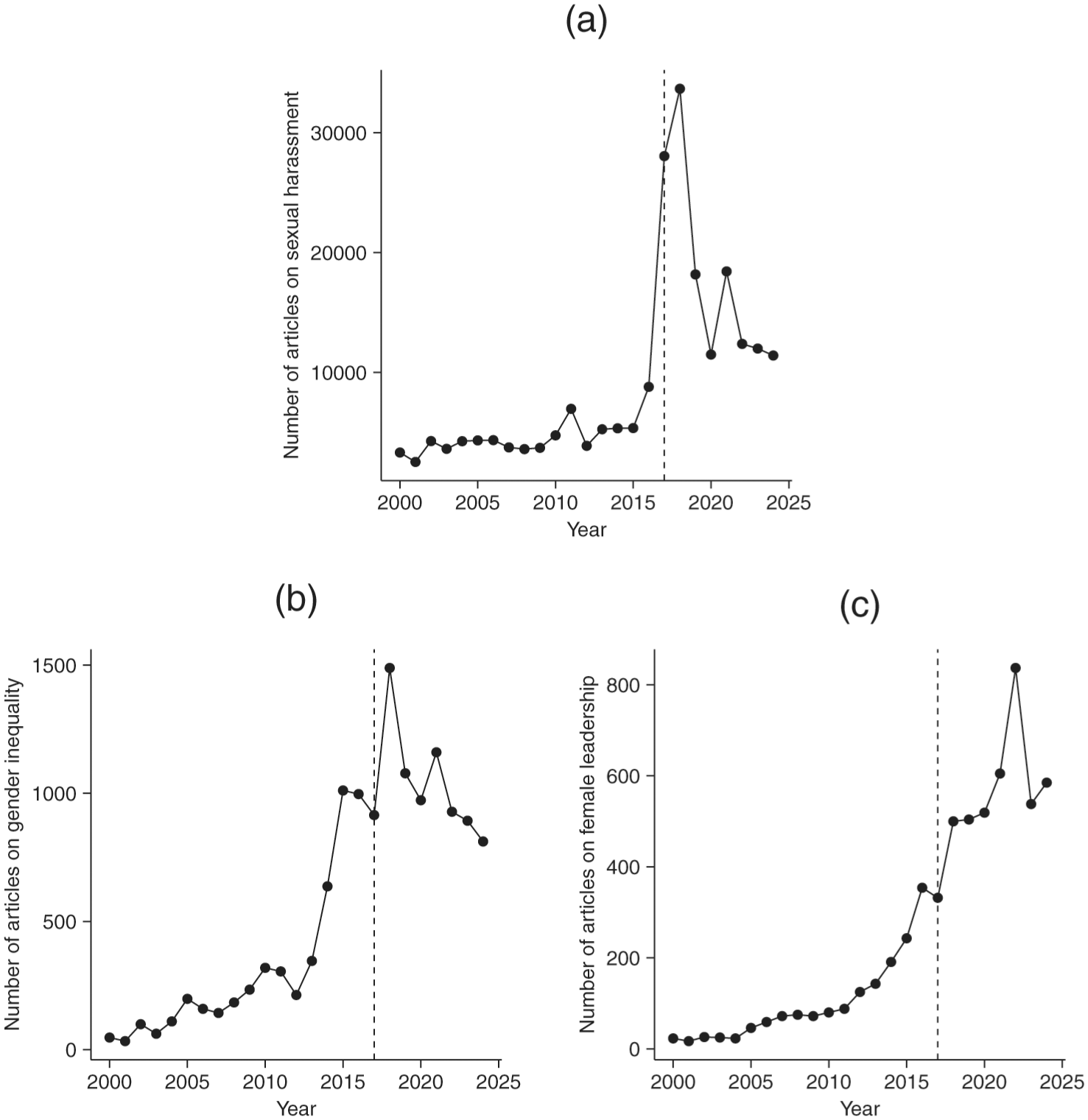
Media Discourse on Sexual Harassment, Gender Inequality, and Female Leadership
#MeToo increased the risk that sexual harassment incidents turn into scandals by significantly lowering the barriers for victims to come forward (Cheng & Hsiaw, 2022). Borelli-Kjaer et al. (2021) found that the number of harassment scandals grew by 300% in response to the movement. While #MeToo initially focused on the prevalence of sexual harassment, ensuing activism and media coverage focused on creating awareness of its root causes, including gendered power differentials in the workplace (Dobbin & Kalev, 2017, 2019). 1 Figures 1b and 1c illustrate that, although media discussions concerning gender inequality and female leadership had been steadily growing over the past decade, #MeToo accelerated these discussions, with media discourse on gender inequality and female leadership growing over 50% from 2017 to 2018.
How the #MeToo Movement Confronted CEOs’ Cultural Imprints
We propose that CEOs from male-dominant cultures were especially motivated to increase women’s representation in response to the movement. First, they faced strong extrinsic pressure. #MeToo highlighted the pervasiveness of sexual harassment and abuse in the workplace and the extent to which it had been tolerated and even enabled by organizational leaders, in particular in male-dominated domains (Luo & Zhang, 2022). Faced with a heightened risk of a harassment scandal, certain CEOs may have acted defensively. Indeed, research indicates that some men sought to limit their potential exposure to accusations by avoiding interactions with women altogether (Amano-Patiño, Faraglia, & Giannitsarou, 2025; Gertsberg, 2022). At the same time, firms and CEOs had incentives to demonstrate that they were part of the solution rather than the problem (Luo & Zhang, 2022). One visible and credible way to do so was to increase women’s representation in leadership, which signals awareness of the issue and commitment to reform (Knight, Dobbin, & Kalev, 2022).
The renewed media attention to gender inequality further amplified these pressures by raising the costs of inaction. After #MeToo, gender discrimination lawsuits against male-dominated firms became more frequent and costly (Griffith, 2020; Thomas, 2022). Even investors—historically skeptical of diversity initiatives (Solal & Snellman, 2019)—advocated for stronger gender-equality measures, partly to mitigate their own reputational risks (Krouse, 2018). Yet, although #MeToo created an environment in which CEOs were expected to demonstrate visible support for gender equality, those demands increased unevenly across firms. Some CEOs, in particular those of firms that already had a high level of gender equality, felt little pressure because they already met, or were closer to meeting, stakeholder demands (Zhang, Briscoe, & DesJardine, 2023). In contrast, for CEOs socialized in male-dominant cultures, the movement likely represented a particularly salient external shock. After #MeToo, CEOs from male-dominant cultures may have felt especially vulnerable to scrutiny because their firms, shaped by their cultural imprint, employed fewer women in senior management and thus risked being seen as embodying the very inequalities the movement exposed. To reduce this vulnerability, these CEOs may have been motivated to demonstrate visible progress by hiring and promoting more women into leadership, and bringing their firms’ diversity levels closer to those of peer organizations (Chang, Milkman, Chugh, & Akinola, 2019).
Second, CEOs from male-dominant cultures may also have been intrinsically motivated to reevaluate their beliefs about gender and leadership. The public exposure of gender inequality and harassment brought by the #MeToo movement likely disrupted established assumptions about women’s roles in organizations and interrupted routine leadership behavior (Morgeson, Mitchell, & Liu, 2015). For CEOs socialized in male-dominant cultures, this disruption was especially pronounced because it directly “challenged traditional gender roles and stereotypes” (Bellet, Dubois, & Godart, 2025: 4915). The heightened visibility of structural inequalities may also have evoked feelings of moral responsibility or collective guilt, particularly among those whose formative environments reinforced the very norms now under scrutiny (Brügger, Morton, & Dessai, 2016). Such moral discomfort can motivate compensatory action aimed at restoring a positive moral self-view (Brügger, Dessai, Devine-Wright, Morton, & Pidgeon, 2015) and group image (Chudy, Piston, & Shipper, 2019). Increasing the representation of women in senior management thus offered a concrete means to demonstrate learning, moral responsiveness, and alignment with evolving societal expectations.
Together, these mechanisms suggest that #MeToo may have altered how CEOs’ cultural imprints translate into organizational outcomes, weakening the previously negative association between male-dominant cultural backgrounds and women’s leadership representation.
Hypothesis 2: In response to #MeToo, CEOs from male-dominant cultures increased the proportion of women in senior management to a greater extent than those from more gender-egalitarian cultures.
Empirical Expectations: Mechanisms Behind CEO Responses to #MeToo
We have theorized that CEOs from male-dominant cultures may have responded to #MeToo through both extrinsic and intrinsic motives (cf. Ryan & Deci, 2000). More broadly, the same decision or policy may be enacted symbolically in one firm and substantively in another, depending on the underlying motive and the extent to which it is implemented (Stevens, Steensma, Harrison, & Cochran, 2005). Extrinsic motives imply that appointing women in response to #MeToo functions as a form of symbolic association: a visible action that affiliates the firm with widely valued normative objectives (Schnackenberg, Bundy, Coen, & Westphal, 2019). In this view, CEOs are motivated to send a “minimum viable signal” (Marx, Wang, & Yimfor, 2026) that defuses reputational threat while limiting costs and commitment (Meyer & Rowan, 1977). By contrast, intrinsic motives suggest that CEOs’ responses to #MeToo reflect genuine attitudinal change: Leaders internalize the movement’s message, experience moral emotions such as guilt or empathy, and seek to revise gender stereotypes (Devine, Plant, Amodio, Harmon-Jones, & Vance, 2002). Such responses are therefore more likely to be substantive and less sensitive to shifts in external stakeholder pressure (Schindler & Westcott, 2021).
Although these motives likely operate simultaneously, examining their relative influence offers insight into how and why CEOs from male-dominant cultures enacted change. Accordingly, we outline a set of empirical expectations that distinguish between extrinsic and intrinsic motives along three dimensions: how long the change lasted, what changed, and who changed.
How long did the change last?
Social movements often have short-lived salience, as media attention and public engagement quickly shift to other issues (Hou & Poliquin, 2023). #MeToo is one of the most salient social movements of our time, but attention to the movement (see Appendix Figure A.5) and its demands (see Figure 1) still decreased over time. When stakeholder attention wanes, the reputational value of visible symbols weakens, reducing incentives to sustain purely perception-oriented responses (Schnackenberg et al., 2019). As counter-movements—fueled by court rulings against gender quotas and political backlash against DEI initiatives (Allen & Wahid, 2024)—gained traction, the stakeholder pressure to maintain diversity efforts weakened. Once opposition becomes legitimized and the threat of backlash decreases, CEOs who adopted diversity initiatives for extrinsic reasons would likely roll them back (Marx et al., 2026). Hence, extrinsically motivated change is expected to be short in duration, fading once reputational risk levels off.
When CEOs internalize the movement’s message, they may revise the beliefs that underlie their original cultural imprint, integrating new understandings of gender equality into their decision-making (Finseraas, Johnsen, Kotsadam, & Torsvik, 2016). In this sense, intrinsic motives can foster enduring change that becomes embedded in organizational routines and practices, yielding lasting effects rather than temporary adjustments to public pressure. Intrinsically motivated change should thus be more durable, persisting even after the spotlight of #MeToo has faded.
What changed?
If extrinsic motives drive responses to #MeToo, we should observe changes that are symbolic and externally oriented. This logic is consistent with symbolic management research showing that organizations may adopt visible symbols while buffering core practices (i.e., decoupling), thereby limiting real redistribution of influence even as they signal responsiveness (Schnackenberg et al., 2019). Extrinsic motives would likely focus on increasing the visibility of women in leadership while limiting their influence in core domains (Knippen, Shen, & Zhu, 2019). Because these domains tend to be male-dominated, they are also where incidents of harassment are most common (Folke & Rickne, 2022). Placements into peripheral, typically female-typed domains thus allow CEOs to signal responsiveness to #MeToo while limiting organizational disruption and minimizing exposure to interpersonal risks associated with increased gender mixing (Amano-Patiño et al., 2025). Extrinsic motives, in turn, suggest an increase in women’s representation predominantly in female-typed domains.
In contrast, intrinsically motivated change, which involves a genuine reversal of gender stereotypes, should manifest most strongly in male-typed domains, such as finance, strategy, or engineering, where women’s representation has historically been the lowest (Kanze, Conley, Okimoto, Phillips, & Merluzzi, 2020). Such appointments also reflect an authentic effort to reshape organizational culture. Harassment tends to flourish where women remain isolated in “core” jobs (Dobbin & Kalev, 2017). CEOs pursuing genuine cultural change would therefore expand female representation precisely in these male-dominated positions, diversifying leadership and altering the composition of occupational groups where gendered power imbalances are most deeply entrenched. Hence, intrinsic motives suggest an increase in women’s representation predominantly in male-typed domains.
Who changed?
Lastly, if extrinsic motives dominate, symbolic management research suggests that change should be greatest where the costs of inaction are highest (Stevens et al., 2005). The media and regulators often target larger, more prominent organizations to set precedents and influence the broader business community (Knight et al., 2022). Activists similarly focus on large, visible firms, where public attention increases the likelihood of mobilizing support for change (Rheinhardt, Briscoe, & Joshi, 2023). Visibility also derives from the salience of gender inequality itself: Firms with all-male boards, few women in leadership, or highly skewed gender ratios embody the disparities challenged by #MeToo and thus face heightened reputational risk (Lins, Roth, Servaes, & Tamayo, 2019). For these firms, symbolic diversity initiatives can serve as public demonstrations of responsiveness to evolving social expectations (Zhang et al., 2023). Smaller firms, or those with less conspicuous gender disparities, on the other hand, typically operate below the threshold of stakeholder scrutiny, reducing incentives for change (Knippen et al., 2019). Hence, extrinsically motivated responses should be most pronounced where stakeholder awareness and expectations are highest—namely, among larger firms and those whose gender inequality is most salient.
If intrinsic considerations dominate, effects should be stronger where CEOs’ personal attitudes and discretion carry greater weight. In smaller, less bureaucratic firms, CEOs exert more direct control over hiring and promotion, enabling intrinsic values to translate more readily into organizational outcomes. In contrast, large corporations with multiple layers of governance tend to dilute the influence of individual CEOs, particularly on personnel matters (Wu et al., 2024). CEO characteristics may further condition these effects: If intrinsic motives are central, the #MeToo response should be stronger among CEOs more receptive to attitudinal change—most notably younger leaders, as age shapes openness to belief revision (Krosnick & Alwin, 1989; Malmendier & Nagel, 2016). Younger people typically show a stronger orientation toward growth and adaptation, updating their beliefs more readily in response to new stimuli, whereas older people tend to hold more established preferences and knowledge structures and are more likely to rationalize environmental change in ways that preserve the status quo (Belenzon, Shamshur, & Zarutskie, 2019). Intrinsic motives thus suggest greater change in smaller firms and under younger CEOs.
Taken together, we expect that the dominant motive will shape the nature of the response. When extrinsic considerations prevail, the effect is likely to be (i) short-lived, (ii) with women appointed mainly to female-dominated roles, and (iii) greater change in larger and male-dominated firms. On the other hand, when intrinsic considerations prevail, the effect should be (i) more enduring, (ii) reflected in appointments of women to male-dominated roles, and (iii) pronounced in smaller firms and under younger CEOs.
Method and Data
We test our predictions in the U.S. ICT industry. This industry offers an especially strong context for examining how CEOs’ cultural imprints shape responses to the #MeToo movement. First, ICT is among the most globally diverse sectors in terms of leadership composition (Kenney & Patton, 2015). Immigrant executives, in turn, are highly prevalent, providing substantial variation in CEOs’ cultural backgrounds and thus in their inherited gender norms. This diversity allows us to isolate cultural influences on leadership decisions while holding constant the institutional and economic environment in which CEOs operate. Second, ICT is a male-dominated domain where gender inequality has long been prominent (The Economist, 2015) and #MeToo had high salience (Browning & Isaac, 2021). These characteristics make ICT a unique natural laboratory to study how CEOs from different cultural backgrounds responded to the movement.
Sample
We constructed an unbalanced panel data set starting from all 404 U.S. ICT firms that went public between 2000 and 2015 based on the IPO database created by Kenney and Patton (2015). 2 We tracked these firms from their IPO until 2024, unless a firm was delisted. Other data come from BoardEx, Compustat, and the World Bank. For additional analyses, we complement those data with LinkedIn career histories and Glassdoor reviews from Revelio Labs and earnings call data from Li, Mai, Shen, and Yan (2021).
A challenge in working with newly public firms is that delistings are relatively common, especially in volatile industries such as ICT. This also often leads to missing data, especially when firms exit soon after their IPO. After excluding firms headquartered or registered outside of the U.S. and observations with missing data, the final dataset comprises 2,471 observations from 295 unique firms. Appendix Figure A.1 shows that most missing data stems from firms that went public in the year 2000, which featured the peak and burst of the dotcom bubble. While we still have accounting information for at least one year for most of these firms, we lack data on the composition of their senior management and, in fewer cases, on the identity of the firm’s CEO. Further, we had to exclude all observations with CEOs originating from Taiwan as the World Bank does not provide country-level indicators for that country. Because of our long time frame, a sizeable number of firms exited the sample before the onset of the #MeToo movement. To alleviate survivorship bias, we use all available firm years for our main analysis. In additional analyses, we restrict our sample to only those firms that remained listed after 2017 to explore the #MeToo treatment effect more directly.
Number of Women in Senior Management
Our primary dependent variable is the number of female senior managers in a firm-year as reported in BoardEx. Because the distribution is skewed and includes zeros, we use its natural logarithm after adding one in all regressions. Because the overall size of senior management teams varies across firms and over time, we condition on the total number of senior managers in our main specifications. This approach yields an interpretable rate effect: Holding team size constant, we can assess whether firms led by CEOs from male-dominant cultures employed fewer women in senior management before #MeToo (H1), and whether these CEOs increased the number of female senior managers more strongly after the movement (H2). We report results using the proportion of women in Appendix Table B.3. To explore mechanisms, we categorized senior management positions into male- and female-dominated domains. We discuss this in Online Supplemental Appendix A.
Women represented 16% of senior managers over our entire sample period (see Table 1). Appendix Figure A.2 shows that the percentage has more than tripled since 2000. Nevertheless, the gender gap remains significant: In 2024, women still accounted for just 23% of all senior managers.
Summary Statistics
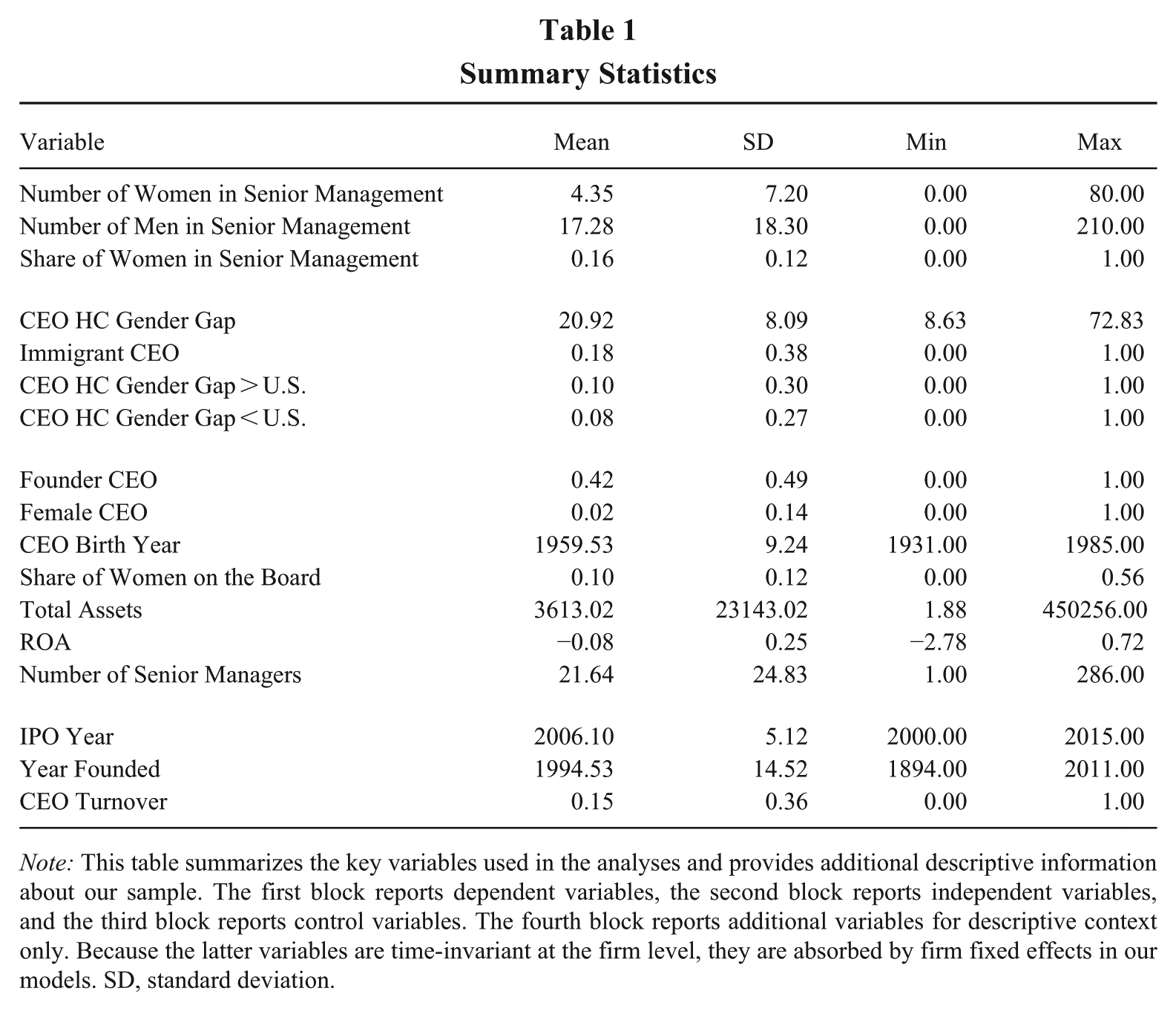
Note: This table summarizes the key variables used in the analyses and provides additional descriptive information about our sample. The first block reports dependent variables, the second block reports independent variables, and the third block reports control variables. The fourth block reports additional variables for descriptive context only. Because the latter variables are time-invariant at the firm level, they are absorbed by firm fixed effects in our models. SD, standard deviation.
CEO Cultural Imprint
We adopt an epidemiological approach that considers “relevant economic outcomes in the country of ancestry as proxies of culture for immigrants” (Liu, 2016: 308). Following this approach, we constructed our main explanatory variable in two steps. First, we determined each CEO’s country of origin by manually collecting data from firms’ IPO prospectuses, BoardEx, company websites, CEOs’ CVs, SEC filings, published interviews, and webpages such as personal websites and LinkedIn profiles. We define a CEO’s home country as the country of birth or, if information on the place of birth is unavailable, the country in which the CEO acquired a first tertiary degree (Kenney & Patton, 2015). That is, we go beyond extant studies that define immigrants based on nationality or name (Foley & Kerr, 2013; Mata & Alves, 2018). This is important in our setting because roughly half of the foreign-born population in the U.S. eventually becomes naturalized U.S. citizens (Zong, Batalov, & Burrows, 2019). When a firm changed CEOs throughout the year, we used the characteristics of the CEO who spent the most time with the firm during that year. We show the distribution of immigrant CEOs’ home countries in Appendix Figure A.3a.
Second, following Fernández and Fogli (2009), we use the historical female labor force participation rate in a CEO’s country of origin as our cultural proxy. To account for differences in a country’s overall labor force participation rate, we use a country’s gender gap: the difference between the male and the female labor force participation rate. The historic point in time from which the gender gap should be taken is not obvious. Given the average age of our CEOs and the time of the study, we select 1990, the first available year, as our historical gender gap. 3 In 1990, the gender gap in our sample varied from 9% to 73% (see Appendix Figure A.3b). Data come from the World Bank. In alternative models, we constructed two categorical versions of this variable. First, we created dummy variables indicating whether an immigrant CEO originates from a country with a larger or smaller gender gap relative to the U.S. Second, because immigrant CEOs from countries with a larger gender gap are more prevalent, we split the sample at the median among immigrant CEOs.
The #MeToo Movement
The #MeToo movement was spurred by sexual abuse allegations against film producer Harvey Weinstein in October 2017. Plotting Google search trends, Appendix Figure A.5 shows there were virtually no searches for “#metoo” or the “#metoo movement” before October 2017. While searches for #MeToo experienced a sharp increase and immediately reached an all-time high in October 2017 (cf. Luo & Zhang, 2022), searches for the #MeToo movement followed a somewhat slower trajectory, peaking in March 2018. Because the #MeToo movement first focused on Hollywood, and hiring and promotion processes take some time, we expect 2018 to be the first year in which the #MeToo movement could have a ripple effect on the composition of senior managers in the ICT industry. This expectation is supported by Figure 1, which shows a clear uptick in media articles on female leadership in 2018 and 2019 but not in 2017. We also conducted a Factiva search on news articles including both “#MeToo” and “female leadership,” which returns merely 4 articles for the year 2017 compared to 139 for 2018.
Model Specification and Controls
To test our hypotheses, we estimate the following difference-in-differences (DiD) specification with a continuous treatment intensity (cf. Acemoglu & Finkelstein, 2008):

where Yit is the number of female senior managers at firm i in year t and CEO HC Gender Gap it measures the historical gender gap in the CEO’s country of origin. Post #MeToo t is a dummy variable equal to 0 for all years before 2018 and 1 for subsequent years (2018 to 2024). The interaction term CEO HC Gender Gap it × Post #MeToo t captures whether firms led by CEOs from more male-dominant cultures exhibited differential changes in the representation of women in senior management following #MeToo.
Xit includes time-varying covariates grouped into two sets. First, we control for CEO characteristics. We include founder status because founders tend to have greater discretion and informal influence than professional managers, which may independently amplify or dampen changes in women’s representation, regardless of the CEO’s cultural imprint. We control for CEO gender because women generally show stronger support for gender equality, which also affects the effect of their ideology on gender equality (Carnahan & Greenwood, 2018). 4 Finally, we account for birth year to capture generational differences in socialization: As gender norms have evolved over time (Goldin, 2014), CEOs of different cohorts have been exposed to distinct stereotypes and expectations regarding women’s roles.
Second, we control for firm-level characteristics that may influence women’s representation. We control for the share of women on the board because board composition can shape top management appointments and signal the firm’s broader commitment to gender diversity. We include firm size (log total assets) because larger firms are typically more visible and subject to greater stakeholder scrutiny, often leading to more formalized diversity practices and stronger responses to backlash. We control for performance (ROA) since profitability can affect both the resources available for new appointments and the willingness to change gender compositions (Cook & Glass, 2014). Finally, we condition on the number of senior managers (log) because firms expanding their leadership teams may increase the likelihood of adding women purely as a function of team size.
δi are firm fixed effects accounting for time-invariant firm characteristics, and ζt are year fixed effects capturing common shocks and secular time trends. Standard errors are clustered at the firm level to account for serial correlation in εit. In robustness analyses, we replace firm fixed effects with CEO–firm fixed effects to absorb all time-invariant CEO-specific heterogeneity. Table 1 and Appendix Table A.1 report descriptive statistics and correlations, respectively.
The identifying assumption underlying Equation 1 is that, absent the #MeToo movement, firms led by CEOs from different cultural backgrounds would have experienced parallel trends in the number of women in senior management. In other words, pre-#MeToo differences in the representation of women across firms with varying CEO cultural gender gaps are assumed to be time-invariant. Under this assumption, the coefficient β2 can be interpreted as the differential post-#MeToo change in women’s representation associated with a one-unit increase in the CEO’s home-country gender gap. We assess the plausibility of this assumption in Online Supplemental Appendix B.
Results
Our results support our hypotheses: before #MeToo, CEOs from male-dominant cultures employed fewer women in senior management, but that relationship reversed afterward. The effect persisted through 2024, was concentrated in male-dominated domains, reflected new female appointments rather than men’s exits, and was stronger for younger CEOs. It was similar in large and small firms and in firms with and without female board representation. Additional analyses reveal that, after #MeToo, firms led by CEOs from male-dominant cultures show faster career progression for women, slower progression for men, fewer harassment and gender inequality complaints in employee reviews, and greater emphasis on integrity and respect in public communication by these CEOs. Together, the evidence points to lasting changes driven at least in part by intrinsic reflection, rather than extrinsic motives alone.
Preliminary Evidence for Cultural Imprinting
Before estimating Equation 1, we present two descriptive analyses. Figure 2a plots the average number of female senior managers against the gender gap in CEOs’ home countries, aggregated at the CEO home country level. The negative relationship is consistent with the prediction that CEOs from more male-dominant cultures employ fewer women in senior management. Figure 2b shows the annual average number of female senior managers for firms led by immigrant CEOs from more gender-egalitarian and more male-dominant cultures. The two groups followed nearly parallel trends before 2017 but diverged sharply afterward, with firms led by CEOs from male-dominant cultures showing a noticeable increase in women’s senior-management representation. These patterns are consistent with our theory. However, these descriptive associations are only suggestive and may reflect selection, most notably the matching of CEOs from more gender-egalitarian countries to firms that already exhibit greater gender diversity. We address this concern next, using panel regressions with firm and year fixed effects.
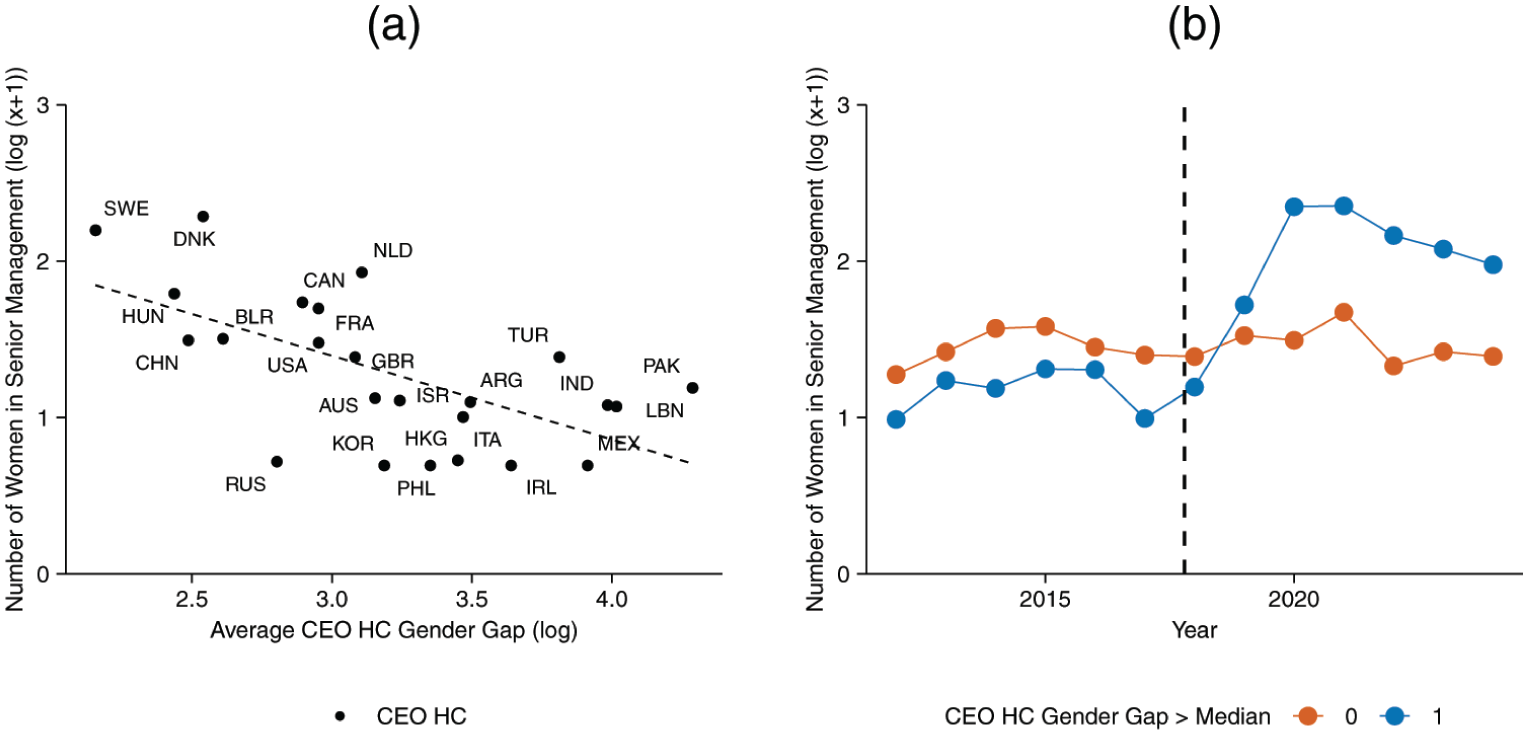
Preliminary Evidence
Main Analysis
Table 2 reports our main results. Model 1 presents the baseline specification with the number of senior managers and firm and year fixed effects. Model 2 adds firm- and CEO-level controls. Before 2017, CEOs’ home-country gender gap is negatively associated with the number of women in senior management: A 10% increase in the gap is associated with a 2% decrease in women in senior management (p < 0.05). After #MeToo, this relationship reversed. The interaction between the home-country gender gap and the post-#MeToo indicator is positive, statistically significant (p < 0.01), and larger than the main effect. Post-#MeToo, a 10% increase in the home-country gender gap is associated with a 1.3% increase in the number of women in senior management.
Change in the Cultural Imprinting Effect After #MeToo: Women in Senior Management
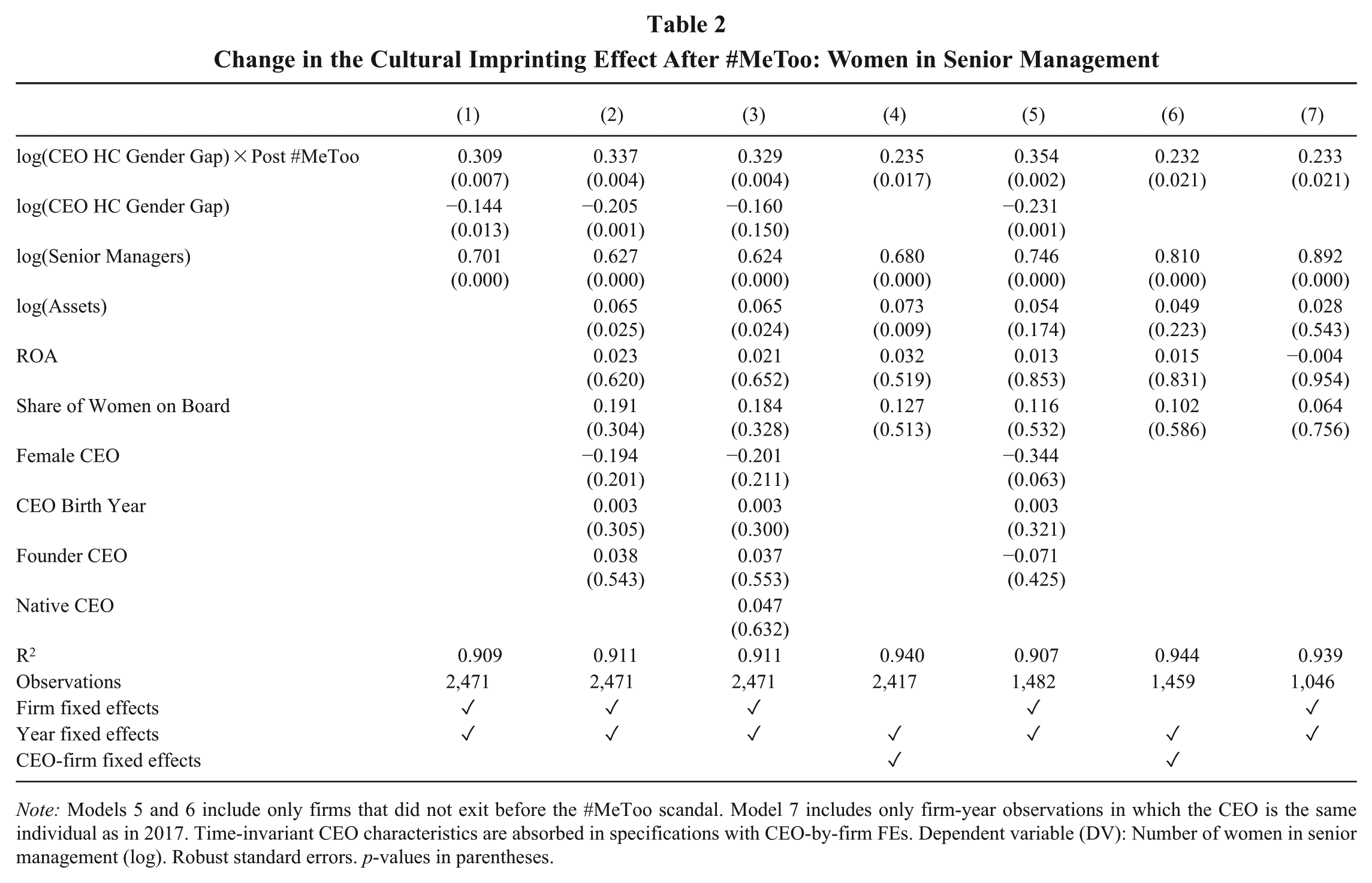
Note: Models 5 and 6 include only firms that did not exit before the #MeToo scandal. Model 7 includes only firm-year observations in which the CEO is the same individual as in 2017. Time-invariant CEO characteristics are absorbed in specifications with CEO-by-firm FEs. Dependent variable (DV): Number of women in senior management (log). Robust standard errors. p-values in parentheses.
To illustrate the magnitude, consider switching from a U.S. CEO (gender gap = 19.1) to an Indian CEO (gender gap = 53.8), the most common immigrant CEO in our setting. Before #MeToo, this difference predicts roughly 20% fewer women in senior management; after #MeToo, it predicts about 14% more. At the 2017 mean of 6.5 female senior managers per firm, this corresponds on average to about 1.5 fewer women before #MeToo and 1 additional woman after. Overall, this shift in CEO cultural background implies roughly three additional women in senior management per firm from the pre- to the post-#MeToo period.
Model 3 adds a dummy for whether the CEO is native or immigrant to separate the cultural imprinting effect from a potential migrant effect. The interaction term remains large, positive, and significant, reinforcing our main conclusion: before #MeToo, CEOs from male-dominant cultures employed fewer women in senior management, but after #MeToo this relationship reversed.
Thus far, our analysis indicates that the effect of CEOs’ cultural imprints changed in response to the #MeToo scandal. While this could be due to the same CEOs changing their behavior, an alternative explanation relates to changes in the composition of CEOs. Of particular concern is that CEOs who were fostering a male-dominant corporate culture could have exited the sample in response to #MeToo (e.g., due to misconduct allegations). If such exits are disproportionately common for CEOs from male-dominant cultures, our DiD coefficient may indicate a change in the composition of CEOs rather than a change in the firms they lead.
We address this concern by replacing firm fixed effects with CEO-firm fixed effects in Model 4 of Table 2. The interaction term remains positive and significant (p < 0.05), indicating that the results are driven mainly by the same CEOs before and after the shock. In Models 5 and 6, we restrict the sample to firms that remain publicly listed after the scandal. Finally, in Model 7, we further restrict the sample to firm-year observations in which the CEO is the same as in 2017. In all cases, the results remain substantively unchanged.
Alternative Explanations and Robustness Checks
Online Supplemental Appendix B presents additional analyses on what drives these effects. First, because our theory focuses on CEOs from more male-dominant cultures, we test whether the results instead reflect declines in female leadership under native CEOs or immigrant CEOs from more gender-egalitarian countries. Section B.1 alleviates this concern. Second, we show that the findings are driven by an increase in women, while the number of men remains unchanged. Finally, we report robustness checks, including event studies, placebo treatments, and generalized synthetic control estimates, all of which reinforce the main findings.
Tests of Mechanisms Behind CEO Responses to #MeToo
Thus far, the findings support our prediction that #MeToo increased women’s leadership representation in firms led by CEOs from male-dominant cultures. However, they do not reveal whether CEOs responded mainly for extrinsic or intrinsic reasons. In this section, we examine the empirical expectations outlined in our theory to assess the relative importance of these motives.
How long did the change last?
We first ask whether the observed change after #MeToo was temporary. Figure 3 shows that the effect emerged gradually, peaked in 2021, and remained positive through 2024. Appendix Table C.1 corroborates this pattern by decomposing the post-#MeToo period into broader intervals and year-by-year interactions: Coefficients are small and insignificant in 2018–2019, then rise in 2020 and remain sizable thereafter. This delayed but persistent response is inconsistent with a purely extrinsic motive, which would predict a short-lived reaction concentrated in the immediate aftermath of the shock, and is more consistent with intrinsic motives.
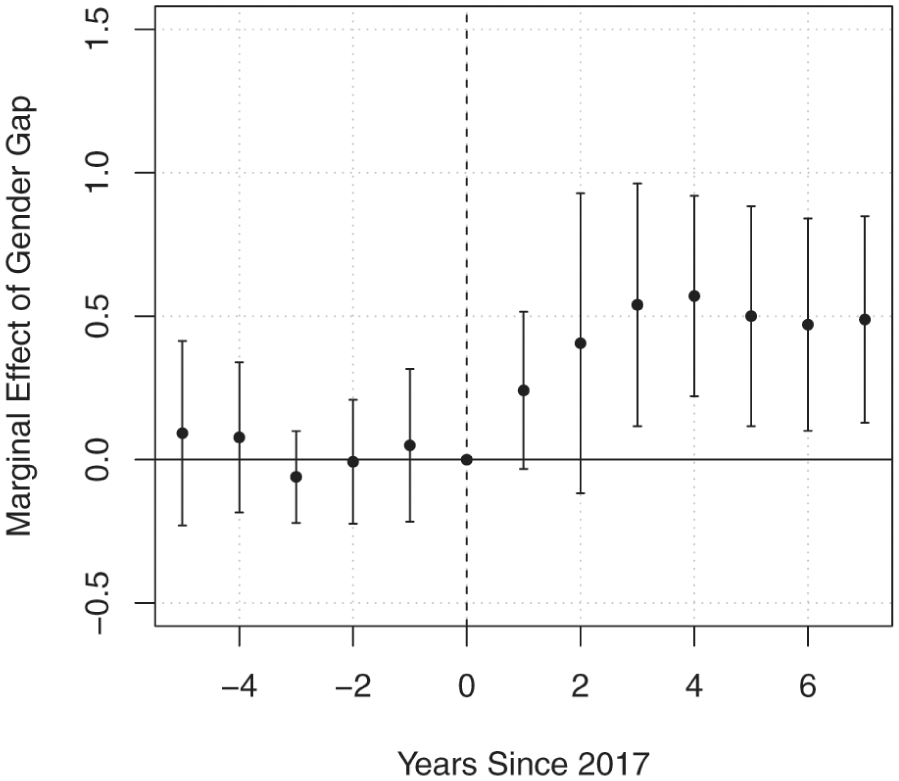
Estimated Change in the CEO HC Gender Gap Effect after #MeToo
What changed?
Next, we examined whether women were appointed to male- or female-dominated domains. As described in Online Supplemental Appendix A, we grouped senior managers into 14 functional categories based on job titles and classified the seven categories with the lowest and highest shares of women as male- and female-dominated, respectively. We then calculated, for each firm-year, the number of women in each group and re-estimated Equation 1 using these counts as dependent variables. Models 1 and 2 in Table 3 show that the results are driven entirely by appointments in male-dominated domains. 5 This pattern is again inconsistent with purely extrinsic motives and supports intrinsic motives.
Mechanism Tests
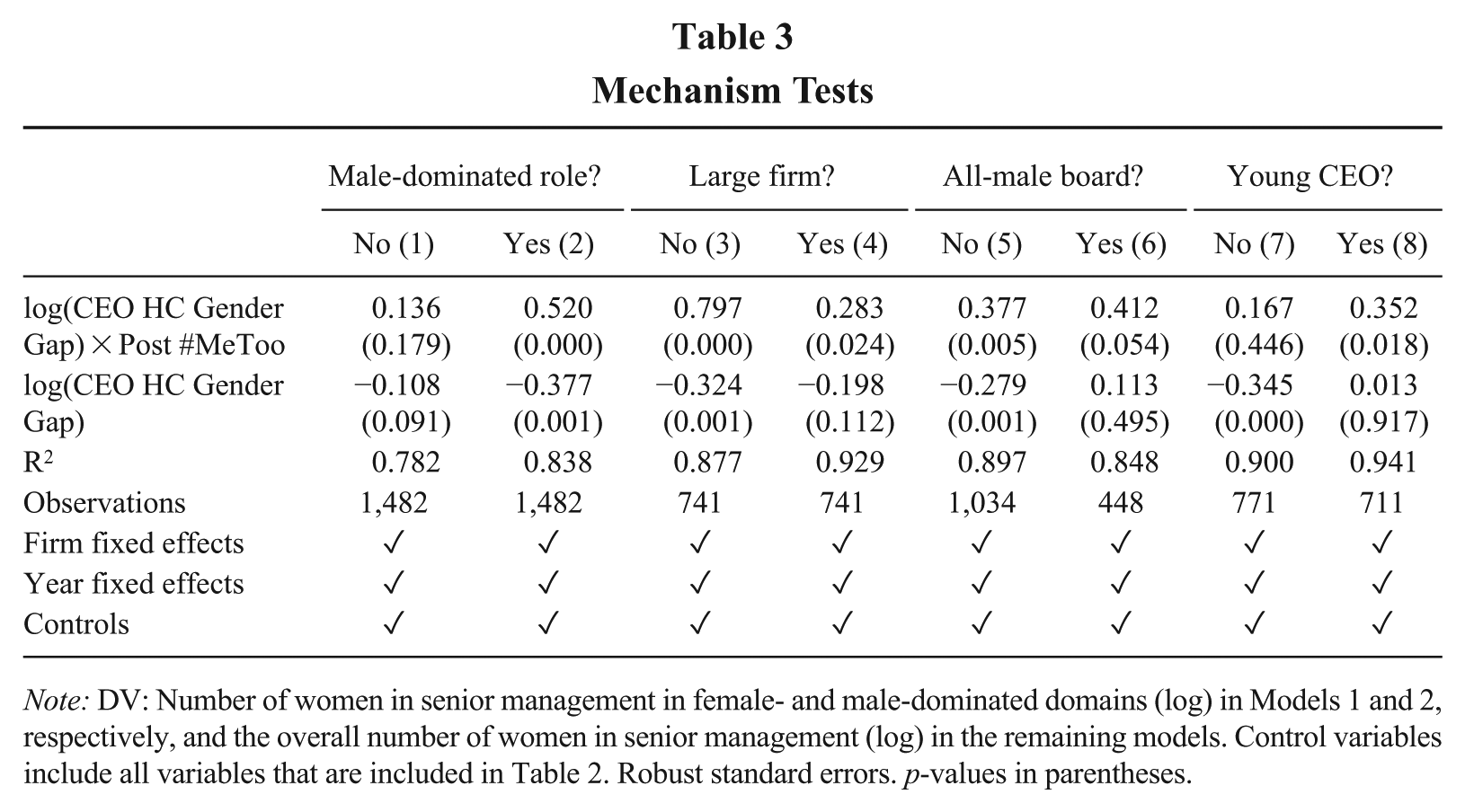
Note: DV: Number of women in senior management in female- and male-dominated domains (log) in Models 1 and 2, respectively, and the overall number of women in senior management (log) in the remaining models. Control variables include all variables that are included in Table 2. Robust standard errors. p-values in parentheses.
Who changed?
To examine heterogeneity in responses to #MeToo, we consider three boundary conditions: firm visibility, visible male dominance, and CEO age. If reputational threat is the dominant mechanism, effects should be strongest in firms facing the greatest external scrutiny. If intrinsic motives matter more, effects should be strongest where CEOs’ personal attitudes and discretion have greater influence.
First, we examine firm size as a proxy for visibility. Models 3 and 4 in Table 3 show positive effects in both small and large firms, although the coefficients are larger in smaller firms. This pattern suggests that the response was not driven solely by visibility and is consistent with a role for intrinsic motives.
Second, we examine whether effects are stronger in firms with all-male boards, where gender inequality is especially visible. Models 5 and 6 show positive and significant effects in both firms with and without female directors. This pattern suggests that visible gender imbalance alone cannot explain the response and that both extrinsic and intrinsic motives may have contributed.
Third, we examine CEO age. If intrinsic motives are important, younger CEOs should respond more strongly because they are generally more receptive to attitude change. Using the median birth year of 1963, Models 7 and 8 in Table 3 show that the pre-#MeToo imprinting effect is strongest for older CEOs and disappears for younger CEOs, whereas the post-#MeToo change is strongest for younger CEOs and disappears for older CEOs. In other words, younger CEOs from male-dominant cultures did not exhibit higher gender inequality before the shock, yet responded most strongly to #MeToo. These results provide the clearest evidence in this section for intrinsic motivation as a central mechanism.
Finally, we re-estimate our main specification in a matched sample in which firms led by immigrant and native CEOs are matched on pre-#MeToo female representation, holding baseline visibility and stakeholder pressure constant. Appendix Table C.3 shows that firms led by CEOs from male-dominant cultures still exhibit significantly larger post-#MeToo increases in female representation. This result reinforces our earlier conclusion that, although extrinsic pressures may have contributed, intrinsic motives likely also played an independent role in CEOs’ responses to the #MeToo movement.
Additional Analyses
Complementing our main analyses, we next examine whether the effects of #MeToo extended beyond senior management. These analyses serve two purposes: to test whether the observed changes reached other layers of the hierarchy and to further assess whether they reflect symbolic adjustments or meaningful shifts in organizational gender dynamics. Table 4 summarizes the core results of these analyses; more detailed data descriptions, results, and event studies are reported in Online Supplemental Appendix D.
Additional Analyses
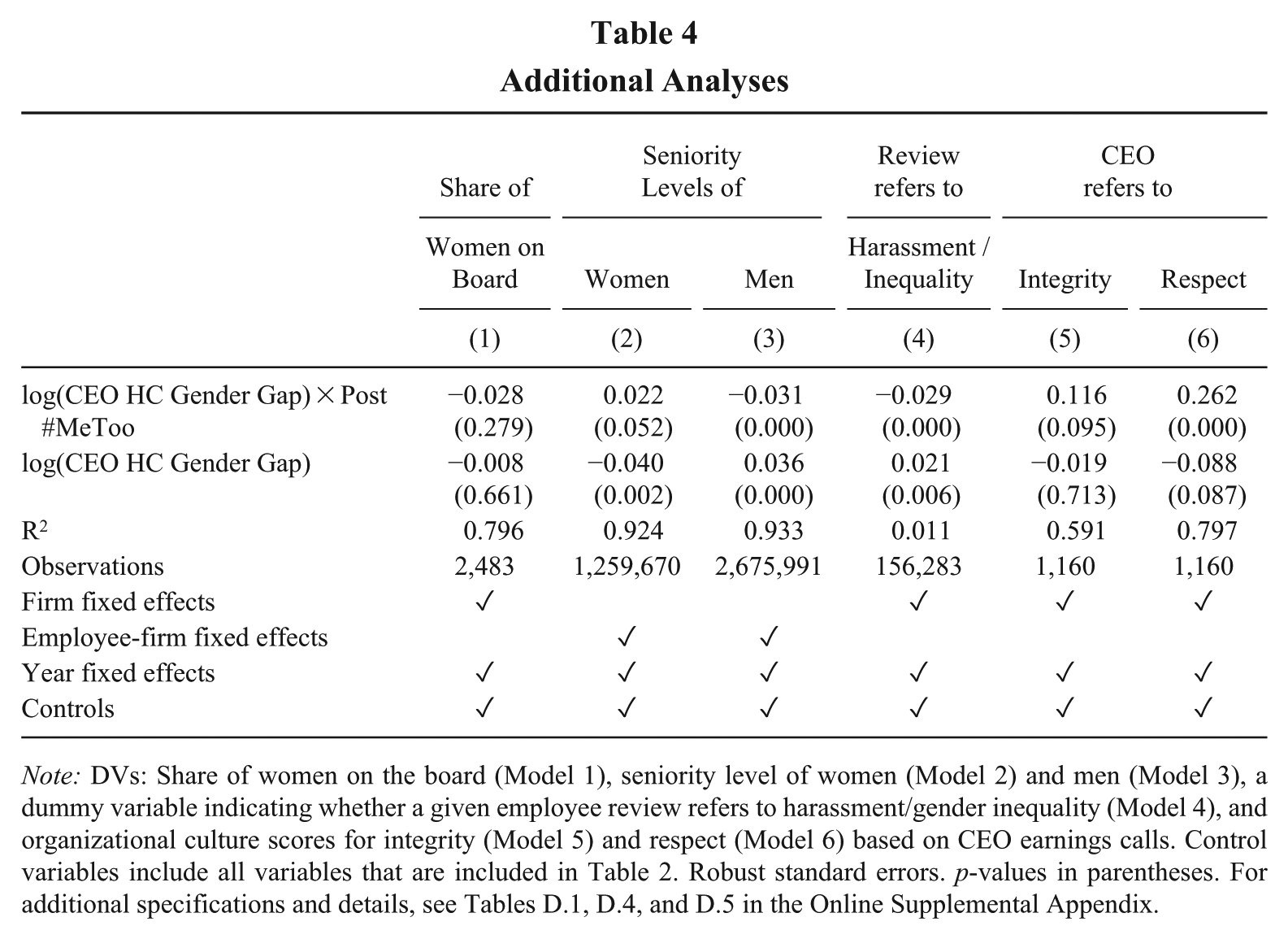
Note: DVs: Share of women on the board (Model 1), seniority level of women (Model 2) and men (Model 3), a dummy variable indicating whether a given employee review refers to harassment/gender inequality (Model 4), and organizational culture scores for integrity (Model 5) and respect (Model 6) based on CEO earnings calls. Control variables include all variables that are included in Table 2. Robust standard errors. p-values in parentheses. For additional specifications and details, see Tables D.1, D.4, and D.5 in the Online Supplemental Appendix.
Women on the board
We first examine whether #MeToo changed women’s representation on boards, the most visible governance body and a likely site of symbolic response (Knippen et al., 2019). If extrinsic motives were primary, we would expect a pronounced board-level response. Model 1 in Table 4 shows that the post-#MeToo interaction with the CEO home-country gender gap is small and statistically indistinguishable from zero.
Women throughout the organization
Next, we leverage LinkedIn data to examine whether #MeToo changed promotion patterns for women and men at firms led by CEOs from male-dominant cultures. Models 2 and 3 in Table 4 show that, before #MeToo, a larger CEO home-country gender gap is associated with slower career progression for women, and that this negative association weakens afterward. Men show the opposite pattern: The pre-#MeToo positive association between the CEO gender gap and career progression weakens after #MeToo. These results support our earlier conclusion that women became more likely to be promoted after #MeToo in firms led by CEOs from male-dominant cultures.
In Online Supplemental Appendix D, we further show that, for women, this is driven mainly by promotions of those who already held managerial positions before #MeToo. Men in both managerial and non-managerial roles experienced slower career progression. Moreover, we find no evidence of an increase in the hiring of women and only limited evidence of a reduction in women’s exits. Internal mobility therefore appears to be the main channel through which #MeToo influenced women’s representation.
Harassment and gender inequality complaints
Because increases in female leadership may help reduce harassment and create more gender-inclusive workplaces (Dobbin & Kalev, 2019), we also examine whether firms led by CEOs from male-dominant cultures experienced fewer workplace harassment and gender inequality-related complaints in Glassdoor reviews (cf. Sockin, Sojourner, & Starr, 2024). Model 4 in Table 4 shows that the generally positive pre-#MeToo association between the CEO gender gap and harassment or gender-inequality reports weakened after #MeToo, consistent with a shift in perceived workplace culture.
CEO communication
Finally, to examine whether CEOs’ responses to #MeToo reflect changes in how they interpreted gender-related norms, we analyze CEO communication using the earnings-call-based organizational culture measures developed by Li et al. (2021). We focus on integrity and respect, the two dimensions most closely tied to #MeToo. Models 5 and 6 in Table 4 show a pronounced post-#MeToo increase in respect-related language and a marginally significant increase in integrity-related language among CEOs from more male-dominant cultures.
Together, these findings suggest changes in public communication related to ethical conduct and interpersonal treatment, consistent with moral reflection and norm revision following #MeToo.
Discussion
We theorized how #MeToo may have led executives from male-dominant cultures to increase gender equality in their firms. In a sample of U.S.-based ICT firms, we find that CEOs from more male-dominant cultures employed fewer women in senior management before #MeToo. However, after #MeToo, firms with CEOs from male-dominant cultures significantly increased women’s representation. In fact, these CEOs then employed more women in senior management than their peers from more egalitarian cultures. These effects persist despite rising counter-movements, are concentrated in male-typed domains, and are strongest among younger CEOs. Additional evidence suggests that change occurred primarily through internal mobility—women advanced faster while men’s progression slowed—and coincided with a shift in employee reviews and CEO communication: references to harassment and inequality in employee reviews decreased, while CEOs from male-dominant cultures increased their emphasis on integrity and respect when speaking. Together, these findings suggest that social movements, like #MeToo, can constitute secondary sensitive periods in which cultural imprints are reconsidered, triggering genuine and lasting organizational change.
Contributions
Our study contributes to several streams of research. First, we contribute to international business research by utilizing an epidemiological approach to examine how cultural imprints persist or evolve. Although most scholars agree that culture matters, identifying its effect on individual behavior remains difficult because culture is intertwined with institutions and economic conditions (Luttmer & Singhal, 2011; Polavieja, 2015). We address this challenge by exploiting the partial portability of culture across borders. When people migrate, they carry some parts of their home-country culture with them but live and work in a different institutional and economic environment (Fernández & Fogli, 2009). The CEOs in our sample faced the same markets and institutions but varied in their cultural heritage. This design shows that managerial decisions remain shaped by the culture in which a CEO was raised, even after relocating abroad, indicating a durable imprint.
Second, we show that this effect is not static but can change in response to social movements. Our study thus extends imprinting research by examining how enduring imprints formed through long-term cultural socialization interact with later punctuated experiences. Prior research has largely treated these processes separately: One stream emphasizes stable environments and persistent early socialization effects (e.g., Duchin et al., 2021; Waguespack et al., 2018), whereas another focuses on brief sensitive periods (e.g., Bianchi & Mohliver, 2016; Jung & Shin, 2019). Building on Marquis and Tilcsik (2013), we show that both mechanisms can jointly shape behavior and, under some conditions, counteract each other.
Third, focusing on #MeToo as an external shock, we contribute to research on social movements and organizations (Wu & Liu, 2024) by clarifying how large-scale movements translate into substantive organizational change. Movements such as #MeToo and Black Lives Matter are powerful cases of global norm making (Levy & Mattsson, 2021), yet we know little about how they alter behavior inside organizations. Our results refine understanding of who evokes changes and why. CEOs from male-dominant cultures, while least aligned with the values promoted by the movement, reacted most strongly. This finding extends recent work on how personal identity and professional background shape leaders’ sensitivity to social movements (e.g., Gertsberg, 2024), suggesting that normative threats can prompt behavioral adjustment even among those considered by some to be the least predisposed to change.
We also contribute to debates about the impact of social movements. Whereas earlier studies often report symbolic or short-lived responses (e.g., Marx et al., 2026), we find persistent and substantive organizational change. The effects of #MeToo were strongest in male-dominated domains, where barriers to inclusion are typically highest (Kanze et al., 2020), persisted for several years, diffused through the hierarchy, and coincided with changes in organizational culture and CEO communication. These patterns go beyond extrinsic adjustment, suggesting #MeToo activated intrinsic motives that led leaders to reevaluate long-held beliefs and practices.
Limitations
We note several limitations and unique elements of this study. First, our design relies on variation in the home countries of CEOs who were all based in the U.S., which helps disentangle culture from local institutions and economic conditions. However, this approach has limitations. Due to selective migration, migrant CEOs may not be the best representatives of their home countries’ cultures. More educated people are generally less influenced by culture (Guiso, Sapienza, & Zingales, 2015), and immigrants experience shocks such as language differences, discrimination, and migration-induced uncertainty that may weaken inherited preferences and beliefs (Fernández, 2008). These forces should bias the estimated effect of culture downward, making our test conservative. At the same time, they may limit the generalizability of our findings. Future research could address this by examining the effects of #MeToo across countries.
Second, our data capture only first-generation migrants. This focus suits our purpose because ancestral imprints generally weaken over immigrant generations (Fernández & Fogli, 2009). Still, it would be useful to examine how the effect varies across second- and later-generation migrant CEOs. It would also be useful to examine whether cultural imprints vary across male and female CEOs. Although both men and women are affected by gender stereotypes, these effects are generally stronger for men (Carnahan & Greenwood, 2018). Unfortunately, only 2% of the CEOs in our sample were women, and only one female CEO was an immigrant, making separate analyses infeasible. Such research may become feasible as more women reach executive roles.
Finally, our setting, the U.S. ICT sector, is useful because it combines strong gender imbalance, substantial cross-cultural variation in CEO backgrounds, and salient exposure to #MeToo. At the same time, focusing on a single sector limits the external validity of our findings. Responses may differ in industries that are more heavily regulated, less visible, or have different gender compositions. Future research could extend our analysis to other industries to assess the boundary conditions of the mechanisms we identify.
Conclusion
In an age of increasing international migration, often from more to less male-dominant cultures, commentators have voiced concerns that migrants may slow progress toward gender equality (Roder & Muhlau, 2014). Our findings challenge this view in the context of organizational leaders. Although CEOs from male-dominant cultures employed fewer women in senior management before #MeToo, they substantially increased women’s representation after the movement’s emergence, eventually surpassing their peers from more egalitarian cultures. Under the right conditions, leaders from male-dominant cultures can thus become unlikely agents of organizational gender inclusion.
Supplemental Material
sj-docx-1-jom-10.1177_01492063261449761 – Supplemental material for Rewriting the Imprint: How #MeToo Led CEOs From Male-Dominant Cultures to Increase Gender Equality
Supplemental material, sj-docx-1-jom-10.1177_01492063261449761 for Rewriting the Imprint: How #MeToo Led CEOs From Male-Dominant Cultures to Increase Gender Equality by Michael J. Mueller and Taco H. Reus in Journal of Management
Footnotes
Acknowledgements
We thank Associate Editor Cuili Qian, two anonymous reviewers, Arjen Slangen, Bruce Lamont, Khadija van der Straaten, Luca Berchicci, Mirko Benischke, Vareska van de Vrande, seminar participants at Copenhagen Business School, and discussants and attendees at the CBS-Princeton Money in Politics Conference and the European International Business Academy for constructive comments and helpful feedback. Their insights have left a lasting imprint on this paper. Any errors are our own.
Supplemental material for this article is available with the manuscript on the JOM website.

Notes
References
Supplementary Material
Please find the following supplemental material available below.
For Open Access articles published under a Creative Commons License, all supplemental material carries the same license as the article it is associated with.
For non-Open Access articles published, all supplemental material carries a non-exclusive license, and permission requests for re-use of supplemental material or any part of supplemental material shall be sent directly to the copyright owner as specified in the copyright notice associated with the article.
