







Abstract
This article investigates migration in postunification Germany, focusing on three particular issues: Do Germans migrate to improve their net wages or for higher levels of amenities? Is migration behavior in East Germany the same as for unified Germany? And finally, is there a difference between age groups in terms of migration? In addition, the authors will control for spatial dependence in the migration model. The authors show that Germany has both equilibrium model and disequilibrium model aspects. The authors also find that migration behavior depends on both different stages in the life cycle and the location. Younger people value amenities higher, while middle-aged people and East Germans prefer regions with low unemployment. Surprisingly, retirees do not have a preference for amenities unless they are from East Germany.
Keywords
Introduction
People migrate whenever spatial differences in utility occur, that is, the present value of the benefits of moving exceeds the associated costs. These spatial utility differences resulting in migration were highly visible after the unification of Germany. More than two decades later, this article investigates migration in Germany. We intent to answer three questions: Do Germans migrate to improve their net wages or for higher levels of amenities? Is migration behavior in East Germany the same as for unified Germany? And finally, is there a difference between age groups in terms of migration?
In response to Graves (1983), who was the first to systematically emphasize amenities in migration, a controversy in the economic literature whether or not migration should be viewed from an equilibrium perspective was started by Evans (1990) who took a disequilibrium approach, and then rebutted by Graves and Mueser (1993). In recent publications, Partridge (2010) has continued this discussion by comparing the equilibrium model with new economic geography and has sided with the amenity point of view. Our article revisits and synthesizes this debate and tests the empirical relevance of both the equilibrium and disequilibrium approaches for Germany where interregional migration has received relatively less attention compared to the United States (see, e.g., Hunt 1993, with a review of some US studies).
Traditional neoclassical models follow the disequilibrium view; they assume that spatial differences in economic opportunities reflect utility variations and that migration results from such differences (net of all costs). In turn, economic opportunities are related to labor market conditions, and migration is therefore specified as a function of a region’s real wage and level of unemployment. Typically, the process of migration and local labor market adjustments is considered relatively slow and costly. Thus, in the disequilibrium point of view, a spatial equilibrium is rarely reached in the short run.
On the other hand, if spatial equilibrium is believed to exist, then migration is caused by household-specific demand for location-fixed goods. As a result, spatial differences in real wages and unemployment reflect compensating differentials associated with corresponding spatial differences in amenities/disamenities. In a way, people “buy” amenities by giving up a portion of their paycheck or by paying higher property prices. Therefore, assuming high mobility and sufficient information about alternative locations, any significant utility differences across space are expected to be quickly arbitraged through migration. As a result, spatial equilibrium is restored and spatial variations in land or labor markets do not fundamentally reflect utility differences. The equilibrium approach, however, does not imply that net migration between regions is close to zero or will eventually die down. After all, people are heterogeneous in terms of income and taste, and taste changes with income. Over their life cycle, people move to more desirable locations due to modified tastes with respect to amenities or higher-income leading to a higher willingness to pay for amenities. The result will be higher property prices and/or lower wages in these desirable locations. On the other hand, some original residents may not appreciate those amenities as much, and thus will be “priced out” of these desirable locations at the margin and move to different, less expensive ones. In the long run, this process could be driven not only by rising incomes but also by demographic changes. At the same time, proponents of the equilibrium view do not rule out that there may be deviations from equilibrium, but they consider these deviations to be of subordinate importance (Graves and Mueser 1993).
Much of the previous migration research in Germany has implicitly followed a disequilibrium approach. A strong focus is placed on regional disparities between the Western and Eastern part of the country, given substantially higher unemployment ratios in the East and the slow convergence of wage rates. Most studies find that the decisive determinants of migration are differences in unemployment and wages. Some studies also indicate that future employment prospects and the risk to lose one’s job stimulate migration (Schwarze and Wagner 1992; Burda 1993; Brücker and Trübswetter 2004). Whereas amenities are often disregarded and considered insignificant in migration studies for Germany (see also Partridge 2010), they are at least partially mentioned in some articles. Earlier studies suggest that the low environmental quality in East Germany (natural disamenities) and the presence of relatives and friends in West Germany (social amenities) significantly influenced the intention to move (Schwarze and Wagner 1992; Burda 1993). More recently, Arntz (2010) includes some consumption amenities/disamenities (child care facilities, population level and density, crime rate, and hotel capacity) in a microeconometric labor market model examining the destination choice patterns of people that have exogenously chosen to change jobs. She finds that for job-to-job matches (as opposed to job-matches-after-unemployment) amenities—next to wage and income variables—play a certain role in migration decisions, at least regarding population level and child care. Other more recent studies obtain conflicting results: Parikh and Van Leuvensteijn (2002) find that infrastructure variables (hospitals and hotel beds) and housing variables play an important role for migration, with unemployment and wage differences remaining significant (see also Maretzke 2004a, 2004b). Cheshire and Magrini (2006) determine in a population growth model which focuses on European cities that, besides economic variables, climate matters for intracountry but not for country-to-country migration. By contrast, Decressin (1994) in a similar earlier analysis for West Germany finds that traditionally used economic variables are no longer significant when amenity variables are introduced.
The current emphasis on the labor market with its strong short-term fluctuations may also obscure other migration motives more generally. First of all, some people, and especially the elderly, no longer participate in the labor market. Interestingly, some recent survey evidence suggests that elderly migrants to the northern part of East Germany are attracted by low housing prices as well as some environmental and man-made amenities, including the mild climate, tranquility, the pleasant countryside atmosphere and the well-developed transport infrastructure (Born, Goltz, and Saupe 2004). Schlömer (2004) confirms the importance of housing- and amenity-related variables for intraregional migration and Kemper (2004) suggests, like Graves and Mueser (1993) that amenity-driven migration is on the rise due to the aging of the population, higher incomes, and technological developments. More recently, Maddison and Rehdanz (2007) find in a hedonic valuation study with happiness data that differences in regional utility levels are rapidly being eliminated over time. Also, Buettner and Ebertz (2009) find for Germany that differences in amenities/disamenities are capitalized in land prices, but they fail to detect a compensating wage differential for differences in regional amenities/disamenities. Migration is not considered explicitly in this study, however.
Overall, the literature on migration and amenities in Germany is growing, but it is deficient in a number of important ways. First, there are strong differences in current studies in the way they treat amenities. Some include only a few, whereas others consider longer list of amenities. As noted by Graves (1983), the difficulty with the latter approach is that there is virtually no limit to the number of amenities entering the preference function. In addition, amenities are often correlated and one is forced to choose between imprecisely estimated amenity impacts and an omitted variable bias. Therefore, we follow Graves (1983) by measuring the composite amenity wage rates and property prices as proxies. Graves suggests that unpriced amenities are reflected in lower wage rates and are capitalized in higher property prices as a result of migration to these desirable regions. The capitalization of amenities in property prices is in line with recent empirical evidence (Buettner and Ebertz 2009), as is the effect on wage rates (Graves, Arthur, and Sexton 1999). How amenities are reflected in property prices and/or wages depend on whether the amenities are firm or household amenities, or if both, on their relative mixture (Graves, Arthur, and Sexton 1999).
Second, none of the German migration studies distinguish between different stages in the life cycle to account for changes and dissimilarities in tastes and incomes, as well as in willingness to pay for amenities. Graves (1983) shows that migration model regression coefficients differ significantly by age group. Therefore, this article explicitly considers life cycle effects, measured by age groups.
Finally, even today hardly any article, and no article focusing on Germany, includes a spatially autoregressive approach in their econometric models of interregional migration (among the few, see Cheshire and Magrini 2006; Lundberg 2006; Rupasingha and Goetz 2004). This is likely to be due to the fact that most studies do not focus on small districts (like this article), but rather on states, provinces, or major regions. However, a spatial spillover of migration rates between neighboring municipalities is not only theoretically plausible but also has strong empirical support. Thus, ignoring the spatially autoregressive structure of the model could lead to biased and inconsistent regression coefficient estimates with the possible consequence of flawed implications in the design of regional policy programs.
The article is organized as follows. The theoretical outline is presented in The Model section. The data set used is described in Data section. Results section presents the results and interprets them. Policy implications are discussed in Policy Discussion section. Finally, the section ends with the Conclusion.
The Model
We begin with defining for a specific location, i, out migration, OUT
i
, and in migration, IN
i
, as functions, f and g, respectively, of its amenities, Ai
, as well as its population size, POP
i
:


By focusing on out and in migration for just one location as opposed to the actual flows between two locations (origin and destination), we abstract from the attractions of all possible second locations, as well as the distance between the first and second location. This omission should not pose a problem, because the missing characteristics of the other locations will be aggregated into the constant ck and distance will be captured by the spatial specification of the econometric model (Lesage and Pace 2008).
Now, we take the ratio of in to out migration in location i,
While the concept of net migration has its downside, because it is an aggregation that abstracts from the actual in and out movements (Rogers 1990), we are more interested in migration as an expression of regional growth based on economic opportunities and amenities. Therefore, and similar to net migration (Smith 1998), in our case, a summary measure of regional in and out flows, such as the migration ratio, is justified.
Migration ratio has some advantages over net migration. Migration ratio can be directly derived from a simplified version of the gravity model and still be econometrically estimated after a logarithmic conversion. In its functional form, the model maintains characteristics where the coefficients can be traced back to the in and out migration equations of the original gravity model.
By forming the migration ratio, we get


Because of the spatial nature of the model, we expect spatial spillover effects in the dependent variable. Therefore, we implement a spatially autoregressive model with the spatial lag term being represented by a spatial weight matrix W, whose elements account for the neighborhood relations of each county. As a result, if one location i is highly attractive to migrants, it should have a positive effect on migration in the neighboring locations. The final spatially autoregressive migration model can be estimated with the maximum likelihood method and may be expressed as follows:

Household amenities and firm amenities in wage-rent-space.
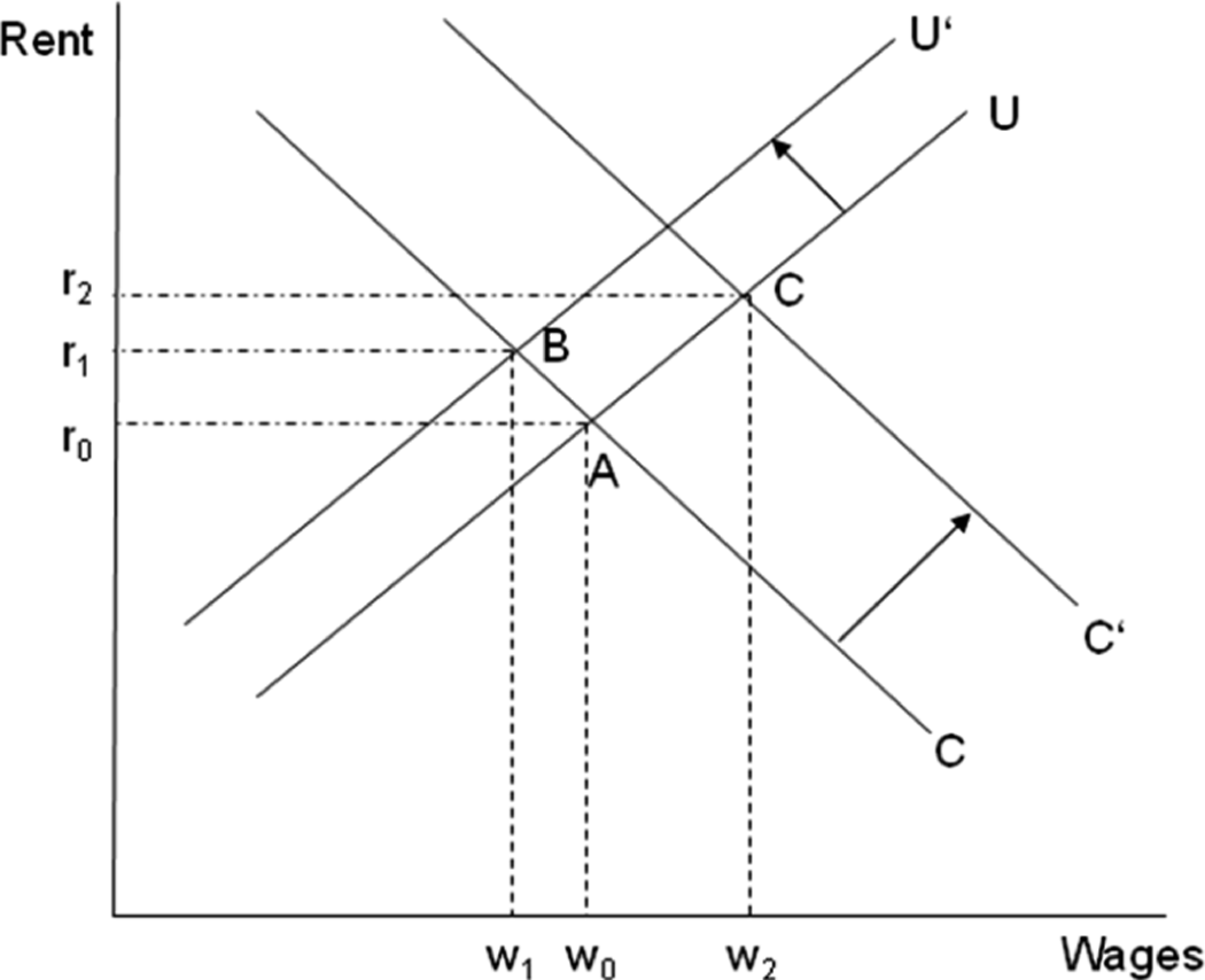
However, such a setting implicitly assumes a featureless world. Some locations may be particularly desirable to firms, as they may have a natural deep sea harbor or exhibit agglomeration economies resulting from the proximity to other firms. Introducing firm amenities implies that the cost curve C shifts upward to the right, because firms are more productive and demand more land and labor, driving up the equilibrium wage and property price to point C. If the amenity, however, is just for households, such as a pleasant climate or beautiful scenery, the utility curve U shifts up to the left. This is because households increase both the supply of labor and the demand for housing, trading off the additional amenity for a decrease in the utility level coming from lower wages and higher property prices (point B as the new equilibrium). Now, in this context, higher property prices and lower wages should be viewed as a measure of the willingness to pay for living in a desirable location and not as an indication of a higher cost of living. Whenever an amenity affects both households and firms, property prices will rise with an ambiguous wage effect depending on whether the amenity is more valuable to firms or to households. Finally, amenities may be desirable to households and undesirable to firms. Here, wages would clearly be lower since the supply of labor would be large while the labor demand would be depressed, but the impact on property prices would be ambiguous.
Interpreting amenities from the standpoint of the household, we can say that a negative sign of the wage coefficient on migration flows suggests the presence of household amenities, while a positive sign is more difficult to interpret. It can either point in the direction of a disequilibrium model (people want to increase their net income), or, it could be just a compensation for a disamenity. The opposite holds for property prices: a positive sign of the property price coefficient hints at household amenities, but a negative sign is again more difficult to interpret. As before, it can either support the disequilibrium view of migration or it could reflect a compensation for a disamenity.
In addition, it needs to be mentioned that due to union power and a strong social welfare system, the labor market is not perfectly competitive in Germany. This means that if wages are not downwardly flexible enough to fully compensate for amenities, unemployment will rise. Therefore, we would expect a positive sign for the unemployment coefficient in the presence of household amenities.
When disaggregating the analysis by age group, we need to qualify the previous statements somewhat. In particular, wage rates do not matter for people who no longer participate in the labor market. Thus, for retirees (sixty-five years and older), it would not make sense to see a positive sign for the wage coefficient. In fact, it would be advantageous for them to move to areas where the household amenities are reflected in lower wages rather than in higher property prices. Also, we would expect that household amenities matter less for families with children, who typically occupy larger dwellings, than for young professionals or households without children. The stage of the life cycle representing families with children is modeled using the under eighteen years old age group.
Finally, following the observations made in the reviewed literature above that East German citizens are more likely to migrate in order to improve their employment situations, we hypothesize different effects than overall of the independent variables, both in sign and in magnitude. For example, a negative sign on the overall wage variable could imply that people move toward household amenities, while a counteracting sign with an equal or even larger magnitude for East Germany would point to the opposite interpretation. In that case, amenities are either irrelevant for the migrants (if the magnitude is about equal), or the migrants are even willing to tolerate amenities/disamenities for their improved job prospects (if the magnitude of the East Germany effect is much larger than the magnitude of the overall effect).
Provided we did not omit any amenity, we expect that the constant term λ is equal to zero. However, if omitted (unpriced) amenities exist and are positive in all the districts not equal to i, then c is <1, causing λ to be negative, and vice versa. We also expect β to be zero, because as long as in and out migration is balanced, β1 should be equal to β2. If that is not the case, however, then the β coefficient will tell us whether the number of the district population or the size of the age-specific peer group in the district constitutes a migration benefit or not. For example, a positive β implies that increasing population size and the same-age cohort size makes a district more attractive. This could be caused by population being also a proxy for the size of the labor market, especially within the model population subgroups. Schaeffer and Gebremedhin (2009) argue that labor market size has an impact on unemployment duration, which, in return, is again a determinant for migration (Fields 1976).
Data
This section gives a brief overview about the data used for the empirical analysis. We use the German Kreise (districts) as the geographic level of analysis. There is a total of 460 Kreise in Germany and we only exclude Hamburg because of missing property prices. While Kreise differ significantly in size and area, and thus in density, Kreise are strongly correlated with the area of the economic city and the city’s regional labor market. Population and migration data are taken from EasyStat: Statistik Lokal 2006, Landesamt fuer Datenverarbeitung und Statistik Nordrhein-Westfalen. To control for short-run effects, we use aggregated in and out migration data for a period of five years from 2000 to 2004. 1 All data are also available by age group. The average district-level wage for industrial manufacturing in €/month was taken from the Indikatoren und Karten zur Raum- und Stadtentwicklung (INKAR) indicators of the Bundesamt für Bauwesen und Raumordnung [Federal Housing and Regional Development Administration]. 2 INKAR also provides us with the official disaggregated unemployment rates and data for property prices in €/m2. 3 Potential endogeneity problems are addressed using values from the beginning of the migration period. Therefore, we take 1999 wage and unemployment data as independent variables, as well as the 1998/1999 mean of the per square meter property price for developed land. The few missing observations were estimated using extrapolations from previous years. In addition, we use a dummy for East Germany which is 1 for East German districts and 0 otherwise. We also interact all the variables with the dummy to allow for different effects in East Germany compared to Germany as a whole. Table 1 provides the main descriptive statistics.
Descriptive Statistics of Explanatory Variables
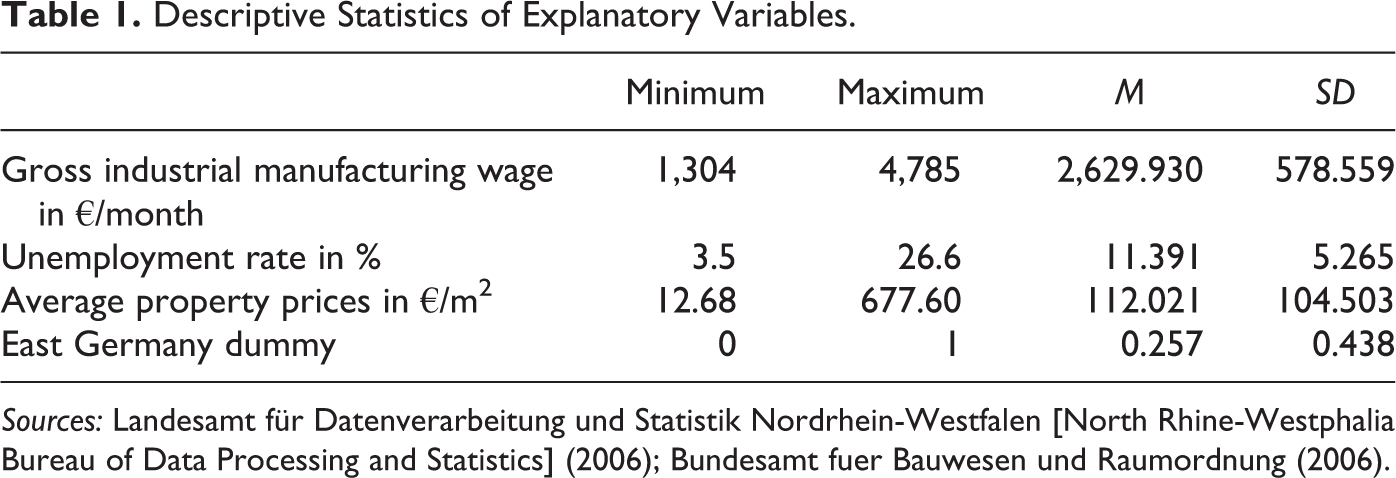
Sources: Landesamt für Datenverarbeitung und Statistik Nordrhein-Westfalen [North Rhine-Westphalia Bureau of Data Processing and Statistics] (2006); Bundesamt fuer Bauwesen und Raumordnung (2006).
Results
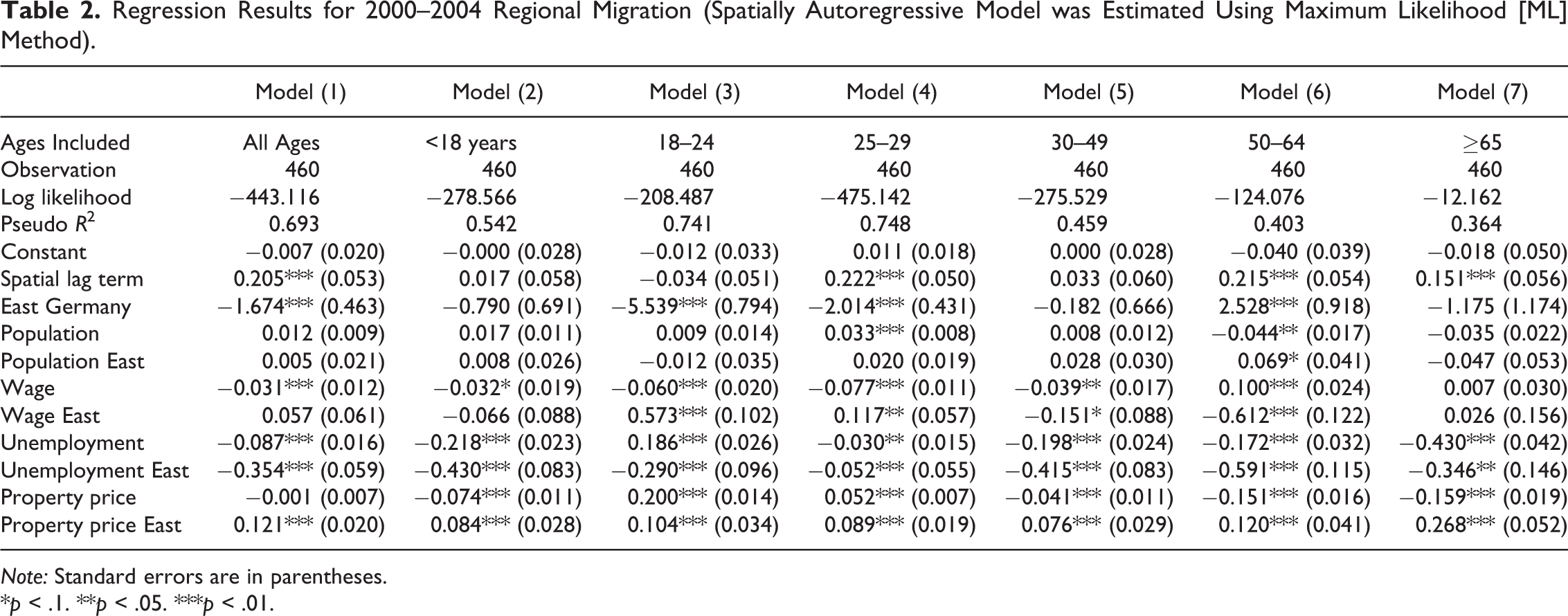
In Table 2 , the regression results for migration between 2000 and 2004 among 460 German districts are presented. Model 1 contains the results for the whole population in Germany while the results are disaggregated by age for models 2 through 7 to analyze life cycle effects.
Regression Results for 2000–2004 Regional Migration (Spatially Autoregressive Model was Estimated Using Maximum Likelihood [ML] Method).
Note: Standard errors are in parentheses.
*p < .1. **p < .05. ***p < .01.
Since the constant term is never significant, it can be said that for all models most migration-relevant forces are captured in the wage, unemployment, and property price variables. For East Germany, however, that does not always hold true. The coefficient for the East Germany dummy is negative and significantly different form zero at the 1 percent level in models 1, 3, and 4, and positive in model 6. Therefore, all migrants, and especially young migrants consider the Eastern locations less attractive (models 1, 3, and 4), while the opposite applies to older migrants, aged fifty through sixty-four (model 6). The latter finding may reflect the fact that elderly people have stronger social ties and that social capital acts as an amenity for them. However, in general, East Germany appears to have an amenity deficit which is not yet totally reflected in wages, unemployment, and property prices. This finding supports the idea that the migration model in Germany has both equilibrium and disequilibrium aspects.
The disequilibrium point of view is further supported by the fact that, except for young people and retirees, who are not concerned about employment, migrants move strongly toward low unemployment areas. The coefficient for unemployment is negatively significant from zero at the 1 percent level in models 1, 2, 4, 5, and 6. This effect is even stronger for East Germany, indicating that for East Germans unemployment is even more important. The unemployment coefficients clearly do not point in the direction of migrants moving toward more amenities.
On the other hand, the negative coefficients for wages in models 1 through 5 show that people tend to migrate toward regions where household amenities are capitalized into wages. The wage coefficient is positive and significantly different from zero at the 1 percent level in West Germany only in model 6, which provides estimates for the age group of fifty through sixty-three. This means that people move to higher wage regions just before retirement, except in East Germany where they still prefer household amenities that are capitalized into wages. Finally, retirees do not seem to be triggered in their migration decision by wages.
In addition, most migrants avoid amenities that are capitalized in property prices, except the two groups of young people (eighteen through twenty-four and twenty-five through twenty-nine years old). However, in East Germany, people are more likely to move to areas with higher property prices. The reason may be that places with higher property prices are also the places with more amenities for firms, such as agglomerations, thus places with more opportunity to also find work.
Spatial spillover effects do not exist for the very young and middle-aged groups, including families. For the twenty-five to twenty-nine years old, the two older age groups, and Germany as a whole, the coefficient for the spatially autoregressive term is positive and significantly different from zero at the 1 percent level. This means that migration exhibits some spatial dependence, and that regions experience growth (contraction) if the neighboring regions grow (contract). However, this does not hold for the very young age group (model 3), where people tend to move to cities but not to their surrounding suburbs, and for the two groups representing families (models 2 and 5), who migrate out of the cities to the suburbs.
In and out migration seems for the most part in equilibrium, as shown in the mostly nonsignificant regression coefficient estimates for the population variables, or their age-specific subgroups. The exceptions are people of age twenty-five to twenty-nine years (model 4), who are attracted to regions with more population in their peer group, and preretirees (fifty to sixty-four years old), where the opposite is the case (model 6). This finding may be explained by the fact that young people benefit more from larger job markets (Fields 1976; Schaeffer and Gebremedhin 2009) than the remaining population.
For the different life cycles, it clearly stands out that the two groups of young people (models 3 and 4) value amenities the most. They migrate to regions with low wages and high property prices. In addition, the group of eighteen through twenty-four (model 3) migrates even to regions with higher unemployment. People in their prime, who also are more likely to have a family with children (models 2 and 5), look very similar. They prefer places where amenities are reflected in wages, but not property prices, mainly because they consume more housing. They also migrate to regions with lower unemployment, indicating that their move may be motivated by finding work.
Finally, older people do not seem to care too much about amenities, unless they move from or to East Germany. However, the fifty to sixty-four years old in East Germany prefers amenities that are capitalized into wages, while retirees have a preference for amenities that are capitalized into property prices. The last finding seems somewhat surprising, however, if we assume that higher property prices come with more amenities for firms, caused by agglomerations and urbanization economies, then we can derive that in East Germany, older people are attracted to larger cities and their corresponding amenities.
In summary, we can say that there are profound differences in migration behavior as a result of life cycle and location. Younger people migrate toward amenities while middle-aged people move to jobs. Older people do not seem to care too much for amenities unless the location is in East Germany. Also, East Germans seem to value employment opportunities higher. Finally, spatial spillover effects are only present for the group of twenty-five through twenty-nine, the two oldest age groups, and as well as for Germany as a whole.
Policy Discussion
In policy discussions, substantial net out migration from unattractive regions is often not accepted because of its real or perceived social and political consequences. Therefore, regional policy makers call for compensatory subsidy policies. In Germany, many regional subsidies are granted through a multilateral support scheme of the federal and the state governments, the “Joint Task Improvement of Regional Economic Structures” (Gemeinschaftsaufgabe Verbesserung der regionalen Wirtschaftsstruktur, GRW). The GRW consists of annual framework plans that lay down the spatial coverage of the assisted areas, their priorities, and broad measures and eligibility criteria for support. The key instrument of the GRW is a capital grant for industrial investment by private companies and, to a lesser degree, for investment in economic infrastructure. Projects typically include the setting up, expansion, or modernization of industrial parks or transportation- and energy-related infrastructure. The redistribution of taxes toward economically disadvantaged regions is also reinforced by the fiscal scheme for equalization of resources among states and district governments (Länderfinanzausgleich, kommunaler Finanzausgleich) where lump-sum transfers are made to regions that receive below-average tax revenues. Moreover, the “Solidarity Pact” with the “Solidarity Tax” (levied on the personal and capital income tax) was introduced to support economic development in the East and to overcome economic differences and alleviate burdens to development stemming from the division of Germany before reunification (for an analysis of equalization schemes in Canada, see, e.g., Boadway and Hayashi 2004).
Our results make it doubtful that net out migration from East Germany can be reversed by such place-making policies (Glaeser and Gottlieb 2008). Current transfers from West Germany to East Germany amount to about €60 billion per year (ifo Institute 2010). However, about half of it leaves East Germany again as net capital exports, suggesting that the investment climate is still unfavorable in East Germany. Our results indicate that migration in East Germany is still mostly work-related. This probably reflects early mistakes of public policies after reunification, especially the rapid wage convergence that made East Germany less competitive. Since migration is one way to improve job matching, increased mobility in the labor market would make it easier for East Germany to catch up economically with West Germany. However, job mobility was historically low in East Germany. Only more recently this is changing and the mobility rate in East Germany is approaching the West German level (Kemper 2004). Policy can help create or sustain the conditions for high mobility, abolishing any potential migration barriers, and providing sufficient information about the attractiveness of alternative locations.
Regional policies should also be more strongly directed toward improving local amenities, as differences in location-specific amenities cause migration. In particular, younger people at the beginning of their work life are attracted to regions rich in amenities. Private investment grants may not change their perception of a region as unattractive and may not have any impact on their decision where to settle down. Infrastructure investments and the promotion of man-made amenities such as “soft” location factors like environmental protection could be more effective and spur the endogenous development potential of lagging regions. Such an approach has lately gained more ground in the funding principles of the European Structural Funds (Reissert 2004).
Conclusion
In general, we find that Germany has both equilibrium model and disequilibrium model aspects. Spatial differences in housing prices and wages reflect, in large part, compensating differentials associated with corresponding spatial differences in amenities/disamenities. This confirms some earlier work for Germany that emphasizes the role of selected amenities on migration behavior. In contrast to these studies, our article uses a broader and more complete definition of amenities following the amenity approach of Graves (1983).
We find that migration behavior depends on both life cycle and location. Younger people place a higher value on amenities, while middle-aged people and East Germans prefer regions with low unemployment. Surprisingly, retirees do not have a preference for amenities unless they are from East Germany. However, in this article, we presented some evidence that not all migration is due to amenity differentials. The unemployment coefficient is consistently negative, indicating the possibility of disequilibrium and the need to improve conditions in the labor market.
Our research certainly has its limitations. While the gravity approach is widely used in migration modeling, its logarithmic functional form constitutes strong assumptions. Furthermore, migration and changes of regional characteristics may be indeed endogenous. In future research, a simultaneous equation framework could be developed where the migration ratio is jointly determined with contemporaneous (as opposed to time lagged) equilibrium wages, property prices, and unemployment. This would allow the analysis of the labor and land markets together with population movements in a more integrated way, as they are affected by specific household amenities.
Unlike the traditional gravity model, we only include the characteristics of the region where the in migration ends and the out migration originates, but not vice versa, mainly because we do not have any information about actual migration flows. Also, aggregations, such as migration ratio, are summary measures and, as such, can potentially cover up important distinctions between actual in and out flows with respect to certain subpopulations or other migrant characteristics.
Finally, further research could explicitly distinguish between two sources of amenity-driven migration, namely changes in amenity demand over time and disequilibrium in amenity markets (Clark 2006). The latter includes the overcompensation or undercompensation across some locations for site attributes in local wages and/or property prices and has not been considered in this article.
Footnotes
Acknowledgment
The authors would like to thank the two anonymous reviewers, as well as Philip Graves, Sean Payne and the editors of this journal for their comments and suggested corrections. All remaining errors and omissions are the authors.
Declaration of Conflicting Interests
The author(s) declared no potential conflicts of interest with respect to the research, authorship, and/or publication of this article.
Funding
The author(s) received no financial support for the research, authorship, and/or publication of this article.