






Abstract
Background:
In interrogating systems of whiteness that govern the protection of language ownership, this study draws on raciolinguistics and highlights the experiences of Hispanic male teachers in Texas K–12 systems, where responsibilities and knowledge sharing were shaped by assumed linguistic abilities. On a national scale, Hispanic male teachers account for less than 2% of the teacher workforce. As noted in the literature, this small percentage is due to several reasons, such as teacher pathway programs not being inclusive; teachers having to navigate educational systems that reinforce racialized, gendered, and linguistic prejudices; and, as documented in this study, stereotypical assumptions of their linguistic identities. The overrepresentation of Eurocentric language perspectives and the underrepresentation of the perspectives of those historically marginalized that threaten settler futurity ideologies within the vast majority of K–12 environments influence how Hispanic male teachers navigate their educational spaces when representing all of their identities.
Purpose:
For this study, we examine how 839 Hispanic male teachers navigate their Texas K–12 school environments when assumptions about their linguistic identities impact their sense of belonging, professional opportunities, and relationships with colleagues, administrators, and students. This paper contributes to the literature on Hispanic male teachers by centering their voices, which are often excluded by dominant epistemologies.
Research Design:
Our research draws on data from the National Hispanic Male Teacher Survey (NHMTS), which explored the experiences and characteristics of Hispanic male teachers in the United States. Participants were identified through the fall 2021 Public Education Information Management System (PEIMS) survey, which is administered by the Texas Education Agency (TEA). Survey design prioritized inclusive and equitable practices by employing multiple-select and self-describe options, in addition to working alongside Hispanic male teachers to develop the study. Our analysis of the qualitative data, including survey responses and focus groups, was done in relation to the literature through a reflective lens.
Conclusion:
Hispanic male teachers in Texas navigated assumptions of their linguistic identities and expressed (1) a lack of racial and cultural awareness from colleagues and administrators, (2) assimilation pedagogies and praxis inside and outside the classroom, and (3) bilingualism as both a bridge and a burden. The dismantling of white Eurocentric language ideological practices within educational systems begins with counterstories, like those of Hispanic male teachers in this study, that refute the normative behaviors and beliefs that govern the systematization of white Eurocentric language norms as standard and return ownership of one’s linguistic identity to those who have been siloed by inferior assumptions.
Recognizing the multifaceted identities of Hispanic male teachers within K–12 environments is critical to understanding how their roles are shaped by their cultural, racial, gendered, and linguistic backgrounds. Despite the increase in Hispanic people having changed society’s demographics (U.S. Census Bureau, 2025), the education field has yet to reflect this growth. Recruitment of Hispanic male teachers is critical to the field for several reasons; many studies document the representation of these teachers as meaningful to mentoring Hispanic students (Ekpe et al., 2025; Singh, 2021) and students of color (Vilson, 2015), diversifying the teacher workforce (Bergey et al., 2019), understanding the criticality of including culturally relevant pedagogy in curricula (Ladson-Billings, 1995), and influencing policy and practice implementation (Lim et al., 2019) that aligns with these teachers’ expectations (Garcia & Chun, 2016). Still, it is important to note the marginalization of Hispanic male teachers in the workforce: from the recruitment stage, where teacher programs are inherently white (Ladson-Billings, 2005), to training stages consisting of white-constructed methods of practice (Carter Andrews et al., 2019), and to the sustaining stage, where institutions struggle to keep these teachers (Ekpe et al., 2025). The disempowerment of Hispanic male teachers often leads to lower numbers within the field (Santoro & Hazel, 2022). Moreover, the mischaracterization of their linguistic identities creates challenges for Hispanic male teachers as they navigate their responsibilities in schools (Shenk, 2007).
Language marginalization for Hispanic male teachers creates hostile work environments because many of these teachers are subjected to forms of devaluation. The devaluation stems from white-sanctioned beliefs that English is the United States’ primary language; this misconception promotes white ideologies and epistemologies within education (Lara et al., 2025; Zentella, 2017). Although educational institutions market themselves as places of inclusion, assumptions about Hispanic male teachers’ linguistic identities frequently lead to exclusionary practices. Additionally, linguistic assumptions (e.g., that all Hispanic individuals are Spanish/English bilinguals and can/should translate/interpret) can lead to dissatisfaction with teacher roles and apprehension around responsibilities (Fallas-Escobar, 2024). Thus, this study highlights the experiences of Hispanic male teachers in K–12 environments when assumptions are made about their linguistic identities. Our study contributes to the literature on Hispanic/Latino teachers in educational settings by foregrounding participants’ narratives as disruptors of hegemonic frameworks that determine whose stories are told, whose knowledge is validated, and whose experiences are deemed worthy of scholarly attention. As such, the guiding research question for this study is:
How are the responsibilities and experiences of Hispanic male teachers in Texas K–12 settings affected when their linguistic identities are assumed?
We use the term Hispanic in this paper because it aligns with the terminology used in the National Hispanic Male Teacher Survey (NHMTS). We considered the use of the term Hispanic throughout the literature (Ekpe et al., 2025; Griffin, 2018; Oboler, 2017; Rinderle, 2005), documenting the often-noted exclusion of Indigenous communities and the alignment of Euro-American terminology. Respective of the diversity represented within our study, we utilized the term Hispanic only as it relates to literature and the application of the results from the surveys and focus groups; we used the term Latino (which encompasses non-Spanish-speaking people and is inclusive of other Latine groups) (Ávila-Saavedra, 2010; Martinez & González, 2021) when it was utilized by participants, in addition to and similarly when noting scholarly literature. A vast majority of NHMTS participants chose the term Hispanic over Latino and Latinx. Accordingly, we noted that ethnicity identifiers can be influenced by demographic regions of the United States (Perez & Hirschman, 2009), adoption of classifications and designations (Valdeón, 2013), communal practices (Rinderle, 2005), class (Lippi-Green, 2012), and collective languaging (Baker et al., 2024). Knowing this, we urge scholars to be critical in their usage of identity markers when highlighting the experiences of racially and ethnically marginalized folx.
Review of Literature
Language does more than communicate; it constructs reality. It shapes what counts as knowledge, who is authorized to produce it, and how it is legitimized (Chón et al., 2021; Cruz, 2001; Urrieta Jr. & Calderón, 2019). Language ideologies impact how minoritized people are assessed, positioned, and valued (Anzaldúa, 1987; Lara et al., 2025; Padilla & Vana, 2024). As Shenk (2007) states, “the linguistic and other social ideologies of a group are mediated by the majority” (p. 196). Accordingly, language becomes a primary tool in the construction of knowledge (Flores & Rosa, 2015). Claims that language is neutral rely on Enlightenment epistemologies that declare knowledge as objective, rational, and universal, thereby erasing the situated, embodied, and relational dimensions of knowing and being (Saavedra & Pérez, 2012; Soto et al., 2009). This approach to understanding is detached from the social conditions and forms of oppression that shape reality and are rationalized through a systematic use of language in a performance of neutrality (Saavedra & Pérez, 2012; Soto et al., 2009), which manifests in two interlocking ways. First, it dehumanizes minoritized people, reinforcing settler-colonial logics of value while naturalizing asymmetrical power relations as fair or organic (Padilla & Vana, 2024; Urrieta Jr. & Calderón, 2019). Second, it works to erase “the other” from public consciousness, preserving settler futurity by denying the visibility and memory of what once existed (Padilla & Vana, 2024; Urrieta Jr. & Calderón, 2019).
The Institutionalization of Eurocentric Languaging
As Cioè-Peña (2024) argues, “Language is one of the most powerful and ongoing settler colonial projects. It is through the use of colonially rooted languages that power continues to be distributed, especially within conceptualizations of who is or can be Latinx” (p. 6). Institutions reinforce normative standards of language stripped of regionalism, emotion, and variation (Blackwell et al., 2017; Cioè-Peña, 2024), rewarding those who align with the neoliberal agenda and comply with these autopoietic systems, silencing and erasing those who do not (Chón et al., 2021; Ek et al., 2013). This process of linguistic regulation pushes individuals to conform to Eurocentric models of speech and behavior under the guise of a universalized model of success (Sanchez, 2024; Singh, 2024a). What results is a meritocratic myth that rewards those who can perform whiteness linguistically while marginalizing those whose language practices reflect their racialized and cultural identities (Flores & Rosa, 2015; Lippi-Green, 2000; Padilla & Vana, 2024; Przymus, 2024). Much literature on the impact of raciolinguistic ideologies in schools focuses on the experiences of minoritized students (Przymus & Mendoza, 2025; Rosa, 2019); however, minoritized teachers, even those who live and teach in contexts where their ethnicity and language practices are significantly represented in their local communities [e.g., Texas], endure the brunt of monoglossic ideologies linked to race and language (Kohli, 2018).
In the United States, schools and curricula often frame Spanish as less prestigious than English or other European languages (e.g., French, Italian) and further reward standard “academic” Spanish over linguistic variations (Chávez-Moreno, 2021; Cioè-Peña, 2024). These dynamics shape students’ and educators’ sense of belonging, agency, and legitimacy within educational spaces (Chón et al., 2021; Cruz, 2001; Ek et al., 2013; Urrieta Jr. & Calderón, 2019). Those occupying compounding “deficit-framed” identities experience dissonance, often manifesting in discrimination (Ekpe et al., 2025), violence (Gomez et al., 2008), anxiety (Lara & Fránquiz, 2015), and insecurity (Varghese, 2008). Our study adds an often-overlooked infrastructural contribution to the current literature on teachers’ experiences with raciolinguistic ways of positioning educators who fall outside the normative white, Standard English–speaking identities most valued in schools, thereby highlighting the harm of assumptions about language in relation to race.
Institutions that emphasize a “hyperstandardization” of language not only eliminate visibility but also shape the ideology of normativity that casts others to the margins (Padilla & Vana, 2024; Saavedra & Pérez, 2012; Singh, 2024b). This standardization is inseparable from racialization because it transcends time, space, and geography, forcing those who do not meet categorical standards into a state of perpetual otherness (García-Louis & Cortés, 2023; Padilla & Vana, 2024; Saavedra & Pérez, 2012; Sawyer & Paschel, 2007; Singh, 2024b). For example, Padilla and Vana (2024) conducted a critical discourse and visual analysis of Spanish textbooks to examine representations and ideologies. Their findings highlight how language and its pedagogy perpetuate colorism and racial stereotypes. Language is imbued with social and symbolic value; much like whiteness as property, it is positioned as a desirable asset, especially in academic environments.
Hispanic/Latino Male Teachers in Education
Scholars have highlighted the underrepresentation of Latino males in secondary and postsecondary educational settings (Noguera et al., 2013; Sáenz & Ponjuan, 2009). Despite the increase in the number of Latino males attending college (Fry, 2002), the teaching workforce fails to represent this increase, ultimately leading to the lack of Latino male teachers within classrooms. Teacher education “pipelines” and “pathways” often reinforce whiteness ideologies (Kohli, 2025; Picower & Kohli, 2017), further marginalizing minoritized teachers (Gist et al., 2019). Consequently, these teachers have to navigate “playing the game” of performance within educational spaces to protect their agency (Urrieta Jr., 2005). Teachers of color are often too familiar with enduring, deeply rooted, systemic structures in education that create tension around whether they can authentically represent all of their identities within these settings (Hernández-Johnson et al., 2023).
Scholarship on teachers of color documents their endurance of hostile racial climates, disproportionate invisible labor, racial liaison fatigue, and racialized elimination from schools that normalize whiteness in policy, curriculum, and interactions (Amanti, 2019; Ekpe et al., 2025; Kohli, 2018; Picower & Mayorga, 2015; Villegas & Irvine, 2010). This body of work reveals that teachers of color are often recruited for their perceived cultural proximity to minoritized students, yet systematically undervalued, overburdened, and held to different professional standards than their white counterparts, leading to burnout (Ekpe et al., 2025; Gist et al., 2019; Lynn, 2006). The literature on Latino male teachers’ experiences remains comparatively limited yet reveals distinct racialized and gendered expectations shaping their professional experiences. Research on Latino male teachers has primarily focused on recruitment, representation, and role modeling, with comparatively less attention paid to how Latino men experience teacher preparation pathways and early-career induction, especially within regionally specific sociopolitical contexts (Lara & Fránquiz, 2015; Singh, 2024b). This omission is particularly significant in Texas, where Hispanic students comprise a majority of the K–12 population, yet Hispanic male teachers remain underrepresented in the workforce (Texas Education Agency [TEA], 2023). In a state shaped by ongoing debates over bilingual education, immigration, and curriculum regulation, Latino male teachers’ professional trajectories not only are questions of representation but also are deeply entangled with racialized masculinity, language politics, and state-level policy climates (Gándara & Hopkins, 2010; Villegas & Lucas, 2002). Existing research on Latino male teachers highlights their recruitment as role models while also being the presumed disciplinarians for students of color, and the gendered expectations of cultural authenticity and authority that accompany these roles (Dorner et al., 2022; Kraemer-Holland & Berumen, 2025). This parallels institutional tokenism and the associated confrontations with stereotyping, hypervisibility, and barriers to advancement (Lara & Fránquiz, 2015; Salinas & Lozano, 2019).
Hispanic/Latino male teachers navigate the educational landscape as an in-between space defined by colonial frameworks, where they are rendered outsiders unless they perform and speak whiteness in alignment with hegemonic norms (Anzaldúa, 1987; Dorner et al., 2022; Ek et al., 2013; Ekpe et al., 2025; Urrieta Jr. & Calderón, 2019; Wei & Garcia, 2022). This conditional access comes at a cost. The informal and unofficial positions and responsibilities that Latino male teachers assume are often unrecognized or uncompensated (Dorner & Kim, 2024). Despite their professional and personal commitments, their professional advancement is stifled by stereotyping and raciolinguistic biases (Kohli, 2018). For example, although essential for bridging institutional and community divides, teachers practicing bilingualism often become the basis for exploitative expectations, as they serve as cultural and linguistic brokers (Przymus, 2024). These burdens are further intensified in institutional contexts where immigration and bilingual education are contentious, exposing educators to heightened scrutiny (Ek et al., 2013). Such conditions reflect how colonial logics commodify Hispanic/Latino male educators, valuing them for their labor, productivity, and economic utility while naturalizing asymmetrical power relations (Cioè-Peña, 2024; Padilla & Vana, 2024; Urrieta Jr. & Calderón, 2019).
Furthermore, when assumptions are made about Hispanic/Latino male teacher identities, expectations of these teachers are ultimately influenced by those making stereotypical judgments (Ekpe et al., 2025). Winstead and Wang (2017) note, “. . .one is often judged by presumably appropriate cultural expertise and behavioral expectations which can include adopting language attitudes that reflect the dominant ideals and notions of the nation-state” (p. 17). The authors continue by explaining the harmful effects of these expectations that ultimately influence minoritized teachers’ capital and status in education and society.
Theoretical Framework
Rosa and Flores (2017) and other scholars in the emerging field of raciolinguistics focus on examining language discrimination through an intersectional lens, arguing that “racialized subjects are perpetually perceived as linguistically deficient even when engaging in language practices that would likely be legitimized or even prized were they produced by white speaking subjects” (p. 628). In intersectional terms, it is important to make space for the complexities of race, nationality, and language; for example, a person can be American of Caribbean descent, Black, and Spanish-speaking. Keeping these in mind, we believe that the raciolinguistic and linguistic justice frameworks (Baker-Bell, 2020) are useful for understanding how workplace discrimination occurs, not only for bilingual individuals but also for those who are assumed to be bilingual. Linguistic justice frameworks place agency in the hands of individuals, rather than systems, to communicate in the language of their choice, without being seen as a deficit, and to challenge systemic racist practices that pigeonhole them into an assumed linguistic identity (Bucholtz & Hall, 2010). For instance, in Baker-Bell’s (2020) argument, the author describes Black languaging from a stance in which the lack of acknowledgment within society and educational spaces reveals a contradiction that relies on the efforts of those who listen to determine what is acceptable as appropriate English. Scholars such as Brittany Frieson (2022) and Patriann Smith (2020) have noted the wrongful conflation of ethnicity and race with language and the dangerous consequences that emerge from these practices in society and organizations. Similarly, this notion is reflected in our study through the assumption that the Hispanic male teachers speak Spanish. Furthermore, this theoretical framework offers implications for decisions in K–12 settings that affect Hispanic male teachers’ experiences when assumptions become norms.
We use Rosa and Flores’s (2017) framework of raciolinguistics to examine how harmful assumptions about Hispanic male teachers in K–12 settings operate as a form of whiteness, regulating how these teachers navigate their careers. Briceño et al. (2018) highlight that racialized educators are often seen as linguistically deficient, even when they use the same “standard” forms that would be validated if spoken by white people. These raciolinguistic perceptions are filtered through colonial views, which influence who determines what is appropriate, legitimate, or professional (Briceño et al., 2018; Flores & Rosa, 2015). This conditional recognition of language preserves whiteness by centering white learners and simultaneously excluding non-white speakers from ownership over their language (Chávez-Moreno, 2021; Flores & Rosa, 2015). Ek et al. (2013) reveal the literal and symbolic violence endured by raciolinguistically marginalized educators within educational institutions that uphold the logic of settler futurity (Chávez-Moreno, 2021). Through standardization processes, these institutions reward and privilege certain language varieties while devaluing and erasing nondominant ones (García-Louis & Cortés, 2023). Furthermore, the assumption that Hispanic male teachers speak Spanish (Lara et al., 2025) maintains a system of institutionalized racism at the top of the linguistic hierarchy (Baker-Bell, 2020; Rosa & Flores, 2017).
As Lippi-Green (2012) notes, several factors influence languaging; these factors also function as means of discriminatory practices within educational spaces, because they are often regulated through forms of colonial assimilation. In addition, raciolinguistic ideologies are inherently intertwined with racism, because people of color often experience linguistic discrimination fundamentally different from that of white communities.
Methods
Sampling
Participants were teachers (defined as educators and/or paraprofessionals) who were actively employed at K–12 Texas public schools and indicated they were male and Hispanic on the fall 2021 Public Education Information Management System (PEIMS) survey, which is generated and managed by the Texas Education Agency (TEA). The participants were selected from the TEA database our team received, which included demographic and contact information for 410,429 teachers across all regions of Texas. The inclusion criteria for this study were that participants had selected they were “male” and “Hispanic.” Notably, PEIMS provided only “male” and “female” options for gender; furthermore, the item indicating “Hispanic” or “non-Hispanic” was separate from the ethnicity item. This means participants could have selected Hispanic and Black on PEIMS, for example, and that these were not mutually exclusive, which could have affected participant selection. The final list of teachers meeting the study’s inclusion criteria totaled N = 23,976, suggesting that Hispanic males account for approximately 5.8% of Texas teachers and school faculty.
Data Collection
We distributed the online survey via the Qualtrics platform to 23,976 teachers who met the study’s inclusion criteria. A total of 1,279 emails bounced back from the initial distribution. All participants received two reminders to complete the survey. Distribution via Qualtrics’s direct email tool may have caused the message to be blocked by spam filters in one or more school districts. In total, 1,042 responses in the initial sample were returned. Of these, 204 respondents had missing values for all variables. An additional 39 respondents had missing values for 90% of the dataset’s variables. A missing values analysis was conducted on the full dataset, including all 1,042 respondents. To assess whether the pattern of missing values was missing completely at random (MCAR), Little’s (1988) MCAR test was conducted. The null hypothesis of Little’s MCAR test assumes that the pattern of the data is randomly distributed or missing completely at random (MCAR) and follows a χ2 distribution. The results of the test indicate that the missing values in the data were randomly distributed (MCAR), χ2 (46,367) = 26,351.487, p = 1.000. This suggests that the missing data would not seriously bias estimates or introduce error in the results, and the analysis for this study was conducted using listwise deletion. We removed the data for 204 respondents with missing values on all variables. Listwise deletion was used for analyses. The dataset included 839 participants (N = 839), with a response rate of 3.5%. Descriptive statistics for these were calculated for multiple-choice, multiple-select, and Likert-scale questions. The original anonymous survey was linked to an optional second survey, which was not connected to the first, in which participants could indicate interest in focus groups or receiving study updates.
Table 1 displays survey participants’ responses to their ethnicities and linguistic identities.
Survey Participants’ Ethnicities and Linguistic Characteristics.
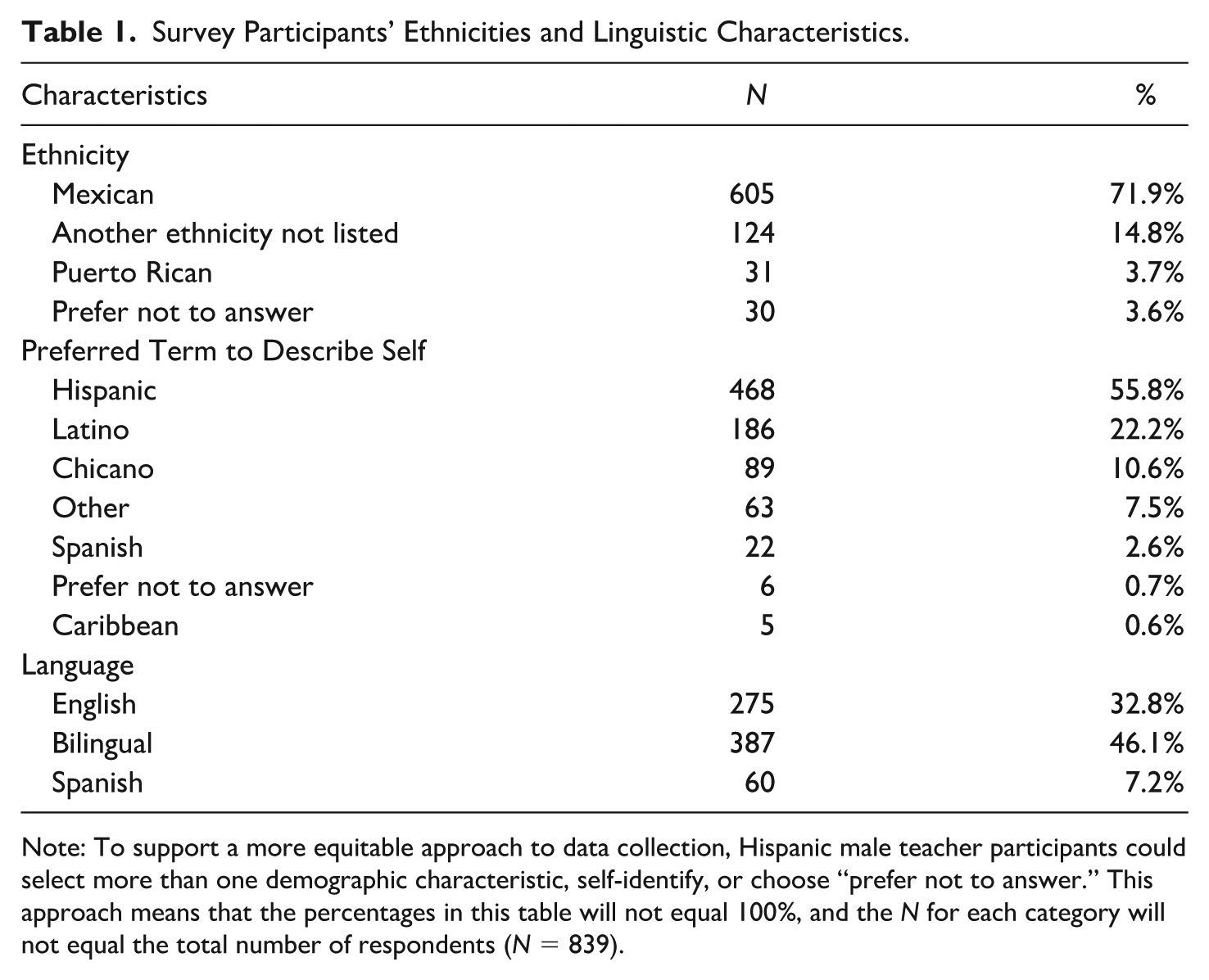
Note: To support a more equitable approach to data collection, Hispanic male teacher participants could select more than one demographic characteristic, self-identify, or choose “prefer not to answer.” This approach means that the percentages in this table will not equal 100%, and the N for each category will not equal the total number of respondents (N = 839).
Survey
Survey Design
We collected data through an online survey. The survey encouraged participants to draw on their experiences in their communities to contextualize the data and pose questions. Although we determined that demographic questions were relevant and necessary for recruiting and sustaining Hispanic males in the teaching profession, our team practiced transparency and informed consent by beginning the survey with detailed information about how personal information would be stored, the study’s goals, and the specific research question. Using an equitable data-collection approach, we invited participants to express the diversity of their identities through a multi-select and open-ended response application. In other words, participants had multiple opportunities to express their identity outside of the limitations of “Hispanic” and “male.” Systemic identity erasure remains, however, as a result of both the way TEA collected demographic information from which we received the eligibility list form and our own listed ethnicity options: multi-select or open-ended. For example, the PEIMS did not provide an opportunity for participants to identify their nationality. However, although participants were not able to identify their nationalities, we provided a “prefer to self-describe” option for them to self-identify. We found it critical that, although the adoption of the PEIMS left no room for modifications, participants who wished to self-identify by nationality were able to do so, because this aligns with the inclusion of Indigenous identities, which are often underrepresented in data.
Additionally, we asked respondents to write the name of the “city where [they] grew up.” This wording was specifically chosen to avoid focusing on the place of birth, which might be associated with surveillance of international and transnational participants, and instead to focus on the environment in which the participant was raised. Meanwhile, race and nationality demographics were collected through multi-select questions asking participants whether they self-identified as any of the options, with one question listing nationalities and the other listing ethnicities; both questions included options for “other, please specify” and “prefer not to answer.” Other demographic questions included years of teaching experience, grade level(s) taught, subject and/or content area, status as a first-generation college student, school county, school type (public, private, or charter), and professional preparation for teaching.
The survey was piloted with two Hispanic male teachers in our local community who were involved in the Maestro program at Texas Christian University (TCU), an initiative that aims to diversify the teacher workforce in Texas by recruiting, supporting, and sustaining Latino men in the teaching profession. The intended outcome of Maestro is for more Latino male students in Texas to see themselves reflected culturally and linguistically in their school communities. Through a culturally responsive approach, the pilot improved the clarity and specificity of the survey questions and enhanced survey navigation and formatting as both individuals reflected the identities represented in this study.
Survey Description
The survey included 35 questions organized into four main blocks: Block 1: Survey Introduction; Block 2: Personal and Demographic Information (14 questions); Block 3: Background and Identities (12 questions); and Block 4: Professional Experiences (9 questions). Questions used closed- and open-ended response formats (e.g., multiple choice, text entry). Most closed-ended questions included an optional, open-ended, “other” response option. The survey was designed to take no longer than 45 minutes. The last question of the survey asked participants for their opinion on how the survey results could best be disseminated to support, provide resources for, and cultivate a community of Hispanic male teachers. Upon completion, participants could stay updated on the survey results and continue participating via a separate Qualtrics survey link, which was not linked to their responses in the main survey. This second survey collected contact information, including email addresses, availability, and interest in participating in focus groups. Only participants who completed the first survey and expressed interest in participating in the focus groups were contacted.
Focus Groups
The first question on the second survey was “Would you be interested in participating in a potential focus group/interview related to this project in the future?” Only participants who selected “Yes” were brought to a page to provide their contact information. In total, 406 respondents indicated interest in a potential focus group or interview. From the survey responses, all 406 respondents were contacted to participate in focus groups to determine preferences for focus group dates, using a scheduling survey. (Respondents were given multiple dates/times to choose from.) 95 respondents completed the scheduling survey, of which <10% attended the scheduled sessions. Sessions were held both in-person and virtually. Three virtual sessions and one in-person session were offered.
Focus groups were led by members of the authorship team and consisted of a three-part process. The first activity involved sharing survey data, allowing participants to view responses from the first survey. Sharing data allowed us to ground our dialogue. The next step involved a member from the authorship team facilitating questions in which participants responded. Lastly, members of the authorship team engaged in active memoing to analyze and reflect on the processes involved in the focus group’s implementation and participation (Birks et al., 2008).
Data Sources
The focus groups were conversational and introduced participants to the research team, the Center for Public Education and Community Engagement (CPECE), and the Maestro program’s goals. Although the focus groups were held in English, some participants used selected Spanish phrases in their responses; therefore, we acknowledge that the use of a qualitative transcription system for translation would have flattened or misconstrued participant quotes.
Data Analysis
Given the nature of the research question, this paper primarily focuses on the qualitative data collected; we also generated descriptive statistics. We want to distinguish that our goal is not generalizability to all Hispanic male teachers, but to paint a broad picture of their varied experiences within the context(s) of K–12 educational institutions in Texas. For qualitative data analysis, our team engaged in a reflexive, iterative thematic coding of open-ended responses. The processes outlined by Merriam (2002) involved data familiarization (Phase 1), systematic data coding (Phase 2), and, finally, the consolidation of codes into themes (Phase 3). Data familiarization was achieved by reading responses, both individually and as a research team, and by sharing reactions to the range of experiences. We employed this practice through each phase of the analysis. Two coders conducted systematic data coding, each generating a list of potential patterns and consolidating them in conversation (Phase 3).
In both analyzing and representing the quotes herein, the vast majority come directly from the survey. In analyzing qualitative data and in the writing process, quotes were examined individually rather than in relation to the person who wrote or said them. We did not create participant identifiers or pseudonyms in the analysis or writing for this paper. This practice exemplifies the contradiction in our task: better understanding the experiences of Hispanic male teachers through an emancipatory lens and the methods we use to do so. In the focus on collecting a large amount of data, our qualitative approach lost some of the humanity that a smaller study would have afforded. In other words, we acknowledge this practice of using disembodied quotes as a form of depersonalization. However, we would rather be transparent about this approach than work backward and pretend we had started that way.
An important point to note is the feasibility of member checking with a large sample. In the absence of member checking, we employed rigorous coding methods through careful analysis to ensure trustworthiness. We ensured transparency with participants, carefully analyzing their experiences (interviews and focus group responses) and documenting and reflecting on our findings.
Positionality
As researchers, we find it important to note how we show up in this work. With experiences in both K–12 and higher education spaces, our work seeks to highlight the voices of marginalized groups in both spaces. As educators with over 40 years of experience in both arenas, we understand how our identities influence our approaches to research, praxis, and ways of knowing (Gounder, 2025).
Our interest in contributing to Hispanic male literature stems from our diverse identities, our roles as researchers and scholars, and our understanding of marginalization within educational institutions. The first author, an African American woman, studies the advancement of racial equity in educational institutions and society, highlighting the experiences of racially and ethnically minoritized groups. The second author, a white woman, seeks to understand how assessments are created within educational policies that further perpetuate systems of exclusion for marginalized folx. The third author, a white woman, examines challenges, opportunities, and effectiveness within various areas in science, technology, engineering, and mathematics (STEM). The fourth author, a white, bilingual male, advocates for advancing bilingual education through a social justice lens. The fifth author, a Latino male, creates opportunities through research and praxis to develop Latino males within educational institutions and societies. The sixth author, a white male, examines the intersections and influence of curricula on school systems. Lastly, the seventh author, a white woman, examines educational institutions and families and how building trust between them requires critical analysis through an equity-focused lens.
Our study was intentionally designed and implemented with Hispanic male teachers at the forefront. We wished to learn alongside the Hispanic male teachers in this study, not just to add to the literature but to share the participants’ lived experiences and counter dominant perspectives that influence raciolinguistic ideologies in educational policy and practice.
Findings
The findings show how Hispanic male teachers in Texas navigate assumptions and expectations about their linguistic identities, and how the beliefs of their colleagues, students, and administrators shape their experiences in schools. The strength in applying Rosa and Flores’s (2017) raciolinguistics framework is that we are connecting the linguistic discrimination that Hispanic male teachers experience to broader systems of oppression, specifically to systemic racism as it permeates K–12 settings. As noted in the introduction, our use of the term Hispanic refers to individuals who self-identify as Hispanic. Thus, generalizations about their language, race, or nationality cannot be made, as our findings demonstrate the diversity within this heterogeneous group.
“Do Not Let Yourself Get Pigeonholed”: A Lack of Racial and Cultural Awareness from Colleagues and Administrators
We documented how racism was intertwined within the assumptions of Hispanic male teacher identities, just as Rosa (2019) demonstrates the harm of “looking like a language, sounding like a race,” which creates false depictions of what minoritized identities should be in accordance with the white lens. This often resulted in Hispanic male teachers not having a sense of belonging and feeling as if their agency was being stripped from them. Hispanic male teachers discussed not being their authentic selves because they felt like their identities were predetermined. Several participants noted feeling “pigeonholed” into additional responsibilities. As one participant stated, “We are pigeonholed into teaching classes and grade levels to students who speak mostly Spanish.” Another participant was so discouraged with constantly being assigned to roles outside of his duties that he was ready to change careers:
I am thinking of leaving the profession. I resent being pigeonholed and prejudiced against simply because I speak Spanish fluently. It is absolutely wrong that, simply because I speak fluent Spanish, I am being tasked with teaching Spanish-speaking students in a subject matter that I do not like at all. I resent it. The pay is not enough for me to put up with this type of administrative decision.
A participant noted that colleagues would make inappropriate statements, such as, “Coworkers asking if I have a green card to work here.” This hostile comment is an example of overt racism, often influenced by stereotypical political narratives of Hispanic people as inherently “illegal.” It therefore subjects the teacher to exclusion, relocation, and carceral or state discipline (Menjívar, 2021).
Participants shared experiences balancing the institutional “hyperstandardized” Spanish language with the raciolinguistic diversity of native speakers. This balance was described as “exhausting.” Other teachers reported feeling that their time and unique skills were not respected amid the constant translation work. One participant expressed, “I’ve been looked at as the unofficial translator for every little thing. I am often pulled out of what I am doing and asked to translate or help with Spanish-speaking parents.” Translation work was often mentioned in relation to cultural competencies and helping families navigate relationships with other school staff. The unnoticed labor that dual-language teachers performed in translating was frequently unrecognized and unjustly undercompensated. This inevitably contributes to the shortage of multilingual educators (Fallas-Escobar, 2024). Hispanic male teachers who did not speak Spanish were unable to serve as translators but were still expected to help emergent bilingual students and their families. The role of an interpreter or translator was mentioned in relation to serving as a conflict mediator, fostering a safe and welcoming school environment. Some participants’ advice to other Hispanic male teachers seeking professional success was to avoid translating, because this could negatively affect their career mobility. One participant stated, “Say you don’t speak Spanish, so they don’t continue asking you to translate. Do not let yourself get pigeonholed into the role of the school’s Spanish-speaking translator or the bilingual/ESL teacher.” Because colleagues assumed Hispanic male teachers’ linguistic capabilities and responsibilities, Hispanic male teachers experienced internalized doubts when navigating professional opportunities, due to the stigma associated with the roles colleagues perceived they should have.
Regarding stereotypes encountered as a Hispanic male teacher, another participant said, “Executive leadership at the secondary school pigeonholes Spanish-speaking teachers into classes with Spanish-speaking students [immigrants].” Ekpe et al. (2025) examined the experiences of Hispanic male teachers in K–12 settings and found that feelings of not being valued influenced how the participants saw themselves as educators. Feelings of being “pigeonholed” were evident across many participants’ experiences in this study, as they felt professional opportunities beyond being the translator, mediator, or disciplinarian were not afforded to them.
Hispanic male teachers spoke a great deal about their colleagues’ prejudice and how it influenced their contributions and productivity. The additional duties given to Hispanic male teachers when assuming their linguistic identities imposed harm and frustration. The assumption of Hispanic male teachers’ linguistic identities was also evident among students’ families due to assumptions reinforced by administrators, as one participant indicated: “Administrators think that . . . you can translate any school documents that go home.” Additional roles influenced by the assumptions of linguistic identity are attributed to deeper systemic issues that impose higher expectations on those who are racially and ethnically minoritized in the educational system. Preconceived notions of a teacher’s linguistic ability to perform to a given standard often influenced how Hispanic male teachers were pigeonholed into racialized roles.
“The Assumption That I Am Going to Lead All of the Latino Programs”: Assimilation Pedagogies and Praxis Inside and Outside the Classroom
Assumptions about Hispanic male teachers’ responsibilities were quite common. Critical consciousness is necessary for understanding the importance of Hispanic male teacher representation in K–12 spaces, where these individuals are seen as more than bodies doing the “diversity” work. For example, one participant explained his experience with having to lead the Mariachi group:
I am Latino, teach Mariachi, but not totally experienced in Mariachi. I have never played in a Mariachi group, but I am so familiar with my culture and language that I can uphold this program. I fought off other colleagues’ assumptions that I was the Mariachi Director, that when the opportunity came to take an Orchestra and Mariachi position, I was hesitant, as it played into people’s prejudices.
The assumption that this participant would lead the Mariachi group was just one of many examples recalled by participants from their K–12 experiences. Another participant noted, “The biggest one is the assumption that I am going to lead all of the Latino programs on campus.” Administrators and colleagues frequently assumed that Hispanic male teachers would take on responsibilities tied to leading cultural programming. In regard to the curriculum, one Hispanic male teacher talked about the (mis)representation of Hispanic and Latino populations in textbooks, specifically requesting that schools, “Give us books on our culture written by Hispanics, not whites, with their opinions about us.” This quote demonstrates how curriculum, as codified in textbooks, tugs upon the strings of linguistic and racial discrimination through deficient or stereotypical representations. Hispanic male teachers, who serve as intermediaries between the textbook and students, have the additional task of negotiating and/or challenging these (mis)representations in their instruction while simultaneously doing damage control as their own culture(s) are portrayed as lesser-than in front of their students. Hispanic male teachers in this study described having to fill in the gap when educating students on the lack of cultural representations within the educational content, because lesson plans and other materials were often absent of people of color’s experiences, creating dissonance for these teachers. Per the principles of culturally responsive teaching (Hammond, 2014; Ladson-Billings, 1995), a diverse curriculum enables students with diverse cultural backgrounds to have a sense of belonging and become more deeply engaged in learning. Hispanic male teachers expressed that having to teach assimilation pedagogy was frustrating, with one participant illustrating how the lack of culturally relevant lessons affected students’ learning: “We often have questions dealing with integers that are referencing golf. Many of these students will not see a golf course nor care to.” Participants explained that the curriculum was not inclusive of people of color’s nuanced identities and experiences, which ultimately contributes to the lack of cultural relevancy within classrooms. As another participant stated, “The curriculum is outrageous. It is a script and does not meet the needs of our students.” Knowing that their identities were not represented in the curriculum created a chilling effect on how participants saw themselves as teachers and on how students interpreted their learning experiences.
Although it is critical for students to see themselves represented in curricula, participants noted the importance of being able to reach beyond representation and create intentional cultural programming and curricula that reflect the multiple diverse identities that they represent, with one participant stating, “We need programs that help bring our cultures, values, and ideas as a male Hispanic to the table so our young Hispanic males can see this and understand there are other ways.” The importance of connecting with individuals from similar backgrounds and upbringings as a teacher was frequently expressed in participants’ experiences. Similar to research on connections among teachers of color, the lack of Hispanic male teachers in these educational spaces likely contributes to tokenism (Ekpe et al., 2025) and to assumptions about the responsibilities associated with their presumed linguistic identity (Ek et al., 2013).
Curricula often fail to include the voices and experiences of racially and ethnically minoritized individuals, which inevitably contributes to the systemic prejudice within education systems. As a result, the representation of Hispanic male teachers decreases as barriers to belonging and advancement increase. As one participant stated, “. . . lessons . . . should extend beyond a cultural section or provide more options to urban and racially diverse lessons or ways.” Taken together, these narratives suggest that Hispanic male teachers serve as cultural and linguistic bridges, implicitly and explicitly expected to negotiate Eurocentric, assimilationist curricular demands while fostering spaces of belonging for their students. This navigation can unsettle teachers’ sense of identity and agency, as they must constantly negotiate who they are allowed to be and in what language while serving as linguistic and cultural brokers. In this sense, Spanish was welcomed as a resource for institutional convenience but not as a legitimate language of knowledge, care, and classroom livingness. Communities of color are familiar with their valuable communal practices being exploited for the ownership of educational institutions (Chávez-Moreno, 2021). Thus, positioning Hispanic male teachers’ linguistic labor was viewed as an extractable resource while their linguistic and cultural understanding and identity remained structurally marginalized. Through a raciolinguistic lens, we found that when participants took or stepped into these additional roles, they were less likely to be compensated or acknowledged for these extra duties, which made us question whether the standards for individuals who are not Hispanic and male, who step into these roles, are rewarded and recognized (Wilkins, 1998). The deprofessionalization of Hispanic male educators is seen within educational institutions through white systemic structures of who gets to be valued and appreciated, and whose agency is respected.
“I’m Not a Translator—Do Not Make Me Translate”: Bilingualism as Both a Bridge and a Burden
Many teachers who identified as bilingual acknowledged an internal conflict between their desire to be a resource for families, schools, and districts, and institutions’ tendency to stereotype them based on their linguistic identity while relying on them as interpreters. A participant expressed frustration with additional, uncompensated responsibilities, saying, “I’m not a translator—do not make me translate.” Participants noted that colleagues would assume the role of “translator” because of their presumed bilingualism. As Chávez-Moreno (2021) describes, when language functions as white property within educational institutions, individuals who most often benefit from white-sanctioned educational practices then dictate how language is used and/or celebrated. When asked what challenges they face in the classroom, one Hispanic male teacher said it was difficult “having to translate for other teachers when we are super swamped with work.” Another participant noted that the assumptions of being bilingual resulted in additional stressors in the classroom, “Again, the expectation of knowing Spanish and being able to connect with students of color.” Although several participants expressed a desire to step in as mentors to Hispanic students, assuming this role created barriers between Hispanic male teachers and administrators. Hispanic male teachers often found their sense of community expanded due to their bilingualism, yet this personal growth bloomed in the shadow of institutional language weaponization and commodification. For example, one teacher explained:
When I moved back to the States from the Dominican Republic, my first job was ESL social studies and math. And I’d never taught social studies or math in my life. I was just a Spanish speaker, and they were like, “You just go work with them. Do the best you can.” I was like, “There’s something wrong about this.”
One tenured Hispanic male teacher described going above and beyond to fulfill the needs of bilingual students and families at his school earlier in his career. He ultimately came to terms with the fact that he alone could not meet every need of each student and their families; in fact, his extra efforts might have obscured the district’s need to hire more bilingual professionals for that particular school. Speaking about his experiences, he often asked older students to mentor newer students, describing this strategy as successful and meaningful. Similar to Ekpe et al.’s (2025) study on Hispanic male teachers’ experiences in K–12 environments, bilingual participants in this study were often assigned additional roles, contributing to stressors in their academic environments.
Lara and Fránquiz (2015) note the small percentage of certified emergent bilingual teachers in K–12 settings. This lack contributes to educational institutions often placing teachers (who may not be qualified) in these positions due to phenotypical assumptions rooted in ignorance. This allowed us to call attention to the role racism played in the marginalization of bilingual participants in this study. Hispanic male teachers assisted students in coping with discriminatory offenses not only from other students but also from teachers and school administrators. As participants recalled their experiences, ambivalence showed itself when participants noted the importance of being able to be the representative for students and their families; however, noting the lack of representation to meet the students’ needs, especially those students who identified as bilingual, adding to the responsibilities of Hispanic male teachers in K–12 environments (Ekpe et al., 2025). Relationships with their students, although critical to their sense of belonging in their schools, created tension for several Hispanic male teachers, as they appreciated the roles they played for their students but observed colleagues and administrators taking advantage of these relationships to assume unassigned roles.
It is critical to note the nuance in participants’ experiences: some emphasized the importance of being there for their students as a bridge, while others highlighted the burden of translating. One participant noted, “I feel like I’m expected to do more, not only as a male teacher but as a Hispanic male teacher, and with little to no support. I’m there for the students, but who is there for me?” Hispanic male teachers in this study felt a lack of support, resulting in alienation, which influenced their perceptions and contributions to the field; as one participant noted, “My white colleagues assume a lot of the time that I’m comfortable translating or being a mediator between them and our bilingual emergent students.” This participant continued by explaining the stereotypical linguistic assumptions they faced during their hiring process: “When I was interviewed, my principal said, ‘We are SO excited to have a bilingual music teacher,’ and I had to very awkwardly explain that I’m not bilingual and that it’s nowhere on my resume.” With the administrators’ assumptions of Hispanic male teachers’ linguistic identities, the lack of cultural awareness leads to further discriminatory practices, contributing to the small numbers of these teachers within the profession.
Stereotypical assumptions colleagues made about bilingual speakers influenced how Hispanic male teachers saw themselves in their work and their understanding of their significance in educational spaces. Hispanic male teachers who also identified as bilingual explained how linguistic assumptions harm their identities and how understanding the disparities among them is essential to increasing their representation in the workforce. Similar to the literature noted in this study, when teachers of color (i.e., Hispanic male teachers) are forced to navigate their racialized identities in relation to their educational environments—in this case, bilingualism—we often witness the exclusion of these teachers through reinforced discriminatory practices (Lara et al., 2025).
Implications
Using the conflation of whiteness with monolingual, standardized forms of English as a conceptual approach allowed us to understand the diverse and complex experiences of Hispanic male teachers as having commonality only in juxtaposition to hegemonic understandings of teachers that center the assumptions of white, monolingual English speakers. In this way, we were able to connect several different examples of racial and linguistic discrimination experienced by Hispanic male teachers through the assumptions made by colleagues and administrators about their linguistic identities. We find that even participants who were not bilingual were expected to take on additional roles as translators, social workers, disciplinarians, and family liaisons for Hispanic students and their families. This lack of awareness regarding the assumptions about their linguistic identities led many participants to express internalized doubts about the sustainability of their current professional roles and their sense of belonging in the educational community. Furthermore, these assumptions about participants’ linguistic identities influenced their pedagogical approaches, reflections on their schooling experiences, and perceived career trajectories in the teaching profession.
Additionally, based on the experiences of Hispanic male teachers in this study, we see how the institutionalization of deficit narratives around assumptions about linguistic identities influences these teachers’ agency. Our study calls into question how the white gaze in education normalizes Eurocentric surveillance of marginalized teachers. The white gaze, influenced by colonial perspectives, problematizes Hispanic male teachers into categories that impose harm on their professional, cultural, and linguistic identities. Bridging raciolinguistics and Hispanic male teachers’ experiences in K–12 settings allowed us to examine stereotypical assumptions about the teachers’ linguistic identities, which often reinforced power dynamics. Our study challenges equity practices that assert that the recruitment of teachers of color is enough, a monolithic approach to building and sustaining racial equity within educational institutions. Thus, our study calls attention to the question of: How do colonial ways of knowing surveil and marginalize teachers’ linguistic identities in education?
Discussion and Conclusion
The research results in this study lay a framework for understanding the challenges that Hispanic male teachers encounter when their linguistic identities are assumed. Language functions as a form of exclusion—a different lexicon that racially and ethnically minoritized educators must master while also contending with assumptions about their intellectual and linguistic competence (Flores & Rosa, 2015; Padilla & Vana, 2024). Additionally, using a linguistic lens, such as Baker-Bell’s (2020) raciolinguistic model, alongside the literature on teachers of color, allowed us to contextualize how Hispanic male teachers made sense of their experiences in K–12 settings as they navigated assumptions about their linguistic identities. The violence of epistemic exclusion is often most acutely felt by those living at the intersection of multiple oppressions and who struggle to find spaces where their intersecting identities are fully recognized and affirmed (García-Louis & Cortés, 2023). From our findings, discriminatory linguistic practices directly influenced how teachers saw themselves in the field, because the struggle for belonging was systemic. The feeling of belonging was shaped by who was allowed to enter, remain, and be recognized in educational spaces, based on stereotypical linguistic assumptions about one’s role within the field.
We also found that pedagogy and curricula, heavily influenced by whiteness, caused Hispanic male teachers to feel further excluded in their teacher roles. Although institutions claim to value individual agency, they simultaneously censor, regulate, and devalue linguistic practices that fall outside hegemonic norms (Anzaldúa, 1987; Padilla & Vana, 2024). Enforced linguistic conformity is a powerful tool of colonial discipline that erases the cultural and epistemic worlds that were once visible (Anzaldúa, 1987). Individuals are labeled not only by what language they speak but also by how they speak it, judged through raciolinguistic ideologies that conflate language proficiency with race and class (Briceño et al., 2018; Chávez-Moreno, 2021; Flores & Rosa, 2015; Padilla & Vana, 2024). It is critical to the success of Hispanic male teachers that curricula reflect their identities and the identities of the students they teach. Even more so, literature has documented the representation of teachers and students of color in educational curricula and materials as a contributing factor to teachers’ inclusion and belonging, and students’ academic and social achievement (Borrero et al., 2016; Gordon, 1994; Kohli, 2009; Ladson-Billings, 1995, 2005; Milner, 2005; Nganga et al., 2021; Su, 1996).
We witnessed the dissonance among many Hispanic male teachers who want to speak their native language to serve as a liaison and mentor for their students, but who struggle to step into this role, knowing the assigned labor that may come with the decision. Hispanic male teachers who were bilingual often experienced overt racism as they had to navigate the expectations of colleagues and administrators to serve in additional capacities that were aligned with stereotypical assumptions about them speaking Spanish. Lara et al. (2025) explain how deficit views of bilingualism categorize teachers as “inadequate” as a practice of whiteness. Similarly, “nonstandard” Spanish-speaking educators are cast into the constructed category of “the other,” external to the normative center and positioned as threats or anomalies to the settler-colonial order (Blackwell et al., 2017; Cioè-Peña, 2024). Ultimately, language is not simply about communication but a site of struggle over identity, belonging, and power. Writing, speaking, and counterstorytelling become forms of resistance—of reclaiming what was silenced and of imagining new grammars for more just and liberatory futures (Cioè-Peña, 2024). Through narratives, the internalization of linguistic oppression can be brought to light and challenged (Saavedra & Pérez, 2012). Thus, to dismantle forms of linguistic oppression(s), educational institutions must note the diversity within Hispanic male teachers and comprehend how language holds immense influence as a tool of expression but can be weaponized in the service of dominant ideologies that sustain neoliberalism and racial capitalism (Saavedra & Pérez, 2012).
The thematic findings illustrate teachers’ ability to perform in light of their colleagues’ and administrators’ linguistic assumptions. Knowing this, Hispanic male teachers might perform by limiting their linguistic repertoire to not include any variations of the English language or any other language fitting outside that which has been deemed “professional” and “rigorous” by the white Eurocentric valuations of language. If they do not perform, they may be penalized socially and professionally by administrators, colleagues, and/or parents who doubt their credentials or underestimate their value in connecting with students, especially those who are multilingual. In short, teachers of color—especially those perceived as speaking a language that deviates from the norm—are pigeonholed into taking on the majority of the disciplinary, communicative, mentoring, and tutoring tasks for students of color. Although some teachers may find fulfillment in these roles, many may also feel a sense of sacrifice to other aspects of their profession.
The presumption that Hispanic male teachers must adopt the linguistic identity placed on them further perpetuates systems of harm, exclusion, and neglect within educational institutions. If K–12 educational institutions are truly seeking racial equity for their constituents, particularly those who have been racially and ethnically marginalized, these institutions must identify disparities in practices and policies so that teachers of color, such as Hispanic male teachers, are sustained rather than maintained (Ekpe et al., 2025). Take, for instance, Latino male students, whose native language is Spanish and who are often penalized for speaking anything other than English in the classroom (see Katz, 1999) or for not being able to speak Spanish (a presumed language based on phenotypical assumptions). What we often see in K–12 settings is the danger of both scenarios playing out within the same educational institutions where these students return as teachers. As schools look to recruit Hispanic male teachers, returning agency to these teachers is critical to sustaining them in the field (Ekpe et al., 2025). If the roles these individuals play are predicated on how they are observed or assumed through white-constructed methods of practice, then Hispanic male teachers will continue to be siloed into positions based on the assumptions of their racialized and linguistic identities. In the current sociopolitical climate, addressing how white language standardization informs educational culture that maintains systemic inequities must begin with the dismantling of beliefs and practices that influence the characterization of Hispanic male teachers based on assumptions of their linguistic identities.
Footnotes
Acknowledgements
We express our sincere appreciation to Gilberto Lara for his thoughts and feedback on our paper.
Declaration of Conflicting Interests
The authors declared no potential conflicts of interest with respect to the research, authorship, and/or publication of this article.
Funding
The authors received no financial support for the research, authorship, and/or publication of this article.
