






Abstract
Talking about sexual health can be a challenge for some older women. This project was initiated to identify key factors that improve communication between aging women and their primary care providers. A sample of women (aged 60+) completed an online survey regarding their intent to communicate with a provider about sexual health. Using the integrative model of behavioral prediction as a guide, the survey instrument captured data on attitudes, perceived norms, self-efficacy, and intent to communicate with a provider about sexual health. Data were analyzed using structural equation modeling. Self-efficacy and perceived norms were the most important factors predicting intent to communicate for this sample of women. Intent did not vary with race, but mean scores of the predictors of intent varied for African American and White women. Results can guide practice and intervention with ethnically diverse older women who may be struggling to communicate about their sexual health concerns.
Introduction
The World Health Organization considers sexual health to be an important component of quality of life and overall well-being (World Health Organization, 2006), but it is often overlooked as a concern for older women (Gott, 2005). Aging women experience high rates of some sexual problems (Laumann, Das, & Waite, 2008) and these problems can serve as important indicators of other serious health concerns, such as cardiovascular problems and depression (Basson & Schultz, 2007; Nusbaum, Lenahan, & Sadovsky, 2005). However, barriers to communication with a health care provider can influence whether or not older women get help for sexual health concerns (Lindau, Leitsch, Lundberg, & Jerome, 2006). Communication could be enhanced if the factors that play a role in whether or not older women will communicate with their health providers about sexual health were better understood. The integrative model of behavioral prediction (IMBP; Fishbein, 2000) proposes a model that identifies the factors that predict engagement in a behavior, such as communication. This study aims to increase understanding of how important the main variables of the IMBP are to an older woman’s intent to communicate with a health provider about sexual health.
Literature Review
Sexual Health and Aging
Sexual health is associated positively with life satisfaction (Woloski-Wruble, Oliel, Leefsma, & Hochner-Celnikier, 2010), greater purpose in life (Prairie, Scheier, Matthews, Chang, & Hess, 2011), and well-being (Avis et al., 2005; Davison, Bell, LaChina, Holden, & Davis, 2009; Laumann, Paik, & Rosen, 1999). In a global study of older men and women, subjective sexual well-being was found to be positively correlated with overall happiness (Laumann et al., 2005). Older women identify sexual health as a lifelong need (Woloski-Wruble et al., 2010), and continue to engage in sexual activity well into older age (Jacoby & Revere, 2005; Trompeter, Bettencourt, & Barrett-Connor, 2012). However, aging is also associated with an increased incidence of problems in sexual functioning and associated relationship strain (Hartmann, Philippsohn, Heiser, & Ruffer-Hesse, 2004; Howard, O’Neill, & Travers, 2006; Ling, Wong, & Ho, 2008; Luftey, Link, Rosen, Wiegel, & McKinlay, 2009). With the incidence of some sexual problems as high as 49% among women aged 40–80 (Moreira et al., 2005) inclusion of sexual health in assessments or clinical encounters would provide an opportunity for providers to address this concern (Woloski-Wruble et al., 2010).
Communication About Sexual Health
Because many sexual health concerns (e.g., anorgasmia, low desire, and some sexually transmitted diseases) do not present with physical signs, communication is especially relevant to their identification, treatment, and management (Sobecki, Curlin, Rasinski, & Lindau, 2012). Unfortunately, providers have struggled with communication about sexual health, especially across gender, age, and cultural differences (Burd, Nevadunsky, & Bachmann, 2005; Gott, Galena, Hinchliff, & Elford, 2004; Gott & Hinchliff, 2003). Factors that contribute to communication difficulties are provider discomfort, negative attitudes about sexuality and aging, and patient discomfort (Gott, 2005). Older female patients may be reluctant to talk because of embarrassment or shame or belief in the social stereotype that older women should not be concerned with sexuality beyond reproduction (Gott & Hinchliff, 2003). Younger age of the provider, perceived lack of interest on the provider’s part, and preference that the provider initiate discussions have also been found to impact sexual health communication for older women (Nusbaum, Singh, & Pyles, 2004).
The IMBP
The IMBP proposes that to understand why someone engages in a particular behavior, we must understand that person’s intent to engage in the behavior. Intent is predicted by three primary variables: (1) attitudes toward the behavior, (2) perceived norms regarding the behavior, and (3) self-efficacy to perform the behavior, as well as skills and environmental constraints (Fishbein, 2000; Fishbein & Yzer, 2003). Intent is enhanced if one has a positive attitude toward the behavior, perceives that important people in their life will support the behavior, and has positive self-efficacy to perform the behavior (Fishbein, 2000; Fishbein & Yzer, 2003). Attitudes come from one’s feelings toward the behavior and are based on a person’s beliefs about the positive and negative consequences of engaging in the behavior. Sexual health communication may be associated for some older women with negative outcomes, especially if they have had a negative experience with it in the past. Perceived norms are described as having two components: injunctive norms (e.g., the perception that other people that you are close to would support you adopting the behavior) and descriptive norms (e.g., whether or not those people engage in the behavior themselves). Older women’s intent can be impacted if their friends and family are generally supportive of discussing sexual health with providers and if those friends and family have spoken to a provider about their own sexual health. Self-efficacy refers to one’s belief that she could perform the behavior even under difficult circumstances (Fishbein, 2000; Fishbein & Yzer, 2003). In the area of sexual health communication, an example would be if a woman felt she was able to talk to her physician even if the sexual health topic was very difficult for her, say discussing a sexually transmitted disease or decreased sexual function.
It is important to understand to what degree behavioral intent is under the control of attitudes, perceived norms, or self-efficacy (Fishbein & Yzer, 2003). The IMBP has been used in several studies to understand health behavior, such as predicting participation in cancer prevention activities (Smith-McLallen & Fishbein, 2009), HIV prevention (Rhodes, Stein, Fishbein, Goldstein, & Rotheram-Borus, 2007), and use of decision aids in primary care (Frosch, Legare, & Mangione, 2008). These research studies found that the influential factors in changing health behavior varied with the particular behavior under study as well as the sample population. Fishbein (2000) discusses the primacy of understanding behavior, so that we can implement interventions that most effectively target behavior change.
A previous qualitative study (Hughes, 2011) found that for a convenience sample of 27 women in the Midwest (mean age = 60.96 [SD = 7.95]; 48% African American), perceived norms was the least important IMBP construct when these women considered whether or not to communicate about sexual health with a health care provider. Attitudes and self-efficacy were found to be more salient to this group of women, all of whom had intent to communicate with a provider about their sexual health. The current study was developed to examine whether the trends indicated in the previous qualitative work would be maintained in a larger, more representative sample of older U.S. women. This study was guided by two research questions: (1) How do the IMBP variables—attitudes, perceived norms, and self-efficacy—relate to intention to communicate about sexual health for older U.S. women? and (2) What is the relative strength of these three variables as predictors of an older woman’s intent to communicate with a health care provider about sexual health?
Method
Sample
The sampling frame consisted of members of SurveyMonkey Audience, a diverse group of people who are reflective of the U.S. population that uses the Internet (K. Campbell, SurveyMonkey Audience account representative, personal communication, September 29, 2011). Members of SurveyMonkey Audience participate in the completion of surveys on a voluntary basis and are compensated for their participation with points toward merchandise or donations to a charity of their choice. The principal investigator worked with a representative from SurveyMonkey to determine the sampling frame, which included women, aged 60 and above, one third of whom were non-White. The survey was made available online to this stratified sample. Participants had to be members of SurveyMonkey Audience to receive an invitation to participate in the online survey, and they chose whether or not to complete it.
Procedures
The research protocol was approved by institutional review board of the university. During the fall of 2011, members of the sample were sent an e-mail notification from SurveyMonkey informing them of the study and a link to the online questionnaire, which was available for 1 week. The questionnaire included a cover letter that described the study as well as informed consent. No incentive was given to participants. Analysis was conducted using Mplus version 6.1 (Muthen & Muthen, 1998–2011).
Measures
The questionnaire included demographic items, such as year of birth, race and ethnicity, level of education, income, and marital status. Items measuring the constructs of intent, attitudes, perceived norms, and self-efficacy were created by the principal investigator, and were guided by prior research on development of items to measure IMBP constructs (Busse, Fishbein, Bleakley, & Hennessy, 2010; Francis et al., 2004; Frosch, Legare, Fishbein, & Elwyn, 2009). The questionnaire was piloted with 10 women aged 60 and over from the community. The women provided feedback on the length of time it took to complete, their comprehension of the items, and what they thought the purpose of the study was. Changes based on their feedback were integrated into the final online questionnaire. Table 1 provides details on the individual items that were utilized to measure each of the IMBP constructs. Items were reverse scored when necessary and summed, with higher numbers corresponding to more of the construct (e.g., more positive attitudes, higher self-efficacy). Cronbach’s α coefficients were calculated for the IMBP variables in the model, with the following results: intent (.954), attitudes (.837), perceived norms (.625), and self-efficacy (.689).
IMBP Questionnaire Items.

Note. IMBP = integrative model of behavioral prediction.
aIndicates reverse scoring of the item in analysis.
Statistical Analysis
Demographic characteristics of the sample were summarized using descriptive statistics. Confirmatory factor analysis and structural equation modeling were used to test the IMBP that examined the antecedents of intent to communicate about sexual health with a health care provider. A measurement model was tested for each of the four constructs (1) attitudes, (2) perceived norms, (3) self-efficacy, and (4) intent. Measurement models were evaluated and respecified before examination of the structural model (Bentler, 1989).
To assess model fit multiple global fit indices were used, namely, the comparative fit index (CFI; Bentler, 1990), the Tucker–Lewis index (TLI; Tucker & Lewis, 1973), and the root mean square error of approximation (RMSEA; Brown & Cudeck, 1993). For the CFI and TLI indices values at or above .90 indicate adequate fit, for the RMSEA a value less than .08 is considered to indicate good fit (Bentler, 1995). Lagrange multiplier indices were used for post hoc model testing in order to identify theoretically relevant paths and enhance overall model fit (Bentler, 1995). We analyzed our models using full information maximum likelihood estimation that takes missingness into account (Enders & Bandalos, 2001; Muthen & Muthen, 1998–2011).
Results
The invitation to participate in this study was sent to a total of 7,225 members of the SurveyMonkey Audience. Nine hundred and ninety-six respondents completed the survey for a response rate of 13.79%. Race of respondents included the following: 4.0% Native American, 2.7% Asian, 18.2% African American, 71% White, and 0.8% Native Hawaiian or Other Pacific Islander. Women of Hispanic ethnicity were 2.2% of the respondents. Because of the relatively large numbers of these races, women who were African American or White were included in the analysis for a sample size of 853 participants. Table 2 provides the demographic details of the sample.
Demographic Characteristics of the Sample (N = 853).

The first measurement model specified fit the data poorly (CFI = .850, TLI = .819, RMSEA = .104). Evaluation of Lagrange multiplier indices identified five error covariances: two within the attitudes subscale, two within the perceived norms subscale, and one between Item 1 on the perceived norms subscale and Item 4 on the attitudes subscale. The error covariance within subscales likely reflects some shared measurement error. Shared error may also reflect the IMBP proposition that there are common background factors affecting behavior through their influence on the proximal predictors of intent (Busse et al., 2010). Prior theory and research has suggested a potential relationship between attitudes and perceived norms, as someone’s attitude or perception of the behavioral outcome can be influenced by powerful others in their lives (Hardeman et al., 2002, p. 150; Makoul & Clayman, 2006, p. 306). Because of this, as well as the supposition that there are other factors related to the behavior that may be accounting for the error covariance (Noar, Chabot, & Zimmerman, 2008), these modifications were deemed to be substantively reasonable.
The addition of these correlated error covariances resulted in a significant improvement in model fit, ▵χ2(1) = 556.50, p < .001 (CFI = .933, TLI = .916, RMSEA = .071). All factor loadings were significant except for the fourth item on the self-efficacy factor. The removal of this item resulted in improved model fit, ▵χ2(1) = 63.745, p < .001 (CFI = .940, TLI = .922, RMSEA = .073), and this model was retained as the final model. Intent was regressed on attitudes, self-efficacy, and perceived norms. Results indicated that intent is positively related to perceived norms (.127, p < .05) and self-efficacy (.43, p < .0001), but the relationship to attitudes is not statistically significant. Self-efficacy is a stronger predictor of intent when compared to perceived norms, while all other relationships among latent factors are not statistically significant (see Figure 1). Finally, race (African American women and White women) was entered into the model as a predictor of all of the latent factors. Scores for African American women were significantly lower on attitudes (−0.14, p < .0001) and self-efficacy (−0.085, p <.05) but higher on perceived norms (.10, p < .05). The relationship between race and intent was nonsignificant, indicating that there is no difference on intent to communicate by race.
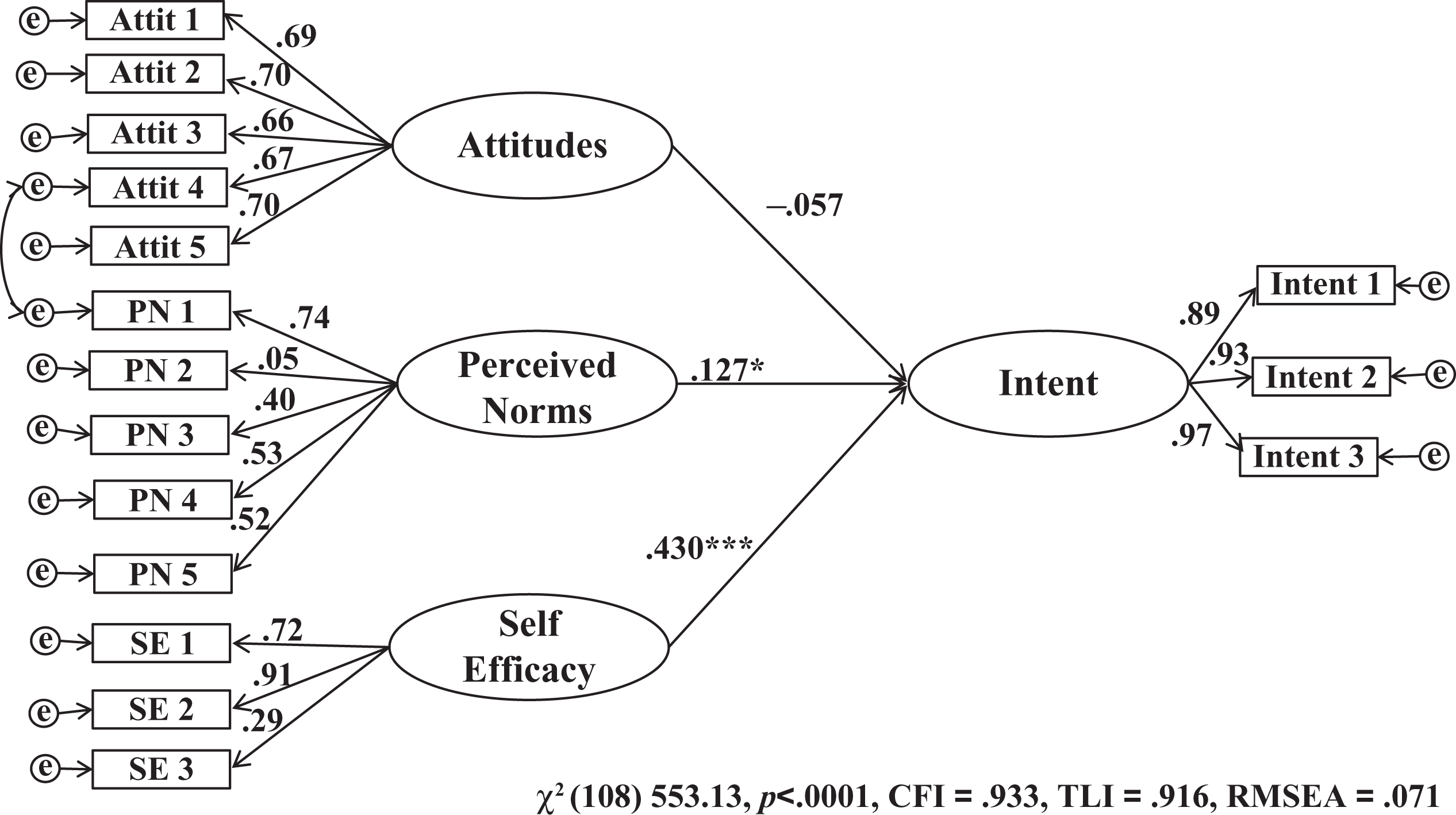
Final model. Note. Attit = attitude; PN = perceived norms; SE = self-efficacy; e = error; CFI = comparative fit index, TLI = Tucker–Lewis index, RMSEA = root mean square error of approximation. Path loadings are standardized coefficients. *Indicates p < .05. ***Indicates p < .001.
Discussion
The final model indicates that of the three main IMBP variables, self-efficacy is the strongest predictor of intent to communicate with a primary care provider about sexual health. Perceived norms is a weaker predictor of intent to communicate about sexual health, and attitudes were unrelated to intent for this sample. Analysis by race indicated that intent was similar for both African American and White women. Some variation by race was found in the mean scores of the predictors of intent. These results can help guide practice with ethnically diverse older women who may be struggling to communicate about their sexual health concerns. This type of formative research also has implications for interventions aimed at improving communication with health care providers about sexual health. Targeting interventions to have the most impact is more plausible when we can identify which factors are most influential to the enactment of a particular behavior (Frosch et al., 2009).
Following the logic of the IMBP, those with intent are more likely to actually carry out the behavior. Self-efficacy, one’s belief that they could perform a behavior even in the face of difficulties, was most important to predicting intent in this sample. Self-efficacy has been found to be important to the management of chronic illness; Holman and Lorig (2004) found that patient self-efficacy was the most important outcome related to improvements in chronic disease self-management. Improving self-efficacy to communicate about sexual health with a provider can be fostered through practice and modeling (Bandura, 1977; Gist & Mitchell, 1992). Supportive counseling to enhance self-efficacy to discuss these issues will likely increase a woman’s intention to do so. This can be especially impactful as sexual health is important to the overall well-being of aging women. An intervention that targets self-efficacy beliefs could help women to identify barriers to communication about sexual health, and work to diminish those barriers and increase her belief that she can communicate.
Women in this sample were sensitive to the opinions and actions of important others in their lives (perceived norms), and this influenced their intent to engage in communication about their sexual health. Although this factor was less important than self-efficacy in predicting intent, it provides an opportunity for providers in the health field. Providers can be powerful models of communication behavior, and through normative pressure increase the likelihood that their clients will follow suit. Women who see this will understand that their provider endorses communication (injunctive norm) and engages in the behavior themselves (descriptive norm). This may be especially important for older African American women, given the findings that intent was more impacted by perceived norms for these women when compared to White women.
Generally, older women prefer if providers initiate a conversation about sexual health (Grant & Ragsdale, 2008; Politi, Clark, Armstrong, McGarry, & Sciamanna, 2009; Woloski-Wruble et al., 2010). Providers in health care have had varied contact with communication training, and such training may be helpful. Studies have found that for nurses and medical doctors the lack of formal communication training is a barrier to discussion of sexual health (Hinchliff & Gott, 2011; Stokes & Mears, 2000). Although not specific to sexual health, a brief training on communication skills for providers yielded improvements in communication about other difficult topics (Helitzer et al., 2011). Within a health care team, discussions should include who is best suited to have these conversations with clients, as these conversations can serve as powerful models for older women.
Limitations
The findings of this study need to be considered in light of some limitations. First, response rate was low at 14%. While web-based response rates are typically lower than surveys sent by the mail (Shih & Fan, 2008), and a previous study using SurveyMonkey Audience also yielded a low (16%) response rate (Morris, 2013), results need to be interpreted with caution regarding generalizability. Response rate may be low because some potential respondents did not care for the topic area, although others have endorsed the use of the Internet to collect data on sensitive topics (Alessi & Martin, 2010). The sample was self-selected and may reflect participation by people who have a particular interest in the topic, and possible selection bias (Couper, 2007). Response rate could have been improved with the use of multiple contacts and greater personalization (Cook, Heath, & Thompson, 2000), or with use of an incentive (Dillman, Smyth, & Christian, 2009). Because a representative sample was not utilized, the sample does not adequately represent the population of older women in the United States. All potential participants were Internet users, and Internet use has been found to be associated with higher income, White race, and more education (Pew, 2012). While this sample had more representation from African Americans as compared to census data from 2010 (Federal Interagency Forum on Aging-Related Statistics, 2012, p. 4), it may be that the African American Internet users in this sample differ significantly from the general population of older African American women on income and education.
In this study, we did not actually measure the behavior communication about sexual health, rather a proxy for this behavior, intent. The IMBP tells us that enactment of the behavior is likely to occur if intent is there, but we do not know if this actually occurred for the women in our sample. It is important to note that within this sample there likely were varying levels of need to discuss sexual health, and that level of need may be an alternate explanation for intent. In addition, we did not ask women about their definition of sexual health concerns, and it is very likely that intent varies as well with the type of sexual health problem. Future research could pursue these avenues to enhance our understanding of this important topic. Despite these limitations, this study enhances our understanding of the potential factors that guide the communication decisions made by older women with regard to their sexual health.
Footnotes
Acknowledgment
The authors would like to thank the reviewers who read and commented on this article.
Authors’ Note
The content is solely the responsibility of the authors and does not necessarily represent the official views of the Eunice Kennedy Shriver National Institute of Child Health & Human Development or the National Institutes of Health.
Declaration of Conflicting Interests
The author(s) declared no potential conflicts of interest with respect to the research, authorship, and/or publication of this article.
Funding
The author(s) disclosed receipt of the following financial support for the research, authorship, and/or publication of this article: The project described was supported by Award Number K12HD065879 from the Eunice Kennedy Shriver National Institute of Child Health & Human Development.